Large-Scale Online Experimentation with Quantile Metrics
Min Liu
Senior Applied Researcher, LinkedIn
Outline
• Motivation
• Challenges
• End-to-end solution
• Methodology for scalable and accurate estimate of quantile variance​
• Pipeline design​
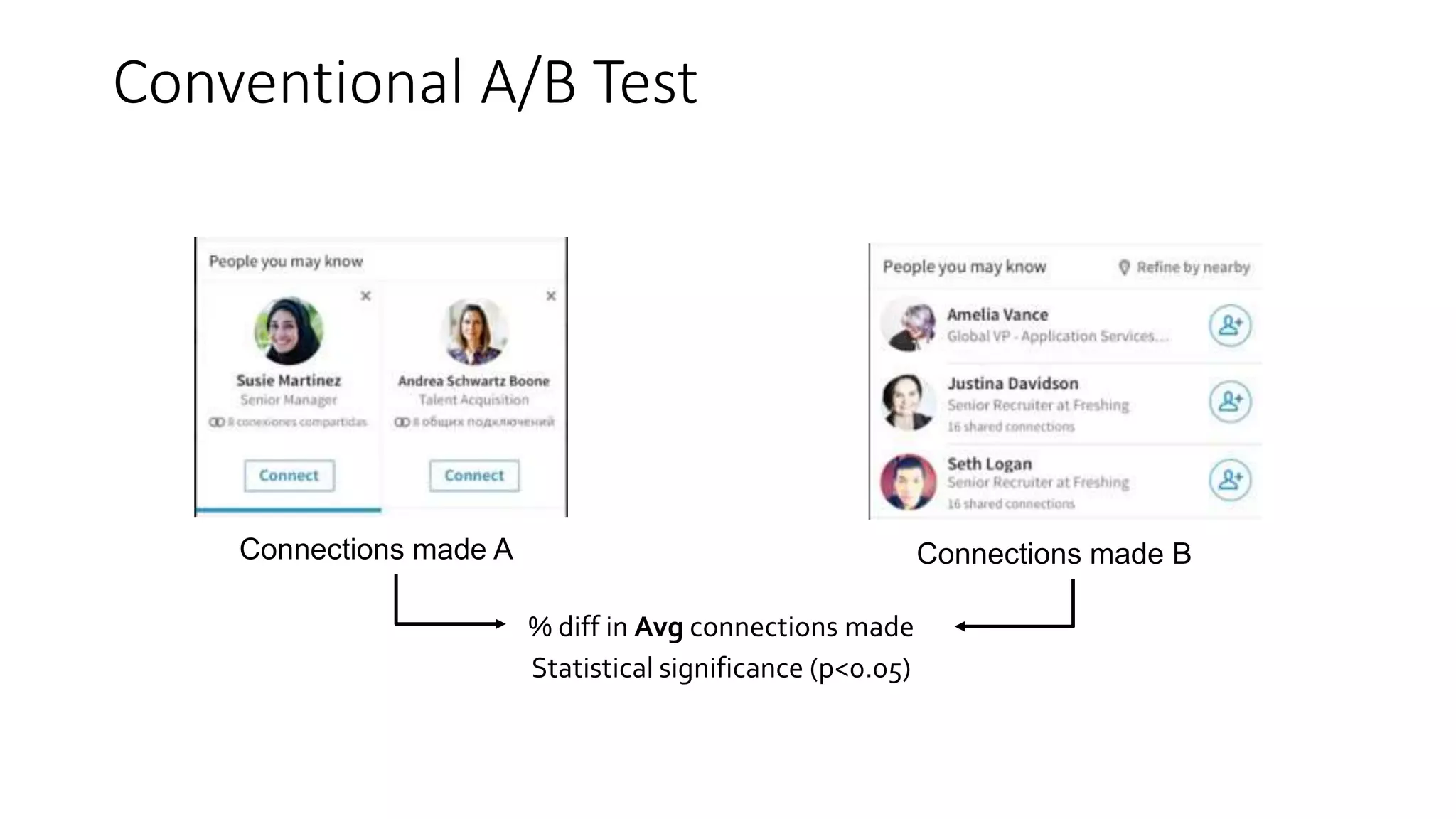
Conventional A/B Test
A B
Connections made A Connections made B
Conventional A/B Test
A B
Connections made A Connections made B
% diff in Avg connections made
Statistical significance (p<0.05)
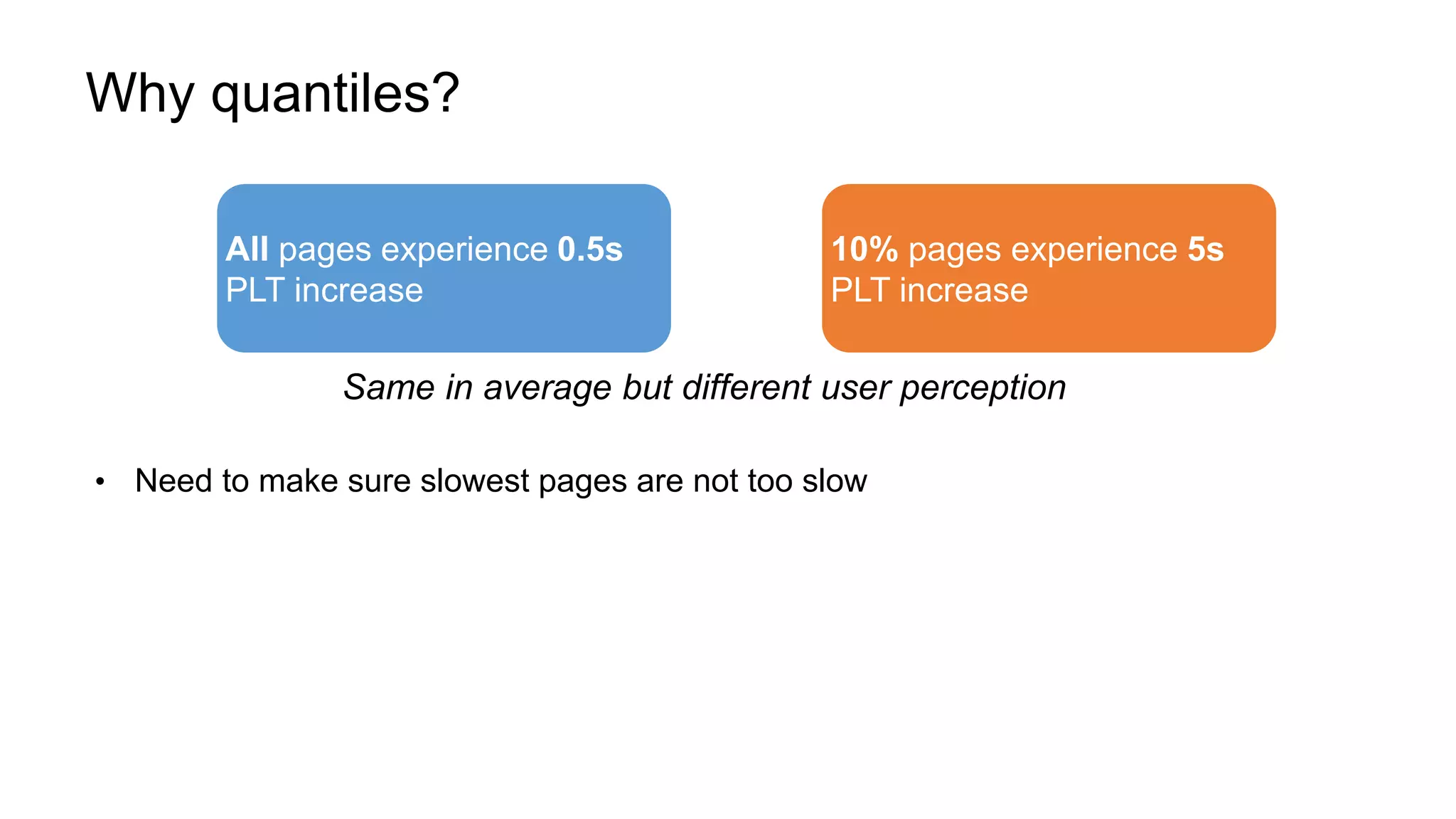
Why quantiles?
• Need to make sure slowest pages are not too slow
vs
All pages experience 0.5s
PLT increase
10% pages experience 5s
PLT increase
Same in average but different user perception
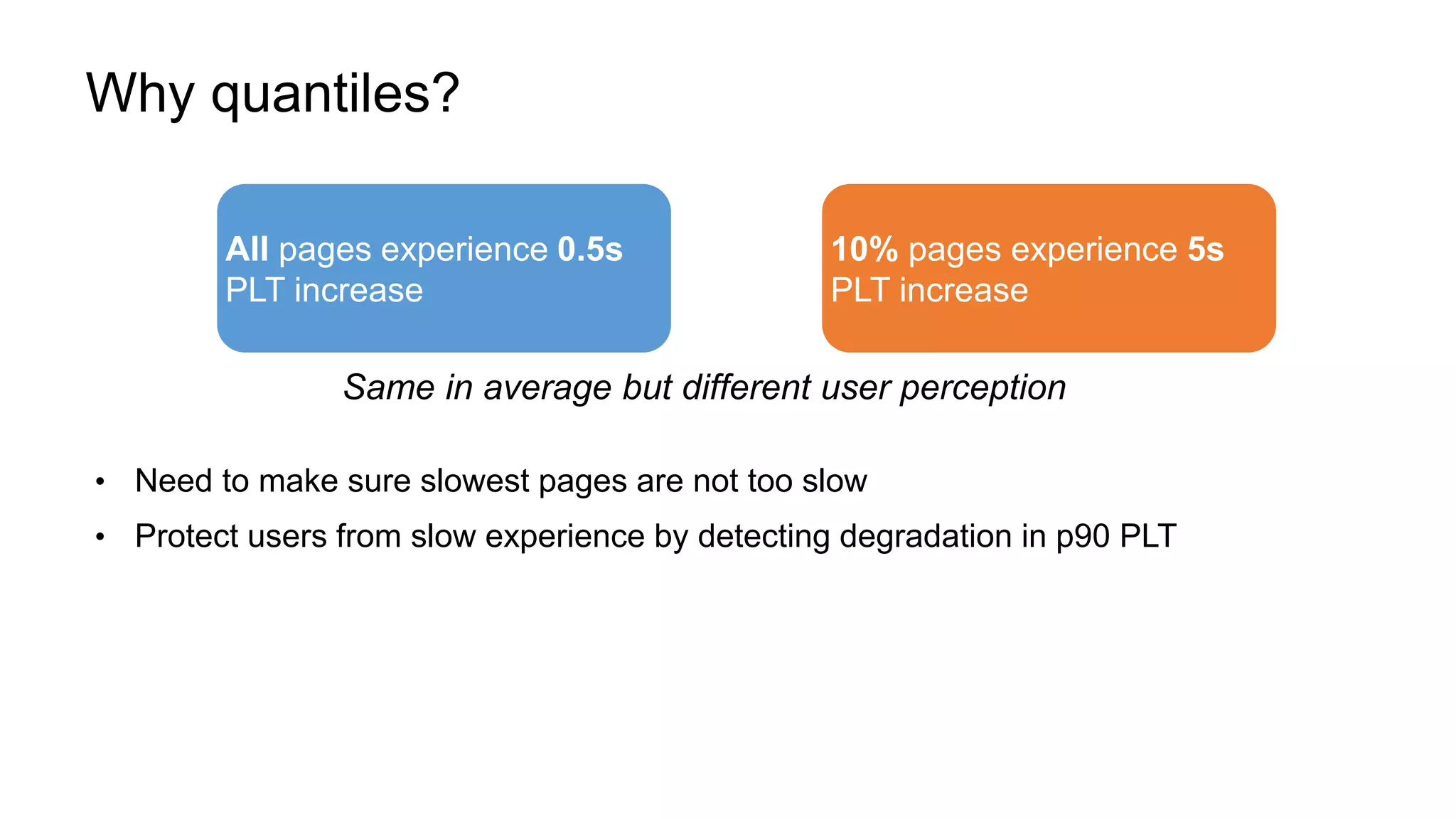
Why quantiles?
• Need to make sure slowest pages are not too slow
• Protect users from slow experience by detecting degradation in p90 PLT
vs
All pages experience 0.5s
PLT increase
10% pages experience 5s
PLT increase
Same in average but different user perception
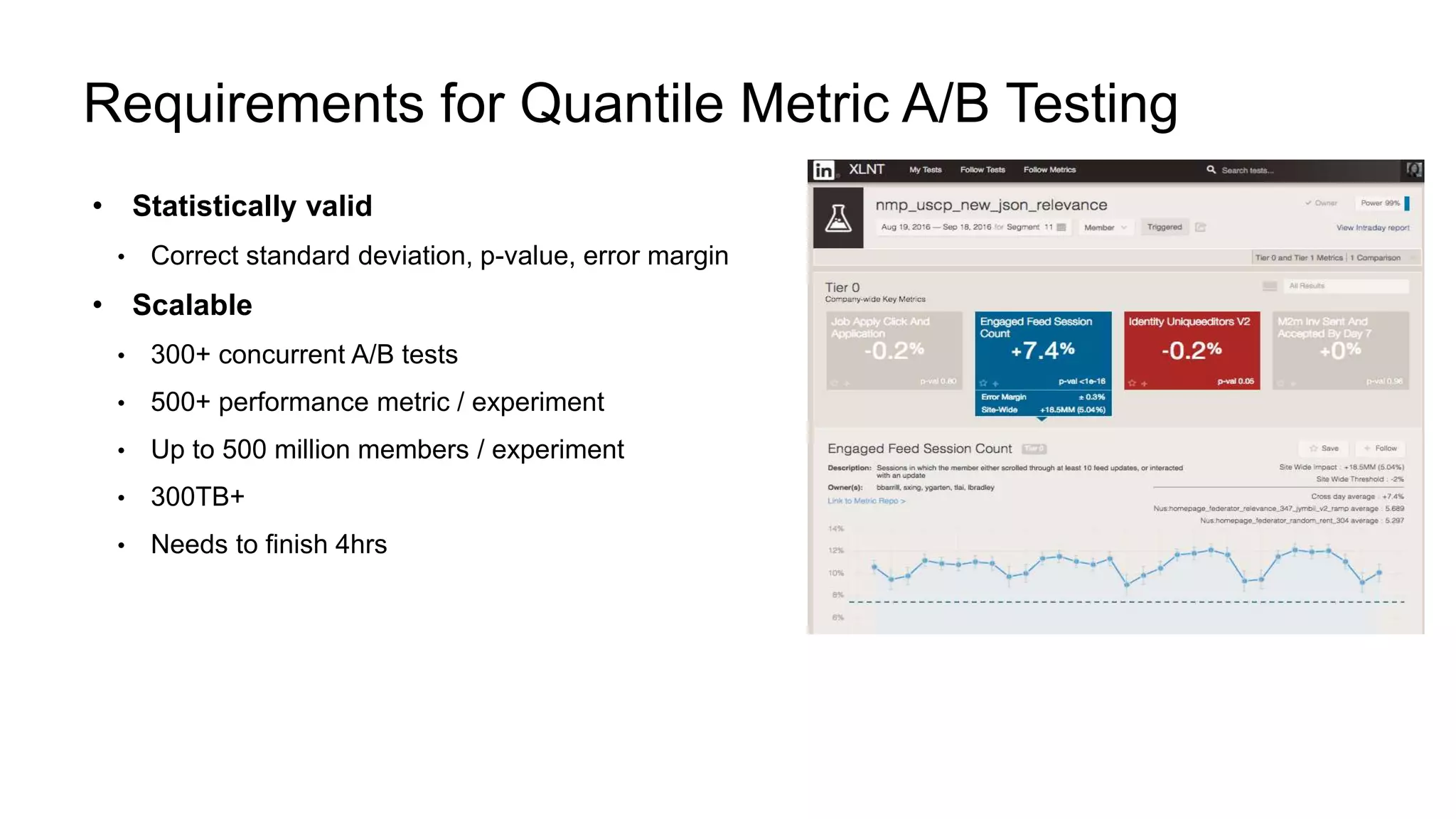
Requirements for Quantile Metric A/B Testing
• Statistically valid
• Correct standard deviation, p-value, error margin
• Scalable
• 300+ concurrent A/B tests
• 500+ performance metric / experiment
• Up to 500 million members / experiment
• 300TB+
• Needs to finish 4hrs
Methodology
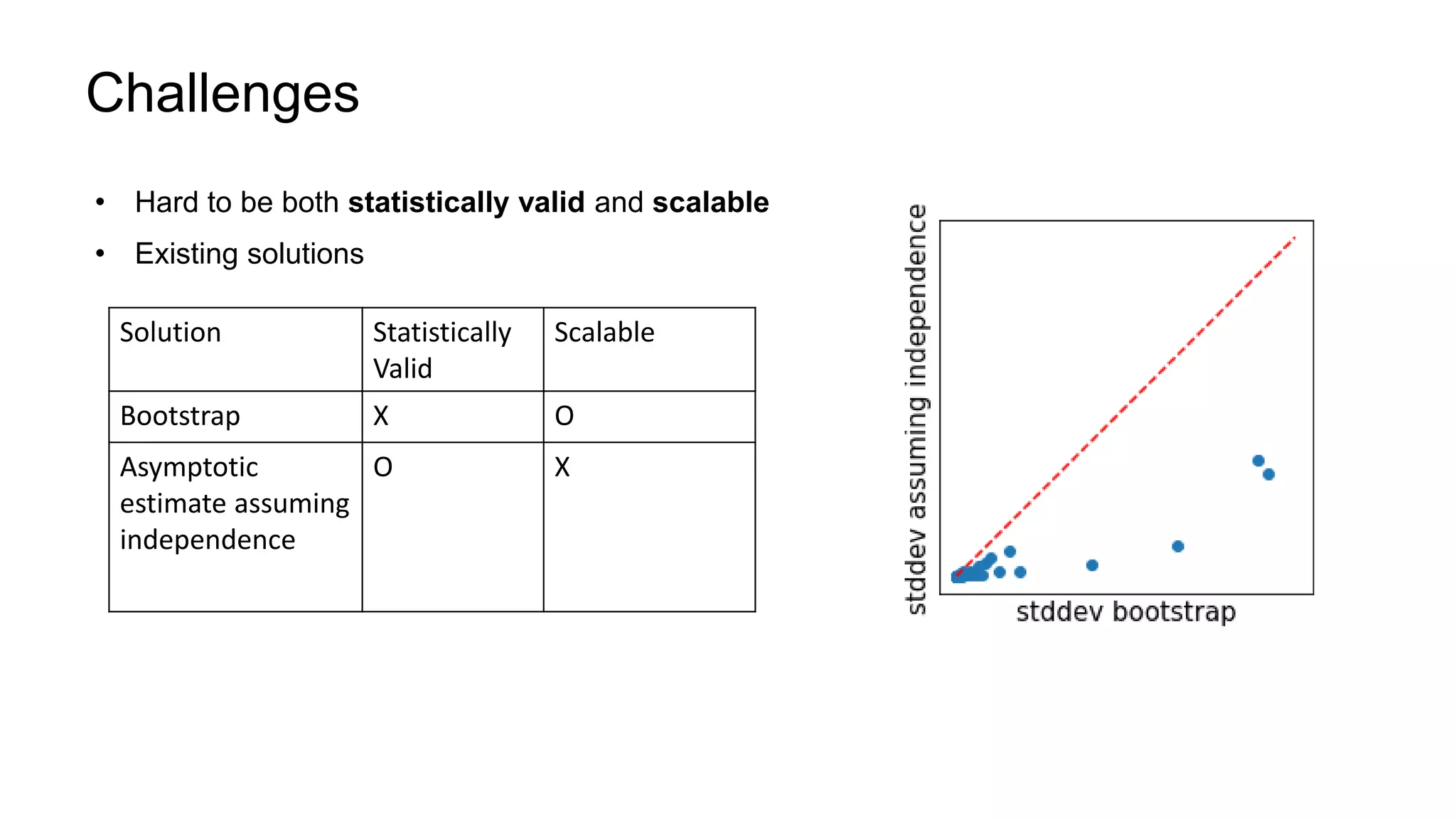
Challenges
• Hard to be both statistically valid and scalable
• Existing solutions
Solution Statistically
Valid
Scalable
Bootstrap X O
Asymptotic
estimate assuming
independence
O X
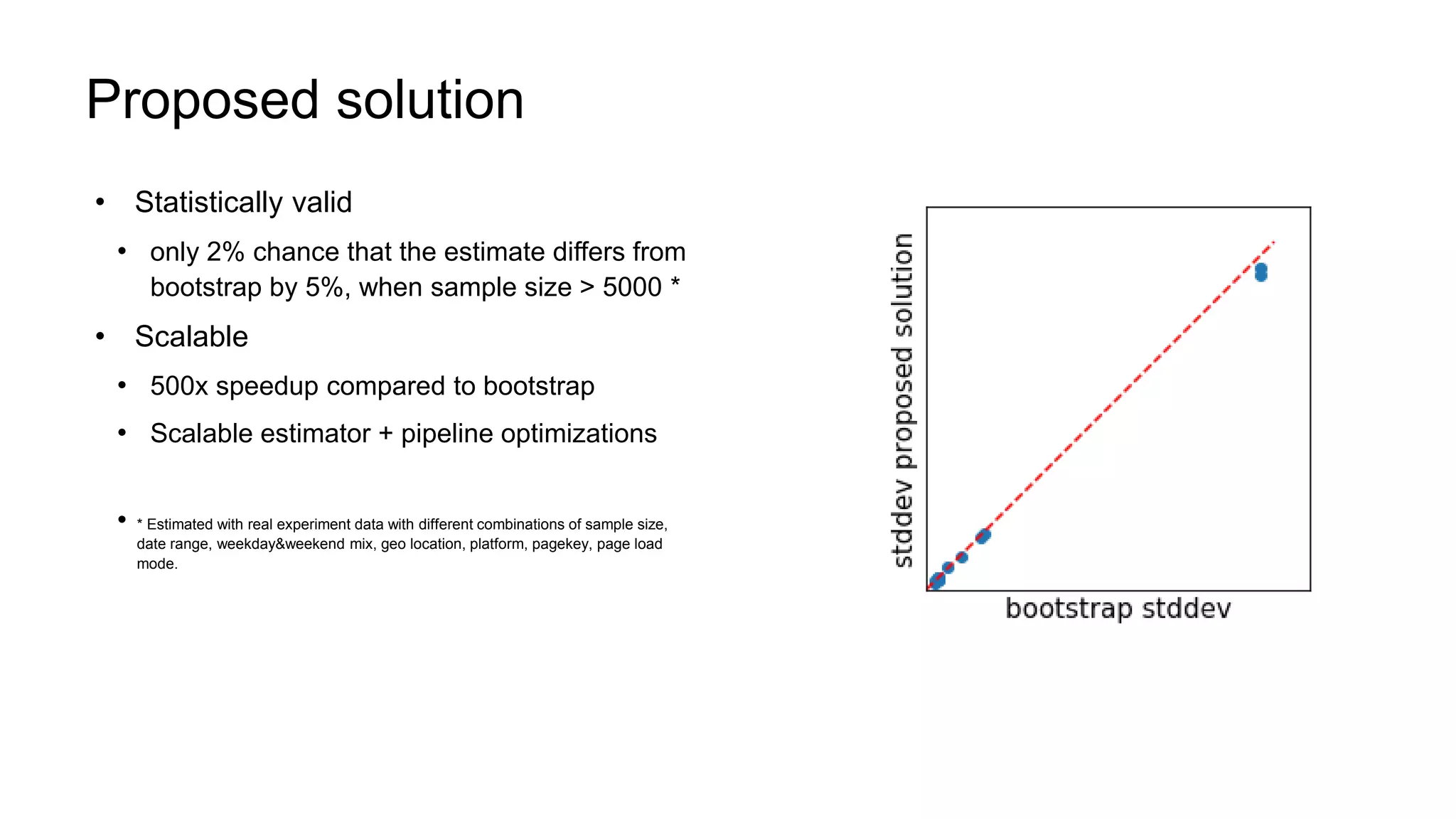
Proposed solution
• Statistically valid
• only 2% chance that the estimate differs from
bootstrap by 5%, when sample size > 5000 *
• Scalable
• 500x speedup compared to bootstrap
• Scalable estimator + pipeline optimizations
• * Estimated with real experiment data with different combinations of sample size,
date range, weekday&weekend mix, geo location, platform, pagekey, page load
mode.
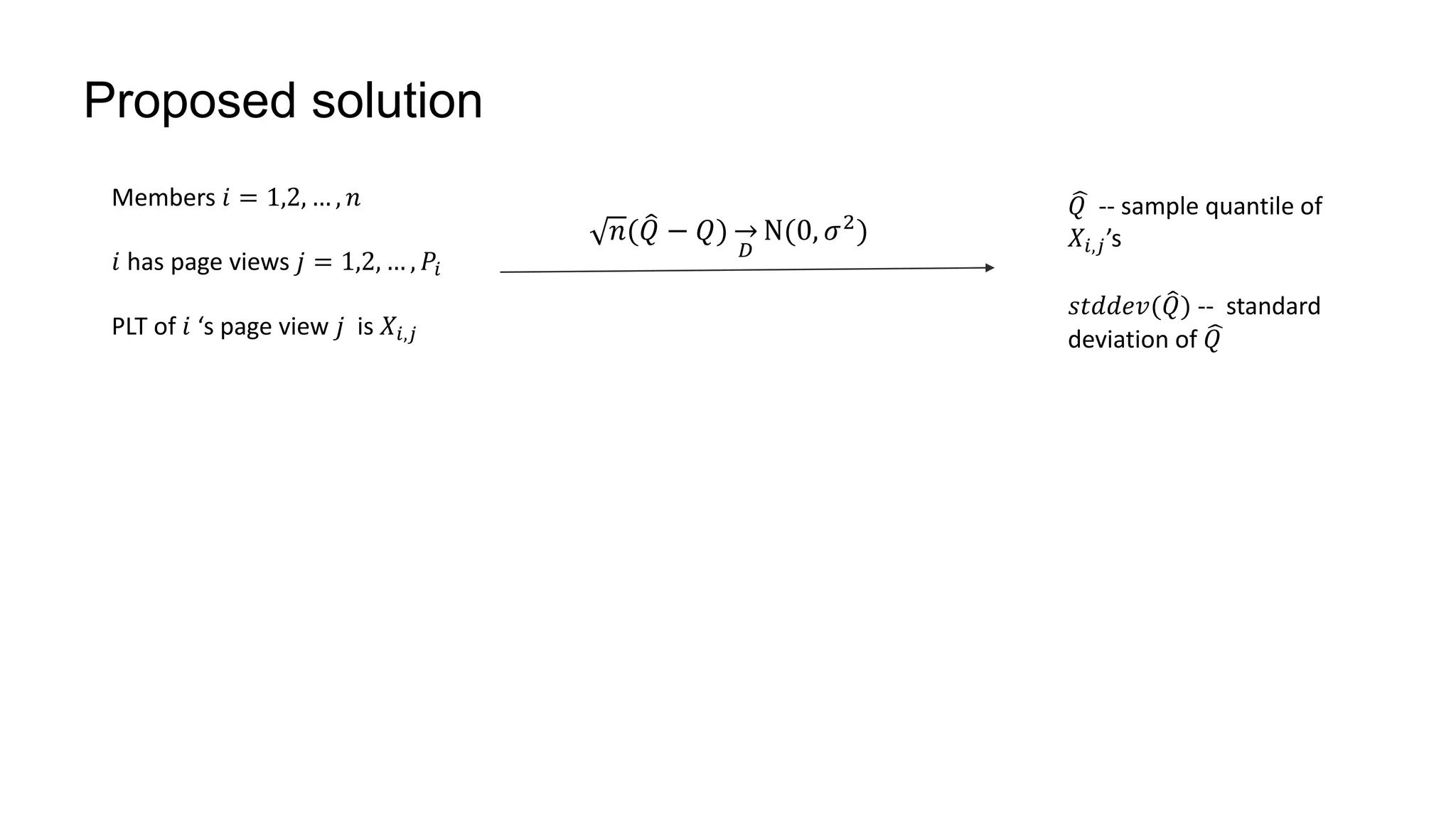
Proposed solution
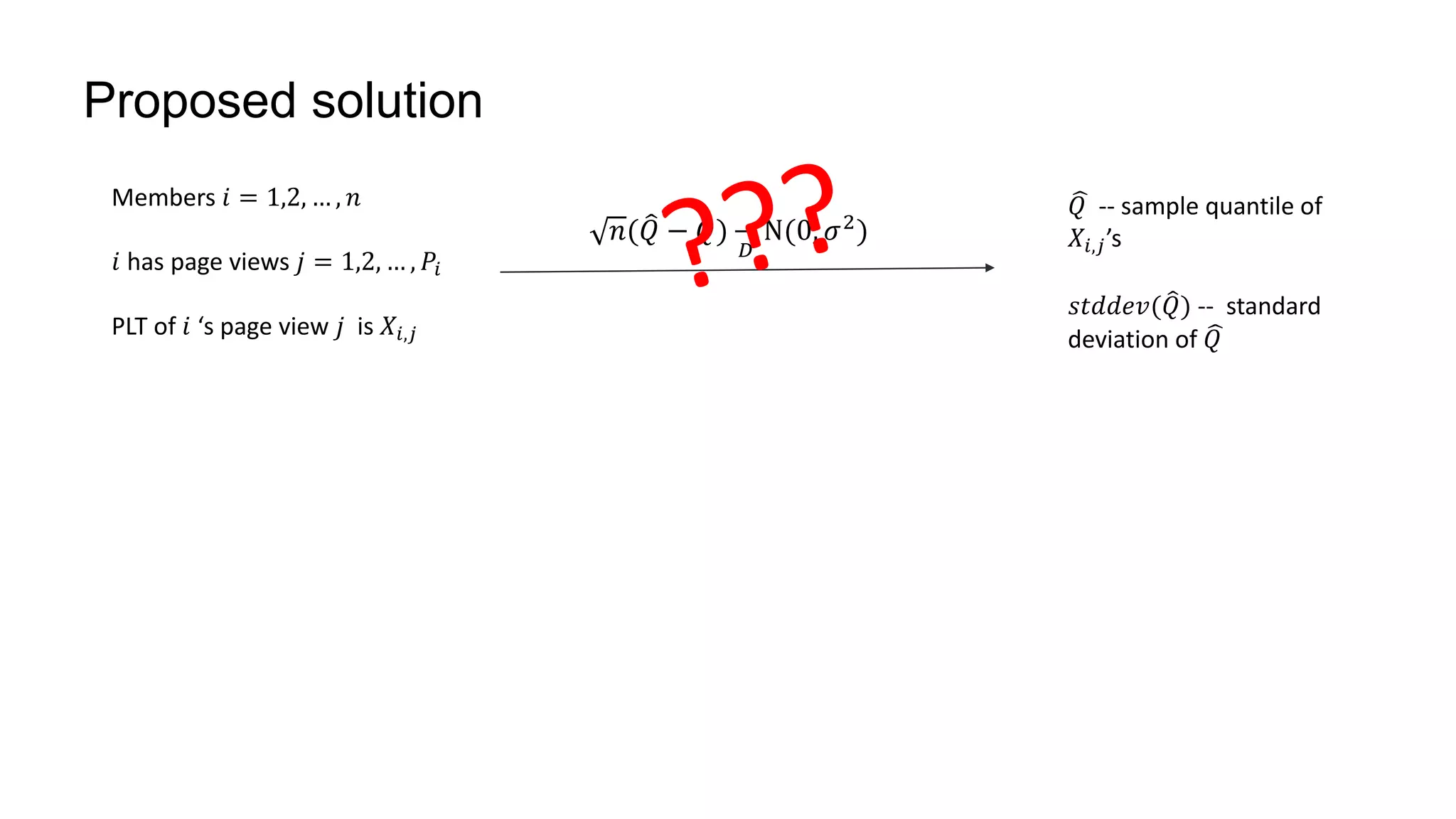
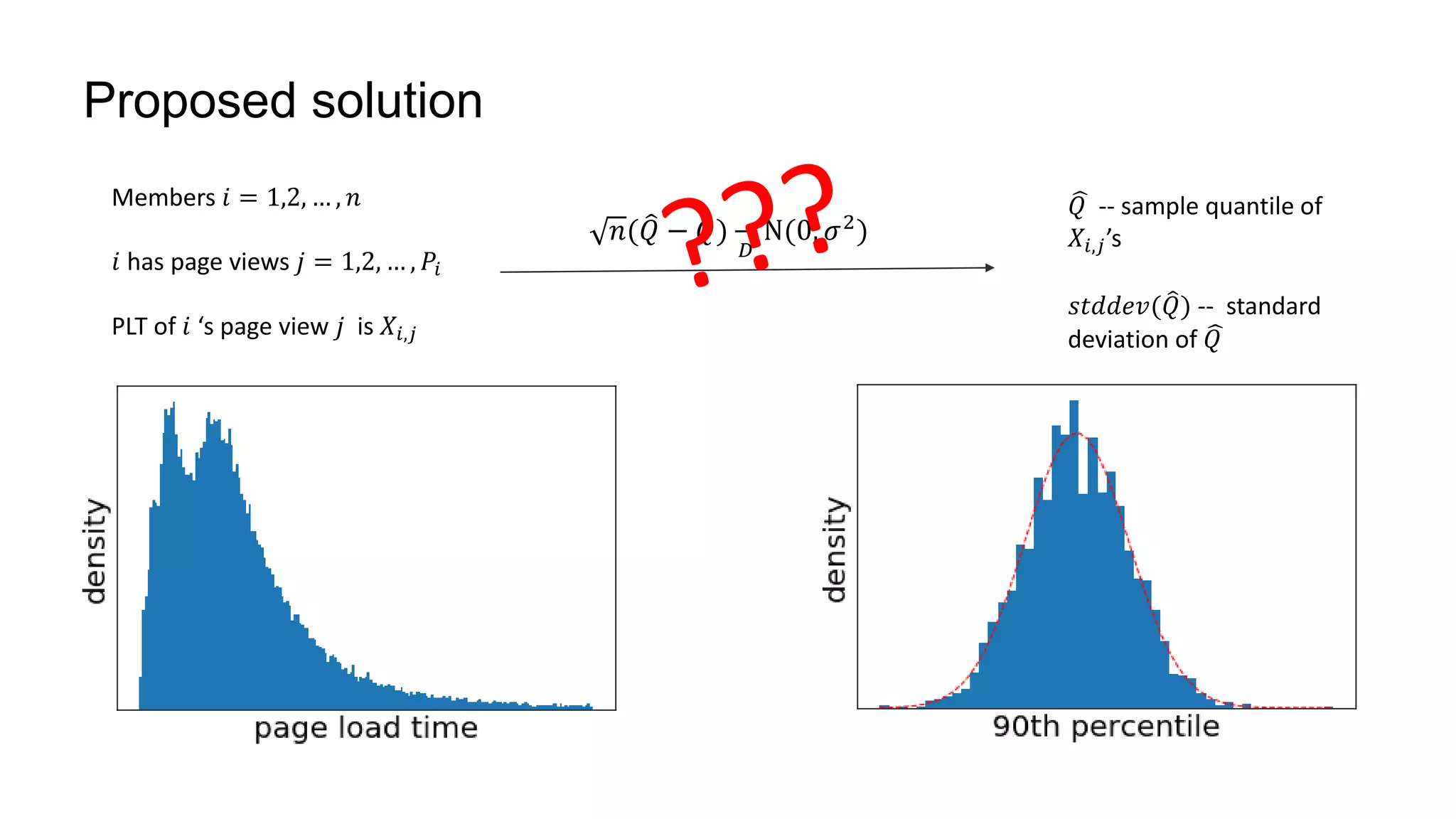
Members 𝑖 = 1,2, … , 𝑛
𝑖 has page views 𝑗 = 1,2, … , 𝑃𝑖
PLT of 𝑖 ‘s page view 𝑗 is 𝑋𝑖,𝑗
𝑄 -- sample quantile of
𝑋𝑖,𝑗’s
𝑠𝑡𝑑𝑑𝑒𝑣( 𝑄) -- standard
deviation of 𝑄
𝑛( 𝑄 − 𝑄)
𝐷
N(0, 𝜎2
)
Proposed solution
Members 𝑖 = 1,2, … , 𝑛
𝑖 has page views 𝑗 = 1,2, … , 𝑃𝑖
PLT of 𝑖 ‘s page view 𝑗 is 𝑋𝑖,𝑗
𝑄 -- sample quantile of
𝑋𝑖,𝑗’s
𝑠𝑡𝑑𝑑𝑒𝑣( 𝑄) -- standard
deviation of 𝑄
𝑛( 𝑄 − 𝑄)
𝐷
N(0, 𝜎2
)
Proposed solution
Members 𝑖 = 1,2, … , 𝑛
𝑖 has page views 𝑗 = 1,2, … , 𝑃𝑖
PLT of 𝑖 ‘s page view 𝑗 is 𝑋𝑖,𝑗
𝑄 -- sample quantile of
𝑋𝑖,𝑗’s
𝑠𝑡𝑑𝑑𝑒𝑣( 𝑄) -- standard
deviation of 𝑄
𝑛( 𝑄 − 𝑄)
𝐷
N(0, 𝜎2
)
Proposed solution
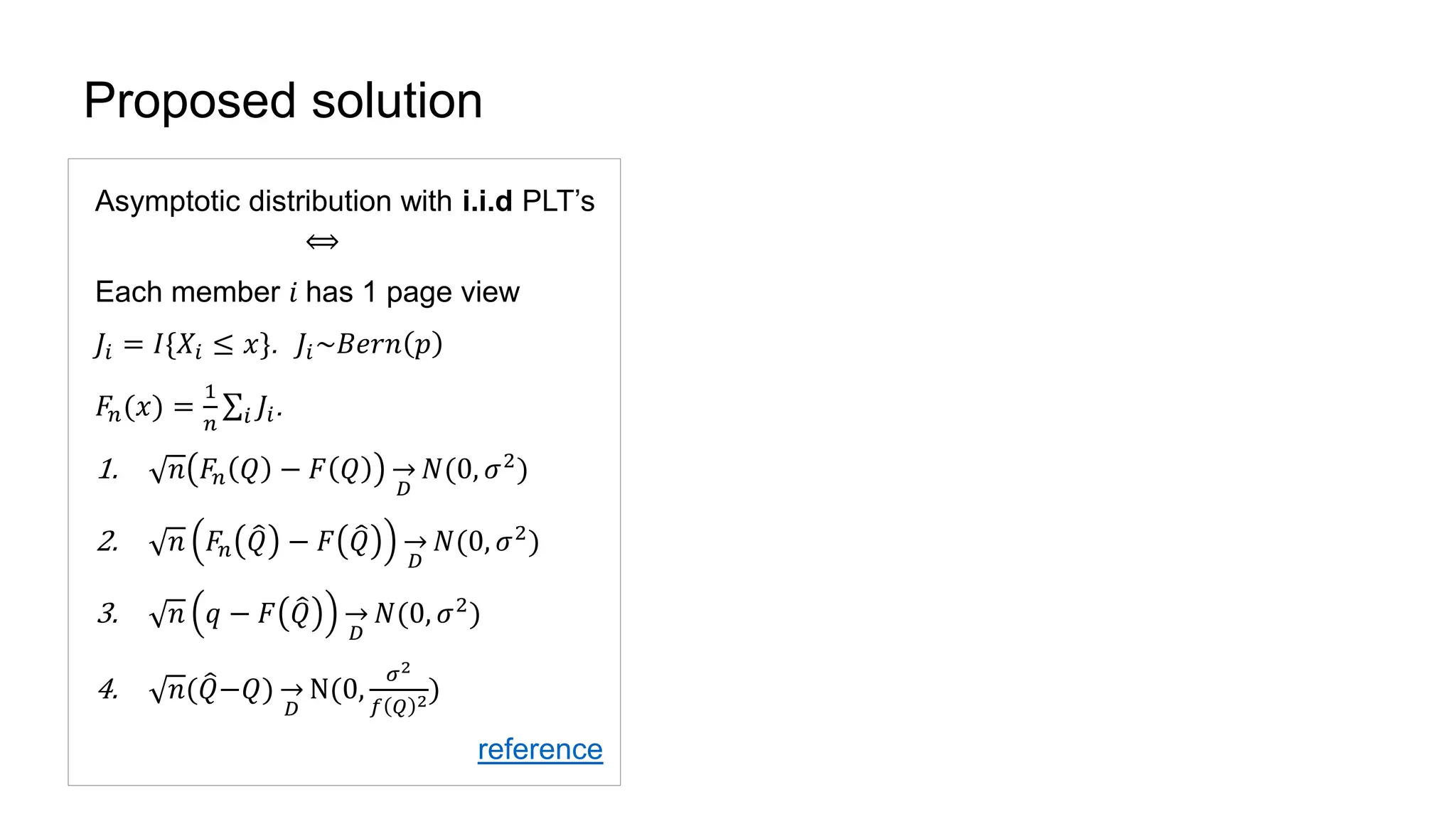
Asymptotic distribution with i.i.d PLT’s
⟺
Each member 𝑖 has 1 page view
𝐽𝑖 = 𝐼{𝑋𝑖 ≤ 𝑥}. 𝐽𝑖~𝐵𝑒𝑟𝑛 𝑝
𝐹𝑛(𝑥) =
1
𝑛 𝑖 𝐽𝑖.
1. 𝑛 𝐹𝑛 𝑄 − 𝐹 𝑄
𝐷
𝑁(0, 𝜎2
)
2. 𝑛 𝐹𝑛 𝑄 − 𝐹 𝑄
𝐷
𝑁(0, 𝜎2
)
3. 𝑛 𝑞 − 𝐹 𝑄
𝐷
𝑁(0, 𝜎2
)
4. 𝑛( 𝑄−𝑄)
𝐷
N(0,
𝜎2
𝑓 𝑄 2)
reference
Proposed solution
Asymptotic distribution with i.i.d PLT’s
⟺
Each member 𝑖 has 1 page view
𝐽𝑖 = 𝐼{𝑋𝑖 ≤ 𝑥}. 𝐽𝑖~𝐵𝑒𝑟𝑛 𝑝
𝐹𝑛(𝑥) =
1
𝑛 𝑖 𝐽𝑖.
1. 𝑛 𝐹𝑛 𝑄 − 𝐹 𝑄
𝐷
𝑁(0, 𝜎2
)
2. 𝑛 𝐹𝑛 𝑄 − 𝐹 𝑄
𝐷
𝑁(0, 𝜎2
)
3. 𝑛 𝑞 − 𝐹 𝑄
𝐷
𝑁(0, 𝜎2
)
4. 𝑛( 𝑄−𝑄)
𝐷
N(0,
𝜎2
𝑓 𝑄 2)
reference
Asymptotic distribution with non-i.i.d PLT’s
𝐽𝑖 = 𝑗 𝐼 𝑋𝑖,𝑗 ≤ 𝑥 . 𝐽𝑖’s are i.i.d
𝑌𝑛(𝑥) =
1
𝑛 𝑖 𝐽𝑖 and 𝑃𝑛 =
1
𝑛 𝑖 𝑃𝑖. 𝐹𝑛(𝑥) =
𝑌𝑛 𝑥
𝑃 𝑛
0. 𝑛[ 𝑌𝑛 𝑄
𝑃 𝑛
− 𝜇 𝐽
𝜇 𝑃
]
𝐷
𝑁(0, Σ)
1. 𝑛(𝐹𝑛(𝑄) − 𝐹(𝑄))
𝐷
𝑁(0, 𝜎 𝑃,𝐽
2
)
where 𝐹 𝑄 =
𝐹 𝑄 𝜇 𝑃
𝜇 𝑃
=
𝐸[𝐸(𝐽 𝑖|𝑃 𝑖)]
𝜇 𝑃
=
𝜇 𝐽
𝜇 𝑃
2. 𝑛 𝐹𝑛 𝑄 − 𝐹 𝑄
𝐷
𝑁(0, 𝜎 𝑃,𝐽
2
)
3. 𝑛 𝑞 − 𝐹 𝑄
𝐷
𝑁(0, 𝜎 𝑃,𝐽
2
)
4. 𝑛( 𝑄−𝑄)
𝐷
N(0,
𝜎 𝑃,𝐽
2
𝑓 𝑄 2)
Proposed solution – a few comments
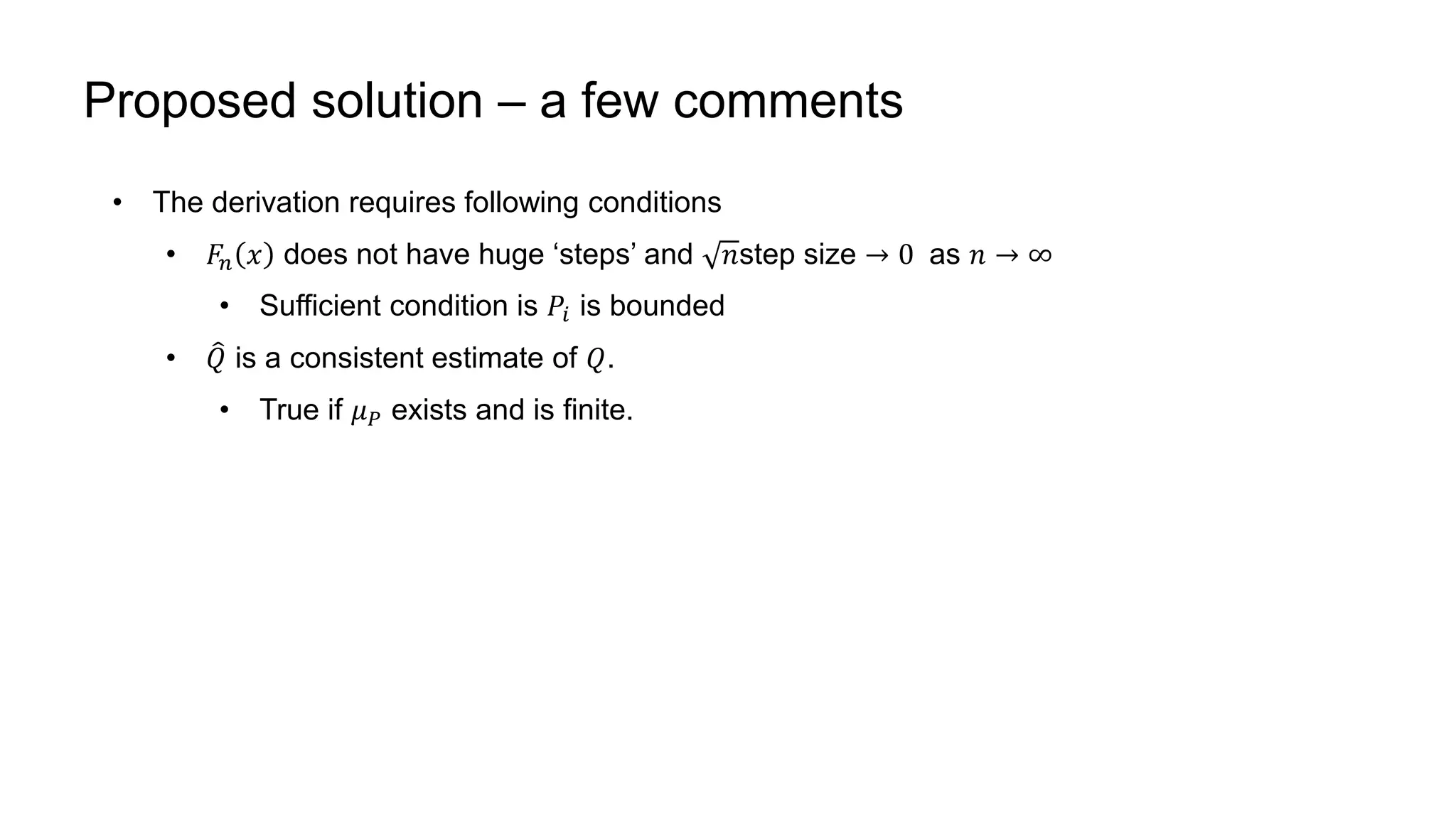
• The derivation requires following conditions
• 𝐹𝑛 𝑥 does not have huge ‘steps’ and 𝑛step size 0 as 𝑛 ∞
• Sufficient condition is 𝑃𝑖 is bounded
• 𝑄 is a consistent estimate of 𝑄.
• True if 𝜇 𝑃 exists and is finite.
Proposed solution – a few comments
• 𝑓(𝑄) estimated by average density in a window ( 𝑄 − 𝛿, 𝑄 + 𝛿]
• 𝛿 set to 50ms for initial estimate
• Then set to 2 × 𝑠𝑡𝑑𝑑𝑒𝑣, turns out to be very effective in reducing estimation error
Pipeline Design
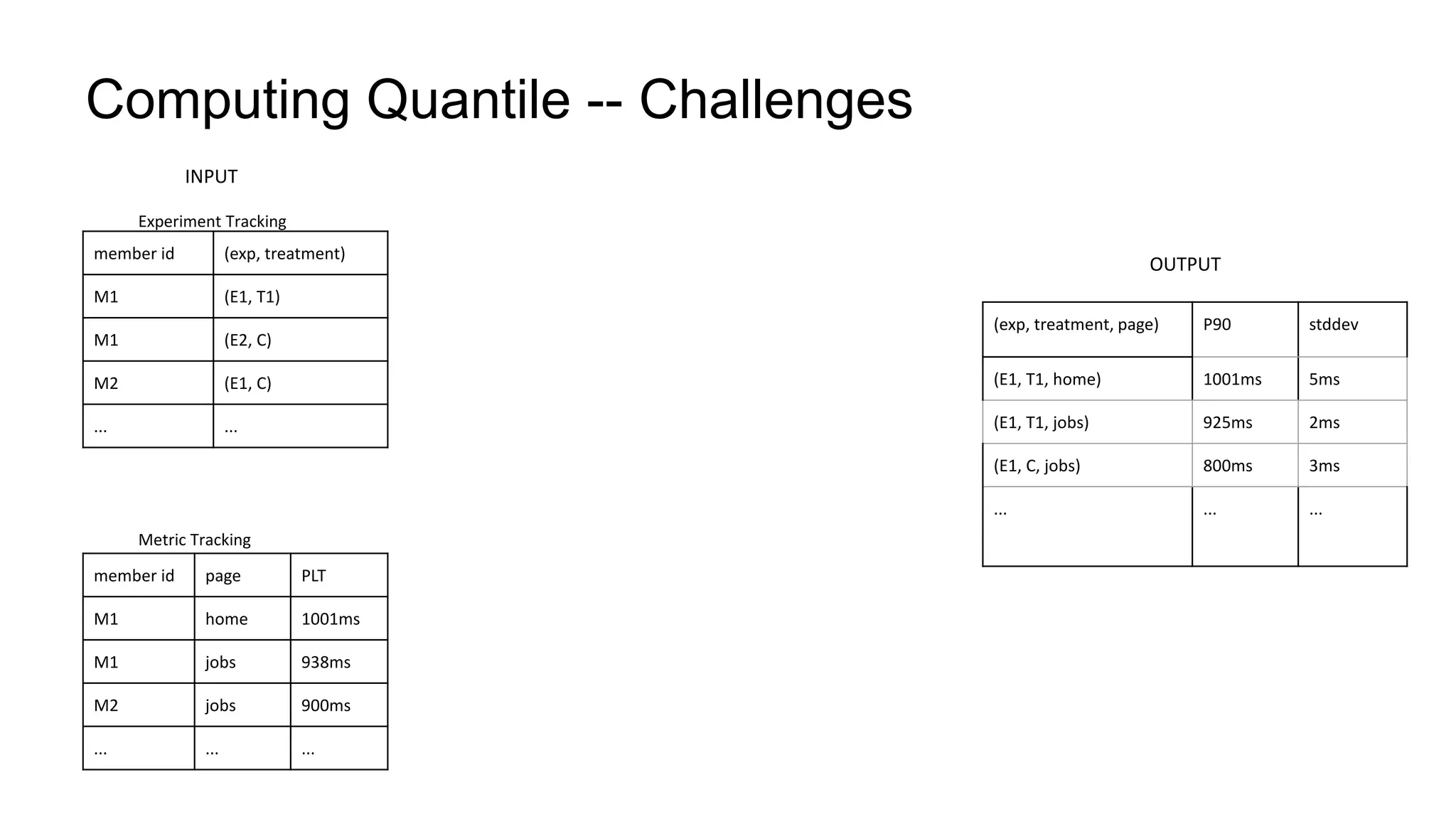
Computing Quantile -- Challenges
member id (exp, treatment)
M1 (E1, T1)
M1 (E2, C)
M2 (E1, C)
... ...
Experiment Tracking
Metric Tracking
member id page PLT
M1 home 1001ms
M1 jobs 938ms
M2 jobs 900ms
... ... ...
(exp, treatment, page) P90 stddev
(E1, T1, home) 1001ms 5ms
(E1, T1, jobs) 925ms 2ms
(E1, C, jobs) 800ms 3ms
... ... ...
INPUT
OUTPUT
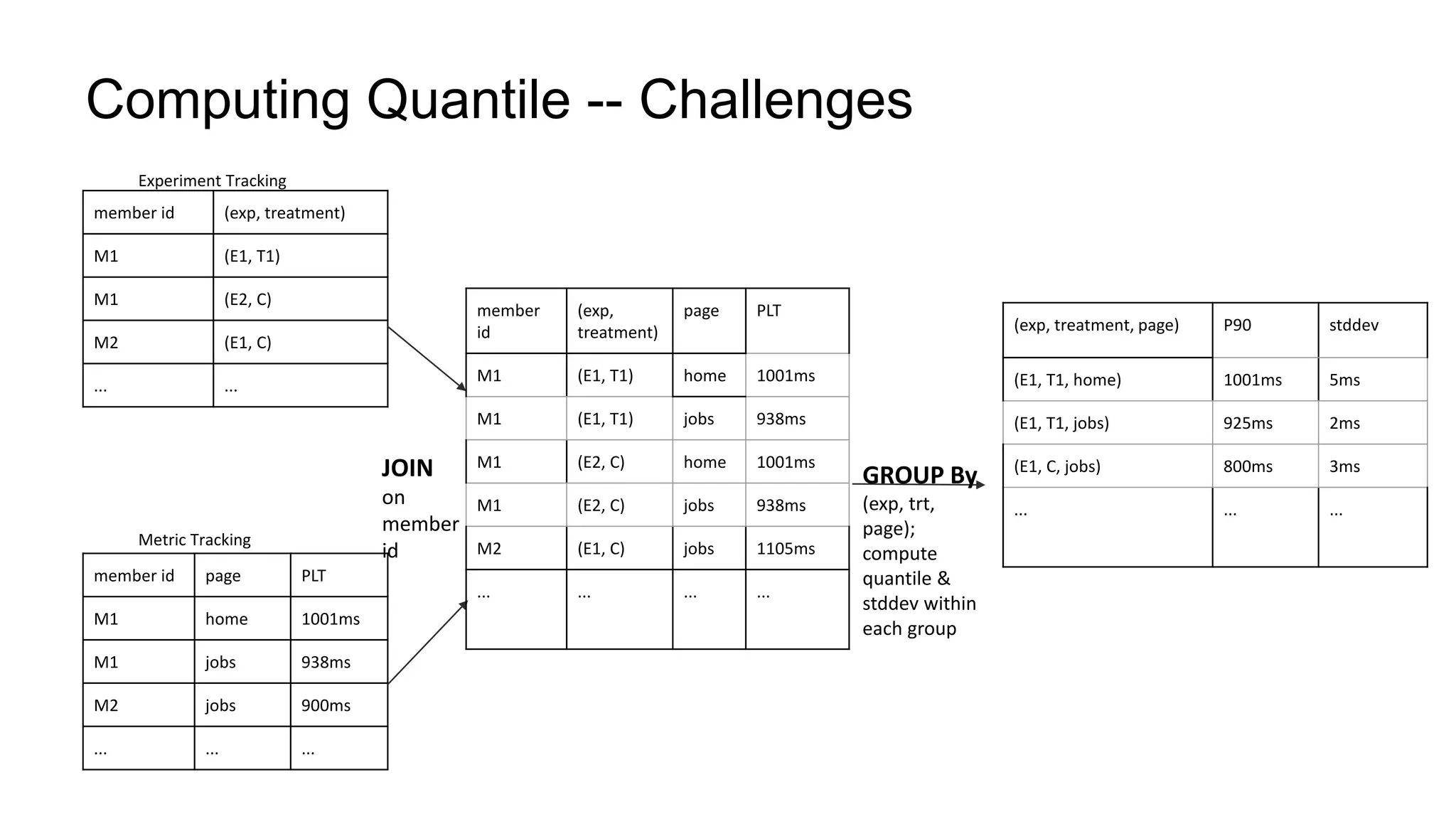
Computing Quantile -- Challenges
member id (exp, treatment)
M1 (E1, T1)
M1 (E2, C)
M2 (E1, C)
... ...
Experiment Tracking
Metric Tracking
member id page PLT
M1 home 1001ms
M1 jobs 938ms
M2 jobs 900ms
... ... ...
member
id
(exp,
treatment)
page PLT
M1 (E1, T1) home 1001ms
M1 (E1, T1) jobs 938ms
M1 (E2, C) home 1001ms
M1 (E2, C) jobs 938ms
M2 (E1, C) jobs 1105ms
... ... ... ...
JOIN
on
member
id
GROUP By
(exp, trt,
page);
compute
quantile &
stddev within
each group
(exp, treatment, page) P90 stddev
(E1, T1, home) 1001ms 5ms
(E1, T1, jobs) 925ms 2ms
(E1, C, jobs) 800ms 3ms
... ... ...
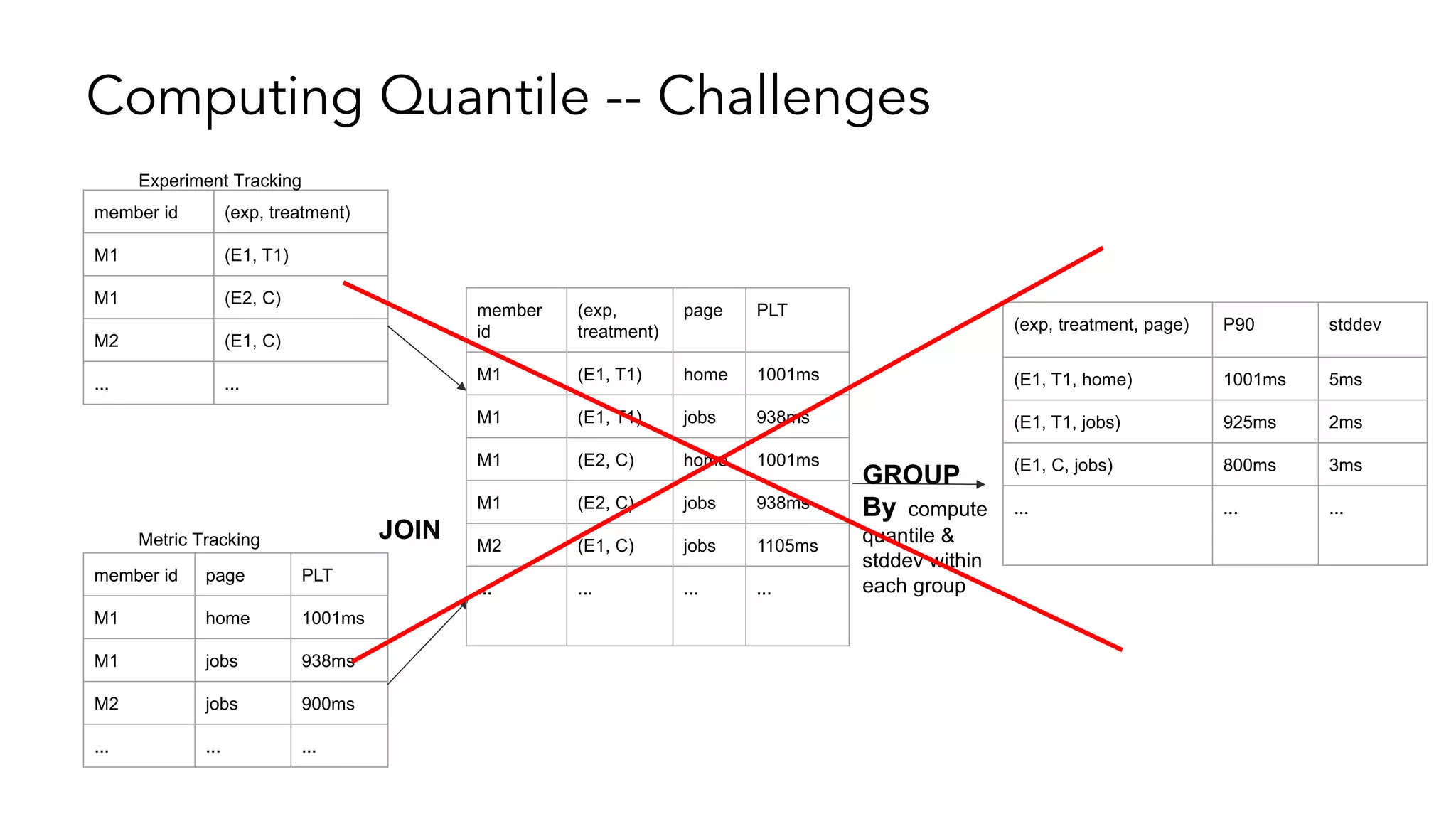
Computing Quantile -- Challenges
member id (exp, treatment)
M1 (E1, T1)
M1 (E2, C)
M2 (E1, C)
... ...
Experiment Tracking
Metric Tracking
member id page PLT
M1 home 1001ms
M1 jobs 938ms
M2 jobs 900ms
... ... ...
member
id
(exp,
treatment)
page PLT
M1 (E1, T1) home 1001ms
M1 (E1, T1) jobs 938ms
M1 (E2, C) home 1001ms
M1 (E2, C) jobs 938ms
M2 (E1, C) jobs 1105ms
... ... ... ...
JOIN
GROUP By
compute
quantile &
stddev within
each group
(exp, treatment, page) P90 stddev
(E1, T1, home) 1001ms 5ms
(E1, T1, jobs) 925ms 2ms
(E1, C, jobs) 800ms 3ms
... ... ...
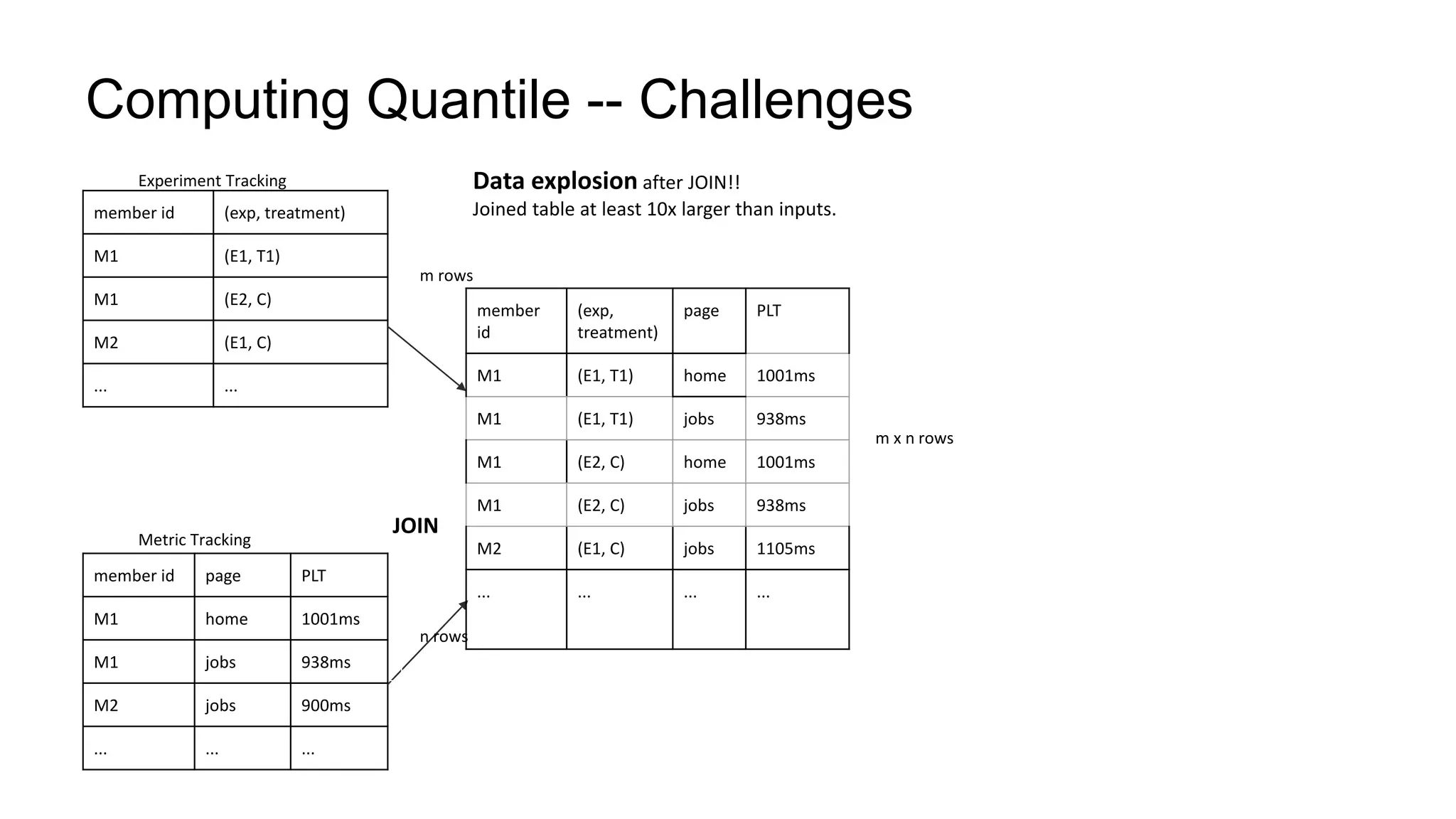
Computing Quantile -- Challenges
member id (exp, treatment)
M1 (E1, T1)
M1 (E2, C)
M2 (E1, C)
... ...
Experiment Tracking
Metric Tracking
member id page PLT
M1 home 1001ms
M1 jobs 938ms
M2 jobs 900ms
... ... ...
member
id
(exp,
treatment)
page PLT
M1 (E1, T1) home 1001ms
M1 (E1, T1) jobs 938ms
M1 (E2, C) home 1001ms
M1 (E2, C) jobs 938ms
M2 (E1, C) jobs 1105ms
... ... ... ...
JOIN
Data explosion after JOIN!!
Joined table at least 10x larger than inputs.
m rows
n rows
m x n rows
Computing Quantile -- Solutions
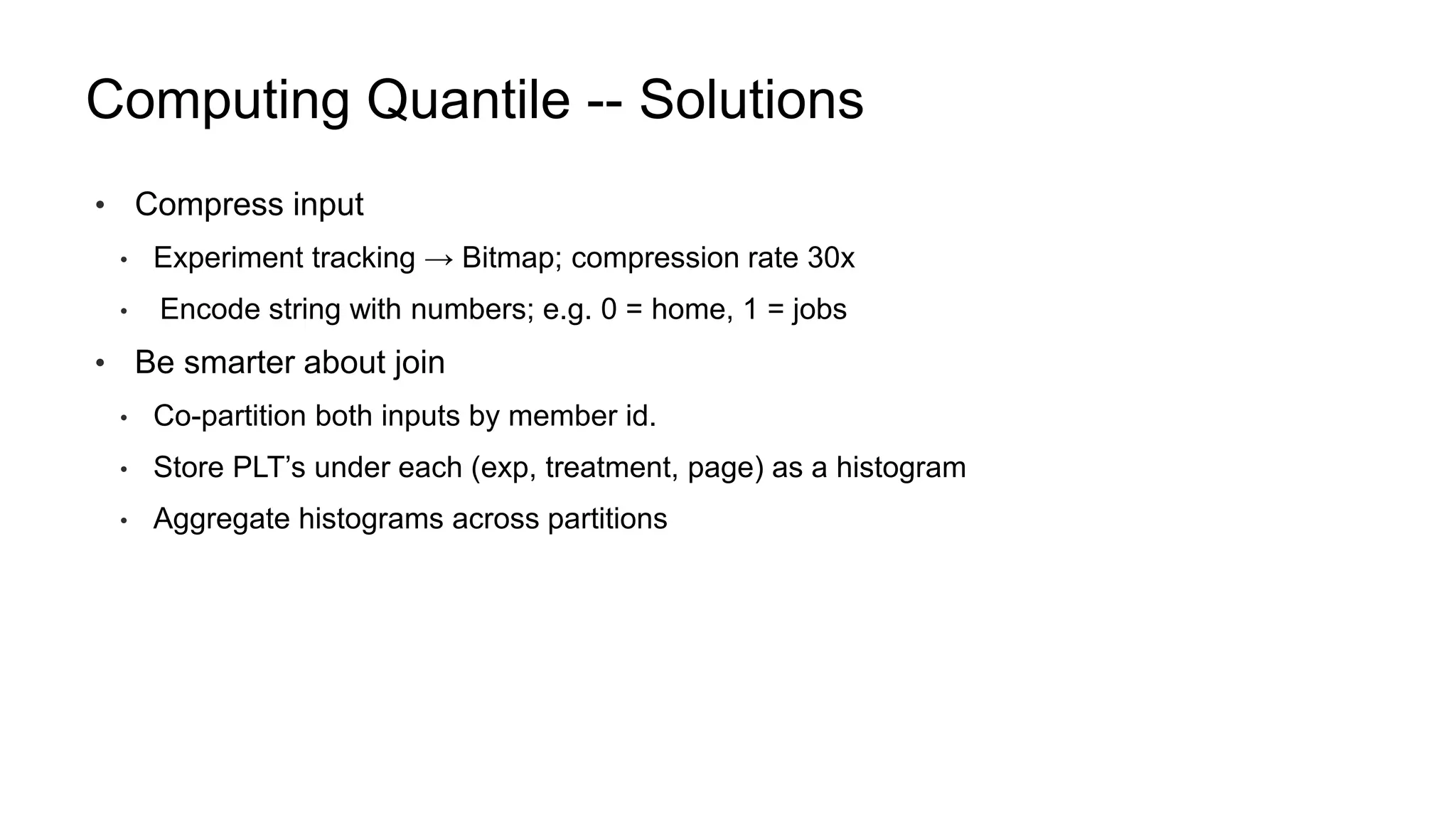
• Compress input
• Experiment tracking → Bitmap; compression rate 30x
• Encode string with numbers; e.g. 0 = home, 1 = jobs
• Be smarter about join
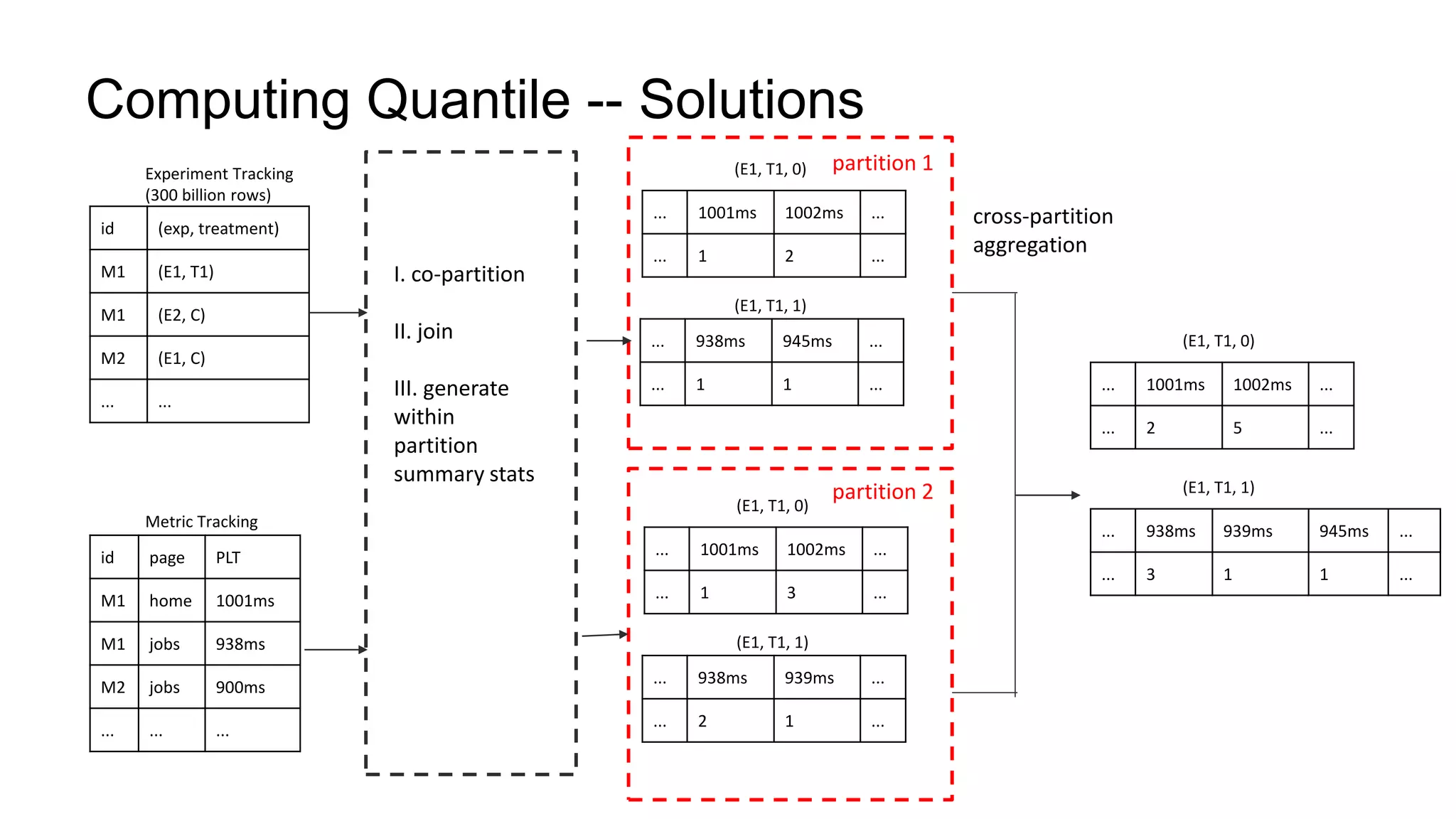
• Co-partition both inputs by member id.
• Store PLT’s under each (exp, treatment, page) as a histogram
• Aggregate histograms across partitions
Computing Quantile -- Solutions
id (exp, treatment)
M1 (E1, T1)
M1 (E2, C)
M2 (E1, C)
... ...
Experiment Tracking
(300 billion rows)
Metric Tracking
id page PLT
M1 home 1001ms
M1 jobs 938ms
M2 jobs 900ms
... ... ...
(E1, T1, 0)
... 1001ms 1002ms ...
... 1 2 ...
(E1, T1, 1)
... 938ms 945ms ...
... 1 1 ...
...
partition 1
I. co-partition
II. join
III. generate
within
partition
summary stats
(E1, T1, 0)
... 1001ms 1002ms ...
... 1 3 ...
(E1, T1, 1)
... 938ms 939ms ...
... 2 1 ...
...
partition 2
(E1, T1, 0)
... 1001ms 1002ms ...
... 2 5 ...
(E1, T1, 1)
... 938ms 939ms 945ms ...
... 3 1 1 ...
...
cross-partition
aggregation
Computing Stddev of Quantile
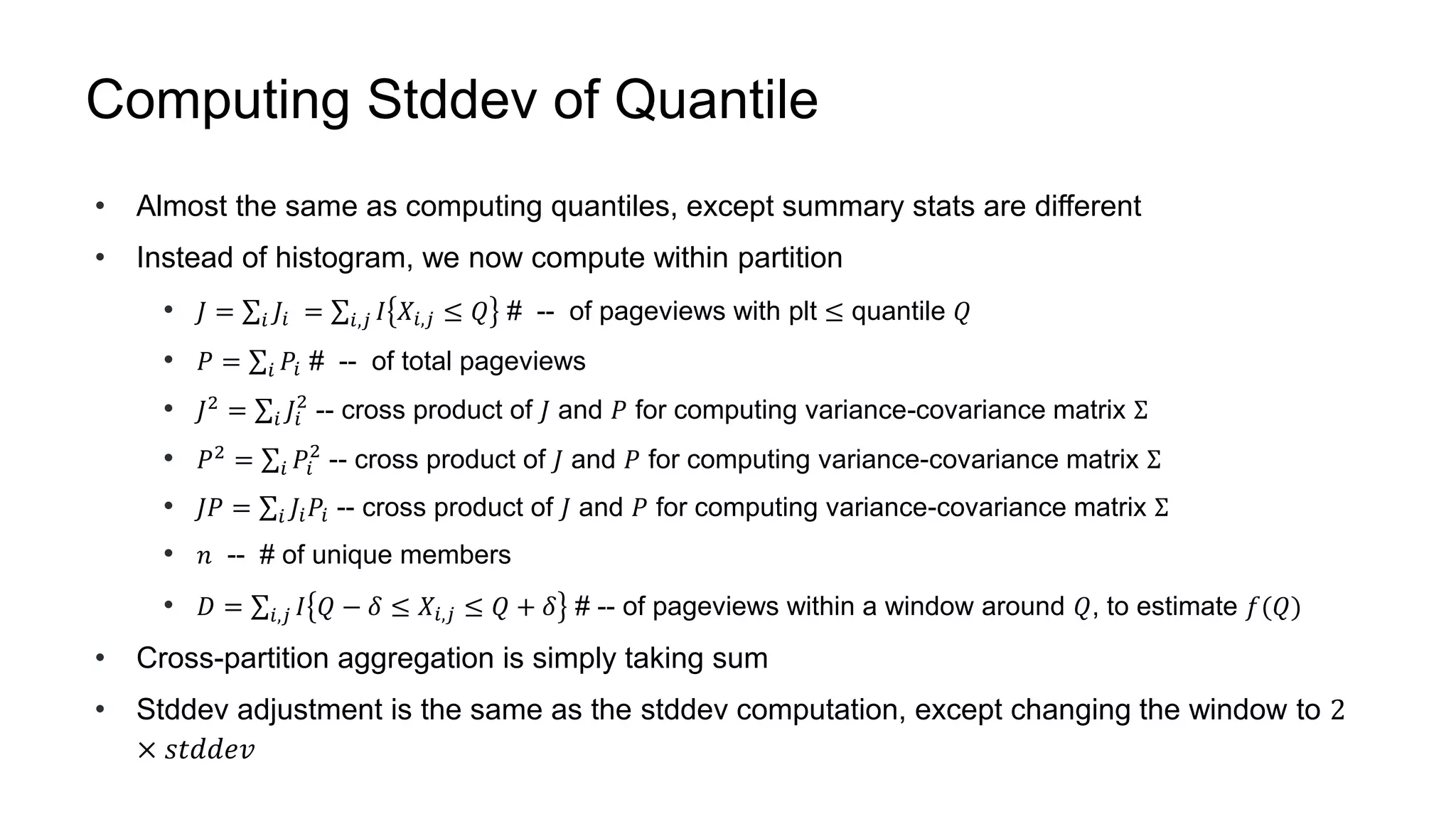
• Almost the same as computing quantiles, except summary stats are different
• Instead of histogram, we now compute within partition
• 𝐽 = 𝑖 𝐽𝑖 = 𝑖,𝑗 𝐼 𝑋𝑖,𝑗 ≤ 𝑄 --# of pageviews with plt ≤ quantile 𝑄
• 𝑃 = 𝑖 𝑃𝑖 --# of total pageviews
• 𝐽2
= 𝑖 𝐽𝑖
2
-- cross product of 𝐽 and 𝑃 for computing variance-covariance matrix Σ
• 𝑃2
= 𝑖 𝑃𝑖
2
-- cross product of 𝐽 and 𝑃 for computing variance-covariance matrix Σ
• 𝐽𝑃 = 𝑖 𝐽𝑖 𝑃𝑖 -- cross product of 𝐽 and 𝑃 for computing variance-covariance matrix Σ
• 𝑛 -- # of unique members
• 𝐷 = 𝑖,𝑗 𝐼 𝑄 − 𝛿 ≤ 𝑋𝑖,𝑗 ≤ 𝑄 + 𝛿 --# of pageviews within a window around 𝑄, to estimate 𝑓(𝑄)
• Cross-partition aggregation is simply taking sum
• Stddev adjustment is the same as the stddev computation, except changing the window to 2
× 𝑠𝑡𝑑𝑑𝑒𝑣
Results
Performance
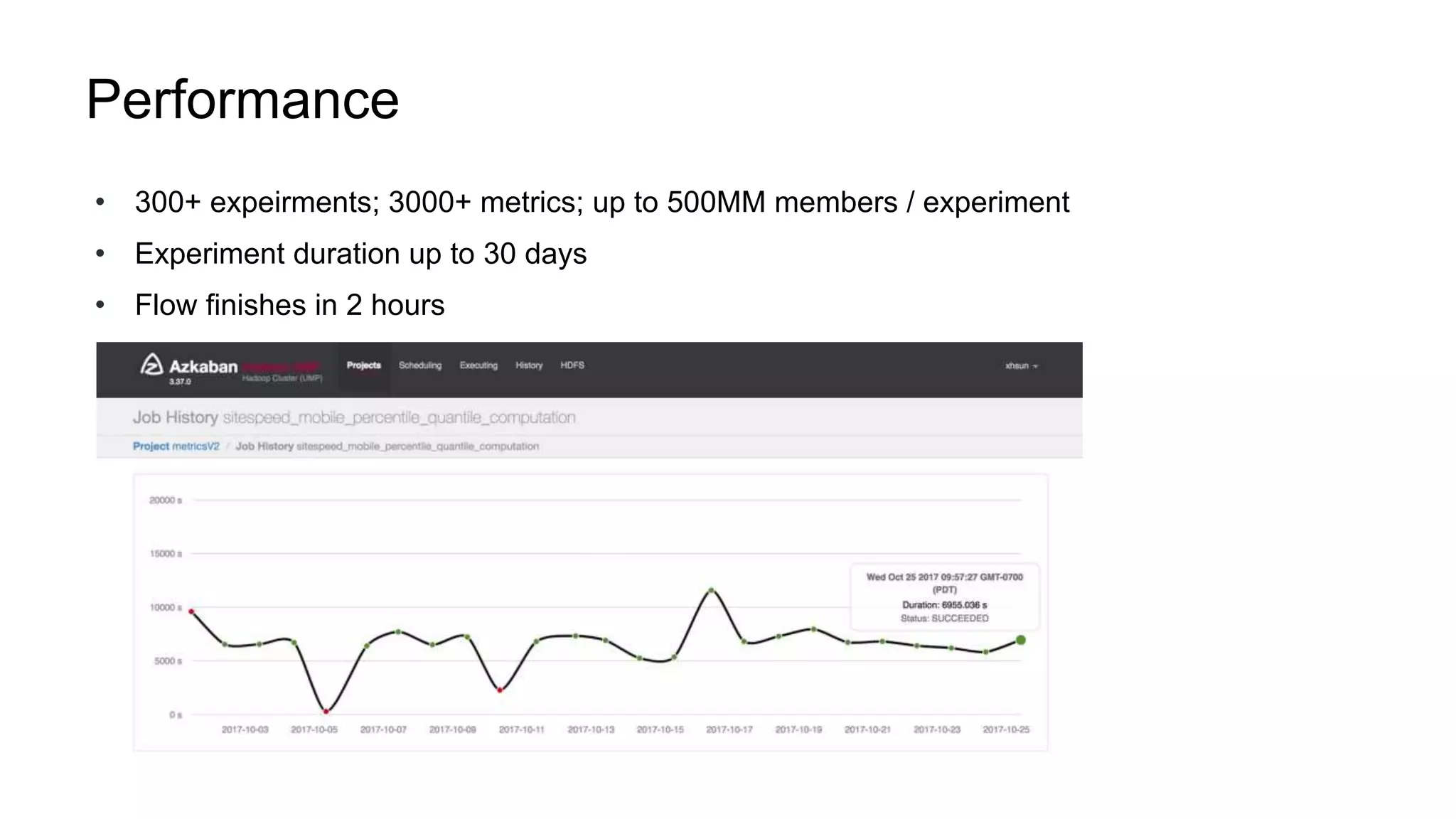
• 300+ expeirments; 3000+ metrics; up to 500MM members / experiment
• Experiment duration up to 30 days
• Flow finishes in 2 hours
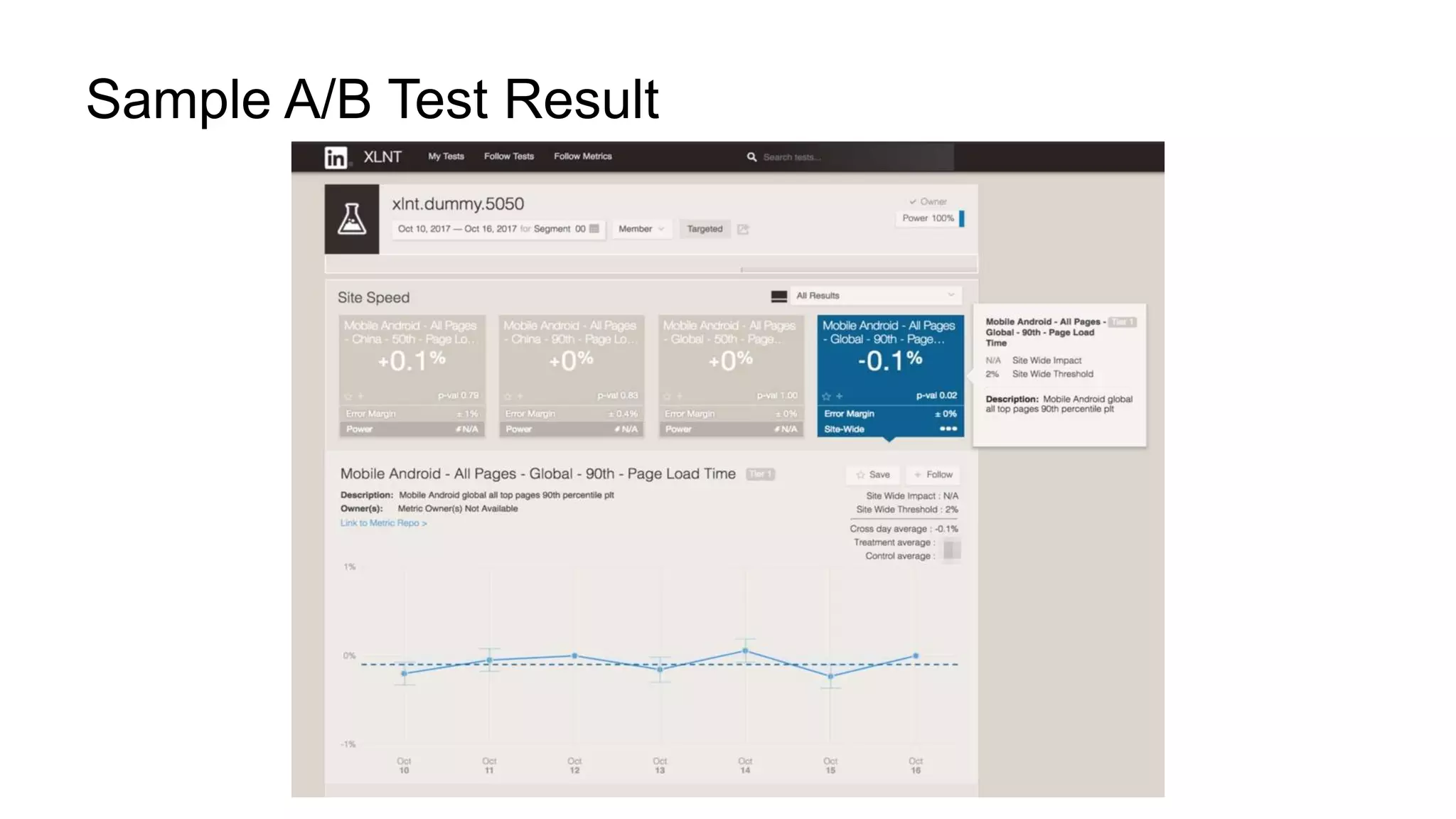
Sample A/B Test Result

Large Scale Online Experimentation with Quantile Metrics

  • 1.
    Large-Scale Online Experimentationwith Quantile Metrics Min Liu Senior Applied Researcher, LinkedIn
  • 2.
    Outline • Motivation • Challenges •End-to-end solution • Methodology for scalable and accurate estimate of quantile variance​ • Pipeline design​
  • 3.
    Conventional A/B Test AB Connections made A Connections made B
  • 4.
    Conventional A/B Test AB Connections made A Connections made B % diff in Avg connections made Statistical significance (p<0.05)
  • 5.
    Why quantiles? • Needto make sure slowest pages are not too slow vs All pages experience 0.5s PLT increase 10% pages experience 5s PLT increase Same in average but different user perception
  • 6.
    Why quantiles? • Needto make sure slowest pages are not too slow • Protect users from slow experience by detecting degradation in p90 PLT vs All pages experience 0.5s PLT increase 10% pages experience 5s PLT increase Same in average but different user perception
  • 7.
    Requirements for QuantileMetric A/B Testing • Statistically valid • Correct standard deviation, p-value, error margin • Scalable • 300+ concurrent A/B tests • 500+ performance metric / experiment • Up to 500 million members / experiment • 300TB+ • Needs to finish 4hrs
  • 8.
  • 9.
    Challenges • Hard tobe both statistically valid and scalable • Existing solutions Solution Statistically Valid Scalable Bootstrap X O Asymptotic estimate assuming independence O X
  • 10.
    Proposed solution • Statisticallyvalid • only 2% chance that the estimate differs from bootstrap by 5%, when sample size > 5000 * • Scalable • 500x speedup compared to bootstrap • Scalable estimator + pipeline optimizations • * Estimated with real experiment data with different combinations of sample size, date range, weekday&weekend mix, geo location, platform, pagekey, page load mode.
  • 11.
    Proposed solution Members 𝑖= 1,2, … , 𝑛 𝑖 has page views 𝑗 = 1,2, … , 𝑃𝑖 PLT of 𝑖 ‘s page view 𝑗 is 𝑋𝑖,𝑗 𝑄 -- sample quantile of 𝑋𝑖,𝑗’s 𝑠𝑡𝑑𝑑𝑒𝑣( 𝑄) -- standard deviation of 𝑄 𝑛( 𝑄 − 𝑄) 𝐷 N(0, 𝜎2 )
  • 12.
    Proposed solution Members 𝑖= 1,2, … , 𝑛 𝑖 has page views 𝑗 = 1,2, … , 𝑃𝑖 PLT of 𝑖 ‘s page view 𝑗 is 𝑋𝑖,𝑗 𝑄 -- sample quantile of 𝑋𝑖,𝑗’s 𝑠𝑡𝑑𝑑𝑒𝑣( 𝑄) -- standard deviation of 𝑄 𝑛( 𝑄 − 𝑄) 𝐷 N(0, 𝜎2 )
  • 13.
    Proposed solution Members 𝑖= 1,2, … , 𝑛 𝑖 has page views 𝑗 = 1,2, … , 𝑃𝑖 PLT of 𝑖 ‘s page view 𝑗 is 𝑋𝑖,𝑗 𝑄 -- sample quantile of 𝑋𝑖,𝑗’s 𝑠𝑡𝑑𝑑𝑒𝑣( 𝑄) -- standard deviation of 𝑄 𝑛( 𝑄 − 𝑄) 𝐷 N(0, 𝜎2 )
  • 14.
    Proposed solution Asymptotic distributionwith i.i.d PLT’s ⟺ Each member 𝑖 has 1 page view 𝐽𝑖 = 𝐼{𝑋𝑖 ≤ 𝑥}. 𝐽𝑖~𝐵𝑒𝑟𝑛 𝑝 𝐹𝑛(𝑥) = 1 𝑛 𝑖 𝐽𝑖. 1. 𝑛 𝐹𝑛 𝑄 − 𝐹 𝑄 𝐷 𝑁(0, 𝜎2 ) 2. 𝑛 𝐹𝑛 𝑄 − 𝐹 𝑄 𝐷 𝑁(0, 𝜎2 ) 3. 𝑛 𝑞 − 𝐹 𝑄 𝐷 𝑁(0, 𝜎2 ) 4. 𝑛( 𝑄−𝑄) 𝐷 N(0, 𝜎2 𝑓 𝑄 2) reference
  • 15.
    Proposed solution Asymptotic distributionwith i.i.d PLT’s ⟺ Each member 𝑖 has 1 page view 𝐽𝑖 = 𝐼{𝑋𝑖 ≤ 𝑥}. 𝐽𝑖~𝐵𝑒𝑟𝑛 𝑝 𝐹𝑛(𝑥) = 1 𝑛 𝑖 𝐽𝑖. 1. 𝑛 𝐹𝑛 𝑄 − 𝐹 𝑄 𝐷 𝑁(0, 𝜎2 ) 2. 𝑛 𝐹𝑛 𝑄 − 𝐹 𝑄 𝐷 𝑁(0, 𝜎2 ) 3. 𝑛 𝑞 − 𝐹 𝑄 𝐷 𝑁(0, 𝜎2 ) 4. 𝑛( 𝑄−𝑄) 𝐷 N(0, 𝜎2 𝑓 𝑄 2) reference Asymptotic distribution with non-i.i.d PLT’s 𝐽𝑖 = 𝑗 𝐼 𝑋𝑖,𝑗 ≤ 𝑥 . 𝐽𝑖’s are i.i.d 𝑌𝑛(𝑥) = 1 𝑛 𝑖 𝐽𝑖 and 𝑃𝑛 = 1 𝑛 𝑖 𝑃𝑖. 𝐹𝑛(𝑥) = 𝑌𝑛 𝑥 𝑃 𝑛 0. 𝑛[ 𝑌𝑛 𝑄 𝑃 𝑛 − 𝜇 𝐽 𝜇 𝑃 ] 𝐷 𝑁(0, Σ) 1. 𝑛(𝐹𝑛(𝑄) − 𝐹(𝑄)) 𝐷 𝑁(0, 𝜎 𝑃,𝐽 2 ) where 𝐹 𝑄 = 𝐹 𝑄 𝜇 𝑃 𝜇 𝑃 = 𝐸[𝐸(𝐽 𝑖|𝑃 𝑖)] 𝜇 𝑃 = 𝜇 𝐽 𝜇 𝑃 2. 𝑛 𝐹𝑛 𝑄 − 𝐹 𝑄 𝐷 𝑁(0, 𝜎 𝑃,𝐽 2 ) 3. 𝑛 𝑞 − 𝐹 𝑄 𝐷 𝑁(0, 𝜎 𝑃,𝐽 2 ) 4. 𝑛( 𝑄−𝑄) 𝐷 N(0, 𝜎 𝑃,𝐽 2 𝑓 𝑄 2)
  • 16.
    Proposed solution –a few comments • The derivation requires following conditions • 𝐹𝑛 𝑥 does not have huge ‘steps’ and 𝑛step size 0 as 𝑛 ∞ • Sufficient condition is 𝑃𝑖 is bounded • 𝑄 is a consistent estimate of 𝑄. • True if 𝜇 𝑃 exists and is finite.
  • 17.
    Proposed solution –a few comments • 𝑓(𝑄) estimated by average density in a window ( 𝑄 − 𝛿, 𝑄 + 𝛿] • 𝛿 set to 50ms for initial estimate • Then set to 2 × 𝑠𝑡𝑑𝑑𝑒𝑣, turns out to be very effective in reducing estimation error
  • 18.
  • 19.
    Computing Quantile --Challenges member id (exp, treatment) M1 (E1, T1) M1 (E2, C) M2 (E1, C) ... ... Experiment Tracking Metric Tracking member id page PLT M1 home 1001ms M1 jobs 938ms M2 jobs 900ms ... ... ... (exp, treatment, page) P90 stddev (E1, T1, home) 1001ms 5ms (E1, T1, jobs) 925ms 2ms (E1, C, jobs) 800ms 3ms ... ... ... INPUT OUTPUT
  • 20.
    Computing Quantile --Challenges member id (exp, treatment) M1 (E1, T1) M1 (E2, C) M2 (E1, C) ... ... Experiment Tracking Metric Tracking member id page PLT M1 home 1001ms M1 jobs 938ms M2 jobs 900ms ... ... ... member id (exp, treatment) page PLT M1 (E1, T1) home 1001ms M1 (E1, T1) jobs 938ms M1 (E2, C) home 1001ms M1 (E2, C) jobs 938ms M2 (E1, C) jobs 1105ms ... ... ... ... JOIN on member id GROUP By (exp, trt, page); compute quantile & stddev within each group (exp, treatment, page) P90 stddev (E1, T1, home) 1001ms 5ms (E1, T1, jobs) 925ms 2ms (E1, C, jobs) 800ms 3ms ... ... ...
  • 21.
    Computing Quantile --Challenges member id (exp, treatment) M1 (E1, T1) M1 (E2, C) M2 (E1, C) ... ... Experiment Tracking Metric Tracking member id page PLT M1 home 1001ms M1 jobs 938ms M2 jobs 900ms ... ... ... member id (exp, treatment) page PLT M1 (E1, T1) home 1001ms M1 (E1, T1) jobs 938ms M1 (E2, C) home 1001ms M1 (E2, C) jobs 938ms M2 (E1, C) jobs 1105ms ... ... ... ... JOIN GROUP By compute quantile & stddev within each group (exp, treatment, page) P90 stddev (E1, T1, home) 1001ms 5ms (E1, T1, jobs) 925ms 2ms (E1, C, jobs) 800ms 3ms ... ... ...
  • 22.
    Computing Quantile --Challenges member id (exp, treatment) M1 (E1, T1) M1 (E2, C) M2 (E1, C) ... ... Experiment Tracking Metric Tracking member id page PLT M1 home 1001ms M1 jobs 938ms M2 jobs 900ms ... ... ... member id (exp, treatment) page PLT M1 (E1, T1) home 1001ms M1 (E1, T1) jobs 938ms M1 (E2, C) home 1001ms M1 (E2, C) jobs 938ms M2 (E1, C) jobs 1105ms ... ... ... ... JOIN Data explosion after JOIN!! Joined table at least 10x larger than inputs. m rows n rows m x n rows
  • 23.
    Computing Quantile --Solutions • Compress input • Experiment tracking → Bitmap; compression rate 30x • Encode string with numbers; e.g. 0 = home, 1 = jobs • Be smarter about join • Co-partition both inputs by member id. • Store PLT’s under each (exp, treatment, page) as a histogram • Aggregate histograms across partitions
  • 24.
    Computing Quantile --Solutions id (exp, treatment) M1 (E1, T1) M1 (E2, C) M2 (E1, C) ... ... Experiment Tracking (300 billion rows) Metric Tracking id page PLT M1 home 1001ms M1 jobs 938ms M2 jobs 900ms ... ... ... (E1, T1, 0) ... 1001ms 1002ms ... ... 1 2 ... (E1, T1, 1) ... 938ms 945ms ... ... 1 1 ... ... partition 1 I. co-partition II. join III. generate within partition summary stats (E1, T1, 0) ... 1001ms 1002ms ... ... 1 3 ... (E1, T1, 1) ... 938ms 939ms ... ... 2 1 ... ... partition 2 (E1, T1, 0) ... 1001ms 1002ms ... ... 2 5 ... (E1, T1, 1) ... 938ms 939ms 945ms ... ... 3 1 1 ... ... cross-partition aggregation
  • 25.
    Computing Stddev ofQuantile • Almost the same as computing quantiles, except summary stats are different • Instead of histogram, we now compute within partition • 𝐽 = 𝑖 𝐽𝑖 = 𝑖,𝑗 𝐼 𝑋𝑖,𝑗 ≤ 𝑄 --# of pageviews with plt ≤ quantile 𝑄 • 𝑃 = 𝑖 𝑃𝑖 --# of total pageviews • 𝐽2 = 𝑖 𝐽𝑖 2 -- cross product of 𝐽 and 𝑃 for computing variance-covariance matrix Σ • 𝑃2 = 𝑖 𝑃𝑖 2 -- cross product of 𝐽 and 𝑃 for computing variance-covariance matrix Σ • 𝐽𝑃 = 𝑖 𝐽𝑖 𝑃𝑖 -- cross product of 𝐽 and 𝑃 for computing variance-covariance matrix Σ • 𝑛 -- # of unique members • 𝐷 = 𝑖,𝑗 𝐼 𝑄 − 𝛿 ≤ 𝑋𝑖,𝑗 ≤ 𝑄 + 𝛿 --# of pageviews within a window around 𝑄, to estimate 𝑓(𝑄) • Cross-partition aggregation is simply taking sum • Stddev adjustment is the same as the stddev computation, except changing the window to 2 × 𝑠𝑡𝑑𝑑𝑒𝑣
  • 26.
  • 27.
    Performance • 300+ expeirments;3000+ metrics; up to 500MM members / experiment • Experiment duration up to 30 days • Flow finishes in 2 hours
  • 28.