Laplace Transform
An Overview of Fundamentals and Applications in Signals and Systems
2XXX
Introduction
This presentation will cover the fundamental concepts of Laplace
Transform and its significance in analyzing signals and systems.
Laplace
Transform Basics
01
Definition and Purpose
The Laplace Transform is a mathematical technique used to transform a
time-domain function into a complex frequency-domain representation.
It is widely used in engineering fields, particularly for solving differential
equations and analyzing linear time-invariant (LTI) systems. The primary
purpose is to simplify the analysis of dynamic systems by providing a
method for transforming operations such as differentiation and
integration into algebraic forms.
Key Properties
• The Laplace Transform exhibits several important
properties that facilitate the analysis of signals and
systems. These include linearity, time-shifting, frequency-
shifting, scaling in the time domain, and the initial and
final value theorems. Understanding these properties
allows engineers to manipulate and analyze signals
effectively, making it easier to design and control
engineering systems.
Common Functions
Several common functions have well-defined Laplace Transforms. These
include the exponential function, unit step function, and delta function.
For instance, the Laplace Transform of the exponential function e^(at) is
1/(s-a), while for the unit step function u(t), it is 1/s. Understanding
these transforms is crucial for engineers to analyze system responses,
as they often represent real-world signals.
Region of
Convergence
02
Definition of RoC
The Region of Convergence (RoC) for the Laplace Transform is the range
of values in the complex frequency domain (s-plane) for which the
integral of the transform converges. It is essential to determine RoC as
it affects the stability and causality of the corresponding time-domain
signal or system. The RoC typically extends outward from the poles of
the Laplace Transform.
Finding RoC for Signals
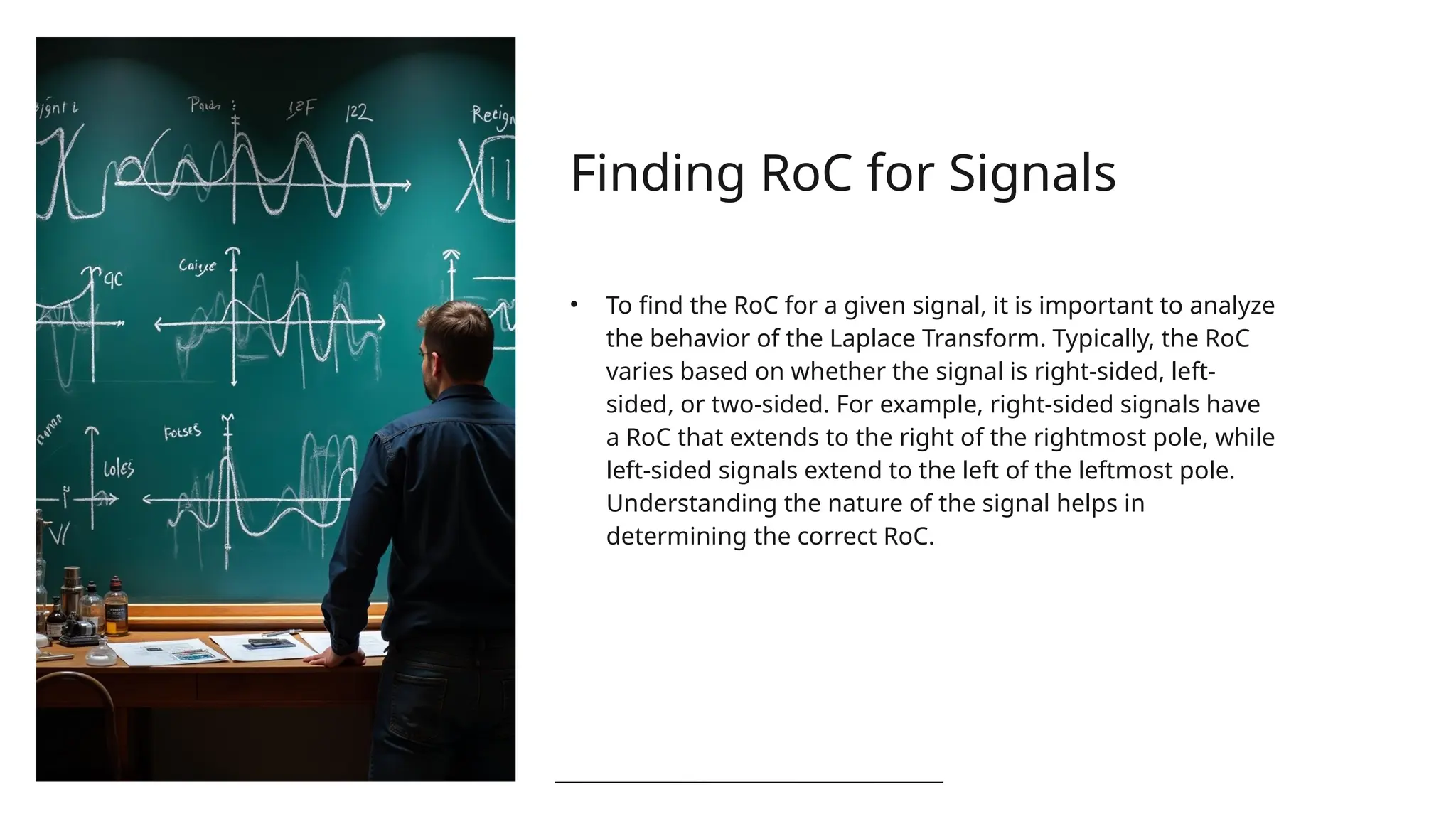
• To find the RoC for a given signal, it is important to analyze
the behavior of the Laplace Transform. Typically, the RoC
varies based on whether the signal is right-sided, left-
sided, or two-sided. For example, right-sided signals have
a RoC that extends to the right of the rightmost pole, while
left-sided signals extend to the left of the leftmost pole.
Understanding the nature of the signal helps in
determining the correct RoC.
Importance in System Analysis
The RoC plays a pivotal role in system analysis, particularly in ensuring
stability and determining system behavior. A Laplace Transform with a
specified RoC can indicate whether a system is stable or marginally
stable. For instance, if the RoC includes the imaginary axis, the system is
considered stable. Additionally, the RoC allows engineers to characterize
responses to inputs and understand the implications of signal
processing.
Conclusions
In summary, the Laplace Transform is a vital tool in the analysis of
signals and systems. Understanding common functions and the
concept of the Region of Convergence is crucial for effectively applying
the transform in engineering practice. These concepts facilitate the
design, analysis, and control of dynamic systems.

Laplace fouriers & Laplace Transform.pptx

  • 2.
    Laplace Transform An Overviewof Fundamentals and Applications in Signals and Systems 2XXX
  • 3.
    Introduction This presentation willcover the fundamental concepts of Laplace Transform and its significance in analyzing signals and systems.
  • 4.
  • 5.
    Definition and Purpose TheLaplace Transform is a mathematical technique used to transform a time-domain function into a complex frequency-domain representation. It is widely used in engineering fields, particularly for solving differential equations and analyzing linear time-invariant (LTI) systems. The primary purpose is to simplify the analysis of dynamic systems by providing a method for transforming operations such as differentiation and integration into algebraic forms.
  • 6.
    Key Properties • TheLaplace Transform exhibits several important properties that facilitate the analysis of signals and systems. These include linearity, time-shifting, frequency- shifting, scaling in the time domain, and the initial and final value theorems. Understanding these properties allows engineers to manipulate and analyze signals effectively, making it easier to design and control engineering systems.
  • 7.
    Common Functions Several commonfunctions have well-defined Laplace Transforms. These include the exponential function, unit step function, and delta function. For instance, the Laplace Transform of the exponential function e^(at) is 1/(s-a), while for the unit step function u(t), it is 1/s. Understanding these transforms is crucial for engineers to analyze system responses, as they often represent real-world signals.
  • 8.
  • 9.
    Definition of RoC TheRegion of Convergence (RoC) for the Laplace Transform is the range of values in the complex frequency domain (s-plane) for which the integral of the transform converges. It is essential to determine RoC as it affects the stability and causality of the corresponding time-domain signal or system. The RoC typically extends outward from the poles of the Laplace Transform.
  • 10.
    Finding RoC forSignals • To find the RoC for a given signal, it is important to analyze the behavior of the Laplace Transform. Typically, the RoC varies based on whether the signal is right-sided, left- sided, or two-sided. For example, right-sided signals have a RoC that extends to the right of the rightmost pole, while left-sided signals extend to the left of the leftmost pole. Understanding the nature of the signal helps in determining the correct RoC.
  • 11.
    Importance in SystemAnalysis The RoC plays a pivotal role in system analysis, particularly in ensuring stability and determining system behavior. A Laplace Transform with a specified RoC can indicate whether a system is stable or marginally stable. For instance, if the RoC includes the imaginary axis, the system is considered stable. Additionally, the RoC allows engineers to characterize responses to inputs and understand the implications of signal processing.
  • 12.
    Conclusions In summary, theLaplace Transform is a vital tool in the analysis of signals and systems. Understanding common functions and the concept of the Region of Convergence is crucial for effectively applying the transform in engineering practice. These concepts facilitate the design, analysis, and control of dynamic systems.