Language as a
Disguise for Information
Disguises (text)
Lawrie Hunter
Language as a
Disguise for Information
Lawrie Hunter
Don’t take notes:
Downloads from:
http://lawriehunter.com
http://slideshare.net/rolenzo
/
Contact:
lawriehunter@gmail.com
1.Overview
2. Disguises
Uniform text
Unsignaled structures
Blend of levels
Semantic ambiguity
Syntactic ambiguity
Rhetoric clouds
Vagueness and hedging
Metaphor / simile
3. Visualizations of information
4. Focus: Hunter’s ISmaps
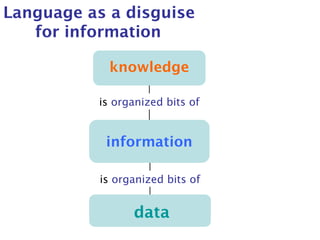
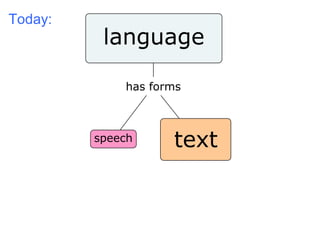
Language as a disguise
for information
knowledge
information
data
is organized bits of
Today:
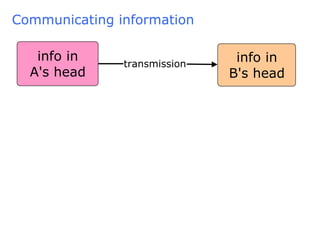
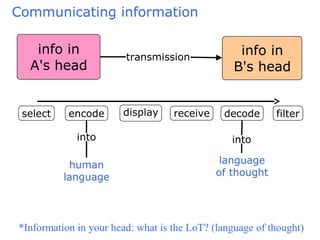
*Information in your head: what is the LoT? (language of thought)
This project will make a major academic
contribution by providing tests of the
currently available hypotheses, creating a
more universal system of knowledge, and
offering a new development in the debate
about the origins of modern humans.
Some typical disguises
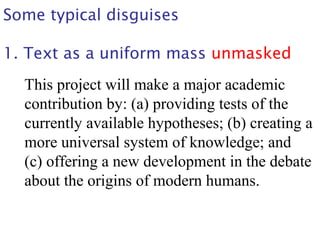
1. Text as a uniform mass
Some typical disguises
1. Text as a uniform mass unmasked
This project will make a major academic
contribution by: (a) providing tests of the
currently available hypotheses; (b) creating a
more universal system of knowledge; and
(c) offering a new development in the debate
about the origins of modern humans.
Some typical disguises
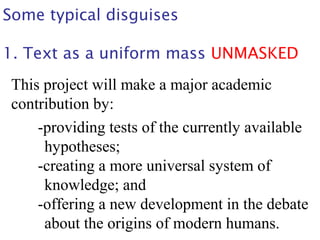
1. Text as a uniform mass UNMASKED
This project will make a major academic
contribution by:
-providing tests of the currently available
hypotheses;
-creating a more universal system of
knowledge; and
-offering a new development in the debate
about the origins of modern humans.
Some typical disguises
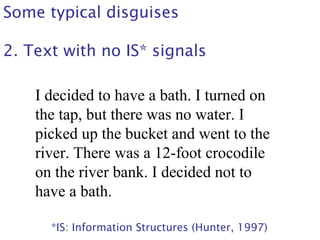
2. Text with no IS* signals
I decided to have a bath. I turned on
the tap, but there was no water. I
picked up the bucket and went to the
river. There was a 12-foot crocodile
on the river bank. I decided not to
have a bath.
*IS: Information Structures (Hunter, 1997)
Some typical disguises
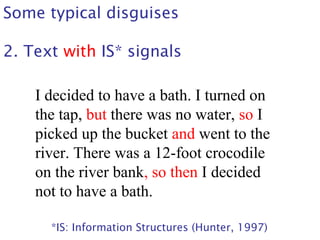
2. Text with IS* signals
I decided to have a bath. I turned on
the tap, but there was no water, so I
picked up the bucket and went to the
river. There was a 12-foot crocodile
on the river bank, so then I decided
not to have a bath.
*IS: Information Structures (Hunter, 1997)
Some typical disguises
3. Text as a blend of levels:
-rhetoric
-background
-concrete content
3. Text as a blend of levels:
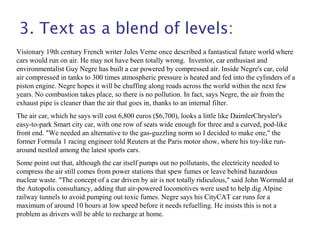
Visionary 19th century French writer Jules Verne once described a fantastical future world where
cars would run on air. He may not have been totally wrong. Inventor, car enthusiast and
environmentalist Guy Negre has built a car powered by compressed air. Inside Negre's car, cold
air compressed in tanks to 300 times atmospheric pressure is heated and fed into the cylinders of a
piston engine. Negre hopes it will be chuffing along roads across the world within the next few
years. No combustion takes place, so there is no pollution. In fact, says Negre, the air from the
exhaust pipe is cleaner than the air that goes in, thanks to an internal filter.
The air car, which he says will cost 6,800 euros ($6,700), looks a little like DaimlerChrysler's
easy-to-park Smart city car, with one row of seats wide enough for three and a curved, pod-like
front end. "We needed an alternative to the gas-guzzling norm so I decided to make one," the
former Formula 1 racing engineer told Reuters at the Paris motor show, where his toy-like run-
around nestled among the latest sports cars.
Some point out that, although the car itself pumps out no pollutants, the electricity needed to
compress the air still comes from power stations that spew fumes or leave behind hazardous
nuclear waste. "The concept of a car driven by air is not totally ridiculous," said John Wormald at
the Autopolis consultancy, adding that air-powered locomotives were used to help dig Alpine
railway tunnels to avoid pumping out toxic fumes. Negre says his CityCAT car runs for a
maximum of around 10 hours at low speed before it needs refuelling. He insists this is not a
problem as drivers will be able to recharge at home.
3. Text as a blend of levels:
Visionary 19th century French writer Jules Verne once described a fantastical future world
where cars would run on air. He may not have been totally wrong. Inventor, car enthusiast and
environmentalist Guy Negre has built a car powered by compressed air. Inside Negre's car,
cold air compressed in tanks to 300 times atmospheric pressure is heated and fed into the
cylinders of a piston engine. Negre hopes it will be chuffing along roads across the world within
the next few years. No combustion takes place, so there is no pollution. In fact, says Negre, the air
from the exhaust pipe is cleaner than the air that goes in, thanks to an internal filter.
The air car, which he says will cost 6,800 euros ($6,700), looks a little like DaimlerChrysler's
easy-to-park Smart city car, with one row of seats wide enough for three and a curved, pod-like
front end. "We needed an alternative to the gas-guzzling norm so I decided to make one,"
the former Formula 1 racing engineer told Reuters at the Paris motor show, where his toy-
like run-around nestled among the latest sports cars.
Some point out that, although the car itself pumps out no pollutants, the electricity needed to
compress the air still comes from power stations that spew fumes or leave behind hazardous
nuclear waste. "The concept of a car driven by air is not totally ridiculous," said John Wormald
at the Autopolis consultancy, adding that air-powered locomotives were used to help dig
Alpine railway tunnels to avoid pumping out toxic fumes. Negre says his CityCAT car runs for
a maximum of around 10 hours at low speed before it needs refuelling. He insists this is not a
problem as drivers will be able to recharge at home.
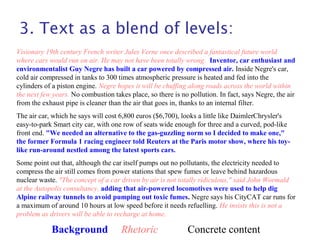
Background Rhetoric Concrete content
3. Text as a blend of levels:
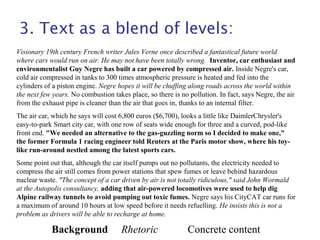
Visionary 19th century French writer Jules Verne once described a fantastical future world
where cars would run on air. He may not have been totally wrong. Inventor, car enthusiast and
environmentalist Guy Negre has built a car powered by compressed air. Inside Negre's car,
cold air compressed in tanks to 300 times atmospheric pressure is heated and fed into the
cylinders of a piston engine. Negre hopes it will be chuffing along roads across the world within
the next few years. No combustion takes place, so there is no pollution. In fact, says Negre, the air
from the exhaust pipe is cleaner than the air that goes in, thanks to an internal filter.
The air car, which he says will cost 6,800 euros ($6,700), looks a little like DaimlerChrysler's
easy-to-park Smart city car, with one row of seats wide enough for three and a curved, pod-like
front end. "We needed an alternative to the gas-guzzling norm so I decided to make one,"
the former Formula 1 racing engineer told Reuters at the Paris motor show, where his toy-
like run-around nestled among the latest sports cars.
Some point out that, although the car itself pumps out no pollutants, the electricity needed to
compress the air still comes from power stations that spew fumes or leave behind hazardous
nuclear waste. "The concept of a car driven by air is not totally ridiculous," said John Wormald
at the Autopolis consultancy, adding that air-powered locomotives were used to help dig
Alpine railway tunnels to avoid pumping out toxic fumes. Negre says his CityCAT car runs for
a maximum of around 10 hours at low speed before it needs refuelling. He insists this is not a
problem as drivers will be able to recharge at home.
Background Rhetoric Concrete content
Some typical disguises
4. Ambiguity
(a) semantic ambiguity
(b) syntactic ambiguity
Some typical disguises
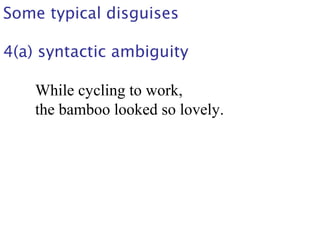
4(a) syntactic ambiguity
While cycling to work,
the bamboo looked so lovely.
Some typical disguises
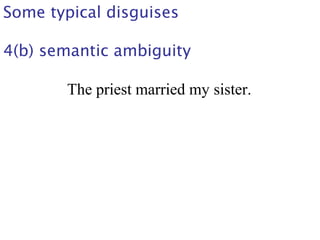
4(b) semantic ambiguity
The priest married my sister.
Some typical disguises
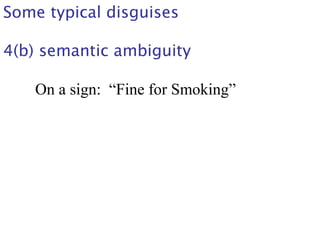
4(b) semantic ambiguity
On a sign: “Fine for Smoking”
Some typical disguises
5. Rhetoric clouds
Some typical disguises
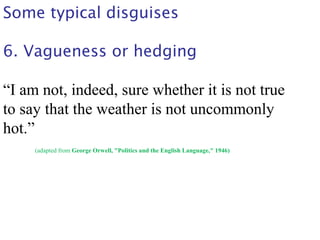
6. Vagueness or hedging
“I am not, indeed, sure whether it is not true
to say that the weather is not uncommonly
hot.”
(adapted from George Orwell, "Politics and the English Language," 1946)
Some typical disguises
7. Metaphor
Structural metaphors
[More is up; less is down.]
“My blood pressure went up.”
Some typical disguises
7. Metaphor
Structural metaphors
[Time is money.]
“He spent his whole life in boats.”
Some typical disguises
8. Metaphor / simile
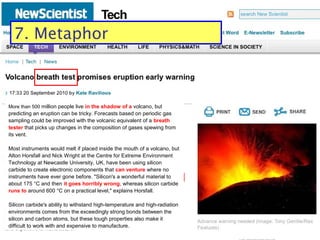
More than 500 million people live in the shadow of a volcano, but
predicting an eruption can be tricky. Forecasts based on periodic gas
sampling could be improved with the volcanic equivalent of a breath
tester that picks up changes in the composition of gases spewing from
its vent.
Most instruments would melt if placed inside the mouth of a volcano, but
Alton Horsfall and Nick Wright at the Centre for Extreme Environment
Technology at Newcastle University, UK, have been using silicon
carbide to create electronic components that can venture where no
instruments have ever gone before. "Silicon's a wonderful material to
about 175 °C and then it goes horribly wrong, whereas silicon carbide
runs to around 600 °C on a practical level," explains Horsfall.
Silicon carbide's ability to withstand high-temperature and high-radiation
environments comes from the exceedingly strong bonds between the
silicon and carbon atoms, but these tough properties also make it
difficult to work with and expensive to manufacture.
7. Metaphor
Some typical disguises
8. Ellipsis / elision
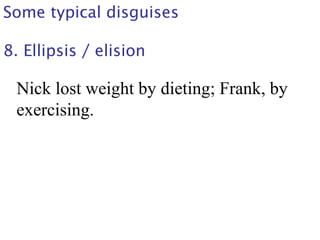
Nick lost weight by dieting; Frank, by
exercising.
Some typical disguises
8. Ellipsis / elision
I like Beethoven more than you.
Some typical disguises
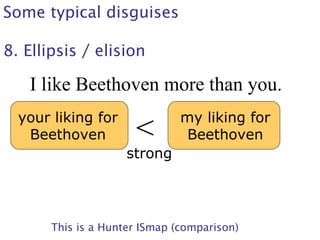
8. Ellipsis / elision
<
strong
your liking for
Beethoven
my liking for
Beethoven
This is a Hunter ISmap (comparison)
I like Beethoven more than you.
Some typical disguises
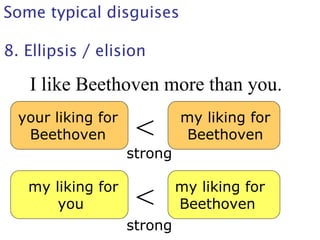
8. Ellipsis / elision
<
strong
my liking for
you
my liking for
Beethoven
<
strong
your liking for
Beethoven
my liking for
Beethoven
I like Beethoven more than you.
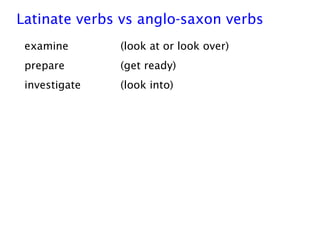
Latinate verbs vs anglo-saxon verbs
examine (look at or look over)
prepare (get ready)
investigate (look into)
”The members of group A were better than the
members of group B” [subjective, opinion]
Subjective / objective / precise
”The members of group A were better than the
members of group B” [subjective, opinion]
vs.
”Group A’s average score on the reasoning test was
higher than that of group B.”
[objective, can be confirmed from experience]
[higher score does not mean better person].
Subjective / objective / precise
”The members of group A were better than the
members of group B” [subjective, opinion]
vs.
”Group A’s average score on the reasoning test was
higher than that of group B.”
[objective, can be confirmed from experience]
[higher score does not mean better person].
vs.
”The average reasoning test scores for groups A and
B were 39.2 and 32.3, respectively.”
Subjective / objective / precise

Language as a disguise for information 1. text

  • 1.
    Language as a Disguisefor Information Disguises (text) Lawrie Hunter
  • 2.
    Language as a Disguisefor Information Lawrie Hunter Don’t take notes: Downloads from: http://lawriehunter.com http://slideshare.net/rolenzo / Contact: lawriehunter@gmail.com 1.Overview 2. Disguises Uniform text Unsignaled structures Blend of levels Semantic ambiguity Syntactic ambiguity Rhetoric clouds Vagueness and hedging Metaphor / simile 3. Visualizations of information 4. Focus: Hunter’s ISmaps
  • 3.
    Language as adisguise for information knowledge information data is organized bits of is organized bits of
  • 5.
  • 7.
    *Information in yourhead: what is the LoT? (language of thought)
  • 8.
    This project willmake a major academic contribution by providing tests of the currently available hypotheses, creating a more universal system of knowledge, and offering a new development in the debate about the origins of modern humans. Some typical disguises 1. Text as a uniform mass
  • 9.
    Some typical disguises 1.Text as a uniform mass unmasked This project will make a major academic contribution by: (a) providing tests of the currently available hypotheses; (b) creating a more universal system of knowledge; and (c) offering a new development in the debate about the origins of modern humans.
  • 10.
    Some typical disguises 1.Text as a uniform mass UNMASKED This project will make a major academic contribution by: -providing tests of the currently available hypotheses; -creating a more universal system of knowledge; and -offering a new development in the debate about the origins of modern humans.
  • 11.
    Some typical disguises 2.Text with no IS* signals I decided to have a bath. I turned on the tap, but there was no water. I picked up the bucket and went to the river. There was a 12-foot crocodile on the river bank. I decided not to have a bath. *IS: Information Structures (Hunter, 1997)
  • 12.
    Some typical disguises 2.Text with IS* signals I decided to have a bath. I turned on the tap, but there was no water, so I picked up the bucket and went to the river. There was a 12-foot crocodile on the river bank, so then I decided not to have a bath. *IS: Information Structures (Hunter, 1997)
  • 13.
    Some typical disguises 3.Text as a blend of levels: -rhetoric -background -concrete content
  • 14.
    3. Text asa blend of levels: Visionary 19th century French writer Jules Verne once described a fantastical future world where cars would run on air. He may not have been totally wrong. Inventor, car enthusiast and environmentalist Guy Negre has built a car powered by compressed air. Inside Negre's car, cold air compressed in tanks to 300 times atmospheric pressure is heated and fed into the cylinders of a piston engine. Negre hopes it will be chuffing along roads across the world within the next few years. No combustion takes place, so there is no pollution. In fact, says Negre, the air from the exhaust pipe is cleaner than the air that goes in, thanks to an internal filter. The air car, which he says will cost 6,800 euros ($6,700), looks a little like DaimlerChrysler's easy-to-park Smart city car, with one row of seats wide enough for three and a curved, pod-like front end. "We needed an alternative to the gas-guzzling norm so I decided to make one," the former Formula 1 racing engineer told Reuters at the Paris motor show, where his toy-like run- around nestled among the latest sports cars. Some point out that, although the car itself pumps out no pollutants, the electricity needed to compress the air still comes from power stations that spew fumes or leave behind hazardous nuclear waste. "The concept of a car driven by air is not totally ridiculous," said John Wormald at the Autopolis consultancy, adding that air-powered locomotives were used to help dig Alpine railway tunnels to avoid pumping out toxic fumes. Negre says his CityCAT car runs for a maximum of around 10 hours at low speed before it needs refuelling. He insists this is not a problem as drivers will be able to recharge at home.
  • 15.
    3. Text asa blend of levels: Visionary 19th century French writer Jules Verne once described a fantastical future world where cars would run on air. He may not have been totally wrong. Inventor, car enthusiast and environmentalist Guy Negre has built a car powered by compressed air. Inside Negre's car, cold air compressed in tanks to 300 times atmospheric pressure is heated and fed into the cylinders of a piston engine. Negre hopes it will be chuffing along roads across the world within the next few years. No combustion takes place, so there is no pollution. In fact, says Negre, the air from the exhaust pipe is cleaner than the air that goes in, thanks to an internal filter. The air car, which he says will cost 6,800 euros ($6,700), looks a little like DaimlerChrysler's easy-to-park Smart city car, with one row of seats wide enough for three and a curved, pod-like front end. "We needed an alternative to the gas-guzzling norm so I decided to make one," the former Formula 1 racing engineer told Reuters at the Paris motor show, where his toy- like run-around nestled among the latest sports cars. Some point out that, although the car itself pumps out no pollutants, the electricity needed to compress the air still comes from power stations that spew fumes or leave behind hazardous nuclear waste. "The concept of a car driven by air is not totally ridiculous," said John Wormald at the Autopolis consultancy, adding that air-powered locomotives were used to help dig Alpine railway tunnels to avoid pumping out toxic fumes. Negre says his CityCAT car runs for a maximum of around 10 hours at low speed before it needs refuelling. He insists this is not a problem as drivers will be able to recharge at home. Background Rhetoric Concrete content
  • 16.
    3. Text asa blend of levels: Visionary 19th century French writer Jules Verne once described a fantastical future world where cars would run on air. He may not have been totally wrong. Inventor, car enthusiast and environmentalist Guy Negre has built a car powered by compressed air. Inside Negre's car, cold air compressed in tanks to 300 times atmospheric pressure is heated and fed into the cylinders of a piston engine. Negre hopes it will be chuffing along roads across the world within the next few years. No combustion takes place, so there is no pollution. In fact, says Negre, the air from the exhaust pipe is cleaner than the air that goes in, thanks to an internal filter. The air car, which he says will cost 6,800 euros ($6,700), looks a little like DaimlerChrysler's easy-to-park Smart city car, with one row of seats wide enough for three and a curved, pod-like front end. "We needed an alternative to the gas-guzzling norm so I decided to make one," the former Formula 1 racing engineer told Reuters at the Paris motor show, where his toy- like run-around nestled among the latest sports cars. Some point out that, although the car itself pumps out no pollutants, the electricity needed to compress the air still comes from power stations that spew fumes or leave behind hazardous nuclear waste. "The concept of a car driven by air is not totally ridiculous," said John Wormald at the Autopolis consultancy, adding that air-powered locomotives were used to help dig Alpine railway tunnels to avoid pumping out toxic fumes. Negre says his CityCAT car runs for a maximum of around 10 hours at low speed before it needs refuelling. He insists this is not a problem as drivers will be able to recharge at home. Background Rhetoric Concrete content
  • 17.
    Some typical disguises 4.Ambiguity (a) semantic ambiguity (b) syntactic ambiguity
  • 18.
    Some typical disguises 4(a)syntactic ambiguity While cycling to work, the bamboo looked so lovely.
  • 19.
    Some typical disguises 4(b)semantic ambiguity The priest married my sister.
  • 20.
    Some typical disguises 4(b)semantic ambiguity On a sign: “Fine for Smoking”
  • 21.
  • 22.
    Some typical disguises 6.Vagueness or hedging “I am not, indeed, sure whether it is not true to say that the weather is not uncommonly hot.” (adapted from George Orwell, "Politics and the English Language," 1946)
  • 23.
    Some typical disguises 7.Metaphor Structural metaphors [More is up; less is down.] “My blood pressure went up.”
  • 24.
    Some typical disguises 7.Metaphor Structural metaphors [Time is money.] “He spent his whole life in boats.”
  • 25.
    Some typical disguises 8.Metaphor / simile More than 500 million people live in the shadow of a volcano, but predicting an eruption can be tricky. Forecasts based on periodic gas sampling could be improved with the volcanic equivalent of a breath tester that picks up changes in the composition of gases spewing from its vent. Most instruments would melt if placed inside the mouth of a volcano, but Alton Horsfall and Nick Wright at the Centre for Extreme Environment Technology at Newcastle University, UK, have been using silicon carbide to create electronic components that can venture where no instruments have ever gone before. "Silicon's a wonderful material to about 175 °C and then it goes horribly wrong, whereas silicon carbide runs to around 600 °C on a practical level," explains Horsfall. Silicon carbide's ability to withstand high-temperature and high-radiation environments comes from the exceedingly strong bonds between the silicon and carbon atoms, but these tough properties also make it difficult to work with and expensive to manufacture. 7. Metaphor
  • 26.
    Some typical disguises 8.Ellipsis / elision Nick lost weight by dieting; Frank, by exercising.
  • 27.
    Some typical disguises 8.Ellipsis / elision I like Beethoven more than you.
  • 28.
    Some typical disguises 8.Ellipsis / elision < strong your liking for Beethoven my liking for Beethoven This is a Hunter ISmap (comparison) I like Beethoven more than you.
  • 29.
    Some typical disguises 8.Ellipsis / elision < strong my liking for you my liking for Beethoven < strong your liking for Beethoven my liking for Beethoven I like Beethoven more than you.
  • 30.
    Latinate verbs vsanglo-saxon verbs examine (look at or look over) prepare (get ready) investigate (look into)
  • 31.
    ”The members ofgroup A were better than the members of group B” [subjective, opinion] Subjective / objective / precise
  • 32.
    ”The members ofgroup A were better than the members of group B” [subjective, opinion] vs. ”Group A’s average score on the reasoning test was higher than that of group B.” [objective, can be confirmed from experience] [higher score does not mean better person]. Subjective / objective / precise
  • 33.
    ”The members ofgroup A were better than the members of group B” [subjective, opinion] vs. ”Group A’s average score on the reasoning test was higher than that of group B.” [objective, can be confirmed from experience] [higher score does not mean better person]. vs. ”The average reasoning test scores for groups A and B were 39.2 and 32.3, respectively.” Subjective / objective / precise