



LESSON SUMMARY
• Reading: Article about inventions
• Vocabulary: adverbs
• Speaking: discussing inventions
• Topic: science and technology
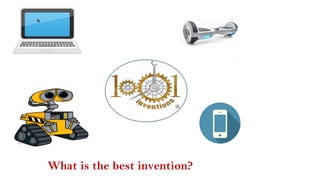
What is the best invention?
READING
“Necessity is the mother of invention”
An expression that means that if you
really need to do something, you
will think of a way of doing it.
Exercise 3
TRUE / FALSE
TASK
READING
STRATEGIES
Read the statement and the task
carefully
Underline the parts of the text
that contain useful information
Rely only on the information given
in the text, not on your general
knowledge
READING
READING
Ever since the horse and buggy,
people have been inventing new
ways of travelling – some more
effective than others. Here are
three of them…
Crazy ways of getting
around – past, present
and future
READING
The C5
‘Imagine a vehicle that can drive you five miles for
a penny. A vehicle that needs no petrol, just a
battery.’ This might sound like an amazingly good
idea now, but back in 1985, when Clive Sinclair
invented the C5, people weren’t so sure. ‘It will be
the answer to our inner-city traffic problems.’
explained the marketing executives. ‘You won’t
need a driving license. Anyone can drive it,
whether you are 14 or 40.’ The problem was the
C5 didn’t work well in the British climate and
could be dangerous on wet road.
1 Past
Read the text.
Are the sentences True (T) or False (F)
1. In 1985 people welcomed the idea of an
environmentally friendly car.
2. The C5 failed partly because it was dangerous
in bad weather.
3. Dean Kamen predicted that Segways would be
more popular than cars.
4. They’ve sold more Segways than they
expected.
5. Ben Gulak has placed advertisements for the
Uno on US TV.
6. The driver doesn’t have to operate any
controls on the Uno.
F
T
READING
The Segway
Its inventor, Dean Kamen, confidently predicted
that the Segway ‘will be to the car what the car was
to the horse and buggy’. Despite sales predictors of
40,000 a year when it appeared in 2001, sales have
been disappointingly low. But the Segway might not
be a total failure. The police in some European
countries use them (though probably not in theme
parks, warehouses and some airports. You aren’t
allowed to use them on public roads in many
European countries, though that might change and
sales could then increase dramatically.
2 Present
Read the text.
Are the sentences True (T) or False (F)
1. In 1985 people welcomed the idea of an
environmentally friendly car.
2. The C5 failed partly because it was dangerous
in bad weather.
3. Dean Kamen predicted that Segways would be
more popular than cars.
4. They’ve sold more Segways than they
expected.
5. Ben Gulak has placed advertisements for the
Uno on US TV.
6. The driver doesn’t have to operate any
controls on the Uno.
T
F
READING
The Uno
Canadian teenager Ben Gulak has recently won an award
for the best new invention of the future – the Uno. He has
already appeared on American television to demonstrate
his unique electric vehicle, it looks exactly like a motor
scooter except the wheels are beside each other. A
computerized system keeps the vehicle carefully balanced.
You can easily ride it – it has absolutely no controls. There
is only an on-off switch. To move it, you move your body.
To go forward, you simply lean forward. To stop it, you
lean back. You lean left or right to go round a corner.
‘People really seem to like it,’ says Gulak. With the right
business help, the Uno might become a common sight on
our roads in the future.
3 Future
Read the text.
Are the sentences True (T) or False (F)
1. In 1985 people welcomed the idea of an
environmentally friendly car.
2. The C5 failed partly because it was dangerous
in bad weather.
3. Dean Kamen predicted that Segways would be
more popular than cars.
4. They’ve sold more Segways than they
expected.
5. Ben Gulak has placed advertisements for the
Uno on US TV.
6. The driver doesn’t have to operate any
controls on the Uno.
F
T
Find 12 adverbs ending in –ly
in the texts.
READING
The C5
‘Imagine a vehicle that can drive you five miles for
a penny. A vehicle that needs no petrol, just a
battery.’ This might sound like an amazingly good
idea now, but back in 1985, when Clive Sinclair
invented the C5, people weren’t so sure. ‘It will
be the answer to our inner-city traffic problems.’
explained the marketing executives. ‘You won’t
need a driving license. Anyone can drive it,
whether you are 14 or 40.’ The problem was the
C5 didn’t work well in the British climate and
could be dangerous on wet road.
1 Past
READING
The C5
‘Imagine a vehicle that can drive you five miles for
a penny. A vehicle that needs no petrol, just a
battery.’ This might sound like an amazingly good
idea now, but back in 1985, when Clive Sinclair
invented the C5, people weren’t so sure. ‘It will
be the answer to our inner-city traffic problems.’
explained the marketing executives. ‘You won’t
need a driving license. Anyone can drive it,
whether you are 14 or 40.’ The problem was the
C5 didn’t work well in the British climate and
could be dangerous on wet road.
1 Past
READING
The Segway
Its inventor, Dean Kamen, confidently predicted
that the Segway ‘will be to the car what the car was
to the horse and buggy’. Despite sales predictors of
40,000 a year when it appeared in 2001, sales have
been disappointingly low. But the Segway might not
be a total failure. The police in some European
countries use them (though probably not in theme
parks, warehouses and some airports. You aren’t
allowed to use them on public roads in many
European countries, though that might change and
sales could then increase dramatically.
2 Present
READING
The Segway
Its inventor, Dean Kamen, confidently predicted
that the Segway ‘will be to the car what the car was
to the horse and buggy’. Despite sales predictors of
40,000 a year when it appeared in 2001, sales have
been disappointingly low. But the Segway might
not be a total failure. The police in some European
countries use them (though probably not in theme
parks, warehouses and some airports. You aren’t
allowed to use them on public roads in many
European countries, though that might change and
sales could then increase dramatically.
2 Present
READING
The Uno
Canadian teenager Ben Gulak has recently won an award
for the best new invention of the future – the Uno. He has
already appeared on American television to demonstrate
his unique electric vehicle, it looks exactly like a motor
scooter except the wheels are beside each other. A
computerized system keeps the vehicle carefully
balanced. You can easily ride it – it has absolutely no
controls. There is only an on-off switch. To move it, you
move your body. To go forward, you simply lean forward.
To stop it, you lean back. You lean left or right to go
round a corner. ‘People really seem to like it,’ says Gulak.
With the right business help, the Uno might become a
common sight on our roads in the future.
3 Future
READING
The Uno
Canadian teenager Ben Gulak has recently won an award
for the best new invention of the future – the Uno. He has
already appeared on American television to demonstrate
his unique electric vehicle, it looks exactly like a motor
scooter except the wheels are beside each other. A
computerized system keeps the vehicle carefully
balanced. You can easily ride it – it has absolutely no
controls. There is only an on-off switch. To move it, you
move your body. To go forward, you simply lean forward.
To stop it, you lean back. You lean left or right to go round
a corner. ‘People really seem to like it,’ says Gulak. With
the right business help, the Uno might become a common
sight on our roads in the future.
3 Future
We can use adverbs before adjectives and other
adverbs.
These shoes were amazingly cheap.
The car was travelling incredibly slowly.
LEARN
THIS!
• Amazingly good, disappointingly low, careful
balanced
Look at the inventions in the pictures and read
these questions. Make notes.
Use the words below each photo to help you.
1. How do you think each invention works?
2. Which invention do you think is the most
or least useful? Why? Try to use adverbs if
you can.
3. What is a fair price each invention, in your
opinion?
SPEAKING
Work in pairs. Ask and answer the
questions in the previous exercise.
How do you think the first invention
works?
You attach the toilet paper holder to your
head, and unroll the paper. Then you use it
to …
Which invention do you think is the most
useful and why?
I think the … is the most useful because it’s
really …
What is a fair price for the first invention,
in your opinion?
I think a fair price is €15
• https://youtu.be/l-ijcGqPE4o
SPEAKING
Useful expressions:
• I think…
• In my opinion,
• From my point of view,…
• As far as I’m concerned,…
Understand an article in detail
What have
you learned
today?
What can you
do now?
Describe and discuss strange inventions
Unit 6 - Part E

Unit 6 - Part E

  • 2.
    LESSON SUMMARY • Reading:Article about inventions • Vocabulary: adverbs • Speaking: discussing inventions • Topic: science and technology
  • 3.
    What is thebest invention?
  • 4.
    READING “Necessity is themother of invention” An expression that means that if you really need to do something, you will think of a way of doing it.
  • 5.
  • 6.
  • 7.
    Read the statementand the task carefully Underline the parts of the text that contain useful information Rely only on the information given in the text, not on your general knowledge READING
  • 8.
    READING Ever since thehorse and buggy, people have been inventing new ways of travelling – some more effective than others. Here are three of them… Crazy ways of getting around – past, present and future
  • 9.
    READING The C5 ‘Imagine avehicle that can drive you five miles for a penny. A vehicle that needs no petrol, just a battery.’ This might sound like an amazingly good idea now, but back in 1985, when Clive Sinclair invented the C5, people weren’t so sure. ‘It will be the answer to our inner-city traffic problems.’ explained the marketing executives. ‘You won’t need a driving license. Anyone can drive it, whether you are 14 or 40.’ The problem was the C5 didn’t work well in the British climate and could be dangerous on wet road. 1 Past
  • 10.
    Read the text. Arethe sentences True (T) or False (F) 1. In 1985 people welcomed the idea of an environmentally friendly car. 2. The C5 failed partly because it was dangerous in bad weather. 3. Dean Kamen predicted that Segways would be more popular than cars. 4. They’ve sold more Segways than they expected. 5. Ben Gulak has placed advertisements for the Uno on US TV. 6. The driver doesn’t have to operate any controls on the Uno. F T
  • 11.
    READING The Segway Its inventor,Dean Kamen, confidently predicted that the Segway ‘will be to the car what the car was to the horse and buggy’. Despite sales predictors of 40,000 a year when it appeared in 2001, sales have been disappointingly low. But the Segway might not be a total failure. The police in some European countries use them (though probably not in theme parks, warehouses and some airports. You aren’t allowed to use them on public roads in many European countries, though that might change and sales could then increase dramatically. 2 Present
  • 12.
    Read the text. Arethe sentences True (T) or False (F) 1. In 1985 people welcomed the idea of an environmentally friendly car. 2. The C5 failed partly because it was dangerous in bad weather. 3. Dean Kamen predicted that Segways would be more popular than cars. 4. They’ve sold more Segways than they expected. 5. Ben Gulak has placed advertisements for the Uno on US TV. 6. The driver doesn’t have to operate any controls on the Uno. T F
  • 13.
    READING The Uno Canadian teenagerBen Gulak has recently won an award for the best new invention of the future – the Uno. He has already appeared on American television to demonstrate his unique electric vehicle, it looks exactly like a motor scooter except the wheels are beside each other. A computerized system keeps the vehicle carefully balanced. You can easily ride it – it has absolutely no controls. There is only an on-off switch. To move it, you move your body. To go forward, you simply lean forward. To stop it, you lean back. You lean left or right to go round a corner. ‘People really seem to like it,’ says Gulak. With the right business help, the Uno might become a common sight on our roads in the future. 3 Future
  • 14.
    Read the text. Arethe sentences True (T) or False (F) 1. In 1985 people welcomed the idea of an environmentally friendly car. 2. The C5 failed partly because it was dangerous in bad weather. 3. Dean Kamen predicted that Segways would be more popular than cars. 4. They’ve sold more Segways than they expected. 5. Ben Gulak has placed advertisements for the Uno on US TV. 6. The driver doesn’t have to operate any controls on the Uno. F T
  • 15.
    Find 12 adverbsending in –ly in the texts.
  • 16.
    READING The C5 ‘Imagine avehicle that can drive you five miles for a penny. A vehicle that needs no petrol, just a battery.’ This might sound like an amazingly good idea now, but back in 1985, when Clive Sinclair invented the C5, people weren’t so sure. ‘It will be the answer to our inner-city traffic problems.’ explained the marketing executives. ‘You won’t need a driving license. Anyone can drive it, whether you are 14 or 40.’ The problem was the C5 didn’t work well in the British climate and could be dangerous on wet road. 1 Past
  • 17.
    READING The C5 ‘Imagine avehicle that can drive you five miles for a penny. A vehicle that needs no petrol, just a battery.’ This might sound like an amazingly good idea now, but back in 1985, when Clive Sinclair invented the C5, people weren’t so sure. ‘It will be the answer to our inner-city traffic problems.’ explained the marketing executives. ‘You won’t need a driving license. Anyone can drive it, whether you are 14 or 40.’ The problem was the C5 didn’t work well in the British climate and could be dangerous on wet road. 1 Past
  • 18.
    READING The Segway Its inventor,Dean Kamen, confidently predicted that the Segway ‘will be to the car what the car was to the horse and buggy’. Despite sales predictors of 40,000 a year when it appeared in 2001, sales have been disappointingly low. But the Segway might not be a total failure. The police in some European countries use them (though probably not in theme parks, warehouses and some airports. You aren’t allowed to use them on public roads in many European countries, though that might change and sales could then increase dramatically. 2 Present
  • 19.
    READING The Segway Its inventor,Dean Kamen, confidently predicted that the Segway ‘will be to the car what the car was to the horse and buggy’. Despite sales predictors of 40,000 a year when it appeared in 2001, sales have been disappointingly low. But the Segway might not be a total failure. The police in some European countries use them (though probably not in theme parks, warehouses and some airports. You aren’t allowed to use them on public roads in many European countries, though that might change and sales could then increase dramatically. 2 Present
  • 20.
    READING The Uno Canadian teenagerBen Gulak has recently won an award for the best new invention of the future – the Uno. He has already appeared on American television to demonstrate his unique electric vehicle, it looks exactly like a motor scooter except the wheels are beside each other. A computerized system keeps the vehicle carefully balanced. You can easily ride it – it has absolutely no controls. There is only an on-off switch. To move it, you move your body. To go forward, you simply lean forward. To stop it, you lean back. You lean left or right to go round a corner. ‘People really seem to like it,’ says Gulak. With the right business help, the Uno might become a common sight on our roads in the future. 3 Future
  • 21.
    READING The Uno Canadian teenagerBen Gulak has recently won an award for the best new invention of the future – the Uno. He has already appeared on American television to demonstrate his unique electric vehicle, it looks exactly like a motor scooter except the wheels are beside each other. A computerized system keeps the vehicle carefully balanced. You can easily ride it – it has absolutely no controls. There is only an on-off switch. To move it, you move your body. To go forward, you simply lean forward. To stop it, you lean back. You lean left or right to go round a corner. ‘People really seem to like it,’ says Gulak. With the right business help, the Uno might become a common sight on our roads in the future. 3 Future
  • 22.
    We can useadverbs before adjectives and other adverbs. These shoes were amazingly cheap. The car was travelling incredibly slowly. LEARN THIS! • Amazingly good, disappointingly low, careful balanced
  • 23.
    Look at theinventions in the pictures and read these questions. Make notes. Use the words below each photo to help you. 1. How do you think each invention works? 2. Which invention do you think is the most or least useful? Why? Try to use adverbs if you can. 3. What is a fair price each invention, in your opinion?
  • 24.
  • 25.
    Work in pairs.Ask and answer the questions in the previous exercise. How do you think the first invention works? You attach the toilet paper holder to your head, and unroll the paper. Then you use it to … Which invention do you think is the most useful and why? I think the … is the most useful because it’s really … What is a fair price for the first invention, in your opinion? I think a fair price is €15
  • 26.
  • 27.
    SPEAKING Useful expressions: • Ithink… • In my opinion, • From my point of view,… • As far as I’m concerned,…
  • 28.
    Understand an articlein detail What have you learned today? What can you do now? Describe and discuss strange inventions

Editor's Notes

  • #4 These are new devices that people create. Work with your partner and decide what the best invention of all time is.
  • #5 When do you invent something? Now, you will read the text to figure out what is that inventions and why did people invent those things?
  • #6 Now read the text again and decide whether the sentences
  • #7 Now, I will show you some reading strategies to help you do exercise 3.
  • #8 Here are some key points that you need to remember when doing a True/ False task.
  • #9 Now, read the text again and decide whether these sentences True or False.
  • #16 There are 12 adverbs ending in -ly in the texts, can anyone tell me what are they?
  • #17 Where are they in paragraph 1?
  • #19 Where are they in paragraph 2?
  • #21 Where are they in paragraph 3?
  • #23 Let’s look at the adverbs you have found and tell me where are they in a sentence?
  • #26 Ok class, let’s look at the example. Now you will watch a video. Then work with your partner using the above questions to talk about the pictures in your textbook.
  • #27 This is the example
  • #28 Here are some expressions that you can use.