5English
LanguageArts
INSTRUCTION
FloridaLAFS
Explaining Relationships in Scientific
and Technical Texts
Student Instruction Book andTeacher
Resource Book: Lesson Sample
5English
LanguageArts
INSTRUCTION
FloridaLAFS
Standards
	 Key Ideas and Details in
Informational Text  .  .  .  .  .  .  .  .  .  .  .  .  	 8
Lesson
1	 Finding Main Ideas and Details  .  .  .  .  .  .  .  .  .  .  .  .  	10	 5.RI.1.2, 5.RI.1.1, 5.RI.2.4, 5.W.3.9b, 5.SL.1.1,
5.L.3.4, 5.L.3.6
2	 Summarizing Informational Texts .  .  .  .  .  .  .  .  .  .  .  	24	 5.RI.1.2, 5.RI.1.1, 5.RI.2.4, 5.W.3.9b, 5.SL.1.1,
5.L.3.4, 5.L.3.6
3	 Using Details to Support Inferences  .  .  .  .  .  .  .  .  .  	38	 5.RI.1.1, 5.RI.2.4, 5.W.3.9b, 5.SL.1.1, 5.L.3.4,
5.L.3.6
4a	 Explaining Relationships in Scientific and
Technical Texts  .  .  .  .  .  .  .  .  .  .  .  .  .  .  .  .  .  .  .  .  .  .  	52	 5.RI.1.3, 5.RI.1.1, 5.RI.2.4, 5.W.3.9b, 5.SL.1.1,
5.L.3.4, 5.L.3.6
4b	Explaining Relationships in Historical Texts .  .  .  .  .  	66	 5.RI.1.3, 5.RI.1.1, 5.RI.2.4, 5.W.3.9b, 5.SL.1.1,
5.L.3.4, 5.L.3.6
Interim Assessment  .  .  .  .  .  .  .  .  .  .  .  .  .  .  .  .  .  .  .  .  	80
	 Key Ideas and Details in
Literature .  .  .  .  .  .  .  .  .  .  .  .  .  .  .  .  .  .  .  .  	 90
Lesson
5	 Comparing and Contrasting
Characters in Drama .  .  .  .  .  .  .  .  .  .  .  .  .  .  .  .  .  .  .  	92	 5.RL.1.3, 5.RL.1.1, 5.W.3.9a, 5.SL.1.1, 5.L.3.4,
5.L.3.6
6	 Comparing and Contrasting
Settings and Events .  .  .  .  .  .  .  .  .  .  .  .  .  .  .  .  .  .  .  . 	106	 5.RL.1.3, 5.RL.1.1, 5.W.3.9a, 5.SL.1.1, 5.L.3.4,
5.L.3.6
7	 Finding the Theme of a Story or Drama  .  .  .  .  .  .  .  	120	 5.RL.1.2, 5.RL.1.1, 5.W.3.9a, 5.SL.1.1, 5.L.3.4,
5.L.3.6
8	 Finding the Theme of a Poem  .  .  .  .  .  .  .  .  .  .  .  .  .  	134	 5.RL.1.2, 5.RL.1.1, 5.W.3.9a, 5.SL.1.1, 5.L.3.4,
5.L.3.6
9	 Summarizing Literary Texts .  .  .  .  .  .  .  .  .  .  .  .  .  .  .  	148	 5.RL.1.2, 5.RL.1.1, 5.W.3.9a, 5.SL.1.1, 5.L.3.4,
5.L.3.6
10	 Using Details to Support Inferences in
Literary Texts .  .  .  .  .  .  .  .  .  .  .  .  .  .  .  .  .  .  .  .  .  .  .  .  	162	 5.RL.1.1, 5.W.3.9a, 5.SL.1.1, 5.L.3.4, 5.L.3.6
Interim Assessment  .  .  .  .  .  .  .  .  .  .  .  .  .  .  .  .  .  .  .  .  	176
1
UNIT
2
UNIT
Table of Contents
Standards in boldface are the focus standards that address major lesson content.
©Curriculum Associates, LLC  Copying is not permitted.
Table of Contents
4
Standards
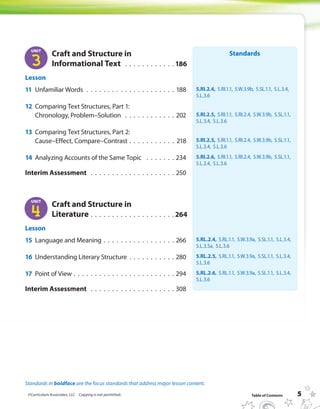
	 Craft and Structure in
Informational Text  .  .  .  .  .  .  .  .  .  .  .  .  	
186
Lesson
11	 Unfamiliar Words .  .  .  .  .  .  .  .  .  .  .  .  .  .  .  .  .  .  .  .  .  	188	 5.RI.2.4, 5.RI.1.1, 5.W.3.9b, 5.SL.1.1, 5.L.3.4,
5.L.3.6
12	 Comparing Text Structures, Part 1:
Chronology, Problem–Solution  .  .  .  .  .  .  .  .  .  .  .  .  	202	 5.RI.2.5, 5.RI.1.1, 5.RI.2.4, 5.W.3.9b, 5.SL.1.1,
5.L.3.4, 5.L.3.6
13	 Comparing Text Structures, Part 2:
Cause–Effect, Compare–Contrast .  .  .  .  .  .  .  .  .  .  .  	218	 5.RI.2.5, 5.RI.1.1, 5.RI.2.4, 5.W.3.9b, 5.SL.1.1,
5.L.3.4, 5.L.3.6
14	 Analyzing Accounts of the Same Topic  .  .  .  .  .  .  .  	234	 5.RI.2.6, 5.RI.1.1, 5.RI.2.4, 5.W.3.9b, 5.SL.1.1,
5.L.3.4, 5.L.3.6
Interim Assessment  .  .  .  .  .  .  .  .  .  .  .  .  .  .  .  .  .  .  .  .  	250
	 Craft and Structure in
Literature .  .  .  .  .  .  .  .  .  .  .  .  .  .  .  .  .  .  .  .  	
264
Lesson
15	 Language and Meaning .  .  .  .  .  .  .  .  .  .  .  .  .  .  .  .  .  	266	 5.RL.2.4, 5.RL.1.1, 5.W.3.9a, 5.SL.1.1, 5.L.3.4,
5.L.3.5a, 5.L.3.6
16	 Understanding Literary Structure .  .  .  .  .  .  .  .  .  .  .  	280	 5.RL.2.5, 5.RL.1.1, 5.W.3.9a, 5.SL.1.1, 5.L.3.4,
5.L.3.6
17	 Point of View .  .  .  .  .  .  .  .  .  .  .  .  .  .  .  .  .  .  .  .  .  .  .  .  	294	 5.RL.2.6, 5.RL.1.1, 5.W.3.9a, 5.SL.1.1, 5.L.3.4,
5.L.3.6
Interim Assessment  .  .  .  .  .  .  .  .  .  .  .  .  .  .  .  .  .  .  .  .  	308
3
UNIT
4
UNIT
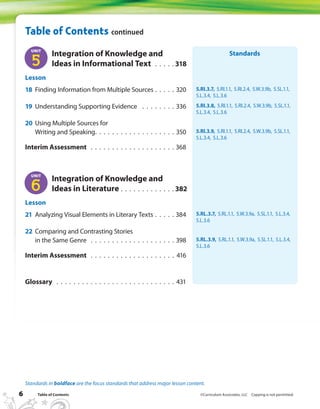
Standards in boldface are the focus standards that address major lesson content.
©Curriculum Associates, LLC  Copying is not permitted. Table of Contents 5
Standards
	 Integration of Knowledge and
Ideas in Informational Text  .  .  .  .  .  	
318
Lesson
18	 Finding Information from Multiple Sources .  .  .  .  .  	320	 5.RI.3.7, 5.RI.1.1, 5.RI.2.4, 5.W.3.9b, 5.SL.1.1,
5.L.3.4, 5.L.3.6
19	 Understanding Supporting Evidence  .  .  .  .  .  .  .  .  	336	 5.RI.3.8, 5.RI.1.1, 5.RI.2.4, 5.W.3.9b, 5.SL.1.1,
5.L.3.4, 5.L.3.6
20	 Using Multiple Sources for
Writing and Speaking .  .  .  .  .  .  .  .  .  .  .  .  .  .  .  .  .  .  . 	350	 5.RI.3.9, 5.RI.1.1, 5.RI.2.4, 5.W.3.9b, 5.SL.1.1,
5.L.3.4, 5.L.3.6
Interim Assessment  .  .  .  .  .  .  .  .  .  .  .  .  .  .  .  .  .  .  .  .  	368
	 Integration of Knowledge and
Ideas in Literature .  .  .  .  .  .  .  .  .  .  .  .  .  	
382
Lesson
21	 Analyzing Visual Elements in Literary Texts .  .  .  .  .  	384	 5.RL.3.7, 5.RL.1.1, 5.W.3.9a, 5.SL.1.1, 5.L.3.4,
5.L.3.6
22	 Comparing and Contrasting Stories
in the Same Genre  .  .  .  .  .  .  .  .  .  .  .  .  .  .  .  .  .  .  .  .  	398	 5.RL.3.9, 5.RL.1.1, 5.W.3.9a, 5.SL.1.1, 5.L.3.4,
5.L.3.6
Interim Assessment  .  .  .  .  .  .  .  .  .  .  .  .  .  .  .  .  .  .  .  .  	416
Glossary  .  .  .  .  .  .  .  .  .  .  .  .  .  .  .  .  .  .  .  .  .  .  .  .  .  .  .  .  	431
5
UNIT
6
UNIT
Table of Contents continued
Standards in boldface are the focus standards that address major lesson content.
©Curriculum Associates, LLC  Copying is not permitted.
Table of Contents
6
Learning Target
52 Lesson 4a  Explaining Relationships in Scientific and Technical Texts ©Curriculum Associates, LLC  Copying is not permitted.
Introduction
Read  When you read scientific texts, you learn about the natural
world. If you read about why lightning strikes or how electricity works,
you’re reading a scientific text. When you read technical texts, you
are learning to make or do something. If you read the directions for
using a cell phone, you are reading a technical text. Both scientific and
technical texts describe the relationships and interactions between
events, ideas, or concepts.
Read the passage. Underline any relationships or details that
seem important.
ELECTRICITY IN MOTION
	 You’re pretty familiar with what electricity can do. You flip a
switch and a light bulb glows. You push a button and a fan whirs to
life. Turning on an electric oven makes it heat up. But why do you
get these results? What do a glowing light bulb, a spinning fan, and
a hot oven have in common?
	 The answer is current electricity, or the steady flow of bits of
matter called electrons. You can’t see electrons. They’re so small
that even the best microscopes won’t show one to you. But while
electrons aren’t visible, you can see the effects of their motion.
Light bulbs, fans, ovens—all of these work because you’ve let the
electrons flow.
Explaining the relationships or interactions between
events and ideas will help you develop a deeper
understanding of scientific or technical texts.
Explaining Relationships in
Scientific and Technical Texts
Lesson 4a
LAFS.5.RI.1.3 Explain the relationships or interactions between two or more . . .
events, ideas, or concepts in a . . . scientific or technical text.
©Curriculum Associates, LLC  Copying is not permitted. 53
Lesson 4a  Explaining Relationships in Scientific and Technical Texts
Theme: It’s Electric Lesson 4a
Academic Talk 
Use these words and phrases to talk about the text.
• relationship • interaction
• scientific text • technical text


Explanation of the Process
You flip a light switch.
Event 3
Event 1 Event 2
Think  Consider what you know about scientific and technical texts. What
process does the passage describe? How does one event lead to another?
Complete the organizer, and then write a short explanation of what you
learned about electricity.
Talk  Share your explanation with a partner.
•	 What events do you include in your organizer?
•	 What kind of relationships do you see between one event
and another?
•	 How does understanding one event help you understand
another event?
Modeled and Guided Instruction
54 Lesson 4a  Explaining Relationships in Scientific and Technical Texts ©Curriculum Associates, LLC  Copying is not permitted.
Genre: Science Text
Close Reader Habits
As you reread the science
text, circle the words that
show the steps Volta
followed. Then, underline
the sentence that tells the
results of his work.
Electricity
Batteries
And
1		 Electricity powers our smartphones, music players, and other devices.
Where does the electricity for these small machines come from? Batteries, of
course. But who invented the battery? And what did a battery teach us about
the relationship between electricity and magnetism?
2		 Let’s begin with the invention of the battery. In 1799, scientists didn’t
know much about electricity. When faced with the unknown, scientists get
curious—and Alessandro Volta was curious, indeed. Volta discovered that he
could produce electricity by dipping two different metals (such as zinc and
copper) into a glass of salt water. He experimented further. First, he soaked
small pieces of cardboard in salt water. Next, he sandwiched one piece of
soaked cardboard between a copper disk and a zinc disk. Finally, he stacked
several such sandwiches into a pile. When Volta attached a wire to the top
and bottom of the pile, electricity flowed through the wire. The first battery
was born.
3		 In the following years, scientists made more discoveries about electricity.
One of the most startling of these came in 1820. In that year, the scientist
Hans Oersted (UR-stead) observed that a compass needle will move when
brought near a wire hooked to a battery. Oersted, knowing that compass
needles respond to magnets, realized that electric currents produce
magnetic fields. Oersted’s recognition that electricity and magnetism
are related was one of the most important discoveries of nineteenth-
century science.
4		 Today, batteries, electricity, and magnetism are so common that
you probably don’t give them a second thought. But to people of 1799
and 1820, Volta’s and Oersted’s discoveries were magical. If you ever
get the chance to build a battery and use it to generate a magnetic
field, you might experience a bit of that old magic for yourself.
by Nicole S. Slate
Read
Explaining Relationships in Scientific and Technical Texts  Lesson 4a
©Curriculum Associates, LLC  Copying is not permitted. 55
Lesson 4a  Explaining Relationships in Scientific and Technical Texts
HINT Don’t just
describe what Volta
and Oersted
discovered. Explain
how Oersted’s
discovery depended
on Volta’s.
Volta put small pieces
of cardboard between
disks of copper and
zinc and stacked
several of them
together.
Talk 
2 	 Share your organizers. Discuss the events you describe and how they are
related. Revise your organizers as necessary.
Write
3 	 Short Response  Explain how Volta’s discovery led to Oersted’s
discovery. Use details from the text to support your answer. Use the
space provided on page 58 to write your answer.
Explore
Event 3
Event 1 Event 2
How does explaining the discoveries of Volta and Oersted
add to your understanding of electricity?
Think
1 	 Complete this organizer for the important events in paragraphs 2 and 3.
Paragraphs 2 and 3
don’t just describe
two discoveries. They
tell you how the
second one depended
on the first.
Guided Practice
56 Lesson 4a  Explaining Relationships in Scientific and Technical Texts ©Curriculum Associates, LLC  Copying is not permitted.
Genre: Technical Text
1		 Find 12 copper coins and zinc washers of similar size.
They will need to be stacked. Cut out 12 same-sized circles
of blotting paper.
2		 Pour vinegar into a glass with a tablespoonful of salt.
Soak each piece of blotting paper in the mixture. Stack a
coin, then a washer, on a piece of blotting paper. Finish with
a washer.
3		 Take 6½ feet of thin plastic-coated copper wire. Coil
it tightly around an iron nail as many times as you can.
4		 Attach one end of the copper wire to the bottom coin and
the other to the top washer.
5		 Test your battery by bringing the nail close to a small
compass. The nail should make the compass needle swing.
	 Why It Works
6		 The salt and vinegar start a chemical reaction. Negatively charged
particles flow through coins to the washers, around the wire coil, and
back to the battery.1
The electric current creates a magnetic field that
affects a compass needle.
1
The negatively charged particles are bits of matter called electrons.
Close Reader Habits
What steps and materials
are needed to make the
battery? Reread the text.
Circle words and phrases
that tell you this.
This experiment tells how to make a battery similar to the one Alessandro Volta
made. The chemical reaction of salt and vinegar in the presence of copper and
zinc makes electricity flow through a wire.
BATTERYPOWER
by Gary Gibson, in Science for Fun Experiments
Read
Explaining Relationships in Scientific and Technical Texts  Lesson 4a
©Curriculum Associates, LLC  Copying is not permitted. 57
Lesson 4a  Explaining Relationships in Scientific and Technical Texts
Think  Use what you learned from reading the technical text to respond to
the following questions.
1 	 This question has two parts. Answer Part A. Then answer Part B.
Part A
Which statement best describes how an electric current affects a
compass?
A 	 The electric current goes from the wire into the compass.
B 	 The electric current works only with thin copper wire.
C 	 The electric current makes the compass needle move.
D 	 The electric current causes the nail to swing near the compass.
Part B
Which two sentences best show the relationship made in Part A?
A 	 “Pour vinegar into a glass with a tablespoonful of salt.”
B	 “Coil it tightly around an iron nail as many times as you can.”
C	 “Attach one end of the copper wire to the bottom coin and the
other to the top washer.”
D	 “The nail should make the compass needle swing.”
E	 “The salt and vinegar start a chemical reaction.”
F	 “The electric current creates a magnetic field that affects a
compass needle.”
Talk 
2 	 Reread the steps to make and test the battery. Why is it important to
follow the steps in the order? What would happen if you didn’t, or if you
used different materials? Write notes from your discussion.
	
	
Write 
3 	 Short Response  Explain why it is important to follow the steps in order
and use the proper materials. Use details from the text to support your
answer. Use the space provided on page 59 to write your answer.
HINT Don’t just
describe the steps
and materials. Explain
why the steps and
specific materials are
necessary.
Read all the directions
to understand what
you’re making or
doing. Then reread
and picture what
happens at each step.
Modeled and Guided Instruction
58 Lesson 4a  Explaining Relationships in Scientific and Technical Texts ©Curriculum Associates, LLC  Copying is not permitted.
Don’t forget to check
your writing.
Electricity
Batteries
And
Write  Use the space below to write your answer to the question on page 55.
3 	 Short Response  Explain how Volta’s discovery led to Oersted’s
discovery. Use details from the text to support your answer.


HINT Don’t just
describe what Volta
and Oersted
discovered. Explain
how Oersted’s
discovery depended
on Volta’s.
Guided Practice
©Curriculum Associates, LLC  Copying is not permitted. 59
Lesson 4a  Explaining Relationships in Scientific and Technical Texts
Check Your Writing
  Did you read the prompt carefully?
  Did you put the prompt in your own words?
  Did you use the best evidence from the text to support your ideas?
  Are your ideas clearly organized?
  Did you write in clear and complete sentences?
  Did you check your spelling and punctuation?
Write  Use the space below to write your answer to the question on page 57.
4 	 Short Response  Explain why it is important to follow the steps
in order and use the proper materials. Use details from the text
to support your answer.


HINT Don’t just
describe the steps and
materials. Explain why
the steps and specific
materials are
necessary.
BATTERYPOWER
BY THE UNITED STATES GEOLOGICAL SURVEY
Hydroelectric Power: How It Works
1		 So just how do we get electricity from water? Actually,
hydroelectric and coal-fired power plants produce electricity in
a similar way. In both cases, a power source is used to turn a
propeller-like piece called a turbine.The turbine then turns a metal
shaft in an electric generator.The generator is the motor that
produces electricity.A coal-fired power plant uses steam to turn
the turbine blades.A hydroelectric plant uses falling water to turn
the turbine.The results are the same.
This
photograph
shows Hoover
Dam. Built on
the Colorado
River in the
southwest
United States,
the dam
generates
electricity for
parts of Nevada,
Arizona, and
California.
Independent Practice
60 Lesson 4a  Explaining Relationships in Scientific and Technical Texts ©Curriculum Associates, LLC  Copying is not permitted.
Genre: Technical Text
WORDS TO KNOW
As you read, look
inside, around, and
beyond these words to
figure out what they
mean.
• demand
• facilities
• efficient
Read
Generator
Turbine
Tailrace
Power Lines
Penstock
Water enters
through
penstock.
1

Water turns a
turbine propeller.
2
Generator produces power,
which is carried by power lines.
3
2		 A typical hydroelectric dam is built on a large river with a large drop
in elevation.The dam stores lots of water behind it in the reservoir.
Near the bottom of the dam wall there is the water intake called a
penstock. Gravity causes the water to fall through the penstock inside
the dam.At the end of the penstock, there is a turbine propeller, which
is turned by the moving water.The shaft from the turbine goes up into
the generator, which produces the power.1
Power lines connected
to the generator carry electricity to your home and mine.The water
continues past the propeller through the tailrace.The water then flows
into the river, past the dam. By the way, it is not a good idea to be
playing in the water right below a dam when water is released!
1

For the generator to produce electricity, loops of wire must spin rapidly through force fields
made by magnets.
Explaining Relationships in Scientific and Technical Texts  Lesson 4a
©Curriculum Associates, LLC  Copying is not permitted. 61
Lesson 4a  Explaining Relationships in Scientific and Technical Texts
Storage pool
Power plant
Flow of water during pumping
(low electricity demand)
Flow of water to
generate electricity
Pumped Storage: Reusing Water for Peak
Electricity Demand
3		 Demand for electricity is not “flat” and constant. Demand goes up
and down during the day. Overnight there is less need for electricity in
homes, businesses, and other facilities. For example, at 5:00 pm on a
hot August weekend day, there may be a huge demand for electricity
to run millions of air conditioners! But,12 hours later at 5:00 am . . . not
so much. Hydroelectric plants are more efficient at providing for peak
power demands during short periods than are fossil fuel and nuclear
power plants. One way of doing that is by using “pumped storage,”
which uses the same water more than once.
4		 Pumped storage is a method of keeping water in reserve for peak
periods of power demand. Pumps move water that had already
flowed through the turbines back up to a storage pool above the
power plant.That happens when customer demand for energy is low,
such as during the middle of the night.The water is then allowed to
flow back through the turbine-generators at times when electricity
demand is high.
Independent Practice
62 Lesson 4a  Explaining Relationships in Scientific and Technical Texts ©Curriculum Associates, LLC  Copying is not permitted.
Explaining Relationships in Scientific and Technical Texts  Lesson 4a
©Curriculum Associates, LLC  Copying is not permitted. 63
Lesson 4a  Explaining Relationships in Scientific and Technical Texts
Think  Use what you learned from reading the technical text to respond to
the following questions.
1 	 The boxes below describe four events from “Hydroelectric Power.” Two
events are causes, one event is an effect, and one event results from that
effect. The events are in no particular order .
Water is stored
in response to
changing demand.
People use more
electricity in
the day.
The demand on a
power plant
changes over time.
Electricity use
drops at night.
Cause
Cause
Effect Result
Complete the diagram below by copying each event in the correct box.
2 	 Which sentence describes a way hydroelectric plants are better than
other power plants?
A	 “Actually, hydroelectric and coal-fired power plants produce
electricity in a similar way.”
B	 “A typical hydroelectric dam is built on a large river with a large
drop in elevation.”
C	 “Overnight there is less need for electricity in homes,
businesses, and other facilities.”
D	 “Hydroelectric plants are more efficient at providing for peak
power demands during short periods than are fossil fuel and
nuclear power plants.”
Independent Practice
64 Lesson 4a  Explaining Relationships in Scientific and Technical Texts ©Curriculum Associates, LLC  Copying is not permitted.
3 	 This question has two parts. First, answer Part A. Then answer Part B.
Part A
Select the statement that best describes how water produces
electricity.
A 	 Water is stored during periods when electricity is not needed.
B 	 A coal-fired power plant turns steam into electricity.
C 	 Moving water turns a turbine within a generator.
D 	 A penstock is needed to create electricity from water.
Part B
Which two sentences from the text best show the relationship
described in Part A?
A 	 “Actually, hydroelectric and coal-fired power plants produce
electricity in a similar way.”
B	 “The generator is the motor that produces electricity.”
C 	 “A hydroelectric plant uses falling water to turn the turbine.”
D 	 “A typical hydroelectric dam is built on a big river with a large
drop in elevation.”
E 	 “Power lines connected to the generator carry electricity to your
home and mine.”
F 	 “Pumps move water that had already flowed through the
turbines back up to a storage pool above the power plant.”
4 	 Read the sentence from the text.
The turbine then turns a metal shaft in an electric generator.
Which dictionary entry best defines turbine?
A 	 a natural force that causes things to fall
B	 a gate for regulating the flow of water
C 	 an engine with a part that turns like a wheel
D 	 a machine for carrying things to different levels in a building
Explaining Relationships in Scientific and Technical Texts  Lesson 4a
©Curriculum Associates, LLC  Copying is not permitted. 65
Lesson 4a  Explaining Relationships in Scientific and Technical Texts
	 Learning Target
In this lesson, you practiced explaining the relationships and
interactions between events and ideas in scientific and
technical texts. Explain how your work has prepared you to
read other scientific or technical texts.


Write
5 	 Short Response  Explain the role that gravity plays in a hydroelectric
dam’s ability to produce electricity. Use details from the text to support
your answer.
Reorder No. CA16242.9—Single
16242.9
I S B N 978-1-4957-0588-5
9 7 8 1 4 9 5 7 0 5 8 8 5
Raising the bar and making it reachable.
Ready® is a rigorous, on-grade-level instruction and practice program for Reading, Writing, and Mathematics.
Lessons are designed to activate students’ full potential to become college and career ready. Unparalleled
teacher support materials provide teachers with step-by-step, point-of-use professional development.
CheckoutallofthesubjectsandgradesReadyoffers.
TeacherToolbox
Online Instructional Resources
Grades K–8
English Language Arts
Grades K–8
Writing
Grades 2–5
Mathematics
Grades K–8
5
5English
LanguageArts
INSTRUCTION
Teacher Resource Book
TEACHER RESOURCE BOOK
English
Language
Arts
INSTRUCTION
TEACHER
RESOURCE
BOOK
Florida
LAFS
FloridaLAFS
A3
Table of Contents
TableofContents
Overview  .  .  .  .  .  .  .  .  .  .  .  .  .  .  .  .  .  .  .  .  .  .  .  .  .  .  .  .  .  .  .  .  .  .  .  .  .  .  .  .  .  .  .  .  .  .  .  
A8
Meeting New Expectations and Best Practices
• Answering the Demands of Today’s Rigorous Standards .  .  .  .  .  .  .  .  .  .  .  .  .  .  .  .  .  .A14
• Complex and Engaging Texts  .  .  .  .  .  .  .  .  .  .  .  .  .  .  .  .  .  .  .  .  .  .  .  .  .  .  .  .  .  .  .  .  .  .  .A16
• Genres and Themes in Ready®  .  .  .  .  .  .  .  .  .  .  .  .  .  .  .  .  .  .  .  .  .  .  .  .  .  .  .  .  .  .  .  .  .  . A18
• Close Reader Habits  .  .  .  .  .  .  .  .  .  .  .  .  .  .  .  .  .  .  .  .  .  .  .  .  .  .  .  .  .  .  .  .  .  .  .  .  .  .  .  .  .A20
• Vocabulary Development  .  .  .  .  .  .  .  .  .  .  .  .  .  .  .  .  .  .  .  .  .  .  .  .  .  .  .  .  .  .  .  .  .  .  .  .  . A21
• Addressing English Language Learners  .  .  .  .  .  .  .  .  .  .  .  .  .  .  .  .  .  .  .  .  .  .  .  .  .  .  .  . A22
• Supporting Research   .  .  .  .  .  .  .  .  .  .  .  .  .  .  .  .  .  .  .  .  .  .  .  .  .  .  .  .  .  .  .  .  .  .  .  .  .  .  .  .A24
• Depth of Knowledge Levels in Ready®  .  .  .  .  .  .  .  .  .  .  .  .  .  .  .  .  .  .  .  .  .  .  .  .  .  .  .  .  . A28
What Ready® Instruction Looks Like
• Instructional Models that Foster Engagement  .  .  .  .  .  .  .  .  .  .  .  .  .  .  .  .  .  .  .  .  .  .  .  . A30
• Teacher Resource Book: Lesson Overview  .  .  .  .  .  .  .  .  .  .  .  .  .  .  .  .  .  .  .  .  .  .  .  .  .  .  .A32
• Key Features: Student Book Lesson   .  .  .  .  .  .  .  .  .  .  .  .  .  .  .  .  .  .  .  .  .  .  .  .  .  .  .  .  .  .  .A34
• Key Features: Teacher Resource Book  .  .  .  .  .  .  .  .  .  .  .  .  .  .  .  .  .  .  .  .  .  .  .  .  .  .  .  .  .  .A42
• Ongoing Opportunities to Monitor Understanding  .  .  .  .  .  .  .  .  .  .  .  .  .  .  .  .  .  .  .  .  .A46
• Ready® Classroom Routines  .  .  .  .  .  .  .  .  .  .  .  .  .  .  .  .  .  .  .  .  .  .  .  .  .  .  .  .  .  .  .  .  .  .  .  .A48
How to Implement Ready® Florida LAFS
• Pacing Ready® Florida LAFS  .  .  .  .  .  .  .  .  .  .  .  .  .  .  .  .  .  .  .  .  .  .  .  .  .  .  .  .  .  .  .  .  .  .  .  . A56
• Ready® Florida LAFS 1 Writing 5 Fully Integrated Instruction .  .  .  .  .  .  .  .  .  .  .  .  .  .  .A58
Florida LAFS
5English
LanguageArts
INSTRUCTION
Teacher Resource Book
A4
TableofContents
Reading Lessons
	Standards
Standards in boldface are the focus standards that address major lesson content.
	 Key Ideas and Details in
Informational Text  .  .  .  .  .  .  .  .  .  .  .  .  	 8a
Lesson
1	 Finding Main Ideas and Details  .  .  .  .  .  .  .  .  .  .  .  	10a	 5.RI.1.2, 5.RI.1.1, 5.RI.2.4, 5.W.3.9b, 5.SL.1.1, 5.L.3.4, 5.L.3.6
2	 Summarizing Informational Texts .  .  .  .  .  .  .  .  .  .  	24a	 5.RI.1.2, 5.RI.1.1, 5.RI.2.4, 5.W.3.9b, 5.SL.1.1, 5.L.3.4, 5.L.3.6
3	 Using Details to Support Inferences  .  .  .  .  .  .  .  .  	38a	 5.RI.1.1, 5.RI.2.4, 5.W.3.9b, 5.SL.1.1, 5.L.3.4, 5.L.3.6
4a	 Explaining Relationships in Scientific and
Technical Texts  .  .  .  .  .  .  .  .  .  .  .  .  .  .  .  .  .  .  .  .  .  	52a	 5.RI.1.3, 5.RI.1.1, 5.RI.2.4, 5.W.3.9b, 5.SL.1.1, 5.L.3.4, 5.L.3.6
4b	Explaining Relationships in Historical Texts .  .  .  .  	66a	 5.RI.1.3, 5.RI.1.1, 5.RI.2.4, 5.W.3.9b, 5.SL.1.1, 5.L.3.4, 5.L.3.6
Interim Assessment  .  .  .  .  .  .  .  .  .  .  .  .  .  .  .  .  .  .  .  .  	80
	 Key Ideas and Details in
Literature .  .  .  .  .  .  .  .  .  .  .  .  .  .  .  .  .  .  .  .  	
90a
Lesson
5	 Comparing and Contrasting
Characters in Drama .  .  .  .  .  .  .  .  .  .  .  .  .  .  .  .  .  .  	92a	 5.RL.1.3, 5.RL.1.1, 5.W.3.9a, 5.SL.1.1, 5.L.3.4, 5.L.3.6
6	 Comparing and Contrasting
Settings and Events .  .  .  .  .  .  .  .  .  .  .  .  .  .  .  .  .  .  . 	106a	 5.RL.1.3, 5.RL.1.1, 5.W.3.9a, 5.SL.1.1, 5.L.3.4, 5.L.3.6
7	 Finding the Theme of a Story or Drama  .  .  .  .  .  .  	120a	 5.RL.1.2, 5.RL.1.1, 5.W.3.9a, 5.SL.1.1, 5.L.3.4, 5.L.3.6
8	 Finding the Theme of a Poem  .  .  .  .  .  .  .  .  .  .  .  .  	134a	 5.RL.1.2, 5.RL.1.1, 5.W.3.9a, 5.SL.1.1, 5.L.3.4, 5.L.3.6
9	 Summarizing Literary Texts .  .  .  .  .  .  .  .  .  .  .  .  .  .  	148a	 5.RL.1.2, 5.RL.1.1, 5.W.3.9a, 5.SL.1.1, 5.L.3.4, 5.L.3.6
10	 Using Details to Support Inferences in
Literary Texts .  .  .  .  .  .  .  .  .  .  .  .  .  .  .  .  .  .  .  .  .  .  .  	162a	 5.RL.1.1, 5.W.3.9a, 5.SL.1.1, 5.L.3.4, 5.L.3.6
Interim Assessment  .  .  .  .  .  .  .  .  .  .  .  .  .  .  .  .  .  .  .  	 176
1
UNIT
2
UNIT
A5
Table of Contents
Reading Lessons, continued
	Standards
Standards in boldface are the focus standards that address major lesson content.
	 Craft and Structure in
Informational Text  .  .  .  .  .  .  .  .  .  .  .  	
186a
Lesson
11	 Unfamiliar Words .  .  .  .  .  .  .  .  .  .  .  .  .  .  .  .  .  .  .  .  	188a	 5.RI.2.4, 5.RI.1.1, 5.W.3.9b, 5.SL.1.1, 5.L.3.4, 5.L.3.6
12	 Comparing Text Structures, Part 1:
Chronology, Problem–Solution  .  .  .  .  .  .  .  .  .  .  .  	202a	 5.RI.2.5, 5.RI.1.1, 5.RI.2.4, 5.W.3.9b, 5.SL.1.1, 5.L.3.4, 5.L.3.6
13	 Comparing Text Structures, Part 2:
Cause–Effect, Compare–Contrast .  .  .  .  .  .  .  .  .  .  	218a	 5.RI.2.5, 5.RI.1.1, 5.RI.2.4, 5.W.3.9b, 5.SL.1.1, 5.L.3.4, 5.L.3.6
14	 Analyzing Accounts of the Same Topic  .  .  .  .  .  .  	234a	 5.RI.2.6, 5.RI.1.1, 5.RI.2.4, 5.W.3.9b, 5.SL.1.1, 5.L.3.4, 5.L.3.6
Interim Assessment  .  .  .  .  .  .  .  .  .  .  .  .  .  .  .  .  .  .  .  .  	250
	 Craft and Structure in
Literature .  .  .  .  .  .  .  .  .  .  .  .  .  .  .  .  .  .  .  	
264a
Lesson
15	 Language and Meaning .  .  .  .  .  .  .  .  .  .  .  .  .  .  .  .  	266a	 5.RL.2.4, 5.RL.1.1, 5.W.3.9a, 5.SL.1.1, 5.L.3.4, 5.L.3.5a, 5.L.3.6
16	 Understanding Literary Structure .  .  .  .  .  .  .  .  .  .  	280a	 5.RL.2.5, 5.RL.1.1, 5.W.3.9a, 5.SL.1.1, 5.L.3.4, 5.L.3.6
17	 Point of View .  .  .  .  .  .  .  .  .  .  .  .  .  .  .  .  .  .  .  .  .  .  .  	294a	 5.RL.2.6, 5.RL.1.1, 5.W.3.9a, 5.SL.1.1, 5.L.3.4, 5.L.3.6
Interim Assessment  .  .  .  .  .  .  .  .  .  .  .  .  .  .  .  .  .  .  .  .  	308
3
UNIT
4
UNIT
A6
TableofContents
Reading Lessons, continued
	Standards
	 Integration of Knowledge and
Ideas in Informational Text  .  .  .  .  	
318a
Lesson
18	 Finding Information from Multiple Sources .  .  .  .  	320a	 5.RI.3.7, 5.RI.1.1, 5.RI.2.4, 5.W.3.9b, 5.SL.1.1, 5.L.3.4, 5.L.3.6
19	 Understanding Supporting Evidence  .  .  .  .  .  .  .  	336a	 5.RI.3.8, 5.RI.1.1, 5.RI.2.4, 5.W.3.9b, 5.SL.1.1, 5.L.3.4, 5.L.3.6
20	 Using Multiple Sources for
Writing and Speaking .  .  .  .  .  .  .  .  .  .  .  .  .  .  .  .  .  . 	350a	 5.RI.3.9, 5.RI.1.1, 5.RI.2.4, 5.W.3.9b, 5.SL.1.1, 5.L.3.4, 5.L.3.6
Interim Assessment  .  .  .  .  .  .  .  .  .  .  .  .  .  .  .  .  .  .  .  .  	368
	 Integration of Knowledge and
Ideas in Literature .  .  .  .  .  .  .  .  .  .  .  .  	
382a
Lesson
21	 Analyzing Visual Elements in Literary Texts .  .  .  .  	384a	 5.RL.3.7, 5.RL.1.1, 5.W.3.9a, 5.SL.1.1, 5.L.3.4, 5.L.3.6
22	 Comparing and Contrasting Stories
in the Same Genre  .  .  .  .  .  .  .  .  .  .  .  .  .  .  .  .  .  .  .  	398a	 5.RL.3.9, 5.RL.1.1, 5.W.3.9a, 5.SL.1.1, 5.L.3.4, 5.L.3.6
Interim Assessment  .  .  .  .  .  .  .  .  .  .  .  .  .  .  .  .  .  .  .  .  	416
Glossary of Words to Know  .  .  .  .  .  .  .  .  .  .  .  .  .  .  .  	431
Reading Lessons, continued
5
UNIT
6
UNIT
Standards in boldface are the focus standards that address major lesson content.
A7
Table of Contents
Language Handbook
	Standards
Conventions of Standard English
Lesson
1	 Coordinating and Subordinating Conjunctions  .  .  .  .  .  .  .	LH438	 5.L.1.1b
2	 Prepositions and Prepositional Phrases  .  .  .  .  .  .  .  .  .  .  .  .	LH440	 5.L.1.1b
3	 Interjections  .  .  .  .  .  .  .  .  .  .  .  .  .  .  .  .  .  .  .  .  .  .  .  .  .  .  .  .  .	LH442	 5.L.1.1b
4	 Perfect Verb Tenses .  .  .  .  .  .  .  .  .  .  .  .  .  .  .  .  .  .  .  .  .  .  .  .  .	LH444	 5.L.1.1c
5	 Using Verb Tenses  .  .  .  .  .  .  .  .  .  .  .  .  .  .  .  .  .  .  .  .  .  .  .  .  . 	LH446	 5.L.1.1d
6	 Shifts in Verb Tense .  .  .  .  .  .  .  .  .  .  .  .  .  .  .  .  .  .  .  .  .  .  .  .  .	LH448	 5.L.1.1e
7	 Correlative Conjunctions  .  .  .  .  .  .  .  .  .  .  .  .  .  .  .  .  .  .  .  .  .	LH450	 5.L.1.1f
8	 Punctuating Items in a Series  .  .  .  .  .  .  .  .  .  .  .  .  .  .  .  .  .  .	LH452	 5.L.1.2a
9	 Commas After Introductory Elements  .  .  .  .  .  .  .  .  .  .  .  .  .	LH454	 5.L.1.2b, 5.L.1.2c
10	 More Uses for Commas  .  .  .  .  .  .  .  .  .  .  .  .  .  .  .  .  .  .  .  .  .  .	LH456	 5.L.1.2c
11	 Punctuating Titles of Works  .  .  .  .  .  .  .  .  .  .  .  .  .  .  .  .  .  .  .	LH458	 5.L.1.2d
Knowledge of Language
Lesson
12	 Revising Sentences  .  .  .  .  .  .  .  .  .  .  .  .  .  .  .  .  .  .  .  .  .  .  .  . 	LH460	 5.L.2.3a
13	 Combining Sentences  .  .  .  .  .  .  .  .  .  .  .  .  .  .  .  .  .  .  .  .  .  .  .	LH462	 5.L.2.3a
14	 Varieties of English: Dialect and Register  .  .  .  .  .  .  .  .  .  .  .	LH464	 5.L.2.3b
Vocabulary Acquisition and Use
Lesson
15	 Using Context Clues  .  .  .  .  .  .  .  .  .  .  .  .  .  .  .  .  .  .  .  .  .  .  .  .	LH466	 5.L.3.4a
16	 Greek and Latin Word Parts  .  .  .  .  .  .  .  .  .  .  .  .  .  .  .  .  .  .  .	LH468	 5.L.3.4b
17	 Using a Dictionary or Glossary .  .  .  .  .  .  .  .  .  .  .  .  .  .  .  .  .  .	LH470	 5.L.3.4c
18	 Figurative Language  .  .  .  .  .  .  .  .  .  .  .  .  .  .  .  .  .  .  .  .  .  .  .  .	LH472	 5.L.3.5a
19	 Idioms, Adages, and Proverbs  .  .  .  .  .  .  .  .  .  .  .  .  .  .  .  .  .  . 	LH474	 5.L.3.5b
20	 Synonyms and Antonyms .  .  .  .  .  .  .  .  .  .  .  .  .  .  .  .  .  .  .  .  .	LH476	 5.L.3.5c
21	 Homographs .  .  .  .  .  .  .  .  .  .  .  .  .  .  .  .  .  .  .  .  .  .  .  .  .  .  .  .  .	LH478	 5.L.3.5c
22	 Using a Thesaurus  .  .  .  .  .  .  .  .  .  .  .  .  .  .  .  .  .  .  .  .  .  .  .  .  .	LH480	 5.L.3.4c
23	 Words That Connect Ideas  .  .  .  .  .  .  .  .  .  .  .  .  .  .  .  .  .  .  .  .	LH482	 5.L.3.6
Teacher Resources
Glossary of Terms  .  .  .  .  .  .  .  .  .  .  .  .  .  .	 TR2
Blackline Masters
  Writing Rubric   .  .  .  .  .  .  .  .  .  .  .  .  .  .  .	TR10
  Graphic Organizers  .  .  .  .  .  .  .  .  .  .  .  . 	TR11
 Routines   .  .  .  .  .  .  .  .  .  .  .  .  .  .  .  .  .  .  .	TR27
LAFS Correlations  .  .  .  .  .  .  .  .  .  .  .  .  .  .	TR31
Cognitive Rigor Matrix .  .  .  .  .  .  .  .  .  .  .	TR37
Interim Assessment Answer Keys
and Correlations  .  .  .  .  .  .  .  .  .  .  .  .  .  .  .	TR38
Supporting Research References .  .  .  .	TR41
LESSON
OVERVIEW
Lesson 4a Explaining Relationships in Scientific and
Technical Texts
©Curriculum Associates, LLC  Copying is not permitted
Lesson 4b  Explaining Relationships in Scientific and Technical Texts
52a
Learning Progression
Grade 4 Grade 6
Students explain events,
procedures, ideas, or
concepts in a scientific or
technical text, including
what happened and why,
based on specific
information in the text.
Grade 6 increases in
complexity by requiring
students to analyze in
detail how a key
individual, event, or idea
is introduced, illustrated,
and elaborated in a text
(e.g., through examples).
Learning Progression
Grade 5
Building on Grade 4,
students draw on specific
details to explain the
relationships between
events, ideas, or concepts
in a scientific or technical
text. The inclusion of
scientific concepts and
technical procedures points
to the standards’ focus on
academic and domain-
specific knowledge.
Electricity and Batteries
by Nicole S. Slate
Genre: Science Text
Battery Power
by Gary Gibson
Genre: Technical Text
Hydroelectric Power
by the United States
Geological Survey
Genre: Technical Text
Guided Practice
56 Lesson 4a Explaining Relationships in Scientific and Technical Texts ©Curriculum Associates, LLC Copying is not permitted.
Genre: Technical Text
1 Find 12 copper coins and zinc washers of similar size.
They will need to be stacked. Cut out 12 same-sized circles
of blotting paper.
2 Pour vinegar into a glass with a tablespoonful of salt.
Soak each piece of blotting paper in the mixture. Stack a
coin, then a washer, on a piece of blotting paper. Finish with
a washer.
3 Take 6½ feet of thin plastic-coated copper wire. Coil
it tightly around an iron nail as many times as you can.
4 Attach one end of the copper wire to the bottom coin and
the other to the top washer.
5 Test your battery by bringing the nail close to a small
compass. The nail should make the compass needle swing.
Why It Works
6 The salt and vinegar start a chemical reaction. Negatively charged
particles flow through coins to the washers, around the wire coil, and
back to the battery.1
The electric current creates a magnetic field that
affects a compass needle.
1
The negatively charged particles are bits of matter called electrons.
Close Reader Habits
What steps and materials
are needed to make the
battery? Reread the text.
Circle words and phrases
that tell you this.
This experiment tells how to make a battery similar to the one Alessandro Volta
made. The chemical reaction of salt and vinegar in the presence of copper and
zinc makes electricity flow through a wire.
BATTERYPOWER
by Gary Gibson, in Science for Fun Experiments
Read
Modeled and Guided Instruction
54 Lesson 4a Explaining Relationships in Scientific and Technical Texts ©Curriculum Associates, LLC Copying is not permitted.
Genre: Science Text
Close Reader Habits
As you reread the science
text, circle the words that
show the steps Volta
followed. Then, underline
the sentence that tells the
results of his work.
Electricity
Batteries
And
1 Electricity powers our smartphones, music players, and other devices.
Where does the electricity for these small machines come from? Batteries, of
course. But who invented the battery? And what did a battery teach us about
the relationship between electricity and magnetism?
2 Let’s begin with the invention of the battery. In 1799, scientists didn’t
know much about electricity. When faced with the unknown, scientists get
curious—and Alessandro Volta was curious, indeed. Volta discovered that he
could produce electricity by dipping two different metals (such as zinc and
copper) into a glass of salt water. He experimented further. First, he soaked
small pieces of cardboard in salt water. Next, he sandwiched one piece of
soaked cardboard between a copper disk and a zinc disk. Finally, he stacked
several such sandwiches into a pile. When Volta attached a wire to the top
and bottom of the pile, electricity flowed through the wire. The first battery
was born.
3 In the following years, scientists made more discoveries about electricity.
One of the most startling of these came in 1820. In that year, the scientist
Hans Oersted (UR-stead) observed that a compass needle will move when
brought near a wire hooked to a battery. Oersted, knowing that compass
needles respond to magnets, realized that electric currents produce
magnetic fields. Oersted’s recognition that electricity and magnetism
are related was one of the most important discoveries of nineteenth-
century science.
4 Today, batteries, electricity, and magnetism are so common that
you probably don’t give them a second thought. But to people of 1799
and 1820, Volta’s and Oersted’s discoveries were magical. If you ever
get the chance to build a battery and use it to generate a magnetic
field, you might experience a bit of that old magic for yourself.
by Nicole S. Slate
Read
BY THE UNITED STATES GEOLOGICAL SURVEY
Hydroelectric Power: How It Works
1 So just how do we get electricity from water? Actually,
hydroelectric and coal-fired power plants produce electricity in
a similar way. In both cases, a power source is used to turn a
propeller-like piece called a turbine.The turbine then turns a metal
shaft in an electric generator.The generator is the motor that
produces electricity.A coal-fired power plant uses steam to turn
the turbine blades.A hydroelectric plant uses falling water to turn
the turbine.The results are the same.
This
photograph
shows Hoover
Dam. Built on
the Colorado
River in the
southwest
United States,
the dam
generates
electricity for
parts of Nevada,
Arizona, and
California.
Independent Practice
60 Lesson 4a Explaining Relationships in Scientific and Technical Texts ©Curriculum Associates, LLC Copying is not permitted.
Genre: Technical Text
WORDS TO KNOW
As you read, look
inside, around, and
beyond these words to
figure out what they
mean.
• demand
• facilities
• efficient
Read
Lesson Text Selections
Modeled and
Guided Instruction Guided Practice Independent Practice
Standards Focus
Lesson Objectives
Academic Talk
See Glossary of Terms, pp. TR2–TR9
•	relationship
•	 scientific text
•	interaction
•	 technical text
Explain the relationships or interactions
between two or more . . . events, ideas, or
concepts in a . . . scientific or technical text.
5.RI.1.3
Reading
•	 Identify relationships between two or
more events, ideas, or concepts in a
scientific or technical text. 5.RI.1.3
•	 Explain relationships between two or
more events, ideas, or concepts in a
scientific or technical text. 5.RI.1.3
Writing
•	 Draw evidence from informational
texts to support analysis and reflection.
5.W.3.9b
Speaking and Listening
•	 Pose and respond to specific questions
and contribute to discussions. 5.SL.1.1c
•	 Review the key ideas expressed and
draw conclusions. 5.SL.1.1d
Language
•	 Use context as a clue to the meaning of
a word or phrase. 5.L.3.4a
•	 Acquire and use academic and domain-
specific words and phrases. 5.L.3.6
Additional Practice:  5.RI.1.1, 5.RI.1.2,
5.RI.2.5, 5.RI.3.7, 5.RI.3.8
Lesson 4a  Overview
©Curriculum Associates, LLC  Copying is not permitted Lesson 4b  Explaining Relationships in Scientific and Technical Texts 52b
Lesson Pacing Guide
Ready Writing Connection
During Ready Reading Days 1–5, use:
Lesson 1 Writing an Opinion:
Letter to the Editor
•	Steps 6 and 7  Revise
•	Step 8  Edit
•	Prepare to Publish
•	Collaborate
•	Present
See Ready Writing TRB, p. 1a for complete lesson plan.
Teacher-led Activities
Tools for Instruction
•	Text Structure
Reteach
Ready Reading Prerequisite Lessons
Grade 4 
•	Lesson 2  Understanding Historical Texts
•	Lesson 3 
Understanding Technical Texts
•	Lesson 4 
Understanding Scientific Texts
•	Lesson 14 
Text Structures, Part 1: Cause–Effect
and Compare–Contrast
•	Lesson 15 
Text Structures, Part 2: Chronology
and Problem–Solution
Small Group Differentiation
Teacher-Toolbox.com
Personalized Learning
i-Ready.com
Independent
i-Ready Close Reading Lesson
•	Grade 5  
Explaining Relationships in
Scientific and Technical Texts
Day 1 Teacher-Toolbox.com   Interactive Tutorial
Check the Teacher Toolbox for Interactive Tutorials to
use with this lesson.
Introduction   pp. 52–53
•	Read  Explaining Relationships
in Scientific and Technical Texts  10 min
•	Think  10 min
Graphic Organizer: Sequence Chart
•	Talk  5 min
Quick Write (TRB)  5 min
Day 2 Modeled and Guided Instruction   pp. 54–55, 58
•	Read  Electricity and Batteries  10 min
•	Think  10 min
Graphic Organizer: Sequence Chart
•	Talk  5 min
•	Write  Short Response  10 min
Day 3 Guided Practice   pp. 56–57, 59
•	Read  Battery Power  10 min
•	Think  10 min
•	Talk  5 min
•	Write  Short Response  10 min
Day 4 Independent Practice   pp. 60–65
•	Read  Hydroelectric Power  15 min
•	Think  10 min
•	Write  Short Response  10 min
Day 5 Independent Practice   pp. 60–65
•	Review  Answer Analysis (TRB)  10 min
•	Review  Response Analysis (TRB)  10 min
•	Assign and Discuss  Learning Target  10 min
Language Handbook 
Lesson 22  Using a Thesaurus, pp. 480–481
20 min (optional)
Whole Class Instruction  30–45 minutes per day
©Curriculum Associates, LLC  Copying is not permitted
Introduction
Lesson 4a  Explaining Relationships in Scientific and Technical Texts
52
•	Explain to students that in this lesson they will read
informational texts about electricity. As they read,
they will identify and explain relationships
between and among ideas and events.
•	Ask students to state the meaning of relationship.
Guide them to define it as “the connection
between two or more things.” Review:
You are probably already familiar with
cause–effect and compare–contrast
relationships. There are other types of
relationships, too, like steps in a process or
problem–solution. When we think about
relationships in a text, we think about how
two or more details are connected.
•	Work with students to review familiar examples of
each type of relationship: a recipe has steps in a
process; a “Frequently Asked Questions” (FAQ)
guide can describe common problems and offer
solutions. Encourage students to offer their own
examples.
•	Focus students’ attention on the Learning Target.
Read it aloud to set the purpose for the lesson.
•	Display the Academic Talk words and phrases. Tell
students to listen for these terms and their
meanings as you work through the lesson
together. Use the Academic Talk Routine on
pp. A48–A49.
English Language Learners
	Genre Focus
Read
•	Read aloud the Read section as students follow
along. Restate to reinforce:
There is an important difference between
scientific texts and technical texts. A scientific
text teaches you facts and ideas about our
natural world. A technical text—like a set of
instructions—teaches you how something
works, or how to use, make, or do something.
•	Have students read the passage. Remind them to
underline parts of the text that describe
connections between events and ideas.
Get Started
English Language Learners
Develop Language
•	Academic Vocabulary  Clarify for
students that relationship is a multiple-
meaning word. Invite students to
share known meanings of the word.
(“the way two people know one another,
as in family members”; “two people
romantically involved”) Record
students’ definitions on the board.
•	Underline the words or concepts that
the definitions have in common. Guide
students to see that all relationships
have to do with two or more things
being connected somehow.
•	Connect this meaning to the
academic language, reviewing terms
such as cause-and-effect, compare-
contrast, sequence, process, and so
forth.
	 Genre Focus
Technical Text
Explain that in Guided Practice and
Independent Practice students will
read technical texts. These types of
informational texts often deal with
subjects such as engineering,
electronics, and architecture.
Typically, technical texts tell how things
work or how to use, do, or make things.
Examples include notes on scientific
experiments, how-to manuals,
directions, and procedures.
Technical texts often contain
specialized vocabulary that is specific
to the topic. For example, a recipe uses
words like cup, teaspoon, whip, grill,
poach, and preheat.
Learning Target
52 Lesson 4a Explaining Relationships in Scientific and Technical Texts ©Curriculum Associates, LLC Copying is not permitted.
Introduction
Read When you read scientific texts, you learn about the natural
world. If you read about why lightning strikes or how electricity works,
you’re reading a scientific text. When you read technical texts, you
are learning to make or do something. If you read the directions for
using a cell phone, you are reading a technical text. Both scientific and
technical texts describe the relationships and interactions between
events, ideas, or concepts.
Read the passage. Underline any relationships or details that
seem important.
ELECTRICITY IN MOTION
You’re pretty familiar with what electricity can do. You flip a
switch and a light bulb glows. You push a button and a fan whirs to
life. Turning on an electric oven makes it heat up. But why do you
get these results? What do a glowing light bulb, a spinning fan, and
a hot oven have in common?
The answer is current electricity, or the steady flow of bits of
matter called electrons. You can’t see electrons. They’re so small
that even the best microscopes won’t show one to you. But while
electrons aren’t visible, you can see the effects of their motion.
Light bulbs, fans, ovens—all of these work because you’ve let the
electrons flow.
Explaining the relationships or interactions between
events and ideas will help you develop a deeper
understanding of scientific or technical texts.
Explaining Relationships in
Scientific and Technical Texts
Lesson 4a
RI.5.3 Explain the relationships or interactions between two or more . . . events, ideas,
or concepts in a . . . scientific or technical text.
52
©Curriculum Associates, LLC  Copying is not permitted
Lesson 4a
Lesson 4a  Explaining Relationships in Scientific and Technical Texts 53
©Curriculum Associates, LLC Copying is not permitted. 53
Lesson 4a Explaining Relationships in Scientific and Technical Texts
Theme: It’s Electric Lesson 4a
Academic Talk
Use these words and phrases to talk about the text.
• relationship • interaction
• scientific text • technical text
Explanation of the Process
You flip a light switch.
Event 3
Event 1 Event 2
Think Consider what you know about scientific and technical texts. What
process does the passage describe? How does one event lead to another?
Complete the organizer, and then write a short explanation of what you
learned about electricity.
Talk Share your explanation with a partner.
• What events do you include in your organizer?
• What kind of relationships do you see between one event
and another?
• How does understanding one event help you understand
another event?
By flipping a switch, you start the electrons moving. When the
electrons are flowing, the light bulb shines. The electricity has given
you light to see in a dark room.
Electrons start
moving.
A light bulb comes on.
53
	 Monitor Understanding
If…  students struggle to identify relationships,
then… give an example. Tell students that yesterday you filled your
teakettle with water, placed the kettle on the stove, and turned on
the gas flame.
•	What do you think happened next? (The water in the teakettle
boiled. The teakettle began to whistle.)
•	Why did these events happen? (Heat causes water to boil and
change to steam. When steam forces itself through the tiny hole in
the cover over the teakettle’s spout, it causes a whistling sound.)
Ask students to provide their own examples.
Think
•	Have students read aloud the Think section.
Explain that the organizer will help them capture
their thinking.
•	Have partners complete the organizer. Remind
students to use details from the passage to
describe the events that happen as a result of
flipping a light switch.
•	As students work, circulate and provide assistance
as needed.
•	Ask volunteers to share what they wrote in
their organizers.
•	Make certain students understand that Event 1
causes Event 2 to happen, and Event 2 causes
Event 3.
Talk
•	Read aloud the Talk prompts.
•	Have partners discuss and identify the type of
relationship that exists between Events 1 and 2
and between Events 2 and 3. (cause–effect)
•	Ask volunteers to share their ideas.
Quick Write  Have students write a response
to the following prompt:
Choose a process you go through each
day, such as tying your shoes or getting
ready for school. Write each step of the
process and then explain why you go
through the steps in the order you do.
Ask students to share their responses.
Monitor Understanding
•	Invite students to share what they’ve learned so
far. Encourage them to use the Academic Talk
words and phrases in their explanations.
•	Explain to students that when they read scientific
and technical texts, they discover connections,
relationships, and interactions among scientific
events and ideas.
In the next section, you’ll read about how
electricity, batteries, and magnetism are
related. Explaining these relationships will
help you better understand the information
in the text.
Wrap Up
©Curriculum Associates, LLC  Copying is not permitted
54
Lesson 4a  Explaining Relationships in Scientific and Technical Texts
 Independent Practice
54 Lesson 4a  Explaining Relationships in Scientific and Technical Texts ©Curriculum Associates, LLC  Copying is not permitted
©Curriculum Associates, LLC  Copying is not permitted
Modeled and Guided Instruction
54 Lesson 4a  Explaining Relationships in Scientific and Technical Texts
Lesson 4a  Explaining Relationships in Scientific and Technical Texts
Modeled and Guided Instruction
54 Lesson 4a Explaining Relationships in Scientific and Technical Texts ©Curriculum Associates, LLC Copying is not permitted.
Genre: Science Text
Close Reader Habits
As you reread the science
text, circle the words that
show the steps Volta
followed. Then, underline
the sentence that tells the
results of his work.
Electricity
Batteries
And
1 Electricity powers our smartphones, music players, and other devices.
Where does the electricity for these small machines come from? Batteries, of
course. But who invented the battery? And what did a battery teach us about
the relationship between electricity and magnetism?
2 Let’s begin with the invention of the battery. In 1799, scientists didn’t
know much about electricity. When faced with the unknown, scientists get
curious—and Alessandro Volta was curious, indeed. Volta discovered that he
could produce electricity by dipping two different metals (such as zinc and
copper) into a glass of salt water. He experimented further. First, he soaked
small pieces of cardboard in salt water. Next, he sandwiched one piece of
soaked cardboard between a copper disk and a zinc disk. Finally, he stacked
several such sandwiches into a pile. When Volta attached a wire to the top
and bottom of the pile, electricity flowed through the wire. The first battery
was born.
3 In the following years, scientists made more discoveries about electricity.
One of the most startling of these came in 1820. In that year, the scientist
Hans Oersted (UR-stead) observed that a compass needle will move when
brought near a wire hooked to a battery. Oersted, knowing that compass
needles respond to magnets, realized that electric currents produce
magnetic fields. Oersted’s recognition that electricity and magnetism
are related was one of the most important discoveries of nineteenth-
century science.
4 Today, batteries, electricity, and magnetism are so common that
you probably don’t give them a second thought. But to people of 1799
and 1820, Volta’s and Oersted’s discoveries were magical. If you ever
get the chance to build a battery and use it to generate a magnetic
field, you might experience a bit of that old magic for yourself.
by Nicole S. Slate
Read
54
Today you will read a science text. First, you’ll
read to understand the events that the author
describes. Then you’ll read to analyze
connections between events and scientific ideas.
Read
•	Read aloud the title of the text. Invite students to
briefly share prior knowledge about what electricity
and batteries are commonly used for.
•	Have students read the text independently. Tell
them to place a check mark above any confusing
words and phrases as they read. Remind students
to look inside, around, and beyond each unknown
word to help them figure out its meaning. Use the
Word Learning Routine on pp. A50–A51.
•	When students have finished reading, clarify the
meanings of words and phrases they still find
confusing. Then use the questions below to check
understanding. Encourage students to identify
details in the text that support their answers.
What materials did Volta use to create a
battery? (zinc and copper disks, salt water,
cardboard, and wire)
What did Oersted discover? (that electricity and
magnetism are connected; that a compass needle
reacts to the electrical current in a battery’s wire)
English Language Learners
	Word Learning Strategy 
Explore
•	Read aloud the Explore question at the top of p. 55
to set the purpose for the second read. Tell
students they will need to take a closer look at the
connections between batteries and magnetism to
answer this question.
•	Have students read aloud the Close Reader Habit
on p. 54.
TIP  Tell students that often they will also need
to make inferences, or educated guesses, to link
events, facts, and ideas.
Get Started
English Language Learners
Build Meaning
VisualAids  To help students understand
the words sandwiched and sandwiches in
the article, have them study the illustration
on p. 56.
How is this like a sandwich? How is
it like Volta’s battery? (A sandwich
has stacks of ingredients. Volta’s
battery had stacks of different metals
and soaked cardboard.)
•	Have students form trios and create
hand “sandwiches.” Student A places
one hand flat on a desktop, B places a
hand on top of A’s hand, and C places
a hand on top of B’s. They then
repeat the process to form an
ABCABC “sandwich” of hands.
	 Word Learning Strategy
Use Context Clues
•	Direct students’ attention to the word
devices in the first sentence.
What do you think devices means?
What clues help you figure this out?
•	Guide students to find the examples
smartphones and music players as
well as the synonymous phrase small
machines. Help them infer that device
can mean “a small machine.” Have
students name other battery-
powered devices, such as watches
and remote controls.
•	Remind students that one type of
context clue is a synonym, a word or
phrase with a similar meaning.
Another type is an example.
5.L.3.4a
©Curriculum Associates, LLC  Copying is not permitted
Lesson 4a
55
Lesson 4a  Explaining Relationships in Scientific and Technical Texts
•	Event 1 has already been
provided in the organizer. It says
that Volta put small pieces of
cardboard between disks of copper
and zinc and stacked several of
them together.
•	I need to go back to the text to
figure out what happened
immediately after Event 1.
•	What happened as a result of
Volta’s idea to stack the metals
and cardboard? The second-to-
last sentence in paragraph 2 tells
me the answer: “When Volta
attached a wire to the top and
bottom of the pile, electricity
flowed through the wire.” I’ll
write about electricity flowing in
the Event 2 box.
Explaining Relationships in Scientific and Technical Texts Lesson 4a
©Curriculum Associates, LLC Copying is not permitted. 55
Lesson 4a Explaining Relationships in Scientific and Technical Texts
HINT Don’t just
describe what Volta
and Oersted
discovered. Explain
how Oersted’s
discovery depended
on Volta’s.
Volta put small pieces
of cardboard between
disks of copper and
zinc and stacked
several of them
together.
Talk
2 Share your organizers. Discuss the events you describe and how they are
related. Revise your organizers as necessary.
Write
3 Short Response Explain how Volta’s discovery led to Oersted’s
discovery. Use details from the text to support your answer. Use the
space provided on page 58 to write your answer.
Explore
Event 3
Event 1 Event 2
How does explaining the discoveries of Volta and Oersted
add to your understanding of electricity?
Think
1 Complete this organizer for the important events in paragraphs 2 and 3.
Paragraphs 2 and 3
don’t just describe
two discoveries. They
tell you how the
second one depended
on the first.
Electricity flowed
through a wire
attached to the top
and bottom of the
stack, making a
battery.
Oersted discovered
that a compass
needle moves if it is
near a wire connected
to a battery.
55
Think Aloud
Think
•	Read aloud the Think section. Explain to students
that you will model how to find text evidence to fill
in part of the organizer. Use the Think Aloud below
to guide your modeling.
•	Revisit the Explore question. Guide students to
determine that they need to look for more details,
using the Close Reader Habit.
•	Encourage students to work with a partner to
continue rereading the passage and complete the
organizer. Remind them that the Buddy Tip will
help them find the information they need.
•	Ask volunteers to share their completed organizers.
•	Guide students to see that the first two events led
to the third. First, Volta invented a battery. As a
result, Oersted discovered the connection
between electricity and magnetism.
Talk
•	Read aloud the Talk prompt.
•	Have partners respond to the prompt. Use the Talk
Routine on pp. A52–A53.
•	Circulate to check that students are using details
from their partners’ organizers to improve
their own.
Write
•	Ask a volunteer to read aloud the Write prompt.
•	Invite a few students to tell what the prompt is
asking them to do.
•	Make sure students understand that they need to
show how Oersted’s discovery was a result of
Volta’s invention.
•	Have students turn to p. 58 to write their responses.
•	Use Review Responses on p. 58 to assess students’
writing.
•	Ask students to recall the Learning Target.
Have them explain how looking closely at
relationships between events and interactions
among materials (such as zinc, copper, salt water,
cardboard, and wire) helped them better
understand this scientific text.
Wrap Up
©Curriculum Associates, LLC  Copying is not permitted
Guided Practice
Lesson 4a  Explaining Relationships in Scientific and Technical Texts
56 Lesson 4a  Explaining Relationships in Scientific and Technical Texts
Guided Practice
56 Lesson 4a Explaining Relationships in Scientific and Technical Texts ©Curriculum Associates, LLC Copying is not permitted.
Genre: Technical Text
1 Find 12 copper coins and zinc washers of similar size.
They will need to be stacked. Cut out 12 same-sized circles
of blotting paper.
2 Pour vinegar into a glass with a tablespoonful of salt.
Soak each piece of blotting paper in the mixture. Stack a
coin, then a washer, on a piece of blotting paper. Finish with
a washer.
3 Take 6½ feet of thin plastic-coated copper wire. Coil
it tightly around an iron nail as many times as you can.
4 Attach one end of the copper wire to the bottom coin and
the other to the top washer.
5 Test your battery by bringing the nail close to a small
compass. The nail should make the compass needle swing.
Why It Works
6 The salt and vinegar start a chemical reaction. Negatively charged
particles flow through coins to the washers, around the wire coil, and
back to the battery.1
The electric current creates a magnetic field that
affects a compass needle.
1
The negatively charged particles are bits of matter called electrons.
Close Reader Habits
What steps and materials
are needed to make the
battery? Reread the text.
Circle words and phrases
that tell you this.
This experiment tells how to make a battery similar to the one Alessandro Volta
made. The chemical reaction of salt and vinegar in the presence of copper and
zinc makes electricity flow through a wire.
BATTERYPOWER
by Gary Gibson, in Science for Fun Experiments
Read
56
Today you will read a technical text. First you will
read to understand what the text is about. Then
you will reread with a partner to make sure you
fully understand the steps of the procedure.
Read
•	Read aloud the short introduction and the title of
the text. Have students predict what the text will
be about based on the introduction, the genre, the
title, and the illustration.
•	Read to Understand  Have students read the text
independently. Tell them to place a check mark
above any confusing words and phrases as they
read. Remind students to look inside, around, and
beyond each unknown word or phrase to help
them figure out its meaning. Use the Word
Learning Routine on pp. A50–A51.
•	When students have finished reading, clarify the
meanings of words and phrases they still find
confusing. Then use the questions below to check
understanding. Encourage students to identify
details in the text that support their answers.
What materials do you need to create this
kind of battery? (12 copper coins, 12 zinc washers,
12 circles of blotting paper, salt, vinegar, wire, and
an iron nail)
Describe the stack that the instructions and
the illustration tell you how to make. (Stack a
coin, then a washer, on a piece of blotting paper 12
times; end with a zinc washer on top.)
What should you do after you have created
the stack of 36 items? (Coil a long piece of wire
many times around a nail. Attach the ends of the
wire to the top washer and the bottom coin.)
English Language Learners
	Word Learning Strategy 
•	Read to Analyze  Read aloud the Close Reader
Habit on p. 56 to set the purpose for the second
read. Then have students reread the text with a
partner and discuss any questions they might have.
Get Started
English Language Learners
Develop Language
Act It Out  Have students demonstrate
and describe the meanings of the
verbs blot and coil.
•	Dribble some water on a desktop.
Ask a volunteer to blot the water with
a paper towel or tissue. Say, and have
students repeat: [Student] used a
[paper towel] to blot the water.
The [paper towel] soaked up
the water.
•	Use the illustration on p. 56 and a
coiling gesture to have students
demonstrate and describe the
meaning of coil. Encourage them to
describe other coiled objects they
know, such as a coiled rope or a
coiled snake.
	 Word Learning Strategy
Use Context Clues
•	Point out the word charged in the
last paragraph.
What does the word charged
means as it is used in this
sentence? (having an electric
charge; containing flowing electrons)
What context clues help you
figure out its meaning? (“particles
flow through coins . . . and back to
the battery”; “electric current”; “bits of
matter called electrons”)
•	Remind students that when they
encounter multiple-meaning words,
they should analyze how the word is
used in the text to determine its
correct meaning in that instance.
5.L.3.4a
©Curriculum Associates, LLC  Copying is not permitted
Lesson 4a
57
Lesson 4a  Explaining Relationships in Scientific and Technical Texts
Explaining Relationships in Scientific and Technical Texts Lesson 4a
©Curriculum Associates, LLC Copying is not permitted. 57
Lesson 4a Explaining Relationships in Scientific and Technical Texts
Think Use what you learned from reading the technical text to respond to
the following questions.
1 This question has two parts. Answer Part A. Then answer Part B.
Part A
Which statement best describes how an electric current affects a
compass?
A The electric current goes from the wire into the compass.
B The electric current works only with thin copper wire.
C The electric current makes the compass needle move.
D The electric current causes the nail to swing near the compass.
Part B
Which two sentences best show the relationship made in Part A?
A “Pour vinegar into a glass with a tablespoonful of salt.”
B “Coil it tightly around an iron nail as many times as you can.”
C “Attach one end of the copper wire to the bottom coin and the
other to the top washer.”
D “The nail should make the compass needle swing.”
E “The salt and vinegar start a chemical reaction.”
F “The electric current creates a magnetic field that affects a
compass needle.”
Talk
2 Reread the steps to make and test the battery. Why is it important to
follow the steps in the order? What would happen if you didn’t, or if you
used different materials? Write notes from your discussion.
Write
3 Short Response Explain why it is important to follow the steps in order
and use the proper materials. Use details from the text to support your
answer. Use the space provided on page 59 to write your answer.
HINT Don’t just
describe the steps
and materials. Explain
why the steps and
specific materials are
necessary.
Read all the directions
to understand what
you’re making or
doing. Then reread
and picture what
happens at each step.
57
	 Monitor Understanding
If…  students have difficulty
answering Part B of item 1,
then…  remind them that this
answer depends on identifying the
correct answer to Part A. To answer
Part B, students should pick the two
sentences that are most closely
related to answer choice C of Part A,
which reads “The electric current
makes the compass needle move.”
Guide students to see that in Part B,
sentences D and F relate most
closely to this description because
both mention the compass needle.
Think
•	Have students work with a partner to complete item 1.
Draw attention to the boldface words in each part.
TIP  If students have trouble answering Part A,
explain that the word affects means “causes to
change in some way.”
Answer Analysis
When students have finished, discuss correct and
incorrect responses.
1 	 Part A
The correct choice is C.  Paragraphs 5 and 6
describe the effect of an electric current on a
compass needle.
•	A and B do not tell how a battery’s electric
current affects a compass. D gives incorrect
information—the nail does not swing.
	 Part B
The correct choices are D and F.  These
sentences are from paragraphs 5 and 6, which
describe the effect of an electric current on a
compass needle.
•	A, B, C, and E are either unrelated or not
closely related to the statement The electric
current makes the compass needle move.
DOK 3
Monitor Understanding
	Integrating Standards
Talk
•	Have partners discuss the prompt. Emphasize that
students should support their ideas with text
details and take notes on their discussion.
•	Circulate to clarify misunderstandings.
Write
•	See p. 59 for instructional guidance.
•	Ask students to recall the Learning Target. Have
them discuss the interactions among the battery’s
materials (the ways that the materials affect one
another to produce an electric charge). Discuss
how looking closely at these interactions helps
them better understand this technical text.
Wrap Up
	 Integrating Standards
Use these questions to further
students’ understanding of the text.
•	Summarize the purpose of the
experiment. Explain how you
can tell whether the experiment
is a success. (The purpose is to
create a working battery. It is
successful if the battery causes the
needle of a compass to move.)
DOK 3  5.RI.1.2
•	How does the author organize
information in this text? (The
author lists the instructions in a
sequence, beginning with the first
step in the process and ending with
the last step.)
DOK 3  5.RI.2.5
©Curriculum Associates, LLC  Copying is not permitted
Modeled and Guided Instruction
58
Lesson 4a  Explaining Relationships in Scientific and Technical Texts
58 Lesson 4a  Explaining Relationships in Scientific and Technical Texts
Modeled and Guided Instruction
58 Lesson 4a Explaining Relationships in Scientific and Technical Texts ©Curriculum Associates, LLC Copying is not permitted.
Ch
Don’t forget to check
your writing.
Electricity
Batteries
And
Write Use the space below to write your answer to the question on page 55.
3 Short Response Explain how Volta’s discovery led to Oersted’s
discovery. Use details from the text to support your answer.
HINT Don’t just
describe what Volta
and Oersted
discovered. Explain
how Oersted’s
discovery depended
on Volta’s.
Sample response: When Alessandro Volta invented the battery in 1799, he produced an
object that could make electricity flow through a wire. Years later, in 1820, Hans Oersted
saw that the needle of a magnetic compass will move when brought near a wire hooked
up to a battery. This observation suggested that electricity flowing through the wire
could produce a magnetic force. This observation led Oersted to discover that the forces
of electricity and magnetism are closely related. Without Volta’s invention of the
battery in 1799, Oersted might not have made his discovery about electricity and
magnetism.
58
Scaffolding Support for Reluctant Writers
If students are having a difficult time getting started, use the
strategies below. Work individually with struggling students,
or have students work with partners.
•	Circle the verbs in the prompt that tell you what to do, such
as describe, explain, or compare.
•	Underline words and phrases in the prompt that show what
information you need to provide in your response, such as
causes, reasons, or character traits.
•	Talk about the details from the text that you will include in
your response.
•	Explain aloud how you will respond to the prompt.
Write
•	Remember to use the Response-Writing Routine
on pp. A54–A55.
Review Responses
After students complete the writing activity, help
them evaluate their responses.
3 	 Responses may vary but should show that
students realize Oersted could not have
observed a compass needle responding to a
battery if the battery had not been invented. See
the sample response on the student book page.
DOK 3
©Curriculum Associates, LLC  Copying is not permitted
Guided Practice
59
Explaining Relationships in Scientific and Technical Texts  Lesson 4a
59
Lesson 4a  Explaining Relationships in Scientific and Technical Texts
Guided Practice
©Curriculum Associates, LLC Copying is not permitted. 59
Lesson 4a Explaining Relationships in Scientific and Technical Texts
Check Your Writing
Did you read the prompt carefully?
Did you put the prompt in your own words?
Did you use the best evidence from the text to support your ideas?
Are your ideas clearly organized?
Did you write in clear and complete sentences?
Did you check your spelling and punctuation?
Write Use the space below to write your answer to the question on page 57.
3 Short Response Explain why it is important to follow the steps
in order and use the proper materials. Use details from the text
to support your answer.
HINT Don’t just
describe the steps and
materials. Explain why
the steps and specific
materials are
necessary.
BATTERYPOWER
Sample response: Following the steps in the order they appear in “Battery Power”
produces a working battery. If a step is done out of order, then the experiment might
fail. As for why specific materials are needed, the section “Why It Works” explains it.
This section says that the salt and vinegar start a chemical reaction with the copper
coins and zinc washers. This reaction lets “charged particles” flow, producing an electric
current in the wire. If other sorts of materials are used, the chemical reaction might not
happen and electricity won’t flow. (DOK 3)
Teacher Notes
59
Write
•	Ask a volunteer to read aloud the Write prompt.
•	Invite students to tell what the prompt is asking
them to do. Make sure they understand that they
need to explain why getting the correct result
depends on using the proper materials and
following the order of the steps described.
•	Call attention to the HINT.
•	Remember to use the Response-Writing Routine
on pp. A54–A55.
Review Responses
After students complete the writing activity, help
them evaluate their responses.
3 	 Responses may vary but should demonstrate
understanding that all the materials must be
aligned precisely for the battery to work. See the
sample response on the student book page.
DOK 3
©Curriculum Associates, LLC  Copying is not permitted
Lesson 4a  Explaining Relationships in Scientific and Technical Texts
 Independent Practice
60
BY THE UNITED STATES GEOLOGICAL SURVEY
Hydroelectric Power: How It Works
1 So just how do we get electricity from water? Actually,
hydroelectric and coal-fired power plants produce electricity in
a similar way. In both cases, a power source is used to turn a
propeller-like piece called a turbine.The turbine then turns a metal
shaft in an electric generator.The generator is the motor that
produces electricity.A coal-fired power plant uses steam to turn
the turbine blades.A hydroelectric plant uses falling water to turn
the turbine.The results are the same.
This
photograph
shows Hoover
Dam. Built on
the Colorado
River in the
southwest
United States,
the dam
generates
electricity for
parts of Nevada,
Arizona, and
California.
Independent Practice
60 Lesson 4a Explaining Relationships in Scientific and Technical Texts ©Curriculum Associates, LLC Copying is not permitted.
Genre: Technical Text
WORDS TO KNOW
As you read, look
inside, around, and
beyond these words to
figure out what they
mean.
• demand
• facilities
• efficient
Read
Today you are going to read another technical
text. As you read, look for relationships among
steps in the process of using water to create
electric power.
•	Ask volunteers to state why explaining relationships
between steps in a process can help readers
understand that process more deeply. Encourage
students to use the Academic Talk words and
phrases in their responses.
English Language Learners
Read
You are going to read the text independently
and use what you have learned to think and
write about the text. As you read, remember to
look closely at details to identify the steps
involved in creating hydroelectric power. Also
pay attention to the relationships, or
connections, between steps or events.
•	Read aloud the title of the passage and then
encourage students to preview the text, paying
close attention to the photograph and the
diagrams. Help students infer that the word part
hydro- means “water.”
•	Call attention to the Words to Know in the upper
left of p. 60. Remind students to use the Glossary
of Words to Know in the back of the Student Book
if they struggle to determine meaning from
context, or to confirm their understanding of
the word.
•	If students need support in reading the passage,
you may wish to use the Monitor Understanding
suggestions.
•	When students have finished, have them complete
the Think and Write sections.
	Monitor Understanding
Get Started
60
English Language Learners
Build Meaning
Preview Illustrations  Have students preview the visuals that
accompany the text in “Hydroelectric Power.” Begin by having
them describe what they see in the photograph on p. 60. Then
guide discussion with the following questions:
•	Where can you see water in the photograph?
•	What structure is in front of the higher body of water
in the photograph?
•	Where do you see the same structure in the diagram
on p. 61?
•	What questions do you have about this structure?
List students’ questions. Then read aloud the first two
sentences on p. 61 to make certain students have a firm
understanding of the words dam and reservoir.
©Curriculum Associates, LLC  Copying is not permitted
Lesson 4a  Explaining Relationships in Scientific and Technical Texts
©Curriculum Associates, LLC  Copying is not permitted
Lesson 4a
61
Generator
Turbine
Tailrace
Power Lines
Penstock
Water enters
through
penstock.
1
Water turns a
turbine propeller.
2
Generator produces power,
which is carried by power lines.
3
2 A typical hydroelectric dam is built on a large river with a large drop
in elevation.The dam stores lots of water behind it in the reservoir.
Near the bottom of the dam wall there is the water intake called a
penstock. Gravity causes the water to fall through the penstock inside
the dam.At the end of the penstock, there is a turbine propeller, which
is turned by the moving water.The shaft from the turbine goes up into
the generator, which produces the power.1
Power lines connected
to the generator carry electricity to your home and mine.The water
continues past the propeller through the tailrace.The water then flows
into the river, past the dam. By the way, it is not a good idea to be
playing in the water right below a dam when water is released!
1
For the generator to produce electricity, loops of wire must spin rapidly through force
fields made by magnets.
Explaining Relationships in Scientific and Technical Texts Lesson 4a
©Curriculum Associates, LLC Copying is not permitted. 61
Lesson 4a Explaining Relationships in Scientific and Technical Texts
61
	 Monitor Understanding
If… students struggle to read and understand the passage,
then… use these scaffolding suggestions:
Question the Text  Preview the text
by asking the following questions:
•	Based on the title and text
features, what do you predict
this text will be about?
•	 What questions do you have
about the text?
Vocabulary Support Define
specialized terms that may interfere
with comprehension, such as coal-fired,
power source, propeller, turbine, shaft,
and generator.
Read Aloud  Read aloud the text with
students. You could also have students
chorally read the text in a small group.
Check Understanding Use
the questions below to check
understanding. Encourage students to
cite details in the text and illustrations
that support their answers.
•	What happens after moving
water turns the propeller? (The
moving propeller spins the turbine
shaft in a generator.)
•	Where does the electric power go
after the generator creates it?
(It travels over power lines to homes
and businesses.)
•	What is the text mainly about?
(how people use huge dams to create
hydroelectric power)
Lesson 4a  Explaining Relationships in Scientific and Technical Texts
©Curriculum Associates, LLC  Copying is not permitted
Lesson 4a  Explaining Relationships in Scientific and Technical Texts
 Independent Practice
62
Storage pool
Power plant
Flow of water during pumping
(low electricity demand)
Flow of water to
generate electricity
Pumped Storage: Reusing Water for Peak
Electricity Demand
3 Demand for electricity is not “flat” and constant. Demand goes up
and down during the day. Overnight there is less need for electricity in
homes, businesses, and other facilities. For example, at 5:00 PM on a
hot August weekend day, there may be a huge demand for electricity
to run millions of air conditioners! But,12 hours later at 5:00 AM . . . not
so much. Hydroelectric plants are more efficient at providing for peak
power demands during short periods than are fossil fuel and nuclear
power plants. One way of doing that is by using “pumped storage,”
which uses the same water more than once.
4 Pumped storage is a method of keeping water in reserve for peak
periods of power demand. Pumps move water that had already
flowed through the turbines back up to a storage pool above the
power plant.That happens when customer demand for energy is low,
such as during the middle of the night.The water is then allowed to
flow back through the turbine-generators at times when electricity
demand is high.
Independent Practice
62 Lesson 4a Explaining Relationships in Scientific and Technical Texts ©Curriculum Associates, LLC Copying is not permitted.
62
	 Theme Connection
•	Remind students that the theme of this lesson is It’s Electric.
•	Display a four-column chart on a whiteboard. Label each
column with the passage titles, including “Introduction” for
the short passage on p. 52.
•	Ask students to recall facts and ideas they learned from each
passage. List their responses in the appropriate column.
•	Ask students to explain how all of the passages relate to the
theme of electricity.
©Curriculum Associates, LLC  Copying is not permitted
Lesson 4a  Explaining Relationships in Scientific and Technical Texts
After students have read the text, use these
questions to discuss the text with them.
•	Compare the photograph on p. 60 to the
diagram on p. 61. Where in the photograph do
you think the penstock and the tailrace are
located?
	 (The penstock is probably located near the bottom of
the water in the reservoir behind the dam; its entrance
is probably near the bottom on the side of the dam
that we cannot see in the photograph. The tailrace is
probably located at the dam end of the rectangular
pool shown at the bottom of the photograph.)
DOK 3  5.RI.3.7
•	Reread the footnote on p. 61. What do you
think causes the loops of wire to “spin rapidly
through force fields”? Explain why you think
your answer is correct.
(The force produced by the turbine’s moving
propeller and shaft probably causes the loops to
spin. I think so because the text says, “The shaft from
the turbine goes up into the generator, which
produces the power.” Then the footnote gives more
details about how the generator creates power. I
think the shaft spins inside the generator and causes
the wire loops to spin.)
DOK 3  5.RL.1.1
•	What reasons does the author use to show why
pumped storage makes hydroelectric plants
efficient?
	 (The author tells how hydroelectric plants are able to
produce power differently at different times of the
day. The plants store water in reserve pools when
demand is low; they reuse this water to produce more
power when demand is high.)
DOK 3  5.RI.3.8
	Theme Connection
Integrating Standards
©Curriculum Associates, LLC  Copying is not permitted
Lesson 4a
63
Explaining Relationships in Scientific and Technical Texts Lesson 4a
©Curriculum Associates, LLC Copying is not permitted. 63
Lesson 4a Explaining Relationships in Scientific and Technical Texts
Think Use what you learned from reading the technical text to respond to
the following questions.
1 The boxes below describe four events from “Hydroelectric Power.” Two
events are causes, one event is an effect, and one event results from that
effect. The events are in no particular order .
Water is stored
in response to
changing demand.
People use more
electricity in
the day.
The demand on a
power plant
changes over time.
Electricity use
drops at night.
Cause
Cause
Effect Result
Complete the diagram below by copying each event in the correct box.
2 Which sentence describes a way hydroelectric plants are better than
other power plants?
A “Actually, hydroelectric and coal-fired power plants produce
electricity in a similar way.”
B “A typical hydroelectric dam is built on a large river with a large
drop in elevation.”
C “Overnight there is less need for electricity in homes,
businesses, and other facilities.”
D “Hydroelectric plants are more efficient at providing for peak
power demands during short periods than are fossil fuel and
nuclear power plants.”
Electricity use drops at
night.
People use more
electricity in the day.
The demand on a
power plant changes
over time.
Water is stored in
response to changing
demand.
63
	 Monitor Understanding
If…  students struggle to complete the items,
then…  you may wish to use the following suggestions:
Read Aloud Activities
•	As you read, have students note any unfamiliar words or
phrases. Clarify any misunderstandings.
•	Discuss each item with students to make certain they
understand the expectation.
Reread the Text
•	Have students complete a What Happens? and Why?
chart as they reread. For example: What Happens? Water
flows from the reservoir at the top of the dam into the
penstock. Why? The penstock slants downhill, so gravity
causes water to flow into the penstock and down, like a
child sliding down a slide.
•	Have partners ask each other questions to clarify parts of
the process that they do not understand.
©Curriculum Associates, LLC  Copying is not permitted Lesson 4a  Explaining Relationships in Scientific and Technical Texts
Think
•	Use the Monitor Understanding suggestions
to support students in completing items 1–4.
	Monitor Understanding
Answer Analysis
When students have finished, discuss correct and
incorrect responses.
1 	 See the answers on the student book page.
Discuss students’ answers to make sure they
understand which events lead to other events.
Remind students that this item simulates drag-
and-drop items they may see on a computer-
based assessment.
DOK 3 5.RI.1.3
2 	 The correct choice is D.  This is the only choice
that clearly describes an advantage that
hydroelectric plants have over other types of
power plants.
•	A only mentions a similarity between
hydroelectric and coal-fired power plants.
•	B describes a characteristic of a hydroelectric
plant, but it does not say whether that
characteristic makes it better than other
power plants.
•	C does not describe power plants, just the
facilities that rely on them to produce
electricity.
DOK 1  5.RI.1.3
©Curriculum Associates, LLC  Copying is not permitted
Lesson 4a  Explaining Relationships in Scientific and Technical Texts
 Independent Practice
64 Lesson 4a  Explaining Relationships in Scientific and Technical Texts
Independent Practice
64 Lesson 4a Explaining Relationships in Scientific and Technical Texts ©Curriculum Associates, LLC Copying is not permitted.
3 This question has two parts. First, answer Part A. Then answer Part B.
Part A
Select the statement that best describes how water produces
electricity.
A Water is stored during periods when electricity is not needed.
B A coal-fired power plant turns steam into electricity.
C Moving water turns a turbine within a generator.
D A penstock is needed to create electricity from water.
Part B
Which two sentences from the text best show the relationship
described in Part A?
A “Actually, hydroelectric and coal-fired power plants produce
electricity in a similar way.”
B “The generator is the motor that produces electricity.”
C “A hydroelectric plant uses falling water to turn the turbine.”
D “A typical hydroelectric dam is built on a big river with a large
drop in elevation.”
E “Power lines connected to the generator carry electricity to your
home and mine.”
F “Pumps move water that had already flowed through the
turbines back up to a storage pool above the power plant.”
4 Read the sentence from the text.
The turbine then turns a metal shaft in an electric generator.
Which dictionary entry best defines turbine?
A a natural force that causes things to fall
B a gate for regulating the flow of water
C an engine with a part that turns like a wheel
D a machine for carrying things to different levels in a building
64
	 Monitor Understanding
If…  students don’t understand the writing task,
then…  read aloud the writing prompt. Use the following
questions to help students get started.
•	What is the prompt asking you to write about?
•	Do you need to reread the text to find more
information?
•	How will you identify the information you need
to include?
•	Have partners talk about how they will organize their
responses.
•	Provide a graphic organizer to assist students, if needed.
©Curriculum Associates, LLC  Copying is not permitted
3 	 Part A
The correct choice is C.  This sentence provides
the best summary of the process.
•	A and D each describe only one aspect of the
process.
•	B is factual, but it describes a coal-fired electric
plant, not a hydroelectric one.
	 Part B
The correct choices are C and D.  These
sentences are most closely related to answer
choice C in Part A.
•	A, B, E, and F are either unrelated or not very
closely related to the statement in answer
choice C in Part A.
DOK 3  5.RI.1.3
4 	 The correct choice is C.  The quotation implies
that a turbine “turns like a wheel.”
•	A is incorrect—a turbine is not a natural force;
it is man-made.
•	B is incorrect—a turbine is not an intake valve
or a gate.
•	D is incorrect—a turbine is part of a machine,
but it does not carry things to different places.
DOK 2  5.RI.2.4, 5.L.3.4b
©Curriculum Associates, LLC  Copying is not permitted
Lesson 4a
Points Focus Evidence Organization
2 My answer does
exactly what the
prompt asked me
to do.
My answer is
supported with
plenty of details
from the text.
My ideas are clear
and in a logical
order.
1 Some of my
answer does not
relate to the
prompt.
My answer is
missing some
important details
from the text.
Some of my ideas
are unclear and
out of order.
0 My answer does
not make sense.
My answer does
not have any
details from
the text.
My ideas are
unclear and not in
any order.
Explaining Relationships in Scientific and Technical Texts Lesson 4a
©Curriculum Associates, LLC Copying is not permitted. 65
Lesson 4a Explaining Relationships in Scientific and Technical Texts
Learning Target
In this lesson, you practiced explaining the relationships and
interactions between events and ideas in scientific and
technical texts. Explain how your work has prepared you to
read other scientific or technical texts.
Write
5 Short Response Explain the role that gravity plays in a hydroelectric
dam’s ability to produce electricity. Use details from the text to support
your answer.
Sample response: Gravity begins the whole process of creating
electricity in a hydroelectric dam. Gravity causes water to move
downward. Paragraph 2 explains, “gravity causes the water to fall
through the penstock.” Then the moving water turns the “turbine
propeller.” The turbine moves inside the generator, which
produces electricity.
Responses will vary, but students should identify that looking for
and explaining the relationships or interactions of events and ideas
helps them understand what scientific and technical texts are trying
to tell them.
65
©Curriculum Associates, LLC  Copying is not permitted 65
5 	 2-Point Writing Rubric
Lesson 4a  Explaining Relationships in Scientific and Technical Texts
Write
•	Tell students that using what they read, they will
compose a short response to the writing prompt.
	Monitor Understanding
Review Responses
After students have completed the writing activity,
help them evaluate their responses.
5 	 Display or pass out copies of the 2-Point
Writing Rubric on p. TR10. Have students use
the rubric to individually assess their writing and
revise as needed.
	 When students have finished their revisions,
evaluate their responses. Answers will vary but
should use details from the text to explain
gravity’s role. See the sample response.
DOK 3  5.RI.1.3, 5.W.3.9b
Learning Target
•	Have each student respond in writing to the
Learning Target prompt.
•	When students have finished, have them share
their responses. This may be done with a partner,
in small groups, or as a whole class.
Wrap Up

Language Arts I - Ready Book

  • 1.
    5English LanguageArts INSTRUCTION FloridaLAFS Explaining Relationships inScientific and Technical Texts Student Instruction Book andTeacher Resource Book: Lesson Sample
  • 2.
  • 3.
    Standards Key Ideasand Details in Informational Text . . . . . . . . . . . . 8 Lesson 1 Finding Main Ideas and Details . . . . . . . . . . . . 10 5.RI.1.2, 5.RI.1.1, 5.RI.2.4, 5.W.3.9b, 5.SL.1.1, 5.L.3.4, 5.L.3.6 2 Summarizing Informational Texts . . . . . . . . . . . 24 5.RI.1.2, 5.RI.1.1, 5.RI.2.4, 5.W.3.9b, 5.SL.1.1, 5.L.3.4, 5.L.3.6 3 Using Details to Support Inferences . . . . . . . . . 38 5.RI.1.1, 5.RI.2.4, 5.W.3.9b, 5.SL.1.1, 5.L.3.4, 5.L.3.6 4a Explaining Relationships in Scientific and Technical Texts . . . . . . . . . . . . . . . . . . . . . . 52 5.RI.1.3, 5.RI.1.1, 5.RI.2.4, 5.W.3.9b, 5.SL.1.1, 5.L.3.4, 5.L.3.6 4b Explaining Relationships in Historical Texts . . . . . 66 5.RI.1.3, 5.RI.1.1, 5.RI.2.4, 5.W.3.9b, 5.SL.1.1, 5.L.3.4, 5.L.3.6 Interim Assessment . . . . . . . . . . . . . . . . . . . . 80 Key Ideas and Details in Literature . . . . . . . . . . . . . . . . . . . . 90 Lesson 5 Comparing and Contrasting Characters in Drama . . . . . . . . . . . . . . . . . . . 92 5.RL.1.3, 5.RL.1.1, 5.W.3.9a, 5.SL.1.1, 5.L.3.4, 5.L.3.6 6 Comparing and Contrasting Settings and Events . . . . . . . . . . . . . . . . . . . . 106 5.RL.1.3, 5.RL.1.1, 5.W.3.9a, 5.SL.1.1, 5.L.3.4, 5.L.3.6 7 Finding the Theme of a Story or Drama . . . . . . . 120 5.RL.1.2, 5.RL.1.1, 5.W.3.9a, 5.SL.1.1, 5.L.3.4, 5.L.3.6 8 Finding the Theme of a Poem . . . . . . . . . . . . . 134 5.RL.1.2, 5.RL.1.1, 5.W.3.9a, 5.SL.1.1, 5.L.3.4, 5.L.3.6 9 Summarizing Literary Texts . . . . . . . . . . . . . . . 148 5.RL.1.2, 5.RL.1.1, 5.W.3.9a, 5.SL.1.1, 5.L.3.4, 5.L.3.6 10 Using Details to Support Inferences in Literary Texts . . . . . . . . . . . . . . . . . . . . . . . . 162 5.RL.1.1, 5.W.3.9a, 5.SL.1.1, 5.L.3.4, 5.L.3.6 Interim Assessment . . . . . . . . . . . . . . . . . . . . 176 1 UNIT 2 UNIT Table of Contents Standards in boldface are the focus standards that address major lesson content. ©Curriculum Associates, LLC  Copying is not permitted. Table of Contents 4
  • 4.
    Standards Craft andStructure in Informational Text . . . . . . . . . . . . 186 Lesson 11 Unfamiliar Words . . . . . . . . . . . . . . . . . . . . . 188 5.RI.2.4, 5.RI.1.1, 5.W.3.9b, 5.SL.1.1, 5.L.3.4, 5.L.3.6 12 Comparing Text Structures, Part 1: Chronology, Problem–Solution . . . . . . . . . . . . 202 5.RI.2.5, 5.RI.1.1, 5.RI.2.4, 5.W.3.9b, 5.SL.1.1, 5.L.3.4, 5.L.3.6 13 Comparing Text Structures, Part 2: Cause–Effect, Compare–Contrast . . . . . . . . . . . 218 5.RI.2.5, 5.RI.1.1, 5.RI.2.4, 5.W.3.9b, 5.SL.1.1, 5.L.3.4, 5.L.3.6 14 Analyzing Accounts of the Same Topic . . . . . . . 234 5.RI.2.6, 5.RI.1.1, 5.RI.2.4, 5.W.3.9b, 5.SL.1.1, 5.L.3.4, 5.L.3.6 Interim Assessment . . . . . . . . . . . . . . . . . . . . 250 Craft and Structure in Literature . . . . . . . . . . . . . . . . . . . . 264 Lesson 15 Language and Meaning . . . . . . . . . . . . . . . . . 266 5.RL.2.4, 5.RL.1.1, 5.W.3.9a, 5.SL.1.1, 5.L.3.4, 5.L.3.5a, 5.L.3.6 16 Understanding Literary Structure . . . . . . . . . . . 280 5.RL.2.5, 5.RL.1.1, 5.W.3.9a, 5.SL.1.1, 5.L.3.4, 5.L.3.6 17 Point of View . . . . . . . . . . . . . . . . . . . . . . . . 294 5.RL.2.6, 5.RL.1.1, 5.W.3.9a, 5.SL.1.1, 5.L.3.4, 5.L.3.6 Interim Assessment . . . . . . . . . . . . . . . . . . . . 308 3 UNIT 4 UNIT Standards in boldface are the focus standards that address major lesson content. ©Curriculum Associates, LLC  Copying is not permitted. Table of Contents 5
  • 5.
    Standards Integration ofKnowledge and Ideas in Informational Text . . . . . 318 Lesson 18 Finding Information from Multiple Sources . . . . . 320 5.RI.3.7, 5.RI.1.1, 5.RI.2.4, 5.W.3.9b, 5.SL.1.1, 5.L.3.4, 5.L.3.6 19 Understanding Supporting Evidence . . . . . . . . 336 5.RI.3.8, 5.RI.1.1, 5.RI.2.4, 5.W.3.9b, 5.SL.1.1, 5.L.3.4, 5.L.3.6 20 Using Multiple Sources for Writing and Speaking . . . . . . . . . . . . . . . . . . . 350 5.RI.3.9, 5.RI.1.1, 5.RI.2.4, 5.W.3.9b, 5.SL.1.1, 5.L.3.4, 5.L.3.6 Interim Assessment . . . . . . . . . . . . . . . . . . . . 368 Integration of Knowledge and Ideas in Literature . . . . . . . . . . . . . 382 Lesson 21 Analyzing Visual Elements in Literary Texts . . . . . 384 5.RL.3.7, 5.RL.1.1, 5.W.3.9a, 5.SL.1.1, 5.L.3.4, 5.L.3.6 22 Comparing and Contrasting Stories in the Same Genre . . . . . . . . . . . . . . . . . . . . 398 5.RL.3.9, 5.RL.1.1, 5.W.3.9a, 5.SL.1.1, 5.L.3.4, 5.L.3.6 Interim Assessment . . . . . . . . . . . . . . . . . . . . 416 Glossary . . . . . . . . . . . . . . . . . . . . . . . . . . . . 431 5 UNIT 6 UNIT Table of Contents continued Standards in boldface are the focus standards that address major lesson content. ©Curriculum Associates, LLC  Copying is not permitted. Table of Contents 6
  • 6.
    Learning Target 52 Lesson4a  Explaining Relationships in Scientific and Technical Texts ©Curriculum Associates, LLC  Copying is not permitted. Introduction Read  When you read scientific texts, you learn about the natural world. If you read about why lightning strikes or how electricity works, you’re reading a scientific text. When you read technical texts, you are learning to make or do something. If you read the directions for using a cell phone, you are reading a technical text. Both scientific and technical texts describe the relationships and interactions between events, ideas, or concepts. Read the passage. Underline any relationships or details that seem important. ELECTRICITY IN MOTION You’re pretty familiar with what electricity can do. You flip a switch and a light bulb glows. You push a button and a fan whirs to life. Turning on an electric oven makes it heat up. But why do you get these results? What do a glowing light bulb, a spinning fan, and a hot oven have in common? The answer is current electricity, or the steady flow of bits of matter called electrons. You can’t see electrons. They’re so small that even the best microscopes won’t show one to you. But while electrons aren’t visible, you can see the effects of their motion. Light bulbs, fans, ovens—all of these work because you’ve let the electrons flow. Explaining the relationships or interactions between events and ideas will help you develop a deeper understanding of scientific or technical texts. Explaining Relationships in Scientific and Technical Texts Lesson 4a LAFS.5.RI.1.3 Explain the relationships or interactions between two or more . . . events, ideas, or concepts in a . . . scientific or technical text.
  • 7.
    ©Curriculum Associates, LLC Copying is not permitted. 53 Lesson 4a  Explaining Relationships in Scientific and Technical Texts Theme: It’s Electric Lesson 4a Academic Talk  Use these words and phrases to talk about the text. • relationship • interaction • scientific text • technical text Explanation of the Process You flip a light switch. Event 3 Event 1 Event 2 Think  Consider what you know about scientific and technical texts. What process does the passage describe? How does one event lead to another? Complete the organizer, and then write a short explanation of what you learned about electricity. Talk  Share your explanation with a partner. • What events do you include in your organizer? • What kind of relationships do you see between one event and another? • How does understanding one event help you understand another event?
  • 8.
    Modeled and GuidedInstruction 54 Lesson 4a  Explaining Relationships in Scientific and Technical Texts ©Curriculum Associates, LLC  Copying is not permitted. Genre: Science Text Close Reader Habits As you reread the science text, circle the words that show the steps Volta followed. Then, underline the sentence that tells the results of his work. Electricity Batteries And 1 Electricity powers our smartphones, music players, and other devices. Where does the electricity for these small machines come from? Batteries, of course. But who invented the battery? And what did a battery teach us about the relationship between electricity and magnetism? 2 Let’s begin with the invention of the battery. In 1799, scientists didn’t know much about electricity. When faced with the unknown, scientists get curious—and Alessandro Volta was curious, indeed. Volta discovered that he could produce electricity by dipping two different metals (such as zinc and copper) into a glass of salt water. He experimented further. First, he soaked small pieces of cardboard in salt water. Next, he sandwiched one piece of soaked cardboard between a copper disk and a zinc disk. Finally, he stacked several such sandwiches into a pile. When Volta attached a wire to the top and bottom of the pile, electricity flowed through the wire. The first battery was born. 3 In the following years, scientists made more discoveries about electricity. One of the most startling of these came in 1820. In that year, the scientist Hans Oersted (UR-stead) observed that a compass needle will move when brought near a wire hooked to a battery. Oersted, knowing that compass needles respond to magnets, realized that electric currents produce magnetic fields. Oersted’s recognition that electricity and magnetism are related was one of the most important discoveries of nineteenth- century science. 4 Today, batteries, electricity, and magnetism are so common that you probably don’t give them a second thought. But to people of 1799 and 1820, Volta’s and Oersted’s discoveries were magical. If you ever get the chance to build a battery and use it to generate a magnetic field, you might experience a bit of that old magic for yourself. by Nicole S. Slate Read
  • 9.
    Explaining Relationships inScientific and Technical Texts  Lesson 4a ©Curriculum Associates, LLC  Copying is not permitted. 55 Lesson 4a  Explaining Relationships in Scientific and Technical Texts HINT Don’t just describe what Volta and Oersted discovered. Explain how Oersted’s discovery depended on Volta’s. Volta put small pieces of cardboard between disks of copper and zinc and stacked several of them together. Talk  2 Share your organizers. Discuss the events you describe and how they are related. Revise your organizers as necessary. Write 3 Short Response  Explain how Volta’s discovery led to Oersted’s discovery. Use details from the text to support your answer. Use the space provided on page 58 to write your answer. Explore Event 3 Event 1 Event 2 How does explaining the discoveries of Volta and Oersted add to your understanding of electricity? Think 1 Complete this organizer for the important events in paragraphs 2 and 3. Paragraphs 2 and 3 don’t just describe two discoveries. They tell you how the second one depended on the first.
  • 10.
    Guided Practice 56 Lesson4a  Explaining Relationships in Scientific and Technical Texts ©Curriculum Associates, LLC  Copying is not permitted. Genre: Technical Text 1 Find 12 copper coins and zinc washers of similar size. They will need to be stacked. Cut out 12 same-sized circles of blotting paper. 2 Pour vinegar into a glass with a tablespoonful of salt. Soak each piece of blotting paper in the mixture. Stack a coin, then a washer, on a piece of blotting paper. Finish with a washer. 3 Take 6½ feet of thin plastic-coated copper wire. Coil it tightly around an iron nail as many times as you can. 4 Attach one end of the copper wire to the bottom coin and the other to the top washer. 5 Test your battery by bringing the nail close to a small compass. The nail should make the compass needle swing. Why It Works 6 The salt and vinegar start a chemical reaction. Negatively charged particles flow through coins to the washers, around the wire coil, and back to the battery.1 The electric current creates a magnetic field that affects a compass needle. 1 The negatively charged particles are bits of matter called electrons. Close Reader Habits What steps and materials are needed to make the battery? Reread the text. Circle words and phrases that tell you this. This experiment tells how to make a battery similar to the one Alessandro Volta made. The chemical reaction of salt and vinegar in the presence of copper and zinc makes electricity flow through a wire. BATTERYPOWER by Gary Gibson, in Science for Fun Experiments Read
  • 11.
    Explaining Relationships inScientific and Technical Texts  Lesson 4a ©Curriculum Associates, LLC  Copying is not permitted. 57 Lesson 4a  Explaining Relationships in Scientific and Technical Texts Think  Use what you learned from reading the technical text to respond to the following questions. 1 This question has two parts. Answer Part A. Then answer Part B. Part A Which statement best describes how an electric current affects a compass? A The electric current goes from the wire into the compass. B The electric current works only with thin copper wire. C The electric current makes the compass needle move. D The electric current causes the nail to swing near the compass. Part B Which two sentences best show the relationship made in Part A? A “Pour vinegar into a glass with a tablespoonful of salt.” B “Coil it tightly around an iron nail as many times as you can.” C “Attach one end of the copper wire to the bottom coin and the other to the top washer.” D “The nail should make the compass needle swing.” E “The salt and vinegar start a chemical reaction.” F “The electric current creates a magnetic field that affects a compass needle.” Talk  2 Reread the steps to make and test the battery. Why is it important to follow the steps in the order? What would happen if you didn’t, or if you used different materials? Write notes from your discussion. Write  3 Short Response  Explain why it is important to follow the steps in order and use the proper materials. Use details from the text to support your answer. Use the space provided on page 59 to write your answer. HINT Don’t just describe the steps and materials. Explain why the steps and specific materials are necessary. Read all the directions to understand what you’re making or doing. Then reread and picture what happens at each step.
  • 12.
    Modeled and GuidedInstruction 58 Lesson 4a  Explaining Relationships in Scientific and Technical Texts ©Curriculum Associates, LLC  Copying is not permitted. Don’t forget to check your writing. Electricity Batteries And Write  Use the space below to write your answer to the question on page 55. 3 Short Response  Explain how Volta’s discovery led to Oersted’s discovery. Use details from the text to support your answer. HINT Don’t just describe what Volta and Oersted discovered. Explain how Oersted’s discovery depended on Volta’s.
  • 13.
    Guided Practice ©Curriculum Associates,LLC  Copying is not permitted. 59 Lesson 4a  Explaining Relationships in Scientific and Technical Texts Check Your Writing   Did you read the prompt carefully?   Did you put the prompt in your own words?   Did you use the best evidence from the text to support your ideas?   Are your ideas clearly organized?   Did you write in clear and complete sentences?   Did you check your spelling and punctuation? Write  Use the space below to write your answer to the question on page 57. 4 Short Response  Explain why it is important to follow the steps in order and use the proper materials. Use details from the text to support your answer. HINT Don’t just describe the steps and materials. Explain why the steps and specific materials are necessary. BATTERYPOWER
  • 14.
    BY THE UNITEDSTATES GEOLOGICAL SURVEY Hydroelectric Power: How It Works 1 So just how do we get electricity from water? Actually, hydroelectric and coal-fired power plants produce electricity in a similar way. In both cases, a power source is used to turn a propeller-like piece called a turbine.The turbine then turns a metal shaft in an electric generator.The generator is the motor that produces electricity.A coal-fired power plant uses steam to turn the turbine blades.A hydroelectric plant uses falling water to turn the turbine.The results are the same. This photograph shows Hoover Dam. Built on the Colorado River in the southwest United States, the dam generates electricity for parts of Nevada, Arizona, and California. Independent Practice 60 Lesson 4a  Explaining Relationships in Scientific and Technical Texts ©Curriculum Associates, LLC  Copying is not permitted. Genre: Technical Text WORDS TO KNOW As you read, look inside, around, and beyond these words to figure out what they mean. • demand • facilities • efficient Read
  • 15.
    Generator Turbine Tailrace Power Lines Penstock Water enters through penstock. 1 Waterturns a turbine propeller. 2 Generator produces power, which is carried by power lines. 3 2 A typical hydroelectric dam is built on a large river with a large drop in elevation.The dam stores lots of water behind it in the reservoir. Near the bottom of the dam wall there is the water intake called a penstock. Gravity causes the water to fall through the penstock inside the dam.At the end of the penstock, there is a turbine propeller, which is turned by the moving water.The shaft from the turbine goes up into the generator, which produces the power.1 Power lines connected to the generator carry electricity to your home and mine.The water continues past the propeller through the tailrace.The water then flows into the river, past the dam. By the way, it is not a good idea to be playing in the water right below a dam when water is released! 1 For the generator to produce electricity, loops of wire must spin rapidly through force fields made by magnets. Explaining Relationships in Scientific and Technical Texts  Lesson 4a ©Curriculum Associates, LLC  Copying is not permitted. 61 Lesson 4a  Explaining Relationships in Scientific and Technical Texts
  • 16.
    Storage pool Power plant Flowof water during pumping (low electricity demand) Flow of water to generate electricity Pumped Storage: Reusing Water for Peak Electricity Demand 3 Demand for electricity is not “flat” and constant. Demand goes up and down during the day. Overnight there is less need for electricity in homes, businesses, and other facilities. For example, at 5:00 pm on a hot August weekend day, there may be a huge demand for electricity to run millions of air conditioners! But,12 hours later at 5:00 am . . . not so much. Hydroelectric plants are more efficient at providing for peak power demands during short periods than are fossil fuel and nuclear power plants. One way of doing that is by using “pumped storage,” which uses the same water more than once. 4 Pumped storage is a method of keeping water in reserve for peak periods of power demand. Pumps move water that had already flowed through the turbines back up to a storage pool above the power plant.That happens when customer demand for energy is low, such as during the middle of the night.The water is then allowed to flow back through the turbine-generators at times when electricity demand is high. Independent Practice 62 Lesson 4a  Explaining Relationships in Scientific and Technical Texts ©Curriculum Associates, LLC  Copying is not permitted.
  • 17.
    Explaining Relationships inScientific and Technical Texts  Lesson 4a ©Curriculum Associates, LLC  Copying is not permitted. 63 Lesson 4a  Explaining Relationships in Scientific and Technical Texts Think  Use what you learned from reading the technical text to respond to the following questions. 1 The boxes below describe four events from “Hydroelectric Power.” Two events are causes, one event is an effect, and one event results from that effect. The events are in no particular order . Water is stored in response to changing demand. People use more electricity in the day. The demand on a power plant changes over time. Electricity use drops at night. Cause Cause Effect Result Complete the diagram below by copying each event in the correct box. 2 Which sentence describes a way hydroelectric plants are better than other power plants? A “Actually, hydroelectric and coal-fired power plants produce electricity in a similar way.” B “A typical hydroelectric dam is built on a large river with a large drop in elevation.” C “Overnight there is less need for electricity in homes, businesses, and other facilities.” D “Hydroelectric plants are more efficient at providing for peak power demands during short periods than are fossil fuel and nuclear power plants.”
  • 18.
    Independent Practice 64 Lesson4a  Explaining Relationships in Scientific and Technical Texts ©Curriculum Associates, LLC  Copying is not permitted. 3 This question has two parts. First, answer Part A. Then answer Part B. Part A Select the statement that best describes how water produces electricity. A Water is stored during periods when electricity is not needed. B A coal-fired power plant turns steam into electricity. C Moving water turns a turbine within a generator. D A penstock is needed to create electricity from water. Part B Which two sentences from the text best show the relationship described in Part A? A “Actually, hydroelectric and coal-fired power plants produce electricity in a similar way.” B “The generator is the motor that produces electricity.” C “A hydroelectric plant uses falling water to turn the turbine.” D “A typical hydroelectric dam is built on a big river with a large drop in elevation.” E “Power lines connected to the generator carry electricity to your home and mine.” F “Pumps move water that had already flowed through the turbines back up to a storage pool above the power plant.” 4 Read the sentence from the text. The turbine then turns a metal shaft in an electric generator. Which dictionary entry best defines turbine? A a natural force that causes things to fall B a gate for regulating the flow of water C an engine with a part that turns like a wheel D a machine for carrying things to different levels in a building
  • 19.
    Explaining Relationships inScientific and Technical Texts  Lesson 4a ©Curriculum Associates, LLC  Copying is not permitted. 65 Lesson 4a  Explaining Relationships in Scientific and Technical Texts Learning Target In this lesson, you practiced explaining the relationships and interactions between events and ideas in scientific and technical texts. Explain how your work has prepared you to read other scientific or technical texts. Write 5 Short Response  Explain the role that gravity plays in a hydroelectric dam’s ability to produce electricity. Use details from the text to support your answer.
  • 20.
    Reorder No. CA16242.9—Single 16242.9 IS B N 978-1-4957-0588-5 9 7 8 1 4 9 5 7 0 5 8 8 5 Raising the bar and making it reachable. Ready® is a rigorous, on-grade-level instruction and practice program for Reading, Writing, and Mathematics. Lessons are designed to activate students’ full potential to become college and career ready. Unparalleled teacher support materials provide teachers with step-by-step, point-of-use professional development. CheckoutallofthesubjectsandgradesReadyoffers. TeacherToolbox Online Instructional Resources Grades K–8 English Language Arts Grades K–8 Writing Grades 2–5 Mathematics Grades K–8 5 5English LanguageArts INSTRUCTION Teacher Resource Book TEACHER RESOURCE BOOK English Language Arts INSTRUCTION TEACHER RESOURCE BOOK Florida LAFS FloridaLAFS
  • 21.
    A3 Table of Contents TableofContents Overview . . . . . . . . . . . . . . . . . . . . . . . . . . . . . . . . . . . . . . . . . . . . . . . A8 Meeting New Expectations and Best Practices • Answering the Demands of Today’s Rigorous Standards . . . . . . . . . . . . . . . . . .A14 • Complex and Engaging Texts . . . . . . . . . . . . . . . . . . . . . . . . . . . . . . . . . . .A16 • Genres and Themes in Ready® . . . . . . . . . . . . . . . . . . . . . . . . . . . . . . . . . . A18 • Close Reader Habits . . . . . . . . . . . . . . . . . . . . . . . . . . . . . . . . . . . . . . . . .A20 • Vocabulary Development . . . . . . . . . . . . . . . . . . . . . . . . . . . . . . . . . . . . . A21 • Addressing English Language Learners . . . . . . . . . . . . . . . . . . . . . . . . . . . . A22 • Supporting Research . . . . . . . . . . . . . . . . . . . . . . . . . . . . . . . . . . . . . . . .A24 • Depth of Knowledge Levels in Ready® . . . . . . . . . . . . . . . . . . . . . . . . . . . . . A28 What Ready® Instruction Looks Like • Instructional Models that Foster Engagement . . . . . . . . . . . . . . . . . . . . . . . . A30 • Teacher Resource Book: Lesson Overview . . . . . . . . . . . . . . . . . . . . . . . . . . .A32 • Key Features: Student Book Lesson . . . . . . . . . . . . . . . . . . . . . . . . . . . . . . .A34 • Key Features: Teacher Resource Book . . . . . . . . . . . . . . . . . . . . . . . . . . . . . .A42 • Ongoing Opportunities to Monitor Understanding . . . . . . . . . . . . . . . . . . . . .A46 • Ready® Classroom Routines . . . . . . . . . . . . . . . . . . . . . . . . . . . . . . . . . . . .A48 How to Implement Ready® Florida LAFS • Pacing Ready® Florida LAFS . . . . . . . . . . . . . . . . . . . . . . . . . . . . . . . . . . . . A56 • Ready® Florida LAFS 1 Writing 5 Fully Integrated Instruction . . . . . . . . . . . . . . .A58 Florida LAFS 5English LanguageArts INSTRUCTION Teacher Resource Book
  • 22.
    A4 TableofContents Reading Lessons Standards Standards inboldface are the focus standards that address major lesson content. Key Ideas and Details in Informational Text . . . . . . . . . . . . 8a Lesson 1 Finding Main Ideas and Details . . . . . . . . . . . 10a 5.RI.1.2, 5.RI.1.1, 5.RI.2.4, 5.W.3.9b, 5.SL.1.1, 5.L.3.4, 5.L.3.6 2 Summarizing Informational Texts . . . . . . . . . . 24a 5.RI.1.2, 5.RI.1.1, 5.RI.2.4, 5.W.3.9b, 5.SL.1.1, 5.L.3.4, 5.L.3.6 3 Using Details to Support Inferences . . . . . . . . 38a 5.RI.1.1, 5.RI.2.4, 5.W.3.9b, 5.SL.1.1, 5.L.3.4, 5.L.3.6 4a Explaining Relationships in Scientific and Technical Texts . . . . . . . . . . . . . . . . . . . . . 52a 5.RI.1.3, 5.RI.1.1, 5.RI.2.4, 5.W.3.9b, 5.SL.1.1, 5.L.3.4, 5.L.3.6 4b Explaining Relationships in Historical Texts . . . . 66a 5.RI.1.3, 5.RI.1.1, 5.RI.2.4, 5.W.3.9b, 5.SL.1.1, 5.L.3.4, 5.L.3.6 Interim Assessment . . . . . . . . . . . . . . . . . . . . 80 Key Ideas and Details in Literature . . . . . . . . . . . . . . . . . . . . 90a Lesson 5 Comparing and Contrasting Characters in Drama . . . . . . . . . . . . . . . . . . 92a 5.RL.1.3, 5.RL.1.1, 5.W.3.9a, 5.SL.1.1, 5.L.3.4, 5.L.3.6 6 Comparing and Contrasting Settings and Events . . . . . . . . . . . . . . . . . . . 106a 5.RL.1.3, 5.RL.1.1, 5.W.3.9a, 5.SL.1.1, 5.L.3.4, 5.L.3.6 7 Finding the Theme of a Story or Drama . . . . . . 120a 5.RL.1.2, 5.RL.1.1, 5.W.3.9a, 5.SL.1.1, 5.L.3.4, 5.L.3.6 8 Finding the Theme of a Poem . . . . . . . . . . . . 134a 5.RL.1.2, 5.RL.1.1, 5.W.3.9a, 5.SL.1.1, 5.L.3.4, 5.L.3.6 9 Summarizing Literary Texts . . . . . . . . . . . . . . 148a 5.RL.1.2, 5.RL.1.1, 5.W.3.9a, 5.SL.1.1, 5.L.3.4, 5.L.3.6 10 Using Details to Support Inferences in Literary Texts . . . . . . . . . . . . . . . . . . . . . . . 162a 5.RL.1.1, 5.W.3.9a, 5.SL.1.1, 5.L.3.4, 5.L.3.6 Interim Assessment . . . . . . . . . . . . . . . . . . . 176 1 UNIT 2 UNIT
  • 23.
    A5 Table of Contents ReadingLessons, continued Standards Standards in boldface are the focus standards that address major lesson content. Craft and Structure in Informational Text . . . . . . . . . . . 186a Lesson 11 Unfamiliar Words . . . . . . . . . . . . . . . . . . . . 188a 5.RI.2.4, 5.RI.1.1, 5.W.3.9b, 5.SL.1.1, 5.L.3.4, 5.L.3.6 12 Comparing Text Structures, Part 1: Chronology, Problem–Solution . . . . . . . . . . . 202a 5.RI.2.5, 5.RI.1.1, 5.RI.2.4, 5.W.3.9b, 5.SL.1.1, 5.L.3.4, 5.L.3.6 13 Comparing Text Structures, Part 2: Cause–Effect, Compare–Contrast . . . . . . . . . . 218a 5.RI.2.5, 5.RI.1.1, 5.RI.2.4, 5.W.3.9b, 5.SL.1.1, 5.L.3.4, 5.L.3.6 14 Analyzing Accounts of the Same Topic . . . . . . 234a 5.RI.2.6, 5.RI.1.1, 5.RI.2.4, 5.W.3.9b, 5.SL.1.1, 5.L.3.4, 5.L.3.6 Interim Assessment . . . . . . . . . . . . . . . . . . . . 250 Craft and Structure in Literature . . . . . . . . . . . . . . . . . . . 264a Lesson 15 Language and Meaning . . . . . . . . . . . . . . . . 266a 5.RL.2.4, 5.RL.1.1, 5.W.3.9a, 5.SL.1.1, 5.L.3.4, 5.L.3.5a, 5.L.3.6 16 Understanding Literary Structure . . . . . . . . . . 280a 5.RL.2.5, 5.RL.1.1, 5.W.3.9a, 5.SL.1.1, 5.L.3.4, 5.L.3.6 17 Point of View . . . . . . . . . . . . . . . . . . . . . . . 294a 5.RL.2.6, 5.RL.1.1, 5.W.3.9a, 5.SL.1.1, 5.L.3.4, 5.L.3.6 Interim Assessment . . . . . . . . . . . . . . . . . . . . 308 3 UNIT 4 UNIT
  • 24.
    A6 TableofContents Reading Lessons, continued Standards Integration of Knowledge and Ideas in Informational Text . . . . 318a Lesson 18 Finding Information from Multiple Sources . . . . 320a 5.RI.3.7, 5.RI.1.1, 5.RI.2.4, 5.W.3.9b, 5.SL.1.1, 5.L.3.4, 5.L.3.6 19 Understanding Supporting Evidence . . . . . . . 336a 5.RI.3.8, 5.RI.1.1, 5.RI.2.4, 5.W.3.9b, 5.SL.1.1, 5.L.3.4, 5.L.3.6 20 Using Multiple Sources for Writing and Speaking . . . . . . . . . . . . . . . . . . 350a 5.RI.3.9, 5.RI.1.1, 5.RI.2.4, 5.W.3.9b, 5.SL.1.1, 5.L.3.4, 5.L.3.6 Interim Assessment . . . . . . . . . . . . . . . . . . . . 368 Integration of Knowledge and Ideas in Literature . . . . . . . . . . . . 382a Lesson 21 Analyzing Visual Elements in Literary Texts . . . . 384a 5.RL.3.7, 5.RL.1.1, 5.W.3.9a, 5.SL.1.1, 5.L.3.4, 5.L.3.6 22 Comparing and Contrasting Stories in the Same Genre . . . . . . . . . . . . . . . . . . . 398a 5.RL.3.9, 5.RL.1.1, 5.W.3.9a, 5.SL.1.1, 5.L.3.4, 5.L.3.6 Interim Assessment . . . . . . . . . . . . . . . . . . . . 416 Glossary of Words to Know . . . . . . . . . . . . . . . 431 Reading Lessons, continued 5 UNIT 6 UNIT Standards in boldface are the focus standards that address major lesson content.
  • 25.
    A7 Table of Contents LanguageHandbook Standards Conventions of Standard English Lesson 1 Coordinating and Subordinating Conjunctions . . . . . . . LH438 5.L.1.1b 2 Prepositions and Prepositional Phrases . . . . . . . . . . . . LH440 5.L.1.1b 3 Interjections . . . . . . . . . . . . . . . . . . . . . . . . . . . . . LH442 5.L.1.1b 4 Perfect Verb Tenses . . . . . . . . . . . . . . . . . . . . . . . . . LH444 5.L.1.1c 5 Using Verb Tenses . . . . . . . . . . . . . . . . . . . . . . . . . LH446 5.L.1.1d 6 Shifts in Verb Tense . . . . . . . . . . . . . . . . . . . . . . . . . LH448 5.L.1.1e 7 Correlative Conjunctions . . . . . . . . . . . . . . . . . . . . . LH450 5.L.1.1f 8 Punctuating Items in a Series . . . . . . . . . . . . . . . . . . LH452 5.L.1.2a 9 Commas After Introductory Elements . . . . . . . . . . . . . LH454 5.L.1.2b, 5.L.1.2c 10 More Uses for Commas . . . . . . . . . . . . . . . . . . . . . . LH456 5.L.1.2c 11 Punctuating Titles of Works . . . . . . . . . . . . . . . . . . . LH458 5.L.1.2d Knowledge of Language Lesson 12 Revising Sentences . . . . . . . . . . . . . . . . . . . . . . . . LH460 5.L.2.3a 13 Combining Sentences . . . . . . . . . . . . . . . . . . . . . . . LH462 5.L.2.3a 14 Varieties of English: Dialect and Register . . . . . . . . . . . LH464 5.L.2.3b Vocabulary Acquisition and Use Lesson 15 Using Context Clues . . . . . . . . . . . . . . . . . . . . . . . . LH466 5.L.3.4a 16 Greek and Latin Word Parts . . . . . . . . . . . . . . . . . . . LH468 5.L.3.4b 17 Using a Dictionary or Glossary . . . . . . . . . . . . . . . . . . LH470 5.L.3.4c 18 Figurative Language . . . . . . . . . . . . . . . . . . . . . . . . LH472 5.L.3.5a 19 Idioms, Adages, and Proverbs . . . . . . . . . . . . . . . . . . LH474 5.L.3.5b 20 Synonyms and Antonyms . . . . . . . . . . . . . . . . . . . . . LH476 5.L.3.5c 21 Homographs . . . . . . . . . . . . . . . . . . . . . . . . . . . . . LH478 5.L.3.5c 22 Using a Thesaurus . . . . . . . . . . . . . . . . . . . . . . . . . LH480 5.L.3.4c 23 Words That Connect Ideas . . . . . . . . . . . . . . . . . . . . LH482 5.L.3.6 Teacher Resources Glossary of Terms . . . . . . . . . . . . . . TR2 Blackline Masters   Writing Rubric . . . . . . . . . . . . . . . TR10   Graphic Organizers . . . . . . . . . . . . TR11  Routines . . . . . . . . . . . . . . . . . . . TR27 LAFS Correlations . . . . . . . . . . . . . . TR31 Cognitive Rigor Matrix . . . . . . . . . . . TR37 Interim Assessment Answer Keys and Correlations . . . . . . . . . . . . . . . TR38 Supporting Research References . . . . TR41
  • 26.
    LESSON OVERVIEW Lesson 4a Explaining Relationshipsin Scientific and Technical Texts ©Curriculum Associates, LLC  Copying is not permitted Lesson 4b  Explaining Relationships in Scientific and Technical Texts 52a Learning Progression Grade 4 Grade 6 Students explain events, procedures, ideas, or concepts in a scientific or technical text, including what happened and why, based on specific information in the text. Grade 6 increases in complexity by requiring students to analyze in detail how a key individual, event, or idea is introduced, illustrated, and elaborated in a text (e.g., through examples). Learning Progression Grade 5 Building on Grade 4, students draw on specific details to explain the relationships between events, ideas, or concepts in a scientific or technical text. The inclusion of scientific concepts and technical procedures points to the standards’ focus on academic and domain- specific knowledge. Electricity and Batteries by Nicole S. Slate Genre: Science Text Battery Power by Gary Gibson Genre: Technical Text Hydroelectric Power by the United States Geological Survey Genre: Technical Text Guided Practice 56 Lesson 4a Explaining Relationships in Scientific and Technical Texts ©Curriculum Associates, LLC Copying is not permitted. Genre: Technical Text 1 Find 12 copper coins and zinc washers of similar size. They will need to be stacked. Cut out 12 same-sized circles of blotting paper. 2 Pour vinegar into a glass with a tablespoonful of salt. Soak each piece of blotting paper in the mixture. Stack a coin, then a washer, on a piece of blotting paper. Finish with a washer. 3 Take 6½ feet of thin plastic-coated copper wire. Coil it tightly around an iron nail as many times as you can. 4 Attach one end of the copper wire to the bottom coin and the other to the top washer. 5 Test your battery by bringing the nail close to a small compass. The nail should make the compass needle swing. Why It Works 6 The salt and vinegar start a chemical reaction. Negatively charged particles flow through coins to the washers, around the wire coil, and back to the battery.1 The electric current creates a magnetic field that affects a compass needle. 1 The negatively charged particles are bits of matter called electrons. Close Reader Habits What steps and materials are needed to make the battery? Reread the text. Circle words and phrases that tell you this. This experiment tells how to make a battery similar to the one Alessandro Volta made. The chemical reaction of salt and vinegar in the presence of copper and zinc makes electricity flow through a wire. BATTERYPOWER by Gary Gibson, in Science for Fun Experiments Read Modeled and Guided Instruction 54 Lesson 4a Explaining Relationships in Scientific and Technical Texts ©Curriculum Associates, LLC Copying is not permitted. Genre: Science Text Close Reader Habits As you reread the science text, circle the words that show the steps Volta followed. Then, underline the sentence that tells the results of his work. Electricity Batteries And 1 Electricity powers our smartphones, music players, and other devices. Where does the electricity for these small machines come from? Batteries, of course. But who invented the battery? And what did a battery teach us about the relationship between electricity and magnetism? 2 Let’s begin with the invention of the battery. In 1799, scientists didn’t know much about electricity. When faced with the unknown, scientists get curious—and Alessandro Volta was curious, indeed. Volta discovered that he could produce electricity by dipping two different metals (such as zinc and copper) into a glass of salt water. He experimented further. First, he soaked small pieces of cardboard in salt water. Next, he sandwiched one piece of soaked cardboard between a copper disk and a zinc disk. Finally, he stacked several such sandwiches into a pile. When Volta attached a wire to the top and bottom of the pile, electricity flowed through the wire. The first battery was born. 3 In the following years, scientists made more discoveries about electricity. One of the most startling of these came in 1820. In that year, the scientist Hans Oersted (UR-stead) observed that a compass needle will move when brought near a wire hooked to a battery. Oersted, knowing that compass needles respond to magnets, realized that electric currents produce magnetic fields. Oersted’s recognition that electricity and magnetism are related was one of the most important discoveries of nineteenth- century science. 4 Today, batteries, electricity, and magnetism are so common that you probably don’t give them a second thought. But to people of 1799 and 1820, Volta’s and Oersted’s discoveries were magical. If you ever get the chance to build a battery and use it to generate a magnetic field, you might experience a bit of that old magic for yourself. by Nicole S. Slate Read BY THE UNITED STATES GEOLOGICAL SURVEY Hydroelectric Power: How It Works 1 So just how do we get electricity from water? Actually, hydroelectric and coal-fired power plants produce electricity in a similar way. In both cases, a power source is used to turn a propeller-like piece called a turbine.The turbine then turns a metal shaft in an electric generator.The generator is the motor that produces electricity.A coal-fired power plant uses steam to turn the turbine blades.A hydroelectric plant uses falling water to turn the turbine.The results are the same. This photograph shows Hoover Dam. Built on the Colorado River in the southwest United States, the dam generates electricity for parts of Nevada, Arizona, and California. Independent Practice 60 Lesson 4a Explaining Relationships in Scientific and Technical Texts ©Curriculum Associates, LLC Copying is not permitted. Genre: Technical Text WORDS TO KNOW As you read, look inside, around, and beyond these words to figure out what they mean. • demand • facilities • efficient Read Lesson Text Selections Modeled and Guided Instruction Guided Practice Independent Practice Standards Focus Lesson Objectives Academic Talk See Glossary of Terms, pp. TR2–TR9 • relationship • scientific text • interaction • technical text Explain the relationships or interactions between two or more . . . events, ideas, or concepts in a . . . scientific or technical text. 5.RI.1.3 Reading • Identify relationships between two or more events, ideas, or concepts in a scientific or technical text. 5.RI.1.3 • Explain relationships between two or more events, ideas, or concepts in a scientific or technical text. 5.RI.1.3 Writing • Draw evidence from informational texts to support analysis and reflection. 5.W.3.9b Speaking and Listening • Pose and respond to specific questions and contribute to discussions. 5.SL.1.1c • Review the key ideas expressed and draw conclusions. 5.SL.1.1d Language • Use context as a clue to the meaning of a word or phrase. 5.L.3.4a • Acquire and use academic and domain- specific words and phrases. 5.L.3.6 Additional Practice:  5.RI.1.1, 5.RI.1.2, 5.RI.2.5, 5.RI.3.7, 5.RI.3.8
  • 27.
    Lesson 4a  Overview ©CurriculumAssociates, LLC  Copying is not permitted Lesson 4b  Explaining Relationships in Scientific and Technical Texts 52b Lesson Pacing Guide Ready Writing Connection During Ready Reading Days 1–5, use: Lesson 1 Writing an Opinion: Letter to the Editor • Steps 6 and 7  Revise • Step 8  Edit • Prepare to Publish • Collaborate • Present See Ready Writing TRB, p. 1a for complete lesson plan. Teacher-led Activities Tools for Instruction • Text Structure Reteach Ready Reading Prerequisite Lessons Grade 4  • Lesson 2  Understanding Historical Texts • Lesson 3  Understanding Technical Texts • Lesson 4  Understanding Scientific Texts • Lesson 14  Text Structures, Part 1: Cause–Effect and Compare–Contrast • Lesson 15  Text Structures, Part 2: Chronology and Problem–Solution Small Group Differentiation Teacher-Toolbox.com Personalized Learning i-Ready.com Independent i-Ready Close Reading Lesson • Grade 5  Explaining Relationships in Scientific and Technical Texts Day 1 Teacher-Toolbox.com   Interactive Tutorial Check the Teacher Toolbox for Interactive Tutorials to use with this lesson. Introduction   pp. 52–53 • Read  Explaining Relationships in Scientific and Technical Texts  10 min • Think  10 min Graphic Organizer: Sequence Chart • Talk  5 min Quick Write (TRB)  5 min Day 2 Modeled and Guided Instruction   pp. 54–55, 58 • Read  Electricity and Batteries  10 min • Think  10 min Graphic Organizer: Sequence Chart • Talk  5 min • Write  Short Response  10 min Day 3 Guided Practice   pp. 56–57, 59 • Read  Battery Power  10 min • Think  10 min • Talk  5 min • Write  Short Response  10 min Day 4 Independent Practice   pp. 60–65 • Read  Hydroelectric Power  15 min • Think  10 min • Write  Short Response  10 min Day 5 Independent Practice   pp. 60–65 • Review  Answer Analysis (TRB)  10 min • Review  Response Analysis (TRB)  10 min • Assign and Discuss  Learning Target  10 min Language Handbook  Lesson 22  Using a Thesaurus, pp. 480–481 20 min (optional) Whole Class Instruction  30–45 minutes per day
  • 28.
    ©Curriculum Associates, LLC Copying is not permitted Introduction Lesson 4a  Explaining Relationships in Scientific and Technical Texts Lesson 4a  Explaining Relationships in Scientific and Technical Texts 52 • Explain to students that in this lesson they will read informational texts about electricity. As they read, they will identify and explain relationships between and among ideas and events. • Ask students to state the meaning of relationship. Guide them to define it as “the connection between two or more things.” Review: You are probably already familiar with cause–effect and compare–contrast relationships. There are other types of relationships, too, like steps in a process or problem–solution. When we think about relationships in a text, we think about how two or more details are connected. • Work with students to review familiar examples of each type of relationship: a recipe has steps in a process; a “Frequently Asked Questions” (FAQ) guide can describe common problems and offer solutions. Encourage students to offer their own examples. • Focus students’ attention on the Learning Target. Read it aloud to set the purpose for the lesson. • Display the Academic Talk words and phrases. Tell students to listen for these terms and their meanings as you work through the lesson together. Use the Academic Talk Routine on pp. A48–A49. English Language Learners Genre Focus Read • Read aloud the Read section as students follow along. Restate to reinforce: There is an important difference between scientific texts and technical texts. A scientific text teaches you facts and ideas about our natural world. A technical text—like a set of instructions—teaches you how something works, or how to use, make, or do something. • Have students read the passage. Remind them to underline parts of the text that describe connections between events and ideas. Get Started English Language Learners Develop Language • Academic Vocabulary  Clarify for students that relationship is a multiple- meaning word. Invite students to share known meanings of the word. (“the way two people know one another, as in family members”; “two people romantically involved”) Record students’ definitions on the board. • Underline the words or concepts that the definitions have in common. Guide students to see that all relationships have to do with two or more things being connected somehow. • Connect this meaning to the academic language, reviewing terms such as cause-and-effect, compare- contrast, sequence, process, and so forth. Genre Focus Technical Text Explain that in Guided Practice and Independent Practice students will read technical texts. These types of informational texts often deal with subjects such as engineering, electronics, and architecture. Typically, technical texts tell how things work or how to use, do, or make things. Examples include notes on scientific experiments, how-to manuals, directions, and procedures. Technical texts often contain specialized vocabulary that is specific to the topic. For example, a recipe uses words like cup, teaspoon, whip, grill, poach, and preheat. Learning Target 52 Lesson 4a Explaining Relationships in Scientific and Technical Texts ©Curriculum Associates, LLC Copying is not permitted. Introduction Read When you read scientific texts, you learn about the natural world. If you read about why lightning strikes or how electricity works, you’re reading a scientific text. When you read technical texts, you are learning to make or do something. If you read the directions for using a cell phone, you are reading a technical text. Both scientific and technical texts describe the relationships and interactions between events, ideas, or concepts. Read the passage. Underline any relationships or details that seem important. ELECTRICITY IN MOTION You’re pretty familiar with what electricity can do. You flip a switch and a light bulb glows. You push a button and a fan whirs to life. Turning on an electric oven makes it heat up. But why do you get these results? What do a glowing light bulb, a spinning fan, and a hot oven have in common? The answer is current electricity, or the steady flow of bits of matter called electrons. You can’t see electrons. They’re so small that even the best microscopes won’t show one to you. But while electrons aren’t visible, you can see the effects of their motion. Light bulbs, fans, ovens—all of these work because you’ve let the electrons flow. Explaining the relationships or interactions between events and ideas will help you develop a deeper understanding of scientific or technical texts. Explaining Relationships in Scientific and Technical Texts Lesson 4a RI.5.3 Explain the relationships or interactions between two or more . . . events, ideas, or concepts in a . . . scientific or technical text. 52
  • 29.
    ©Curriculum Associates, LLC Copying is not permitted Lesson 4a Lesson 4a  Explaining Relationships in Scientific and Technical Texts 53 ©Curriculum Associates, LLC Copying is not permitted. 53 Lesson 4a Explaining Relationships in Scientific and Technical Texts Theme: It’s Electric Lesson 4a Academic Talk Use these words and phrases to talk about the text. • relationship • interaction • scientific text • technical text Explanation of the Process You flip a light switch. Event 3 Event 1 Event 2 Think Consider what you know about scientific and technical texts. What process does the passage describe? How does one event lead to another? Complete the organizer, and then write a short explanation of what you learned about electricity. Talk Share your explanation with a partner. • What events do you include in your organizer? • What kind of relationships do you see between one event and another? • How does understanding one event help you understand another event? By flipping a switch, you start the electrons moving. When the electrons are flowing, the light bulb shines. The electricity has given you light to see in a dark room. Electrons start moving. A light bulb comes on. 53 Monitor Understanding If…  students struggle to identify relationships, then… give an example. Tell students that yesterday you filled your teakettle with water, placed the kettle on the stove, and turned on the gas flame. • What do you think happened next? (The water in the teakettle boiled. The teakettle began to whistle.) • Why did these events happen? (Heat causes water to boil and change to steam. When steam forces itself through the tiny hole in the cover over the teakettle’s spout, it causes a whistling sound.) Ask students to provide their own examples. Think • Have students read aloud the Think section. Explain that the organizer will help them capture their thinking. • Have partners complete the organizer. Remind students to use details from the passage to describe the events that happen as a result of flipping a light switch. • As students work, circulate and provide assistance as needed. • Ask volunteers to share what they wrote in their organizers. • Make certain students understand that Event 1 causes Event 2 to happen, and Event 2 causes Event 3. Talk • Read aloud the Talk prompts. • Have partners discuss and identify the type of relationship that exists between Events 1 and 2 and between Events 2 and 3. (cause–effect) • Ask volunteers to share their ideas. Quick Write  Have students write a response to the following prompt: Choose a process you go through each day, such as tying your shoes or getting ready for school. Write each step of the process and then explain why you go through the steps in the order you do. Ask students to share their responses. Monitor Understanding • Invite students to share what they’ve learned so far. Encourage them to use the Academic Talk words and phrases in their explanations. • Explain to students that when they read scientific and technical texts, they discover connections, relationships, and interactions among scientific events and ideas. In the next section, you’ll read about how electricity, batteries, and magnetism are related. Explaining these relationships will help you better understand the information in the text. Wrap Up
  • 30.
    ©Curriculum Associates, LLC Copying is not permitted 54 Lesson 4a  Explaining Relationships in Scientific and Technical Texts  Independent Practice 54 Lesson 4a  Explaining Relationships in Scientific and Technical Texts ©Curriculum Associates, LLC  Copying is not permitted ©Curriculum Associates, LLC  Copying is not permitted Modeled and Guided Instruction 54 Lesson 4a  Explaining Relationships in Scientific and Technical Texts Lesson 4a  Explaining Relationships in Scientific and Technical Texts Modeled and Guided Instruction 54 Lesson 4a Explaining Relationships in Scientific and Technical Texts ©Curriculum Associates, LLC Copying is not permitted. Genre: Science Text Close Reader Habits As you reread the science text, circle the words that show the steps Volta followed. Then, underline the sentence that tells the results of his work. Electricity Batteries And 1 Electricity powers our smartphones, music players, and other devices. Where does the electricity for these small machines come from? Batteries, of course. But who invented the battery? And what did a battery teach us about the relationship between electricity and magnetism? 2 Let’s begin with the invention of the battery. In 1799, scientists didn’t know much about electricity. When faced with the unknown, scientists get curious—and Alessandro Volta was curious, indeed. Volta discovered that he could produce electricity by dipping two different metals (such as zinc and copper) into a glass of salt water. He experimented further. First, he soaked small pieces of cardboard in salt water. Next, he sandwiched one piece of soaked cardboard between a copper disk and a zinc disk. Finally, he stacked several such sandwiches into a pile. When Volta attached a wire to the top and bottom of the pile, electricity flowed through the wire. The first battery was born. 3 In the following years, scientists made more discoveries about electricity. One of the most startling of these came in 1820. In that year, the scientist Hans Oersted (UR-stead) observed that a compass needle will move when brought near a wire hooked to a battery. Oersted, knowing that compass needles respond to magnets, realized that electric currents produce magnetic fields. Oersted’s recognition that electricity and magnetism are related was one of the most important discoveries of nineteenth- century science. 4 Today, batteries, electricity, and magnetism are so common that you probably don’t give them a second thought. But to people of 1799 and 1820, Volta’s and Oersted’s discoveries were magical. If you ever get the chance to build a battery and use it to generate a magnetic field, you might experience a bit of that old magic for yourself. by Nicole S. Slate Read 54 Today you will read a science text. First, you’ll read to understand the events that the author describes. Then you’ll read to analyze connections between events and scientific ideas. Read • Read aloud the title of the text. Invite students to briefly share prior knowledge about what electricity and batteries are commonly used for. • Have students read the text independently. Tell them to place a check mark above any confusing words and phrases as they read. Remind students to look inside, around, and beyond each unknown word to help them figure out its meaning. Use the Word Learning Routine on pp. A50–A51. • When students have finished reading, clarify the meanings of words and phrases they still find confusing. Then use the questions below to check understanding. Encourage students to identify details in the text that support their answers. What materials did Volta use to create a battery? (zinc and copper disks, salt water, cardboard, and wire) What did Oersted discover? (that electricity and magnetism are connected; that a compass needle reacts to the electrical current in a battery’s wire) English Language Learners Word Learning Strategy  Explore • Read aloud the Explore question at the top of p. 55 to set the purpose for the second read. Tell students they will need to take a closer look at the connections between batteries and magnetism to answer this question. • Have students read aloud the Close Reader Habit on p. 54. TIP  Tell students that often they will also need to make inferences, or educated guesses, to link events, facts, and ideas. Get Started English Language Learners Build Meaning VisualAids  To help students understand the words sandwiched and sandwiches in the article, have them study the illustration on p. 56. How is this like a sandwich? How is it like Volta’s battery? (A sandwich has stacks of ingredients. Volta’s battery had stacks of different metals and soaked cardboard.) • Have students form trios and create hand “sandwiches.” Student A places one hand flat on a desktop, B places a hand on top of A’s hand, and C places a hand on top of B’s. They then repeat the process to form an ABCABC “sandwich” of hands. Word Learning Strategy Use Context Clues • Direct students’ attention to the word devices in the first sentence. What do you think devices means? What clues help you figure this out? • Guide students to find the examples smartphones and music players as well as the synonymous phrase small machines. Help them infer that device can mean “a small machine.” Have students name other battery- powered devices, such as watches and remote controls. • Remind students that one type of context clue is a synonym, a word or phrase with a similar meaning. Another type is an example. 5.L.3.4a
  • 31.
    ©Curriculum Associates, LLC Copying is not permitted Lesson 4a 55 Lesson 4a  Explaining Relationships in Scientific and Technical Texts • Event 1 has already been provided in the organizer. It says that Volta put small pieces of cardboard between disks of copper and zinc and stacked several of them together. • I need to go back to the text to figure out what happened immediately after Event 1. • What happened as a result of Volta’s idea to stack the metals and cardboard? The second-to- last sentence in paragraph 2 tells me the answer: “When Volta attached a wire to the top and bottom of the pile, electricity flowed through the wire.” I’ll write about electricity flowing in the Event 2 box. Explaining Relationships in Scientific and Technical Texts Lesson 4a ©Curriculum Associates, LLC Copying is not permitted. 55 Lesson 4a Explaining Relationships in Scientific and Technical Texts HINT Don’t just describe what Volta and Oersted discovered. Explain how Oersted’s discovery depended on Volta’s. Volta put small pieces of cardboard between disks of copper and zinc and stacked several of them together. Talk 2 Share your organizers. Discuss the events you describe and how they are related. Revise your organizers as necessary. Write 3 Short Response Explain how Volta’s discovery led to Oersted’s discovery. Use details from the text to support your answer. Use the space provided on page 58 to write your answer. Explore Event 3 Event 1 Event 2 How does explaining the discoveries of Volta and Oersted add to your understanding of electricity? Think 1 Complete this organizer for the important events in paragraphs 2 and 3. Paragraphs 2 and 3 don’t just describe two discoveries. They tell you how the second one depended on the first. Electricity flowed through a wire attached to the top and bottom of the stack, making a battery. Oersted discovered that a compass needle moves if it is near a wire connected to a battery. 55 Think Aloud Think • Read aloud the Think section. Explain to students that you will model how to find text evidence to fill in part of the organizer. Use the Think Aloud below to guide your modeling. • Revisit the Explore question. Guide students to determine that they need to look for more details, using the Close Reader Habit. • Encourage students to work with a partner to continue rereading the passage and complete the organizer. Remind them that the Buddy Tip will help them find the information they need. • Ask volunteers to share their completed organizers. • Guide students to see that the first two events led to the third. First, Volta invented a battery. As a result, Oersted discovered the connection between electricity and magnetism. Talk • Read aloud the Talk prompt. • Have partners respond to the prompt. Use the Talk Routine on pp. A52–A53. • Circulate to check that students are using details from their partners’ organizers to improve their own. Write • Ask a volunteer to read aloud the Write prompt. • Invite a few students to tell what the prompt is asking them to do. • Make sure students understand that they need to show how Oersted’s discovery was a result of Volta’s invention. • Have students turn to p. 58 to write their responses. • Use Review Responses on p. 58 to assess students’ writing. • Ask students to recall the Learning Target. Have them explain how looking closely at relationships between events and interactions among materials (such as zinc, copper, salt water, cardboard, and wire) helped them better understand this scientific text. Wrap Up
  • 32.
    ©Curriculum Associates, LLC Copying is not permitted Guided Practice Lesson 4a  Explaining Relationships in Scientific and Technical Texts 56 Lesson 4a  Explaining Relationships in Scientific and Technical Texts Guided Practice 56 Lesson 4a Explaining Relationships in Scientific and Technical Texts ©Curriculum Associates, LLC Copying is not permitted. Genre: Technical Text 1 Find 12 copper coins and zinc washers of similar size. They will need to be stacked. Cut out 12 same-sized circles of blotting paper. 2 Pour vinegar into a glass with a tablespoonful of salt. Soak each piece of blotting paper in the mixture. Stack a coin, then a washer, on a piece of blotting paper. Finish with a washer. 3 Take 6½ feet of thin plastic-coated copper wire. Coil it tightly around an iron nail as many times as you can. 4 Attach one end of the copper wire to the bottom coin and the other to the top washer. 5 Test your battery by bringing the nail close to a small compass. The nail should make the compass needle swing. Why It Works 6 The salt and vinegar start a chemical reaction. Negatively charged particles flow through coins to the washers, around the wire coil, and back to the battery.1 The electric current creates a magnetic field that affects a compass needle. 1 The negatively charged particles are bits of matter called electrons. Close Reader Habits What steps and materials are needed to make the battery? Reread the text. Circle words and phrases that tell you this. This experiment tells how to make a battery similar to the one Alessandro Volta made. The chemical reaction of salt and vinegar in the presence of copper and zinc makes electricity flow through a wire. BATTERYPOWER by Gary Gibson, in Science for Fun Experiments Read 56 Today you will read a technical text. First you will read to understand what the text is about. Then you will reread with a partner to make sure you fully understand the steps of the procedure. Read • Read aloud the short introduction and the title of the text. Have students predict what the text will be about based on the introduction, the genre, the title, and the illustration. • Read to Understand  Have students read the text independently. Tell them to place a check mark above any confusing words and phrases as they read. Remind students to look inside, around, and beyond each unknown word or phrase to help them figure out its meaning. Use the Word Learning Routine on pp. A50–A51. • When students have finished reading, clarify the meanings of words and phrases they still find confusing. Then use the questions below to check understanding. Encourage students to identify details in the text that support their answers. What materials do you need to create this kind of battery? (12 copper coins, 12 zinc washers, 12 circles of blotting paper, salt, vinegar, wire, and an iron nail) Describe the stack that the instructions and the illustration tell you how to make. (Stack a coin, then a washer, on a piece of blotting paper 12 times; end with a zinc washer on top.) What should you do after you have created the stack of 36 items? (Coil a long piece of wire many times around a nail. Attach the ends of the wire to the top washer and the bottom coin.) English Language Learners Word Learning Strategy  • Read to Analyze  Read aloud the Close Reader Habit on p. 56 to set the purpose for the second read. Then have students reread the text with a partner and discuss any questions they might have. Get Started English Language Learners Develop Language Act It Out  Have students demonstrate and describe the meanings of the verbs blot and coil. • Dribble some water on a desktop. Ask a volunteer to blot the water with a paper towel or tissue. Say, and have students repeat: [Student] used a [paper towel] to blot the water. The [paper towel] soaked up the water. • Use the illustration on p. 56 and a coiling gesture to have students demonstrate and describe the meaning of coil. Encourage them to describe other coiled objects they know, such as a coiled rope or a coiled snake. Word Learning Strategy Use Context Clues • Point out the word charged in the last paragraph. What does the word charged means as it is used in this sentence? (having an electric charge; containing flowing electrons) What context clues help you figure out its meaning? (“particles flow through coins . . . and back to the battery”; “electric current”; “bits of matter called electrons”) • Remind students that when they encounter multiple-meaning words, they should analyze how the word is used in the text to determine its correct meaning in that instance. 5.L.3.4a
  • 33.
    ©Curriculum Associates, LLC Copying is not permitted Lesson 4a 57 Lesson 4a  Explaining Relationships in Scientific and Technical Texts Explaining Relationships in Scientific and Technical Texts Lesson 4a ©Curriculum Associates, LLC Copying is not permitted. 57 Lesson 4a Explaining Relationships in Scientific and Technical Texts Think Use what you learned from reading the technical text to respond to the following questions. 1 This question has two parts. Answer Part A. Then answer Part B. Part A Which statement best describes how an electric current affects a compass? A The electric current goes from the wire into the compass. B The electric current works only with thin copper wire. C The electric current makes the compass needle move. D The electric current causes the nail to swing near the compass. Part B Which two sentences best show the relationship made in Part A? A “Pour vinegar into a glass with a tablespoonful of salt.” B “Coil it tightly around an iron nail as many times as you can.” C “Attach one end of the copper wire to the bottom coin and the other to the top washer.” D “The nail should make the compass needle swing.” E “The salt and vinegar start a chemical reaction.” F “The electric current creates a magnetic field that affects a compass needle.” Talk 2 Reread the steps to make and test the battery. Why is it important to follow the steps in the order? What would happen if you didn’t, or if you used different materials? Write notes from your discussion. Write 3 Short Response Explain why it is important to follow the steps in order and use the proper materials. Use details from the text to support your answer. Use the space provided on page 59 to write your answer. HINT Don’t just describe the steps and materials. Explain why the steps and specific materials are necessary. Read all the directions to understand what you’re making or doing. Then reread and picture what happens at each step. 57 Monitor Understanding If…  students have difficulty answering Part B of item 1, then…  remind them that this answer depends on identifying the correct answer to Part A. To answer Part B, students should pick the two sentences that are most closely related to answer choice C of Part A, which reads “The electric current makes the compass needle move.” Guide students to see that in Part B, sentences D and F relate most closely to this description because both mention the compass needle. Think • Have students work with a partner to complete item 1. Draw attention to the boldface words in each part. TIP  If students have trouble answering Part A, explain that the word affects means “causes to change in some way.” Answer Analysis When students have finished, discuss correct and incorrect responses. 1 Part A The correct choice is C.  Paragraphs 5 and 6 describe the effect of an electric current on a compass needle. • A and B do not tell how a battery’s electric current affects a compass. D gives incorrect information—the nail does not swing. Part B The correct choices are D and F.  These sentences are from paragraphs 5 and 6, which describe the effect of an electric current on a compass needle. • A, B, C, and E are either unrelated or not closely related to the statement The electric current makes the compass needle move. DOK 3 Monitor Understanding Integrating Standards Talk • Have partners discuss the prompt. Emphasize that students should support their ideas with text details and take notes on their discussion. • Circulate to clarify misunderstandings. Write • See p. 59 for instructional guidance. • Ask students to recall the Learning Target. Have them discuss the interactions among the battery’s materials (the ways that the materials affect one another to produce an electric charge). Discuss how looking closely at these interactions helps them better understand this technical text. Wrap Up Integrating Standards Use these questions to further students’ understanding of the text. • Summarize the purpose of the experiment. Explain how you can tell whether the experiment is a success. (The purpose is to create a working battery. It is successful if the battery causes the needle of a compass to move.) DOK 3  5.RI.1.2 • How does the author organize information in this text? (The author lists the instructions in a sequence, beginning with the first step in the process and ending with the last step.) DOK 3  5.RI.2.5
  • 34.
    ©Curriculum Associates, LLC Copying is not permitted Modeled and Guided Instruction 58 Lesson 4a  Explaining Relationships in Scientific and Technical Texts 58 Lesson 4a  Explaining Relationships in Scientific and Technical Texts Modeled and Guided Instruction 58 Lesson 4a Explaining Relationships in Scientific and Technical Texts ©Curriculum Associates, LLC Copying is not permitted. Ch Don’t forget to check your writing. Electricity Batteries And Write Use the space below to write your answer to the question on page 55. 3 Short Response Explain how Volta’s discovery led to Oersted’s discovery. Use details from the text to support your answer. HINT Don’t just describe what Volta and Oersted discovered. Explain how Oersted’s discovery depended on Volta’s. Sample response: When Alessandro Volta invented the battery in 1799, he produced an object that could make electricity flow through a wire. Years later, in 1820, Hans Oersted saw that the needle of a magnetic compass will move when brought near a wire hooked up to a battery. This observation suggested that electricity flowing through the wire could produce a magnetic force. This observation led Oersted to discover that the forces of electricity and magnetism are closely related. Without Volta’s invention of the battery in 1799, Oersted might not have made his discovery about electricity and magnetism. 58 Scaffolding Support for Reluctant Writers If students are having a difficult time getting started, use the strategies below. Work individually with struggling students, or have students work with partners. • Circle the verbs in the prompt that tell you what to do, such as describe, explain, or compare. • Underline words and phrases in the prompt that show what information you need to provide in your response, such as causes, reasons, or character traits. • Talk about the details from the text that you will include in your response. • Explain aloud how you will respond to the prompt. Write • Remember to use the Response-Writing Routine on pp. A54–A55. Review Responses After students complete the writing activity, help them evaluate their responses. 3 Responses may vary but should show that students realize Oersted could not have observed a compass needle responding to a battery if the battery had not been invented. See the sample response on the student book page. DOK 3
  • 35.
    ©Curriculum Associates, LLC Copying is not permitted Guided Practice 59 Explaining Relationships in Scientific and Technical Texts  Lesson 4a 59 Lesson 4a  Explaining Relationships in Scientific and Technical Texts Guided Practice ©Curriculum Associates, LLC Copying is not permitted. 59 Lesson 4a Explaining Relationships in Scientific and Technical Texts Check Your Writing Did you read the prompt carefully? Did you put the prompt in your own words? Did you use the best evidence from the text to support your ideas? Are your ideas clearly organized? Did you write in clear and complete sentences? Did you check your spelling and punctuation? Write Use the space below to write your answer to the question on page 57. 3 Short Response Explain why it is important to follow the steps in order and use the proper materials. Use details from the text to support your answer. HINT Don’t just describe the steps and materials. Explain why the steps and specific materials are necessary. BATTERYPOWER Sample response: Following the steps in the order they appear in “Battery Power” produces a working battery. If a step is done out of order, then the experiment might fail. As for why specific materials are needed, the section “Why It Works” explains it. This section says that the salt and vinegar start a chemical reaction with the copper coins and zinc washers. This reaction lets “charged particles” flow, producing an electric current in the wire. If other sorts of materials are used, the chemical reaction might not happen and electricity won’t flow. (DOK 3) Teacher Notes 59 Write • Ask a volunteer to read aloud the Write prompt. • Invite students to tell what the prompt is asking them to do. Make sure they understand that they need to explain why getting the correct result depends on using the proper materials and following the order of the steps described. • Call attention to the HINT. • Remember to use the Response-Writing Routine on pp. A54–A55. Review Responses After students complete the writing activity, help them evaluate their responses. 3 Responses may vary but should demonstrate understanding that all the materials must be aligned precisely for the battery to work. See the sample response on the student book page. DOK 3
  • 36.
    ©Curriculum Associates, LLC Copying is not permitted Lesson 4a  Explaining Relationships in Scientific and Technical Texts  Independent Practice 60 BY THE UNITED STATES GEOLOGICAL SURVEY Hydroelectric Power: How It Works 1 So just how do we get electricity from water? Actually, hydroelectric and coal-fired power plants produce electricity in a similar way. In both cases, a power source is used to turn a propeller-like piece called a turbine.The turbine then turns a metal shaft in an electric generator.The generator is the motor that produces electricity.A coal-fired power plant uses steam to turn the turbine blades.A hydroelectric plant uses falling water to turn the turbine.The results are the same. This photograph shows Hoover Dam. Built on the Colorado River in the southwest United States, the dam generates electricity for parts of Nevada, Arizona, and California. Independent Practice 60 Lesson 4a Explaining Relationships in Scientific and Technical Texts ©Curriculum Associates, LLC Copying is not permitted. Genre: Technical Text WORDS TO KNOW As you read, look inside, around, and beyond these words to figure out what they mean. • demand • facilities • efficient Read Today you are going to read another technical text. As you read, look for relationships among steps in the process of using water to create electric power. • Ask volunteers to state why explaining relationships between steps in a process can help readers understand that process more deeply. Encourage students to use the Academic Talk words and phrases in their responses. English Language Learners Read You are going to read the text independently and use what you have learned to think and write about the text. As you read, remember to look closely at details to identify the steps involved in creating hydroelectric power. Also pay attention to the relationships, or connections, between steps or events. • Read aloud the title of the passage and then encourage students to preview the text, paying close attention to the photograph and the diagrams. Help students infer that the word part hydro- means “water.” • Call attention to the Words to Know in the upper left of p. 60. Remind students to use the Glossary of Words to Know in the back of the Student Book if they struggle to determine meaning from context, or to confirm their understanding of the word. • If students need support in reading the passage, you may wish to use the Monitor Understanding suggestions. • When students have finished, have them complete the Think and Write sections. Monitor Understanding Get Started 60 English Language Learners Build Meaning Preview Illustrations  Have students preview the visuals that accompany the text in “Hydroelectric Power.” Begin by having them describe what they see in the photograph on p. 60. Then guide discussion with the following questions: • Where can you see water in the photograph? • What structure is in front of the higher body of water in the photograph? • Where do you see the same structure in the diagram on p. 61? • What questions do you have about this structure? List students’ questions. Then read aloud the first two sentences on p. 61 to make certain students have a firm understanding of the words dam and reservoir. ©Curriculum Associates, LLC  Copying is not permitted Lesson 4a  Explaining Relationships in Scientific and Technical Texts
  • 37.
    ©Curriculum Associates, LLC Copying is not permitted Lesson 4a 61 Generator Turbine Tailrace Power Lines Penstock Water enters through penstock. 1 Water turns a turbine propeller. 2 Generator produces power, which is carried by power lines. 3 2 A typical hydroelectric dam is built on a large river with a large drop in elevation.The dam stores lots of water behind it in the reservoir. Near the bottom of the dam wall there is the water intake called a penstock. Gravity causes the water to fall through the penstock inside the dam.At the end of the penstock, there is a turbine propeller, which is turned by the moving water.The shaft from the turbine goes up into the generator, which produces the power.1 Power lines connected to the generator carry electricity to your home and mine.The water continues past the propeller through the tailrace.The water then flows into the river, past the dam. By the way, it is not a good idea to be playing in the water right below a dam when water is released! 1 For the generator to produce electricity, loops of wire must spin rapidly through force fields made by magnets. Explaining Relationships in Scientific and Technical Texts Lesson 4a ©Curriculum Associates, LLC Copying is not permitted. 61 Lesson 4a Explaining Relationships in Scientific and Technical Texts 61 Monitor Understanding If… students struggle to read and understand the passage, then… use these scaffolding suggestions: Question the Text  Preview the text by asking the following questions: • Based on the title and text features, what do you predict this text will be about? • What questions do you have about the text? Vocabulary Support Define specialized terms that may interfere with comprehension, such as coal-fired, power source, propeller, turbine, shaft, and generator. Read Aloud  Read aloud the text with students. You could also have students chorally read the text in a small group. Check Understanding Use the questions below to check understanding. Encourage students to cite details in the text and illustrations that support their answers. • What happens after moving water turns the propeller? (The moving propeller spins the turbine shaft in a generator.) • Where does the electric power go after the generator creates it? (It travels over power lines to homes and businesses.) • What is the text mainly about? (how people use huge dams to create hydroelectric power) Lesson 4a  Explaining Relationships in Scientific and Technical Texts ©Curriculum Associates, LLC  Copying is not permitted
  • 38.
    ©Curriculum Associates, LLC Copying is not permitted Lesson 4a  Explaining Relationships in Scientific and Technical Texts  Independent Practice 62 Storage pool Power plant Flow of water during pumping (low electricity demand) Flow of water to generate electricity Pumped Storage: Reusing Water for Peak Electricity Demand 3 Demand for electricity is not “flat” and constant. Demand goes up and down during the day. Overnight there is less need for electricity in homes, businesses, and other facilities. For example, at 5:00 PM on a hot August weekend day, there may be a huge demand for electricity to run millions of air conditioners! But,12 hours later at 5:00 AM . . . not so much. Hydroelectric plants are more efficient at providing for peak power demands during short periods than are fossil fuel and nuclear power plants. One way of doing that is by using “pumped storage,” which uses the same water more than once. 4 Pumped storage is a method of keeping water in reserve for peak periods of power demand. Pumps move water that had already flowed through the turbines back up to a storage pool above the power plant.That happens when customer demand for energy is low, such as during the middle of the night.The water is then allowed to flow back through the turbine-generators at times when electricity demand is high. Independent Practice 62 Lesson 4a Explaining Relationships in Scientific and Technical Texts ©Curriculum Associates, LLC Copying is not permitted. 62 Theme Connection • Remind students that the theme of this lesson is It’s Electric. • Display a four-column chart on a whiteboard. Label each column with the passage titles, including “Introduction” for the short passage on p. 52. • Ask students to recall facts and ideas they learned from each passage. List their responses in the appropriate column. • Ask students to explain how all of the passages relate to the theme of electricity. ©Curriculum Associates, LLC  Copying is not permitted Lesson 4a  Explaining Relationships in Scientific and Technical Texts After students have read the text, use these questions to discuss the text with them. • Compare the photograph on p. 60 to the diagram on p. 61. Where in the photograph do you think the penstock and the tailrace are located? (The penstock is probably located near the bottom of the water in the reservoir behind the dam; its entrance is probably near the bottom on the side of the dam that we cannot see in the photograph. The tailrace is probably located at the dam end of the rectangular pool shown at the bottom of the photograph.) DOK 3  5.RI.3.7 • Reread the footnote on p. 61. What do you think causes the loops of wire to “spin rapidly through force fields”? Explain why you think your answer is correct. (The force produced by the turbine’s moving propeller and shaft probably causes the loops to spin. I think so because the text says, “The shaft from the turbine goes up into the generator, which produces the power.” Then the footnote gives more details about how the generator creates power. I think the shaft spins inside the generator and causes the wire loops to spin.) DOK 3  5.RL.1.1 • What reasons does the author use to show why pumped storage makes hydroelectric plants efficient? (The author tells how hydroelectric plants are able to produce power differently at different times of the day. The plants store water in reserve pools when demand is low; they reuse this water to produce more power when demand is high.) DOK 3  5.RI.3.8 Theme Connection Integrating Standards
  • 39.
    ©Curriculum Associates, LLC Copying is not permitted Lesson 4a 63 Explaining Relationships in Scientific and Technical Texts Lesson 4a ©Curriculum Associates, LLC Copying is not permitted. 63 Lesson 4a Explaining Relationships in Scientific and Technical Texts Think Use what you learned from reading the technical text to respond to the following questions. 1 The boxes below describe four events from “Hydroelectric Power.” Two events are causes, one event is an effect, and one event results from that effect. The events are in no particular order . Water is stored in response to changing demand. People use more electricity in the day. The demand on a power plant changes over time. Electricity use drops at night. Cause Cause Effect Result Complete the diagram below by copying each event in the correct box. 2 Which sentence describes a way hydroelectric plants are better than other power plants? A “Actually, hydroelectric and coal-fired power plants produce electricity in a similar way.” B “A typical hydroelectric dam is built on a large river with a large drop in elevation.” C “Overnight there is less need for electricity in homes, businesses, and other facilities.” D “Hydroelectric plants are more efficient at providing for peak power demands during short periods than are fossil fuel and nuclear power plants.” Electricity use drops at night. People use more electricity in the day. The demand on a power plant changes over time. Water is stored in response to changing demand. 63 Monitor Understanding If…  students struggle to complete the items, then…  you may wish to use the following suggestions: Read Aloud Activities • As you read, have students note any unfamiliar words or phrases. Clarify any misunderstandings. • Discuss each item with students to make certain they understand the expectation. Reread the Text • Have students complete a What Happens? and Why? chart as they reread. For example: What Happens? Water flows from the reservoir at the top of the dam into the penstock. Why? The penstock slants downhill, so gravity causes water to flow into the penstock and down, like a child sliding down a slide. • Have partners ask each other questions to clarify parts of the process that they do not understand. ©Curriculum Associates, LLC  Copying is not permitted Lesson 4a  Explaining Relationships in Scientific and Technical Texts Think • Use the Monitor Understanding suggestions to support students in completing items 1–4. Monitor Understanding Answer Analysis When students have finished, discuss correct and incorrect responses. 1 See the answers on the student book page. Discuss students’ answers to make sure they understand which events lead to other events. Remind students that this item simulates drag- and-drop items they may see on a computer- based assessment. DOK 3 5.RI.1.3 2 The correct choice is D.  This is the only choice that clearly describes an advantage that hydroelectric plants have over other types of power plants. • A only mentions a similarity between hydroelectric and coal-fired power plants. • B describes a characteristic of a hydroelectric plant, but it does not say whether that characteristic makes it better than other power plants. • C does not describe power plants, just the facilities that rely on them to produce electricity. DOK 1  5.RI.1.3
  • 40.
    ©Curriculum Associates, LLC Copying is not permitted Lesson 4a  Explaining Relationships in Scientific and Technical Texts  Independent Practice 64 Lesson 4a  Explaining Relationships in Scientific and Technical Texts Independent Practice 64 Lesson 4a Explaining Relationships in Scientific and Technical Texts ©Curriculum Associates, LLC Copying is not permitted. 3 This question has two parts. First, answer Part A. Then answer Part B. Part A Select the statement that best describes how water produces electricity. A Water is stored during periods when electricity is not needed. B A coal-fired power plant turns steam into electricity. C Moving water turns a turbine within a generator. D A penstock is needed to create electricity from water. Part B Which two sentences from the text best show the relationship described in Part A? A “Actually, hydroelectric and coal-fired power plants produce electricity in a similar way.” B “The generator is the motor that produces electricity.” C “A hydroelectric plant uses falling water to turn the turbine.” D “A typical hydroelectric dam is built on a big river with a large drop in elevation.” E “Power lines connected to the generator carry electricity to your home and mine.” F “Pumps move water that had already flowed through the turbines back up to a storage pool above the power plant.” 4 Read the sentence from the text. The turbine then turns a metal shaft in an electric generator. Which dictionary entry best defines turbine? A a natural force that causes things to fall B a gate for regulating the flow of water C an engine with a part that turns like a wheel D a machine for carrying things to different levels in a building 64 Monitor Understanding If…  students don’t understand the writing task, then…  read aloud the writing prompt. Use the following questions to help students get started. • What is the prompt asking you to write about? • Do you need to reread the text to find more information? • How will you identify the information you need to include? • Have partners talk about how they will organize their responses. • Provide a graphic organizer to assist students, if needed. ©Curriculum Associates, LLC  Copying is not permitted 3 Part A The correct choice is C.  This sentence provides the best summary of the process. • A and D each describe only one aspect of the process. • B is factual, but it describes a coal-fired electric plant, not a hydroelectric one. Part B The correct choices are C and D.  These sentences are most closely related to answer choice C in Part A. • A, B, E, and F are either unrelated or not very closely related to the statement in answer choice C in Part A. DOK 3  5.RI.1.3 4 The correct choice is C.  The quotation implies that a turbine “turns like a wheel.” • A is incorrect—a turbine is not a natural force; it is man-made. • B is incorrect—a turbine is not an intake valve or a gate. • D is incorrect—a turbine is part of a machine, but it does not carry things to different places. DOK 2  5.RI.2.4, 5.L.3.4b
  • 41.
    ©Curriculum Associates, LLC Copying is not permitted Lesson 4a Points Focus Evidence Organization 2 My answer does exactly what the prompt asked me to do. My answer is supported with plenty of details from the text. My ideas are clear and in a logical order. 1 Some of my answer does not relate to the prompt. My answer is missing some important details from the text. Some of my ideas are unclear and out of order. 0 My answer does not make sense. My answer does not have any details from the text. My ideas are unclear and not in any order. Explaining Relationships in Scientific and Technical Texts Lesson 4a ©Curriculum Associates, LLC Copying is not permitted. 65 Lesson 4a Explaining Relationships in Scientific and Technical Texts Learning Target In this lesson, you practiced explaining the relationships and interactions between events and ideas in scientific and technical texts. Explain how your work has prepared you to read other scientific or technical texts. Write 5 Short Response Explain the role that gravity plays in a hydroelectric dam’s ability to produce electricity. Use details from the text to support your answer. Sample response: Gravity begins the whole process of creating electricity in a hydroelectric dam. Gravity causes water to move downward. Paragraph 2 explains, “gravity causes the water to fall through the penstock.” Then the moving water turns the “turbine propeller.” The turbine moves inside the generator, which produces electricity. Responses will vary, but students should identify that looking for and explaining the relationships or interactions of events and ideas helps them understand what scientific and technical texts are trying to tell them. 65 ©Curriculum Associates, LLC  Copying is not permitted 65 5 2-Point Writing Rubric Lesson 4a  Explaining Relationships in Scientific and Technical Texts Write • Tell students that using what they read, they will compose a short response to the writing prompt. Monitor Understanding Review Responses After students have completed the writing activity, help them evaluate their responses. 5 Display or pass out copies of the 2-Point Writing Rubric on p. TR10. Have students use the rubric to individually assess their writing and revise as needed. When students have finished their revisions, evaluate their responses. Answers will vary but should use details from the text to explain gravity’s role. See the sample response. DOK 3  5.RI.1.3, 5.W.3.9b Learning Target • Have each student respond in writing to the Learning Target prompt. • When students have finished, have them share their responses. This may be done with a partner, in small groups, or as a whole class. Wrap Up