



FARM MECHANIZATION
HAFIZ MAHMOOD AHMAD
REG. NO. 2015-UAM-205
SEMESTER 3rd (A)
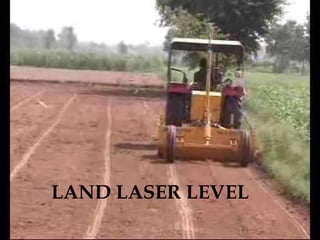
LAND LASER LEVEL
 The concept of a laser level has been around
since at least the early 1970s
 The original spinning-mirror design laser plane
and line level was patented by the late 1980s.
 The compact lens-based laser line level was
patented in the late 1990s.
 Land levelling is a precursor to good
agronomic, soil, and crop management
practices.
 These levelers are implements consisting of a
blade acting as a small bucket for shifting the
soil from higher to the low-lying positions.
 These practices on traditionally leveled or
unlevelled lands lead to water logging
conditions in low-lying areas and soil water
deficit at higher spots.
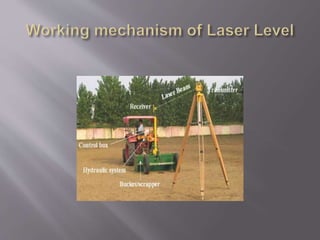
 LLS consists of the following five major
components
 Drag Scrapper or bucket
 Laser transmitter
 Laser receiver
 Control box
 Hydraulic system
 Drag scrapper or Bucket:
 The drag bucket can be either 3-point linkage
mounted on by a tractor.
 It is easier to connect the tractor’s hydraulic
system to an external hydraulic by the 3-point-
linkage system.
 Laser transmitter:
 The laser transmitter mounts on a tripod,
which allows the laser beam to sweep above
the field.
 Laser receiver:
 It is a multi-directional receiver
 That detects the position of the laser reference
plane and transmits this signal to the control
box.
 Control box:
 The control box accepts and processes signals
from the machine mounted receiver.
 It displays these signals to indicate the drag
buckets position relative to the finished grade.
 Hydraulic system:
 The hydraulic system of the tractor is used to
supply oil to raise and lower the leveling
bucket.
 Reduction in time and water for irrigation.
 Uniform distribution of water.
 Less water consumption in land preparation.
 Uniform moisture environment for crops.
 Lesser weeds in the field.
 Good germination and growth of crop.
 Uniformity in crop maturity.
 Reduced seed rate, fertilizers, chemicals and
fuel requirements.
 Saves irrigation water >35 %
 Reduced weed in the field
 Increase in field areas about 3.5 %
 Reduce farm operating time by 10 %
 Assist top soil management
 Saves labor costs
 Saves fuel/electricity used in irrigation
 Increase productivity up to 50 %
The change in our vision of future agriculture in relation to
food and nutritional security, environmental safety and
globalization of markets demands improving
resource-Laser leveling is evidently one of the
ways by which we can address these issues to a
great extent.
land laser levelar

land laser levelar

  • 2.
    FARM MECHANIZATION HAFIZ MAHMOODAHMAD REG. NO. 2015-UAM-205 SEMESTER 3rd (A)
  • 3.
  • 4.
     The conceptof a laser level has been around since at least the early 1970s  The original spinning-mirror design laser plane and line level was patented by the late 1980s.  The compact lens-based laser line level was patented in the late 1990s.  Land levelling is a precursor to good agronomic, soil, and crop management practices.
  • 5.
     These levelersare implements consisting of a blade acting as a small bucket for shifting the soil from higher to the low-lying positions.  These practices on traditionally leveled or unlevelled lands lead to water logging conditions in low-lying areas and soil water deficit at higher spots.
  • 6.
     LLS consistsof the following five major components  Drag Scrapper or bucket  Laser transmitter  Laser receiver  Control box  Hydraulic system
  • 7.
     Drag scrapperor Bucket:  The drag bucket can be either 3-point linkage mounted on by a tractor.  It is easier to connect the tractor’s hydraulic system to an external hydraulic by the 3-point- linkage system.  Laser transmitter:  The laser transmitter mounts on a tripod, which allows the laser beam to sweep above the field.
  • 8.
     Laser receiver: It is a multi-directional receiver  That detects the position of the laser reference plane and transmits this signal to the control box.  Control box:  The control box accepts and processes signals from the machine mounted receiver.  It displays these signals to indicate the drag buckets position relative to the finished grade.
  • 9.
     Hydraulic system: The hydraulic system of the tractor is used to supply oil to raise and lower the leveling bucket.
  • 11.
     Reduction intime and water for irrigation.  Uniform distribution of water.  Less water consumption in land preparation.  Uniform moisture environment for crops.  Lesser weeds in the field.  Good germination and growth of crop.  Uniformity in crop maturity.  Reduced seed rate, fertilizers, chemicals and fuel requirements.
  • 12.
     Saves irrigationwater >35 %  Reduced weed in the field  Increase in field areas about 3.5 %  Reduce farm operating time by 10 %  Assist top soil management  Saves labor costs  Saves fuel/electricity used in irrigation  Increase productivity up to 50 %
  • 13.
    The change inour vision of future agriculture in relation to food and nutritional security, environmental safety and globalization of markets demands improving resource-Laser leveling is evidently one of the ways by which we can address these issues to a great extent.