LAN ARCHITECTURES
2
W H AT A R E L A N A R C H I T E C T U R E S
LAN architecture is basically the overall design of
the Local Area Networking, which comprises of
different devices and hardware designed in such a
way that they can communicate with each other.
And these designs or the series of devices are
called Topologies. The series of devices connected
together to form one network.
That network can be small and big ranging from
home to the large industry.
NETWORK TOPOLOGOES
3
BUS
TREE
STAR
RING
MESH
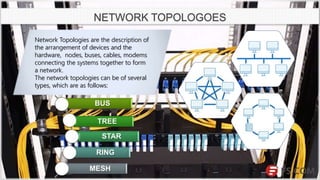
Network Topologies are the description of
the arrangement of devices and the
hardware, nodes, buses, cables, modems
connecting the systems together to form
a network.
The network topologies can be of several
types, which are as follows:
4
BUS TOPOLOGY
1. Cost effective. Easy
to expand joining the
extra cables.
2. It is easy to install
and understand.
1. If main cable fails
whole network goes
down.
2. Cables are
complicated and it is
slow.
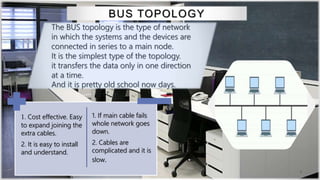
The BUS topology is the type of network
in which the systems and the devices are
connected in series to a main node.
It is the simplest type of the topology.
it transfers the data only in one direction
at a time.
And it is pretty old school now days.
5
STAR TOPOLOGY
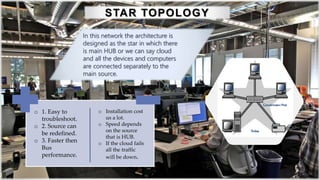
In this network the architecture is
designed as the star in which there
is main HUB or we can say cloud
and all the devices and computers
are connected separately to the
main source.
o Installation cost
us a lot.
o Speed depends
on the source
that is HUB.
o If the cloud fails
all the traffic
will be down.
o 1. Easy to
troubleshoot.
o 2. Source can
be redefined.
o 3. Faster then
Bus
performance.
6
TREE TOPOLOGY
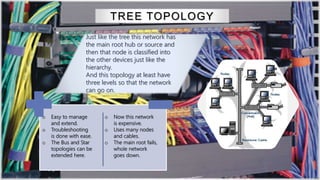
Just like the tree this network has
the main root hub or source and
then that node is classified into
the other devices just like the
hierarchy.
And this topology at least have
three levels so that the network
can go on.
o Easy to manage
and extend.
o Troubleshooting
is done with ease.
o The Bus and Star
topologies can be
extended here.
o Now this network
is expensive.
o Uses many nodes
and cables.
o The main root fails,
whole network
goes down.
7
MESH TOPOLOGY
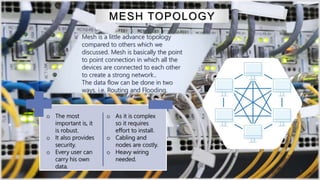
Mesh is a little advance topology
compared to others which we
discussed. Mesh is basically the point
to point connection in which all the
devices are connected to each other
to create a strong network..
The data flow can be done in two
ways. i.e. Routing and Flooding.
o The most
important is, it
is robust.
o It also provides
security.
o Every user can
carry his own
data.
o As it is complex
so it requires
effort to install.
o Cabling and
nodes are costly.
o Heavy wiring
needed.
8
C O N C L U S I O N
In this presentation our main task was to get aware
about the basic LAN Network and to discuss its
architecture. we also did talk about the topologies
which are basically the architectures of any network.
Moreover, these each topology has its own properties
and function and are used accordingly. I was able to
make you understand and clear my point about the
presentation.
9
THANK YOU

LAN ARCHITECTURE (LAN Network Design)

  • 1.
  • 2.
    2 W H ATA R E L A N A R C H I T E C T U R E S LAN architecture is basically the overall design of the Local Area Networking, which comprises of different devices and hardware designed in such a way that they can communicate with each other. And these designs or the series of devices are called Topologies. The series of devices connected together to form one network. That network can be small and big ranging from home to the large industry.
  • 3.
    NETWORK TOPOLOGOES 3 BUS TREE STAR RING MESH Network Topologiesare the description of the arrangement of devices and the hardware, nodes, buses, cables, modems connecting the systems together to form a network. The network topologies can be of several types, which are as follows:
  • 4.
    4 BUS TOPOLOGY 1. Costeffective. Easy to expand joining the extra cables. 2. It is easy to install and understand. 1. If main cable fails whole network goes down. 2. Cables are complicated and it is slow. The BUS topology is the type of network in which the systems and the devices are connected in series to a main node. It is the simplest type of the topology. it transfers the data only in one direction at a time. And it is pretty old school now days.
  • 5.
    5 STAR TOPOLOGY In thisnetwork the architecture is designed as the star in which there is main HUB or we can say cloud and all the devices and computers are connected separately to the main source. o Installation cost us a lot. o Speed depends on the source that is HUB. o If the cloud fails all the traffic will be down. o 1. Easy to troubleshoot. o 2. Source can be redefined. o 3. Faster then Bus performance.
  • 6.
    6 TREE TOPOLOGY Just likethe tree this network has the main root hub or source and then that node is classified into the other devices just like the hierarchy. And this topology at least have three levels so that the network can go on. o Easy to manage and extend. o Troubleshooting is done with ease. o The Bus and Star topologies can be extended here. o Now this network is expensive. o Uses many nodes and cables. o The main root fails, whole network goes down.
  • 7.
    7 MESH TOPOLOGY Mesh isa little advance topology compared to others which we discussed. Mesh is basically the point to point connection in which all the devices are connected to each other to create a strong network.. The data flow can be done in two ways. i.e. Routing and Flooding. o The most important is, it is robust. o It also provides security. o Every user can carry his own data. o As it is complex so it requires effort to install. o Cabling and nodes are costly. o Heavy wiring needed.
  • 8.
    8 C O NC L U S I O N In this presentation our main task was to get aware about the basic LAN Network and to discuss its architecture. we also did talk about the topologies which are basically the architectures of any network. Moreover, these each topology has its own properties and function and are used accordingly. I was able to make you understand and clear my point about the presentation.
  • 9.