Objectives
Identify the main causes of outbreak in the
work zone
Know the different types of samples and
diagnostic tests that can be conducted, based
on the infection dynamics
Review the role of the laboratory coordinated
with surveillance to characterize outbreaks
Content
Most frequent etiologies in the
Americas
Most commonly used tests for
diagnosing etiologic agents
– Serology
– Molecular
– Microscopic
Specimen type, collection, and
conservation
– Examples of type of sample
and appropriate conservation
Most common etiologies
in the Americas
• Febrile syndrome:
– Dengue, Chikungunya, Zika, yellow fever, influenza, leptospirosis, malaria
• Icteric febrile syndrome:
– Yellow fever, leptospirosis, malaria, hepatitis
• Hemorrhagic icteric febrile syndrome:
– Yellow fever, leptospirosis
• Hemorrhagic febrile syndrome:
– Dengue, yellow fever, leptospirosis, hantavirus
• Neurological syndromes:
– Bacterial, viral (Zika and viral encephalitis), polio, botulism
• Respiratory syndromes:
– Influenza, hantavirus, diphtheria and other respiratory viruses
• Acute diarrheic disease:
– Cholera, rotavirus, norovirus, enterobacteria
• Exanthematous disease:
– Zika, measles, rubella
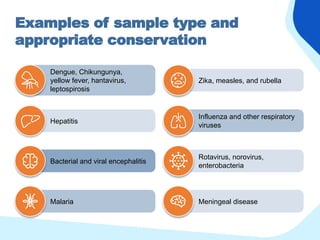
Examples of sample type and
appropriate conservation
Dengue, Chikungunya,
yellow fever, hantavirus,
leptospirosis
Zika, measles, and rubella
Hepatitis
Influenza and other respiratory
viruses
Bacterial and viral encephalitis
Rotavirus, norovirus,
enterobacteria
Malaria Meningeal disease
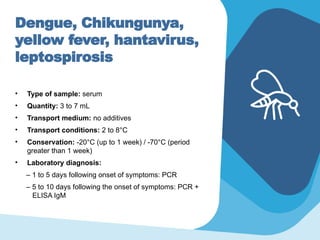
Dengue, Chikungunya,
yellow fever, hantavirus,
leptospirosis
• Type of sample: serum
• Quantity: 3 to 7 mL
• Transport medium: no additives
• Transport conditions: 2 to 8°C
• Conservation: -20°C (up to 1 week) / -70°C (period
greater than 1 week)
• Laboratory diagnosis:
– 1 to 5 days following onset of symptoms: PCR
– 5 to 10 days following the onset of symptoms: PCR +
ELISA IgM
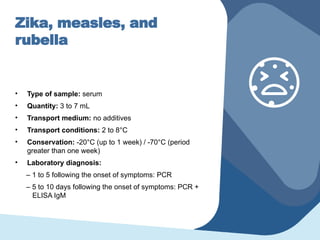
Zika, measles, and
rubella
• Type of sample: serum
• Quantity: 3 to 7 mL
• Transport medium: no additives
• Transport conditions: 2 to 8°C
• Conservation: -20°C (up to 1 week) / -70°C (period
greater than one week)
• Laboratory diagnosis:
– 1 to 5 following the onset of symptoms: PCR
– 5 to 10 days following the onset of symptoms: PCR +
ELISA IgM
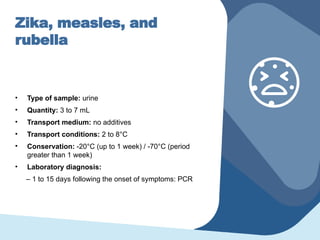
Zika, measles, and
rubella
• Type of sample: urine
• Quantity: 3 to 7 mL
• Transport medium: no additives
• Transport conditions: 2 to 8°C
• Conservation: -20°C (up to 1 week) / -70°C (period
greater than 1 week)
• Laboratory diagnosis:
– 1 to 15 days following the onset of symptoms: PCR
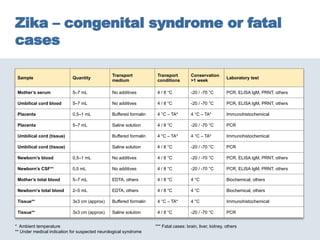
Zika – congenital syndrome or fatal
cases
Sample Quantity
Transport
medium
Transport
conditions
Conservation
>1 week
Laboratory test
Mother’s serum 5–7 mL No additives 4 / 8 °C -20 / -70 °C PCR, ELISA IgM, PRNT, others
Umbilical cord blood 5–7 mL No additives 4 / 8 °C -20 / -70 °C PCR, ELISA IgM, PRNT, others
Placenta 0,5–1 mL Buffered formalin 4 °C – TA* 4 °C – TA* Immunohistochemical
Placenta 5–7 mL Saline solution 4 / 8 °C -20 / -70 °C PCR
Umbilical cord (tissue) Buffered formalin 4 °C – TA* 4 °C – TA* Immunohistochemical
Umbilical cord (tissue) Saline solution 4 / 8 °C -20 / -70 °C PCR
Newborn’s blood 0,5–1 mL No additives 4 / 8 °C -20 / -70 °C PCR, ELISA IgM, PRNT, others
Newborn’s CSF** 0,5 mL No additives 4 / 8 °C -20 / -70 °C PCR, ELISA IgM, PRNT, others
Mother’s total blood 5–7 mL EDTA, others 4 / 8 °C 4 °C Biochemical, others
Newborn’s total blood 2–5 mL EDTA, others 4 / 8 °C 4 °C Biochemical, others
Tissue** 3x3 cm (approx) Buffered formalin 4 °C – TA* 4 °C Immunohistochemical
Tissue** 3x3 cm (approx) Saline solution 4 / 8 °C -20 / -70 °C PCR
* Ambient temperature
** Under medical indication for suspected neurological syndrome
*** Fatal cases: brain, liver, kidney, others
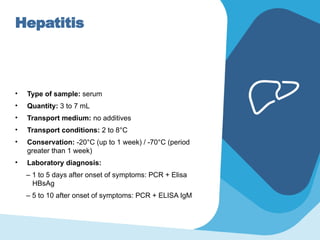
Hepatitis
• Type of sample: serum
• Quantity: 3 to 7 mL
• Transport medium: no additives
• Transport conditions: 2 to 8°C
• Conservation: -20°C (up to 1 week) / -70°C (period
greater than 1 week)
• Laboratory diagnosis:
– 1 to 5 days after onset of symptoms: PCR + Elisa
HBsAg
– 5 to 10 after onset of symptoms: PCR + ELISA IgM
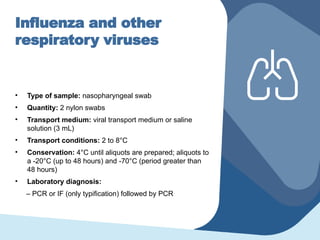
Influenza and other
respiratory viruses
• Type of sample: nasopharyngeal swab
• Quantity: 2 nylon swabs
• Transport medium: viral transport medium or saline
solution (3 mL)
• Transport conditions: 2 to 8°C
• Conservation: 4°C until aliquots are prepared; aliquots to
a -20°C (up to 48 hours) and -70°C (period greater than
48 hours)
• Laboratory diagnosis:
– PCR or IF (only typification) followed by PCR
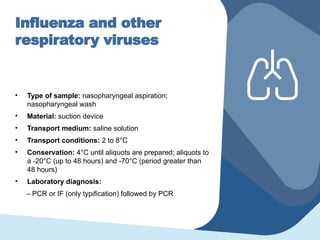
Influenza and other
respiratory viruses
• Type of sample: nasopharyngeal aspiration;
nasopharyngeal wash
• Material: suction device
• Transport medium: saline solution
• Transport conditions: 2 to 8°C
• Conservation: 4°C until aliquots are prepared; aliquots to
a -20°C (up to 48 hours) and -70°C (period greater than
48 hours)
• Laboratory diagnosis:
– PCR or IF (only typification) followed by PCR
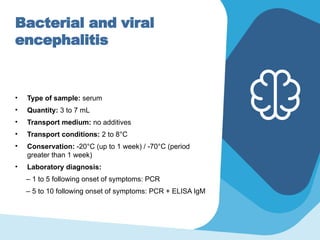
Bacterial and viral
encephalitis
• Type of sample: serum
• Quantity: 3 to 7 mL
• Transport medium: no additives
• Transport conditions: 2 to 8°C
• Conservation: -20°C (up to 1 week) / -70°C (period
greater than 1 week)
• Laboratory diagnosis:
– 1 to 5 following onset of symptoms: PCR
– 5 to 10 following onset of symptoms: PCR + ELISA IgM
Bacterial and viral
encephalitis
• Type of sample: blood
• Quantity: 3 to 7 mL
• Transport medium: no additives
• Transport conditions: 2 to 8°C
• Conservation: -20°C (up to 1 week) / -70°C (period
greater than 1 week)
• Laboratory diagnosis:
– 1 to 5 following onset of symptoms: PCR
– 5 to 10 following onset of symptoms: PCR + ELISA IgM
Rotavirus, norovirus,
enterobacteria
• Type of sample: fecal material
• Conservation: 2 to 8°C
• Laboratory diagnosis:
– Generally, molecular methods are used based
on PCR and ELISA kits for antigen detection
Malaria
• Type of sample: total blood
• Conservation: 2 to 4°C
• Laboratory diagnosis:
– Large drop (extended) for microscopy
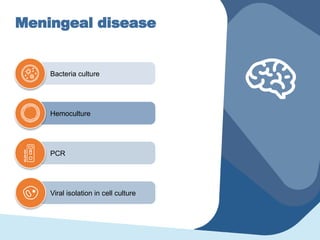
Meningeal disease
Bacteria culture
Hemoculture
PCR
Viral isolation in cell culture
© Pan American Health Organization, 2023
Property of the Pan American Health Organization. Reproduced with permission pursuant to the Creative
Commons Attribution-NonCommercial-NoDerivs 3.0 IGO license (CC BY-NC-ND 3.0 IGO).
In any use of this work, there should be no suggestion that the Pan American Health Organization (PAHO)
endorses any specific organization, product, or service. Use of the PAHO logo, in a way that is not already
incorporated in the work or consistent with the Creative Commons license CC BY-NC-ND 3.0 IGO, is strictly
prohibited. Any use of this work that is inconsistent with or not permitted under the Creative Commons
license BY-NC-ND 3.0 IGO requires the express written consent of PAHO.
Further, all reasonable precautions have been taken by PAHO and the GS/OAS to verify the information
contained in this publication. However, the published material is being distributed without warranty of any
kind, either expressed or implied. The responsibility for the interpretation and use of the material lies with the
reader. In no event shall PAHO and/or the OAS or GS/OAS be liable for damages arising from its use

laboratory testing procedure for medicine.pptx

  • 1.
    Objectives Identify the maincauses of outbreak in the work zone Know the different types of samples and diagnostic tests that can be conducted, based on the infection dynamics Review the role of the laboratory coordinated with surveillance to characterize outbreaks
  • 2.
    Content Most frequent etiologiesin the Americas Most commonly used tests for diagnosing etiologic agents – Serology – Molecular – Microscopic Specimen type, collection, and conservation – Examples of type of sample and appropriate conservation
  • 3.
    Most common etiologies inthe Americas • Febrile syndrome: – Dengue, Chikungunya, Zika, yellow fever, influenza, leptospirosis, malaria • Icteric febrile syndrome: – Yellow fever, leptospirosis, malaria, hepatitis • Hemorrhagic icteric febrile syndrome: – Yellow fever, leptospirosis • Hemorrhagic febrile syndrome: – Dengue, yellow fever, leptospirosis, hantavirus • Neurological syndromes: – Bacterial, viral (Zika and viral encephalitis), polio, botulism • Respiratory syndromes: – Influenza, hantavirus, diphtheria and other respiratory viruses • Acute diarrheic disease: – Cholera, rotavirus, norovirus, enterobacteria • Exanthematous disease: – Zika, measles, rubella
  • 4.
    Examples of sampletype and appropriate conservation Dengue, Chikungunya, yellow fever, hantavirus, leptospirosis Zika, measles, and rubella Hepatitis Influenza and other respiratory viruses Bacterial and viral encephalitis Rotavirus, norovirus, enterobacteria Malaria Meningeal disease
  • 5.
    Dengue, Chikungunya, yellow fever,hantavirus, leptospirosis • Type of sample: serum • Quantity: 3 to 7 mL • Transport medium: no additives • Transport conditions: 2 to 8°C • Conservation: -20°C (up to 1 week) / -70°C (period greater than 1 week) • Laboratory diagnosis: – 1 to 5 days following onset of symptoms: PCR – 5 to 10 days following the onset of symptoms: PCR + ELISA IgM
  • 6.
    Zika, measles, and rubella •Type of sample: serum • Quantity: 3 to 7 mL • Transport medium: no additives • Transport conditions: 2 to 8°C • Conservation: -20°C (up to 1 week) / -70°C (period greater than one week) • Laboratory diagnosis: – 1 to 5 following the onset of symptoms: PCR – 5 to 10 days following the onset of symptoms: PCR + ELISA IgM
  • 7.
    Zika, measles, and rubella •Type of sample: urine • Quantity: 3 to 7 mL • Transport medium: no additives • Transport conditions: 2 to 8°C • Conservation: -20°C (up to 1 week) / -70°C (period greater than 1 week) • Laboratory diagnosis: – 1 to 15 days following the onset of symptoms: PCR
  • 8.
    Zika – congenitalsyndrome or fatal cases Sample Quantity Transport medium Transport conditions Conservation >1 week Laboratory test Mother’s serum 5–7 mL No additives 4 / 8 °C -20 / -70 °C PCR, ELISA IgM, PRNT, others Umbilical cord blood 5–7 mL No additives 4 / 8 °C -20 / -70 °C PCR, ELISA IgM, PRNT, others Placenta 0,5–1 mL Buffered formalin 4 °C – TA* 4 °C – TA* Immunohistochemical Placenta 5–7 mL Saline solution 4 / 8 °C -20 / -70 °C PCR Umbilical cord (tissue) Buffered formalin 4 °C – TA* 4 °C – TA* Immunohistochemical Umbilical cord (tissue) Saline solution 4 / 8 °C -20 / -70 °C PCR Newborn’s blood 0,5–1 mL No additives 4 / 8 °C -20 / -70 °C PCR, ELISA IgM, PRNT, others Newborn’s CSF** 0,5 mL No additives 4 / 8 °C -20 / -70 °C PCR, ELISA IgM, PRNT, others Mother’s total blood 5–7 mL EDTA, others 4 / 8 °C 4 °C Biochemical, others Newborn’s total blood 2–5 mL EDTA, others 4 / 8 °C 4 °C Biochemical, others Tissue** 3x3 cm (approx) Buffered formalin 4 °C – TA* 4 °C Immunohistochemical Tissue** 3x3 cm (approx) Saline solution 4 / 8 °C -20 / -70 °C PCR * Ambient temperature ** Under medical indication for suspected neurological syndrome *** Fatal cases: brain, liver, kidney, others
  • 9.
    Hepatitis • Type ofsample: serum • Quantity: 3 to 7 mL • Transport medium: no additives • Transport conditions: 2 to 8°C • Conservation: -20°C (up to 1 week) / -70°C (period greater than 1 week) • Laboratory diagnosis: – 1 to 5 days after onset of symptoms: PCR + Elisa HBsAg – 5 to 10 after onset of symptoms: PCR + ELISA IgM
  • 10.
    Influenza and other respiratoryviruses • Type of sample: nasopharyngeal swab • Quantity: 2 nylon swabs • Transport medium: viral transport medium or saline solution (3 mL) • Transport conditions: 2 to 8°C • Conservation: 4°C until aliquots are prepared; aliquots to a -20°C (up to 48 hours) and -70°C (period greater than 48 hours) • Laboratory diagnosis: – PCR or IF (only typification) followed by PCR
  • 11.
    Influenza and other respiratoryviruses • Type of sample: nasopharyngeal aspiration; nasopharyngeal wash • Material: suction device • Transport medium: saline solution • Transport conditions: 2 to 8°C • Conservation: 4°C until aliquots are prepared; aliquots to a -20°C (up to 48 hours) and -70°C (period greater than 48 hours) • Laboratory diagnosis: – PCR or IF (only typification) followed by PCR
  • 12.
    Bacterial and viral encephalitis •Type of sample: serum • Quantity: 3 to 7 mL • Transport medium: no additives • Transport conditions: 2 to 8°C • Conservation: -20°C (up to 1 week) / -70°C (period greater than 1 week) • Laboratory diagnosis: – 1 to 5 following onset of symptoms: PCR – 5 to 10 following onset of symptoms: PCR + ELISA IgM
  • 13.
    Bacterial and viral encephalitis •Type of sample: blood • Quantity: 3 to 7 mL • Transport medium: no additives • Transport conditions: 2 to 8°C • Conservation: -20°C (up to 1 week) / -70°C (period greater than 1 week) • Laboratory diagnosis: – 1 to 5 following onset of symptoms: PCR – 5 to 10 following onset of symptoms: PCR + ELISA IgM
  • 14.
    Rotavirus, norovirus, enterobacteria • Typeof sample: fecal material • Conservation: 2 to 8°C • Laboratory diagnosis: – Generally, molecular methods are used based on PCR and ELISA kits for antigen detection
  • 15.
    Malaria • Type ofsample: total blood • Conservation: 2 to 4°C • Laboratory diagnosis: – Large drop (extended) for microscopy
  • 16.
  • 17.
    © Pan AmericanHealth Organization, 2023 Property of the Pan American Health Organization. Reproduced with permission pursuant to the Creative Commons Attribution-NonCommercial-NoDerivs 3.0 IGO license (CC BY-NC-ND 3.0 IGO). In any use of this work, there should be no suggestion that the Pan American Health Organization (PAHO) endorses any specific organization, product, or service. Use of the PAHO logo, in a way that is not already incorporated in the work or consistent with the Creative Commons license CC BY-NC-ND 3.0 IGO, is strictly prohibited. Any use of this work that is inconsistent with or not permitted under the Creative Commons license BY-NC-ND 3.0 IGO requires the express written consent of PAHO. Further, all reasonable precautions have been taken by PAHO and the GS/OAS to verify the information contained in this publication. However, the published material is being distributed without warranty of any kind, either expressed or implied. The responsibility for the interpretation and use of the material lies with the reader. In no event shall PAHO and/or the OAS or GS/OAS be liable for damages arising from its use