FEVER AND FEBRILE SYNDROMES
DR. AKSHAYA
PHYSIOLOGY OF TEMPERATURE
REGULATION
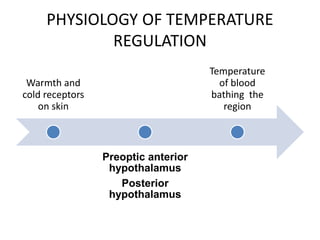
Warmth and
cold receptors
on skin
Preoptic anterior
hypothalamus
Posterior
hypothalamus
Temperature
of blood
bathing the
region
PHYSIOLOGY OF TEMPERATURE
REGULATION
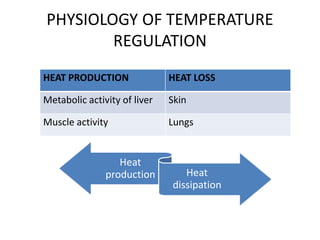
Heat
production Heat
dissipation
HEAT PRODUCTION HEAT LOSS
Metabolic activity of liver Skin
Muscle activity Lungs
PHYSIOLOGY OF TEMPERATURE
REGULATION
• Normal daily variation in temperature – 0.5°C/1.0°F
• Diurnal variation: lowest at 6 am and maximum
between 4 and 6 pm
• Seasonal variation: low during summer
• Rectal > oral > axillary temperature
• Menstrual cycle: lower in the 2 weeks prior to
ovulation and rises during ovulation till menstruation
PATHOGENESIS OF FEVER
• Rise in hypothalamic set point.
• A temperature of >37.7°C (>99.9°F) defines a
fever.
• Rise in set point – heat conservation
(vasoconstriction) and heat production
(shivering and increased nonshivering
thermogenesis)
• Reset in set point – vasodilation and sweating
PATHOGENESIS OF FEVER
1. Crisis: Immediately temperature returns to
baseline eg. Pneumonia, sepsis, dengue
2. Lysis: temperature goes back slowly in step
ladder fashion over days eg. Uncomplicated
typhoid fever
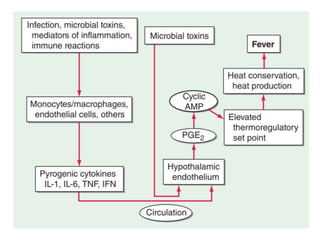
PYROGENS
• Substances that cause fever
• Exogenous pyrogens: microbial products, toxins
and whole microorganisms eg. LPS of gram-
negative bacteria
• Pyrogenic cytokines: IL-1, IL-6, TNF, ciliary
neurotrophic factor, IFN-α
FEVER vs HYPERTHERMIA
• A fever of >41.5°C (106.7°F) is called hyperpyrexia.
• Hypothalamic fever – local trauma, hemorrhage,
tumor or intrinsic hypothalamic malfunction.
• Hyperthermia – setting of hypothalamic set point
is unchanged; does not respond to antipyretics.
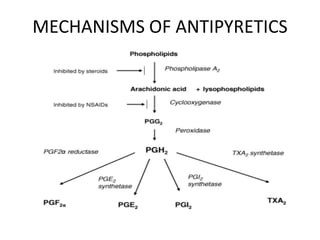
MECHANISMS OF ANTIPYRETICS
ALARMING FEATURES
• PR >120/min
• SpO2 <92%
• Temp >41.5°C
• Altered sensorium/seizures/severe headache
• Cold extremities/hypotension
• Dyspnea/tachypnea/cyanosis
• Profuse diarrhea/severe abdominal
pain/dehydration/recurrent vomiting
• Decreased urine output
• Bleeding manifestations
• Muscle paralysis
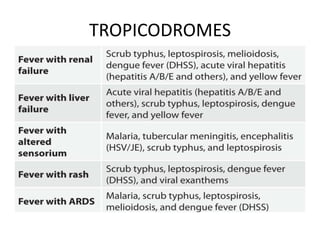
TROPICODROMES
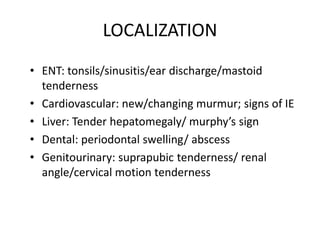
LOCALIZATION
• ENT: tonsils/sinusitis/ear discharge/mastoid
tenderness
• Cardiovascular: new/changing murmur; signs of IE
• Liver: Tender hepatomegaly/ murphy’s sign
• Dental: periodontal swelling/ abscess
• Genitourinary: suprapubic tenderness/ renal
angle/cervical motion tenderness
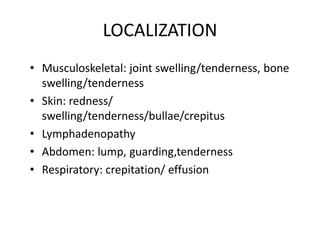
LOCALIZATION
• Musculoskeletal: joint swelling/tenderness, bone
swelling/tenderness
• Skin: redness/
swelling/tenderness/bullae/crepitus
• Lymphadenopathy
• Abdomen: lump, guarding,tenderness
• Respiratory: crepitation/ effusion
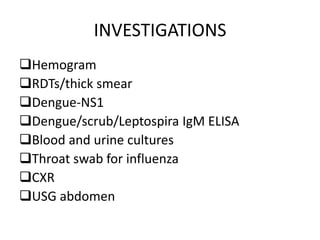
INVESTIGATIONS
Hemogram
RDTs/thick smear
Dengue-NS1
Dengue/scrub/Leptospira IgM ELISA
Blood and urine cultures
Throat swab for influenza
CXR
USG abdomen
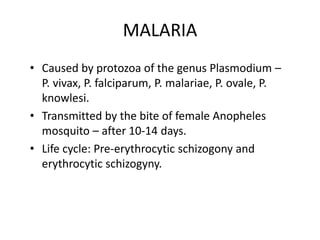
MALARIA
• Caused by protozoa of the genus Plasmodium –
P. vivax, P. falciparum, P. malariae, P. ovale, P.
knowlesi.
• Transmitted by the bite of female Anopheles
mosquito – after 10-14 days.
• Life cycle: Pre-erythrocytic schizogony and
erythrocytic schizogyny.
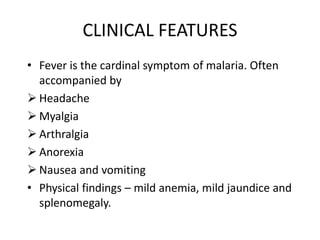
CLINICAL FEATURES
• Fever is the cardinal symptom of malaria. Often
accompanied by
 Headache
 Myalgia
 Arthralgia
 Anorexia
 Nausea and vomiting
• Physical findings – mild anemia, mild jaundice and
splenomegaly.
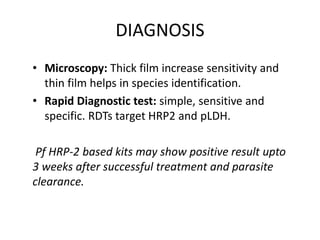
DIAGNOSIS
• Microscopy: Thick film increase sensitivity and
thin film helps in species identification.
• Rapid Diagnostic test: simple, sensitive and
specific. RDTs target HRP2 and pLDH.
Pf HRP-2 based kits may show positive result upto
3 weeks after successful treatment and parasite
clearance.
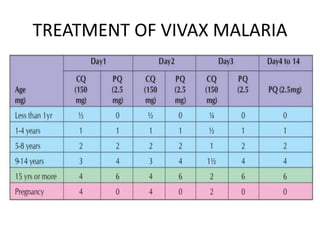
TREATMENT OF VIVAX MALARIA
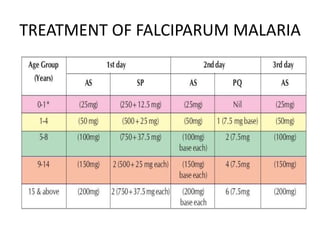
TREATMENT OF FALCIPARUM MALARIA
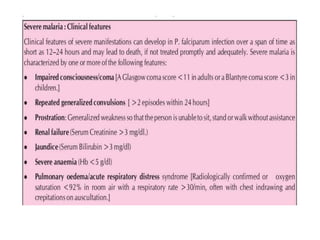
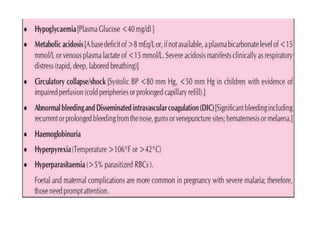
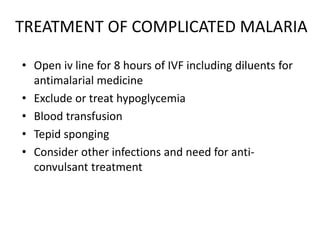
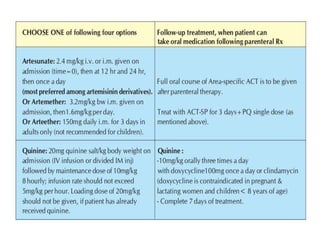
TREATMENT OF COMPLICATED MALARIA
• Open iv line for 8 hours of IVF including diluents for
antimalarial medicine
• Exclude or treat hypoglycemia
• Blood transfusion
• Tepid sponging
• Consider other infections and need for anti-
convulsant treatment
ENTERIC FEVER
• Systemic disease characterized by fever and
abdominal pain and caused by dissemination of
S. typhi or S. paratyphi
• No known hosts other than humans.
• Most commonly, food-borne or waterborne
transmission results from fecal contamination by
ill or asymptomatic chronic carriers
ENTERIC FEVER
• Incubation period is about 5-21 days.
• First week: “stepwise” fever and relative
bradycardia
• Second week: abdominal pain and rose spots
• Third week: Hepatosplenomegaly, intestinal
perforation or bleeding leading to peritonitis
ENTERIC FEVER
• Definitive diagnosis: isolation of S. typhi or S.
paratyphi from blood, bone marrow or other
sterile sites such as rose spots, stool or intestinal
secretions
• Serological tests include Widal and Typhidot IgM
Widal agglutination test is considered to be positive
if a four-fold or greater increase in titer in paired
samples of acute and convalescent sera is
documented
ENTERIC FEVER
• Ceftriaxone and high-dose azithromycin remain
the main drugs for the treatment of enteric fever
• Chronic carriers – oral amoxicillin, ciprofloxacin,
norfloxacin or TMP-SMX for 4-6 weeks
• Vaccines – Ty21a on days 1,3,5 and 7 with a
booster every 5 years; Vi polysaccharide
parenteral vaccine given in a single dose with a
booster every 2 years
DENGUE
• A major public health concern.
• Upsurge in cases during the period July –
November in India.
• Transmitted by Aedes aegypti and Aedes
albopictus.
• IP – 5 to 7 days
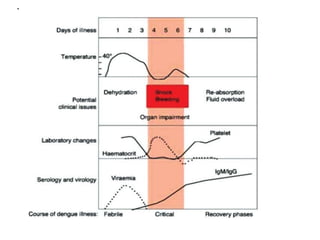
COURSE OF DENGUE ILLNESS
• FEBRILE PHASE
• CRITICAL PHASE
• RECOVERY PHASE
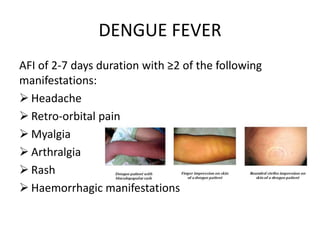
DENGUE FEVER
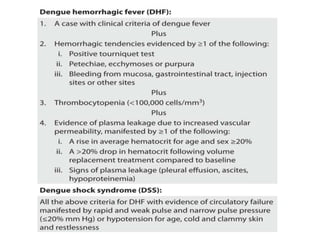
AFI of 2-7 days duration with ≥2 of the following
manifestations:
 Headache
 Retro-orbital pain
 Myalgia
 Arthralgia
 Rash
 Haemorrhagic manifestations
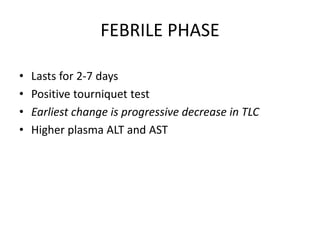
FEBRILE PHASE
• Lasts for 2-7 days
• Positive tourniquet test
• Earliest change is progressive decrease in TLC
• Higher plasma ALT and AST
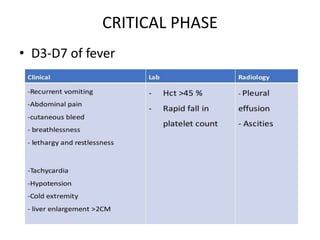
CRITICAL PHASE
• D3-D7 of fever
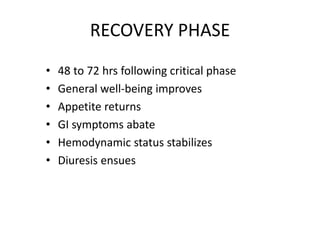
RECOVERY PHASE
• 48 to 72 hrs following critical phase
• General well-being improves
• Appetite returns
• GI symptoms abate
• Hemodynamic status stabilizes
• Diuresis ensues
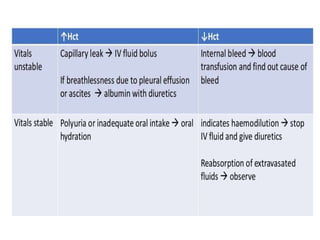
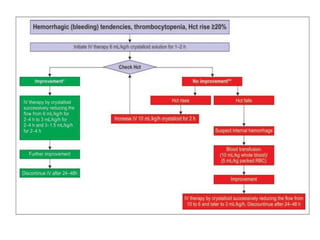
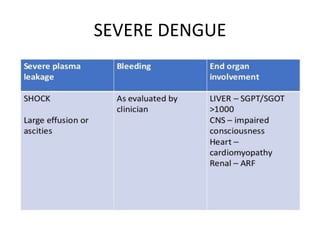
SEVERE DENGUE
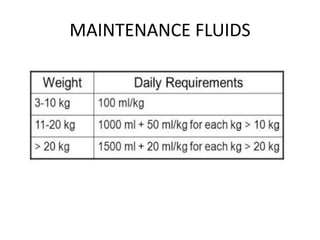
MAINTENANCE FLUIDS
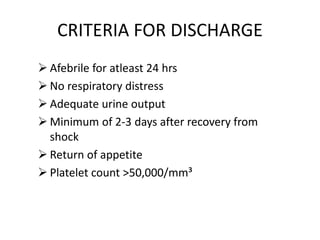
CRITERIA FOR DISCHARGE
 Afebrile for atleast 24 hrs
 No respiratory distress
 Adequate urine output
 Minimum of 2-3 days after recovery from
shock
 Return of appetite
 Platelet count >50,000/mm³
LEPTOSPIROSIS
• Global public health problem.
• Peak incidence in summer and epidemics
following unusually heavy rainfall and
monsoons.
• Humans get infected through indirect contact
with water or soil contaminated by the urine of
infected animals.
LEPTOSPIROSIS
o IP – 2 to 26 days
o Mild leptospirosis:
 Flu-like illness with fever, nausea, vomiting,
abdominal pain, conjunctival suffusion
 Severe headache and myalgia
 Spontaneous resolution in 7 – 10 days
LEPTOSPIROSIS
o Severe Leptospirosis:
 Renal insufficiency
 Hepatic dysfunction
 Hemorrhage
 Myocarditis
 High mortality
Triad of hemorrhage, jaundice and AKI – “Weil’s
syndrome”
LEPTOSPIROSIS
• Diagnosis: Direct detection of organisms or
serology
• Assays include MAT, IHA and ELISA
• Definitive diagnosis – isolation of the organism,
positive result in the PCR, seroconversion, rise
in antibody titer (four-fold or greater rise)
LEPTOSPIROSIS
• Severe cases – iv penicillin or Ceftriaxone or
Doxycycline
• Mild cases – oral doxycycline, azithromycin,
ampicillin or amoxicillin
• Preventive measures:
 Avoidance of exposure to urine and tissues from
infected animals through protective equipment
 Rodent control strategies
SCRUB TYPHUS
• Causative organism, Orientia tsutsugamushi,
obligate intracellular gram-negative bacterium
• India: kato, karp serotypes
• Transmitted to humans by trombiculid mites –
chiggers (Leptotrombidium)
• Most cases occur between August and February
SCRUB TYPHUS
• IP is 5 -20 days
• Fever, myalgia, headache, generalized
lymphadenopathy, GI symptoms, cough, transient
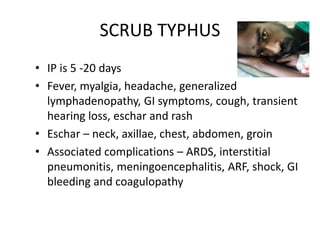
hearing loss, eschar and rash
• Eschar – neck, axillae, chest, abdomen, groin
• Associated complications – ARDS, interstitial
pneumonitis, meningoencephalitis, ARF, shock, GI
bleeding and coagulopathy
SCRUB TYPHUS
• Thrombocytopenia, leukopenia or leukocytosis,
elevations in hepatic enzymes, bilirubin and
creatinine
• Weil-Felix test: lacks sensitivity and specificity
• IgM ELISA against a recombinant 56 kDa protein
– reliable method for early detection of scrub
typhus
SCRUB TYPHUS
• DOC – Doxycycline
• Alternatives – Azithromycin, rifampicin,
chloramphenicol
THANK YOU

FEVER_AND_FEBRILE_SYNDROMESTROPICAL.pptx

  • 1.
    FEVER AND FEBRILESYNDROMES DR. AKSHAYA
  • 2.
    PHYSIOLOGY OF TEMPERATURE REGULATION Warmthand cold receptors on skin Preoptic anterior hypothalamus Posterior hypothalamus Temperature of blood bathing the region
  • 3.
    PHYSIOLOGY OF TEMPERATURE REGULATION Heat productionHeat dissipation HEAT PRODUCTION HEAT LOSS Metabolic activity of liver Skin Muscle activity Lungs
  • 4.
    PHYSIOLOGY OF TEMPERATURE REGULATION •Normal daily variation in temperature – 0.5°C/1.0°F • Diurnal variation: lowest at 6 am and maximum between 4 and 6 pm • Seasonal variation: low during summer • Rectal > oral > axillary temperature • Menstrual cycle: lower in the 2 weeks prior to ovulation and rises during ovulation till menstruation
  • 5.
    PATHOGENESIS OF FEVER •Rise in hypothalamic set point. • A temperature of >37.7°C (>99.9°F) defines a fever. • Rise in set point – heat conservation (vasoconstriction) and heat production (shivering and increased nonshivering thermogenesis) • Reset in set point – vasodilation and sweating
  • 6.
    PATHOGENESIS OF FEVER 1.Crisis: Immediately temperature returns to baseline eg. Pneumonia, sepsis, dengue 2. Lysis: temperature goes back slowly in step ladder fashion over days eg. Uncomplicated typhoid fever
  • 7.
    PYROGENS • Substances thatcause fever • Exogenous pyrogens: microbial products, toxins and whole microorganisms eg. LPS of gram- negative bacteria • Pyrogenic cytokines: IL-1, IL-6, TNF, ciliary neurotrophic factor, IFN-α
  • 9.
    FEVER vs HYPERTHERMIA •A fever of >41.5°C (106.7°F) is called hyperpyrexia. • Hypothalamic fever – local trauma, hemorrhage, tumor or intrinsic hypothalamic malfunction. • Hyperthermia – setting of hypothalamic set point is unchanged; does not respond to antipyretics.
  • 11.
  • 12.
    ALARMING FEATURES • PR>120/min • SpO2 <92% • Temp >41.5°C • Altered sensorium/seizures/severe headache • Cold extremities/hypotension • Dyspnea/tachypnea/cyanosis • Profuse diarrhea/severe abdominal pain/dehydration/recurrent vomiting • Decreased urine output • Bleeding manifestations • Muscle paralysis
  • 13.
  • 14.
    LOCALIZATION • ENT: tonsils/sinusitis/eardischarge/mastoid tenderness • Cardiovascular: new/changing murmur; signs of IE • Liver: Tender hepatomegaly/ murphy’s sign • Dental: periodontal swelling/ abscess • Genitourinary: suprapubic tenderness/ renal angle/cervical motion tenderness
  • 15.
    LOCALIZATION • Musculoskeletal: jointswelling/tenderness, bone swelling/tenderness • Skin: redness/ swelling/tenderness/bullae/crepitus • Lymphadenopathy • Abdomen: lump, guarding,tenderness • Respiratory: crepitation/ effusion
  • 16.
    INVESTIGATIONS Hemogram RDTs/thick smear Dengue-NS1 Dengue/scrub/Leptospira IgMELISA Blood and urine cultures Throat swab for influenza CXR USG abdomen
  • 17.
    MALARIA • Caused byprotozoa of the genus Plasmodium – P. vivax, P. falciparum, P. malariae, P. ovale, P. knowlesi. • Transmitted by the bite of female Anopheles mosquito – after 10-14 days. • Life cycle: Pre-erythrocytic schizogony and erythrocytic schizogyny.
  • 18.
    CLINICAL FEATURES • Feveris the cardinal symptom of malaria. Often accompanied by  Headache  Myalgia  Arthralgia  Anorexia  Nausea and vomiting • Physical findings – mild anemia, mild jaundice and splenomegaly.
  • 21.
    DIAGNOSIS • Microscopy: Thickfilm increase sensitivity and thin film helps in species identification. • Rapid Diagnostic test: simple, sensitive and specific. RDTs target HRP2 and pLDH. Pf HRP-2 based kits may show positive result upto 3 weeks after successful treatment and parasite clearance.
  • 22.
  • 23.
  • 24.
    TREATMENT OF COMPLICATEDMALARIA • Open iv line for 8 hours of IVF including diluents for antimalarial medicine • Exclude or treat hypoglycemia • Blood transfusion • Tepid sponging • Consider other infections and need for anti- convulsant treatment
  • 26.
    ENTERIC FEVER • Systemicdisease characterized by fever and abdominal pain and caused by dissemination of S. typhi or S. paratyphi • No known hosts other than humans. • Most commonly, food-borne or waterborne transmission results from fecal contamination by ill or asymptomatic chronic carriers
  • 27.
    ENTERIC FEVER • Incubationperiod is about 5-21 days. • First week: “stepwise” fever and relative bradycardia • Second week: abdominal pain and rose spots • Third week: Hepatosplenomegaly, intestinal perforation or bleeding leading to peritonitis
  • 28.
    ENTERIC FEVER • Definitivediagnosis: isolation of S. typhi or S. paratyphi from blood, bone marrow or other sterile sites such as rose spots, stool or intestinal secretions • Serological tests include Widal and Typhidot IgM Widal agglutination test is considered to be positive if a four-fold or greater increase in titer in paired samples of acute and convalescent sera is documented
  • 29.
    ENTERIC FEVER • Ceftriaxoneand high-dose azithromycin remain the main drugs for the treatment of enteric fever • Chronic carriers – oral amoxicillin, ciprofloxacin, norfloxacin or TMP-SMX for 4-6 weeks • Vaccines – Ty21a on days 1,3,5 and 7 with a booster every 5 years; Vi polysaccharide parenteral vaccine given in a single dose with a booster every 2 years
  • 30.
    DENGUE • A majorpublic health concern. • Upsurge in cases during the period July – November in India. • Transmitted by Aedes aegypti and Aedes albopictus. • IP – 5 to 7 days
  • 32.
    COURSE OF DENGUEILLNESS • FEBRILE PHASE • CRITICAL PHASE • RECOVERY PHASE
  • 33.
    DENGUE FEVER AFI of2-7 days duration with ≥2 of the following manifestations:  Headache  Retro-orbital pain  Myalgia  Arthralgia  Rash  Haemorrhagic manifestations
  • 34.
    FEBRILE PHASE • Lastsfor 2-7 days • Positive tourniquet test • Earliest change is progressive decrease in TLC • Higher plasma ALT and AST
  • 35.
  • 36.
    RECOVERY PHASE • 48to 72 hrs following critical phase • General well-being improves • Appetite returns • GI symptoms abate • Hemodynamic status stabilizes • Diuresis ensues
  • 38.
  • 41.
  • 42.
    CRITERIA FOR DISCHARGE Afebrile for atleast 24 hrs  No respiratory distress  Adequate urine output  Minimum of 2-3 days after recovery from shock  Return of appetite  Platelet count >50,000/mm³
  • 43.
    LEPTOSPIROSIS • Global publichealth problem. • Peak incidence in summer and epidemics following unusually heavy rainfall and monsoons. • Humans get infected through indirect contact with water or soil contaminated by the urine of infected animals.
  • 44.
    LEPTOSPIROSIS o IP –2 to 26 days o Mild leptospirosis:  Flu-like illness with fever, nausea, vomiting, abdominal pain, conjunctival suffusion  Severe headache and myalgia  Spontaneous resolution in 7 – 10 days
  • 45.
    LEPTOSPIROSIS o Severe Leptospirosis: Renal insufficiency  Hepatic dysfunction  Hemorrhage  Myocarditis  High mortality Triad of hemorrhage, jaundice and AKI – “Weil’s syndrome”
  • 46.
    LEPTOSPIROSIS • Diagnosis: Directdetection of organisms or serology • Assays include MAT, IHA and ELISA • Definitive diagnosis – isolation of the organism, positive result in the PCR, seroconversion, rise in antibody titer (four-fold or greater rise)
  • 47.
    LEPTOSPIROSIS • Severe cases– iv penicillin or Ceftriaxone or Doxycycline • Mild cases – oral doxycycline, azithromycin, ampicillin or amoxicillin • Preventive measures:  Avoidance of exposure to urine and tissues from infected animals through protective equipment  Rodent control strategies
  • 48.
    SCRUB TYPHUS • Causativeorganism, Orientia tsutsugamushi, obligate intracellular gram-negative bacterium • India: kato, karp serotypes • Transmitted to humans by trombiculid mites – chiggers (Leptotrombidium) • Most cases occur between August and February
  • 49.
    SCRUB TYPHUS • IPis 5 -20 days • Fever, myalgia, headache, generalized lymphadenopathy, GI symptoms, cough, transient hearing loss, eschar and rash • Eschar – neck, axillae, chest, abdomen, groin • Associated complications – ARDS, interstitial pneumonitis, meningoencephalitis, ARF, shock, GI bleeding and coagulopathy
  • 50.
    SCRUB TYPHUS • Thrombocytopenia,leukopenia or leukocytosis, elevations in hepatic enzymes, bilirubin and creatinine • Weil-Felix test: lacks sensitivity and specificity • IgM ELISA against a recombinant 56 kDa protein – reliable method for early detection of scrub typhus
  • 51.
    SCRUB TYPHUS • DOC– Doxycycline • Alternatives – Azithromycin, rifampicin, chloramphenicol
  • 52.