Jerusalem Institute for Israel Studies www.jiis.org
May, 2015
Meir Kraus
Jerusalem Institute
for Israel Studies
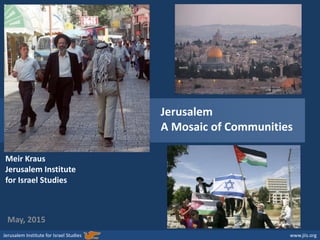
Jerusalem
A Mosaic of Communities
Jerusalem Institute for Israel Studies www.jiis.org
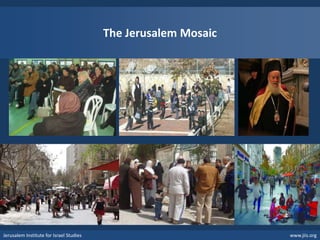
The Jerusalem Mosaic
Jerusalem Institute for Israel Studies www.jiis.org
3
Society and Demography
Key Population Figures
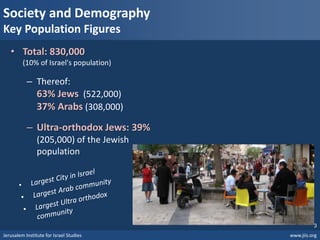
• Total: 830,000
(10% of Israel's population)
– Thereof:
63% Jews (522,000)
37% Arabs (308,000)
– Ultra-orthodox Jews: 39%
(205,000) of the Jewish
population
Jerusalem Institute for Israel Studies www.jiis.org
4
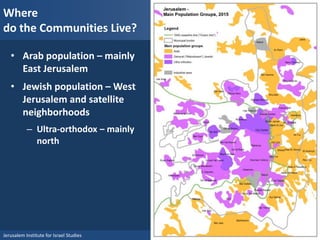
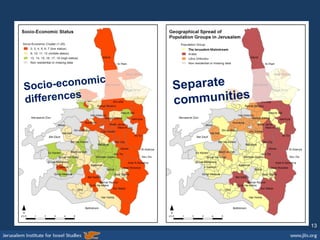
Where
do the Communities Live?
• Arab population – mainly
East Jerusalem
• Jewish population – West
Jerusalem and satellite
neighborhoods
– Ultra-orthodox – mainly
north
Jerusalem Institute for Israel Studies www.jiis.org
5
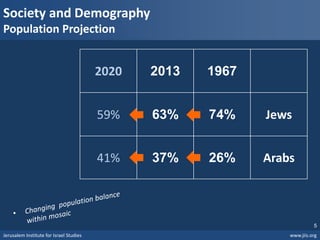
Society and Demography
Population Projection
196720132020
Jews74%63%59%
Arabs26%37%41%
Jerusalem Institute for Israel Studies www.jiis.org
6
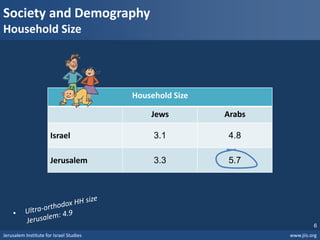
Society and Demography
Household Size
Household Size
Jews Arabs
Israel 3.1 4.8
Jerusalem 3.3 5.7
Jerusalem Institute for Israel Studies www.jiis.org
7
0% 10% 20% 30% 40%
0-14
65+
Percent of population
Agegroup
Age Groups in Jerusalem and Tel Aviv
Jerusalem
Tel Aviv
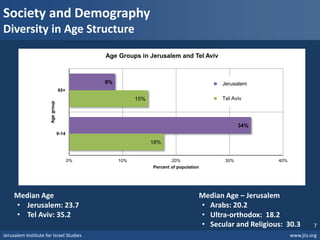
Society and Demography
Diversity in Age Structure
Median Age – Jerusalem
• Arabs: 20.2
• Ultra-orthodox: 18.2
• Secular and Religious: 30.3
18%
15%
34%
9%
0% 10% 20% 30% 40%
0-14
65+
Percent of population
Agegroup
Age Groups in Jerusalem and Tel Aviv
Jerusalem
Tel Aviv
Median Age
• Jerusalem: 23.7
• Tel Aviv: 35.2
Jerusalem Institute for Israel Studies www.jiis.org
8
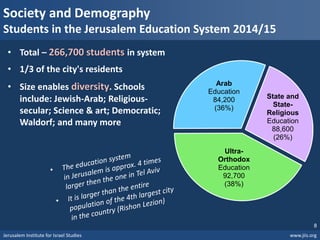
Society and Demography
Students in the Jerusalem Education System 2014/15
• Total – 266,700 students in system
• 1/3 of the city's residents
• Size enables diversity. Schools
include: Jewish-Arab; Religious-
secular; Science & art; Democratic;
Waldorf; and many more
State and
State-
Religious
Education
88,600
(26%)
Ultra-
Orthodox
Education
92,700
(38%)
Arab
Education
84,200
(36%)
Jerusalem Institute for Israel Studies www.jiis.org
9
Society and Demography
Trends in Education
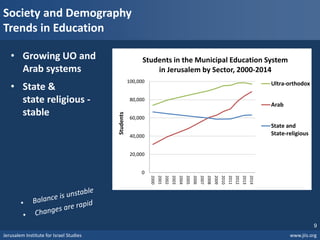
• Growing UO and
Arab systems
• State &
state religious -
stable
0
20,000
40,000
60,000
80,000
100,000
2000
2001
2002
2003
2004
2005
2006
2007
2008
2009
2010
2011
2012
2013
2014
Students
Students in The Municipal Education System
in Jerusalem by Sector, 2000-2014
Ultra-orthodox
Arab
State and
State-religious
0
20,000
40,000
60,000
80,000
100,000
2000
2001
2002
2003
2004
2005
2006
2007
2008
2009
2010
2011
2012
2013
2014
Students
Students in the Municipal Education System
in Jerusalem by Sector, 2000-2014
Ultra-orthodox
Arab
State and
State-religious
Jerusalem Institute for Israel Studies www.jiis.org
10
Society and Demography
Migration
JLM
Jerusalem Institute for Israel Studies www.jiis.org
11
Economy
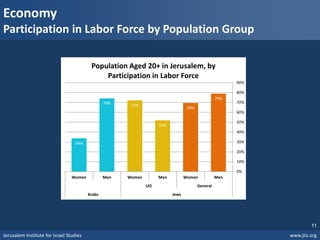
Participation in Labor Force by Population Group
79%
69%
52%
72%74%
34%
0%
10%
20%
30%
40%
50%
60%
70%
80%
90%
MenWomenMenWomenMenWomen
GeneralUO
JewsArabs
Population Aged 20+ in Jerusalem, by
Participation in Labor Force
Jerusalem Institute for Israel Studies www.jiis.org
12
27%
76%
14%
52%
Jews Arabs
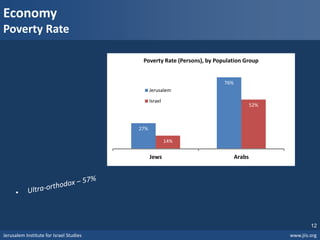
Poverty Rate (Persons), by Population Group
Jerusalem
Israel
Economy
Poverty Rate
27%
76%
14%
52%
Jews Arabs
Poverty Rate (Persons), by Population Group
Jerusalem
Israel
Jerusalem Institute for Israel Studies www.jiis.org
13
The Jerusalem Mainstream
Jerusalem Institute for Israel Studies www.jiis.org
14
Society and Demography
Diversity in Religiousness
10%
2%
22%
26%
60%
63%
8%
9%
0 10 20 30 40 50 60 70 80 90 100
Israel
Jerusalem
Percent of population aged 20 and over
Muslim Population Aged 20 and over
in Israel and in Jerusalem, 2011-2013
Non-religious Loosely religiously observant
Religiously observant Very religiously observant
Jerusalem Institute for Israel Studies www.jiis.org
15
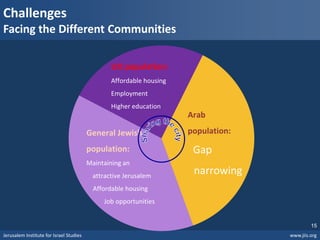
Challenges
Facing the Different Communities
Arab
population:
Gap
narrowing
General Jewish
population:
Maintaining an
attractive Jerusalem
Affordable housing
Job opportunities
UO population:
Affordable housing
Employment
Higher education
Jerusalem Institute for Israel Studies www.jiis.org

The Jerusalem Mosaic: A Delicate Balance. Meir Kraus at UCLA's convention: "Israel in 3D"

  • 1.
    Jerusalem Institute forIsrael Studies www.jiis.org May, 2015 Meir Kraus Jerusalem Institute for Israel Studies Jerusalem A Mosaic of Communities
  • 2.
    Jerusalem Institute forIsrael Studies www.jiis.org The Jerusalem Mosaic
  • 3.
    Jerusalem Institute forIsrael Studies www.jiis.org 3 Society and Demography Key Population Figures • Total: 830,000 (10% of Israel's population) – Thereof: 63% Jews (522,000) 37% Arabs (308,000) – Ultra-orthodox Jews: 39% (205,000) of the Jewish population
  • 4.
    Jerusalem Institute forIsrael Studies www.jiis.org 4 Where do the Communities Live? • Arab population – mainly East Jerusalem • Jewish population – West Jerusalem and satellite neighborhoods – Ultra-orthodox – mainly north
  • 5.
    Jerusalem Institute forIsrael Studies www.jiis.org 5 Society and Demography Population Projection 196720132020 Jews74%63%59% Arabs26%37%41%
  • 6.
    Jerusalem Institute forIsrael Studies www.jiis.org 6 Society and Demography Household Size Household Size Jews Arabs Israel 3.1 4.8 Jerusalem 3.3 5.7
  • 7.
    Jerusalem Institute forIsrael Studies www.jiis.org 7 0% 10% 20% 30% 40% 0-14 65+ Percent of population Agegroup Age Groups in Jerusalem and Tel Aviv Jerusalem Tel Aviv Society and Demography Diversity in Age Structure Median Age – Jerusalem • Arabs: 20.2 • Ultra-orthodox: 18.2 • Secular and Religious: 30.3 18% 15% 34% 9% 0% 10% 20% 30% 40% 0-14 65+ Percent of population Agegroup Age Groups in Jerusalem and Tel Aviv Jerusalem Tel Aviv Median Age • Jerusalem: 23.7 • Tel Aviv: 35.2
  • 8.
    Jerusalem Institute forIsrael Studies www.jiis.org 8 Society and Demography Students in the Jerusalem Education System 2014/15 • Total – 266,700 students in system • 1/3 of the city's residents • Size enables diversity. Schools include: Jewish-Arab; Religious- secular; Science & art; Democratic; Waldorf; and many more State and State- Religious Education 88,600 (26%) Ultra- Orthodox Education 92,700 (38%) Arab Education 84,200 (36%)
  • 9.
    Jerusalem Institute forIsrael Studies www.jiis.org 9 Society and Demography Trends in Education • Growing UO and Arab systems • State & state religious - stable 0 20,000 40,000 60,000 80,000 100,000 2000 2001 2002 2003 2004 2005 2006 2007 2008 2009 2010 2011 2012 2013 2014 Students Students in The Municipal Education System in Jerusalem by Sector, 2000-2014 Ultra-orthodox Arab State and State-religious 0 20,000 40,000 60,000 80,000 100,000 2000 2001 2002 2003 2004 2005 2006 2007 2008 2009 2010 2011 2012 2013 2014 Students Students in the Municipal Education System in Jerusalem by Sector, 2000-2014 Ultra-orthodox Arab State and State-religious
  • 10.
    Jerusalem Institute forIsrael Studies www.jiis.org 10 Society and Demography Migration JLM
  • 11.
    Jerusalem Institute forIsrael Studies www.jiis.org 11 Economy Participation in Labor Force by Population Group 79% 69% 52% 72%74% 34% 0% 10% 20% 30% 40% 50% 60% 70% 80% 90% MenWomenMenWomenMenWomen GeneralUO JewsArabs Population Aged 20+ in Jerusalem, by Participation in Labor Force
  • 12.
    Jerusalem Institute forIsrael Studies www.jiis.org 12 27% 76% 14% 52% Jews Arabs Poverty Rate (Persons), by Population Group Jerusalem Israel Economy Poverty Rate 27% 76% 14% 52% Jews Arabs Poverty Rate (Persons), by Population Group Jerusalem Israel
  • 13.
    Jerusalem Institute forIsrael Studies www.jiis.org 13 The Jerusalem Mainstream
  • 14.
    Jerusalem Institute forIsrael Studies www.jiis.org 14 Society and Demography Diversity in Religiousness 10% 2% 22% 26% 60% 63% 8% 9% 0 10 20 30 40 50 60 70 80 90 100 Israel Jerusalem Percent of population aged 20 and over Muslim Population Aged 20 and over in Israel and in Jerusalem, 2011-2013 Non-religious Loosely religiously observant Religiously observant Very religiously observant
  • 15.
    Jerusalem Institute forIsrael Studies www.jiis.org 15 Challenges Facing the Different Communities Arab population: Gap narrowing General Jewish population: Maintaining an attractive Jerusalem Affordable housing Job opportunities UO population: Affordable housing Employment Higher education
  • 16.
    Jerusalem Institute forIsrael Studies www.jiis.org

Editor's Notes

  • #2 We have chosen to present a very distinct aspect of Jerusalem – the diversity of communities and populations.
  • #4 Diversity is the main feature of the city: Each of the groups is large in number, and has a unique identity. But this is not the whole picture. There is wide diversity within the communities, too: UO – Hasidim/Litaim, the non UO Jews: secular Jews and religious Zionists, and in the Palestinian community: Jerusalemites versus Hebronites, beduins versus urban communities, Muslims and Christians and so on. Figures are for Dec. 2013 – latest available The diversity is the main feature: Each of the groups is large in number, and has a unique identity Ultra orthodox – there is a data problem: no one has his religious identity written in his passport – we don't know Self definition – the same lifestyle could be defind by some as ultraorthodox, and by others as orthodox Wide diversity within the ultraorthodox community
  • #5 Where do they live? You can see the Arab communities in orange, the UO in dark purple and the non OU in light purple. What is very important to mention—as you can see—is that the different communities are living separately. Any time that some people want to move to a neighborhood which is outside of their own community, it raises a lot of tension.
  • #6 But these numbers in Jerusalem aren't stable. The balance today is changing quite rapidly. Here are the projections for 2020. Not only external factors (such as change in policy) can drive change. Currently the balance is changing by prevailing demographic trends. * It should be mentioned that the total fertility rate amont Arab women is dropping, and the projection's assumptions may soon change, resulting in different figures for the balance in 2020
  • #7 What do the families look like? Jewish household size is similar in Jerusalem and in Israel. However, Arab household size is much larger in Jerusalem than it in Israel. Arab household size is larger in Jerusalem than in Israel Jewish household size is similar in Jerusalem and in Israel
  • #8 Another demographic aspect to note about Jerusalem is that it is an incredibly young city, with a vast population of children. This, as you can imagine, has an effect on a whole range of public services—first and foremost, the education system. Jerusalem has a vast population of children. This has an effect on a whole range of public services
  • #9 State and State-religious education is now stable, mainly due to a rise in the religious education. The largest group is the Ultraorthodx * Arab and Ultra orthodox sectors also include independent schools.
  • #10 Arab education is growing rapidly, partly because of a shift from private, unlisted systems, towards the municipal education. Ultraorthodox education is also growing – but seems stable for the last two years. State and State-religious education is now stable, mainly due to a rise in the religious education. Arab education growing rapidly, partly because of a shift from private, unlisted systems, twards the municipal education Ultraorthodox education also growing – but seems stable for the last two years
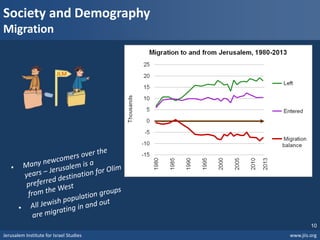
  • #11 Migration: Where do most Jerusalemites come from? Approximately 10,000 people migrate to Jerusalem every year About 20% of the Jewish residents (aged 20+) are newcomers with 10 or less years of residence in Jerusalem UO also migrate – in and out Palestinian elites are leaving to Ramallah Approximately 10,000 people migrate to Jerusalem every year 19% of the Jewish residents (aged 20+) are newcomers with 10 or less years of residence in Jerusalem (similar to most large cities in Israel, excluding Tel Aviv) UO also migrate – in and out Migration to the metro area and beyond Palestinian elites are leaving to Ramallah
  • #12 How do the different communities make a living? You can see that Arab women and UO men participate less in the labor force, which is greatly influencing their capability to make a living.
  • #13 and here are the results. So many people live below the poverty line.
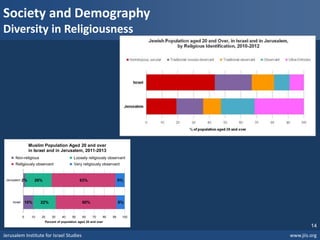
  • #15 The Jewish population in Jerusalem is diverse in terms of religious identity, but you can see the differences between Israel and Jerusalem. The percentage of UO in Jerusalem is more than three times their rate in Israel. The rate of the observant Jews in Jerusalem is about double their rate in Israel and the rate of secular people in Jerusalem is less than half their rate in Israel. In the non-Jewish (mostly Muslim) population, religious and very religious constitute 79% of the population in Jerusalem – compared to 56% in Israel as a whole Jewish population in Jerusalem is diverse in terms of religious identity Non-Jewish (mostly Muslim) population less so (religious and very religious constitute 79% of the population – compared to 56% in Israel as a whole)
  • #16 As you can imagine, all of these demographic and social issues lead to major challenges for each community .each of them has its own unique challenges but the main challenge for the city is how all those three can live together. And this is the challenge we came to discuses today.