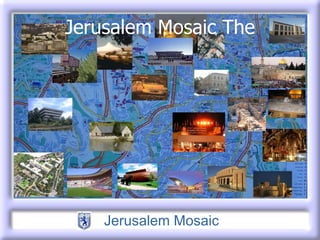
" Jerusalem Mosaic   " Jerusalem -  Education and Culture  City


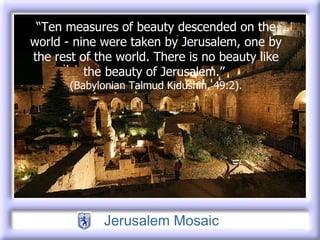
“ Ten measures of beauty descended on the   world - nine were taken by Jerusalem, one by   the rest of the world. There is no beauty like the   beauty of Jerusalem.”  (Babylonian Talmud   Kidushin, 49:2).
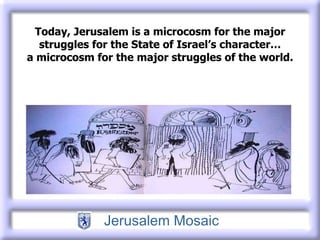
Today, Jerusalem is a microcosm for the major struggles for the State of Israel’s character… a microcosm for the major struggles of the world.
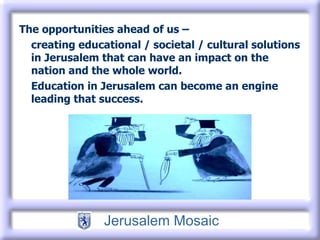
The opportunities ahead of us – creating educational / societal / cultural solutions in Jerusalem that can have an impact on the nation and the whole world. Education in Jerusalem can become an engine leading that success.
Rabbi Yohanan said: the future of Jerusalem is to become a metropolis for all the nations ( Shemot Rabba )
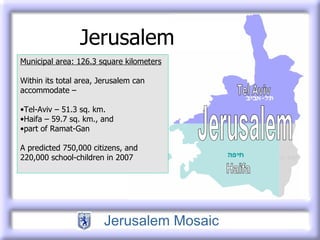
Jerusalem Jerusalem Municipal area: 126.3 square kilometers Within its total area, Jerusalem can accommodate –  Tel-Aviv – 51.3 sq. km. Haifa – 59.7 sq. km., and part of Ramat-Gan A predicted 750,000 citizens, and  220,000 school-children in 2007  Haifa Tel Aviv
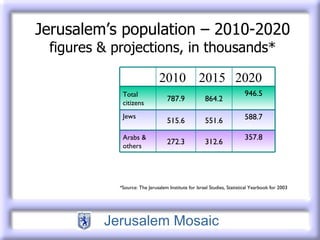
Jerusalem’s population – 2010-2020 figures & projections, in thousands* *Source: The Jerusalem Institute for Israel Studies, Statistical Yearbook for 2003 2020 2015 2010 946.5 864.2 787.9 Total citizens 588.7 551.6 515.6 Jews 357.8 312.6 272.3 Arabs & others
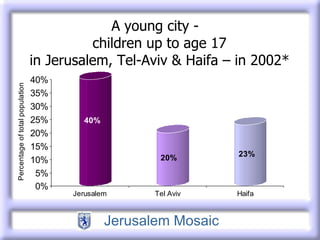
A young city -  children up to age 17 in Jerusalem, Tel-Aviv & Haifa – in 2002*
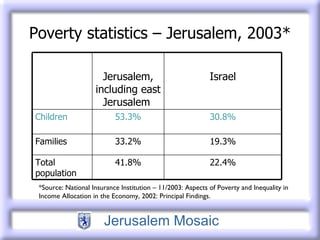
Poverty statistics – Jerusalem, 2003*   *Source: National Insurance Institution – 11/2003: Aspects of Poverty and Inequality in  Income Allocation in the Economy, 2002: Principal Findings. Israel Jerusalem, including east Jerusalem  30.8% 53.3% Children 19.3% 33.2% Families 22.4% 41.8% Total population
And in contrast – the map of  Jerusalem’s Wealth A strong concentration of major institutions, relative to the number of citizens, including –  A variety of cultural institutions  Sites sacred to the three major religions Public and private leisure facilities Institutions of the three authorities – the legislative, executive, and judicial. And so, the educational answer to the current state of Jerusalem is…
 
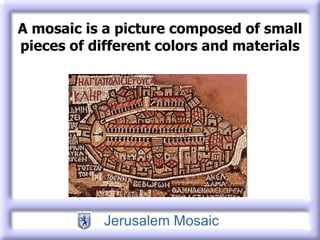
A mosaic is a picture composed of small pieces of different colors and materials
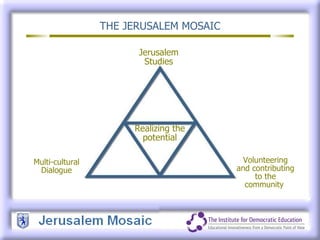
THE JERUSALEM MOSAIC Jerusalem Studies Realizing the potential Multi-cultural Dialogue Volunteering and contributing to the community
Jerusalem Mosaic   The
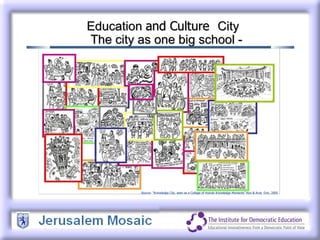
Education  and Culture   City  The city as one big school - Source: "Knowledge City, seen as a Collage of Human Knowledge Moments” Ron & Arye  Dvir, 2005
Education and Culture   City –  …  by cooperation between education systems, public organizations & private organizations
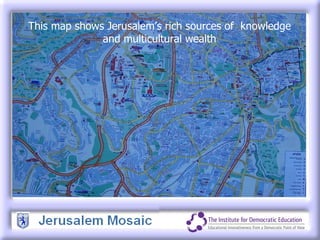
This map shows Jerusalem’s rich sources of  knowledge and multicultural wealth
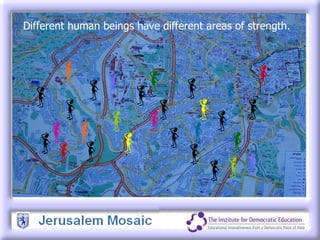
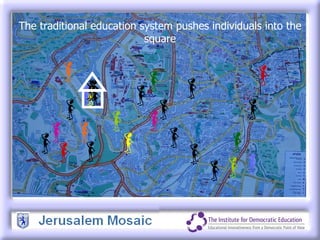
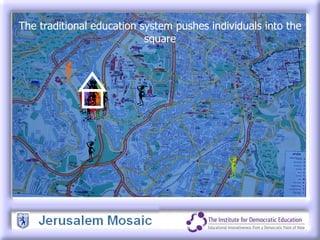
Different human beings have different areas of strength.
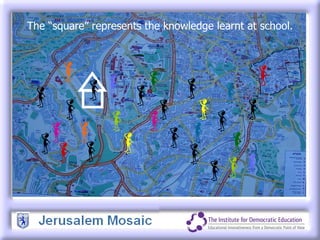
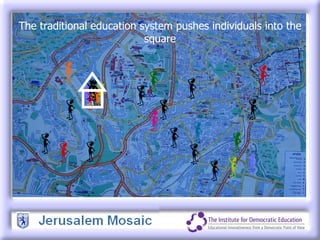
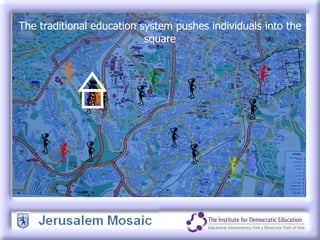
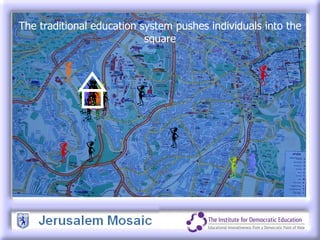
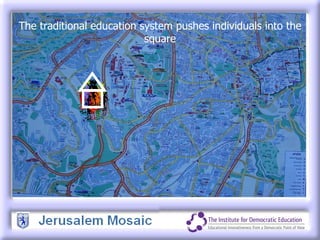
The “square” represents the knowledge learnt at school.
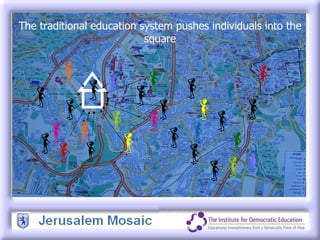
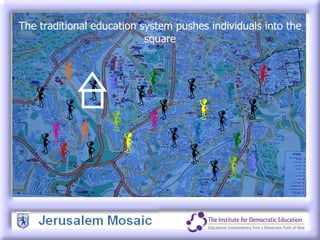
The traditional education system pushes individuals into the square
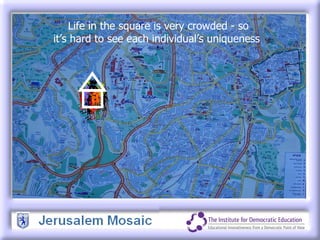
Life in the square is very crowded - so  it’s hard to see each individual’s uniqueness
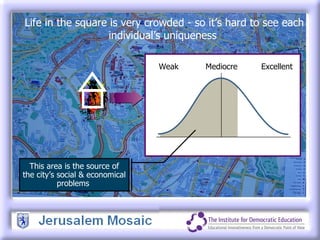
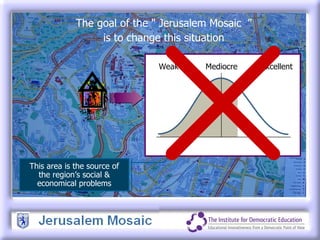
This area is the source of the city’s social & economical problems  Life in the square is very crowded - so it’s hard to see each individual’s uniqueness  Weak Mediocre Excellent
The goal of the " Jerusalem Mosaic   ” is to change this situation This area is the source of the region’s social & economical problems Weak Mediocre Excellent
Everybody can be successful …  … once  we encourage people to develop their  strength areas
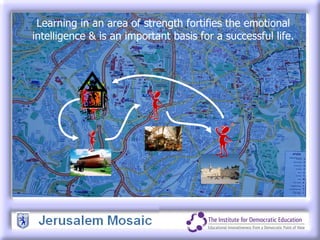
Learning in an area of strength fortifies the emotional intelligence & is an important basis for a successful life.
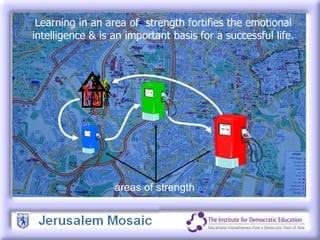
areas of strength Learning in an area of  strength fortifies the emotional intelligence & is an important basis for a successful life.
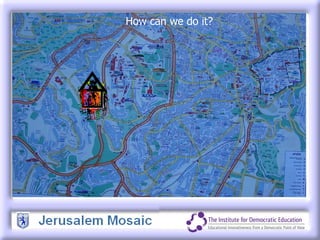
How can we do it?
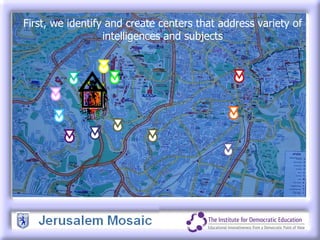
First, we identify and create centers that address variety of intelligences and subjects
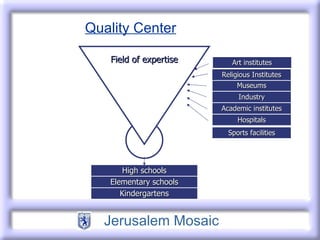
Field of expertise High schools Hospitals Academic institutes Industry Museums Sports facilities Art institutes Quality  Center Religious Institutes Kindergartens Elementary schools
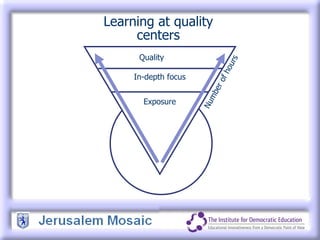
Learning at quality centers Quality  In-depth focus Exposure Number of hours
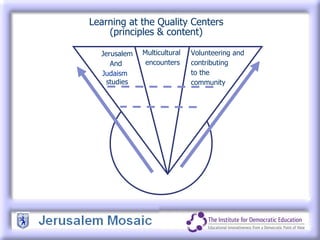
Learning at the Quality Centers (principles & content) Jerusalem And  Judaism  studies Multicultural  encounters Volunteering and contributing to the  community
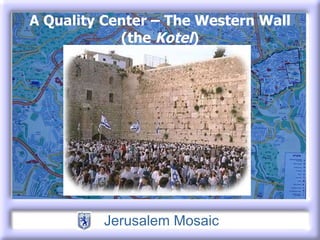
A Quality Center – The Western Wall (the  Kotel )
“ Exposure” programs  First-grade program   - receiving a  siddur   - visit to the tunnels + tour of the Jewish Quarter + creativity workshop Second-grade program   - receiving a  homesh  – visit to the  tunnels + tour of the Jewish Quarter + creativity workshop Third-grade program  - a program focusing on the yearly cycle, for schools seeking activities around the Jewish holidays – Passover, Chanukah, Purim, Shavuot and so on. Fourth-grade program  – a  special program for parents and kids, targeting secular people, and aimed at creating a study program and parent-child encounter
Seventh-grade program  – special program towards the bar-mitzvah Tenth-grade program  – on Citizenship & Democracy; the program is operated jointly with the courts  Preparatory program ahead of journey to Poland  – the program is offered jointly with the Education Ministry, and is aimed at youngsters who will be going to Poland. It provides content and values deriving from Jewish identity, as well as visits.
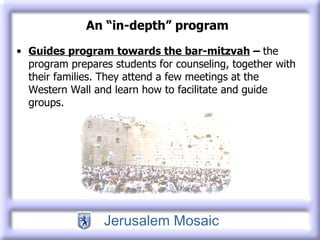
An “in-depth” program Guides program towards the bar-mitzvah  –  the program prepares students for counseling, together with their families. They attend a few meetings at the Western Wall and learn how to facilitate and guide groups.
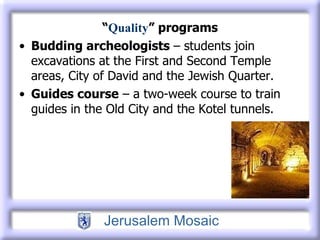
“ Quality ” programs Budding archeologists  – students join excavations at the First and Second Temple areas, City of David and the Jewish Quarter. Guides course  – a two-week course to train guides in the Old City and the Kotel tunnels.
A Quality Center –   Jewish Agency for Israel
           Contemporary Jewish Demography
           Connecting to Community   Programming Series  targeted at young people, focusing on raising awareness about personal and mutual commitment , the Jewish community, Israel, and the common destiny of the Jewish People, wherever they may be living . 
           Anti-Semitism Israel-Diaspora Relations
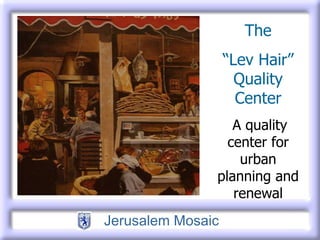
The “ Lev Hair” Quality Center A quality center for urban planning and renewal
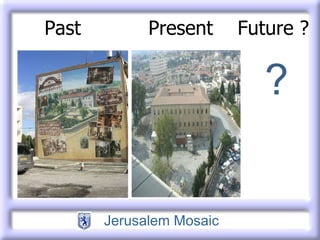
? Past  Present  Future ?
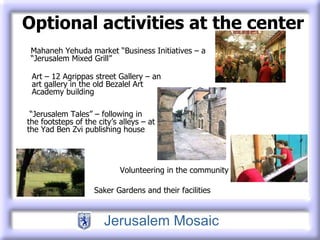
Optional activities at the center   Saker Gardens and their facilities   Volunteering in the community Art – 12 Agrippas street Gallery – an art gallery in the old Bezalel Art Academy building Mahaneh Yehuda market “Business Initiatives – a “Jerusalem Mixed Grill”     “ Jerusalem Tales” – following in the footsteps of the city’s alleys – at the Yad Ben Zvi publishing house
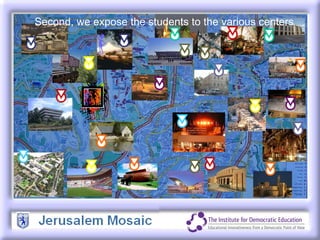
Second, we expose the students to the various centers
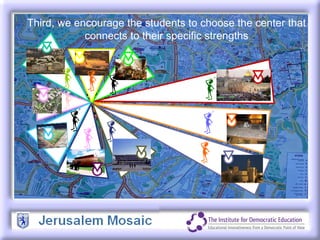
Third, we encourage the students to choose the center that connects to their specific strengths
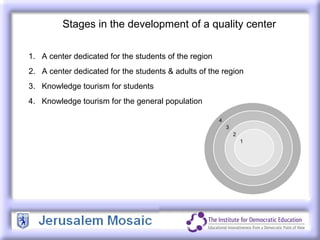
Stages in the development of a  quality  center 1. A center dedicated for the students of the region 2. A center dedicated for the students & adults of the region 3. Knowledge tourism for students 4. Knowledge tourism for the general population 4 3 2 1
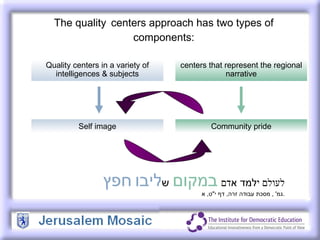
The quality   centers approach has two types of components: Quality centers in a variety of intelligences & subjects centers that represent the regional narrative Self image Community pride לעולם י למד א דם   במקום   ש ליבו   חפץ גמ ' ,  מסכת עבודה זרה ,  דף י " ט ,  א .
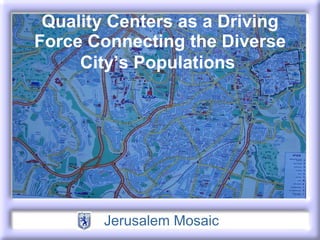
Quality Centers as a Driving Force Connecting the Diverse City’s Populations
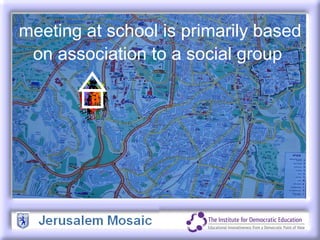
meeting at school is primarily based on association to a social group
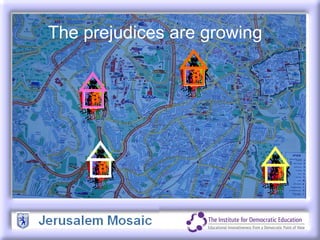
The prejudices are growing
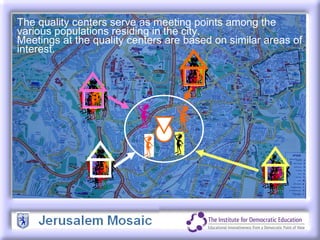
The quality centers serve as meeting points among the various populations residing in the city.  Meetings at the quality centers are based on similar areas of interest.
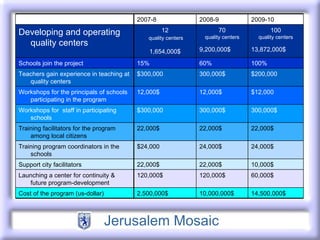
2009-10 2008-9 2007-8   100 quality centers 13,872,000$ 70 quality centers 9,200,000$ 12 quality centers 1,654,000$ Developing and operating quality centers 100% 60% 15% Schools join the project $200,000 300,000 $ $300,000 Teachers gain experience in teaching at quality centers $12,000 12,000 $ 12,000 $ Workshops for the principals of schools participating in the program 300,000 $ 300,000 $ $300,000 Workshops for  staff in participating schools  22,000 $ 22,000$ 22,000 $ Training facilitators for the program among local citizens 24,000 $ 24,000 $ $24,000 Training program coordinators in the schools 10,000$ 22,000 $ 22,000 $ Support city facilitators 60,000 $ 120,000 $ 120,000 $ Launching a center for continuity & future program-development 14,500,000$ 10,000,000$ 2,500,000$ Cost of the program (us-dollar)
Thank you very much!

Jerusalem Mosaic 31 12

  • 1.
    " Jerusalem Mosaic " Jerusalem - Education and Culture City
  • 2.
  • 3.
  • 4.
  • 5.
    “ Ten measuresof beauty descended on the world - nine were taken by Jerusalem, one by the rest of the world. There is no beauty like the beauty of Jerusalem.” (Babylonian Talmud Kidushin, 49:2).
  • 6.
    Today, Jerusalem isa microcosm for the major struggles for the State of Israel’s character… a microcosm for the major struggles of the world.
  • 7.
    The opportunities aheadof us – creating educational / societal / cultural solutions in Jerusalem that can have an impact on the nation and the whole world. Education in Jerusalem can become an engine leading that success.
  • 8.
    Rabbi Yohanan said:the future of Jerusalem is to become a metropolis for all the nations ( Shemot Rabba )
  • 9.
    Jerusalem Jerusalem Municipalarea: 126.3 square kilometers Within its total area, Jerusalem can accommodate – Tel-Aviv – 51.3 sq. km. Haifa – 59.7 sq. km., and part of Ramat-Gan A predicted 750,000 citizens, and 220,000 school-children in 2007 Haifa Tel Aviv
  • 10.
    Jerusalem’s population –2010-2020 figures & projections, in thousands* *Source: The Jerusalem Institute for Israel Studies, Statistical Yearbook for 2003 2020 2015 2010 946.5 864.2 787.9 Total citizens 588.7 551.6 515.6 Jews 357.8 312.6 272.3 Arabs & others
  • 11.
    A young city- children up to age 17 in Jerusalem, Tel-Aviv & Haifa – in 2002*
  • 12.
    Poverty statistics –Jerusalem, 2003* *Source: National Insurance Institution – 11/2003: Aspects of Poverty and Inequality in Income Allocation in the Economy, 2002: Principal Findings. Israel Jerusalem, including east Jerusalem 30.8% 53.3% Children 19.3% 33.2% Families 22.4% 41.8% Total population
  • 13.
    And in contrast– the map of Jerusalem’s Wealth A strong concentration of major institutions, relative to the number of citizens, including – A variety of cultural institutions Sites sacred to the three major religions Public and private leisure facilities Institutions of the three authorities – the legislative, executive, and judicial. And so, the educational answer to the current state of Jerusalem is…
  • 14.
  • 15.
    A mosaic isa picture composed of small pieces of different colors and materials
  • 16.
    THE JERUSALEM MOSAICJerusalem Studies Realizing the potential Multi-cultural Dialogue Volunteering and contributing to the community
  • 17.
  • 18.
    Education andCulture City The city as one big school - Source: "Knowledge City, seen as a Collage of Human Knowledge Moments” Ron & Arye Dvir, 2005
  • 19.
    Education and Culture City – … by cooperation between education systems, public organizations & private organizations
  • 20.
    This map showsJerusalem’s rich sources of knowledge and multicultural wealth
  • 21.
    Different human beingshave different areas of strength.
  • 22.
    The “square” representsthe knowledge learnt at school.
  • 23.
    The traditional educationsystem pushes individuals into the square
  • 24.
    The traditional educationsystem pushes individuals into the square
  • 25.
    The traditional educationsystem pushes individuals into the square
  • 26.
    The traditional educationsystem pushes individuals into the square
  • 27.
    The traditional educationsystem pushes individuals into the square
  • 28.
    The traditional educationsystem pushes individuals into the square
  • 29.
    The traditional educationsystem pushes individuals into the square
  • 30.
    The traditional educationsystem pushes individuals into the square
  • 31.
    Life in thesquare is very crowded - so it’s hard to see each individual’s uniqueness
  • 32.
    This area isthe source of the city’s social & economical problems Life in the square is very crowded - so it’s hard to see each individual’s uniqueness Weak Mediocre Excellent
  • 33.
    The goal ofthe " Jerusalem Mosaic ” is to change this situation This area is the source of the region’s social & economical problems Weak Mediocre Excellent
  • 34.
    Everybody can besuccessful … … once we encourage people to develop their strength areas
  • 35.
    Learning in anarea of strength fortifies the emotional intelligence & is an important basis for a successful life.
  • 36.
    areas of strengthLearning in an area of strength fortifies the emotional intelligence & is an important basis for a successful life.
  • 37.
    How can wedo it?
  • 38.
    First, we identifyand create centers that address variety of intelligences and subjects
  • 39.
    Field of expertiseHigh schools Hospitals Academic institutes Industry Museums Sports facilities Art institutes Quality Center Religious Institutes Kindergartens Elementary schools
  • 40.
    Learning at qualitycenters Quality In-depth focus Exposure Number of hours
  • 41.
    Learning at theQuality Centers (principles & content) Jerusalem And Judaism studies Multicultural encounters Volunteering and contributing to the community
  • 42.
    A Quality Center– The Western Wall (the Kotel )
  • 43.
    “ Exposure” programs First-grade program - receiving a siddur - visit to the tunnels + tour of the Jewish Quarter + creativity workshop Second-grade program - receiving a homesh – visit to the tunnels + tour of the Jewish Quarter + creativity workshop Third-grade program - a program focusing on the yearly cycle, for schools seeking activities around the Jewish holidays – Passover, Chanukah, Purim, Shavuot and so on. Fourth-grade program – a special program for parents and kids, targeting secular people, and aimed at creating a study program and parent-child encounter
  • 44.
    Seventh-grade program – special program towards the bar-mitzvah Tenth-grade program – on Citizenship & Democracy; the program is operated jointly with the courts Preparatory program ahead of journey to Poland – the program is offered jointly with the Education Ministry, and is aimed at youngsters who will be going to Poland. It provides content and values deriving from Jewish identity, as well as visits.
  • 45.
    An “in-depth” programGuides program towards the bar-mitzvah – the program prepares students for counseling, together with their families. They attend a few meetings at the Western Wall and learn how to facilitate and guide groups.
  • 46.
    “ Quality ”programs Budding archeologists – students join excavations at the First and Second Temple areas, City of David and the Jewish Quarter. Guides course – a two-week course to train guides in the Old City and the Kotel tunnels.
  • 47.
    A Quality Center– Jewish Agency for Israel
  • 48.
              Contemporary Jewish Demography
  • 49.
              Connecting to Community Programming Series  targeted at young people, focusing on raising awareness about personal and mutual commitment , the Jewish community, Israel, and the common destiny of the Jewish People, wherever they may be living . 
  • 50.
              Anti-Semitism Israel-Diaspora Relations
  • 51.
    The “ LevHair” Quality Center A quality center for urban planning and renewal
  • 52.
    ? Past Present Future ?
  • 53.
    Optional activities atthe center Saker Gardens and their facilities   Volunteering in the community Art – 12 Agrippas street Gallery – an art gallery in the old Bezalel Art Academy building Mahaneh Yehuda market “Business Initiatives – a “Jerusalem Mixed Grill”   “ Jerusalem Tales” – following in the footsteps of the city’s alleys – at the Yad Ben Zvi publishing house
  • 54.
    Second, we exposethe students to the various centers
  • 55.
    Third, we encouragethe students to choose the center that connects to their specific strengths
  • 56.
    Stages in thedevelopment of a quality center 1. A center dedicated for the students of the region 2. A center dedicated for the students & adults of the region 3. Knowledge tourism for students 4. Knowledge tourism for the general population 4 3 2 1
  • 57.
    The quality centers approach has two types of components: Quality centers in a variety of intelligences & subjects centers that represent the regional narrative Self image Community pride לעולם י למד א דם במקום ש ליבו חפץ גמ ' , מסכת עבודה זרה , דף י " ט , א .
  • 58.
    Quality Centers asa Driving Force Connecting the Diverse City’s Populations
  • 59.
    meeting at schoolis primarily based on association to a social group
  • 60.
  • 61.
    The quality centersserve as meeting points among the various populations residing in the city. Meetings at the quality centers are based on similar areas of interest.
  • 62.
    2009-10 2008-9 2007-8  100 quality centers 13,872,000$ 70 quality centers 9,200,000$ 12 quality centers 1,654,000$ Developing and operating quality centers 100% 60% 15% Schools join the project $200,000 300,000 $ $300,000 Teachers gain experience in teaching at quality centers $12,000 12,000 $ 12,000 $ Workshops for the principals of schools participating in the program 300,000 $ 300,000 $ $300,000 Workshops for staff in participating schools 22,000 $ 22,000$ 22,000 $ Training facilitators for the program among local citizens 24,000 $ 24,000 $ $24,000 Training program coordinators in the schools 10,000$ 22,000 $ 22,000 $ Support city facilitators 60,000 $ 120,000 $ 120,000 $ Launching a center for continuity & future program-development 14,500,000$ 10,000,000$ 2,500,000$ Cost of the program (us-dollar)
  • 63.