Electronic Data Processing
(EDP)
Muhammad Zaman-ul-Haq
B-Tech (Civil)/F18, ICTE,IIUI
1
Managing Files: Basic Concepts
 Data can be grouped into categories
 The data storage hierarchy consists of the
levels of data
 Bits
 Bytes
 Fields
 Records
 Files
 Databases
stored in a computer
4
Managing Files: Basic Concepts
 Characters: A character (byte) is a letter,
number, or special character
Examples : A, B, C, 1, 2, 3, #, $, %
 Field: A field is a unit of data consisting
one or more characters (bytes).
Examples: your name, address
of
5
Managing Files: Basic Concepts
 Record: A
fields.
Examples
:
record is a collection of related
Student code, name and
address
 File: A file is a collection of related records.
Examples: file of students grade
information
6
Managing Files: Basic Concepts
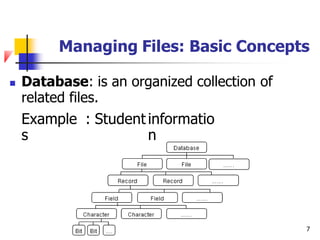
 Database: is an organized collection
related files.
of
Example
s
: Student informatio
n
7
Managing Files: Basic Concepts
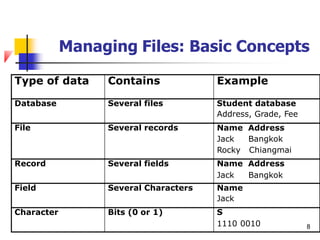
Type of data Contains Example
Database Several files Student database
Address, Grade, Fee
File Several records Name Address
Jack Bangkok
Rocky Chiangmai
Record Several fields Name Address
Jack Bangkok
Field Several Characters Name
Jack
Character Bits (0 or 1) S
1110 0010 8
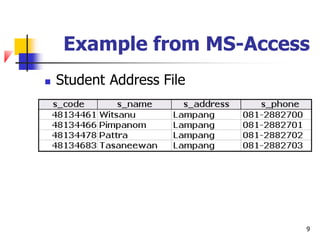
Example from MS-Access
 Student Address File
9
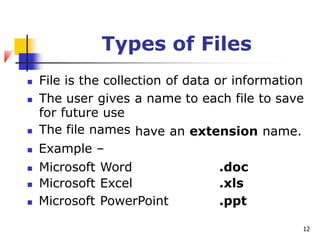
Types of Files
 File is the collection of data or information
 The user gives
for future use
 The file names
 Example –
a name to each file to save
have an extension name.
 Microsoft
 Microsoft
 Microsoft
Word
Excel
PowerPoint
.doc
.xls
.ppt
12
Types of Files
 There are many types of files but the
most important
Program files
types are –
Data files
13
Program Files
 Program files
instructions.
 The program
by a program
are files containing software
files are instruction files written
for a particular application
 They have a file extension. For example –
.bas for BASIC, .pas for Pascal or .jav for Java
 For the processor to use a source file at first it
must be converted to an executable file,
.exe file
14
Data files
 Data files are files that contain data –
words, numbers, pictures, sounds, etc.
 Data files are created by the users.
15
Other types of files
 ASCII files
 .txt
 Image(graphic files)
 .bmp, .gif, .jpg, .pcx,
 Audio files
 .wav, .mid, .mp3
 Animation/video files
 .avi, .mpg
 Web files
.tif, .wmf
 .html, .htm, .xml, .php, .asp
16
Data Access Methods
 Sequential Storage: means
in
that data is
in
stored and retrieved sequence,
alphabetically
order
– ascending or descending
 Example: A tape cassette
 Advantage: less expensive
 Disadvantage: file searching is slow
21
Data Access Methods
 Direct Access Storage: means that
computer can go directly to
as
the information
you want. It is also known
 Example: A CD Player
 Advantage: faster
random.
 Disadvantage: more expensive
23
Offline Storage
 Offline storage means that data is not in
the direct control on the CPU. It maybe
saved in a CD.
 The data
device.
has to be loaded onto an input
25
Online Storage
 Online storage means that data is
immediately accessible by the CPU.
 You need not wait for a CD.
(direct
 Storage is on the disk access storage)
26
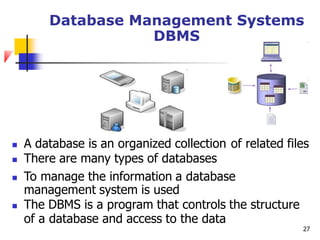
Database Management
DBMS
Systems
 A database is an organized collection
 There are many types of databases
of related files
 To manage the information a database
management system is used
 The DBMS is a program that controls the structure
of a database and access to the data
27
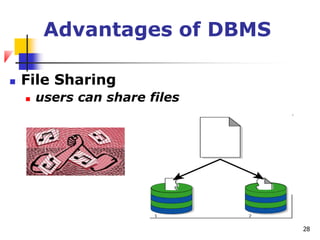
Advantages of DBMS
 File Sharing
 users can share files
28
Advantages of DBMS
 Reduced
 prevent
data redundancy
duplication
29
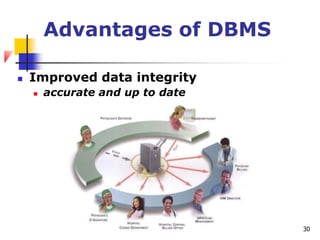
Advantages of DBMS
 Improved data integrity
 accurate and up to date
30
Advantages of DBMS
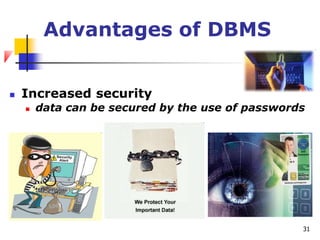
 Increased security
 data can be secured by the use of passwords
31
Types of Database Access
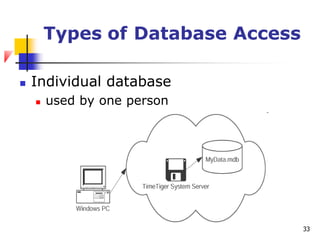
 Individual database
 used by one person
33
Types of Database Access
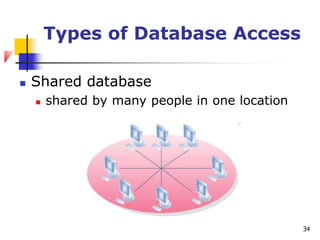
 Shared database
 shared by many people in one location
34
Types of Database Access
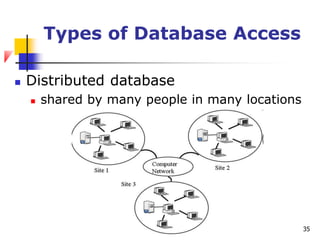
 Distributed database
 shared by many people in many locations
35
Types of Database Access
 Public databank
 information
 Yahoo
 Google
 Law
 Shopping
 News
 Games
for the public
36

L3_Electronic Data Processing.pptx

  • 1.
    Electronic Data Processing (EDP) MuhammadZaman-ul-Haq B-Tech (Civil)/F18, ICTE,IIUI 1
  • 2.
    Managing Files: BasicConcepts  Data can be grouped into categories  The data storage hierarchy consists of the levels of data  Bits  Bytes  Fields  Records  Files  Databases stored in a computer 4
  • 3.
    Managing Files: BasicConcepts  Characters: A character (byte) is a letter, number, or special character Examples : A, B, C, 1, 2, 3, #, $, %  Field: A field is a unit of data consisting one or more characters (bytes). Examples: your name, address of 5
  • 4.
    Managing Files: BasicConcepts  Record: A fields. Examples : record is a collection of related Student code, name and address  File: A file is a collection of related records. Examples: file of students grade information 6
  • 5.
    Managing Files: BasicConcepts  Database: is an organized collection related files. of Example s : Student informatio n 7
  • 6.
    Managing Files: BasicConcepts Type of data Contains Example Database Several files Student database Address, Grade, Fee File Several records Name Address Jack Bangkok Rocky Chiangmai Record Several fields Name Address Jack Bangkok Field Several Characters Name Jack Character Bits (0 or 1) S 1110 0010 8
  • 7.
    Example from MS-Access Student Address File 9
  • 8.
    Types of Files File is the collection of data or information  The user gives for future use  The file names  Example – a name to each file to save have an extension name.  Microsoft  Microsoft  Microsoft Word Excel PowerPoint .doc .xls .ppt 12
  • 9.
    Types of Files There are many types of files but the most important Program files types are – Data files 13
  • 10.
    Program Files  Programfiles instructions.  The program by a program are files containing software files are instruction files written for a particular application  They have a file extension. For example – .bas for BASIC, .pas for Pascal or .jav for Java  For the processor to use a source file at first it must be converted to an executable file, .exe file 14
  • 11.
    Data files  Datafiles are files that contain data – words, numbers, pictures, sounds, etc.  Data files are created by the users. 15
  • 12.
    Other types offiles  ASCII files  .txt  Image(graphic files)  .bmp, .gif, .jpg, .pcx,  Audio files  .wav, .mid, .mp3  Animation/video files  .avi, .mpg  Web files .tif, .wmf  .html, .htm, .xml, .php, .asp 16
  • 13.
    Data Access Methods Sequential Storage: means in that data is in stored and retrieved sequence, alphabetically order – ascending or descending  Example: A tape cassette  Advantage: less expensive  Disadvantage: file searching is slow 21
  • 14.
    Data Access Methods Direct Access Storage: means that computer can go directly to as the information you want. It is also known  Example: A CD Player  Advantage: faster random.  Disadvantage: more expensive 23
  • 15.
    Offline Storage  Offlinestorage means that data is not in the direct control on the CPU. It maybe saved in a CD.  The data device. has to be loaded onto an input 25
  • 16.
    Online Storage  Onlinestorage means that data is immediately accessible by the CPU.  You need not wait for a CD. (direct  Storage is on the disk access storage) 26
  • 17.
    Database Management DBMS Systems  Adatabase is an organized collection  There are many types of databases of related files  To manage the information a database management system is used  The DBMS is a program that controls the structure of a database and access to the data 27
  • 18.
    Advantages of DBMS File Sharing  users can share files 28
  • 19.
    Advantages of DBMS Reduced  prevent data redundancy duplication 29
  • 20.
    Advantages of DBMS Improved data integrity  accurate and up to date 30
  • 21.
    Advantages of DBMS Increased security  data can be secured by the use of passwords 31
  • 22.
    Types of DatabaseAccess  Individual database  used by one person 33
  • 23.
    Types of DatabaseAccess  Shared database  shared by many people in one location 34
  • 24.
    Types of DatabaseAccess  Distributed database  shared by many people in many locations 35
  • 25.
    Types of DatabaseAccess  Public databank  information  Yahoo  Google  Law  Shopping  News  Games for the public 36