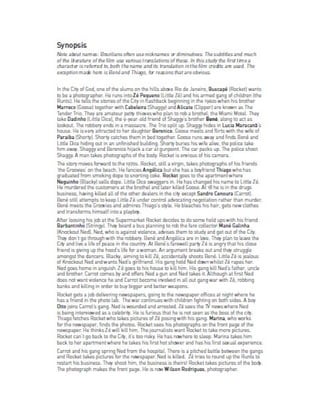
Use the following for further reading on this Brief Film:
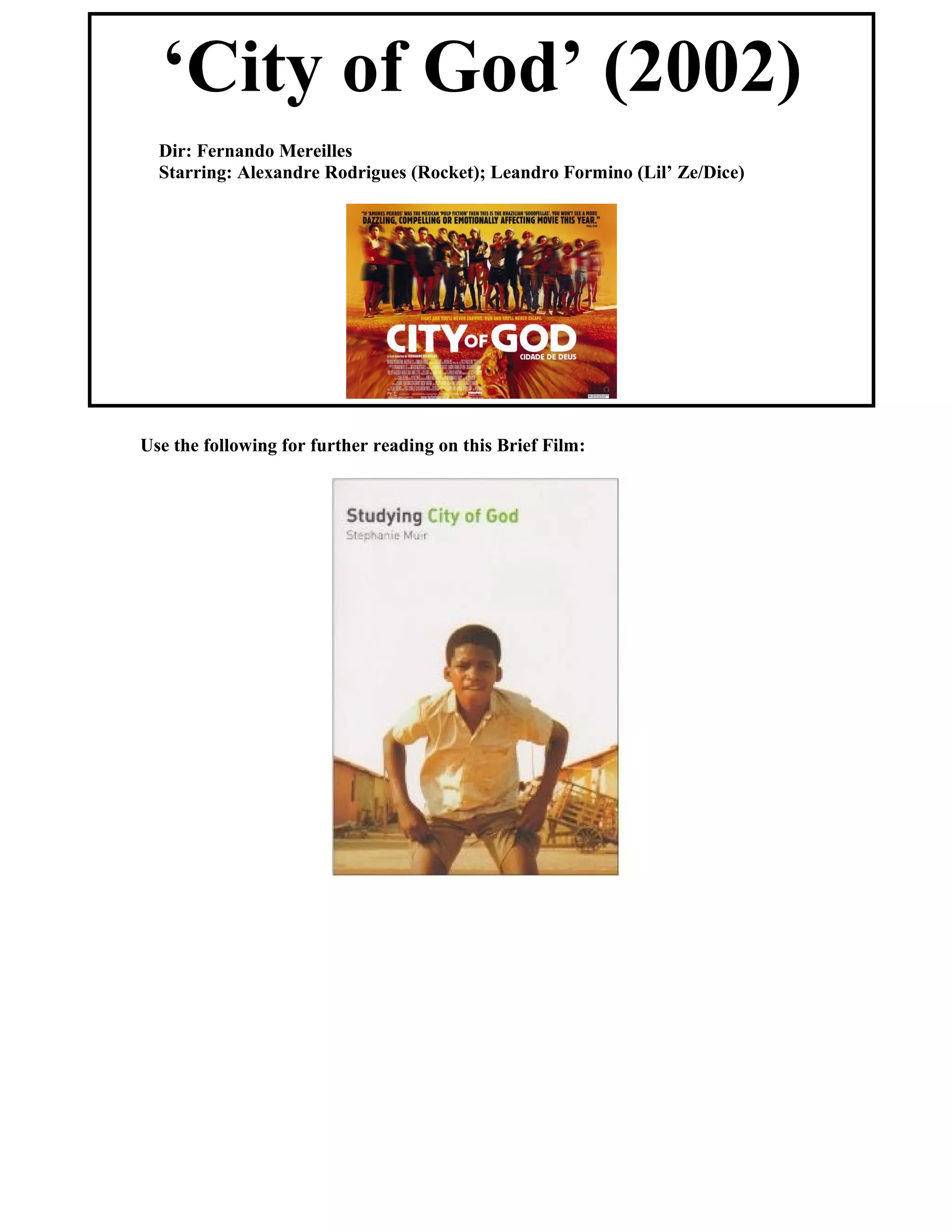
‘City of God’ (2002)
Dir: Fernando Mereilles
Starring: Alexandre Rodrigues (Rocket); Leandro Formino (Lil’ Ze/Dice)
Cast
Key facts and information
Described by The Guardian (Peter Bradshaw) as “a strongly emotive experience”
Wendy Helsby describes how media texts often “reflect the World” – City of God is no
different, for example:
• An estimated 20% of the population (approx 32 million) live in absolute poverty
City of God conforms to Brazil’s “New wave” film making through the following
conventions:
- Use of small, hand held cameras
- Shot on location to capture “real” experiences
City of God’s characters also convey “star” appeal, very similarly to the New Wave style
of film making, through Mereilles “manufacturing” (Dyer – 2004) a look at that makes
the personified acting seem more “authentic” (Lee Strasberg)
Narrative Themes
- Desire to climb the social ladder (hierarchy) within the slum through Power,
intimidation and “respect”
- Money is the key to their happiness and the downfall of the main protagonists –
commonly represented in texts set in “difficult, urban environments”
- Any desire to leave the Gangster lifestyle (for example Bene) results in tragedy
- Rocket represents the solitary example of expressionism and freedom amongst the
youths through a legitimate skill – photography.
Setting
There is a clear sense of binary opposition (Levi Strauss), in many respects similar to the
principle text “Tsotsi” where the Paradise of Rio, high key lighting and idyliic
surroundings are in dramatic irony with the consequences of the slum and the dangers of
being exposed to ‘monstrous characters’ (Neale & Krutnik) like Lil’ Ze.
“Fierce, shocking, dazzling and wonderful. It’s that rare film that manages to be
seductively entertaining without ever compromising its authenticity and power”
(Megan Turner)
Key theory
“One of the most remarkable things that the arts can do is to take alien works –
unknown to us by experience, shown only sketchingly by the media – and not
only communicate them to us, but tangibly and forcibly to relate them to things
we all go through”
(Ian Maldron-Mantgani)
This is achieved through:
- Recognizable Generic conventions being presented (similar to other Gangster
texts)
- “Personally identify” (Katz) to some of the life experiences of the protagonists, no
matter how “alien” they are to our conscience.
Recent Coverage of the Film (2013 – onwards)
1)
http://www.bbc.co.uk/news/world-latin-america-23333368
2)
http://www.theguardian.com/film/2014/jun/09/how-we-made-city-of-god
- Lamartine Ferreira, assistant director:
Rocket, one of the central characters, was born in the favela and has
many things going against him, but he's able to realise his ambitions.
He becomes a photographer and gets his pictures in the newspaper –
and people come to understand that he is not just another criminal
from the favela.
Rocket, one of the central characters, was born in the favela and has
many things going against him, but he's able to realise his ambitions.
He becomes a photographer and gets his pictures in the newspaper –
and people come to understand that he is not just another criminal
from the favela.

L19 key facts and information

  • 1.
    Use the followingfor further reading on this Brief Film: ‘City of God’ (2002) Dir: Fernando Mereilles Starring: Alexandre Rodrigues (Rocket); Leandro Formino (Lil’ Ze/Dice)
  • 3.
    Cast Key facts andinformation Described by The Guardian (Peter Bradshaw) as “a strongly emotive experience” Wendy Helsby describes how media texts often “reflect the World” – City of God is no different, for example: • An estimated 20% of the population (approx 32 million) live in absolute poverty City of God conforms to Brazil’s “New wave” film making through the following conventions: - Use of small, hand held cameras - Shot on location to capture “real” experiences City of God’s characters also convey “star” appeal, very similarly to the New Wave style of film making, through Mereilles “manufacturing” (Dyer – 2004) a look at that makes the personified acting seem more “authentic” (Lee Strasberg) Narrative Themes - Desire to climb the social ladder (hierarchy) within the slum through Power, intimidation and “respect”
  • 4.
    - Money isthe key to their happiness and the downfall of the main protagonists – commonly represented in texts set in “difficult, urban environments” - Any desire to leave the Gangster lifestyle (for example Bene) results in tragedy - Rocket represents the solitary example of expressionism and freedom amongst the youths through a legitimate skill – photography. Setting There is a clear sense of binary opposition (Levi Strauss), in many respects similar to the principle text “Tsotsi” where the Paradise of Rio, high key lighting and idyliic surroundings are in dramatic irony with the consequences of the slum and the dangers of being exposed to ‘monstrous characters’ (Neale & Krutnik) like Lil’ Ze. “Fierce, shocking, dazzling and wonderful. It’s that rare film that manages to be seductively entertaining without ever compromising its authenticity and power” (Megan Turner) Key theory “One of the most remarkable things that the arts can do is to take alien works – unknown to us by experience, shown only sketchingly by the media – and not only communicate them to us, but tangibly and forcibly to relate them to things we all go through” (Ian Maldron-Mantgani) This is achieved through: - Recognizable Generic conventions being presented (similar to other Gangster texts) - “Personally identify” (Katz) to some of the life experiences of the protagonists, no matter how “alien” they are to our conscience. Recent Coverage of the Film (2013 – onwards) 1) http://www.bbc.co.uk/news/world-latin-america-23333368 2) http://www.theguardian.com/film/2014/jun/09/how-we-made-city-of-god - Lamartine Ferreira, assistant director:
  • 5.
    Rocket, one ofthe central characters, was born in the favela and has many things going against him, but he's able to realise his ambitions. He becomes a photographer and gets his pictures in the newspaper – and people come to understand that he is not just another criminal from the favela.
  • 6.
    Rocket, one ofthe central characters, was born in the favela and has many things going against him, but he's able to realise his ambitions. He becomes a photographer and gets his pictures in the newspaper – and people come to understand that he is not just another criminal from the favela.