
Learning Objectives
  Identify how City of God’s representation of Rio
  differs from the Dominant ‘Identity’ created by
  Brazilian ruling class


 Complete short contextual
 analysis of Rio and the Flavela’s


Discuss the causes of the Brazilian
Drug War and how they are
represented in City of God
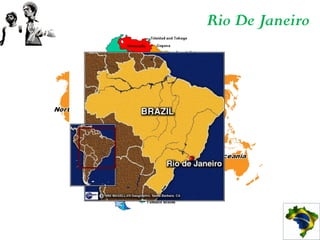
Rio De Janeiro
City of the Gods?

Watch this short tourism advert
from Brazil and answer the
following question:


       How does this representation of Rio contrast with the
               environment seen in City of God?


Include example from the
Advertisement and from the film
                                  You must make direct comparisons
                                  between the two texts
Rio De Janeiro
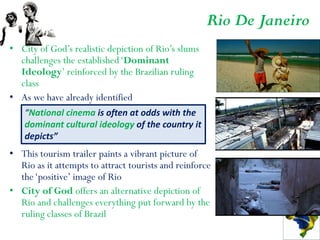
• City of God’s realistic depiction of Rio’s slums
  challenges the established ‘Dominant
  Ideology’ reinforced by the Brazilian ruling
  class
• As we have already identified
    “National cinema is often at odds with the
    dominant cultural ideology of the country it
    depicts”
• This tourism trailer paints a vibrant picture of
  Rio as it attempts to attract tourists and reinforce
  the ‘positive’ image of Rio
• City of God offers an alternative depiction of
  Rio and challenges everything put forward by the
  ruling classes of Brazil
Favela
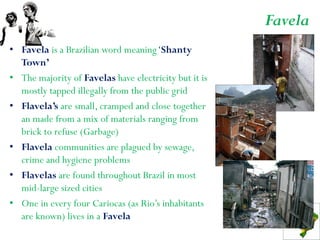
• Favela is a Brazilian word meaning ‘Shanty
  Town’
• The majority of Favelas have electricity but it is
  mostly tapped illegally from the public grid
• Flavela’s are small, cramped and close together
  an made from a mix of materials ranging from
  brick to refuse (Garbage)
• Flavela communities are plagued by sewage,
  crime and hygiene problems
• Flavelas are found throughout Brazil in most
  mid-large sized cities
• One in every four Cariocas (as Rio’s inhabitants
  are known) lives in a Favela
Drugs in the Favelas
                                                       Rio (City) Murder
                                                       Rate:
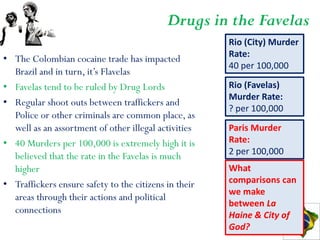
• The Colombian cocaine trade has impacted
                                                       40 per 100,000
  Brazil and in turn, it’s Flavelas
• Favelas tend to be ruled by Drug Lords               Rio (Favelas)
                                                       Murder Rate:
• Regular shoot outs between traffickers and
                                                       ? per 100,000
  Police or other criminals are common place, as
  well as an assortment of other illegal activities    Paris Murder
• 40 Murders per 100,000 is extremely high it is       Rate:
  believed that the rate in the Favelas is much        2 per 100,000
  higher                                               What
• Traffickers ensure safety to the citizens in their   comparisons can
                                                       we make
  areas through their actions and political
                                                       between La
  connections                                          Haine & City of
                                                       God?
Drugs in the Favelas
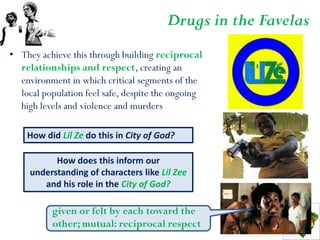
• They achieve this through building reciprocal
  relationships and respect, creating an
  environment in which critical segments of the
  local population feel safe, despite the ongoing
  high levels and violence and murders

    How did Lil Ze do this in City of God?

           How does this inform our
     understanding of characters like Lil Zee
        and his role in the City of God?

          given or felt by each toward the
          other; mutual: reciprocal respect
Brazils Drug Wars
• Watch the following short and prepare to answer the following
  questions:
                            Do the police really have the situation under
                            control?

                            Why do the drug gangs remain such a
                            ‘formidable force?’

                            How does the government plan to ‘solve’ the
                            problem?

                            Why do you think Lou Lou was seen as a
                            Robin Hood figure by the people?

                            What are the potential problems with sending
                            in the Army?
The Dividing Line
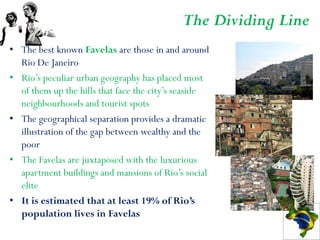
• The best known Favelas are those in and around
  Rio De Janeiro
• Rio’s peculiar urban geography has placed most
  of them up the hills that face the city’s seaside
  neighbourhoods and tourist spots
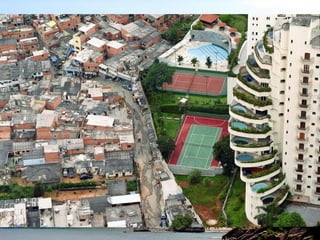
• The geographical separation provides a dramatic
  illustration of the gap between wealthy and the
  poor
• The Favelas are juxtaposed with the luxurious
  apartment buildings and mansions of Rio’s social
  elite
• It is estimated that at least 19% of Rio’s
  population lives in Favelas
Flavela Wars
• Watch the following short and prepare to answer the following
  questions:
                            What are some of the programs being run to
                            help the young people?

                            Outline the differences between the Wealthy
                            and the Poor

                            How are the locals trying to help?

                            “Kill or be Killed”... How is this mantra
                            or rule demonstrated in City of God?
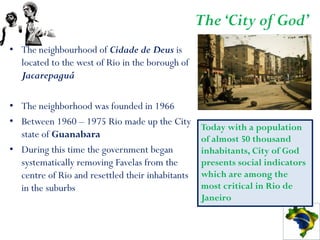
The ‘City of God’
• The neighbourhood of Cidade de Deus is
  located to the west of Rio in the borough of
  Jacarepaguá

• The neighborhood was founded in 1966
• Between 1960 – 1975 Rio made up the City
                                                  Today with a population
  state of Guanabara                              of almost 50 thousand
• During this time the government began           inhabitants, City of God
  systematically removing Favelas from the        presents social indicators
  centre of Rio and resettled their inhabitants   which are among the
  in the suburbs                                  most critical in Rio de
                                                  Janeiro
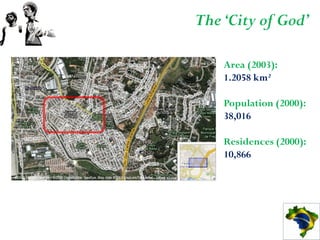
The ‘City of God’

    Area (2003):
    1.2058 km²

    Population (2000):
    38,016

    Residences (2000):
    10,866
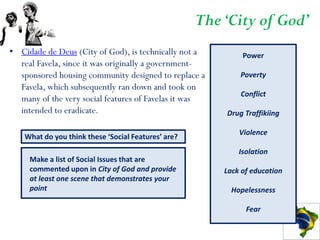
The ‘City of God’
• Cidade de Deus (City of God), is technically not a          Power
  real Favela, since it was originally a government-
  sponsored housing community designed to replace a          Poverty
  Favela, which subsequently ran down and took on
                                                             Conflict
  many of the very social features of Favelas it was
  intended to eradicate.                                 Drug Traffikiing

                                                             Violence
    What do you think these ‘Social Features’ are?
                                                             Isolation
     Make a list of Social Issues that are
     commented upon in City of God and provide           Lack of education
     at least one scene that demonstrates your
     point                                                 Hopelessness

                                                               Fear
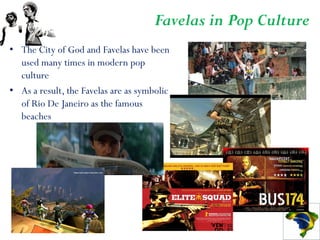
Favelas in Pop Culture
• The City of God and Favelas have been
  used many times in modern pop
  culture
• As a result, the Favelas are as symbolic
  of Rio De Janeiro as the famous
  beaches
Representin’ the City
• Representation is constructed through
  textual elements and informed by the
  context of a film’s production
• You will need to give detailed consideration
  to the ways in which cinematography, mise-
  en-scene, editing and sound are combined
  to create a specific representation of the City
  of God

    How important is the location in the film?

    Use the following stills from the film and
    make notes on how the lighting and mise-en-
    scene give us information about the different
    time periods the film is set across
Location, Location
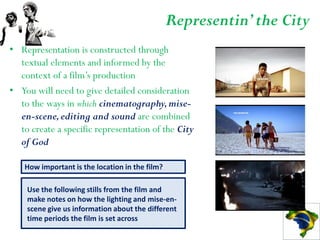
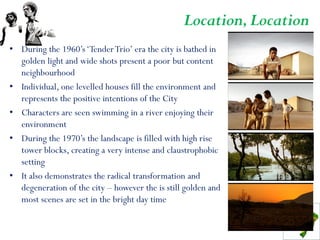
• During the 1960’s ‘Tender Trio’ era the city is bathed in
  golden light and wide shots present a poor but content
  neighbourhood
• Individual, one levelled houses fill the environment and
  represents the positive intentions of the City
• Characters are seen swimming in a river enjoying their
  environment
• During the 1970’s the landscape is filled with high rise
  tower blocks, creating a very intense and claustrophobic
  setting
• It also demonstrates the radical transformation and
  degeneration of the city – however the is still golden and
  most scenes are set in the bright day time
Location, Location
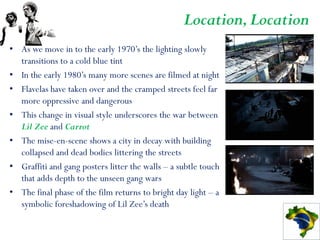
• As we move in to the early 1970’s the lighting slowly
  transitions to a cold blue tint
• In the early 1980’s many more scenes are filmed at night
• Flavelas have taken over and the cramped streets feel far
  more oppressive and dangerous
• This change in visual style underscores the war between
  Lil Zee and Carrot
• The mise-en-scene shows a city in decay with building
  collapsed and dead bodies littering the streets
• Graffiti and gang posters litter the walls – a subtle touch
  that adds depth to the unseen gang wars
• The final phase of the film returns to bright day light – a
  symbolic foreshadowing of Lil Zee’s death
Location, Location

   In the film the Favela is almost like a
       separate character in the film.
                  Discuss.

Working in pairs discuss this comment and
prepare an essay plan for how you would
          answer the question
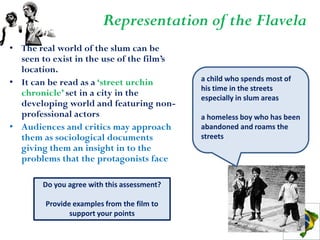
Representation of the Flavela
• The real world of the slum can be
  seen to exist in the use of the film’s
  location.
• It can be read as a ‘street urchin         a child who spends most of
                                             his time in the streets
  chronicle’ set in a city in the            especially in slum areas
  developing world and featuring non-
  professional actors                        a homeless boy who has been
• Audiences and critics may approach         abandoned and roams the
  them as sociological documents             streets
  giving them an insight in to the
  problems that the protagonists face

        Do you agree with this assessment?

        Provide examples from the film to
               support your points
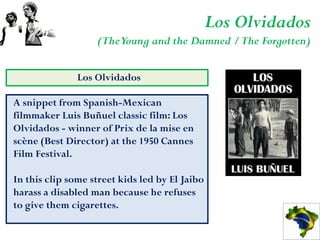
Los Olvidados
                   (The Young and the Damned / The Forgotten)


               Los Olvidados

A snippet from Spanish-Mexican
filmmaker Luis Buñuel classic film: Los
Olvidados - winner of Prix de la mise en
scène (Best Director) at the 1950 Cannes
Film Festival.

In this clip some street kids led by El Jaibo
harass a disabled man because he refuses
to give them cigarettes.
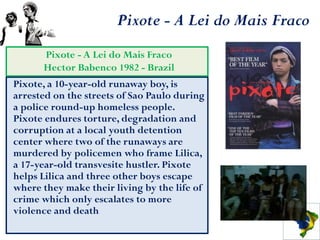
Pixote - A Lei do Mais Fraco
      Pixote - A Lei do Mais Fraco
      Hector Babenco 1982 - Brazil
Pixote, a 10-year-old runaway boy, is
arrested on the streets of Sao Paulo during
a police round-up homeless people.
Pixote endures torture, degradation and
corruption at a local youth detention
center where two of the runaways are
murdered by policemen who frame Lilica,
a 17-year-old transvesite hustler. Pixote
helps Lilica and three other boys escape
where they make their living by the life of
crime which only escalates to more
violence and death
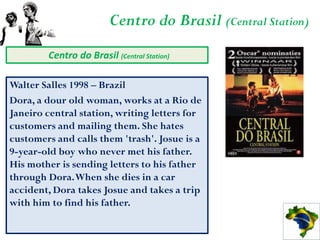
Centro do Brasil (Central Station)
        Centro do Brasil (Central Station)

Walter Salles 1998 – Brazil
Dora, a dour old woman, works at a Rio de
Janeiro central station, writing letters for
customers and mailing them. She hates
customers and calls them 'trash'. Josue is a
9-year-old boy who never met his father.
His mother is sending letters to his father
through Dora. When she dies in a car
accident, Dora takes Josue and takes a trip
with him to find his father.
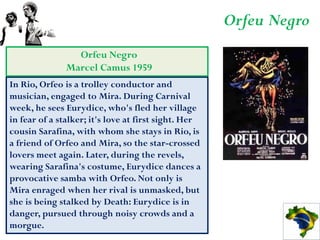
Orfeu Negro
                 Orfeu Negro
               Marcel Camus 1959
In Rio, Orfeo is a trolley conductor and
musician, engaged to Mira. During Carnival
week, he sees Eurydice, who's fled her village
in fear of a stalker; it's love at first sight. Her
cousin Sarafina, with whom she stays in Rio, is
a friend of Orfeo and Mira, so the star-crossed
lovers meet again. Later, during the revels,
wearing Sarafina's costume, Eurydice dances a
provocative samba with Orfeo. Not only is
Mira enraged when her rival is unmasked, but
she is being stalked by Death: Eurydice is in
danger, pursued through noisy crowds and a
morgue.
Past and Present

How do these past representations of
the Favelas compare to the present?
Authenticity

  The location filming is another
contributor to the film’s perceived
       authenticity. Discuss.
Modern Changes

As with any medium the representation of the
favelas has continually been in a state of flux.

       Where do you see the future of this
            representation going?
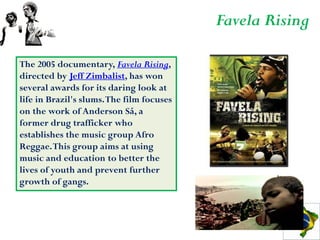
Favela Rising

The 2005 documentary, Favela Rising,
directed by Jeff Zimbalist, has won
several awards for its daring look at
life in Brazil's slums. The film focuses
on the work of Anderson Sá, a
former drug trafficker who
establishes the music group Afro
Reggae. This group aims at using
music and education to better the
lives of youth and prevent further
growth of gangs.
Homework
                   Are the locations represented within City
                   of God presented in a way that seems to
                   conform to the dominant social attitudes,
                   or do they seem to challenge dominant
                   ideologies?

                   Word Count: 750 words
                   Deadline: Monday 31st October


matthew.oregan@sssfc.ac.uk

Cog 4 Favela & Drug War - Context

  • 2.
    Learning Objectives Identify how City of God’s representation of Rio differs from the Dominant ‘Identity’ created by Brazilian ruling class Complete short contextual analysis of Rio and the Flavela’s Discuss the causes of the Brazilian Drug War and how they are represented in City of God
  • 3.
  • 4.
    City of theGods? Watch this short tourism advert from Brazil and answer the following question: How does this representation of Rio contrast with the environment seen in City of God? Include example from the Advertisement and from the film You must make direct comparisons between the two texts
  • 5.
    Rio De Janeiro •City of God’s realistic depiction of Rio’s slums challenges the established ‘Dominant Ideology’ reinforced by the Brazilian ruling class • As we have already identified “National cinema is often at odds with the dominant cultural ideology of the country it depicts” • This tourism trailer paints a vibrant picture of Rio as it attempts to attract tourists and reinforce the ‘positive’ image of Rio • City of God offers an alternative depiction of Rio and challenges everything put forward by the ruling classes of Brazil
  • 6.
    Favela • Favela isa Brazilian word meaning ‘Shanty Town’ • The majority of Favelas have electricity but it is mostly tapped illegally from the public grid • Flavela’s are small, cramped and close together an made from a mix of materials ranging from brick to refuse (Garbage) • Flavela communities are plagued by sewage, crime and hygiene problems • Flavelas are found throughout Brazil in most mid-large sized cities • One in every four Cariocas (as Rio’s inhabitants are known) lives in a Favela
  • 7.
    Drugs in theFavelas Rio (City) Murder Rate: • The Colombian cocaine trade has impacted 40 per 100,000 Brazil and in turn, it’s Flavelas • Favelas tend to be ruled by Drug Lords Rio (Favelas) Murder Rate: • Regular shoot outs between traffickers and ? per 100,000 Police or other criminals are common place, as well as an assortment of other illegal activities Paris Murder • 40 Murders per 100,000 is extremely high it is Rate: believed that the rate in the Favelas is much 2 per 100,000 higher What • Traffickers ensure safety to the citizens in their comparisons can we make areas through their actions and political between La connections Haine & City of God?
  • 8.
    Drugs in theFavelas • They achieve this through building reciprocal relationships and respect, creating an environment in which critical segments of the local population feel safe, despite the ongoing high levels and violence and murders How did Lil Ze do this in City of God? How does this inform our understanding of characters like Lil Zee and his role in the City of God? given or felt by each toward the other; mutual: reciprocal respect
  • 9.
    Brazils Drug Wars •Watch the following short and prepare to answer the following questions: Do the police really have the situation under control? Why do the drug gangs remain such a ‘formidable force?’ How does the government plan to ‘solve’ the problem? Why do you think Lou Lou was seen as a Robin Hood figure by the people? What are the potential problems with sending in the Army?
  • 10.
    The Dividing Line •The best known Favelas are those in and around Rio De Janeiro • Rio’s peculiar urban geography has placed most of them up the hills that face the city’s seaside neighbourhoods and tourist spots • The geographical separation provides a dramatic illustration of the gap between wealthy and the poor • The Favelas are juxtaposed with the luxurious apartment buildings and mansions of Rio’s social elite • It is estimated that at least 19% of Rio’s population lives in Favelas
  • 12.
    Flavela Wars • Watchthe following short and prepare to answer the following questions: What are some of the programs being run to help the young people? Outline the differences between the Wealthy and the Poor How are the locals trying to help? “Kill or be Killed”... How is this mantra or rule demonstrated in City of God?
  • 13.
    The ‘City ofGod’ • The neighbourhood of Cidade de Deus is located to the west of Rio in the borough of Jacarepaguá • The neighborhood was founded in 1966 • Between 1960 – 1975 Rio made up the City Today with a population state of Guanabara of almost 50 thousand • During this time the government began inhabitants, City of God systematically removing Favelas from the presents social indicators centre of Rio and resettled their inhabitants which are among the in the suburbs most critical in Rio de Janeiro
  • 14.
    The ‘City ofGod’ Area (2003): 1.2058 km² Population (2000): 38,016 Residences (2000): 10,866
  • 15.
    The ‘City ofGod’ • Cidade de Deus (City of God), is technically not a Power real Favela, since it was originally a government- sponsored housing community designed to replace a Poverty Favela, which subsequently ran down and took on Conflict many of the very social features of Favelas it was intended to eradicate. Drug Traffikiing Violence What do you think these ‘Social Features’ are? Isolation Make a list of Social Issues that are commented upon in City of God and provide Lack of education at least one scene that demonstrates your point Hopelessness Fear
  • 16.
    Favelas in PopCulture • The City of God and Favelas have been used many times in modern pop culture • As a result, the Favelas are as symbolic of Rio De Janeiro as the famous beaches
  • 17.
    Representin’ the City •Representation is constructed through textual elements and informed by the context of a film’s production • You will need to give detailed consideration to the ways in which cinematography, mise- en-scene, editing and sound are combined to create a specific representation of the City of God How important is the location in the film? Use the following stills from the film and make notes on how the lighting and mise-en- scene give us information about the different time periods the film is set across
  • 18.
    Location, Location • Duringthe 1960’s ‘Tender Trio’ era the city is bathed in golden light and wide shots present a poor but content neighbourhood • Individual, one levelled houses fill the environment and represents the positive intentions of the City • Characters are seen swimming in a river enjoying their environment • During the 1970’s the landscape is filled with high rise tower blocks, creating a very intense and claustrophobic setting • It also demonstrates the radical transformation and degeneration of the city – however the is still golden and most scenes are set in the bright day time
  • 19.
    Location, Location • Aswe move in to the early 1970’s the lighting slowly transitions to a cold blue tint • In the early 1980’s many more scenes are filmed at night • Flavelas have taken over and the cramped streets feel far more oppressive and dangerous • This change in visual style underscores the war between Lil Zee and Carrot • The mise-en-scene shows a city in decay with building collapsed and dead bodies littering the streets • Graffiti and gang posters litter the walls – a subtle touch that adds depth to the unseen gang wars • The final phase of the film returns to bright day light – a symbolic foreshadowing of Lil Zee’s death
  • 20.
    Location, Location In the film the Favela is almost like a separate character in the film. Discuss. Working in pairs discuss this comment and prepare an essay plan for how you would answer the question
  • 21.
    Representation of theFlavela • The real world of the slum can be seen to exist in the use of the film’s location. • It can be read as a ‘street urchin a child who spends most of his time in the streets chronicle’ set in a city in the especially in slum areas developing world and featuring non- professional actors a homeless boy who has been • Audiences and critics may approach abandoned and roams the them as sociological documents streets giving them an insight in to the problems that the protagonists face Do you agree with this assessment? Provide examples from the film to support your points
  • 22.
    Los Olvidados (The Young and the Damned / The Forgotten) Los Olvidados A snippet from Spanish-Mexican filmmaker Luis Buñuel classic film: Los Olvidados - winner of Prix de la mise en scène (Best Director) at the 1950 Cannes Film Festival. In this clip some street kids led by El Jaibo harass a disabled man because he refuses to give them cigarettes.
  • 23.
    Pixote - ALei do Mais Fraco Pixote - A Lei do Mais Fraco Hector Babenco 1982 - Brazil Pixote, a 10-year-old runaway boy, is arrested on the streets of Sao Paulo during a police round-up homeless people. Pixote endures torture, degradation and corruption at a local youth detention center where two of the runaways are murdered by policemen who frame Lilica, a 17-year-old transvesite hustler. Pixote helps Lilica and three other boys escape where they make their living by the life of crime which only escalates to more violence and death
  • 24.
    Centro do Brasil(Central Station) Centro do Brasil (Central Station) Walter Salles 1998 – Brazil Dora, a dour old woman, works at a Rio de Janeiro central station, writing letters for customers and mailing them. She hates customers and calls them 'trash'. Josue is a 9-year-old boy who never met his father. His mother is sending letters to his father through Dora. When she dies in a car accident, Dora takes Josue and takes a trip with him to find his father.
  • 25.
    Orfeu Negro Orfeu Negro Marcel Camus 1959 In Rio, Orfeo is a trolley conductor and musician, engaged to Mira. During Carnival week, he sees Eurydice, who's fled her village in fear of a stalker; it's love at first sight. Her cousin Sarafina, with whom she stays in Rio, is a friend of Orfeo and Mira, so the star-crossed lovers meet again. Later, during the revels, wearing Sarafina's costume, Eurydice dances a provocative samba with Orfeo. Not only is Mira enraged when her rival is unmasked, but she is being stalked by Death: Eurydice is in danger, pursued through noisy crowds and a morgue.
  • 26.
    Past and Present Howdo these past representations of the Favelas compare to the present?
  • 27.
    Authenticity Thelocation filming is another contributor to the film’s perceived authenticity. Discuss.
  • 28.
    Modern Changes As withany medium the representation of the favelas has continually been in a state of flux. Where do you see the future of this representation going?
  • 29.
    Favela Rising The 2005documentary, Favela Rising, directed by Jeff Zimbalist, has won several awards for its daring look at life in Brazil's slums. The film focuses on the work of Anderson Sá, a former drug trafficker who establishes the music group Afro Reggae. This group aims at using music and education to better the lives of youth and prevent further growth of gangs.
  • 30.
    Homework Are the locations represented within City of God presented in a way that seems to conform to the dominant social attitudes, or do they seem to challenge dominant ideologies? Word Count: 750 words Deadline: Monday 31st October matthew.oregan@sssfc.ac.uk