Versioning
System
Overview
Instructor:
Muhammad Shahzad Mughal
Course:
System Programming
Punjab University
College of InformationTechnology
University ofThe Punjab
2
Topics of this session
• Introduction toVersion Control
• Types of Revision Control Systems
• Local Data Model (sccs, rcs)
• Centralized Data Model (cvs, svn)
• Distributed Data Model (bitkeeper, git, mercurial, darcs)
• Downloading, installing and configuring git
• Working with git
• Initializing a git repository
• Adding and committing files to git repository
• Viewing logs and status
• Deleting, renaming and comparing files
• Ignoring files
• Undoing changes and moving to old commits
Version Control System
• A Version Control System is a software tool that records changes to a file or a set of
files over time, so that you can recall specific versions later
• Before VCSs exists we used different ways for maintaining versions of file(s) e.g.
using save as for every new change made to file and making a copy and then giving a
version number and date of update to that file
• AVCS allows us to
 Maintain a history of different versions of a file
 To move back and forth between these versions
 Compare different versions
 Merge multiple versions of same file to create a new version
 Lock other users when one user is altering a file
 Conflict resolution
Types of
Version Control Systems
(VCSs)
1. Local Data Model
Local Data Model
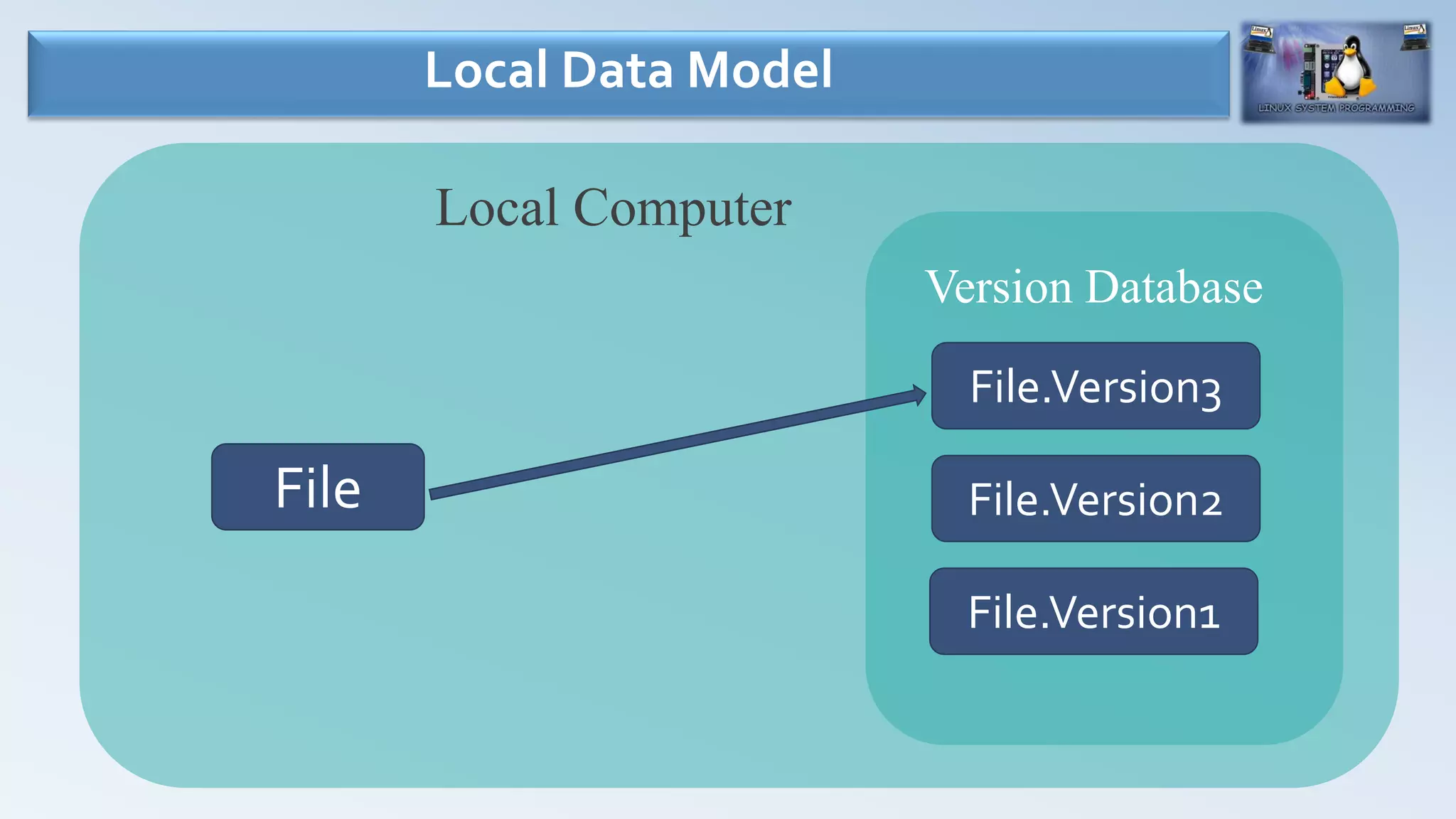
Local Computer
File
Version Database
File.Version3
File.Version2
File.Version1
Source Code Control System: (SCCS-1972)
• Written in C, developed by AT&T and bundled free with UNIX
• It was not the firstVCS, rather the first to become popular
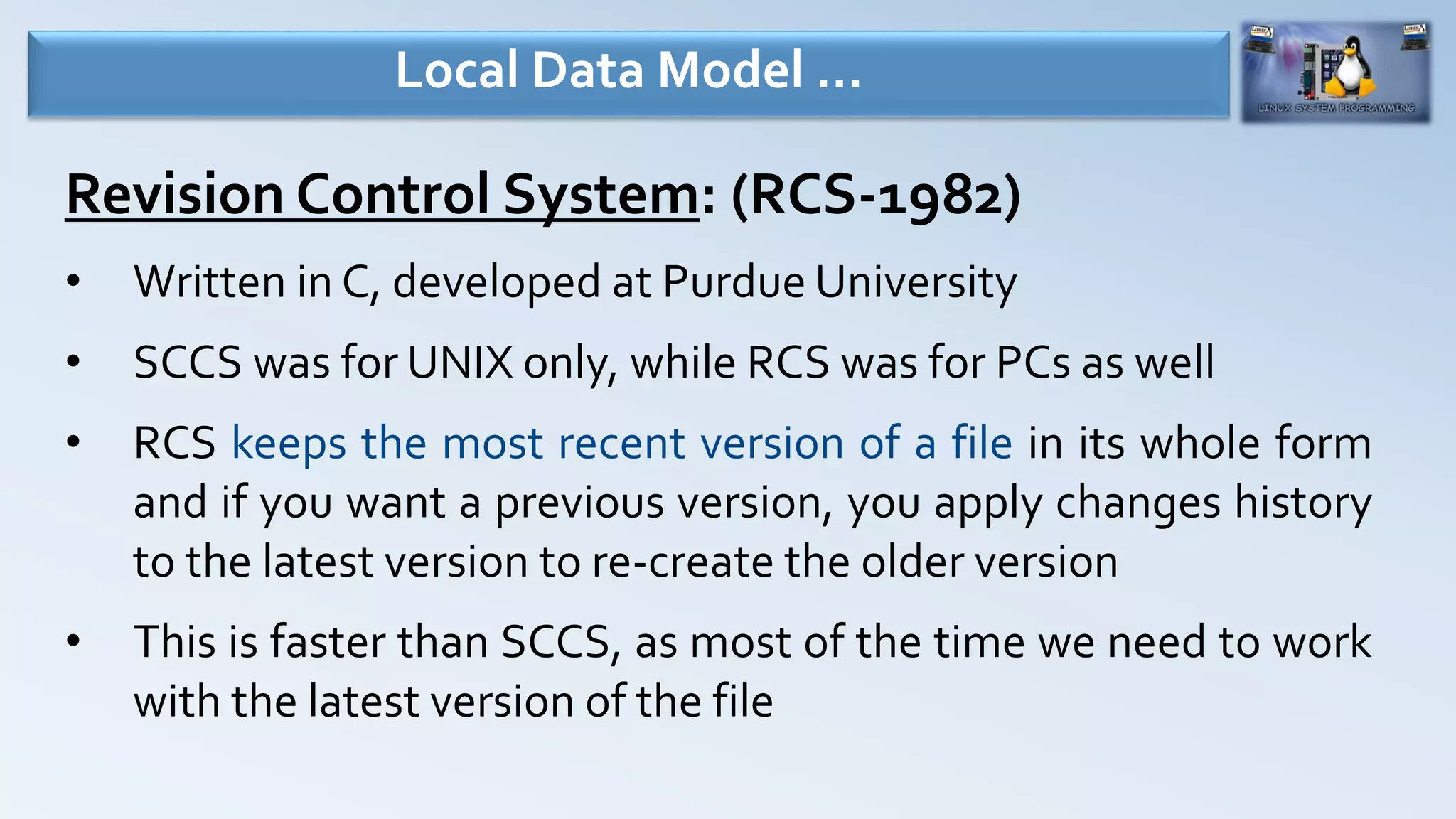
• SCCS keeps the original file as-it-is and instead of saving the
complete new version just save the snapshot of the changes
• If you want ver.3 of a file, you take ver.1 of the file and apply
two set of changes to it to get to ver.3
Local Data Model …
Revision Control System: (RCS-1982)
• Written in C, developed at Purdue University
• SCCS was for UNIX only, while RCS was for PCs as well
• RCS keeps the most recent version of a file in its whole form
and if you want a previous version, you apply changes history
to the latest version to re-create the older version
• This is faster than SCCS, as most of the time we need to work
with the latest version of the file
Local Data Model …
Limitations of LocalVCSs:
• You can track changes in a single file and not in a set of files or
in a whole project
• Only one user can work with a file at a single time, therefore,
multiple users / team members cannot collaborate and work
on the same project
Local Data Model …
2. Centralized Data Model
Centralized Data Model
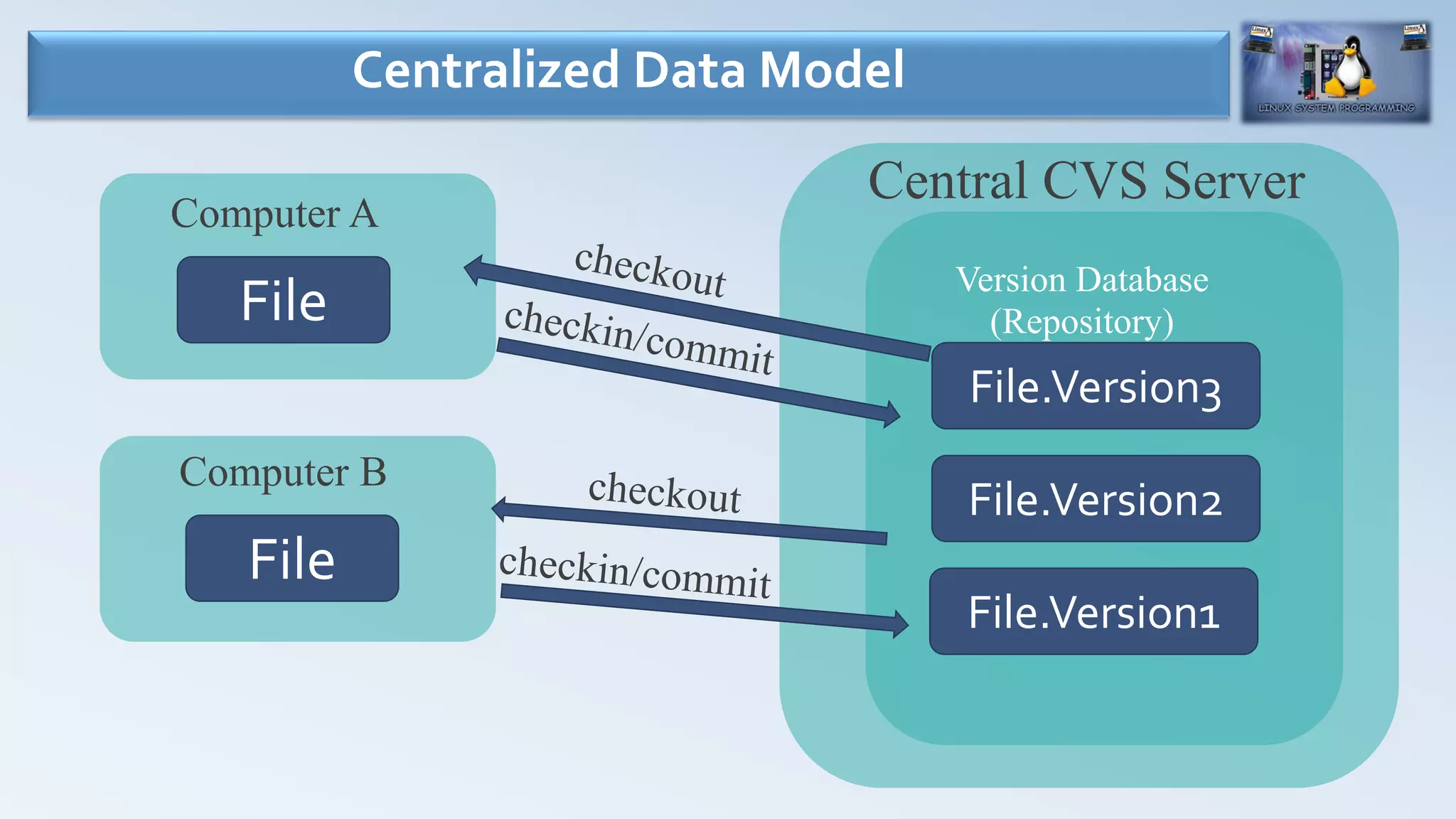
Central CVS Server
File Version Database
(Repository)
File.Version3
File.Version2
File.Version1
Computer A
File
Computer B
ConcurrentVersion System: (CVS-1990)
• Written in C and is open source
• Available for UNIX like OSs (UNIX, Linux, Solaris) as well as for MS
Windows
• Introduced the idea of branching. A set of files may be branched at a
point in time so that, from that time onward, two copies of those files
may be developed in different ways independently of each other
Limitations
• CVS lacks atomic operations. Uses lock-modify-unlock model, allowing a
user to place a lock on the checkout data in the repository, avoiding
concurrency problems
• No file renaming as cannot track directories
Centralized Data Model …
Apache Subversion System: (SVN-2000)
• Written in C, and is open source
• Cross platform and is faster than CVS
• Supports atomic commits
• Can track directories, so you can rename files within directories
• It can also track non-text files like images
Centralized Data Model …
Limitations of CentralizedVCSs:
• Single point of failure as the centralized server containing the
version database may crash
• No collaboration if server is down
• Developers do not have history of project on their local machines
Centralized Data Model …
3. Distributed Data Model
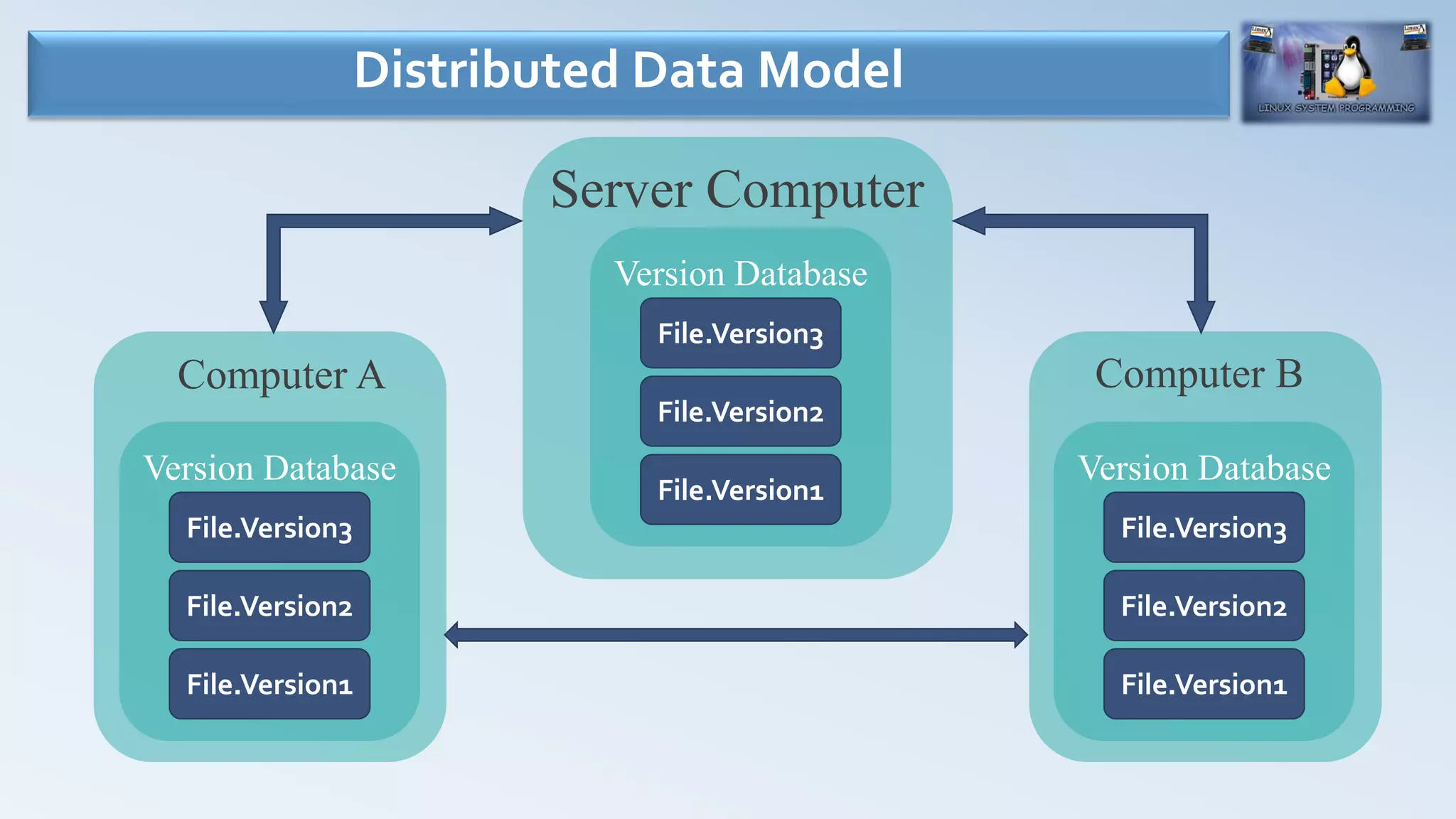
Distributed Data Model
Server Computer
Version Database
File.Version3
File.Version2
File.Version1
Computer B
Version Database
File.Version3
File.Version2
File.Version1
Computer A
Version Database
File.Version3
File.Version2
File.Version1
Bitkeeper -2000
• Written in C, and is proprietary and closed source
• A community version of bitkeeper with limited functionalities was
free and that was used to manage Linux Kernel source from 2002
to 2005
• In April 2005, the “community version of bitkeeper” stopped
being free and it was then git was born
Distributed Data Model …
git - 2005
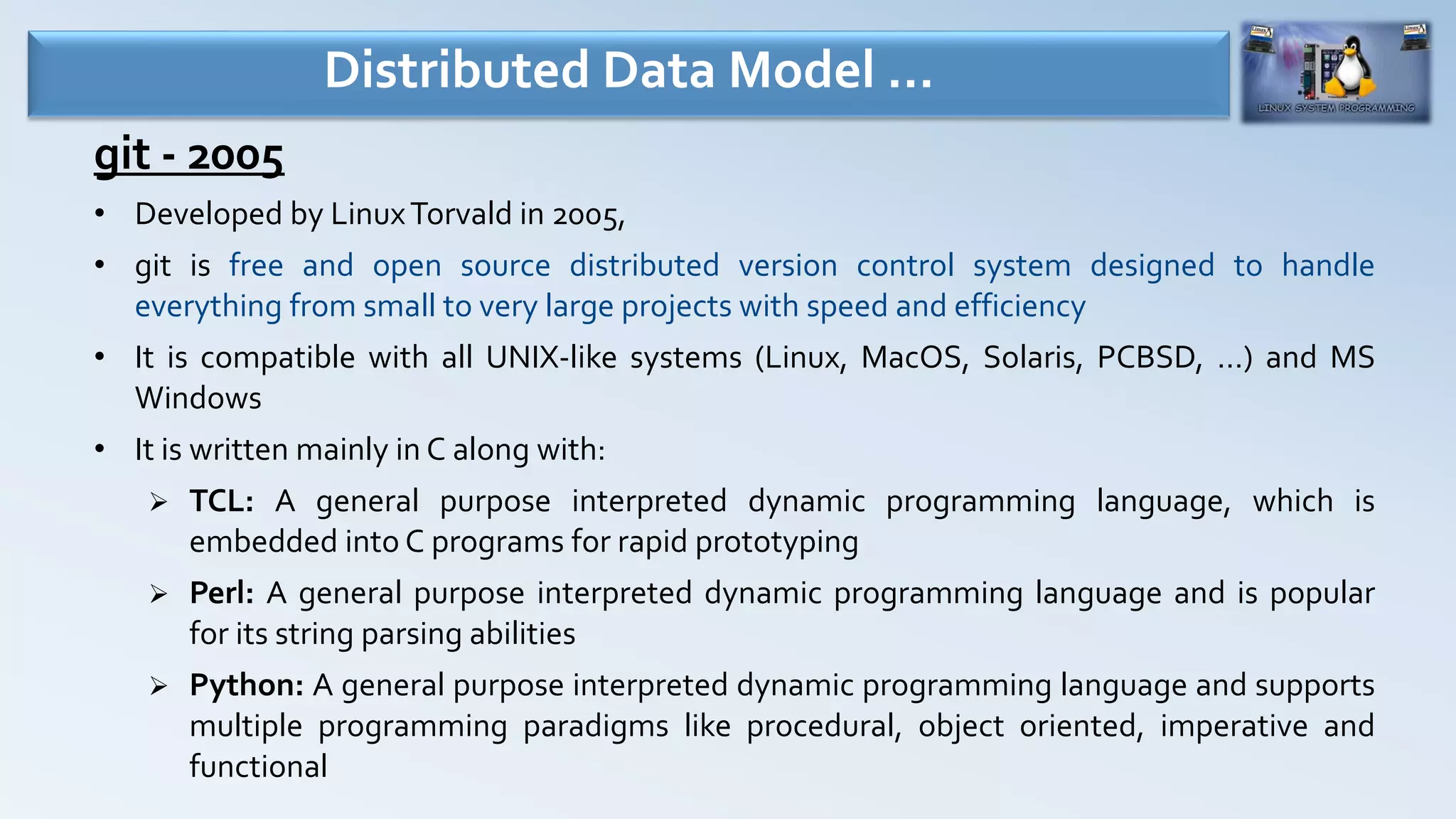
• Developed by LinuxTorvald in 2005,
• git is free and open source distributed version control system designed to handle
everything from small to very large projects with speed and efficiency
• It is compatible with all UNIX-like systems (Linux, MacOS, Solaris, PCBSD, …) and MS
Windows
• It is written mainly in C along with:
 TCL: A general purpose interpreted dynamic programming language, which is
embedded into C programs for rapid prototyping
 Perl: A general purpose interpreted dynamic programming language and is popular
for its string parsing abilities
 Python: A general purpose interpreted dynamic programming language and supports
multiple programming paradigms like procedural, object oriented, imperative and
functional
Distributed Data Model …
git
Installation & Configuration
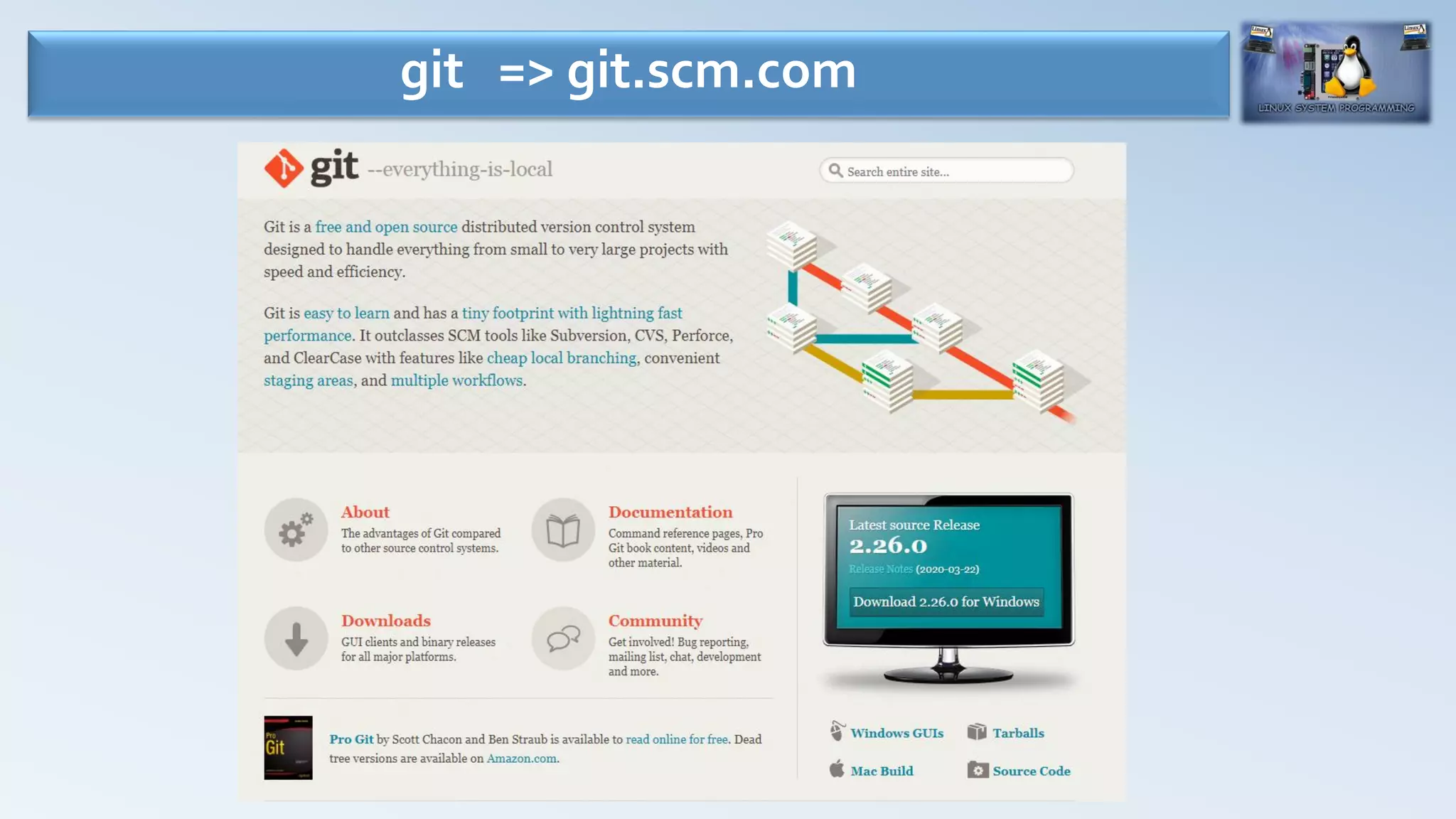
git => git.scm.com
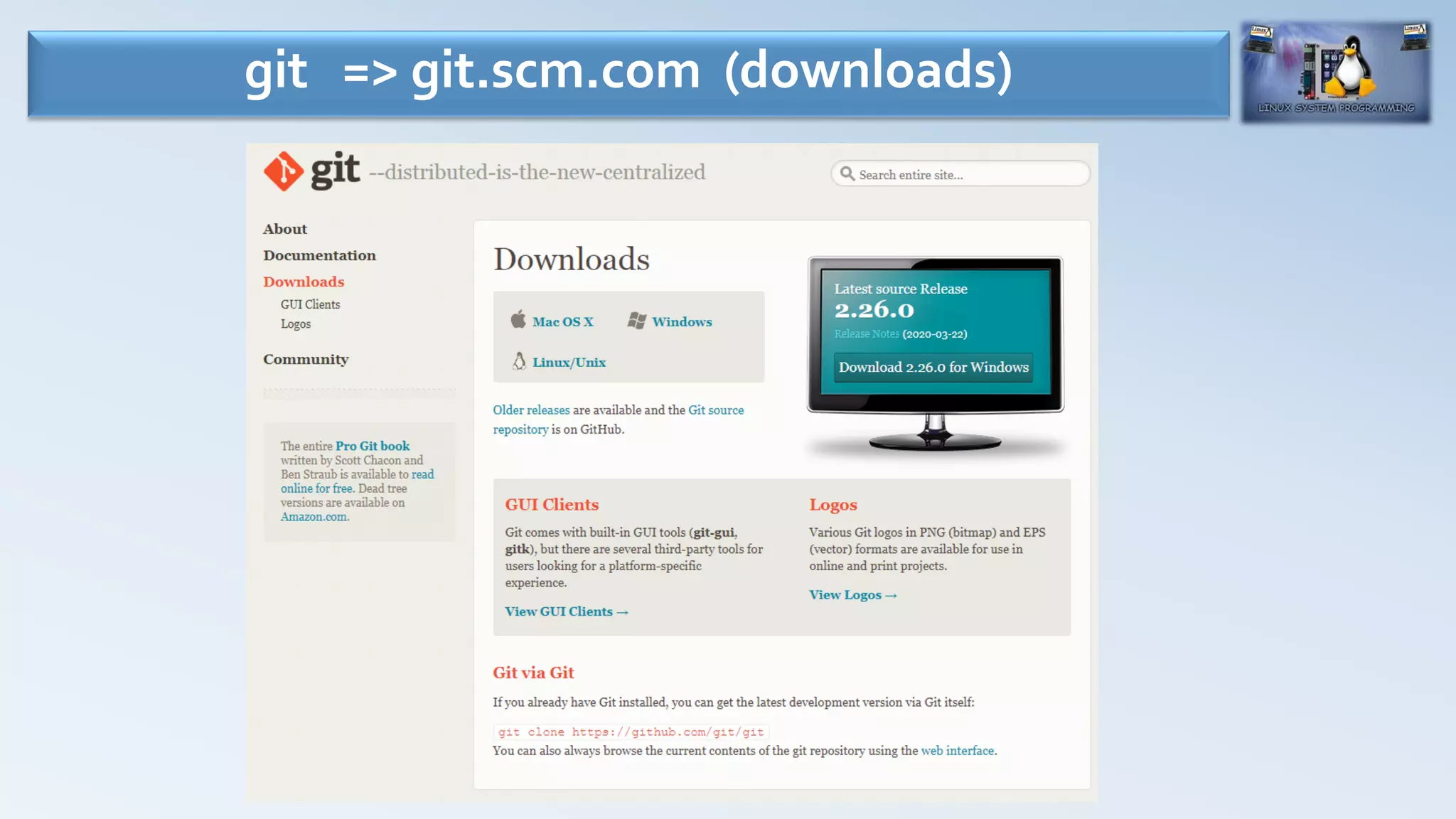
git => git.scm.com (downloads)
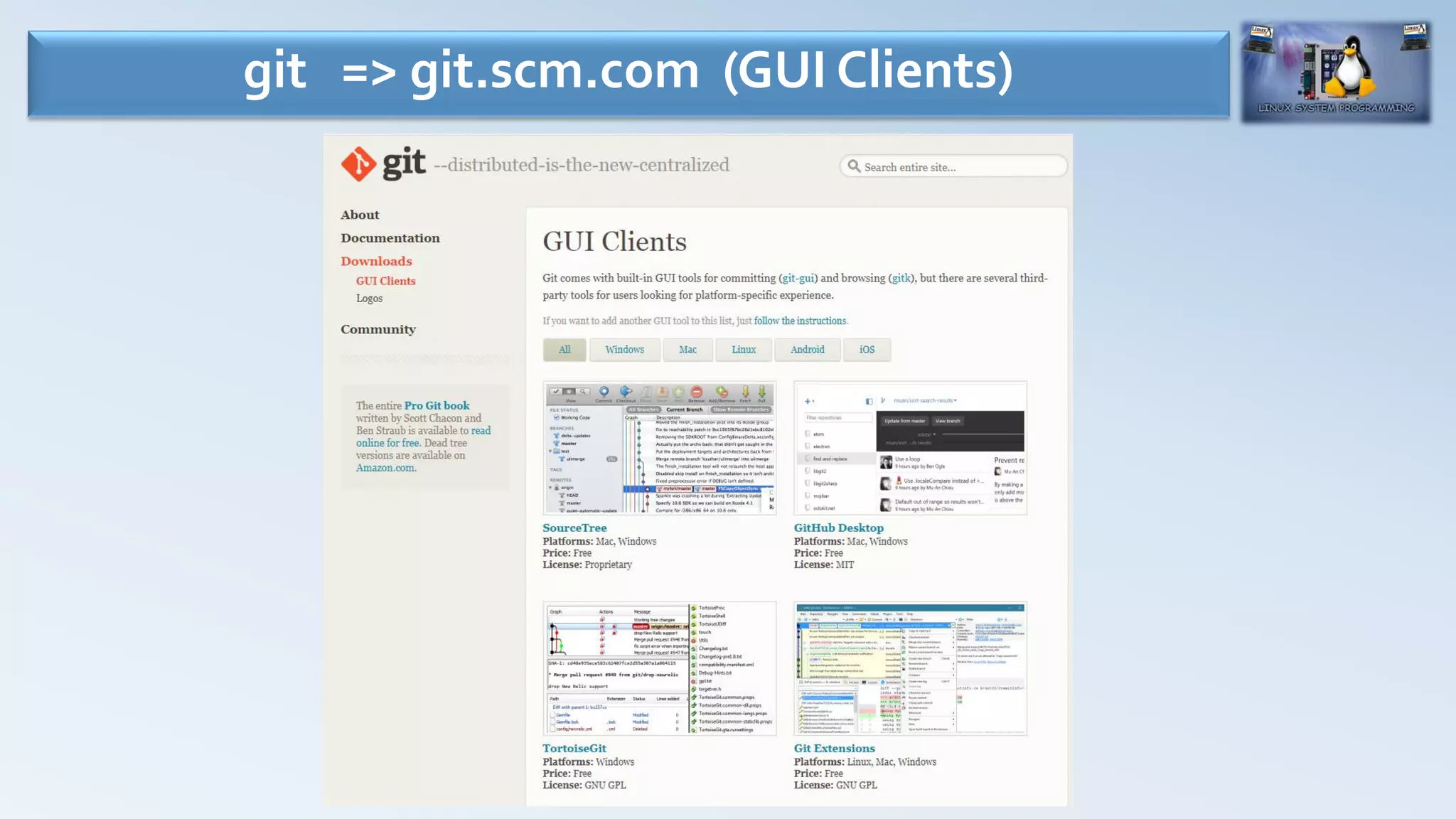
git => git.scm.com (GUI Clients)
23
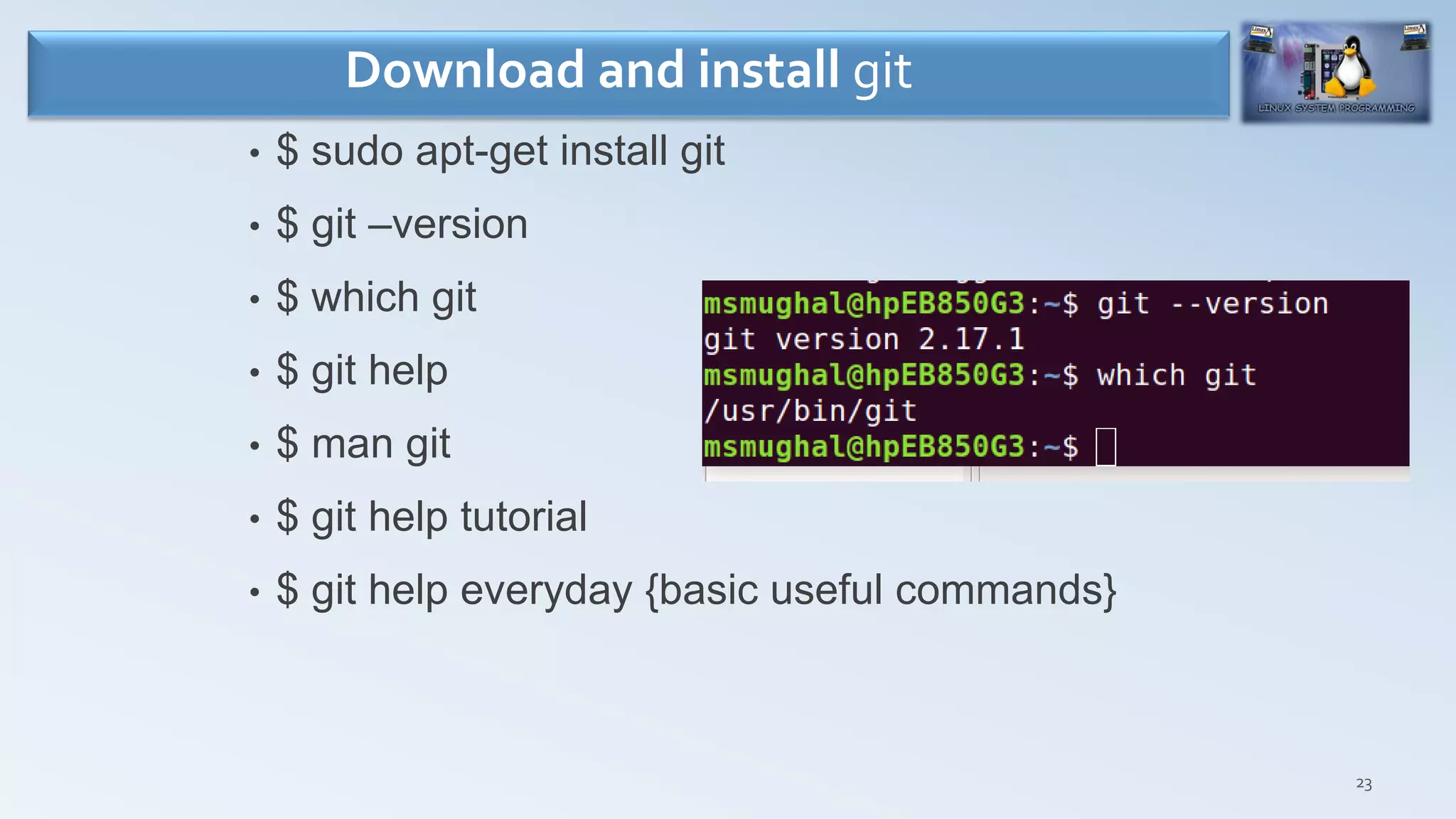
• $ sudo apt-get install git
• $ git –version
• $ which git
• $ git help
• $ man git
• $ git help tutorial
• $ git help everyday {basic useful commands}
Download and install git
24
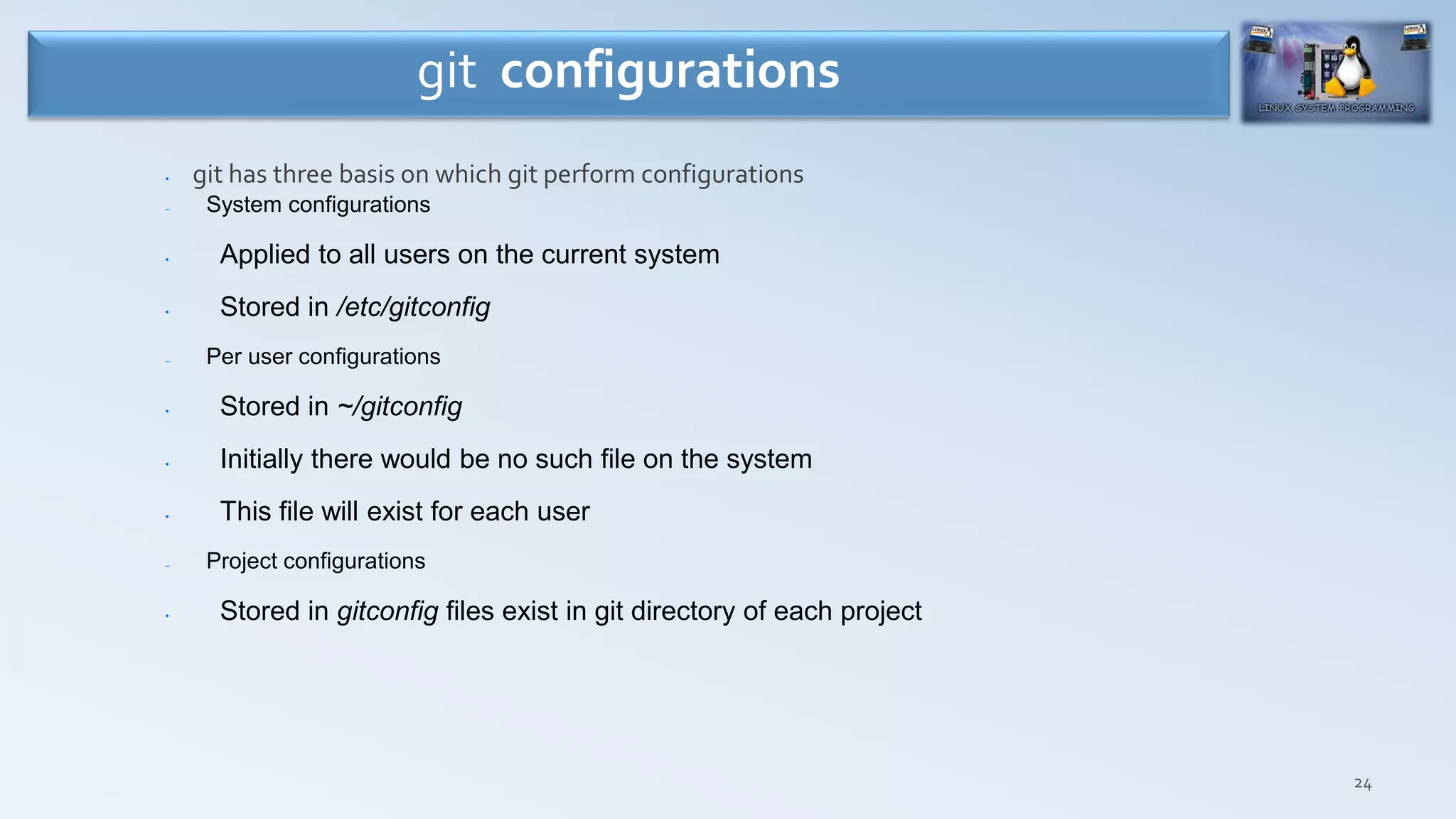
• git has three basis on which git perform configurations
– System configurations
• Applied to all users on the current system
• Stored in /etc/gitconfig
– Per user configurations
• Stored in ~/gitconfig
• Initially there would be no such file on the system
• This file will exist for each user
– Project configurations
• Stored in gitconfig files exist in git directory of each project
git configurations
25
● We can edit these files directly
● Better to use config tool
● different configurations
–$ git config --system {for system configuration}
–$ git config --global {for per user configurations}
–$ git config --local {for project level configurations}
git configurations …
26
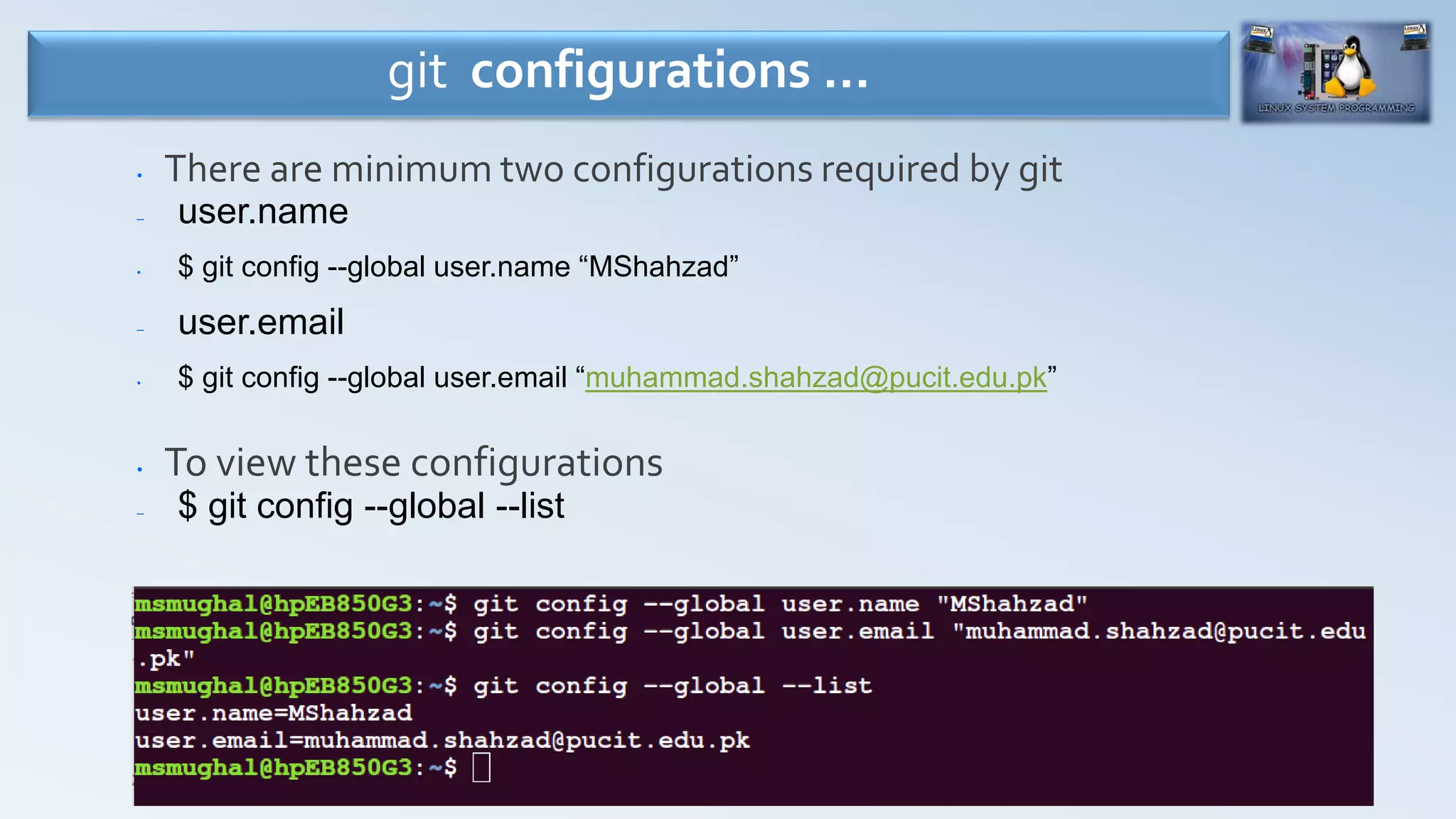
• There are minimum two configurations required by git
– user.name
• $ git config --global user.name “MShahzad”
– user.email
• $ git config --global user.email “muhammad.shahzad@pucit.edu.pk”
• To view these configurations
– $ git config --global --list
git configurations …
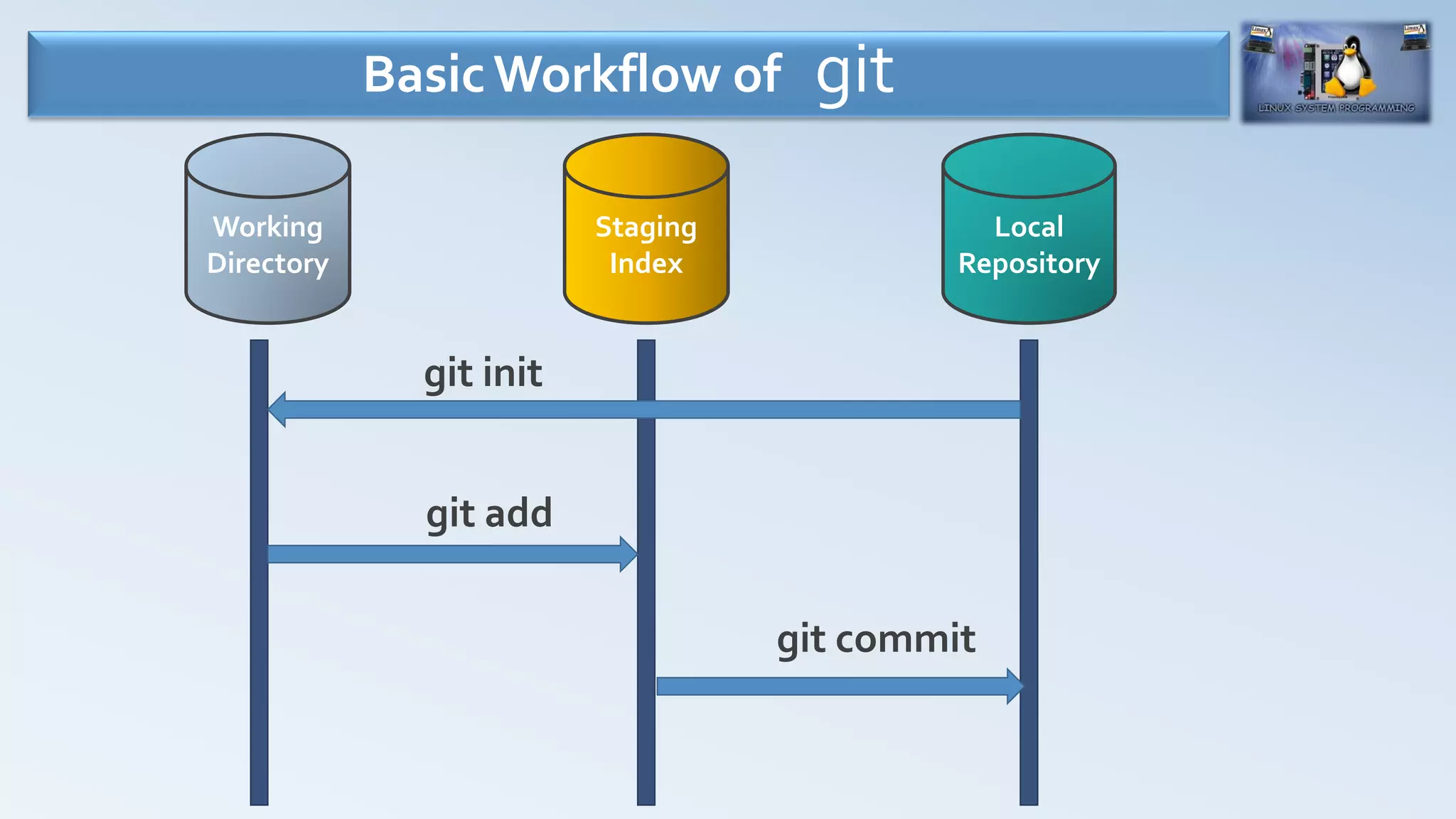
BasicWorkflow of git
Working
Directory
Staging
Index
Local
Repository
git init
git add
git commit
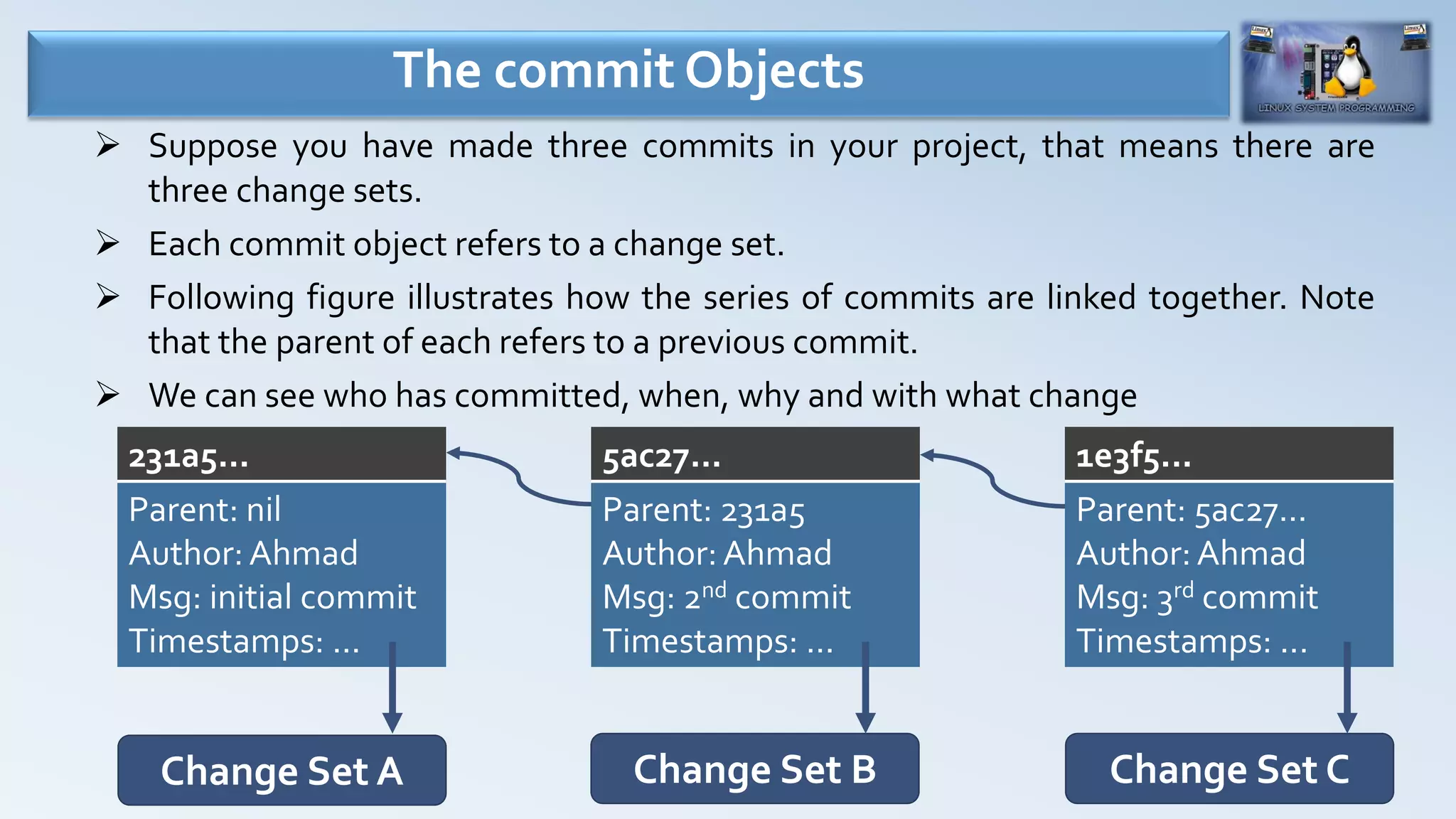
 Suppose you have made three commits in your project, that means there are
three change sets.
 Each commit object refers to a change set.
 Following figure illustrates how the series of commits are linked together. Note
that the parent of each refers to a previous commit.
 We can see who has committed, when, why and with what change
The commit Objects
231a5...
Parent: nil
Author: Ahmad
Msg: initial commit
Timestamps: ...
5ac27...
Parent: 231a5
Author: Ahmad
Msg: 2nd commit
Timestamps: ...
1e3f5...
Parent: 5ac27...
Author: Ahmad
Msg: 3rd commit
Timestamps: ...
Change Set A Change Set B Change Set C
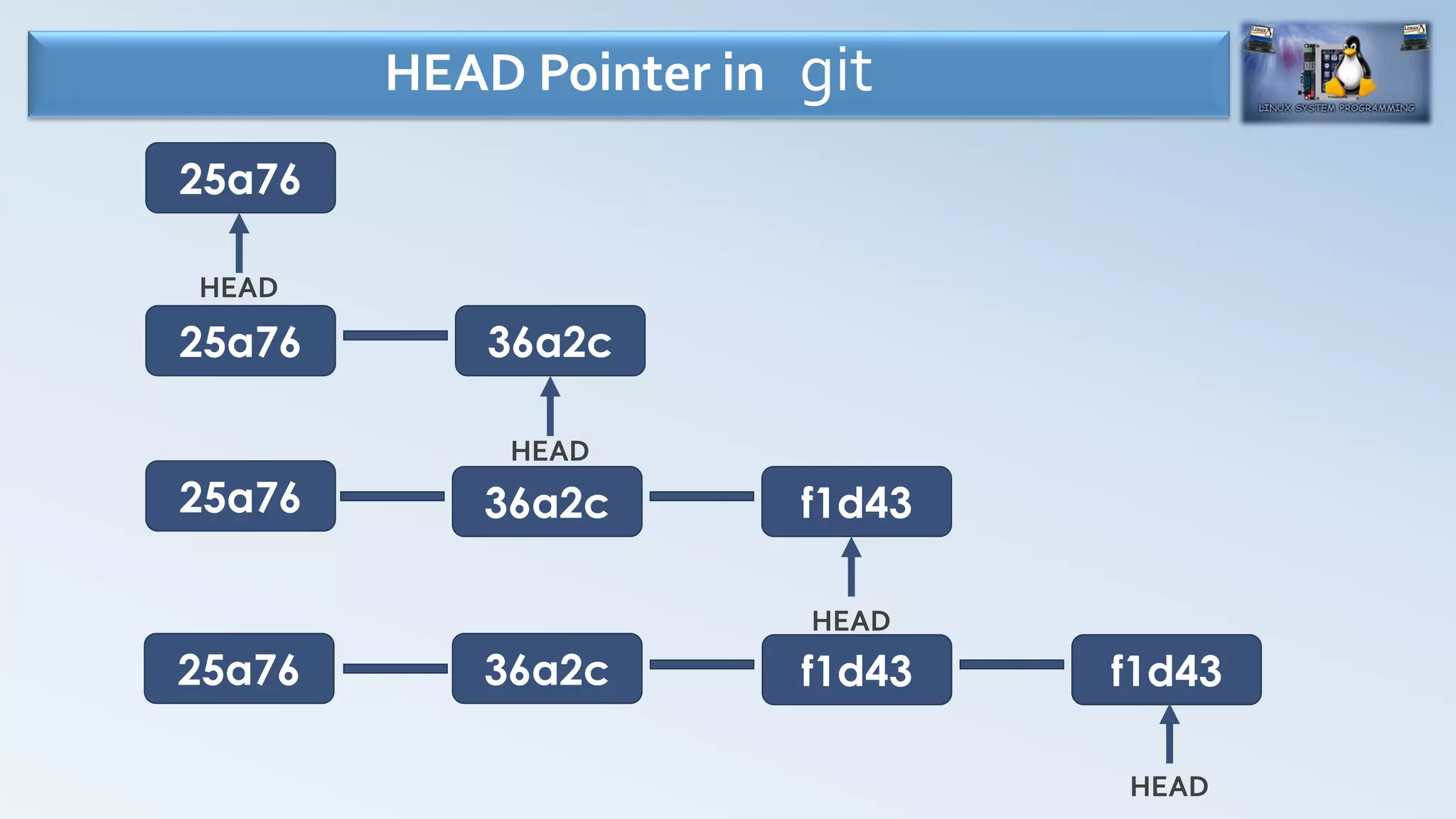
HEAD Pointer in git
25a76
HEAD
25a76
HEAD
25a76
HEAD
25a76
36a2c
36a2c
36a2c
f1d43
f1d43 f1d43
HEAD
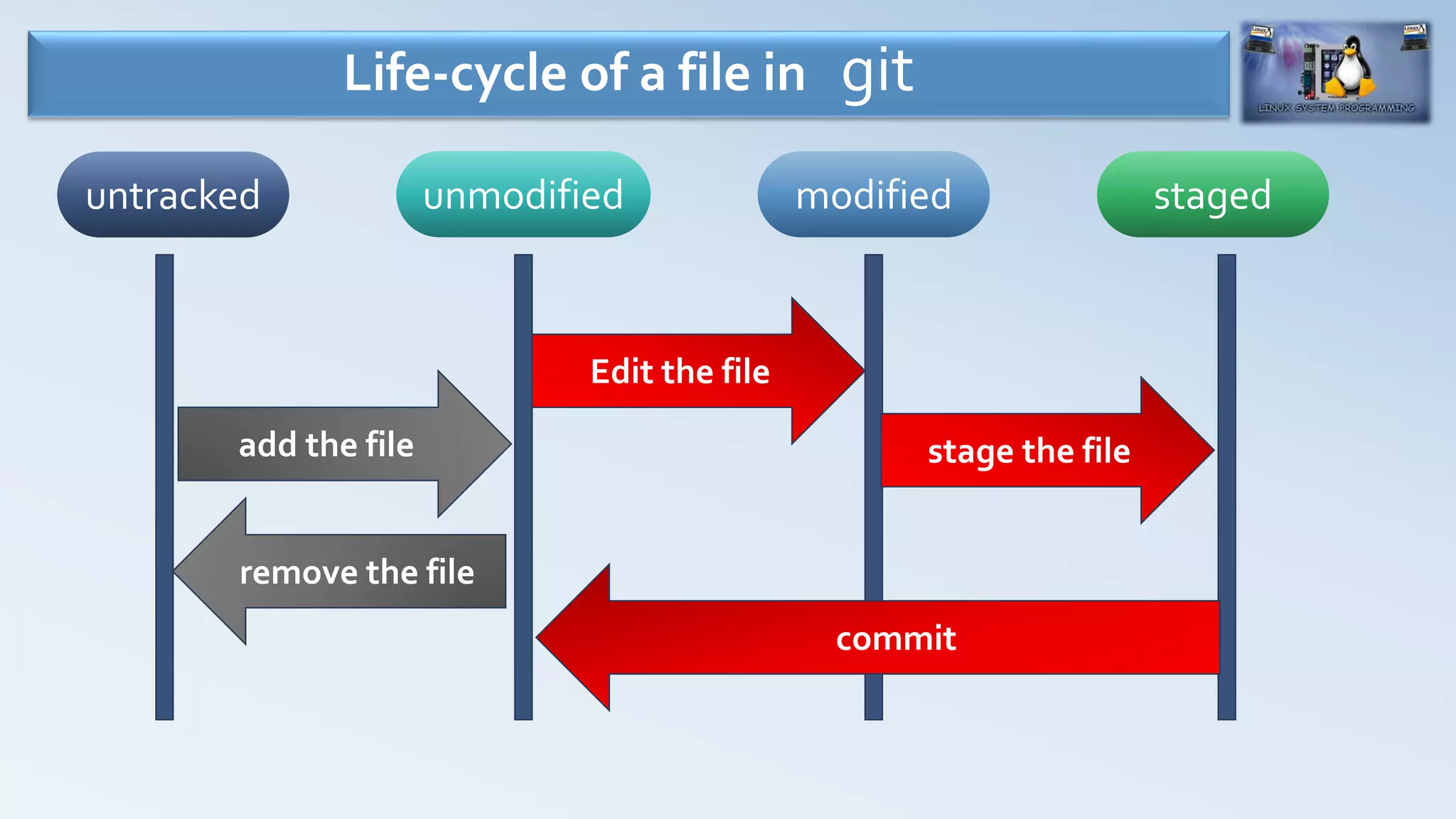
Life-cycle of a file in git
untracked unmodified modified staged
Edit the file
stage the file
commit
add the file
remove the file
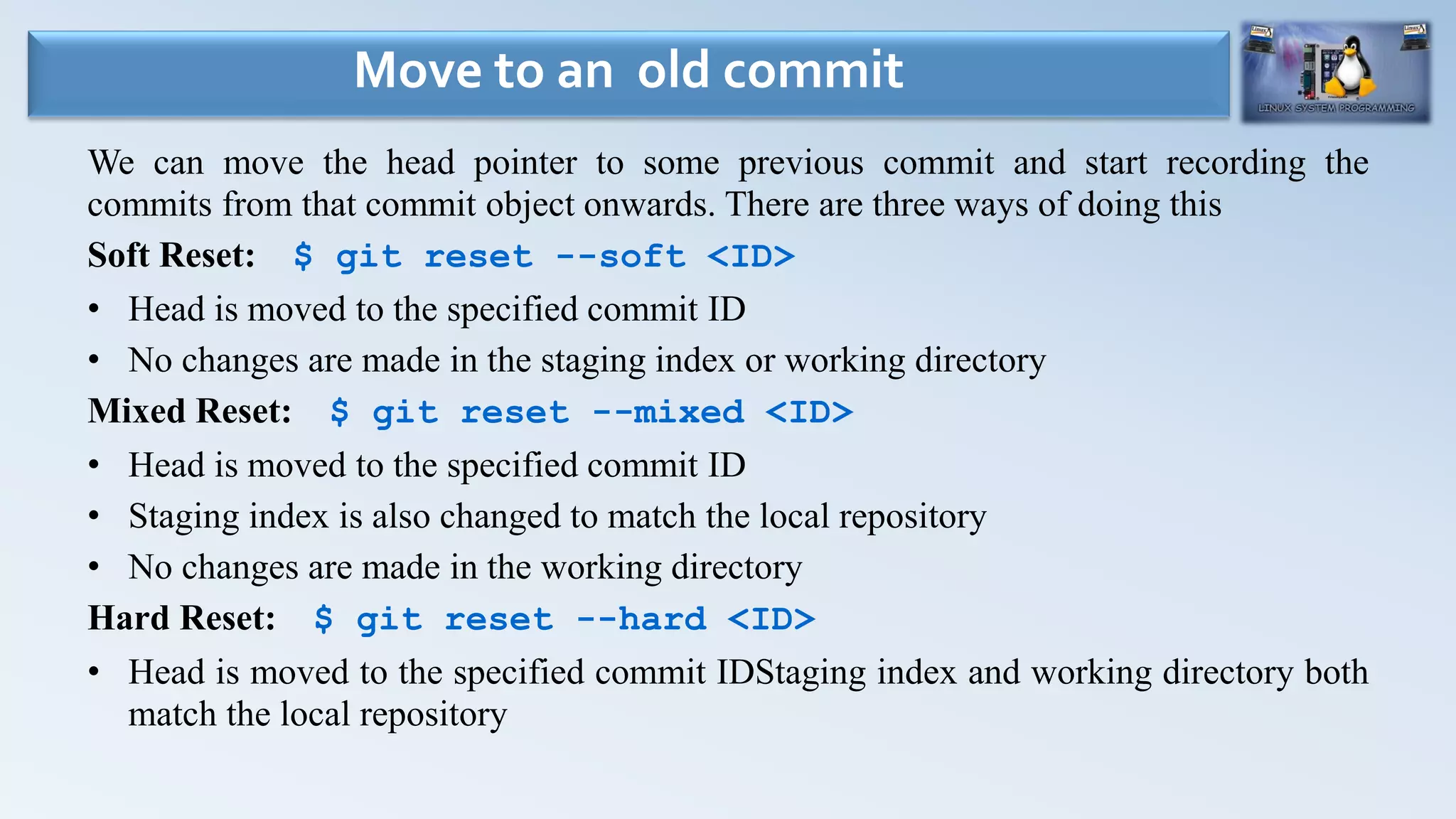
We can move the head pointer to some previous commit and start recording the
commits from that commit object onwards. There are three ways of doing this
Soft Reset: $ git reset --soft <ID>
• Head is moved to the specified commit ID
• No changes are made in the staging index or working directory
Mixed Reset: $ git reset --mixed <ID>
• Head is moved to the specified commit ID
• Staging index is also changed to match the local repository
• No changes are made in the working directory
Hard Reset: $ git reset --hard <ID>
• Head is moved to the specified commit IDStaging index and working directory both
match the local repository
Move to an old commit
ThankYou !!!

L06 a versioning_system_overview

  • 1.
    Versioning System Overview Instructor: Muhammad Shahzad Mughal Course: SystemProgramming Punjab University College of InformationTechnology University ofThe Punjab
  • 2.
    2 Topics of thissession • Introduction toVersion Control • Types of Revision Control Systems • Local Data Model (sccs, rcs) • Centralized Data Model (cvs, svn) • Distributed Data Model (bitkeeper, git, mercurial, darcs) • Downloading, installing and configuring git • Working with git • Initializing a git repository • Adding and committing files to git repository • Viewing logs and status • Deleting, renaming and comparing files • Ignoring files • Undoing changes and moving to old commits
  • 3.
    Version Control System •A Version Control System is a software tool that records changes to a file or a set of files over time, so that you can recall specific versions later • Before VCSs exists we used different ways for maintaining versions of file(s) e.g. using save as for every new change made to file and making a copy and then giving a version number and date of update to that file • AVCS allows us to  Maintain a history of different versions of a file  To move back and forth between these versions  Compare different versions  Merge multiple versions of same file to create a new version  Lock other users when one user is altering a file  Conflict resolution
  • 4.
  • 5.
  • 6.
    Local Data Model LocalComputer File Version Database File.Version3 File.Version2 File.Version1
  • 7.
    Source Code ControlSystem: (SCCS-1972) • Written in C, developed by AT&T and bundled free with UNIX • It was not the firstVCS, rather the first to become popular • SCCS keeps the original file as-it-is and instead of saving the complete new version just save the snapshot of the changes • If you want ver.3 of a file, you take ver.1 of the file and apply two set of changes to it to get to ver.3 Local Data Model …
  • 8.
    Revision Control System:(RCS-1982) • Written in C, developed at Purdue University • SCCS was for UNIX only, while RCS was for PCs as well • RCS keeps the most recent version of a file in its whole form and if you want a previous version, you apply changes history to the latest version to re-create the older version • This is faster than SCCS, as most of the time we need to work with the latest version of the file Local Data Model …
  • 9.
    Limitations of LocalVCSs: •You can track changes in a single file and not in a set of files or in a whole project • Only one user can work with a file at a single time, therefore, multiple users / team members cannot collaborate and work on the same project Local Data Model …
  • 10.
  • 11.
    Centralized Data Model CentralCVS Server File Version Database (Repository) File.Version3 File.Version2 File.Version1 Computer A File Computer B
  • 12.
    ConcurrentVersion System: (CVS-1990) •Written in C and is open source • Available for UNIX like OSs (UNIX, Linux, Solaris) as well as for MS Windows • Introduced the idea of branching. A set of files may be branched at a point in time so that, from that time onward, two copies of those files may be developed in different ways independently of each other Limitations • CVS lacks atomic operations. Uses lock-modify-unlock model, allowing a user to place a lock on the checkout data in the repository, avoiding concurrency problems • No file renaming as cannot track directories Centralized Data Model …
  • 13.
    Apache Subversion System:(SVN-2000) • Written in C, and is open source • Cross platform and is faster than CVS • Supports atomic commits • Can track directories, so you can rename files within directories • It can also track non-text files like images Centralized Data Model …
  • 14.
    Limitations of CentralizedVCSs: •Single point of failure as the centralized server containing the version database may crash • No collaboration if server is down • Developers do not have history of project on their local machines Centralized Data Model …
  • 15.
  • 16.
    Distributed Data Model ServerComputer Version Database File.Version3 File.Version2 File.Version1 Computer B Version Database File.Version3 File.Version2 File.Version1 Computer A Version Database File.Version3 File.Version2 File.Version1
  • 17.
    Bitkeeper -2000 • Writtenin C, and is proprietary and closed source • A community version of bitkeeper with limited functionalities was free and that was used to manage Linux Kernel source from 2002 to 2005 • In April 2005, the “community version of bitkeeper” stopped being free and it was then git was born Distributed Data Model …
  • 18.
    git - 2005 •Developed by LinuxTorvald in 2005, • git is free and open source distributed version control system designed to handle everything from small to very large projects with speed and efficiency • It is compatible with all UNIX-like systems (Linux, MacOS, Solaris, PCBSD, …) and MS Windows • It is written mainly in C along with:  TCL: A general purpose interpreted dynamic programming language, which is embedded into C programs for rapid prototyping  Perl: A general purpose interpreted dynamic programming language and is popular for its string parsing abilities  Python: A general purpose interpreted dynamic programming language and supports multiple programming paradigms like procedural, object oriented, imperative and functional Distributed Data Model …
  • 19.
  • 20.
  • 21.
    git => git.scm.com(downloads)
  • 22.
    git => git.scm.com(GUI Clients)
  • 23.
    23 • $ sudoapt-get install git • $ git –version • $ which git • $ git help • $ man git • $ git help tutorial • $ git help everyday {basic useful commands} Download and install git
  • 24.
    24 • git hasthree basis on which git perform configurations – System configurations • Applied to all users on the current system • Stored in /etc/gitconfig – Per user configurations • Stored in ~/gitconfig • Initially there would be no such file on the system • This file will exist for each user – Project configurations • Stored in gitconfig files exist in git directory of each project git configurations
  • 25.
    25 ● We canedit these files directly ● Better to use config tool ● different configurations –$ git config --system {for system configuration} –$ git config --global {for per user configurations} –$ git config --local {for project level configurations} git configurations …
  • 26.
    26 • There areminimum two configurations required by git – user.name • $ git config --global user.name “MShahzad” – user.email • $ git config --global user.email “muhammad.shahzad@pucit.edu.pk” • To view these configurations – $ git config --global --list git configurations …
  • 27.
  • 28.
     Suppose youhave made three commits in your project, that means there are three change sets.  Each commit object refers to a change set.  Following figure illustrates how the series of commits are linked together. Note that the parent of each refers to a previous commit.  We can see who has committed, when, why and with what change The commit Objects 231a5... Parent: nil Author: Ahmad Msg: initial commit Timestamps: ... 5ac27... Parent: 231a5 Author: Ahmad Msg: 2nd commit Timestamps: ... 1e3f5... Parent: 5ac27... Author: Ahmad Msg: 3rd commit Timestamps: ... Change Set A Change Set B Change Set C
  • 29.
    HEAD Pointer ingit 25a76 HEAD 25a76 HEAD 25a76 HEAD 25a76 36a2c 36a2c 36a2c f1d43 f1d43 f1d43 HEAD
  • 30.
    Life-cycle of afile in git untracked unmodified modified staged Edit the file stage the file commit add the file remove the file
  • 31.
    We can movethe head pointer to some previous commit and start recording the commits from that commit object onwards. There are three ways of doing this Soft Reset: $ git reset --soft <ID> • Head is moved to the specified commit ID • No changes are made in the staging index or working directory Mixed Reset: $ git reset --mixed <ID> • Head is moved to the specified commit ID • Staging index is also changed to match the local repository • No changes are made in the working directory Hard Reset: $ git reset --hard <ID> • Head is moved to the specified commit IDStaging index and working directory both match the local repository Move to an old commit
  • 32.