INDICATORS OF GLOBALIZATION
Measuring and Assessing Global Impact and Engagement in
Education
Dr. Linc Johnson
May 27-29, 2014
RANKING GLOBAL ENGAGEMENT
• Data were collected from rankings methodologies, observations and
qualitative inquiry interviews with administrators and executives/experts.
• From this data, a list of 17 indicators of globalization was developed to
assist schools with focusing comprehensive activities, culture and
climate toward more useful processes, activities and competencies that
can be undertaken to promote globalization.
RATIONALE
• EXPERIENCE
• EXPOSURE
• EDUCATION
WORLD-CLASS, WORLDWIDE
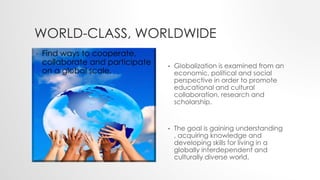
• Globalization is examined from an
economic, political and social
perspective in order to promote
educational and cultural
collaboration, research and
scholarship.
• The goal is gaining understanding
, acquiring knowledge and
developing skills for living in a
globally interdependent and
culturally diverse world.
• Find ways to cooperate,
collaborate and participate
on a global scale.
WORLD-CLASS, WORLDWIDE
• Focus is to create outcomes, build quality into programs, and
facilitate learning and global integration
• A major strategy is educational reform projects that cultivate
the creative, high-quality human resources necessary for a
knowledge-based society
• Cross-pollination of educational theory and practice, diversity
of thought and culture, the sharing of ideas, and collaboration
on a worldwide scale
RESEARCH/METHODOLOGY
Qualitative Research
- Administrators, Executives, Authors, Experts
- Observation (Travel)
- Ranking Methodologies
• Designing and Implementing an Academic Scorecard
(O’Neil, Bensimon, Diamond, & Moore, 1999)
• Internationalization in Higher Education: Towards a
Conceptual Framework (Qiang, 2003)
INDICATORS OF GLOBALIZATION
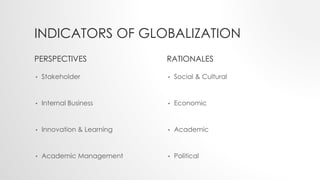
PERSPECTIVES
• Stakeholder
• Internal Business
• Innovation & Learning
• Academic Management
RATIONALES
• Social & Cultural
• Economic
• Academic
• Political
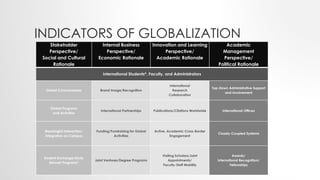
INDICATORS OF GLOBALIZATION
Stakeholder
Perspective/
Social and Cultural
Rationale
Internal Business
Perspective/
Economic Rationale
Innovation and Learning
Perspective/
Academic Rationale
Academic
Management
Perspective/
Political Rationale
International Students*, Faculty, and Administrators
Global Consciousness Brand Image/Recognition
International
Research
Collaboration
Top-Down Administrative Support
and Involvement
Global Programs
and Activities
International Partnerships Publications/Citations Worldwide International Offices
Meaningful Interaction/
Integration on Campus
Funding/Fundraising for Global
Activities
Active, Academic Cross-Border
Engagement
Closely-Coupled Systems
Student Exchange/Study
Abroad Programs*
Joint Ventures/Degree Programs
Visiting Scholars/Joint
Appointments/
Faculty-Staff Mobility
Awards/
International Recognition/
Fellowships
MEANINGFUL, GLOBALLY CONSCIOUS STUDENT EXPERIENCES
ENSURE CURRICULA ARE BASED IN INNOVATION
ALLOW FACULTY EXPERIENCES THAT INCLUDE ACTIVE, ACADEMIC COLLABORATION
INTEGRATE INTERCULTURAL DIMENSIONS INTO THE FUNCTION OF AN INSTITUTION
DYNAMIC PROCESS, NOT A SET OF ISOLATED ACTIVITIES
COMPARATIVE ADVANTAGE VS. COMPETITIVE ADVANTAGE
NEXT STEPS
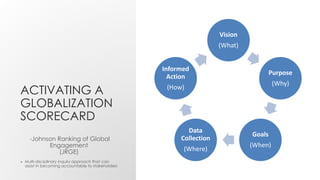
ACTIVATING A
GLOBALIZATION
SCORECARD
-Johnson Ranking of Global
Engagement
(JRGE)
 Multi-disciplinary inquiry approach that can
assist in becoming accountable to stakeholders
Vision
(What)
Purpose
(Why)
Goals
(When)
Data
Collection
(Where)
Informed
Action
(How)
THE THIRD
WAVE
Globalization processes alter the
educational landscape around
the world.
• Creates a new marketplace that
is very different
• Requires new tools that assist in
monitoring impact, influence and
immersion
• The importance of integrating these
dimensions into the structure of an
institution will provide benefits, such as
helping to develop research,
teaching and learning methods, that
address the needs of a broader
spectrum of learners and facilitates
the development of graduates who
are both well-suited to participate in
professional life and are aware of their
social context.
QUESTIONS?
• Resources
• apru.org
• ciee.org
• unicef.org
• bc.edu/research/cihe.html
• Cited Sources
• Altbach, P.G. (2004). Globalisation and the
university: Myths and realities in an unequal world.
Tertiary Education and Management, 10(1), 3-25.
• Association of Pacific Rim Universities Secretariat.
(2008). Bridging the Pacific Rim community
through education, research and enterprise.
• Council on International Educational Exchange.
(2009). CIEE at 60: Celebrating sixty years of
international educational exchange.
• O’Neil, H.F., Bensimon, E.M., Diamond, M.A., &
Moore, M.R. (1999). Designing and implementing
an academic scorecard. Change, 32-40.
• Qiang, Z. (2003). Internationalization of higher
education: toward a conceptual framework.
Policy Futures in Education, 1(2), 248-270.
• European Commission (2012). Fostering and
measuring ‘third mission’ in higher education.
Valencia Spain: Jan Sadlak.

L johnson global indicators 052014 cdcr

  • 1.
    INDICATORS OF GLOBALIZATION Measuringand Assessing Global Impact and Engagement in Education Dr. Linc Johnson May 27-29, 2014
  • 2.
    RANKING GLOBAL ENGAGEMENT •Data were collected from rankings methodologies, observations and qualitative inquiry interviews with administrators and executives/experts. • From this data, a list of 17 indicators of globalization was developed to assist schools with focusing comprehensive activities, culture and climate toward more useful processes, activities and competencies that can be undertaken to promote globalization.
  • 3.
  • 4.
    WORLD-CLASS, WORLDWIDE • Globalizationis examined from an economic, political and social perspective in order to promote educational and cultural collaboration, research and scholarship. • The goal is gaining understanding , acquiring knowledge and developing skills for living in a globally interdependent and culturally diverse world. • Find ways to cooperate, collaborate and participate on a global scale.
  • 5.
    WORLD-CLASS, WORLDWIDE • Focusis to create outcomes, build quality into programs, and facilitate learning and global integration • A major strategy is educational reform projects that cultivate the creative, high-quality human resources necessary for a knowledge-based society • Cross-pollination of educational theory and practice, diversity of thought and culture, the sharing of ideas, and collaboration on a worldwide scale
  • 6.
    RESEARCH/METHODOLOGY Qualitative Research - Administrators,Executives, Authors, Experts - Observation (Travel) - Ranking Methodologies • Designing and Implementing an Academic Scorecard (O’Neil, Bensimon, Diamond, & Moore, 1999) • Internationalization in Higher Education: Towards a Conceptual Framework (Qiang, 2003)
  • 7.
    INDICATORS OF GLOBALIZATION PERSPECTIVES •Stakeholder • Internal Business • Innovation & Learning • Academic Management RATIONALES • Social & Cultural • Economic • Academic • Political
  • 8.
    INDICATORS OF GLOBALIZATION Stakeholder Perspective/ Socialand Cultural Rationale Internal Business Perspective/ Economic Rationale Innovation and Learning Perspective/ Academic Rationale Academic Management Perspective/ Political Rationale International Students*, Faculty, and Administrators Global Consciousness Brand Image/Recognition International Research Collaboration Top-Down Administrative Support and Involvement Global Programs and Activities International Partnerships Publications/Citations Worldwide International Offices Meaningful Interaction/ Integration on Campus Funding/Fundraising for Global Activities Active, Academic Cross-Border Engagement Closely-Coupled Systems Student Exchange/Study Abroad Programs* Joint Ventures/Degree Programs Visiting Scholars/Joint Appointments/ Faculty-Staff Mobility Awards/ International Recognition/ Fellowships
  • 9.
    MEANINGFUL, GLOBALLY CONSCIOUSSTUDENT EXPERIENCES ENSURE CURRICULA ARE BASED IN INNOVATION ALLOW FACULTY EXPERIENCES THAT INCLUDE ACTIVE, ACADEMIC COLLABORATION INTEGRATE INTERCULTURAL DIMENSIONS INTO THE FUNCTION OF AN INSTITUTION DYNAMIC PROCESS, NOT A SET OF ISOLATED ACTIVITIES COMPARATIVE ADVANTAGE VS. COMPETITIVE ADVANTAGE NEXT STEPS
  • 10.
    ACTIVATING A GLOBALIZATION SCORECARD -Johnson Rankingof Global Engagement (JRGE)  Multi-disciplinary inquiry approach that can assist in becoming accountable to stakeholders Vision (What) Purpose (Why) Goals (When) Data Collection (Where) Informed Action (How)
  • 11.
    THE THIRD WAVE Globalization processesalter the educational landscape around the world. • Creates a new marketplace that is very different • Requires new tools that assist in monitoring impact, influence and immersion • The importance of integrating these dimensions into the structure of an institution will provide benefits, such as helping to develop research, teaching and learning methods, that address the needs of a broader spectrum of learners and facilitates the development of graduates who are both well-suited to participate in professional life and are aware of their social context.
  • 12.
    QUESTIONS? • Resources • apru.org •ciee.org • unicef.org • bc.edu/research/cihe.html • Cited Sources • Altbach, P.G. (2004). Globalisation and the university: Myths and realities in an unequal world. Tertiary Education and Management, 10(1), 3-25. • Association of Pacific Rim Universities Secretariat. (2008). Bridging the Pacific Rim community through education, research and enterprise. • Council on International Educational Exchange. (2009). CIEE at 60: Celebrating sixty years of international educational exchange. • O’Neil, H.F., Bensimon, E.M., Diamond, M.A., & Moore, M.R. (1999). Designing and implementing an academic scorecard. Change, 32-40. • Qiang, Z. (2003). Internationalization of higher education: toward a conceptual framework. Policy Futures in Education, 1(2), 248-270. • European Commission (2012). Fostering and measuring ‘third mission’ in higher education. Valencia Spain: Jan Sadlak.