REVIEWS Concerts
60 International Piano May/June 2016
UK
LONDON
Institut Français Gwilym Simcock; Jean
Rondeau, 19 Mar
Kings Place Dan Tepfer, 13 Feb
Milton Court Steven Osborne, 18 Nov
Wigmore Hall Piotr Anderszewski, 9 Feb;
Alexander Ullman, 28 Feb
Royal Festival Hall Maurizio Pollini, 23 Feb
StJohn’sSmithSquareSeong-JinCho, 11 Mar
Conway Hall Jonathan Plowright, 4 Feb
More and more classical pianists are trying
their hand at jazz, but its demands sort
them out pretty fast: some have a natural
aptitude for music without a score, others
just haven’t. And although there are a
million different ways of playing jazz piano,
there is one golden rule: it must have a
musical logic which is clearly perceptible,
even if it’s not capable of being analysed
in words.
In the sparky little annual festival at
London’s Institut Français entitled ‘It’s All
About Piano!’ we got a sharply contrasting
pair of jazz performers. I’ve long been
dazzled by Gwilym Simcock’s
improvisatory brilliance. To be seated
below stage-level, so that one could see his
hands from underneath, was to learn a lot
about how his music works. It seemed as
though the crazily flying fingers of the right
hand knew exactly what the more repetitive
left hand was preparing to demand of
them; many of his pieces were rapid
perpetuum mobile excursions in intricate
counterpoint.
As he made clear in his running
commentary, Simcock’s classical grounding
is integral to his art as a jazz player: the slow
movement of Grieg’s Piano Concerto, which
he had loved as a boy, now offered an ideal
framework for improvisation. Likewise a
Samuel Barber trifle which he had played
when he was 11 years old formed the
springboard for a dizzily muscular romp.
Chick Corea –‘who makes the piano dance’
– was another of his inspirations; as was the
progressive rock keyboardist Keith Emerson,
in whose memory Simcock played an
affectionate piece. There were times when
his sound was pure Debussy, times when it
was pure stride, but everything was bursting
with melody.
Two hours before, we had heard Jean
Rondeau give a two-part recital: some
Scarlatti sonatas, Rameau’s Gavotte avec
doubles in A minor, and Brahms’s left-hand
arrangement of Bach’s great D minor violin
Chaconne, followed by improvisations on
these same works. The classical pieces were
delivered in a pleasingly workmanlike
manner, if with no great insights, but the
jazz improvisations were woefully lacking in
the aforementioned logic. Most of the time
he was simply floundering, and going off at
tangents to nothing in particular. With his
winsome French accent and his extravagantly
bouffant mop, he’s a marketing gift to his
record label; but without that hair he’s
nothing much. Maybe, as he’s young, he’ll
improve with time.
In 2011 the pianist-composer Dan
Tepfer brought out a CD entitled Goldberg
Variations/Variations, which paired Bach’s
variations with improvised variations of his
own. More recently, at Kings Place, he gave
a recital of this composite work. He
declared at the outset that it was a ‘loving’
reaction to the Bach, in which he would be
seeing how much diversity he could extract
from the basic chord progression; after all,
he said, Bach’s own variations followed the
same pattern as embroideries on a jazz
standard, and he would be reacting to Bach
in his own voice. It all proved a bit of a
let-down, more satisfying for him than it
was for us. Since his straight Bach was
pretty ropey, it was lucky he didn’t play the
repeats; a few of his ‘reactions’ represented
brave stabs at matching the glory of the
originals, but most of them were
pointlessly quirky. On the other hand,
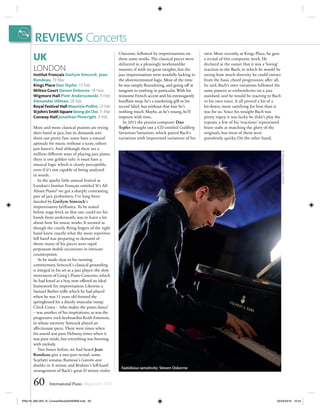
Fastidious sensitivity: Steven Osborne
©BENJAMINEALOVEGA
IPMJ16_060-064_R_ConcertRevs0504BWM.indd 60 05/04/2016 10:55
May/June 2016 International Piano 61
REVIEWS Concerts
Steven Osborne, improvising on
Stravinsky’s Tango at Milton Court, got
infinitely closer to his original, but given
this superb pianist’s fastidious sensitivity to
idiom, that was no surprise.
Back in the realms of world-class
pianism, Seong-Jin Cho’s solo debut in the
Southbank International Piano Series at St
John’s Smith Square was as impressive as
we had hoped. Just 21, and celebrating his
win at the latest International Chopin
Competition, he is both technically
immaculate and instinctively poetic, and
this all-Chopin recital of short and long
pieces was a pleasure from beginning to
end. But with one big proviso: we still don’t
know what kind of animal he really is, and
we haven’t yet heard his unique voice.
There was just one moment of real magic
– the last movement of the Funeral March
Sonata, played so fast and with such
gossamer delicacy as to take the breath
away. Otherwise, everything he plays is too
smoothly efficient at present.
Maurizio Pollini is now at the opposite
pole. At the Festival Hall he scuttled
nervously onstage as is his wont, and
rushed through two big Schumann works
too fast and too anxiously to do either them
or himself justice. Only after the interval
did he relax enough to allow his artistry to
emerge, and Chopin’s Polonaise-Fantaisie,
the third Scherzo, and two majestic Chopin
encores were each exquisitely wrought and
flawlessly delivered. How long will this
great Italian master go on? He’s 74, and one
senses that he’s getting tired; but there’s
such generosity in his performances that
we’ll queue up to hear him as long as he
wants us to.
Meanwhile Piotr Anderszewski was
celebrating the 25th anniversary of his
Wigmore debut with a typically provocative
programme, bookending Schumann’s
Papillons and Ghost Variations,
Szymanowski’s Metopes and two Bach
Partitas. If the Szymanowski emerged as
little more than a sub-Scriabin curiosity,
and if Papillons was delivered with too
broad a brush, the Ghost Variations really
did sound like a cry from the grave, and the
Partitas were full of revelatory surprises. His
final encore was also typical – an entire
Janáček suite, played with the empathy of a
fellow Central European.
In cosy little Conway Hall, Jonathan
Plowright’s Rhinegold LIVE recital
showed what splendours an old and
well-practised hand can create with a
variegated menu of Brahms, Mozart,
Chopin, and Paderewski; the ensuing Q&A
made the evening doubly worthwhile.
Finally, a warm welcome for twenty-five-
year-old Alexander Ullman. The first half
of his Wigmore recital was relentlessly
strident, but when he relaxed he brought
lovely poetry out of Chopin’s fourth
Ballade, and from a medley of Mazurkas
and Nocturnes. MICHAEL CHURCH
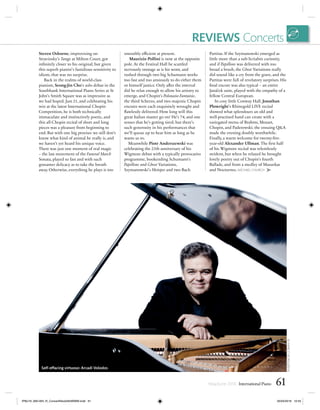
Self-effacing virtuoso: Arcadi Volodos
©MARCOBORGGREVE
⌂
IPMJ16_060-064_R_ConcertRevs0504BWM.indd 61 05/04/2016 10:55
REVIEWS Concerts
62 International Piano May/June 2016
FRANCE
BORDEAUX
L’Esprit du Piano
Auditorium du Bordeaux Lang Lang, 17
Nov; Arcadi Volodos, 25 Nov
The annual piano festival l’Esprit du Piano
brought 10 keyboard events to the
Bordeaux area last November, bookended
with an opening recital by Lang Lang and a
concluding recital by Arcadi Volodos. It was
a step up from previous editions that have
featured few star players. The series attracted
some 5,000 pianophiles,a significant increase
over attendance in the five previous years,
according to artistic director Paul-Arnaud
Péjouan.
The outstanding performance was the
recital by Arcadi Volodos, the self-effacing
Russian virtuoso making his first
appearance before Bordeaux audiences.
Volodos is a meticulous performer with a
quiet onstage manner. His husky frame
belies a talent for clear articulation and his
feathery touch seemed to impress the
near-capacity Bordeaux Auditorium crowd.
Volodos’s personal profile may be a tier
or two below that of the exuberant Lang
Lang but the music he produced was
decidedly superior. I counted 11 curtain
calls and four encores, including one short
piece from the Catalonian composer
Mompou whom Volodos has recently been
promoting with a new CD.
He held the audience in the palm of his
hand from the first chord of the Brahms
Theme and Variations in B minor Op 18b,
dedicated to Clara Schumann and based on
the original sextet version, composed in
1860. Brahms was only 27 at the time of
completion but his sextet has become one
of the staples of today’s chamber repertory.
The piano version captures the essentials.
The six variations on a simple line develop
gracefully in tone and colour.
He followed Op 18b with more Brahms,
the Eight Klavierstücke Op 76, another study
in styles and contrasts. Capriccio (No 5) is
one of the most challenging of Brahms’s
short pieces and Volodos made the
transition from virtuosity to the lyrical
Intermezzo (No 6) with natural finesse.
The second half of the recital featured
Schubert’s extended B-flat major Sonata
D960, a monument to the sonata form with
familiar, pleasant themes recurring
throughout. Volodos seemed emotionally
invested, swaying freely on his folding chair
(no bench for him) as he brought Schubert
back to life. He imposed his mark firmly on
the second movement, the melancholy
Andante sostenuto, ratcheting down the
tempo radically to allow the harmonics and
resonances to mingle in the air. The effect
was close to magical.
The programme climaxed with four
sparkling encores. He was rewarded with a
standing ovation, rare in this charmingly
provincial city. Volodos’s programme was
especially poignant when viewed in
context of the Brahms-Schubert
relationship. Schubert was never a great
success in his own lifetime, but in the
decades following his early death his work
attracted the support of influential
musicians in Vienna. Among the
champions of his work was Brahms
himself.
Nine days prior to Volodos’s
performance, Lang Lang’s programme was
a disappointment to the audience which
greeted his 45-minute colourless reading of
Tchaikovsky’s The Seasons with lukewarm
applause. He rescued the recital with more
vitality in the second half, playing Chopin’s
Four Scherzos, but even those showed signs
of wear and tear. He has recorded them all
and often includes them in his recitals.
More than a dozen other pianists have
launched the same works on CD.
The l’Esprit du Piano festival enriches
Bordeaux’s musical life considerably. This
year’s edition featured two other
outstanding Russians besides Volodos:
Denis Kozhukhin, first-prize winner at the
Queen Elizabeth Competition in Brussels
in 2010, and Elena Bashkirova, daughter of
the pianist and pedagogue Dmitri
Bashkirov.
Also on the programme were Elena
Mouzalas, Chilly Gonzales, Bruno Rigutto,
Guillaume Coppola, Sandro de Palma and
a video concert by Édouard Ferlet, Axel
Arno and Maurice Salaün. MICHAEL JOHNSON
HUNGARY
BUDAPEST
KURTÁG 90
Budapest Music Centre Arnaud Arbet,
18 Feb
Liszt Academy of Music Tamara
Stefanovich; Pierre-Laurent Aimard,
19 Feb
If there was a recurring leitmotif running
through Budapest’s celebration of György
Kurtág’s 90th birthday in February, it was
pianos: upright pianos, grand pianos,
expensive pianos, cheap pianos, pianos
shoved into small rooms, pianos wheeled
onto grand stages. It probably wasn’t
intended as such, but all these instruments
served as a neat reminder of the composer’s
origins at the keyboard – not as a grand
concert pianist, but as a répétiteur at the
National Philharmonic in Budapest from
1960-68, and later on the piano faculty of
the Liszt Academy.
Kurtág’s life story thus far is similarly
rooted. When everyone else was leaving the
Eastern Bloc in the 1950s, Kurtág was
heading back there from his studies in Paris
– totally committed to the music and
creative life of his adopted Hungary. While
the works of his colleague György Ligeti
became ever more transcendent and
international, Kurtág dug deeper into his
country’s soil in search of a truly original
yet wholly Hungarian voice. His heroes
remained Schoenberg, Webern and
Stravinsky. But Kurtág wasn’t afraid of
getting Magyar mud on his shoes.
It was the piano that reinvigorated the
composer after a period of doubt. In 1973,
the composer wrote a series of piano works
under the titles Games and Pre-Games
founded on the simplest building blocks.
Some pieces explored just a single note or
single gesture (one is based entirely on the
idea of a glissando). The scores were
designed for both children and adults to
play while graphic elements in the notation
were intended to stimulate experimentation
and freedom. They had precisely the same
effect on Kurtág’s oeuvre. Even when his
music is at its most stringent and bleak,
there is playfulness and spirit somewhere
inside it.
Kurtág appeared to personify that spirit
during his birthday celebrations hosted by
the Budapest Music Centre, the Liszt
Academy and the Palace of Arts. He is
physically frail but mentally sharp,
enlivened by in-the-moment creativity. At a
private concert on the eve of his birthday,
he waded in to a performance of a fragment
of his in-progress opera based on Beckett’s
Endgame, unseating pianist Arnaud Arbet
and proceeding to dissect contralto Hilary
Summers’ performance with forensic
attention to detail.‘That’s the special thing
about [his music]’, Summers told me
afterwards.‘He’s got this idea, this image,
and it’s not the norm.’
Perhaps that’s why Kurtág enjoys such a
formidable reputation inside Hungary and
outside it. The country’s prime minister
was due at the main event – a gala birthday
⌂
IPMJ16_060-064_R_ConcertRevs0504BWM.indd 62 05/04/2016 10:55
May/June 2016 International Piano 63
REVIEWS Concerts
concert at the beautifully refurbished Liszt
Academy on the composer’s actual
birthday, 19 February. In the end, the PM
was called to Brussels and replaced by
Hungary’s culture minister. One side effect
of this nationalist government’s agenda is
its cleaving to artistic figures like Kurtág;
it’s hard to imagine this degree of adulation
being showered upon any avant-garde
composer, other than perhaps in the Baltic
states.
The concert’s international flavour came
first in the form of a video message from
Sir Simon Rattle, who spoke of Kurtág’s
music in terms of ‘fragments of such
extreme weight, depth and meaning’ while
promising him it remained ‘deep in the
hearts’ of the Berlin Philharmonic. The idea
of ‘fragments’ isn’t just musicological, it’s
geopolitical too: Kurtág was born in
Romania, studied in Paris, enjoyed a
successful career in newly independent
Hungary and now lives near Bordeaux. The
shifting, drifting fragments that make up
his Double Concerto – played here with deep
care and honest expression by Tamara
Stefanovich (piano) and Louise Hopkins
(cello) – speak of a man barely able to look
over his shoulder and notice what elements
of his personal history have already
disappeared.
Straight after that, Pierre-Laurent
Aimard played …quasi una fantasia…, a
short but intense fantasy for piano and
orchestra which felt just that bit too tense
and jittery. Who can blame Aimard, when
the notoriously particular maestro was
sitting a few rows into the audience? It’s
hard not to feel, to some extent, that
performances of Kurtág’s music were stifled
just a touch by his physical presence. But
the crowd was loosened when the video
screen appeared once more, this time to air
a film of the introduction to Bach’s Actus
Tragicus performed by the four hands of the
composer and his wife on a small, tinny
upright piano. Here was the heartbeat that
so often exists in Kurtág’s own music. The
humility and humanity of the performance
said something about why its creator is so
treasured.
ANDREW MELLOR
ITALY
BERGAMO
Bergamo Jazz 2016
Teatro Sociale Franco D’Andrea, 17 Mar
Teatro Donizetti Geri Allen, 18 Mar;
Kenny Barron Trio, 19 Mar
Auditorium di Piazza della Libertà
Markelian Kapedani, 20 Mar
Bergamo Jazz’s main locations – two
wonderful venues in the traditional teatro
all’italiana format, Teatro Donizetti and
Teatro Sociale – saw three concerts by
pianists. We first heard Italian master
Franco D’Andrea and his small group,
Traditions Today. D’Andrea has long been
fascinated by early jazz, and the Louis
Armstrong Hot Five. His trio with Daniele
D’Agaro (clarinet) and Mauro Ottolini
(trombone) offers a compelling
postmodern tribute: a totally empathetic
performance of spontaneous counterpoint,
contemporary freedom, and riffs and
timbres inspired by the jungle-style Duke
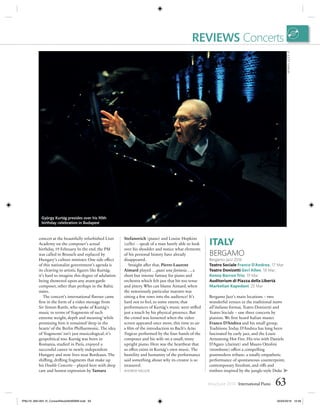
György Kurtág presides over his 90th
birthday celebration in Budapest
©JUDITMARJAI
⌂
IPMJ16_060-064_R_ConcertRevs0504BWM.indd 63 05/04/2016 10:56
REVIEWS Concerts
64 International Piano May/June 2016
Ellington. The highpoint was the latter’s
Caravan, idiomatically interpreted as jive
misterioso. The trio was supplemented by
drummer Han Bennink – no shrinking
violet; but D’Andrea was the dominant
figure. His grasp of jazz history is so
assured, his playing lucid and compelling.
He is much too little known outside his
native country, and it was good to hear him
live for the first time.
Geri Allen is better known as a trio or
ensemble player than as a solo pianist,
having worked with such masters as Ron
Carter and Charlie Haden. But her concert
presented material from the mostly solo
album Motown & Motor City Inspirations –
Grand River Crossings from 2013. She was
brought up in Detroit, and dedicated the
concert to her mentor, trumpeter Marcus
Belgrave, who died last year at the age of 78.
Allen featured classics from African-
American music, including Billy
Strayhorn’s A Flower is a Lovesome Thing. Yet
mostly these classics were from a later era:
Inner City Blues by Marvin Gaye, That Girl
by Stevie Wonder and Wanna Be Startin’
Somethin’ by Michael Jackson. Jazz
musicians have often wanted to make a
grab for the popular audience that was
finally lost to the music after the hardbop
era – but this post-50s pop material remains
a challenge. Some critics found her album
rather tentative; on the evidence of the
concert, I’d describe the approach as
reflective, its mood angled towards the
most attentive jazz audiences. The hour-
long set was a brave effort by an always
intelligent musician.
More in the jazz mainstream, but classic
too, was the Kenny Barron Trio with
Kiyoshi Kitagawa on bass and Johnathan
Blake on drums. Born in 1947 in
Philadelphia, Barron worked with star
names including Dizzy Gillespie and
Freddie Hubbard, and later founded the
quartet Sphere, dedicated to the music of
Thelonious Monk. His magisterial
performance coincided with his new album
Book of Intuition on the Impulse label, also
featuring Kitagawa and Blake. Their set
began with a rather restrained Bebop. Next,
Bud Like, a Barron original, upped the
energy level, with suggestions of Bud
Powell’s Un Poco Loco. It included a festive
drum solo to great applause. Charlie
Haden’s Nightfall was a plangent ballad,
while Thelonious Monk’s Shuffle Boil and
Barron’s own Calypso were a delight. Barron
could be regarded as belonging to the
rather well-mannered jazz piano tradition
of Hank Jones and Tommy Flanagan, but
his set was better than that – and it
suggested that his recordings, fine though
they are, haven’t always done him justice.
In the Auditorium of Piazza della
Libertà, Markelian Kapedani’s Balkan Bop
Trio, with Yuri Goloubev (double bass) and
Asaf Sirkis (drums), produced some curious
results – not just because of a doubtful
sound-system.‘Balkan jazz’ turned out to be
a synthesis of Oscar Peterson and the
additive rhythms of Balkan folk music
– surprisingly conservative, when
compared, for instance, with the activities
of New York Downtown Balkans.
Best piano by a non-leader was
Alexander Hawkins, effectively musical
director of Louis Moholo-Moholo’s
wonderful Five Blokes, who contributed
beautifully expansive, ecstatic piano to the
group’s burning free jazz. I’ve long been a
fan of this fine musician whose stylistic
range seems encyclopedic, but his
performance here was a revelation, showing
again the potential for a synthesis of free
and South African jazz. Lawrence Fields,
pianist with the Jo Lovano Quartet, also
impressed, with his sober, articulate and
thoughtful contributions – more in the
modern mainstream than Hawkins, but a
fine prospect.
With packed concerts, Bergamo showed
that it remains one of the Europe’s, indeed
the world’s, most artistically successful jazz
festivals.
ANDY HAMILTON
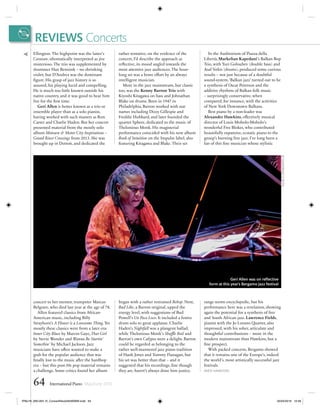
Geri Allen was on reflective
form at this year’s Bergamo Jazz festival
©GIANFRANCOROTA
⌂
IPMJ16_060-064_R_ConcertRevs0504BWM.indd 64 05/04/2016 10:56

KURTAG_IPMJ16_060

  • 1.
    REVIEWS Concerts 60 InternationalPiano May/June 2016 UK LONDON Institut Français Gwilym Simcock; Jean Rondeau, 19 Mar Kings Place Dan Tepfer, 13 Feb Milton Court Steven Osborne, 18 Nov Wigmore Hall Piotr Anderszewski, 9 Feb; Alexander Ullman, 28 Feb Royal Festival Hall Maurizio Pollini, 23 Feb StJohn’sSmithSquareSeong-JinCho, 11 Mar Conway Hall Jonathan Plowright, 4 Feb More and more classical pianists are trying their hand at jazz, but its demands sort them out pretty fast: some have a natural aptitude for music without a score, others just haven’t. And although there are a million different ways of playing jazz piano, there is one golden rule: it must have a musical logic which is clearly perceptible, even if it’s not capable of being analysed in words. In the sparky little annual festival at London’s Institut Français entitled ‘It’s All About Piano!’ we got a sharply contrasting pair of jazz performers. I’ve long been dazzled by Gwilym Simcock’s improvisatory brilliance. To be seated below stage-level, so that one could see his hands from underneath, was to learn a lot about how his music works. It seemed as though the crazily flying fingers of the right hand knew exactly what the more repetitive left hand was preparing to demand of them; many of his pieces were rapid perpetuum mobile excursions in intricate counterpoint. As he made clear in his running commentary, Simcock’s classical grounding is integral to his art as a jazz player: the slow movement of Grieg’s Piano Concerto, which he had loved as a boy, now offered an ideal framework for improvisation. Likewise a Samuel Barber trifle which he had played when he was 11 years old formed the springboard for a dizzily muscular romp. Chick Corea –‘who makes the piano dance’ – was another of his inspirations; as was the progressive rock keyboardist Keith Emerson, in whose memory Simcock played an affectionate piece. There were times when his sound was pure Debussy, times when it was pure stride, but everything was bursting with melody. Two hours before, we had heard Jean Rondeau give a two-part recital: some Scarlatti sonatas, Rameau’s Gavotte avec doubles in A minor, and Brahms’s left-hand arrangement of Bach’s great D minor violin Chaconne, followed by improvisations on these same works. The classical pieces were delivered in a pleasingly workmanlike manner, if with no great insights, but the jazz improvisations were woefully lacking in the aforementioned logic. Most of the time he was simply floundering, and going off at tangents to nothing in particular. With his winsome French accent and his extravagantly bouffant mop, he’s a marketing gift to his record label; but without that hair he’s nothing much. Maybe, as he’s young, he’ll improve with time. In 2011 the pianist-composer Dan Tepfer brought out a CD entitled Goldberg Variations/Variations, which paired Bach’s variations with improvised variations of his own. More recently, at Kings Place, he gave a recital of this composite work. He declared at the outset that it was a ‘loving’ reaction to the Bach, in which he would be seeing how much diversity he could extract from the basic chord progression; after all, he said, Bach’s own variations followed the same pattern as embroideries on a jazz standard, and he would be reacting to Bach in his own voice. It all proved a bit of a let-down, more satisfying for him than it was for us. Since his straight Bach was pretty ropey, it was lucky he didn’t play the repeats; a few of his ‘reactions’ represented brave stabs at matching the glory of the originals, but most of them were pointlessly quirky. On the other hand, Fastidious sensitivity: Steven Osborne ©BENJAMINEALOVEGA IPMJ16_060-064_R_ConcertRevs0504BWM.indd 60 05/04/2016 10:55
  • 2.
    May/June 2016 InternationalPiano 61 REVIEWS Concerts Steven Osborne, improvising on Stravinsky’s Tango at Milton Court, got infinitely closer to his original, but given this superb pianist’s fastidious sensitivity to idiom, that was no surprise. Back in the realms of world-class pianism, Seong-Jin Cho’s solo debut in the Southbank International Piano Series at St John’s Smith Square was as impressive as we had hoped. Just 21, and celebrating his win at the latest International Chopin Competition, he is both technically immaculate and instinctively poetic, and this all-Chopin recital of short and long pieces was a pleasure from beginning to end. But with one big proviso: we still don’t know what kind of animal he really is, and we haven’t yet heard his unique voice. There was just one moment of real magic – the last movement of the Funeral March Sonata, played so fast and with such gossamer delicacy as to take the breath away. Otherwise, everything he plays is too smoothly efficient at present. Maurizio Pollini is now at the opposite pole. At the Festival Hall he scuttled nervously onstage as is his wont, and rushed through two big Schumann works too fast and too anxiously to do either them or himself justice. Only after the interval did he relax enough to allow his artistry to emerge, and Chopin’s Polonaise-Fantaisie, the third Scherzo, and two majestic Chopin encores were each exquisitely wrought and flawlessly delivered. How long will this great Italian master go on? He’s 74, and one senses that he’s getting tired; but there’s such generosity in his performances that we’ll queue up to hear him as long as he wants us to. Meanwhile Piotr Anderszewski was celebrating the 25th anniversary of his Wigmore debut with a typically provocative programme, bookending Schumann’s Papillons and Ghost Variations, Szymanowski’s Metopes and two Bach Partitas. If the Szymanowski emerged as little more than a sub-Scriabin curiosity, and if Papillons was delivered with too broad a brush, the Ghost Variations really did sound like a cry from the grave, and the Partitas were full of revelatory surprises. His final encore was also typical – an entire Janáček suite, played with the empathy of a fellow Central European. In cosy little Conway Hall, Jonathan Plowright’s Rhinegold LIVE recital showed what splendours an old and well-practised hand can create with a variegated menu of Brahms, Mozart, Chopin, and Paderewski; the ensuing Q&A made the evening doubly worthwhile. Finally, a warm welcome for twenty-five- year-old Alexander Ullman. The first half of his Wigmore recital was relentlessly strident, but when he relaxed he brought lovely poetry out of Chopin’s fourth Ballade, and from a medley of Mazurkas and Nocturnes. MICHAEL CHURCH Self-effacing virtuoso: Arcadi Volodos ©MARCOBORGGREVE ⌂ IPMJ16_060-064_R_ConcertRevs0504BWM.indd 61 05/04/2016 10:55
  • 3.
    REVIEWS Concerts 62 InternationalPiano May/June 2016 FRANCE BORDEAUX L’Esprit du Piano Auditorium du Bordeaux Lang Lang, 17 Nov; Arcadi Volodos, 25 Nov The annual piano festival l’Esprit du Piano brought 10 keyboard events to the Bordeaux area last November, bookended with an opening recital by Lang Lang and a concluding recital by Arcadi Volodos. It was a step up from previous editions that have featured few star players. The series attracted some 5,000 pianophiles,a significant increase over attendance in the five previous years, according to artistic director Paul-Arnaud Péjouan. The outstanding performance was the recital by Arcadi Volodos, the self-effacing Russian virtuoso making his first appearance before Bordeaux audiences. Volodos is a meticulous performer with a quiet onstage manner. His husky frame belies a talent for clear articulation and his feathery touch seemed to impress the near-capacity Bordeaux Auditorium crowd. Volodos’s personal profile may be a tier or two below that of the exuberant Lang Lang but the music he produced was decidedly superior. I counted 11 curtain calls and four encores, including one short piece from the Catalonian composer Mompou whom Volodos has recently been promoting with a new CD. He held the audience in the palm of his hand from the first chord of the Brahms Theme and Variations in B minor Op 18b, dedicated to Clara Schumann and based on the original sextet version, composed in 1860. Brahms was only 27 at the time of completion but his sextet has become one of the staples of today’s chamber repertory. The piano version captures the essentials. The six variations on a simple line develop gracefully in tone and colour. He followed Op 18b with more Brahms, the Eight Klavierstücke Op 76, another study in styles and contrasts. Capriccio (No 5) is one of the most challenging of Brahms’s short pieces and Volodos made the transition from virtuosity to the lyrical Intermezzo (No 6) with natural finesse. The second half of the recital featured Schubert’s extended B-flat major Sonata D960, a monument to the sonata form with familiar, pleasant themes recurring throughout. Volodos seemed emotionally invested, swaying freely on his folding chair (no bench for him) as he brought Schubert back to life. He imposed his mark firmly on the second movement, the melancholy Andante sostenuto, ratcheting down the tempo radically to allow the harmonics and resonances to mingle in the air. The effect was close to magical. The programme climaxed with four sparkling encores. He was rewarded with a standing ovation, rare in this charmingly provincial city. Volodos’s programme was especially poignant when viewed in context of the Brahms-Schubert relationship. Schubert was never a great success in his own lifetime, but in the decades following his early death his work attracted the support of influential musicians in Vienna. Among the champions of his work was Brahms himself. Nine days prior to Volodos’s performance, Lang Lang’s programme was a disappointment to the audience which greeted his 45-minute colourless reading of Tchaikovsky’s The Seasons with lukewarm applause. He rescued the recital with more vitality in the second half, playing Chopin’s Four Scherzos, but even those showed signs of wear and tear. He has recorded them all and often includes them in his recitals. More than a dozen other pianists have launched the same works on CD. The l’Esprit du Piano festival enriches Bordeaux’s musical life considerably. This year’s edition featured two other outstanding Russians besides Volodos: Denis Kozhukhin, first-prize winner at the Queen Elizabeth Competition in Brussels in 2010, and Elena Bashkirova, daughter of the pianist and pedagogue Dmitri Bashkirov. Also on the programme were Elena Mouzalas, Chilly Gonzales, Bruno Rigutto, Guillaume Coppola, Sandro de Palma and a video concert by Édouard Ferlet, Axel Arno and Maurice Salaün. MICHAEL JOHNSON HUNGARY BUDAPEST KURTÁG 90 Budapest Music Centre Arnaud Arbet, 18 Feb Liszt Academy of Music Tamara Stefanovich; Pierre-Laurent Aimard, 19 Feb If there was a recurring leitmotif running through Budapest’s celebration of György Kurtág’s 90th birthday in February, it was pianos: upright pianos, grand pianos, expensive pianos, cheap pianos, pianos shoved into small rooms, pianos wheeled onto grand stages. It probably wasn’t intended as such, but all these instruments served as a neat reminder of the composer’s origins at the keyboard – not as a grand concert pianist, but as a répétiteur at the National Philharmonic in Budapest from 1960-68, and later on the piano faculty of the Liszt Academy. Kurtág’s life story thus far is similarly rooted. When everyone else was leaving the Eastern Bloc in the 1950s, Kurtág was heading back there from his studies in Paris – totally committed to the music and creative life of his adopted Hungary. While the works of his colleague György Ligeti became ever more transcendent and international, Kurtág dug deeper into his country’s soil in search of a truly original yet wholly Hungarian voice. His heroes remained Schoenberg, Webern and Stravinsky. But Kurtág wasn’t afraid of getting Magyar mud on his shoes. It was the piano that reinvigorated the composer after a period of doubt. In 1973, the composer wrote a series of piano works under the titles Games and Pre-Games founded on the simplest building blocks. Some pieces explored just a single note or single gesture (one is based entirely on the idea of a glissando). The scores were designed for both children and adults to play while graphic elements in the notation were intended to stimulate experimentation and freedom. They had precisely the same effect on Kurtág’s oeuvre. Even when his music is at its most stringent and bleak, there is playfulness and spirit somewhere inside it. Kurtág appeared to personify that spirit during his birthday celebrations hosted by the Budapest Music Centre, the Liszt Academy and the Palace of Arts. He is physically frail but mentally sharp, enlivened by in-the-moment creativity. At a private concert on the eve of his birthday, he waded in to a performance of a fragment of his in-progress opera based on Beckett’s Endgame, unseating pianist Arnaud Arbet and proceeding to dissect contralto Hilary Summers’ performance with forensic attention to detail.‘That’s the special thing about [his music]’, Summers told me afterwards.‘He’s got this idea, this image, and it’s not the norm.’ Perhaps that’s why Kurtág enjoys such a formidable reputation inside Hungary and outside it. The country’s prime minister was due at the main event – a gala birthday ⌂ IPMJ16_060-064_R_ConcertRevs0504BWM.indd 62 05/04/2016 10:55
  • 4.
    May/June 2016 InternationalPiano 63 REVIEWS Concerts concert at the beautifully refurbished Liszt Academy on the composer’s actual birthday, 19 February. In the end, the PM was called to Brussels and replaced by Hungary’s culture minister. One side effect of this nationalist government’s agenda is its cleaving to artistic figures like Kurtág; it’s hard to imagine this degree of adulation being showered upon any avant-garde composer, other than perhaps in the Baltic states. The concert’s international flavour came first in the form of a video message from Sir Simon Rattle, who spoke of Kurtág’s music in terms of ‘fragments of such extreme weight, depth and meaning’ while promising him it remained ‘deep in the hearts’ of the Berlin Philharmonic. The idea of ‘fragments’ isn’t just musicological, it’s geopolitical too: Kurtág was born in Romania, studied in Paris, enjoyed a successful career in newly independent Hungary and now lives near Bordeaux. The shifting, drifting fragments that make up his Double Concerto – played here with deep care and honest expression by Tamara Stefanovich (piano) and Louise Hopkins (cello) – speak of a man barely able to look over his shoulder and notice what elements of his personal history have already disappeared. Straight after that, Pierre-Laurent Aimard played …quasi una fantasia…, a short but intense fantasy for piano and orchestra which felt just that bit too tense and jittery. Who can blame Aimard, when the notoriously particular maestro was sitting a few rows into the audience? It’s hard not to feel, to some extent, that performances of Kurtág’s music were stifled just a touch by his physical presence. But the crowd was loosened when the video screen appeared once more, this time to air a film of the introduction to Bach’s Actus Tragicus performed by the four hands of the composer and his wife on a small, tinny upright piano. Here was the heartbeat that so often exists in Kurtág’s own music. The humility and humanity of the performance said something about why its creator is so treasured. ANDREW MELLOR ITALY BERGAMO Bergamo Jazz 2016 Teatro Sociale Franco D’Andrea, 17 Mar Teatro Donizetti Geri Allen, 18 Mar; Kenny Barron Trio, 19 Mar Auditorium di Piazza della Libertà Markelian Kapedani, 20 Mar Bergamo Jazz’s main locations – two wonderful venues in the traditional teatro all’italiana format, Teatro Donizetti and Teatro Sociale – saw three concerts by pianists. We first heard Italian master Franco D’Andrea and his small group, Traditions Today. D’Andrea has long been fascinated by early jazz, and the Louis Armstrong Hot Five. His trio with Daniele D’Agaro (clarinet) and Mauro Ottolini (trombone) offers a compelling postmodern tribute: a totally empathetic performance of spontaneous counterpoint, contemporary freedom, and riffs and timbres inspired by the jungle-style Duke György Kurtág presides over his 90th birthday celebration in Budapest ©JUDITMARJAI ⌂ IPMJ16_060-064_R_ConcertRevs0504BWM.indd 63 05/04/2016 10:56
  • 5.
    REVIEWS Concerts 64 InternationalPiano May/June 2016 Ellington. The highpoint was the latter’s Caravan, idiomatically interpreted as jive misterioso. The trio was supplemented by drummer Han Bennink – no shrinking violet; but D’Andrea was the dominant figure. His grasp of jazz history is so assured, his playing lucid and compelling. He is much too little known outside his native country, and it was good to hear him live for the first time. Geri Allen is better known as a trio or ensemble player than as a solo pianist, having worked with such masters as Ron Carter and Charlie Haden. But her concert presented material from the mostly solo album Motown & Motor City Inspirations – Grand River Crossings from 2013. She was brought up in Detroit, and dedicated the concert to her mentor, trumpeter Marcus Belgrave, who died last year at the age of 78. Allen featured classics from African- American music, including Billy Strayhorn’s A Flower is a Lovesome Thing. Yet mostly these classics were from a later era: Inner City Blues by Marvin Gaye, That Girl by Stevie Wonder and Wanna Be Startin’ Somethin’ by Michael Jackson. Jazz musicians have often wanted to make a grab for the popular audience that was finally lost to the music after the hardbop era – but this post-50s pop material remains a challenge. Some critics found her album rather tentative; on the evidence of the concert, I’d describe the approach as reflective, its mood angled towards the most attentive jazz audiences. The hour- long set was a brave effort by an always intelligent musician. More in the jazz mainstream, but classic too, was the Kenny Barron Trio with Kiyoshi Kitagawa on bass and Johnathan Blake on drums. Born in 1947 in Philadelphia, Barron worked with star names including Dizzy Gillespie and Freddie Hubbard, and later founded the quartet Sphere, dedicated to the music of Thelonious Monk. His magisterial performance coincided with his new album Book of Intuition on the Impulse label, also featuring Kitagawa and Blake. Their set began with a rather restrained Bebop. Next, Bud Like, a Barron original, upped the energy level, with suggestions of Bud Powell’s Un Poco Loco. It included a festive drum solo to great applause. Charlie Haden’s Nightfall was a plangent ballad, while Thelonious Monk’s Shuffle Boil and Barron’s own Calypso were a delight. Barron could be regarded as belonging to the rather well-mannered jazz piano tradition of Hank Jones and Tommy Flanagan, but his set was better than that – and it suggested that his recordings, fine though they are, haven’t always done him justice. In the Auditorium of Piazza della Libertà, Markelian Kapedani’s Balkan Bop Trio, with Yuri Goloubev (double bass) and Asaf Sirkis (drums), produced some curious results – not just because of a doubtful sound-system.‘Balkan jazz’ turned out to be a synthesis of Oscar Peterson and the additive rhythms of Balkan folk music – surprisingly conservative, when compared, for instance, with the activities of New York Downtown Balkans. Best piano by a non-leader was Alexander Hawkins, effectively musical director of Louis Moholo-Moholo’s wonderful Five Blokes, who contributed beautifully expansive, ecstatic piano to the group’s burning free jazz. I’ve long been a fan of this fine musician whose stylistic range seems encyclopedic, but his performance here was a revelation, showing again the potential for a synthesis of free and South African jazz. Lawrence Fields, pianist with the Jo Lovano Quartet, also impressed, with his sober, articulate and thoughtful contributions – more in the modern mainstream than Hawkins, but a fine prospect. With packed concerts, Bergamo showed that it remains one of the Europe’s, indeed the world’s, most artistically successful jazz festivals. ANDY HAMILTON Geri Allen was on reflective form at this year’s Bergamo Jazz festival ©GIANFRANCOROTA ⌂ IPMJ16_060-064_R_ConcertRevs0504BWM.indd 64 05/04/2016 10:56