French Music Angel Orange Brandi Hubert Justin Dodd Luke Griffin
Background of French Music Music in France has been present throughout the country’s history and there have been many eras during which the French were the most influential composers of their time, inspiring the development of music in other parts of Europe. This is particularly true of medieval times
The Eras of French Music Medieval French Music French Renaissance Music 17 th , 18 th , and 19 th  Century 20 th  Century French Music
Medieval French Music It was during the later Middle Ages that France essentially headed the development of music throughout Europe, both sacred and secular. Secular music was   epic poems sung and performed by minstrels
French Renaissance Music The 16th century saw the Reformation take place in France, as Calvinism began spreading across Europe. During this period only spiritual music was allowed; only songs of French translations of the Psalms were permitted.
17 th , 18 th , and 19 th  Century During the next three centuries that followed, German and Italians dominated the music scene. However, important compositions for operas and baroque harpsichord music were created by Frenchmen. The opera was the leading musical form during the 17th century and the French had their unique opera style, combining it with ballet. This made it distinctly different from the Italian-style operas.
20 th  Century French Music The 20th century saw a more “neo-classical” style of French music. Very direct, accessible and simple
Classical French Musicians Charles Camille Saint-Saëns composer, organist and pianist famous works include Danse Macabre, Sampson and Delilah, and the Carnival of the Animals (a work frequently used to introduce children to classical music) Claude Debussy Pianist and composer  heavily influenced by cross-cultural music, including Javanese music
Modern French Musicians The Gipsy Kings  Unique blend of flamenco and rumba music best dance rhythms (Rumba, flamenco, salsa) Stephane Grapelli  astounding virtuoso violin work, whether accompanied by other strings or on its own brilliant jazz sound
Using it in the classroom Language arts You can have your students look up famous French musicians and have them write a paper on them. Can have them learn different French words Can use it to clam your students down or get them ready for an activity. Can use it to decorate your classroom by making French musician bulletin boards
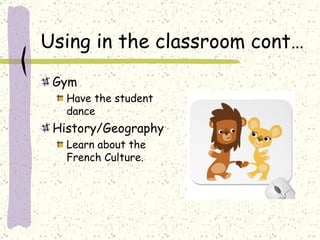
Using in the classroom cont… Gym  Have the student dance History/Geography  Learn about the French Culture.
Have the students have a pen pal with a high school French student.  Student will learn the French culture and write simple sentences in French.  Pledge of Allegiance in French  Have a French Day at the end of the school year.  Pen Pal
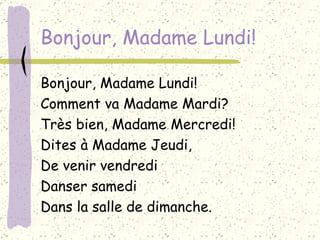
Bonjour, Madame Lundi! Bonjour, Madame Lundi! Comment va Madame Mardi? Très bien, Madame Mercredi! Dites à Madame Jeudi, De venir vendredi Danser samedi Dans la salle de dimanche.
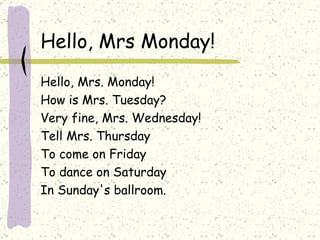
Hello, Mrs Monday! Hello, Mrs. Monday! How is Mrs. Tuesday? Very fine, Mrs. Wednesday! Tell Mrs. Thursday To come on Friday To dance on Saturday In Sunday's ballroom.
Songs Frère Jacques   L'alphabet
Advantages Students can learn pieces of another language through the lyrics.  Increase the students interest in Social Studies, Geography, and other cultures.
Disadvantages  Teacher may not be knowledgeable of French pronunciation on certain words.  Harder for the teacher to find out if the song is appropriate. (different language) French dances (kiss)
Resources http://www.understandfrance.org/France/FrenchSongs.html http://french.lovetoknow.com/Famous_French_Musicians   http://www.mamalisa.com/?p=22&t=ec&c=22 http://www.discoverfrance.net/France/DF_music.shtml http://sprachcaffe.com/english/study_abroad/countries/france/french_music.htm

French Music

  • 1.
    French Music AngelOrange Brandi Hubert Justin Dodd Luke Griffin
  • 2.
    Background of FrenchMusic Music in France has been present throughout the country’s history and there have been many eras during which the French were the most influential composers of their time, inspiring the development of music in other parts of Europe. This is particularly true of medieval times
  • 3.
    The Eras ofFrench Music Medieval French Music French Renaissance Music 17 th , 18 th , and 19 th Century 20 th Century French Music
  • 4.
    Medieval French MusicIt was during the later Middle Ages that France essentially headed the development of music throughout Europe, both sacred and secular. Secular music was epic poems sung and performed by minstrels
  • 5.
    French Renaissance MusicThe 16th century saw the Reformation take place in France, as Calvinism began spreading across Europe. During this period only spiritual music was allowed; only songs of French translations of the Psalms were permitted.
  • 6.
    17 th ,18 th , and 19 th Century During the next three centuries that followed, German and Italians dominated the music scene. However, important compositions for operas and baroque harpsichord music were created by Frenchmen. The opera was the leading musical form during the 17th century and the French had their unique opera style, combining it with ballet. This made it distinctly different from the Italian-style operas.
  • 7.
    20 th Century French Music The 20th century saw a more “neo-classical” style of French music. Very direct, accessible and simple
  • 8.
    Classical French MusiciansCharles Camille Saint-Saëns composer, organist and pianist famous works include Danse Macabre, Sampson and Delilah, and the Carnival of the Animals (a work frequently used to introduce children to classical music) Claude Debussy Pianist and composer heavily influenced by cross-cultural music, including Javanese music
  • 9.
    Modern French MusiciansThe Gipsy Kings Unique blend of flamenco and rumba music best dance rhythms (Rumba, flamenco, salsa) Stephane Grapelli astounding virtuoso violin work, whether accompanied by other strings or on its own brilliant jazz sound
  • 10.
    Using it inthe classroom Language arts You can have your students look up famous French musicians and have them write a paper on them. Can have them learn different French words Can use it to clam your students down or get them ready for an activity. Can use it to decorate your classroom by making French musician bulletin boards
  • 11.
    Using in theclassroom cont… Gym Have the student dance History/Geography Learn about the French Culture.
  • 12.
    Have the studentshave a pen pal with a high school French student. Student will learn the French culture and write simple sentences in French. Pledge of Allegiance in French Have a French Day at the end of the school year. Pen Pal
  • 13.
    Bonjour, Madame Lundi!Bonjour, Madame Lundi! Comment va Madame Mardi? Très bien, Madame Mercredi! Dites à Madame Jeudi, De venir vendredi Danser samedi Dans la salle de dimanche.
  • 14.
    Hello, Mrs Monday!Hello, Mrs. Monday! How is Mrs. Tuesday? Very fine, Mrs. Wednesday! Tell Mrs. Thursday To come on Friday To dance on Saturday In Sunday's ballroom.
  • 15.
  • 16.
    Advantages Students canlearn pieces of another language through the lyrics. Increase the students interest in Social Studies, Geography, and other cultures.
  • 17.
    Disadvantages Teachermay not be knowledgeable of French pronunciation on certain words. Harder for the teacher to find out if the song is appropriate. (different language) French dances (kiss)
  • 18.
    Resources http://www.understandfrance.org/France/FrenchSongs.html http://french.lovetoknow.com/Famous_French_Musicians http://www.mamalisa.com/?p=22&t=ec&c=22 http://www.discoverfrance.net/France/DF_music.shtml http://sprachcaffe.com/english/study_abroad/countries/france/french_music.htm