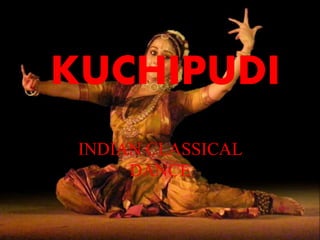
KUCHIPUDI 
INDIAN CLASSICAL 
DANCE
Kuchipudi is a Classical Indian dance from Andhra Pradesh, India. It is also popular all 
over SouthIndia. Kuchipudi is the name of a village in the Divi Taluka of Krishna 
district that borders the Bay of Bengal and also the surname of the resident 
Brahmins practicing this traditional dance form, it acquired the present name.
Bharata Muni who wrote the Natya Shastra about 3000 years ago had explained 
various aspects of this dance form. Later sometime in the 13th century, the impetus 
to kuchipudi was given by Sidhendra Yogi. Siddhendra Yogi redefined the dance form. 
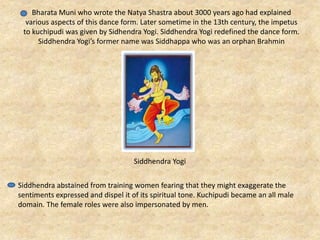
Siddhendra Yogi’s former name was Siddhappa who was an orphan Brahmin 
Siddhendra Yogi 
Siddhendra abstained from training women fearing that they might exaggerate the 
sentiments expressed and dispel it of its spiritual tone. Kuchipudi became an all male 
domain. The female roles were also impersonated by men.
The technique of Kuchipudi makes use of fast rhythmic footwork and 
sculpturesque body movements. Stylized mime, using hand gestures and 
subtle facial expression, is combined with more realistic acting, occasionally 
including dialogues spoken by the dancers. 
• Kuchipudi today is performed either as a solo or a group presentation, but 
historically it was performed as a dance drama, with several dancers 
taking different roles. 
The themes are mostly derived form the scriptures and mythology, 
and the portrayal of certain characters is a central motif of this dance 
form.
Kuchipudi dance-dramas, each present a particular episode or a series of 
episodes. A solo recital, on the other hand, typically consists of such items as 
the 'Sabdam', 'Bhama kalapam' which is the main item, 'Padams' and 
'Tarangams'. In 'Bhama kalapam', the dancer has enormous scope for the 
dramatisation of characters. 
Bhama Kalapam 
Sabdam
The main character is Satyabhama, a beautiful but arrogant queen who goes 
through the process of discovering the path of true love and devotion. In the 
'Tarangam', the dancer frequently perform a balancing feat, her feet poised 
on the edge of a brass plate as she moves around. 
Satyabhama 
Tarangam
The whole dance follow the navrasas theory to show 
the 
expressions and convey their moods. 
These are: 
Shringara (love and beauty) 
Hasya (joy or mirth) 
Bhibatsya (disgust) 
Rowdra (anger and its forms) 
Shanta (serenity and peace) 
Veera (heroism) 
Bhaya (fear) 
Karuna (grief and compassion) 
Adbhuta (wonder and curiosity)
Some of dance which is practice today in 
kuchipudi are: 
Purvaranga, 
Tandava Nritya kari Gajana a or Vinayaka Kautham 
Bhamakalapam 
Satya Bhama 
Bhakta Phrahalda 
Usha Parinayam 
Sasirekha Parinayam 
Rama Natakam 
Gollakalapam 
Gollabhama 
Tarangam
MUDRAS 
• A symbolic hand gesture used in Hindu 
ceremonies and statuary, and in Indian dance. 
Head Gestures 
Eyes 
Neck 
Hands
Head Gestures 
Sama - level 
Udvaahita - raised up 
Adhomukha - down-cast face 
Aalolita - rolling 
Dhuta - shaken sideway 
Kampita - nodded 
Paraavrtta - turned round 
Utksipta - thrown up 
parivaahita - widely move
Eyes 
Sama - Ievel 
Aalokita -keen glance 
Saaci -side long 
Pralokita- wide glance 
Nimilita -closed 
Ullokita looking up 
Anuvrtta-quickly up & down 
Avalokita- looking down
Neck 
Sundari - to & fro horizonally 
Tirascinaa - upward movemenet on both sides 
Parivartitaa - right to left like half moon 
Prakampitaa – backward and forward movement
Hands
Kuchipudi Makeup 
The kuchipudi dance makeup should have a graceful 
look and must be suitable for stage light. 
Makeup must suit dancers with fair and dark skin colours. 
The important characters have their makeup different 
from the others. The makeup used in is not so heavy. The 
list of items required for the makeup of this dance form 
are: Altha ,sindur , kumkum, bindi, black eye line eye 
shadow, facial power and foundation whose color should 
be lighter than the character's skin color.
Kuchipudi 
Makeup
Kuchipudi Costume 
Types of sarees 
The kanchipuram silk saree –is handmade of dyed silk with zari works. 
kanchipuram silk saree are expensive than other types of silk 
available in south India. Kanchipuram sarees are stronger 
than Dharmavaram or Arani silk generally.
Dharamavaram silk saree- in many other places also, silk 
sarees are produced , they are Dharamavaram, Arni, Salem and 
Tribhvanam.Even though these sarees are good in quality , kanchipuram is 
best.
Semi silk saree — costumes are also made of semi silk 
sarees which is cheaper than the other two types. This saree is mainly used 
for group performance where cost factor matters. Many costumes are 
stitched at a time in group performance.
DRESS USED 
Blouse (upper part) 
Pyjama (lower part) 
Small fan (waist) 
Pallu (drape over bosom)
Examples for kuchipudi costume
Kuchipudi Jewellery 
The dancers adorn themselves with temple jewellery, which is 
the style of ornaments worn by the deities in south Indian 
temples. 
Some ornaments are made from silver with a plating of gold 
and some worn by the artists are made up of alight weight 
wood, called Boorugu. 
Jewelleries adorn the head, ear, neck, hands, fingers, and the 
waist of the female dancers. It includes 
RAKUDI (head ornament), 
CHAN DRA VAN KI (arm ornament) and 
ADDA BHASA and KASINA SARA (neck ornaments). 
Even the long plait of dancer's hair is decorated with 
ornaments and beautiful white flowers. 
The male dancers are lightly ornamented 
Thus we can say that the kuchipudi dance form is known for its 
grace and beauty which would be incomplete without its dressing 
style,costumes,makeup and its jewellery
JEWELLRY USED: 
Jumka (earring with upward extension) 
Oddiyanam (waist band) 
Nathni (nose ring) 
Long Mala (long necklace) 
Short Mala (choker) 
zvaanki (armbands) 
Chudiya (colored bangles to match your dress) 
Ghungroo (musical anklet with metallic bells) 
Mattal (forehead) 
Chandra (moon shaped hair ornament) 
Surya (sun shaped hair ornament) 
1 Red stick—on Bindi ( a decorative mark worn in the middle of the 
forehead)
Examples Kuchipudi jewellery
MUSIC IN KUCHIPUDI 
A raga (musical mode) with its unique and individual pattern is the soul 
of Indian music. Each raga has a special structure of fixed notes. It is 
the way in which a musician 
It is the way in which a musician utilises this structural form that makes 
for the full expression of the different melodic types. Ancient authors 
gave the essential characteristics of ragas as the utilisation of special 
notes while avoiding some notes and rendering others with 
embellishments or graces 
Interestingly ragas were meant, according to their emotional appeal, 
to be sung only at certain times a day. They were also associated 
with visual images.
The play began with the orchestral music which included Mridangam , Kanjira 
, Tanpura and a pair of Manjira, followed by an invocation to a deity and 
appearance of Ganesha. 
Mridangam Manjira 
Kanjira 
Tanpura
Rituals Before Kuchipudi 
Before the dance drama of Kuchipudi, there are certain rituals that are 
performed in front of the audience. After the rituals, the Soothradhara or the 
conductor, with the supporting musicians, comes on stage, gives a play of 
rhythm on the drums and cymbals and announces the title of the dance 
drama. 
After this, two people enter, holding a curtain, behind which is a dancer in 
the mask of Ganpati (the elephant headed god). The dancer dances for 
some time, to worship Ganpati, so that the dance drama goes on without 
hitches.
Introduction of Characters 
Daru: it is a small composition of dance and song specially for each 
character to help the artist reveal his or her identity and also to show the 
performer's skill in the art. 
There are nearly 80 darus or dance sequences in a traditional Kuchipudi 
dance drama. 
Kalaps: it has a few characters with theme revolving around a single 
incident or a character 
Daru
The Performance 
After the initial rituals as well the introduction of the characters is complete, it 
is the time to finally begin the performance of Kuchipudi. Through the show, the 
dance is accompanied by song, typically Carnatic music.
Conclusion 
Today Kuchipudi is considerably a different style of dance form than it originally used to be. 
In most of the cases it is now a solo performance done by female dancers. The Sutradhara 
has become a phenomenon of the past and the Vachika abhinaya, that is, expressional 
numbers are sung by the danseuses herself instead by the vocalists in the background on 
the stage as was the traditional practice. 
The element of devotion to gods has also been done away with and it has become 
purely a secular affair with predominance of 'sringar' or erotic flavour. Besides the 
drama component has also been totally reduced. 
Elements not indigenous to the dance drama such as sculpture like stances and freezes 
based on perfect iconographic forms motifs and shapes have also been incorporated into 
Kuchipudi dance recitals to make it more competitive with other dance forms.
THANK YOU

Kuchipudi

  • 1.
  • 3.
    Kuchipudi is aClassical Indian dance from Andhra Pradesh, India. It is also popular all over SouthIndia. Kuchipudi is the name of a village in the Divi Taluka of Krishna district that borders the Bay of Bengal and also the surname of the resident Brahmins practicing this traditional dance form, it acquired the present name.
  • 4.
    Bharata Muni whowrote the Natya Shastra about 3000 years ago had explained various aspects of this dance form. Later sometime in the 13th century, the impetus to kuchipudi was given by Sidhendra Yogi. Siddhendra Yogi redefined the dance form. Siddhendra Yogi’s former name was Siddhappa who was an orphan Brahmin Siddhendra Yogi Siddhendra abstained from training women fearing that they might exaggerate the sentiments expressed and dispel it of its spiritual tone. Kuchipudi became an all male domain. The female roles were also impersonated by men.
  • 5.
    The technique ofKuchipudi makes use of fast rhythmic footwork and sculpturesque body movements. Stylized mime, using hand gestures and subtle facial expression, is combined with more realistic acting, occasionally including dialogues spoken by the dancers. • Kuchipudi today is performed either as a solo or a group presentation, but historically it was performed as a dance drama, with several dancers taking different roles. The themes are mostly derived form the scriptures and mythology, and the portrayal of certain characters is a central motif of this dance form.
  • 6.
    Kuchipudi dance-dramas, eachpresent a particular episode or a series of episodes. A solo recital, on the other hand, typically consists of such items as the 'Sabdam', 'Bhama kalapam' which is the main item, 'Padams' and 'Tarangams'. In 'Bhama kalapam', the dancer has enormous scope for the dramatisation of characters. Bhama Kalapam Sabdam
  • 7.
    The main characteris Satyabhama, a beautiful but arrogant queen who goes through the process of discovering the path of true love and devotion. In the 'Tarangam', the dancer frequently perform a balancing feat, her feet poised on the edge of a brass plate as she moves around. Satyabhama Tarangam
  • 8.
    The whole dancefollow the navrasas theory to show the expressions and convey their moods. These are: Shringara (love and beauty) Hasya (joy or mirth) Bhibatsya (disgust) Rowdra (anger and its forms) Shanta (serenity and peace) Veera (heroism) Bhaya (fear) Karuna (grief and compassion) Adbhuta (wonder and curiosity)
  • 9.
    Some of dancewhich is practice today in kuchipudi are: Purvaranga, Tandava Nritya kari Gajana a or Vinayaka Kautham Bhamakalapam Satya Bhama Bhakta Phrahalda Usha Parinayam Sasirekha Parinayam Rama Natakam Gollakalapam Gollabhama Tarangam
  • 10.
    MUDRAS • Asymbolic hand gesture used in Hindu ceremonies and statuary, and in Indian dance. Head Gestures Eyes Neck Hands
  • 11.
    Head Gestures Sama- level Udvaahita - raised up Adhomukha - down-cast face Aalolita - rolling Dhuta - shaken sideway Kampita - nodded Paraavrtta - turned round Utksipta - thrown up parivaahita - widely move
  • 12.
    Eyes Sama -Ievel Aalokita -keen glance Saaci -side long Pralokita- wide glance Nimilita -closed Ullokita looking up Anuvrtta-quickly up & down Avalokita- looking down
  • 13.
    Neck Sundari -to & fro horizonally Tirascinaa - upward movemenet on both sides Parivartitaa - right to left like half moon Prakampitaa – backward and forward movement
  • 14.
  • 15.
    Kuchipudi Makeup Thekuchipudi dance makeup should have a graceful look and must be suitable for stage light. Makeup must suit dancers with fair and dark skin colours. The important characters have their makeup different from the others. The makeup used in is not so heavy. The list of items required for the makeup of this dance form are: Altha ,sindur , kumkum, bindi, black eye line eye shadow, facial power and foundation whose color should be lighter than the character's skin color.
  • 16.
  • 17.
    Kuchipudi Costume Typesof sarees The kanchipuram silk saree –is handmade of dyed silk with zari works. kanchipuram silk saree are expensive than other types of silk available in south India. Kanchipuram sarees are stronger than Dharmavaram or Arani silk generally.
  • 18.
    Dharamavaram silk saree-in many other places also, silk sarees are produced , they are Dharamavaram, Arni, Salem and Tribhvanam.Even though these sarees are good in quality , kanchipuram is best.
  • 19.
    Semi silk saree— costumes are also made of semi silk sarees which is cheaper than the other two types. This saree is mainly used for group performance where cost factor matters. Many costumes are stitched at a time in group performance.
  • 20.
    DRESS USED Blouse(upper part) Pyjama (lower part) Small fan (waist) Pallu (drape over bosom)
  • 21.
  • 23.
    Kuchipudi Jewellery Thedancers adorn themselves with temple jewellery, which is the style of ornaments worn by the deities in south Indian temples. Some ornaments are made from silver with a plating of gold and some worn by the artists are made up of alight weight wood, called Boorugu. Jewelleries adorn the head, ear, neck, hands, fingers, and the waist of the female dancers. It includes RAKUDI (head ornament), CHAN DRA VAN KI (arm ornament) and ADDA BHASA and KASINA SARA (neck ornaments). Even the long plait of dancer's hair is decorated with ornaments and beautiful white flowers. The male dancers are lightly ornamented Thus we can say that the kuchipudi dance form is known for its grace and beauty which would be incomplete without its dressing style,costumes,makeup and its jewellery
  • 24.
    JEWELLRY USED: Jumka(earring with upward extension) Oddiyanam (waist band) Nathni (nose ring) Long Mala (long necklace) Short Mala (choker) zvaanki (armbands) Chudiya (colored bangles to match your dress) Ghungroo (musical anklet with metallic bells) Mattal (forehead) Chandra (moon shaped hair ornament) Surya (sun shaped hair ornament) 1 Red stick—on Bindi ( a decorative mark worn in the middle of the forehead)
  • 26.
  • 28.
    MUSIC IN KUCHIPUDI A raga (musical mode) with its unique and individual pattern is the soul of Indian music. Each raga has a special structure of fixed notes. It is the way in which a musician It is the way in which a musician utilises this structural form that makes for the full expression of the different melodic types. Ancient authors gave the essential characteristics of ragas as the utilisation of special notes while avoiding some notes and rendering others with embellishments or graces Interestingly ragas were meant, according to their emotional appeal, to be sung only at certain times a day. They were also associated with visual images.
  • 29.
    The play beganwith the orchestral music which included Mridangam , Kanjira , Tanpura and a pair of Manjira, followed by an invocation to a deity and appearance of Ganesha. Mridangam Manjira Kanjira Tanpura
  • 30.
    Rituals Before Kuchipudi Before the dance drama of Kuchipudi, there are certain rituals that are performed in front of the audience. After the rituals, the Soothradhara or the conductor, with the supporting musicians, comes on stage, gives a play of rhythm on the drums and cymbals and announces the title of the dance drama. After this, two people enter, holding a curtain, behind which is a dancer in the mask of Ganpati (the elephant headed god). The dancer dances for some time, to worship Ganpati, so that the dance drama goes on without hitches.
  • 31.
    Introduction of Characters Daru: it is a small composition of dance and song specially for each character to help the artist reveal his or her identity and also to show the performer's skill in the art. There are nearly 80 darus or dance sequences in a traditional Kuchipudi dance drama. Kalaps: it has a few characters with theme revolving around a single incident or a character Daru
  • 32.
    The Performance Afterthe initial rituals as well the introduction of the characters is complete, it is the time to finally begin the performance of Kuchipudi. Through the show, the dance is accompanied by song, typically Carnatic music.
  • 33.
    Conclusion Today Kuchipudiis considerably a different style of dance form than it originally used to be. In most of the cases it is now a solo performance done by female dancers. The Sutradhara has become a phenomenon of the past and the Vachika abhinaya, that is, expressional numbers are sung by the danseuses herself instead by the vocalists in the background on the stage as was the traditional practice. The element of devotion to gods has also been done away with and it has become purely a secular affair with predominance of 'sringar' or erotic flavour. Besides the drama component has also been totally reduced. Elements not indigenous to the dance drama such as sculpture like stances and freezes based on perfect iconographic forms motifs and shapes have also been incorporated into Kuchipudi dance recitals to make it more competitive with other dance forms.
  • 34.