Victory in Europe
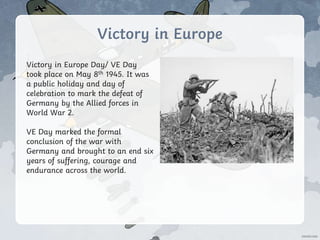
Victory in Europe Day/ VE Day
took place on May 8th 1945. It was
a public holiday and day of
celebration to mark the defeat of
Germany by the Allied forces in
World War 2.
VE Day marked the formal
conclusion of the war with
Germany and brought to an end six
years of suffering, courage and
endurance across the world.
Surrender
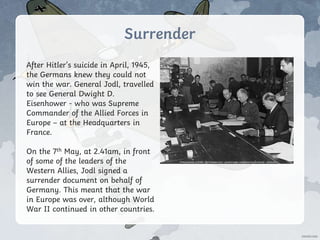
After Hitler’s suicide in April, 1945,
the Germans knew they could not
win the war. General Jodl, travelled
to see General Dwight D.
Eisenhower - who was Supreme
Commander of the Allied Forces in
Europe – at the Headquarters in
France.
On the 7th May, at 2.41am, in front
of some of the leaders of the
Western Allies, Jodl signed a
surrender document on behalf of
Germany. This meant that the war
in Europe was over, although World
War II continued in other countries.
Photo courtesy of Ras67 (@Wikipedia.com) - granted under creative commons licence – attribution
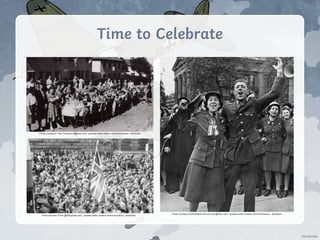
Celebrations
As news of the surrender spread, the war-weary British began to rejoice
straight away. During the previous six years, half a million homes had
been destroyed, thousands of civilians had been killed and many millions
of lives disrupted, in Britain alone.
The news of a surrender was what everyone needed to hear.
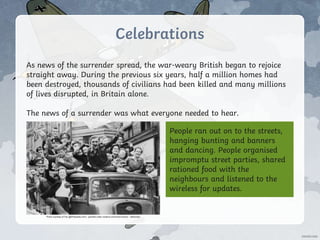
People ran out on to the streets,
hanging bunting and banners
and dancing. People organised
impromptu street parties, shared
rationed food with the
neighbours and listened to the
wireless for updates.
Photo courtesy of Fæ (@Wikipedia.com) - granted under creative commons licence – attribution
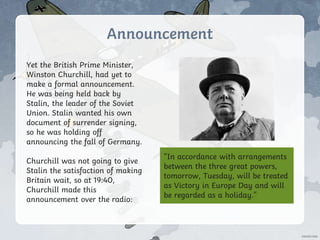
Announcement
Yet the British Prime Minister,
Winston Churchill, had yet to
make a formal announcement.
He was being held back by
Stalin, the leader of the Soviet
Union. Stalin wanted his own
document of surrender signing,
so he was holding off
announcing the fall of Germany.
Churchill was not going to give
Stalin the satisfaction of making
Britain wait, so at 19:40,
Churchill made this
announcement over the radio:
“In accordance with arrangements
between the three great powers,
tomorrow, Tuesday, will be treated
as Victory in Europe Day and will
be regarded as a holiday."
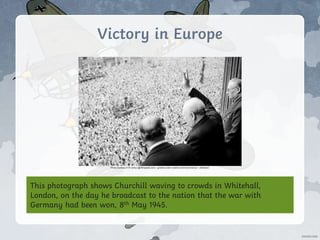
Victory in Europe
This photograph shows Churchill waving to crowds in Whitehall,
London, on the day he broadcast to the nation that the war with
Germany had been won, 8th May 1945.
Photo courtesy of W.wolny (@Wikipedia.com) - granted under creative commons licence – attribution
Time to Celebrate
Photo courtesy of Paul Townsend (@flickr.com) - granted under creative commons licence – attribution
Photo courtesy of Fæ (@Wikipedia.com) - granted under creative commons licence – attribution
Photo courtesy of Galt Museum & Archives (@flickr.com) - granted under creative commons licence – attribution
London VE Day
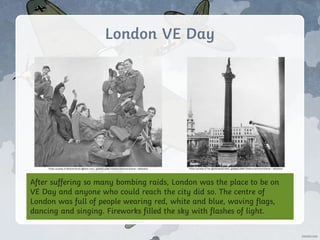
After suffering so many bombing raids, London was the place to be on
VE Day and anyone who could reach the city did so. The centre of
London was full of people wearing red, white and blue, waving flags,
dancing and singing. Fireworks filled the sky with flashes of light.
Photo courtesy of BiblioArchives (@flickr.com) - granted under creative commons licence – attribution Photo courtesy of Fæ (@Wikipedia.com) - granted under creative commons licence – attribution
Britain’s Resolve and Strength
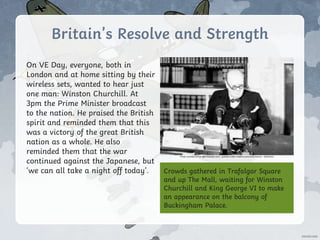
On VE Day, everyone, both in
London and at home sitting by their
wireless sets, wanted to hear just
one man: Winston Churchill. At
3pm the Prime Minister broadcast
to the nation. He praised the British
spirit and reminded them that this
was a victory of the great British
nation as a whole. He also
reminded them that the war
continued against the Japanese, but
‘we can all take a night off today’. Crowds gathered in Trafalgar Square
and up The Mall, waiting for Winston
Churchill and King George VI to make
an appearance on the balcony of
Buckingham Palace.
Photo courtesy of Fæ (@Wikipedia.com) - granted under creative commons licence – attribution
“This is your victory!”
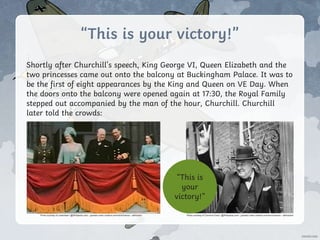
Shortly after Churchill's speech, King George VI, Queen Elizabeth and the
two princesses came out onto the balcony at Buckingham Palace. It was to
be the first of eight appearances by the King and Queen on VE Day. When
the doors onto the balcony were opened again at 17:30, the Royal Family
stepped out accompanied by the man of the hour, Churchill. Churchill
later told the crowds:
Photo courtesy of Lewenstein (@Wikipedia.com) - granted under creative commons licence – attribution Photo courtesy of Common Good (@Wikipedia.com) - granted under creative commons licence – attributiont
“This is
your
victory!”
A Memorable Night
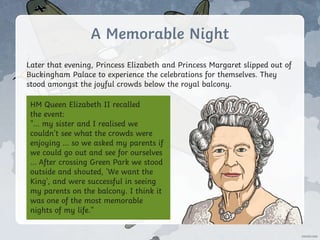
Later that evening, Princess Elizabeth and Princess Margaret slipped out of
Buckingham Palace to experience the celebrations for themselves. They
stood amongst the joyful crowds below the royal balcony.
HM Queen Elizabeth II recalled
the event:
"... my sister and I realised we
couldn't see what the crowds were
enjoying ... so we asked my parents if
we could go out and see for ourselves
... After crossing Green Park we stood
outside and shouted, 'We want the
King', and were successful in seeing
my parents on the balcony. I think it
was one of the most memorable
nights of my life.”
Ks2 ve-day-information-powerpoint

Ks2 ve-day-information-powerpoint

  • 2.
    Victory in Europe Victoryin Europe Day/ VE Day took place on May 8th 1945. It was a public holiday and day of celebration to mark the defeat of Germany by the Allied forces in World War 2. VE Day marked the formal conclusion of the war with Germany and brought to an end six years of suffering, courage and endurance across the world.
  • 3.
    Surrender After Hitler’s suicidein April, 1945, the Germans knew they could not win the war. General Jodl, travelled to see General Dwight D. Eisenhower - who was Supreme Commander of the Allied Forces in Europe – at the Headquarters in France. On the 7th May, at 2.41am, in front of some of the leaders of the Western Allies, Jodl signed a surrender document on behalf of Germany. This meant that the war in Europe was over, although World War II continued in other countries. Photo courtesy of Ras67 (@Wikipedia.com) - granted under creative commons licence – attribution
  • 4.
    Celebrations As news ofthe surrender spread, the war-weary British began to rejoice straight away. During the previous six years, half a million homes had been destroyed, thousands of civilians had been killed and many millions of lives disrupted, in Britain alone. The news of a surrender was what everyone needed to hear. People ran out on to the streets, hanging bunting and banners and dancing. People organised impromptu street parties, shared rationed food with the neighbours and listened to the wireless for updates. Photo courtesy of Fæ (@Wikipedia.com) - granted under creative commons licence – attribution
  • 5.
    Announcement Yet the BritishPrime Minister, Winston Churchill, had yet to make a formal announcement. He was being held back by Stalin, the leader of the Soviet Union. Stalin wanted his own document of surrender signing, so he was holding off announcing the fall of Germany. Churchill was not going to give Stalin the satisfaction of making Britain wait, so at 19:40, Churchill made this announcement over the radio: “In accordance with arrangements between the three great powers, tomorrow, Tuesday, will be treated as Victory in Europe Day and will be regarded as a holiday."
  • 6.
    Victory in Europe Thisphotograph shows Churchill waving to crowds in Whitehall, London, on the day he broadcast to the nation that the war with Germany had been won, 8th May 1945. Photo courtesy of W.wolny (@Wikipedia.com) - granted under creative commons licence – attribution
  • 7.
    Time to Celebrate Photocourtesy of Paul Townsend (@flickr.com) - granted under creative commons licence – attribution Photo courtesy of Fæ (@Wikipedia.com) - granted under creative commons licence – attribution Photo courtesy of Galt Museum & Archives (@flickr.com) - granted under creative commons licence – attribution
  • 8.
    London VE Day Aftersuffering so many bombing raids, London was the place to be on VE Day and anyone who could reach the city did so. The centre of London was full of people wearing red, white and blue, waving flags, dancing and singing. Fireworks filled the sky with flashes of light. Photo courtesy of BiblioArchives (@flickr.com) - granted under creative commons licence – attribution Photo courtesy of Fæ (@Wikipedia.com) - granted under creative commons licence – attribution
  • 9.
    Britain’s Resolve andStrength On VE Day, everyone, both in London and at home sitting by their wireless sets, wanted to hear just one man: Winston Churchill. At 3pm the Prime Minister broadcast to the nation. He praised the British spirit and reminded them that this was a victory of the great British nation as a whole. He also reminded them that the war continued against the Japanese, but ‘we can all take a night off today’. Crowds gathered in Trafalgar Square and up The Mall, waiting for Winston Churchill and King George VI to make an appearance on the balcony of Buckingham Palace. Photo courtesy of Fæ (@Wikipedia.com) - granted under creative commons licence – attribution
  • 10.
    “This is yourvictory!” Shortly after Churchill's speech, King George VI, Queen Elizabeth and the two princesses came out onto the balcony at Buckingham Palace. It was to be the first of eight appearances by the King and Queen on VE Day. When the doors onto the balcony were opened again at 17:30, the Royal Family stepped out accompanied by the man of the hour, Churchill. Churchill later told the crowds: Photo courtesy of Lewenstein (@Wikipedia.com) - granted under creative commons licence – attribution Photo courtesy of Common Good (@Wikipedia.com) - granted under creative commons licence – attributiont “This is your victory!”
  • 11.
    A Memorable Night Laterthat evening, Princess Elizabeth and Princess Margaret slipped out of Buckingham Palace to experience the celebrations for themselves. They stood amongst the joyful crowds below the royal balcony. HM Queen Elizabeth II recalled the event: "... my sister and I realised we couldn't see what the crowds were enjoying ... so we asked my parents if we could go out and see for ourselves ... After crossing Green Park we stood outside and shouted, 'We want the King', and were successful in seeing my parents on the balcony. I think it was one of the most memorable nights of my life.”