A Closer Look at Borderline Personality DisorderKristin O’Neil South Puget Sound Community College
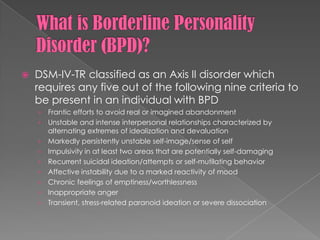
What is Borderline Personality Disorder (BPD)?DSM-IV-TR classified as an Axis II disorder which requires any five out of the following nine criteria to be present in an individual with BPDFrantic efforts to avoid real or imagined abandonmentUnstable and intense interpersonal relationships characterized by alternating extremes of idealization and devaluationMarkedly persistently unstable self-image/sense of selfImpulsivity in at least two areas that are potentially self-damagingRecurrent suicidal ideation/attempts or self-mutilating behavior Affective instability due to a marked reactivity of moodChronic feelings of emptiness/worthlessnessInappropriate angerTransient, stress-related paranoid ideation or severe dissociation
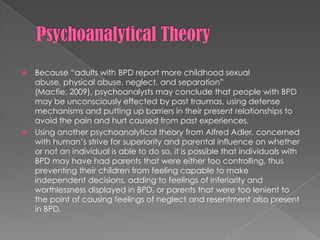
Psychoanalytical TheoryBecause “adults with BPD report more childhood sexual abuse, physical abuse, neglect, and separation” (Macfie, 2009), psychoanalysts may conclude that people with BPD may be unconsciously effected by past traumas, using defense mechanisms and putting up barriers in their present relationships to avoid the pain and hurt caused from past experiences. Using another psychoanalytical theory from Alfred Adler, concerned with human’s strive for superiority and parental influence on whether or not an individual is able to do so, it is possible that individuals with BPD may have had parents that were either too controlling, thus preventing their children from feeling capable to make independent decisions, adding to feelings of inferiority and worthlessness displayed in BPD, or parents that were too lenient to the point of causing feelings of neglect and resentment also present in BPD.
Trait TheoryIndividuals with BPD are likely to demonstrate very extreme traitsImportant in the trait theory is also the concept of the “self” (Burger, 2009)Because individuals with BPD often have such blurred self-concepts, they display extreme, worrisome neurotic characteristics that are likely to consume their lives
Biological TheoryResearch supports strong evidence for a biological basis for BPD (Swift, 2009)Twin and adoption studies have shown that personality disorders are 70% inherited (Swift, 2009)“There are indications that erratic mood swings, social cognitive difficulties, and maladaptive behaviors may be caused by a prefrontal and temporolimbic dysfunction” (Swift, 2009)
Humanistic TheoryIndividuals with BPD must recognize the control they can have over their actions and the better future ahead if they choose to make a change.Humanistic theorists may also use psychologist Carl Rogers’ theory to help understand people with BPD.  He believed that every person has the ability to get the most out of life, however, some people (in this case BPD patients), are unable to do so because they allow outside information to threaten their self-concept and eventually allow it to become a part of them.Any negative feedback to someone with BPD could potentially only add to feelings of low self-worth.Must overcome these feelings and create their own concept of the self
Behavioral & Social Learning TheoryChildren whose mothers have BPD are at an increased risk of developing the disorder themselves because they may be subjected to volatile and unstable living environments and where extreme behaviors associated with BPD are displayed (Macfie, 2009).Behaviors present in BPD individuals may also be conditioned through a desirable.  For example: a neglected child may learn that by acting out they will receive the attention they crave
Cognitive TheoryPsychologist George Kelly believed that psychological problems stem from past traumatic experiences where our personal constructs (the way we interpret a situation) fail to enable us to make sense of our lives (Burger, 2009).Furthermore, patients with BPD often assume that “what exists in his or her mind reflects what exists in the world” (“Mentalization”, 2009), however, this isn’t always the case, hence, where their mental illness begins to set in
Useful TherapiesDialectical Behavioral Therapy (DBT)Emphasizes classical and operant conditioningBehavioral analyses allow client and therapist to determine triggers of problematic behaviors and determine more useful  responses to apply in the future (Swales, 2009)Cognitive Behavior Therapy (CBT), Rational Emotive Behavior Therapy (REBT), & Emotion Regulation Training (ERT)All center mainly around cognitive therapiesAllow patients to take responsibility for their inner thoughts and actions, helping them to change their irrational core beliefs for future benefit (Swift, 2009)
References(2009). Mentalization-based treatment for borderline personality disorder. Harvard Mental Health Letter, 25(10), 1-2. Retrieved from Academic Premier Database.Burger, Jerry M.  (2009).  Belmont, CA: Wadsworth Cengage Learning.Fletcher, R.  (2010). Refusing to Bow: The diagnostic category of BorderlinePersonalityDisorder considered from an Object Relations viewpoint.  Counselling Psychology Review, 25(2),21-27.  Retrieved from Academic Premier Database.  Macfie, J. (2009). Development in Children and Adolescents Whose Mothers Have Borderline Personality Disorder. Child Development Perspectives, 3(1), 66-71. doi:10.1111/j.1750-8606.2008.00079.x.Niedtfeld, I., & Schmahl, C. (2009). Emotion Regulation and Pain in Borderline Personality Disorder. Current Psychiatry Reviews, 5(1), 48-54. Retrieved from Academic Premier Database.Schuppert, H., Giesen-Bloo, J., Van Gemert, T., Wiersema, H., Minderaa, R., Emmelkamp, P., et al. (2009). Effectiveness of an emotion regulation group training for adolescents—a randomized controlled pilot study. Clinical Psychology & Psychotherapy, 16(6), 467-478. doi:10.1002/cpp.637.Swales, M. (2009). Dialectical Behaviour Therapy: Description, Research and Future Directions. International Journal of Behavioral Consultation & Therapy, 5(2), 164-177. Retrieved from Academic Premier Database.Swift, E. (2009). Borderline personality disorder: aetiology, presentation and therapeutic relationship. Mental Health Practice, 13(3), 22-25. Retrieved from Academic Premier Database.Swift, E.  (2009).  The efficacy of treatments for borderlinepersonalitydisorder.  Mental Health Practice, 13(4),30-33.  Retrieved from Academic Premier Database.  Tamir, M. (2009). Differential Preferences for Happiness: Extraversion and Trait-Consistent Emotion Regulation. Journal of Personality, 77(2), 447-470. doi:10.1111/j.1467-6494.2008.00554.x.Zimmerman, D., & Choi-Kain, L. (2009). The Hypothalamic-Pituitary-Adrenal Axis in Borderline Personality Disorder: A Review. Harvard Review of Psychiatry, 17(3), 167-183. doi:10.1080/10673220902996734.

Kristins Psych Pp

  • 1.
    A Closer Lookat Borderline Personality DisorderKristin O’Neil South Puget Sound Community College
  • 2.
    What is BorderlinePersonality Disorder (BPD)?DSM-IV-TR classified as an Axis II disorder which requires any five out of the following nine criteria to be present in an individual with BPDFrantic efforts to avoid real or imagined abandonmentUnstable and intense interpersonal relationships characterized by alternating extremes of idealization and devaluationMarkedly persistently unstable self-image/sense of selfImpulsivity in at least two areas that are potentially self-damagingRecurrent suicidal ideation/attempts or self-mutilating behavior Affective instability due to a marked reactivity of moodChronic feelings of emptiness/worthlessnessInappropriate angerTransient, stress-related paranoid ideation or severe dissociation
  • 3.
    Psychoanalytical TheoryBecause “adultswith BPD report more childhood sexual abuse, physical abuse, neglect, and separation” (Macfie, 2009), psychoanalysts may conclude that people with BPD may be unconsciously effected by past traumas, using defense mechanisms and putting up barriers in their present relationships to avoid the pain and hurt caused from past experiences. Using another psychoanalytical theory from Alfred Adler, concerned with human’s strive for superiority and parental influence on whether or not an individual is able to do so, it is possible that individuals with BPD may have had parents that were either too controlling, thus preventing their children from feeling capable to make independent decisions, adding to feelings of inferiority and worthlessness displayed in BPD, or parents that were too lenient to the point of causing feelings of neglect and resentment also present in BPD.
  • 4.
    Trait TheoryIndividuals withBPD are likely to demonstrate very extreme traitsImportant in the trait theory is also the concept of the “self” (Burger, 2009)Because individuals with BPD often have such blurred self-concepts, they display extreme, worrisome neurotic characteristics that are likely to consume their lives
  • 5.
    Biological TheoryResearch supportsstrong evidence for a biological basis for BPD (Swift, 2009)Twin and adoption studies have shown that personality disorders are 70% inherited (Swift, 2009)“There are indications that erratic mood swings, social cognitive difficulties, and maladaptive behaviors may be caused by a prefrontal and temporolimbic dysfunction” (Swift, 2009)
  • 6.
    Humanistic TheoryIndividuals withBPD must recognize the control they can have over their actions and the better future ahead if they choose to make a change.Humanistic theorists may also use psychologist Carl Rogers’ theory to help understand people with BPD. He believed that every person has the ability to get the most out of life, however, some people (in this case BPD patients), are unable to do so because they allow outside information to threaten their self-concept and eventually allow it to become a part of them.Any negative feedback to someone with BPD could potentially only add to feelings of low self-worth.Must overcome these feelings and create their own concept of the self
  • 7.
    Behavioral & SocialLearning TheoryChildren whose mothers have BPD are at an increased risk of developing the disorder themselves because they may be subjected to volatile and unstable living environments and where extreme behaviors associated with BPD are displayed (Macfie, 2009).Behaviors present in BPD individuals may also be conditioned through a desirable. For example: a neglected child may learn that by acting out they will receive the attention they crave
  • 8.
    Cognitive TheoryPsychologist GeorgeKelly believed that psychological problems stem from past traumatic experiences where our personal constructs (the way we interpret a situation) fail to enable us to make sense of our lives (Burger, 2009).Furthermore, patients with BPD often assume that “what exists in his or her mind reflects what exists in the world” (“Mentalization”, 2009), however, this isn’t always the case, hence, where their mental illness begins to set in
  • 9.
    Useful TherapiesDialectical BehavioralTherapy (DBT)Emphasizes classical and operant conditioningBehavioral analyses allow client and therapist to determine triggers of problematic behaviors and determine more useful responses to apply in the future (Swales, 2009)Cognitive Behavior Therapy (CBT), Rational Emotive Behavior Therapy (REBT), & Emotion Regulation Training (ERT)All center mainly around cognitive therapiesAllow patients to take responsibility for their inner thoughts and actions, helping them to change their irrational core beliefs for future benefit (Swift, 2009)
  • 10.
    References(2009). Mentalization-based treatmentfor borderline personality disorder. Harvard Mental Health Letter, 25(10), 1-2. Retrieved from Academic Premier Database.Burger, Jerry M. (2009). Belmont, CA: Wadsworth Cengage Learning.Fletcher, R. (2010). Refusing to Bow: The diagnostic category of BorderlinePersonalityDisorder considered from an Object Relations viewpoint. Counselling Psychology Review, 25(2),21-27. Retrieved from Academic Premier Database. Macfie, J. (2009). Development in Children and Adolescents Whose Mothers Have Borderline Personality Disorder. Child Development Perspectives, 3(1), 66-71. doi:10.1111/j.1750-8606.2008.00079.x.Niedtfeld, I., & Schmahl, C. (2009). Emotion Regulation and Pain in Borderline Personality Disorder. Current Psychiatry Reviews, 5(1), 48-54. Retrieved from Academic Premier Database.Schuppert, H., Giesen-Bloo, J., Van Gemert, T., Wiersema, H., Minderaa, R., Emmelkamp, P., et al. (2009). Effectiveness of an emotion regulation group training for adolescents—a randomized controlled pilot study. Clinical Psychology & Psychotherapy, 16(6), 467-478. doi:10.1002/cpp.637.Swales, M. (2009). Dialectical Behaviour Therapy: Description, Research and Future Directions. International Journal of Behavioral Consultation & Therapy, 5(2), 164-177. Retrieved from Academic Premier Database.Swift, E. (2009). Borderline personality disorder: aetiology, presentation and therapeutic relationship. Mental Health Practice, 13(3), 22-25. Retrieved from Academic Premier Database.Swift, E. (2009). The efficacy of treatments for borderlinepersonalitydisorder. Mental Health Practice, 13(4),30-33. Retrieved from Academic Premier Database. Tamir, M. (2009). Differential Preferences for Happiness: Extraversion and Trait-Consistent Emotion Regulation. Journal of Personality, 77(2), 447-470. doi:10.1111/j.1467-6494.2008.00554.x.Zimmerman, D., & Choi-Kain, L. (2009). The Hypothalamic-Pituitary-Adrenal Axis in Borderline Personality Disorder: A Review. Harvard Review of Psychiatry, 17(3), 167-183. doi:10.1080/10673220902996734.