A business plan
For –
Branden Fredricks
Marketing Director
Pemberton Products
Pemberton – Snack Food div. of Candler Enterprise – a $18 Bn business
house
A market leader in its Snack food products with $5 Bn revenue
Products – Cookies, Muffins, Doughnuts i.e. the sweet snacks
CAGR of 14% over past 5 years
Current Business at Pemberton
Growth Plans Of Pemberton
 Building Brands
 Enhanced Marketing & Sales
 Leveraging company’s Direct Store Delivery Policy (DSD)
 Entering into the salty market
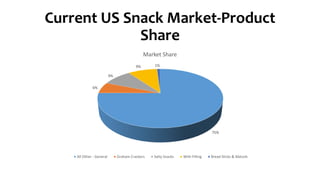
Current US Snack Market – Product Share
Total market – $6.90 Billion
Salty Snacks share – 9% ~ $621 Million
Market CAGR – 2.2% (Year 2008-2010)
Current US Snack Market-Product
Share
75%
6%
9%
9% 1%
Market Share
All Other - General Graham Crackers Salty Snacks With Filling Bread Sticks & Matzoh
Current US Snack Market – Competition
wise
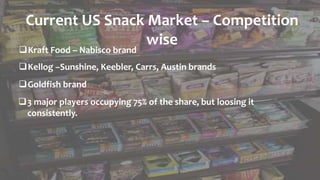
Kraft Food – Nabisco brand
Kellog –Sunshine, Keebler, Carrs, Austin brands
Goldfish brand
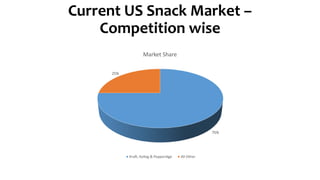
3 major players occupying 75% of the share, but loosing it
consistently.
Current US Snack Market –
Competition wise
75%
25%
Market Share
Kraft, Kellog & Pepperidge All Other
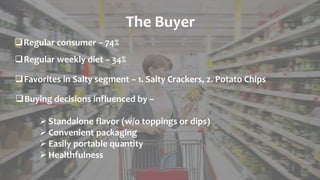
Regular consumer – 74%
Regular weekly diet – 34%
Favorites in Salty segment – 1. Salty Crackers, 2. Potato Chips
Buying decisions influenced by –
 Standalone flavor (w/o toppings or dips)
 Convenient packaging
 Easily portable quantity
 Healthfulness
The Buyer
Krispy Incorporation – Acquisition &
Failure
 Acquired
 Regional brand in southeast salty snack market
 3 plants of single serve pack
 ‘Grab & Go’ packs – Vending machines & convenience stores
 Fell short of sales by nearly 57% against the projected sales in
2009
Possible Reasons for Failure in Market
 Limited product line and thus presence in supermarkets
unnoticed
 Low flavour satisfaction
The Re-launch
 Plan to re-launch Krispy as a brand Krispy Natural
 Improved taste & quality through R&D
 Single as well as multi serve packages for targeting larger
market segment
 More flavours to mark its presence in the market
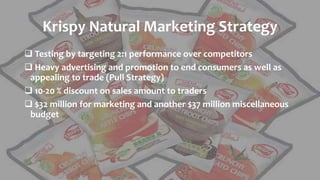
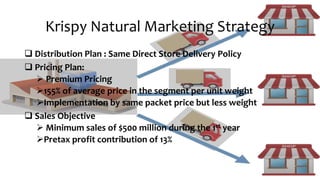
Krispy Natural Marketing Strategy
 Testing by targeting 2:1 performance over competitors
 Heavy advertising and promotion to end consumers as well as
appealing to trade (Pull Strategy)
 10-20 % discount on sales amount to traders
 $32 million for marketing and another $37 million miscellaneous
budget
Krispy Natural Marketing Strategy
 Distribution Plan : Same Direct Store Delivery Policy
 Pricing Plan:
 Premium Pricing
155% of average price in the segment per unit weight
Implementation by same packet price but less weight
 Sales Objective
 Minimum sales of $500 million during the 1st year
Pretax profit contribution of 13%
A 16 weeks market test conducted
The Market Test of Krispy Natural
1. Columbus + Ohio
2. Three Cities of South-East America
Expected to secure 15% shelf space in supermarkets
Two territories selected –
 The test in first territory –
The Market Test of Krispy Natural
1. Columbus + Ohio
– No prior presence in market
– Brand completely new to the Buyer
– Advertisements on TV, on-line promos and discount couponing
– Existing Sales & Marketing resources as well as Direct Stores Delivery
– Additional 5 hired representatives dedicated for sales of Krispy Natural
– Expected to capture 9% market share (from existing 0%)
 The test in second territory –
The Market Test of Krispy Natural
– Brand awareness through existing regular products
– “Krispy Natural” – the premium product to be promoted
– Advertisements on TV, on-line promos and discount couponing
– Existing Sales & Marketing resources as well as Direct Stores Delivery
– Additional 5 hired representatives dedicated for sales of Krispy Natural
– Expected to increase market share from existing 9% to 15%
2. Three Cities of South-East America
The test results in Columbus + Ohio –
Results
– Achieved market share of 18% against expected 9%
– Category volume increased by 30%
The test results in three cities of South-East –
– Gained market share by 1% against expected 9%
– Category volume increased slightly
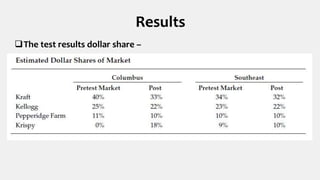
The test results dollar share –
Results
Results
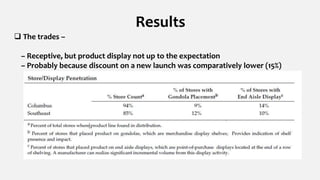
 The trades –
– Receptive, but product display not up to the expectation
– Probably because discount on a new launch was comparatively lower (15%)
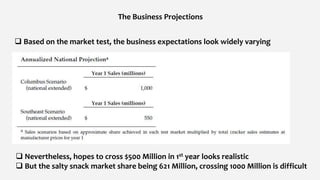
 Based on the market test, the business expectations look widely varying
 Nevertheless, hopes to cross $500 Million in 1st year looks realistic
 But the salty snack market share being 621 Million, crossing 1000 Million is difficult
The Business Projections
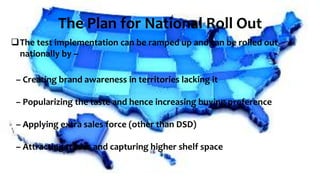
The test implementation can be ramped up and can be rolled out
nationally by –
– Creating brand awareness in territories lacking it
– Popularizing the taste and hence increasing buying preference
– Applying extra sales force (other than DSD)
– Attracting trades and capturing higher shelf space
The Plan for National Roll Out
DISCLAIMER
This presentation is created by Ms. Stuti Mehta, PICT Pune, during
an internship under Prof. Sameer Mathur, IIM-Lucknow.
Ms. Stuti Mehta Prof. Sameer Mathur

Krispy natural

  • 1.
    A business plan For– Branden Fredricks Marketing Director Pemberton Products
  • 2.
    Pemberton – SnackFood div. of Candler Enterprise – a $18 Bn business house A market leader in its Snack food products with $5 Bn revenue Products – Cookies, Muffins, Doughnuts i.e. the sweet snacks CAGR of 14% over past 5 years Current Business at Pemberton
  • 3.
    Growth Plans OfPemberton  Building Brands  Enhanced Marketing & Sales  Leveraging company’s Direct Store Delivery Policy (DSD)  Entering into the salty market
  • 4.
    Current US SnackMarket – Product Share Total market – $6.90 Billion Salty Snacks share – 9% ~ $621 Million Market CAGR – 2.2% (Year 2008-2010)
  • 5.
    Current US SnackMarket-Product Share 75% 6% 9% 9% 1% Market Share All Other - General Graham Crackers Salty Snacks With Filling Bread Sticks & Matzoh
  • 6.
    Current US SnackMarket – Competition wise Kraft Food – Nabisco brand Kellog –Sunshine, Keebler, Carrs, Austin brands Goldfish brand 3 major players occupying 75% of the share, but loosing it consistently.
  • 7.
    Current US SnackMarket – Competition wise 75% 25% Market Share Kraft, Kellog & Pepperidge All Other
  • 8.
    Regular consumer –74% Regular weekly diet – 34% Favorites in Salty segment – 1. Salty Crackers, 2. Potato Chips Buying decisions influenced by –  Standalone flavor (w/o toppings or dips)  Convenient packaging  Easily portable quantity  Healthfulness The Buyer
  • 9.
    Krispy Incorporation –Acquisition & Failure  Acquired  Regional brand in southeast salty snack market  3 plants of single serve pack  ‘Grab & Go’ packs – Vending machines & convenience stores  Fell short of sales by nearly 57% against the projected sales in 2009
  • 10.
    Possible Reasons forFailure in Market  Limited product line and thus presence in supermarkets unnoticed  Low flavour satisfaction
  • 11.
    The Re-launch  Planto re-launch Krispy as a brand Krispy Natural  Improved taste & quality through R&D  Single as well as multi serve packages for targeting larger market segment  More flavours to mark its presence in the market
  • 12.
    Krispy Natural MarketingStrategy  Testing by targeting 2:1 performance over competitors  Heavy advertising and promotion to end consumers as well as appealing to trade (Pull Strategy)  10-20 % discount on sales amount to traders  $32 million for marketing and another $37 million miscellaneous budget
  • 13.
    Krispy Natural MarketingStrategy  Distribution Plan : Same Direct Store Delivery Policy  Pricing Plan:  Premium Pricing 155% of average price in the segment per unit weight Implementation by same packet price but less weight  Sales Objective  Minimum sales of $500 million during the 1st year Pretax profit contribution of 13%
  • 14.
    A 16 weeksmarket test conducted The Market Test of Krispy Natural 1. Columbus + Ohio 2. Three Cities of South-East America Expected to secure 15% shelf space in supermarkets Two territories selected –
  • 15.
     The testin first territory – The Market Test of Krispy Natural 1. Columbus + Ohio – No prior presence in market – Brand completely new to the Buyer – Advertisements on TV, on-line promos and discount couponing – Existing Sales & Marketing resources as well as Direct Stores Delivery – Additional 5 hired representatives dedicated for sales of Krispy Natural – Expected to capture 9% market share (from existing 0%)
  • 16.
     The testin second territory – The Market Test of Krispy Natural – Brand awareness through existing regular products – “Krispy Natural” – the premium product to be promoted – Advertisements on TV, on-line promos and discount couponing – Existing Sales & Marketing resources as well as Direct Stores Delivery – Additional 5 hired representatives dedicated for sales of Krispy Natural – Expected to increase market share from existing 9% to 15% 2. Three Cities of South-East America
  • 17.
    The test resultsin Columbus + Ohio – Results – Achieved market share of 18% against expected 9% – Category volume increased by 30% The test results in three cities of South-East – – Gained market share by 1% against expected 9% – Category volume increased slightly
  • 18.
    The test resultsdollar share – Results
  • 19.
    Results  The trades– – Receptive, but product display not up to the expectation – Probably because discount on a new launch was comparatively lower (15%)
  • 20.
     Based onthe market test, the business expectations look widely varying  Nevertheless, hopes to cross $500 Million in 1st year looks realistic  But the salty snack market share being 621 Million, crossing 1000 Million is difficult The Business Projections
  • 21.
    The test implementationcan be ramped up and can be rolled out nationally by – – Creating brand awareness in territories lacking it – Popularizing the taste and hence increasing buying preference – Applying extra sales force (other than DSD) – Attracting trades and capturing higher shelf space The Plan for National Roll Out
  • 22.
    DISCLAIMER This presentation iscreated by Ms. Stuti Mehta, PICT Pune, during an internship under Prof. Sameer Mathur, IIM-Lucknow. Ms. Stuti Mehta Prof. Sameer Mathur