Arvin Bera
CST, KPC
Normalization
Learning OutCome
 BCNF
 Definition
 Comparisons with others
 Examples
BCNF(Boyce–Codd normal form)
Boyce–Codd normal form (or BCNF or 3.5NF) is
a normal form used in database normalization. It
is a slightly stronger version of the third normal
form (3NF).
1. BCNF is the advance version of 3NF. It is
stricter than 3NF.
2. A table is in BCNF if every functional
dependency X → Y, X is the super key of the
table.
3. For BCNF, the table should be in 3NF, and for
every FD, LHS is super key.
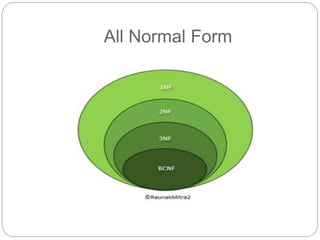
All Normal Form
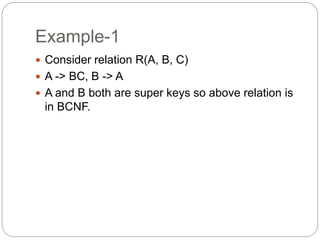
Example-1
 Consider relation R(A, B, C)
 A -> BC, B -> A
 A and B both are super keys so above relation is
in BCNF.
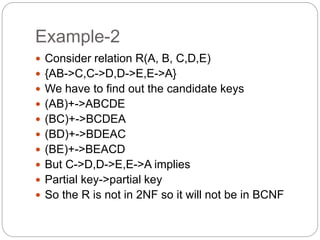
Example-2
 Consider relation R(A, B, C,D,E)
 {AB->C,C->D,D->E,E->A}
 We have to find out the candidate keys
 (AB)+->ABCDE
 (BC)+->BCDEA
 (BD)+->BDEAC
 (BE)+->BEACD
 But C->D,D->E,E->A implies
 Partial key->partial key
 So the R is not in 2NF so it will not be in BCNF
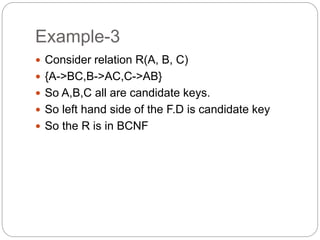
Example-3
 Consider relation R(A, B, C)
 {A->BC,B->AC,C->AB}
 So A,B,C all are candidate keys.
 So left hand side of the F.D is candidate key
 So the R is in BCNF

#KPC #CST #DBMS(BCNF)

  • 1.
  • 2.
    Learning OutCome  BCNF Definition  Comparisons with others  Examples
  • 3.
    BCNF(Boyce–Codd normal form) Boyce–Coddnormal form (or BCNF or 3.5NF) is a normal form used in database normalization. It is a slightly stronger version of the third normal form (3NF). 1. BCNF is the advance version of 3NF. It is stricter than 3NF. 2. A table is in BCNF if every functional dependency X → Y, X is the super key of the table. 3. For BCNF, the table should be in 3NF, and for every FD, LHS is super key.
  • 4.
  • 5.
    Example-1  Consider relationR(A, B, C)  A -> BC, B -> A  A and B both are super keys so above relation is in BCNF.
  • 6.
    Example-2  Consider relationR(A, B, C,D,E)  {AB->C,C->D,D->E,E->A}  We have to find out the candidate keys  (AB)+->ABCDE  (BC)+->BCDEA  (BD)+->BDEAC  (BE)+->BEACD  But C->D,D->E,E->A implies  Partial key->partial key  So the R is not in 2NF so it will not be in BCNF
  • 7.
    Example-3  Consider relationR(A, B, C)  {A->BC,B->AC,C->AB}  So A,B,C all are candidate keys.  So left hand side of the F.D is candidate key  So the R is in BCNF