Relational Decomposition
Arvin Bera
(Lecturer CST KPC)
Learning Outcome
 Types of Decomposition
 Lossless Decomposition
 Dependency Preserving
Types of Decomposition
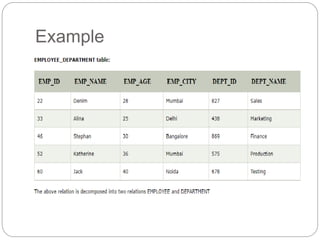
Lossless Decomposition
 If the information is not lost from the relation that
is decomposed, then the decomposition will be
lossless.
 The lossless decomposition guarantees that the
join of relations will result in the same relation as
it was decomposed.
 The relation is said to be lossless decomposition
if natural joins of all the decomposition give the
original relation.
Example
Example
Example
Lossy Decomposition
 As the name suggests, when a relation is
decomposed into two or more relational schemas,
the loss of information is unavoidable when the
original relation is retrieved.
Lossy Decomposition
Dependency Preserving
 It is an important constraint of the database.
 In the dependency preservation, at least one
decomposed table must satisfy every
dependency.
 If a relation R is decomposed into relation R1 and
R2, then the dependencies of R either must be a
part of R1 or R2 or must be derivable from the
combination of functional dependencies of R1
and R2.
Dependency Preserving
 For example, suppose there is a relation R (A, B,
C, D) with functional dependency set (A->BC).
The relational R is decomposed into R1(ABC)
and R2(AD) which is dependency preserving
because FD A->BC is a part of relation R1(ABC).
Example
 R(A,B,C,D,E)
 {AB->C,B->D,D->E}
 (AB)+=>ABCDE
 B=>D B is the partial key
 So the relation is not in 2NF
 So we have to decompose this relation into two
parts ABC and BDE
 Now we have to decompose the BDE into two
parts
 BD and DE
 Here all the FD’s are reserved decomposition

#KPC #CST #Relational Decomposition

  • 1.
  • 2.
    Learning Outcome  Typesof Decomposition  Lossless Decomposition  Dependency Preserving
  • 3.
  • 4.
    Lossless Decomposition  Ifthe information is not lost from the relation that is decomposed, then the decomposition will be lossless.  The lossless decomposition guarantees that the join of relations will result in the same relation as it was decomposed.  The relation is said to be lossless decomposition if natural joins of all the decomposition give the original relation.
  • 5.
  • 6.
  • 7.
  • 8.
    Lossy Decomposition  Asthe name suggests, when a relation is decomposed into two or more relational schemas, the loss of information is unavoidable when the original relation is retrieved.
  • 9.
  • 10.
    Dependency Preserving  Itis an important constraint of the database.  In the dependency preservation, at least one decomposed table must satisfy every dependency.  If a relation R is decomposed into relation R1 and R2, then the dependencies of R either must be a part of R1 or R2 or must be derivable from the combination of functional dependencies of R1 and R2.
  • 11.
    Dependency Preserving  Forexample, suppose there is a relation R (A, B, C, D) with functional dependency set (A->BC). The relational R is decomposed into R1(ABC) and R2(AD) which is dependency preserving because FD A->BC is a part of relation R1(ABC).
  • 12.
    Example  R(A,B,C,D,E)  {AB->C,B->D,D->E} (AB)+=>ABCDE  B=>D B is the partial key  So the relation is not in 2NF  So we have to decompose this relation into two parts ABC and BDE  Now we have to decompose the BDE into two parts  BD and DE  Here all the FD’s are reserved decomposition