The business case for
reducing emissions
Helping businesses increase value
through reducing greenhouse gas emissions
click here to start >
The business case for reducing emissions To suggest amends/updates to content, email: Toby.Pickard@igd.com
Please give us feedback
Contents
About this guide
Section One: Regulation
Section Two: Financial considerations
Section Three: Reputation
Section Four: The future
Section Five: Next steps and support
Section Six: About greenhouse gas emissions and
business
Section Seven: IGD and sustainability
>
>
>
>
>
>
>
>
©InstituteofGroceryDistribution2012.
All intellectualpropertyrightsreserved.
IGD is the trade mark of the Institute of Grocery
Distribution.
IGDauthorisesyouto:
• Viewandprintoutthematerialforpersonaluse
only
• Extractsmallamountsoftext,tablesandcharts
forinclusionwithininternalcompanydocuments
forlimiteddistribution.IGDmustbereferredto
asthesourceofinformationwhenthisoccurs
Youarenotauthorisedto:
• Sell,licenseordisposeofmaterialfor
commercialoranyothergain
• Alterthematerialinanyway
Whilsteveryefforthasbeenmadetoensurethat
theinformationcontainedinthispublicationis
correct,neitherIGDnoranyofitsstaffshallbe
liableforerrorsoromissionshowsoevercaused.
Thispublicationisaguideonlyanddoesnot
providespecificadviceonanyspecificissue. You
mustseekyourownindependentlegaladviceor
specialistadviceinallcases.
Contents and
How to use this guide
About this guide
Section one:
Regulation
Section two:
Financial considerations
Section three:
Reputation
Section four:
The future
Section five:
Next steps and support
Section six:
About greenhouse gas
emissions and business
Section seven:
IGD and sustainability
How to use this guide
The guide is an interactive PDF (iPDF). It will present itself in ‘full screen mode’. By pressing ‘Esc’ on your keyboard at any time you will return to a normal PDF screen where
you can print copies/pages as required (please ensure that your printer options are set to landscape, and the appropriate print page size).
The guide has been specifically designed to navigate you through three key drivers that relate to greenhouse gas management and reduction.
To access external links, click on the words that are in blue text and underlined. Please ensure you are connected to the internet.
There are also links within the guide itself. Words that are in bold and italic link to relevant areas within the guide to help you understand the interconnectivity of the
issues and opportunities.
The business case for reducing emissions To suggest amends/updates to content, email: Toby.Pickard@igd.com
Please give us feedback
About this guide
This guide has been developed by an IGD working
group due to the success of the 2011 Environmental
Sustainability Matrix. The guide has been created
with the specific purpose of helping food and grocery
businesses build sustainability issues into their strategic
plans.
Currently, sustainability issues do not significantly
feature on a lot of companies’ corporate strategic plans.
This is partly due to the difficulty in quantifying return on
investment in sustainability initiatives, but also due to a
limited understanding within some business functions
of the significance of sustainability issues.
This guide is designed to help businesses understand
what they can do to reduce their greenhouse gas
emissions, and communicates it in a way that will
provide the business case for investment in greenhouse
gas (GHG) reduction initiatives.
The guide uses numerous best practice examples from
industry and offers links to tools and further sources
of information to help organisations reduce their GHG
emissions.
With the business case for sustainability only recently
gaining traction, most of the best practice examples
presented are from larger food and grocery businesses.
However, there are examples from smaller progressive
companies. All the examples highlight the direction of
travel by industry and offer numerous opportunities
for organisations to collaborate and learn from others
within the industry to drive positive change.
The guide focuses on three key drivers that
organisations need to be aware of and address to help
them reduce their GHG emissions and become a more
environmentally sound business. The three key drivers
are:
• Regulation
• Financial considerations
• Reputation
These drivers have different levels of importance. This
is because regulation is something that organisations
must comply to, whilst understanding and addressing
the financial considerations and reputational issues
concerned with reducing GHG emissions can be entirely
based upon an organisation’s priorities and concerns.
If you have best practice examples that you would
like featured in this guide please submit them to:
toby.pickard@igd.com
Contents and
How to use this guide
About this guide
Section one:
Regulation
Section two:
Financial considerations
Section three:
Reputation
Section four:
The future
Section five:
Next steps and support
Section six:
About greenhouse gas
emissions and business
Section seven:
IGD and sustainability
Regulation
As companies must comply with regulation this
is the first section of the guide. Within this section
there are links to relevant policies for industry, along
with a list of practical tips to reduce emissions and
a hierarchy of actions to reduce emissions.
Did you know?
The Carbon Reduction Commitment is expected
to deliver carbon savings of 21 MtCO2
by 2027.
Click here to find out more...
Financial considerations
The financial considerations section focuses on
the cost savings that can be achieved through
reducing emissions and energy use, and features
case studies from industry. There is also a checklist
and links to help businesses reduce energy use and
therefore save money and emissions.
Did you know?
Marks and Spencer’s sustainability strategy has
delivered a net benefit of £185m in its first 5
years. Click here to find out more...
Reputation
The third section and final driver is reputation.
This section has examples of how companies have
increased share price due to their sustainability
credentials and improved staff retention. It also
highlights some emerging issues that businesses
need to be aware of to help improve their
reputation, and subsequently enhance their share
price, increase sales and build trust.
Did you know?
83% of shoppers expect food and grocery
companies to be constantly checking that their
suppliers are acting responsibly towards the
environment. Click here to find out more...
The business case for reducing emissions To suggest amends/updates to content, email: Toby.Pickard@igd.com
Please give us feedback
Section one: Regulation
Regulation has been, and will remain, an important
tool in encouraging organisations to develop greener
products, services and operating procedures by offering
a clear direction of travel and a level playing field. Over
recent years, there has been an increase in the number
of regulations introduced in the UK that are linked to,
or are directly related to, greenhouse gas emission
reductions that impact the food and grocery industry.
The Green Economy Timeline, below, gives an overview
of existing regulations and policies that are related to
greenhouse gas reduction and it also highlights future
policy.
Once you have downloaded the above image, hover over the policies
and regulations and a pop-up box will give you a brief description of the
policy
The plans laid out by the UK government and the
European Union (EU) highlight that more stringent
regulations will come into force over the coming years to
help the UK reduce its emissions.
A brief history of greenhouse gas
emissions and climate change
regulation
The need to regulate for climate change was first
recognised in the early 1990’s. In 1992, the Earth
Summit in Rio de Janeiro created the United Nations
Framework Convention on Climate Change (UNFCCC).
Whilst this convention encouraged industrialised
countries to stabilise greenhouse gas (GHG) emissions,
it was recognised that a harder-hitting commitment was
necessary. The Kyoto Protocol was therefore created
in Kyoto, Japan in 1997, as a legally binding framework
for 37 industrialised countries and the EU. It came into
force in 2005 and amounts to an average reduction in
GHGs of 5% vs. 1990 over the five year period between
2008-2012.
Regulation brings a level playing field
Organisations can benefit from the certainty that
regulation offers. In some instances, such as energy
efficiency linked to GHG reductions, regulatory
compliance can also lead to significant cost savings.
To understand more about the cost savings associated
with reducing GHG emissions go to the Financial
considerations section.
The UK is in the vanguard of legislation for GHG
reductions, and is the first country to introduce a long-
term legally binding framework to tackle climate change.
Many organisations from the food and grocery industry
will be affected by more immediate regulations imposed
by the UK government to help meet greenhouse gas
reduction targets.
Even if legislation on greenhouse gases does not
affect your organisation, reducing your emissions can
bring other benefits, such as lower energy bills and
improving the way stakeholders view your business.
You may also be able to take advantage of related tax
breaks.
Key regulations
The major pieces of legislation associated with
greenhouse gas reduction are listed below.
The Climate Change Act 2008 creates a new
approach to managing and responding to climate
change in the UK by:
- Setting ambitious, legally binding targets
- Taking powers to help meet those targets
- Strengthening the institutional framework
- Enhancing the UK’s ability to adapt to the impact
of climate change
- Establishing clear and regular accountability to
the UK Parliament and to the devolved legislatures.
The UK is committed to reducing its emissions by at
least 80% by 2050, relative to 1990 levels. This means
there is a need to transform the UK economy while
ensuring secure, low carbon energy supplies to 2050.
Along with the Climate Change Act there are numerous
other pieces of legislation that impact food and grocery
businesses. Some of these can be seen on the next
page.
Green Economy Policy Timeline
(click on image to download)
PAGE 1 OF 4
Regulation is subject to change and alterations.
For a full and up-to-date list of policy and
legislation, please visit the Department of Energy &
Climate Change and Defra.
Contents and
How to use this guide
About this guide
Section one:
Regulation
Section two:
Financial considerations
Section three:
Reputation
Section four:
The future
Section five:
Next steps and support
Section six:
About greenhouse gas
emissions and business
Section seven:
IGD and sustainability
The business case for reducing emissions To suggest amends/updates to content, email: Toby.Pickard@igd.com
Please give us feedback
Section one: Regulation
The Climate Change Levy (CCL) is a tax on energy
supplied to non-domestic premises. The levy forms
part of the Climate Change Act and was introduced
in April 2001 by Defra. The CCL is an energy tax that
adds approximately 15% to typical energy bills in
UK businesses. The aim of the levy is to encourage
businesses to become more energy efficient and to
reduce greenhouse gas emissions. There are related
measures also designed to help companies become
more energy efficient:
- 100% first-year capital allowances on energy-saving
investments
- An exemption on CCL for energy generated from
some renewable sources
- An exemption from CCL for fuel input to “good
quality” combined heat and power
Click here for further details on the Climate Change
Levy.
The Carbon Reduction Commitment (CRC) is a
mandatory UK-wide trading scheme covering large
business and public sector organisations; these produce
12% of UK carbon emissions. Qualification for CRC is
determined on the basis of half-hourly electricity supply.
Click here for further details on the Carbon Reduction
Commitment.
The Energy Performance of Buildings Regulations
require new builds and major refurbishments of
buildings to meet the energy efficiency requirements of
the Building Regulations. They also include mandatory
inspection of air-conditioning systems every 5 years.
Display Energy Certificates are required in buildings
with a usable floor space of more than 1,000m2
that
are occupied or part occupied by public authorities
or institutions providing services to a large number of
people who may visit the building.
Click here for further details on the Energy Performance
of Buildings Regulations.
Fluorinated greenhouse gases
The fluorinated greenhouse gases (F gases) are
hydrofluorocarbons, perfluorocarbons and sulphur
hexafluorides.
F gases form part of the Kyoto Protocol’s ‘basket’ of
greenhouse gases. Action to contain, prevent and
reduce emissions of F gases is being taken by the EU as
part of its obligations under the Kyoto Protocol. The UK
and the EU are signatories to the protocol and the UK is
therefore committed to reducing its emissions.
In 2006, the EU introduced the EU F gas regulation.
The obligations in this regulation are fleshed out
by a number of European Commission regulations
that provide extra detail and introduce minimum
requirements which must be complied with.
The EU framework has been fully implemented in
Great Britain by the Fluorinated Greenhouse Gases
Regulations 2009 (FGG Regulations 2009).
Click here for further details on fluorinated greenhouse
gases from the European Commission.
Companies Act 2006
In addition, UK company law places some requirements
on businesses to report environmental information.
The Companies Act 2006 (section 417) requires that
all companies, other than small companies, include a
business review in their directors’ report.
The purpose of the business review is to inform
stakeholders of the company and help them assess how
the directors have performed their duty to promote the
success of the company. The business review should
include a fair review of the company’s business and its
principal risks and uncertainties.
For a quoted company, the business review must
include, amongst other things, information about
environmental matters (including the impact of the
company’s business on the environment) to the extent
necessary for an understanding of the development,
performance or position of the company’s business.
Leading businesses to disclose
emissions
The UK Government has confirmed that companies
listed on the London Stock Exchange will be required to
report on their carbon emissions from 2013.
The mandatory carbon reporting will require about
1,800 of the UK’s largest listed companies to report
annually on their greenhouse gas emissions.
“ “The CRC is expected to
deliver carbon savings
of 21 MtCO2
O by 2027.2
DECC
PAGE 2 OF 4
Contents and
How to use this guide
About this guide
Section one:
Regulation
Section two:
Financial considerations
Section three:
Reputation
Section four:
The future
Section five:
Next steps and support
Section six:
About greenhouse gas
emissions and business
Section seven:
IGD and sustainability
Regulation is subject to change and alterations.
For a full and up-to-date list of policy and
legislation please visit the Department of Energy &
Climate Change and Defra.
The business case for reducing emissions To suggest amends/updates to content, email: Toby.Pickard@igd.com
Please give us feedback
Section one: Regulation
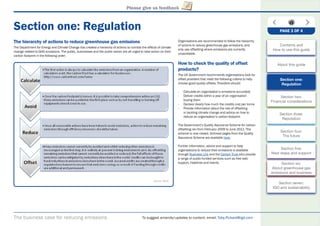
The hierarchy of actions to reduce greenhouse gas emissions
The Department for Energy and Climate Change has created a hierarchy of actions to combat the effects of climate
change related to GHG emissions. The public, businesses and the public sector are all urged to take action on their
carbon footprint in the following order:
Organisations are recommended to follow the hierarchy
of actions to reduce greenhouse gas emissions, and
only use offsetting where emissions are currently
unavoidable.
How to check the quality of offset
products?
The UK Government recommends organisations look for
offset providers that meet the following criteria to help
choose good quality offsets. Providers should:
- Calculate an organisation’s emissions accurately
- Deliver credits within a year of an organisation
buying them
- Declare clearly how much the credits cost per tonne
- Provide information about the role of offsetting
in tackling climate change and advice on how to
reduce an organisation’s carbon footprint
The Government’s Quality Assurance Scheme for carbon
offsetting ran from February 2009 to June 2011. The
scheme is now closed. Archived pages from the Quality
Assurance Scheme are available here.
Further information, advice and support to help
organisations to reduce their emissions is available
through Business Link and the Carbon Trust who provide
a range of public-funded services such as free web
support, helplines and events.
Source: DECC
PAGE 3 OF 4
Contents and
How to use this guide
About this guide
Section one:
Regulation
Section two:
Financial considerations
Section three:
Reputation
Section four:
The future
Section five:
Next steps and support
Section six:
About greenhouse gas
emissions and business
Section seven:
IGD and sustainability
The business case for reducing emissions To suggest amends/updates to content, email: Toby.Pickard@igd.com
Please give us feedback
Section one: Regulation
Below is a list of practical tips to help organisations
ensure they are reducing their emissions.
- Has the organisation measured its greenhouse gas
(GHG) emissions?
- Does the company have a GHG management
reduction policy?
- Is someone accountable for GHG compliance?
- Has the company looked at implementing an
Environmental Management System?
- Do GHG reduction Key Performance Indicators (KPI)
exist in the organisation?
- Where is the highest level of direct responsibility for
climate change within the company?
- Are GHG reduction KPIs reported at Board level?
- Does the company provide incentives for the
management of climate change issues, including
the attainment of targets?
- Do GHG plans get reviewed regularly?
- How is GHG compliance supported in the business?
- Is climate change and GHG reduction integrated into
the business strategy?
- Have any climate change risks been identified
(current or future) that have the potential to
generate a substantive change in the business
operations, revenue or expenditure?
- Have climate change opportunities been identified
(current or future) that have the potential to
generate a substantive change in business
operations, revenue or expenditure?
- Does the company engage with policy makers to
encourage further action on mitigation and/or
adaptation?
- Has the organisation considered application for the
Carbon Trust Standard?
- Are the company’s greenhouse gas emissions
diclosed through the Carbon Disclosure Project?
- Has the organisation considered working with its
trading partners to reduce GHG emissions outside
of its direct control?
Some useful tools and guides
Defra, in partnership with the Department for Energy
and Climate Change (DECC), provides guidance for
businesses and organisations on how to measure and
report their GHG emissions:
- Guidance on how to measure and report your
greenhouse gas emissions (pdf)
- Small Business User Guide: Guidance on how to
measure and report your greenhouse gas emissions
(pdf)
The reports explain how organisations can measure
and report their GHG emissions as well as set targets
to reduce them. The reports are aimed at all sizes
of businesses as well as public and third sector
organisations.
Defra has also created guidelines to help:
- Give clear guidance to companies on how to
report on their environmental performance using
environmental Key Performance Indicators (KPIs)
- Define which KPIs are most relevant to which
sectors, and
- Set out the business rationale for managing
environmental performance using KPIs.
Access the report here: Environmental Key Performance
Indicators Reporting Guidelines for UK Business (pdf)
PAGE 4 OF 4
Did you know? Walmart’s energy and fuel
efficiency initiatives - launched in 2005 - saves the
retailer more than $500m a year.
Contents and
How to use this guide
About this guide
Section one:
Regulation
Section two:
Financial considerations
Section three:
Reputation
Section four:
The future
Section five:
Next steps and support
Section six:
About greenhouse gas
emissions and business
Section seven:
IGD and sustainability
Did you know? Morrisons Kidderminster store
became the first UK supermarket to achieve an
‘excellent’ BREEAM rating for its environmental
performance.
Did you know? Robert Wiseman Dairies has a
certified Environmental Management System to
ISO 14401, which reduces the cost of its Pollution
Prevention and Control permits and helps it
identify potential risks that could end up costing it
financially and reputationally.
The business case for reducing emissions To suggest amends/updates to content, email: Toby.Pickard@igd.com
Please give us feedback
Section two: Financial considerations
Greenhouse gas (GHG) emissions are likely to have
financial implications for all organisations in the
grocery industry. Legislation brings taxation, restrictions
on activities with associated costs, and even fines.
Companies that do not reduce their emissions of GHGs
could find taxation and other duties to governments
increasing, and may find their activities are restricted.
Reducing GHG emissions can result in cost savings, as
energy bills are reduced. While reducing energy use
through better working practices and energy efficiency
investments generally have quick payback, there may
be costs associated with achieving more stretching GHG
emissions reduction targets.
Reducing GHG emissions from sources not associated
with energy, such as refrigerants and agricultural
husbandry systems, may be complex and carry costs
that are less easy to justify with conventional financial
analysis.
The risk of not acting
Despite climate change posing a ‘substantial’ risk to
the UK, fewer than half of the UK’s major companies
have contingency plans to deal with climate change.
That is the conclusion of research by the Carbon
Disclosure Project (CDP), which conducted a poll of UK
FTSE 100 companies as part of its Insight into Climate
Change Adaptation by UK companies.
However, the report concludes that for businesses, risks
and opportunities are strongly linked, adding that many
new business risks can also be seen as opportunities
because there is a possibility of gaining competitive
advantage through better strategic planning.
Investors and shareholders are being called upon to
keep pressure on their business interests, in a bid to
adapt to climate change and sustain long-term growth.
The former Environment Minister Lord Taylor has been
reported as saying: ‘Investors that want to keep share
prices high must stress the need for action to prepare
for climate change. They can provide an incentive to
businesses to not only consider the long-term risks of
climate change, but also the opportunities that can be
grasped now.’
The UK Government estimates that it will cost
approximately £25-29bn to deliver the carbon
reductions that are necessary. However, it insists that
the cost is far lower than the cost of no action. This has
been addressed by Lord Stern in the Stern Review, and
subsequently acknowledged by the food and grocery
industry.
80% of directly
responding FTSE 100
companies identify
substantive risks
to their business as
a result of climate
change.
Insights into Climateg
Change Adaptation byg p y
UK Companies, Carbonp ,
Disclosure Projectj (pdf)t
“
“
80% is the potential
value uplift for a
company proactively
addressing climate
change opportunities.
Carbon Trust (pdf)t
For every £2 we spend
now on tackling climate
change, we are saving
future generations
anywhere between
£5 and £20 at today’s
value.
Sir Terry Leahy, Januaryy y, y
2009
The UK’s annual energy
spend is £23,645 million
and most businesses
could save 10% off their
energy bills through no
or relatively low cost
measures.
Carbon Trust (pdf)t
Did you know? In 2012, Unilever claimed that
there was a 68% increase in their share price
following the launch of its Sustainable Living Plan.
PAGE 1 OF 4
Did you know? Marks and Spencer’s
sustainability strategy, Plan A, has delivered a net
benefit of £185m in its first five years.
Contents and
How to use this guide
About this guide
Section one:
Regulation
Section two:
Financial considerations
Section three:
Reputation
Section four:
The future
Section five:
Next steps and support
Section six:
About greenhouse gas
emissions and business
Section seven:
IGD and sustainability
The business case for reducing emissions To suggest amends/updates to content, email: Toby.Pickard@igd.com
Please give us feedback
Section two: Financial considerations
Tax breaks to encourage energy
efficiency
Tax breaks are on offer as an incentive to encourage
organisations to adopt certain environmentally
responsible practices. For example:
- Using sources of energy that have less
environmental impact can make organisations
eligible for a reduction in the climate change levy
- Organisations can benefit from investing in energy
saving plant and machinery through tax breaks
called enhanced capital allowances (ECAs)
Click here for a guide on enhanced capital
allowances for energy saving products
- Organisations can also use ECAs for investing in
company cars that have low CO2
emissions
Click here for a guide on first year allowances: the
basics
- Organisations that frequently travel in and out of the
congestion charging zone in London may be eligible
for a discount if vehicles use alternative fuels
Click here for a guide on reducing your vehicle
emissions
Key issues
Commercial activities that create greenhouse gas
emissions are targeted through Government schemes
to restrict overall emissions through the issuing of
quotas, and through taxing emissions.
Most activities creating GHG emissions in the grocery
industry are associated with the generation of energy
from fossil fuels. These may be directly emitted from a
company’s premises or vehicles through the use of oil,
petrol or gas, or indirectly through the use of electricity.
There is therefore a link between an enterprise’s
energy and fuel bill, and its greenhouse gas emissions.
If possible, switching to lower global warming
potential fossil fuels (e.g. gas), could have a
significant reduction of GHG emissions. There may be
a financial cost associated with such moves, but this
could be reduced if a carbon floor price is introduced
in the UK or if an organisation is captured under the
CRC Energy Efficiency Scheme.
For parts of the grocery industry, the use of
refrigerants has a significant impact on the emission
of GHGs. Refrigeration is the largest source of GHGs
in any supermarket through both the energy required
to power them and the refrigerants themselves.
Many refrigerants have very high global warming
potential if released into the atmosphere. Replacing
these refrigerant gases with more benign alternatives
is costly, but can have significant environmental
benefits.
Parts of the grocery industry’s upstream activities
such as agriculture or petrochemical processing
create significant GHGs. These would not be captured
by any current legislation and are not subject to
quotas or taxation, but they are captured by lifecycle
analysis and carbon footprinting, and stakeholders
may choose to reject products that have higher
carbon footprints.
Similarly waste food products create GHGs as they
decompose, particularly methane if they are sent
to landfill. Increasing landfill taxes are causing
companies to deal with waste at source.
Measures
Financial considerations will be measured in terms of:
- Increased costs – taxation or investment
- Reduced costs – from reducing energy or other
input use
- Revenues – which could increase or decrease,
according to the outcome of actions taken
Reduction/Improving
Reducing the impact of taxation and quotas on GHG
emissions is clearly best addressed by reducing the
quantity of emissions.
Significant financial savings can be made through
reducing the use of fossil fuels and can be achieved
through many means – the Carbon Trust estimates
that businesses in the UK waste some 10-20% of
the energy they buy due to poor control of heating,
air conditioning and ventilation and through leaving
lights and appliances on when not in use.
Did you know? Adnams invested in a new more
efficient distribution centre which resulted in it
using 58% less gas and 67% less electricity per
square metre. The energy efficiencies save Adnams
£50,000 per annum.
BitC
PAGE 2 OF 4
Contents and
How to use this guide
About this guide
Section one:
Regulation
Section two:
Financial considerations
Section three:
Reputation
Section four:
The future
Section five:
Next steps and support
Section six:
About greenhouse gas
emissions and business
Section seven:
IGD and sustainability
Did you know? Sainsbury’s estimates that if all
UK supermarkets converted to CO2
refrigeration,
the UK’s carbon emissions would immediately
drop by 2 million tonnes per year.
Did you know? Robert Wiseman Dairies
utilised the enhanced capital allowance Scheme
to install two new low lose, energy efficient
transformers at its East Kilbride processing
facility saving 353 tonnes of CO2
per annum.
The business case for reducing emissions To suggest amends/updates to content, email: Toby.Pickard@igd.com
Please give us feedback
Section two: Financial considerations
Over a longer timescale, investments in alternative
sources of power to generate electricity such as wind
turbines, photovoltaic cells or bio-digesters could
both reduce greenhouse gas emissions and save
money. However, the longer payback period for such
investments may put them beyond the means of
many companies.
Challenges
Replacing HFC refrigerant gases with more benign
alternatives is a legal requirement, but these are more
expensive and less efficient so create a cost. Increasing
vigilance over leakage from refrigerant systems is
essential if cost control is to accompany GHG reductions
due to refrigerant gases.
Upstream GHG emissions that contribute to a
product’s carbon footprint are most likely to impact
companies financially if their customers (retailers
or consumers) start to ‘choice edit’ higher carbon
footprint products out of their shopping baskets.
However, the practicality of accurately measuring
upstream emissions is challenging, particularly
from a global supply base where raw materials
are sourced from different regions, using different
agricultural systems, at different times of the year or
due to changing world markets. Where opportunities
do exist to reduce GHG emissions from specific
agricultural systems (e.g. soil tillage, rainforest
destruction, animal diet) there are likely to be many
considerations including cost, and human and animal
welfare, that prove challenging.
Evaluating the costs and benefits of reducing GHG
emissions in the upstream supply chain is probably
one of the greatest environmental challenges to the
food and grocery industry.
Reducing GHGs resulting downstream, from
decomposition of food waste by consumers should
result in cost savings, as overall input costs reduce
and landfill taxes are avoided. However, there will
be costs associated with developing the systems
and processes required to reduce waste, and could
potentially reduce sales for various organisations in
the supply chain as their customers purchase less.
Unintended consequences
Understanding the true impact of GHG reduction
measures can be complex, and ensuring there is a
net benefit often requires costly lifecycle assessment
work.
Ostensibly beneficial reduction measures, such as
limiting the use of air freight, do not always give the
desired outcome. For example, a product lifecycle
assessment of roses found that flowers air freighted
from Kenya have a lower carbon footprint than
roses from Holland1
transported by sea, due to the
large amounts of energy consumed by hothouses
in Holland. Similarly, packaging changes that are
beneficial to retailers may not always result in an
emissions reduction over the lifecycle of the product
if, for instance, recyclability is compromised.
Below is a checklist to help organisations ensure
cost savings can be achieved and greenhouse gas
production reduced.
Energy/GHG Saving
- What is the organisation’s energy costs?
- Where does the organisation waste energy?
- What energy-saving measures could be
introduced?
- How many staff are aware of the ways in which
they can save energy?
- Are colleagues aware of basic energy-saving
measures?
- Has the organisation considered sourcing energy
from renewable sources?
- Has the organisation considered investing in
onsite renewable energy?
Did you know? Mornflake Cereals has
commissioned one of Europe’s largest wind turbines
which has reduced costs for the business and cut its
CO2
emissions by over 4,000 tonnes a year.
Did you know? 97% of Waitrose’s energy comes
from renewable sources.
PAGE 3 OF 4
Did you know? Tesco is working to cut
emissions from its own operations and
through numerous initiatives within stores and
distribution. It has made savings of over £200m
in its energy bills.
Did you know? Asda’s sustainability strategy is
set to deliver £800m in savings by 2020.
Contents and
How to use this guide
About this guide
Section one:
Regulation
Section two:
Financial considerations
Section three:
Reputation
Section four:
The future
Section five:
Next steps and support
Section six:
About greenhouse gas
emissions and business
Section seven:
IGD and sustainability
Did you know? Brakes Group donated over 1
million meal equivalents of in date food waste to
charity in 2011, diverting 420 tonnes away from
landfill.
Did you know? Kraft Foods has saved energy and
carbon through efficient generation and reuse of
heat.
1
Comparative Study of Cut Roses for the British Market Produced in Kenya and the Netherlands http://www.fairflowers.de/fileadmin/flp.de/Redaktion/Dokumente/Studien/Comparative_Study_of_Cut_Roses_Feb_2007.pdf
The business case for reducing emissions To suggest amends/updates to content, email: Toby.Pickard@igd.com
Please give us feedback
Section two: Financial considerations
Heating
- Are there staff complaints about the temperature?
- Have heaters/boilers been serviced in the last 12
months?
- Are portable heaters being used?
- Are heaters and air conditioning units operating in
the same space?
- If hot water is provided, is it being wasted (such as
dripping taps, or leaking urns)?
- Do all areas have the same heating requirements?
- Are room thermostats working and set to the correct
temperature?
- Are the timers working and on the correct settings?
- Are other heating controls working and on the
correct settings?
- Are there obstructions in front of radiators or
heaters?
- How are extractor fans controlled (e.g. in toilets)?
- Are windows and doors open when heating or air
conditioning is on?
- Are there any cold draughts coming from windows or
doors?
Lighting
- Are lights switched off (if daylight sufficient/room not
in use)?
- Are any old, large diameter (1.5 inches) fluorescent
tubes still in use?
- Are lamps, fittings and roof lights clean?
- Are traditional tungsten light bulbs still in use?
- Are light switches arranged conveniently and
labelled?
- Is exterior lighting switched off when not needed?
In the office
- Have computers got built-in energy saving features
— and are they activated?
- Are computers left on overnight?
- Are monitors and fans switched off when not in use?
- Are photocopiers located in air conditioned areas?
- Are printers and photocopiers left on overnight/at
weekends?
- Are vending machines/water coolers left on all the
time?
In the factory/warehouse
- Are pumps/fans/compressed air switched off when
the equipment they serve is not in use?
- Are there compressed air leaks?
- Are refrigeration units being run efficiently?
- Are there energy/GHG reduction champions?
Source: Carbon Trust
For further information and advice visit: Carbon Trust
Empower - Empowering employees to reduce carbon
emissions
Heating costs rise by
about 8% for every 1°C
of overheating
Green your business fory
growthg
“
“
Lighting in a typical
office costs about
£3.75/m2
annually, but2
in the most efficient
office only costs about
£1.00/m2
Green your business fory
growthg
Did you know? All Marks and Spencer directors
have a sustainability target as part of their annual
bonus objective.
PAGE 4 OF 4
Contents and
How to use this guide
About this guide
Section one:
Regulation
Section two:
Financial considerations
Section three:
Reputation
Section four:
The future
Section five:
Next steps and support
Section six:
About greenhouse gas
emissions and business
Section seven:
IGD and sustainability
Did you know? Morrisons campaign ‘Switching
On to Switching Off’ trained over 110,000
colleagues in energy awareness, saving over
24,734 tonnes of carbon emissions and £3.28m in
energy costs.
The business case for reducing emissions To suggest amends/updates to content, email: Toby.Pickard@igd.com
Please give us feedback
Section three: Reputation
Reputation and trust are extremely important to
companies. A good reputation can enhance the share
price, increase sales and build trust in an organisation
and brand. Increasingly, more companies are being
scrutinised by third party organisations, trading partners
and other stakeholders about their green credentials
and how they operate.
Over the years, there has been an increase in the
number of indexes and surveys that have ranked
and critiqued organisations on their sustainability
performance. The result of which has impacted
companies’ reputations both postively and negatively.
This has meant that companies really need to
understand their own impacts and look at ways of
reducing them, or run the risk of becoming targeted and
having their reputation tarnished - potentially not only
losing trust but also business.
It is important for organisations to understand how
their greenhouse gas reduction initiatives are perceived
by stakeholders and how this differs from actual
performance. Organisations could be perceived to be
doing well while in fact they are not, or vice-versa; this
could leave an organisation open to potential threat.
More recently, there has been a monumental shift in
how companies can be named and shamed. Sites like
WikiLeaks and social media platforms like Facebook
and Twitter are holding companies to account and
are enabling disgruntled employees, customers or
suppliers to broadcast their frustrations to the world,
with potentially devastating consequences. The barriers
between brands and stakeholders have crumbled with
the increased use of social media.
The growing power of non-
government organisations
Non-government organisations (NGO) have become
significant drivers for change over recent years. Their
focus has predominately been on large companies with
poor reputations.
However, this is starting to change. With the increase
in technology and social media, NGOs are finding it far
easier to target more companies and gain significant
traction with their campaigns. This presents a real risk
to companies that aren’t addressing issues or are not
willing to work with NGOs. A good reputation can take
years to develop but can be lost very quickly.
Know your suppliers
The reputation of companies can be adversely affected
by their suppliers. This growing trend is likely to make
companies very cautious in selecting suppliers and a
poor reputation or apparent poor performance may
reduce the likelihood of winning contracts.
Greenhouse gas emissions and
reputation
Greenhouse gas management is becoming business
critical. Research has shown that leading companies
are delisting suppliers who fail to manage greenhouse
gases. Many retailers and manufacturers are measuring
the greenhouse gas impact of their operations, and are
looking to their suppliers to measure and manage their
own emissions. Industry is also being scrutinised by
non-government organisations to reduce emissions and
become more environmentally aware.
Based on surveys by McKinsey and the UN Global
Compact led by Accenture, as well as research by the
Boston Consulting Group, there is a strengthening case
for industry to take reputation and trust as a serious
issue when it comes to reducing greenhouse gases.
79% of consumer goods CEOs
cite ‘brand, trust and reputation’
as one of the top three factors
driving them to take action on
sustainability issues.
New Era of Sustainability iny
Consumer Goods (pdf)s
“
“
83% of shoppers expect food
and grocery companies to be
constantly checking that their
suppliers are acting responsibly
towards the environment.
IGD, ShopperVista, pp
PAGE 1 OF 3
Contents and
How to use this guide
About this guide
Section one:
Regulation
Section two:
Financial considerations
Section three:
Reputation
Section four:
The future
Section five:
Next steps and support
Section six:
About greenhouse gas
emissions and business
Section seven:
IGD and sustainability
The business case for reducing emissions To suggest amends/updates to content, email: Toby.Pickard@igd.com
Please give us feedback
Section three: Reputation
Complacency can be seductive
The reputation argument has a clear downside
compared to regulation and financial considerations as
it is hard to measure; without a crisis, complacency can
be seductive.
However, with the world becoming more interconnected
through technologies and consumers expecting more
from industry, organisations that don’t understand
the reputational issues of greenhouse gas reduction
could find themselves exposed to negative media and
consumer campaigns or boycotts.
Key issues
The impact of GHGs on climate change is one of the
most widely publicised environmental sustainability
issues. Businesses therefore need to ensure that their
reputation is not damaged by poor environmental
strategies, lack of awareness of their impacts (direct
and indirect) or by mishandling the communication of
their strategies.
Examples of issues associated with a poor reputation in
GHG management are as follows:
Non-government organisation (NGO)
focus
The reputation of a business can be undermined by a
disproportionate focus on a specific area by a pressure
group or NGO.
Information on business activities can be quickly
communicated via social media and action can be
coordinated in a way that would previously have taken
far longer. Photos and videos can be uploaded on to
the web in minutes and many businesses have found
themselves targeted by groups via social networks.
Issues raised via networking sites can be picked up by
mainstream media very easily and quickly.
Organisations can monitor activity on social network
sites, either informally or via specific tools applied by
media agencies, to help address any potential issues.
Some NGOs will have their own websites, which can be
monitored for positive and/or negative stories. Press
cutting services exist that can also help identify media
coverage on specific topics. Media stories can be
monitored and reported on for their positive/negative
tone through services like Google Alerts.
Investor confidence
Existing investors need to know that the business is
not at risk of negative publicity arising from inadequate
management of the supply chain and a resultant
increase in GHG emissions.
Environmental management, including the management
of GHGs, is one of the measures that investors will look
for when evaluating future investments. Shareholders
will have more confidence in a business with a good
environmental reputation that can be demonstrated by
quantified measures.
The most tangible measure of overall investor
confidence is the share price of publicly listed
businesses. How much of the price is driven by the
management of GHGs is harder to quantify.
Other measures will include the amount of funding
that is made available by investors for energy-saving
technology, for example in more efficient baking
or heating processes during the manufacturing of
products.
Did you know? In 2012, Unilever claimed that
there was a 68% increase in their share price
following the launch of its Sustainable Living Plan.68% of shoppers would be
unhappy if they found out
that the food and grocery
products they choose to buy
have a poor environmental
record.
IGD, ShopperVista, pp
“
“
PAGE 2 OF 3
Contents and
How to use this guide
About this guide
Section one:
Regulation
Section two:
Financial considerations
Section three:
Reputation
Section four:
The future
Section five:
Next steps and support
Section six:
About greenhouse gas
emissions and business
Section seven:
IGD and sustainability
63% of global, socially-conscious
consumers are under the of age 40,
and they consult social media when
making purchase decisions. They are
most concerned about environmental,
educational and hunger.
The Global, Social-Conscious,
Consumer Report, 2012p , . (pdf)
“
“
The business case for reducing emissions To suggest amends/updates to content, email: Toby.Pickard@igd.com
Please give us feedback
Section three: Reputation
Customer and consumer confidence
Retailers and manufacturers must ensure that
consumers trust the brands they buy. Trust can be
undermined by concerns about the way in which a
product is manufactured or where ingredients come
from. For example, the use of ingredients that have
caused deforestation will have a negative impact on
brand reputation.
On the contrary, some initiatives can enhance
reputation; a reduction in food waste sent to landfill will
have a positive impact on business or brand reputation.
Brands that engage consumers in their sustainability
credentials are more likely to build long-term trust. This
translates into a stronger commercial performance and
a more sustainable market share.
Tangible measures of consumer confidence are sales
growth and market share. Companies can include
questions about their environmental credentials
in regular brand tracking questionnaires. This will
allow organisations to identify if their environmental
performance is perceived to be improving.
Employee recruitment and retention
Employees are more likely to want to work for a business
with a good sustainability reputation.
Studies have shown that recruitment of higher calibre
individuals and improved retention can be achieved
through having a positive reputation.
Employees may be prepared to accept a lower salary to
work for a business that fits with their ideals.
Success in this area can be measured by employee
turnover, the number of unfilled vacancies as well as
via internal questionnaires and exit interviews that
measure the views of employees on an organisation’s
environmental credentials.
Below is a list of organisations and indexes that
benchmark organisations on sustainability credentials.
It may be worth considering entering into the awards or
at least understanding their criteria for success to help
improve reputation?
- Interbrand Best Green Brand
- Goodbrand Social Equity Index
- WPP Top Green Brands Index
- BitC Corporate Responsibility Index
- FTSE4Good Index
- Dow Jones Sustainability Index
- The Times Green Company awards
- IGD FIA Awards
- BusinessGreen Leaders Awards
- Green Retailer of the Year
- Green Supplier of the Year
- Green Wholesaler of the Year
- Guardian Green Business Awards
- Carbon Disclosure Project
- International Green Awards
79% of CFOs believe ESG
[environmental, social,
governance] programmes
add value to the business by
maintaining good corporate
reputation and/or brand equity.
McKinsey Global Survey ofy y
CFOs: Valuing corporate socialg p
responsibility.p y
“
“
The Co-operative Group report
that its ethical policy has
positively impacted customer
attrition. 88% of The Co-operative
Food’s customers believe that its
ethical policy made the business
more appealing.
BitC
Did you know? Marks & Spencer claim that
candidates often mention Plan A as a reason why
they want to work for them, and their employee
survey confirms that Plan A contributes to job
satisfaction.
Did you know? Over half of the student
population (58%) would take a 15% pay cut to
“work for an organisation whose values are like my
own“
Talent Report: What workers want in 2012 (pdf)
PAGE 3 OF 3
Contents and
How to use this guide
About this guide
Section one:
Regulation
Section two:
Financial considerations
Section three:
Reputation
Section four:
The future
Section five:
Next steps and support
Section six:
About greenhouse gas
emissions and business
Section seven:
IGD and sustainability
Did you know? United Biscuits achieved Platinum
status for the second year running in Business in
the Community’s Corporate Responsibility (CR)
Index 2011.
The business case for reducing emissions To suggest amends/updates to content, email: Toby.Pickard@igd.com
Please give us feedback
Section four: The future
Like any assessment of the future, projections of the
future impacts of climate change will always be uncertain.
This is in part due to uncertainty over the level of future
greenhouse gas emissions, but also due to limited
understanding of some aspects of climate change, and to
the extent to which we are able to represent a system as
complex as the climate system in climate models.
However, this uncertainty over the future is not
something which should paralyse decision-making.
Looking back to predict the future
Scientific evidence suggests that our climate is
changing, mainly as a result of human activity. Over the
course of the last century, global average temperature
increased by 0.74°C2
. Each of the last three decades
has, on average, been warmer than the previous, and
each has set a new record; with the 2000s the warmest
decade of all3
. Continuing this warming trend has
profound implications for our societies and economies.
Since the industrial revolution, through the burning of
fossil fuels, agricultural practices and land use changes,
the levels of greenhouse gases in the earth’s atmosphere
have risen.
Locked into a challenging future
We are already committed to a certain amount of climate
change. Even if global greenhouse gas emissions were
to dramatically reduce tomorrow the warming trend will
continue for several decades as the climate system slowly
responds to past and current emissions.
The growing risk
At the beginning of 2012, Defra published the UK’s first
Climate Change Risk Assessment (pdf). This report looks
at risks posed by climate change across UK regions and
sectors out to the end of this century, identifying key
risks – in the absence of any action – to the increased
chance of flooding, water scarcity and threats to wildlife;
and establishing that, while warmer winters may reduce
cold-related deaths, hotter summers are likely to increase
health risks. For the majority of the risks identified, the
severity of impact increases with time in scenarios where
emissions are not constrained.
However, the report did also suggest that there may be
opportunities; for example, for businesses to make the
most of potential services related to climate change
adaptation. However, the net effect of climate change for
the UK is thought to be negative, if no action is taken.
The implication
With climate change having a net negative impact on the
UK, it is very likely that regulation around greenhouse
gas emissions will become stricter. Greenhouse gas
emissions are linked to fossil fuel energy production, and
with energy prices expected to rise, companies would
benefit financially, if they can reduce greenhouse gas
emissions. The benefit will be even greater if a carbon
floor price is introduced.
It is very likely that more drivers to reduce greenhouse
gas emissions will emerge than those addressed in this
guide. Therefore organisations would be wise to start
understanding their own risks and the risks that impact
their suppliers and customers so that they can take steps
to future-proof their organisation against the challenges
that they face in reducing greenhouse gas emissions and
climate change.
2
Trenberth, K. E., Jones, P. D., Ambenje, P., Bojariu, R., Easterling, D., Klein Tank, A., Parker, D., Rahimzadeh, F., Renwick, J. A., Rusticucci, M., Soden, B. & Zhai, P. (2007) Observations: Surface and Atmospheric Climate
Change In: Climate Change 2007: The Physical Science Basis. Contribution of Working Group I to the Fourth Assessment Report of the Intergovernmental Panel on Climate Change Cambridge University Press
3
Arndt, D. S., Baringer, M. O. and Johnson, M. R. Eds. (2010) State of the Climate in 2009. Bull. Amer.Meteor. Soc., 91 (7), S1–S224
The uncertainty is not whether
the world will experience
climate change but how its
impacts will be felt.
Future risk: Climate change andg
energy securitygy y (pdf)y
“
“
Rising temperatures will affect
weatherandprecipitation
patterns,sealevelwillrise,
heatwaveswillincrease,andthere
isthe potentialforanincreasein
extreme events, such as droughts,
flooding and storm surges.
Future risk: Climate change andg
energy securitygy y (pdf)
Energy prices are projected to
rise and become more volatile.
The Future of Food and Farmingg
(pdf)
Policies for climate change
mitigation will also have a
very significant effect on the
food system – the challenge
of feeding a larger global
population must be met while
delivering a steep reduction in
greenhouse gas emissions.
The Future of Food and Farmingg
(pdf)
PAGE 1 OF 1
Contents and
How to use this guide
About this guide
Section one:
Regulation
Section two:
Financial considerations
Section three:
Reputation
Section four:
The future
Section five:
Next steps and support
Section six:
About greenhouse gas
emissions and business
Section seven:
IGD and sustainability
The business case for reducing emissions To suggest amends/updates to content, email: Toby.Pickard@igd.com
Please give us feedback
Section five: Next steps and support
It is inevitable that companies will be at different stages
on this journey. This guide therefore offers a breadth
of information and advice, from the very simple and
practical, to the more complex.
Businesses that need more detail on particular themes
are urged to follow the links to sources of further
information and use the following tools and resources.
Department for Environment, Food
and Rural Affairs
Defra takes the lead on adaptation to climate change in
the UK. The Adapting to Climate Change team has a web
site, which provides a useful overview of climate change
adaptation and outlines the Government’s approach for
developing policy in this area. Note that adaptation is a
devolved issue, and the devolved administrations are
developing their own programmes.
www.defra.gov.uk
www.doeni.gov.uk
www.scotland.gov.uk
www.wales.gov.uk
Information and reports to help organisations measure
and report environmental impacts can be accessed
here: http://www.defra.gov.uk/environment/economy/
business-efficiency/reporting/
The contribution that reporting of greenhouse gas
emissions makes to the UK meeting its climate
change objectives report can be accessed here:
http://www.official-documents.gov.uk/document/
other/9780102969283/9780102969283.pdf (pdf)
Department for Energy and Climate
Change
The Department was created in 2008, bringing
together the Government’s climate change and energy
policy areas. It leads on work to reduce greenhouse
gas emissions and also on international adaptation
initiatives.
www.decc.gov.uk
Carbon Trust
The Carbon Trust is an organisation helping businesses,
governments and the public sector to accelerate
the move to a low carbon economy through carbon
reduction, energy-saving strategies and commercialising
low carbon technologies.
http://www.carbontrust.com/home
Carbon Trust SME Network
Join the Carbon Trust’s free online community designed
to help SMEs share knowledge and best practice with
each other regarding saving energy, cutting carbon and
reducing costs.
http://smenetwork.carbontrust.com/
Carbon Disclosure Project
The Carbon Disclosure Project (CDP) is an independent
not-for-profit organisation working to drive greenhouse
gas emissions reduction. https://www.cdproject.net/
en-US/Pages/HomePage.aspx
Report: “Insights into Climate Change Adaptation by UK
companies” (PDF 2MB) uses data disclosed to Carbon
Disclosure Project by FTSE 100 companies in response
to shareholder requests for insights into business
attitudes and actions.
BACLIAT (Business Areas Climate
Impacts Assessment Tool)
BACLIAT is a simple tool aimed at helping organisations
scope the impacts of climate change. It uses six
headings representing generic business areas (markets,
process, people, premises, logistics and finance) to
encourage the identification of a comprehensive list of
potential threats and opportunities from climate change.
It is primarily aimed at use in a workshop setting,
but has also found application in research projects
and the development of climate audits. BACLIAT was
developed in collaboration several of UKCIP’s business
stakeholders, representing a range of sectors.
www.ukcip.org.uk/bacliat
UKCIP Adaptation Wizard
The UKCIP Adaptation Wizard is an online tool to
help you adapt to climate change. It is based on
the Environment Agency and UKCIP report: Willows
R.I., Connell, R.K. (2003) Climate adaptation: Risk,
uncertainty and decision-making. It will take you through
a 5-step process that will help you to develop a climate
change adaptation strategy.
www.ukcip.org.uk/wizard
UK Climate Projections (UKCP09)
The UK Climate Projections provides probabilistic
information on expected changes in the UK’s climate
at a regional level throughout the 21st century. The
UKCP09 package also includes a Weather Generator,
which will enable users to estimate the increasing (or
decreasing) frequency of specific weather types, such
as heatwaves or heavy downpours of rain. It is available
through an online facility, enabling users to access the
information at different levels of detail and customise it
for their purposes.
http://ukclimateprojections.defra.gov.uk
PAGE 1 OF 2
Contents and
How to use this guide
About this guide
Section one:
Regulation
Section two:
Financial considerations
Section three:
Reputation
Section four:
The future
Section five:
Next steps and support
Section six:
About greenhouse gas
emissions and business
Section seven:
IGD and sustainability
The business case for reducing emissions To suggest amends/updates to content, email: Toby.Pickard@igd.com
Please give us feedback
Section five: Next steps and support
CLARA (Climate Adaptation Resource
for Advisors)
A web-based resource aimed at those providing advice
and support to SMEs. Advice is provided on making
the business case and some practical tips for providing
appropriate support, including delivery resources.
www.ukcip.org.uk/clara
Climate change partnerships in the UK
The English regions and the devolved administrations
all now have climate change impact partnerships that
bring together local stakeholders who share an interest
in climate change issues. The partnerships share
information and provide a focal point for action on
climate change in their communities. Some focus only
on climate change impacts and adaptation, while others
also incorporate work on climate change mitigation.
Links to these partnerships can be found on the Climate
UK website.
Climate UK is the national network of climate change
partnerships which exists in order to maximise the
benefit of each partnership’s work.
www.climateuk.net
UKCIP programme of work with
business
UKCIP has a rolling programme of initiatives that
involve working with the business community. As
well as working directly with companies, it engages
with organisations that represent, support or
regulate business. Advice and support is free on the
understanding that where appropriate, findings and
learning can feed back into publicly-available tools and
resources.
See the UKCIP website or telephone on 01865 285717
for more information on current business initiatives and
how to get involved.
www.ukcip.org.uk/business
Environment Agency (EA)
The EA provides environmental protection and
improvement in England and Wales. They work
with businesses and other organisations to prevent
damage to the environment by providing education and
guidance.
www.environment-agency.gov.uk
The Environment Agency also provides extensive
information on flooding: www.environment-agency.gov.
uk/homeandleisure/floods/
The Scottish Environment Protection Agency
SEPA is responsible for the protection of the
environment in Scotland. Its task is to protect the land,
air and water in partnership with others, and enabling
Scotland to sustain a strong and diverse economy.
www.sepa.org.uk
SEPA’s information on flooding can be found here: www.
sepa.org.uk/flooding
Business Link
Business Link is the primary access route for businesses
seeking support. It provides information on a range
of issues and provides a diagnostic and signposting
function.
http://www.businesslink.gov.uk/static/html/layer-126.
html
Confederation of British Industry
(CBI)
The CBI is the premier lobbying organisation for UK
business on national and international issues. It works
with the UK government, international legislators
and policy-makers to help UK businesses compete
effectively. They have a programme of work on climate
change, which is driven by a dedicated climate change
board.
http://climatechange.cbi.org.uk
Federation of Small Business (FSB)
The FSB is a campaigning pressure group promoting
and protecting the interests of the self-employed and
owners of small firms. As well as having a lobbying role,
it delivers a wide range of services to business.
www.fsb.org.uk
The Institute of Environmental
Management and Assessment
Volume 14 Climate Change Mitigation (pdf)
PAGE 2 OF 2
Contents and
How to use this guide
About this guide
Section one:
Regulation
Section two:
Financial considerations
Section three:
Reputation
Section four:
The future
Section five:
Next steps and support
Section six:
About greenhouse gas
emissions and business
Section seven:
IGD and sustainability
The business case for reducing emissions To suggest amends/updates to content, email: Toby.Pickard@igd.com
Please give us feedback
Section six: About greenhouse gas emissions and business
The Earth’s climate is constantly changing and this
has and continues to have an impact on our natural
environment and the way businesses operate. However,
these climate changes are expected to become more
significant over the coming decades and century4
.
According to most climate scientists, these changes
can now be directly linked to human activities, through
activities like burning fossil fuels, and therefore
businesses need to be prepared and able to adapt to
address these challenges.
According to the United Nations Environment
Programme, over the last twenty years we have
witnessed some significant changes in our environment.
Businesses need to understand how this direct link
between human activities and climate change will
increase and alter regulation and reputation. Early
action can reduce future costs and help business exploit
opportunities from climate change adaptation5
.
However, even if we manage to limit future GHG
emissions, current and historical emissions mean
that a certain amount of additional global warming is
inevitable6
. The increased warming is projected to have
detrimental effects on our natural environment. Look
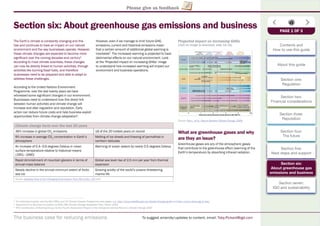
at the ‘Projected impact on increasing GHGs’ image
to understand how increased warming will impact our
environment and business operations.
Source: Parry , et al., Nature Reviews Climate Change, 2008
What are greenhouse gases and why
are they an issue?
Greenhouse gases are any of the atmospheric gases
that contribute to the greenhouse effect (warming of the
Earth’s temperature) by absorbing infrared radiation.
4
For historical analysis, see the Met Office and UK Climate Impacts Programme web pages, e.g. http://www.metoffice.gov.uk/climate-change/guide and http://www.ukcip.org.uk/faq/
5
Department for Business Innovation & Skills, BIS Climate Change Adaptation Plan, March 2010
6
IPCC Contribution of Working Group I to the Fourth Assessment Report of the Intergovernmental Panel on Climate Change 2007
Climate change facts over the last 20 years
36% increase in global CO2
emissions 18 of the 20 hottest years on record
9% increase in average CO2
concentration in Earth’s
atmosphere
Melting of ice sheets and thawing of permafrost in
northern latitudes
An increase of 0.4–0.6 degrees Celsius in mean
surface temperature relative to historical means
(1951–1990)
Warming of ocean waters by nearly 0.5 degrees Celsius
Rapid diminishment of mountain glaciers in terms of
annual mass balance
Global sea level rise of 2.5 mm per year from thermal
expansion
Steady decline in the annual minimum extent of Arctic
sea ice
Growing acidity of the world’s oceans threatening
marine life
Source: Keeping Track of Our Changing Environment: From Rio to Rio + 20 (pdf)
Projected impact on increasing GHGs
(click on image to download, slide 14/16) Contents and
How to use this guide
About this guide
Section one:
Regulation
Section two:
Financial considerations
Section three:
Reputation
Section four:
The future
Section five:
Next steps and support
Section six:
About greenhouse gas
emissions and business
Section seven:
IGD and sustainability
PAGE 1 OF 3
The business case for reducing emissions To suggest amends/updates to content, email: Toby.Pickard@igd.com
Please give us feedback
Section six: About greenhouse gas emissions and business
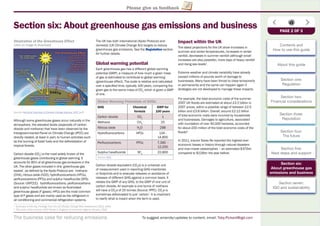
Source: Historical Overview of Climate Change Science, IPCC (pdf)
Although some greenhouse gases occur naturally in the
atmosphere, the elevated levels (especially of carbon
dioxide and methane) that have been observed by the
Intergovernmental Panel on Climate Change (IPCC) are
directly related, at least in part, to human activities such
as the burning of fossil fuels and the deforestation of
tropical forests.
Carbon dioxide (CO2
) is the most widely known of the
greenhouse gases contributing to global warming. It
accounts for 85% of all greenhouse gas emissions in the
UK. The other gases included in this ‘greenhouse gas
basket’, as defined by the Kyoto Protocol are: methane
(CH4), nitrous oxide (N2O), hydrofluorocarbons (HFCs),
perfluorocarbons (PFCs) and sulphur hexafluoride (SF6).
(Source: UNFCCC). hydrofluorocarbons, perfluorocarbons
and sulphur hexafluoride are known as fluorinated
greenhouse gases (F gases). HFCs are the most common
type of F gases and are mainly used as the refrigerant in
air conditioning and commercial refrigeration systems.
The UK has both international (Kyoto Protocol) and
domestic (UK Climate Change Act) targets to reduce
greenhouse gas emissions. See the Regulation section
for further details.
Global warming potential
Each greenhouse gas has a different global warming
potential (GWP), a measure of how much a given mass
of gas is estimated to contribute to global warming
(greenhouse effect). The scale is relative and calculated
over a specified time, typically 100 years, comparing the
given gas to the same mass of CO2
which is given a GWP
of one.
Carbon dioxide equivalent (CO2
e) is a universal unit
of measurement used in reporting GHG inventories
or footprints and to evaluate releases or avoidance of
releases of different GHG against a common basis. It
relates the GWP of any GHG, to the GWP of one unit of
carbon dioxide. An example is one tonne of methane
will have a CO2
e of 25 tonnes (Source: IPPC). CO2
e is
sometimes abbreviated to just ‘carbon’. It is important
to clarify what is meant when the term is used.
Impact within the UK
The latest projections for the UK show increases in
summer and winter temperatures, increases in winter
rainfall, decreases in summer rainfall (although small
increases are also possible), more days of heavy rainfall
and rising sea levels7
.
Extreme weather and climate variability have already
caused millions of pounds worth of damage to
businesses. Many have been forced to close temporarily
or permanently and the same can happen again if
strategies are not developed to manage these impacts.
For example, the total economic costs of the summer
2007 UK floods are estimated at about £3.2 billion in
2007 prices, within a possible range of between £2.5
billion and £3.8 billion. Overall, around £2.12 billion
of total economic costs were incurred by households
and businesses. Damages to agriculture, associated
with inundation of over 40,000 hectares, accounted
for about £50 million of the total economic costs of the
floods8
.
In 2011, insurer Swiss Re reported the highest ever
economic losses in history through natural disasters
and man-made catastrophes – an estimated $370bn
compared to $226bn the year before.
Illustration of the Greenhouse Effect
(click on image to download)
PAGE 2 OF 3
Global Warming Potentials of GHGs
GHG Chemical
formula
GWP for
100 years
Carbon dioxide CO2
1
Methane CH4
25
Nitrous oxide N2
O 298
Hydrofluorocarbons HFCs 124 -
14,800
Perfluorocarbons PFCs 7,390 -
12,200
Sulphur hexafluoride SF6
22,800
Source: IPCC
Contents and
How to use this guide
About this guide
Section one:
Regulation
Section two:
Financial considerations
Section three:
Reputation
Section four:
The future
Section five:
Next steps and support
Section six:
About greenhouse gas
emissions and business
Section seven:
IGD and sustainability
7
Summary of the Key Findings from the UK Climate Change Risk Assessment 2012, Defra
8
The costs of the summer 2007 floods in England, Environment Agency January, 2010
The business case for reducing emissions To suggest amends/updates to content, email: Toby.Pickard@igd.com
Please give us feedback
Section six: About greenhouse gas emissions and business
Greenhouse gas emissions and the
economy
Organisations will increasingly need to take
sustainability issues into the boardroom and factor them
into strategic business planning.
There is a need for an economy that is more
environmentally sustainable, that is more resilient to
significant changes to prices of fossil fuel and other
natural resources, and that is well placed to take
advantage of the massive business opportunities
presented by the global shift to a green, low-carbon,
resource-efficient economy.
There is a strong and growing case for moving an
organisation onto a more environmentally sound
trajectory, due to regulatory requirements, cost savings
and reputational issues.
Greenhouse gas emissions and the
food and grocery industry
According to Defra, the food and drink sector is
responsible for approximately 20% of the UK’s
greenhouse gas emissions. Energy savings in the sector
therefore have the potential to make a significant
positive impact on total UK emissions.
Many companies within the food sector have taken
steps to reduce their energy consumption, which,
combined with the switch from coal to gas generation
and/or renewable energy, means that significant
emissions reductions have been achieved. If the whole
industry applied similar measures to those of the best
companies, impressive GHG reductions will be achieved.
However, to go beyond that towards the reduction levels
that are required by the UK’s Climate Change Act, there
will need to be a systemic step change. Therefore, those
companies that can start reducing their emissions now,
will contribute positively to the UK’s carbon reduction
plans.
The risks and opportunities
organisations currently face
Despite climate change posing a ‘substantial’ risk to
major UK companies, fewer than half have contingency
plans in place. That is the conclusion of research by the
Carbon Disclosure Project (CDP), which conducted a poll
of UK FTSE 100.
The report found that while 80% of respondents
identified substantial risks to their business from
climate change, just 46% said they had plans in place
to protect against it. This highlights a real risk that
many organisations are facing, but also shows the real
opportunities available.
Risks and opportunities are strongly linked; many
new business risks can also be seen as opportunities
because there is a possibility of gaining competitive
advantage through better strategic planning.
Successful businesses will need to ensure they are
resilient to changes in climate, look at new technologies,
business models and production processes, use
resources and energy more efficiently and respond
to changing consumer demand. The transition to a
green economy will bring a range of advantages to an
organisation.
It can help organisations manage risks, such as those
from increasing and fluctuating fossil fuel prices
and increase resilience, to the impacts of climate
change and seize the opportunities from new and
emerging markets, both nationally and internationally.
Furthermore, organisations can save money through
increased energy and resource efficiency.
PAGE 3 OF 3
Did you know? The food industry accounts for
about 14% of energy consumption by UK businesses
and 7 million tonnes of carbon emissions per year.
Defra
“
“
The food system is a
significant producer
of greenhouse gases
and must contribute
to global mitigation
efforts; immediate
action on climate avoids
the necessity of more
radical measures in the
future.
The Future of Food and
Farming (pdf)g (p )
Contents and
How to use this guide
About this guide
Section one:
Regulation
Section two:
Financial considerations
Section three:
Reputation
Section four:
The future
Section five:
Next steps and support
Section six:
About greenhouse gas
emissions and business
Section seven:
IGD and sustainability
Did you know? United Biscuits reduced its group
wide carbon emissions by over 6%. In the UK energy
used per tonne of product was down over 8%. UB has
now reduced group wide energy use by a third since
1995.
The business case for reducing emissions To suggest amends/updates to content, email: Toby.Pickard@igd.com
Please give us feedback
Section seven: IGD and sustainability
IGD’s Policy Issues Council (PIC) is a forum of industry
leaders, broadly representative of IGD’s membership.
It brings together chairmen and chief executives from
the UK’s leading retailers, manufacturers, wholesalers,
foodservice businesses and producers to address
strategic challenges affecting the food and grocery
supply chain. Sustainability is a priority for the PIC and
IGD.
IGD’s Industry Sustainability Group (ISG) was
established in 2009 following consultation with IGD
members to help the food and grocery industry tackle
key sustainability issues. This builds on the recognition
of the need for the industry to adapt to a more resource-
constrained world through the development of insight
and good practice on sustainability issues.
This guide is the output from an ISG Working Group. The
Working Group was tasked with developing a guide to
help food and grocery businesses build sustainability
issues into their strategic plans, focusing on greenhouse
gases.
Companies that were part of the Working Group are
listed below:
Industry Working Group members
- Brakes
- Kerry Foods Ltd.
- Kraft
- Nestle
- Robert Wiseman & Sons Ltd.
- Tesco plc
- The Co-operative Group
- United Biscuits (UK) Ltd.
- Waitrose Ltd.
The guide was reviewed and critiqued by IGD’s ISG
and a selected group of individuals, to ensure that the
project delivered its objectives. ISG member companies
can be seen below:
Industry Sustainability Group (ISG)
member companies
- ASDA Stores Ltd.
- Bakkavor Group
- Booker Group plc
- Brakes Group
- Coca-Cola Enterprises Ltd.
- Compass Group plc
- Dairy Crest Group plc
- Greencore Group plc
- H J Heinz Co Ltd.
- Kerry Foods Ltd.
- Kimberly-Clark Ltd.
- Kraft Foods
- Marks & Spencer plc
- Musgrave Group
- National Farmers’ Union
- Nestle UK Ltd.
- PepsiCo UK & Ireland
- Robert Wiseman & Sons Ltd.
- Sainsbury’s
- Tesco plc
- The Co-operative Group
- United Biscuits (UK) Ltd.
- Watrose Ltd.
- Wm Morrison Supermarkets plc
IGD would like to thank the members of the Working
Group for all their support and help.
We would also like to thank members of IGD’s ISG,
along with the organisations and individuals that
reviewed the guide during its development.
Further information
IGD has further information on sustainability on its
sustainability website where you can access free
articles, factsheets and case studies on a wide range
of sustainability issues. Please visit the website via
the following link for more information: www.igd.com/
sustainability
PAGE 1 OF 1
Contents and
How to use this guide
About this guide
Section one:
Regulation
Section two:
Financial considerations
Section three:
Reputation
Section four:
The future
Section five:
Next steps and support
Section six:
About greenhouse gas
emissions and business
Section seven:
IGD and sustainability

The business case for reducing emissions

  • 1.
    The business casefor reducing emissions Helping businesses increase value through reducing greenhouse gas emissions click here to start >
  • 2.
    The business casefor reducing emissions To suggest amends/updates to content, email: Toby.Pickard@igd.com Please give us feedback Contents About this guide Section One: Regulation Section Two: Financial considerations Section Three: Reputation Section Four: The future Section Five: Next steps and support Section Six: About greenhouse gas emissions and business Section Seven: IGD and sustainability > > > > > > > > ©InstituteofGroceryDistribution2012. All intellectualpropertyrightsreserved. IGD is the trade mark of the Institute of Grocery Distribution. IGDauthorisesyouto: • Viewandprintoutthematerialforpersonaluse only • Extractsmallamountsoftext,tablesandcharts forinclusionwithininternalcompanydocuments forlimiteddistribution.IGDmustbereferredto asthesourceofinformationwhenthisoccurs Youarenotauthorisedto: • Sell,licenseordisposeofmaterialfor commercialoranyothergain • Alterthematerialinanyway Whilsteveryefforthasbeenmadetoensurethat theinformationcontainedinthispublicationis correct,neitherIGDnoranyofitsstaffshallbe liableforerrorsoromissionshowsoevercaused. Thispublicationisaguideonlyanddoesnot providespecificadviceonanyspecificissue. You mustseekyourownindependentlegaladviceor specialistadviceinallcases. Contents and How to use this guide About this guide Section one: Regulation Section two: Financial considerations Section three: Reputation Section four: The future Section five: Next steps and support Section six: About greenhouse gas emissions and business Section seven: IGD and sustainability How to use this guide The guide is an interactive PDF (iPDF). It will present itself in ‘full screen mode’. By pressing ‘Esc’ on your keyboard at any time you will return to a normal PDF screen where you can print copies/pages as required (please ensure that your printer options are set to landscape, and the appropriate print page size). The guide has been specifically designed to navigate you through three key drivers that relate to greenhouse gas management and reduction. To access external links, click on the words that are in blue text and underlined. Please ensure you are connected to the internet. There are also links within the guide itself. Words that are in bold and italic link to relevant areas within the guide to help you understand the interconnectivity of the issues and opportunities.
  • 3.
    The business casefor reducing emissions To suggest amends/updates to content, email: Toby.Pickard@igd.com Please give us feedback About this guide This guide has been developed by an IGD working group due to the success of the 2011 Environmental Sustainability Matrix. The guide has been created with the specific purpose of helping food and grocery businesses build sustainability issues into their strategic plans. Currently, sustainability issues do not significantly feature on a lot of companies’ corporate strategic plans. This is partly due to the difficulty in quantifying return on investment in sustainability initiatives, but also due to a limited understanding within some business functions of the significance of sustainability issues. This guide is designed to help businesses understand what they can do to reduce their greenhouse gas emissions, and communicates it in a way that will provide the business case for investment in greenhouse gas (GHG) reduction initiatives. The guide uses numerous best practice examples from industry and offers links to tools and further sources of information to help organisations reduce their GHG emissions. With the business case for sustainability only recently gaining traction, most of the best practice examples presented are from larger food and grocery businesses. However, there are examples from smaller progressive companies. All the examples highlight the direction of travel by industry and offer numerous opportunities for organisations to collaborate and learn from others within the industry to drive positive change. The guide focuses on three key drivers that organisations need to be aware of and address to help them reduce their GHG emissions and become a more environmentally sound business. The three key drivers are: • Regulation • Financial considerations • Reputation These drivers have different levels of importance. This is because regulation is something that organisations must comply to, whilst understanding and addressing the financial considerations and reputational issues concerned with reducing GHG emissions can be entirely based upon an organisation’s priorities and concerns. If you have best practice examples that you would like featured in this guide please submit them to: toby.pickard@igd.com Contents and How to use this guide About this guide Section one: Regulation Section two: Financial considerations Section three: Reputation Section four: The future Section five: Next steps and support Section six: About greenhouse gas emissions and business Section seven: IGD and sustainability Regulation As companies must comply with regulation this is the first section of the guide. Within this section there are links to relevant policies for industry, along with a list of practical tips to reduce emissions and a hierarchy of actions to reduce emissions. Did you know? The Carbon Reduction Commitment is expected to deliver carbon savings of 21 MtCO2 by 2027. Click here to find out more... Financial considerations The financial considerations section focuses on the cost savings that can be achieved through reducing emissions and energy use, and features case studies from industry. There is also a checklist and links to help businesses reduce energy use and therefore save money and emissions. Did you know? Marks and Spencer’s sustainability strategy has delivered a net benefit of £185m in its first 5 years. Click here to find out more... Reputation The third section and final driver is reputation. This section has examples of how companies have increased share price due to their sustainability credentials and improved staff retention. It also highlights some emerging issues that businesses need to be aware of to help improve their reputation, and subsequently enhance their share price, increase sales and build trust. Did you know? 83% of shoppers expect food and grocery companies to be constantly checking that their suppliers are acting responsibly towards the environment. Click here to find out more...
  • 4.
    The business casefor reducing emissions To suggest amends/updates to content, email: Toby.Pickard@igd.com Please give us feedback Section one: Regulation Regulation has been, and will remain, an important tool in encouraging organisations to develop greener products, services and operating procedures by offering a clear direction of travel and a level playing field. Over recent years, there has been an increase in the number of regulations introduced in the UK that are linked to, or are directly related to, greenhouse gas emission reductions that impact the food and grocery industry. The Green Economy Timeline, below, gives an overview of existing regulations and policies that are related to greenhouse gas reduction and it also highlights future policy. Once you have downloaded the above image, hover over the policies and regulations and a pop-up box will give you a brief description of the policy The plans laid out by the UK government and the European Union (EU) highlight that more stringent regulations will come into force over the coming years to help the UK reduce its emissions. A brief history of greenhouse gas emissions and climate change regulation The need to regulate for climate change was first recognised in the early 1990’s. In 1992, the Earth Summit in Rio de Janeiro created the United Nations Framework Convention on Climate Change (UNFCCC). Whilst this convention encouraged industrialised countries to stabilise greenhouse gas (GHG) emissions, it was recognised that a harder-hitting commitment was necessary. The Kyoto Protocol was therefore created in Kyoto, Japan in 1997, as a legally binding framework for 37 industrialised countries and the EU. It came into force in 2005 and amounts to an average reduction in GHGs of 5% vs. 1990 over the five year period between 2008-2012. Regulation brings a level playing field Organisations can benefit from the certainty that regulation offers. In some instances, such as energy efficiency linked to GHG reductions, regulatory compliance can also lead to significant cost savings. To understand more about the cost savings associated with reducing GHG emissions go to the Financial considerations section. The UK is in the vanguard of legislation for GHG reductions, and is the first country to introduce a long- term legally binding framework to tackle climate change. Many organisations from the food and grocery industry will be affected by more immediate regulations imposed by the UK government to help meet greenhouse gas reduction targets. Even if legislation on greenhouse gases does not affect your organisation, reducing your emissions can bring other benefits, such as lower energy bills and improving the way stakeholders view your business. You may also be able to take advantage of related tax breaks. Key regulations The major pieces of legislation associated with greenhouse gas reduction are listed below. The Climate Change Act 2008 creates a new approach to managing and responding to climate change in the UK by: - Setting ambitious, legally binding targets - Taking powers to help meet those targets - Strengthening the institutional framework - Enhancing the UK’s ability to adapt to the impact of climate change - Establishing clear and regular accountability to the UK Parliament and to the devolved legislatures. The UK is committed to reducing its emissions by at least 80% by 2050, relative to 1990 levels. This means there is a need to transform the UK economy while ensuring secure, low carbon energy supplies to 2050. Along with the Climate Change Act there are numerous other pieces of legislation that impact food and grocery businesses. Some of these can be seen on the next page. Green Economy Policy Timeline (click on image to download) PAGE 1 OF 4 Regulation is subject to change and alterations. For a full and up-to-date list of policy and legislation, please visit the Department of Energy & Climate Change and Defra. Contents and How to use this guide About this guide Section one: Regulation Section two: Financial considerations Section three: Reputation Section four: The future Section five: Next steps and support Section six: About greenhouse gas emissions and business Section seven: IGD and sustainability
  • 5.
    The business casefor reducing emissions To suggest amends/updates to content, email: Toby.Pickard@igd.com Please give us feedback Section one: Regulation The Climate Change Levy (CCL) is a tax on energy supplied to non-domestic premises. The levy forms part of the Climate Change Act and was introduced in April 2001 by Defra. The CCL is an energy tax that adds approximately 15% to typical energy bills in UK businesses. The aim of the levy is to encourage businesses to become more energy efficient and to reduce greenhouse gas emissions. There are related measures also designed to help companies become more energy efficient: - 100% first-year capital allowances on energy-saving investments - An exemption on CCL for energy generated from some renewable sources - An exemption from CCL for fuel input to “good quality” combined heat and power Click here for further details on the Climate Change Levy. The Carbon Reduction Commitment (CRC) is a mandatory UK-wide trading scheme covering large business and public sector organisations; these produce 12% of UK carbon emissions. Qualification for CRC is determined on the basis of half-hourly electricity supply. Click here for further details on the Carbon Reduction Commitment. The Energy Performance of Buildings Regulations require new builds and major refurbishments of buildings to meet the energy efficiency requirements of the Building Regulations. They also include mandatory inspection of air-conditioning systems every 5 years. Display Energy Certificates are required in buildings with a usable floor space of more than 1,000m2 that are occupied or part occupied by public authorities or institutions providing services to a large number of people who may visit the building. Click here for further details on the Energy Performance of Buildings Regulations. Fluorinated greenhouse gases The fluorinated greenhouse gases (F gases) are hydrofluorocarbons, perfluorocarbons and sulphur hexafluorides. F gases form part of the Kyoto Protocol’s ‘basket’ of greenhouse gases. Action to contain, prevent and reduce emissions of F gases is being taken by the EU as part of its obligations under the Kyoto Protocol. The UK and the EU are signatories to the protocol and the UK is therefore committed to reducing its emissions. In 2006, the EU introduced the EU F gas regulation. The obligations in this regulation are fleshed out by a number of European Commission regulations that provide extra detail and introduce minimum requirements which must be complied with. The EU framework has been fully implemented in Great Britain by the Fluorinated Greenhouse Gases Regulations 2009 (FGG Regulations 2009). Click here for further details on fluorinated greenhouse gases from the European Commission. Companies Act 2006 In addition, UK company law places some requirements on businesses to report environmental information. The Companies Act 2006 (section 417) requires that all companies, other than small companies, include a business review in their directors’ report. The purpose of the business review is to inform stakeholders of the company and help them assess how the directors have performed their duty to promote the success of the company. The business review should include a fair review of the company’s business and its principal risks and uncertainties. For a quoted company, the business review must include, amongst other things, information about environmental matters (including the impact of the company’s business on the environment) to the extent necessary for an understanding of the development, performance or position of the company’s business. Leading businesses to disclose emissions The UK Government has confirmed that companies listed on the London Stock Exchange will be required to report on their carbon emissions from 2013. The mandatory carbon reporting will require about 1,800 of the UK’s largest listed companies to report annually on their greenhouse gas emissions. “ “The CRC is expected to deliver carbon savings of 21 MtCO2 O by 2027.2 DECC PAGE 2 OF 4 Contents and How to use this guide About this guide Section one: Regulation Section two: Financial considerations Section three: Reputation Section four: The future Section five: Next steps and support Section six: About greenhouse gas emissions and business Section seven: IGD and sustainability Regulation is subject to change and alterations. For a full and up-to-date list of policy and legislation please visit the Department of Energy & Climate Change and Defra.
  • 6.
    The business casefor reducing emissions To suggest amends/updates to content, email: Toby.Pickard@igd.com Please give us feedback Section one: Regulation The hierarchy of actions to reduce greenhouse gas emissions The Department for Energy and Climate Change has created a hierarchy of actions to combat the effects of climate change related to GHG emissions. The public, businesses and the public sector are all urged to take action on their carbon footprint in the following order: Organisations are recommended to follow the hierarchy of actions to reduce greenhouse gas emissions, and only use offsetting where emissions are currently unavoidable. How to check the quality of offset products? The UK Government recommends organisations look for offset providers that meet the following criteria to help choose good quality offsets. Providers should: - Calculate an organisation’s emissions accurately - Deliver credits within a year of an organisation buying them - Declare clearly how much the credits cost per tonne - Provide information about the role of offsetting in tackling climate change and advice on how to reduce an organisation’s carbon footprint The Government’s Quality Assurance Scheme for carbon offsetting ran from February 2009 to June 2011. The scheme is now closed. Archived pages from the Quality Assurance Scheme are available here. Further information, advice and support to help organisations to reduce their emissions is available through Business Link and the Carbon Trust who provide a range of public-funded services such as free web support, helplines and events. Source: DECC PAGE 3 OF 4 Contents and How to use this guide About this guide Section one: Regulation Section two: Financial considerations Section three: Reputation Section four: The future Section five: Next steps and support Section six: About greenhouse gas emissions and business Section seven: IGD and sustainability
  • 7.
    The business casefor reducing emissions To suggest amends/updates to content, email: Toby.Pickard@igd.com Please give us feedback Section one: Regulation Below is a list of practical tips to help organisations ensure they are reducing their emissions. - Has the organisation measured its greenhouse gas (GHG) emissions? - Does the company have a GHG management reduction policy? - Is someone accountable for GHG compliance? - Has the company looked at implementing an Environmental Management System? - Do GHG reduction Key Performance Indicators (KPI) exist in the organisation? - Where is the highest level of direct responsibility for climate change within the company? - Are GHG reduction KPIs reported at Board level? - Does the company provide incentives for the management of climate change issues, including the attainment of targets? - Do GHG plans get reviewed regularly? - How is GHG compliance supported in the business? - Is climate change and GHG reduction integrated into the business strategy? - Have any climate change risks been identified (current or future) that have the potential to generate a substantive change in the business operations, revenue or expenditure? - Have climate change opportunities been identified (current or future) that have the potential to generate a substantive change in business operations, revenue or expenditure? - Does the company engage with policy makers to encourage further action on mitigation and/or adaptation? - Has the organisation considered application for the Carbon Trust Standard? - Are the company’s greenhouse gas emissions diclosed through the Carbon Disclosure Project? - Has the organisation considered working with its trading partners to reduce GHG emissions outside of its direct control? Some useful tools and guides Defra, in partnership with the Department for Energy and Climate Change (DECC), provides guidance for businesses and organisations on how to measure and report their GHG emissions: - Guidance on how to measure and report your greenhouse gas emissions (pdf) - Small Business User Guide: Guidance on how to measure and report your greenhouse gas emissions (pdf) The reports explain how organisations can measure and report their GHG emissions as well as set targets to reduce them. The reports are aimed at all sizes of businesses as well as public and third sector organisations. Defra has also created guidelines to help: - Give clear guidance to companies on how to report on their environmental performance using environmental Key Performance Indicators (KPIs) - Define which KPIs are most relevant to which sectors, and - Set out the business rationale for managing environmental performance using KPIs. Access the report here: Environmental Key Performance Indicators Reporting Guidelines for UK Business (pdf) PAGE 4 OF 4 Did you know? Walmart’s energy and fuel efficiency initiatives - launched in 2005 - saves the retailer more than $500m a year. Contents and How to use this guide About this guide Section one: Regulation Section two: Financial considerations Section three: Reputation Section four: The future Section five: Next steps and support Section six: About greenhouse gas emissions and business Section seven: IGD and sustainability Did you know? Morrisons Kidderminster store became the first UK supermarket to achieve an ‘excellent’ BREEAM rating for its environmental performance. Did you know? Robert Wiseman Dairies has a certified Environmental Management System to ISO 14401, which reduces the cost of its Pollution Prevention and Control permits and helps it identify potential risks that could end up costing it financially and reputationally.
  • 8.
    The business casefor reducing emissions To suggest amends/updates to content, email: Toby.Pickard@igd.com Please give us feedback Section two: Financial considerations Greenhouse gas (GHG) emissions are likely to have financial implications for all organisations in the grocery industry. Legislation brings taxation, restrictions on activities with associated costs, and even fines. Companies that do not reduce their emissions of GHGs could find taxation and other duties to governments increasing, and may find their activities are restricted. Reducing GHG emissions can result in cost savings, as energy bills are reduced. While reducing energy use through better working practices and energy efficiency investments generally have quick payback, there may be costs associated with achieving more stretching GHG emissions reduction targets. Reducing GHG emissions from sources not associated with energy, such as refrigerants and agricultural husbandry systems, may be complex and carry costs that are less easy to justify with conventional financial analysis. The risk of not acting Despite climate change posing a ‘substantial’ risk to the UK, fewer than half of the UK’s major companies have contingency plans to deal with climate change. That is the conclusion of research by the Carbon Disclosure Project (CDP), which conducted a poll of UK FTSE 100 companies as part of its Insight into Climate Change Adaptation by UK companies. However, the report concludes that for businesses, risks and opportunities are strongly linked, adding that many new business risks can also be seen as opportunities because there is a possibility of gaining competitive advantage through better strategic planning. Investors and shareholders are being called upon to keep pressure on their business interests, in a bid to adapt to climate change and sustain long-term growth. The former Environment Minister Lord Taylor has been reported as saying: ‘Investors that want to keep share prices high must stress the need for action to prepare for climate change. They can provide an incentive to businesses to not only consider the long-term risks of climate change, but also the opportunities that can be grasped now.’ The UK Government estimates that it will cost approximately £25-29bn to deliver the carbon reductions that are necessary. However, it insists that the cost is far lower than the cost of no action. This has been addressed by Lord Stern in the Stern Review, and subsequently acknowledged by the food and grocery industry. 80% of directly responding FTSE 100 companies identify substantive risks to their business as a result of climate change. Insights into Climateg Change Adaptation byg p y UK Companies, Carbonp , Disclosure Projectj (pdf)t “ “ 80% is the potential value uplift for a company proactively addressing climate change opportunities. Carbon Trust (pdf)t For every £2 we spend now on tackling climate change, we are saving future generations anywhere between £5 and £20 at today’s value. Sir Terry Leahy, Januaryy y, y 2009 The UK’s annual energy spend is £23,645 million and most businesses could save 10% off their energy bills through no or relatively low cost measures. Carbon Trust (pdf)t Did you know? In 2012, Unilever claimed that there was a 68% increase in their share price following the launch of its Sustainable Living Plan. PAGE 1 OF 4 Did you know? Marks and Spencer’s sustainability strategy, Plan A, has delivered a net benefit of £185m in its first five years. Contents and How to use this guide About this guide Section one: Regulation Section two: Financial considerations Section three: Reputation Section four: The future Section five: Next steps and support Section six: About greenhouse gas emissions and business Section seven: IGD and sustainability
  • 9.
    The business casefor reducing emissions To suggest amends/updates to content, email: Toby.Pickard@igd.com Please give us feedback Section two: Financial considerations Tax breaks to encourage energy efficiency Tax breaks are on offer as an incentive to encourage organisations to adopt certain environmentally responsible practices. For example: - Using sources of energy that have less environmental impact can make organisations eligible for a reduction in the climate change levy - Organisations can benefit from investing in energy saving plant and machinery through tax breaks called enhanced capital allowances (ECAs) Click here for a guide on enhanced capital allowances for energy saving products - Organisations can also use ECAs for investing in company cars that have low CO2 emissions Click here for a guide on first year allowances: the basics - Organisations that frequently travel in and out of the congestion charging zone in London may be eligible for a discount if vehicles use alternative fuels Click here for a guide on reducing your vehicle emissions Key issues Commercial activities that create greenhouse gas emissions are targeted through Government schemes to restrict overall emissions through the issuing of quotas, and through taxing emissions. Most activities creating GHG emissions in the grocery industry are associated with the generation of energy from fossil fuels. These may be directly emitted from a company’s premises or vehicles through the use of oil, petrol or gas, or indirectly through the use of electricity. There is therefore a link between an enterprise’s energy and fuel bill, and its greenhouse gas emissions. If possible, switching to lower global warming potential fossil fuels (e.g. gas), could have a significant reduction of GHG emissions. There may be a financial cost associated with such moves, but this could be reduced if a carbon floor price is introduced in the UK or if an organisation is captured under the CRC Energy Efficiency Scheme. For parts of the grocery industry, the use of refrigerants has a significant impact on the emission of GHGs. Refrigeration is the largest source of GHGs in any supermarket through both the energy required to power them and the refrigerants themselves. Many refrigerants have very high global warming potential if released into the atmosphere. Replacing these refrigerant gases with more benign alternatives is costly, but can have significant environmental benefits. Parts of the grocery industry’s upstream activities such as agriculture or petrochemical processing create significant GHGs. These would not be captured by any current legislation and are not subject to quotas or taxation, but they are captured by lifecycle analysis and carbon footprinting, and stakeholders may choose to reject products that have higher carbon footprints. Similarly waste food products create GHGs as they decompose, particularly methane if they are sent to landfill. Increasing landfill taxes are causing companies to deal with waste at source. Measures Financial considerations will be measured in terms of: - Increased costs – taxation or investment - Reduced costs – from reducing energy or other input use - Revenues – which could increase or decrease, according to the outcome of actions taken Reduction/Improving Reducing the impact of taxation and quotas on GHG emissions is clearly best addressed by reducing the quantity of emissions. Significant financial savings can be made through reducing the use of fossil fuels and can be achieved through many means – the Carbon Trust estimates that businesses in the UK waste some 10-20% of the energy they buy due to poor control of heating, air conditioning and ventilation and through leaving lights and appliances on when not in use. Did you know? Adnams invested in a new more efficient distribution centre which resulted in it using 58% less gas and 67% less electricity per square metre. The energy efficiencies save Adnams £50,000 per annum. BitC PAGE 2 OF 4 Contents and How to use this guide About this guide Section one: Regulation Section two: Financial considerations Section three: Reputation Section four: The future Section five: Next steps and support Section six: About greenhouse gas emissions and business Section seven: IGD and sustainability Did you know? Sainsbury’s estimates that if all UK supermarkets converted to CO2 refrigeration, the UK’s carbon emissions would immediately drop by 2 million tonnes per year. Did you know? Robert Wiseman Dairies utilised the enhanced capital allowance Scheme to install two new low lose, energy efficient transformers at its East Kilbride processing facility saving 353 tonnes of CO2 per annum.
  • 10.
    The business casefor reducing emissions To suggest amends/updates to content, email: Toby.Pickard@igd.com Please give us feedback Section two: Financial considerations Over a longer timescale, investments in alternative sources of power to generate electricity such as wind turbines, photovoltaic cells or bio-digesters could both reduce greenhouse gas emissions and save money. However, the longer payback period for such investments may put them beyond the means of many companies. Challenges Replacing HFC refrigerant gases with more benign alternatives is a legal requirement, but these are more expensive and less efficient so create a cost. Increasing vigilance over leakage from refrigerant systems is essential if cost control is to accompany GHG reductions due to refrigerant gases. Upstream GHG emissions that contribute to a product’s carbon footprint are most likely to impact companies financially if their customers (retailers or consumers) start to ‘choice edit’ higher carbon footprint products out of their shopping baskets. However, the practicality of accurately measuring upstream emissions is challenging, particularly from a global supply base where raw materials are sourced from different regions, using different agricultural systems, at different times of the year or due to changing world markets. Where opportunities do exist to reduce GHG emissions from specific agricultural systems (e.g. soil tillage, rainforest destruction, animal diet) there are likely to be many considerations including cost, and human and animal welfare, that prove challenging. Evaluating the costs and benefits of reducing GHG emissions in the upstream supply chain is probably one of the greatest environmental challenges to the food and grocery industry. Reducing GHGs resulting downstream, from decomposition of food waste by consumers should result in cost savings, as overall input costs reduce and landfill taxes are avoided. However, there will be costs associated with developing the systems and processes required to reduce waste, and could potentially reduce sales for various organisations in the supply chain as their customers purchase less. Unintended consequences Understanding the true impact of GHG reduction measures can be complex, and ensuring there is a net benefit often requires costly lifecycle assessment work. Ostensibly beneficial reduction measures, such as limiting the use of air freight, do not always give the desired outcome. For example, a product lifecycle assessment of roses found that flowers air freighted from Kenya have a lower carbon footprint than roses from Holland1 transported by sea, due to the large amounts of energy consumed by hothouses in Holland. Similarly, packaging changes that are beneficial to retailers may not always result in an emissions reduction over the lifecycle of the product if, for instance, recyclability is compromised. Below is a checklist to help organisations ensure cost savings can be achieved and greenhouse gas production reduced. Energy/GHG Saving - What is the organisation’s energy costs? - Where does the organisation waste energy? - What energy-saving measures could be introduced? - How many staff are aware of the ways in which they can save energy? - Are colleagues aware of basic energy-saving measures? - Has the organisation considered sourcing energy from renewable sources? - Has the organisation considered investing in onsite renewable energy? Did you know? Mornflake Cereals has commissioned one of Europe’s largest wind turbines which has reduced costs for the business and cut its CO2 emissions by over 4,000 tonnes a year. Did you know? 97% of Waitrose’s energy comes from renewable sources. PAGE 3 OF 4 Did you know? Tesco is working to cut emissions from its own operations and through numerous initiatives within stores and distribution. It has made savings of over £200m in its energy bills. Did you know? Asda’s sustainability strategy is set to deliver £800m in savings by 2020. Contents and How to use this guide About this guide Section one: Regulation Section two: Financial considerations Section three: Reputation Section four: The future Section five: Next steps and support Section six: About greenhouse gas emissions and business Section seven: IGD and sustainability Did you know? Brakes Group donated over 1 million meal equivalents of in date food waste to charity in 2011, diverting 420 tonnes away from landfill. Did you know? Kraft Foods has saved energy and carbon through efficient generation and reuse of heat. 1 Comparative Study of Cut Roses for the British Market Produced in Kenya and the Netherlands http://www.fairflowers.de/fileadmin/flp.de/Redaktion/Dokumente/Studien/Comparative_Study_of_Cut_Roses_Feb_2007.pdf
  • 11.
    The business casefor reducing emissions To suggest amends/updates to content, email: Toby.Pickard@igd.com Please give us feedback Section two: Financial considerations Heating - Are there staff complaints about the temperature? - Have heaters/boilers been serviced in the last 12 months? - Are portable heaters being used? - Are heaters and air conditioning units operating in the same space? - If hot water is provided, is it being wasted (such as dripping taps, or leaking urns)? - Do all areas have the same heating requirements? - Are room thermostats working and set to the correct temperature? - Are the timers working and on the correct settings? - Are other heating controls working and on the correct settings? - Are there obstructions in front of radiators or heaters? - How are extractor fans controlled (e.g. in toilets)? - Are windows and doors open when heating or air conditioning is on? - Are there any cold draughts coming from windows or doors? Lighting - Are lights switched off (if daylight sufficient/room not in use)? - Are any old, large diameter (1.5 inches) fluorescent tubes still in use? - Are lamps, fittings and roof lights clean? - Are traditional tungsten light bulbs still in use? - Are light switches arranged conveniently and labelled? - Is exterior lighting switched off when not needed? In the office - Have computers got built-in energy saving features — and are they activated? - Are computers left on overnight? - Are monitors and fans switched off when not in use? - Are photocopiers located in air conditioned areas? - Are printers and photocopiers left on overnight/at weekends? - Are vending machines/water coolers left on all the time? In the factory/warehouse - Are pumps/fans/compressed air switched off when the equipment they serve is not in use? - Are there compressed air leaks? - Are refrigeration units being run efficiently? - Are there energy/GHG reduction champions? Source: Carbon Trust For further information and advice visit: Carbon Trust Empower - Empowering employees to reduce carbon emissions Heating costs rise by about 8% for every 1°C of overheating Green your business fory growthg “ “ Lighting in a typical office costs about £3.75/m2 annually, but2 in the most efficient office only costs about £1.00/m2 Green your business fory growthg Did you know? All Marks and Spencer directors have a sustainability target as part of their annual bonus objective. PAGE 4 OF 4 Contents and How to use this guide About this guide Section one: Regulation Section two: Financial considerations Section three: Reputation Section four: The future Section five: Next steps and support Section six: About greenhouse gas emissions and business Section seven: IGD and sustainability Did you know? Morrisons campaign ‘Switching On to Switching Off’ trained over 110,000 colleagues in energy awareness, saving over 24,734 tonnes of carbon emissions and £3.28m in energy costs.
  • 12.
    The business casefor reducing emissions To suggest amends/updates to content, email: Toby.Pickard@igd.com Please give us feedback Section three: Reputation Reputation and trust are extremely important to companies. A good reputation can enhance the share price, increase sales and build trust in an organisation and brand. Increasingly, more companies are being scrutinised by third party organisations, trading partners and other stakeholders about their green credentials and how they operate. Over the years, there has been an increase in the number of indexes and surveys that have ranked and critiqued organisations on their sustainability performance. The result of which has impacted companies’ reputations both postively and negatively. This has meant that companies really need to understand their own impacts and look at ways of reducing them, or run the risk of becoming targeted and having their reputation tarnished - potentially not only losing trust but also business. It is important for organisations to understand how their greenhouse gas reduction initiatives are perceived by stakeholders and how this differs from actual performance. Organisations could be perceived to be doing well while in fact they are not, or vice-versa; this could leave an organisation open to potential threat. More recently, there has been a monumental shift in how companies can be named and shamed. Sites like WikiLeaks and social media platforms like Facebook and Twitter are holding companies to account and are enabling disgruntled employees, customers or suppliers to broadcast their frustrations to the world, with potentially devastating consequences. The barriers between brands and stakeholders have crumbled with the increased use of social media. The growing power of non- government organisations Non-government organisations (NGO) have become significant drivers for change over recent years. Their focus has predominately been on large companies with poor reputations. However, this is starting to change. With the increase in technology and social media, NGOs are finding it far easier to target more companies and gain significant traction with their campaigns. This presents a real risk to companies that aren’t addressing issues or are not willing to work with NGOs. A good reputation can take years to develop but can be lost very quickly. Know your suppliers The reputation of companies can be adversely affected by their suppliers. This growing trend is likely to make companies very cautious in selecting suppliers and a poor reputation or apparent poor performance may reduce the likelihood of winning contracts. Greenhouse gas emissions and reputation Greenhouse gas management is becoming business critical. Research has shown that leading companies are delisting suppliers who fail to manage greenhouse gases. Many retailers and manufacturers are measuring the greenhouse gas impact of their operations, and are looking to their suppliers to measure and manage their own emissions. Industry is also being scrutinised by non-government organisations to reduce emissions and become more environmentally aware. Based on surveys by McKinsey and the UN Global Compact led by Accenture, as well as research by the Boston Consulting Group, there is a strengthening case for industry to take reputation and trust as a serious issue when it comes to reducing greenhouse gases. 79% of consumer goods CEOs cite ‘brand, trust and reputation’ as one of the top three factors driving them to take action on sustainability issues. New Era of Sustainability iny Consumer Goods (pdf)s “ “ 83% of shoppers expect food and grocery companies to be constantly checking that their suppliers are acting responsibly towards the environment. IGD, ShopperVista, pp PAGE 1 OF 3 Contents and How to use this guide About this guide Section one: Regulation Section two: Financial considerations Section three: Reputation Section four: The future Section five: Next steps and support Section six: About greenhouse gas emissions and business Section seven: IGD and sustainability
  • 13.
    The business casefor reducing emissions To suggest amends/updates to content, email: Toby.Pickard@igd.com Please give us feedback Section three: Reputation Complacency can be seductive The reputation argument has a clear downside compared to regulation and financial considerations as it is hard to measure; without a crisis, complacency can be seductive. However, with the world becoming more interconnected through technologies and consumers expecting more from industry, organisations that don’t understand the reputational issues of greenhouse gas reduction could find themselves exposed to negative media and consumer campaigns or boycotts. Key issues The impact of GHGs on climate change is one of the most widely publicised environmental sustainability issues. Businesses therefore need to ensure that their reputation is not damaged by poor environmental strategies, lack of awareness of their impacts (direct and indirect) or by mishandling the communication of their strategies. Examples of issues associated with a poor reputation in GHG management are as follows: Non-government organisation (NGO) focus The reputation of a business can be undermined by a disproportionate focus on a specific area by a pressure group or NGO. Information on business activities can be quickly communicated via social media and action can be coordinated in a way that would previously have taken far longer. Photos and videos can be uploaded on to the web in minutes and many businesses have found themselves targeted by groups via social networks. Issues raised via networking sites can be picked up by mainstream media very easily and quickly. Organisations can monitor activity on social network sites, either informally or via specific tools applied by media agencies, to help address any potential issues. Some NGOs will have their own websites, which can be monitored for positive and/or negative stories. Press cutting services exist that can also help identify media coverage on specific topics. Media stories can be monitored and reported on for their positive/negative tone through services like Google Alerts. Investor confidence Existing investors need to know that the business is not at risk of negative publicity arising from inadequate management of the supply chain and a resultant increase in GHG emissions. Environmental management, including the management of GHGs, is one of the measures that investors will look for when evaluating future investments. Shareholders will have more confidence in a business with a good environmental reputation that can be demonstrated by quantified measures. The most tangible measure of overall investor confidence is the share price of publicly listed businesses. How much of the price is driven by the management of GHGs is harder to quantify. Other measures will include the amount of funding that is made available by investors for energy-saving technology, for example in more efficient baking or heating processes during the manufacturing of products. Did you know? In 2012, Unilever claimed that there was a 68% increase in their share price following the launch of its Sustainable Living Plan.68% of shoppers would be unhappy if they found out that the food and grocery products they choose to buy have a poor environmental record. IGD, ShopperVista, pp “ “ PAGE 2 OF 3 Contents and How to use this guide About this guide Section one: Regulation Section two: Financial considerations Section three: Reputation Section four: The future Section five: Next steps and support Section six: About greenhouse gas emissions and business Section seven: IGD and sustainability 63% of global, socially-conscious consumers are under the of age 40, and they consult social media when making purchase decisions. They are most concerned about environmental, educational and hunger. The Global, Social-Conscious, Consumer Report, 2012p , . (pdf) “ “
  • 14.
    The business casefor reducing emissions To suggest amends/updates to content, email: Toby.Pickard@igd.com Please give us feedback Section three: Reputation Customer and consumer confidence Retailers and manufacturers must ensure that consumers trust the brands they buy. Trust can be undermined by concerns about the way in which a product is manufactured or where ingredients come from. For example, the use of ingredients that have caused deforestation will have a negative impact on brand reputation. On the contrary, some initiatives can enhance reputation; a reduction in food waste sent to landfill will have a positive impact on business or brand reputation. Brands that engage consumers in their sustainability credentials are more likely to build long-term trust. This translates into a stronger commercial performance and a more sustainable market share. Tangible measures of consumer confidence are sales growth and market share. Companies can include questions about their environmental credentials in regular brand tracking questionnaires. This will allow organisations to identify if their environmental performance is perceived to be improving. Employee recruitment and retention Employees are more likely to want to work for a business with a good sustainability reputation. Studies have shown that recruitment of higher calibre individuals and improved retention can be achieved through having a positive reputation. Employees may be prepared to accept a lower salary to work for a business that fits with their ideals. Success in this area can be measured by employee turnover, the number of unfilled vacancies as well as via internal questionnaires and exit interviews that measure the views of employees on an organisation’s environmental credentials. Below is a list of organisations and indexes that benchmark organisations on sustainability credentials. It may be worth considering entering into the awards or at least understanding their criteria for success to help improve reputation? - Interbrand Best Green Brand - Goodbrand Social Equity Index - WPP Top Green Brands Index - BitC Corporate Responsibility Index - FTSE4Good Index - Dow Jones Sustainability Index - The Times Green Company awards - IGD FIA Awards - BusinessGreen Leaders Awards - Green Retailer of the Year - Green Supplier of the Year - Green Wholesaler of the Year - Guardian Green Business Awards - Carbon Disclosure Project - International Green Awards 79% of CFOs believe ESG [environmental, social, governance] programmes add value to the business by maintaining good corporate reputation and/or brand equity. McKinsey Global Survey ofy y CFOs: Valuing corporate socialg p responsibility.p y “ “ The Co-operative Group report that its ethical policy has positively impacted customer attrition. 88% of The Co-operative Food’s customers believe that its ethical policy made the business more appealing. BitC Did you know? Marks & Spencer claim that candidates often mention Plan A as a reason why they want to work for them, and their employee survey confirms that Plan A contributes to job satisfaction. Did you know? Over half of the student population (58%) would take a 15% pay cut to “work for an organisation whose values are like my own“ Talent Report: What workers want in 2012 (pdf) PAGE 3 OF 3 Contents and How to use this guide About this guide Section one: Regulation Section two: Financial considerations Section three: Reputation Section four: The future Section five: Next steps and support Section six: About greenhouse gas emissions and business Section seven: IGD and sustainability Did you know? United Biscuits achieved Platinum status for the second year running in Business in the Community’s Corporate Responsibility (CR) Index 2011.
  • 15.
    The business casefor reducing emissions To suggest amends/updates to content, email: Toby.Pickard@igd.com Please give us feedback Section four: The future Like any assessment of the future, projections of the future impacts of climate change will always be uncertain. This is in part due to uncertainty over the level of future greenhouse gas emissions, but also due to limited understanding of some aspects of climate change, and to the extent to which we are able to represent a system as complex as the climate system in climate models. However, this uncertainty over the future is not something which should paralyse decision-making. Looking back to predict the future Scientific evidence suggests that our climate is changing, mainly as a result of human activity. Over the course of the last century, global average temperature increased by 0.74°C2 . Each of the last three decades has, on average, been warmer than the previous, and each has set a new record; with the 2000s the warmest decade of all3 . Continuing this warming trend has profound implications for our societies and economies. Since the industrial revolution, through the burning of fossil fuels, agricultural practices and land use changes, the levels of greenhouse gases in the earth’s atmosphere have risen. Locked into a challenging future We are already committed to a certain amount of climate change. Even if global greenhouse gas emissions were to dramatically reduce tomorrow the warming trend will continue for several decades as the climate system slowly responds to past and current emissions. The growing risk At the beginning of 2012, Defra published the UK’s first Climate Change Risk Assessment (pdf). This report looks at risks posed by climate change across UK regions and sectors out to the end of this century, identifying key risks – in the absence of any action – to the increased chance of flooding, water scarcity and threats to wildlife; and establishing that, while warmer winters may reduce cold-related deaths, hotter summers are likely to increase health risks. For the majority of the risks identified, the severity of impact increases with time in scenarios where emissions are not constrained. However, the report did also suggest that there may be opportunities; for example, for businesses to make the most of potential services related to climate change adaptation. However, the net effect of climate change for the UK is thought to be negative, if no action is taken. The implication With climate change having a net negative impact on the UK, it is very likely that regulation around greenhouse gas emissions will become stricter. Greenhouse gas emissions are linked to fossil fuel energy production, and with energy prices expected to rise, companies would benefit financially, if they can reduce greenhouse gas emissions. The benefit will be even greater if a carbon floor price is introduced. It is very likely that more drivers to reduce greenhouse gas emissions will emerge than those addressed in this guide. Therefore organisations would be wise to start understanding their own risks and the risks that impact their suppliers and customers so that they can take steps to future-proof their organisation against the challenges that they face in reducing greenhouse gas emissions and climate change. 2 Trenberth, K. E., Jones, P. D., Ambenje, P., Bojariu, R., Easterling, D., Klein Tank, A., Parker, D., Rahimzadeh, F., Renwick, J. A., Rusticucci, M., Soden, B. & Zhai, P. (2007) Observations: Surface and Atmospheric Climate Change In: Climate Change 2007: The Physical Science Basis. Contribution of Working Group I to the Fourth Assessment Report of the Intergovernmental Panel on Climate Change Cambridge University Press 3 Arndt, D. S., Baringer, M. O. and Johnson, M. R. Eds. (2010) State of the Climate in 2009. Bull. Amer.Meteor. Soc., 91 (7), S1–S224 The uncertainty is not whether the world will experience climate change but how its impacts will be felt. Future risk: Climate change andg energy securitygy y (pdf)y “ “ Rising temperatures will affect weatherandprecipitation patterns,sealevelwillrise, heatwaveswillincrease,andthere isthe potentialforanincreasein extreme events, such as droughts, flooding and storm surges. Future risk: Climate change andg energy securitygy y (pdf) Energy prices are projected to rise and become more volatile. The Future of Food and Farmingg (pdf) Policies for climate change mitigation will also have a very significant effect on the food system – the challenge of feeding a larger global population must be met while delivering a steep reduction in greenhouse gas emissions. The Future of Food and Farmingg (pdf) PAGE 1 OF 1 Contents and How to use this guide About this guide Section one: Regulation Section two: Financial considerations Section three: Reputation Section four: The future Section five: Next steps and support Section six: About greenhouse gas emissions and business Section seven: IGD and sustainability
  • 16.
    The business casefor reducing emissions To suggest amends/updates to content, email: Toby.Pickard@igd.com Please give us feedback Section five: Next steps and support It is inevitable that companies will be at different stages on this journey. This guide therefore offers a breadth of information and advice, from the very simple and practical, to the more complex. Businesses that need more detail on particular themes are urged to follow the links to sources of further information and use the following tools and resources. Department for Environment, Food and Rural Affairs Defra takes the lead on adaptation to climate change in the UK. The Adapting to Climate Change team has a web site, which provides a useful overview of climate change adaptation and outlines the Government’s approach for developing policy in this area. Note that adaptation is a devolved issue, and the devolved administrations are developing their own programmes. www.defra.gov.uk www.doeni.gov.uk www.scotland.gov.uk www.wales.gov.uk Information and reports to help organisations measure and report environmental impacts can be accessed here: http://www.defra.gov.uk/environment/economy/ business-efficiency/reporting/ The contribution that reporting of greenhouse gas emissions makes to the UK meeting its climate change objectives report can be accessed here: http://www.official-documents.gov.uk/document/ other/9780102969283/9780102969283.pdf (pdf) Department for Energy and Climate Change The Department was created in 2008, bringing together the Government’s climate change and energy policy areas. It leads on work to reduce greenhouse gas emissions and also on international adaptation initiatives. www.decc.gov.uk Carbon Trust The Carbon Trust is an organisation helping businesses, governments and the public sector to accelerate the move to a low carbon economy through carbon reduction, energy-saving strategies and commercialising low carbon technologies. http://www.carbontrust.com/home Carbon Trust SME Network Join the Carbon Trust’s free online community designed to help SMEs share knowledge and best practice with each other regarding saving energy, cutting carbon and reducing costs. http://smenetwork.carbontrust.com/ Carbon Disclosure Project The Carbon Disclosure Project (CDP) is an independent not-for-profit organisation working to drive greenhouse gas emissions reduction. https://www.cdproject.net/ en-US/Pages/HomePage.aspx Report: “Insights into Climate Change Adaptation by UK companies” (PDF 2MB) uses data disclosed to Carbon Disclosure Project by FTSE 100 companies in response to shareholder requests for insights into business attitudes and actions. BACLIAT (Business Areas Climate Impacts Assessment Tool) BACLIAT is a simple tool aimed at helping organisations scope the impacts of climate change. It uses six headings representing generic business areas (markets, process, people, premises, logistics and finance) to encourage the identification of a comprehensive list of potential threats and opportunities from climate change. It is primarily aimed at use in a workshop setting, but has also found application in research projects and the development of climate audits. BACLIAT was developed in collaboration several of UKCIP’s business stakeholders, representing a range of sectors. www.ukcip.org.uk/bacliat UKCIP Adaptation Wizard The UKCIP Adaptation Wizard is an online tool to help you adapt to climate change. It is based on the Environment Agency and UKCIP report: Willows R.I., Connell, R.K. (2003) Climate adaptation: Risk, uncertainty and decision-making. It will take you through a 5-step process that will help you to develop a climate change adaptation strategy. www.ukcip.org.uk/wizard UK Climate Projections (UKCP09) The UK Climate Projections provides probabilistic information on expected changes in the UK’s climate at a regional level throughout the 21st century. The UKCP09 package also includes a Weather Generator, which will enable users to estimate the increasing (or decreasing) frequency of specific weather types, such as heatwaves or heavy downpours of rain. It is available through an online facility, enabling users to access the information at different levels of detail and customise it for their purposes. http://ukclimateprojections.defra.gov.uk PAGE 1 OF 2 Contents and How to use this guide About this guide Section one: Regulation Section two: Financial considerations Section three: Reputation Section four: The future Section five: Next steps and support Section six: About greenhouse gas emissions and business Section seven: IGD and sustainability
  • 17.
    The business casefor reducing emissions To suggest amends/updates to content, email: Toby.Pickard@igd.com Please give us feedback Section five: Next steps and support CLARA (Climate Adaptation Resource for Advisors) A web-based resource aimed at those providing advice and support to SMEs. Advice is provided on making the business case and some practical tips for providing appropriate support, including delivery resources. www.ukcip.org.uk/clara Climate change partnerships in the UK The English regions and the devolved administrations all now have climate change impact partnerships that bring together local stakeholders who share an interest in climate change issues. The partnerships share information and provide a focal point for action on climate change in their communities. Some focus only on climate change impacts and adaptation, while others also incorporate work on climate change mitigation. Links to these partnerships can be found on the Climate UK website. Climate UK is the national network of climate change partnerships which exists in order to maximise the benefit of each partnership’s work. www.climateuk.net UKCIP programme of work with business UKCIP has a rolling programme of initiatives that involve working with the business community. As well as working directly with companies, it engages with organisations that represent, support or regulate business. Advice and support is free on the understanding that where appropriate, findings and learning can feed back into publicly-available tools and resources. See the UKCIP website or telephone on 01865 285717 for more information on current business initiatives and how to get involved. www.ukcip.org.uk/business Environment Agency (EA) The EA provides environmental protection and improvement in England and Wales. They work with businesses and other organisations to prevent damage to the environment by providing education and guidance. www.environment-agency.gov.uk The Environment Agency also provides extensive information on flooding: www.environment-agency.gov. uk/homeandleisure/floods/ The Scottish Environment Protection Agency SEPA is responsible for the protection of the environment in Scotland. Its task is to protect the land, air and water in partnership with others, and enabling Scotland to sustain a strong and diverse economy. www.sepa.org.uk SEPA’s information on flooding can be found here: www. sepa.org.uk/flooding Business Link Business Link is the primary access route for businesses seeking support. It provides information on a range of issues and provides a diagnostic and signposting function. http://www.businesslink.gov.uk/static/html/layer-126. html Confederation of British Industry (CBI) The CBI is the premier lobbying organisation for UK business on national and international issues. It works with the UK government, international legislators and policy-makers to help UK businesses compete effectively. They have a programme of work on climate change, which is driven by a dedicated climate change board. http://climatechange.cbi.org.uk Federation of Small Business (FSB) The FSB is a campaigning pressure group promoting and protecting the interests of the self-employed and owners of small firms. As well as having a lobbying role, it delivers a wide range of services to business. www.fsb.org.uk The Institute of Environmental Management and Assessment Volume 14 Climate Change Mitigation (pdf) PAGE 2 OF 2 Contents and How to use this guide About this guide Section one: Regulation Section two: Financial considerations Section three: Reputation Section four: The future Section five: Next steps and support Section six: About greenhouse gas emissions and business Section seven: IGD and sustainability
  • 18.
    The business casefor reducing emissions To suggest amends/updates to content, email: Toby.Pickard@igd.com Please give us feedback Section six: About greenhouse gas emissions and business The Earth’s climate is constantly changing and this has and continues to have an impact on our natural environment and the way businesses operate. However, these climate changes are expected to become more significant over the coming decades and century4 . According to most climate scientists, these changes can now be directly linked to human activities, through activities like burning fossil fuels, and therefore businesses need to be prepared and able to adapt to address these challenges. According to the United Nations Environment Programme, over the last twenty years we have witnessed some significant changes in our environment. Businesses need to understand how this direct link between human activities and climate change will increase and alter regulation and reputation. Early action can reduce future costs and help business exploit opportunities from climate change adaptation5 . However, even if we manage to limit future GHG emissions, current and historical emissions mean that a certain amount of additional global warming is inevitable6 . The increased warming is projected to have detrimental effects on our natural environment. Look at the ‘Projected impact on increasing GHGs’ image to understand how increased warming will impact our environment and business operations. Source: Parry , et al., Nature Reviews Climate Change, 2008 What are greenhouse gases and why are they an issue? Greenhouse gases are any of the atmospheric gases that contribute to the greenhouse effect (warming of the Earth’s temperature) by absorbing infrared radiation. 4 For historical analysis, see the Met Office and UK Climate Impacts Programme web pages, e.g. http://www.metoffice.gov.uk/climate-change/guide and http://www.ukcip.org.uk/faq/ 5 Department for Business Innovation & Skills, BIS Climate Change Adaptation Plan, March 2010 6 IPCC Contribution of Working Group I to the Fourth Assessment Report of the Intergovernmental Panel on Climate Change 2007 Climate change facts over the last 20 years 36% increase in global CO2 emissions 18 of the 20 hottest years on record 9% increase in average CO2 concentration in Earth’s atmosphere Melting of ice sheets and thawing of permafrost in northern latitudes An increase of 0.4–0.6 degrees Celsius in mean surface temperature relative to historical means (1951–1990) Warming of ocean waters by nearly 0.5 degrees Celsius Rapid diminishment of mountain glaciers in terms of annual mass balance Global sea level rise of 2.5 mm per year from thermal expansion Steady decline in the annual minimum extent of Arctic sea ice Growing acidity of the world’s oceans threatening marine life Source: Keeping Track of Our Changing Environment: From Rio to Rio + 20 (pdf) Projected impact on increasing GHGs (click on image to download, slide 14/16) Contents and How to use this guide About this guide Section one: Regulation Section two: Financial considerations Section three: Reputation Section four: The future Section five: Next steps and support Section six: About greenhouse gas emissions and business Section seven: IGD and sustainability PAGE 1 OF 3
  • 19.
    The business casefor reducing emissions To suggest amends/updates to content, email: Toby.Pickard@igd.com Please give us feedback Section six: About greenhouse gas emissions and business Source: Historical Overview of Climate Change Science, IPCC (pdf) Although some greenhouse gases occur naturally in the atmosphere, the elevated levels (especially of carbon dioxide and methane) that have been observed by the Intergovernmental Panel on Climate Change (IPCC) are directly related, at least in part, to human activities such as the burning of fossil fuels and the deforestation of tropical forests. Carbon dioxide (CO2 ) is the most widely known of the greenhouse gases contributing to global warming. It accounts for 85% of all greenhouse gas emissions in the UK. The other gases included in this ‘greenhouse gas basket’, as defined by the Kyoto Protocol are: methane (CH4), nitrous oxide (N2O), hydrofluorocarbons (HFCs), perfluorocarbons (PFCs) and sulphur hexafluoride (SF6). (Source: UNFCCC). hydrofluorocarbons, perfluorocarbons and sulphur hexafluoride are known as fluorinated greenhouse gases (F gases). HFCs are the most common type of F gases and are mainly used as the refrigerant in air conditioning and commercial refrigeration systems. The UK has both international (Kyoto Protocol) and domestic (UK Climate Change Act) targets to reduce greenhouse gas emissions. See the Regulation section for further details. Global warming potential Each greenhouse gas has a different global warming potential (GWP), a measure of how much a given mass of gas is estimated to contribute to global warming (greenhouse effect). The scale is relative and calculated over a specified time, typically 100 years, comparing the given gas to the same mass of CO2 which is given a GWP of one. Carbon dioxide equivalent (CO2 e) is a universal unit of measurement used in reporting GHG inventories or footprints and to evaluate releases or avoidance of releases of different GHG against a common basis. It relates the GWP of any GHG, to the GWP of one unit of carbon dioxide. An example is one tonne of methane will have a CO2 e of 25 tonnes (Source: IPPC). CO2 e is sometimes abbreviated to just ‘carbon’. It is important to clarify what is meant when the term is used. Impact within the UK The latest projections for the UK show increases in summer and winter temperatures, increases in winter rainfall, decreases in summer rainfall (although small increases are also possible), more days of heavy rainfall and rising sea levels7 . Extreme weather and climate variability have already caused millions of pounds worth of damage to businesses. Many have been forced to close temporarily or permanently and the same can happen again if strategies are not developed to manage these impacts. For example, the total economic costs of the summer 2007 UK floods are estimated at about £3.2 billion in 2007 prices, within a possible range of between £2.5 billion and £3.8 billion. Overall, around £2.12 billion of total economic costs were incurred by households and businesses. Damages to agriculture, associated with inundation of over 40,000 hectares, accounted for about £50 million of the total economic costs of the floods8 . In 2011, insurer Swiss Re reported the highest ever economic losses in history through natural disasters and man-made catastrophes – an estimated $370bn compared to $226bn the year before. Illustration of the Greenhouse Effect (click on image to download) PAGE 2 OF 3 Global Warming Potentials of GHGs GHG Chemical formula GWP for 100 years Carbon dioxide CO2 1 Methane CH4 25 Nitrous oxide N2 O 298 Hydrofluorocarbons HFCs 124 - 14,800 Perfluorocarbons PFCs 7,390 - 12,200 Sulphur hexafluoride SF6 22,800 Source: IPCC Contents and How to use this guide About this guide Section one: Regulation Section two: Financial considerations Section three: Reputation Section four: The future Section five: Next steps and support Section six: About greenhouse gas emissions and business Section seven: IGD and sustainability 7 Summary of the Key Findings from the UK Climate Change Risk Assessment 2012, Defra 8 The costs of the summer 2007 floods in England, Environment Agency January, 2010
  • 20.
    The business casefor reducing emissions To suggest amends/updates to content, email: Toby.Pickard@igd.com Please give us feedback Section six: About greenhouse gas emissions and business Greenhouse gas emissions and the economy Organisations will increasingly need to take sustainability issues into the boardroom and factor them into strategic business planning. There is a need for an economy that is more environmentally sustainable, that is more resilient to significant changes to prices of fossil fuel and other natural resources, and that is well placed to take advantage of the massive business opportunities presented by the global shift to a green, low-carbon, resource-efficient economy. There is a strong and growing case for moving an organisation onto a more environmentally sound trajectory, due to regulatory requirements, cost savings and reputational issues. Greenhouse gas emissions and the food and grocery industry According to Defra, the food and drink sector is responsible for approximately 20% of the UK’s greenhouse gas emissions. Energy savings in the sector therefore have the potential to make a significant positive impact on total UK emissions. Many companies within the food sector have taken steps to reduce their energy consumption, which, combined with the switch from coal to gas generation and/or renewable energy, means that significant emissions reductions have been achieved. If the whole industry applied similar measures to those of the best companies, impressive GHG reductions will be achieved. However, to go beyond that towards the reduction levels that are required by the UK’s Climate Change Act, there will need to be a systemic step change. Therefore, those companies that can start reducing their emissions now, will contribute positively to the UK’s carbon reduction plans. The risks and opportunities organisations currently face Despite climate change posing a ‘substantial’ risk to major UK companies, fewer than half have contingency plans in place. That is the conclusion of research by the Carbon Disclosure Project (CDP), which conducted a poll of UK FTSE 100. The report found that while 80% of respondents identified substantial risks to their business from climate change, just 46% said they had plans in place to protect against it. This highlights a real risk that many organisations are facing, but also shows the real opportunities available. Risks and opportunities are strongly linked; many new business risks can also be seen as opportunities because there is a possibility of gaining competitive advantage through better strategic planning. Successful businesses will need to ensure they are resilient to changes in climate, look at new technologies, business models and production processes, use resources and energy more efficiently and respond to changing consumer demand. The transition to a green economy will bring a range of advantages to an organisation. It can help organisations manage risks, such as those from increasing and fluctuating fossil fuel prices and increase resilience, to the impacts of climate change and seize the opportunities from new and emerging markets, both nationally and internationally. Furthermore, organisations can save money through increased energy and resource efficiency. PAGE 3 OF 3 Did you know? The food industry accounts for about 14% of energy consumption by UK businesses and 7 million tonnes of carbon emissions per year. Defra “ “ The food system is a significant producer of greenhouse gases and must contribute to global mitigation efforts; immediate action on climate avoids the necessity of more radical measures in the future. The Future of Food and Farming (pdf)g (p ) Contents and How to use this guide About this guide Section one: Regulation Section two: Financial considerations Section three: Reputation Section four: The future Section five: Next steps and support Section six: About greenhouse gas emissions and business Section seven: IGD and sustainability Did you know? United Biscuits reduced its group wide carbon emissions by over 6%. In the UK energy used per tonne of product was down over 8%. UB has now reduced group wide energy use by a third since 1995.
  • 21.
    The business casefor reducing emissions To suggest amends/updates to content, email: Toby.Pickard@igd.com Please give us feedback Section seven: IGD and sustainability IGD’s Policy Issues Council (PIC) is a forum of industry leaders, broadly representative of IGD’s membership. It brings together chairmen and chief executives from the UK’s leading retailers, manufacturers, wholesalers, foodservice businesses and producers to address strategic challenges affecting the food and grocery supply chain. Sustainability is a priority for the PIC and IGD. IGD’s Industry Sustainability Group (ISG) was established in 2009 following consultation with IGD members to help the food and grocery industry tackle key sustainability issues. This builds on the recognition of the need for the industry to adapt to a more resource- constrained world through the development of insight and good practice on sustainability issues. This guide is the output from an ISG Working Group. The Working Group was tasked with developing a guide to help food and grocery businesses build sustainability issues into their strategic plans, focusing on greenhouse gases. Companies that were part of the Working Group are listed below: Industry Working Group members - Brakes - Kerry Foods Ltd. - Kraft - Nestle - Robert Wiseman & Sons Ltd. - Tesco plc - The Co-operative Group - United Biscuits (UK) Ltd. - Waitrose Ltd. The guide was reviewed and critiqued by IGD’s ISG and a selected group of individuals, to ensure that the project delivered its objectives. ISG member companies can be seen below: Industry Sustainability Group (ISG) member companies - ASDA Stores Ltd. - Bakkavor Group - Booker Group plc - Brakes Group - Coca-Cola Enterprises Ltd. - Compass Group plc - Dairy Crest Group plc - Greencore Group plc - H J Heinz Co Ltd. - Kerry Foods Ltd. - Kimberly-Clark Ltd. - Kraft Foods - Marks & Spencer plc - Musgrave Group - National Farmers’ Union - Nestle UK Ltd. - PepsiCo UK & Ireland - Robert Wiseman & Sons Ltd. - Sainsbury’s - Tesco plc - The Co-operative Group - United Biscuits (UK) Ltd. - Watrose Ltd. - Wm Morrison Supermarkets plc IGD would like to thank the members of the Working Group for all their support and help. We would also like to thank members of IGD’s ISG, along with the organisations and individuals that reviewed the guide during its development. Further information IGD has further information on sustainability on its sustainability website where you can access free articles, factsheets and case studies on a wide range of sustainability issues. Please visit the website via the following link for more information: www.igd.com/ sustainability PAGE 1 OF 1 Contents and How to use this guide About this guide Section one: Regulation Section two: Financial considerations Section three: Reputation Section four: The future Section five: Next steps and support Section six: About greenhouse gas emissions and business Section seven: IGD and sustainability