
a brief history
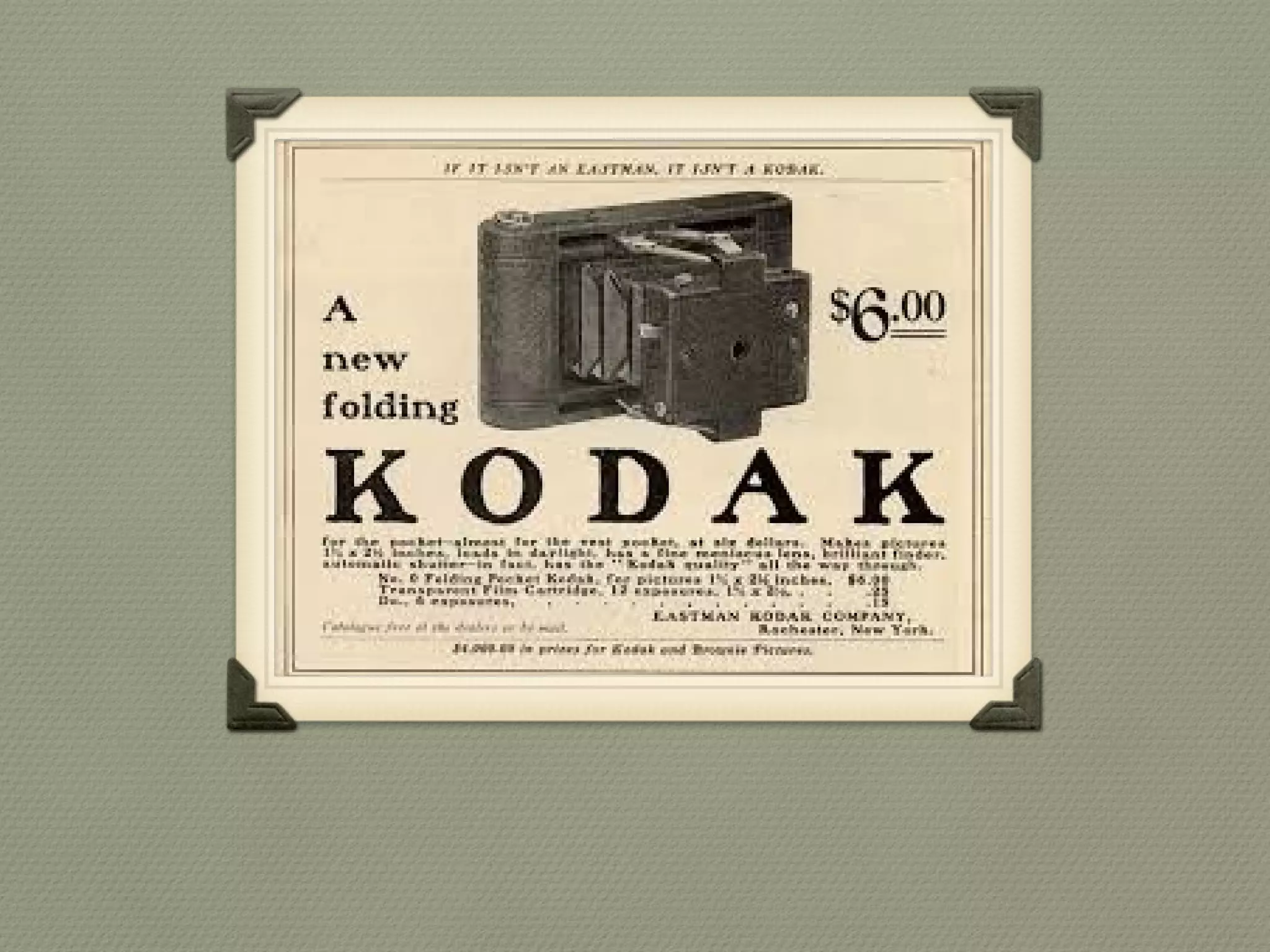
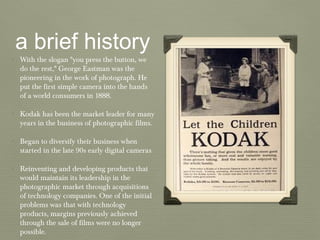
• With the slogan "you press the button, we
do the rest," George Eastman was the
pioneering in the work of photograph. He
put the first simple camera into the hands
of a world consumers in 1888.
• Kodak has been the market leader for many
years in the business of photographic films.
• Began to diversify their business when
started in the late 90s early digital cameras
• Reinventing and developing products that
would maintain its leadership in the
photographic market through acquisitions
of technology companies. One of the initial
problems was that with technology
products, margins previously achieved
through the sale of films were no longer
possible.
Kodak’s business and its Key Success Factors
(KSFs)
✓ Pioneer company and leader in
the photograph film industries.
✓ Key success Factors are the
access to technology on late 19th
century to make photography
an easier task and by doing
that to become a reference in
the industry.
✓ Understanding that
profitability, since that time,
was more related to
consumables (films) and not
hardware (cameras). With these
success factors they have
become leaders in the
photograph industry in the
20th century.
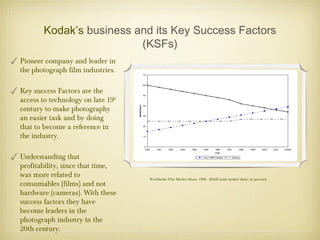
Worldwide Film Market Share, 1990 - 2002E (unit market share, in percent)
Key Strategic Resources and Core Competences
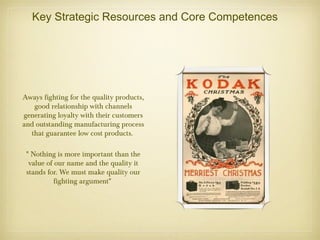
Aways fighting for the quality products,
good relationship with channels
generating loyalty with their customers
and outstanding manufacturing process
that guarantee low cost products.
" Nothing is more important than the
value of our name and the quality it
stands for. We must make quality our
fighting argument"
the industry’s KSFs with Kodak’s Resources and
Core Competences
At the beginning of 20th century their
success factors and resources strategy used
to make perfect sense. The case shows that
time and digital cameras these factors did
not fit anymore
level of uncertainty
The time described by the case talks
about the challenge Kodak had to face
when Digital Cameras were invented and
how they could survive without
photograph films, that was always their
leading product. They needed to know
how to maintain leadership in the market
by selling hardware and not consumer
products. They were not specialists in the
technology required at that moment.
Digital Imaging Technology;an Opportunity or a
Threat for Kodak?
It was always a threat to the semi-monopoly
Kodak used to have for many years. They had
to deferential them selves to keep surviving
but did not used this new era as an
opportunity to keep being a reference in that
market, by lack of right decisions in their
strategic planning. Competitors: Canon Inc.,
Fuji Photo Film Co., Hewlett Packard Co.,
Nikon, Sony Corp.
Kodak’s strategy
Time has proven that Kodak had to
change their mind – do not insist to
have consumer products/service as core
competency. Technology hardware was
key to competitors like Sony and
Canon to succeed.
✓Changing CEO from Whitmore to
Fischer was the right decision but
company’s culture was not ready to the
structural change proposed by Fischer
at the time.
✓During the 90’s Fuji Film took a lot of
market share from Kodak during the
time the latter was diversifying and
loosing focus on their core business.
✓Early 2000 Kodak had to become a
technology company focused on
hardware and not to waste resources on
consumer products and printing
services.

Kodak full

  • 2.
    a brief history •With the slogan "you press the button, we do the rest," George Eastman was the pioneering in the work of photograph. He put the first simple camera into the hands of a world consumers in 1888. • Kodak has been the market leader for many years in the business of photographic films. • Began to diversify their business when started in the late 90s early digital cameras • Reinventing and developing products that would maintain its leadership in the photographic market through acquisitions of technology companies. One of the initial problems was that with technology products, margins previously achieved through the sale of films were no longer possible.
  • 3.
    Kodak’s business andits Key Success Factors (KSFs) ✓ Pioneer company and leader in the photograph film industries. ✓ Key success Factors are the access to technology on late 19th century to make photography an easier task and by doing that to become a reference in the industry. ✓ Understanding that profitability, since that time, was more related to consumables (films) and not hardware (cameras). With these success factors they have become leaders in the photograph industry in the 20th century. Worldwide Film Market Share, 1990 - 2002E (unit market share, in percent)
  • 4.
    Key Strategic Resourcesand Core Competences Aways fighting for the quality products, good relationship with channels generating loyalty with their customers and outstanding manufacturing process that guarantee low cost products. " Nothing is more important than the value of our name and the quality it stands for. We must make quality our fighting argument"
  • 5.
    the industry’s KSFswith Kodak’s Resources and Core Competences At the beginning of 20th century their success factors and resources strategy used to make perfect sense. The case shows that time and digital cameras these factors did not fit anymore
  • 6.
    level of uncertainty Thetime described by the case talks about the challenge Kodak had to face when Digital Cameras were invented and how they could survive without photograph films, that was always their leading product. They needed to know how to maintain leadership in the market by selling hardware and not consumer products. They were not specialists in the technology required at that moment.
  • 7.
    Digital Imaging Technology;anOpportunity or a Threat for Kodak? It was always a threat to the semi-monopoly Kodak used to have for many years. They had to deferential them selves to keep surviving but did not used this new era as an opportunity to keep being a reference in that market, by lack of right decisions in their strategic planning. Competitors: Canon Inc., Fuji Photo Film Co., Hewlett Packard Co., Nikon, Sony Corp.
  • 8.
    Kodak’s strategy Time hasproven that Kodak had to change their mind – do not insist to have consumer products/service as core competency. Technology hardware was key to competitors like Sony and Canon to succeed. ✓Changing CEO from Whitmore to Fischer was the right decision but company’s culture was not ready to the structural change proposed by Fischer at the time. ✓During the 90’s Fuji Film took a lot of market share from Kodak during the time the latter was diversifying and loosing focus on their core business. ✓Early 2000 Kodak had to become a technology company focused on hardware and not to waste resources on consumer products and printing services.