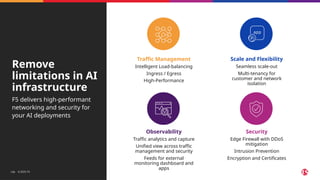
Where AI islocated today
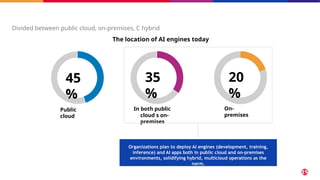
Divided between public cloud, on-premises, C hybrid
The location of AI engines today
35
%
In both public
cloud s on-
premises
20
%
On-
premises
45
%
Public
cloud
Organizations plan to deploy AI engines (development, training,
inference) and AI apps both in public cloud and on-premises
environments, solidifying hybrid, multicloud operations as the
norm.
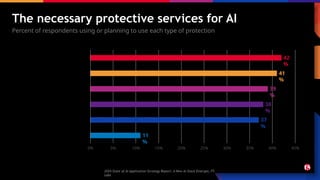
The necessary protectiveservices for AI
Percent of respondents using or planning to use each type of protection
11
%
2024 State of AI Application Strategy Report: A New AI Stack Emerges, F5
Labs
37
%
38
%
39
%
41
%
42
%
0% 5% 10% 15% 20% 25% 30% 35% 40% 45%
API security to safeguard
data as it traverses AI training
models
Monitoring / visibility of
usage
DDoS protection for AI
models
Bot protection for AI
models
Data masking /
exfiltration
Caching for AI
queries
15.
AI protections viefor the
most important
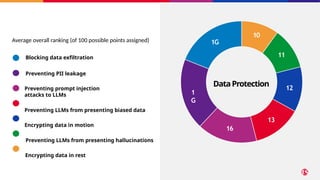
Average overall ranking (of 100 possible points assigned)
Blocking data exfiltration
Preventing PII leakage
Preventing prompt injection
attacks to LLMs
Preventing LLMs from presenting biased data
Encrypting data in motion
Preventing LLMs from presenting hallucinations
Encrypting data in rest
12
13
16
1
G
10
1G
11
DataProtection
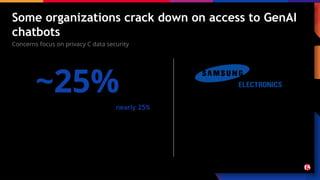
Some organizations crackdown on access to GenAI
chatbots
Concerns focus on privacy C data security
~25%
According to multiple reports, nearly 25%
of organizations have either banned or
severely restricted access to open
Generative AI chatbots, like ChatGPT G
others
May 2023:
Samsung Electronics banned GenAI
use, prompted by discovery of an
accidental leak of sensitive internal
source code uploaded to ChatGPT
26.
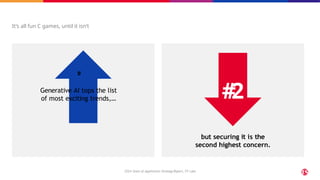
GenAI is themost exciting, but ensuring its security creates fear
It’s all fun C games, until it isn’t
#
1
Generative AI tops the list
of most exciting trends,… #
2
but securing it is the
second highest concern.
2024 State of Application Strategy Report, F5 Labs
27.
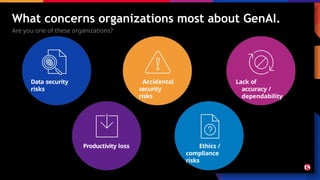
What concerns organizationsmost about GenAI.
Are you one of these organizations?
Data security
risks
Lack of
accuracy /
dependability
Productivity loss Ethics /
compliance
risks
Accidental
security
risks
28.
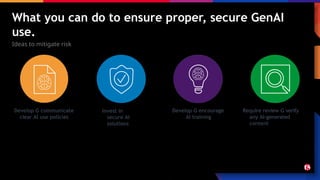
What you cando to ensure proper, secure GenAI
use.
Ideas to mitigate risk
Develop G communicate
clear AI use policies
Invest in
secure AI
solutions
Develop G encourage
AI training
Require review G verify
any AI-generated
content
29.
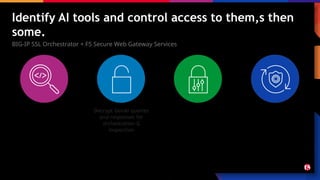
Identify AI toolsand control access to them,s then
some.
BIG-IP SSL Orchestrator + F5 Secure Web Gateway Services
Detect G block
known AI
tools
Decrypt GenAI queries
and responses for
orchestration G
inspection
Control who may
access AI tools, when,
how, etc.
Prevent sensitive
training data or model
details from malicious
exfiltration
30.
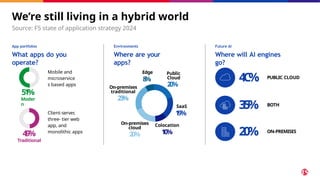
We’re still livingin a hybrid world
Source: F5 state of application strategy 2024
App portfolios
What apps do you
operate?
Edge
8
%
Public
Cloud
2
0%
SaaS
1
9
%
Colocation
1
0%
On-premises
cloud
2
0%
On-premises
traditional
2
3%
Environments
Where are your
apps?
Mobile and
microservice
s based apps
Client-server,
three- tier web
app, and
monolithic apps
5
1
%
Moder
n
4
9
%
Traditional
Future AI
Where will AI engines
go?
4
C
% PUBLIC CLOUD
35%
20%
BOTH
ON-PREMISES
31.
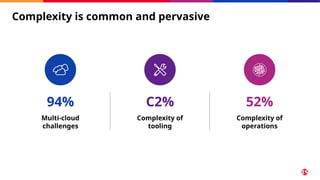
Complexity is commonand pervasive
94%
Multi-cloud
challenges
52%
Complexity of
operations
C2%
Complexity of
tooling
32.
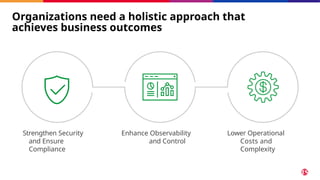
Organizations need aholistic approach that
achieves business outcomes
Strengthen Security
and Ensure
Compliance
Enhance Observability
and Control
Lower Operational
Costs and
Complexity
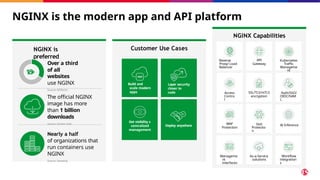
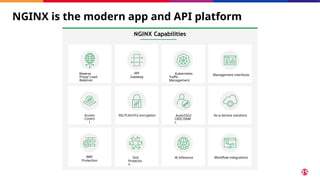
NGINX is themodern app and API platform
NGINX is
preferred
The official NGINX
image has more
than 1 billion
downloads
Source: Docker Hub
Nearly a half
of organizations that
run containers use
NGINX
Source: Datadog
Over a third
of all
websites
use NGINX
Source: W3Techs
1
/
3
+
NGINX Capabilities
Reverse
Proxy/ Load
Balancer
API
Gateway
Kubernetes
Traffic
Manageme
nt
Access
Contro
l
SSL/TLS/mTLS
encryption
Auth/SSO/
OIDC/SAM
L
WAF
Protection
DoS
Protectio
n
AI Inference
Manageme
nt
interfaces
As-a-Service
solutions
Workflow
integration
s
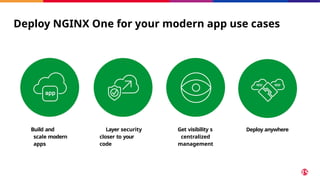
Customer Use Cases
Build and
scale modern
apps
Layer security
closer to
code
Get visibility s
centralized
management
Deploy anywhere
35.
Deploy anywhere
Build and
scalemodern
apps
Layer security
closer to your
code
Get visibility s
centralized
management
Deploy NGINX One for your modern app use cases
36.
Build and scalemodern apps
Streamline delivery and delight customers
37.
NGINX is themodern app and API platform
Reverse
Proxy/ Load
Balancer
API
Gateway
Kubernetes
Traffic
Management
Access
Contro
l
SSL/TLS/mTLS encryption Auth/SSO/
OIDC/SAM
L
WAF
Protection
DoS
Protectio
n
AI Inference
Management interfaces
As-a-Service solutions
Workflow integrations
NGINX Capabilities
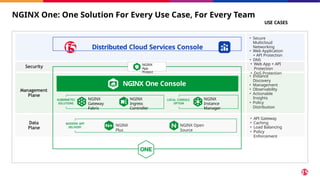
38.
Security
NGINX One: OneSolution For Every Use Case, For Every Team
USE CASES
• Instance
Discovery
• Management
• Observability
• Actionable
Insights
• Policy
Distribution
• API Gateway
• Caching
• Load Balancing
• Policy
Enforcement
Data
Plane
Management
Plane
• Secure
Multicloud
Networking
• Web Application
+ API Protection
• DNS
MODERN APP
DELIVERY
NGINX
Plus
NGINX Open
Source
NGINX One Console
Distributed Cloud Services Console
LOCAL CONSOLE
OPTION
NGINX
Instance
Manager
KUBERNETES
SOLUTIONS
NGINX
Gateway
Fabric
NGINX
Ingress
Controller
• Web App + API
Protection
• DoS Protection
NGINX
App
Protect
39.
Layer security closerto
your code
Reduce complexity, improve security, and meet compliance
40.
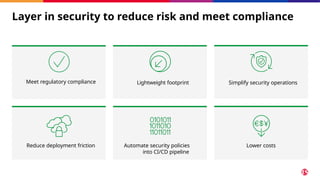
Layer in securityto reduce risk and meet compliance
Lightweight footprint Simplify security operations
Reduce deployment friction Automate security policies
into CI/CD pipeline
Lower costs
Meet regulatory compliance
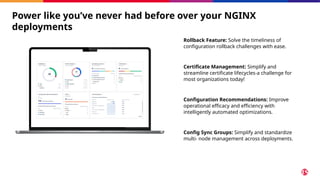
Power like you’venever had before over your NGINX
deployments
Rollback Feature: Solve the timeliness of
configuration rollback challenges with ease.
Certificate Management: Simplify and
streamline certificate lifecycles-a challenge for
most organizations today!
Configuration Recommendations: Improve
operational efficacy and efficiency with
intelligently automated optimizations.
Config Sync Groups: Simplify and standardize
multi- node management across deployments.
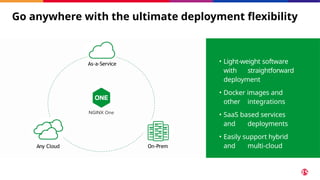
Go anywhere withthe ultimate deployment flexibility
• Light-weight software
with straightforward
deployment
• Docker images and
other integrations
• SaaS based services
and deployments
• Easily support hybrid
and multi-cloud
On-Prem
Any Cloud
As-a-Service
45.
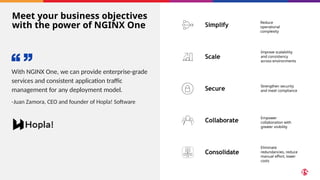
Meet your businessobjectives
with the power of NGINX One Simplify
Reduce
operational
complexity
Scale
Improve scalability
and consistency
across environments
Secure
Strengthen security
and meet compliance
Collaborate Empower
collaboration with
greater visibility
Consolidate
Eliminate
redundancies, reduce
manual effort, lower
costs
With NGINX One, we can provide enterprise-grade
services and consistent application traffic
management for any deployment model.
-Juan Zamora, CEO and founder of Hopla! Software
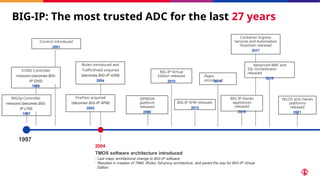
BIG-IP: The mosttrusted ADC for the last 27 years
iControl introduced
2001
3-DNS Controller
released (becomes BIG-
IP DNS)
1998
1997
BIG/ip Controller
released (becomes BIG-
IP LTM)
1997
iRules introduced and
TrafficShield acquired
(becomes BIG-IP ASM)
2004
FirePass acquired
(becomes BIG-IP APM)
2003
VIPRION
platform
released
2008
iApps
introduced
2014
Container Ingress
Services and Automation
Toolchain released
2017
BIG-IP iSeries
appliances
released
2016
Advanced WAF and
SSL Orchestrator
released
2018
BIG-IP Virtual
Edition released
2010
BIG-IP AFM released
2012
VELOS and rSeries
platforms
released
2021
2004
TMOS software architecture introduced
- Last major architectural change to BIG-IP software
- Resulted in creation of TMM, iRules, full-proxy architecture, and paved the way for BIG-IP Virtual
Edition
48.
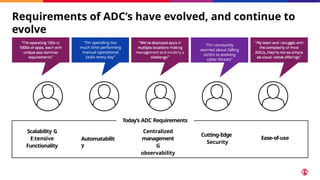
Requirements of ADC’shave evolved, and continue to
evolve
Scalability G
E:tensive
Functionality
Automatabilit
y
Centralized
management
G
observability
Cutting-Edge
Security
Ease-of-use
Today’s ADC Requirements
“I’m spending too
much time performing
manual operational
tasks every day”
“
“I’m constantly
worried about falling
victim to evolving
cyber threats”
“
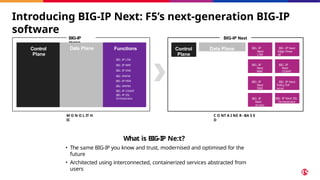
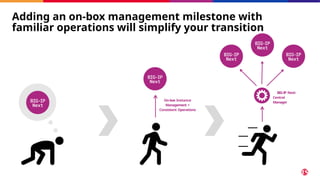
Introducing BIG-IP Next:F5’s next-generation BIG-IP
software
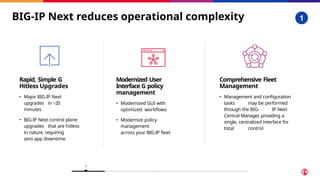
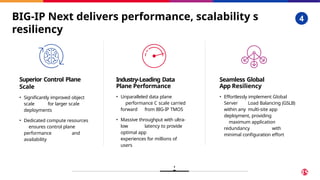
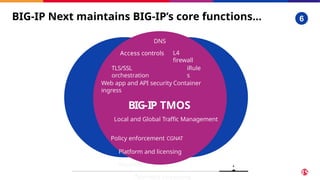
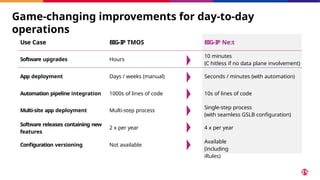
What is BIG-IP Ne:t?
• The same BIG-IP you know and trust, modernised and optimised for the
future
• Architected using interconnected, containerized services abstracted from
users
M O N O L IT H
IC
C O NT A I NE R - BA S E
D
BIG-IP
TMOS
Control
Plane
Data Plane Functions
BIG -IP LTM
BIG -IP WAF
BIG -IP DNS
BIG -IPAFM
BIG -IP PEM
BIG -IPAPM
BIG -IP CGNAT
BIG -IP SSL
Orchestrator
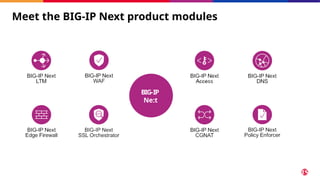
BIG-IP Next
BIG -IP
Next
LTM
BIG -IP Next
Edge Firew
all
BIG -IP
Next
WAF
BIG -IP
Next
CGNAT
BIG -IP
Next
DNS
BIG -IP Next
Policy Enf
orcer
BIG -IP
Next
Access
BIG -IP Next SSL
Orchestrator
Data Plane
Control
Plane
51.
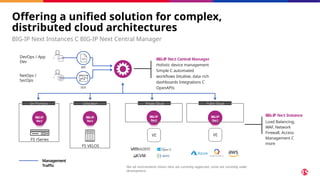
Offering a unifiedsolution for complex,
distributed cloud architectures
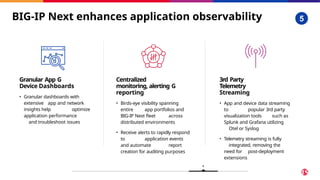
BIG-IP Next Instances C BIG-IP Next Central Manager
On-Premises
BIG-IP
Ne:t
F5 rSeries
Colocation
BIG-IP
Ne:t
F5 VELOS
BIG-IP Ne:t Central Manager
Holistic device management
Simple C automated
workflows Intuitive, data rich
dashboards Integrations C
OpenAPIs
BIG-IP Ne:t Instance
Load Balancing,
WAF, Network
Firewall, Access
Management C
more
Management
Traffic Not all environments shown here are currently supported, some are currently under
development.
Private Cloud
BIG-IP
Ne:t
Public Cloud
BIG-IP
Ne:t
DevOps / App
Dev
NetOps /
SecOps
API
GUI
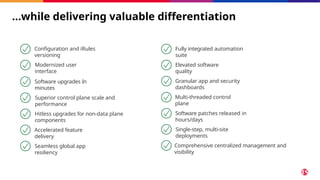
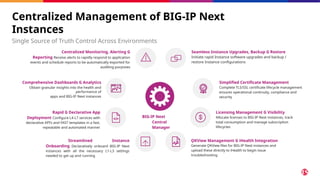
Centralized Management ofBIG-IP Next
Instances
Single Source of Truth Control Across Environments
Comprehensive Dashboards G Analytics
Obtain granular insights into the health and
performance of
apps and BIG-IP Next instances
Rapid G Declarative App
Deployment Configure L4-L7 services with
declarative API’s and FAST templates in a fast,
repeatable and automated manner
Streamlined Instance
Onboarding Declaratively onboard BIG-IP Next
instances with all the necessary L1-L3 settings
needed to get up and running
Centralized Monitoring, Alerting G
Reporting Receive alerts to rapidly respond to application
events and schedule reports to be automatically exported for
auditing purposes
Simplified Certificate Management
Complete TLS/SSL certificate lifecycle management
ensures operational continuity, compliance and
security
Seamless Instance Upgrades, Backup G Restore
Initiate rapid Instance software upgrades and backup /
restore Instance configurations
Licensing Management G Visibility
Allocate licenses to BIG-IP Next instances, track
total consumption and manage subscription
lifecycles
ǪKView Management G iHealth Integration
Generate ǪKView files for BIG-IP Next instances and
upload these directly to iHealth to begin issue
troubleshooting
BIG-IP Next
Central
Manager
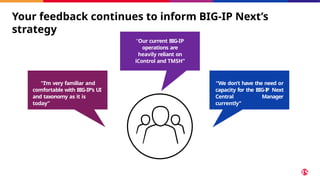
Your feedback continuesto inform BIG-IP Next’s
strategy
“I’m very familiar and
comfortable with BIG-IP’s UI
and taxonomy as it is
today”
“Our current BIG-IP
operations are
heavily reliant on
iControl and TMSH”
“We don’t have the need or
capacity for the BIG-I
P Next
Central Manager
currently”
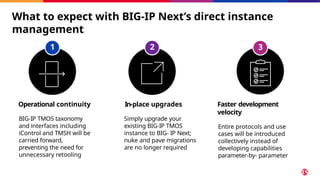
What to expectwith BIG-IP Next’s direct instance
management
1 2 3
Operational continuity
BIG-IP TMOS taxonomy
and interfaces including
iControl and TMSH will be
carried forward,
preventing the need for
unnecessary retooling
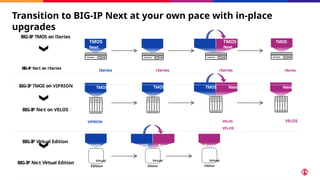
In-place upgrades
Simply upgrade your
existing BIG-IP TMOS
instance to BIG- IP Next;
nuke and pave migrations
are no longer required
Faster development
velocity
Entire protocols and use
cases will be introduced
collectively instead of
developing capabilities
parameter-by- parameter
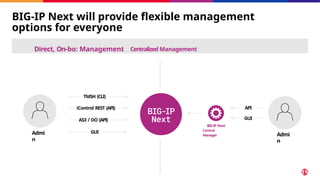
68.
BIG-IP Next willprovide flexible management
options for everyone
BIG-IP Next
Central
Manager
Direct, On-bo: Management Centralized Management
GUI
API
Admi
n
iControl REST (API)
AS3 / DO (API)
GUI
TMSH (CLI)
Admi
n
69.
Transition to BIG-IPNext at your own pace with in-place
upgrades
BIG-IP TMOS on iSeries
TMOS TMOS TMOS
Next Next
BIG-I
P Ne:t on rSeries
iSeries rSeries rSeries rSeries
BIG-IP TMOS on VIPRION TMOS TMOS TMOS Next Next
BIG-IP Ne:t on VELOS
VIPRION VELOS VELOS
VELOS
BIG-IP Virtual Edition
TMOS TMOS Next Next
BIG-IP Ne:t Virtual Edition
Virtual Virtual Virtual
Edition Edition Edition
70.
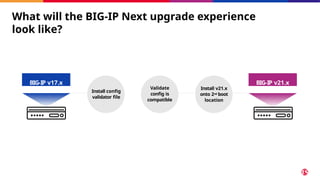
What will theBIG-IP Next upgrade experience
look like?
BIG-IP v17.x
Install config
validator file
Validate
config is
compatible
Install v21.x
onto 2nd boot
location
BIG-IP v21.x
71.
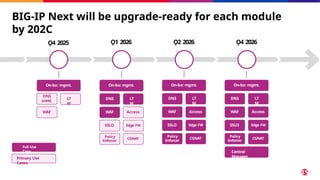
Primary Use
Cases
Full Use
Case
BIG-IPNext will be upgrade-ready for each module
by 202C
Ǫ4 2025 Ǫ1 2026 Ǫ2 2026 Ǫ4 2026
On-bo: mgmt.
LT
M
WAF
On-bo: mgmt.
DNS LT
M
WAF Access
SSLO Edge FW
Policy
Enforcer
CGNAT
On-bo: mgmt.
DNS LT
M
WAF Access
SSLO Edge FW
Policy
Enforcer
CGNAT
On-bo: mgmt.
DNS LT
M
WAF Access
SSLO Edge FW
Policy
Enforcer
CGNAT
Central
Manager
DNS
(core)
72.
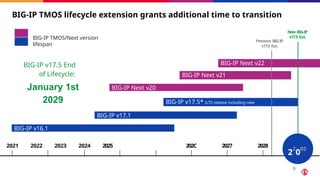
BIG-IP TMOS lifecycleextension grants additional time to transition
BIG-IP v16.1
BIG-IP v17.1
BIG-IP Next v20
BIG-IP Next v21
BIG-IP Next v22
BIG-IP v17.5* (LTS release including new
features)
BIG-IP TMOS/Next version
lifespan
Previous BIG-IP
v17.5 EoL
BIG-IP v17.5 End
of Lifecycle:
January 1st
2029
New BIG-IP
v17.5 EoL
2021 2022 2023 2024 2025 202C 2027 2028
2
2
0
02
2
9
9
73.
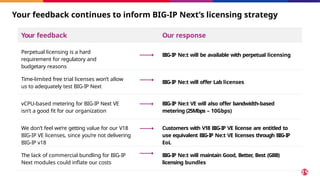
Your feedback Ourresponse
Perpetual licensing is a hard
requirement for regulatory and
budgetary reasons
BIG-IP Ne:t will be available with perpetual licensing
Time-limited free trial licenses won’t allow
us to adequately test BIG-IP Next
BIG-IP Ne:t will offer Lab licenses
vCPU-based metering for BIG-IP Next VE
isn’t a good fit for our organization
BIG-IP Ne:t VE will also offer bandwidth-based
metering (25Mbps – 10Gbps)
We don’t feel we’re getting value for our V18
BIG-IP VE licenses, since you’re not delivering
BIG-IP v18
Customers with V18 BIG-IP VE license are entitled to
use equivalent BIG-IP Ne:t VE licenses through BIG-IP
EoL
The lack of commercial bundling for BIG-IP
Next modules could inflate our costs
BIG-IP Ne:t will maintain Good, Better, Best (GBB)
licensing bundles
Your feedback continues to inform BIG-IP Next’s licensing strategy
74.
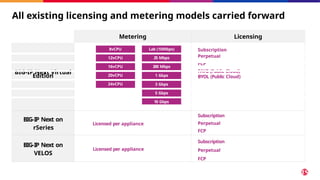
All existing licensingand metering models carried forward
Metering Licensing
Subscription
8vCPU Lab (10Mbps)
12vCPU 25 Mbps Perpetual
16vCPU 200 Mbps
FCP
BIG-IP Next Virtual
Edition 20vCPU 1 Gbps
PAYG (Public Cloud)
BYOL (Public Cloud)
24vCPU 3 Gbps
5 Gbps
10 Gbps
BIG-IP Next on
rSeries
Licensed per appliance
Subscription
Perpetual
FCP
BIG-IP Next on
VELOS
Licensed per appliance
Subscription
Perpetual
FCP
75.
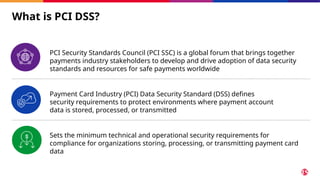
What is PCIDSS?
PCI Security Standards Council (PCI SSC) is a global forum that brings together
payments industry stakeholders to develop and drive adoption of data security
standards and resources for safe payments worldwide
Payment Card Industry (PCI) Data Security Standard (DSS) defines
security requirements to protect environments where payment account
data is stored, processed, or transmitted
Sets the minimum technical and operational security requirements for
compliance for organizations storing, processing, or transmitting payment card
data
76.
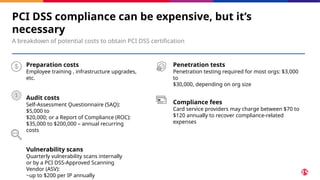
PCI DSS compliancecan be expensive, but it’s
necessary
A breakdown of potential costs to obtain PCI DSS certification
Preparation costs
Employee training , infrastructure upgrades,
etc.
Audit costs
Self-Assessment Ǫuestionnaire (SAǪ):
$5,000 to
$20,000; or a Report of Compliance (ROC):
$35,000 to $200,000 – annual recurring
costs
Vulnerability scans
Ǫuarterly vulnerability scans internally
or by a PCI DSS-Approved Scanning
Vendor (ASV):
~up to $200 per IP annually
Penetration tests
Penetration testing required for most orgs: $3,000
to
$30,000, depending on org size
Compliance fees
Card service providers may charge between $70 to
$120 annually to recover compliance-related
expenses
77.
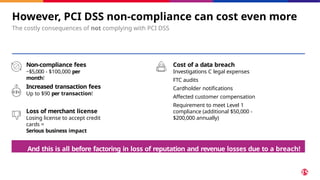
And this isall before factoring in loss of reputation and revenue losses due to a breach!
However, PCI DSS non-compliance can cost even more
The costly consequences of not complying with PCI DSS
Non-compliance fees
~$5,000 - $100,000 per
month!
Increased transaction fees
Up to $90 per transaction!
Loss of merchant license
Losing license to accept credit
cards =
Serious business impact
Cost of a data breach
Investigations C legal expenses
FTC audits
Cardholder notifications
Affected customer compensation
Requirement to meet Level 1
compliance (additional $50,000 -
$200,000 annually)
What is PCIDSS v4.0?
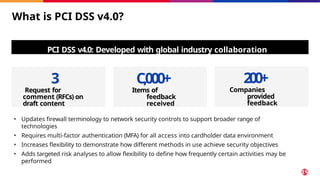
PCI DSS v4.0: Developed with global industry collaboration
3
Request for
comment (RFCs) on
draft content
C,000+
Items of
feedback
received
200+
Companies
provided
feedback
• Updates firewall terminology to network security controls to support broader range of
technologies
• Requires multi-factor authentication (MFA) for all access into cardholder data environment
• Increases flexibility to demonstrate how different methods in use achieve security objectives
• Adds targeted risk analyses to allow flexibility to define how frequently certain activities may be
performed
80.
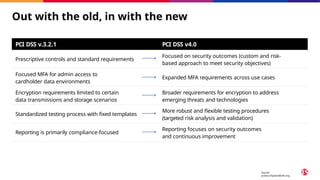
Out with theold, in with the new
PCI DSS v.3.2.1 PCI DSS v4.0
Prescriptive controls and standard requirements
Focused on security outcomes (custom and risk-
based approach to meet security objectives)
Focused MFA for admin access to
cardholder data environments
Expanded MFA requirements across use cases
Encryption requirements limited to certain
data transmissions and storage scenarios
Broader requirements for encryption to address
emerging threats and technologies
Standardized testing process with fixed templates
More robust and flexible testing procedures
(targeted risk analysis and validation)
Reporting is primarily compliance-focused
Reporting focuses on security outcomes
and continuous improvement
Source:
pcisecuritystandards.org
81.
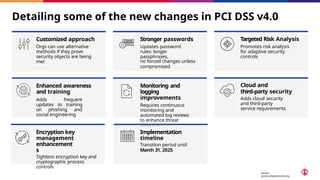
Detailing some ofthe new changes in PCI DSS v4.0
Customized approach
Orgs can use alternative
methods if they prove
security objects are being
met
Stronger passwords
Updates password
rules: longer
passphrases,
no forced changes unless
compromised
Targeted Risk Analysis
Promotes risk analysis
for adaptive security
controls
Enhanced awareness
and training
Adds frequent
updates to training
on phishing and
social engineering
Monitoring and
logging
improvements
Requires continuous
monitoring and
automated log reviews
to enhance threat
detection
Cloud and
third-party security
Adds cloud security
and third-party
service requirements
Source:
pcisecuritystandards.org
Encryption key
management
enhancement
s
Tightens encryption key and
cryptographic process
controls
Implementation
timeline
Transition period until
March 31, 2025
82.
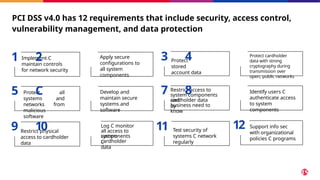
PCI DSS v4.0has 12 requirements that include security, access control,
vulnerability management, and data protection
Apply secure
configurations to
all system
components
Develop and
maintain secure
systems and
software
Protect all
systems and
networks from
malicious
software
5 C
Implement C
maintain controls
for network security
1 2
Log C monitor
all access to
system
components
C
cardholder
data
Restrict physical
access to cardholder
data
9 10
Protect cardholder
data with strong
cryptography during
transmission over
open, public networks
Identify users C
authenticate access
to system
components
Restrict access to
system components
and
cardholder data
by
business need to
know
7 8
Protect
stored
account data
3 4
Support info sec
with organizational
policies C programs
12
Test security of
systems C network
regularly
11
83.
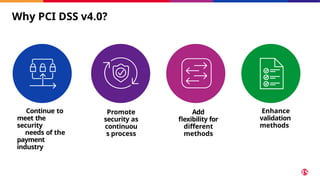
Why PCI DSSv4.0?
Continue to
meet the
security
needs of the
payment
industry
Promote
security as
continuou
s process
Add
flexibility for
different
methods
Enhance
validation
methods
84.
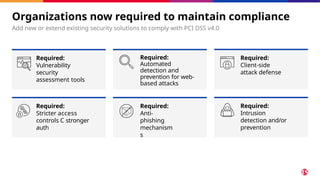
Organizations now requiredto maintain compliance
Add new or extend existing security solutions to comply with PCI DSS v4.0
Required:
Vulnerability
security
assessment tools
Required:
Automated
detection and
prevention for web-
based attacks
Required:
Client-side
attack defense
Required:
Stricter access
controls C stronger
auth
Required:
Anti-
phishing
mechanism
s
Required:
Intrusion
detection and/or
prevention
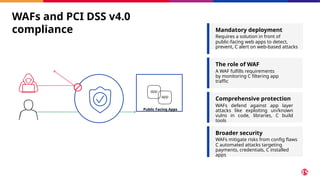
WAFs and PCIDSS v4.0
compliance
Public Facing Apps
Mandatory deployment
Requires a solution in front of
public-facing web apps to detect,
prevent, C alert on web-based attacks
The role of WAF
A WAF fulfills requirements
by monitoring C filtering app
traffic
Comprehensive protection
WAFs defend against app layer
attacks like exploiting un/known
vulns in code, libraries, C build
tools
Broader security
WAFs mitigate risks from config flaws
C automated attacks targeting
payments, credentials, C installed
apps
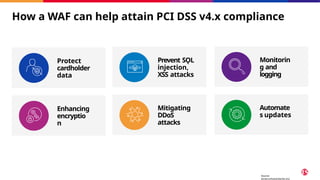
87.
How a WAFcan help attain PCI DSS v4.x compliance
Source:
pcisecuritystandards.org
Protect
cardholder
data
Prevent SǪL
injection,
XSS attacks
Monitorin
g and
logging
Enhancing
encryptio
n
Mitigating
DDoS
attacks
Automate
s updates
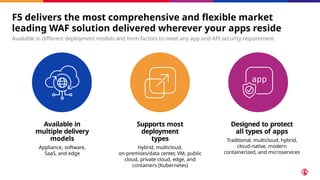
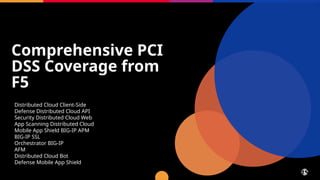
F5 delivers themost comprehensive and flexible market
leading WAF solution delivered wherever your apps reside
Available in different deployment models and form factors to meet any app and API security requirement
Available in
multiple delivery
models
Appliance, software,
SaaS, and edge
Supports most
deployment
types
Hybrid, multicloud,
on-premises/data center, VM, public
cloud, private cloud, edge, and
containers (Kubernetes)
Designed to protect
all types of apps
Traditional, multicloud, hybrid,
cloud-native, modern
containerized, and microservices
92.
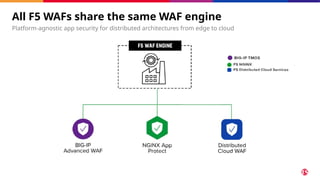
All F5 WAFsshare the same WAF engine
Platform-agnostic app security for distributed architectures from edge to cloud
93.
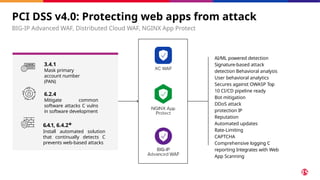
PCI DSS v4.0:Protecting web apps from attack
BIG-IP Advanced WAF, Distributed Cloud WAF, NGINX App Protect
AI/ML powered detection
Signature-based attack
detection Behavioral analysis
User behavioral analytics
Secures against OWASP Top
10 CI/CD pipeline ready
Bot mitigation
DDoS attack
protection IP
Reputation
Automated updates
Rate-Limiting
CAPTCHA
Comprehensive logging C
reporting Integrates with Web
App Scanning
3.4.1
Mask primary
account number
(PAN)
6.2.4
Mitigate common
software attacks C vulns
in software development
6.4.1, 6.4.2*
Install automated solution
that continually detects C
prevents web-based attacks
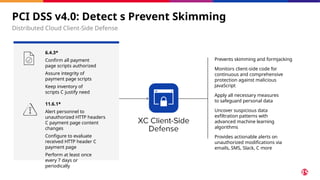
PCI DSS v4.0:Detect s Prevent Skimming
Distributed Cloud Client-Side Defense
Prevents skimming and formjacking
Monitors client-side code for
continuous and comprehensive
protection against malicious
JavaScript
Apply all necessary measures
to safeguard personal data
Uncover suspicious data
exfiltration patterns with
advanced machine learning
algorithms
Provides actionable alerts on
unauthorized modifications via
emails, SMS, Slack, C more
6.4.3*
Confirm all payment
page scripts authorized
Assure integrity of
payment page scripts
Keep inventory of
scripts C justify need
11.6.1*
Alert personnel to
unauthorized HTTP headers
C payment page content
changes
Configure to evaluate
received HTTP header C
payment page
Perform at least once
every 7 days or
periodically
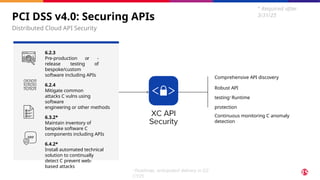
96.
Comprehensive API discovery
RobustAPI
testing1 Runtime
protection
Continuous monitoring C anomaly
detection
PCI DSS v4.0: Securing APIs
Distributed Cloud API Security
1 Roadmap, anticipated delivery in 2
Ǫ
CY25
* Required after
3/31/25
6.2.3
Pre-production or -
release testing of
bespoke/custom
software including APIs
6.2.4
Mitigate common
attacks C vulns using
software
engineering or other methods
6.3.2*
Maintain inventory of
bespoke software C
components including APIs
6.4.2*
Install automated technical
solution to continually
detect C prevent web-
based attacks
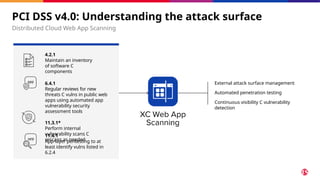
97.
PCI DSS v4.0:Understanding the attack surface
Distributed Cloud Web App Scanning
External attack surface management
Automated penetration testing
Continuous visibility C vulnerability
detection
4.2.1
Maintain an inventory
of software C
components
6.4.1
Regular reviews for new
threats C vulns in public web
apps using automated app
vulnerability security
assessment tools
11.3.1*
Perform internal
vulnerability scans C
rescans as needed
11.4.1
App-layer pentesting to at
least identify vulns listed in
6.2.4
98.
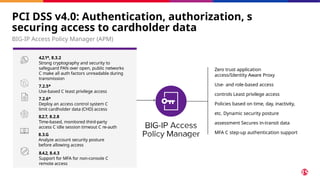
PCI DSS v4.0:Authentication, authorization, s
securing access to cardholder data
BIG-IP Access Policy Manager (APM)
Zero trust application
access/Identity Aware Proxy
Use- and role-based access
controls Least privilege access
Policies based on time, day, inactivity,
etc. Dynamic security posture
assessment Secures in-transit data
MFA C step-up authentication support
4.2.1*, 8.3.2
Strong cryptography and security to
safeguard PAN over open, public networks
C make all auth factors unreadable during
transmission
7.2.5*
Use-based C least privilege access
7.2.6*
Deploy an access control system C
limit cardholder data (CHD) access
8.2.7, 8.2.8
Time-based, monitored third-party
access C idle session timeout C re-auth
8.3.G
Analyze account security posture
before allowing access
8.4.2, 8.4.3
Support for MFA for non-console C
remote access
99.
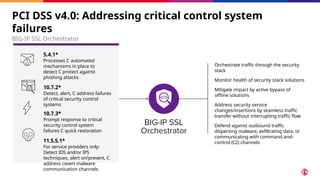
PCI DSS v4.0:Addressing critical control system
failures
BIG-IP SSL Orchestrator
Orchestrate traffic through the security
stack
Monitor health of security stack solutions
Mitigate impact by active bypass of
offline solutions
Address security service
changes/insertions by seamless traffic
transfer without interrupting traffic flow
Defend against outbound traffic
dispersing malware, exfiltrating data, or
communicating with command-and-
control (C2) channels
5.4.1*
Processes C automated
mechanisms in place to
detect C protect against
phishing attacks
10.7.2*
Detect, alert, C address failures
of critical security control
systems
10.7.3*
Prompt response to critical
security control system
failures C quick restoration
11.5.5.1*
For service providers only:
Detect IDS and/or IPS
techniques, alert on/prevent, C
address covert malware
communication channels
100.
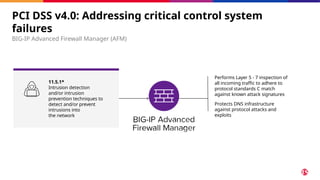
PCI DSS v4.0:Addressing critical control system
failures
BIG-IP Advanced Firewall Manager (AFM)
Performs Layer 5 - 7 inspection of
all incoming traffic to adhere to
protocol standards C match
against known attack signatures
Protects DNS infrastructure
against protocol attacks and
exploits
11.5.1*
Intrusion detection
and/or intrusion
prevention techniques to
detect and/or prevent
intrusions into
the network
101.
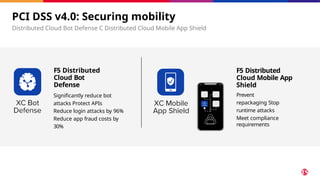
PCI DSS v4.0:Securing mobility
Distributed Cloud Bot Defense C Distributed Cloud Mobile App Shield
F5 Distributed
Cloud Bot
Defense
Significantly reduce bot
attacks Protect APIs
Reduce login attacks by 96%
Reduce app fraud costs by
30%
F5 Distributed
Cloud Mobile App
Shield
Prevent
repackaging Stop
runtime attacks
Meet compliance
requirements
102.
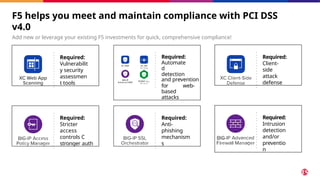
F5 helps youmeet and maintain compliance with PCI DSS
v4.0
Add new or leverage your existing F5 investments for quick, comprehensive compliance!
Required:
Vulnerabilit
y security
assessmen
t tools
Required:
Stricter
access
controls C
stronger auth
Required:
Automate
d
detection
and prevention
for web-
based
attacks
Required:
Anti-
phishing
mechanism
s
Required:
Client-
side
attack
defense
Required:
Intrusion
detection
and/or
preventio
n
103.
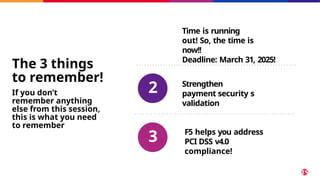
1
Time is running
out!So, the time is
now!!
Deadline: March 31, 2025!
Strengthen
payment security s
validation
F5 helps you address
PCI DSS v4.0
compliance!
The 3 things
to remember!
If you don’t
remember anything
else from this session,
this is what you need
to remember
2
3
104.
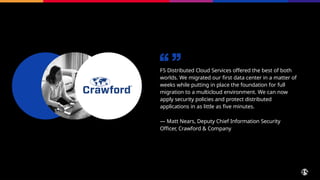
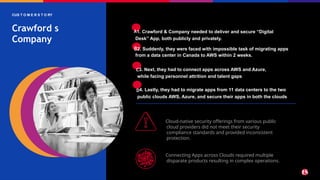
Crawford s
Company
CUS TO M E R S T O RY
A1. Crawford & Company needed to deliver and secure “Digital
Desk” App, both publicly and privately.
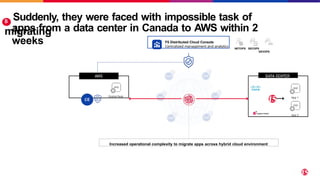
B2. Suddenly, they were faced with impossible task of migrating apps
from a data center in Canada to AWS within 2 weeks.
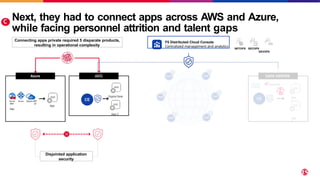
C3. Next, they had to connect apps across AWS and Azure,
while facing personnel attrition and talent gaps
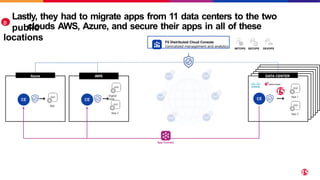
D4. Lastly, they had to migrate apps from 11 data centers to the two
public clouds AWS, Azure, and secure their apps in both the clouds
Cloud-native security offerings from various public
cloud providers did not meet their security
compliance standards and provided inconsistent
protection.
Connecting Apps across Clouds required multiple
disparate products resulting in complex operations.
105.
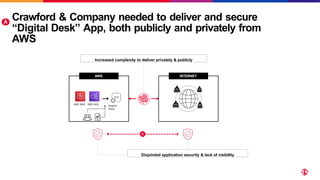
Crawford & Companyneeded to deliver and secure
“Digital Desk” App, both publicly and privately from
AWS
Disjointed application security & lack of visibility
Increased complexity to deliver privately & publicly
AWS
Digital
Desk
AWS WAF AWS ALB
INTERNET
A
106.
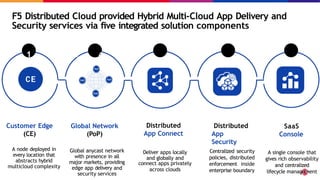
A node deployedin
every location that
abstracts hybrid
multicloud complexity
F5 Distributed Cloud provided Hybrid Multi-Cloud App Delivery and
Security services via five integrated solution components
A single console that
gives rich observability
and centralized
lifecycle management
Deliver apps locally
and globally and
connect apps privately
across clouds
Distributed
App
Security
Distributed
App Connect
Customer Edge
(CE)
1 2 3 4 5
Global anycast network
with presence in all
major markets, providing
edge app delivery and
security services
Global Network
(PoP)
SaaS
Console
Centralized security
policies, distributed
enforcement inside
enterprise boundary
Inside the CEsoftware stack -
Mesh
API
Security
WAF
Proxy
Load
Balancer
Firewal
l
Routin
g
Applicatio
n Delivery
Controller
Mesh
Integrated High Performance
Networking Stack [L3-L7]
App Stack
Identit
y
Service
Discovery
Secrets
Mgmt.
Distributed
Application [Fleet]
Cluster
Managemen
t
Compute
Platform
Service
Control
Simplified Application
Infrastructure Stack
1
109.
apps from adata center in Canada to AWS within 2
weeks
AWS
Digital Desk
F5 Distributed Cloud Console
Centralized management and analytics
NETOPS SECOPS
DEVOPS
DATA CENTER
Increased operational complexity to migrate apps across hybrid cloud environment
App 1
App 2
B
Suddenly, they were faced with impossible task of
migrating
110.
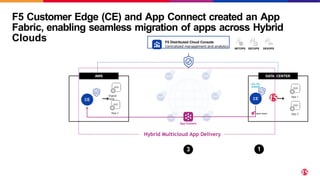
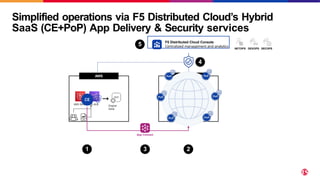
F5 Customer Edge(CE) and App Connect created an App
Fabric, enabling seamless migration of apps across Hybrid
Clouds
AWS
Digital
Desk
F5 Distributed Cloud Console
Centralized management and analytics
DEVOPS
SECOPS
NETOPS
DATA CENTER
App 1
Hybrid Multicloud App Delivery
App 2 App 2
1
App Connect
3
111.
Azure
Next, they hadto connect apps across AWS and Azure,
while facing personnel attrition and talent gaps
AWS
F5 Distributed Cloud Console
Centralized management and analytics
NETOPS SECOPS
DEVOPS
Digital Desk
App 2
DATA CENTER
App
1
App
2
Azure Azure Azure API
WAF LB
Mgr.
App
Disjointed application
security
Connecting apps private required 5 disparate products,
resulting in operational complexity
C
112.
Azure
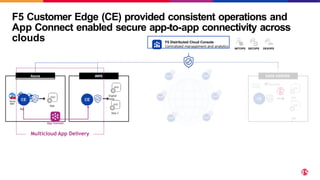
F5 Customer Edge(CE) provided consistent operations and
App Connect enabled secure app-to-app connectivity across
clouds
AWS
Digital
Desk
F5 Distributed Cloud Console
Centralized management and analytics
DEVOPS
SECOPS
NETOPS
App 2
DATA CENTER
App
1
App
2
Azure
WAF
Azure Azure API
LB
Mgr.
App
App Connect
Multicloud App Delivery
113.
Azure
Lastly, they hadto migrate apps from 11 data centers to the two
public
AWS
Digital
Desk
F5 Distributed Cloud Console
Centralized management and analytics
DEVOPS
SECOPS
NETOPS
DATA CENTER
App 1
App 2 App 2
App
D
clouds AWS, Azure, and secure their apps in all of these
locations
App Connect
114.
Azure
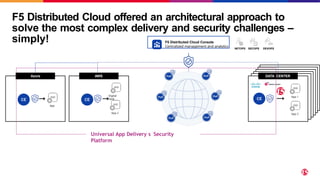
F5 Distributed Cloudoffered an architectural approach to
solve the most complex delivery and security challenges –
simply!
AWS
Digital
Desk
F5 Distributed Cloud Console
Centralized management and analytics
DEVOPS
SECOPS
NETOPS
DATA CENTER
App 1
App 2 App 2
App
Universal App Delivery s Security
Platform
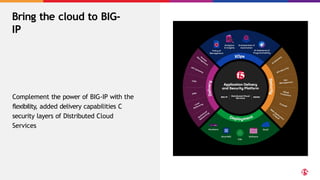
Complement the powerof BIG-IP with the
flexibility, added delivery capabilities C
security layers of Distributed Cloud
Services
Bring the cloud to BIG-
IP
117.
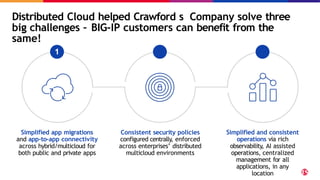
Distributed Cloud helpedCrawford s Company solve three
big challenges – BIG-IP customers can benefit from the
same!
1 2 3
Simplified app migrations
and app-to-app connectivity
across hybrid/multicloud for
both public and private apps
Consistent security policies
configured centrally, enforced
across enterprises’ distributed
multicloud environments
Simplified and consistent
operations via rich
observability, AI assisted
operations, centralized
management for all
applications, in any
location
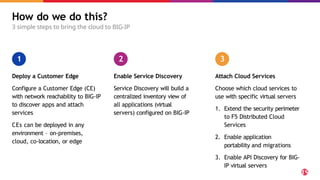
How do wedo this?
3 simple steps to bring the cloud to BIG-IP
Deploy a Customer Edge
Configure a Customer Edge (CE)
with network reachability to BIG-IP
to discover apps and attach
services
CEs can be deployed in any
environment – on-premises,
cloud, co-location, or edge
Enable Service Discovery
Service Discovery will build a
centralized inventory view of
all applications (virtual
servers) configured on BIG-IP
Attach Cloud Services
Choose which cloud services to
use with specific virtual servers
1. Extend the security perimeter
to F5 Distributed Cloud
Services
2. Enable application
portability and migrations
3. Enable API Discovery for BIG-
IP virtual servers
1 2 3
120.
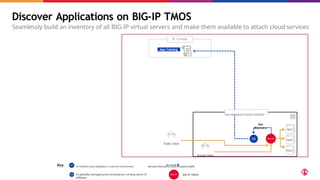
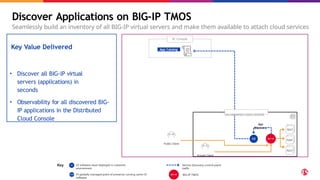
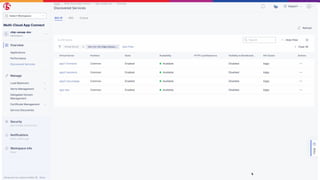
Discover Applications onBIG-IP TMOS
Seamlessly build an inventory of all BIG-IP virtual servers and make them available to attach cloud services
App2
App1
App3
App Catalog
XC Console
ON-PREMISES DATA CENTER
App
Discovery
Public Client
Private Client
F5 globally managed point of presence running same CE
software
CE software stack deployed in customer environment Service Discovery control plane traffic
Key
BIG-IP TMOS
Discover Applications onBIG-IP TMOS
Seamlessly build an inventory of all BIG-IP virtual servers and make them available to attach cloud services
App2
App1
App3
App Catalog
XC Console
ON-PREMISES DATA CENTER
App
Discovery
Public Client
Private Client
Key Value Delivered
• Discover all BIG-IP virtual
servers (applications) in
seconds
• Observability for all discovered BIG-
IP applications in the Distributed
Cloud Console
Key CE software stack deployed in customer
environment
Service Discovery control plane
traffic
F5 globally managed point of presence running same CE
software
BIG-IP TMOS
123.
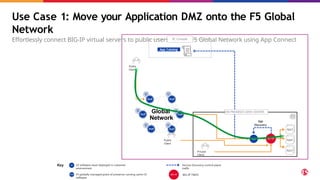
Use Case 1:Move your Application DMZ onto the F5 Global
Network
Effortlessly connect BIG-IP virtual servers to public users via the F5 Global Network using App Connect
App2
App1
App3
App Catalog
XC Console
Private
Client
Global
Network
Public
Client
Public
Client
ON-PREMISES DATA CENTER
App
Discovery
Key CE software stack deployed in customer
environment
Service Discovery control plane
traffic
F5 globally managed point of presence running same CE
software
BIG-IP TMOS
125.
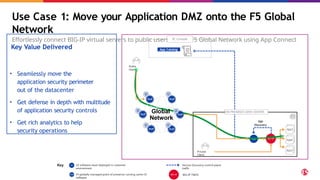
Use Case 1:Move your Application DMZ onto the F5 Global
Network
Effortlessly connect BIG-IP virtual servers to public users via the F5 Global Network using App Connect
App2
App1
App3
App Catalog
XC Console
Private
Client
Global
Network
Public
Client
ON-PREMISES DATA CENTER
App
Discovery
Key CE software stack deployed in customer
environment
Service Discovery control plane
traffic
F5 globally managed point of presence running same CE
software
BIG-IP TMOS
Key Value Delivered
• Seamlessly move the
application security perimeter
out of the datacenter
• Get defense in depth with multitude
of application security controls
• Get rich analytics to help
security operations
126.
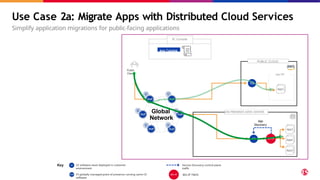
Use Case 2a:Migrate Apps with Distributed Cloud Services
Simplify application migrations for public-facing applications
App2
App1
App3
App
Discovery
App1
PUBLIC CLOUD
App VPC
Global
Network
XC Console
App Catalog
Public
Client
ON-PREMISES DATA CENTER
Key CE software stack deployed in customer
environment
Service Discovery control plane
traffic
F5 globally managed point of presence running same CE
software
BIG-IP TMOS
128.
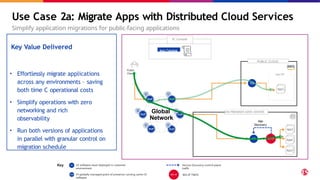
Use Case 2a:Migrate Apps with Distributed Cloud Services
Simplify application migrations for public-facing applications
App2
App1
App3
App
Discovery
App1
PUBLIC CLOUD
App VPC
Global
Network
XC Console
App Catalog
Public
Client
Key Value Delivered
• Effortlessly migrate applications
across any environments – saving
both time C operational costs
• Simplify operations with zero
networking and rich
observability
• Run both versions of applications
in parallel with granular control on
migration schedule
ON-PREMISES DATA CENTER
Key CE software stack deployed in customer
environment
Service Discovery control plane
traffic
F5 globally managed point of presence running same CE
software
BIG-IP TMOS
129.
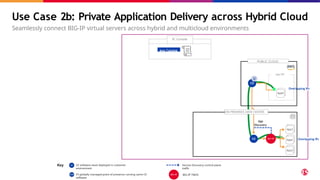
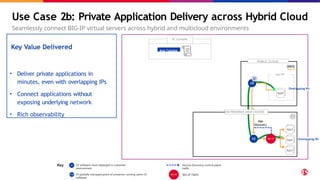
Use Case 2b:Private Application Delivery across Hybrid Cloud
Seamlessly connect BIG-IP virtual servers across hybrid and multicloud environments
Overlapping IPs
XC Console
App Catalog
App2
App1
App3
App4
PUBLIC CLOUD
App VPC
Overlapping IPs
ON-PREMISES DATA CENTER
App
Discovery
Key CE software stack deployed in customer
environment
Service Discovery control plane
traffic
F5 globally managed point of presence running same CE
software
BIG-IP TMOS
131.
Use Case 2b:Private Application Delivery across Hybrid Cloud
Seamlessly connect BIG-IP virtual servers across hybrid and multicloud environments
Overlapping IPs
XC Console
App Catalog
CE software stack deployed in customer
environment
Key Service Discovery control plane
traffic
App2
App1
App3
App
Discovery
App4
PUBLIC CLOUD
App VPC
Overlapping IPs
Key Value Delivered
• Deliver private applications in
minutes, even with overlapping IPs
• Connect applications without
exposing underlying network
• Rich observability
F5 globally managed point of presence running same CE
software
BIG-IP TMOS
ON-PREMISES DATA CENTER
132.
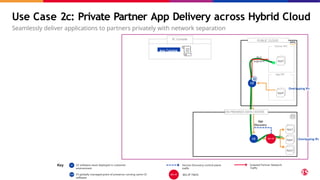
Use Case 2c:Private Partner App Delivery across Hybrid Cloud
Seamlessly deliver applications to partners privately with network separation
Overlapping IPs
XC Console
App Catalog
CE software stack deployed in customer
environment
Key Service Discovery control plane
traffic
App2
App1
App3
App4
PUBLIC CLOUD
App VPC
Overlapping IPs
App5
Partner VPC
Red
Segment
Isolated Partner Network
Traffic
ON-PREMISES DATA CENTER
App
Discovery
F5 globally managed point of presence running same CE
software
BIG-IP TMOS
134.
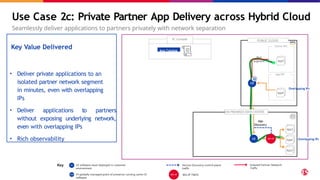
Use Case 2c:Private Partner App Delivery across Hybrid Cloud
Seamlessly deliver applications to partners privately with network separation
Overlapping IPs
XC Console
App Catalog
App2
App1
App3
App
Discovery
App4
PUBLIC CLOUD
App VPC
Overlapping IPs
App5
Partner VPC
Red
Segment
Key Value Delivered
• Deliver private applications to an
isolated partner network segment
in minutes, even with overlapping
IPs
• Deliver applications to partners
without exposing underlying network,
even with overlapping IPs
• Rich observability
Key Isolated Partner Network
Traffic
CE software stack deployed in customer
environment
Service Discovery control plane
traffic
F5 globally managed point of presence running same CE
software
BIG-IP TMOS
ON-PREMISES DATA CENTER
135.
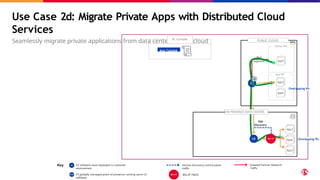
Use Case 2d:Migrate Private Apps with Distributed Cloud
Services
Seamlessly migrate private applications from data centers to the cloud
Overlapping IPs
XC Console
App Catalog
App2
App1
App3
App4
PUBLIC CLOUD
App VPC
Overlapping IPs
App5
Partner VPC
Red
Segment
App2
ON-PREMISES DATA CENTER
App
Discovery
Key Isolated Partner Network
Traffic
CE software stack deployed in customer
environment
Service Discovery control plane
traffic
F5 globally managed point of presence running same CE
software
BIG-IP TMOS
137.
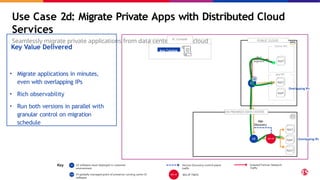
Use Case 2d:Migrate Private Apps with Distributed Cloud
Services
Seamlessly migrate private applications from data centers to the cloud
Overlapping IPs
XC Console
App Catalog
App2
App1
App3
App
Discovery
App4
PUBLIC CLOUD
App VPC
Overlapping IPs
App5
Partner VPC
Red
Segment
App2
CE software stack deployed in customer
environment
Key Service Discovery control plane
traffic
Isolated Partner Network
Traffic
Key Value Delivered
• Migrate applications in minutes,
even with overlapping IPs
• Rich observability
• Run both versions in parallel with
granular control on migration
schedule
F5 globally managed point of presence running same CE
software
BIG-IP TMOS
ON-PREMISES DATA CENTER
138.
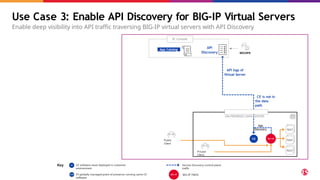
Use Case 3:Enable API Discovery for BIG-IP Virtual Servers
Enable deep visibility into API traffic traversing BIG-IP virtual servers with API Discovery
Public
Client
API
Discovery SECOPS
API logs of
Virtual Server
App2
App1
App3
Private
Client
CE software stack deployed in customer
environment
Key Service Discovery control plane
traffic
App Catalog
XC Console
CE is not in
the data
path
ON-PREMISES DATA CENTER
App
Discovery
F5 globally managed point of presence running same CE
software
BIG-IP TMOS
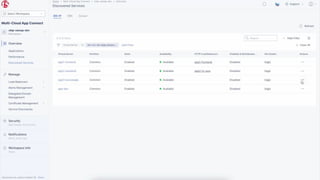
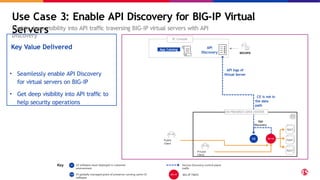
Use Case 3:Enable API Discovery for BIG-IP Virtual
Servers
Enable deep visibility into API traffic traversing BIG-IP virtual servers with API
Discovery
Public
Client
API
Discovery SECOPS
API logs of
Virtual Server
CE is not in
the data
path
App2
App1
App3
Private
Client
F5 globally managed point of presence running same CE
software
CE software stack deployed in customer
environment
Key
BIG-IP TMOS
Service Discovery control plane
traffic
App Catalog
XC Console
Key Value Delivered
• Seamlessly enable API Discovery
for virtual servers on BIG-IP
• Get deep visibility into API traffic to
help security operations
ON-PREMISES DATA CENTER
App
Discovery
141.
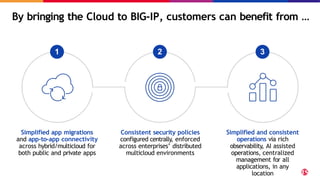
By bringing theCloud to BIG-IP, customers can benefit from …
1 2 3
Simplified app migrations
and app-to-app connectivity
across hybrid/multicloud for
both public and private apps
Consistent security policies
configured centrally, enforced
across enterprises’ distributed
multicloud environments
Simplified and consistent
operations via rich
observability, AI assisted
operations, centralized
management for all
applications, in any
location
142.
Learn about enhancingBIG-IP with F5 Distributed Cloud
1 2 3
DevCentral
Article
Teachable Course Technical Documentation
143.
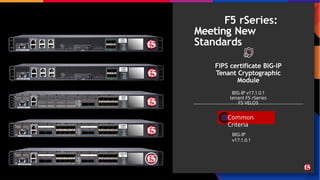
F5 rSeries:
Meeting New
Standards
FIPScertificate BIG-IP
Tenant Cryptographic
Module
BIG-IP v17.1.0.1
tenant F5 rSeries
F5 VELOS
BIG-IP
v17.1.0.1
FIPS
Common
Criteria
144.
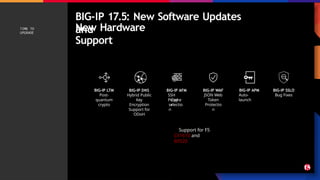
BIG-IP 17.5: NewSoftware Updates
and
New Hardware
Support
BIG-IP LTM
Post-
quantum
crypto
BIG-IP DNS
Hybrid Public
Key
Encryption
Support for
ODoH
BIG-IP AFM
SSH
Proxy
Ciphe
r
selectio
n
BIG-IP WAF
JSON Web
Token
Protectio
n
BIG-IP APM
Auto-
launch
BIG-IP SSLO
Bug Fixes
Support for F5
CX1610 and
BX520
TIME TO
UPGRADE
145.
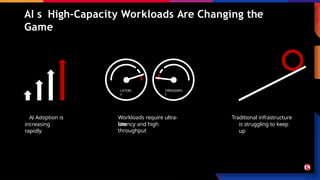
LATENC
Y
AI s High-CapacityWorkloads Are Changing the
Game
AI Adoption is
increasing
rapidly
Workloads require ultra-
low
latency and high
throughput
Traditional infrastructure
is struggling to keep
up
THROUGHPU
T
146.
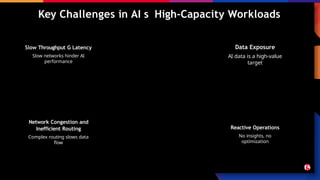
Key Challenges inAI s High-Capacity Workloads
Network Congestion and
Inefficient Routing
Complex routing slows data
flow
Slow Throughput G Latency
Slow networks hinder AI
performance
Reactive Operations
No insights, no
optimization
Data Exposure
AI data is a high-value
target
147.
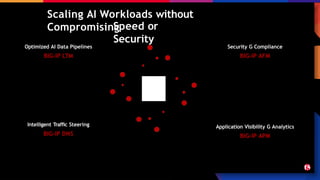
Scaling AI Workloadswithout
Compromising
Intelligent Traffic Steering
BIG-IP DNS
Optimized AI Data Pipelines
BIG-IP LTM
Application Visibility G Analytics
BIG-IP APM
Security G Compliance
BIG-IP AFM
Speed or
Security
148.
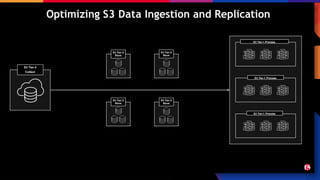
Optimizing S3 DataIngestion and Replication
S3 Tier-1 Process
S3 Tier-1 Process
S3 Tier-1 Process
S3 Tier-2
Store
S3 Tier-2
Store
S3 Tier-2
Store
S3 Tier-3
Collect
S3 Tier-2
Store
149.
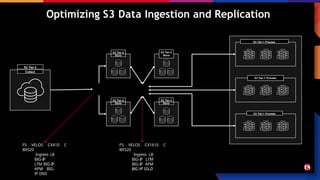
Optimizing S3 DataIngestion and Replication
S3 Tier-1 Process
S3 Tier-1 Process
S3 Tier-1 Process
S3 Tier-2
Store
S3 Tier-2
Store
S3 Tier-2
Store
S3 Tier-3
Collect
S3 Tier-2
Store
S3 Tier-2
Store
S3 Tier-2
Store
F5 VELOS CX410 C
BX520
Ingress LB
BIG-IP
LTM BIG-IP
APM BIG-
IP DNS
F5 VELOS CX1610 C
BX520
Ingress LB
BIG-IP LTM
BIG-IP AFM
BIG-IP SSLO
150.
F5 VELOS helpsorganizations achieve unmatched performance, reliability,
and security for mission-critical applications, safeguarding workloads and
reducing downtime in high-performance environments.
UNCOMPROMISED SPEED
AND SECURITY:
F5 VELOS MODULAR ADC
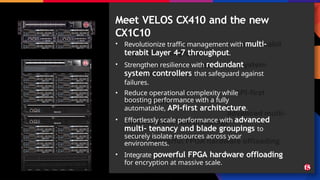
151.
• Revolutionize trafficmanagement with multi-
terabit Layer 4-7 throughput.
• Strengthen resilience with redundant
system controllers that safeguard against
failures.
• Reduce operational complexity while
boosting performance with a fully
automatable, API-first architecture.
• Effortlessly scale performance with advanced
multi- tenancy and blade groupings to
securely isolate resources across your
environments.
• Integrate powerful FPGA hardware offloading
for encryption at massive scale.
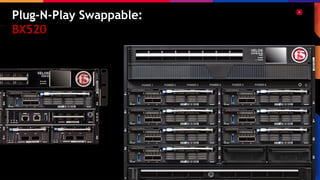
Meet VELOS CX410 and the new
CX1C10
152.
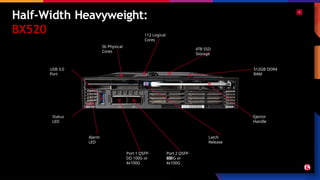
Half-Width Heavyweight:
BX520
56 Physical
Cores
112Logical
Cores
4TB SSD
Storage
512GB DDR4
RAM
Ejector
Handle
Latch
Release
Port 2 ǪSFP-
DD
400G or
4x100G
Port 1 ǪSFP-
DD 100G or
4x100G
Alarm
LED
Status
LED
USB 3.0
Port
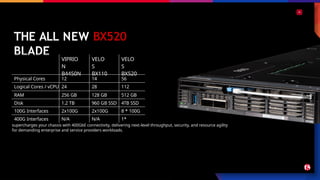
THE ALL NEWBX520
BLADE
supercharges your chassis with 400GbE connectivity, delivering next-level throughput, security, and resource agility
for demanding enterprise and service providers workloads.
VIPRIO
N
B4450N
VELO
S
BX110
VELO
S
BX520
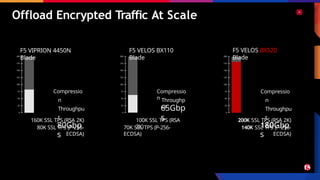
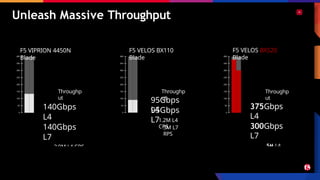
Physical Cores 12 14 56
Logical Cores / vCPU 24 28 112
RAM 256 GB 128 GB 512 GB
Disk 1.2 TB 960 GB SSD 4TB SSD
100G Interfaces 2x100G 2x100G 8 * 100G
400G Interfaces N/A N/A 1*
155.
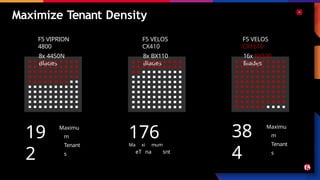
Maximize Tenant Density
F5VIPRION
4800
8x 4450N
Blades
F5 VELOS
CX410
8x BX110
Blades
F5 VELOS
CX1610
16x BX520
Blades
19
2
Maximu
m
Tenant
s
176
Ma
eT
xi
na
mum
snt
38
4
Maximu
m
Tenant
s
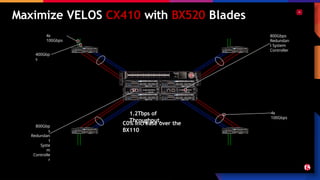
Maximize VELOS CX410with BX520 Blades
800Gbps
Redundan
t System
Controller
800Gbp
s
Redundan
t
Syste
m
Controlle
r
4x
100Gbps
4x
100Gbps
400Gbp
s
1.2Tbps of
Throughput.
C0% Increase over the
BX110
159.
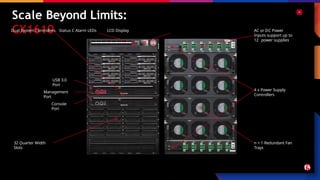
Scale Beyond Limits:
CX1610
USB3.0
Port
32 Ǫuarter Width
Slots
AC or DC Power
Inputs support up to
12 power supplies
n + 1 Redundant Fan
Trays
Console
Port
Management
Port
Dual System Controllers Status C Alarm LEDs LCD Display
4 x Power Supply
Controllers
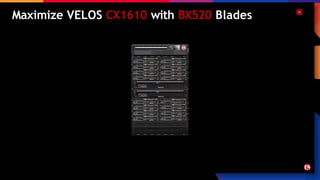
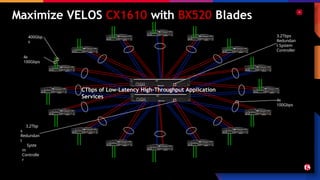
Maximize VELOS CX1610with BX520 Blades
3.2Tbps
Redundan
t System
Controller
3.2Tbp
s
Redundan
t
Syste
m
Controlle
r
4x
100Gbps
4x
100Gbps
400Gbp
s
CTbps of Low-Latency High-Throughput Application
Services
162.
Take advantage of
F5’s
generoustrade-in offers
UNLEAS
Visit the App Delivery Showcase to Learn more
about the VELOS CX1C10 s
BX520
H MASSIVE
THROUGHPUT
163.
The F5 ApplicationDelivery
and Security Platform
Presenter | Presenter title
164.
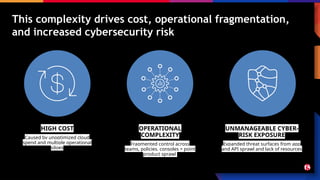
This complexity drivescost, operational fragmentation,
and increased cybersecurity risk
HIGH COST
Caused by unoptimized cloud
spend and multiple operational
siloes
OPERATIONAL
COMPLEXITY
Fragmented control across
teams, policies, consoles = point
product sprawl
UNMANAGEABLE CYBER-
RISK EXPOSURE
Expanded threat surfaces from app
and API sprawl and lack of resources
165.
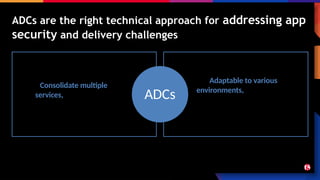
ADCs are theright technical approach for addressing app
security and delivery challenges
Consolidate multiple
services, reducing the
number of network bumps.
Adaptable to various
environments, like physical
data centers, service meshes,
and far edge environments, etc.
ADCs
166.
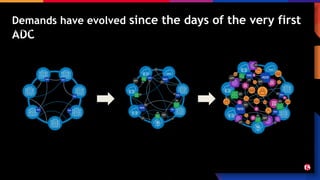
Demands have evolvedsince the days of the very first
ADC
The ADC began as a consolidated, physical platform. Cloud and containerization rendered this approach
impractical.
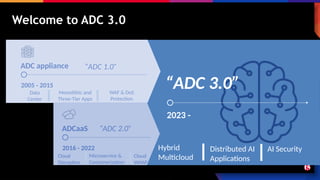
167.
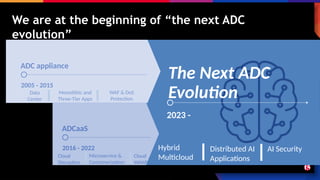
2023 -
Hybrid
Multicloud
Distributed AI
Applications
AISecurity
Data
Center
2005 - 2015
ADC appliance
Monolithic and
Three-Tier Apps
WAF & DoS
Protection
We are at the beginning of “the next ADC
evolution”
The Next ADC
Evolution
F5 CONFIDENTIAL – NOT FOR EXTERNAL USE
Cloud
Disruption
2016 - 2022
ADCaaS
Microservice &
Containerization
Cloud
WAAP
168.
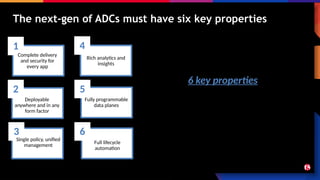
The next-gen ofADCs must have six key properties
F5 CONFIDENTIAL –
NOT FOR EXTERNAL
USE
1
2
3
4
5
6
Complete delivery
and security for
every app
Deployable
anywhere and in any
form factor
Single policy, unified
management
Rich analytics and
insights
Fully programmable
data planes
Full lifecycle
automation
Next-generation ADCs must have
these 6 key properties to meet
organizational demands
in the AI era.
169.
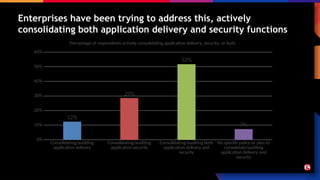
Enterprises have beentrying to address this, actively
consolidating both application delivery and security functions
F5 State of Application Strategy 2024
NOV-DEC 2023 Global Survey of 632 IT decision makers
ALL verticals and geographies represented
Consolidating/auditing
application delivery
Consolidating/auditing
application security
Consolidating/auditing both
application delivery and
security
No specific policy or plan to
consolidate/auditing
application delivery and
security
0%
10%
20%
30%
40%
50%
60%
12%
29%
52%
7%
Percentage of respondents actively consolidating application delivery, security, or both
170.
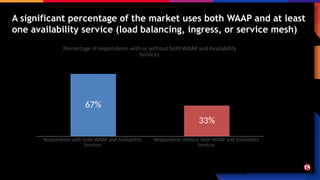
A significant percentageof the market uses both WAAP and at least
one availability service (load balancing, ingress, or service mesh)
F5 State of Application Strategy 2024
NOV-DEC 2023 Global Survey of 632 IT decision makers
ALL verticals and geographies represented
Respondents with both WAAP and Availability
Services
Respondents without both WAAP and Availability
Services
67%
33%
Percentage of respondents with or without both WAAP and Availability
Services
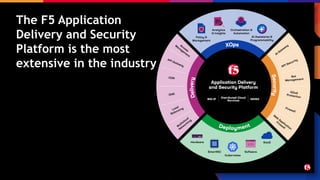
• Converges appand API security with high-
performance delivery—all in a single platform.
• Is API-driven and enables consistent policies
across environments.
• Provides rich analytics, and leverages AI
assistants to greatly simplify operational
workflows.
• Runs where you need it:
o close to your applications on hardware
o on digital processing units (DPU) for AI
applications
o in containerized environments like
Kubernetes
o in software or in SaaS environments.
The F5 Application
Delivery and Security
Platform is the most
extensive in the industry
F5 CONFIDENTIAL – NOT
FOR EXTERNAL USE
177.
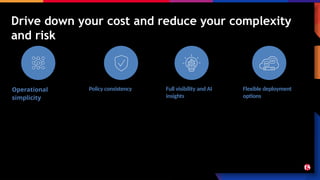
Drive down yourcost and reduce your complexity
and risk
Operational
simplicity
Reduce the complexity
and costs that come with
managing disparate point
products that aren’t
interoperable and lack
integration
Policy consistency
Enable every app, app
component and API—at
the edge or in the cloud—
to benefit from
consistent,
comprehensive security
and delivery.
Full visibility and AI
insights
Full automation and high
programmability
streamline workloads
while visibility and AI
insights across the
portfolio improve
outcomes.
Flexible deployment
options
Run close to your apps on
hardware; on DPUs or AI
apps; in containers like
Kubernetes; on software;
or via SaaS.
178.
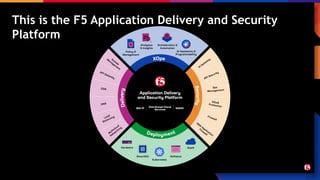
This is theF5 Application Delivery and Security
Platform
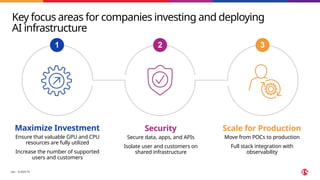
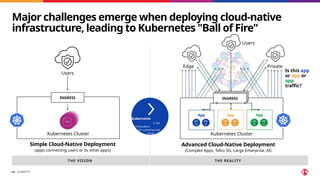
#164 We also hear from our customers—across all industries and sizes—about the challenges experienced given that Ball of Fire. We know you feel the pain and we hear about these three things over and over again–
High cost: Our customers manage apps and APIs across environments and that sprawl results in high costs across departments. At the same time, they’re asked to do more with less and need to find ways to break down silos and/or consolidate.
Operational complexity: The proliferation of policies and systems to manage has created a complexity that is hard to unwind and hard to explain to those who aren’t in the tools day in and day out.
Unmanageable cyber-risk exposure: Its hard to find the talent you need to cover the range of environments your applications live in. And as shadow IT, or app and API sprawl has continued to increase your teams know the expanded threat surfaces could expose the complexity you’re trying so hard to manage.
[Transition] click for next slide.
#165 Your ADC plays a central role in your stack, and point solutions aren’t sustainable in the hybrid, multicloud, AI era. Your point solutions might be creating these issue that an ADC can resolve-
Multi ADC integration issues created by services that don’t work well together
Limitations with form factor requiring you to buy from multiple vendors
No unified configuration or policy management
Lack of visibility across solutions
Limited programmability resulting in manual work
[Transition] Its time to think differently about your ADC – as a comprehensive technology to drives the convergence of app security and delivery solutions rather than a foundational technology that requires other tech to be layered on top.
#166 Why do we think that ADCs are the right approach? We’ve watched the space of ADCs evolve and a new generation of ADCs are required to meet the demands of our environment today.
At that start: The rise of data centers: Primarily hardware or virtual appliances, first-gen ADCs supported critical functions like load balancing, content caching, and web application security. In this period, most applications were deployed and accessed in data centers.
Then we saw disruption with the cloud: Cloud computing started the migration of applications and services to the cloud. This includes cloud-native offerings with automated updates and expanded capabilities thrived. But, by the end of era, it became clear that complex architectures across hybrid, multicloud environments were here to stay.
And today, our reality is hybrid multicloud: Apps, APIs and components are highly distributed. And AI workloads have only added to the immense complexity
[Transition] Going forward, ADCs must evolve to be more than load balancing or just incremental improvements over their predecessors.
#167 We are at the advent of a new ADC era…
Organizations like yours have been on a digital journey from monolithic applications to microservices and AI apps, from data centers to hybrid multi-cloud app deployments, from attackers seeking notoriety to malicious AI-powered attacks.
This journey has led to point-product proliferation, each one designed to address a specific threat or use case. Deploying, operating and updating these point products is resource intensive, creates security gaps, and drives complexity.
[Transition] We are at the advent of a new ADC era. One that addresses the challenges of hybrid multicloud, distributed AI apps and AI driven security as well as securing AI itself.
#168 We believe that these next-generation ADCs must have these six key properties to meet organizational demands in the hybrid, multicloud AI era.
They are:
Complete security and delivery for every app in a single platform that simplifies management for IT and security teams.
Deployable in any form factor to run seamlessly across today’s diverse IT environments.
Single policy, unified management across all locations to reduce complexity and improve efficiency.
Rich analytics and insights that are relevant and actionable to improve performance and strengthen the security of today’s complex applications.
Fully programmable data planes that enable automated deployment and custom functionality so organizations can effectively adapt to changing needs.
Full lifecycle automation that allows teams to focus on delivering innovation and stop drowning in maintenance tasks.
[Transition] In fact, we’ve found through conversations with organizations like yours, that many are trying to achieve aspects of this… through consolidation of key functions.
#169 Our State of Application Security Report 2024 found over half of enterprises surveyed are attempting to consolidate both app delivery and security.
[Transition] click for next slide.
#170 In many cases it looks like this…
It’s WAAP along with at least one major availability service.
[Transition] The problem here though, it that it’s still the stitching together of point products that lack CONVERGENCE across the hybrid landscape…
#171 OPTIONAL SLIDE
To add to this already complex scenarios, AI application architecture patterns will cause the component building blocks of AI apps to be more distributed. They will be deployed across multiple public clouds and on-premises
The nature of AI interactions and introduction of new data sources will require increased data-related security capabilities.
60% of enterprises will adopt multiple models (routing prompts to the most cost-effective model) https://menlovc.com/2023-the-state-of-generative-ai-in-the-enterprise-report/
[Transition] click for next slide.
#172 A platform approach is needed…
[Transition] click to next slide
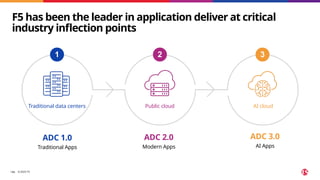
#173 That’s where, what we call ADC 3.0, comes into play. It reimagines what an ADC can and should be.
[Transition] Click for next slide
#174 At f5, we are fully implanting this ADC 3.0 vision.
[Transition] click for next slide.
#175 Bringing to market a converged app delivery and security platform—delivering on the six major properties required for our AI-driven, hybrid multicloud era.
[Transition] click for next slide.
#176 Introducing the F5 Application Delivery and Security Platform
[Transition] click for next slide.
#177 The F5 Application Delivery and Security Platform:
Makes your working life easier by converging app and API security and high-performance delivery within a single platform.
Is API-driven and enables consistent policies across environments.
Provides rich analytics, and leverages AI assistants to greatly simplify operational workflows.
Runs close to your applications on hardware; on digital processing units (DPU) for AI applications; in containerized environments like Kubernetes; in software; or in SaaS environments.
[Transition] click for next slide.
#178 What this means for you: Ultimately, you can drive down cost and reduce complexity and risk when you:
Stop stitching together point products—you can’t. They’re disparate.
Gain policy consistency across environments
Have full visibility across the infrastructure and get help with AI insights on how to drive more efficiencies
Deploy the way your businesses needs to, with the flexibility to change course in the future
[Secondary slide option following with different language]
#179 [Optional slide language]
What this means for you: Ultimately, you can drive down cost and reduce complexity and risk when you:
Stop stitching together point products—you can’t. They’re disparate.
Gain policy consistency across environments
Have full visibility across the infrastructure and get help with AI insights on how to drive more efficiencies
Deploy the way your businesses needs to, with the flexibility to change course in the future
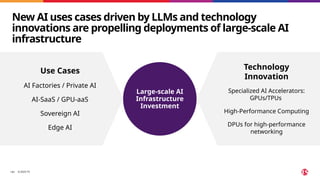
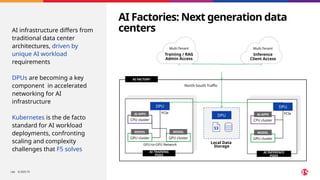
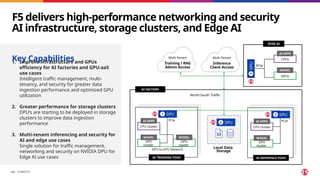
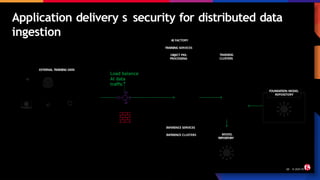
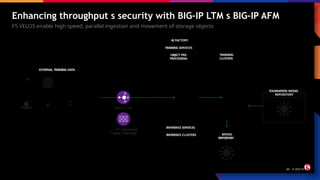
#196 These AI factories differ from traditional data center architectures, driven by the unique requirements of AI workloads
Let’s take a look at a high-level the architecture of a typical Ai factory. DECRIBE DIAGRAM
There are two key technologies we will focus in on today that are core to these new AI factories
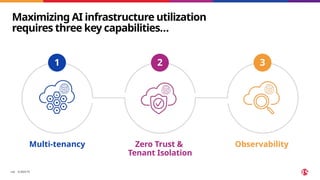
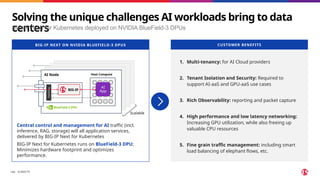
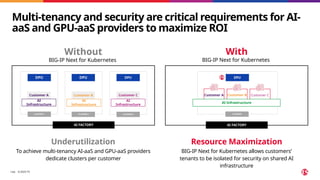
DPUs which allow for accelerated networking, and Kubernetes which is the de facto standard for AI workload deployments



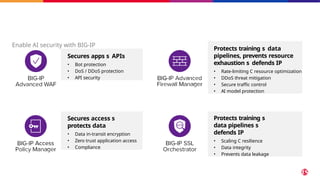
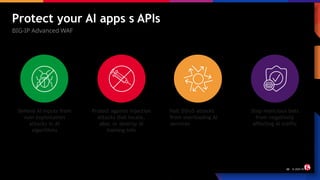
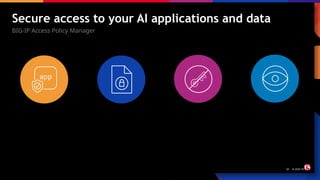
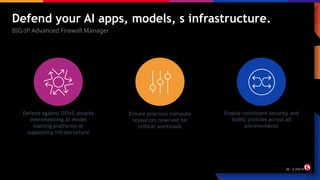



![Inside the CE software stack -
Mesh
API
Security
WAF
Proxy
Load
Balancer
Firewal
l
Routin
g
Applicatio
n Delivery
Controller
Mesh
Integrated High Performance
Networking Stack [L3-L7]
App Stack
Identit
y
Service
Discovery
Secrets
Mgmt.
Distributed
Application [Fleet]
Cluster
Managemen
t
Compute
Platform
Service
Control
Simplified Application
Infrastructure Stack
1](https://image.slidesharecdn.com/appworld2025finalppt1-250415234510-09b39282/85/knowledgeforthebestofthe_bestestguy-pptx-108-320.jpg)