
Download to read offline
![SSR Inst. Int. J. Life Sci. ISSN (O): 2581-8740 | ISSN (P): 2581-8732
Gupta and Nagar, 2020
DOI: 10.21276/SSR-IIJLS.2020.6.4.6
Copyright © 2015 - 2020| SSR-IIJLS by Society for Scientific Research under a CC BY-NC 4.0 International License Volume 06 | Issue 04 | Page 2640
Solid State Fermentation of Wheat Bran for Production of
Glucoamylase by Aspergillus niger
Khushboo Gupta1
*, S. J. Nagar2
1
Student, Department of Biochemical Engineering, HBTU, Kanpur, India
2
Professor, Department of Biochemical Engineering, HBTU, Kanpur, India
*Address for Correspondence: Khushboo Gupta, Student, Department of Biochemical Engineering, HBTU, Kanpur,
India
E-mail: anshul456gupta@gmail.com
Received: 16 Dec 2019/ Revised: 29 Jan 2020/ Accepted: 22 Jun 2020
ABSTRACT
Background: Glucoamylase is an exo-enzyme use for the digestion of starch. It is widely used in production of glucose from starch,
preparation of high fructose corn syrup (HFCS), baking industry, and alcohol production etc.
Methods: The present study was deals with the optimization (pH, Temperature, inoculum size, inoculum age, carbon source, and
nitrogen source) of the production media (wheat bran) for the production of glucoamylase from Aspergillus niger.
Results: optimized study suggested that the highest production of glucoamylase was observed at 35oC temperature, pH 6,
inoculum size 15% at 5 day inoculum age. Best production of glucoamylase was observed as 0.6932 U/ml at the optimized
condition.
Conclusion: Wheat bran is a good source for the production glucoamylase by A. niger. Glucoamylase can be produced by A. niger
through solid state fermentation of wheat bran. Pre-treatment of wheat bran can improve the production of glucoamylase.
Key-words: - Aspergillus niger, Glucoamylase, Solid state fermentation, SSF, Wheat bran production of glucoamylase
INTRODUCTION
It is an exo-enzyme use for the hydrolysis of
carbohydrate. Chemically, it is also known as α- 1,4
glucan glycohydrolase in which glucan refers to a
sequence of connected glucose units and glycohydrolase
made up of glycol and hydrolyse, which mines
breakdown of glycosidic linkage present in between two
glucose units. The enzyme identification code allocated
to the Commission for Enzymes EC 3.2.1.3 by IUBM1992.
Number 3 denotes the hydrolysis of large sugar molecule
by the addition of water. While number 2 denote the
glycosidase, which breaks the glycoside linkage present
in between two glucose molecule [1]
. Wheat bran is part
of wheat so it contains many nutrients like protein,
carbohydrate, fat, and fibres etc. the average content of
protein, carbohydrate, fat, fibres and phosphorus are
16.4%, 65%, 4.5%, 6%, and 1.29% respectively.
How to cite this article
Gupta K, Nagar SJ. Solid State Fermentation of Wheat Bran for
Production of Glucoamylase by Aspergillus niger. SSR Inst. Int. J.
Life Sci., 2020; 6(4): 2640-2645.
Access this article online
https://iijls.com/
The 0.13% trace amount of calcium’s obtained in
previous report, given by the Islam et al. [2]
. The
glucoamylase can be produced by different type of
microorganisms such as bacteria, fungus, and yeast. A.
niger can produce different proteolytic enzyme,
carbohydrate enzyme, and hydrolytic enzyme etc [3]
.
The nutrient content of fibre can support the growth of
the micro-organisms. The present study deals with the
use of cost efficient wheat bran for the solid state
fermentation for the production of glucoamylase and
evaluated the production level.
MATERIALS AND METHODS
The present study was proceed from March 2019 to June
2019 in the Department of Biochemical Engineering,
HBTU Kanpur, India.
Culture of Aspergillus niger- A. niger culture was
procured from National Chemical Laboratory, Pune
(Maharashtra), India. A. niger culture was grown on
potato dextrose agar (PDA) media and incubated at 30C
for 5 days.
Research Article](https://image.slidesharecdn.com/solidstatefermentationwheatbranproductionglucoamylaseaspergillusniger-230718115506-5fd81510/85/Solid_State_Fermentation_Wheat_Bran_Production_Glucoamylase_Aspergillus_niger-pdf-1-320.jpg)
![SSR Inst. Int. J. Life Sci. ISSN (O): 2581-8740 | ISSN (P): 2581-8732
Gupta and Nagar, 2020
DOI: 10.21276/SSR-IIJLS.2020.6.4.6
Copyright © 2015 - 2020| SSR-IIJLS by Society for Scientific Research under a CC BY-NC 4.0 International License Volume 06 | Issue 04 | Page 2640
Solid State Fermentation of Wheat Bran for Production of
Glucoamylase by Aspergillus niger
Khushboo Gupta1
*, S. J. Nagar2
1
Student, Department of Biochemical Engineering, HBTU, Kanpur, India
2
Professor, Department of Biochemical Engineering, HBTU, Kanpur, India
*Address for Correspondence: Khushboo Gupta, Student, Department of Biochemical Engineering, HBTU, Kanpur,
India
E-mail: anshul456gupta@gmail.com
Received: 16 Dec 2019/ Revised: 29 Jan 2020/ Accepted: 22 Jun 2020
ABSTRACT
Background: Glucoamylase is an exo-enzyme use for the digestion of starch. It is widely used in production of glucose from starch,
preparation of high fructose corn syrup (HFCS), baking industry, and alcohol production etc.
Methods: The present study was deals with the optimization (pH, Temperature, inoculum size, inoculum age, carbon source, and
nitrogen source) of the production media (wheat bran) for the production of glucoamylase from Aspergillus niger.
Results: optimized study suggested that the highest production of glucoamylase was observed at 35oC temperature, pH 6,
inoculum size 15% at 5 day inoculum age. Best production of glucoamylase was observed as 0.6932 U/ml at the optimized
condition.
Conclusion: Wheat bran is a good source for the production glucoamylase by A. niger. Glucoamylase can be produced by A. niger
through solid state fermentation of wheat bran. Pre-treatment of wheat bran can improve the production of glucoamylase.
Key-words: - Aspergillus niger, Glucoamylase, Solid state fermentation, SSF, Wheat bran production of glucoamylase
INTRODUCTION
It is an exo-enzyme use for the hydrolysis of
carbohydrate. Chemically, it is also known as α- 1,4
glucan glycohydrolase in which glucan refers to a
sequence of connected glucose units and glycohydrolase
made up of glycol and hydrolyse, which mines
breakdown of glycosidic linkage present in between two
glucose units. The enzyme identification code allocated
to the Commission for Enzymes EC 3.2.1.3 by IUBM1992.
Number 3 denotes the hydrolysis of large sugar molecule
by the addition of water. While number 2 denote the
glycosidase, which breaks the glycoside linkage present
in between two glucose molecule [1]
. Wheat bran is part
of wheat so it contains many nutrients like protein,
carbohydrate, fat, and fibres etc. the average content of
protein, carbohydrate, fat, fibres and phosphorus are
16.4%, 65%, 4.5%, 6%, and 1.29% respectively.
How to cite this article
Gupta K, Nagar SJ. Solid State Fermentation of Wheat Bran for
Production of Glucoamylase by Aspergillus niger. SSR Inst. Int. J.
Life Sci., 2020; 6(4): 2640-2645.
Access this article online
https://iijls.com/
The 0.13% trace amount of calcium’s obtained in
previous report, given by the Islam et al. [2]
. The
glucoamylase can be produced by different type of
microorganisms such as bacteria, fungus, and yeast. A.
niger can produce different proteolytic enzyme,
carbohydrate enzyme, and hydrolytic enzyme etc [3]
.
The nutrient content of fibre can support the growth of
the micro-organisms. The present study deals with the
use of cost efficient wheat bran for the solid state
fermentation for the production of glucoamylase and
evaluated the production level.
MATERIALS AND METHODS
The present study was proceed from March 2019 to June
2019 in the Department of Biochemical Engineering,
HBTU Kanpur, India.
Culture of Aspergillus niger- A. niger culture was
procured from National Chemical Laboratory, Pune
(Maharashtra), India. A. niger culture was grown on
potato dextrose agar (PDA) media and incubated at 30C
for 5 days.
Research Article](https://image.slidesharecdn.com/solidstatefermentationwheatbranproductionglucoamylaseaspergillusniger-230718115506-5fd81510/75/Solid_State_Fermentation_Wheat_Bran_Production_Glucoamylase_Aspergillus_niger-pdf-1-2048.jpg)
![SSR Inst. Int. J. Life Sci. ISSN (O): 2581-8740 | ISSN (P): 2581-8732
Gupta and Nagar, 2020
DOI: 10.21276/SSR-IIJLS.2020.6.4.6
Copyright © 2015 - 2020| SSR-IIJLS by Society for Scientific Research under a CC BY-NC 4.0 International License Volume 06 | Issue 04 | Page 2641
Preparation of Inoculum- Spores were used to inoculate
production medium. For sporulation, flasks containing 5
gram moistened substrate was inoculated from 5 days
old slants followed by incubation for 5 days at 30C
temp. At the end of incubation period, the fermented
mass mixed with 50 ml of sterile saline water, containing
0.1% Twin 80 and then left for 20 min. It was then
filtered to remove unwanted components of medium
from spores. Spore count was performed to adjust the
count (5107 spores/ml) in spore suspension. For
counting of spores, spread plate method was used after
serial dilution of filtered containing spores [4]
.
Glucoamylase enzyme Extraction- The glucoamylase
enzyme was estimated using the method given by Cori [5]
and the reducing sugars liberated were determined by
Dinitrosalicylic acid (DNSA) method that given by Miller
[6]
.
Preparation of standard graph of Glucose- Taken
different test tube and prepared the 1 ml different
concentrations (0, 0.2, 0.4, 0.6, 0.8, and 1 mg/ml) of
glucose by the help of distilled water and added to 1 ml
of DNS (Dinitrosalcilic acid) in each test tube and
incubated the test tube in boiling water bath at 100o
C for
10 min duration. After that cool the test tube and taken
the OD at 540 nm wavelength [6]
.
Fig. 1: Standard glucose curve of Glucose concentration
Optimization of the fermentation parameters for
glucoamylase production by using wheat bran as a
substrate-
Optimization of Carbon source- To study, the effect of
the carbon source on production glucoamylase, media
was prepared by using different 1% carbon source
(glucose, fructose, maltose, starch, and sucrose) and
media was inoculated by A. niger and incubated at 35o
C
for 5 days duration. The other fermentation parameters
were kept constant.
Optimization of Nitrogen source- To study, the effect of
the different nitrogen source on the production of
glucoamylase, 1% of different nitrogen source (urea,
peptone, yeast extract, malt extract, and ammonium
sulphate) were added in different fermentation medium
and media was inoculated by A. niger and incubated at
35o
C for 5 days duration. The other fermentation
parameters were kept constant [7]
.
Optimization of Temperature- Effect of the temperature
on glucoamylase production was also investigated to
know the optimized temperature for enzyme production.
For this, the inoculated medium was incubated for 7 days
at different temp. (25C, 30C, 35C, 40C, and 45C).
The other fermentation parameters were kept constant
[8]
.
Optimization of pH- Effect of initial pH on glucoamylase
production was investigated to know the optimum pH
for enzyme production. For this study, initial pH of
medium was adjusted to different initial pH value (3, 4,
5, 6, 7, and 8) at the end of the incubation period (7th
days) enzyme activity was determined. The other
fermentation parameters were kept constant [9]
.
Inoculum age- Inoculum of different ages (1 to 7 days
old) was used to study the effect of inoculum age on
glucoamylase production. The other fermentation
parameters were kept constant [10]
.
Inoculum level- Effect of inoculum level on glucoamylase
production was examined to know the inoculum size for
best enzyme production. Different inoculum levels
between 5–30 % (5, 10, 15, 20, 25, and 30) were used
and at the end of incubation period (7 days) the enzyme
activity was measured. Rest of the fermentation
parameters were maintained constant [11]
.
RESULTS
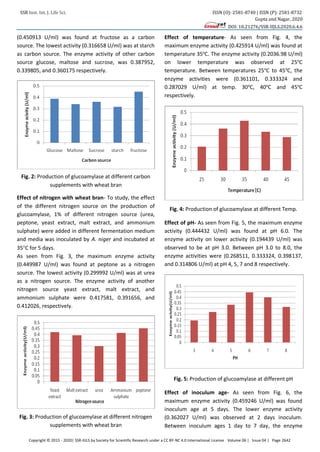
Effect of carbon with wheat bran- To study, effect of the
carbon source on production glucoamylase, media was
prepared by using 1% different carbon source (glucose,
fructose, maltose, starch, and sucrose) and media was
inoculated by A. niger and incubated at 35o
C for 5
days. As seen from Fig. 2, the maximum enzyme activity](https://image.slidesharecdn.com/solidstatefermentationwheatbranproductionglucoamylaseaspergillusniger-230718115506-5fd81510/85/Solid_State_Fermentation_Wheat_Bran_Production_Glucoamylase_Aspergillus_niger-pdf-2-320.jpg)
![SSR Inst. Int. J. Life Sci. ISSN (O): 2581-8740 | ISSN (P): 2581-8732
Gupta and Nagar, 2020
DOI: 10.21276/SSR-IIJLS.2020.6.4.6
Copyright © 2015 - 2020| SSR-IIJLS by Society for Scientific Research under a CC BY-NC 4.0 International License Volume 06 | Issue 04 | Page 2643
activities were 0.327769, 0.348138, 0.399989, 0.412026
and 0.378693 U/ml at inoculum age 1,3,4,6 and 7 day
respectively.
Fig. 6: Production of glucoamylase at different inoculum
age
Effect of inoculum level- As can be seen from Fig. 7, the
maximum enzyme activity (0.450913 U/ml) was found at
inoculum level at 15%. The lowest enzyme activity
(0.299992 U/ml) was found at 5% inoculum level.
Between inoculum level 5% to 30%, the enzyme activities
were 0.42221, 0.419433, 0.380545, and 0.3601751 U/ml
at inoculum level 10, 20, 25 and 30% respectively.
Fig. 7: Production of glucoamylase at different inoculum
level (%)
Production of glucoamylase at optimized condition-
From the above study, we got the best condition for the
production of glucoamylase from A. Niger sp. The
production of glucoamylase at fructose as a carbon
source, peptone as a nitrogen source the pH of the
media was 6 and inoculum level 15%. Media was
inoculated with 5 day old culture. At given condition
production was observed as 0.6932 U/ml.
DISCUSSION
Solid state fermentation of wheat bran give a clear idea
to utilize food waste for the production of glucoamylase
but the amount of glucoamylase produced during this
process was very less. The additional carbon and
nitrogen source was given to support the initial growth
of A. niger. Pavezzi et al. [12]
reported that potato starch
as a best substrate for the production of glucoamylase
(8.3 U/ml) by A. awamori in combination with
Saccharomyces cerevisiae, while we have reported, the
maximum production of 0.6932 U/ml, there was great
difference in the concentration of glucoamylase, this
may be due to different organism or due to different
substrate.
The current study also suggested similar results by some
researchers i.e. Pavezzi et al. [6]
, Norouzian et al. [12]
and,
Adefisoye et. al. [13]
had suggested that pH 6 was taken
for the maximum production of glucoamylase.
The similar study was done by Anto et al. [14]
suggested
that temperature play a violet role in the production of
glucoamylase, the maximum production of glucoamylase
was at 55o
C while current study suggested 35o
C for the
maximum production, this may be due to difference in
microorganism. Another previous research study done
by Lakshmi et al. [15]
that suggested that maximum
production of glucoamylase had produced by nitrogen
source i.e. peptone (a organic compound). Inoculum age
and inoculum size change with the change of
microorganism different study suggest 3 day to 7 day
inoculum age and 5 to 25% inoculum size were given by
other previous studies i.e. Kumar et al. [16]
; Selvakumar et
al. [17]
; Papagianni et al. [18]
; Kumar et al. [19]
; Arasaratnam
et al. [20]
. While this study suggest 5 day inoculum age
and 15% inoculum size, which are similar to the above
study.
CONCLUSIONS
The use of wheat bran as substrate for the production of
glucoamylase by A. niger can be a great idea for the
utilization of waste food material. For the grater
production of glucoamylase the solid state media of
wheat bran was supplemented with different carbon
source and nitrogen source. The maximum production of
glucoamylase was observed at fructose as a carbon
source, peptone at a nitrogen source. Apart from carbon
and nitrogen source some other factor likes pH (6),
inoculum level (15%) and inoculum age (5 day) also
played a vital role in the production glucoamylase.](https://image.slidesharecdn.com/solidstatefermentationwheatbranproductionglucoamylaseaspergillusniger-230718115506-5fd81510/85/Solid_State_Fermentation_Wheat_Bran_Production_Glucoamylase_Aspergillus_niger-pdf-4-320.jpg)
![SSR Inst. Int. J. Life Sci. ISSN (O): 2581-8740 | ISSN (P): 2581-8732
Gupta and Nagar, 2020
DOI: 10.21276/SSR-IIJLS.2020.6.4.6
Copyright © 2015 - 2020| SSR-IIJLS by Society for Scientific Research under a CC BY-NC 4.0 International License Volume 06 | Issue 04 | Page 2644
The present study revealed that wheat bran can be use
as substrate for the A. niger for the production of
glucoamylase but the production was very less, this may
be due to the complex nature of the wheat bran. The
production of glucoamylase can be increase by pre-
treatment of wheat bran.
ACKNOWLEDGMENTS
We would like to thank my supervisor Professor S. J.
Nagar Sir and all teaching and non-teaching staff of
Department of Biochemical Engineering.
CONTRIBUTION OF AUTHORS
Research concept- S. J. Nagar
Research design- Khushboo Gupta
Supervision- S. J. Nagar
Materials- Khushboo Gupta
Data collection- Khushboo Gupta
Data analysis and Interpretation- Khushboo Gupta, S. J.
Nagar
Literature search- Khushboo Gupta
Writing article- Khushboo Gupta
Critical review- S. J. Nagar
Article editing- S. J. Nagar
Final approval- S. J. Nagar
REFERENCES
[1] Reilly PJ. Protein engineering of glucoamylase to
improve industrial performance-A review. Starch‐
Starke, 1999; 51(8‐9): 269-74.
[2] Islam MS, Khan M, Reza A. Effect of wheat bran
substitution for corn and dehydrated Alfalfa on
finishing Lambs. Bangladesh J. Animal Sci., 2009;
38(1-2): 61-66.
[3] Nielsen KF, Mogensen JM, Johansen M, Larsen TO,
Frisvad JC. Review of secondary metabolites and
mycotoxins from the Aspergillus niger
group. Analytical Bioanalytical. Chem., 2009; 395(5):
1225-42.
[4] Espinel-Ingroff A, Kerkering TM, Spectrophotometric
method of inoculum preparation for the in vitro
susceptibility testing of filamentous fungi. J. Clin.
Microbiol., 1991; 29(2): 393-94.
[5] Miller GL. Modified DNS method for reducing
sugars. Analytical chem., 1959; 31(3): 426-28.
[6] Pavezzi FC, Gomes E, Silva RD. Production and
characterization of glucoamylase from fungus
Aspergillus awamori expressed in yeast
Saccharomyces cerevisiae using different carbon
sources. Braz. J. Microbiol., 2008; 39(1): 108-14.
[7] Khan A, Butt WA, Ali S, Qadeer MA. Effect of carbon
and nitrogen sources on xylanase production by
mutant strain of Aspergillus niger GCBMX-45. J. Biol.
Sci., 2002; 2(2): 143-44.
[8] Shivanna GB, Venkateswaran G. Phytase production
by Aspergillus niger CFR 335 Aspergillus ficuum SGA
01 through submerged and solid-state fermentation.
Sci. World J., 2014; 392615.
[9] Vu VH, Pham TA, Kim K. Improvement of fungal
cellulase production by mutation and optimization of
solid state fermentation. Mycobiol., 2011; 39(1):
20-25.
[10]Kaur P, Satyanarayana T. Production and starch
saccharification by a thermostable and neutral
glucoamylase of a thermophilic mould Thermomucor
indicae-seudaticae. World J. Microbiol. Biotechnol.,
2004; 20(4): 419-25.
[11]Kumar MS, Lakshmi MV, Sridevi V. Production and
optimization of Glucoamylase from wheat bran by
Aspergillus oryzae NCIM 1212 under Solid State
Fermentation. Int. J. Appl. Innov. Eng. Manage, 2013;
2(10): 318-23.
[12]Norouzian D, Akbarzadeh A, Scharer JM, Young MM.
Fungal glucoamylases. Biotechnol. Adv., 2006; 24(1):
80-85.
[13]Adefisoye SA, Sakariyau AO Production of
Glucoamylase by Aspergillus niger in Solid
State Fermentation, Adv. Biol. Res., 2018, 12 (1):
07-11.
[14]Anto H, Trivedi UB, Patel KC. Glucoamylase
production by solid-state fermentation using rice
flake manufacturing waste products as substrate.
Bioresource Technol., 2006; 97(10): 1161-66.
[15]Lakshmi MMVC, Jyothi P. Production and
optimization of Glucoamylase from Aspergillus
oryzae NCIM 1212 using wheat bran, varying
chemical parameters under solid state fermentation.
Int. J. Curr. Microbiol. App. Sci., 2014; 3(5): 70-76.
[16]Kumar MS, Lakshmi MV, Sridevi V. Production and
optimization of Glucoamylase from wheat bran by
Aspergillus oryzae NCIM 1212 under Solid State
Fermentation. Int. J. Appl. Innov. Eng. Manage, 2013;
2(10): 318-23.
[17]Selvakumar P, Ashakumary L, Pandey A. Biosynthesis
of glucoamylase from Aspergillus niger by solid-state](https://image.slidesharecdn.com/solidstatefermentationwheatbranproductionglucoamylaseaspergillusniger-230718115506-5fd81510/85/Solid_State_Fermentation_Wheat_Bran_Production_Glucoamylase_Aspergillus_niger-pdf-5-320.jpg)
![SSR Inst. Int. J. Life Sci. ISSN (O): 2581-8740 | ISSN (P): 2581-8732
Gupta and Nagar, 2020
DOI: 10.21276/SSR-IIJLS.2020.6.4.6
Copyright © 2015 - 2020| SSR-IIJLS by Society for Scientific Research under a CC BY-NC 4.0 International License Volume 06 | Issue 04 | Page 2645
fermentation using tea waste as the basis of a solid
substrate. Bioresour. Technol., 1998; 65(1-2): 83-85.
[18]Papagianni M, Moo-Young M. Protease secretion in
glucoamylase producer Aspergillus niger cultures:
Fungal morphology and inoculum effects. Process
Biochem., 2002; 37(11): 1271-78.
[19]Kumar S, Kumar P, Satyanarayana T. Production of
raw starch-saccharifying thermostable and neutral
glucoamylase by the thermophilic mold
Thermomucor indicae-seudaticae in submerged
fermentation. Appl. Biochem. Biotechnol., 2007;
142(3): 221-30.
[20]Arasaratnam VA, Mylvaganam KE, Balasubramaniam
KA. Glucoamylase production by Aspergillus niger in
solid state fermentation with paddy husk as support.
J. Food sci. Technol. Mysore, 2001; 38(4): 334-38.
Open Access Policy:
Authors/Contributors are responsible for originality, contents, correct references, and ethical issues. SSR-IIJLS publishes all articles under Creative
Commons Attribution- Non-Commercial 4.0 International License (CC BY-NC). https://creativecommons.org/licenses/by-nc/4.0/legalcode](https://image.slidesharecdn.com/solidstatefermentationwheatbranproductionglucoamylaseaspergillusniger-230718115506-5fd81510/85/Solid_State_Fermentation_Wheat_Bran_Production_Glucoamylase_Aspergillus_niger-pdf-6-320.jpg)
The study explores the production of glucoamylase, an enzyme for starch digestion, using solid state fermentation of wheat bran with Aspergillus niger. Optimal production conditions were found to be at 35°C, pH 6, with a 15% inoculum size and a 5-day old culture, yielding 0.6932 u/ml of glucoamylase. This research highlights the potential of utilizing food waste like wheat bran for enzyme production, while also addressing factors such as carbon and nitrogen sources that impact yield.


