Knowledge Formulation for AI Planning Lee McCluskey Ron Simpson Artform research group Department of Computing and Mathematical Sciences, The University of Huddersfield Artform
Contents  Background + Problems in KE for AI Planning Automated acquisition by generic object patterns Automated acquisition by induction Advertising some KE+AI planning things Ontology-free talk
A I Planning and Scheduling has moved on… THEN NOW B A Goal A B Initial
Missing Layer… Inference Logic RDF XML Trust Semantic Web Not just pre- condition achieventt! B A Goal A B Initial
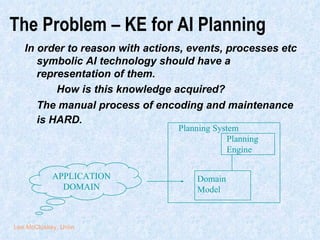
The Problem – KE for AI Planning In order to reason with actions, events, processes etc symbolic AI technology should have a representation of them.  How is this knowledge acquired?  The manual process of encoding and maintenance is HARD.   APPLICATION DOMAIN Domain Model Planning Engine Planning System
Background and Research Aim  Our area: algorithms and representations for AI plan generation technology.  Our aim is to make the technology more accessible and usable.  The knowledge engineering method/tools should reduce the complexity of the creation process by  abstraction (eg  of “mathematical details”)  reuse (eg planning patterns, import ontologies) early error ID (static/dynamic tests)  Eventually we would like to construct an autonomous knowledge acquisition agent for planning problems .
Results of early work: GIPO  http://scom.hud.ac.uk/planform/gipo/
GIPO – versions GIPO 1.1 Downloadable For ‘Flat’ models (ECP’01) GIPO 2 Downloadable For hierarchical models (ICAPS’03) GIPO+ For models with cts time, events and processes (PlanSig’03) GIPO 1.2 Incorporating first  version operator  induction (AIPS’02)
Problems  GIPO has a user-base but problems prevent it from being very effective:  Dosen’t hide tricky parameter manipulation Re-use only of existing models (not abstract) also ‘re-factoring’ hard Still have to be a Planning/KE expert to use In the paper we detail two ‘high level’ approaches that suppress some of the mathematical details and (we claim) make the KE process more efficient
Example in paper:The Lazy Hiking World Imagine Sue and Fred want to have a hiking holiday in the Lake District in North West England. They walk in one direction, and do one ``leg'' each day. But not being very fit, they use two cars to carry them / the tent / their luggage to the start/end of a leg. They must have their tent up already so they can sleep the night, before they set off again to do the next leg in the morning.  Actions include walking,  driving, moving and erecting tents, and sleeping. The requirement for the planner is to work out the logistics and generate plans for each day of the holiday. Helvelyn Fairfield Coniston
Automated acquisition by generic object patterns IDEA - many planning domains are built on common sets of Patterns.  We have ‘hardwired’ some of these patterns into GIPO e.g. mobile, carrier, bistate, portable .. INPUT: user configures patterns THEN merges them with other configured patterns. Eg in Hiking world a tent = portable + bistate Car = carrier  Person = driver + portable + bistate OUPUT: full domain model.
Automated acquisition by induction (Opmaker)  INPUTS: Offline:  Partial domain spec, got via  GIPO  or other acquisition method (eg importing an ontology):-  Objects, object classes, predicates, invariants Online:  Training sequences, initial states, and user input.  Example training sequence : Load tent1 sue keswick Get-in-car sue car1 keswick Drive sue car1 keswick helvelyn tent1 Unload tent1 sue car1 helvelyn  Putup tent1 sue helvelyn  ETC OUTPUTS:   A set of Action Schema – one for each action name in training
EVALUATION? Evaluated by re-creating benchmark domains, new domains, or new versions of old domains .. EG OPMAKER: The Hiking Domain : a full action schema set was generated by Opmaker, passing all local and global validation checks in the GIPO system. The resulting model was fed into Hoffman’s FF via GIPO, generated a plan to solve the general hiking problem. This was all done in approximately 1 day’s development. Our claim: encoding time of planning benchmarks  Hours (generic object patterns / induction ) 1 or 2 days (with GIPO)  Several days / weeks (hand written) All this could be independently verified as GIPO is publicly available BUT t he two techniques (generic object patterns, induction of operators) not independently, empirically validated yet
Related Work Not a great deal: Some work in inducing action schema in the Planning literature (Wang, Grant) but not in the context of a tools environment like GIPO Generic patterns for AI Planning: Our work was originally formulated with Fox and Long of Strathclyde University – but we know of no similar work
Conclusions + Future Work “ Planning technology is more accessible / usable / less error prone with GIPO + new high level methods”  BUT Re-factoring: Can edit configured patterns rather than domain model (and re-generate domain model) BUT ‘manual’ changes would be lost.  Scaling-up: Generic objects / induction methods still to be implemented on more expressive versions of GIPO Generic Object Interface: Text -> Diagrammatic (State machine) interface
Advertisement sections GIPO-I and GIPO-II software can be obtained freely  for Linux, Solaris and Windows  via our website:  http://scom.hud.ac.uk/planform/gipo/ there is a comprehensive web site for planners and schedulers, planning tools, domain models - on  http://scom.hud.ac.uk/planet/repository/ AND a roadmap for KE in AI Planning sponsored by the EU PLANET Network
More Advertising ICAPS’05: we are staging the First International Competition on Knowledge Engineering for Planning and Scheduling
Even more advertising…

Knowledge Formulation For Ai Planning

  • 1.
    Knowledge Formulation forAI Planning Lee McCluskey Ron Simpson Artform research group Department of Computing and Mathematical Sciences, The University of Huddersfield Artform
  • 2.
    Contents Background+ Problems in KE for AI Planning Automated acquisition by generic object patterns Automated acquisition by induction Advertising some KE+AI planning things Ontology-free talk
  • 3.
    A I Planningand Scheduling has moved on… THEN NOW B A Goal A B Initial
  • 4.
    Missing Layer… InferenceLogic RDF XML Trust Semantic Web Not just pre- condition achieventt! B A Goal A B Initial
  • 5.
    The Problem –KE for AI Planning In order to reason with actions, events, processes etc symbolic AI technology should have a representation of them. How is this knowledge acquired? The manual process of encoding and maintenance is HARD. APPLICATION DOMAIN Domain Model Planning Engine Planning System
  • 6.
    Background and ResearchAim Our area: algorithms and representations for AI plan generation technology. Our aim is to make the technology more accessible and usable. The knowledge engineering method/tools should reduce the complexity of the creation process by abstraction (eg of “mathematical details”) reuse (eg planning patterns, import ontologies) early error ID (static/dynamic tests) Eventually we would like to construct an autonomous knowledge acquisition agent for planning problems .
  • 7.
    Results of earlywork: GIPO http://scom.hud.ac.uk/planform/gipo/
  • 8.
    GIPO – versionsGIPO 1.1 Downloadable For ‘Flat’ models (ECP’01) GIPO 2 Downloadable For hierarchical models (ICAPS’03) GIPO+ For models with cts time, events and processes (PlanSig’03) GIPO 1.2 Incorporating first version operator induction (AIPS’02)
  • 9.
    Problems GIPOhas a user-base but problems prevent it from being very effective: Dosen’t hide tricky parameter manipulation Re-use only of existing models (not abstract) also ‘re-factoring’ hard Still have to be a Planning/KE expert to use In the paper we detail two ‘high level’ approaches that suppress some of the mathematical details and (we claim) make the KE process more efficient
  • 10.
    Example in paper:TheLazy Hiking World Imagine Sue and Fred want to have a hiking holiday in the Lake District in North West England. They walk in one direction, and do one ``leg'' each day. But not being very fit, they use two cars to carry them / the tent / their luggage to the start/end of a leg. They must have their tent up already so they can sleep the night, before they set off again to do the next leg in the morning. Actions include walking, driving, moving and erecting tents, and sleeping. The requirement for the planner is to work out the logistics and generate plans for each day of the holiday. Helvelyn Fairfield Coniston
  • 11.
    Automated acquisition bygeneric object patterns IDEA - many planning domains are built on common sets of Patterns. We have ‘hardwired’ some of these patterns into GIPO e.g. mobile, carrier, bistate, portable .. INPUT: user configures patterns THEN merges them with other configured patterns. Eg in Hiking world a tent = portable + bistate Car = carrier Person = driver + portable + bistate OUPUT: full domain model.
  • 12.
    Automated acquisition byinduction (Opmaker) INPUTS: Offline: Partial domain spec, got via GIPO or other acquisition method (eg importing an ontology):- Objects, object classes, predicates, invariants Online: Training sequences, initial states, and user input. Example training sequence : Load tent1 sue keswick Get-in-car sue car1 keswick Drive sue car1 keswick helvelyn tent1 Unload tent1 sue car1 helvelyn Putup tent1 sue helvelyn ETC OUTPUTS: A set of Action Schema – one for each action name in training
  • 13.
    EVALUATION? Evaluated byre-creating benchmark domains, new domains, or new versions of old domains .. EG OPMAKER: The Hiking Domain : a full action schema set was generated by Opmaker, passing all local and global validation checks in the GIPO system. The resulting model was fed into Hoffman’s FF via GIPO, generated a plan to solve the general hiking problem. This was all done in approximately 1 day’s development. Our claim: encoding time of planning benchmarks Hours (generic object patterns / induction ) 1 or 2 days (with GIPO) Several days / weeks (hand written) All this could be independently verified as GIPO is publicly available BUT t he two techniques (generic object patterns, induction of operators) not independently, empirically validated yet
  • 14.
    Related Work Nota great deal: Some work in inducing action schema in the Planning literature (Wang, Grant) but not in the context of a tools environment like GIPO Generic patterns for AI Planning: Our work was originally formulated with Fox and Long of Strathclyde University – but we know of no similar work
  • 15.
    Conclusions + FutureWork “ Planning technology is more accessible / usable / less error prone with GIPO + new high level methods” BUT Re-factoring: Can edit configured patterns rather than domain model (and re-generate domain model) BUT ‘manual’ changes would be lost. Scaling-up: Generic objects / induction methods still to be implemented on more expressive versions of GIPO Generic Object Interface: Text -> Diagrammatic (State machine) interface
  • 16.
    Advertisement sections GIPO-Iand GIPO-II software can be obtained freely for Linux, Solaris and Windows via our website: http://scom.hud.ac.uk/planform/gipo/ there is a comprehensive web site for planners and schedulers, planning tools, domain models - on http://scom.hud.ac.uk/planet/repository/ AND a roadmap for KE in AI Planning sponsored by the EU PLANET Network
  • 17.
    More Advertising ICAPS’05:we are staging the First International Competition on Knowledge Engineering for Planning and Scheduling
  • 18.