Embedding policy and communication programmes
in global research collaborations
Knowledge Exchange Programmes in Science
MONASH
SCIENCE
@rosgleadow
GPC Symposium, Nov 4 2018
Enhancing Global Collaborations in Crop Science
CSSA/ASA Annual meeting In Baltimore USA
Professor Ros Gleadow
2
Knowledge Exchange Programmes in Science
 Who is doing the exchanging?
 What do we want to communicate?
 How can this be facilitated?
 Why? To improve food security in a changing world
Simon Sinek
3
Overview
 Why communicate? How to communicate?
 Examples
– International: cyanide in cassava
– Interdisciplinary/commercial: agricultural technology
 Identification of ways forward (discussion)
Knowledge transfer is good, so why is it so hard?
5
Who do scientists (need/want to) communicate with?
Scientist to scientist
– Which ones?
– Same/different discipline?
Science communication:
 general public
 industry
 government
 funding agency
 managers
 students
Plant scientists, geneticists
Engineers, IT
Physicists
Soil chemistsIndustry:
Big Players
Start ups
Government
No profits
6
Why exchange knowledge?
 Economic argument
– the contribution science can make to the national economy and individual wealth
 Utilitarian argument
– people owe much of their health and well-being to scientific invention
 Democratic argument
– to be fully informed enfranchises people
 Cultural argument
– the best science is, in company with the best of other areas endeavour, high art
 Social argument
– at every evolutionary stage – stone, bronze, iron, industrial, biological – science
underpins the evolution of society.
7
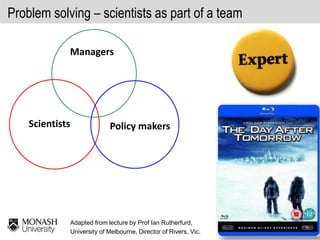
Managers
Scientists Policy makers
Problem solving – scientists as part of a team
Adapted from lecture by Prof Ian Rutherfurd,
University of Melbourne, Director of Rivers, Vic.
Why should people be interested in your science?
• Different rewards
• Raison d'être
• Language
Manager
Scientist
Scientist
What are the reward systems in each organisation?
• Making policy happen
• Making decisions
• Implementing decisions
• Serving the organisation
• Predicting correctly
(95% of the time)
• Publishing
• Doing challenging, rather than
useful, research
• Getting external money
• Independence
• Having equipment
Manager
Adapted from lecture by Prof Ian Rutherfurd,
University of Melbourne, Director of Rivers, Vic.
Manager
Scientist
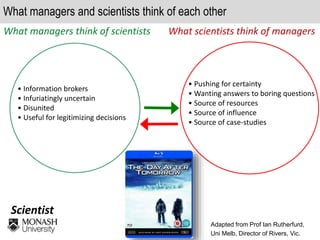
What scientists think of managers
What managers and scientists think of each other
• Information brokers
• Infuriatingly uncertain
• Disunited
• Useful for legitimizing decisions
• Pushing for certainty
• Wanting answers to boring questions
• Source of resources
• Source of influence
• Source of case-studies
What managers think of scientists
Adapted from Prof Ian Rutherfurd,
Uni Melb, Director of Rivers, Vic.
11
Recognise and respect the different goals for each group
 Scientists: funding, research papers, knowledge
 Australian farmers: $/ha or $/water
 Industry: $$$ Keeping people employed
 Subsistence farmers: security, yield, workload
 Politicians: getting elected
 Others? Non-profits, social enterprises -- changing the landscape
12
What model of communication suits your purpose?
 Monologue
– scientists conveys knowledge to receiver – scientist as expert
 Dialogue
– scientist in conversation: listening and talking – scientist as
expert
 Community engagement
– involving the community in the science, - scientists as one
partner in the conversation.
 Citizen science
– scientists relying on others to create the science
13
Getting your message “out there”
Why should these people be interested in your story?
What strategies could you use?
 Industry?
 General public?
 Journalists?
 Farmers?
 Policy makers/politicians?
14
Overview
 Why communicate? How to communicate?
 Examples
– International: cyanide in cassava
– Interdisciplinary/commercial: agricultural technology
 Identification of ways forward (discussion)
15
Example 1: Developing safer food for 1 billion people
HCN 
Photo:J.H.Bradbury
• Highly productive crop
• Acute cyanide poisoning (from cyanogenic glucosides)
• Konzo: Increasing, Current epidemics in DRC, NW Mozambique
• More prevalent during droughts (physiology), civil unrest (social, political)
Photo: R.Miller
Cassava/Manioc/Yucca
Manihot esculenta
Boy with konzo
Processing cassava
linamarin
linamarin
glucose
glucose
HCN 
16
Effect of excess cyanide in humans
 Acute poisoning
 Chronic- ataxia, cognitive decline
 Konzo
– Permanent paralysis, lower limbs
– Increasing
– Epidemics
0
100
200
300
400
500
Control Drought
Cyanideintubersppm
dw
WHO
level
Vandegeer et al. 2013 Funct Plant Biol 40, 195
Burns et al. 2012 J Ag Food Chem 60, 4946−4956
SUMU ILI YOKO KWENYE UNGA WA MUHOGO INA MADHARA GANI?
Unapokula ugali uliotayarishwa kutokana na unga wa muhogo mchungu ambao
haukusindikwa unavyotakiwa unaweza kupata madhara yafuatayo :
· Mapema unapata sumu iliyoko kwenye mhogo ambayo huleta
kizunguzungu, maumivu ya kichwa, tumbo, kuharisha, kutapika na hata
wakati mwingine kifo
· Konzo ni ugonjwa wa kupooza miguu wa kudumu ambao mtu
anashindwa kutembea. Ugonjwa huu hutokea wiki chache baada ya kula
ugali wa unga wa muhogo ambao haukusindikwa ipasavyo.
NSI YA KUONDOA SUMU
WENYE UNGA
A MUHOGO?
rahisi,
ukua kiasi cha unga unachohitaji kupika.
Ongeza maji safi kidogo kidogo kwenye unga, huku
ukikoroga, mpaka unga ulowane na kimo chake kilingane
na cha ule unga mkavu ambao ulipimwa mwanzoni kwa
kutumia ncha ya kisu. Hakikisha unga umelowana
sawasawa, lakini usiwe kama uji wala mabonge
mabonge ya unga mkavu.
Weka unga ndani ya sufuria au beseni, usawazishe
uwe na mwinuko unaolingana na ncha ya kisu ili
kupata kimo cha unga.
Howard Bradbury Wetting method
Tim Cavagnaro
Anabela Zacarias
Constantino
Cuambe
Rebecca Miller
17
Getting the story out there
Brown et al. (2016) Global Change Biology 22, 3461–3473
The Lens: Minidoco > 12,000 view
https://tinyurl.com/yapgjpo4
18
Developing safe and nutritious food for the 1 billion people who live on cassava
• Cassava biology & composition
– CO2 x Temp x Drought X Genotype
• Plant breeding / GMOs
– What are we aiming for?
– Elimination?
• Social factors
– Agricultural practice
– Knowledge, Governance
• Simpler testing systems
– Technology
Street Market, Suva, Fiji
Pacific Medical Students Camp Conference, Milolo, Fiji, December 2017
20
Example 2: Interdisciplinary Research – The AgTech Launch Pad
Funding sources:
University, Industry,
Australian Research Council
Infrastructure (?)
Communicating with University managers!
Industry partners, UK & Canadian Universities
Creating an ‘ecosystem’ to drive innovation
www.slideshare.net/tommens/challenges-in-software-ecosystem-research
It takes a long time to create an ecosystem!
Last Monday
23
Overview
 Why communicate? How to communicate?
 Examples
– International: cyanide in cassava
– Interdisciplinary/commercial: agricultural technology
 Identification of ways forward (discussion)
24
What do you bring to the table?
 List formal exchange programs
– International
– Interdisciplinary
 Your experience in building research collaborations?
 What are the rewards for your collaborators?
 Is there a role for the Global Plant Council? (general discussion)
25
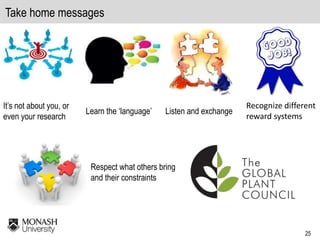
Take home messages
It’s not about you, or
even your research
Learn the ‘language’ Listen and exchange
Respect what others bring
and their constraints
Recognize different
reward systems

Knowledge Exchange programmes in Science

  • 1.
    Embedding policy andcommunication programmes in global research collaborations Knowledge Exchange Programmes in Science MONASH SCIENCE @rosgleadow GPC Symposium, Nov 4 2018 Enhancing Global Collaborations in Crop Science CSSA/ASA Annual meeting In Baltimore USA Professor Ros Gleadow
  • 2.
    2 Knowledge Exchange Programmesin Science  Who is doing the exchanging?  What do we want to communicate?  How can this be facilitated?  Why? To improve food security in a changing world Simon Sinek
  • 3.
    3 Overview  Why communicate?How to communicate?  Examples – International: cyanide in cassava – Interdisciplinary/commercial: agricultural technology  Identification of ways forward (discussion)
  • 4.
    Knowledge transfer isgood, so why is it so hard?
  • 5.
    5 Who do scientists(need/want to) communicate with? Scientist to scientist – Which ones? – Same/different discipline? Science communication:  general public  industry  government  funding agency  managers  students Plant scientists, geneticists Engineers, IT Physicists Soil chemistsIndustry: Big Players Start ups Government No profits
  • 6.
    6 Why exchange knowledge? Economic argument – the contribution science can make to the national economy and individual wealth  Utilitarian argument – people owe much of their health and well-being to scientific invention  Democratic argument – to be fully informed enfranchises people  Cultural argument – the best science is, in company with the best of other areas endeavour, high art  Social argument – at every evolutionary stage – stone, bronze, iron, industrial, biological – science underpins the evolution of society.
  • 7.
    7 Managers Scientists Policy makers Problemsolving – scientists as part of a team Adapted from lecture by Prof Ian Rutherfurd, University of Melbourne, Director of Rivers, Vic.
  • 8.
    Why should peoplebe interested in your science? • Different rewards • Raison d'être • Language
  • 9.
    Manager Scientist Scientist What are thereward systems in each organisation? • Making policy happen • Making decisions • Implementing decisions • Serving the organisation • Predicting correctly (95% of the time) • Publishing • Doing challenging, rather than useful, research • Getting external money • Independence • Having equipment Manager Adapted from lecture by Prof Ian Rutherfurd, University of Melbourne, Director of Rivers, Vic.
  • 10.
    Manager Scientist What scientists thinkof managers What managers and scientists think of each other • Information brokers • Infuriatingly uncertain • Disunited • Useful for legitimizing decisions • Pushing for certainty • Wanting answers to boring questions • Source of resources • Source of influence • Source of case-studies What managers think of scientists Adapted from Prof Ian Rutherfurd, Uni Melb, Director of Rivers, Vic.
  • 11.
    11 Recognise and respectthe different goals for each group  Scientists: funding, research papers, knowledge  Australian farmers: $/ha or $/water  Industry: $$$ Keeping people employed  Subsistence farmers: security, yield, workload  Politicians: getting elected  Others? Non-profits, social enterprises -- changing the landscape
  • 12.
    12 What model ofcommunication suits your purpose?  Monologue – scientists conveys knowledge to receiver – scientist as expert  Dialogue – scientist in conversation: listening and talking – scientist as expert  Community engagement – involving the community in the science, - scientists as one partner in the conversation.  Citizen science – scientists relying on others to create the science
  • 13.
    13 Getting your message“out there” Why should these people be interested in your story? What strategies could you use?  Industry?  General public?  Journalists?  Farmers?  Policy makers/politicians?
  • 14.
    14 Overview  Why communicate?How to communicate?  Examples – International: cyanide in cassava – Interdisciplinary/commercial: agricultural technology  Identification of ways forward (discussion)
  • 15.
    15 Example 1: Developingsafer food for 1 billion people HCN  Photo:J.H.Bradbury • Highly productive crop • Acute cyanide poisoning (from cyanogenic glucosides) • Konzo: Increasing, Current epidemics in DRC, NW Mozambique • More prevalent during droughts (physiology), civil unrest (social, political) Photo: R.Miller Cassava/Manioc/Yucca Manihot esculenta Boy with konzo Processing cassava linamarin linamarin glucose glucose HCN 
  • 16.
    16 Effect of excesscyanide in humans  Acute poisoning  Chronic- ataxia, cognitive decline  Konzo – Permanent paralysis, lower limbs – Increasing – Epidemics 0 100 200 300 400 500 Control Drought Cyanideintubersppm dw WHO level Vandegeer et al. 2013 Funct Plant Biol 40, 195 Burns et al. 2012 J Ag Food Chem 60, 4946−4956 SUMU ILI YOKO KWENYE UNGA WA MUHOGO INA MADHARA GANI? Unapokula ugali uliotayarishwa kutokana na unga wa muhogo mchungu ambao haukusindikwa unavyotakiwa unaweza kupata madhara yafuatayo : · Mapema unapata sumu iliyoko kwenye mhogo ambayo huleta kizunguzungu, maumivu ya kichwa, tumbo, kuharisha, kutapika na hata wakati mwingine kifo · Konzo ni ugonjwa wa kupooza miguu wa kudumu ambao mtu anashindwa kutembea. Ugonjwa huu hutokea wiki chache baada ya kula ugali wa unga wa muhogo ambao haukusindikwa ipasavyo. NSI YA KUONDOA SUMU WENYE UNGA A MUHOGO? rahisi, ukua kiasi cha unga unachohitaji kupika. Ongeza maji safi kidogo kidogo kwenye unga, huku ukikoroga, mpaka unga ulowane na kimo chake kilingane na cha ule unga mkavu ambao ulipimwa mwanzoni kwa kutumia ncha ya kisu. Hakikisha unga umelowana sawasawa, lakini usiwe kama uji wala mabonge mabonge ya unga mkavu. Weka unga ndani ya sufuria au beseni, usawazishe uwe na mwinuko unaolingana na ncha ya kisu ili kupata kimo cha unga. Howard Bradbury Wetting method Tim Cavagnaro Anabela Zacarias Constantino Cuambe Rebecca Miller
  • 17.
    17 Getting the storyout there Brown et al. (2016) Global Change Biology 22, 3461–3473 The Lens: Minidoco > 12,000 view https://tinyurl.com/yapgjpo4
  • 18.
    18 Developing safe andnutritious food for the 1 billion people who live on cassava • Cassava biology & composition – CO2 x Temp x Drought X Genotype • Plant breeding / GMOs – What are we aiming for? – Elimination? • Social factors – Agricultural practice – Knowledge, Governance • Simpler testing systems – Technology Street Market, Suva, Fiji
  • 19.
    Pacific Medical StudentsCamp Conference, Milolo, Fiji, December 2017
  • 20.
    20 Example 2: InterdisciplinaryResearch – The AgTech Launch Pad Funding sources: University, Industry, Australian Research Council Infrastructure (?) Communicating with University managers! Industry partners, UK & Canadian Universities
  • 21.
    Creating an ‘ecosystem’to drive innovation www.slideshare.net/tommens/challenges-in-software-ecosystem-research
  • 22.
    It takes along time to create an ecosystem! Last Monday
  • 23.
    23 Overview  Why communicate?How to communicate?  Examples – International: cyanide in cassava – Interdisciplinary/commercial: agricultural technology  Identification of ways forward (discussion)
  • 24.
    24 What do youbring to the table?  List formal exchange programs – International – Interdisciplinary  Your experience in building research collaborations?  What are the rewards for your collaborators?  Is there a role for the Global Plant Council? (general discussion)
  • 25.
    25 Take home messages It’snot about you, or even your research Learn the ‘language’ Listen and exchange Respect what others bring and their constraints Recognize different reward systems