Knowledge Basis 
for Design 
Steve Frezza, Ph. D., C.S.D.P. 
1
Designing the Engineer 
Motivation: 
What makes engineering education Engineering… 
What engineers kHnooww …they know it… 
What makes engineering knowing different… 
Not that different, form of Common-Sense Knowledge 
Different from Scientific knowing 
Yet different – Informed, Pragmatic 
2
Usefulness as Value 
Epistemological lens 
Suggests a set of defining 
values 
Pragmatic use 
‘Pragmatic’ always located 
in a context 
Problem/solution context 
Solvers’ context 
3
Problem/Solution Context 
Each problem/solution context may be unique 
Includes: 
Social as well as domain-specific patterns 
Problem-specific knowledge 
Knowledge brought to, discovered or synthesized 
Exploring the problem context is part of the 
engineering activity ?? 
Not emphasized in the 
rationalist approach 
4
Solvers’ Context 
Epistemological lens the engineers bring to problems 
and solutions 
Includes 
Historical, scientific and artistic roots of modern 
engineering practice, 
Embodied in the knowledge expected of current engineers 
Engineering heuristics and patterns specific to sub-domains 
of engineering 
E.g., electrical, mechanical, environmental, civil, software, 
etc. 
5
Design Considerations 
Engineering activity: Design 
Activity and work product 
Aimed at sufficiently satisfactory solution(s) 
vs. single, optimal solution 
Social, human activity 
Characterized by language and goal negotiation 
Creative, constructive knowledge & skill 
Rationalist, empiricist, other? 
6
Thinking about … 
engineering design thinking 
Key question: 
Is engineering design knowing somehow different 
from other types of knowing? 
UUssee iinn ssoollnn oovveerr eexxppllaannaattiioonn 
EExxtteerrnnaall vvaalluuee oovveerr iinntteerrnnaall 
7 
Scientific knowing 
Artistic knowing 
EEnnggiinneeeerriinngg DDeessiiggnn KKnnoowwiinngg DDiiffffeerrss
Thinking about … 
engineering design thinking 
Key questions: 
In engineering design, what do we know, and how 
do we know it? 
Math and science: Approximating Reality 
Practical reasoning: Conversation 
Constructing solutions: Puzzle making and puzzle solving 
Value claims: Usefulness 
EEnnggiinneeeerriinngg DDeessiiggnn KKnnoowwiinngg 
SSiimmiillaarr,, bbuutt ddiiffffeerreenntt 
8
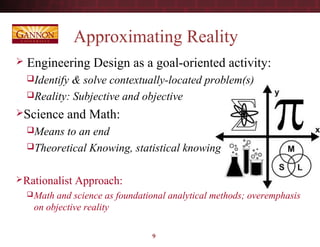
Approximating Reality 
 Engineering Design as a goal-oriented activity: 
Identify & solve contextually-located problem(s) 
Reality: Subjective and objective 
Science and Math: 
Means to an end 
Theoretical Knowing, statistical knowing 
Rationalist Approach: 
Math and science as foundational analytical methods; overemphasis 
on objective reality 
9
Practical Design Reasoning 
Reasoning that terminates in an action 
Core metric: ‘satisfactoriness,’ 
Selecting course of action; satisfactory way to fulfill a need 
Action to explore requirements, advance designs, evaluate 
sufficiency of product or the process 
A set of developing arguments 
In the mind of the designer 
Among collaborating designers 
Among the members of a design team 
Among designers and stakeholders 
10
Practical Design Reasoning 
Designer(s) identify the relevant details 
From the surrounding context 
Weave it into a plan to satisfactorily achieves the sought-for 
good 
Activities and artifacts act as warrants and reasons 
Build the case for the solution, sought-for good 
Establish a value claim with respect to the problem(s) 
identified 
Examine details of the problem/solution fragments 
Requires a certain reasoning skill 
11
Constructing Distinctly 
Engineering Designs 
Puzzle making and puzzle solving 
Require a satisfactory response 
ongoing series of satisfactory responses 
‘wicked’–no definitive formulation; 
Solutions emerge 
A function of how the problem is described 
Must be compared, judgment over relative “goodness” 
Criteria of goodness negotiated 
12
Constructing Designs 
Constructed artifacts and conversations 
Part of the design process 
Multi-purpose: constructed artifacts serve as 
Sub-goals for the knowledge-generating activities 
Evidence of what has been learned, accepted, 
Evidence of what remains to be assessed for its validity or 
‘goodness’ 
13
Values and Value Claims 
Central value: Justified reasoning 
Use of math and science 
Means to an end; Approximation of reality 
Application of practical reasoning 
Reasoning for action; satisfactoriness 
Domain-specific means of constructing solutions 
Traditional engineering content 
Establishing and validating value claims 
Economics, trade-offs, pitches, refinement 
14
Implications for Pedagogy 
Shift the focus of engineering education 
from applied technical or scientific knowledge 
to practical reasoning and solution making & solving 
Distinguishing engineering design education… 
Foundations in reasoning 
Social patterns of design 
Patterns for exploring problem/solution contexts 
Design Reasoning 
15
Teach Design Reasoning 
Design Reasoning… 
To support action 
Uses ‘satisfactoriness’ as its central metric 
Under incomplete knowledge 
Where details are essential 
In situations where the relevance of details is not clear or 
obvious 
16
Core Engineering Design 
Education that emphasizes 
Puzzle making and puzzle solving 
Risk and Failure 
Identification of the user perspective 
Social context of design 
17
Core Engineering Design 
Education emphasizing the wicked 
Solution making that: 
Emerge as a function of how the ‘problem’ is described… 
Lack clear-cut criteria for determining if the problem has 
been satisfactorily solved… 
Are about better or worse, not right or wrong… 
Whose costs and risks only allow for one attempt… 
18

Knowledge basis for design 2014

  • 1.
    Knowledge Basis forDesign Steve Frezza, Ph. D., C.S.D.P. 1
  • 2.
    Designing the Engineer Motivation: What makes engineering education Engineering… What engineers kHnooww …they know it… What makes engineering knowing different… Not that different, form of Common-Sense Knowledge Different from Scientific knowing Yet different – Informed, Pragmatic 2
  • 3.
    Usefulness as Value Epistemological lens Suggests a set of defining values Pragmatic use ‘Pragmatic’ always located in a context Problem/solution context Solvers’ context 3
  • 4.
    Problem/Solution Context Eachproblem/solution context may be unique Includes: Social as well as domain-specific patterns Problem-specific knowledge Knowledge brought to, discovered or synthesized Exploring the problem context is part of the engineering activity ?? Not emphasized in the rationalist approach 4
  • 5.
    Solvers’ Context Epistemologicallens the engineers bring to problems and solutions Includes Historical, scientific and artistic roots of modern engineering practice, Embodied in the knowledge expected of current engineers Engineering heuristics and patterns specific to sub-domains of engineering E.g., electrical, mechanical, environmental, civil, software, etc. 5
  • 6.
    Design Considerations Engineeringactivity: Design Activity and work product Aimed at sufficiently satisfactory solution(s) vs. single, optimal solution Social, human activity Characterized by language and goal negotiation Creative, constructive knowledge & skill Rationalist, empiricist, other? 6
  • 7.
    Thinking about … engineering design thinking Key question: Is engineering design knowing somehow different from other types of knowing? UUssee iinn ssoollnn oovveerr eexxppllaannaattiioonn EExxtteerrnnaall vvaalluuee oovveerr iinntteerrnnaall 7 Scientific knowing Artistic knowing EEnnggiinneeeerriinngg DDeessiiggnn KKnnoowwiinngg DDiiffffeerrss
  • 8.
    Thinking about … engineering design thinking Key questions: In engineering design, what do we know, and how do we know it? Math and science: Approximating Reality Practical reasoning: Conversation Constructing solutions: Puzzle making and puzzle solving Value claims: Usefulness EEnnggiinneeeerriinngg DDeessiiggnn KKnnoowwiinngg SSiimmiillaarr,, bbuutt ddiiffffeerreenntt 8
  • 9.
    Approximating Reality Engineering Design as a goal-oriented activity: Identify & solve contextually-located problem(s) Reality: Subjective and objective Science and Math: Means to an end Theoretical Knowing, statistical knowing Rationalist Approach: Math and science as foundational analytical methods; overemphasis on objective reality 9
  • 10.
    Practical Design Reasoning Reasoning that terminates in an action Core metric: ‘satisfactoriness,’ Selecting course of action; satisfactory way to fulfill a need Action to explore requirements, advance designs, evaluate sufficiency of product or the process A set of developing arguments In the mind of the designer Among collaborating designers Among the members of a design team Among designers and stakeholders 10
  • 11.
    Practical Design Reasoning Designer(s) identify the relevant details From the surrounding context Weave it into a plan to satisfactorily achieves the sought-for good Activities and artifacts act as warrants and reasons Build the case for the solution, sought-for good Establish a value claim with respect to the problem(s) identified Examine details of the problem/solution fragments Requires a certain reasoning skill 11
  • 12.
    Constructing Distinctly EngineeringDesigns Puzzle making and puzzle solving Require a satisfactory response ongoing series of satisfactory responses ‘wicked’–no definitive formulation; Solutions emerge A function of how the problem is described Must be compared, judgment over relative “goodness” Criteria of goodness negotiated 12
  • 13.
    Constructing Designs Constructedartifacts and conversations Part of the design process Multi-purpose: constructed artifacts serve as Sub-goals for the knowledge-generating activities Evidence of what has been learned, accepted, Evidence of what remains to be assessed for its validity or ‘goodness’ 13
  • 14.
    Values and ValueClaims Central value: Justified reasoning Use of math and science Means to an end; Approximation of reality Application of practical reasoning Reasoning for action; satisfactoriness Domain-specific means of constructing solutions Traditional engineering content Establishing and validating value claims Economics, trade-offs, pitches, refinement 14
  • 15.
    Implications for Pedagogy Shift the focus of engineering education from applied technical or scientific knowledge to practical reasoning and solution making & solving Distinguishing engineering design education… Foundations in reasoning Social patterns of design Patterns for exploring problem/solution contexts Design Reasoning 15
  • 16.
    Teach Design Reasoning Design Reasoning… To support action Uses ‘satisfactoriness’ as its central metric Under incomplete knowledge Where details are essential In situations where the relevance of details is not clear or obvious 16
  • 17.
    Core Engineering Design Education that emphasizes Puzzle making and puzzle solving Risk and Failure Identification of the user perspective Social context of design 17
  • 18.
    Core Engineering Design Education emphasizing the wicked Solution making that: Emerge as a function of how the ‘problem’ is described… Lack clear-cut criteria for determining if the problem has been satisfactorily solved… Are about better or worse, not right or wrong… Whose costs and risks only allow for one attempt… 18

Editor's Notes

  • #3 Walter Vincente 1990…
  • #8 scientific approach and the engineering approach is its goal: The scientist aims at explanation: universal, reliable, comprehensive and sufficiently precise formulation of knowledge; the engineer, aims at timeliness, completeness, with sufficient precision and comprehension [10]. Science and math are used in design as means to an end, tools to approximate reality and not an end in themselves. Similarly this is different from artistic design in that its primary goal (goodness) is its ability to solve the contextually-located problem for which the task was undertaken
  • #9 While similar, these next slides focus on what distinguishes
  • #12 Activities and artifacts extend the knowledge and conversation of the design relevance that helps determine the next activities. Not all practical reasoning is design; but it is not about the creation of a new object, system or process to satisfy a need or desire. This is where the constructive nature of design plays a key and distinguishing role.
  • #15 scientific approach and the engineering approach is its goal: The scientist aims at explanation: universal, reliable, comprehensive and sufficiently precise formulation of knowledge; the engineer, aims at timeliness, completeness, with sufficient precision and comprehension [10]. Science and math are used in design as means to an end, tools to approximate reality and not an end in themselves. Similarly this is different from artistic design in that its primary goal (goodness) is its ability to solve the contextually-located problem for which the task was undertaken