Understanding the stakes 
Stephen Frezza, Ph.D., C.S.D.P. 
Gannon University
Human Life 
Start of Life 
• Abortion Contraception 
• Artificial Insemination 
End of Life 
• Genocide Ethnic Cleansing 
• Death Penalty Assisted Suicide
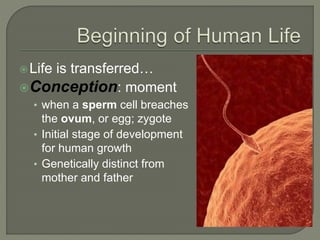
 Life is transferred… 
Conception: moment 
• when a sperm cell breaches 
the ovum, or egg; zygote 
• Initial stage of development 
for human growth 
• Genetically distinct from 
mother and father
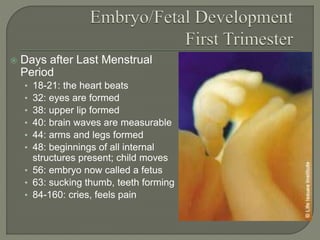
 Days after Last Menstrual 
Period 
• 18-21: the heart beats 
• 32: eyes are formed 
• 38: upper lip formed 
• 40: brain waves are measurable 
• 44: arms and legs formed 
• 48: beginnings of all internal 
structures present; child moves 
• 56: embryo now called a fetus 
• 63: sucking thumb, teeth forming 
• 84-160: cries, feels pain
13 to less than 28 weeks 
• 13 - 3 in. & ½ oz., reflexes active 
• 14 - fingerprints present 
• 15 - grasp, grimace, frown, squint 
• 16 - 6 in. & 6 oz., somersaults, 
mother feels movement 
• 17 - hiccups, plays with umbilical 
cord 
• 18 - hair and eyebrows growing 
• 20 - recognizes mother’s voice 
• 22 - responds to stories, music 
• 24 - 1 lb., 85% survival rate 
• 26 - responds to light, 1.5 to 2 lbs.
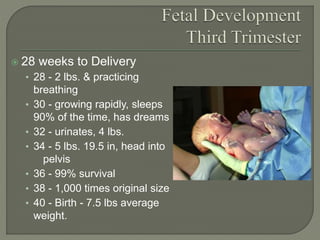
 28 weeks to Delivery 
• 28 - 2 lbs. & practicing 
breathing 
• 30 - growing rapidly, sleeps 
90% of the time, has dreams 
• 32 - urinates, 4 lbs. 
• 34 - 5 lbs. 19.5 in, head into 
pelvis 
• 36 - 99% survival 
• 38 - 1,000 times original size 
• 40 - Birth - 7.5 lbs average 
weight.
“The transmission of human life is a most 
serious role in which married people 
collaborate freely and responsibly with God 
the Creator. It has always been a source of 
great joy to them, even though it sometimes 
entails many difficulties and hardships.” 
Pope Paul VI
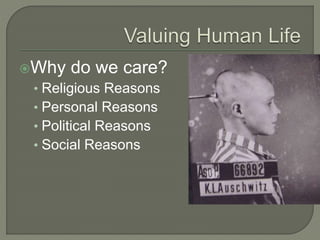
Why do we care? 
• Religious Reasons 
• Personal Reasons 
• Political Reasons 
• Social Reasons
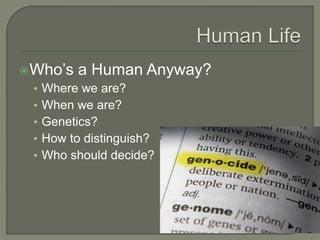
Who’s a Human Anyway? 
• Where we are? 
• When we are? 
• Genetics? 
• How to distinguish? 
• Who should decide?
“We no longer agree about the content of 
dignity, because we no longer share ... a 
'vision of what it means to be human'." 
Diana Schaub, Political Scientist
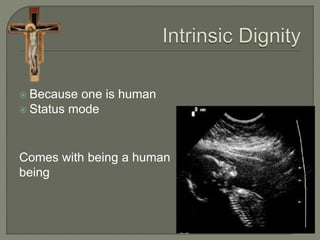
 Because one is human 
 Status mode 
Comes with being a human 
being
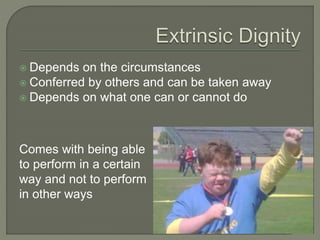
 Depends on the circumstances 
 Conferred by others and can be taken away 
 Depends on what one can or cannot do 
Comes with being able 
to perform in a certain 
way and not to perform 
in other ways
“We hold these truths to be self-evident, that 
all men are created equal, that they are 
endowed by their Creator with certain 
unalienable Rights, that among these are 
Life, Liberty and the pursuit of Happiness.” 
Declaration of Independence, 1776
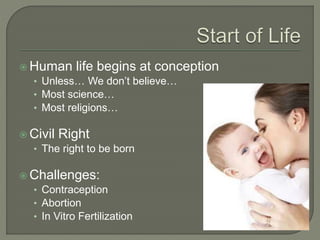
Human life begins at conception 
• Unless… We don’t believe… 
• Most science… 
• Most religions… 
 Civil Right 
• The right to be born 
 Challenges: 
• Contraception 
• Abortion 
• In Vitro Fertilization
Abortion is the #1 moral issue of our time. 
 It has impacted and will impact your life in 
one way or another – family, friends, 
acquaintances. 
• Millions of people – 43% of US Women 
• Economy
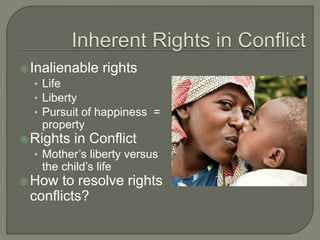
Inalienable rights 
• Life 
• Liberty 
• Pursuit of happiness = 
property 
Rights in Conflict 
• Mother’s liberty versus 
the child’s life 
How to resolve rights 
conflicts?
 Is it [birth control] an abortion? 
Definitely not. An abortion kills the life of a 
baby after it has begun. It is dangerous to 
your life and health. It may make you sterile 
so that when you want a child you cannot 
have it. Birth control merely postpones the 
beginning of life. 
Planned Parenthood Advertisement 
1964
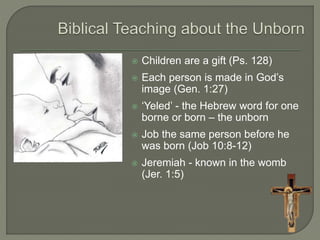
 Children are a gift (Ps. 128) 
 Each person is made in God’s 
image (Gen. 1:27) 
 ‘Yeled’ - the Hebrew word for one 
borne or born – the unborn 
 Job the same person before he 
was born (Job 10:8-12) 
 Jeremiah - known in the womb 
(Jer. 1:5)
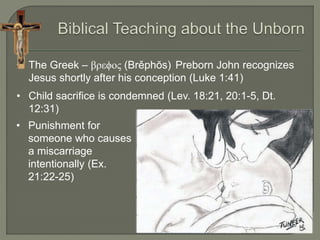
• The Greek – βρεϕος (Brěphŏs) Preborn John recognizes 
Jesus shortly after his conception (Luke 1:41) 
• Child sacrifice is condemned (Lev. 18:21, 20:1-5, Dt. 
12:31) 
• Punishment for 
someone who causes 
a miscarriage 
intentionally (Ex. 
21:22-25)
“The fundamental human right, the 
presupposition of every other right, is 
the right to life itself. This is true of life 
from the moment of conception until its 
natural end. Abortion consequently, 
cannot be a human right – it is the very 
opposite. It is a deep wound in society.” 
Pope Benedict XVI
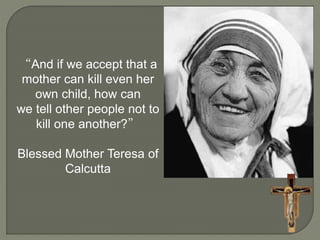
“And if we accept that a 
mother can kill even her 
own child, how can 
we tell other people not to 
kill one another?” 
Blessed Mother Teresa of 
Calcutta
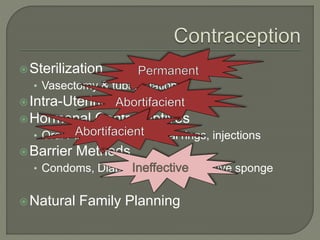
Sterilization 
• Vasectomy & tubal ligation 
 Intra-Uterine Device (IUD) 
Hormonal Contraceptives 
• Oral Pills, patches, vaginal rings, injections 
Barrier Methods 
• Condoms, Diaphragms contraceptive sponge 
Natural Family Planning
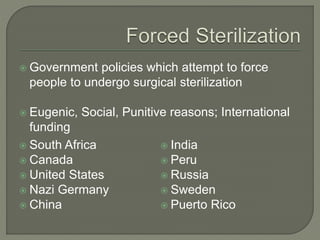
 Government policies which attempt to force 
people to undergo surgical sterilization 
 Eugenic, Social, Punitive reasons; International 
funding 
 South Africa 
 Canada 
 United States 
 Nazi Germany 
 China 
 India 
 Peru 
 Russia 
 Sweden 
 Puerto Rico
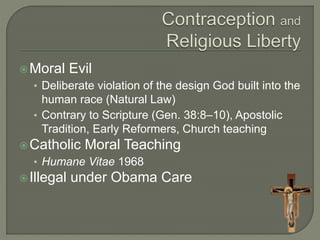
Moral Evil 
• Deliberate violation of the design God built into the 
human race (Natural Law) 
• Contrary to Scripture (Gen. 38:8–10), Apostolic 
Tradition, Early Reformers, Church teaching 
Catholic Moral Teaching 
• Humane Vitae 1968 
 Illegal under Obama Care
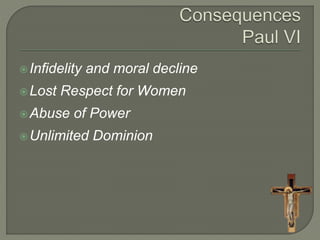
 Infidelity and moral decline 
Lost Respect for Women 
Abuse of Power 
Unlimited Dominion
“I would now like to say a special word to women 
who have had an abortion. The Church is aware of 
the many factors which may have influenced your 
decision, and she does not doubt that in many 
cases it was a painful and even shattering decision. 
The wound in your heart may not yet have healed. 
Certainly what happened was and remains terribly 
wrong. But do not give in to discouragement and do 
not lose hope. ” 
Pope John Paul II
Process by which an egg is fertilized by 
sperm outside the body 
Used most for pregnancy for: 
• Impotent male, using donor sperm 
• Women with cervical issues 
• Single woman without a male partner (sperm 
donor) 
• Female couples (sperm donor) 
• Male couples (egg donor and surrogate mother)
Human life ends at natural death 
• Unless… We kill 
Civil Right 
• The right to … die? 
Challenges: 
• Genocide/Ethnic Cleansing 
• Assisted Suicide 
• Death Penalty
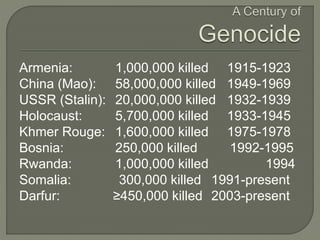
Armenia: 1,000,000 killed 1915-1923 
China (Mao): 58,000,000 killed 1949-1969 
USSR (Stalin): 20,000,000 killed 1932-1939 
Holocaust: 5,700,000 killed 1933-1945 
Khmer Rouge: 1,600,000 killed 1975-1978 
Bosnia: 250,000 killed 1992-1995 
Rwanda: 1,000,000 killed 1994 
Somalia: 300,000 killed 1991-present 
Darfur: ≥450,000 killed 2003-present
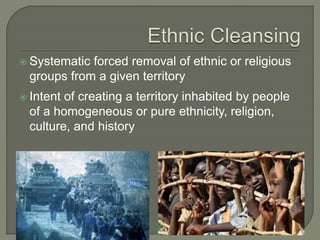
 Systematic forced removal of ethnic or religious 
groups from a given territory 
 Intent of creating a territory inhabited by people 
of a homogeneous or pure ethnicity, religion, 
culture, and history
Euthanasia 
• direct killing of a person, usually by injecting a 
lethal substance 
• legal in the Netherlands (no consent) legal in 
Belgium and Luxembourg 
Assisted suicide 
• one person providing the means and instructions 
to help another person commit suicide
 Executions are expensive 
• California spent ≥$4 billion on capital punishment since 1978 
• Capital trials are 20 times more expensive 
 Capital punishment does not deter crime 
 Innocent people convicted and executed 
• Since 1978, 142 men and women have been released from 
Death Row 
 Race plays a role in determining who dies 
• 82% of cases, race of the victim was found to influence the 
likelihood of receiving the death penalty 
 The death penalty is applied at random. 
• 22,000 capital crimes  ~100 people sentenced to death 
 Goes against many religions

Catholic life issues 1-27-14

  • 1.
    Understanding the stakes Stephen Frezza, Ph.D., C.S.D.P. Gannon University
  • 2.
    Human Life Startof Life • Abortion Contraception • Artificial Insemination End of Life • Genocide Ethnic Cleansing • Death Penalty Assisted Suicide
  • 3.
     Life istransferred… Conception: moment • when a sperm cell breaches the ovum, or egg; zygote • Initial stage of development for human growth • Genetically distinct from mother and father
  • 4.
     Days afterLast Menstrual Period • 18-21: the heart beats • 32: eyes are formed • 38: upper lip formed • 40: brain waves are measurable • 44: arms and legs formed • 48: beginnings of all internal structures present; child moves • 56: embryo now called a fetus • 63: sucking thumb, teeth forming • 84-160: cries, feels pain
  • 5.
    13 to lessthan 28 weeks • 13 - 3 in. & ½ oz., reflexes active • 14 - fingerprints present • 15 - grasp, grimace, frown, squint • 16 - 6 in. & 6 oz., somersaults, mother feels movement • 17 - hiccups, plays with umbilical cord • 18 - hair and eyebrows growing • 20 - recognizes mother’s voice • 22 - responds to stories, music • 24 - 1 lb., 85% survival rate • 26 - responds to light, 1.5 to 2 lbs.
  • 6.
     28 weeksto Delivery • 28 - 2 lbs. & practicing breathing • 30 - growing rapidly, sleeps 90% of the time, has dreams • 32 - urinates, 4 lbs. • 34 - 5 lbs. 19.5 in, head into pelvis • 36 - 99% survival • 38 - 1,000 times original size • 40 - Birth - 7.5 lbs average weight.
  • 7.
    “The transmission ofhuman life is a most serious role in which married people collaborate freely and responsibly with God the Creator. It has always been a source of great joy to them, even though it sometimes entails many difficulties and hardships.” Pope Paul VI
  • 8.
    Why do wecare? • Religious Reasons • Personal Reasons • Political Reasons • Social Reasons
  • 9.
    Who’s a HumanAnyway? • Where we are? • When we are? • Genetics? • How to distinguish? • Who should decide?
  • 10.
    “We no longeragree about the content of dignity, because we no longer share ... a 'vision of what it means to be human'." Diana Schaub, Political Scientist
  • 11.
     Because oneis human  Status mode Comes with being a human being
  • 12.
     Depends onthe circumstances  Conferred by others and can be taken away  Depends on what one can or cannot do Comes with being able to perform in a certain way and not to perform in other ways
  • 13.
    “We hold thesetruths to be self-evident, that all men are created equal, that they are endowed by their Creator with certain unalienable Rights, that among these are Life, Liberty and the pursuit of Happiness.” Declaration of Independence, 1776
  • 14.
    Human life beginsat conception • Unless… We don’t believe… • Most science… • Most religions…  Civil Right • The right to be born  Challenges: • Contraception • Abortion • In Vitro Fertilization
  • 15.
    Abortion is the#1 moral issue of our time.  It has impacted and will impact your life in one way or another – family, friends, acquaintances. • Millions of people – 43% of US Women • Economy
  • 16.
    Inalienable rights •Life • Liberty • Pursuit of happiness = property Rights in Conflict • Mother’s liberty versus the child’s life How to resolve rights conflicts?
  • 17.
     Is it[birth control] an abortion? Definitely not. An abortion kills the life of a baby after it has begun. It is dangerous to your life and health. It may make you sterile so that when you want a child you cannot have it. Birth control merely postpones the beginning of life. Planned Parenthood Advertisement 1964
  • 18.
     Children area gift (Ps. 128)  Each person is made in God’s image (Gen. 1:27)  ‘Yeled’ - the Hebrew word for one borne or born – the unborn  Job the same person before he was born (Job 10:8-12)  Jeremiah - known in the womb (Jer. 1:5)
  • 19.
    • The Greek– βρεϕος (Brěphŏs) Preborn John recognizes Jesus shortly after his conception (Luke 1:41) • Child sacrifice is condemned (Lev. 18:21, 20:1-5, Dt. 12:31) • Punishment for someone who causes a miscarriage intentionally (Ex. 21:22-25)
  • 20.
    “The fundamental humanright, the presupposition of every other right, is the right to life itself. This is true of life from the moment of conception until its natural end. Abortion consequently, cannot be a human right – it is the very opposite. It is a deep wound in society.” Pope Benedict XVI
  • 21.
    “And if weaccept that a mother can kill even her own child, how can we tell other people not to kill one another?” Blessed Mother Teresa of Calcutta
  • 22.
    Sterilization • Vasectomy& tubal ligation  Intra-Uterine Device (IUD) Hormonal Contraceptives • Oral Pills, patches, vaginal rings, injections Barrier Methods • Condoms, Diaphragms contraceptive sponge Natural Family Planning
  • 23.
     Government policieswhich attempt to force people to undergo surgical sterilization  Eugenic, Social, Punitive reasons; International funding  South Africa  Canada  United States  Nazi Germany  China  India  Peru  Russia  Sweden  Puerto Rico
  • 24.
    Moral Evil •Deliberate violation of the design God built into the human race (Natural Law) • Contrary to Scripture (Gen. 38:8–10), Apostolic Tradition, Early Reformers, Church teaching Catholic Moral Teaching • Humane Vitae 1968  Illegal under Obama Care
  • 25.
     Infidelity andmoral decline Lost Respect for Women Abuse of Power Unlimited Dominion
  • 26.
    “I would nowlike to say a special word to women who have had an abortion. The Church is aware of the many factors which may have influenced your decision, and she does not doubt that in many cases it was a painful and even shattering decision. The wound in your heart may not yet have healed. Certainly what happened was and remains terribly wrong. But do not give in to discouragement and do not lose hope. ” Pope John Paul II
  • 27.
    Process by whichan egg is fertilized by sperm outside the body Used most for pregnancy for: • Impotent male, using donor sperm • Women with cervical issues • Single woman without a male partner (sperm donor) • Female couples (sperm donor) • Male couples (egg donor and surrogate mother)
  • 28.
    Human life endsat natural death • Unless… We kill Civil Right • The right to … die? Challenges: • Genocide/Ethnic Cleansing • Assisted Suicide • Death Penalty
  • 29.
    Armenia: 1,000,000 killed1915-1923 China (Mao): 58,000,000 killed 1949-1969 USSR (Stalin): 20,000,000 killed 1932-1939 Holocaust: 5,700,000 killed 1933-1945 Khmer Rouge: 1,600,000 killed 1975-1978 Bosnia: 250,000 killed 1992-1995 Rwanda: 1,000,000 killed 1994 Somalia: 300,000 killed 1991-present Darfur: ≥450,000 killed 2003-present
  • 30.
     Systematic forcedremoval of ethnic or religious groups from a given territory  Intent of creating a territory inhabited by people of a homogeneous or pure ethnicity, religion, culture, and history
  • 31.
    Euthanasia • directkilling of a person, usually by injecting a lethal substance • legal in the Netherlands (no consent) legal in Belgium and Luxembourg Assisted suicide • one person providing the means and instructions to help another person commit suicide
  • 32.
     Executions areexpensive • California spent ≥$4 billion on capital punishment since 1978 • Capital trials are 20 times more expensive  Capital punishment does not deter crime  Innocent people convicted and executed • Since 1978, 142 men and women have been released from Death Row  Race plays a role in determining who dies • 82% of cases, race of the victim was found to influence the likelihood of receiving the death penalty  The death penalty is applied at random. • 22,000 capital crimes  ~100 people sentenced to death  Goes against many religions