Know Your
Behavior
Applied Behavior
Analysis
What is Science?
“a systematic approach for seeking and organizing knowledge about the
natural world as evidenced by description, prediction, and control that
relies on determinism as its fundamental assumption, empiricism as its
prime directive, experimentation as its basic strategy, replication as its
necessary requirement for believability, parsimony as its conservative
value, and philosophic doubt as its guiding conscience.” (Cooper)
We are going to focus on:
Evidenced by description, prediction, and control
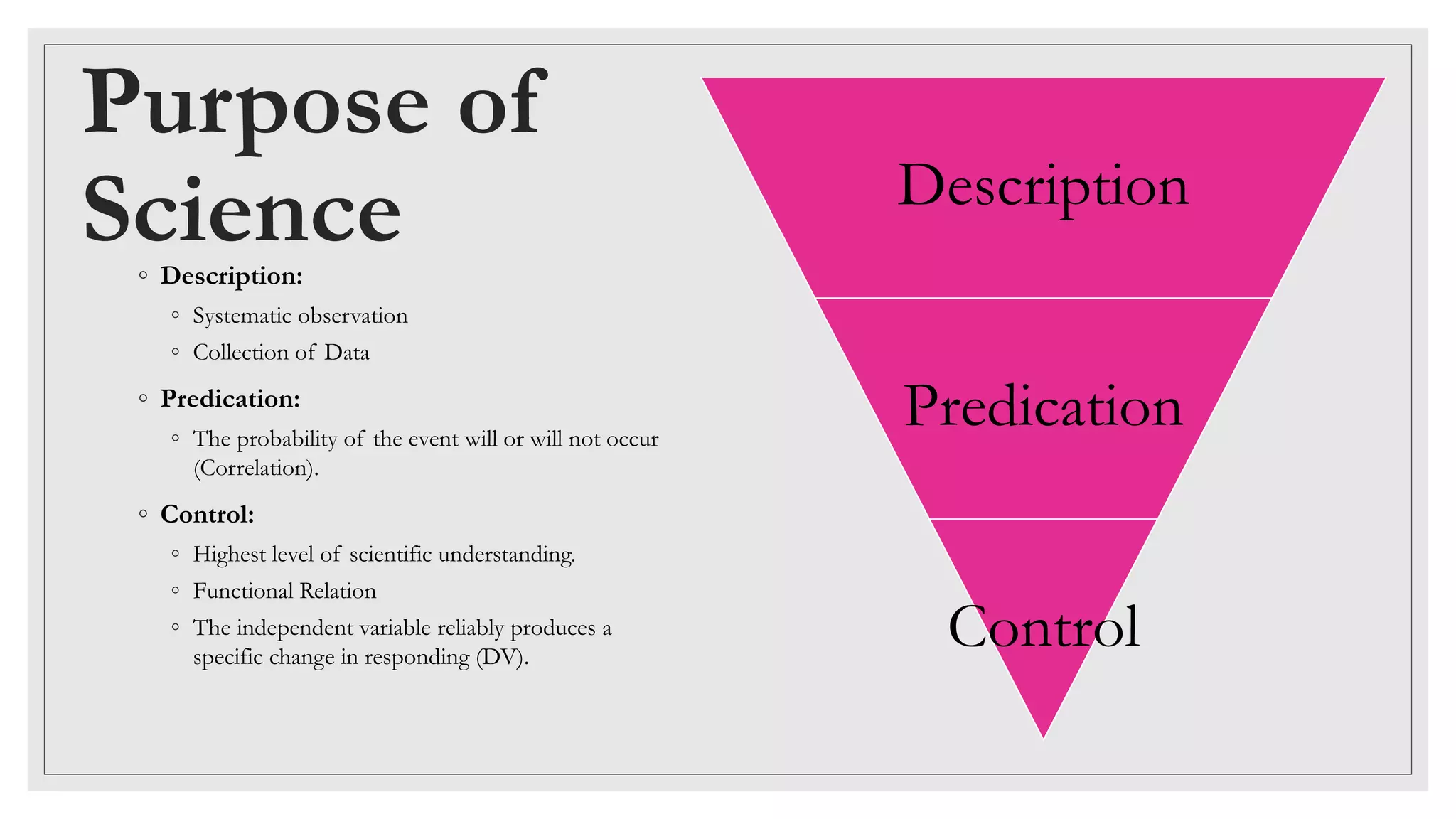
Purpose of
Science◦ Description:
◦ Systematic observation
◦ Collection of Data
◦ Predication:
◦ The probability of the event will or will not occur
(Correlation).
◦ Control:
◦ Highest level of scientific understanding.
◦ Functional Relation
◦ The independent variable reliably produces a
specific change in responding (DV).
Description
Predication
Control
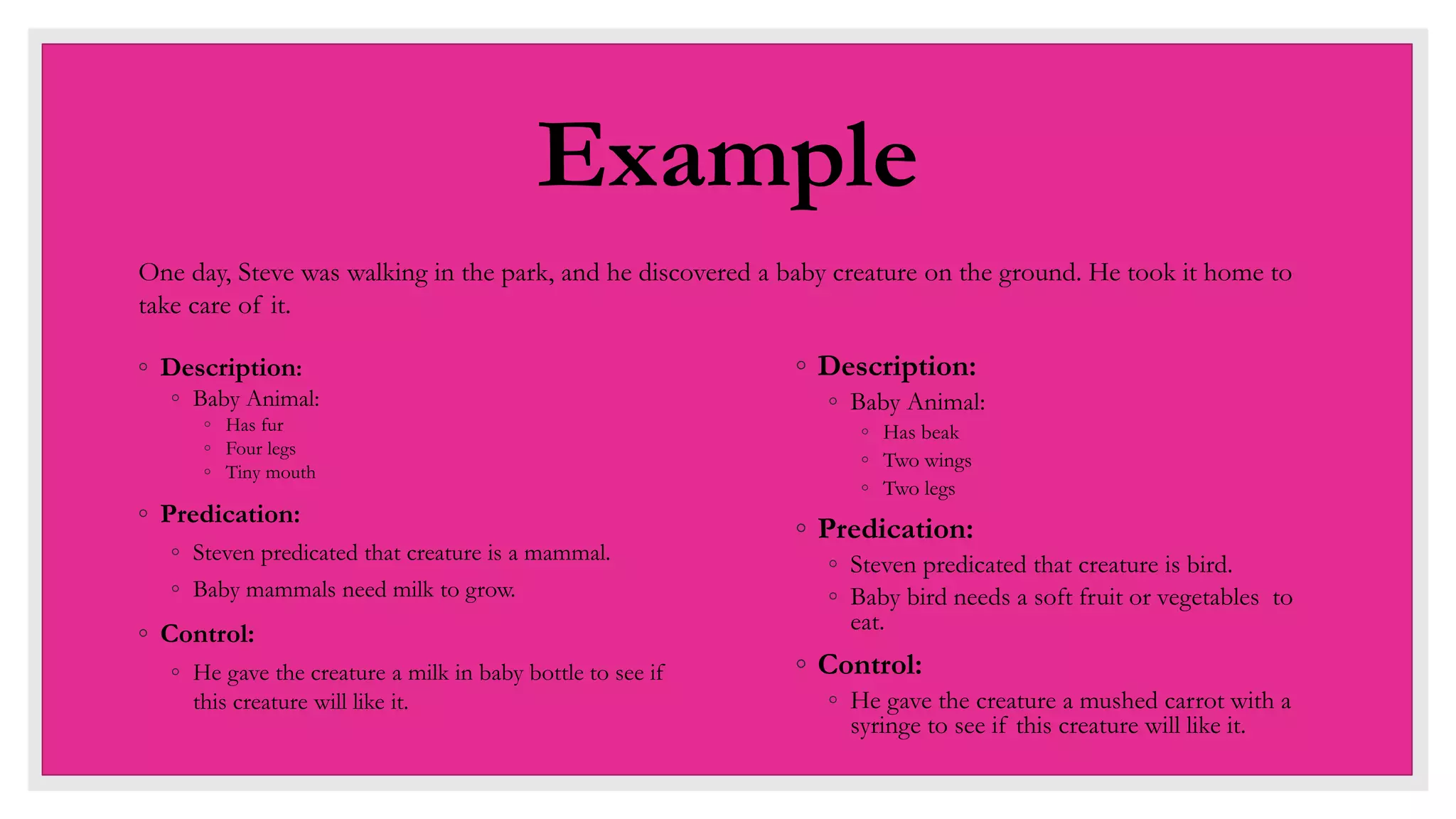
Example
◦ Description:
◦ Baby Animal:
◦ Has fur
◦ Four legs
◦ Tiny mouth
◦ Predication:
◦ Steven predicated that creature is a mammal.
◦ Baby mammals need milk to grow.
◦ Control:
◦ He gave the creature a milk in baby bottle to see if
this creature will like it.
◦ Description:
◦ Baby Animal:
◦ Has beak
◦ Two wings
◦ Two legs
◦ Predication:
◦ Steven predicated that creature is bird.
◦ Baby bird needs a soft fruit or vegetables to
eat.
◦ Control:
◦ He gave the creature a mushed carrot with a
syringe to see if this creature will like it.
One day, Steve was walking in the park, and he discovered a baby creature on the ground. He took it home to
take care of it.
Reference
◦ Cooper J.O, Heron T.E, Heward W.L. Applied
behavior analysis (2nd ed.) Upper Saddle River,
NJ: Pearson; 2007.
Know Your
Behavior
Thank
You

Know Your Behavior: 3 Levels of Scientific Understanding

  • 1.
  • 2.
    What is Science? “asystematic approach for seeking and organizing knowledge about the natural world as evidenced by description, prediction, and control that relies on determinism as its fundamental assumption, empiricism as its prime directive, experimentation as its basic strategy, replication as its necessary requirement for believability, parsimony as its conservative value, and philosophic doubt as its guiding conscience.” (Cooper)
  • 3.
    We are goingto focus on: Evidenced by description, prediction, and control
  • 4.
    Purpose of Science◦ Description: ◦Systematic observation ◦ Collection of Data ◦ Predication: ◦ The probability of the event will or will not occur (Correlation). ◦ Control: ◦ Highest level of scientific understanding. ◦ Functional Relation ◦ The independent variable reliably produces a specific change in responding (DV). Description Predication Control
  • 5.
    Example ◦ Description: ◦ BabyAnimal: ◦ Has fur ◦ Four legs ◦ Tiny mouth ◦ Predication: ◦ Steven predicated that creature is a mammal. ◦ Baby mammals need milk to grow. ◦ Control: ◦ He gave the creature a milk in baby bottle to see if this creature will like it. ◦ Description: ◦ Baby Animal: ◦ Has beak ◦ Two wings ◦ Two legs ◦ Predication: ◦ Steven predicated that creature is bird. ◦ Baby bird needs a soft fruit or vegetables to eat. ◦ Control: ◦ He gave the creature a mushed carrot with a syringe to see if this creature will like it. One day, Steve was walking in the park, and he discovered a baby creature on the ground. He took it home to take care of it.
  • 6.
    Reference ◦ Cooper J.O,Heron T.E, Heward W.L. Applied behavior analysis (2nd ed.) Upper Saddle River, NJ: Pearson; 2007.
  • 7.