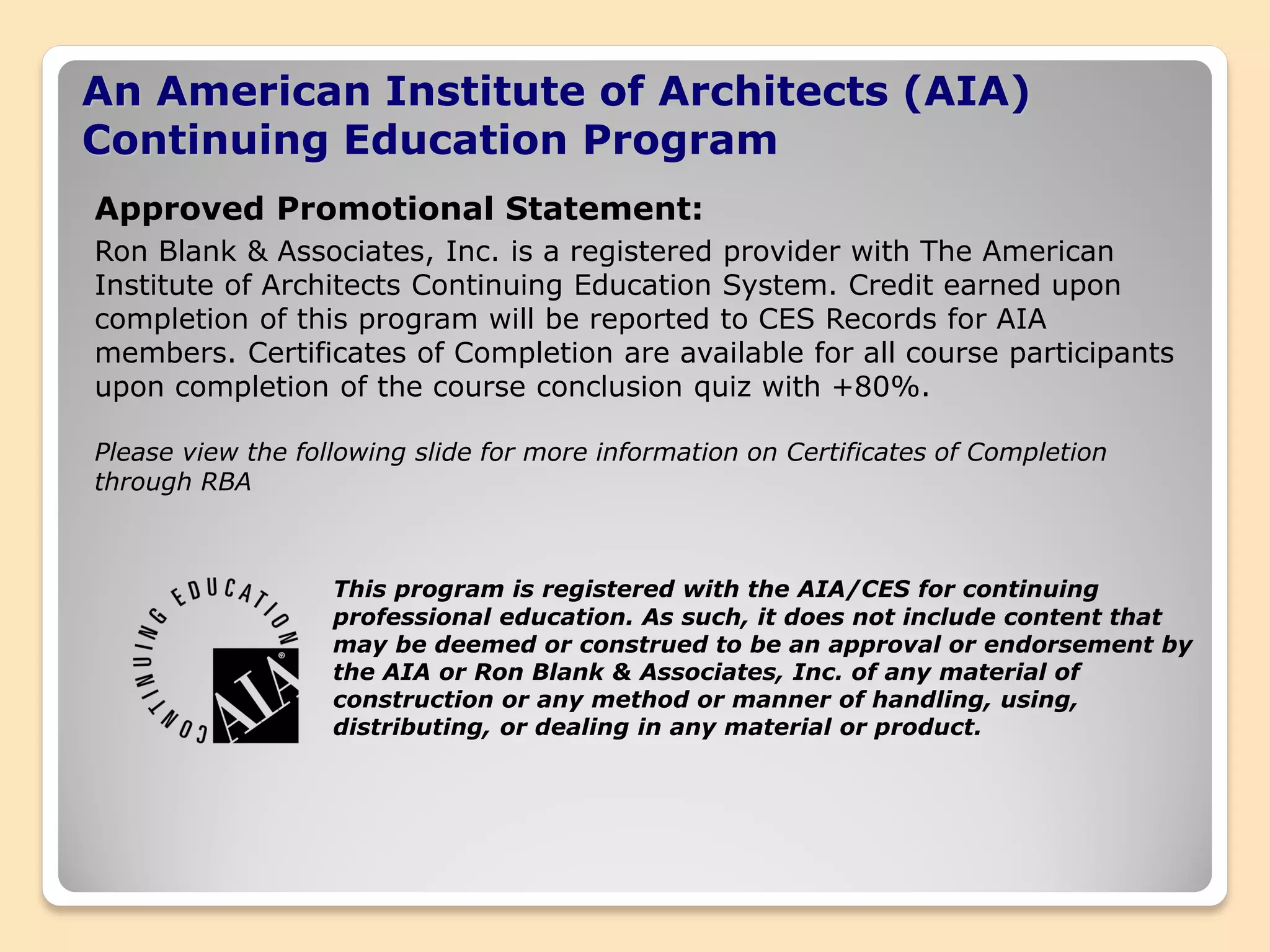
Mechanical Parking
Solutions for Modern
Urban Density
Rick Rombach
Klaus Multiparking, Inc
3652A Chestnut Street
Lafayette, CA
925-284-2092
sales@parklift.com
www.parklift.com
Course Number kmp14a
An AIA Continuing Education Program
Credit for this course is 1 AIA HSW CE Hour
© Ron Blank & Associates, Inc 2010
Please note: you will need to complete the conclusion quiz online at ronblank.com to receive credit
An American Institute of Architects (AIA)
Continuing Education Program
Approved Promotional Statement:
Ron Blank & Associates, Inc. is a registered provider with The American
Institute of Architects Continuing Education System. Credit earned upon
completion of this program will be reported to CES Records for AIA
members. Certificates of Completion are available for all course participants
upon completion of the course conclusion quiz with +80%.
Please view the following slide for more information on Certificates of Completion
through RBA
This program is registered with the AIA/CES for continuing
professional education. As such, it does not include content that
may be deemed or construed to be an approval or endorsement by
the AIA or Ron Blank & Associates, Inc. of any material of
construction or any method or manner of handling, using,
distributing, or dealing in any material or product.
Course Format: This is a structured, web-based, self study course with a
final exam.
Course Credit: 1 AIA Health Safety & Welfare (HSW) CE Hour
Completion Certificate: A confirmation is sent to you by email and you can
print one upon successful completion of a course or from your RonBlank.com
transcript. If you have any difficulties printing or receiving your Certificate
please send requests to certificate@ronblank.com
Design professionals, please remember to print or save your
certificate of completion after successfully completing a
course conclusion quiz. Email confirmations will be sent to
the email address you have provided in your RonBlank.com
account.
An American Institute of Architects (AIA)
Continuing Education Program
Please note: you will need to complete the conclusion
quiz online at ronblank.com to receive credit
INTRODUCTION
objectives – what? – why? – how?
An innovative solution to parking space, mechanical
parking and the dependent access parking stackers’ uses
and limitations are illustrated and described in this course
to expand your knowledge on this unique product. Learn
about the different types of parking stackers and how they
work.
Course Description
Learning Objectives
Upon completion of this course, you will be able to:
 Define mechanical parking
 Describe dependent access parking stackers’ uses and limitations
 List the different types of independent access parking stackers
 Explain puzzle lifts, how they work and what their advantages are
 Describe fully automatic machines and why they might be used
 Compare and contrast the different stackers and lifts and describe
when each would be appropriate for use
 Describe what type of cars are suitable for each lift
 Describe the design requirements for each parking type
What is Mechanical Parking?
 Mechanical Parking encompasses
a wide range of options all
designed to increase parking
density and cut costs over
traditional parking methods.
 The solutions start at simple
stackers, where the bottom car
must be moved to get to the top
car (dependent access) and go up
to fully automatic machines where
cars can be stored and retrieved
from a single point of access.
 There are 5 mechanical parking
typologies: dependent access
stackers, independent access
stackers, puzzle lifts, pallets and
fully automatic parking machines.
Why Mechanical Parking Systems?
1. Excavating a conventional basement is expensive and
sometimes difficult. If you need to dig down and add a level or
levels, mechanical parking will save money. A parking stall in a
stacker generally costs between $5,000 - $20,000 depending on model
and quantity, compared with $35,000 for a ground-floor space and
$50,000 for a stall built underground in urban areas.
2. Parking machines can compact the cars as much as possible to
create free space at ground level for retail areas or other higher
uses. A normal parking stall requires around 300 to 350 square feet.
That allows for the stall and a modest amount of circulation and drive
aisles; where as with a mechanical parking system, this dimension is
closer to 200 square feet per stall, reducing area usage by 1/3.
3. Mechanical parking systems can increase parking capacity as
much as possible to add value to the building. Providing additional
parking can frequently add value to units.
Design Example
72 Cars + 50 Units:
Minimum Excavation, No Ramps
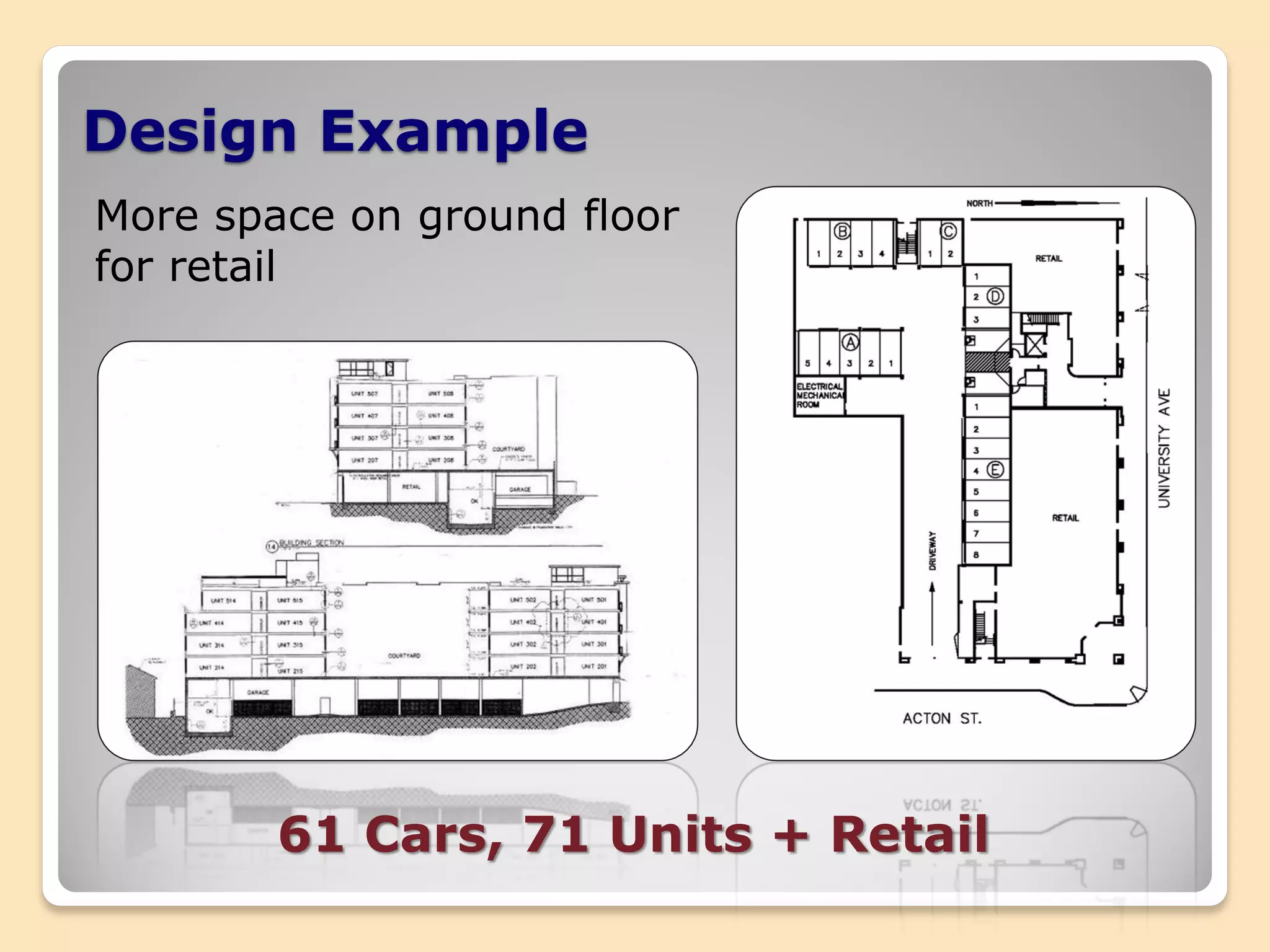
Design Example
More space on ground floor
for retail
61 Cars, 71 Units + Retail
Mechanical Parking Typologies
DEPENDANT ACCESS STACKERS
low ceiling – two high – three high
INDEPENDENT ACCESS STACKERS
sloping – double – triple
PUZZLE LIFTS
PALLETS
FULLY AUTOMATICS
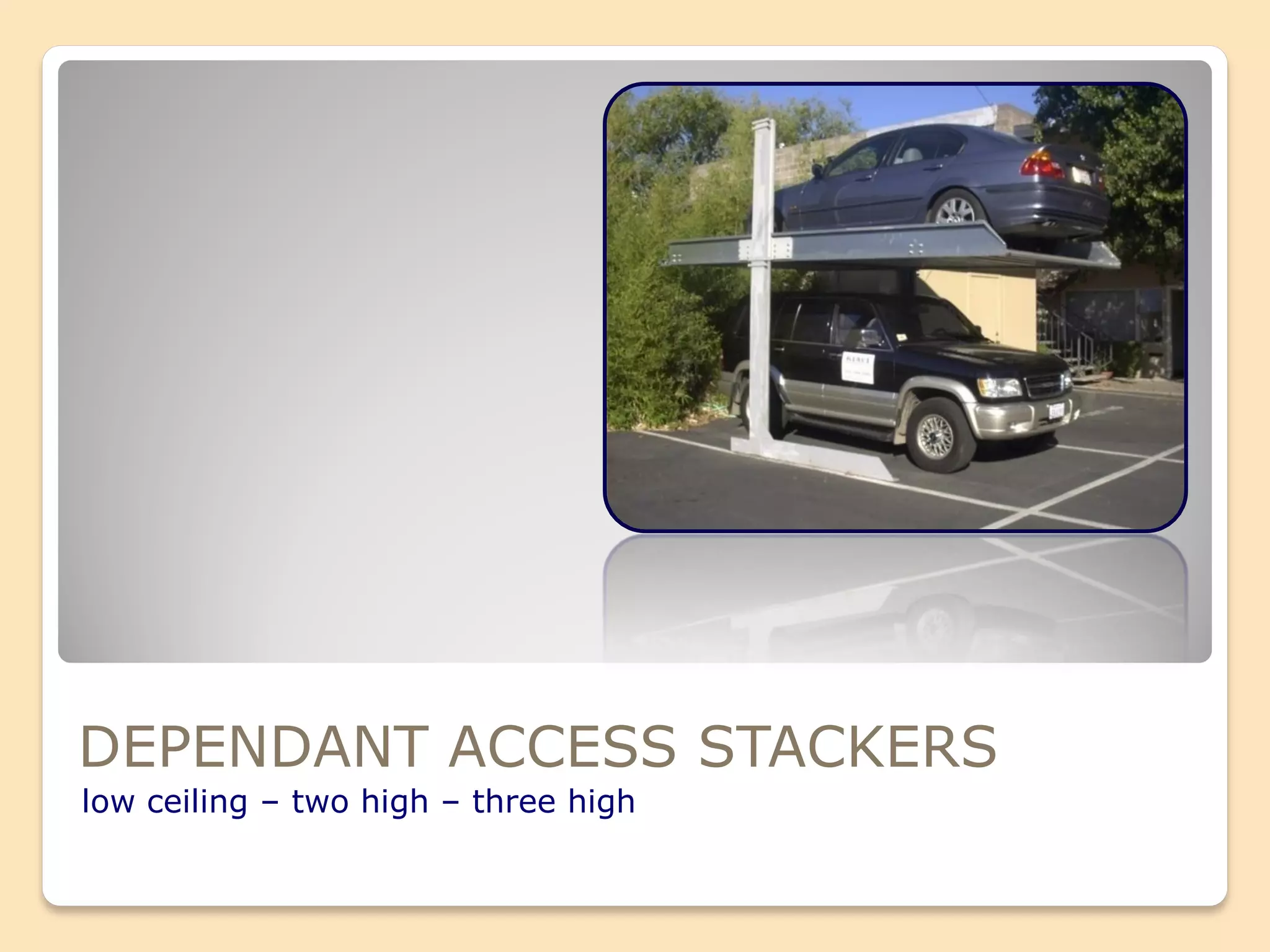
DEPENDANT ACCESS STACKERS
low ceiling – two high – three high
Dependent Access Stackers
 Dependent parking means that the
lower car or cars must be moved by
the user to access the top car.
 This solution works well if both
vehicles are for one unit or if there is
a valet.
 Advantages
◦ Low Cost
◦ Can be installed in existing buildings
◦ Low ceiling height (as low as 9’-4’’)
◦ No pit required
◦ Less than 60 seconds to retrieve car
◦ Suitable for outdoor use
 Disadvantages
◦ Lower car must be moved by user
◦ User must have keys to both vehicles
Dependent Access Models Overview
Low Ceiling Model
As low as 9’-4’’
Three High
Ceiling height min 18’ – 3’’
Standard Two High
Ceiling height min 10’-6’’
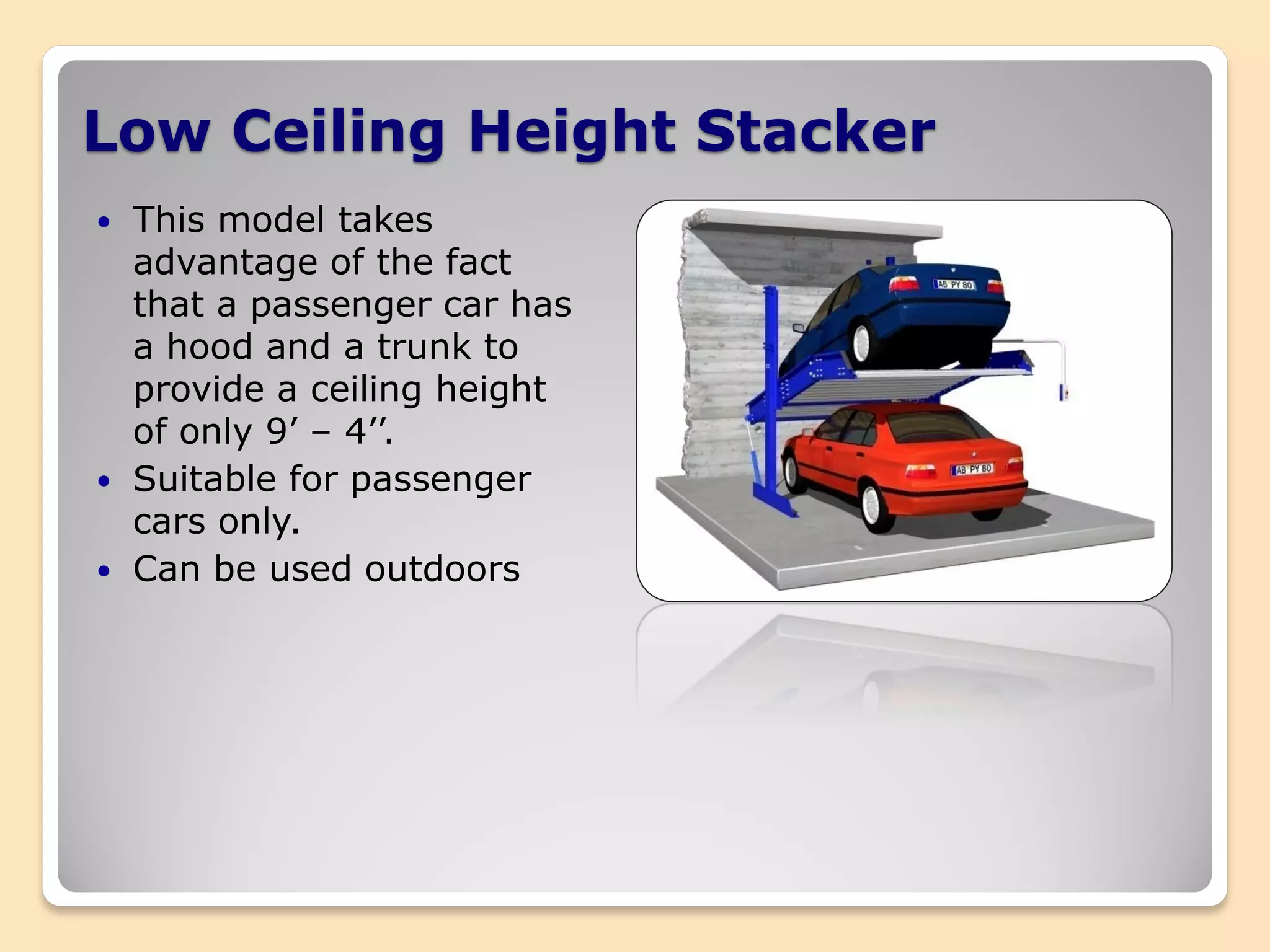
Low Ceiling Height Stacker
 This model takes
advantage of the fact
that a passenger car has
a hood and a trunk to
provide a ceiling height
of only 9’ – 4’’.
 Suitable for passenger
cars only.
 Can be used outdoors
Standard Two High Stacker
 The standard model is useful in
areas where the ceiling height
is not restricted. While the
minimum ceiling height is
10’ – 6’’, the height of the
platform is adjustable and can
accommodate SUV’s if the
ceiling is higher.
 Typically used in apartments or
condos where both cars on the
lift are for the same unit.
 A very popular model for valet
use. The upper lifts are usually
reserved for longer term
parking and the bottom space
for short term parkers
Two High Stacker Examples
Santa Monica, CA Lafayette, CA
New York, NY Emeryville, CA
Three High Stacker
With this version, two cars must
be moved in order to get to the
top car. It requires a ceiling
height of 18’ – 3’’ and is
generally used outdoors with a
valet or for car storage.
INDEPENDENT ACCESS STACKERS
sloping – double – triple
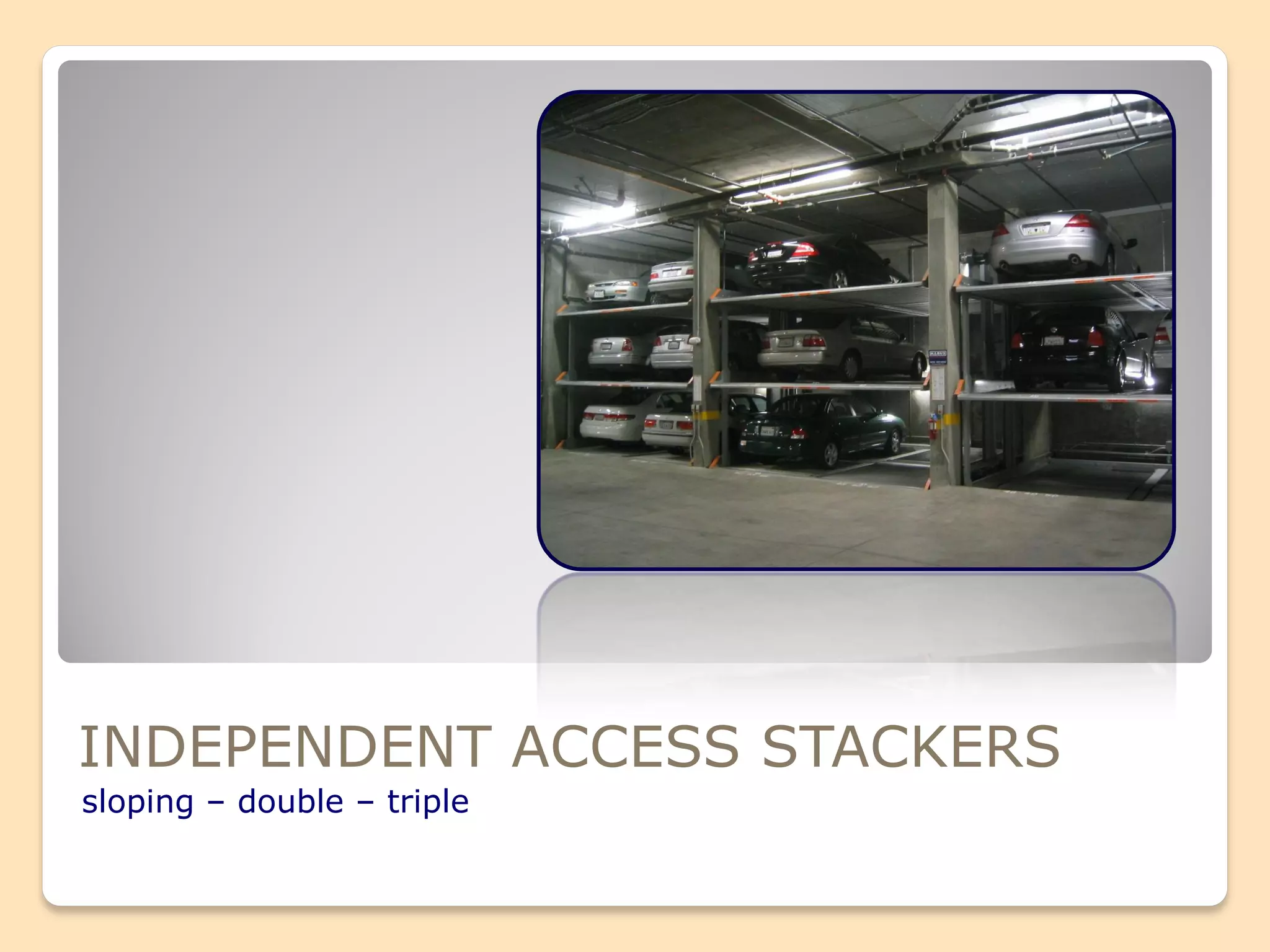
Independent Access Stackers
 Independent Access Stack
Parkers require a pit, the bottom
car is lowered into the pit so that
the top car(s) can be driven off
 Advantages
◦ No cars need to be moved
◦ Simple operation
◦ Less than 60 Seconds to retrieve a car
◦ SUV’s possible depending on model
◦ Cost effective
 Disadvantages
◦ Doesn’t make the most efficient use of
space (see puzzle lift)
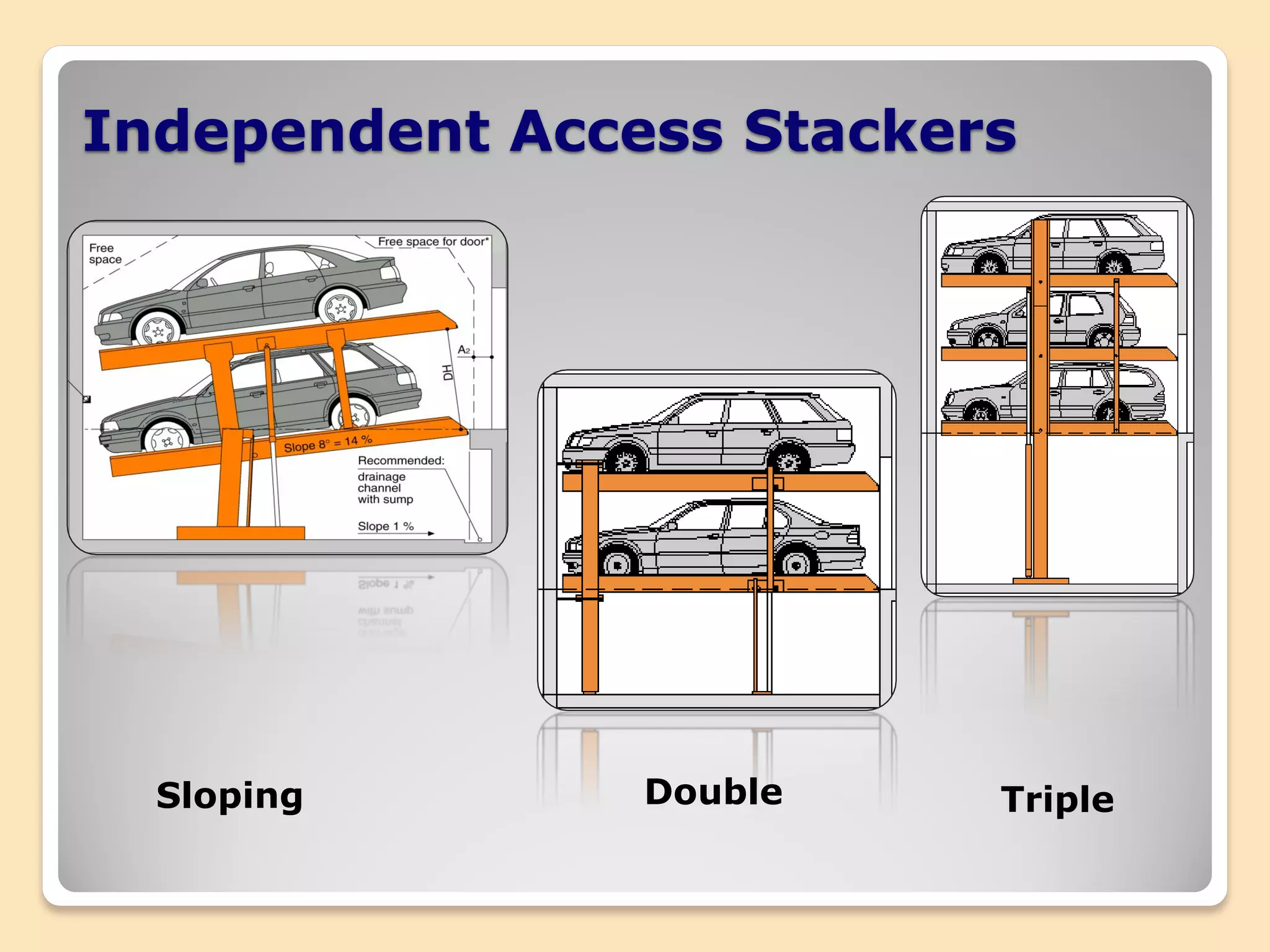
Independent Access Stackers
Sloping Double Triple
Two High Stacker with Pit
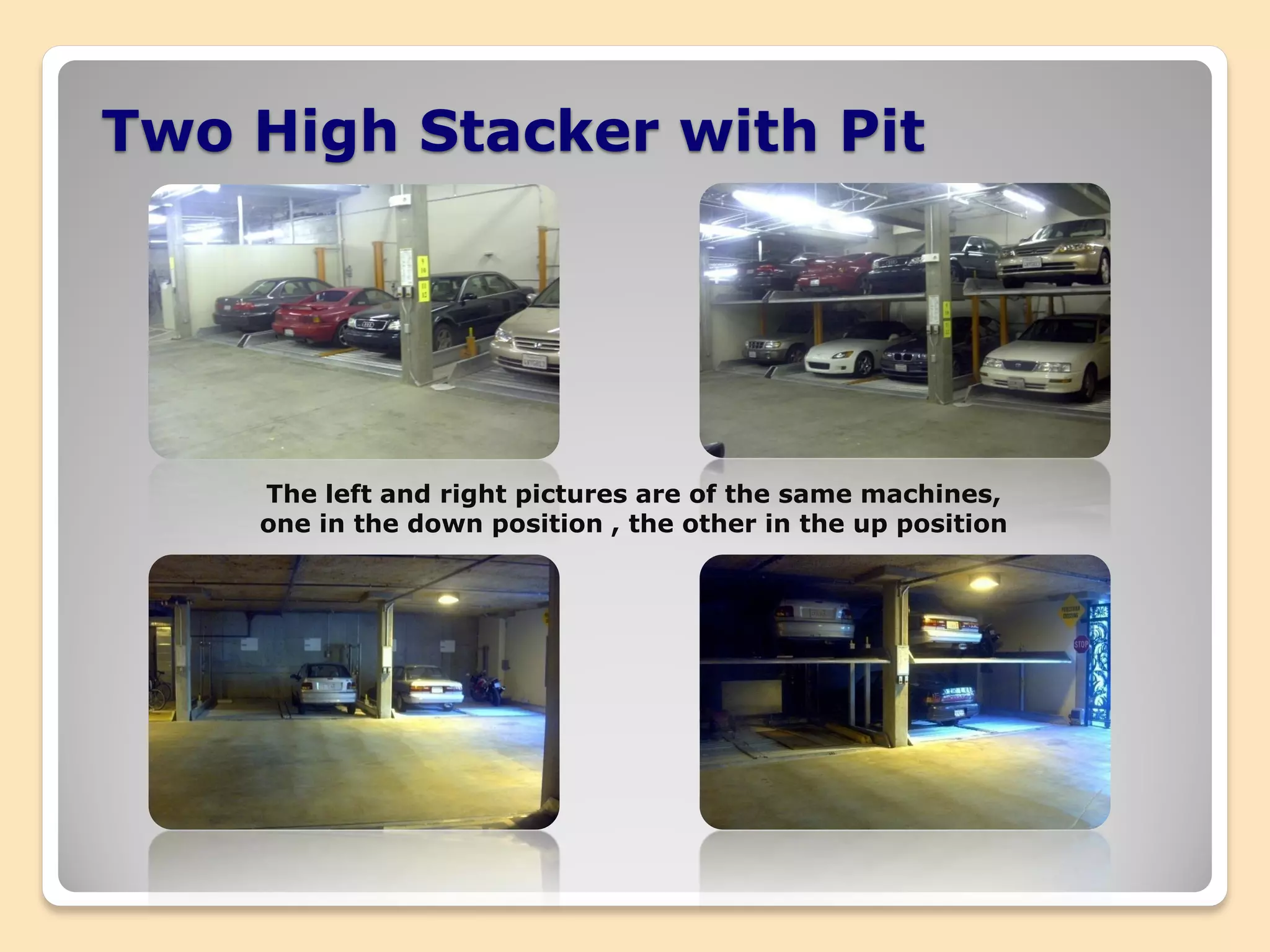
The left and right pictures are of the same machines,
one in the down position , the other in the up position
Two High Stacker with Pit
4 Cars- San Francisco
Three High Stacker with Pit
 The three high stacker lowers one or two levels into the pit
in order to provide independent access for each level.
 Advantages
◦ Very Dense
◦ Cost effective
◦ Available as a single wide or
double wide
 Disadvantages
◦ Requires 15’ – 9’’ ceiling and
10’ – 10’’ pit
◦ Passenger cars only
◦ Low head room for user
General Design Information
Electrical
 Generally only a 208v 3 phase 30 amp circuit is required for each group
of lifts (a few three high models require 40 amps). 220v single phase is
also available for most lifts.
 Utility costs to run the lifts are usually quite low due to the fact that each
lift is typically run just a few minutes per day.
Sprinklers
 Most communities will require sprinklers on each level of the machine and
in the pit, if the machine has one.
Seismic
 If the lifts are to be installed in a seismic zone they may need to be
braced to a wall or column.
 The lift manufacturer must be able to provide the structural loads
associated with the earthquake zone and recommendations on any
bracing requirements.
PUZZLE LIFTS
two high – three high – combination
Puzzle Lifts
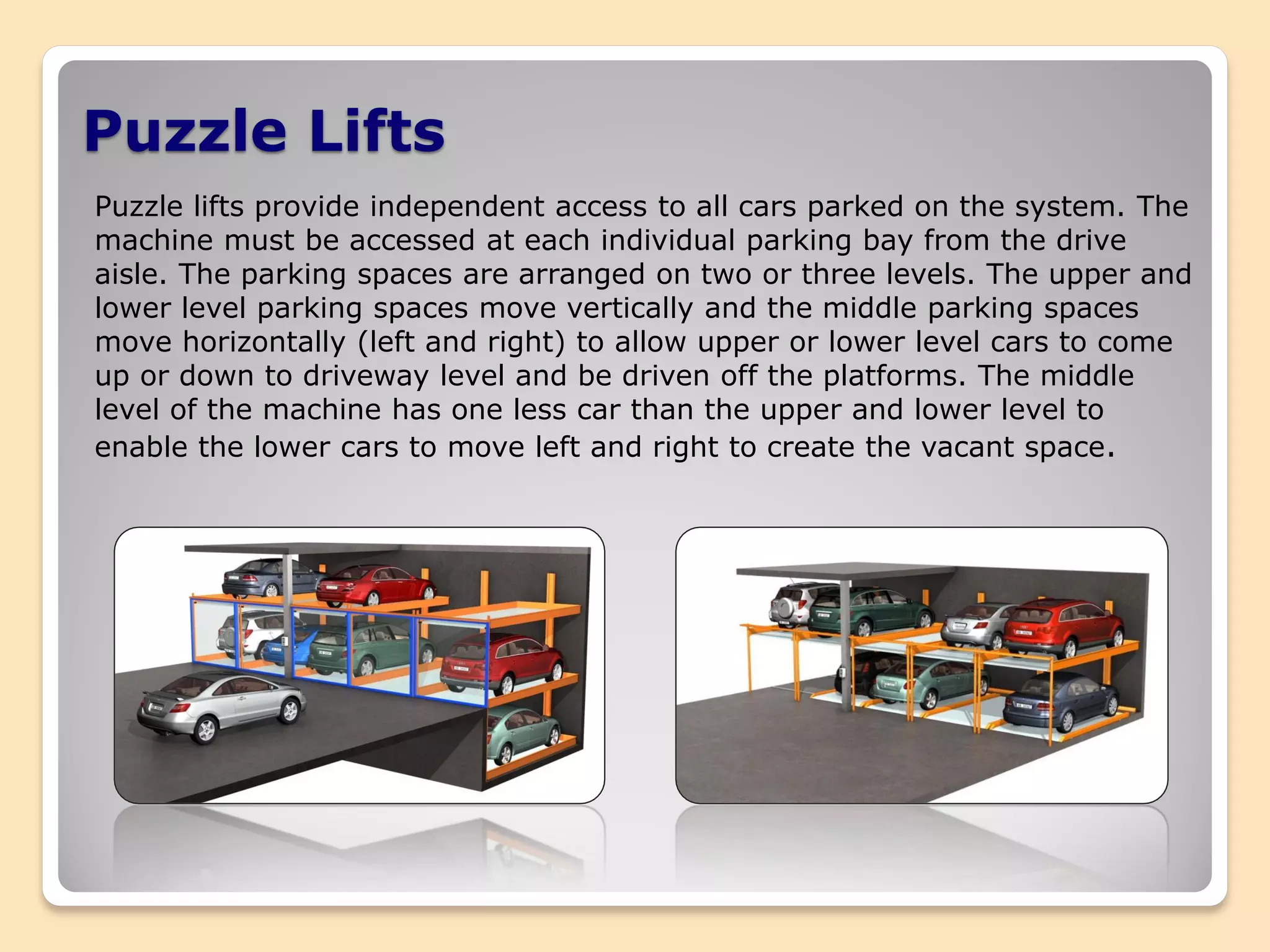
Puzzle lifts provide independent access to all cars parked on the system. The
machine must be accessed at each individual parking bay from the drive
aisle. The parking spaces are arranged on two or three levels. The upper and
lower level parking spaces move vertically and the middle parking spaces
move horizontally (left and right) to allow upper or lower level cars to come
up or down to driveway level and be driven off the platforms. The middle
level of the machine has one less car than the upper and lower level to
enable the lower cars to move left and right to create the vacant space.
Puzzle Lift Two High
 The two high puzzle lift provides
independent access and does not
require a pit. The minimum ceiling
height is 11’ – 4’’. However it does
require one empty slot in each
module. It is available from two
wide (holds 3 cars) to 15 wide
(holds 29 cars).
Advantages
 Independent access
 Can accommodate SUV’s
 No pit required, can be used on
upper levels of a garage
 Almost doubles the amount of
parking in the same space with no
excavation
Disadvantages
 More expensive than simple
stackers
Two High Puzzle Lift Animation
Video available in online format only
Three High Puzzle Lift
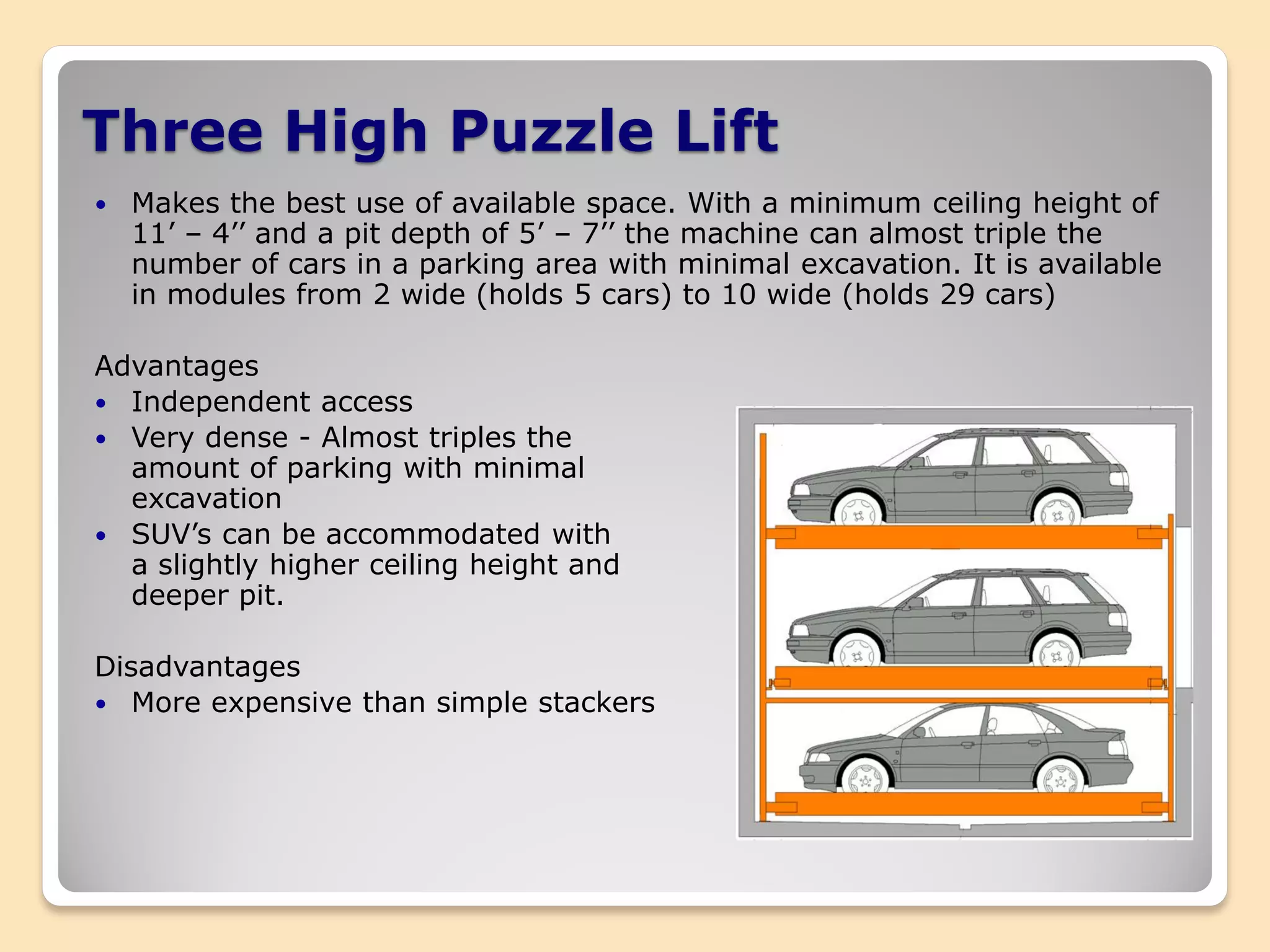
 Makes the best use of available space. With a minimum ceiling height of
11’ – 4’’ and a pit depth of 5’ – 7’’ the machine can almost triple the
number of cars in a parking area with minimal excavation. It is available
in modules from 2 wide (holds 5 cars) to 10 wide (holds 29 cars)
Advantages
 Independent access
 Very dense - Almost triples the
amount of parking with minimal
excavation
 SUV’s can be accommodated with
a slightly higher ceiling height and
deeper pit.
Disadvantages
 More expensive than simple stackers
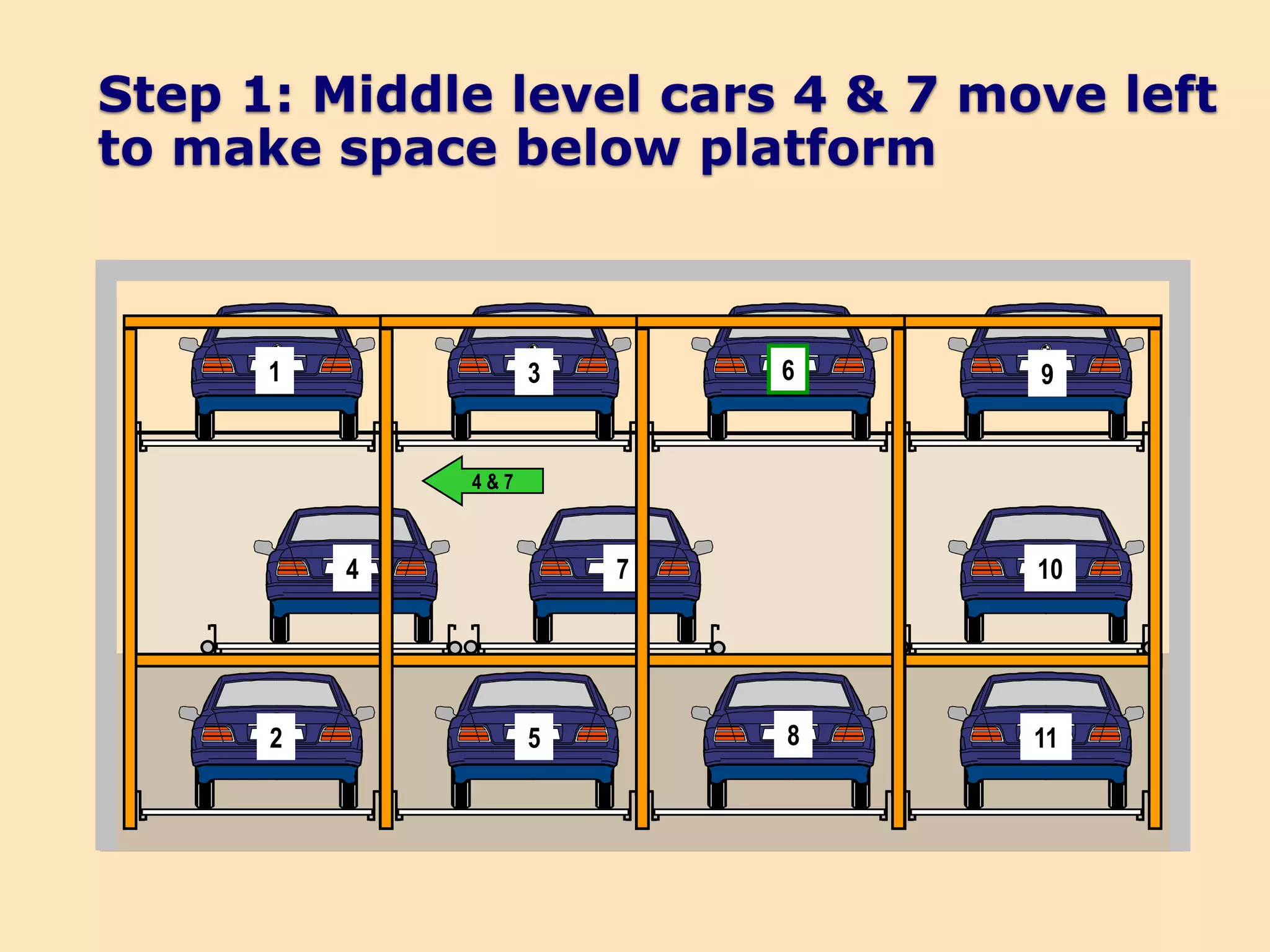
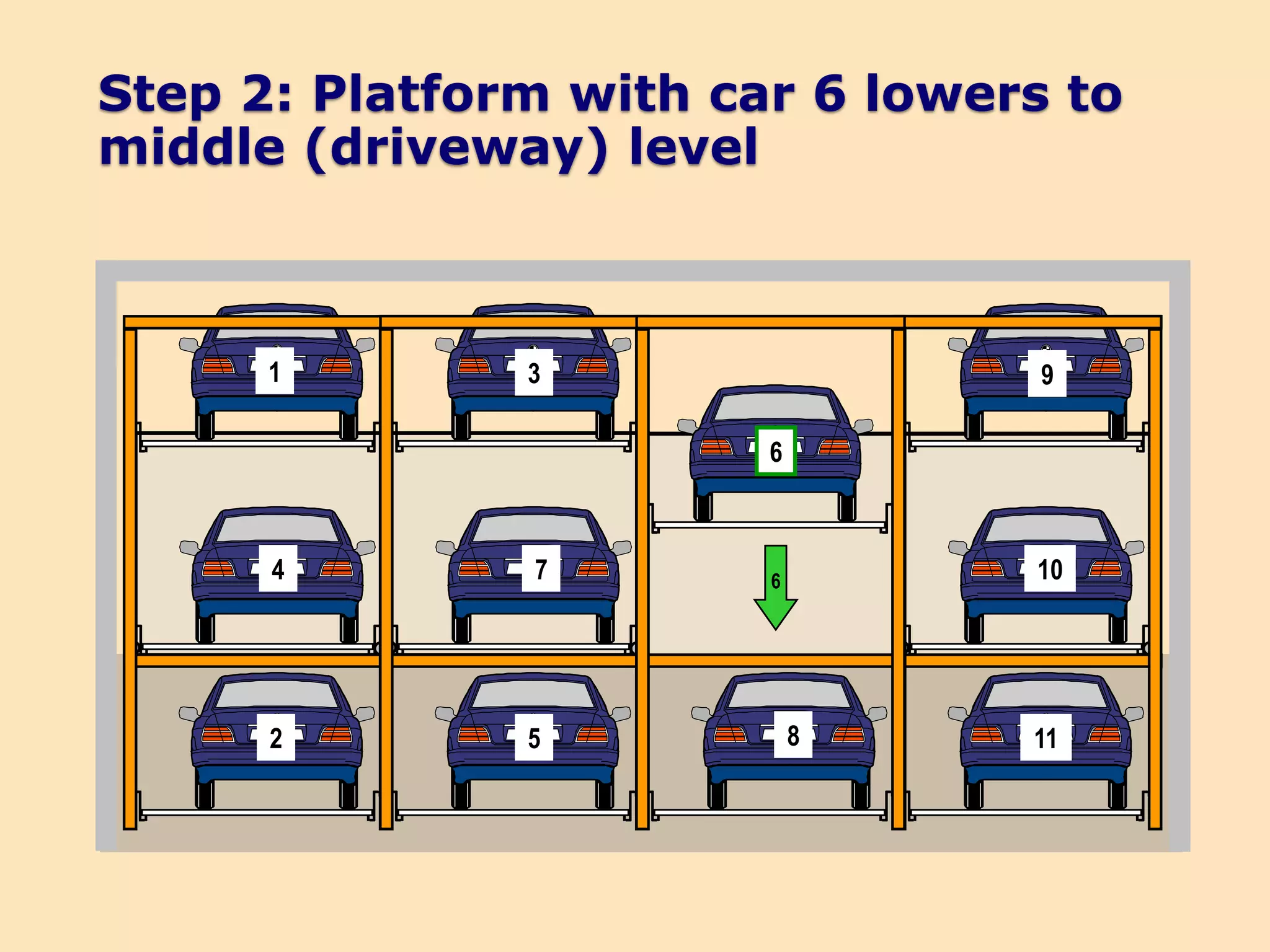
Puzzle lift Functional Diagram of
Operating Sequence for retrevial of car
in parking Space 6
2 5 8 11
9631
1074
Step 1: Middle level cars 4 & 7 move left
to make space below platform
2 5 8 11
9631
1074
4 & 7
Step 2: Platform with car 6 lowers to
middle (driveway) level
2 5 8 11
9
6
31
1074 6
Step 3: Door opens to allow car 6 to
drive out. Doors can be manual or
electric with remote controls
6
2 5 8 11
931
1074
Door
Step 4: User drives car 6 out.
2 5 8 11
931
1074 6
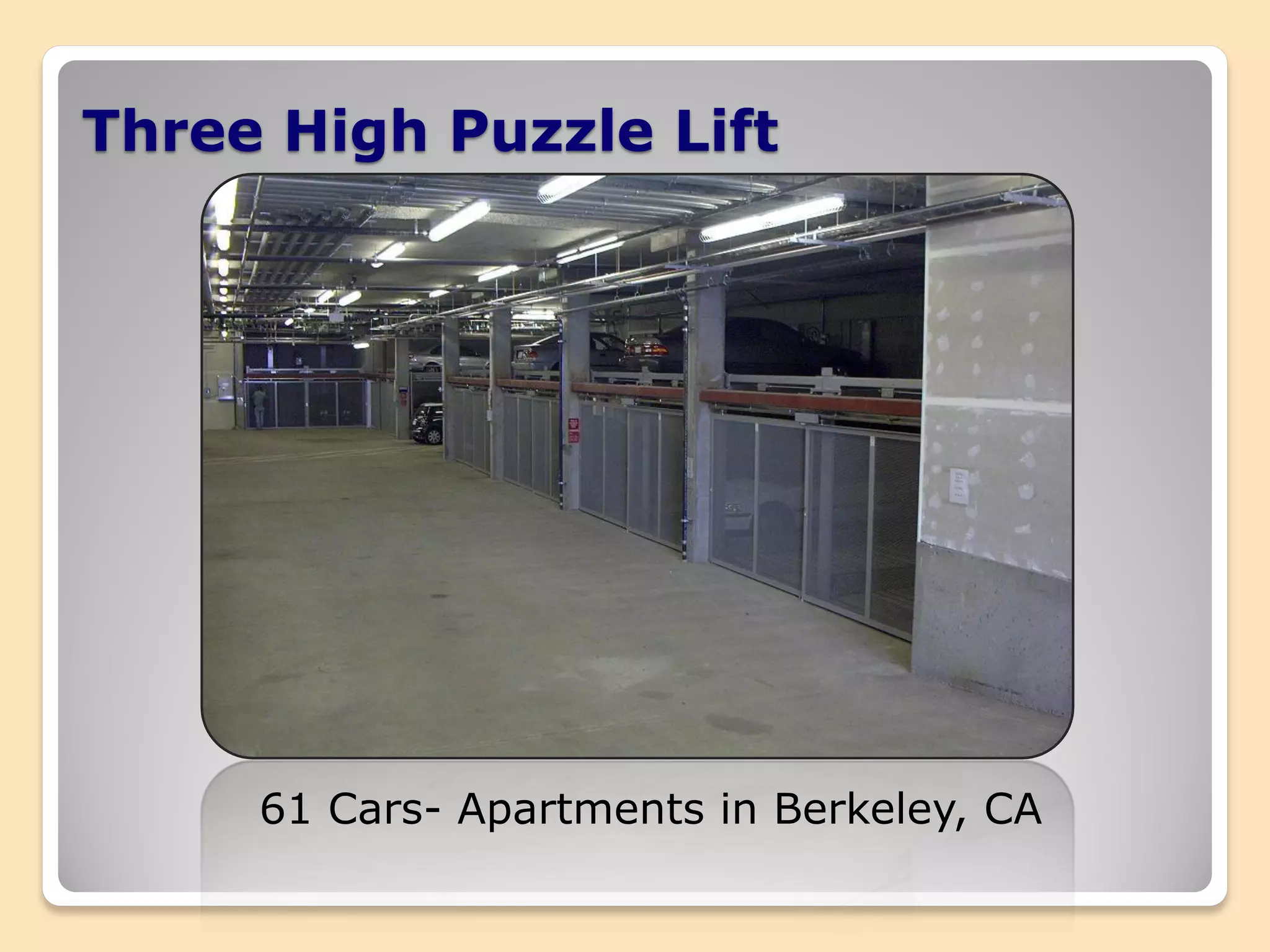
Three High Puzzle Lift
61 Cars- Apartments in Berkeley, CA
Three High Puzzle Lift Animation
Video available in online format only
Puzzle Lift Combinations
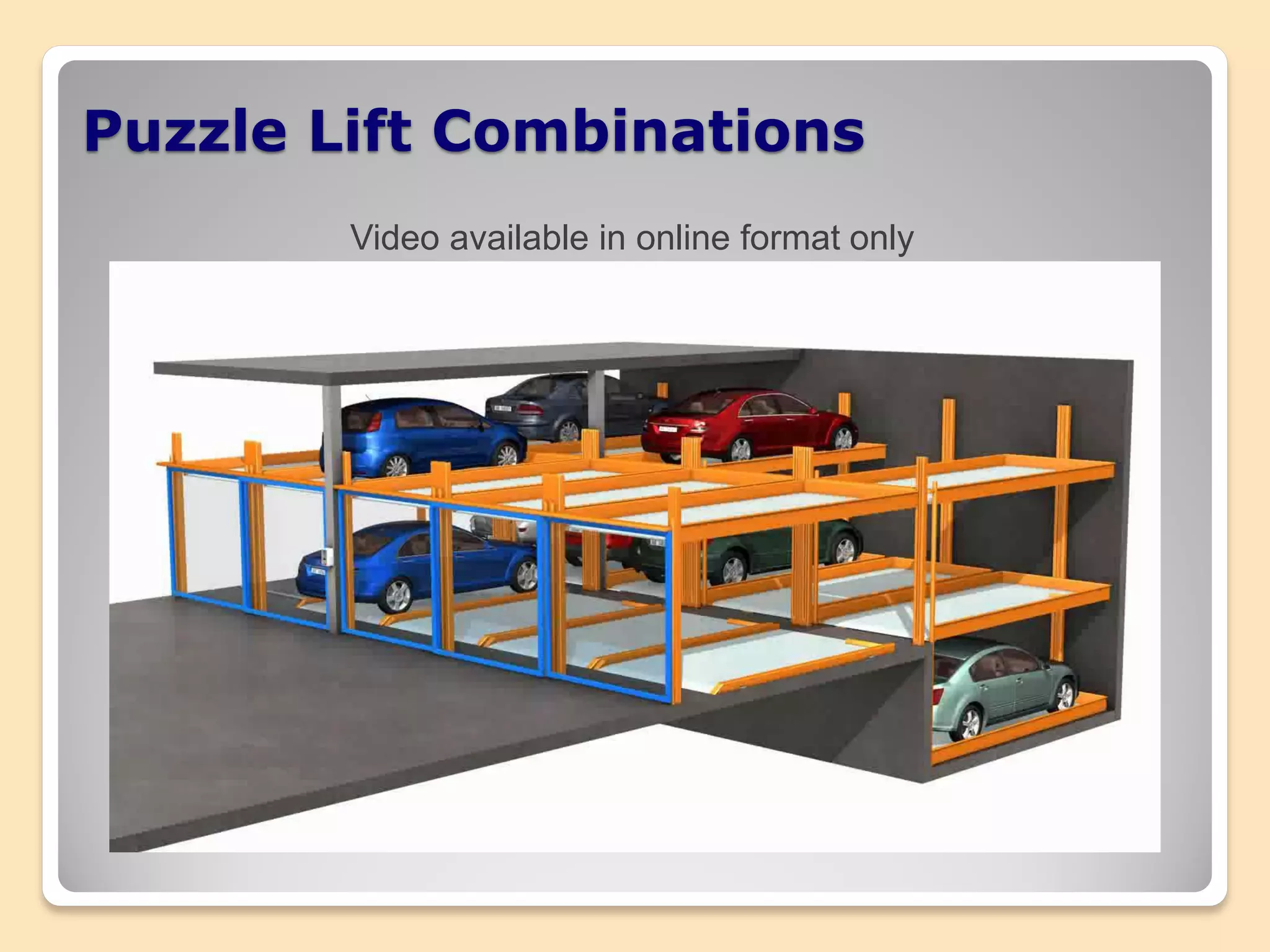
The Puzzle Lifts can be combined together with a two high version
in front and three high, two high or normal parking spaces in the
rear. The machine creates a space that the user drives through to
get to the second machine. The machine takes approx. 39 ft of
depth, but is extremely dense. A six wide (2 high / 3 high)
combination machine holds 28 cars.
Puzzle Lift Combinations
Video available in online format only
Various Puzzle Lift Combinations
two high/ two high combination
two high/ three high
with pit combination
two high/ two high
with pit combination
ADDITIONAL AUTOMATIC SYSTEMS
pallets – fully automatics
Pallets
Pallets are another way to move cars around, they are
especially useful in situations where there is not enough
ceiling height to stack cars and a pit is not possible. They
can provide independent access to what would be a row or
rows of land locked cars.
Pallet Animation
Video available in online format only
Fully Automatic Car Parking Systems
 Fully automatics are useful if none of the previous standard
models will work. The vehicle to be parked is placed in the
entrance box and moved via lift to the storage and retrieval unit
and put into the nearest available parking space. The vehicles can
be stored lengthwise or perpendicular to the driving direction.
 The system can be used as an aboveground or underground
system, or as a combination of both variants. Different vehicle
heights can be realized by different floor heights.
Lasers check the
car dimensions to
make sure the
vehicle will fit in
the machine. The
user is given
instructions on a
large screen in
front of the car.
Transfer Area / Entrance Box
Main door
User information
Panel
Vehicle control sides
Vehicle rear check
Vehicle height check
Load carrier check
EMPTY or VACANT
Control box
Vehicle front check
Entrance Box With Optional Turntable
Main door
Automatic Car Parking Systems
Variants
 Shelf System
 Layer System
There Are a Variety of Options
 The fully automatic machines are part of
an extensive product line. Once a base
model is chosen, the number of levels and
rows can be customized for the needs of
the specific project.
 Typically each entrance handles no more
than 60 to 80 cars. Larger systems would
be broken into multiple adjacent systems
each with it’s own entrance.
Underground Example
Entry Garage
Most comfortable, space saving and efficient way to park cars.
Procedure
1. Park your car in the entrance box,
2. Entrance door closes
3. The lift stores your car
4. The computer saves your car location
in memory
Advantages
 Max. car park capacity in min. space
 Safe against crime and vandalism
 Environmentally friendly
Disadvantage
 The most expensive solution
Fully Automatic Car Parking Systems
CONCLUSION
concerns – benefits – summary
Car Size Concerns
 The type of cars that need to be
accommodated must be taken into
consideration when choosing the
model. All models come with a choice
of widths and heights. Ceiling height
usually comes with a cost and may
involve a tradeoff with the size of
vehicles that fit in the machine. A
minimum ceiling height between
10’ – 6’’ and 11’ – 4’’ is generally
required to accommodate passenger
cars stacked two high. If SUV’s are
desired then an additional 1-2 feet of
ceiling height is usually required.
 There are however a few cars that will
not fit on any car lifts. Cars such as
Hummers and Suburbans will need to
be accommodated with a few at grade
spaces as well as ADA spaces.
Benefits of Mechanical Parking
 Can double or triple your parking capacity with little or no
excavation
 Valuable ground floor space can be recovered for retail or
other uses
 Can eliminate entire parking levels along with their ramps
and drive isles
 The number of units which are able to be developed on the
same site can be tripled
 Security in the parking area is improved
 Inexpensive to operate
Course Summary
By now, you should be able to:
 Define mechanical parking
 Describe dependent access parking stackers’ uses and limitations
 List the different types of independent access parking stackers
 Explain puzzle lifts, how they work and what their advantages are
 Describe fully automatic machines and why they might be used
 Compare and contrast the different stackers and lifts and describe
when each would be appropriate for use
 Describe what type of cars are suitable for each lift
 Describe the design requirements for each parking type
Mechanical Parking
Solutions for Modern
Urban Density
Rick Rombach
Klaus Multiparking, Inc
3652A Chestnut Street
Lafayette, CA
925-284-2092
sales@parklift.com
www.parklift.com
Course Number kmp14a
An AIA Continuing Education Program
Credit for this course is 1 AIA HSW CE Hour
© Ron Blank & Associates, Inc 2010
Please note: you will need to complete the conclusion quiz online at ronblank.com to receive credit

Kmp14a

  • 1.
    Mechanical Parking Solutions forModern Urban Density Rick Rombach Klaus Multiparking, Inc 3652A Chestnut Street Lafayette, CA 925-284-2092 sales@parklift.com www.parklift.com Course Number kmp14a An AIA Continuing Education Program Credit for this course is 1 AIA HSW CE Hour © Ron Blank & Associates, Inc 2010 Please note: you will need to complete the conclusion quiz online at ronblank.com to receive credit
  • 2.
    An American Instituteof Architects (AIA) Continuing Education Program Approved Promotional Statement: Ron Blank & Associates, Inc. is a registered provider with The American Institute of Architects Continuing Education System. Credit earned upon completion of this program will be reported to CES Records for AIA members. Certificates of Completion are available for all course participants upon completion of the course conclusion quiz with +80%. Please view the following slide for more information on Certificates of Completion through RBA This program is registered with the AIA/CES for continuing professional education. As such, it does not include content that may be deemed or construed to be an approval or endorsement by the AIA or Ron Blank & Associates, Inc. of any material of construction or any method or manner of handling, using, distributing, or dealing in any material or product.
  • 3.
    Course Format: Thisis a structured, web-based, self study course with a final exam. Course Credit: 1 AIA Health Safety & Welfare (HSW) CE Hour Completion Certificate: A confirmation is sent to you by email and you can print one upon successful completion of a course or from your RonBlank.com transcript. If you have any difficulties printing or receiving your Certificate please send requests to certificate@ronblank.com Design professionals, please remember to print or save your certificate of completion after successfully completing a course conclusion quiz. Email confirmations will be sent to the email address you have provided in your RonBlank.com account. An American Institute of Architects (AIA) Continuing Education Program Please note: you will need to complete the conclusion quiz online at ronblank.com to receive credit
  • 4.
  • 5.
    An innovative solutionto parking space, mechanical parking and the dependent access parking stackers’ uses and limitations are illustrated and described in this course to expand your knowledge on this unique product. Learn about the different types of parking stackers and how they work. Course Description
  • 6.
    Learning Objectives Upon completionof this course, you will be able to:  Define mechanical parking  Describe dependent access parking stackers’ uses and limitations  List the different types of independent access parking stackers  Explain puzzle lifts, how they work and what their advantages are  Describe fully automatic machines and why they might be used  Compare and contrast the different stackers and lifts and describe when each would be appropriate for use  Describe what type of cars are suitable for each lift  Describe the design requirements for each parking type
  • 7.
    What is MechanicalParking?  Mechanical Parking encompasses a wide range of options all designed to increase parking density and cut costs over traditional parking methods.  The solutions start at simple stackers, where the bottom car must be moved to get to the top car (dependent access) and go up to fully automatic machines where cars can be stored and retrieved from a single point of access.  There are 5 mechanical parking typologies: dependent access stackers, independent access stackers, puzzle lifts, pallets and fully automatic parking machines.
  • 8.
    Why Mechanical ParkingSystems? 1. Excavating a conventional basement is expensive and sometimes difficult. If you need to dig down and add a level or levels, mechanical parking will save money. A parking stall in a stacker generally costs between $5,000 - $20,000 depending on model and quantity, compared with $35,000 for a ground-floor space and $50,000 for a stall built underground in urban areas. 2. Parking machines can compact the cars as much as possible to create free space at ground level for retail areas or other higher uses. A normal parking stall requires around 300 to 350 square feet. That allows for the stall and a modest amount of circulation and drive aisles; where as with a mechanical parking system, this dimension is closer to 200 square feet per stall, reducing area usage by 1/3. 3. Mechanical parking systems can increase parking capacity as much as possible to add value to the building. Providing additional parking can frequently add value to units.
  • 9.
    Design Example 72 Cars+ 50 Units: Minimum Excavation, No Ramps
  • 10.
    Design Example More spaceon ground floor for retail 61 Cars, 71 Units + Retail
  • 11.
    Mechanical Parking Typologies DEPENDANTACCESS STACKERS low ceiling – two high – three high INDEPENDENT ACCESS STACKERS sloping – double – triple PUZZLE LIFTS PALLETS FULLY AUTOMATICS
  • 12.
    DEPENDANT ACCESS STACKERS lowceiling – two high – three high
  • 13.
    Dependent Access Stackers Dependent parking means that the lower car or cars must be moved by the user to access the top car.  This solution works well if both vehicles are for one unit or if there is a valet.  Advantages ◦ Low Cost ◦ Can be installed in existing buildings ◦ Low ceiling height (as low as 9’-4’’) ◦ No pit required ◦ Less than 60 seconds to retrieve car ◦ Suitable for outdoor use  Disadvantages ◦ Lower car must be moved by user ◦ User must have keys to both vehicles
  • 14.
    Dependent Access ModelsOverview Low Ceiling Model As low as 9’-4’’ Three High Ceiling height min 18’ – 3’’ Standard Two High Ceiling height min 10’-6’’
  • 15.
    Low Ceiling HeightStacker  This model takes advantage of the fact that a passenger car has a hood and a trunk to provide a ceiling height of only 9’ – 4’’.  Suitable for passenger cars only.  Can be used outdoors
  • 16.
    Standard Two HighStacker  The standard model is useful in areas where the ceiling height is not restricted. While the minimum ceiling height is 10’ – 6’’, the height of the platform is adjustable and can accommodate SUV’s if the ceiling is higher.  Typically used in apartments or condos where both cars on the lift are for the same unit.  A very popular model for valet use. The upper lifts are usually reserved for longer term parking and the bottom space for short term parkers
  • 17.
    Two High StackerExamples Santa Monica, CA Lafayette, CA New York, NY Emeryville, CA
  • 18.
    Three High Stacker Withthis version, two cars must be moved in order to get to the top car. It requires a ceiling height of 18’ – 3’’ and is generally used outdoors with a valet or for car storage.
  • 19.
  • 20.
    Independent Access Stackers Independent Access Stack Parkers require a pit, the bottom car is lowered into the pit so that the top car(s) can be driven off  Advantages ◦ No cars need to be moved ◦ Simple operation ◦ Less than 60 Seconds to retrieve a car ◦ SUV’s possible depending on model ◦ Cost effective  Disadvantages ◦ Doesn’t make the most efficient use of space (see puzzle lift)
  • 21.
  • 22.
    Two High Stackerwith Pit The left and right pictures are of the same machines, one in the down position , the other in the up position
  • 23.
    Two High Stackerwith Pit 4 Cars- San Francisco
  • 24.
    Three High Stackerwith Pit  The three high stacker lowers one or two levels into the pit in order to provide independent access for each level.  Advantages ◦ Very Dense ◦ Cost effective ◦ Available as a single wide or double wide  Disadvantages ◦ Requires 15’ – 9’’ ceiling and 10’ – 10’’ pit ◦ Passenger cars only ◦ Low head room for user
  • 25.
    General Design Information Electrical Generally only a 208v 3 phase 30 amp circuit is required for each group of lifts (a few three high models require 40 amps). 220v single phase is also available for most lifts.  Utility costs to run the lifts are usually quite low due to the fact that each lift is typically run just a few minutes per day. Sprinklers  Most communities will require sprinklers on each level of the machine and in the pit, if the machine has one. Seismic  If the lifts are to be installed in a seismic zone they may need to be braced to a wall or column.  The lift manufacturer must be able to provide the structural loads associated with the earthquake zone and recommendations on any bracing requirements.
  • 26.
    PUZZLE LIFTS two high– three high – combination
  • 27.
    Puzzle Lifts Puzzle liftsprovide independent access to all cars parked on the system. The machine must be accessed at each individual parking bay from the drive aisle. The parking spaces are arranged on two or three levels. The upper and lower level parking spaces move vertically and the middle parking spaces move horizontally (left and right) to allow upper or lower level cars to come up or down to driveway level and be driven off the platforms. The middle level of the machine has one less car than the upper and lower level to enable the lower cars to move left and right to create the vacant space.
  • 28.
    Puzzle Lift TwoHigh  The two high puzzle lift provides independent access and does not require a pit. The minimum ceiling height is 11’ – 4’’. However it does require one empty slot in each module. It is available from two wide (holds 3 cars) to 15 wide (holds 29 cars). Advantages  Independent access  Can accommodate SUV’s  No pit required, can be used on upper levels of a garage  Almost doubles the amount of parking in the same space with no excavation Disadvantages  More expensive than simple stackers
  • 29.
    Two High PuzzleLift Animation Video available in online format only
  • 30.
    Three High PuzzleLift  Makes the best use of available space. With a minimum ceiling height of 11’ – 4’’ and a pit depth of 5’ – 7’’ the machine can almost triple the number of cars in a parking area with minimal excavation. It is available in modules from 2 wide (holds 5 cars) to 10 wide (holds 29 cars) Advantages  Independent access  Very dense - Almost triples the amount of parking with minimal excavation  SUV’s can be accommodated with a slightly higher ceiling height and deeper pit. Disadvantages  More expensive than simple stackers
  • 31.
    Puzzle lift FunctionalDiagram of Operating Sequence for retrevial of car in parking Space 6 2 5 8 11 9631 1074
  • 32.
    Step 1: Middlelevel cars 4 & 7 move left to make space below platform 2 5 8 11 9631 1074 4 & 7
  • 33.
    Step 2: Platformwith car 6 lowers to middle (driveway) level 2 5 8 11 9 6 31 1074 6
  • 34.
    Step 3: Dooropens to allow car 6 to drive out. Doors can be manual or electric with remote controls 6 2 5 8 11 931 1074 Door
  • 35.
    Step 4: Userdrives car 6 out. 2 5 8 11 931 1074 6
  • 36.
    Three High PuzzleLift 61 Cars- Apartments in Berkeley, CA
  • 37.
    Three High PuzzleLift Animation Video available in online format only
  • 38.
    Puzzle Lift Combinations ThePuzzle Lifts can be combined together with a two high version in front and three high, two high or normal parking spaces in the rear. The machine creates a space that the user drives through to get to the second machine. The machine takes approx. 39 ft of depth, but is extremely dense. A six wide (2 high / 3 high) combination machine holds 28 cars.
  • 39.
    Puzzle Lift Combinations Videoavailable in online format only
  • 40.
    Various Puzzle LiftCombinations two high/ two high combination two high/ three high with pit combination two high/ two high with pit combination
  • 41.
  • 42.
    Pallets Pallets are anotherway to move cars around, they are especially useful in situations where there is not enough ceiling height to stack cars and a pit is not possible. They can provide independent access to what would be a row or rows of land locked cars.
  • 43.
    Pallet Animation Video availablein online format only
  • 44.
    Fully Automatic CarParking Systems  Fully automatics are useful if none of the previous standard models will work. The vehicle to be parked is placed in the entrance box and moved via lift to the storage and retrieval unit and put into the nearest available parking space. The vehicles can be stored lengthwise or perpendicular to the driving direction.  The system can be used as an aboveground or underground system, or as a combination of both variants. Different vehicle heights can be realized by different floor heights.
  • 45.
    Lasers check the cardimensions to make sure the vehicle will fit in the machine. The user is given instructions on a large screen in front of the car. Transfer Area / Entrance Box Main door User information Panel Vehicle control sides Vehicle rear check Vehicle height check Load carrier check EMPTY or VACANT Control box Vehicle front check
  • 46.
    Entrance Box WithOptional Turntable Main door
  • 47.
    Automatic Car ParkingSystems Variants  Shelf System  Layer System
  • 48.
    There Are aVariety of Options  The fully automatic machines are part of an extensive product line. Once a base model is chosen, the number of levels and rows can be customized for the needs of the specific project.  Typically each entrance handles no more than 60 to 80 cars. Larger systems would be broken into multiple adjacent systems each with it’s own entrance.
  • 49.
  • 50.
    Most comfortable, spacesaving and efficient way to park cars. Procedure 1. Park your car in the entrance box, 2. Entrance door closes 3. The lift stores your car 4. The computer saves your car location in memory Advantages  Max. car park capacity in min. space  Safe against crime and vandalism  Environmentally friendly Disadvantage  The most expensive solution Fully Automatic Car Parking Systems
  • 51.
  • 52.
    Car Size Concerns The type of cars that need to be accommodated must be taken into consideration when choosing the model. All models come with a choice of widths and heights. Ceiling height usually comes with a cost and may involve a tradeoff with the size of vehicles that fit in the machine. A minimum ceiling height between 10’ – 6’’ and 11’ – 4’’ is generally required to accommodate passenger cars stacked two high. If SUV’s are desired then an additional 1-2 feet of ceiling height is usually required.  There are however a few cars that will not fit on any car lifts. Cars such as Hummers and Suburbans will need to be accommodated with a few at grade spaces as well as ADA spaces.
  • 53.
    Benefits of MechanicalParking  Can double or triple your parking capacity with little or no excavation  Valuable ground floor space can be recovered for retail or other uses  Can eliminate entire parking levels along with their ramps and drive isles  The number of units which are able to be developed on the same site can be tripled  Security in the parking area is improved  Inexpensive to operate
  • 54.
    Course Summary By now,you should be able to:  Define mechanical parking  Describe dependent access parking stackers’ uses and limitations  List the different types of independent access parking stackers  Explain puzzle lifts, how they work and what their advantages are  Describe fully automatic machines and why they might be used  Compare and contrast the different stackers and lifts and describe when each would be appropriate for use  Describe what type of cars are suitable for each lift  Describe the design requirements for each parking type
  • 55.
    Mechanical Parking Solutions forModern Urban Density Rick Rombach Klaus Multiparking, Inc 3652A Chestnut Street Lafayette, CA 925-284-2092 sales@parklift.com www.parklift.com Course Number kmp14a An AIA Continuing Education Program Credit for this course is 1 AIA HSW CE Hour © Ron Blank & Associates, Inc 2010 Please note: you will need to complete the conclusion quiz online at ronblank.com to receive credit