KMD1001 DESIGN BRIEF &
   ONTOLOGY TASK
  Peter Pennefather, Oct 22, 2012
Assignments:
1. KMD Ontology task – 15% (due Sun. Oct. 28 online)
2. A 5x5 presentation in class an online – 15% (over term)
3. Active participation in class and online – 15%
4. Specific KMD framework analysis & critique brief – total 50% (5+5+15+25%)
        •Preliminary Design Brief Summary (1 pages) – 5% (Oct 29)
        •Design Brief Summary, Framework visualization, Annotated bibliography – 5% (Nov 5)
        •10x10 Presentation of Chosen Design Challenge Conceptualization – 15% (Nov 5,12,19,26)
        •Final report (around 3000 words) – 25% (due Dec 22)
5. Public group presentation on KMD topic – 5% TBD around KMDI holiday party
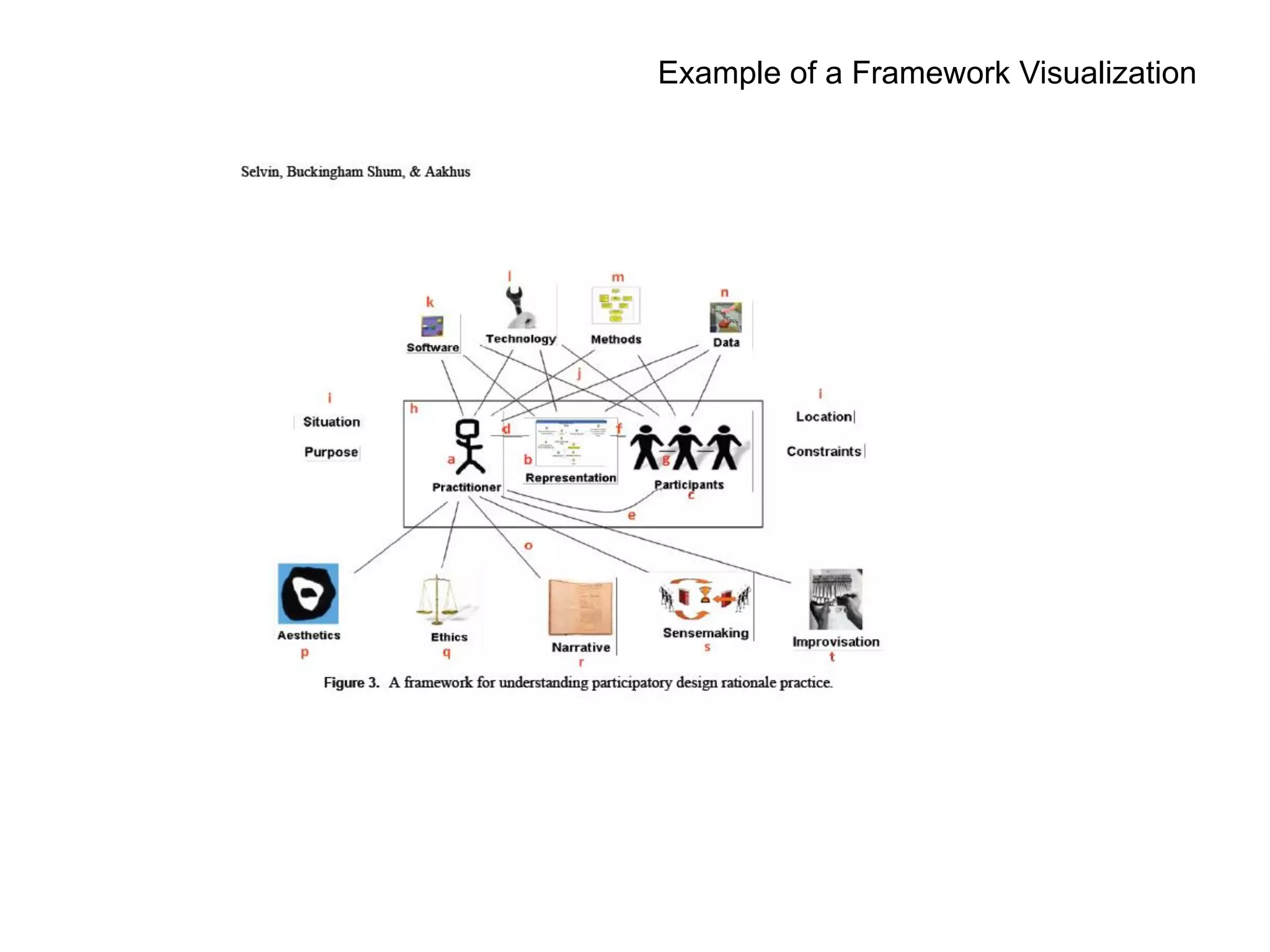
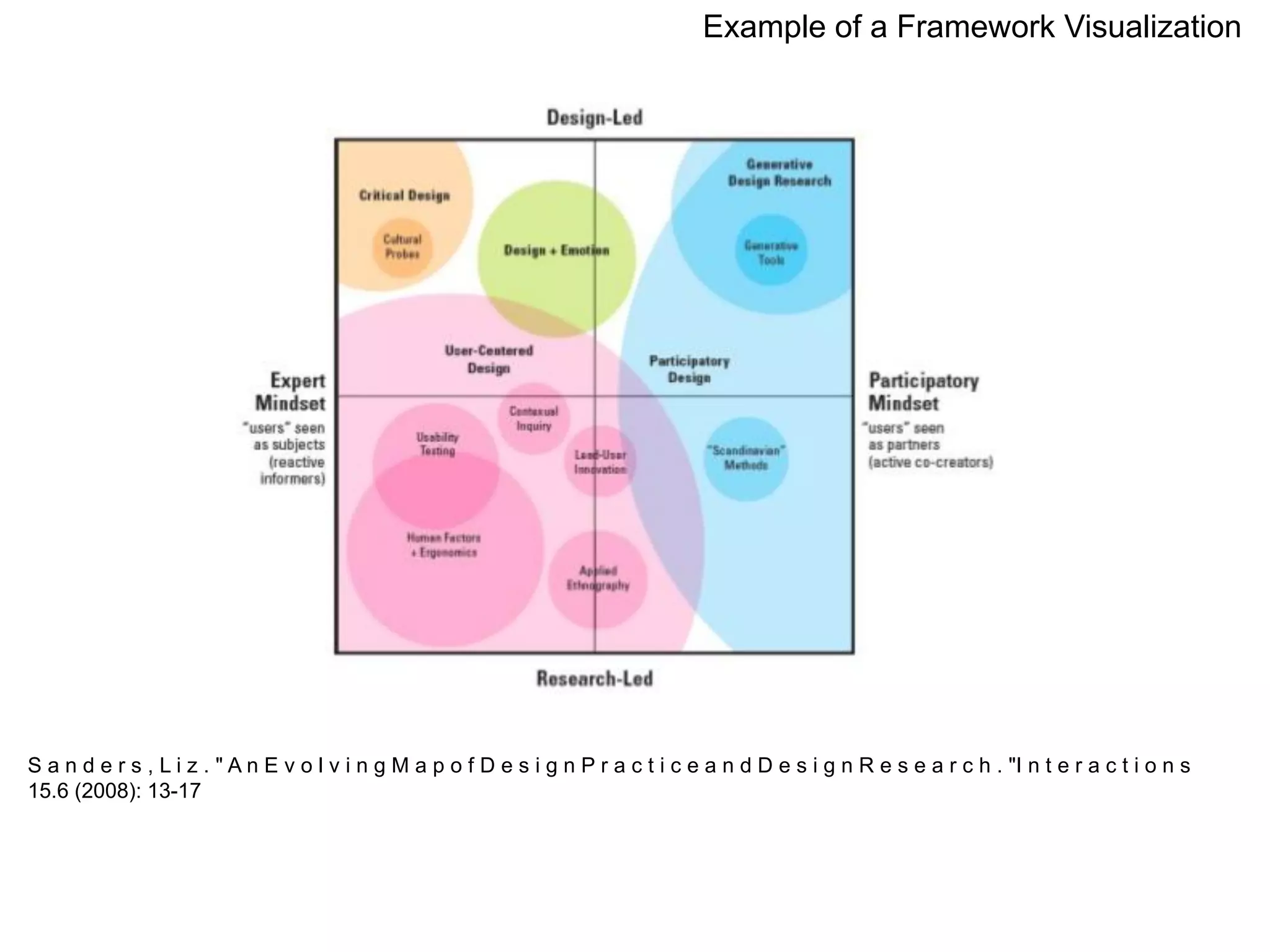
Example of a Framework Visualization


S a n d e r s , L i z . " A n E v o l v i n g M a p o f D e s i g n P r a c t i c e a n d D e s i g n R e s e a r c h . "I n t e r a c t i o n s
15.6 (2008): 13-17 5 . 6
ONTOLOGY TASK: In computer and information science an ontology formally represents
knowledge as a set of concepts within a domain and the relationships among those concepts

In this course we are examining concepts related to how media can be designed and adapted to
promote building and sharing of knowledge. Within that context we are exploring the meaning of
design and waymaking, knowledge and interdisciplinarity and media and embodiment.

The ontology task asks you to discuss relationships between those pairs of concepts or any other
set of 3 pairs of concepts. The task has three stages
1)   for each pair specify each concept with a short (about 100 +/- 50 words) definition; pick a
     definition that you are comfortable with and that can be linked a reputable and citable source;
2)   briefly discuss how the two concepts are related to each other and the overall goals of the
     course as you understand them,
3)   repeat the exercise for two more concept pairs of your choosing. You should end up with 5
     pages of text.
The report should be about 5 pages (1.5 line spacing 2000 words).
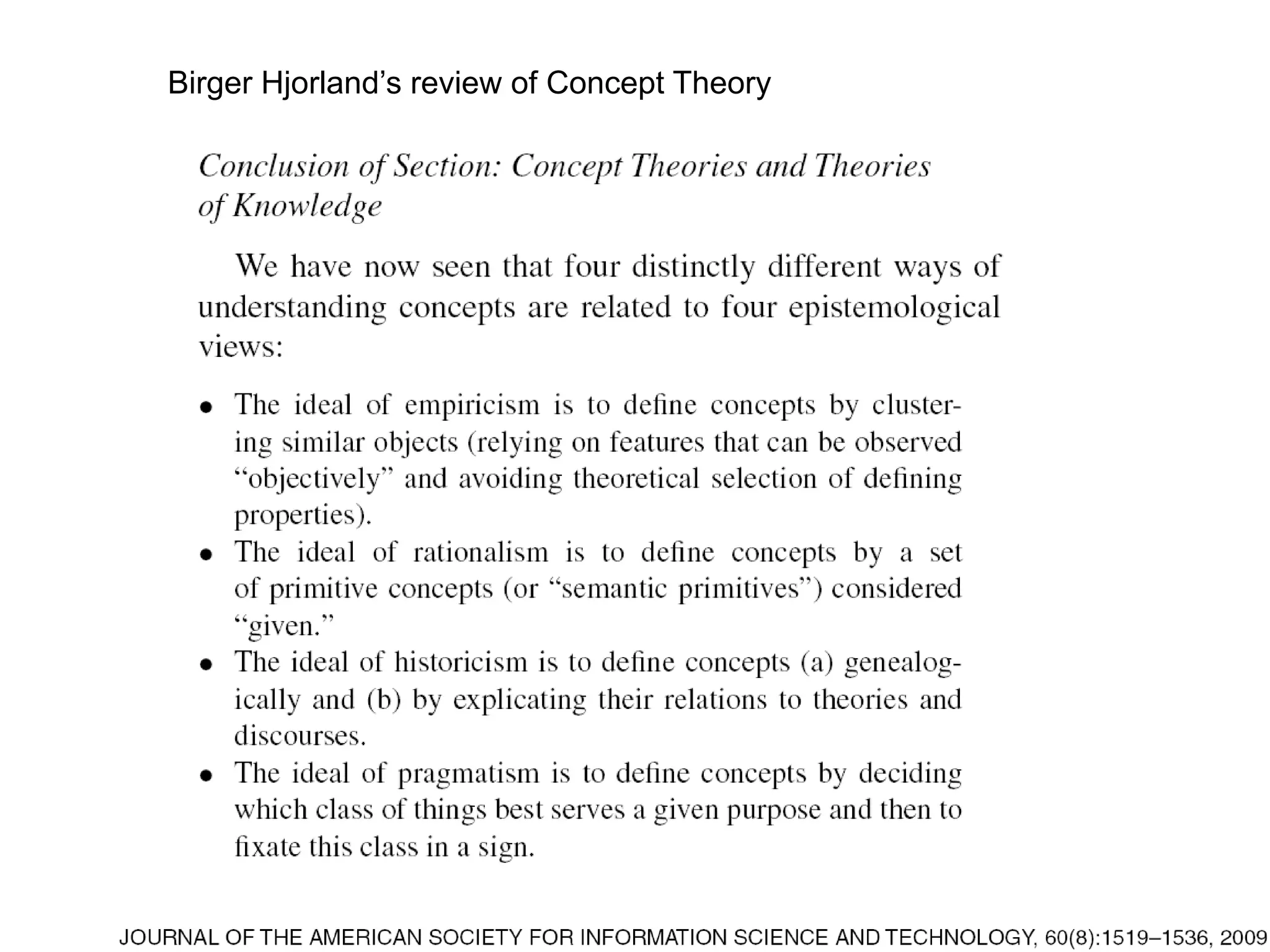
Birger Hjorland’s review of Concept Theory
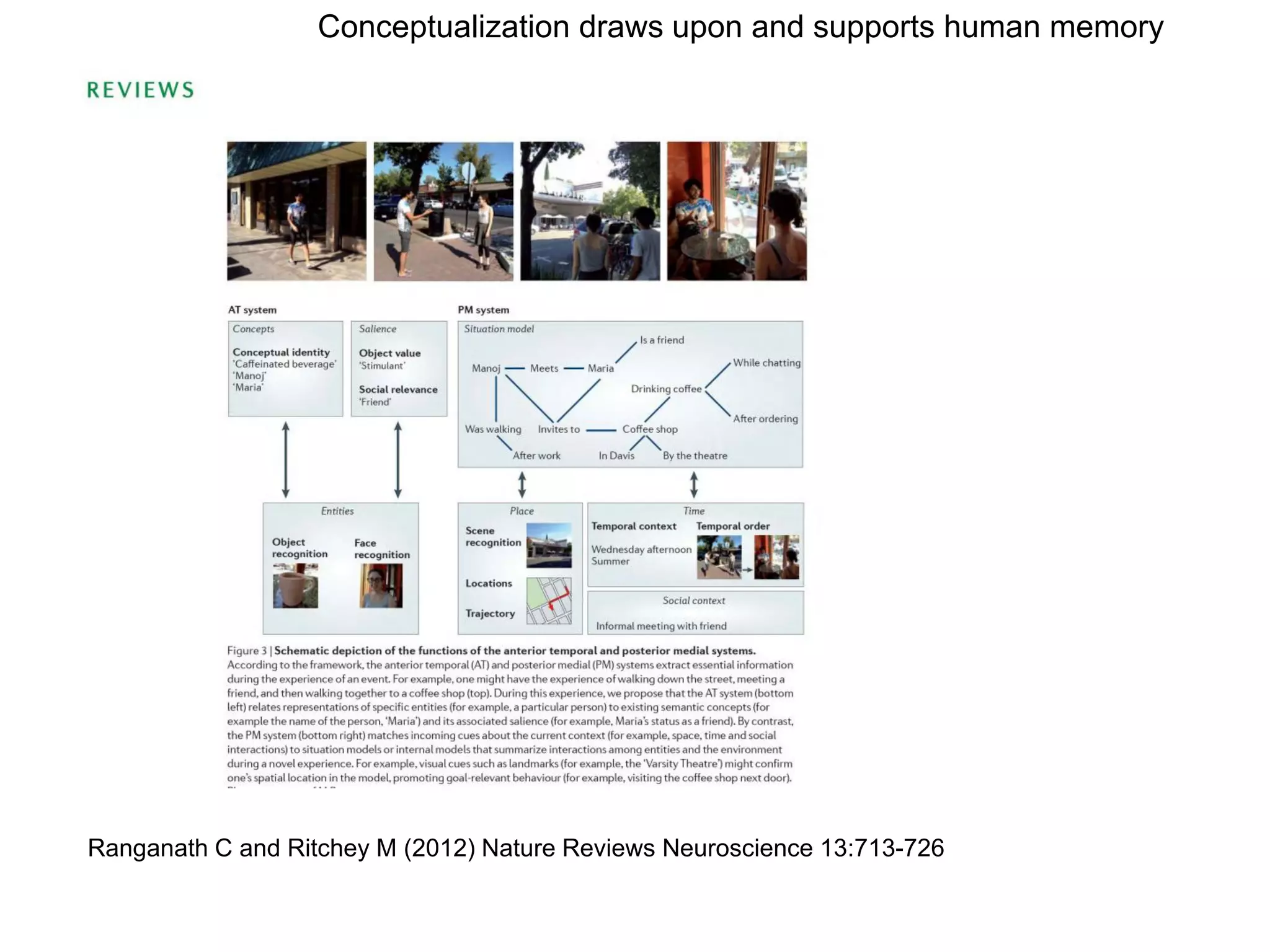
Conceptualization draws upon and supports human memory


Ranganath C and Ritchey M (2012) Nature Reviews Neuroscience 13:713-726
Conceptual Design Brief
Kant’s conceptualization of concept formation
Kant investigated the way that empirical a posteriori concepts are created. The logical acts
of the understanding by which concepts are generated as to their form are:
1.comparison, i.e., the likening of mental images to one another in relation to the unity of
consciousness;
2.reflection, i.e., the going back over different mental images, how they can be
comprehended in one consciousness; and finally
3.abstraction or the segregation of everything else by which the mental images differ ...

In order to make our mental images into concepts, one must thus be able to compare,
reflect, and abstract, for these three logical operations of the understanding are essential
and general conditions of generating any concept whatever. For example, I see a fir, a
willow, and a linden. In firstly comparing these objects, I notice that they are different from
one another in respect of trunk, branches, leaves, and the like; further, however, I reflect
only on what they have in common, the trunk, the branches, the leaves themselves, and
abstract from their size, shape, and so forth; thus I gain a concept of a tree. — Logic, §6


From Wikipedia entry on Concept (http://en.wikipedia.org/wiki/Concept)
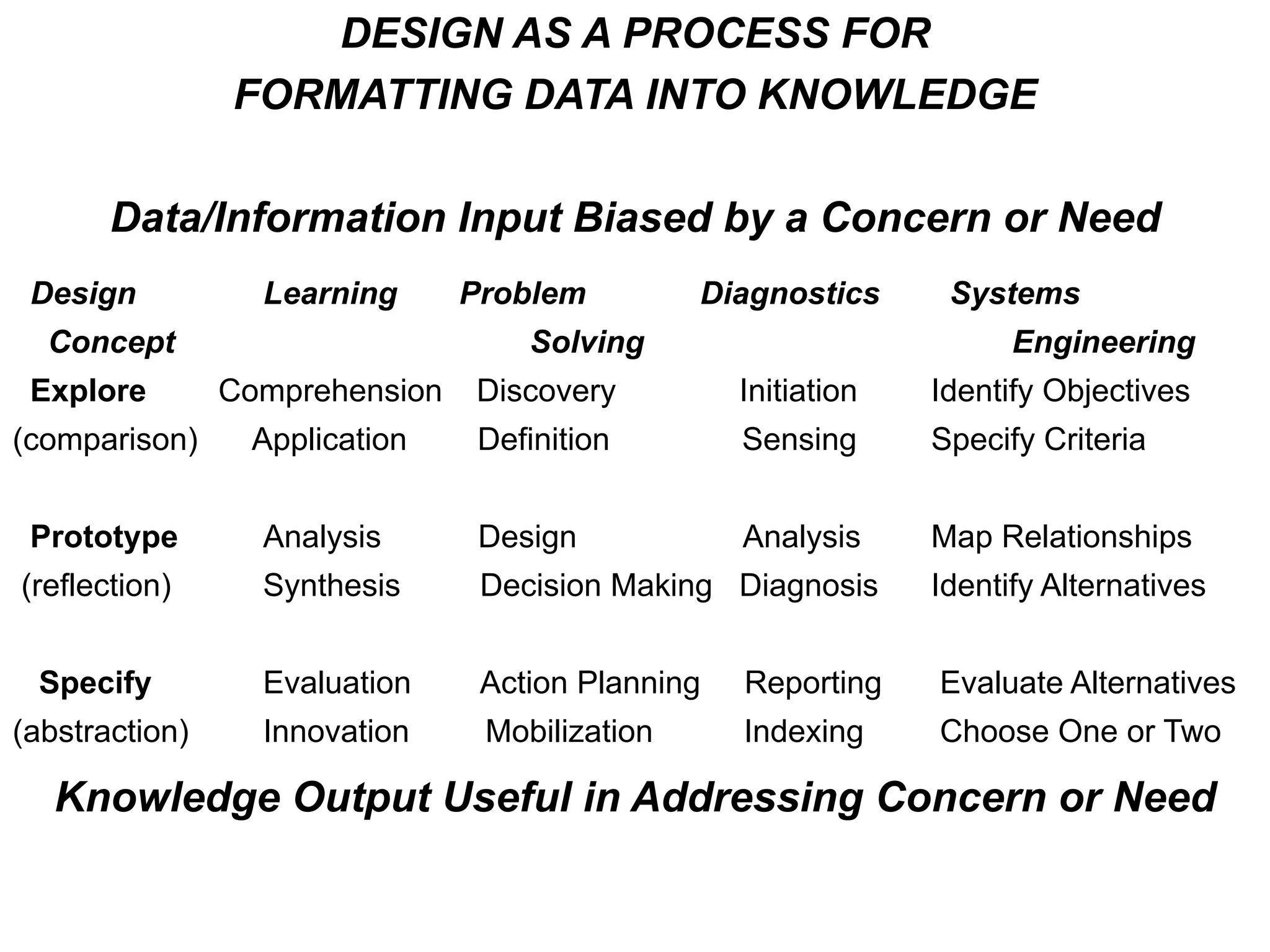
DESIGN AS A PROCESS FOR
                FORMATTING DATA INTO KNOWLEDGE

       Data/Information Input Biased by a Concern or Need
 Design           Learning      Problem         Diagnostics      Systems
  Concept                           Solving                           Engineering
 Explore        Comprehension   Discovery          Initiation   Identify Objectives
(comparison)     Application     Definition        Sensing      Specify Criteria


 Prototype        Analysis       Design            Analysis     Map Relationships
(reflection)      Synthesis      Decision Making Diagnosis      Identify Alternatives


 Specify          Evaluation     Action Planning   Reporting    Evaluate Alternatives
(abstraction)     Innovation     Mobilization      Indexing     Choose One or Two

   Knowledge Output Useful in Addressing Concern or Need
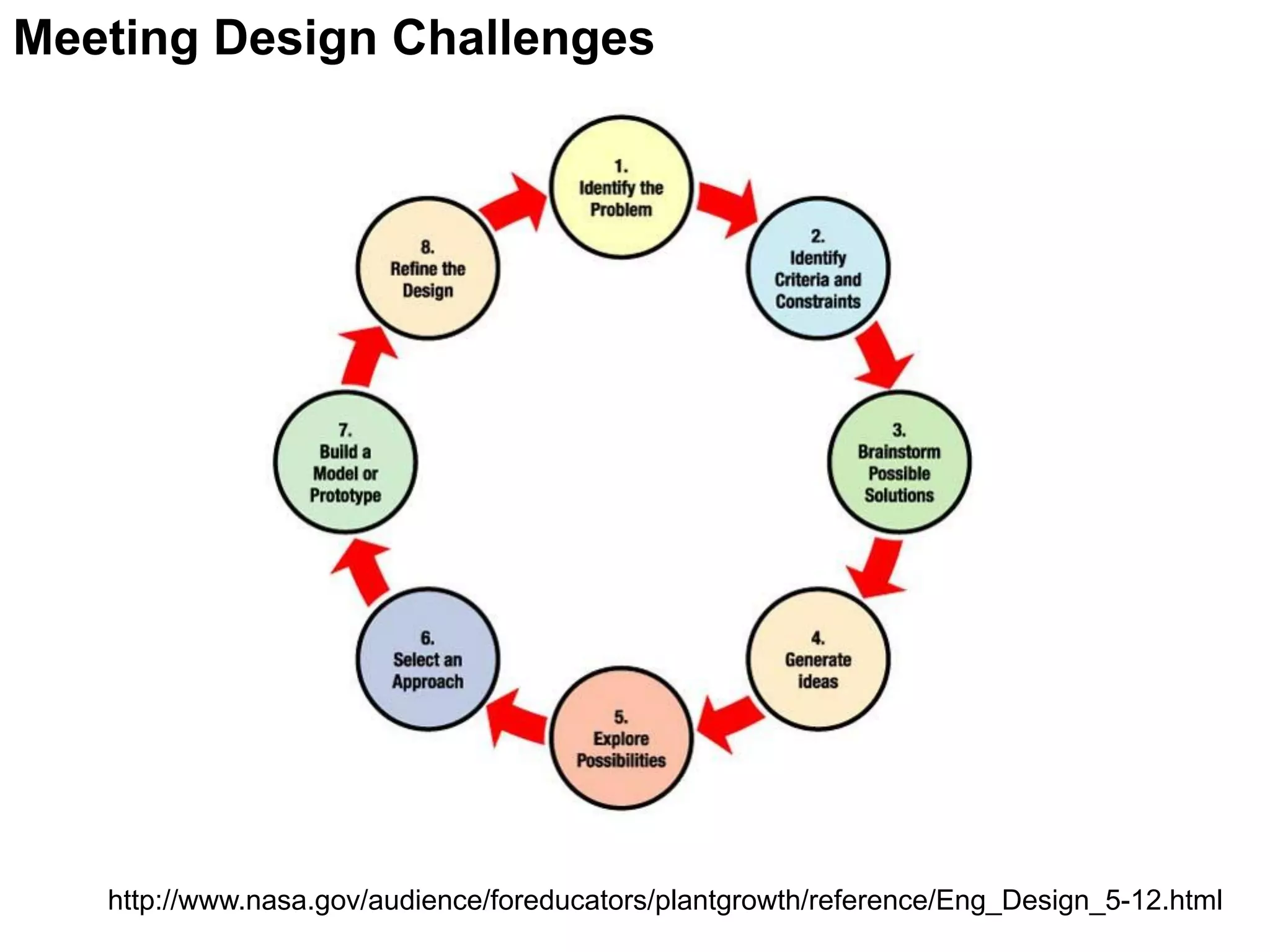
Meeting Design Challenges


   http://www.nasa.gov/audience/foreducators/plantgrowth/reference/Eng_Design_5-12.html
Before Dec 22, all students will have submitted a final design brief outlining their KMD concept or
process innovation and how their analysis suggests a re-design. The brief should have three sections:

1) Map/Indentify the Design Challenge Conceptualization and Desired Outcomes
   identify the KMD domain that you will focus on and a particular challenge you will be exploring
   provide a history of previous attempts to conceptualize the challenge and contrast them with yours
   describe the design constraints, usability, and goals that are guiding your design conceptualization
   provide a summary of uncertainties and gaps in knowledge related to the proposed approach

2) Prototype
   Consider a few implications of the way that you have chosen to conceive of the challenge
   develop a framework for evaluating the outcomes of the suggested solutions to the challenge,
   think of situations and people who could find your approach useful
   imagine possible impacts of different possible solutions consistent with your constraints and values
   determine which of these you want to specify in greater detail and why

3) Detail/Specify
   identify a specific use case and user community that could appreciate your solution
   summarize why the solution is appropriate at the suggested time and place
   analyze strategies for obtaining confirming your expectations
   analyze potential sources of support for implementing further study and refinement of your concept
   analyze potential resistance to or criticism of your design conceptualization

4) Synopsis
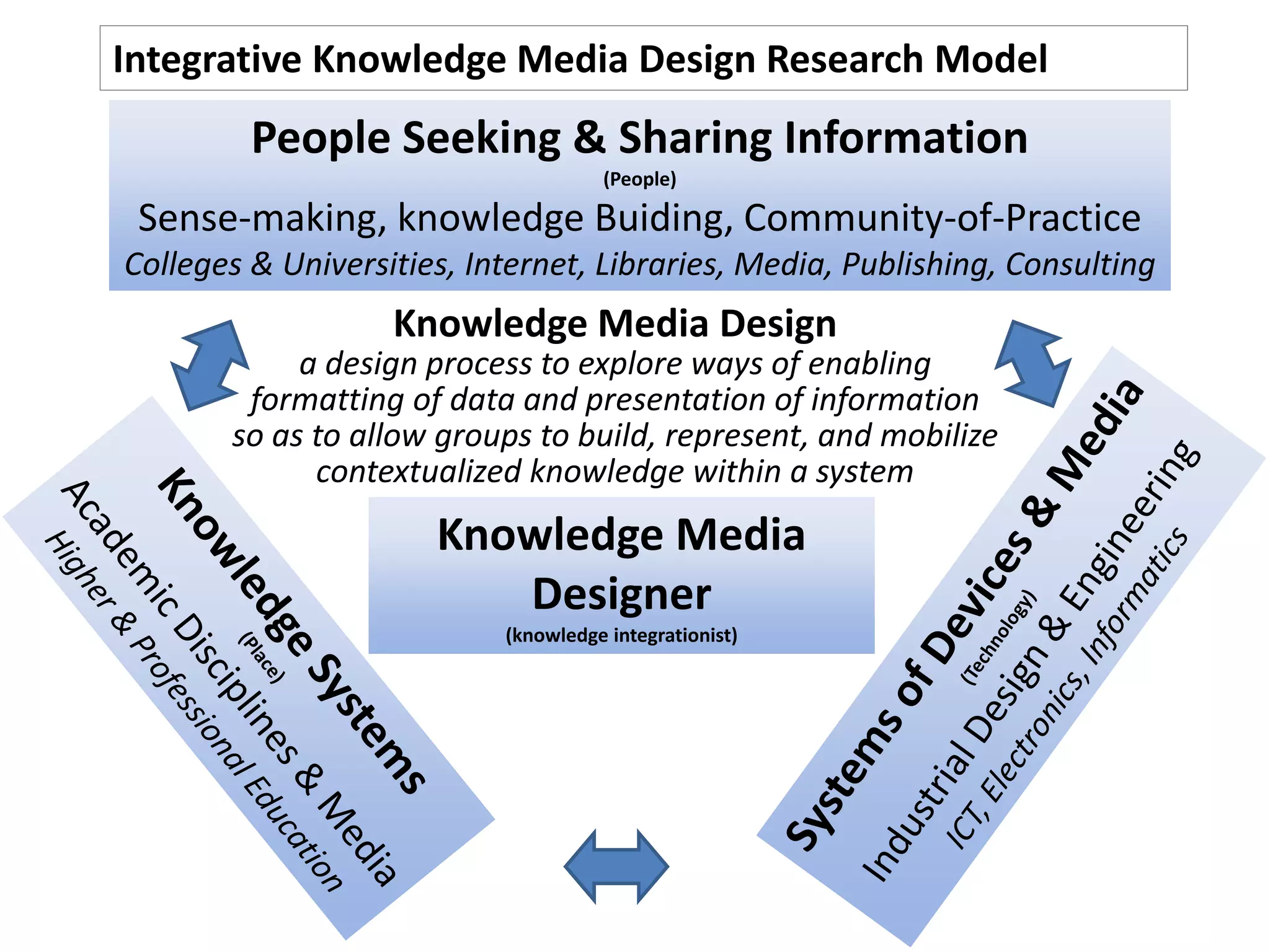
Integrative Knowledge Media Design Research Model

               People Seeking & Sharing Information
                                        (People)

      Sense-making, Knowledge Building, Community-of-Practice
      Colleges & Universities, Internet, Libraries, Media, Publishing, Consulting

                           Knowledge Media Design
                    a design process to explore ways of enabling
                formatting of data and presentation of information
               so as to allow groups to build, represent, and mobilize
                     contextualized knowledge within a system


   Knowledge Systems                               Systems of Devices & Media
               (Place)                                           (Technology)

Academic Disciplines & Media                       Industrial Design & Engineering,
 Higher & Professional Education                       ICT, Electronics, Informatics
Integrative Knowledge Media Design Research Model
         People Seeking & Sharing Information
                                     (People)

 Sense-making, knowledge Buiding, Community-of-Practice
Colleges & Universities, Internet, Libraries, Media, Publishing, Consulting
                   Knowledge Media Design
            a design process to explore ways of enabling
        formatting of data and presentation of information
       so as to allow groups to build, represent, and mobilize
             contextualized knowledge within a system
                      Knowledge Media
                         Designer
                           (knowledge integrationist)
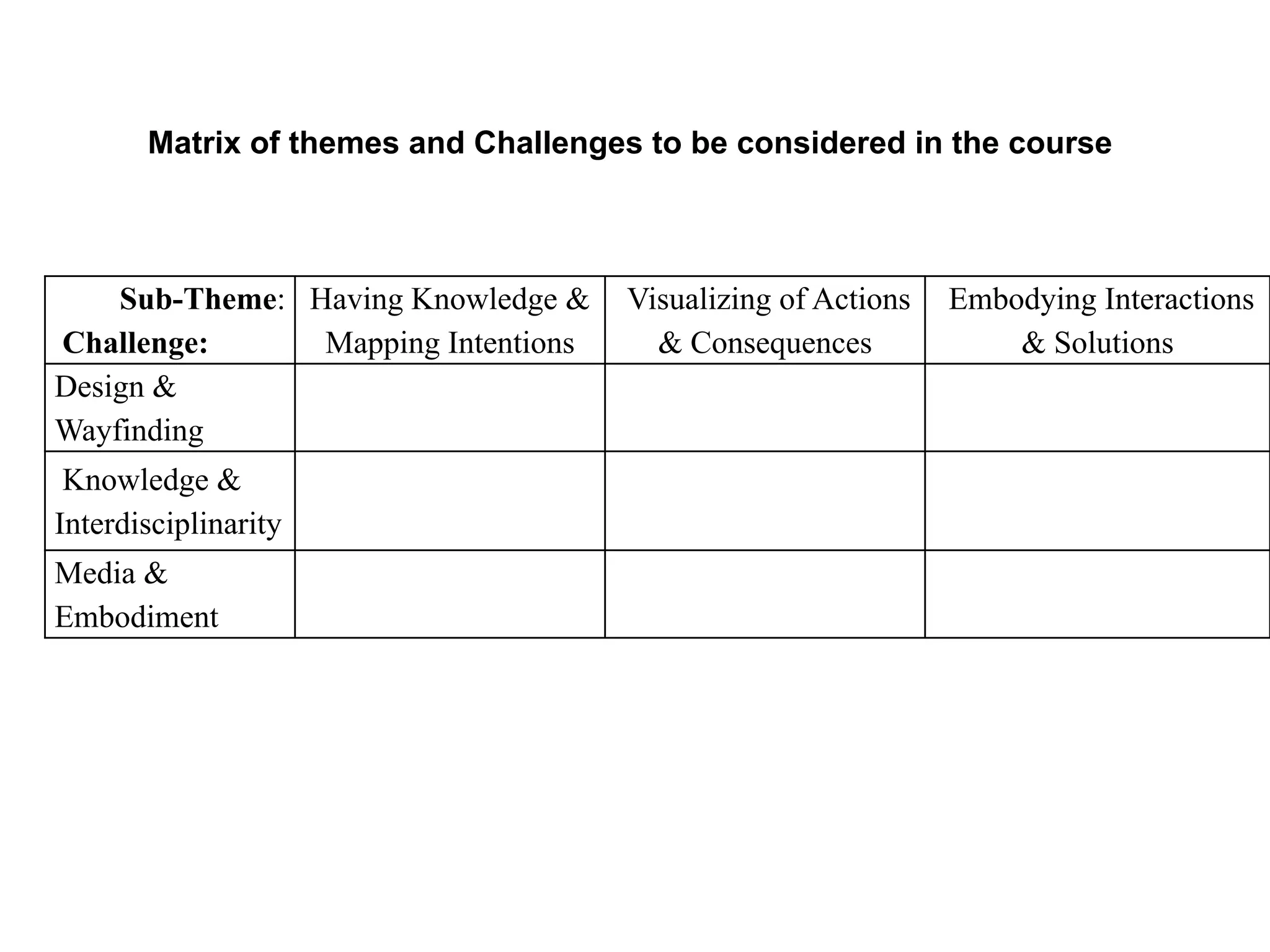
Matrix of themes and Challenges to be considered in the course


    Sub-Theme: Having Knowledge &    Visualizing of Actions   Embodying Interactions
Challenge:      Mapping Intentions     & Consequences             & Solutions
Design &
Wayfinding
 Knowledge &
Interdisciplinarity
Media &
Embodiment
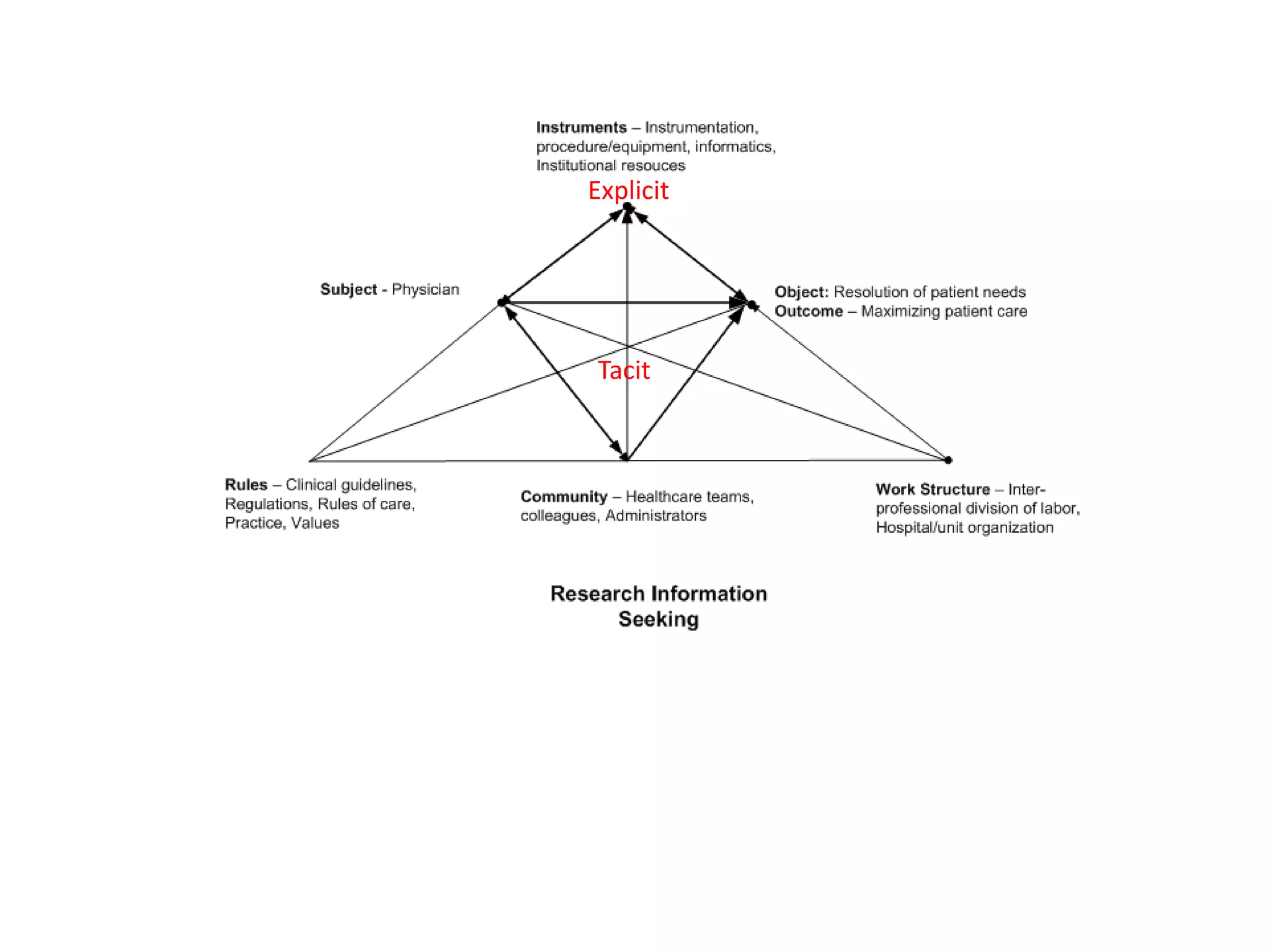
Conceptualizing Significance
in Guiding Research Information Seeking
Explicit


Tacit
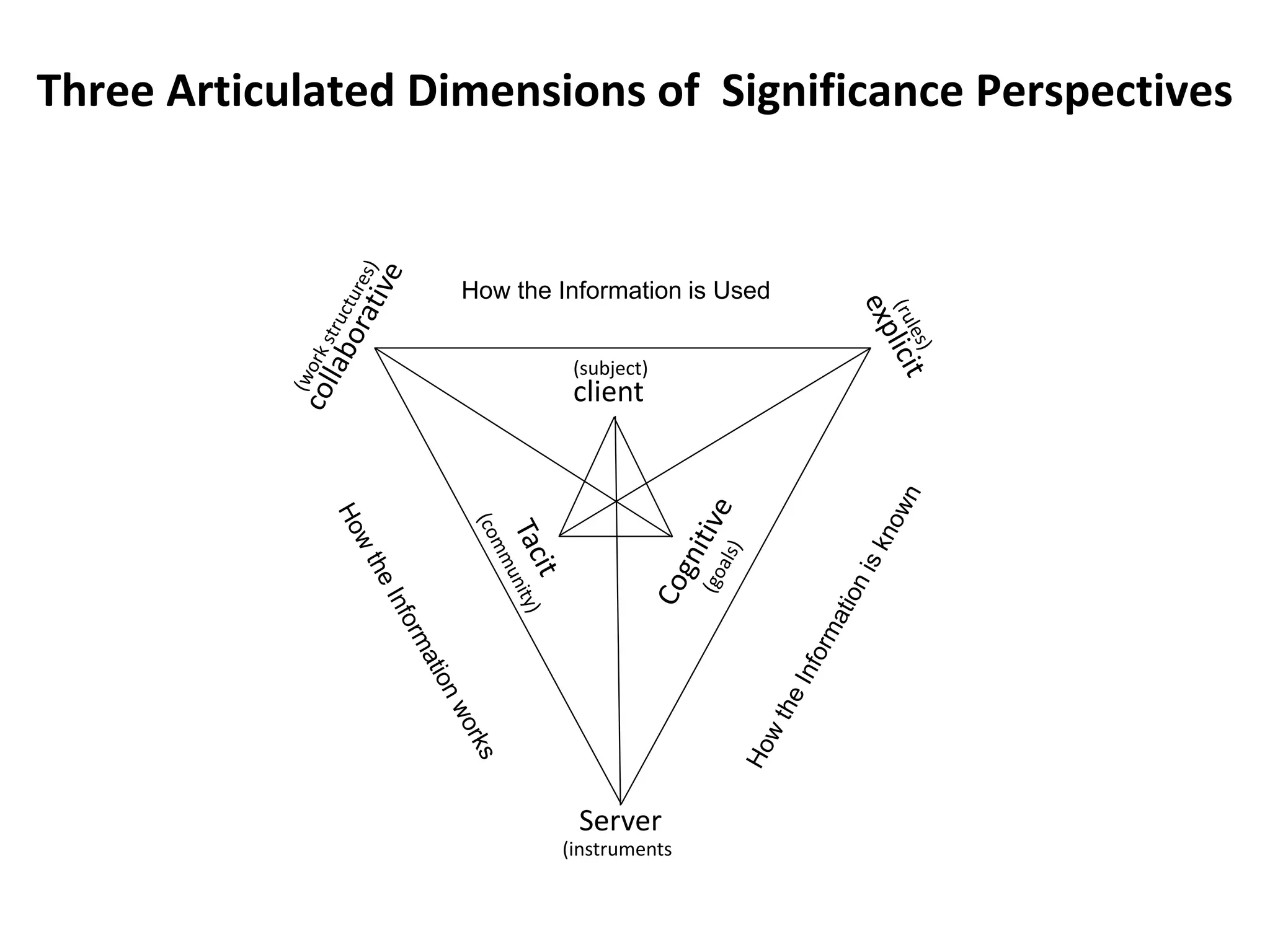
Three Articulated Dimensions of Significance Perspectives


                    How the Information is Used


                             (subject)
                             client


                              Server
                            (instruments)
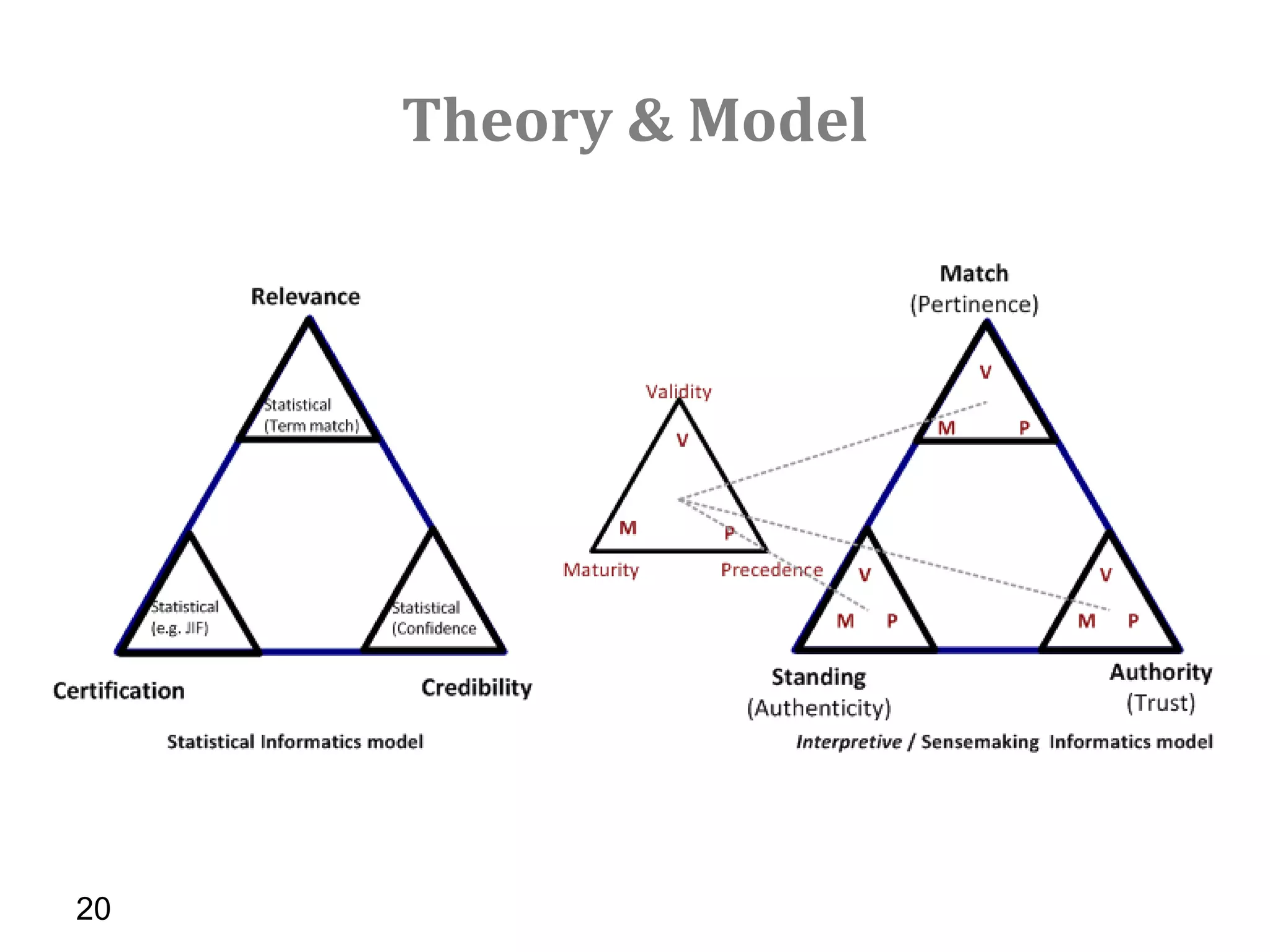
Theory & Model


20
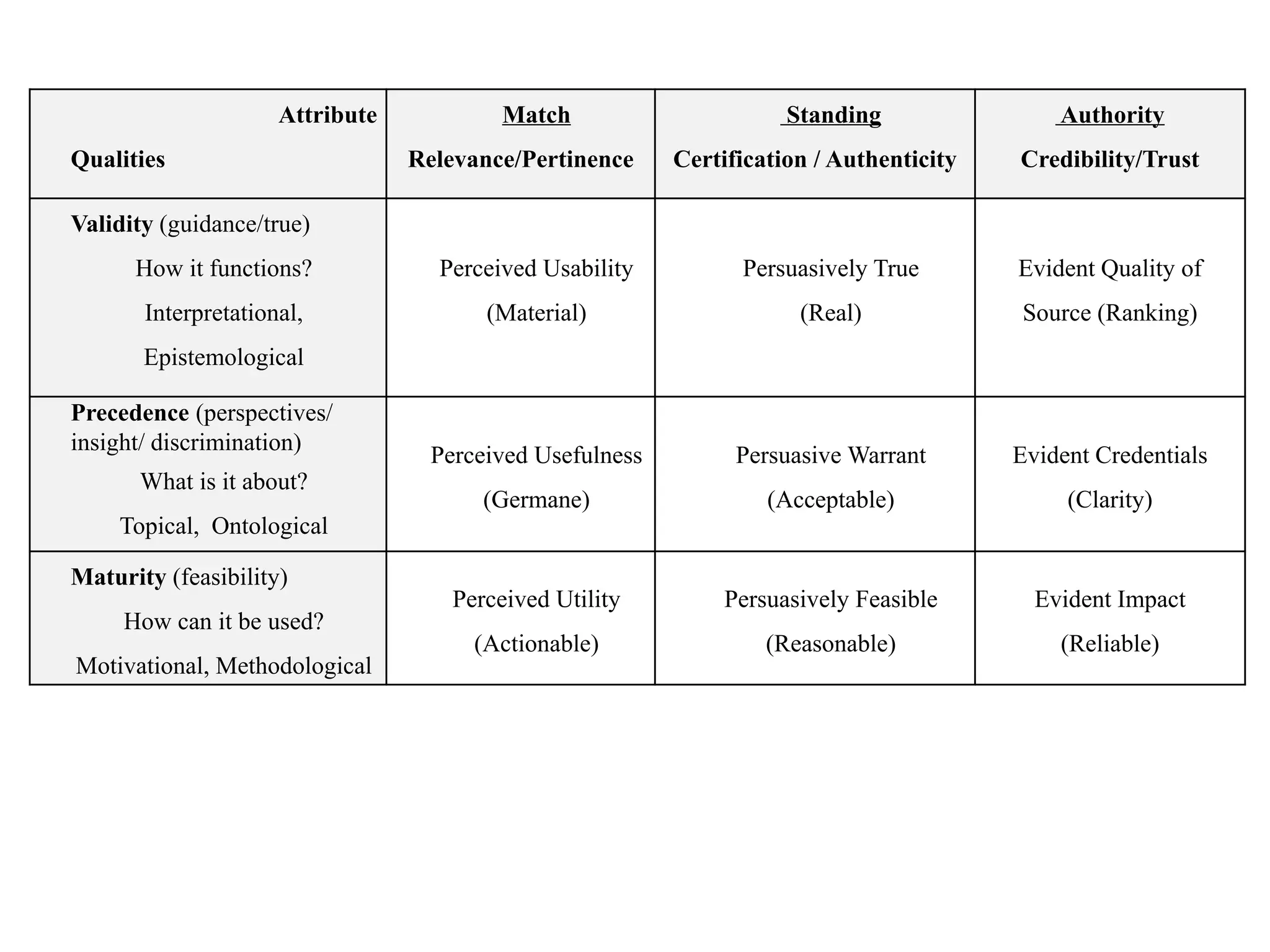
Attribute            Match                      Standing                Authority
Qualities                        Relevance/Pertinence     Certification / Authenticity   Credibility/Trust

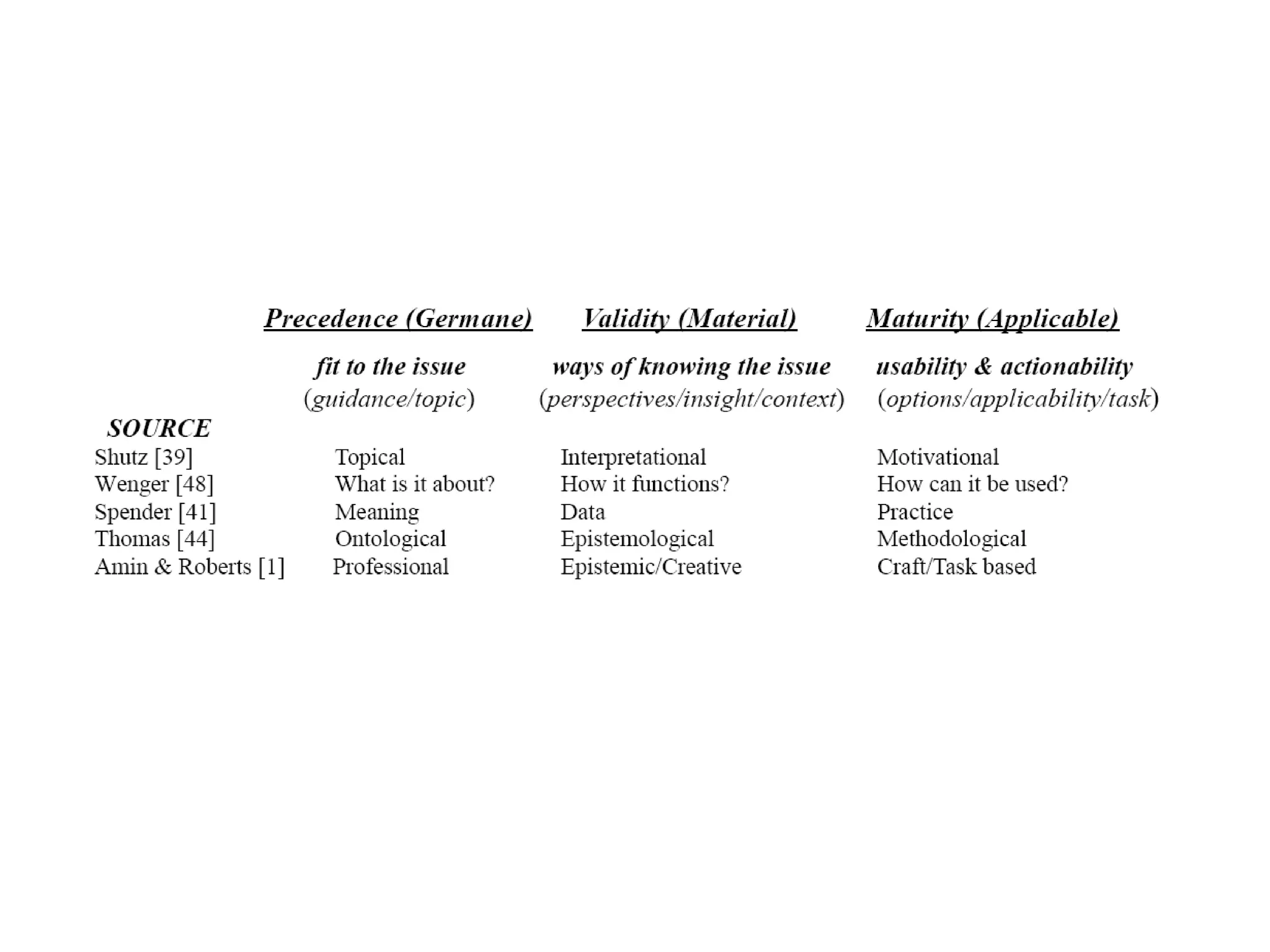
Validity (guidance/true)
      How it functions?            Perceived Usability          Persuasively True        Evident Quality of
       Interpretational,                (Material)                    (Real)             Source (Ranking)
       Epistemological

Precedence (perspectives/
insight/ discrimination)
                                   Perceived Usefulness         Persuasive Warrant       Evident Credentials
       What is it about?
                                        (Germane)                  (Acceptable)               (Clarity)
    Topical, Ontological

Maturity (feasibility)
                                     Perceived Utility         Persuasively Feasible       Evident Impact
     How can it be used?
                                       (Actionable)                (Reasonable)              (Reliable)
Motivational, Methodological
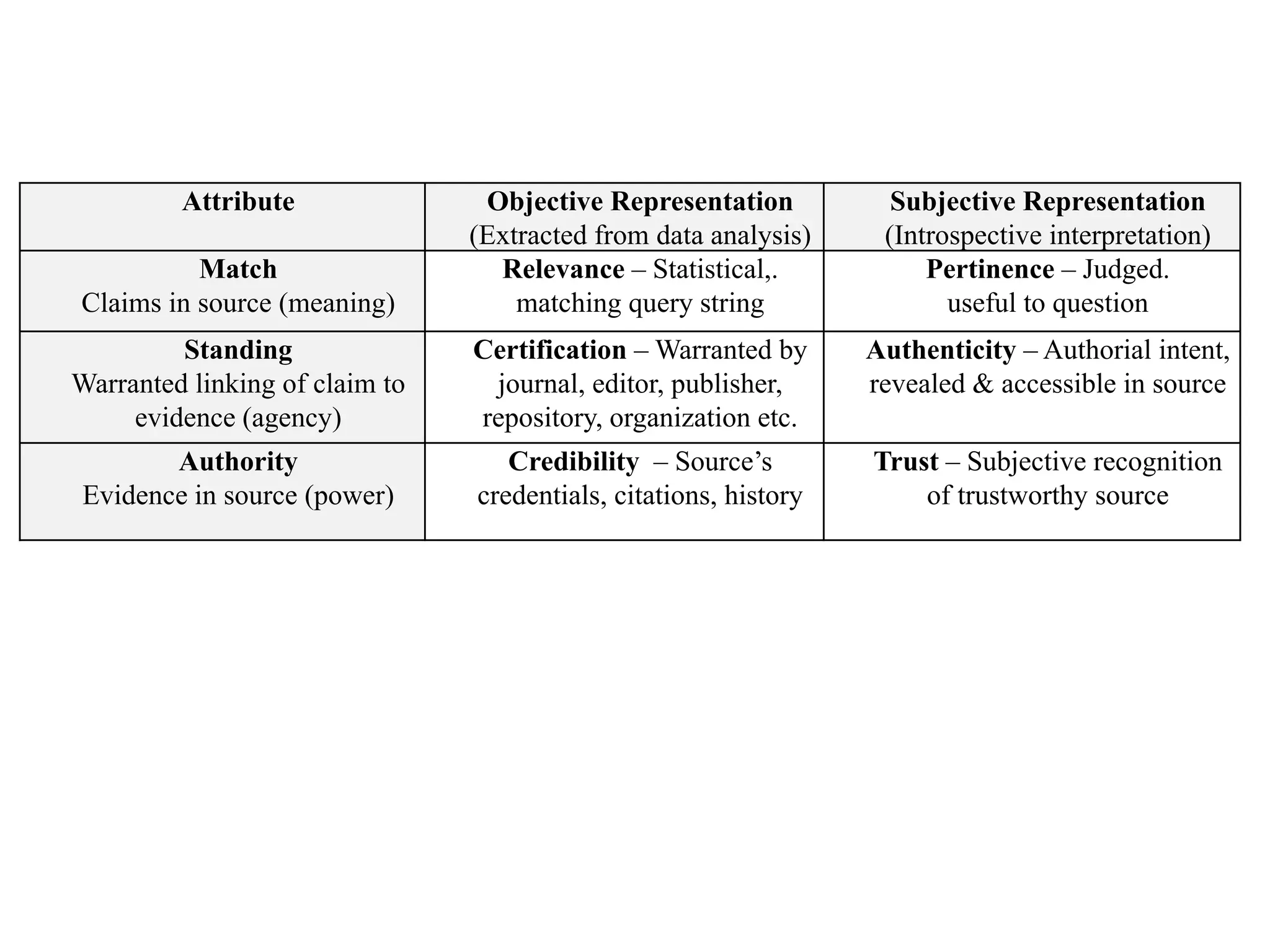
Attribute               Objective Representation           Subjective Representation
                                (Extracted from data analysis)     (Introspective interpretation)
          Match                   Relevance – Statistical,.            Pertinence – Judged.
Claims in source (meaning)          matching query string                useful to question
         Standing               Certification – Warranted by      Authenticity – Authorial intent,
Warranted linking of claim to    journal, editor, publisher,      revealed & accessible in source
     evidence (agency)          repository, organization etc.
       Authority                   Credibility – Source’s         Trust – Subjective recognition
Evidence in source (power)      credentials, citations, history       of trustworthy source
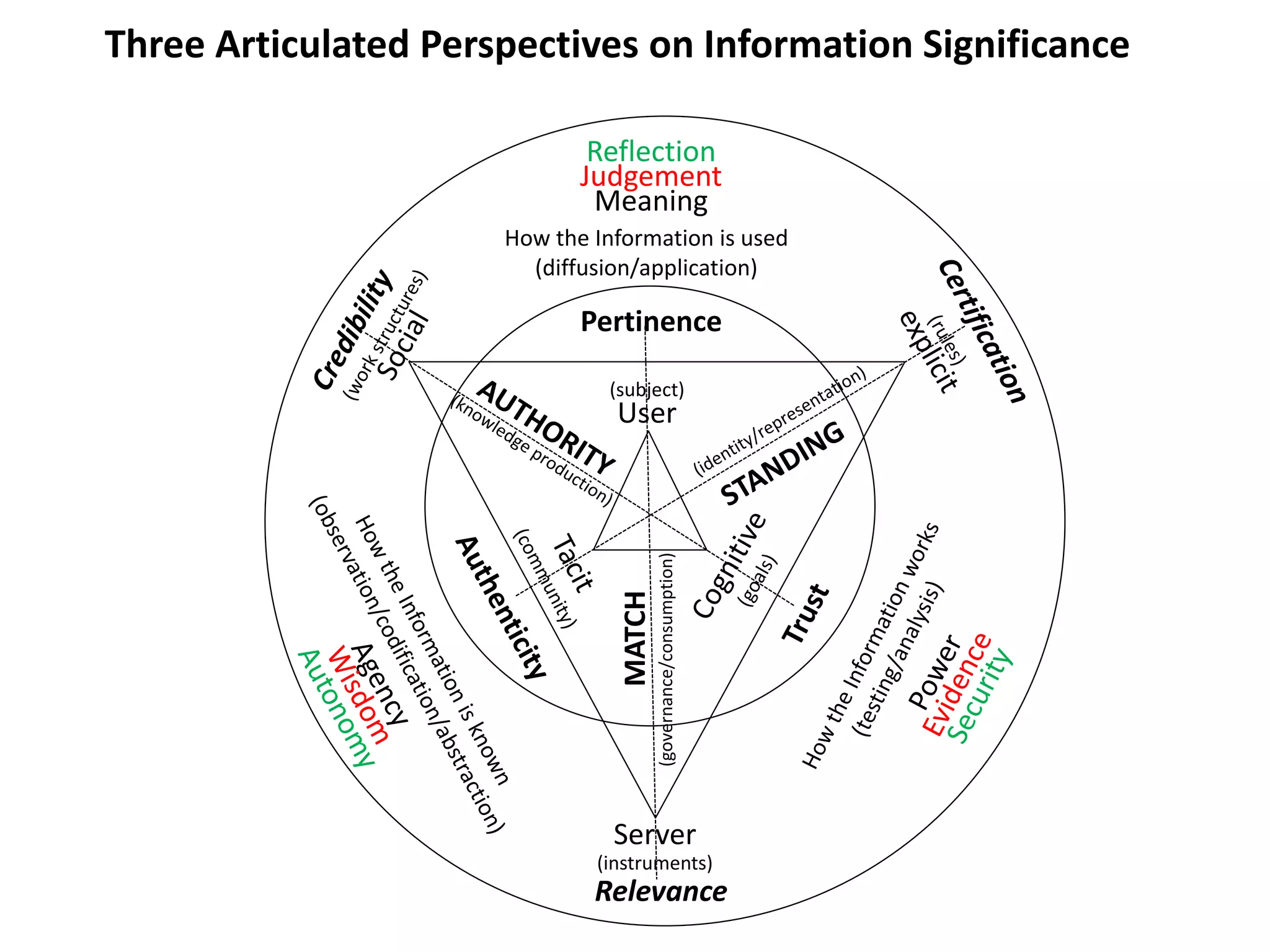
Three Articulated Perspectives on Information Significance

                              Reflection
                             Judgement
                              Meaning
                      How the Information is used
                        (diffusion/application)

                             Pertinence

                               (subject)
                                User


                                         (governance/consumption)
                                 MATCH


                                Server
                              (instruments)
                              Relevance

KMD 1001 Design Brief and Ontology Task

  • 1.
    KMD1001 DESIGN BRIEF& ONTOLOGY TASK Peter Pennefather, Oct 22, 2012
  • 2.
    Assignments: 1. KMD Ontologytask – 15% (due Sun. Oct. 28 online) 2. A 5x5 presentation in class an online – 15% (over term) 3. Active participation in class and online – 15% 4. Specific KMD framework analysis & critique brief – total 50% (5+5+15+25%) •Preliminary Design Brief Summary (1 pages) – 5% (Oct 29) •Design Brief Summary, Framework visualization, Annotated bibliography – 5% (Nov 5) •10x10 Presentation of Chosen Design Challenge Conceptualization – 15% (Nov 5,12,19,26) •Final report (around 3000 words) – 25% (due Dec 22) 5. Public group presentation on KMD topic – 5% TBD around KMDI holiday party
  • 3.
    Example of aFramework Visualization
  • 4.
    Example of aFramework Visualization S a n d e r s , L i z . " A n E v o l v i n g M a p o f D e s i g n P r a c t i c e a n d D e s i g n R e s e a r c h . "I n t e r a c t i o n s 15.6 (2008): 13-17 5 . 6
  • 5.
    ONTOLOGY TASK: Incomputer and information science an ontology formally represents knowledge as a set of concepts within a domain and the relationships among those concepts In this course we are examining concepts related to how media can be designed and adapted to promote building and sharing of knowledge. Within that context we are exploring the meaning of design and waymaking, knowledge and interdisciplinarity and media and embodiment. The ontology task asks you to discuss relationships between those pairs of concepts or any other set of 3 pairs of concepts. The task has three stages 1) for each pair specify each concept with a short (about 100 +/- 50 words) definition; pick a definition that you are comfortable with and that can be linked a reputable and citable source; 2) briefly discuss how the two concepts are related to each other and the overall goals of the course as you understand them, 3) repeat the exercise for two more concept pairs of your choosing. You should end up with 5 pages of text. The report should be about 5 pages (1.5 line spacing 2000 words).
  • 6.
    Birger Hjorland’s reviewof Concept Theory
  • 7.
    Conceptualization draws uponand supports human memory Ranganath C and Ritchey M (2012) Nature Reviews Neuroscience 13:713-726
  • 8.
  • 9.
    Kant’s conceptualization ofconcept formation Kant investigated the way that empirical a posteriori concepts are created. The logical acts of the understanding by which concepts are generated as to their form are: 1.comparison, i.e., the likening of mental images to one another in relation to the unity of consciousness; 2.reflection, i.e., the going back over different mental images, how they can be comprehended in one consciousness; and finally 3.abstraction or the segregation of everything else by which the mental images differ ... In order to make our mental images into concepts, one must thus be able to compare, reflect, and abstract, for these three logical operations of the understanding are essential and general conditions of generating any concept whatever. For example, I see a fir, a willow, and a linden. In firstly comparing these objects, I notice that they are different from one another in respect of trunk, branches, leaves, and the like; further, however, I reflect only on what they have in common, the trunk, the branches, the leaves themselves, and abstract from their size, shape, and so forth; thus I gain a concept of a tree. — Logic, §6 From Wikipedia entry on Concept (http://en.wikipedia.org/wiki/Concept)
  • 10.
    DESIGN AS APROCESS FOR FORMATTING DATA INTO KNOWLEDGE Data/Information Input Biased by a Concern or Need Design Learning Problem Diagnostics Systems Concept Solving Engineering Explore Comprehension Discovery Initiation Identify Objectives (comparison) Application Definition Sensing Specify Criteria Prototype Analysis Design Analysis Map Relationships (reflection) Synthesis Decision Making Diagnosis Identify Alternatives Specify Evaluation Action Planning Reporting Evaluate Alternatives (abstraction) Innovation Mobilization Indexing Choose One or Two Knowledge Output Useful in Addressing Concern or Need
  • 11.
    Meeting Design Challenges http://www.nasa.gov/audience/foreducators/plantgrowth/reference/Eng_Design_5-12.html
  • 12.
    Before Dec 22,all students will have submitted a final design brief outlining their KMD concept or process innovation and how their analysis suggests a re-design. The brief should have three sections: 1) Map/Indentify the Design Challenge Conceptualization and Desired Outcomes identify the KMD domain that you will focus on and a particular challenge you will be exploring provide a history of previous attempts to conceptualize the challenge and contrast them with yours describe the design constraints, usability, and goals that are guiding your design conceptualization provide a summary of uncertainties and gaps in knowledge related to the proposed approach 2) Prototype Consider a few implications of the way that you have chosen to conceive of the challenge develop a framework for evaluating the outcomes of the suggested solutions to the challenge, think of situations and people who could find your approach useful imagine possible impacts of different possible solutions consistent with your constraints and values determine which of these you want to specify in greater detail and why 3) Detail/Specify identify a specific use case and user community that could appreciate your solution summarize why the solution is appropriate at the suggested time and place analyze strategies for obtaining confirming your expectations analyze potential sources of support for implementing further study and refinement of your concept analyze potential resistance to or criticism of your design conceptualization 4) Synopsis
  • 13.
    Integrative Knowledge MediaDesign Research Model People Seeking & Sharing Information (People) Sense-making, Knowledge Building, Community-of-Practice Colleges & Universities, Internet, Libraries, Media, Publishing, Consulting Knowledge Media Design a design process to explore ways of enabling formatting of data and presentation of information so as to allow groups to build, represent, and mobilize contextualized knowledge within a system Knowledge Systems Systems of Devices & Media (Place) (Technology) Academic Disciplines & Media Industrial Design & Engineering, Higher & Professional Education ICT, Electronics, Informatics
  • 14.
    Integrative Knowledge MediaDesign Research Model People Seeking & Sharing Information (People) Sense-making, knowledge Buiding, Community-of-Practice Colleges & Universities, Internet, Libraries, Media, Publishing, Consulting Knowledge Media Design a design process to explore ways of enabling formatting of data and presentation of information so as to allow groups to build, represent, and mobilize contextualized knowledge within a system Knowledge Media Designer (knowledge integrationist)
  • 15.
    Matrix of themesand Challenges to be considered in the course Sub-Theme: Having Knowledge & Visualizing of Actions Embodying Interactions Challenge: Mapping Intentions & Consequences & Solutions Design & Wayfinding Knowledge & Interdisciplinarity Media & Embodiment
  • 16.
    Conceptualizing Significance in GuidingResearch Information Seeking
  • 18.
  • 19.
    Three Articulated Dimensionsof Significance Perspectives How the Information is Used (subject) client Server (instruments)
  • 20.
  • 21.
    Attribute Match Standing Authority Qualities Relevance/Pertinence Certification / Authenticity Credibility/Trust Validity (guidance/true) How it functions? Perceived Usability Persuasively True Evident Quality of Interpretational, (Material) (Real) Source (Ranking) Epistemological Precedence (perspectives/ insight/ discrimination) Perceived Usefulness Persuasive Warrant Evident Credentials What is it about? (Germane) (Acceptable) (Clarity) Topical, Ontological Maturity (feasibility) Perceived Utility Persuasively Feasible Evident Impact How can it be used? (Actionable) (Reasonable) (Reliable) Motivational, Methodological
  • 22.
    Attribute Objective Representation Subjective Representation (Extracted from data analysis) (Introspective interpretation) Match Relevance – Statistical,. Pertinence – Judged. Claims in source (meaning) matching query string useful to question Standing Certification – Warranted by Authenticity – Authorial intent, Warranted linking of claim to journal, editor, publisher, revealed & accessible in source evidence (agency) repository, organization etc. Authority Credibility – Source’s Trust – Subjective recognition Evidence in source (power) credentials, citations, history of trustworthy source
  • 23.
    Three Articulated Perspectiveson Information Significance Reflection Judgement Meaning How the Information is used (diffusion/application) Pertinence (subject) User (governance/consumption) MATCH Server (instruments) Relevance