Exploring Session Search

     Gene Golovchinsky
 FX Palo Alto Laboratory, Inc.
       @HCIR_GeneG
Thanks to:
Jeremy Pickens, Abdigani Diriye, Tony Dunnigan
Exploratory search


                          Interactive
                Information seeking
       Anomalous state of knowledge
          Evolving information need
               Often recall-oriented
One Query to Rule Them All

No single query satisfies a typical exploratory search
information need


Search strategies involve many queries


Queries return overlapping results
Why we’re here
1. How do we know what’s a session?

2. How do we help people deal with this complex task?

3. How do we evaluate systems and algorithms?
Warning

THIS TALK CONTAINS EXPLICIT
CONTENT
Explicit vs. implicit sessions
Explicit sessions
  1. We ask the person

  2. We infer it from structural aspects
     of the search context
    Task context may provide strong
    organizing queues
    For example, genealogical
    searches are often tied to a
    person in a family tree

What about implicit
sessions?
Implicit section detection is
       based on implicit assumptions

How do we detect a session?
   – Time heuristics
   – Client connection heuristics
   – Query similarity heuristics


What are we assuming?
   – Person works continuously
   – Person does not switch tasks
   – Enough overlap in queries


How good are these assumptions?
Tradeoffs
Implicit sessions                              Explicit sessions
Pros                                    Pros
  No explicit user input required          Accurate
                                           Needed for collaboration
Cons                                       Durable over time
  Effectiveness relies on precision-
  oriented information needs and
  inter-query similarity, i.e., on      Cons
  redundancy                               Requires manual input in
                                           some cases
  More difficult to connect recurring
  or ongoing instances of the same
  information need
Dealing with redundancy
Strategies
                                 Ignore it
                    The traditional approach


     Manage redundancy in the UI
                      Ancestry.com, Querium


 Increase diversity through scoring
                 Some algorithmic evaluation,
   but are such interactive systems deployed?
Manage redundancy in the UI

COPING WITH REDUNDANCY
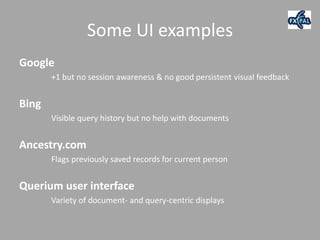
Some UI examples
Google
       +1 but no session awareness & no good persistent visual feedback


Bing
       Visible query history but no help with documents


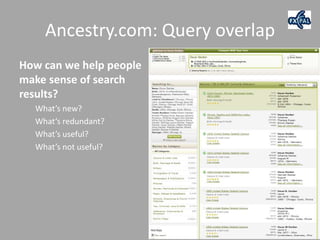
Ancestry.com
       Flags previously saved records for current person


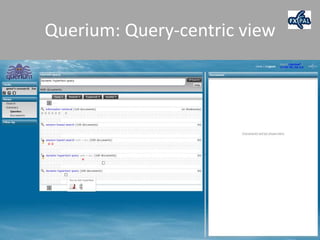
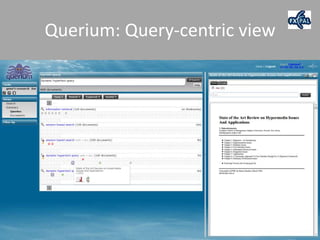
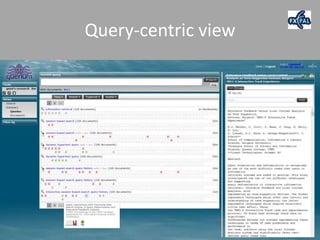
Querium user interface
       Variety of document- and query-centric displays
Ancestry.com: Query overlap
How can we help people
make sense of search
results?
  What’s new?
  What’s redundant?
  What’s useful?
  What’s not useful?
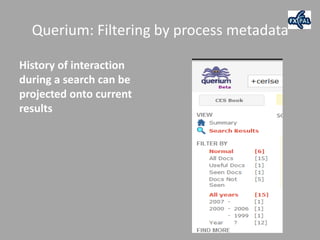
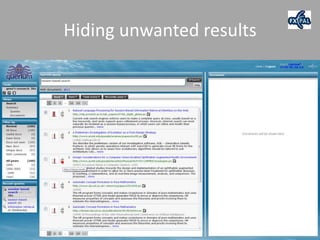
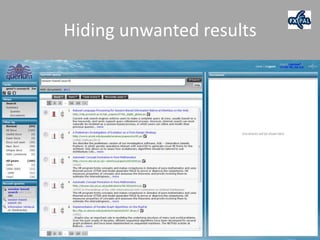
Querium: Filtering by process metadata

History of interaction
during a search can be
projected onto current
results
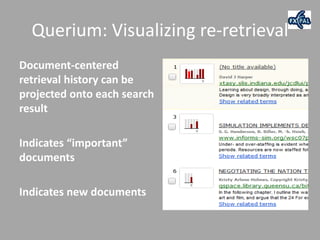
Querium: Visualizing re-retrieval
Document-centered
retrieval history can be
projected onto each search
result

Indicates “important”
documents

Indicates new documents
Querium: Query-centric view
Query-centric view
Increasing diversity

PREVENTING REDUNDANCY
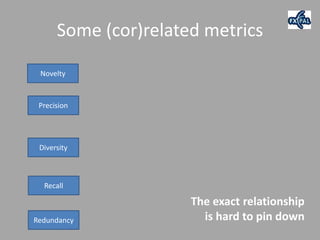
Some (cor)related metrics

 Novelty


 Precision


 Diversity


  Recall

                      The exact relationship
Redundancy              is hard to pin down
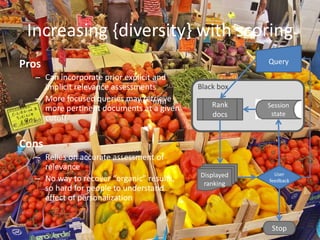
Increasing {diversity} with scoring
Pros                                                   Query
  – Can incorporate prior explicit and
    implicit relevance assessments         Black box
  – More focused queries may retrieve
    more pertinent documents at a given        Rank    Session
                                               docs     state
    cutoff


Cons
  – Relies on accurate assessment of
    relevance
                                           Displayed     User
  – No way to recover “organic” results,               feedback
                                            ranking
    so hard for people to understand
    effect of personalization


                                                        Stop
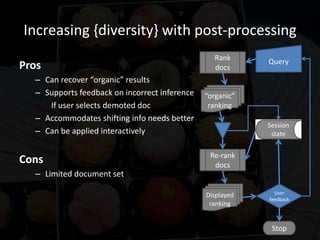
Increasing {diversity} with post-processing
                                                 Rank      Query
Pros                                             docs
  – Can recover “organic” results
  – Supports feedback on incorrect inference   “organic”
     If user selects demoted doc                ranking
  – Accommodates shifting info needs better
                                                           Session
  – Can be applied interactively                            state


                                                Re-rank
Cons                                             docs
  – Limited document set

                                               Displayed     User
                                                           feedback
                                                ranking


                                                            Stop
A holistic approach

EVALUATION
Vague generalities
Session-based search must be evaluated as a human-
machine system
      Hard to account for real human behavior through simulations only


Recall and precision do not tell the whole story
      Exploratory search is inherently a learning process
      Effort, knowledge gain, frustration, serendipity important


Look at patterns of interaction that led to discovery
      Hard to evaluate marginal contribution of each query due to
      negative results, learning, information need drift
Some thoughts on evaluating algorithms
Small gains in retrieval effectiveness will be swamped by
interaction, good or bad
       Small statistically-significant effects are meaningless in practice


Evaluation “in the wild” relies on users for ground truth
      Use post-hoc analysis to test how algorithms predicted users’ choices


Look at system’s ability to help people recognize useful
documents
       How many times was a document retrieved before it was seen?
       This works for lab and naturalistic studies
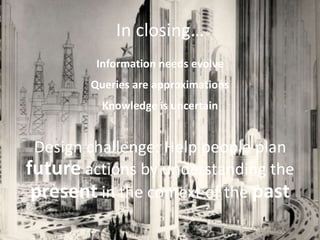
In closing…
         Information needs evolve
        Queries are approximations
          Knowledge is uncertain


 Design challenge: Help people plan
future actions by understanding the
 present in the context of the past
While I have your attention…
There is a pending proposal to create a StackExchange
site for information retrieval.
      Think of it as Stack Overflow for IR geeks.

      We need more people to vote & promote.

http://area51.stackexchange.com/proposals/39142/informatio
n-retrieval-and-search-engines
Do I still have your attention?
IIiX 2012
       August 21-24, 2012, Nijmegen, The Netherlands
       Deadline for papers April 9, 2012

EuroHCIR 2012
       Same place, August 25
       Deadline for papers is June 22, 2012

HCIR 2012: The 6th Symposium on Human Computer Information
Retrieval
       October 4-5, 2012, Boston, Massachusetts, USA
       Submission deadline mid-summer
       Will publish works in progress and archival, full-length papers
Image credits


http://www.flickr.com/photos/torremountain/6831414535/
http://www.flickr.com/photos/bigtallguy/233176326/
http://www.flickr.com/photos/77074420@N00/198347900/
http://www.flickr.com/photos/racatumba/93569705/
http://www.flickr.com/photos/chrisolson/3595815374/
http://www.flickr.com/photos/brymo/2813028454/
http://www.flickr.com/photos/computix/108732248/
http://www.flickr.com/photos/funadium/913303959/
http://www.flickr.com/photos/moriza/189890016/
http://www.flickr.com/photos/uhdigital/6802789537/
Hiding unwanted results

Exploring session search