The Ripple Effect of 
Sense of Belonging 
Engaging First-Generation College Students on 
Their Journey to Academic Success
Introduction 
• The experience of first year college students has gained 
significant interest as college enrollment increases and 
higher education becomes more accessible. Along with 
the change comes unique characteristics that reflects the 
true experience of first-generation college students. 
• Researchers ( Hossler & Gallagher, 1987; Hurtado, 
Inkelas, Briggs & Rhee, 1997) suggest that the journey to 
college comprises of the following three stages: 
predisposition, preparation, and matriculation. 
• Predisposition is defined as the extent to which the 
student's family background and/or primary support system 
influences their quest and journey to obtain a college 
degree. First-generation college students usually struggle 
as they balance their new roles between work, home and 
school.
Achievement Works Shares 
About 
The First Generation College 
http://youtu.be/DSp6tr0ugdrDeZ9nst
Purpose of Study 
The purpose of this study explores the impact 
sense of belonging and collegiate readiness has 
on first generation college students as they 
transition into their new role as a student. 
This study will also explore the dynamics of SES 
on the learning and socialization of first-generation 
college students and their sense of 
belonging.
Research Questions 
To what extent does first-generation college 
students experience college readiness? 
To what extent is sense of belonging viewed as a 
vital component to academic success among 
first-generation college students? 
To what extent is engagement is perceived as a 
vital component of academic success among 
first-generation college students?
I’m First 
Video: First Lady Michelle Obama 
http://youtu.be/RYsQp_ocMvQ
Literature Review 
Interestingly, studies have confirmed that first-generation 
college students are uniquely different (Lippincott & 
German, 2007; Wang & Castaneda-Sound, 2008). 
Specifically, they are often “over-looked, marginalized and 
at- risk”. 
The role of sense of belonging has come to the forefront as 
it relates to meeting the needs of first generation students. 
Others constructs refer to the “cultural fit” for under 
represented groups (Gloria, et al., 2005). 
Additionally, first-generation college students of lower 
socioeconomic status are disadvantaged in the competition 
for academic rewards because of their sociocultural 
environment, that may not provide the types of cultural 
capital required for success in school (Cabrera et al., 
2006).
Literature Review 
Transition theory (Schlossberg, 1995) resonates with the 
first generation college student’s experience and the 
process of coping in an academic environment. 
• In 1993 Vincent Tinto, argues that the concept of social and 
academic integration should be given consideration. 
Building on the work of Astin’s Theory of 
Involvement/Attrition, Tinto argued that the responsibility 
was shared and that “institutional culture” was fundamental 
component of student success. 
• Educational researcher, Martin suggests that first-generation 
college students’ experiences is often coupled 
with “cultural and emotional alienation” . Their experience 
is comprised of minimal financial support from family which 
can force decisions related to work and debt that 
compromise the student's best intentions of persistence 
and degree completion (Eitel & Martin, 2009).
Literature Review 
According to the US Department of Education, 
first generation college students are defined as 
“neither parent having more than a high school 
education. 
Specifically, the National Center for Education 
Statistics first generation students are defined as 
“undergraduates whose parents never enrolled in 
postsecondary education". Therefore, not 
possessing or obtaining a two or four year 
degree
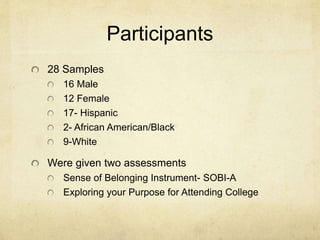
Participants 
28 Samples 
16 Male 
12 Female 
17- Hispanic 
2- African American/Black 
9-White 
Were given two assessments 
Sense of Belonging Instrument- SOBI-A 
Exploring your Purpose for Attending College
Context 
Developmental 1300 course 
Required by all incoming students 
Community College District in Houston Area 
(Texas)
Education 1300 – Learning 
Frameworks 
This course teaches concepts from the learning sciences to help 
students acquire the strategies and the tenacity necessary to 
succeed in college coursework, and within their future careers: 
research and theory in the psychology of learning, cognition, and 
motivation; factors that impact learning, and application of learning 
strategies. 
Theoretical models of strategic learning, cognition, and motivation 
serve as the conceptual basis for the introduction of college-level 
student academic strategies. 
Students use assessment instruments (e.g., learning inventories) to 
help them identify their own strengths and weaknesses as strategic 
learners 
Course instruction focuses on four main content strands: developing 
and maintaining motivation for college success, developing and using 
study strategies and skills, building community and connecting to 
campus resources, and developing a college completion plan.
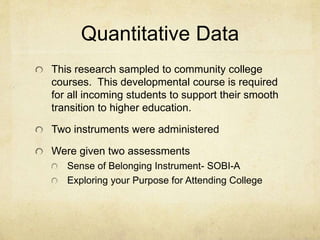
Quantitative Data 
This research sampled to community college 
courses. This developmental course is required 
for all incoming students to support their smooth 
transition to higher education. 
Two instruments were administered 
Were given two assessments 
Sense of Belonging Instrument- SOBI-A 
Exploring your Purpose for Attending College
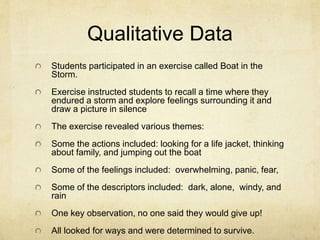
Qualitative Data 
Students participated in an exercise called Boat in the 
Storm. 
Exercise instructed students to recall a time where they 
endured a storm and explore feelings surrounding it and 
draw a picture in silence 
The exercise revealed various themes: 
Some the actions included: looking for a life jacket, thinking 
about family, and jumping out the boat 
Some of the feelings included: overwhelming, panic, fear, 
Some of the descriptors included: dark, alone, windy, and 
rain 
One key observation, no one said they would give up! 
All looked for ways and were determined to survive.
Samples: Boat in the 
Storm
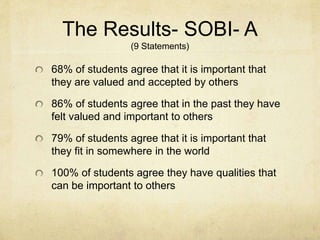
The Results- SOBI- A 
(9 Statements) 
68% of students agree that it is important that 
they are valued and accepted by others 
86% of students agree that in the past they have 
felt valued and important to others 
79% of students agree that it is important that 
they fit in somewhere in the world 
100% of students agree they have qualities that 
can be important to others
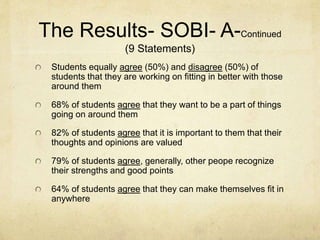
The Results- SOBI- A-Continued 
(9 Statements) 
Students equally agree (50%) and disagree (50%) of 
students that they are working on fitting in better with those 
around them 
68% of students agree that they want to be a part of things 
going on around them 
82% of students agree that it is important to them that their 
thoughts and opinions are valued 
79% of students agree, generally, other peope recognize 
their strengths and good points 
64% of students agree that they can make themselves fit in 
anywhere
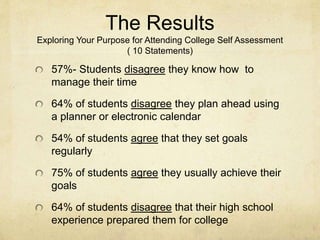
The Results 
Exploring Your Purpose for Attending College Self Assessment 
( 10 Statements) 
57%- Students disagree they know how to 
manage their time 
64% of students disagree they plan ahead using 
a planner or electronic calendar 
54% of students agree that they set goals 
regularly 
75% of students agree they usually achieve their 
goals 
64% of students disagree that their high school 
experience prepared them for college
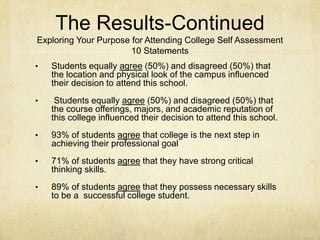
The Results-Continued 
Exploring Your Purpose for Attending College Self Assessment 
10 Statements 
• Students equally agree (50%) and disagreed (50%) that 
the location and physical look of the campus influenced 
their decision to attend this school. 
• Students equally agree (50%) and disagreed (50%) that 
the course offerings, majors, and academic reputation of 
this college influenced their decision to attend this school. 
• 93% of students agree that college is the next step in 
achieving their professional goal 
• 71% of students agree that they have strong critical 
thinking skills. 
• 89% of students agree that they possess necessary skills 
to be a successful college student.
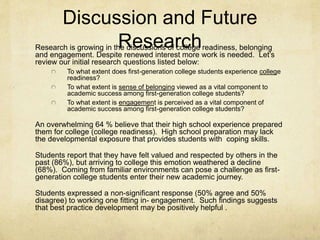
Discussion and Future 
Research Research is growing in the discussions of college readiness, belonging 
and engagement. Despite renewed interest more work is needed. Let’s 
review our initial research questions listed below: 
To what extent does first-generation college students experience college 
readiness? 
To what extent is sense of belonging viewed as a vital component to 
academic success among first-generation college students? 
To what extent is engagement is perceived as a vital component of 
academic success among first-generation college students? 
An overwhelming 64 % believe that their high school experience prepared 
them for college (college readiness). High school preparation may lack 
the developmental exposure that provides students with coping skills. 
Students report that they have felt valued and respected by others in the 
past (86%), but arriving to college this emotion weathered a decline 
(68%). Coming from familiar environments can pose a challenge as first-generation 
college students enter their new academic journey. 
Students expressed a non-significant response (50% agree and 50% 
disagree) to working one fitting in- engagement. Such findings suggests 
that best practice development may be positively helpful .
Educational Leaders 
Reflect 
Racial and Cultural Justice 
http://youtu.be/5u5cDn 
VY2dY 
These educational 
leaders share their 
journey to success and 
candidly described 
their experience along 
the way. 
First-generation college 
students must quickly learn 
to navigate the academic 
world by finding their place, 
space and voice. These 
students often bridge two 
cultures, not feeling a 
sense of belonging in either 
one (Oldfield, 2007).
References (10 citations) 
Eitel, S. J., & Martin, J. (2009). First-generation female college students' financial literacy: Real and perceived barriers 
to degree completion. College Student Journal, 43(2), 616-630. 
Gloria, A.M., Castellanos, J., Lopez, A.G., & Rosales, R. (2005). An examination of academic nonpersistence 
decisions of Latino undergraduates. Hispanic Journal of Behavioral Sciences, 27(2), 202–223. 
Hossler, D., & Gallagher, K.S. (1987, Spring). Studying student college choices: A three-phase model and the 
implications for policymakers. College and University, 207-221 
Hurtado, S., Inkelas, K.K., Briggs, C., & Rhee, B. S. (1997). Differences in college access and choice among 
racial/ethnic groups: Identifying continuing barriers. Research in Higher Education, 38 (1), 43-75. 
Lippincott, J. A., & German, N. (2007). From blue collar to ivory tower: Counseling first-generation, working-class 
students.. Alexandria, VA: American Counseling Association. 
Oldfield, K. (2007). Humble and hopeful: Welcoming first-generation poor and working-class students to college. About 
Campus, 11(6), 2-12. 
Schlossberg, N. K., Waters, E. B., & Goodman, J. (1995). Counseling adults in transition: Linking practice with theory 
(2nd ed.). New York: Spring. 
Swail, W. S., Cabrera, A. F., Lee, C., & Williams, A. (2005). Latino students and the educational pipeline. Washington, 
DC: Educational Policy Institute. Retrieved November 13, 2005, from http://www.educationalpolicy.org/pdf/LatinoI.pdf. 
Tinto, V. (1993). Leaving college: Rethinking the causes and cures of student attrition (2nd Edition). Chicago, IL: 
University of Chicago Press 
Wang, C.-C. D. and Castañeda-Sound, C. (2008), The Role of Generational Status, Self-Esteem, Academic Self- 
Efficacy, and Perceived Social Support in College Students' Psychological Well-Being. Jnl of College Counseling, 
11: 101–118.

Kitchen.Tawanda.Final Presentation

  • 1.
    The Ripple Effectof Sense of Belonging Engaging First-Generation College Students on Their Journey to Academic Success
  • 2.
    Introduction • Theexperience of first year college students has gained significant interest as college enrollment increases and higher education becomes more accessible. Along with the change comes unique characteristics that reflects the true experience of first-generation college students. • Researchers ( Hossler & Gallagher, 1987; Hurtado, Inkelas, Briggs & Rhee, 1997) suggest that the journey to college comprises of the following three stages: predisposition, preparation, and matriculation. • Predisposition is defined as the extent to which the student's family background and/or primary support system influences their quest and journey to obtain a college degree. First-generation college students usually struggle as they balance their new roles between work, home and school.
  • 3.
    Achievement Works Shares About The First Generation College http://youtu.be/DSp6tr0ugdrDeZ9nst
  • 4.
    Purpose of Study The purpose of this study explores the impact sense of belonging and collegiate readiness has on first generation college students as they transition into their new role as a student. This study will also explore the dynamics of SES on the learning and socialization of first-generation college students and their sense of belonging.
  • 5.
    Research Questions Towhat extent does first-generation college students experience college readiness? To what extent is sense of belonging viewed as a vital component to academic success among first-generation college students? To what extent is engagement is perceived as a vital component of academic success among first-generation college students?
  • 6.
    I’m First Video:First Lady Michelle Obama http://youtu.be/RYsQp_ocMvQ
  • 7.
    Literature Review Interestingly,studies have confirmed that first-generation college students are uniquely different (Lippincott & German, 2007; Wang & Castaneda-Sound, 2008). Specifically, they are often “over-looked, marginalized and at- risk”. The role of sense of belonging has come to the forefront as it relates to meeting the needs of first generation students. Others constructs refer to the “cultural fit” for under represented groups (Gloria, et al., 2005). Additionally, first-generation college students of lower socioeconomic status are disadvantaged in the competition for academic rewards because of their sociocultural environment, that may not provide the types of cultural capital required for success in school (Cabrera et al., 2006).
  • 8.
    Literature Review Transitiontheory (Schlossberg, 1995) resonates with the first generation college student’s experience and the process of coping in an academic environment. • In 1993 Vincent Tinto, argues that the concept of social and academic integration should be given consideration. Building on the work of Astin’s Theory of Involvement/Attrition, Tinto argued that the responsibility was shared and that “institutional culture” was fundamental component of student success. • Educational researcher, Martin suggests that first-generation college students’ experiences is often coupled with “cultural and emotional alienation” . Their experience is comprised of minimal financial support from family which can force decisions related to work and debt that compromise the student's best intentions of persistence and degree completion (Eitel & Martin, 2009).
  • 9.
    Literature Review Accordingto the US Department of Education, first generation college students are defined as “neither parent having more than a high school education. Specifically, the National Center for Education Statistics first generation students are defined as “undergraduates whose parents never enrolled in postsecondary education". Therefore, not possessing or obtaining a two or four year degree
  • 10.
    Participants 28 Samples 16 Male 12 Female 17- Hispanic 2- African American/Black 9-White Were given two assessments Sense of Belonging Instrument- SOBI-A Exploring your Purpose for Attending College
  • 11.
    Context Developmental 1300course Required by all incoming students Community College District in Houston Area (Texas)
  • 12.
    Education 1300 –Learning Frameworks This course teaches concepts from the learning sciences to help students acquire the strategies and the tenacity necessary to succeed in college coursework, and within their future careers: research and theory in the psychology of learning, cognition, and motivation; factors that impact learning, and application of learning strategies. Theoretical models of strategic learning, cognition, and motivation serve as the conceptual basis for the introduction of college-level student academic strategies. Students use assessment instruments (e.g., learning inventories) to help them identify their own strengths and weaknesses as strategic learners Course instruction focuses on four main content strands: developing and maintaining motivation for college success, developing and using study strategies and skills, building community and connecting to campus resources, and developing a college completion plan.
  • 13.
    Quantitative Data Thisresearch sampled to community college courses. This developmental course is required for all incoming students to support their smooth transition to higher education. Two instruments were administered Were given two assessments Sense of Belonging Instrument- SOBI-A Exploring your Purpose for Attending College
  • 14.
    Qualitative Data Studentsparticipated in an exercise called Boat in the Storm. Exercise instructed students to recall a time where they endured a storm and explore feelings surrounding it and draw a picture in silence The exercise revealed various themes: Some the actions included: looking for a life jacket, thinking about family, and jumping out the boat Some of the feelings included: overwhelming, panic, fear, Some of the descriptors included: dark, alone, windy, and rain One key observation, no one said they would give up! All looked for ways and were determined to survive.
  • 15.
  • 16.
    The Results- SOBI-A (9 Statements) 68% of students agree that it is important that they are valued and accepted by others 86% of students agree that in the past they have felt valued and important to others 79% of students agree that it is important that they fit in somewhere in the world 100% of students agree they have qualities that can be important to others
  • 17.
    The Results- SOBI-A-Continued (9 Statements) Students equally agree (50%) and disagree (50%) of students that they are working on fitting in better with those around them 68% of students agree that they want to be a part of things going on around them 82% of students agree that it is important to them that their thoughts and opinions are valued 79% of students agree, generally, other peope recognize their strengths and good points 64% of students agree that they can make themselves fit in anywhere
  • 18.
    The Results ExploringYour Purpose for Attending College Self Assessment ( 10 Statements) 57%- Students disagree they know how to manage their time 64% of students disagree they plan ahead using a planner or electronic calendar 54% of students agree that they set goals regularly 75% of students agree they usually achieve their goals 64% of students disagree that their high school experience prepared them for college
  • 19.
    The Results-Continued ExploringYour Purpose for Attending College Self Assessment 10 Statements • Students equally agree (50%) and disagreed (50%) that the location and physical look of the campus influenced their decision to attend this school. • Students equally agree (50%) and disagreed (50%) that the course offerings, majors, and academic reputation of this college influenced their decision to attend this school. • 93% of students agree that college is the next step in achieving their professional goal • 71% of students agree that they have strong critical thinking skills. • 89% of students agree that they possess necessary skills to be a successful college student.
  • 20.
    Discussion and Future Research Research is growing in the discussions of college readiness, belonging and engagement. Despite renewed interest more work is needed. Let’s review our initial research questions listed below: To what extent does first-generation college students experience college readiness? To what extent is sense of belonging viewed as a vital component to academic success among first-generation college students? To what extent is engagement is perceived as a vital component of academic success among first-generation college students? An overwhelming 64 % believe that their high school experience prepared them for college (college readiness). High school preparation may lack the developmental exposure that provides students with coping skills. Students report that they have felt valued and respected by others in the past (86%), but arriving to college this emotion weathered a decline (68%). Coming from familiar environments can pose a challenge as first-generation college students enter their new academic journey. Students expressed a non-significant response (50% agree and 50% disagree) to working one fitting in- engagement. Such findings suggests that best practice development may be positively helpful .
  • 21.
    Educational Leaders Reflect Racial and Cultural Justice http://youtu.be/5u5cDn VY2dY These educational leaders share their journey to success and candidly described their experience along the way. First-generation college students must quickly learn to navigate the academic world by finding their place, space and voice. These students often bridge two cultures, not feeling a sense of belonging in either one (Oldfield, 2007).
  • 22.
    References (10 citations) Eitel, S. J., & Martin, J. (2009). First-generation female college students' financial literacy: Real and perceived barriers to degree completion. College Student Journal, 43(2), 616-630. Gloria, A.M., Castellanos, J., Lopez, A.G., & Rosales, R. (2005). An examination of academic nonpersistence decisions of Latino undergraduates. Hispanic Journal of Behavioral Sciences, 27(2), 202–223. Hossler, D., & Gallagher, K.S. (1987, Spring). Studying student college choices: A three-phase model and the implications for policymakers. College and University, 207-221 Hurtado, S., Inkelas, K.K., Briggs, C., & Rhee, B. S. (1997). Differences in college access and choice among racial/ethnic groups: Identifying continuing barriers. Research in Higher Education, 38 (1), 43-75. Lippincott, J. A., & German, N. (2007). From blue collar to ivory tower: Counseling first-generation, working-class students.. Alexandria, VA: American Counseling Association. Oldfield, K. (2007). Humble and hopeful: Welcoming first-generation poor and working-class students to college. About Campus, 11(6), 2-12. Schlossberg, N. K., Waters, E. B., & Goodman, J. (1995). Counseling adults in transition: Linking practice with theory (2nd ed.). New York: Spring. Swail, W. S., Cabrera, A. F., Lee, C., & Williams, A. (2005). Latino students and the educational pipeline. Washington, DC: Educational Policy Institute. Retrieved November 13, 2005, from http://www.educationalpolicy.org/pdf/LatinoI.pdf. Tinto, V. (1993). Leaving college: Rethinking the causes and cures of student attrition (2nd Edition). Chicago, IL: University of Chicago Press Wang, C.-C. D. and Castañeda-Sound, C. (2008), The Role of Generational Status, Self-Esteem, Academic Self- Efficacy, and Perceived Social Support in College Students' Psychological Well-Being. Jnl of College Counseling, 11: 101–118.