AN EXPLORATION OF THE ACADEMIC SUCCESS AND PERSISTENCE OF
FIRST-GENERATION, ETHNIC MINORITY FEMALE COLLEGE STUDENTS
by
Erica D. Wyatt
LEAH MANCUSO, PhD, Faculty Mentor and Chair
JEAN DUFFY, PhD, Committee Member
AMIE A. MANIS, PhD, Committee Member
Anna Hultquist, PhD, LMFT, CFLE, Dean
Harold Abel School of Social and Behavioral Sciences
A Dissertation Presented in Partial Fulfillment
Of the Requirements for the Degree
Doctor of Philosophy
Capella University
January 2014
© Erica Wyatt, 2014
Abstract
Almost 50% of undergraduate students on college campuses across the United States are
first-generation college students or students whose parents have not completed a post-
secondary degree program. There are a great number of first-generation college students
who do not persist until degree completion because of the many obstacles and challenges
that they face along the way. However, there are those first-generation college students
who experience academic success and persist year after year to obtain a post-secondary
degree. This qualitative study explored the experiences of academic success and
persistence among a sample of first-generation ethnic minority female college students.
The data collection method for this study consisted of nine, in-depth, semi-structured,
face to face interviews with first-generation ethnic minority female college students who
had completed at least one semester of higher education and were at different phases in
their degree program. A phenomenological data analysis approach was used to extract
meaning from participants’ experiences. Structural and textural themes were extracted
from the interviews of each research participant during the data analysis phase of the
study. These themes were analyzed to develop a composite textural-structural description
of what it means to experience academic success and persistence as a first-generation
ethnic minority female college student. The findings revealed that the experience of a
first-generation, ethnic minority, female college student is filled with challenges and
obstacles. However, with a strong support system, self-confidence and remembering the
“why” for the journey, this student population is able to experience academic success and
persistence.
iii
Dedication
I dedicate this work, first and foremost, to my children who are indeed my legacy.
It is my prayer that this journey, which we have walked together, will inspire you to
chase after all that life has to offer you.
I also dedicate this work to the success of every future first-generation college
graduate. Don’t let anyone or anything stop you from accomplishing your goal.
iv
Acknowledgments
I want to thank and acknowledge everyone who helped me to successfully
complete this educational journey:
First and foremost, I want to acknowledge and thank the wisest man that I know:
my pastor, my mentor and my friend: Apostle Mark W. Webb. Without you, I would
never have started out on this journey, and I definitely would not have been able to see it
through to completion. Your sacrifice was not in vain.
Secondly, I want to thank my mentor, Dr. Leah Mancuso for always saying the
right things at the right time. We never know when someone is on the edge of giving up
and sometimes all it takes is an encouraging word. You gave me many of those on this
long journey, and for that I am truly grateful.
To the rest of my committee, Dr. Amie Manis and Dr. Jean Duffy, I thank you for
being a part of this process and keeping the stress minimal.
Last but definitely not least, I want to say thank you to my church family
and friends: Outreach Ministries, International. Thank you for all of your prayers and
support. I love you guys more than you know!
To all of the first-generation college students who shared their personal
experiences of success and hard work, I acknowledge you, and I am eternally grateful for
your contributions to this study.
v
Table of Contents
Acknowledgments iv
List of Tables viii
CHAPTER 1. INTRODUCTION 1
Background of the Problem 2
Statement of the Problem 4
Purpose of the Study 4
Significance of the Study 5
Research Design 6
Research Questions 8
Assumptions and Limitations 8
Definition of Terms 9
Expected Findings 10
Organization of the Remainder of the Study 10
CHAPTER 2. LITERATURE REVIEW 12
Introduction to the Literature Review 12
Theoretical Orientation for the Study 12
Review of Research Literature and Methodological Literature Specific to the
Topic or Research Question 14
Synthesis of the Research Findings 31
Critique of the Previous Research 33
Summary 33
CHAPTER 3. METHODOLOGY 35
vi
Purpose of the Study 35
Research Design 35
Target Population and Participant Selection 37
Procedures 38
Instruments 39
Research Questions 40
Data Analysis 41
Ethical Considerations 42
Expected Findings 43
CHAPTER 4. RESULTS 45
Introduction: The Study and the Researcher 45
Description of the Sample (Participants) 46
Research Methodology Applied to the Data Analysis 47
Presentation of the Data and Results of the Analysis 48
Summary 120
CHAPTER 5. DISCUSSION, IMPLICATIONS, RECOMMENDATIONS 122
Introduction 122
Summary of the Results 122
Discussion of the Results 124
Discussion of the Conclusions 125
Limitations 133
Recommendations for Future Research or Interventions 137
Conclusion 137
vii
REFERENCES 139
APPENDIX A. Statement of Original Work 144
viii
List of Tables
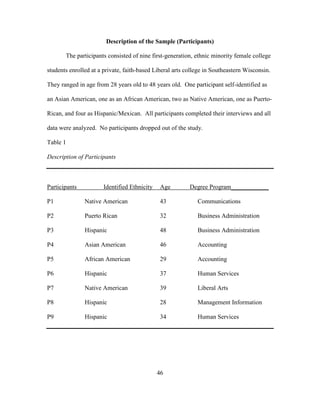
Table 1. Description of Participants
1
CHAPTER 1. INTRODUCTION
First-generation students have been defined as students whose parents have not
obtained education beyond the high school level (Choy, 2001). According to Engle and
Tinto (2008), this population of students currently account for approximately 24% of
undergraduate college enrollments. Despite the steady increase in access to higher
education among traditionally underrepresented populations, educational inequities
continue to abound. First-generation students from low socioeconomic backgrounds are
four times as likely to leave college after their first year as are those with neither of these
factors (Engle & Tinto, 2008). Within four year institutions, first-generation students are
more than twice as likely as continuing generation students to leave before their second
year (Choy, 2001).
First-generation students are a population that is considered to be at-risk because
of various demographic factors. Research on this student population reveals that a
disproportionate amount of first-generation college students are from ethnic and minority
backgrounds. Additionally, these students tend to be female, older, receive less social
and financial support from parents and have multiple obligations outside of their
education, which may consist of family and work. Lack of academic preparation has also
been cited as one of the risk factors related to first-generation students’ ability to persist
in higher education (Bui, 2002; Choy, 2001; Engle & Tinto, 2008; Mehta, Newbold &
O’Rourke, 2011). Additionally, even though women comprise a larger portion of the
first-generation student population, they are less likely than their male counterparts to
persist in their academics (Lohfink & Paulsen, 2005).
2
Higher education plays a vital role in shaping an individual’s social and economic
future (Pascarella & Terenzini, 2005). With the steady increase of the first-generation
college student population, it is vital that colleges begin to develop strategies to increase
retention among these students (Choy, 2001; Giancola, Munz & Trares, 2008; Ishitani,
2003). Despite this need, attrition rates for first-generation college students continue to
exceed those of continuing generation students ( Choy 2001; Engle & Tinto, 2008).
Background of the Problem
There are many factors that may potentially impact persistence among first-
generation students. A study conducted by Ramos-Sanchez and Nichols (2007) revealed
a positive relationship between academic self-efficacy, a students’ confidence in their
academic ability, and college adjustment. The findings of this study also indicated that
non-first-generation students demonstrated higher levels of self-efficacy than their first-
generation counterparts. A later study conducted by Wang and Castaneda-Sound (2008)
corroborated these empirical findings. Positive self-concept, degree of academic and
social integration, and a strong support system are additional factors that have been
associated with academic success (Prospero & Vohra-Gupta, 2007; Ting, 2003; Tinto,
1987). Research has also found that higher levels of self-esteem and positive self-
concept contributed to successful college adjustment and overall well-being of first-
generation students (Hertel, 2002; Wang & Castaneda-Sound, 2008).
Self-efficacy has been related to students’ academic expectations and their
academic performance. Chemers, Hu, and Garcia (2001) conducted a study to examine
the effects of self-efficacy on a population of freshmen students. The findings of this
study revealed that those students who enter into the college environment with a greater
3
confidence in their academic abilities tend to experience greater academic success than
those with less confidence. Those students within the Chemers et al (2001) study who
were identified as confident and optimistic were more likely to view their academic
experience as a challenge rather than a threat. Additionally, Awad (2007) found that
academic self-concept is one of the best predictors of a students’ grade point average
(GPA). For this reason, it can be concluded from these findings that students with a
positive attitude toward their education and their academic abilities are more likely to
perform better.
The parents of first-generation college students have never attended college and
thus lack the knowledge gained by those who have, which renders them inexperienced in
their attempts to assist their children in overcoming the challenges of the college
experience (Phinney & Haas, 2003). For this reason, first-generation students are less
likely to possess the cultural capital or knowledge about the college going process that
has been associated with an increased likelihood of academic success (Pascarella,
Pierson, Wolniak, & Terenzini, 2004). Additionally, first-generation students have been
found to experience greater difficulty in becoming engaged and integrated within
institutions of higher education. These students are often fearful of interacting with
faculty and characterize their environment as one that is not supportive of their academic
endeavors (Longwell-Grice, R. & Longwell-Grice, H., 2008; Pike & Kuh, 2005).
The ability to successfully transition, integrate and adjust to the college culture
has been identified as a very significant indicator of academic persistence (Tinto, 1987).
Social support from parents and peers is an important factor in helping students adjust to
the challenges of the college environment (Dennis, Phinney & Lizette, 2005). Despite
4
this need, a study conducted by Barry, Hudley, Cho and Kelly (2008) revealed that first
generation students were less likely than their non-first-generation counterparts to discuss
their college experiences with their parents. Phinney and Haas (2003) examined the
factors of self-efficacy and social support and their impact on the coping strategies of
first-generation college students. The results of this study indicated that the ability to
seek support during stressful times was the most successful coping strategy for first-
generation students. Additionally those students who perceived to have less social
support experienced greater difficulty in focusing on their academics.
Statement of the Problem
The literature on first-generation college students presents a clear picture of the
challenges that place these students at greater risk for failure (Bui, 2002; Choy, 2001;
Engle & Tinto, 2008; Mehta, Newbold & O’Rourke, 2011). However, what is currently
missing from the literature is how some students within this at-risk population overcome
their challenges and persist in higher education. More specifically, it is unknown how
first-generation, female, ethnic minority college students persist despite the demographic
characteristics that threaten their academic success.
Purpose of the Study
The purpose of this study was to examine the perceptions of first-generation,
female ethnic minority college students through a phenomenological study in order to
gain a better understanding of how they persist in spite of the risk factors associated with
being first-generation. The study explored factors such as self-efficacy, social support,
and self-esteem and their impact on first-generation, female, ethnic minority college
students’ ability to persist. By exploring the phenomena of academic success and
5
persistence through the lived experiences of the research participants, this study will add
to the knowledge that is currently available on the first-generation student population.
Significance of the Study
` First-generation college students are considered an at-risk population because
they enter into the college environment with needs that are not often met by traditional
programs and services (Folger, Carter, & Chase, 2004). These students are characterized
as being underprepared for the challenges of higher education in addition to being less
informed about the college culture. First-generation students face financial difficulties
and experience challenges in their attempts to integrate academically and socially into the
college environment (Choy, 2001; Mehta, et al., 2011). Research has revealed that the
academic and social experiences of first-generation students are quite different than those
of continuing generation students (Pascarella, et al., 2004; Pascarella, Wolniak, Pierson &
Terenzini, 2003). However, in spite of their challenges, first-generation students have
proven to be resilient in their academic endeavors (Pascarella et al, 2003). Despite this
finding, there is a very limited amount of literature available that examines the
experiences of those who have been able to persist in spite of the risk factors associated
with being the first in their family to pursue higher education (Olenchak & Hebert, 2002;
Stieha, 2010; Longwell-Grice, R. & Longwell-Grice.H., 2008).
When first-generation students persist and succeed in higher education, they are
more likely to retain their academic identity and increase their likelihood of obtaining
economic stability. In addition, institutions of higher education and the community at
large have a vested interest in the academic success of first-generation college students
(Folgers et al, 2004). As the demographics of the U.S. continue to change and college
6
campuses become more diversified, first-generation college students will become an
increasingly larger proportion of college enrollments (Choy, 2001; Engle & Tinto, 2008;
Pascarella et al, 2004). For these reasons, it is important to begin to acquire a greater
understanding of the academic experiences of those individuals who comprise such a
large portion of student populations within institutions of higher education.
This study will contribute to the knowledge base that is currently available on
first-generation college students. However, this particular study focused on ethnic
minority, female college students within the first-generation student population. By
doing so, the study will bring about a greater understanding in the research community as
well as among administrators of higher education, college counselors and student affairs
personnel of how this particular segment of the first-generation student population are
able to overcome their obstacles and persist in higher education.
Research Design
In a review of the literature available on first generation college students, it
became evident that the majority of the research had employed a quantitative research
design. In an effort to fill this gap in the literature, this research study used a qualitative
research design and employed a transcendental phenomenological framework.
Phenomenology was appropriate for this particular study because this qualitative
approach seeks to describe a common meaning for several individuals for a specific
phenomenon (Creswell, 2013). This approach coincides with the purpose of this research
study since it attempted to explain the experiences of academic success and persistence
among first generation, ethnic minority female college students. As stated by Steiha
(2010) in her qualitative research study of academic persistence, a phenomenological
7
research design allows the researcher to explore the students’ perceptions of the many
different factors that affect the decisions they make during the college going process.
Additionally, Longwell-Grice and Longwell-Grice (2008) noted that a qualitative
approach was essential in extending the research beyond that which simply compares
first-generation students to their continuing generation counterparts and fails to explore
other factors that impact their college experiences. This particular study centered on
exploring the lived experiences of first-generation, ethnic minority female college
students and their individual perceptions of academic success and persistence.
According to Moustakas (1994), the primary source of knowledge in
phenomenological research is perception, which is a source that cannot be questioned.
Likewise, transcendental phenomenology stresses the subjective nature of discovering the
essence of personal experiences. The advantages of this particular design include the fact
that it allows the researcher to study phenomena that are unapproachable through
quantitative research methods. Also, it identifies and acknowledges the data of
experience as significant in understanding human behavior. Lastly, a phenomenological
approach to the research allows the researcher to explore the essence of an experience
rather than seeking for measurements and explanations. Overall, the aim of
phenomenological research is to determine the meaning of an experience for those who
have had the particular experience or phenomena being studied and who have the ability
to provide a rich description of that experience (Moustakas).
Based on the studies examined that utilized a qualitative research design and the
advantages and goals of phenomenological research as discussed above, this study was
8
qualitative in nature and followed the strategy of transcendental phenomenology in the
data collection and data analysis process.
Research Questions
This study was guided and informed by two research questions. The central
research question was, “How do first-generation, ethnic minority female college students
describe their experiences of academic persistence and success?” This study also
explored the sub-questions:
1. What motivates first-generation, ethnic minority, female college students to
persist in college?
2. How does the self-concept of first-generation, ethnic minority, female college
students affect their academic success?
3. What barriers do first-generation, ethnic minority, female college students
have to overcome to achieve academic success?
Assumptions and Limitations
Assumptions
This research study made the following assumptions: (a) Research participants
would accurately portray their individual experiences of overcoming obstacles and
persisting in their academics (b) Research participants would be those who are concerned
with the academic success of first-generation students and are sharing their stories in
hopes of helping others (c) The findings of this study would inform and benefit
institutions of higher education by providing them with information that would assist in
the development of supportive services geared specifically towards first-generation
students.
9
Limitations
This study was limited to first-generation, ethnic minority, female college
students who had persisted through at least one semester of academic study. For this
reason, the findings of this study cannot be generalized to populations that do not meet
these specific criteria. Additionally, this study was limited to the academic experiences
of a small number of first-generation, ethnic minority female college students in an adult
education setting in a Suburban area. The study did not assume that the experiences of
all students within this particular population would be the same as those who participate
in this study.
Definition of Terms
This study used the following terms and definitions:
Self-efficacy. Self-efficacy refers to an individual’s personal judgment or belief
concerning his ability to successfully perform a specific task or behavior (Bandura,
1997).
First-generation student. First-generation students are those whose parents’
education does not exceed high school (Choy, 2001).
Social Support. Social support refers to the level of support or assistance that an
individual receives from his family, peers or significant others. This support may be in
the form of financial assistance, encouragement, mentorship or in any other form that the
individual characterizes as being supportive of his academic pursuits.
Persistence. Persistence refers to an individual’s ability to overcome challenges
and progress from one semester to the next and eventually complete a program of study
10
(e.g. certificate, 2-year degree, 4-year degree, etc.). This study will focus specifically on
those individuals who have successfully completed at least 1 semester of academic study.
Expected Findings
It was expected that the research participants in this study would be truthful in
sharing their personal experiences of academic success and persistence. Additionally, the
researcher expected that the findings of this particular study would add to the literature
currently available on first generation college students and inform researchers and
practitioners in the field. The researcher was conscious of how her personal experiences
of being a first generation, ethnic minority female college student could affect the
findings of the research study. For this reason, keeping a personal journal, seeking the
assistance of her mentor and setting aside any preconceptions and biases were essential to
the integrity of the research findings.
Organization of the Remainder of the Study
Chapter two presents an examination and analysis of the literature available on
first-generation college students as well as self-efficacy and its relationship to academic
outcomes such as success and persistence. This chapter closes with a synthesis and
critique of the literature, which offers the reader a greater insight into how the present
study seeks to fill a gap in the literature available on first-generation college student.
Following a review of the literature, chapter three provides a discussion of the
methodological approach to the present study. This chapter addresses the benefits of
using a qualitative versus a quantitative methodology in answering the research questions
and filling a gap in the present literature. Afterwards, chapter four presents the data
collected during the course of the present study as well as an analysis of that data. Lastly,
11
chapter five presents a discussion of the findings, an analysis of those findings and
implications that can be derived from the study’s findings.
12
CHAPTER 2. LITERATURE REVIEW
Introduction to the Literature Review
This chapter examined and analyzed the literature that has been conducted on
first-generation college students as well as self-efficacy and its relationship to academic
outcomes. A review of the literature provided a greater insight into the academic
experiences of first-generation college students. Additionally, this review revealed the
benefits of exploring self-efficacy and its relationship to students’ ability to persist in the
face of adversity. The literature review revealed the need for a study that would provide
insight into how some first-generation college students are able to succeed and persist in
spite of the challenges presented by their demographics. For this reason, the present
study sought to fill a gap in the literature by exploring the experiences of first-generation,
ethnic minority female college students who had the ability to overcome these challenges
and persist in their academics.
The literature review consisted of a search of databases such as Academic Search
Premier, Education Research Complete, ProQuest Education Journals, Sage Journals
Online and SocINDEX with Full Text. The following keywords were used within these
databases to obtain articles for this literature review: “academic success”, “academic
persistence”, “first-generation college students”, “self-efficacy”, and “college students.”
Theoretical Orientation for the Study
Tinto (1975) laid the foundation for a theoretical model that would seek to explain
the factors that impact persistence among college students. In his article, Tinto sought to
formulate a theory that would explain the processes of interaction between both the
student and the institution of higher education and how this interaction led to either
13
persistence or drop-out. The basis of his theory was founded on the premises that
students dropped out of higher education because of a lack of academic and social
integration within the college environment. Furthermore, Tinto viewed the process of
dropout as a longitudinal process of interactions between the student and the academic
and social systems of the college. During the student’s college experience, his goals and
commitments would undergo a continuous modification that would lead to either
persistence towards degree completion or dropout. Therefore, based on Tinto’s
theoretical model of persistence, a student’s level of academic and social integration into
the college environment directly impacted his commitment to the institution and the goal
of degree completion (Tinto).
In his seminal work, Albert Bandura (1977) developed a theoretical framework
from which researchers could examine the phenomenon of self-efficacy in a variety of
contexts. In this article, self-efficacy is defined as an individual’s belief that he can
successfully carry out the tasks that are necessary to achieve a desired outcome. It is this
belief or conviction in one’s abilities that affect his decision to both engage in and persist
in a certain task or activity. Self-efficacy is also directly related to an individual’s ability
to persist in a given behavior. Perceived self-efficacy affects an individual’s choices,
coping behaviors and persistence in any situation (Bandura)
Tinto’s (1975; 1987) Theory of College Persistence and Bandura’s (1977) Theory
of Self-Efficacy were used as the theoretical framework from which to explore the
experiences of academic success and academic persistence among first-generation, ethnic
minority female college students. They were used in an effort to examine the validity of
their implications and their application to this particular student population.
14
Review of Research Literature and Methodological Literature
Specific to the Topic or Research Question
First Generation
First-generation students are becoming an increasingly larger proportion of
student enrollments in institutions of higher education because of the current mandate for
diversity in this arena (Engle & Tinto, 2008). In 1995-1996, almost half (47%) of all
enrolling undergraduates were first-generation students or those whose parents have not
received more than a high school education (Choy, 2001). Ishitani (2003) reported that
first-generation students represented 364,000 of the 1.3 million first-time freshmen taking
the SAT in the year 2002. First-generation students have been characterized as an at-risk
student population, which makes their retention of vital importance to college advisors,
administrators and faculty (Choy, 2001; Ishitani, 2003; Ishitani, 2006). In an effort to
understand the phenomena of academic success among first generation college students,
one must first examine the precollege factors associated with being a first-generation
student as well as the quality of their college experiences (Engle & Tinto, 2008; Ishitani,
2006).
First-generation students are more likely than non-first generation students to be
black or Hispanic, female, older, and married with dependents (Choy, 2001; Nunez &
Cuccaro-Alamin, 1998). These students are also more likely to come from families of
lower socioeconomic status where neither parent has received a post-secondary degree,
which increases the likelihood that they will be recipients of financial aid in the form of
grants and loans. Additionally, first generation students have been found to work more
hours than continuing generation students and to be more likely to enroll as a part-time
15
student and complete fewer credit hours than continuing generation students. This may
be due to the fact that this student population is also more likely to have multiple
obligations outside of college (e.g. family, work).
In addition to these factors, first-generation students are usually less
academically prepared for college level work than are their continuing generation
counterparts. Also, they tend to score lower than their counterparts on their SAT’s (Bui
2002; Choy, 2001). For this reason, first-generation students are more likely to begin
their college careers at 2-year public institutions versus 4-year institutions (Bui 2002;
Choy 2001; Nunez & Cuccaro Alamin, 1998; Pascarella et al, 2004).
The likelihood of enrolling in higher education has been strongly linked to the
level of parents’ education (Choy, 2001). Not only does the level of parents’ education
affect the likelihood of enrollment, but it is also associated with the students’ ability to
navigate the college environment once enrolled. The literature currently available on first
generation students reflects a student population that is at a disadvantage because of their
lack of knowledge about higher education (Pascarella et al, 2004; Prospero & Vohra-
Gupta, 2007; Mehta et al, 2011). The knowledge that students gain from those who have
experienced post-secondary education increases their level of comfort and familiarity
with the norms and culture associated with the college environment. First-generation
students lack this knowledge or cultural capital that continuing generation students
possess (Lundberg et al, 2007; Mehta et al, 2011).
Hand and Payne (2008) conducted a study that sought to examine the factors that
impacted the academic success of a group of first-generation Appalachian students. The
participants in this study reported that one of the negative impacts on their success was
16
their lack of knowledge of available resources prior to and during their college
experiences. One of the students in the study revealed that he had failed to receive a
scholarship to attend college due to his lack of knowledge concerning the scholarship
process. Overall, the literature reveals that the success of first-generation students is
compromised because of their parents’ inability to assist them in the college-going
process.
The college experiences of first-generation students are another important factor
to consider when examining the success of this student population. The literature reveals
that the first year of academic enrollment is the most critical for the first-generation
student (Ishitani, 2003). Ishitani (2003) conducted a longitudinal study of first-
generation and continuing generation students that spanned the course of five academic
years. The study revealed that the risk of attrition in the first year was 71% higher for
first-generation students when compared to students with two college-educated parents.
The risk of departure for first-generation students is less pronounced after the first year of
enrollment (Ishitani, 2003; Ishitani, 2006).
In addition to first-generation status, the literature reveals that ethnicity impacts
the likelihood of academic success. The findings of Ishitani (2006) indicated that
Hispanic and Black students were 59% and 58% less likely to graduate in their fourth
year of enrollment respectively when compared to their continuing generation
counterparts. These findings indicate that first-generation, ethnic minority students are at
a great disadvantage when compared to their counterparts. Furthermore, the literature
examines additional factors that impact the college experiences of first-generation
students.
17
Academic and social integration are two factors that have been associated with
persistence and academic success (Lohfink & Paulsen, 2005; Prospero & Vohra-Gupta,
2007; Tinto, 1987). First-generation students who are successful in becoming
academically integrated into the college environment are more likely to obtain higher
G.P.A.’s (Prospero & Vohra-Gupta, 2007). Prospero and Vohra-Gupta (2007) found a
significant correlation between intrinsic motivation and academic integration, which
suggests that those students who enjoy their college experience may find it less difficult
to integrate into the environment. Subsequently, these combined factors may increase
retention and persistence among those students. In spite of the benefits associated with
academic and social integration, first generation students are less likely to become
engaged academically and socially (Hertel, 2002; Mehta et al, 2011).
The lack of academic and social integration achieved by first-generation students
may be due to the fact that they spend a large portion of their time off campus because
they live and work off campus due to a shortage of financial resources (Engle & Tinto,
2008; Nunez & Cuccaro-Alamin, 1998). First-generation students have also been cited to
have greater time demands than their continuing generation counterparts, which may
have a negative impact on their ability to become socially involved on campus. This lack
of social integration has been found to result in lower academic performance and an
overall dissatisfaction with the college experience for first-generation students (Mehta et
al, 2011).
First-generation students may know less about the importance of academic and
social engagement and the process of becoming engaged in the college environment due
to their lack of cultural capital (Longwell-Grice & Longwell-Grice, 2008; Pike & Kuh,
18
2005). The perceptions of some first-generation students are that the college
environment is not supportive of their academic endeavors (Longwell-Grice & Longwell-
Grice, 2008; Lundberg et al, 2007; Pike & Kuh, 2005). Additionally, a study conducted
by Steiha (2010) revealed that family relationships, culture and values of first-generation
students’ families may cause conflict in their attempts to successfully integrate into the
college environment.
The educational aspirations and motivations of first-generation college students is
another area that has been examined in an attempt to better understand the academic
experiences of this student population. Bui (2002) conducted a study designed to
examine first-generation students’ motivations for attending college. First-generation
students in the study reported that some of their reasons for pursuing higher education
were to gain respect/status, bring honor to their family and to be in a position to help their
family. The literature on first-generation students has revealed a significant relationship
between parental involvement and a student’s educational aspirations (Hand & Payne,
2008; McCarron & Inkelas, 2006). Hand and Payne (2008) conducted a study of first-
generation students to examine the factors that contributed to their persistence. The
participants reported that their parents instilled into them the importance of higher
education and expected them to attend college. Additionally, these students perceived
that they were emotionally supported by their parents during the course of their college
experience.
Furthermore, the literature reveals that first generation students are less interested
in having a good time in college and place more value on academic and intellectual
activities than they do social activities (Forbus, Newbold & Mehta, 2011; Hertel, 2002;
19
Lohfink & Paulsen, 2005). For this reason, student-faculty interactions have been
emphasized as a significant factor in keeping first-generation students motivated and
connected to the college environment (Hertel, 2002; Lohfink & Paulsen, 2005).
Additionally, the study conducted by Forbus et al (2011) revealed the significant impact
that support services provided by colleges may have on the academic outcomes of first-
generation students.
Self-Efficacy
In his seminal work, Albert Bandura (1977) developed a theoretical framework
from which researchers could examine the phenomenon of self-efficacy in a variety of
contexts. In this article, self-efficacy is defined as an individual’s belief that he can
successfully carry out the tasks that are necessary to achieve a desired outcome. It is this
belief or conviction in one’s abilities that affect his decision to both engage in and persist
in a certain task or activity. Self-efficacy is also directly related to an individual’s ability
to persist in a given behavior. Perceived self-efficacy affects an individual’s choices,
coping behaviors and persistence in any situation (Bandura).
Self-efficacy is shaped and affected by four areas, which are performance
accomplishments, vicarious experiences, verbal persuasion and physiological states
(Bandura, 1977). Bandura defined performance accomplishments as the experiences of
personal mastery or success in a task that affect his belief in his ability to successfully
complete that task in the future. Vicarious experiences refer to experiences of watching
another individual’s success that communicate to the individual if someone else can
successfully complete a task, so can he. Verbal persuasion can be understand as those
messages that one receives from other individual’s that he can be successful in a given
20
task. Lastly, physiological states refer to an individual’s assessment of his emotional
arousal (e.g. anxiety) to a stressful situation, which affects how he will respond in the
future.
Self-Efficacy and Academic Outcomes
In the 1980’s, researchers began to explore the concept of self-efficacy and its
effects on phenomena such as vocational choice and academic achievement. Hackett and
Betz (1981) wrote the first theoretical paper that explored self-efficacy in the context of
vocation and education. In this study, the researchers explored how self-efficacy affected
male and female college students’ beliefs about their ability to successfully complete the
educational requirements that are necessary for both traditionally female and male
vocations. The results of this study revealed that out of twenty occupations, ten of those
demonstrated statistically significant sex differences in the number of students believing
they could be successful in their completion of the educational requirements for that
given occupation. Overall, male students reported an equivalent self-efficacy for both
traditional and non-traditional occupations. However, females reported a substantially
lower self-efficacy expectation in relationship to non-traditional than traditional
vocational opportunities.
In the 1990’s, researchers began to evaluate the empirical findings of self-efficacy
and its relationship to academic outcomes (Multon & Brown, 1991). In their meta-
analytic investigation, Multon and Brown explored the body of research that had surfaced
over the previous decade that sought to relate self-efficacy beliefs to career and academic
outcomes. Their analysis of the literature included studies that related self-efficacy
beliefs to outcomes in academic performance and persistence. The results of their
21
investigation provided support for the relationship between self-efficacy, academic
performance and persistence. In their meta-analysis, self-efficacy beliefs accounted for
14% of the variance found in student’s academic performance and 12% of that found in
their academic persistence.
After the passing of another decade, Zimmerman (2000) surveyed the research
that had been conducted on self-efficacy in an attempt to establish the validity of self-
efficacy as a predictor of student’s motivation and learning. The results of his study
proved that self-efficacy held discriminant validity by its ability to predict the academic
outcomes of students. Also, self-efficacy held convergent validity in its ability to predict
different forms of motivation, which included activity choices, effort, persistence and
emotional reactions. When self-efficacy was studied as a mediating variable, it proved to
be responsive to improvements in the area of students’ methods of learning, and it was
also predictive of achievement outcomes. From the results of his study, Zimmerman
(2000) concluded that students’ self-beliefs about their academic abilities play an
essential role in their motivation to achieve.
Over the course of the last decade, researchers have continued to explore the
relationship between self-efficacy and academic outcomes in many different contexts
(Chemers, Hu & Garcia, 2001; DeWitz & Walsh, 2002; Zajacova, Lynch & Espenshade,
2005; Davenport & Lane, 2006; Gore, 2006; Hsieh, Sullivan & Guerra, 2007; Ramos-
Sanchez & Nichols, 2007; Wang & Castaneda-Sound, 2008; DeWitz, Woolsey & Walsh,
2009; Majer, 2009; Vuong, Brown-Welty & Tracz, 2010; Brady-Amoon & Fuertes,
2011). From this research, it has been found that self-efficacy is directly and indirectly
related to the academic performance and personal adjustment of college students
22
(Chemers, et al, 2001; Ramos-Sanchez & Nichols, 2007; Brady-Amoon & Fuertes,
2011). It is also positively correlated with students’ level of college satisfaction in that
students with higher self-efficacy report a greater sense of being compensated for their
academic performance (DeWitz & Walsh, 2002) Additionally, self-efficacy has been
proven to be a consistent predictor of grades and persistence in college (Zajacova, et al,
2005; Gore, 2006; Majer, 2009; Vuong, et al, 2010). Research has also revealed a
relationship between self-efficacy and a student’s use of effective coping strategies,
which increases his beliefs in his ability to achieve desired outcomes (Davenport & Lane,
2006). Another area that has been explored in the research of self-efficacy is its
relationship to purpose in life (DeWitz, et al, 2009). DeWitz et al. found that self-
efficacy was significantly and positively correlated with purpose in life. In other words,
those students with higher levels of self-efficacy also demonstrated greater purpose in
life.
The studies that have been conducted to explore self-efficacy and its relationship
to various academic outcomes have been conducted utilizing different research designs in
different contexts and with different populations. The use of a particular design, research
contexts and research participants reveal different findings concerning self-efficacy and
its effects on academic performance. Chemers et al (2001) conducted a quantitative study
of first-year college students in a traditional university setting to explore the relationship
between self-efficacy, academic performance and adjustment to college. This study
revealed to students who reported higher academic self-efficacy also employed greater
usage of effective cognitive strategies in the college environment. These strategies
increased their abilities to manage their time and their learning environments more
23
effectively. Students with higher academic self-efficacy were also better at monitoring
and regulating their own effort. Overall, the study revealed that students who enter into
the college environment with confidence in their academic abilities perform significantly
better than those who have less confidence. Also, those students with higher expectations
for academic success demonstrate higher academic performance.
DeWitz and Walsh (2002) explored the relationship between self-efficacy and
college satisfaction among a group of 312 undergraduate students in a large Midwestern
University. In their study, female students reported a higher sense of college self-
efficacy than males, which the researchers concede may be the result of the smaller
number of males compared to females in the sample. The results of the study revealed a
positive correlation between self-efficacy and college satisfaction. In other words, higher
levels of self-efficacy were found to be associated with higher levels of college
satisfaction. The students who reported higher levels of self-efficacy believed that their
academic effort was more fairly related to their academic outcomes (e.g. grades). These
individuals also communicated greater levels of acceptance from the faculty and other
students. The findings of this study support the relationship between college satisfaction,
retention and academic performance.
Research has also been conducted to explore the relationship between self-
efficacy, academic success and persistence. Hsieh et al (2007) conducted a study with
undergraduate students from a large, metropolitan Hispanic-serving institution in the
Southwest to explore the interaction between students’ goal orientation and self-efficacy.
The study was designed to investigate how students with different levels of self-efficacy
and academic standings compared in the academic goals they adopted and their academic
24
achievement. The results of the study revealed that those students who were in good
academic standing held higher self-efficacy judgments than those who were on academic
probation. Students’ G.P.A. was positively related to higher self-efficacy and an
adoption of mastery goal orientation. Overall, students in good academic standing held a
mastery goal orientation or embraced goals to master the skills taught in college and had
a stronger belief that they could successfully complete academic tasks than those students
who were not in good academic standing.
Researchers have also conducted studies that have explored the relationship
between self-efficacy and a student’s ability to cope with, adjust to and persist in the
college environment (Brady-Amoon & Fuertes, 2011; Davenport & Lane, 2006; Gore,
2006; Ramos-Sanchez & Nichols, 2007). Brady-Amoon and Fuertes (2011) study of 275
full time undergraduate students supported research findings that self-efficacy contributes
to a student’s ability to adjust to the college environment. Likewise, Ramos-Sanchez and
Nichols (2007) study of a group of first-generation and non-first generation freshmen at a
private liberal arts West Coast university revealed that a student’s level of self-efficacy at
the beginning of the year significantly predicted his college adjustment at the end of the
academic year regardless of generational status. Their findings did not support a
mediating relationship between self-efficacy, generational status and G.P.A. However,
the results of the study revealed that a student’s confidence in his academic ability was
related to better adjustment in college.
Gore (2006) reported different results in regards to the relationship between self-
efficacy and academic outcomes (e.g. performance and persistence) as it relates to the
time of the measurement. In his study, Gore reported a stronger relationship between
25
self-efficacy and G.P.A. at the end of the student’s first semester and subsequent
semesters than at the beginning of the first semester. Gore’s reasoning for these findings
is that self-efficacy beliefs of experienced students are more strongly related to
performance and persistence than are those of “college naïve” students. A study
conducted by Davenport & Lane (2006) investigated the relationship between self-
efficacy, coping and retention. The results of the study supported a link between a
student’s use of active coping strategies and self-efficacy. In other words, students who
use active coping strategies experience an increasing in coping efficacy, which
contributes to an increase in outcome efficacy. The self-efficacy scores reported in the
study were correct in classifying 81.3% of the students who were originally identified as
at-risk of dropout.
Majer (2009) and Vuong et al (2010) conducted studies to explore the effects of
self-efficacy on the academic success of first-generation college students. Majer (2009)
conducted a study of 96 first generation ethnic-minority students from a community
college in Chicago, IL. This study was conducted as a longitudinal study that examined
academic outcomes at 4 month and 12 month intervals. The results of the study
suggested that a greater self-efficacy for education is essential in promoting educational
gains among first generation students attending a community college. From these
findings, the author concluded that students would benefit from interventions that address
academic self-efficacy. The study conducted by Vuong et al (2010) consisted of first-
generation sophomore students and examined the effect of self-efficacy on academic
success and persistence rates. The findings revealed that academic success and
persistence were functions of self-efficacy. In other words, the way that college
26
sophomore students perceive their capabilities influences their academic performance and
their persistence in maintaining a G.P.A. that will allow them to continue in their degree
program until graduation.
Academic Persistence
Tinto (1975) laid the foundation for a theoretical model that would seek to explain
the factors that impact persistence among college students. In his article, Tinto sought to
formulate a theory that would explain the processes of interaction between both the
student and the institution of higher education and how this interaction led to either
persistence or drop-out. The basis of his theory was founded on the premises that
students dropped out of higher education because of a lack of academic and social
integration within the college environment. Furthermore, Tinto viewed the process of
dropout as a longitudinal process of interactions between the student and the academic
and social systems of the college. During the student’s college experience, his goals and
commitments would undergo a continuous modification that would lead to either
persistence towards degree completion or dropout. Therefore, based on Tinto’s
theoretical model of persistence, a student’s level of academic and social integration into
the college environment directly impacted his commitment to the institution and the goal
of degree completion (Tinto).
In the 1980’s, Astin (1984) developed a theory of student involvement that sought
to further explain the link between student involvement and ability to persist. Astin’s
theory explored areas such as student’s place of residence (on or off-campus), college
choice, institutional fit, student-faculty interaction, academic involvement, athletic
involvement, etc. This theory provided yet another look into the factors that impact a
27
college student’s ability and desire to persist towards completing his goal of degree
attainment. Over the last decade, researchers have sought to build on and reconstruct the
theories developed by Tinto (1975) and Astin (1984) and provide further insight into the
prevailing issue of academic persistence among college students and how it can best be
addressed.
Since the development of Tinto’s (1975, 1987) Interactionalist Theory of Student
Departure, researchers have conducted research to support and refute the tenets of this
theory. In the work edited by Braxton (2000), he stated that the model set forth by Tinto
(1975, 1987) needed to be revised. One of the main questions brought up by Braxton
(2000) was the validity of the relationship between academic integration and institutional
commitment. A review of the research conducted on this factor of academic persistence
reveals that this variable fluctuates according to the focus of the study (e.g. multi-
institutional vs. single institution) and institution type. Another area warranting review as
stated by Braxton (2000) is that of financial aid and its impact on persistence. Braxton
discusses the necessity of integrating the factor of financial aid with other persistence
factors (e.g. academic and social integration) instead of viewing it as a stand-alone factor.
Overall, Braxton (2000) stresses the importance of reconstructing theoretical models of
academic persistence so that they include other factors such as the classroom, faculty and
pedagogy.
Researchers seeking to gain a better understanding of the factors that
impact academic persistence among different student populations have explored areas
such as academic and social integration, financial aid, social support systems, mentoring,
student-faculty interaction, and academic advising (Alon 2011; Astin 1984; Barbatis,
28
2010; Braxton 2000; Gloria & Ho, 2003; Hu & Ma, 2010; Morrow & Ackerman, 2012;
Pascarella & Terenzini, 2005; Tinto, 1975, 1987). Review of this research provides a
firm understanding of these factors as well as the need for further research in certain
areas and among different student populations.
Factors Impacting Academic Persistence
Researchers have explored various factors and how they impact academic
persistence among college students. Alon (2011) examined the effect of financial aid on
a student’s ability to persist in college. According to his research, a persistence gap
currently exists due to economic inequality. Financial aid eliminates some of the
economic barriers experienced by lower income students, which increases their chances
of persisting towards degree completion. However, affluent students also receive some
needs-based grants, which decrease the amount of financial aid that can be distributed
among students who are economically disadvantaged. For this reason, Alon (2011)
suggested that the aid granted to affluent students is a waste of resources as it relates to
academic persistence. It is his suggestion that in order to close the persistence gap that
exists among students of different income levels, needs-based grants on the state and
institutional level need to be reallocated to benefit low-income students.
Another area that has been explored in the persistence literature is that of social
support systems and their impact on a student’s ability to persist in college. Gloria and
Ho (2003) conducted a study that sought to explore the social, psychological and
environmental experiences of Asian American undergraduate students as it related to
their ability to persist. The study examined the relationship between comfort in the
university environment, social support and self-beliefs and the degree to which they
29
predicted academic persistence. The findings of the study suggested that each variable
was a significant predictor of persistence with social support being the strongest predictor
of a student’s ability to persist. Additionally, Gloria and Ho (2003) conducted their
research using six different Asian American ethnic groups. The findings of this study
demonstrated differences between ethnic groups, which suggest that ethnicity is an
important factor to consider when examining factors that impact persistence.
Morrow and Ackerman (2012) explored the impact of sense of belonging and
motivation on students’ intent to persist and actual retention rates. The study was
conducted with a group of undergraduate freshmen during the summer of their first year
of college. Morrow and Ackerman (2012) hypothesized that high levels of sense of
belonging (i.e. peer support, faculty support and classroom comfort) and motivation
attitudes (i.e. intrinsic values, instrumental value and personal development) would be
related to intention to persist and second-year retention. The findings of the study
suggested that faculty support had a small but significant positive relationship with
intention to persist. Additionally, peer support was a significant predictor of second year
retention. However, when both faculty support and peer support were included in the
final analysis with all predictors (i.e. sense of belonging and motivational attitudes), the
sense of belonging variables were no longer significantly related to intention to persist or
second year retention. These findings present the question of whether or not motivation
is more important than sense of belonging in students’ intention to persist and actual
retention rates.
Mentoring and student-faculty interaction can positively impact persistence rates
of underprepared and ethnically diverse college students through the facilitation of social
30
and academic integration, which enhances students’ college experience and strengthens
their commitment towards degree completion (Barbatis, 2010; Hu & Ma, 2010). Hu and
Ma (2010) conducted a study that was designed to explore the impact of mentor
assignment on college persistence. The study explored this relationship and how it varied
based on race/ethnicity, gender, institution type and academic preparation. The findings
of the study revealed that four-year public institutions were more likely to assign students
a college mentor. Also, the research suggested that Hispanic and “other” students were
more likely than White students to actively seek out support and encouragement from
their assigned mentors. Additionally, Hispanic students were more likely than white
students to perceive the mentor relationship as important. Student persistence was
positively affected by the extent to which students sought out the support of their
assigned mentor. Therefore, the findings of this study imply not only the importance of
assigning mentors to college students but the importance of students actually turning to
those mentors for support and guidance throughout their college experience.
The study conducted by Barbatis (2010) stresses the importance of factors such as
precollege characteristics, social involvement and academic integration for underprepared
and ethnically diverse college students. Students in the Barbatis (2010) study represented
students who were first-generation college students, first generation in the United States,
non-native English speakers, women and under-represented minority populations. The
findings of this study revealed that unlike the Tinto (1975) model of student persistence,
which stresses the importance of assimilation into the college culture, some students rely
on their cultural background for support during their college experience. Also, students
in the Barbatis (2010) study mentioned factors such as determination, faith, goal
31
orientation and resourcefulness as contributors to their ability to persist in their
academics. These are factors that are not mentioned in the Interactionalist Theory of
Student Departure proposed by Tinto (1975; 1987).
Synthesis of the Research Findings
The literature available on first-generation college students provided insight into
the demographics of this student population and the challenges that those demographics
present. Researchers agree that first-generation college students face many difficulties
and challenges that threaten their ability to persist towards degree completion (Bui, 2002;
Choy, 2001; Engle & Tinto, 2008; Mehta, Newbold & O’Rourke, 2011. According to the
literature available on first-generation college students, they are less likely than their
continuing generation counterparts to successfully complete their degree program (Bui
2002; Choy, 2001). The literature revealed that factors such as family responsibilities,
lack of cultural capital, work responsibilities, etc. may affect first-generation college
students’ ability to become academically and socially integrated within the college
environment ((Pascarella et al, 2004; Prospero & Vohra-Gupta, 2007; Mehta et al, 2011).
Researchers agree that this inability to successfully integrate within the college
environment may negatively impact these students’ academic success and ability to
persist (Longwell-Grice & Longwell-Grice, 2008; Pike & Kuh, 2005). Additionally, the
literature stressed the importance of the parent’s role in the overall success of the first-
generation college student. The parent’s lack of knowledge concerning the college
process and the intricacies of the college experience may serve as an additional
contributing factor in the ability of the first-generation college student to succeed (Hand
& Payne, 2008; McCarron & Inkelas, 2006).
32
A review of the available literature in the area of self-efficacy revealed that self-
efficacy is positively related with several academic outcomes such as academic
performance and college satisfaction (Chemers, et al, 2001; Ramos-Sanchez & Nichols,
2007; Brady-Amoon & Fuertes, 2011). Researchers have also determined that self-
efficacy is predictive of good grades and persistence in academics (Zajacova, et al, 2005;
Gore, 2006; Majer, 2009; Vuong, et al, 2010). Additionally, the literature on self-
efficacy revealed a positive relationship between self-efficacy and effective coping
strategies, which help to predict a student’s ability to adjust to and persist in the college
environment (Brady-Amoon & Fuertes, 2011; Davenport & Lane, 2006; Gore, 2006;
Ramos-Sanchez & Nichols, 2007). Overall, the findings on self-efficacy revealed a
positive relationship between self-efficacy and many determinants of academic success
and persistence.
The literature available on academic persistence gives insight into the different
factors that impact a college student’s intent and ability to persist towards degree
completion. Some of those factors include the amount and type of financial aid students
receive, social support from family and friends, faculty mentoring and internal factors
such as sense of belonging, motivation, determination, faith and resourcefulness (Alon
2011; Barbatis, 2010; Gloria & Ho, 2003; Hu & Ma, 2010; Morrow & Ackerman, 2012).
The findings of these studies can begin to assist academic administrators, faculty,
academic advisors and other interested stakeholders in developing interventions to
increase persistence and retention rates among minority and first-generation college
students.
33
Critique of the Previous Research
The research available on first-generation college students presented a bleak
picture of their ability to succeed and persist in higher education. The research that has
been conducted on this student population only examined their demographics in light of
the difficulties and challenges that they present. The literature does not offer any insight
into how first-generation ethnic minority female college students can succeed in spite of
the factors that threaten their success. Additionally, the majority of research studies
conducted on first-generation college students were quantitative in nature. These studies
framed the academic success and persistence of first-generation college students as a
comparison to continuing generation college students. However, these studies failed to
give insight into how some first-generation college students are able to succeed and
persist in spite of the challenges presented by uncontrollable demographics. Therefore,
the present study will explore the academic success and persistence of first-generation,
ethnic minority female college students in the context of a qualitative study that seeks to
bring about a greater understanding of their personal academic experiences.
Summary
First-generation college students are an at-risk student population who face many
challenges in their attempts to succeed and persist toward degree completion. A review
of the literature available on this student population revealed that they are less likely to
succeed when compared to their continuing generation counterparts (Bui 2002; Choy,
2001). Up until now, the majority of the research available on first-generation college
students has been quantitative in nature, which presents limitations towards developing a
thorough understanding of their academic experiences. The lack of qualitative research
34
available on first-generation college students revealed the need to explore the academic
experiences of first-generation college students from a qualitative approach. By
exploring academic success and persistence as perceived by first-generation college
students, this study seeks to fill a gap in the literature and obtain a greater understanding
of the factors that assist these students in succeeding and persisting towards degree
completion.
35
CHAPTER 3. METHODOLOGY
Purpose of the Study
The purpose of this phenomenological study was to explore the personal
experiences of academic success and persistence among first-generation, ethnic minority
college students. Participants in this study included first-generation, ethnic minority
female college students who had completed at least one semester of higher education and
were in various stages of completing a Bachelor’s Degree program. The main research
question guiding the study was: How do first-generation, ethnic minority female college
students describe their experiences of academic persistence and success. The study also
explored the following sub questions:
1. What motivates first-generation, ethnic minority, female college students to
persist in college?
2. How does the self-concept of first-generation, ethnic minority, female
college students affect their academic success?
3. What barriers do first-generation, ethnic minority, female college students
have to overcome to achieve academic success?
Research Design
In a review of the literature available on first generation college students, it
becomes evident that the majority of the research has employed a quantitative research
design. In an effort to fill this gap in the literature, this research study used a qualitative
research design and employed a transcendental phenomenological framework.
Phenomenology was appropriate for this particular study because this qualitative
36
approach seeks to describe a common meaning for several individuals for a specific
phenomenon (Creswell, 2013). This approach coincides with the purpose of this research
study since it attempted to explain the experiences of academic success and persistence
among first generation, ethnic minority female college students. As stated by Steiha
(2010) in her qualitative research study of academic persistence, a phenomenological
research design allows the researcher to explore the students’ perceptions of the many
different factors that affect the decisions they make during the college going process.
Additionally, Longwell-Grice and Longwell-Grice (2008) noted that a qualitative
approach was essential in extending the research beyond that which simply compares
first-generation students to their continuing generation counterparts and fails to explore
other factors that impact their college experiences. This particular study centered on
exploring the lived experiences of first-generation, ethnic minority female college
students and their individual perceptions of academic success and persistence.
According to Moustakas (1994), the primary source of knowledge in
phenomenological research is perception, which is a source that cannot be questioned.
Likewise, transcendental phenomenology stresses the subjective nature of discovering the
essence of personal experiences. The advantages of this particular design include the fact
that it allows the researcher to study phenomena that are unapproachable through
quantitative research methods. Also, it identifies and acknowledges the data of
experience as significant in understanding human behavior. Lastly, a phenomenological
approach to the research allows the researcher to explore the essence of an experience
rather than seeking for measurements and explanations. Overall, the aim of
phenomenological research is to determine the meaning of an experience for those who
37
have had the particular experience or phenomena being studied and who have the ability
to provide a rich description of that experience (Moustakas).
Based on the studies examined that utilized a qualitative research design and the
advantages and goals of phenomenological research as discussed above, this study was
qualitative in nature and followed the strategy of transcendental phenomenology in the
data collection and data analysis process.
Target Population and Participant Selection
According to Chen & Carroll (2005), 22% of students in the nation who entered
postsecondary education between the years of 1992 and 2000 were first generation
college students or those whose parents had not completed a college degree. As of 2008,
this population of students accounted for approximately 24% of all undergraduate college
enrollments (Engle & Tinto). Additionally, first-generation college students were more
likely to be Black or Hispanic and to come from low income families (Chen & Carroll,
2005). These students are also more likely to be 24 years of age or older (Choy, 2001).
Lastly, women and ethnic minorities make up a significant proportion of the first-
generation student population (Bui 2002; Choy, 2001; Engle & Tinto, 2008; Nunez &
Cuccaro-Alamin, 2008).
According to Creswell (2009, 2013), researchers employing a qualitative research
design purposefully select participants and/or research sites that will be most beneficial in
providing him with a greater understanding of the research problem. For this reason, the
researcher targeted first generation college students at a non-traditional, private university
who were willing to share their personal experiences of academic success and
persistence. The sample consisted only of first-generation, ethnic minority female
38
college students who had completed at least one semester of higher education. The
research participants consisted of students in different phases of their degree program,
including those who had recently graduated from the University. Research participants
were sent an introductory email describing the purpose of the study and soliciting their
voluntary participation in the research study. Students were provided with the
researcher’s email address and telephone number and assured that all contact would
remain confidential.
After the initial contact, the researcher screened interested participants to ensure
that they met all of the criteria for the study. Those students who met all of the criteria
for the study and who were still interested in volunteering for the research study were
scheduled to meet with the researcher individually for a one-on-one face to face
interview. Creswell (2013) states the importance of receiving individuals’ consent to
participate in the study. For this reason, the researcher provided the participant with the
informed consent and received both written and oral consent from the participant prior to
the face to face interview.
The chosen sample for the research study included ten ethnic minority women
from different ethnic backgrounds at different phases in their degree programs.
According to Creswell (2013), a phenomenology study typically includes a group of
individuals who have all experienced the same phenomenon. This group may range
anywhere in size from three to four to ten to fifteen research participants.
Procedures
Data collection procedures for this research study consisted of one face to face
interview with each participant that lasted approximately 45 minutes to 1 hour in length.
39
Moustakas (1994) suggested the development of an interview guide that consists of open-
ended questions that are intended to evoke the most comprehensive account of the
participant’s experience of the phenomenon in question. For this reason, the researcher
took great care in formulating an interview guide that would achieve this suggested end.
Additionally, during the interviews, the researcher was mindful of utilizing the proper
language and the correct timing of asking questions to encourage full disclosure of the
participant’s experience (Moustakas).
Each interview session began with the researcher collecting basic information
from the participant, which included demographic information, the amount of time the
participant had been enrolled in her current degree program and her expected graduation
date. These basic questions were designed to give the participant time to get comfortable
with the researcher and the interview process. Afterwards, the researcher utilized the
interview guide to collect information about the participant’s initial and continued
motivations for college, barriers to academic success and perception of her ability to
persist despite these obstacles and challenges.
The interviews were audiotaped in an effort to eliminate any disruption that would
be caused by constant note-taking by the researcher. The audiotapes were also collected
to assist the researcher in the transcription and analysis of the data collected. All of the
interviews were held in a private room located on the college campus that ensured the
participant was comfortable and in familiar surroundings.
Instruments
A phenomenological study consists primarily of in-depth interviews in an effort to
provide the researcher with a rich understanding of the phenomenon in question
40
(Creswell, 2013). For this reason, the researcher is the instrument used to collect data in
the research study. The qualitative interview allows the research participant to share rich
descriptions of specific phenomenon that the researcher is then able to interpret and
analyze (DiCicco-Bloom & Crabtree, 2006). Creswell (2013) stressed the importance of
selecting the type of interview that is most practical and will yield information that will
be useful in answering the research questions. For this reason, the researcher utilized a
semi-structured qualitative interview as this is often the sole source of data collection for
most qualitative studies (DiCicco-Bloom & Crabtree, 2006).
The interview was conducted as a one-on-one face to face interview since this
method has been identified as one that allows the researcher to delve deeply into the
social and personal aspects of the phenomenon being studied ((DiCicco-Bloom &
Crabtree). The semi-structured interview guide contained questions about the
participant’s motivations for attending college, barriers to academic success and overall
experiences of being a first-generation college student. The interview questions were
field tested by three experts in the field of higher education prior to finalizing the
interview guide. One of the responsibilities of the researcher as the sole instrument of
data collection is to ensure that the interview is conducted in an environment that will
elicit honest and comprehensive responses from the participant (Moustakas, 1994). For
this reason, the researcher conducted all interviews in a private room that encouraged
participants to provide information freely and uninhibited.
Research Questions
This study was guided and informed by two research questions. The central
research question was, “How do first-generation, ethnic minority female college students
41
describe their experiences of academic persistence and success?” This study also
explored the sub-questions:
1. What motivates first-generation, ethnic minority, female college students to
persist in college?
2. How does the self-concept of first-generation, ethnic minority, female college
students affect their academic success?
3. What barriers do first-generation, ethnic minority, female college students
have to overcome to achieve academic success?
Data Analysis
For the purposes of this particular study, the data analysis strategy described by
Moustakas (1994) was followed. During the data analysis process, the researcher listened
to the audiotaped recording of each interview several times in an attempt to gather a firm
understanding of each participant’s personal experience of academic success and
persistence. Afterwards, the researcher transcribed participants’ responses to develop a
narrative of participants’ experiences as first-generation, ethnic minority female college
students.
During the second phase of the data analysis process, the researcher began
transcribing each interview. This consisted of listing each expression relevant to the
phenomenon in question and then eliminating those expressions that did not contribute to
an understanding of the participant’s experience (Moustakas, 1994). By doing so, the
researcher was then able to cluster the information into themes that described the
phenomenon of the research participants.
42
Once these themes were identified, the researcher was then able to use them to
construct an individual textural description of the experience for each participant.
Additionally, the researcher constructed a structural description of the experience for
each participant in the study. Afterwards, a textural-structural description of the
meanings and essence of the experience, which included the identified themes, was
constructed. Lastly, the researcher was able to construct a composite description of the
phenomenon that represented the experience of the entire group as a whole (Moustakas).
Ethical Considerations
Prior to selecting and contacting research participants to be included in this study,
the researcher underwent two separate Institutional Review Board (IRB) processes. Prior
to completing the IRB process for Capella University, the researcher was required to
complete the IRB process for the chosen research site. The IRB application outlined the
purpose of the proposed study as well as the methods that would be employed to ensure
the safety and well-being of the research participants. The research site approved the
IRB application and informed the researcher that the research study could be conducted
after receiving approval from Capella University.
Next, the researcher completed the IRB process for Capella University, which is
required prior to contacting any research participants for the study. The researcher
employed the ethical guidelines set forth by both institutions to ensure the safety, well-
being and confidentiality of the research participants at all times.
All students who were interested in participating in the study were screened and
then met with the researcher individually and privately. The researcher provided each
participant with detailed information concerning the research study to ensure voluntary
43
participation. The researcher read the informed consent to each participant and received
both verbal and written confirmation of informed consent from each participant.
Participants were informed of minimal risk associated with the study and were given the
freedom to discontinue the study at any time throughout the course of the interview
process. The participants were provided information concerning available counseling
resources provided by the research site.
In accordance with the American Counseling Association Code of Ethics (2005),
all data should always remain in a locked file when not in use. The researcher was the
only individual with access to the locked file containing participant’s information.
Additionally, the researcher also stored data on a password protected computer, to which
only she had the password. The research site and each participant were given code names
to ensure that no personal identifiers exist. The researcher will maintain written
documents and audio-taped recordings in a locked file and a password protected
computer for up to seven years after the completion of the research study. After this
time, the researcher will destroy all written documents by shredding and any information
contained on the computer by deleting. Also, all audio-taped recordings will be deleted
from the researcher’s personal audio recorder.
Expected Findings
It was expected that the research participants in this study would be truthful in
sharing their personal experiences of academic success and persistence. Additionally, the
researcher expected that the findings of this particular study would add to the literature
currently available on first generation college students and inform researchers and
practitioners in the field. The researcher was conscious of how her personal experiences
44
of being a first generation, ethnic minority female college student could affect the
findings of the research study. For this reason, keeping a personal journal, seeking the
assistance of her mentor and setting aside any preconceptions and biases were essential to
the integrity of the research findings.
45
CHAPTER 4. DATA COLLECTION AND ANALYSIS
Introduction: The Study and the Researcher
The researcher is a first-generation, ethnic minority female college student who
represented the first in her family to successfully complete a college degree. Her
professional background includes working as an educator in the field of higher education
as well as counseling. This study represents the first time that the researcher has
conducted a phenomenological qualitative study. The personal and academic experiences
of the researcher mirrored those of the research participants in this particular study. The
researcher experienced many obstacles and hardships associated with being a first-
generation college student and lacking that much desired support of family members and
friends.
In a qualitative study, the researcher is the primary instrument of data collection
(Creswell, 2013). For this reason, it is necessary for the research to engage in a process
of self-reflection to ensure that his personal experiences and biases do not interfere with
the collection and interpretation of the data. The researcher acknowledged the possibility
of bias in relation to her personal experiences and thus comprehended the importance of
suspending any judgment of the participants’ experiences in order to gain a greater
understanding of those experiences.
In this particular study, the researcher organized all of the recruitment efforts
and performed all of the data collection and analysis with the support and assistance of
her mentor. The researcher was driven by a strong desire to gain a better understanding
of the experiences of academic success and persistence among first-generation, ethnic
minority female college students.
46
Description of the Sample (Participants)
The participants consisted of nine first-generation, ethnic minority female college
students enrolled at a private, faith-based Liberal arts college in Southeastern Wisconsin.
They ranged in age from 28 years old to 48 years old. One participant self-identified as
an Asian American, one as an African American, two as Native American, one as Puerto-
Rican, and four as Hispanic/Mexican. All participants completed their interviews and all
data were analyzed. No participants dropped out of the study.
Table 1
Description of Participants
Participants Identified Ethnicity Age Degree Program____________
P1 Native American 43 Communications
P2 Puerto Rican 32 Business Administration
P3 Hispanic 48 Business Administration
P4 Asian American 46 Accounting
P5 African American 29 Accounting
P6 Hispanic 37 Human Services
P7 Native American 39 Liberal Arts
P8 Hispanic 28 Management Information
P9 Hispanic 34 Human Services
47
Research Methodology Applied to the Data Analysis
Moustakas’ (1994) transcendental phenomenological method was used to analyze the
experiences of academic success and persistence among the first-generation, ethnic
minority female college students in this study. The data was collected in the form of one
on one, informal interviews utilizing an interview guide of open-ended questions. The
main research question guiding this study was “How do first generation, ethnic minority
female college students explain their experiences of academic success and persistence?”
It also explored the following sub questions:
1. What motivates first-generation, ethnic minority female college students to
persist in college?
2. How does the self-concept of first-generation, ethnic minority female college
students affect their academic success?
3. What barriers do first-generation, ethnic minority female college students have to
overcome to achieve academic success?
The researcher conducted nine face-to-face interviews with the research
participants using open-ended questions as a guide to exploring their experiences.
After conducting the interviews, the researcher developed transcripts for each
interview, which were then reviewed by the researcher. Afterwards, the researcher
engaged in the process of phenomenological reduction, which consisted of
eliminating those expressions that did not contribute to an understanding of the
participant’s experience (Moustakas, 1994). Once this process was completed, the
researcher clustered the information into themes that described the phenomena in
question.
48
After themes were extracted from the data, the researcher developed individual
textural and structural descriptions for each participant. Next, the researcher was able
to develop a composite textural and structural description by integrating the textural
and structural descriptions of each participant. The final composite represented the
essence of the experience for all research participants included in the study.
Presentation of the Data and Results of the Analysis
This section presents the meaning units for each research participant regarding
their experiences of academic success and persistence as first-generation, ethnic
minority female college students. The list of meaning units is followed by individual
textural, structural and textural-structural descriptions for each participant.
Afterwards, the composite textural, structural and textural-structural description is
explored. Finally, the essence of the experience of academic success and persistence
as a first-generation, ethnic minority female college student is revealed.
The analysis of the data was focused on the lived experiences of first-generation,
ethnic minority female college students in their own words as expressed during the
interviews. The researcher encountered no difficulties in the data analysis process.
The meaning units for each participant are listed below:
Textural Themes, Participant 1
Family as motivation
1. “I know I need to do this for us because I need to get us out of where we are.”
Family/Peers as support
1. “It’s really not their job to be supportive, but it’s nice to know that I have
friends that are.”
2. “If I say I have to read, you’re going to have to go in the bedroom and watch
T.V.”
49
Lack of support from family
1. “It’s really difficult for them to be supportive when they didn’t have the
initiative to do so and they are happy where they are.”
Self-Motivation/Determination
1. “ You gotta do what you gotta do to get where you want.”
2. “Sheer determination to get us out of where we are.”
3. “Once you get your mind set on something, go ahead and stand in my way if
you want to.”
4. “Don’t let anybody or anything stand in your way. Don’t pay attention to
what they say. Do what you feel in your heart to do.”
Education as key to advancement
1. “The company I work for is an awesome company, but there is absolutely no
room for advancement.”
2. “As much as I hate to leave the company at some point I’m going to have to
because I’m not going to be 50 and still doing collections.”
Finances as barrier
1. “The expense, and it’s even more expensive for online.”
The role of the college
1. “You (the college) just have to be more flexible because sometimes kids get
sick and you can’t hold that against somebody.”
Textural Description, Participant 1
Participant 1 was never encouraged to go to college by her family because as she
stated, “It’s really difficult for them to be supportive when they didn’t have the initiative
to do so and they are happy where they are.” She realized after years of working in
collections that she would not be able to advance in the field without a higher education.
For this reason, she decided to pursue her Bachelor’s Degree in Communications.
Participant 1 spoke of her husband as an additional motivation for her to return to
college because of his disability, which renders him incapable of working. She stated, “I
know I need to do this for us because I need to get us out of where we are.” She views
her education as the key to advancing and experiencing a life better than that of her
mother and father. Participant 1 spoke of the difficult life that her mother and father
50
experienced because of their lack of education. Concerning her mother, she stated, “If
she would have had an education, she would have been able to work her way up more
quickly.” Participant 1 expressed her desire to advance in her career by obtaining a
higher education degree. As she stated, “I’m not going to be 50 and still doing
collections.”
Participant 1 spoke of her husband as being both a motivation and an obstacle to
completing her degree because of his physical disability. When speaking of obstacles she
stated, “On the flip side, it’s him because he is sick, so sometimes it’s really difficult to
do what I need to do.” She spoke of the importance of having his support in order to be
successful as a college student. In giving an example of how her husband works to
support her, she stated, “If I say I have to read, you’re going to have to go in the bedroom
and watch T.V.” She also spoke of the need to have her husband push her at times when
she feels herself getting lazy in turning assignments in on time: “he’s going to have to
start pushing me a little bit there too because I get really lazy with it.”
Participant 1 was very positive about her ability to complete her degree in spite of
the obstacles that she faced. When asked what she would like to have known prior to
beginning college, she stated, “the expense, and it’s even more expensive for online.”
Finances presented a very significant barrier to Participant 1 and so much to the extent
that she was currently taking her classes online due to a lack of transportation. In spite of
these situations, Participant 1 constantly spoke of her determination. As she stated, “you
gotta do what you gotta do to get where you want.”
For Participant 1, academic success and persistence were rooted in the support she
received from her husband, her desire to advance in her career and achieve financial
51
freedom, and her determination to succeed. Being a first generation college student
presented its challenges, but it also presented Participant 1 with an opportunity that
neither her mother nor father had experienced. Participant 1 was confident in her ability
to complete her degree program and accomplish her goals. “Strong and going” were the
words she expressed when asked about her ability to complete her college degree. It was
because of this attitude that Participant 1 has been able to persist in spite of the
difficulties that she has faced being a first-generation college student.
Structural Description, Participant 1
The first structural theme to emerge for Participant 1 was her relationship to
others. Her parents are deceased but when asked what motivated her to continue towards
her degree, she emphatically stated, “my husband.” Participant 1 also spoke about the
encouragement that she received from some of her co-workers at her place of
employment. As she stated, “It’s really not their job to be supportive, but it’s nice to
know that I have friends that are.” Her husband’s disability, which renders him incapable
of employment is also a driving force for Participant 1. As she stated, her reasons for
believing that she can achieve her goals can be defined as “sheer determination to get us
out of where we are.” In addition to her determination, Participant 1 stated that the
support she receives from her family and peers means “a lot” in her quest to complete her
degree program.
Participant 1 has also received a lack of support from her family members due to
the fact that they don’t see the value of her obtaining a higher education degree. As she
stated, ““It’s really difficult for them to be supportive when they didn’t have the initiative
to do so and they are happy where they are.” However, in spite of this lack of support,
52
Participant 1 is determined to make a better life for herself and her family. As she stated,
“knowing what I need to do for my family right now”, is what gives her the strength to
press forward. Her determination is seen even more when she stated, “I don’t care about
what yall do, I need to take care of mine.” It is this attitude of sheer determination that
has helped Participant 1 to overcome the lack of support from family and persist towards
degree completion.
The second structural theme to emerge for Participant 1 was relationship to self.
She felt very confident in her ability to complete her degree and believed “you gotta do
what you gotta do to get where you want. Participant 1 believed that she received her
strong sense of “sheer determination” from her father. She believed in her ability to
complete her degree program and when asked what advice she would give to other first-
generation, ethnic minority female college students who were trying to persist in their
degree program, she stated “Don’t let anybody or anything stand in your way. Don’t pay
attention to what they say. Do what you feel in your heart to do.”
Textural-Structural Description, Participant 1
Participant 1 started going to college after she realized that there was no room for
advancement in her current job as a collections agent. Additionally, the fact that her
husband is disabled places her in the position as the sole provider for their family. When
asked about her original motivations for attending college, she stated “A lot of it is I
know I need to do this for us because I need to get us out of where we are.” For this
reason, she views education as the key to financial security for herself and her husband.
Her relationship to others has played a significant role in her ability to persist in
spite of the obstacles that she has faced. Participant 1 looks to her husband as her
53
primary supporter not only in her education but in other areas of her life as well.
Participant 1 gives an example of just how supportive her husband is: “I stopped smoking
in December and he’s been really supportive of that.” Not only is her relationship to her
husband important to her endeavor to be academically successful and persist towards
degree completion, but the support of her peers means a great deal to her as well.
Participant 1 does not have parents to support her in this endeavor because they are both
deceased. However, she has experienced a lack of support from other family members
who did not attend college. Participant 1 does not allow their lack of support to
discourage her. In her words, “It’s really difficult for them to be supportive when they
didn’t have the initiative to do so and they are happy where they are.”
Participant 1 has determined within herself that she is going to persist and achieve
academic success in spite of the challenges she has experienced with her husband’s
disability, financial challenges and lack of support from family members. She has made
up in her mind that others can do whatever they want to do, but she is determined to let
nothing stand in the way of her achieving her goals. As she stated in the interview,
“Once you get your mind set on something, go ahead and stand in my way if you want
to.”
Textural Themes, Participant 2
Lack of support from family
1. “My family told me I would never amount to anything.”
2. “I had a child when I was 16, and my parents told me I would never grow
up to be anything.”
3. “My parents are semi-supportive; not really.”
4. “My parents really did try to talk me out of doing a grad degree.”
54
Support from family/peers
1. “I have my supportive husband [and] his family is really good.”
2. “I can drop her [my daughter] off so that I can go to class and not have to
worry about what she’s doing and where she is.”
3. “My boss is fantastic…..If I have a paper I’m working on or if
something’s just eating at me…..I can always say I need to take a couple
of hours out of my day and work on this.”
4. “My husband of course. He’s been there since the beginning, which is
2005.”
5. “My in-law family is wonderful.”
Lack of support as motivation
1. “Part of it was just to stick it to them and then part of it was for my own.”
2. “Just to prove them wrong is really what drives me.”
3. “I think just the trudging ahead and just keep going and no matter what if
you’re having a rough day or the paper sucks or whatever you just gotta
keep going because if you stop you’re going to prove them right.”
Financial security as motivation
1. “I didn’t want to work a minimum wage job for my entire life. I wanted
to have more for myself than I had growing up cause my parents were not
well off at all.”
2. “I always said I wanted to be able to provide for myself and my family
and not have to rely on anyone else”
Finances as barrier to success
1. “Financial is always a big motivator because even though you have
student loans and you have whatever, when you’re done with school and
you have 50, 60, 70,000 dollars in debt that you come out with, that’s a
big deterrent for a lot of people.”
2. “It’s an expensive feat to take on.”
3. “One of the big things that barred me from going to college right after I
graduated from high school was not knowing that there were financial
options out there to help me.”
4. “I wish someone somewhere would have told me that those things
[financial aid] were available because I probably would have went right
away.”
5. “I also wish before I even went to community college way back when that
I would have known about grants”
55
Work/Life Balance
1. “I work a lot and so sometimes that’s very stressful.”
2. “Like last term, I almost lost it.”
3. “Just trying to fit in a 50 hour work week with going to class twice a
week, plus trying to fit in homework.”
4. “My daughter just turned 1 so last year I had a newborn, and I was trying
to still do school, still work full time, bring up a baby and trying to have a
social life.”
Self-Determination
1. “Instead of taking the easy way out and just stopping and quitting, I
needed to take that higher road and do it through all the bumps and trials
and tribulations. I just needed to keep going.”
2. “Because I’m obstinate, and I’ve never listened to my parents my entire
life so why am I going to let them talk me out of a goal that I’ve always
wanted.”
3. “I always wanted to go to college and be a college graduate.”
4. “I can do it. Just get it done.”
5. “I had to take that break and then I just decided well you just need to do it.
And so I did it.”
6. “Don’t give up and don’t let anyone tell you that you can’t do it because
you can. If you want to do it, do it.”
Self-Confidence
1. “I’m a smart person, and I’m very intelligent and school has always come
easy.”
Self-Discipline
1. “I’ve just had to be very disciplined.”
2. “If I had something that I had to get done, I’d send my husband and my
daughter away for a few hours…..Or I’ll go away, I’ll go to the library or
Starbucks or my in-laws or even my office where it’s quiet and I can
concentrate and do my work and be uninterrupted while I do it.”
Relationship with School/Faculty
1. “He [faculty] really helped with giving me the umph that you can do it.”
56
Textural Description, Participant 2
Participant 2 received no support from her family to go to college. Not only did
she not receive any support, but as she stated, “My family told me I would never amount
to anything.” Participant 2 had her first child at the age of 16, which caused her family to
believe that she “would never grow up to be anything.” For this reason, Participant 2
began her journey as a first-generation college student partly to prove her parents wrong.
As she stated: “Part of it was to just stick it to them and then part of it was for my own.”
Her other motivation for obtaining a college degree was to obtain financial security for
herself and her family. In her own words: “I didn’t want to work in a minimum wage
job for my entire life. I wanted to have more for myself than I had growing up cause my
parents were not well off at all.” Participant 2 believed that by obtaining a college degree
she would be able to create a better life for her family: “I always said I wanted to be able
to provide for myself and my family and not have to rely on anyone else.”
Participant 2 spoke of how being a mother, student and full-time employee
presented challenges to her being academically successful. As she stated, “I work a lot
and so sometimes that’s very stressful.” At one point during her journey, she had to take
time off from school because as she stated, “I had to take that break.” Participant 2 made
it evident that for many first-generation college students such as herself, work/life
balance presents many obstacles. She made this clear when she stated, “Just trying to fit
in a 50 hour work week with going to class twice a week, plus trying to fit in homework.”
In addition to working and completing her assignments for school, Participant 2 had a
newborn baby that she had to care for in addition to her other responsibilities: “My
daughter just turned 1 so last year I had a newborn, and I was trying to still do school,
57
still work full time, bring up a baby and trying to have a social life.” Being able to work
her way through these challenges was crucial to her success as a college student.
One of the ways that Participant 2 found to work her way through her obstacles
was through the support of her family and peers. She stated “I have my supportive
husband [and] his family is really good.” In addition to her husband, Participant 2 spoke
of her in-laws as being supportive in her journey to obtain her college degree. One of the
ways that they supported her was by caring for her daughter while she was in class: “I
can drop her off so that I can go to class and not have to worry about what she’s doing
and where she is.” In addition to her husband and her in-laws, Participant 2 found
support from her boss on her job. As she stated, “my boss is fantastic…..if I have a
paper I’m working on or if something’s just eating at me, I can always say I need a
couple of hours out of my day and work on this.” The support of her family and peers
was a crucial element in helping Participant 2 overcome the barriers to her academic
success.
Other factors that contributed to Participant 2’s experience of academic success
and persistence was her self-determination, confidence and self-discipline. Participant 2
mentioned several times that she was determined to prove her parents wrong, and she had
made up in her mind that she would not give up on her education. In spite of her parents’
insistence that she “would never amount to anything”, Participant 2 stated: ““I always
wanted to go to college and be a college graduate.” It was this goal that kept Participant
2 determined to succeed in spite of the lack of support that she received from her parents.
Not only that, Participant 2 had a great deal of confidence in her academic abilities,
which she believed helped her to succeed and persist in her academic endeavors. She
58
stated, “I’m a smart person, and I’m very intelligent and school has always come easy to
me.” Lastly, Participant 2 spoke of the need to keep herself disciplined in order to work
through the challenges that she faced as a first-generation college student. When asked
the question of how she was able to work through all of the obstacles she faced, she
stated “I’ve just had to be very disciplined.”
Participant 2 spoke of how her relationship with certain faculty members had a
significant impact on her ability to be successful and persist in her education. When
referring to one faculty member who she remembered vividly because of his ability to
motivate and encourage her when she felt like giving up, Participant 2 stated “He really
helped with giving me the umph that you can do it.” Participant 2 spoke of her
experiences with faculty as a positive aspect of her experiences as a first generation
ethnic minority college student.
Structural Description, Participant 2
The first structural theme to emerge for Participant 2 was relationship to others.
Prior to ever beginning college, she was told by her parents that she “would never amount
to anything” because she had her first child at the age of 16 years old. In spite of this
lack of support from her parents, Participant 2 was determined to pursue higher education
and to be successful. In spite of not receiving any support from her parents, Participant 2
received an enormous amount of support from her husband and her in-law family. As she
stated concerning her husband, “He’s been there since the beginning, which is 2005.”
Participant 2 began her educational journey in technical college and went on to pursue
her Bachelor’s degree because of the support she received from her husband and in-law
family. She was currently pursuing her Masters of Business Administration and felt
59
confident that she would complete it having only two additional courses left. Participant
2 could depend on her in-laws to care for her daughter while she was attending classes,
which eliminated a great deal of the stress associated with being a full-time employee,
student, mother and wife. As she stated, ““I can drop her [my daughter] off so that I can
go to class and not have to worry about what she’s doing and where she is.”
Participant 2 also spoke of the support she received from her boss at her place of
employment. She spoke of how he would allow her to take time to complete assignments
while she was at work, which helped her to be successful. Participant 2 stated, “My boss
is fantastic…..If I have a paper I’m working on or if something’s just eating at me…..I
can always say I need to take a couple of hours out of my day and work on this.” The
support that Participant 2 received from her boss was an integral part of her ability to be
successful and to persist towards the completion of her degree program.
A second structural theme that emerged for Participant 2 was her relationship to
self. Participant 2 stressed a great deal of confidence in her academic abilities and her
determination to complete her goals in spite of the obstacles that she faced. Participant 2
described a time in her educational journey when she had to take a break because of
everything that was going on in her life at the time. When asked what made her persist in
spite of those obstacles, she stated, ““Instead of taking the easy way out and just stopping
and quitting, I needed to take that higher road and do it through all the bumps and trials
and tribulations. I just needed to keep going.” This type of self-determination was
essential to her ability to continue in her degree program after taking a break.
In addition to her self-determination, Participant 2 spoke of her confidence in her
academic abilities and how that contributed to her success and ability to persist. She
60
stated, ““I’m a smart person, and I’m very intelligent and school has always come easy to
me.” Not only was this a crucial element of her success, but Participant 2 also expressed
her ability to discipline herself in order to achieve her goals. She stated: “If I had
something that I had to get done, I’d send my husband and my daughter away for a few
hours…..Or I’ll go away, I’ll go to the library or Starbucks or my in-laws or even my
office where it’s quiet and I can concentrate and do my work and be uninterrupted while I
do it.” Her ability to maintain this type of discipline assisted Participant 2 in completing
her Bachelor’s Degree and pushing forward towards the completion of her Master’s
Degree.
Lastly, the third structural theme that emerged for Participant 2 was that of time.
Time was always against her because of the many different responsibilities she had as a
student, mother, wife and a full-time employee. As she stated, ““I work a lot and so
sometimes that’s very stressful.” Her ability to balance her time between school, her job
and her family was crucial and proved to be a challenge and a barrier to her academic
success and ability to persist. Participant 2 stated that there was a time when the
pressures of work and school became overwhelming. As she stated, “I almost lost it!”
Without her ability to properly manage her time, Participant 2 would not have been able
to persist towards the completion of her degree.
Textural-Structural Description, Participant 2
Going to college was something that Participant 2 always wanted to accomplish in
spite of the lack of support that she received from her parents. Her determination to
succeed had already afforded her the honor of receiving a Bachelor’s degree. Because of
her ability to persist in spite of the challenges she faced, Participant 2 was only two
61
courses shy of receiving her Masters of Business Administration. The advice that
Participant 2 offered to other first-generation, ethnic minority female college students
demonstrates her sense of self-determination: “Don’t give up and don’t let anyone tell
you that you can’t do it because you can. If you want to do it, do it.”
The support that Participant 2 received from her husband, her in-laws and her
boss were crucial elements to her academic success and ability to persist. As she stated,
her husband had been there for her since the beginning, “which is 2005.” Her husband
had motivated her to choose a degree program when she began her technical college
experience, and he had supported her through her Bachelor’s Degree program and was
still in her corner through her Master’s Degree program. Participant 2’s in-law family
provided her with the additional support that she needed by caring for her daughter while
she attended classes at night. As she stated, ““I can drop her [my daughter] off so that I
can go to class and not have to worry about what she’s doing and where she is.”
Knowing that her daughter was safe provided Participant 2 with the peace of mind that
she needed to continue to pursue her academic goals. Lastly, Participant 2 described her
boss as “fantastic.” He supported her academic endeavors by allowing her to take time at
work to complete assignments which helped her to work through her work/life balance
challenges.
Lastly, Participant 2 had positive experiences with faculty members who
motivated and encouraged her at difficult times in her degree program. Participant 2
remembered her positive faculty experiences vividly and expressed the importance of
those relationships in her academic experiences. As she stated regarding one faculty
member, ““He [faculty] really helped with giving me the umph that you can do it.” For
62
this reason, it can be said that Participant 2’s faculty experiences played a significant role
in her academic success and ability to persist.
Textural Themes, Participant 3
Family as motivation/support
1. “I encouraged my siblings to continue their education. So, I helped put two of
my siblings through school.”
Peers as motivation/support
1. “A friend of mine kept pushing me and pushing me.”
2. “She finally got on my nerves enough.”
3. “Asides from my family, my girlfriend from work and my tow best friends
and my mentor from work.”
4. “When I needed someone to look at my papers, I went to her [mentor].”
5. “For like two years, I would email her my papers.”
6. “She was my major support for the first few years.”
7. “If I can’t call my girlfriend to vent, I’d be in the looney bin.”
Support as key to success
1. “Their support means a lot to me, a lot, because I could never repay it back.”
2. Their support helps me to obtain my personal goal and my personal dream so
it means a lot.”
Personal Success as motivation
1. “So, that’s when I decided 3 years ago to enroll in school and make it about
me and not about my siblings or my nieces and nephews.”
2. “I said to myself, ok, enough, enough, it’s my turn. It is my turn to go to
school and get myself together.”
3. “For me, it was a personal goal, a dream of mine, that was my motivation to
stay in school.”
4. “I was not going to be a farm hand or work in a field or nothing like that like
my mom.”
Age as motivation
1. “I wasn’t getting any younger and as you get older it gets tougher.”
63
Academic Success as motivation
1. “The fact that I have come this far, I’m not about to quit.”
2. “I’ve come too far and worked too hard to stop now.”
3. “After the first class, the initial class, and I got through that initial class, I’m
like O.K. I’m going to do this. I have to do this.”
Financial Security as motivation
1. “I lost my job in December and through my work I was getting tuition
reimbursement. So then in December when I lost my job, I’m like O.K. now
what am I going to do?”
Lack of Family Support as Obstacle
1. “I think the hardest thing, because I am the oldest sibling, and I take care of
my mom. Having my siblings step up to the plate to help me with my mom
while I went to school….that was, I think, the hardest thing because for years,
it’s been me. I took care of everything….everything and everybody.”
2. “They couldn’t comprehend…that was very frustrating in the beginning
because I’m like I’m doing this for me and you have to help me.”
3. “My family….having them adjust was the toughest.”
Work/Life Balance as Obstacle
1. “Aside from my normal 40 hours a week job…I also help out at our
church.”
Lack of Supportive Services as Obstacle
1. “When I started 3 years ago, they didn’t have the writing center.”
2. “Where can I go for help?”
3. “Before all that [supportive services] was implemented, it was just students
supporting each other.”
4. “I think they should have a physical place for students who are will to tutor
other students and not just the online.”
5. “I would prefer someone physical…instead of just the online.”
6. “Had I known that they didn’t have tutors or writing center or things like that
maybe I would have looked at other colleges.”
Faculty as Support
1. “I did call my instructor all the time.”
2. “For the most part, I only had a problem with one instructor but everybody
else, I cannot say enough good things about them.”
64
3. “They make themselves available. They are approachable. They will go out
of their way to help you; to give you advice.”
4. “They have been awesome instructors.”
Self-Confidence
1. “The first night, I could still remember it like yesterday, I sat there and I’m
like God what am I doing here?”
2. “I don’t belong here, and I’m old.”
3. “I was totally freaking out.”
4. “I didn’t think I was going to make it. I really didn’t”
5. “And now that I’m almost done, I can do it. Anybody can do it.”
6. “I didn’t have that confidence when I first started but that confidence built as I
progressed.”
Self-Determination
1. “It has to be not just in your mind, but in your heart.”
2. If it’s not in your heart, then you’re just going to be wasting your time.”
3. “It has to be something you really, really want.”
4. “If it’s not in your heart, it doesn’t matter how much advice or how much you
push a person”
The Role of the College
1. “Ask them [first generation students] do they need any help because maybe
some students may not ask for help and try to do it on their own.”
2. “Get to know the students, especially those first generation students.”
Textural Description, Participant 3
Participant 3 began her journey towards a college degree for several different
reasons. One of the first things that Participant 3 spoke about was how she first invested
in her family member’s education. As she stated, “I encouraged my siblings to continue
their education. So, I helped put two of my siblings through school.” However, her
investment did not pay off because her siblings dropped out of college before receiving
their degree. For this reason, Participant 3 began to think that it might be time for her to
begin to invest in herself. She stated, “I said to myself, ok enough, enough, it’s my turn.
65
It is my turn to go to school and get myself together.” Additionally, Participant 3 was
being persuaded by one of her close friends to return to school to obtain her degree. As
she stated, “she finally got on my nerves enough.” It was at this point that Participant 3
decided to inquire about going back to college after being out of school for many years.
For Participant 3, age was also a motivating factor for returning to school. She stated, “I
wasn’t getting any younger and as you get older it gets tougher.”
When Participant 3 decided to take the leap into higher education, she
experienced some resistance from her family members. Participant 3 stated:
I think the hardest thing, because I am the oldest sibling, and I take care of my
mom. Having my siblings step up to the plate to help me with my mom while I
went to school…that was, I think, the hardest thing because for years it’s been
me. I took care of everything….everything and everybody.
Additionally, Participant 3 also experienced some difficulty in “selling” her mother on
the idea of her going back to school. As she stated, “The toughest sell was my mother
when I told her I was going back to school. She said what are you going back to school
for. You’re too old to go back to school.” In spite of the resistance that Participant 3
experienced from her family members, she was determined to obtain a college degree.
Even though Participant 3 experienced some resistance that she had to work her way
through, she also experienced a great deal of support from her peers.
Participant 3 spoke about the support that she received from her peers and faculty
and how that support contributed to her academic success. When asked about the
supports that she had outside of the college, she stated, “Asides from my family, my
girlfriend from work and my two best friends and my mentor from work.” Participant 3
66
spoke about how her mentor from work assisted her for the first few years of her college
experience: “When I needed someone else to look at my papers, I went to her…..She was
my major support for the first few years.” Regarding faculty support, Participant 3
stated, “They make themselves available. They are approachable. They will go out of
their way to help you; to give you advice.” In addition to her support systems, Participant
3 spoke about the role of her self-confidence in her ability to succeed and persist.”
Participant 3 admitted that at the beginning of her college experience, she lacked
the confidence in her academic abilities. As she stated, “If you would have asked me that
three years ago, I would have said I’m out of my mind.” When speaking about her
experience with her first class for her degree program, Participant 3 stated, “I was totally
freaking out.” However, Participant 3 spoke about how the role that the faculty member
for her first class played in building her self-confidence. She stated, “He was very
encouraging and very positive.” Because of the positive experience with her first class,
Participant 3 decided to persist toward degree completion. She stated, “And now that I’m
almost done, I can do it. Anybody can do it.” Regarding her self-confidence, Participant
3 stated, “I didn’t have that confidence when I first started but that confidence built as I
progressed.” Participant 3 also spoke about the importance of being self-determined in
one’s ability to persist.
Participant 3 spoke about self-determination and its importance in being
academically successful and being able to persist towards degree completion. She stated,
“It has to be something that you really, really want.” For Participant 3, having a college
degree was something that she really wanted because of the fact that she witnessed her
67
mother struggle when she was a child. Participant 3 shared the back story to why she was
determined to obtain academic success:
I went to work with my mom….my summers and my weekends were spent
working on a farm. I was about 11 or 12 years old. I made up my mind then that
was not going to be me. I was going to go to school and I was going to work in
an air conditioned office and wear nice clothes to work.
For Participant 3, it was this memory of her mother that kept her focused and determined
to complete her degree. As she stated, “That’s always been my thing, that air conditioned
office.” She had a visual in her mind of what she wanted and she was willing to do
whatever it took to obtain that for herself.
Structural Description, Participant 3
The first structural theme to arise for Participant 3 was relationship to others. It
was Participant 3’s endeavor to assist her siblings in obtaining their college degree that
was partly responsible for her decision to pursue her degree. After attempting to help her
siblings, Participant 3 became frustrated because her siblings dropped out of school
before obtaining their degree. It was for this reason that Participant 3 decided to begin
her journey toward degree completion. As she stated, “I said to myself ok enough,
enough, it’s my turn. It is my turn to go to school and get myself together.”
Additionally, Participant 3 constantly reminded herself that she did not want to end up
like her mother or other family members and have to struggle through life. She stated, “I
saw my mom struggle and I didn’t want it to be like that for me.” Participant 3 also
shared how the mindset of some family members also motivated her to want to succeed.
She stated, “My grandfather believed only men go to school…so none of my aunts got
68
more than a 6th
grade education….and I’m like I don’t want to do that.” Lastly,
Participant 3 shared the story of her siblings and how watching their lives also influenced
her to want better for herself. She stated, “My sisters married very young, one at 17 and
one at 18, and both of them had kids very young too, so I saw them struggle. All they
had were high school diplomas.” It was through these relationship experiences that
Participant 3 decided she wanted to pursue a different path in life and be the first in her
family to obtain a college degree.
Participant 3 also experienced some resistance through her relationship with
others that created some obstacles towards her degree completion. Being the oldest
sibling and having the responsibilities of the family on her shoulders caused a great deal
of frustration for Participant 3 in the beginning of her academic experience. As she
stated,
I think the hardest thing, because I am the oldest sibling, and I take care of my
mom. Having my siblings step up to the plate to help with my mom while I went
to school….that was, I think, the hardest thing because for years it’s been me. I
took care of everything….everything and everybody.
Also, prior to Participant 3 beginning her degree program, she experienced some
resistance from her mother. As she stated, “The toughest sell was my mother when I told
her I was going back to school. She said what are you going back to school for. You’re
too old to go back to school.” Participant 3 had to work through overcoming this
resistance from her family in order to persist towards degree completion. In spite of
some resistance, Participant 3 had support in the form of peers and co-workers. Her
friends and co-workers supported her both academically and emotionally. As she stated,
69
“If I can’t call my girlfriend to vent, I’d be in the looney bin.” Participant 3 stated that
“their support helps me to obtain my personal goal and my personal dreams so it means a
lot.”
In addition to her relationship with family and friends, the relationship that
Participant 3 had with faculty was vital to her academic success. As she stated
concerning her experiences with faculty, “For the most part, I only had a problem with
one instructor but everybody else, I cannot say enough good things about them.”
Participant 3 made it clear that it was her relationship with faculty in her first class that
was the deciding factor for her to persist in her academics. As she stated, “He was very
encouraging and very positive.”
The second structural theme to arise for Participant 3 was relationship to self.
Participant 3 was able to persist in her degree program because she was determined to
succeed. When asked what type of advice she would give to another first-generation
student, she stated, “It has to be not just in your mind, but in your heart.” Participant 3
was determined to succeed for herself. As she stated, “I was not going to be a farm hand
or work in a field or nothing like that like my mom.” Participant 3 was constantly
reminded of the struggle that her mother and siblings had experienced in life and she was
determined to create a better life for herself. She made this clear when she stated, “We
need to do better.” Higher education for Participant 3 was more about achieving a
personal goal than anything else. As she stated, “For me, it was a personal goal, a dream
of mine, that was my motivation to stay in school.”
Participant 3’s focus on achieving her personal goal helped her to overcome all of
the obstacles that she faced as a first-generation college student. Participant 3 spoke
70
about some of the difficulties that she faced due to the fact that the college lacked many
supportive services when she first began her degree program. One of the problems that
she faced was her ability to write academically. When she saw that this might create
problems in her being successful, she stated, “I, on my own, ended up taking a writing
class.” Participant 3 was determined to do whatever it took to complete her degree
program. Additionally, Participant 3 chose to view the lack of supportive services as an
opportunity to strengthen herself as a person. She stated, “They didn’t have the things I
needed which made me think outside the box…..It made me a better person because I did
have to work extra hard to get when I needed to get accomplished.” Participant 3’s
relationship to self was a very contributor to her ability to persist in spite of the obstacles
that she faced.
Textural-Structural Description, Participant 3
Participant 3 wanted to be the first in her family to complete a college degree
because she wanted to achieve personal success and not experience many of the struggles
that her family members had experienced in life. Because of her personal dream,
Participant 3 was able to overcome many of the obstacles that threatened her academic
success and her ability to persist towards degree completion. As she stated, “If it’s not in
your heart to do it, then you’re just going to be wasting your time.” For Participant 3,
obtaining a college degree was in her heart. It was her dream to “work in an air
conditioned office and wear nice clothes to work.” It was this dream that gave her a drive
to complete her degree in spite of the many challenges she faced.
Participant 3 experienced some resistance from her family members due to the
fact that she held a great sense of responsibility in taking care of her mother and other
71
family members. As she stated, I took care of everything…..everything and everybody.”
It was difficult for her siblings to comprehend the idea of her returning to school and
having to assist her with some of the family responsibilities. In spite of this resistance,
Participant 3 was able to depend on her peers and co-workers for support through her
degree program. She found support in her friends and a mentor at her place of
employment. It was this mentor who assisted Participant 3 in overcoming her lack of
writing ability in the beginning of her degree program. As she stated, “She was a major
support for the first few years.” Participant 3 was able to email her papers to her mentor
to have them reviewed prior to her submitting them to her instructor. It was this type of
support that Participant 3 stated was crucial to her academic success. As she stated,
“Their support helps me obtain my personal goals and my personal dreams so it means a
lot.”
The support that Participant 3 received from faculty members was also vital to her
ability to persist in her degree program. By making themselves available, Participant 3
was able to overcome many of the challenges of being a first-generation student. As she
stated, “They make themselves available. They are approachable. They will go out of
their way to help you; to give you advice.” For Participant 3 this support was crucial
because when she began her degree program, the college did not have the supportive
services that she needed to be successful. Because of a positive experience with faculty
in her first class, Participant 3 decided to persist towards degree completion. As she
stated, “After the first class, the initial class, and I got through that initial class, I’m like
O.K. I’m going to do this. I have to do this.”
72
Lastly, Participant 3’s confidence in her abilities to complete her degree program
played a major role in her success. For Participant 3, confidence was something that was
built as she continued to progress in her degree program. After experiencing success
after success, Participant 3 could not see herself turning around. As she stated, “I’ve
come too far and worked too hard to stop now.” For Participant 3, it was her desire to
achieve her personal dreams that gave her the ability to persist until her confidence was
built. As she stated, “I didn’t have that confidence when I first started but that confidence
built as I progressed. You just gotta have the heart.”
Textural Themes, Participant 4:
Advancement as motivation
1. “To advance, I’d like to get degree”
2. “I’ve always wanted to be a CPA, and a degree and credit is required.”
3. “At the time my work situation was changing and I was looking for a different
job and then I see what I can do with an accounting job. Those jobs usually
require a degree so I start to think maybe I should go back to college and get a
degree.”
Learning as motivation
1. “There are a lot of things to learn, some things I know and some things I
don’t know and it is interesting. It’s my favorite field.”
Academic success as motivation
1. “I get “A” and I get motivated to go to next class.”
2. “I went to college in Canada…and I finished with honors.”
Work/Life Balance as Barrier
1. “Time is probably the most difficult to make time to do homework or come to
class.”
2. “I work full-time and I have a son and he plays sports so he’s buy in the
evening too.”
73
Academic abilities as barrier
1. “The classes have been not too bad. If it’s accounting class, it’s a lot better
but more kind of like writing or a little more academic class is tough for me.”
2. “Writing is my hardest part.”
Second Language as barrier
1. “I’m having trouble too cause it’s second language.”
2. “Additional help [grammar and writing] would help.”
Supportive Services
1. “ I go to writing lab and ask questions to the teacher”
2. “The writing lab is really helpful”
3. “I try to use the Net Tutor and sometimes they respond quickly and other
times it takes two days and then by that time the deadline is over”
Family as support
1. “My husband and son try to help out around the house.”
Employer as support
1. “My company helps out with half of the tuition”
Support as motivation
1. “I try to stay even if it’s difficulty. They’re helping me so I try to continue to
study.”
Self-Confidence
1. “I think I can do it. It’s not too bad.”
Self-Determination
1. “I always wanted to get a degree.”
2. “Be patient and believe in yourself and just go for it”
Self-Discipline
1. “Even short periods of time, I try to read or if I’m waiting at the doctor’s
office; just the little things add up.”
74
Faculty as support
1. “They’ve been helpful’
2. “It’s been a good experience.”
3. “Some things if I don’t get it, they go over it again.”
Textural Description, Participant 4
Participant 4 decided to pursue her bachelor’s degree after realizing that in order
to obtain her lifelong dream of becoming a CPA, she would need a post-secondary
degree. As she stated, “I’ve always wanted to be a CPA, and a degree and credit is
required.” It was not until her work situation changed that Participant 4 decided that
obtaining a degree was necessary for her advancement. Prior to returning to school,
Participant 4 was satisfied because she had a “good job.” According to Participant 4, “At
the time my work situation was changing and I was looking for a different job and then I
see what I can do with an accounting job. Those jobs usually require a degree so I start to
think maybe I should go back to college and get a degree.” For Participant 4, obtaining a
college degree was all about advancing in her chosen career field.
Participant 4 experienced some challenges in obtaining her degree as a first-
generation student. One of the obstacles that she had to overcome was her ability to
balance work, family and school. As she stated, “time is probably the most difficult; to
make time to do homework or come to class.” Additionally, she stated, “I work full-time
and I have a son and he plays sports so he’s busy in the evenings too.” Finding time for
all of her responsibilities created a challenge for Participant 4. However, she developed
strategies for overcoming these obstacles.
Participant 4 was able to overcome the barrier of time through her self-discipline.
As she stated, “Even short periods of time, I try to read or if I’m waiting at the doctor’s
75
office; just the little things add up.” Participant 4 learned to take advantage of her time in
order to overcome the challenges of time constraints. Additionally, Participant 4 learned
to utilize her supportive services as a strategy to overcome the obstacles of English being
her second language.
Participant 4 experienced some challenges in the classroom due to the fact that
English was her second language. However, Participant 4 stated that by utilizing
supportive services, such as the writing lab, she was able to overcome those challenges.
As she stated, “writing is my hardest part.” When asked what supportive services had
been beneficial, Participant 4 stated, “The writing lab is really helpful.” To overcome
some of her challenges, Participant 4 stated, “I go to writing lab and ask questions to the
teacher.” By utilizing these supportive services, Participant 4 was able to succeed in her
academics and persist towards degree completion. In addition to the supportive services
provided by the college, Participant 4 also depended on the support she received from her
family and her place of employment to assist her in overcoming obstacles.
Participant 4 received a significant amount of support from her family as well as
financial support from her employer. When speaking of the type of support she received
from family, Participant 4 stated: “My husband and son try to help out around the house.”
Participant 4 also spoke of the support that she received from her parents. She described
a time when her parents had assisted her in obtaining her transcripts for her Associate’s
Degree back in her home country of Japan due to the fact that it was difficult for her to
contact them from the United States. Additionally, Participant 4 stated that her employer
was also a source of support. She stated, “My Company helps me out with half of the
tuition.”
76
Lastly, Participant 4 was able to persist towards her degree completion because of
her past academic experiences. When asked why she believed she that she would be able
to complete her degree program, she stated, “I went to college in Canada…..and I
finished it with honors.” For this reason, Participant 4 stated, “I think I can do it. It’s not
too bad.” Participant 4 believed in her ability to complete and her words of advice to
other first-generation students seeking to be the first in their family to obtain a degree
were: “Be patient and believe in yourself and just go for it.”
Structural Description, Participant 4
The first structural theme to emerge for Participant 4 was that of relationship to
others. Participant 4 experienced a great deal of support from her family, which included
her husband, son and her parents. According to Participant 4, the support that she
received from her family was a motivator to persist towards the completion of her degree.
The support that she receives helps her to persist in spite of the challenges she faces as a
first-generation college student. As she stated, “I try to stay even if it’s difficult. They’re
helping me so I try to continue to study.” The support that Participant 4 received from
her family was a significant factor in her desire to persist. Participant 4 also received
financial support from her employer, which also contributed to her ability to persist. As
she stated, “My Company helps me out with half of the tuition.” For this reason, the
relationship that Participant 4 had with her family and her employer were crucial to her
academic success and persistence.
Participant 4’s relationship with faculty and those who provided supportive
services was also essential to her academic experience. These relationships were
important to Participant 4 because of the challenges she experienced with English being
77
her second language. As she stated, “I go to the writing lab and ask questions to the
teacher.” When asked about her experiences with faculty, Participant 4 stated, “They’ve
been helpful….some things if I don’t get it, they go over it again.” It was this type of
support from faculty members that assisted Participant 4 in being academically successful
and persisting toward degree completion.
The second structural theme that emerged for Participant 4 was relationship to
self. Participant 4 referred to her previous academic success as one of the reasons for her
confidence in her ability to complete her degree program. As she stated, “I went to
college in Canada….and I finished it with honors.” Additionally, when asked about her
ability to complete her degree, she stated, “I think I can do it. It’s not too bad.”
Participant 4 was focused on completing her degree because she realized that it was
necessary to reach her personal goals. As she stated, “I’ve always wanted to be a CPA,
and a degree and credit is required.” Participant 4 was aware of what it would take to
accomplish her professional goals.
Lastly, the third structural theme that emerged for Participant 4 was time.
Participant 4 spoke about the challenges that time constraints presented to her and her
ability to complete her degree. As she stated, “Time is probably the most difficult; to
make time to do homework and come to class.” Participant 4 also spoke about time in
regards to her decision to return to school. Prior to a change in her work situation,
Participant 4 stated, “The timing wasn’t good” for her to return to school. Participant 4
stated that her son was very young at the time but now that her son is older, the timing is
more appropriate. As she stated, “My son is in high school and I have a little more time.”
Another way in which time presented challenges for Participant 4 was in the area of her
78
academics. When asked what advice she would give to the college concerning first-
generation college students, she stated, “A little more flexible with the time.” Participant
4 stated that she specifically meant flexibility in completing written assignments. She
stated that one of the problems that she runs into is getting the necessary help in the
required time. According to Participant 4, “I try to use the Net Tutor and sometimes they
respond quickly and other times it takes two days and then by that time the deadline’s
over.” These time constraints present challenges to Participant 4’s academic success and
her ability to persist.
Textural-Structural Description, Participant 4
Participant 4 returned to college in order to complete a degree program to obtain
her personal dream of becoming a CPA. Prior to returning to college, Participant 4 had a
period of time when she did not believe that college was necessary due to the fact that she
had a “good job.” However, there came a time when her work situation changed and
Participant 4 began to rethink the benefits of obtaining a college degree. As she stated,
“At the time my work situation was changing and I was looking for a different job and
then I see what I can do with an accounting job. Those jobs usually require a degree so I
start to think maybe I should go back to college and get a degree.” For this reason,
Participant 4 decided to pursue her life-long dream of becoming a CPA by first obtaining
a college degree.
Participant 4 faced some challenges to her academic success, which included time
constraints as well as difficulties presented by a language barrier. However, Participant 4
was able to overcome those challenges through the support of her family, employer,
faculty and supportive services provided by the college. Participant 4 stated that her
79
husband and son provide her with support around the house, which helps her balance
some of the challenges presented by lack of time. As she explained, “Time is probably
the most difficult; to make time to do homework or come to class.” Additionally, she
stated, “I work full-time and I have a son and he plays sports so he’s busy in the evenings
too.” Participant 4 also used a strategy of self-discipline overcome some of these
challenges. As she stated, “Even short periods of time, I try to read or if I’m waiting at
the doctor’s office; just the little things add up.” Participant 4 has been able to utilize
these strategies to assist her in being successful and persisting in her degree program.
Participant 4 believed in her ability to complete her degree program because not
only did she enjoy her chosen field of study but she had also experienced previous
academic success. As she stated, “I get ‘A’ and I get motivated to go to next class.”
Participant 4 had also received a certificate by completing a one year program in Canada.
She stated, “I went to college in Canada…and I finished it with honors.” Participant 4
believed in her ability to complete: “I think I can do it. It’s not too bad.” Participant 4
believed that in spite of the challenges, first-generation college students could be
successful. As she stated, “Be patient and believe in yourself and just go for it.”
Textural themes for Participant 5:
Family and Peers as support/motivation
1. “It was so much embedded in my family life, in our culture and in our
conversation that I didn’t even know for a long time that I was a first
generation college student”
2. “I wanted to make my daughter proud”
3. “Even though I am first-generation education was always preached to me”
4. “I don’t have any family here so my support system outside of school was my
church home and then my boyfriend. He was very instrumental and very
encouraging”
5. “Even though my family is not here, they were also helpful”
80
6. “Friends that I had attended college with before that I would talk on the phone
with. They were very encouraging.”
7. “I can definitely say that I received lots of support and encouragement.”
Personal Success as motivation
1. “Initially when I started off my college experience, my motivation was
simply just to get out of my city”
2. “I always had it in me to go to school”
3. “I wanted to make myself proud”
4. “I wanted to finish what I started so I came back to college”
Major life events as motivation
1. “Ended up having a daughter and then shortly followed by a divorce, I knew
it was time.”
2. “I ended up losing my job back in ’09 and that was very hard because I had
just had my second child”
Financial Security as motivation
1. “I had money motivations….I had a great job but I knew there was more for
me to do and I felt like in order for me to obtain that education was going to
be my ticket.”
Self-Determination
1. “For me, my mindset has always been the only thing that can get in my way
is me”
2. “I went through sickness….I wanted to quit many times….I just knew I
couldn’t quit…I didn’t want to quit again.”
3. “I just knew I’ve gotta get this done and over with”
4. “Stick with it no matter what….anything worth having is worth fighting for.”
Faculty/advisors/staff as support system
1. “I utilized my advisor…she was very instrumental in just encouraging me…I
felt she went above and beyond her call of duty in helping me.”
2. “Looking for jobs with me on her own time….crying with me”
3. “The staff in general was very helpful because they always were welcoming.
You didn’t have to necessarily have an appointment to stop and talk to them.”
4. “They all seemed to genuinely care about getting you to that point”
5. “I would have credit the staff in general….I did not in particular use one
service. I just used the people that were there.”
81
6. “When you see that you have that added support system, especially from your
school, I think people are more likely to stick with the task, especially people
of color.”
7. “There was a moment when I took off for a quarter….it wasn’t easy coming
back but it was helpful because my counselors were calling.”
8. “They always ask about my family”
Self-Realization
1. “There is never going to be a right time to go to school”
2. “I had to reason in my mind, there is never going to be a right time”
3. “I had to reason with myself and then take the support systems that I had to
help keep pushing me forward”
4. “I can be very defiant, so I need people that are just going to cut to the chase
with me”
5. “I always knew it was in me because I felt like I had been through worse
situations and I overcame those too.”
6. “Know who you are”
Self-Confidence
1. “I like to think I’m pretty intelligent”
2. “You come with that pride”
3. “I always knew I could make it”
Education as key to success
1. “I always felt like knowledge is power”
2. “ I just always saw it [education] as a way out”
3. “That [education] was my ticket in a lot of instances when I was growing up
amongst the chaos”
Textural Description, Participant 5
Participant 5 was raised in a household with drug addicted parents and education
became her way out of a chaotic home lifestyle. As she stated, “”That was my ticket in a
lot of instances when I was growing up amongst the chaos.” Participant 5 engulfed
herself in her education and viewed higher education as a way to escape the life that she
had known as a young child. As she stated concerning her original motivations for
college, “Initially when I started off my college experience, my motivation was simply
82
just to get out of my city.” For this reason, Participant 5 left home for college right out of
high school but soon had to return due to lack of finances. In the years that followed,
Participant 5 experienced a series of life changing events that would influence her
decision to return to college. As she stated, “Ended up having a daughter and then
shortly followed by a divorce, I knew it was time.” Participant 5 spoke of another major
life event that motivated her to return to school: “I ended up losing my job back in ’09
and that was very hard because I had just had my second child.” For these reasons,
Participant 5 returned to college to obtain her Bachelor’s Degree.
Participant 5 was a first-generation college student, but she had received a great
deal of encouragement from family members to pursue a college degree. As she stated,
“It was so much embedded in my family life, in our culture and in our conversation, that I
didn’t even know for a long time that I was a first generation college student.” Because
of this encouragement, Participant 5 believed that she was destined to go to college. As
she stated, “I always had it in me to go to school.” After attempting college straight out
of high school and having to leave because of financial constraints, Participant 5 was
determined to not just give up. As she stated, “I wanted to finish what I started so I came
back to college.” She had both external and internal motivations to persist towards
degree completion: “I wanted to make my daughter proud and then outside of that
identity of just being a mother, I wanted to make myself proud.”
Participant 5 also viewed education as a means to secure financial stability. As
she stated, “I had money motivations….I had a great job but I knew there was more for
me to do and I felt like in order for me to obtain that education was going to be my
ticket.”
83
In spite of all of the different factors motivating Participant 5 to succeed and
persist through towards degree completion, she experienced some obstacles. As she
stated, “I went through sickness…I wanted to quit many times.” In spite of going
through physical sickness that affected her academic performance, Participant 5 was
determined not to give up: “I just knew I couldn’t quit. I didn’t want to quit again.” It
was this type of self-determination that helped to carry Participant 5 through to
completing her degree. In addition to being determined, Participant 5 found a great sense
of support in the faculty and staff members at the college.
Participant 5 spoke very highly of the faculty and the staff and the role that they
played in her ability to persist. As she stated, “There was a moment when I took off for a
quarter…it wasn’t easy coming back but it was helpful because my counselors were
calling.” It was this type of support that Participant 5 received from the college staff that
helped her to overcome many of the obstacles that threatened her academic success. As
she stated, “When you see that you have that added support system, especially from your
school, I think people are more likely to stick with the task.” In addition to the support
that she received from the college, Participant 5 also received a great deal of support from
family and friends.
Participant 5 was not originally from the city in which she was pursuing her
college degree. However as she stated, “Even though my family is not here, they were
also helpful.” She also received support from her church home, boyfriend and other
friends. As she stated, “I don’t have any family here so my support system outside of
school was my church home and then my boyfriend. He was very instrumental and very
84
encouraging.” Overall, Participant 5 “received lots of support and encouragement” from
both family and friends.
In addition to the support that she received inside and outside of the college,
Participant 5 was determined and confident in her ability to succeed and persist in spite of
the obstacles she faced. As she stated, “For me, my mindset has always been the only
thing that can get in my way is me.” It was this type of mindset that helped to ensure that
Participant 5 was successful in obtaining her college degree. She did not allow the timing
in her life to keep her from going back to school. As she stated, “I had to reason in my
mind, there is never going to be a right time.” For this reason, Participant 5 decided to
take the plunge toward being the first one in her family to obtain a college degree.
Participant 5 summed up her experience of academic success and persistence as a
combination of her mindset and the supports that she had in her life: “I had to reason
with myself and then take the support systems that I had to help keep pushing me
forward.” The combination of the two helped Participant 5 in persisting and obtaining
her personal goal of obtaining a college degree.
Structural Description, Participant 5
The first structural theme to emerge for Participant 5 was relationship to others.
Participant 5 had strong ties to her family of origin, and it was their initial encouragement
that instilled in her the desire to go to college. In addition to their encouragement,
Participant 5 was raised by drug addicted parents and because of her desire to have better
for herself, she embraced education as her way out. As she stated, “I just wanted to get
out.” Participant 5 spoke a great deal about the people in her life, her grandmother and
aunts, who constantly “preached” education to her. As she stated, “It was so much
85
embedded in my family life, in our culture and in our conversation, that I didn’t even
know for a long time that I was a first generation college student.” Her family
relationships as a young child were significant motivations to Participant 5’s desire to
obtain a college degree.
Later in life, Participant 5 got married and later divorced, and she also had
children. Getting a divorce and having children were relationship experiences that
motivated Participant 5 to return to school after having attempted to do so right out of
high school. As she stated, “I knew it was time.” Additionally, Participant 5 stated, “I
wanted to make my daughter proud.” In addition to her daughter, Participant 5 spoke of
her relationship with her boyfriend and peers and their influence on her college
experience. She stated, “I don’t have any family here so my support system outside of
school was my church home and then my boyfriend. He was very instrumental and very
encouraging.” Participant 5 even stated that as a result of her finishing her degree, her
boyfriend was inspired to enroll in college and pursue his degree. Participant 5 had a
great deal of support and encouragement from those in her life. As she stated, “I can
definitely say that I received lots of support and encouragement.”
Participant 5 not only was able to persist because of her relationship with family
and friends but also those that she developed within the college environment. She had
very positive experiences with faculty, advisors and other college staff. As she stated, “I
would have to credit the staff in general. I did not in particular use one service. I just
used the people that were there.” Participant 5 spoke highly of her relationship with her
personal advisor and the great impact that relationship had on her ability to succeed and
86
persist. As she stated, “I utilized my advisor…she was very instrumental in just
encouraging me…I felt she went above and beyond her call of duty in helping me.”
The second structural theme to emerge for Participant 5 was relationship to self.
Participant 5 was very in tune with the role that she played in her ability to succeed and
persist in higher education. As she stated, “For me, my mindset has always been the only
thing that can get in my way is me.” Participant 5 utilized this mindset to carry her
through to degree completion. She knew that a college degree was something that she
always wanted in life, and she was not going to let anything deter her from accomplishing
that. In spite of experiencing physical sickness that threatened her academic success, she
was determined not to give up. As she stated, “I went through sickness…I wanted to quit
many times…I just knew I couldn’t quit. I didn’t want to quit again.” It was important to
Participant 5 to complete the degree that she started right out of high school. As she
stated, “I wanted to finish what I started so I came back to college.” Participant 5 had
reasoned within herself that she had to complete her degree, and she was determined to
do whatever it took to make that dream come true. As she stated, “Stick with it no matter
what….anything worth having is worth fighting for.”
Lastly, the third structural theme that emerged for Participant 5 was that of time.
Time was a theme that was significant for Participant 5, and she was determined to not
allow time to hinder her ability to complete her degree. As she stated, “I had to reason in
my mind, there is never going to be a right time.” Participant 5 spoke of coming to grips
with the fact that after certain major life events had taken place in her life, it was time for
her to return to school to complete her degree. As she stated, “ended up having a
daughter and then shortly followed by a divorce, I knew it was time.” Timing was crucial
87
for Participant 5, and she learned how to use time to her advantage and not allow it to
become an excuse for not persisting.
Textural-Structural Description, Participant 5
Participant 5 started her journey towards higher education immediately after high
school as a way to escape the dysfunction of her family life and create a better life for
herself. As she stated, “Initially when I started off my college experience, my motivation
was simply just to get out of my city.” She had the support of family members, such as
her grandmother and aunts, who had instilled in her the importance of receiving a college
degree. As she stated, “It was so much embedded in my family life, in our culture and in
our conversation, that I didn’t even know for a long time that I was a first generation
college student. Participant 5 was not able to persist to degree completion on her first
attempt due to a lack of finances. For this reason, she ended up returning home and
experienced a series of life events that caused her to rethink the benefits of obtaining a
college degree. As she stated, “Ended up having a daughter and then shortly followed by
divorce, I knew it was time.” Not only that, but Participant 5 experienced the loss of her
job and the birth of her second child. As she stated, “I ended up losing my job back in
’09 and that was very hard because I just had my second child.” In spite of all of the
changes that Participant 5 was experiencing in her life, she did not view it as a reason not
to return to college. As she stated, “I had to reason in my mind, there is never going to be
a right time.” Having come to this realization, Participant 5 decided to return to college
for a second time to pursue her degree.
Upon returning to college, Participant 5 had new motivations for persisting
toward degree completion. As she stated, “I wanted to make my daughter proud and then
88
outside of that identity of just being a mother, I wanted to make myself proud.” With
these motivations and a mindset that she did not want to leave without obtaining her
degree, Participant 5 was prepared to persist until she received her degree. When asked
about her motivations for continuing to persist after returning to college, she stated, “The
fact that I had drilled in my mind that I had to finish what I started.”
Participant 5 experienced obstacles even after returning to college for the second
time. She experienced a physical sickness that began to interfere with her ability to
complete her degree program. As she stated, “I went through sickness…I wanted to quit
many times…I just knew I couldn’t quit…I didn’t want to quit again.” Participant 5 was
determined to persist in spite of the challenges that she faced in doing so. As she stated,
“For me, my mindset has always been the only thing that can get in my way is me.” With
this mindset and a strong support system, Participant 5 was equipped with the tools
needed to persist unto degree completion.
Participant 5 had support inside and outside of the college environment. As she
stated, “I don’t have any family here so my support system outside of school was my
church home and then my boyfriend. He was very instrumental and very encouraging.”
Additionally she stated, “Even though my family is not here, they were also helpful.”
Not only that, but Participant 5 developed a strong support system inside of the college
environment. She spoke highly of her advisor and the role that she played in her
academic success and her ability to persist. As she stated, “I utilized my advisor…she
was very instrumental in just encouraging me…I felt she went above and beyond her call
of duty in helping me.” In addition to the support provided by her advisor, Participant 5
89
stated, “The staff in general were very helpful because they always were welcoming.
You didn’t have to necessarily make an appointment to stop and talk with them.”
Participant 5 was able to experience academic success and persist until she
received her degree. When asked what advice she would give to another first-generation,
ethnic minority female college student, she stated, “Stick with it no matter
what….anything worth having is worth fighting for.” It was this mindset and a strong
support system that allowed Participant 5 to become the first one in her family to
successfully obtain a college degree.
Textural Themes, Participant 6:
Career change/advancement as motivation
1. “My body just started to really break down from my previous professions so
college just seemed, actually for the first time in my life, possible”
Personal Success as motivation
1. “I hate leaving things unfinished”
2. “I have a notoriously bad tendency to start and then lose my momentum or
just lose my enthusiasm or motivation to complete stuff and I do not want this
endeavor to be one of those instances where I lose my motivation”
Finances as an obstacle
1. “Right now the biggest hurdle I have in front of me is financial”
2. “At some point my financial aid is going to run down”
3. “I can see that is going to be a huge hindrance”
4. “The financial aid situation is a mess”
5. “I really did not have a good understanding of some of the more financial
intricacies of this particular school”
Family as support/motivation
1. “Making use of the fact that my other half is extremely skilled and talented in
everything that I am deficient at.”
2. Having him by my side…he’s the reason I passed my GED. He’s the reason I
was able to pass these math classes. He was extremely patient.”
90
3. He was instrumental in me progressing as far as I’ve gotten.”
Lack of support from family
1. “Strangely it has not been my family”
2. “It’s been pretty much me”
3. “I love my dad, but he made it through high school and then was a mail carrier
so education was never really a driving force for him”
4. “Nobody takes me seriously. There is absolutely no value put on my
education or my opinion within the family and I think that really sucks”
5. “They don’t support me financially in any way”
6. “They don’t support my progress so far. They don’t support financially. It’s
kind of a mess and it doesn’t choke me up because it makes me sad, it makes
me angry”
Self-Determination
1. “Just the fact that I’m naturally a stubborn and obstinate person”
2. “I always been on my own shoulders….I left the house at 17 and immediately
got into two professions”
3. “I have the testicular fortitude to continue on”
4. “I’m going to get through this if I can just keep money coming in”
5. “Be that pit-bull biting down on the leg…do not let go of that leg until you
have it…until it goes down”
Self-Confidence
1. “I graduated both programs with honors”
Self-Realization
1. “I didn’t want to end up like everybody else”
2. “Why should I be limited…I wanna see what else I can do”
Relationship with faculty/staff
1. “It is kinda nice when all your instructors know you by your first name”
2. “They know you…you’re not just a number…and that’s cool”
3. “The instructors I have now both are extremely patient. They are not one face
in the classroom and another face outside the classroom”
4. “The extra time and patience and clarifications outside the class are great….I
think that’s the strongest asset in getting us through”
91
Support as key to success
1. “Have at least one person in your life that’s not just going to tolerate you
going to school or accept that you go to school but actually support your
endeavor to go to school”
2. “Don’t give up and have at least one person…you don’t need the whole
family…you just need one solid, strong person”
3. “For people that are unfamiliar with the system or don’t have the right
supports or not knowledgeable in how to access any of that stuff, that is going
to be a huge hindrance”
Textural Description, Participant 6
Participant 6 left home at a young age and immediately entered the workforce to
make a living for herself. As she stated, “I always been on my own shoulders…I left the
house at 17 and immediately got into two professions.” Participant 6 described her
original motivations for deciding to pursue a college degree:
I become a little more globally and socially aware…of issues…I think a lot of that
came with my introduction to the internet….that made me a lot more aware of
what’s going on, not just in my backyard, but around the world and how that
affects us.
Additionally, Participant 6 began to realize that she would not be able to continue to work
in her chosen professions because of the toll that they took on her physical body. As she
stated, “my body just started to really break down from my previous professions so
college just seemed, actually for the first time in my life, possible.” For this reason,
Participant 6 decided to return to college to pursue a Bachelors’ degree after having
already obtained two Associate’s Degrees.
Participant 6 did not have a great deal of support from her immediate family in
her academic endeavors. As she stated, “They don’t support my progress so far. They
92
don’t support financially. It’s kind of a mess and it’s doesn’t choke me up because it
makes me sad, it makes me angry.” In spite of their lack of support, Participant 6 found
great support from her “other half.” When asked about her strategies in persisting despite
her obstacles, she stated, “Making use of the fact that my other half is extremely skilled
and talented in everything that I am deficient at.” Participant 6 depended a great deal on
the help and support that she received from her boyfriend. As she stated, “Having
someone who values academia as a priority is helpful.”
Participant 6 struggled to persist towards degree completion due to a lack of
finances. As she stated, “Right now the biggest hurdle I have in front of me is financial.”
She spoke of how having the knowledge of the “financial intricacies” of the school in the
beginning may have resulted in her choosing a different school. Participant 6 had used a
significant amount of her financial aid in obtaining two Associates Degrees prior to
attempting her Bachelor’s Degree. For this reason, she knew that it was only a matter of
time before her financial situation caused problems in her ability to complete. As she
stated, “At some point my financial aid is going to run down…..the financial aid situation
is a mess.” A lack of finances presented a huge barrier to Participant 6’s academic
success and her ability to persist to degree completion.
Despite her financial difficulties, Participant 6’s experience with the faculty
within the college environment was a positive aspect of her college experience. As she
stated, “It is kinda nice when all you instructors know you by your first name.”
Participant 6 also spoke of the asset of having instructors make themselves available
outside of the classroom: “The extra time and patience and clarifications outside the
class are great…I think that’s the strongest asset in getting us through.” Her experience
93
with faculty within the college environment provided Participant 6 with the support that
she needed to be successful within the classroom.
In spite of the obstacles that Participant 6 experienced, she believed that her
determination coupled with the support she received from her boyfriend would be enough
to get her through to degree completion. The main threat that Participant 6 could see to
her ability to obtain her degree was her financial situation. As she stated, “As long as I
have my other half with me to do things like look my paperwork over before I turn them
in……I have the testicular fortitude to continue on…..I’m going to get through this if I
can just keep money coming in.”
Structural Description, Participant 6
The first structural theme to emerge for Participant 6 was her relationship to
others. Participant 6’s relationship to her immediate family was a significant obstacle to
her academic success and ability to persist. As she stated, “They don’t support my
progress so far. They don’t support financially. It’s kind of a mess and it doesn’t choke
me up because it makes me sad, it makes me angry.” Participant 6 also spoke of the lack
of respect that she received from her family and the fact that they did not value her
pursuit towards higher education. As she stated, “Nobody takes me seriously. There is
absolutely no value put on my education or my opinion within the family and I think that
really sucks.” The lack of support that Participant 6 received from her family, both
emotionally and financially, presented a huge challenge for her in her desire to succeed
and persist in her education.
Participant 6 did not find support from her immediate family, but she depended a
great deal on the support that she received from her boyfriend. Not only did he provide
94
her with the encouragement that she needed, but he was also instrumental in assisting her
in the academic challenges that she faced as a student of higher education. As she stated,
“Having him by my side….he’s the reason I passed my GED. He’s the reason I was able
to pass these math classes. He was extremely patient.” Participant 6 believed strongly
that the support that she received from her “other half” would play a major role in her
ability to complete her degree program.
The way that Participant 6 viewed her relationship with faculty was another
significant aspect of her college experience. She viewed her experiences with faculty as
positive and an asset to getting her through each class. The most important aspect of this
relationship for Participant 6 was her experiences outside of the classroom. As she
stated, “The extra time and patience and clarifications outside the class are great…I think
that’s the strongest asset in getting us through.”
The second structural theme that emerged for Participant 6 was her relationship to
self. Participant 6 had already received two Associate’s Degrees before attempting to
obtain her Bachelor’s Degree. For this reason, she had some degree of confidence in her
ability to complete despite the obstacles that she faced in doing so. As she stated, “I
graduated both those programs with honors.” Additionally, Participant 6 did not want to
give up on this endeavor as she had given up on other things in her life. As she stated, “I
have a notoriously bad tendency to start and then lose my momentum or just lose my
enthusiasm or motivation to complete stuff and I do not want this endeavor to be one of
those instances where I lose my motivation.” Participant 6 was determined to complete
her degree because as she stated, “I didn’t want to end up like everybody else.” Not only
that, but Participant 6 had explored other professions in her life, but she also wanted to
95
prove to herself that she could be successful in another career field. She made this clear
when she stated, “Why should I be limited….I wanna see what else I can do.”
Textural-Structural Description, Participant 6
Participant 6 began her journey towards obtaining a college degree as a search
towards a different profession. She had begun working in two different professions as a
young woman that had become physically taxing on her body. Additionally, she realized
that in the grand scheme of things, she would need a college degree to become
competitive in a global society. As she stated, my body just started to really break down
from my previous professions so college just seemed, actually for the first time in my
life, possible.”
Participant 6 received no support, emotionally or financially, from her immediate
family. As she stated, “They don’t support my progress so far. They don’t support
financially.” Additionally, her family has failed to recognize or even value the education
that she has received. As she stated, “Nobody takes me seriously. There is absolutely no
value put on my education or my opinion within the family and I think that really sucks.”
Because of the lack of support that Participant 6 receives from her family, she depended
solely on support from her “other half.” As she stated, “He was instrumental in me
progressing as far as I’ve gotten.”
Participant 6 believed in her ability to complete her degree program with the
assistance of her “other half” and her determination. The main obstacle to her academic
success and ability to persist to degree completion was the issue of financial aid. As she
stated, “I’m going to get through this if I can just keep money coming in.” Participant 6
believed strongly in the benefits of having a strong support system to assist in the
96
challenges of obtaining a college degree. As she stated, “Don’t give up and have at least
one person…you don’t need the whole family…you just need one solid, strong person.”
Textural Themes, Participant 7:
Family as motivation
1. “My motivations for obtaining a college degree are based in the fact that
nobody in my family ever has gone to college and the day before my father
died I promised him that I would break some cycles in our family”
2. “Watching my youngest daughter respond to me sitting down doing
homework is a huge motivation to keep going”
3. “Another motivator….my husband gave me the opportunity to take two years
off and he has taken care of all of our financial needs so that I could further
my education and I have great respect for that”
4. “My husband has not graduated from high school and he is now studying to
take his GED and hoping to go to college”
5. “I’m trying to set a better example for my children and deciding that we no
longer have to live in poverty. We can choose our career paths.”
Family/Peers as support
1. “I have a really close knit spiritual group of friends that is very supportive”
2. “I rely on my husband a lot for support, for motivation, for encouragement”
3. “My husband is number one. He’s fantastic. My children are very supportive.
I have a 12 year old and a 22 year old who think it’s amazing that their old
mother is pursuing an education”
4. “He is so very emotionally supportive of everything I do. He is very good at
relieving stress. He will take my youngest daughter out of the house so that I
can have focus time. He will encourage me to do little bits at a time. He’s
just amazing”
5. “My oldest sister is my backbone. She is just so proud that I’ve been able to
do this”
Spirituality as support
1. “I use prayer a lot to just pray for guidance”
2. “I pray daily for guidance. I pray daily for strength.”
Finances as obstacle
1. “Finances are a huge factor…financial aid has run out and having only one
income in the house”
2. “Lack of income does make it difficult”
97
Lack of support from family
1. “My family of origin…with the exception of one sister, is not at all
supportive of me getting my education”
2. “My family consists of farmers and factory workers, that’s the expectation”
3. “I get a lot of grief over not working full time. I get a lot of grief over
somehow thinking I’m better than my family”
4. “The rest of my family still thinks it’s crazy that I’m wasting my time”
5. “They criticize my every move. My one sister has not spoken to me in three
years. My two brothers have very little to do with me”
6. “My mom every now and again says good job but more often than not it’s
don’t you think it’s time to get back to work”
Supportive Services within the college
1. “Using the writing center here to help me do better with my writing so that I
can feel like I can keep going has been an asset”
2. “The writing center has been number one. I am in there just about every week
and have been in there almost every week for two years….I love the idea of
having someone review something”
3. “Having been out of school 10, 12, 14 years, I think to have an idea of how
things were going to go and where all of your resources were would have been
helpful”
Lack of supportive services
1. “A little more guidance from academic planners would be helpful
2. I had confusion related to my graduation plan”
3. “The other thing that I think would have been beneficial rather than taking
some of those classes that I’ve already taken being able to test out of them or
let my six years of experience count”
Self-Confidence
1. “I’m going to complete it. I feel 100% certain about that. I have moments
where I doubt my abilities, where I feel inferior. Receiving my associates
degree helped with that”
2. “Today, because of my experiences here and the grades that I’ve maintained, I
have no doubt that I’ll finish this. I have no doubt that I’ll go on for a
Master’s as a bare minimum”
3. “It’s just my self-doubt that holds me back. My abilities are there”
98
Relationship with Faculty/Staff
1. “My first encounter with an instructor here was one of the most positive
experiences truly of my life to date”
2. “Her actions backed her words. Her main message to me was that she knew
very well that I could do it”
Support as key to success
1. “Trust in the people around you to help you. Utilize your resources”
2. “Rely on your support”
3. “If it was not for my husband, my sister and my spiritual community, I
couldn’t have done it”
4. “Without the support system that I have, I would not be sober today, I would
have no desire to go to school.”
Textural Description, Participant 7
Participant 7 began her college experience because of a vow that she made to her
father prior to his death. As she stated, “My motivations for obtaining a college degree
are based in the fact that nobody in my family ever has gone to college and the day before
my father died, I promised him that I would break some cycles in our family.”
Participant 7 described her family as “farmers and factory workers” and that was the only
expectation for everyone. Participant 7 wanted more for herself and her children so she
chose to pursue higher education in spite of the lack of support that she received from her
family. As she stated, “I’m trying to set a better example for my children and deciding
that we no longer have to live in poverty. We can choose our career paths.”
Participant 7 did not receive any support from her family because they could not
see the value in obtaining a college degree. In her own words, “My family of origin, with
the exception of one sister, is not at all supportive of me getting my education.”
Participant 7 believed that it would be better for her to stop working while pursuing her
degree. This was another area where she received resistance from her family members,
99
especially her mother. As she stated, “My mom every now and again says good job but
more often than not it’s don’t you think it’s time to get back to work…I think that my
mother takes that very personally. She left school in 7th
grade to be a nanny.” In addition
to her mother, Participant 7 experienced a lack of support from all of her siblings except
one. As she stated, “My oldest sister is my backbone. She is just so proud of that I’ve
been able to do this.”
In spite of the lack of support she received from her family of origin, Participant 7
received a great deal of support from her family and friends within her spiritual
community. With their support, Participant 7 was able to experience academic success
and continue to persist towards degree completion. As she stated, “My husband is
number one. He’s fantastic. My children are very supportive.” Participant 7 received a
great deal of emotional and financial support from her husband that she believed was a
vital key to her ability to persist.
Within the college environment, Participant 7 utilized the supportive services
provided by the college and her relationship with faculty to promote her academic
success and persistence. As she stated, “Using the writing center here to help me do
better with my writing so that I feel like I can keep going has been an asset. Additionally,
regarding her experiences with instructors in the college, Participant 7 stated, “There are
two instructors here without whom I absolutely would not have continued.”
Participant 7’s experiences inside and outside the college environment assisted
her in being successful and having a desire to persist towards degree completion.
Participant 7 was confident in her ability to complete in spite of battling self-doubt at
certain times throughout her degree program. As she stated, “I’m going to complete it. I
100
feel 100% certain about that. I have moments where I doubt my abilities, where I feel
inferior. Receiving my Associate’s Degree helped with that.” Participant 7 had
experienced success in her journey towards completing her Associate’s Degree and that
experience coupled with the positive experiences of her current college increased her
confidence in her ability to complete. As she stated, “Today, because of my experiences
here and the grades that I’ve maintained, I have no doubt that I’ll finish this. I have no
doubt that I’ll go on for a Master’s as a bare minimum.”
Structural Description, Participant 7
The first structural theme to emerge for Participant 7 was her relationship to
others. Participant 7 received a significant amount of resistance from her family origin in
her desire to obtain a college degree. As she stated, “I got a lot of grief over not working
full-time. I got a lot of grief over somehow thinking that I’m better than my family.”
Because of this perception from her family members, Participant 7 was not able to
depend on them for support in her academic endeavors. She received mixed signals from
her mother and total isolation from some of her siblings. As she stated concerning her
siblings, “They criticized my every move. My one sister has not spoken to me in three
years. My two brothers have very little to do with me.” Participant 7 received mixed
signals from her mother, and she believed that was because her mother took her desire to
receive a college degree personally. As she stated, “My mom every now and again says
good job but more often than not it’s don’t you think it’s time to get back to work…I
think that my mother takes that very personally. She left school in the 7th
grade to be a
nanny.”
101
Despite the lack of support that Participant 7 received from the majority of her
family members, she found support in her husband, children, one sister and friends from
her spiritual community. As she stated concerning her husband and children, “My
husband is number one. He’s fantastic. My children are very supportive.” Her husband
was supportive emotionally and financially. As an act of support in her completing her
college degree, her husband allowed her the freedom to quit her job until she completed
her degree program. As she stated, “My husband gave me the opportunity to take two
years off and he has taken care of all of our financial needs so that I could further my
education and I have great respect for that.” Outside of her husband and her children,
Participant 7 found strength in the support that she received from friends within her
spiritual community. As she stated, “Without the support system that I have, I would not
be sober today, I would have no desire to go to school.”
Participant 7 was also able to develop a support system within the college
environment. As she stated, “My first encounter with an instructor here was one of the
most positive experiences truly of my life to date.” Participant 7 spoke highly of two
instructors and the impact that they had on her ability and desire to persist. As she stated,
“There are two instructors here without whom I absolutely would not have continued.”
Participant 7 believed that there were certain qualities that she found in instructors that
positively impacted her experience: “Very positive, very motivation, very good at
teaching each student as they need to be taught.” For Participant 7, the relationships that
she was able to form with instructors assisted her in being successful inside the classroom
and persisting towards degree completion.
102
The second structural theme to emerge for Participant 7 was her relationship to
self. Participant 7 had completed an Associate’s Degree prior to attempting to obtain a
Bachelor’s Degree. This educational experience helped to shape the way that Participant
7 viewed her ability to persist. As she stated, "I’m going to complete it. I feel 100%
certain about that. I have my moments where I doubt my abilities, where I feel inferior.
Receiving my Associates helped with that.” Additionally, the positive experiences that
she had at her current college impacted her view of herself and her academic abilities. In
her words, “Today, because of my experiences here and the grades that I’ve maintained, I
have no doubt that I’ll finish this. I have no doubt that I’ll go on for a Master’s as a bare
minimum.”
Participant 7 spoke significantly about her dependence on her spiritual identity.
As she stated, “I pray daily for guidance. I pray daily for strength.” Her spiritual life was
vital for her and her ability to overcome many of the obstacles and challenges that she
faced in her pursuit towards degree completion. Participant 7 spoke of how at one time
in her life, she had no desire to succeed in any area of life because of an addiction.
Participant 7 had made many changes in her life, and she contributed a great deal of that
ability to change to her spirituality. Overall, Participant 7 experienced academic success
and the ability to persist through her spirituality and past academic successes, and the
positive experiences at her current college.
Textural-Structural Description, Participant 7
Participant 7 began her pursuit towards obtaining a college degree as the result of
a vow that she made to her father prior to his death. It was her desire to break some
cycles in her family and instill within her children the benefits of higher education. As
103
she stated, “I’m trying to set a better example for my children and deciding that we no
longer have to live in poverty. We can choose our career paths.” Participant 7 did not
receive a great deal of support from her family of origin because the expectations for life
were different for them. As she stated, “My family consists of farmers and factory
workers; that’s the expectation.” Participant 7 went against the norms of her family and
decided to pursue a college degree. As part of her experience, she decided to quit her
full-time job, which brought even more resistance from her family members. In her
words, “I got a lot of grief over not working full-time. I got a lot of grief over somehow
thinking I’m better than my family.” For this reason, Participant 7 experienced isolation
from her family and could not depend on their support in her academic endeavors.
Participant 7 decided to pursue her degree in spite of the lack of support she
received from her family members. Her husband, children, one sister and her spiritual
community became the source of her support system outside of the college environment.
Within the college environment, Participant 7 found instructors to be helpful to her ability
to succeed and persist in spite of the obstacles that she faced. For Participant 7, finances
presented an obstacle due to the fact that she was not working and her husband was the
only source of financial support. Additionally, her financial aid was running down,
which posed to present another barrier to her ability to persist. As she stated, “finances
are a huge factor…financial aid has run out and having only one income in the house.”
In spite of the lack of support from her family of origin and a lack of finances, Participant
7 was determined to complete her degree.
Participant 7 had obtained an Associate’s Degree before attempting to obtain her
Bachelor’s Degree. The experience of being successful in college served to build
104
Participant 7’s confidence in her academic abilities. Her past experiences and the
positive experiences at her current college caused Participant 7 to believe that she would
not only complete her degree, but she would go on to obtain a Master’s Degree. As she
stated, “Today, because of my experiences here and the grades that I’ve maintained, I
have no doubt that I’ll finish this. I have no doubt that I’ll go on for a Master’s at a bare
minimum.”
Textural Themes, Participant 8:
Lack of Family Support
1. “I struggled to go to college. I tried to go to college right out of high school.
However, right around that time it was federally regulated and mandated that
parents had to sign documentation for financial aid and my parents were against
it.
2. “The lack of support for me….I was single. I didn’t have any inclination of
following what my parents had set out for me”
3. “The lack of support in the beginning from my parents was the fuel of my
rebellion, good or bad”
Family/Peers as support and motivation
1. “My manager and my co-workers were very supportive and my fiancée all said
go to school…that also fueled me to say O.K. if these people believe in me then I
should believe in myself”
2. “My fiancée has been my number one supporter”
3. “In a very weird way….my in-laws….I’ve inspired them to go back to
school….and in a very weird way that’s also inspired me to continue going”
Culture as a barrier
1. “They thought that as a lady I’m supposed to get a husband and do things around
the home”
2. “There is a big division culturally in my family….I was the black sheep….that
was very hard for me”
3. “I was breaking a lot of cultural and religious standards and every single step of
the way not only was I second guessing myself but I found myself wondering how
I fit in the grand scheme of my faith.
105
4. “Culturally it’s unacceptable for me to break our rules and go out and get an
education. It’s unacceptable for me to out earn my husband. It’s unacceptable for
me not to have children by the age of 25”
Personal Success as motivation
1. “I said this is a bigger issue because I don’t have a degree. I am a woman. I am
a minority. I have all the cards stacked against me. I should really go back and
go to school”
2. “Primarily, the biggest one, later in life was to move up the career ladder”
3. Every time I felt like I was going to quit at school I kept thinking that no I can’t
do it cause this is going to help me. If I really want to move up in the IT world I
need to get this degree”
4. “I didn’t want to be that….I didn’t want to be another statistic. I didn’t want to
limit myself”
Academic Success as motivation
1. “I obtained an Associate’s Degree….then I said you know what, if I’ve come this
far let me go and finish it off. Let me get a Bachelor’s”
Work/Life Balance as a barrier
1. “Later in life it was work/life balance. I have a fiancée….although he’s
extremely supportive of my education because you’re going to school, there’s less
time of you being home”
2. “The cooked meals aren’t there anymore. The spending time isn’t there anymore.
Things are shifted around”
3. “We did have some conflict at the beginning because it was a big adjustment”
4. “Letting go at work and delegating….that was hard”
Support as key to success
1. “At first I was very much trying to show that I was independent and so I didn’t
seek out some of the help or lean on some of the friends that I had or even my
fiancée”
2. “Having conversations with parents after I received my Associates….and showing
them that it was O.K. I haven’t lost my faith….was very important for them and
for me”
3. “When they were able to see that I was able to balance these two worlds, they
were more supportive and that was key for me to continue with my education”
106
Self-Realization
1. “At the beginning when I was trying to figure out how to go to college….it
looked like a mountain…it looked like it was impossible”
2. “It just felt so impossible at the time. I felt so defeated”
3. “The second time around I felt like I can do this. I want to finish this. I want to
finish this for myself. I want to finish it for the world. I want to show myself and
everybody around me that I can do it. I won’t be another status quo”
4. “For me, I wanted to cut out equal pieces. I do still have my faith….I still love
my community and my culture. But I also am a woman, an independent woman,
and now an educated woman. And I like that about me”
5. “To finally say I finished it, I did it. There’s really no words that can describe
how good that feels”
Relationship with Faculty/Staff
1. “There’s been really good experiences and there’s been a few bad”
2. “The ones that have been spectacular are the ones that inspire me to continue”
3. “She had a way about her that made it seem like it was nothing. And it was O.K.
and you’ll get through it and she was very helpful. She made the class fun”
4. “She was a very good motivator”
Textural Description, Participant 8
Participant 8 had a desire to go to college as soon as she graduated high school.
However, she experienced a lack of support from her parents because they had other
plans for her life. As she stated, “They thought that as a lady I’m supposed to get a
husband and do things around the home.” Participant 8 did not see the same things for
her future so she rebelled against the wishes of her parents. Because of their lack of
support, Participant 8 was not able to complete her degree right out of high school. Her
family’s lack of support proved to be very difficult for Participant 8 and created an
obstacle to her obtaining a degree. When asked about the obstacles to her ability to
experience academic success, she stated, “The lack of support for me….I was single. I
didn’t have any inclination of following what my parents had set out for me.”
107
Later in life when Participant 8 was considered independent and did not need her
parents to complete financial aid paperwork for college, she decided to return to college.
However, at this time her motivations had changed slightly. Participant 8 was in the
workforce and because English is her second language, she experienced some difficulties
in writing. Participant 8 spoke of a time when her supervisor brought to her attention the
difficulties that she would experience in the workforce because of her inability to write
English. As she stated, “It fueled my motivation to figure out what I could do to better
my writing so I researched and took some classes internally at work.” After taking these
classes, Participant 8 decided that would not be enough for her to advance in her career
field.
Participant 8 began to think about the bigger picture and what it would take for
her to advance in her career field. In her words, “I said this is a bigger issue because I
don’t have a degree. I am a woman. I am a minority. I have all the cards stacked against
me. I should really go back and go to school.” For this reason, Participant 8 set out to
complete her Associate’s Degree in Information Technology to become more competitive
in her field as a woman and a minority. After obtaining her Associate’s Degree,
Participant 8 began to think about the advantages of having a Bachelor’s Degree. As she
stated, “I obtained an Associate’s Degree….then I said you know what, if I’ve come this
far let me go and finish it off. Let me get a Bachelor’s.” For that reason, Participant 8 set
out on her journey to pursue her Bachelor’s Degree.
Participant 8 received support from her fiancée and his family members, which
had a significant impact on her ability to succeed and persist. As she stated, “my fiancée
is my number one supporter.” Participant 8 did not utilize any of the supportive services
108
available at the college to assist her in completing her degree program. In regards to her
experiences with faculty, Participant 8 stated, “There’s been some really good
experiences and there’s been a few bad.” Participant 8 stated that overall her good
experiences provided inspiration for her to persist towards degree completion. In her
words, “The ones that have been spectacular are the ones that inspire me to continue.”
For Participant 8, persisting towards degree completion meant more to her than just
having a degree for the sake of having one. As she stated, “To finally say I finished it, I
did it. There’s really no words that can describe how good that feels.”
Structural Description, Participant 8
The first structural theme to emerge for Participant 8 was her relationship to
others. Participant 8 could not begin college straight out of high school because it was
against her family’s cultural and religious traditions. Participant 8 had to come against
her parents’ wishes to complete a college degree, which caused her to question herself.
As she stated, “I was breaking a lot of cultural and religious standards and every single
step of the way not only was I second guessing myself but I found myself wondering how
I fit in the grand scheme of my faith.” Making the decision to pursue a degree without
her parent’s support was a very hard choice for Participant 8. Later in life, it was
important for Participant 8 to seek to repair her relationship with her parents because of
the desire to have their support in her academic endeavors. As she stated, “Later on in
life, we’ve come 180 and they have come to see my point of view, but it would have been
nice to have that support from the beginning.” According to Participant 8, “When they
were able to see that I was able to balance those two worlds, they were more supportive
and that was key for me to continue with my education.”
109
In spite of the obstacles created by the lack of support that Participant 8 received
from her parents in the beginning of her college experience, she had the support of her
fiancée, his family members and co-workers. It was the support and motivation that she
received from them that convinced her that she should attempt to obtain her degree. As
she stated, “My manager and my co-workers were very supportive and my fiancée all
said go to school….that also fueled me to say O.K. if these people believe in me then I
should believe in myself.” In addition, after Participant 8 began her college experience,
she developed a strong support system among her “in-law” family. Participant 8 served
as an inspiration for others to return to college, which also inspired her to continue. In
her words, “In a very weird way….my in-laws…..I’ve inspired them to go back to
school….and in a very weird way that’s also inspired me to continue going.” Participant
8’s pursuit towards her Bachelor’s degree has created a closer bond between her and her
in-law family. As she stated, “Not only have we become closer as a family but we’ve
also extended that into our education.”
The second structural theme to emerge for Participant 8 was her relationship to
self. Participant 8 experienced many emotional and mental challenges due to the fact that
she was breaking many cultural and religious barriers by pursuing higher education. As
she stated, “It was a lot of emotional and mental challenges too personally…..I was
breaking a lot of cultural and religious standards.” As a result, Participant 8 began to
question herself and her place within the cultural and religious society in which she had
been raised. However, Participant 8 was able to come to the conclusion that everyone is
different and prioritizes things differently in their lives. As she stated, “For me, I wanted
to cut out equal pieced. I do still have my faith…I still love my community and my
110
culture. But I also am a woman, an independent woman and now an education woman.
And I like that about me.” Completing her college degree was very significant for
Participant 8. She was determined to complete her degree because as she stated: “I want
to finish it for myself. I want to finish it for the world. I want to show myself and
everybody around me that I can do it. I won’t be another status quo.”
Textural-Structural Description, Participant 8
Participant 8 could not enter into college directly after high school because her
parents refused to complete the financial aid paperwork necessary for her to do so due to
cultural and religious beliefs. She was very discouraged because of their lack of support,
and she believed for a while that college may be impossible for her. As she stated, “At
the beginning when I was trying to figure out how to go to college….it looked like a
mountain….it looked like it was impossible.” Participant 8 felt alone in her attempts to
obtain a degree because she could not find support from her family or from the
community at large. As she stated, “It just felt impossible at the time. I felt so defeated.”
Later in life, Participant 8 decided to return to college after having a conversation
with her supervisor and coming to the realization that she would need a degree to
advance as a woman and a minority in her chosen career field. In her words, “I said this
is a bigger issue because I don’t have a degree. I am a woman. I am a minority. I have
all the cards stacked against me. I should really go back and go to school.” For this
reason, Participant 8 decided to go to college with the support of her husband, his family
and her co-workers.
Participant 8 received an Associate’s Degree and then decided that if she could be
successful in that endeavor, she should go ahead and pursue a Bachelor’s Degree. As she
111
stated, “I obtained an Associate’s Degree….then I said you know what, if I’ve come this
far let me go and finish it off. Let me get a Bachelor’s.” For that reason, Participant 8
began her pursuit towards her Bachelor’s degree. This time around, Participant 8 was
presented with the challenge of balancing work and family. As she stated, “Later on in
life, it was work/life balance. I have a fiancée….although he’s extremely supportive of
my education because you’re going to school, there’s less time of being home” In the
beginning, Participant 8 and her fiancée had some conflict due to her returning to school.
As she stated, “We did have some conflict at the beginning because it was a big
adjustment.”
After adjusting to the responsibilities of work, family and school, Participant 8
was on her way towards completing her degree. Participant 8 found a strong support
system in her fiancée and his family members. She inspired them to return to school,
which served to fuel her motivation to persist in spite of any challenges she faced. As she
stated, “Not only have we become closer as a family but we’ve also extended that to our
education.” This support system has assisted Participant 8 in being academically
successful and persisting in her degree program.
Participant 8 was confident that she had what it took to complete her degree
program. She was motivated by proving to herself and the community at large that she
could persist to degree completion. As she stated, “The second time around I felt like I
can do this. I want to finish this. I want to finish it for myself. I want to finish it for the
world. I want to show myself and everybody around me that I can do it. I won’t be
another status quo.” For Participant 8, being the first one to complete a college degree in
112
her family held a great deal of significance. According to Participant 8, “To finally say I
finished it, I did it. There’s really no words that can describe how good that feels.”
Textural Themes, Participant 9
Career Advancement as motivation
1. “To further my education. To get a better job”
Family as motivation
1. “My motivations are also my kids…I don’t want them to think that things can
just stop you cause they pause your life a little bit”
Academic success as motivation
1. “Completing classes that I didn’t think I could”
2. “Learning things that I thought I knew about that I actually didn’t”
Family as barrier
1. “Recently my mother got sick in December so I became her primary
caretaker so that’s been a big challenge to try to juggle work, family and her.”
Self-Discipline
1. “I try to do a little reading and a little homework everyday but that’s kinda
unrealistic”
2. “Sometimes I come to work early so that I can clock out early and then I can
stay at work and close the door in my office”
Family as support
1. “My brother asks me about assignments…I help him with his assignments
also”
Lack of family support
1. “I haven’t talked to my father in several years…my mom supports me but
she’s just got other things going on. She probably could be a little more
supportive but I don’t expect it from her.”
Meaning of Support
1. “Their support does mean a lot to me but it does not change anything”
113
2. “I resent my dad a little bit”
3. “It means a lot to me personally in my head but it does not change my day to
day…what I have to get done”
Self-Determination
1. “Just keep going….I just keep thinking that I can do it”
2. “I don’t like to start things and not finish them and I like the program that I’m
in so that keeps me going to”
Relationship with faculty
1. “I didn’t really think I was going to like the instructors as much as I did here,
but I ended up liking them a lot. Some of the instructors are absolutely
amazing”
2. “One instructor in particular is very realistic. The things that he says are not
sugar coated. They are very real”
3. “Another instructor was just very educated. She knew her stuff”
Textural Description, Participant 9
Participant 9 began her pursuit towards being the first in her family to complete a
college degree mainly to get a better job and as a motivation to her children. As she
stated, “My motivations are also my kids…I don’t want them to think that things can just
stop you cause they pause your life a little bit.” After her initial motivations, Participant
9 was encouraged to continue to persist in her academics because she enjoyed the things
that she was learning, and she began to realize that she could complete classes that she
initially though she could not. Additionally, Participant 9 stated, “I don’t like to start
things and not finish them and I like the program that I’m n so that keeps me going.”
Participant 9 experienced obstacles in obtaining her degree due to the fact that her
mother became sick, and she was her primary caretaker. In her words, “My mother got
sick in December so I became her primary caretaker so that’s been a big challenge for me
to try to juggle work, family and her.” Because of her obstacles, Participant 9 was taking
114
time off from school. When asked how she was working through her obstacles, she
stated, “I’m still working through them.” Participant 9 also stated that being self-
disciplined had helped her to persist as far as she had in her degree program. As she
stated, “I try to do a little reading and a little homework everyday but that’s kinda
unrealistic.”
Participant 9 believed that she would be able to complete her degree program in
spite of the obstacles that she currently faced. As she stated, “I feel like I can do it. I feel
positive about it.”
Structural Description, Participant 9
The first structural theme to emerge for Participant 9 was her relationship to
others. Participant 9 did not have any support from her natural father in her academic
endeavors. As she stated, “I haven’t talked to my father in several years.” As a result of
this, Participant 9 stated, “I kind of resent my dad a little bit.” Additionally, Participant 9
had ended up becoming the primary caretaker for her mother when she fell sick.
Concerning the support that she received from her mother, Participant 9 stated, “My mom
supports me but she’s just got other things going on. She probably could be a little more
supportive but I don’t expect it from her.” Participant 9 spoke of the meaning that her
family’s support or lack thereof held for her: “Their support does mean a lot to me but it
does not change anything….it means a lot to me personally in my head but it does not
change my day to day, what I have to get done.”
Participant 9 spoke of her brother as a source of support in her endeavor to be the
first in her family to obtain a college degree. As she stated, “My brother asks me about
assignments….I help him with his assignments also. In addition to the support that she
115
received from her brother, Participant 9 spoke of how her relationship with faculty had
impacted her college experience. She stated, “I didn’t really think I was going to like the
instructors as much as I did here, but I ended up liking them a lot. Some of the
instructors are absolutely amazing.” Participant 9 also spoke of the qualities in certain
faculty that promoted her academic success. As she stated, “One instructor in particular
is very realistic. The things that he says are not sugar coated. They are very real.”
The second structural theme to emerge for Participant 9 was her relationship to
self. Participant 9 was experiencing obstacles in her attempt to obtain a college degree.
However, in spite of these obstacles, she stated, “I feel like I can do it. I feel positive
about it.” One of the things that motivated Participant 9 was the fact that she enjoyed her
chosen degree program. Additionally, she did not want to just quit because things were
difficult. As she stated, “I don’t like to start things and not finish them and I like the
program that I’m in so that keeps me going too.”
Textural-Structural Description, Participant 9
Participant 9 began her college experience as a way to further her education and
to obtain a better paying job. She was currently not enrolled in classes due to the fact that
she was the primary caretaker for her mother, and she was “still working through” her
obstacles. Participant 9 did not have a strong support system in the form of her mother
and father. As she stated concerning her father, “I kind of resent my dad a little bit.”
Participant 9 believed that her mother could be more supportive than she was, but as she
stated, “I don’t expect it from her.” The only support that Participant 9 referred to was
the support of her brother: “My brother asks me about assignments…I help him with his
assignments also.”
116
Participant 9 did not use any of the supportive services provided by the college.
As she stated, “I haven’t used the writing lab but I’ve heard good things about it.” She
had not developed a strong support system within the college. However, the faculty of
the college had exceeded her initial expectations: “I didn’t really think I was going to like
the instructors as much as I did her, but I ended up liking them a lot. Some of the
instructors are absolutely amazing.” When referring to her relationship with faculty, she
spoke mainly of her experience inside the classroom.
Participant 9 only had to complete two more classes before she would complete
her degree program. In spite of currently being out for a quarter, Participant 9 believed
strongly in her ability to successfully complete. As she stated, “I feel I can do it. I feel
positive about it.”
Introduction to Composite Textural Description
The composite textural description in phenomenological research represents the
analysis of the individual textural descriptions of each participant in the study. The
following is a composite textural description of all nine participants’ descriptions of
being a first-generation, ethnic minority female college student.
Composite Textural Description
The experience of academic success and persistence for first generation ethnic
minority female college students were often characterized by a lack of support from the
student’s family of origin. This lack of support presented emotional, mental and financial
challenges for students seeking to be the first in their family to obtain a college degree.
This lack of support was often times described as an inability to understand and embrace
117
the value of education. For this reason, most often than not, the student seemed to be
coming against the culture and norms of the family.
Regardless of the lack of support received from the student’s family of origin
most of the students found support in other family members and friends such as
husbands, siblings, and co-workers. The support system was vital to the success of the
first-generation student. They depended on their support system for emotional, mental
and financial support. Many expressed the fact that without this support system, it would
be impossible for them to achieve their goals.
Work/life balance was another major obstacle for first-generation ethnic minority
female college students. It was very difficult for these students to make the adjustments
that were needed to be able to devote time to work, school and family life. However, in
spite of this challenge, students developed strategies such as getting away from the house,
going to work early and reading a little every day to ensure their academic success.
Financial struggles had a huge impact on the first-generation ethnic minority
college student. For some, the lack of finances threatened their ability to be able to
persist towards degree completion. For others, the amount of finances needed to pursue a
college degree was something they would have like to be informed of prior to attending
college. One participant had quit her job in order to pursue her degree, which further
complicated her financial situation. On the other hand, there were students who were
currently unemployed due to having recently lost a job. Regardless of the specific
situation, finances were an issue that was common to the majority of participants.
The type of relationship that first-generation students developed with faculty,
staff, and the college in general also had a significant impact on their academic
118
experiences. Some students utilized supportive services that were available to them by
the college, which assisted them in overcoming any academic barriers that threatened
their academic performance. Additionally, many students mentioned instructors,
advisors, etc. who had been instrumental in their decisions to remain with the college and
attempt to persist until degree completion.
Lastly, first-generation ethnic minority female college students possessed internal
qualities that assisted them in overcoming the external challenges that they faced. They
had developed a sense of self-confidence, determination and realization that fueled their
motivation to be successful and to persist. There were many reasons associated with the
levels of confidence and determination. Many students quoted not wanting to give up
because it was something they needed to prove to themselves, to family members and to
the community. Additionally, all of the students had received some type of degree (e.g.
Associate’s Degree) prior to seeking out their Bachelor’s Degree. This academic
experience served to build their confidence in their abilities. Overall, students were
determined to succeed and to persist in spite of the challenges they faced and the
obstacles encountered on their journey towards becoming the first in their family to
obtain a college degree.
Composite Structural Description
The structural themes for all first-generation, ethnic minority female college
students within this study were very similar. The structural themes of relationship to
others and relationship to self were consistent across ass participants. The theme of
relationship to others incorporated relationships such as those with parents, spouses,
significant others, co-workers, friends, faculty and staff members. The nature of these
119
relationships ranged from absolutely no support, to inconsistent support, to invaluable
support, motivation and encouragement. Some participants experienced a transition in
their relationships as they progressed in their degree program.
Relationship to self was another structural theme that emerged for participants in
the study. The majority of participants expressed a strong sense of self-realization. They
understood the reasons why they were pursuing a college degree, and they remained
focused on that “why” during times of struggle and hardship. Self-confidence and
determination were very strong themes that characterized many of the participants.
Additionally, many of the students experienced a shift in their relationship to self as they
continued to progress in their degree program. The students understood that without that
belief in their ability to succeed and a strong desire to do so, their efforts were futile.
Composite Textural-Structural Description
The experience of being a first-generation ethnic minority female college student
is one that is filled with challenges and obstacles. It is one that is oftentimes
characterized by a lack of support from family members, which can cause emotional,
mental and financial turmoil for the student. First-generation students are determined to
succeed and to persist in spite of the challenges they face in their journey towards
obtaining a college degree. The “why” associated with attending college can range from
the desire to advance in a career, to be an example to children and family, to break
generational family cycles, etc. Oftentimes, it is the why attached to the first-generation
college student’s life that keeps them motivated and encouraged in times of distress and
hardship.
120
Support was a very crucial aspect of the experiences of academic success and
persistence of first-generation ethnic minority female college students. Many of the
students voiced the need to have someone in their corner to support them throughout the
process. These students also spoke of the impact that the lack of support had on their
ability to not only enter into college but to complete with their degree program.
First-generation students value their relationships with faculty, advisors and other
staff. They not only value the experiences inside of the classroom, but the assistance
provided by faculty and staff outside of the classroom. The support that they receive in
the college environment is vital to the success and their desire to persist towards degree
completion. Being an ethnic minority brought about its personal challenges in addition to
the challenges of being first-generation. For this reason, students spoke of the need for
colleges to be sensitive to those needs and to reach out to first-generation, ethnic minority
students who may not otherwise seek out the help needed for them to be successful and
persist.
Summary
The results obtained as a result of the data analysis process answered the research
questions for this qualitative study. First-generation, ethnic minority female college
students provided insight into their motivations to attend college, which included being
an example to their children, advancing in their career field and breaking the cycle of
poverty and illiteracy in their family. Additionally, the experiences of the research
participants shed light on the challenges and obstacles faced by first-generation, ethnic
minority female college students. The students who participated in this study
experienced academic success and the ability to persist in their degree program through
121
the support of family, faculty members, etc. They were also able to overcome their
challenges through internal motivation and reminding themselves that they had the
academic ability to complete their degree program in spite of external challenges.
122
CHAPTER 5. RESULTS, CONCLUSIONS, AND RECOMMENDATIONS
Introduction
The purpose of this chapter is to provide a summary and discussion of the results
of this study. This qualitative study was conducted in order to explore the lived
experiences of academic success and persistence among first-generation, ethnic minority
female college students. Through this exploration, the researcher sought to gain a greater
understanding of the phenomena of academic success and persistence and perceived by
first-generation, ethnic minority female college students. The researcher was able to
explore the experiences of research participants using a qualitative, phenomenological
research method outlined by Moustakas (1994). This chapter offers an interpretation and
discussion of the research results and an evaluation of the findings. A discussion of the
conclusions derived from the data and how they relate to the literature will be given. The
researcher will also discuss the limitations of the study in addition to recommendations
for future research. Lastly, this chapter will present a discussion of how the research
question was answered and implications for the research findings.
Summary of the Results
This study was conducted to explore the lived experiences of academic success
and academic persistence among first-generation, ethnic minority female college
students. By conducting this study, the researcher sought to gain a better understanding
of how first-generation ethnic minority female college students succeed and persist in
higher education in spite of the challenges and obstacles associated with being a first-
generation college student. The particular methodology used to conduct this study was
transcendental phenomenology as defined by Moustakas (1994). The main research
123
question for the study was: “What are the lived experiences of academic success and
persistence among first-generation ethnic minority female college students?” This study
can provide significant implications for educators as well as institutions of higher
education in increasing the number of first-generation, ethnic minority female college
students that persist to degree completion.
The goal of this study was to understand the lived experiences of first-generation,
ethnic minority female college students by combining their individual experiences into a
composite description that provided an overall understanding of the essence of their
experiences. Nine first-generation, ethnic minority female college students, ages 28-48,
were interviewed for this study. The inclusion criteria for participation in this study
consisted of being first-generation status, ethnic minority, female between the ages of 18-
65 years old. An additional inclusion criterion was that students had to have completed at
least one semester of higher education prior to the study. For this study, first generation
was defined as not having any parents who had attended post-secondary education. The
participants were recruited by sending out an email to all students who were currently
enrolled in the college as well as those that had graduated within the previous two years.
Nine participants were scheduled for one-time face to face interviews, which lasted
approximately one hour, depending on the participant’s responses. All nine participants
were interviewed and none dropped out of the study.
The researcher conducted all of the interviews, using a prepared interview guide
that consisted of open-ended questions that were intended to provide a rich description of
the lived experiences of each participant. Some follow-up questions were asked to clarify
or to have participants elaborate on their responses. Each interview was audio-recorded
124
and transcribed, and then analyzed for meaning, themes and individual descriptions.
Each description was broken up into a textural, structural and combined textural-
structural description for each participant. Afterwards, composite textural and structural
descriptions were developed into a composite textural-structural synthesis of the data that
provided an understanding of the essence of the experience of academic success and
persistence among first-generation, ethnic minority female college students.
Discussion of the Results
The results of the study showed that first-generation ethnic minority female
college students often decided to go to college as a method to advance in their career
field, to provide a better life for their family or simply to break the generational family
cycle of not having a college degree and to serve as a role model for children and family.
The first-generation students in this study had many different challenges to their
academic success and ability to persist. These challenges consisted of things such as lack
of family support, finances, and work/life balance. Some students even experienced
academic challenges within the classroom that made it necessary for them to utilize
supportive services provided by the college.
Participants in this study associated great meaning with the support provided by
their family and friends. This support was a vital part of their ability to succeed and
persist towards degree completion. Many of the participants expressed a lack of support
or inconsistent support from family members of origin and the impact that this lack of
support had on their personal experiences. For many, the ability to be successful and
persist not only hinged on family and friends but also the support provided by faculty and
staff within the college environment. The support provided by the college assisted
125
participants in overcoming some of the challenges associated with being a first-
generation college student.
Self-confidence and self-efficacy were strong indicators of participants’ ability to
persist in spite of the challenges that they faced in doing so. Participants expressed a
belief in their abilities to complete their degree programs because of past academic
successes. The motivation and encouragement received from family members, peers,
faculty and staff were also vital aspects of building participants’ self-confidence in their
ability to complete what they had started. Many participants believed that the internal
aspects of believing in oneself and the reasons for pursuing higher education outweighed
the challenges associated with being a first-generation college student.
Discussion of the Conclusions
The literature reviewed prior to conducting this study focused mainly on the
characteristics of first-generation college students as well as how they compared to their
continuing generation counterparts. The results of many of those studies provided a
bleak outlook on the ability of first-generation college students to successfully complete
their degree programs because of their many different deficiencies. There were very few
qualitative studies that explored the individual lived experiences of first-generation
college students. None of the studies found focused specifically on first-generation,
ethnic minority female college students.
The literature reviewed on first generation students cited a student population that
is at a disadvantage because of their lack of knowledge about higher education
(Pascarella et al, 2004; Prospero & Vohra-Gupta, 2007; Mehta et al, 2011). The results
of this study aligned with those results because many of the students in the study
126
expressed the fact that they lacked knowledge about things such as financial aid
resources, supportive services available, academic planning, etc. Additionally, some of
the participants admitted not taking full advantage of the supportive services that were
offered by the college.
Hand and Payne (2008) conducted a study that sought to examine the factors that
impacted the academic success of a group of first-generation Appalachian students. The
participants in this study reported that one of the negative impacts on their success was
their lack of knowledge of available resources prior to and during their college
experiences. Some of the students in the study admitted that prior knowledge of certain
things such as financial aid restrictions and supportive services offered by the college
may have impacted their final decision to attend.
First-generation students have been characterized as an at-risk student population,
which makes their retention of vital importance to college advisors, administrators and
faculty (Choy, 2001; Ishitani, 2003; Ishitani, 2006). ). Ishitani (2003) conducted a
longitudinal study of first-generation and continuing generation students that spanned the
course of five academic years. The study revealed that the risk of attrition in the first
year was 71% higher for first-generation students when compared to students with two
college-educated parents. The results of this study were aligned with the findings that
first-generation students have challenges that may characterize them as an at-risk student-
population. Some of these challenges as revealed by the results of the study included
lack of finances, work/life balance, lack of family support and lack of knowledge
concerning the college going process.
127
Literature reviewed on first-generation college students also demonstrated the
importance of students becoming academically and socially integrated into the college
environment (Lohfink & Paulsen, 2005; Prospero & Vohra-Gupta, 2007; Tinto, 1987).
The majority of the research available in this area concludes that first generation students
are less likely to become engaged academically and socially (Hertel, 2002; Mehta et al,
2011). Mehta (2011) found that a lack of social integration resulted in lower academic
performance and an overall dissatisfaction with the college experience for first-generation
students (Mehta et al, 2011). The findings of this particular study did not align with these
findings 100%. The majority of the participants demonstrated an ability to become
academically and socially integrated by developing support systems with students,
faculty and staff. The relationships that participants formed seemed to be adequate to
meet the academic and social needs of the research participants. Overall, participants
relied more on the support that they received from family and friends than they did on
that from the college environment.
Additionally, some of the literature reviewed on the importance of academic and
social integration suggested that first-generation students may know less about the
importance of academic and social engagement and the process of becoming engaged in
the college environment due to their lack of cultural capital (Longwell-Grice &
Longwell-Grice, 2008; Pike & Kuh, 2005). The results of this study aligned with these
particular findings due to the fact that some students expressed no desire to take
advantage of the supportive services offered by the college. However, this could
demonstrate a lack of knowledge concerning the importance of those services or simply
the participant’s ability to succeed and persist without the use of those services.
128
Bui (2002) conducted a study designed to examine first-generation students’
motivations for attending college. First-generation students in the study reported that
some of their reasons for pursuing higher education were to gain respect/status, bring
honor to their family and to be in a position to help their family. The motivations
expressed for attending college by the first-generation college students involved in the
current study support these findings. Many of the students expressed a desire to succeed
to advance in their career and to have the ability to take care of their family. They did not
want to have to struggle financially as they had experienced within their family of origin.
Additionally, students expressed the desire to break generational cycles and to start a new
trend within their family system; one that valued higher education.
The literature reviewed on the relationship between self-efficacy and academic
outcomes found that self-efficacy is directly and indirectly related to the academic
performance and personal adjustment of college students (Chemers, et al, 2001; Ramos-
Sanchez & Nichols, 2007; Brady-Amoon & Fuertes, 2011). The results of this study
supported the findings of the literature available on self-efficacy. The participants in the
study expressed how their self-confidence and efficacy were built throughout their
college experiences. All of the participants in the study had obtained some type of degree
(e.g. Associate’s) prior to pursuing their Bachelor’s Degree. The experiences associated
with doing so served to boost the students’ confidence in their ability to complete their
degree program in spite of the challenges they faced. The research participants in the
current study also spoke of how faculty and staff played a role in building their
confidence in their abilities to complete, which served to counteract many of the negative
129
messages they received from family members who did not support their academic
endeavors.
Overall, the results of this study aligned with the previous findings of the
literature reviewed prior to conducting this study. However, there were some areas in
which the findings deviated and helped to add to the knowledge available about first-
generation college students, specifically ethnic minority, first-generation female college
students. The students within the study did cite many of the challenges that have been
explored in the literature concerning first-generation college students. However, the
research participants did not cite these challenges as obstacles that could not be
overcome. Additionally, they proved that they had the ability to overcome those
challenges and persist in their degree programs.
Additionally, this study revealed that there are internal resources such as self-
confidence, self-determination and self-realization that serve to assist first-generation
college students over the challenges that they face in obtaining a college degree. For the
participants in this study, the support that they received from loved ones in addition to the
way that they viewed their ability to complete was vital in their success and their ability
to persist to degree completion.
During the course of this study, additional studies were published that offered
additional insight into the academic experiences of first-generation college students.
Stephens, Fryberg, Markus, Johnson and Covarrubias (2012) conducted a quantitative
study that explored the impact of the culture of higher education on the academic
performance of first-generation college students. Specifically, the researchers conducted
four different studies to explore three different claims within the context of a cultural
130
mismatch theory. Stephens et al (2012) hypothesized that one of the factors that sustain
the social achievement gap between first generation and continuing generation students is
American universities’ focus on independence. The researchers argue that this is a norm
that is promoted within the middle class. For this reason, continuing generation students,
who are more likely from middle class backgrounds, will thrive within this type of
culture. However, first-generation students will experience a cultural mismatch, which
will affect their overall academic performance.
A second claim within this particular study was that the effect of the university’s
focus on independence was dependent on the cultural framework that the student brings
with them into the college environment. Specifically, continuing generation students are
more likely to enter into the college environment with a cultural framework that
emphasizes independence. For this reason, they will be more likely to thrive within the
culture of the college environment because it aligns with the previously held model of
self. On the other hand, first-generation college students are more likely to enter into the
college environment with a cultural framework that emphasizes interdependence. For
this reason, these students will experience a cultural mismatch between the college
environment and the previously held model of self. The researchers hypothesized that
this different would subsequently impact the way that first-generation students performed
within the college environment.
The third claim presented in this particular study was that when students
experienced a cultural match or mismatch within the college environment, it would affect
their performance by influencing their perception of the setting and the manipulation of
tasks required of them within that particular setting. Specifically, the students’
131
perception of the college environment is impacted by whether or not the culture of the
college matches or aligns with their cultural framework. Additionally, their perception
affects their ability to subsequently meet the requirements of that particular setting.
After conducting four different studies to test the three claims of the cultural
mismatch theory proposed within the study, the researchers made several conclusions.
The conclusion of the first study confirmed that American universities do in fact promote
a culture of independence within their college environments. One additional study
revealed that when compared to continuing generation students, first-generation students
are more likely to be motivated by interdependent values. Additionally, students’
motivations for obtaining a college degree impacted their academic performance.
Specifically, continuing generation students were more likely to have motivations that
were aligned with the independent culture of the college environment and were also more
likely to perform better than first-generation college students at the end of their 1st
and 2nd
year in college.
Lastly, the researchers conducted an experimental study to test the effects of a
cultural match or mismatch on student performance. Specifically, researchers simulated
presenting students with a letter from the university president, which either represented
the university culture as one of independence or one of interdependence. The results of
this particular study revealed that first-generation students performed better when
presented with a letter that communicated a culture of interdependence versus one of
independence. On the other hand, the performance of continuing generation students did
not reveal a significant difference in spite of the message portrayed by the letter.
132
Overall, the results of this study revealed the importance of understanding the
impact of the cultural environment of institutions of higher education. First-generation
college students are more likely to come from working class backgrounds, which
emphasize a culture of interdependence. For this reason, when they enter into the college
environment, which promotes a culture of independence, they experience a cultural
mismatch. This cultural mismatch has the ability to negatively impact their academic
performance and their ability to be successful within the college environment.
DeFreitas and Rinn (2013) conducted a study to explore the effects of academic
self-concept, specifically math and verbal self-concepts, on the academic performance of
a group of ethnically diverse first-generation college students. The sample consisted of
African American, Hispanic, White and Asian first-generation college students.
Approximately 80% of the sample were female first-generation college students. The
results of this study indicated that students with higher verbal and math self-concepts
have higher levels of academic achievement. On the other hand, students with little
confidence in their abilities (i.e. writing, solving math problems, etc.) experience lower
levels of academic performance. Therefore, it may be concluded that implementing
interventions that would improve a student’s beliefs about his abilities may possibly lead
to increased levels of academic achievement.
Espinoza (2013) conducted a research study in an effort to gain greater insight
into the college experiences of Latino students majoring in the field of engineering. This
study was conducted at a large, tier-one research, private and predominately White
university. The sample for this study included eight undergraduate first-generation
college Latino students who were in their senior year of study. Several themes emerged
133
from this study, which included self-efficacy and educational aspirations, generational
status and support from family, role of peers, role of faculty members, and climate on
campus and within the school of engineering. The findings of this study indicated that
the students in this study were able to persist in spite of being first-generation ethnic
minority college students.
The research participants in this particular study perceived themselves as
hardworking and determined to succeed in spite of their first-generation status.
Additionally, the students revealed that their families were an important aspect of their
educational aspirations. They were motivated to succeed because of the sacrifices made
by their families and the impact that an education would have on their family members.
This study also stressed the impact that peers and faculty members had on the
participants’ ability to persist in their degree program. The participants revealed that it
was very important for faculty members to exhibit a caring and approachable attitude
towards students. Lastly, students emphasized the relationship between campus climate
and their degree of comfort with the university. Some of the participants experienced
cultural incongruity due to the racial composition of the campus. Racial and
socioeconomic disparities caused some degree of discomfort for students. However, they
were able to overcome these disparities because of the positive climate within their
chosen degree program.
Limitations
This particular research study was designed to obtain the lived experiences of
first-generation ethnic minority female college students in order to gain a better
134
understanding of their individual experiences. However, this study was limited in several
different ways.
One of the limitations for this particular study was the fact that the researcher only
interviewed each participant one time for approximately an hour. This limited amount of
time did not give the researcher or the participants the amount of time that may have been
necessary to obtain the fullness of the experience. Research participants may have
refrained from sharing certain aspects of their experience because of the lack of
familiarity with the researcher. In an attempt to overcome this limitation, rapport was
established with each participant and each participant was provided a safe and
comfortable environment in which she could share her personal experiences (DiCicco-
Bloom & Crabtree, 2006).
Additionally, the researcher’s personal experiences and biases could have limited
the results of the study. This particular threat to the research was minimized by self-
reflection, commitment to solid research and the support of the dissertation mentor and
committee members. Creswell (2009) discussed the importance of the self-reflection
process, which provides readers with a narrative that is open and honest and is one with
which they can identify.
The sample size for this particular study was small and consisted only of first-
generation ethnic minority female college students. For this reason, the results of the
study may not represent all first-generation college students. Even though the results
may not be generalizable to the entire first-generation student population, they are in
alignment with previous literature conducted on this student population. Creswell (2009)
emphasizes that the value of qualitative research lies in its particularity and not in its
135
generalizability. The qualitative researcher’s intent is not to generalize research findings
to individuals outside of those that are participating in the study. Qualitative researchers
can engage in the process of generalizing findings when new cases are studied, and the
research findings are applied to those cases.
Additionally, the research site used for this particular study was a small faith-
based, liberal arts university. The culture of the chosen research site may have impacted
the results of the study. Research conducted with a sample from a different university or
multiple universities may yield different results.
This was the first time that the researcher conducted a research study. For this
reason, the inexperience of the researcher may be considered as a limitation in this
particular study. However, the researcher had the constant guidance of her mentor and
committee members to ensure the integrity of the research and its results. Additionally,
the research has extensive experience in the areas of counseling, conducting interviews
and analyzing data, which helped to minimize any negative effects to the research
findings.
Recommendations for Future Research or Interventions
One particular area emerged several times within the current study that may be
beneficial to study in the future with reference to first-generation college students. This
area is that of culture and how it influences not only a student’s decision to obtain a
degree but also their overall college experience. One of the participants in the current
study spoke of how she did not realize she was a first-generation college student because
of the way that her grandmother and aunts instilled the importance of education into her
life as a young child. On the other hand, another participant spoke of how her parents did
136
not support her desire to attend college because of their cultural background and belief
systems. This is one area that may need to be explored in the future to better understand
the overall experiences of first-generation college students and their ability to persist
within the college environment.
Another recommendation for further study based off of the results of this study is
the influence of internal resources, such as spirituality on students’ ability to persist.
Several students within the current study mentioned their faith and the impact it may have
had on their ability to overcome the challenges and barriers that they faced as first-
generation college students. By conducting a study in this area, researchers may be able
to provide future practical recommendations to institutions of higher education that may
contribute to the retention of first-generation college students.
The results of the current study support the importance of acknowledging and
responding to the needs of first-generation college students within the college
environment. Administrators, educators and other college staff must be knowledgeable
of the differences between first-generation college students and their continuing
generation counterparts. These differences influence their perception and impact their
experiences inside and outside of the college classroom. For this reason, it is
recommended that further study investigate the practices of administrators, advisors,
educators and other college staff within different college settings and the impact of those
practices on the retention of first-generation college students.
Additionally, the findings of the present study imply the need for higher education
administrators, counselors, advisors and educators to formulate and implement
intervention strategies to retain first-generation, ethnic minority female college students.
137
These interventions may come in the form of the development of a system that identifies
first-generation college students during the college admission and enrollment process.
By doing so, institutions of higher education are aware from the onset of those students
that may face specific challenges and obstacles throughout their college experience.
Colleges may consider designating a first-generation college student advisor or counselor
that is educated about and sensitive to the various needs of this student population.
Additionally, institutions of higher education may consider the benefits of developing a
first-generation college student department that is designed to provide these students with
a built-in institutional support system to increase their likelihood of success.
Additionally, the findings of this study emphasis the relationship between faculty
members and the academic success of first-generation college students. The classroom
presents an opportunity for faculty to acknowledge the challenges faced by first-
generation students and to employ interventions that promote persistence. Faculty need
to be knowledgeable of the importance of the student-faculty relationship and
purposefully develop these relationships with students. These interventions could range
from creating a safe and collaborative environment in the classroom to establishing
mentor-mentee relationships with students outside of the classroom.
Conclusion
The first-generation student population is a population that will continue to
increase within institutions of higher education. For this reason, it is vital that higher
education administrators, educators, academic advisors and counselors, etc. understand
the challenges faced by these students. Not only is it important for them to understand,
but it is even more important for them to begin to respond to these challenges. The
138
findings of this study presented some ways that colleges may begin to meet the needs of
first-generation college students. Without acknowledging and providing resources to
meet their needs, first-generation college students may continue to face extreme difficulty
in succeeding and persisting toward degree completion. The scope of this issue
transcends retention of first-generation college students within institutions of higher
education and impacts the overall economics of our neighborhoods, communities and
society as a whole. For this reason, it is important for many that first-generation college
students overcome their demographic challenges and experience academic success.
139
REFERENCES
Alon, S. (2011). Who benefits from financial aid? The heterogeneous effect of need-
based grants on students’ college persistence. Social Science Quarterly, 92(3),
807-829.
American Counseling Association (2005). Retrieved from
http://www.counseling.org/Resources/aca-code-of-ethics.pdf.
Astin, A.W. (1984). Student involvement: A developmental theory for higher education.
Journal of College Student Development, 25(4), 297-308.
Awad, G.H. (2007). The role of racial identity, academic self-concept, and self-esteem in
the prediction of academic outcomes for African American students. Journal of
Black Psychology, 33(2), 188-207.
Bandura, A. (1977). Self-efficacy: Toward a unifying theory of behavioral change.
Psychological Review, 84(2), 191-215.
Bandura, A. (1997). Self-efficacy: The exercise of control. New York: Freeman.
Barbatis, P. (2010). Underprepared, ethnically diverse community college students:
Factors contributing to persistence. Journal of Developmental Education, 33(3),
14-24.
Barry, L.M., Hudley, C., Cho, Su-Je & Kelly, M. (2008). College students’ perceptions of
parental support: Differences and similarities by first-generation status.
Southeastern Teacher Education Journal, 1(1,)101-108.
Brady-Amoon, P. & Fuertes, J.N. (2011). Self-efficacy, self-rated abilities, adjustment,
and academic performance. Journal of Counseling & Development, 89(4), 431-
438.
Braxton, J.M. (2000). Reworking the student departure puzzle. Vanderbilt University
Press: Nashville.
Bui, K.T. (2002). First-generation college students at a four-year university: Background
characteristics, reasons for pursuing higher education, and first-year experiences.
College Student Journal, 36(1), 3-12.
Chemers, M.M., Hu, L. & Garcia, B.F. (2001). Academic self-efficacy and first-year
college student performance and adjustment. Journal of Educational Psychology,
93(1), 55-64.
140
Chen, X. & Carroll, C.D. (2005). First-generation students in post-secondary education:
A look at their college transcripts (NCES 2005-171). Washington, DC: U.S.
Department of Education, National Center for Educational Statistics.
Choy, S. (2001). Students whose parents did not go to college: Postsecondary access,
persistence, and attainment (NCES 2001-126). Washington, DC: U.S.
Department of Education, National Center for Educational Statistics.
Creswell, J.W. (2009). Research design: Qualitative, quantitative, and mixed methods
approaches. Thousand Oaks: Sage Publications.
Creswell, J.W. (2013). Qualitative inquiry and research design: Choosing among five
approaches. Thousand Oaks: Sage Publications.
Davenport, T.J. & Lane, A.M. (2006). Relationships between self-efficacy, coping, and
student retention. Social Behavior and Personality, 34, 127-138.
DeFreitas, S.C. & Rinn, A. (2013). Academic achievement in first generation college
students: The role of academic self-concept. Journal of Scholarship of Teaching
and Learning, 13(1), 57-67.
Dennis, J.M., Phinney, J.S. & Lizette, I.C. (2005). The role of motivation, parental
support, and peer support in the academic success of ethnic minority first-
generation college students. Journal of College Student Development, 46(3), 223-
236.
DeWitz, S.J. & Walsh, W.B. (2002). Self-efficacy and college student satisfaction.
Journal of Career Assessment, 10, 315-326.
DeWitz, S.J., Woolsey, M.L. & Walsh, W.B. (2009). College student retention: An
exploration of the relationship between self-efficacy beliefs and purpose in life
among college students. Journal of College Student Development, 50(1), 19-34.
DiCicco-Bloom, B. & Crabtree, B. (2006). The qualitative research interview. Medical
Education, 40(4), 314-321.
Engle, J. & Tinto, V. (2008). Moving beyond access: College success for low-income,
first-generation students. Retrieved July 9, 2012 from
http://www.pellinstitute.org/publications- Moving_Beyond_Access_2008.shtml.
Folger, W.A., Carter, J.A. & Chase, P.B. (2004). Supporting first generation college
freshmen with small group intervention. College Student Journal, 38(3), 472-475.
Forbus, P.R., Newbold, J.J., & Mehta, S.S. (2011). First-generation university students:
141
Motivation, academic success and satisfaction with the university experience.
International Journal of Education Research, 6(2), 34-55.
Giancola, J.K., Munz, D.C. & Trares, S. (2008). First-versus-continuing-generation adult
students on college perceptions: Are differences actually because of demographic
variance. Adult Education Quarterly, 58(3), 214-228.
Gloria, A.B. & Ho, T.A. (2003). Environment, social and psychological experiences of
Asian American undergraduates: Examining issues of academic persistence.
Journal of Counseling & Development, 81, 93-105.
Gore, P.A. (2006). Academic self-efficacy as a predictor of college outcomes: Two
incremental validity studies. Journal of Career Assessment, 14, 92-115.
Hackett, G. & Betz, N.E. (1981). A self-efficacy approach to the career development of
women. Journal of Vocational Behavior, 18(3), 326-339.
Hand, C., & Payne, E.M. (2008). First-generation college students: A study of
Appalachian student success. Journal of Developmental Education, 32(1), 4-15.
Hertel, J.B. (2002). College student generational status: Similarities, differences, and
factors in college adjustment. The Psychological Record, 52, 3-18.
Hsieh, P., Sullivan, J.R. & Guerra, N.S. (2007). A closer look at college students: Self-
efficacy and goal orientation. Journal of Advanced Academics, 18(3), 454-476.
Hu, S. & Ma, Y. (2010). Mentoring and student persistence in college: A study of
Washington State Achievers Program. Innovative Higher Education, 35, 329-341.
Ishitani, T.T. (2003). A longitudinal approach to assessing attrition behavior among first-
generation students: Time-varying effects of pre-college characteristics. Research
in Higher Education, 44(4), 433-449.
Ishitani, T.T. (2006). Studying attrition and degree completion behavior among first-
generation college students in the United States. The Journal of Higher
Education, 77(5), 861-885.
Lohfink, M.M., & Paulsen, M.B. (2005). Comparing the determinants of persistence for
first-generation and continuing generation students. Journal of College Student
Development, 46(4), 409-428.
Longwell-Grice, R., & Longwell-Grice, H. (2008). Testing Tinto: How do retention
theories work for first-generation, working-class students. Journal of College
Student Retention, 9(4), 407-420.
142
Lundberg, C.A., Schreiner, L.A., Hovaguimian, K.D., & Miller. S.S. (2007). First-
generation status and student race/ethnicity as distinct predictors of student
involvement and learning. NASPA Journal, 44(1), 57-83.
Majer, J.M. (2009). Self-efficacy and academic success among ethnically diverse first-
generation community college students. Journal of Diversity in Higher Education,
2(4), 243-250.
Mehta, S.S., Newbold, J.J., & O’Rourke, M.A. (2011). Why do first-generation students
fail? College Student Journal, 45(1), 20-35.
McCarron, G.P., & Inkelas, K.K. (2006). The gap between educational aspirations and
attainment for first-generation college students and the role of parental
involvement. Journal of College Student Development, 47(5), 534-549.
Morrow, J.A. & Ackerman, M.E. (2012). Intention to persist and retention of first-year
students: The importance of motivation and sense of belonging. College Student
Journal, 46(3), 483-491.
Moustakas, C. (1994). Phenomenological Research Methods. Thousand Oaks: Sage
Publications.
Multon, K.D. & Brown, S.D. (1991). Relation of self-efficacy beliefs to academic
outcomes: A meta-analytic investigation. Journal of Counseling Psychology,
38(1), 30-38.
Nunez, A., & Cuccaro-Alamin, S. (1998). First-generation students: Undergraduates
whose parents never enrolled in postsecondary education (NCES 98-082).
Washington, DC: National Center for Education Statistics.
Olenchak, R.F. & Hebert, T.P. (2002). Endangered academic talent: Lessons learned
from gifted first-generation college males. Journal of College Student
Development, 43(2), 195-212.
Pascarella, E.T., Wolniak, G.C., Pierson, C.T. & Terenzini, P.T. (2003). Experiences and
outcomes of first-generation students in community colleges. Journal of College
Student Development, 44(3), 420-429.
Pascarella, E.T., Pierson, C.T., Wolniak, G.C., & Terenzini, P.T. (2004). First-generation
students: Additional evidence on college experiences and outcomes. The Journal
of Higher Education, 75(3),249-284.
Pascarella, E.T. & Terenzini, P.T. (2005). How college affects students: Findings and
insights from twenty years of research. San Francisco: Jossey Bass.
143
Phinney, J.S. & Haas, K. (2003). The process of coping among ethnic minority first-
generation college freshmen: A narrative approach. Journal of Social Psychology,
143(6), 707-726.
Pike, G.R., & Kuh, G.D. (2005). First-and-second generation college students: A
comparison of their engagement and intellectual development. Journal of Higher
Education, 76(3), 276-300.
Prospero, M., & Vohra-Gupta, S. (2007). First-generation college students: Motivation,
integration, and academic achievement. Community College Journal of Research
and Practice, 31, 963-975.
Ramos-Sanchez, L. & Nichols, L. (2007). Self-efficacy of first-generation and non-first-
generation college students: The relationship with academic performance and
college adjustment. Journal of College Counseling, 10(1), 6-18.
Steiha, V. (2010). Expectations and experiences: The voice of a first-generation first-year
college student and the question of student persistence. International Journal of
Qualitative Studies in Education, 23(2), 237-249.
Stephens, N.C., Fryberg, S.A., Markus, H.R., Johnson, C.S. & Covarrubias, R. (2012).
Unseen disadvantage: How American universities’ focus on independence
undermines the academic performance of first-generation college students.
Journal of Personality and Social Psychology,102(6), 1178-1197.
Tinto, V. (1975). Dropout from higher education: A theoretical synthesis of recent
research. Review of Educational Research, 45(1), 89-125.
Tinto, V. (1987). Leaving college: Rethinking the causes and cures of student attrition
(2nd
ed). Chicago: University of Chicago Press.
Vuong, M., Brown-Welty, S. & Tracz, S. (2010). The effects of self-efficacy on
academic success of first-generation college sophomore students. Journal of
College Student Development, 51(1), 50-64.
Wang, C-C D.C., Castaneda-Sound, C. (2008). The role of generational status, self-
esteem, academic self-efficacy, and perceived social support in college students’
psychological well-being. Journal of College Counseling, 11(2), 101-118.
Zajacova, A., Lynch, S.M. & Espenshade, T.J. (2005). Self-efficacy, stress and academic
success in college. Research in Higher Education, 46(6), 677-706.
Zimmerman, B.J. (2000). Self-efficacy: An essential motive to learn. Contemporary
Educational Psychology, 25, 82-91.
144
APPENDIX A. STATEMENT OF ORIGINAL WORK
Academic Honesty Policy
Capella University’s Academic Honesty Policy (3.01.01) holds learners accountable for
the integrity of work they submit, which includes but is not limited to discussion
postings, assignments, comprehensive exams, and the dissertation or capstone project.
Established in the Policy are the expectations for original work, rationale for the policy,
definition of terms that pertain to academic honesty and original work, and disciplinary
consequences of academic dishonesty. Also stated in the Policy is the expectation that
learners will follow APA rules for citing another person’s ideas or works.
The following standards for original work and definition of plagiarism are discussed in
the Policy:
Learners are expected to be the sole authors of their work and to acknowledge the
authorship of others’ work through proper citation and reference. Use of another
person’s ideas, including another learner’s, without proper reference or citation
constitutes plagiarism and academic dishonesty and is prohibited conduct. (p. 1)
Plagiarism is one example of academic dishonesty. Plagiarism is presenting
someone else’s ideas or work as your own. Plagiarism also includes copying
verbatim or rephrasing ideas without properly acknowledging the source by author,
date, and publication medium. (p. 2)
Capella University’s Research Misconduct Policy (3.03.06) holds learners accountable for
research integrity. What constitutes research misconduct is discussed in the Policy:
Research misconduct includes but is not limited to falsification, fabrication,
plagiarism, misappropriation, or other practices that seriously deviate from those
that are commonly accepted within the academic community for proposing,
conducting, or reviewing research, or in reporting research results. (p. 1)
Learners failing to abide by these policies are subject to consequences, including but not
limited to dismissal or revocation of the degree.
145
Statement of Original Work and Signature
I have read, understood, and abided by Capella University’s Academic Honesty Policy
(3.01.01) and Research Misconduct Policy (3.03.06), including the Policy Statements,
Rationale, and Definitions.
I attest that this dissertation or capstone project is my own work. Where I have used the
ideas or words of others, I have paraphrased, summarized, or used direct quotes following
the guidelines set forth in the APA Publication Manual.
Learner name
and date Erica D. Wyatt 10/31/2013
Mentor name
and school Dr. Leah Mancuso Capella University

dissertation_pdf.PDF

  • 1.
    AN EXPLORATION OFTHE ACADEMIC SUCCESS AND PERSISTENCE OF FIRST-GENERATION, ETHNIC MINORITY FEMALE COLLEGE STUDENTS by Erica D. Wyatt LEAH MANCUSO, PhD, Faculty Mentor and Chair JEAN DUFFY, PhD, Committee Member AMIE A. MANIS, PhD, Committee Member Anna Hultquist, PhD, LMFT, CFLE, Dean Harold Abel School of Social and Behavioral Sciences A Dissertation Presented in Partial Fulfillment Of the Requirements for the Degree Doctor of Philosophy Capella University January 2014
  • 2.
  • 3.
    Abstract Almost 50% ofundergraduate students on college campuses across the United States are first-generation college students or students whose parents have not completed a post- secondary degree program. There are a great number of first-generation college students who do not persist until degree completion because of the many obstacles and challenges that they face along the way. However, there are those first-generation college students who experience academic success and persist year after year to obtain a post-secondary degree. This qualitative study explored the experiences of academic success and persistence among a sample of first-generation ethnic minority female college students. The data collection method for this study consisted of nine, in-depth, semi-structured, face to face interviews with first-generation ethnic minority female college students who had completed at least one semester of higher education and were at different phases in their degree program. A phenomenological data analysis approach was used to extract meaning from participants’ experiences. Structural and textural themes were extracted from the interviews of each research participant during the data analysis phase of the study. These themes were analyzed to develop a composite textural-structural description of what it means to experience academic success and persistence as a first-generation ethnic minority female college student. The findings revealed that the experience of a first-generation, ethnic minority, female college student is filled with challenges and obstacles. However, with a strong support system, self-confidence and remembering the “why” for the journey, this student population is able to experience academic success and persistence.
  • 4.
    iii Dedication I dedicate thiswork, first and foremost, to my children who are indeed my legacy. It is my prayer that this journey, which we have walked together, will inspire you to chase after all that life has to offer you. I also dedicate this work to the success of every future first-generation college graduate. Don’t let anyone or anything stop you from accomplishing your goal.
  • 5.
    iv Acknowledgments I want tothank and acknowledge everyone who helped me to successfully complete this educational journey: First and foremost, I want to acknowledge and thank the wisest man that I know: my pastor, my mentor and my friend: Apostle Mark W. Webb. Without you, I would never have started out on this journey, and I definitely would not have been able to see it through to completion. Your sacrifice was not in vain. Secondly, I want to thank my mentor, Dr. Leah Mancuso for always saying the right things at the right time. We never know when someone is on the edge of giving up and sometimes all it takes is an encouraging word. You gave me many of those on this long journey, and for that I am truly grateful. To the rest of my committee, Dr. Amie Manis and Dr. Jean Duffy, I thank you for being a part of this process and keeping the stress minimal. Last but definitely not least, I want to say thank you to my church family and friends: Outreach Ministries, International. Thank you for all of your prayers and support. I love you guys more than you know! To all of the first-generation college students who shared their personal experiences of success and hard work, I acknowledge you, and I am eternally grateful for your contributions to this study.
  • 6.
    v Table of Contents Acknowledgmentsiv List of Tables viii CHAPTER 1. INTRODUCTION 1 Background of the Problem 2 Statement of the Problem 4 Purpose of the Study 4 Significance of the Study 5 Research Design 6 Research Questions 8 Assumptions and Limitations 8 Definition of Terms 9 Expected Findings 10 Organization of the Remainder of the Study 10 CHAPTER 2. LITERATURE REVIEW 12 Introduction to the Literature Review 12 Theoretical Orientation for the Study 12 Review of Research Literature and Methodological Literature Specific to the Topic or Research Question 14 Synthesis of the Research Findings 31 Critique of the Previous Research 33 Summary 33 CHAPTER 3. METHODOLOGY 35
  • 7.
    vi Purpose of theStudy 35 Research Design 35 Target Population and Participant Selection 37 Procedures 38 Instruments 39 Research Questions 40 Data Analysis 41 Ethical Considerations 42 Expected Findings 43 CHAPTER 4. RESULTS 45 Introduction: The Study and the Researcher 45 Description of the Sample (Participants) 46 Research Methodology Applied to the Data Analysis 47 Presentation of the Data and Results of the Analysis 48 Summary 120 CHAPTER 5. DISCUSSION, IMPLICATIONS, RECOMMENDATIONS 122 Introduction 122 Summary of the Results 122 Discussion of the Results 124 Discussion of the Conclusions 125 Limitations 133 Recommendations for Future Research or Interventions 137 Conclusion 137
  • 8.
    vii REFERENCES 139 APPENDIX A.Statement of Original Work 144
  • 9.
    viii List of Tables Table1. Description of Participants
  • 10.
    1 CHAPTER 1. INTRODUCTION First-generationstudents have been defined as students whose parents have not obtained education beyond the high school level (Choy, 2001). According to Engle and Tinto (2008), this population of students currently account for approximately 24% of undergraduate college enrollments. Despite the steady increase in access to higher education among traditionally underrepresented populations, educational inequities continue to abound. First-generation students from low socioeconomic backgrounds are four times as likely to leave college after their first year as are those with neither of these factors (Engle & Tinto, 2008). Within four year institutions, first-generation students are more than twice as likely as continuing generation students to leave before their second year (Choy, 2001). First-generation students are a population that is considered to be at-risk because of various demographic factors. Research on this student population reveals that a disproportionate amount of first-generation college students are from ethnic and minority backgrounds. Additionally, these students tend to be female, older, receive less social and financial support from parents and have multiple obligations outside of their education, which may consist of family and work. Lack of academic preparation has also been cited as one of the risk factors related to first-generation students’ ability to persist in higher education (Bui, 2002; Choy, 2001; Engle & Tinto, 2008; Mehta, Newbold & O’Rourke, 2011). Additionally, even though women comprise a larger portion of the first-generation student population, they are less likely than their male counterparts to persist in their academics (Lohfink & Paulsen, 2005).
  • 11.
    2 Higher education playsa vital role in shaping an individual’s social and economic future (Pascarella & Terenzini, 2005). With the steady increase of the first-generation college student population, it is vital that colleges begin to develop strategies to increase retention among these students (Choy, 2001; Giancola, Munz & Trares, 2008; Ishitani, 2003). Despite this need, attrition rates for first-generation college students continue to exceed those of continuing generation students ( Choy 2001; Engle & Tinto, 2008). Background of the Problem There are many factors that may potentially impact persistence among first- generation students. A study conducted by Ramos-Sanchez and Nichols (2007) revealed a positive relationship between academic self-efficacy, a students’ confidence in their academic ability, and college adjustment. The findings of this study also indicated that non-first-generation students demonstrated higher levels of self-efficacy than their first- generation counterparts. A later study conducted by Wang and Castaneda-Sound (2008) corroborated these empirical findings. Positive self-concept, degree of academic and social integration, and a strong support system are additional factors that have been associated with academic success (Prospero & Vohra-Gupta, 2007; Ting, 2003; Tinto, 1987). Research has also found that higher levels of self-esteem and positive self- concept contributed to successful college adjustment and overall well-being of first- generation students (Hertel, 2002; Wang & Castaneda-Sound, 2008). Self-efficacy has been related to students’ academic expectations and their academic performance. Chemers, Hu, and Garcia (2001) conducted a study to examine the effects of self-efficacy on a population of freshmen students. The findings of this study revealed that those students who enter into the college environment with a greater
  • 12.
    3 confidence in theiracademic abilities tend to experience greater academic success than those with less confidence. Those students within the Chemers et al (2001) study who were identified as confident and optimistic were more likely to view their academic experience as a challenge rather than a threat. Additionally, Awad (2007) found that academic self-concept is one of the best predictors of a students’ grade point average (GPA). For this reason, it can be concluded from these findings that students with a positive attitude toward their education and their academic abilities are more likely to perform better. The parents of first-generation college students have never attended college and thus lack the knowledge gained by those who have, which renders them inexperienced in their attempts to assist their children in overcoming the challenges of the college experience (Phinney & Haas, 2003). For this reason, first-generation students are less likely to possess the cultural capital or knowledge about the college going process that has been associated with an increased likelihood of academic success (Pascarella, Pierson, Wolniak, & Terenzini, 2004). Additionally, first-generation students have been found to experience greater difficulty in becoming engaged and integrated within institutions of higher education. These students are often fearful of interacting with faculty and characterize their environment as one that is not supportive of their academic endeavors (Longwell-Grice, R. & Longwell-Grice, H., 2008; Pike & Kuh, 2005). The ability to successfully transition, integrate and adjust to the college culture has been identified as a very significant indicator of academic persistence (Tinto, 1987). Social support from parents and peers is an important factor in helping students adjust to the challenges of the college environment (Dennis, Phinney & Lizette, 2005). Despite
  • 13.
    4 this need, astudy conducted by Barry, Hudley, Cho and Kelly (2008) revealed that first generation students were less likely than their non-first-generation counterparts to discuss their college experiences with their parents. Phinney and Haas (2003) examined the factors of self-efficacy and social support and their impact on the coping strategies of first-generation college students. The results of this study indicated that the ability to seek support during stressful times was the most successful coping strategy for first- generation students. Additionally those students who perceived to have less social support experienced greater difficulty in focusing on their academics. Statement of the Problem The literature on first-generation college students presents a clear picture of the challenges that place these students at greater risk for failure (Bui, 2002; Choy, 2001; Engle & Tinto, 2008; Mehta, Newbold & O’Rourke, 2011). However, what is currently missing from the literature is how some students within this at-risk population overcome their challenges and persist in higher education. More specifically, it is unknown how first-generation, female, ethnic minority college students persist despite the demographic characteristics that threaten their academic success. Purpose of the Study The purpose of this study was to examine the perceptions of first-generation, female ethnic minority college students through a phenomenological study in order to gain a better understanding of how they persist in spite of the risk factors associated with being first-generation. The study explored factors such as self-efficacy, social support, and self-esteem and their impact on first-generation, female, ethnic minority college students’ ability to persist. By exploring the phenomena of academic success and
  • 14.
    5 persistence through thelived experiences of the research participants, this study will add to the knowledge that is currently available on the first-generation student population. Significance of the Study ` First-generation college students are considered an at-risk population because they enter into the college environment with needs that are not often met by traditional programs and services (Folger, Carter, & Chase, 2004). These students are characterized as being underprepared for the challenges of higher education in addition to being less informed about the college culture. First-generation students face financial difficulties and experience challenges in their attempts to integrate academically and socially into the college environment (Choy, 2001; Mehta, et al., 2011). Research has revealed that the academic and social experiences of first-generation students are quite different than those of continuing generation students (Pascarella, et al., 2004; Pascarella, Wolniak, Pierson & Terenzini, 2003). However, in spite of their challenges, first-generation students have proven to be resilient in their academic endeavors (Pascarella et al, 2003). Despite this finding, there is a very limited amount of literature available that examines the experiences of those who have been able to persist in spite of the risk factors associated with being the first in their family to pursue higher education (Olenchak & Hebert, 2002; Stieha, 2010; Longwell-Grice, R. & Longwell-Grice.H., 2008). When first-generation students persist and succeed in higher education, they are more likely to retain their academic identity and increase their likelihood of obtaining economic stability. In addition, institutions of higher education and the community at large have a vested interest in the academic success of first-generation college students (Folgers et al, 2004). As the demographics of the U.S. continue to change and college
  • 15.
    6 campuses become morediversified, first-generation college students will become an increasingly larger proportion of college enrollments (Choy, 2001; Engle & Tinto, 2008; Pascarella et al, 2004). For these reasons, it is important to begin to acquire a greater understanding of the academic experiences of those individuals who comprise such a large portion of student populations within institutions of higher education. This study will contribute to the knowledge base that is currently available on first-generation college students. However, this particular study focused on ethnic minority, female college students within the first-generation student population. By doing so, the study will bring about a greater understanding in the research community as well as among administrators of higher education, college counselors and student affairs personnel of how this particular segment of the first-generation student population are able to overcome their obstacles and persist in higher education. Research Design In a review of the literature available on first generation college students, it became evident that the majority of the research had employed a quantitative research design. In an effort to fill this gap in the literature, this research study used a qualitative research design and employed a transcendental phenomenological framework. Phenomenology was appropriate for this particular study because this qualitative approach seeks to describe a common meaning for several individuals for a specific phenomenon (Creswell, 2013). This approach coincides with the purpose of this research study since it attempted to explain the experiences of academic success and persistence among first generation, ethnic minority female college students. As stated by Steiha (2010) in her qualitative research study of academic persistence, a phenomenological
  • 16.
    7 research design allowsthe researcher to explore the students’ perceptions of the many different factors that affect the decisions they make during the college going process. Additionally, Longwell-Grice and Longwell-Grice (2008) noted that a qualitative approach was essential in extending the research beyond that which simply compares first-generation students to their continuing generation counterparts and fails to explore other factors that impact their college experiences. This particular study centered on exploring the lived experiences of first-generation, ethnic minority female college students and their individual perceptions of academic success and persistence. According to Moustakas (1994), the primary source of knowledge in phenomenological research is perception, which is a source that cannot be questioned. Likewise, transcendental phenomenology stresses the subjective nature of discovering the essence of personal experiences. The advantages of this particular design include the fact that it allows the researcher to study phenomena that are unapproachable through quantitative research methods. Also, it identifies and acknowledges the data of experience as significant in understanding human behavior. Lastly, a phenomenological approach to the research allows the researcher to explore the essence of an experience rather than seeking for measurements and explanations. Overall, the aim of phenomenological research is to determine the meaning of an experience for those who have had the particular experience or phenomena being studied and who have the ability to provide a rich description of that experience (Moustakas). Based on the studies examined that utilized a qualitative research design and the advantages and goals of phenomenological research as discussed above, this study was
  • 17.
    8 qualitative in natureand followed the strategy of transcendental phenomenology in the data collection and data analysis process. Research Questions This study was guided and informed by two research questions. The central research question was, “How do first-generation, ethnic minority female college students describe their experiences of academic persistence and success?” This study also explored the sub-questions: 1. What motivates first-generation, ethnic minority, female college students to persist in college? 2. How does the self-concept of first-generation, ethnic minority, female college students affect their academic success? 3. What barriers do first-generation, ethnic minority, female college students have to overcome to achieve academic success? Assumptions and Limitations Assumptions This research study made the following assumptions: (a) Research participants would accurately portray their individual experiences of overcoming obstacles and persisting in their academics (b) Research participants would be those who are concerned with the academic success of first-generation students and are sharing their stories in hopes of helping others (c) The findings of this study would inform and benefit institutions of higher education by providing them with information that would assist in the development of supportive services geared specifically towards first-generation students.
  • 18.
    9 Limitations This study waslimited to first-generation, ethnic minority, female college students who had persisted through at least one semester of academic study. For this reason, the findings of this study cannot be generalized to populations that do not meet these specific criteria. Additionally, this study was limited to the academic experiences of a small number of first-generation, ethnic minority female college students in an adult education setting in a Suburban area. The study did not assume that the experiences of all students within this particular population would be the same as those who participate in this study. Definition of Terms This study used the following terms and definitions: Self-efficacy. Self-efficacy refers to an individual’s personal judgment or belief concerning his ability to successfully perform a specific task or behavior (Bandura, 1997). First-generation student. First-generation students are those whose parents’ education does not exceed high school (Choy, 2001). Social Support. Social support refers to the level of support or assistance that an individual receives from his family, peers or significant others. This support may be in the form of financial assistance, encouragement, mentorship or in any other form that the individual characterizes as being supportive of his academic pursuits. Persistence. Persistence refers to an individual’s ability to overcome challenges and progress from one semester to the next and eventually complete a program of study
  • 19.
    10 (e.g. certificate, 2-yeardegree, 4-year degree, etc.). This study will focus specifically on those individuals who have successfully completed at least 1 semester of academic study. Expected Findings It was expected that the research participants in this study would be truthful in sharing their personal experiences of academic success and persistence. Additionally, the researcher expected that the findings of this particular study would add to the literature currently available on first generation college students and inform researchers and practitioners in the field. The researcher was conscious of how her personal experiences of being a first generation, ethnic minority female college student could affect the findings of the research study. For this reason, keeping a personal journal, seeking the assistance of her mentor and setting aside any preconceptions and biases were essential to the integrity of the research findings. Organization of the Remainder of the Study Chapter two presents an examination and analysis of the literature available on first-generation college students as well as self-efficacy and its relationship to academic outcomes such as success and persistence. This chapter closes with a synthesis and critique of the literature, which offers the reader a greater insight into how the present study seeks to fill a gap in the literature available on first-generation college student. Following a review of the literature, chapter three provides a discussion of the methodological approach to the present study. This chapter addresses the benefits of using a qualitative versus a quantitative methodology in answering the research questions and filling a gap in the present literature. Afterwards, chapter four presents the data collected during the course of the present study as well as an analysis of that data. Lastly,
  • 20.
    11 chapter five presentsa discussion of the findings, an analysis of those findings and implications that can be derived from the study’s findings.
  • 21.
    12 CHAPTER 2. LITERATUREREVIEW Introduction to the Literature Review This chapter examined and analyzed the literature that has been conducted on first-generation college students as well as self-efficacy and its relationship to academic outcomes. A review of the literature provided a greater insight into the academic experiences of first-generation college students. Additionally, this review revealed the benefits of exploring self-efficacy and its relationship to students’ ability to persist in the face of adversity. The literature review revealed the need for a study that would provide insight into how some first-generation college students are able to succeed and persist in spite of the challenges presented by their demographics. For this reason, the present study sought to fill a gap in the literature by exploring the experiences of first-generation, ethnic minority female college students who had the ability to overcome these challenges and persist in their academics. The literature review consisted of a search of databases such as Academic Search Premier, Education Research Complete, ProQuest Education Journals, Sage Journals Online and SocINDEX with Full Text. The following keywords were used within these databases to obtain articles for this literature review: “academic success”, “academic persistence”, “first-generation college students”, “self-efficacy”, and “college students.” Theoretical Orientation for the Study Tinto (1975) laid the foundation for a theoretical model that would seek to explain the factors that impact persistence among college students. In his article, Tinto sought to formulate a theory that would explain the processes of interaction between both the student and the institution of higher education and how this interaction led to either
  • 22.
    13 persistence or drop-out.The basis of his theory was founded on the premises that students dropped out of higher education because of a lack of academic and social integration within the college environment. Furthermore, Tinto viewed the process of dropout as a longitudinal process of interactions between the student and the academic and social systems of the college. During the student’s college experience, his goals and commitments would undergo a continuous modification that would lead to either persistence towards degree completion or dropout. Therefore, based on Tinto’s theoretical model of persistence, a student’s level of academic and social integration into the college environment directly impacted his commitment to the institution and the goal of degree completion (Tinto). In his seminal work, Albert Bandura (1977) developed a theoretical framework from which researchers could examine the phenomenon of self-efficacy in a variety of contexts. In this article, self-efficacy is defined as an individual’s belief that he can successfully carry out the tasks that are necessary to achieve a desired outcome. It is this belief or conviction in one’s abilities that affect his decision to both engage in and persist in a certain task or activity. Self-efficacy is also directly related to an individual’s ability to persist in a given behavior. Perceived self-efficacy affects an individual’s choices, coping behaviors and persistence in any situation (Bandura) Tinto’s (1975; 1987) Theory of College Persistence and Bandura’s (1977) Theory of Self-Efficacy were used as the theoretical framework from which to explore the experiences of academic success and academic persistence among first-generation, ethnic minority female college students. They were used in an effort to examine the validity of their implications and their application to this particular student population.
  • 23.
    14 Review of ResearchLiterature and Methodological Literature Specific to the Topic or Research Question First Generation First-generation students are becoming an increasingly larger proportion of student enrollments in institutions of higher education because of the current mandate for diversity in this arena (Engle & Tinto, 2008). In 1995-1996, almost half (47%) of all enrolling undergraduates were first-generation students or those whose parents have not received more than a high school education (Choy, 2001). Ishitani (2003) reported that first-generation students represented 364,000 of the 1.3 million first-time freshmen taking the SAT in the year 2002. First-generation students have been characterized as an at-risk student population, which makes their retention of vital importance to college advisors, administrators and faculty (Choy, 2001; Ishitani, 2003; Ishitani, 2006). In an effort to understand the phenomena of academic success among first generation college students, one must first examine the precollege factors associated with being a first-generation student as well as the quality of their college experiences (Engle & Tinto, 2008; Ishitani, 2006). First-generation students are more likely than non-first generation students to be black or Hispanic, female, older, and married with dependents (Choy, 2001; Nunez & Cuccaro-Alamin, 1998). These students are also more likely to come from families of lower socioeconomic status where neither parent has received a post-secondary degree, which increases the likelihood that they will be recipients of financial aid in the form of grants and loans. Additionally, first generation students have been found to work more hours than continuing generation students and to be more likely to enroll as a part-time
  • 24.
    15 student and completefewer credit hours than continuing generation students. This may be due to the fact that this student population is also more likely to have multiple obligations outside of college (e.g. family, work). In addition to these factors, first-generation students are usually less academically prepared for college level work than are their continuing generation counterparts. Also, they tend to score lower than their counterparts on their SAT’s (Bui 2002; Choy, 2001). For this reason, first-generation students are more likely to begin their college careers at 2-year public institutions versus 4-year institutions (Bui 2002; Choy 2001; Nunez & Cuccaro Alamin, 1998; Pascarella et al, 2004). The likelihood of enrolling in higher education has been strongly linked to the level of parents’ education (Choy, 2001). Not only does the level of parents’ education affect the likelihood of enrollment, but it is also associated with the students’ ability to navigate the college environment once enrolled. The literature currently available on first generation students reflects a student population that is at a disadvantage because of their lack of knowledge about higher education (Pascarella et al, 2004; Prospero & Vohra- Gupta, 2007; Mehta et al, 2011). The knowledge that students gain from those who have experienced post-secondary education increases their level of comfort and familiarity with the norms and culture associated with the college environment. First-generation students lack this knowledge or cultural capital that continuing generation students possess (Lundberg et al, 2007; Mehta et al, 2011). Hand and Payne (2008) conducted a study that sought to examine the factors that impacted the academic success of a group of first-generation Appalachian students. The participants in this study reported that one of the negative impacts on their success was
  • 25.
    16 their lack ofknowledge of available resources prior to and during their college experiences. One of the students in the study revealed that he had failed to receive a scholarship to attend college due to his lack of knowledge concerning the scholarship process. Overall, the literature reveals that the success of first-generation students is compromised because of their parents’ inability to assist them in the college-going process. The college experiences of first-generation students are another important factor to consider when examining the success of this student population. The literature reveals that the first year of academic enrollment is the most critical for the first-generation student (Ishitani, 2003). Ishitani (2003) conducted a longitudinal study of first- generation and continuing generation students that spanned the course of five academic years. The study revealed that the risk of attrition in the first year was 71% higher for first-generation students when compared to students with two college-educated parents. The risk of departure for first-generation students is less pronounced after the first year of enrollment (Ishitani, 2003; Ishitani, 2006). In addition to first-generation status, the literature reveals that ethnicity impacts the likelihood of academic success. The findings of Ishitani (2006) indicated that Hispanic and Black students were 59% and 58% less likely to graduate in their fourth year of enrollment respectively when compared to their continuing generation counterparts. These findings indicate that first-generation, ethnic minority students are at a great disadvantage when compared to their counterparts. Furthermore, the literature examines additional factors that impact the college experiences of first-generation students.
  • 26.
    17 Academic and socialintegration are two factors that have been associated with persistence and academic success (Lohfink & Paulsen, 2005; Prospero & Vohra-Gupta, 2007; Tinto, 1987). First-generation students who are successful in becoming academically integrated into the college environment are more likely to obtain higher G.P.A.’s (Prospero & Vohra-Gupta, 2007). Prospero and Vohra-Gupta (2007) found a significant correlation between intrinsic motivation and academic integration, which suggests that those students who enjoy their college experience may find it less difficult to integrate into the environment. Subsequently, these combined factors may increase retention and persistence among those students. In spite of the benefits associated with academic and social integration, first generation students are less likely to become engaged academically and socially (Hertel, 2002; Mehta et al, 2011). The lack of academic and social integration achieved by first-generation students may be due to the fact that they spend a large portion of their time off campus because they live and work off campus due to a shortage of financial resources (Engle & Tinto, 2008; Nunez & Cuccaro-Alamin, 1998). First-generation students have also been cited to have greater time demands than their continuing generation counterparts, which may have a negative impact on their ability to become socially involved on campus. This lack of social integration has been found to result in lower academic performance and an overall dissatisfaction with the college experience for first-generation students (Mehta et al, 2011). First-generation students may know less about the importance of academic and social engagement and the process of becoming engaged in the college environment due to their lack of cultural capital (Longwell-Grice & Longwell-Grice, 2008; Pike & Kuh,
  • 27.
    18 2005). The perceptionsof some first-generation students are that the college environment is not supportive of their academic endeavors (Longwell-Grice & Longwell- Grice, 2008; Lundberg et al, 2007; Pike & Kuh, 2005). Additionally, a study conducted by Steiha (2010) revealed that family relationships, culture and values of first-generation students’ families may cause conflict in their attempts to successfully integrate into the college environment. The educational aspirations and motivations of first-generation college students is another area that has been examined in an attempt to better understand the academic experiences of this student population. Bui (2002) conducted a study designed to examine first-generation students’ motivations for attending college. First-generation students in the study reported that some of their reasons for pursuing higher education were to gain respect/status, bring honor to their family and to be in a position to help their family. The literature on first-generation students has revealed a significant relationship between parental involvement and a student’s educational aspirations (Hand & Payne, 2008; McCarron & Inkelas, 2006). Hand and Payne (2008) conducted a study of first- generation students to examine the factors that contributed to their persistence. The participants reported that their parents instilled into them the importance of higher education and expected them to attend college. Additionally, these students perceived that they were emotionally supported by their parents during the course of their college experience. Furthermore, the literature reveals that first generation students are less interested in having a good time in college and place more value on academic and intellectual activities than they do social activities (Forbus, Newbold & Mehta, 2011; Hertel, 2002;
  • 28.
    19 Lohfink & Paulsen,2005). For this reason, student-faculty interactions have been emphasized as a significant factor in keeping first-generation students motivated and connected to the college environment (Hertel, 2002; Lohfink & Paulsen, 2005). Additionally, the study conducted by Forbus et al (2011) revealed the significant impact that support services provided by colleges may have on the academic outcomes of first- generation students. Self-Efficacy In his seminal work, Albert Bandura (1977) developed a theoretical framework from which researchers could examine the phenomenon of self-efficacy in a variety of contexts. In this article, self-efficacy is defined as an individual’s belief that he can successfully carry out the tasks that are necessary to achieve a desired outcome. It is this belief or conviction in one’s abilities that affect his decision to both engage in and persist in a certain task or activity. Self-efficacy is also directly related to an individual’s ability to persist in a given behavior. Perceived self-efficacy affects an individual’s choices, coping behaviors and persistence in any situation (Bandura). Self-efficacy is shaped and affected by four areas, which are performance accomplishments, vicarious experiences, verbal persuasion and physiological states (Bandura, 1977). Bandura defined performance accomplishments as the experiences of personal mastery or success in a task that affect his belief in his ability to successfully complete that task in the future. Vicarious experiences refer to experiences of watching another individual’s success that communicate to the individual if someone else can successfully complete a task, so can he. Verbal persuasion can be understand as those messages that one receives from other individual’s that he can be successful in a given
  • 29.
    20 task. Lastly, physiologicalstates refer to an individual’s assessment of his emotional arousal (e.g. anxiety) to a stressful situation, which affects how he will respond in the future. Self-Efficacy and Academic Outcomes In the 1980’s, researchers began to explore the concept of self-efficacy and its effects on phenomena such as vocational choice and academic achievement. Hackett and Betz (1981) wrote the first theoretical paper that explored self-efficacy in the context of vocation and education. In this study, the researchers explored how self-efficacy affected male and female college students’ beliefs about their ability to successfully complete the educational requirements that are necessary for both traditionally female and male vocations. The results of this study revealed that out of twenty occupations, ten of those demonstrated statistically significant sex differences in the number of students believing they could be successful in their completion of the educational requirements for that given occupation. Overall, male students reported an equivalent self-efficacy for both traditional and non-traditional occupations. However, females reported a substantially lower self-efficacy expectation in relationship to non-traditional than traditional vocational opportunities. In the 1990’s, researchers began to evaluate the empirical findings of self-efficacy and its relationship to academic outcomes (Multon & Brown, 1991). In their meta- analytic investigation, Multon and Brown explored the body of research that had surfaced over the previous decade that sought to relate self-efficacy beliefs to career and academic outcomes. Their analysis of the literature included studies that related self-efficacy beliefs to outcomes in academic performance and persistence. The results of their
  • 30.
    21 investigation provided supportfor the relationship between self-efficacy, academic performance and persistence. In their meta-analysis, self-efficacy beliefs accounted for 14% of the variance found in student’s academic performance and 12% of that found in their academic persistence. After the passing of another decade, Zimmerman (2000) surveyed the research that had been conducted on self-efficacy in an attempt to establish the validity of self- efficacy as a predictor of student’s motivation and learning. The results of his study proved that self-efficacy held discriminant validity by its ability to predict the academic outcomes of students. Also, self-efficacy held convergent validity in its ability to predict different forms of motivation, which included activity choices, effort, persistence and emotional reactions. When self-efficacy was studied as a mediating variable, it proved to be responsive to improvements in the area of students’ methods of learning, and it was also predictive of achievement outcomes. From the results of his study, Zimmerman (2000) concluded that students’ self-beliefs about their academic abilities play an essential role in their motivation to achieve. Over the course of the last decade, researchers have continued to explore the relationship between self-efficacy and academic outcomes in many different contexts (Chemers, Hu & Garcia, 2001; DeWitz & Walsh, 2002; Zajacova, Lynch & Espenshade, 2005; Davenport & Lane, 2006; Gore, 2006; Hsieh, Sullivan & Guerra, 2007; Ramos- Sanchez & Nichols, 2007; Wang & Castaneda-Sound, 2008; DeWitz, Woolsey & Walsh, 2009; Majer, 2009; Vuong, Brown-Welty & Tracz, 2010; Brady-Amoon & Fuertes, 2011). From this research, it has been found that self-efficacy is directly and indirectly related to the academic performance and personal adjustment of college students
  • 31.
    22 (Chemers, et al,2001; Ramos-Sanchez & Nichols, 2007; Brady-Amoon & Fuertes, 2011). It is also positively correlated with students’ level of college satisfaction in that students with higher self-efficacy report a greater sense of being compensated for their academic performance (DeWitz & Walsh, 2002) Additionally, self-efficacy has been proven to be a consistent predictor of grades and persistence in college (Zajacova, et al, 2005; Gore, 2006; Majer, 2009; Vuong, et al, 2010). Research has also revealed a relationship between self-efficacy and a student’s use of effective coping strategies, which increases his beliefs in his ability to achieve desired outcomes (Davenport & Lane, 2006). Another area that has been explored in the research of self-efficacy is its relationship to purpose in life (DeWitz, et al, 2009). DeWitz et al. found that self- efficacy was significantly and positively correlated with purpose in life. In other words, those students with higher levels of self-efficacy also demonstrated greater purpose in life. The studies that have been conducted to explore self-efficacy and its relationship to various academic outcomes have been conducted utilizing different research designs in different contexts and with different populations. The use of a particular design, research contexts and research participants reveal different findings concerning self-efficacy and its effects on academic performance. Chemers et al (2001) conducted a quantitative study of first-year college students in a traditional university setting to explore the relationship between self-efficacy, academic performance and adjustment to college. This study revealed to students who reported higher academic self-efficacy also employed greater usage of effective cognitive strategies in the college environment. These strategies increased their abilities to manage their time and their learning environments more
  • 32.
    23 effectively. Students withhigher academic self-efficacy were also better at monitoring and regulating their own effort. Overall, the study revealed that students who enter into the college environment with confidence in their academic abilities perform significantly better than those who have less confidence. Also, those students with higher expectations for academic success demonstrate higher academic performance. DeWitz and Walsh (2002) explored the relationship between self-efficacy and college satisfaction among a group of 312 undergraduate students in a large Midwestern University. In their study, female students reported a higher sense of college self- efficacy than males, which the researchers concede may be the result of the smaller number of males compared to females in the sample. The results of the study revealed a positive correlation between self-efficacy and college satisfaction. In other words, higher levels of self-efficacy were found to be associated with higher levels of college satisfaction. The students who reported higher levels of self-efficacy believed that their academic effort was more fairly related to their academic outcomes (e.g. grades). These individuals also communicated greater levels of acceptance from the faculty and other students. The findings of this study support the relationship between college satisfaction, retention and academic performance. Research has also been conducted to explore the relationship between self- efficacy, academic success and persistence. Hsieh et al (2007) conducted a study with undergraduate students from a large, metropolitan Hispanic-serving institution in the Southwest to explore the interaction between students’ goal orientation and self-efficacy. The study was designed to investigate how students with different levels of self-efficacy and academic standings compared in the academic goals they adopted and their academic
  • 33.
    24 achievement. The resultsof the study revealed that those students who were in good academic standing held higher self-efficacy judgments than those who were on academic probation. Students’ G.P.A. was positively related to higher self-efficacy and an adoption of mastery goal orientation. Overall, students in good academic standing held a mastery goal orientation or embraced goals to master the skills taught in college and had a stronger belief that they could successfully complete academic tasks than those students who were not in good academic standing. Researchers have also conducted studies that have explored the relationship between self-efficacy and a student’s ability to cope with, adjust to and persist in the college environment (Brady-Amoon & Fuertes, 2011; Davenport & Lane, 2006; Gore, 2006; Ramos-Sanchez & Nichols, 2007). Brady-Amoon and Fuertes (2011) study of 275 full time undergraduate students supported research findings that self-efficacy contributes to a student’s ability to adjust to the college environment. Likewise, Ramos-Sanchez and Nichols (2007) study of a group of first-generation and non-first generation freshmen at a private liberal arts West Coast university revealed that a student’s level of self-efficacy at the beginning of the year significantly predicted his college adjustment at the end of the academic year regardless of generational status. Their findings did not support a mediating relationship between self-efficacy, generational status and G.P.A. However, the results of the study revealed that a student’s confidence in his academic ability was related to better adjustment in college. Gore (2006) reported different results in regards to the relationship between self- efficacy and academic outcomes (e.g. performance and persistence) as it relates to the time of the measurement. In his study, Gore reported a stronger relationship between
  • 34.
    25 self-efficacy and G.P.A.at the end of the student’s first semester and subsequent semesters than at the beginning of the first semester. Gore’s reasoning for these findings is that self-efficacy beliefs of experienced students are more strongly related to performance and persistence than are those of “college naïve” students. A study conducted by Davenport & Lane (2006) investigated the relationship between self- efficacy, coping and retention. The results of the study supported a link between a student’s use of active coping strategies and self-efficacy. In other words, students who use active coping strategies experience an increasing in coping efficacy, which contributes to an increase in outcome efficacy. The self-efficacy scores reported in the study were correct in classifying 81.3% of the students who were originally identified as at-risk of dropout. Majer (2009) and Vuong et al (2010) conducted studies to explore the effects of self-efficacy on the academic success of first-generation college students. Majer (2009) conducted a study of 96 first generation ethnic-minority students from a community college in Chicago, IL. This study was conducted as a longitudinal study that examined academic outcomes at 4 month and 12 month intervals. The results of the study suggested that a greater self-efficacy for education is essential in promoting educational gains among first generation students attending a community college. From these findings, the author concluded that students would benefit from interventions that address academic self-efficacy. The study conducted by Vuong et al (2010) consisted of first- generation sophomore students and examined the effect of self-efficacy on academic success and persistence rates. The findings revealed that academic success and persistence were functions of self-efficacy. In other words, the way that college
  • 35.
    26 sophomore students perceivetheir capabilities influences their academic performance and their persistence in maintaining a G.P.A. that will allow them to continue in their degree program until graduation. Academic Persistence Tinto (1975) laid the foundation for a theoretical model that would seek to explain the factors that impact persistence among college students. In his article, Tinto sought to formulate a theory that would explain the processes of interaction between both the student and the institution of higher education and how this interaction led to either persistence or drop-out. The basis of his theory was founded on the premises that students dropped out of higher education because of a lack of academic and social integration within the college environment. Furthermore, Tinto viewed the process of dropout as a longitudinal process of interactions between the student and the academic and social systems of the college. During the student’s college experience, his goals and commitments would undergo a continuous modification that would lead to either persistence towards degree completion or dropout. Therefore, based on Tinto’s theoretical model of persistence, a student’s level of academic and social integration into the college environment directly impacted his commitment to the institution and the goal of degree completion (Tinto). In the 1980’s, Astin (1984) developed a theory of student involvement that sought to further explain the link between student involvement and ability to persist. Astin’s theory explored areas such as student’s place of residence (on or off-campus), college choice, institutional fit, student-faculty interaction, academic involvement, athletic involvement, etc. This theory provided yet another look into the factors that impact a
  • 36.
    27 college student’s abilityand desire to persist towards completing his goal of degree attainment. Over the last decade, researchers have sought to build on and reconstruct the theories developed by Tinto (1975) and Astin (1984) and provide further insight into the prevailing issue of academic persistence among college students and how it can best be addressed. Since the development of Tinto’s (1975, 1987) Interactionalist Theory of Student Departure, researchers have conducted research to support and refute the tenets of this theory. In the work edited by Braxton (2000), he stated that the model set forth by Tinto (1975, 1987) needed to be revised. One of the main questions brought up by Braxton (2000) was the validity of the relationship between academic integration and institutional commitment. A review of the research conducted on this factor of academic persistence reveals that this variable fluctuates according to the focus of the study (e.g. multi- institutional vs. single institution) and institution type. Another area warranting review as stated by Braxton (2000) is that of financial aid and its impact on persistence. Braxton discusses the necessity of integrating the factor of financial aid with other persistence factors (e.g. academic and social integration) instead of viewing it as a stand-alone factor. Overall, Braxton (2000) stresses the importance of reconstructing theoretical models of academic persistence so that they include other factors such as the classroom, faculty and pedagogy. Researchers seeking to gain a better understanding of the factors that impact academic persistence among different student populations have explored areas such as academic and social integration, financial aid, social support systems, mentoring, student-faculty interaction, and academic advising (Alon 2011; Astin 1984; Barbatis,
  • 37.
    28 2010; Braxton 2000;Gloria & Ho, 2003; Hu & Ma, 2010; Morrow & Ackerman, 2012; Pascarella & Terenzini, 2005; Tinto, 1975, 1987). Review of this research provides a firm understanding of these factors as well as the need for further research in certain areas and among different student populations. Factors Impacting Academic Persistence Researchers have explored various factors and how they impact academic persistence among college students. Alon (2011) examined the effect of financial aid on a student’s ability to persist in college. According to his research, a persistence gap currently exists due to economic inequality. Financial aid eliminates some of the economic barriers experienced by lower income students, which increases their chances of persisting towards degree completion. However, affluent students also receive some needs-based grants, which decrease the amount of financial aid that can be distributed among students who are economically disadvantaged. For this reason, Alon (2011) suggested that the aid granted to affluent students is a waste of resources as it relates to academic persistence. It is his suggestion that in order to close the persistence gap that exists among students of different income levels, needs-based grants on the state and institutional level need to be reallocated to benefit low-income students. Another area that has been explored in the persistence literature is that of social support systems and their impact on a student’s ability to persist in college. Gloria and Ho (2003) conducted a study that sought to explore the social, psychological and environmental experiences of Asian American undergraduate students as it related to their ability to persist. The study examined the relationship between comfort in the university environment, social support and self-beliefs and the degree to which they
  • 38.
    29 predicted academic persistence.The findings of the study suggested that each variable was a significant predictor of persistence with social support being the strongest predictor of a student’s ability to persist. Additionally, Gloria and Ho (2003) conducted their research using six different Asian American ethnic groups. The findings of this study demonstrated differences between ethnic groups, which suggest that ethnicity is an important factor to consider when examining factors that impact persistence. Morrow and Ackerman (2012) explored the impact of sense of belonging and motivation on students’ intent to persist and actual retention rates. The study was conducted with a group of undergraduate freshmen during the summer of their first year of college. Morrow and Ackerman (2012) hypothesized that high levels of sense of belonging (i.e. peer support, faculty support and classroom comfort) and motivation attitudes (i.e. intrinsic values, instrumental value and personal development) would be related to intention to persist and second-year retention. The findings of the study suggested that faculty support had a small but significant positive relationship with intention to persist. Additionally, peer support was a significant predictor of second year retention. However, when both faculty support and peer support were included in the final analysis with all predictors (i.e. sense of belonging and motivational attitudes), the sense of belonging variables were no longer significantly related to intention to persist or second year retention. These findings present the question of whether or not motivation is more important than sense of belonging in students’ intention to persist and actual retention rates. Mentoring and student-faculty interaction can positively impact persistence rates of underprepared and ethnically diverse college students through the facilitation of social
  • 39.
    30 and academic integration,which enhances students’ college experience and strengthens their commitment towards degree completion (Barbatis, 2010; Hu & Ma, 2010). Hu and Ma (2010) conducted a study that was designed to explore the impact of mentor assignment on college persistence. The study explored this relationship and how it varied based on race/ethnicity, gender, institution type and academic preparation. The findings of the study revealed that four-year public institutions were more likely to assign students a college mentor. Also, the research suggested that Hispanic and “other” students were more likely than White students to actively seek out support and encouragement from their assigned mentors. Additionally, Hispanic students were more likely than white students to perceive the mentor relationship as important. Student persistence was positively affected by the extent to which students sought out the support of their assigned mentor. Therefore, the findings of this study imply not only the importance of assigning mentors to college students but the importance of students actually turning to those mentors for support and guidance throughout their college experience. The study conducted by Barbatis (2010) stresses the importance of factors such as precollege characteristics, social involvement and academic integration for underprepared and ethnically diverse college students. Students in the Barbatis (2010) study represented students who were first-generation college students, first generation in the United States, non-native English speakers, women and under-represented minority populations. The findings of this study revealed that unlike the Tinto (1975) model of student persistence, which stresses the importance of assimilation into the college culture, some students rely on their cultural background for support during their college experience. Also, students in the Barbatis (2010) study mentioned factors such as determination, faith, goal
  • 40.
    31 orientation and resourcefulnessas contributors to their ability to persist in their academics. These are factors that are not mentioned in the Interactionalist Theory of Student Departure proposed by Tinto (1975; 1987). Synthesis of the Research Findings The literature available on first-generation college students provided insight into the demographics of this student population and the challenges that those demographics present. Researchers agree that first-generation college students face many difficulties and challenges that threaten their ability to persist towards degree completion (Bui, 2002; Choy, 2001; Engle & Tinto, 2008; Mehta, Newbold & O’Rourke, 2011. According to the literature available on first-generation college students, they are less likely than their continuing generation counterparts to successfully complete their degree program (Bui 2002; Choy, 2001). The literature revealed that factors such as family responsibilities, lack of cultural capital, work responsibilities, etc. may affect first-generation college students’ ability to become academically and socially integrated within the college environment ((Pascarella et al, 2004; Prospero & Vohra-Gupta, 2007; Mehta et al, 2011). Researchers agree that this inability to successfully integrate within the college environment may negatively impact these students’ academic success and ability to persist (Longwell-Grice & Longwell-Grice, 2008; Pike & Kuh, 2005). Additionally, the literature stressed the importance of the parent’s role in the overall success of the first- generation college student. The parent’s lack of knowledge concerning the college process and the intricacies of the college experience may serve as an additional contributing factor in the ability of the first-generation college student to succeed (Hand & Payne, 2008; McCarron & Inkelas, 2006).
  • 41.
    32 A review ofthe available literature in the area of self-efficacy revealed that self- efficacy is positively related with several academic outcomes such as academic performance and college satisfaction (Chemers, et al, 2001; Ramos-Sanchez & Nichols, 2007; Brady-Amoon & Fuertes, 2011). Researchers have also determined that self- efficacy is predictive of good grades and persistence in academics (Zajacova, et al, 2005; Gore, 2006; Majer, 2009; Vuong, et al, 2010). Additionally, the literature on self- efficacy revealed a positive relationship between self-efficacy and effective coping strategies, which help to predict a student’s ability to adjust to and persist in the college environment (Brady-Amoon & Fuertes, 2011; Davenport & Lane, 2006; Gore, 2006; Ramos-Sanchez & Nichols, 2007). Overall, the findings on self-efficacy revealed a positive relationship between self-efficacy and many determinants of academic success and persistence. The literature available on academic persistence gives insight into the different factors that impact a college student’s intent and ability to persist towards degree completion. Some of those factors include the amount and type of financial aid students receive, social support from family and friends, faculty mentoring and internal factors such as sense of belonging, motivation, determination, faith and resourcefulness (Alon 2011; Barbatis, 2010; Gloria & Ho, 2003; Hu & Ma, 2010; Morrow & Ackerman, 2012). The findings of these studies can begin to assist academic administrators, faculty, academic advisors and other interested stakeholders in developing interventions to increase persistence and retention rates among minority and first-generation college students.
  • 42.
    33 Critique of thePrevious Research The research available on first-generation college students presented a bleak picture of their ability to succeed and persist in higher education. The research that has been conducted on this student population only examined their demographics in light of the difficulties and challenges that they present. The literature does not offer any insight into how first-generation ethnic minority female college students can succeed in spite of the factors that threaten their success. Additionally, the majority of research studies conducted on first-generation college students were quantitative in nature. These studies framed the academic success and persistence of first-generation college students as a comparison to continuing generation college students. However, these studies failed to give insight into how some first-generation college students are able to succeed and persist in spite of the challenges presented by uncontrollable demographics. Therefore, the present study will explore the academic success and persistence of first-generation, ethnic minority female college students in the context of a qualitative study that seeks to bring about a greater understanding of their personal academic experiences. Summary First-generation college students are an at-risk student population who face many challenges in their attempts to succeed and persist toward degree completion. A review of the literature available on this student population revealed that they are less likely to succeed when compared to their continuing generation counterparts (Bui 2002; Choy, 2001). Up until now, the majority of the research available on first-generation college students has been quantitative in nature, which presents limitations towards developing a thorough understanding of their academic experiences. The lack of qualitative research
  • 43.
    34 available on first-generationcollege students revealed the need to explore the academic experiences of first-generation college students from a qualitative approach. By exploring academic success and persistence as perceived by first-generation college students, this study seeks to fill a gap in the literature and obtain a greater understanding of the factors that assist these students in succeeding and persisting towards degree completion.
  • 44.
    35 CHAPTER 3. METHODOLOGY Purposeof the Study The purpose of this phenomenological study was to explore the personal experiences of academic success and persistence among first-generation, ethnic minority college students. Participants in this study included first-generation, ethnic minority female college students who had completed at least one semester of higher education and were in various stages of completing a Bachelor’s Degree program. The main research question guiding the study was: How do first-generation, ethnic minority female college students describe their experiences of academic persistence and success. The study also explored the following sub questions: 1. What motivates first-generation, ethnic minority, female college students to persist in college? 2. How does the self-concept of first-generation, ethnic minority, female college students affect their academic success? 3. What barriers do first-generation, ethnic minority, female college students have to overcome to achieve academic success? Research Design In a review of the literature available on first generation college students, it becomes evident that the majority of the research has employed a quantitative research design. In an effort to fill this gap in the literature, this research study used a qualitative research design and employed a transcendental phenomenological framework. Phenomenology was appropriate for this particular study because this qualitative
  • 45.
    36 approach seeks todescribe a common meaning for several individuals for a specific phenomenon (Creswell, 2013). This approach coincides with the purpose of this research study since it attempted to explain the experiences of academic success and persistence among first generation, ethnic minority female college students. As stated by Steiha (2010) in her qualitative research study of academic persistence, a phenomenological research design allows the researcher to explore the students’ perceptions of the many different factors that affect the decisions they make during the college going process. Additionally, Longwell-Grice and Longwell-Grice (2008) noted that a qualitative approach was essential in extending the research beyond that which simply compares first-generation students to their continuing generation counterparts and fails to explore other factors that impact their college experiences. This particular study centered on exploring the lived experiences of first-generation, ethnic minority female college students and their individual perceptions of academic success and persistence. According to Moustakas (1994), the primary source of knowledge in phenomenological research is perception, which is a source that cannot be questioned. Likewise, transcendental phenomenology stresses the subjective nature of discovering the essence of personal experiences. The advantages of this particular design include the fact that it allows the researcher to study phenomena that are unapproachable through quantitative research methods. Also, it identifies and acknowledges the data of experience as significant in understanding human behavior. Lastly, a phenomenological approach to the research allows the researcher to explore the essence of an experience rather than seeking for measurements and explanations. Overall, the aim of phenomenological research is to determine the meaning of an experience for those who
  • 46.
    37 have had theparticular experience or phenomena being studied and who have the ability to provide a rich description of that experience (Moustakas). Based on the studies examined that utilized a qualitative research design and the advantages and goals of phenomenological research as discussed above, this study was qualitative in nature and followed the strategy of transcendental phenomenology in the data collection and data analysis process. Target Population and Participant Selection According to Chen & Carroll (2005), 22% of students in the nation who entered postsecondary education between the years of 1992 and 2000 were first generation college students or those whose parents had not completed a college degree. As of 2008, this population of students accounted for approximately 24% of all undergraduate college enrollments (Engle & Tinto). Additionally, first-generation college students were more likely to be Black or Hispanic and to come from low income families (Chen & Carroll, 2005). These students are also more likely to be 24 years of age or older (Choy, 2001). Lastly, women and ethnic minorities make up a significant proportion of the first- generation student population (Bui 2002; Choy, 2001; Engle & Tinto, 2008; Nunez & Cuccaro-Alamin, 2008). According to Creswell (2009, 2013), researchers employing a qualitative research design purposefully select participants and/or research sites that will be most beneficial in providing him with a greater understanding of the research problem. For this reason, the researcher targeted first generation college students at a non-traditional, private university who were willing to share their personal experiences of academic success and persistence. The sample consisted only of first-generation, ethnic minority female
  • 47.
    38 college students whohad completed at least one semester of higher education. The research participants consisted of students in different phases of their degree program, including those who had recently graduated from the University. Research participants were sent an introductory email describing the purpose of the study and soliciting their voluntary participation in the research study. Students were provided with the researcher’s email address and telephone number and assured that all contact would remain confidential. After the initial contact, the researcher screened interested participants to ensure that they met all of the criteria for the study. Those students who met all of the criteria for the study and who were still interested in volunteering for the research study were scheduled to meet with the researcher individually for a one-on-one face to face interview. Creswell (2013) states the importance of receiving individuals’ consent to participate in the study. For this reason, the researcher provided the participant with the informed consent and received both written and oral consent from the participant prior to the face to face interview. The chosen sample for the research study included ten ethnic minority women from different ethnic backgrounds at different phases in their degree programs. According to Creswell (2013), a phenomenology study typically includes a group of individuals who have all experienced the same phenomenon. This group may range anywhere in size from three to four to ten to fifteen research participants. Procedures Data collection procedures for this research study consisted of one face to face interview with each participant that lasted approximately 45 minutes to 1 hour in length.
  • 48.
    39 Moustakas (1994) suggestedthe development of an interview guide that consists of open- ended questions that are intended to evoke the most comprehensive account of the participant’s experience of the phenomenon in question. For this reason, the researcher took great care in formulating an interview guide that would achieve this suggested end. Additionally, during the interviews, the researcher was mindful of utilizing the proper language and the correct timing of asking questions to encourage full disclosure of the participant’s experience (Moustakas). Each interview session began with the researcher collecting basic information from the participant, which included demographic information, the amount of time the participant had been enrolled in her current degree program and her expected graduation date. These basic questions were designed to give the participant time to get comfortable with the researcher and the interview process. Afterwards, the researcher utilized the interview guide to collect information about the participant’s initial and continued motivations for college, barriers to academic success and perception of her ability to persist despite these obstacles and challenges. The interviews were audiotaped in an effort to eliminate any disruption that would be caused by constant note-taking by the researcher. The audiotapes were also collected to assist the researcher in the transcription and analysis of the data collected. All of the interviews were held in a private room located on the college campus that ensured the participant was comfortable and in familiar surroundings. Instruments A phenomenological study consists primarily of in-depth interviews in an effort to provide the researcher with a rich understanding of the phenomenon in question
  • 49.
    40 (Creswell, 2013). Forthis reason, the researcher is the instrument used to collect data in the research study. The qualitative interview allows the research participant to share rich descriptions of specific phenomenon that the researcher is then able to interpret and analyze (DiCicco-Bloom & Crabtree, 2006). Creswell (2013) stressed the importance of selecting the type of interview that is most practical and will yield information that will be useful in answering the research questions. For this reason, the researcher utilized a semi-structured qualitative interview as this is often the sole source of data collection for most qualitative studies (DiCicco-Bloom & Crabtree, 2006). The interview was conducted as a one-on-one face to face interview since this method has been identified as one that allows the researcher to delve deeply into the social and personal aspects of the phenomenon being studied ((DiCicco-Bloom & Crabtree). The semi-structured interview guide contained questions about the participant’s motivations for attending college, barriers to academic success and overall experiences of being a first-generation college student. The interview questions were field tested by three experts in the field of higher education prior to finalizing the interview guide. One of the responsibilities of the researcher as the sole instrument of data collection is to ensure that the interview is conducted in an environment that will elicit honest and comprehensive responses from the participant (Moustakas, 1994). For this reason, the researcher conducted all interviews in a private room that encouraged participants to provide information freely and uninhibited. Research Questions This study was guided and informed by two research questions. The central research question was, “How do first-generation, ethnic minority female college students
  • 50.
    41 describe their experiencesof academic persistence and success?” This study also explored the sub-questions: 1. What motivates first-generation, ethnic minority, female college students to persist in college? 2. How does the self-concept of first-generation, ethnic minority, female college students affect their academic success? 3. What barriers do first-generation, ethnic minority, female college students have to overcome to achieve academic success? Data Analysis For the purposes of this particular study, the data analysis strategy described by Moustakas (1994) was followed. During the data analysis process, the researcher listened to the audiotaped recording of each interview several times in an attempt to gather a firm understanding of each participant’s personal experience of academic success and persistence. Afterwards, the researcher transcribed participants’ responses to develop a narrative of participants’ experiences as first-generation, ethnic minority female college students. During the second phase of the data analysis process, the researcher began transcribing each interview. This consisted of listing each expression relevant to the phenomenon in question and then eliminating those expressions that did not contribute to an understanding of the participant’s experience (Moustakas, 1994). By doing so, the researcher was then able to cluster the information into themes that described the phenomenon of the research participants.
  • 51.
    42 Once these themeswere identified, the researcher was then able to use them to construct an individual textural description of the experience for each participant. Additionally, the researcher constructed a structural description of the experience for each participant in the study. Afterwards, a textural-structural description of the meanings and essence of the experience, which included the identified themes, was constructed. Lastly, the researcher was able to construct a composite description of the phenomenon that represented the experience of the entire group as a whole (Moustakas). Ethical Considerations Prior to selecting and contacting research participants to be included in this study, the researcher underwent two separate Institutional Review Board (IRB) processes. Prior to completing the IRB process for Capella University, the researcher was required to complete the IRB process for the chosen research site. The IRB application outlined the purpose of the proposed study as well as the methods that would be employed to ensure the safety and well-being of the research participants. The research site approved the IRB application and informed the researcher that the research study could be conducted after receiving approval from Capella University. Next, the researcher completed the IRB process for Capella University, which is required prior to contacting any research participants for the study. The researcher employed the ethical guidelines set forth by both institutions to ensure the safety, well- being and confidentiality of the research participants at all times. All students who were interested in participating in the study were screened and then met with the researcher individually and privately. The researcher provided each participant with detailed information concerning the research study to ensure voluntary
  • 52.
    43 participation. The researcherread the informed consent to each participant and received both verbal and written confirmation of informed consent from each participant. Participants were informed of minimal risk associated with the study and were given the freedom to discontinue the study at any time throughout the course of the interview process. The participants were provided information concerning available counseling resources provided by the research site. In accordance with the American Counseling Association Code of Ethics (2005), all data should always remain in a locked file when not in use. The researcher was the only individual with access to the locked file containing participant’s information. Additionally, the researcher also stored data on a password protected computer, to which only she had the password. The research site and each participant were given code names to ensure that no personal identifiers exist. The researcher will maintain written documents and audio-taped recordings in a locked file and a password protected computer for up to seven years after the completion of the research study. After this time, the researcher will destroy all written documents by shredding and any information contained on the computer by deleting. Also, all audio-taped recordings will be deleted from the researcher’s personal audio recorder. Expected Findings It was expected that the research participants in this study would be truthful in sharing their personal experiences of academic success and persistence. Additionally, the researcher expected that the findings of this particular study would add to the literature currently available on first generation college students and inform researchers and practitioners in the field. The researcher was conscious of how her personal experiences
  • 53.
    44 of being afirst generation, ethnic minority female college student could affect the findings of the research study. For this reason, keeping a personal journal, seeking the assistance of her mentor and setting aside any preconceptions and biases were essential to the integrity of the research findings.
  • 54.
    45 CHAPTER 4. DATACOLLECTION AND ANALYSIS Introduction: The Study and the Researcher The researcher is a first-generation, ethnic minority female college student who represented the first in her family to successfully complete a college degree. Her professional background includes working as an educator in the field of higher education as well as counseling. This study represents the first time that the researcher has conducted a phenomenological qualitative study. The personal and academic experiences of the researcher mirrored those of the research participants in this particular study. The researcher experienced many obstacles and hardships associated with being a first- generation college student and lacking that much desired support of family members and friends. In a qualitative study, the researcher is the primary instrument of data collection (Creswell, 2013). For this reason, it is necessary for the research to engage in a process of self-reflection to ensure that his personal experiences and biases do not interfere with the collection and interpretation of the data. The researcher acknowledged the possibility of bias in relation to her personal experiences and thus comprehended the importance of suspending any judgment of the participants’ experiences in order to gain a greater understanding of those experiences. In this particular study, the researcher organized all of the recruitment efforts and performed all of the data collection and analysis with the support and assistance of her mentor. The researcher was driven by a strong desire to gain a better understanding of the experiences of academic success and persistence among first-generation, ethnic minority female college students.
  • 55.
    46 Description of theSample (Participants) The participants consisted of nine first-generation, ethnic minority female college students enrolled at a private, faith-based Liberal arts college in Southeastern Wisconsin. They ranged in age from 28 years old to 48 years old. One participant self-identified as an Asian American, one as an African American, two as Native American, one as Puerto- Rican, and four as Hispanic/Mexican. All participants completed their interviews and all data were analyzed. No participants dropped out of the study. Table 1 Description of Participants Participants Identified Ethnicity Age Degree Program____________ P1 Native American 43 Communications P2 Puerto Rican 32 Business Administration P3 Hispanic 48 Business Administration P4 Asian American 46 Accounting P5 African American 29 Accounting P6 Hispanic 37 Human Services P7 Native American 39 Liberal Arts P8 Hispanic 28 Management Information P9 Hispanic 34 Human Services
  • 56.
    47 Research Methodology Appliedto the Data Analysis Moustakas’ (1994) transcendental phenomenological method was used to analyze the experiences of academic success and persistence among the first-generation, ethnic minority female college students in this study. The data was collected in the form of one on one, informal interviews utilizing an interview guide of open-ended questions. The main research question guiding this study was “How do first generation, ethnic minority female college students explain their experiences of academic success and persistence?” It also explored the following sub questions: 1. What motivates first-generation, ethnic minority female college students to persist in college? 2. How does the self-concept of first-generation, ethnic minority female college students affect their academic success? 3. What barriers do first-generation, ethnic minority female college students have to overcome to achieve academic success? The researcher conducted nine face-to-face interviews with the research participants using open-ended questions as a guide to exploring their experiences. After conducting the interviews, the researcher developed transcripts for each interview, which were then reviewed by the researcher. Afterwards, the researcher engaged in the process of phenomenological reduction, which consisted of eliminating those expressions that did not contribute to an understanding of the participant’s experience (Moustakas, 1994). Once this process was completed, the researcher clustered the information into themes that described the phenomena in question.
  • 57.
    48 After themes wereextracted from the data, the researcher developed individual textural and structural descriptions for each participant. Next, the researcher was able to develop a composite textural and structural description by integrating the textural and structural descriptions of each participant. The final composite represented the essence of the experience for all research participants included in the study. Presentation of the Data and Results of the Analysis This section presents the meaning units for each research participant regarding their experiences of academic success and persistence as first-generation, ethnic minority female college students. The list of meaning units is followed by individual textural, structural and textural-structural descriptions for each participant. Afterwards, the composite textural, structural and textural-structural description is explored. Finally, the essence of the experience of academic success and persistence as a first-generation, ethnic minority female college student is revealed. The analysis of the data was focused on the lived experiences of first-generation, ethnic minority female college students in their own words as expressed during the interviews. The researcher encountered no difficulties in the data analysis process. The meaning units for each participant are listed below: Textural Themes, Participant 1 Family as motivation 1. “I know I need to do this for us because I need to get us out of where we are.” Family/Peers as support 1. “It’s really not their job to be supportive, but it’s nice to know that I have friends that are.” 2. “If I say I have to read, you’re going to have to go in the bedroom and watch T.V.”
  • 58.
    49 Lack of supportfrom family 1. “It’s really difficult for them to be supportive when they didn’t have the initiative to do so and they are happy where they are.” Self-Motivation/Determination 1. “ You gotta do what you gotta do to get where you want.” 2. “Sheer determination to get us out of where we are.” 3. “Once you get your mind set on something, go ahead and stand in my way if you want to.” 4. “Don’t let anybody or anything stand in your way. Don’t pay attention to what they say. Do what you feel in your heart to do.” Education as key to advancement 1. “The company I work for is an awesome company, but there is absolutely no room for advancement.” 2. “As much as I hate to leave the company at some point I’m going to have to because I’m not going to be 50 and still doing collections.” Finances as barrier 1. “The expense, and it’s even more expensive for online.” The role of the college 1. “You (the college) just have to be more flexible because sometimes kids get sick and you can’t hold that against somebody.” Textural Description, Participant 1 Participant 1 was never encouraged to go to college by her family because as she stated, “It’s really difficult for them to be supportive when they didn’t have the initiative to do so and they are happy where they are.” She realized after years of working in collections that she would not be able to advance in the field without a higher education. For this reason, she decided to pursue her Bachelor’s Degree in Communications. Participant 1 spoke of her husband as an additional motivation for her to return to college because of his disability, which renders him incapable of working. She stated, “I know I need to do this for us because I need to get us out of where we are.” She views her education as the key to advancing and experiencing a life better than that of her mother and father. Participant 1 spoke of the difficult life that her mother and father
  • 59.
    50 experienced because oftheir lack of education. Concerning her mother, she stated, “If she would have had an education, she would have been able to work her way up more quickly.” Participant 1 expressed her desire to advance in her career by obtaining a higher education degree. As she stated, “I’m not going to be 50 and still doing collections.” Participant 1 spoke of her husband as being both a motivation and an obstacle to completing her degree because of his physical disability. When speaking of obstacles she stated, “On the flip side, it’s him because he is sick, so sometimes it’s really difficult to do what I need to do.” She spoke of the importance of having his support in order to be successful as a college student. In giving an example of how her husband works to support her, she stated, “If I say I have to read, you’re going to have to go in the bedroom and watch T.V.” She also spoke of the need to have her husband push her at times when she feels herself getting lazy in turning assignments in on time: “he’s going to have to start pushing me a little bit there too because I get really lazy with it.” Participant 1 was very positive about her ability to complete her degree in spite of the obstacles that she faced. When asked what she would like to have known prior to beginning college, she stated, “the expense, and it’s even more expensive for online.” Finances presented a very significant barrier to Participant 1 and so much to the extent that she was currently taking her classes online due to a lack of transportation. In spite of these situations, Participant 1 constantly spoke of her determination. As she stated, “you gotta do what you gotta do to get where you want.” For Participant 1, academic success and persistence were rooted in the support she received from her husband, her desire to advance in her career and achieve financial
  • 60.
    51 freedom, and herdetermination to succeed. Being a first generation college student presented its challenges, but it also presented Participant 1 with an opportunity that neither her mother nor father had experienced. Participant 1 was confident in her ability to complete her degree program and accomplish her goals. “Strong and going” were the words she expressed when asked about her ability to complete her college degree. It was because of this attitude that Participant 1 has been able to persist in spite of the difficulties that she has faced being a first-generation college student. Structural Description, Participant 1 The first structural theme to emerge for Participant 1 was her relationship to others. Her parents are deceased but when asked what motivated her to continue towards her degree, she emphatically stated, “my husband.” Participant 1 also spoke about the encouragement that she received from some of her co-workers at her place of employment. As she stated, “It’s really not their job to be supportive, but it’s nice to know that I have friends that are.” Her husband’s disability, which renders him incapable of employment is also a driving force for Participant 1. As she stated, her reasons for believing that she can achieve her goals can be defined as “sheer determination to get us out of where we are.” In addition to her determination, Participant 1 stated that the support she receives from her family and peers means “a lot” in her quest to complete her degree program. Participant 1 has also received a lack of support from her family members due to the fact that they don’t see the value of her obtaining a higher education degree. As she stated, ““It’s really difficult for them to be supportive when they didn’t have the initiative to do so and they are happy where they are.” However, in spite of this lack of support,
  • 61.
    52 Participant 1 isdetermined to make a better life for herself and her family. As she stated, “knowing what I need to do for my family right now”, is what gives her the strength to press forward. Her determination is seen even more when she stated, “I don’t care about what yall do, I need to take care of mine.” It is this attitude of sheer determination that has helped Participant 1 to overcome the lack of support from family and persist towards degree completion. The second structural theme to emerge for Participant 1 was relationship to self. She felt very confident in her ability to complete her degree and believed “you gotta do what you gotta do to get where you want. Participant 1 believed that she received her strong sense of “sheer determination” from her father. She believed in her ability to complete her degree program and when asked what advice she would give to other first- generation, ethnic minority female college students who were trying to persist in their degree program, she stated “Don’t let anybody or anything stand in your way. Don’t pay attention to what they say. Do what you feel in your heart to do.” Textural-Structural Description, Participant 1 Participant 1 started going to college after she realized that there was no room for advancement in her current job as a collections agent. Additionally, the fact that her husband is disabled places her in the position as the sole provider for their family. When asked about her original motivations for attending college, she stated “A lot of it is I know I need to do this for us because I need to get us out of where we are.” For this reason, she views education as the key to financial security for herself and her husband. Her relationship to others has played a significant role in her ability to persist in spite of the obstacles that she has faced. Participant 1 looks to her husband as her
  • 62.
    53 primary supporter notonly in her education but in other areas of her life as well. Participant 1 gives an example of just how supportive her husband is: “I stopped smoking in December and he’s been really supportive of that.” Not only is her relationship to her husband important to her endeavor to be academically successful and persist towards degree completion, but the support of her peers means a great deal to her as well. Participant 1 does not have parents to support her in this endeavor because they are both deceased. However, she has experienced a lack of support from other family members who did not attend college. Participant 1 does not allow their lack of support to discourage her. In her words, “It’s really difficult for them to be supportive when they didn’t have the initiative to do so and they are happy where they are.” Participant 1 has determined within herself that she is going to persist and achieve academic success in spite of the challenges she has experienced with her husband’s disability, financial challenges and lack of support from family members. She has made up in her mind that others can do whatever they want to do, but she is determined to let nothing stand in the way of her achieving her goals. As she stated in the interview, “Once you get your mind set on something, go ahead and stand in my way if you want to.” Textural Themes, Participant 2 Lack of support from family 1. “My family told me I would never amount to anything.” 2. “I had a child when I was 16, and my parents told me I would never grow up to be anything.” 3. “My parents are semi-supportive; not really.” 4. “My parents really did try to talk me out of doing a grad degree.”
  • 63.
    54 Support from family/peers 1.“I have my supportive husband [and] his family is really good.” 2. “I can drop her [my daughter] off so that I can go to class and not have to worry about what she’s doing and where she is.” 3. “My boss is fantastic…..If I have a paper I’m working on or if something’s just eating at me…..I can always say I need to take a couple of hours out of my day and work on this.” 4. “My husband of course. He’s been there since the beginning, which is 2005.” 5. “My in-law family is wonderful.” Lack of support as motivation 1. “Part of it was just to stick it to them and then part of it was for my own.” 2. “Just to prove them wrong is really what drives me.” 3. “I think just the trudging ahead and just keep going and no matter what if you’re having a rough day or the paper sucks or whatever you just gotta keep going because if you stop you’re going to prove them right.” Financial security as motivation 1. “I didn’t want to work a minimum wage job for my entire life. I wanted to have more for myself than I had growing up cause my parents were not well off at all.” 2. “I always said I wanted to be able to provide for myself and my family and not have to rely on anyone else” Finances as barrier to success 1. “Financial is always a big motivator because even though you have student loans and you have whatever, when you’re done with school and you have 50, 60, 70,000 dollars in debt that you come out with, that’s a big deterrent for a lot of people.” 2. “It’s an expensive feat to take on.” 3. “One of the big things that barred me from going to college right after I graduated from high school was not knowing that there were financial options out there to help me.” 4. “I wish someone somewhere would have told me that those things [financial aid] were available because I probably would have went right away.” 5. “I also wish before I even went to community college way back when that I would have known about grants”
  • 64.
    55 Work/Life Balance 1. “Iwork a lot and so sometimes that’s very stressful.” 2. “Like last term, I almost lost it.” 3. “Just trying to fit in a 50 hour work week with going to class twice a week, plus trying to fit in homework.” 4. “My daughter just turned 1 so last year I had a newborn, and I was trying to still do school, still work full time, bring up a baby and trying to have a social life.” Self-Determination 1. “Instead of taking the easy way out and just stopping and quitting, I needed to take that higher road and do it through all the bumps and trials and tribulations. I just needed to keep going.” 2. “Because I’m obstinate, and I’ve never listened to my parents my entire life so why am I going to let them talk me out of a goal that I’ve always wanted.” 3. “I always wanted to go to college and be a college graduate.” 4. “I can do it. Just get it done.” 5. “I had to take that break and then I just decided well you just need to do it. And so I did it.” 6. “Don’t give up and don’t let anyone tell you that you can’t do it because you can. If you want to do it, do it.” Self-Confidence 1. “I’m a smart person, and I’m very intelligent and school has always come easy.” Self-Discipline 1. “I’ve just had to be very disciplined.” 2. “If I had something that I had to get done, I’d send my husband and my daughter away for a few hours…..Or I’ll go away, I’ll go to the library or Starbucks or my in-laws or even my office where it’s quiet and I can concentrate and do my work and be uninterrupted while I do it.” Relationship with School/Faculty 1. “He [faculty] really helped with giving me the umph that you can do it.”
  • 65.
    56 Textural Description, Participant2 Participant 2 received no support from her family to go to college. Not only did she not receive any support, but as she stated, “My family told me I would never amount to anything.” Participant 2 had her first child at the age of 16, which caused her family to believe that she “would never grow up to be anything.” For this reason, Participant 2 began her journey as a first-generation college student partly to prove her parents wrong. As she stated: “Part of it was to just stick it to them and then part of it was for my own.” Her other motivation for obtaining a college degree was to obtain financial security for herself and her family. In her own words: “I didn’t want to work in a minimum wage job for my entire life. I wanted to have more for myself than I had growing up cause my parents were not well off at all.” Participant 2 believed that by obtaining a college degree she would be able to create a better life for her family: “I always said I wanted to be able to provide for myself and my family and not have to rely on anyone else.” Participant 2 spoke of how being a mother, student and full-time employee presented challenges to her being academically successful. As she stated, “I work a lot and so sometimes that’s very stressful.” At one point during her journey, she had to take time off from school because as she stated, “I had to take that break.” Participant 2 made it evident that for many first-generation college students such as herself, work/life balance presents many obstacles. She made this clear when she stated, “Just trying to fit in a 50 hour work week with going to class twice a week, plus trying to fit in homework.” In addition to working and completing her assignments for school, Participant 2 had a newborn baby that she had to care for in addition to her other responsibilities: “My daughter just turned 1 so last year I had a newborn, and I was trying to still do school,
  • 66.
    57 still work fulltime, bring up a baby and trying to have a social life.” Being able to work her way through these challenges was crucial to her success as a college student. One of the ways that Participant 2 found to work her way through her obstacles was through the support of her family and peers. She stated “I have my supportive husband [and] his family is really good.” In addition to her husband, Participant 2 spoke of her in-laws as being supportive in her journey to obtain her college degree. One of the ways that they supported her was by caring for her daughter while she was in class: “I can drop her off so that I can go to class and not have to worry about what she’s doing and where she is.” In addition to her husband and her in-laws, Participant 2 found support from her boss on her job. As she stated, “my boss is fantastic…..if I have a paper I’m working on or if something’s just eating at me, I can always say I need a couple of hours out of my day and work on this.” The support of her family and peers was a crucial element in helping Participant 2 overcome the barriers to her academic success. Other factors that contributed to Participant 2’s experience of academic success and persistence was her self-determination, confidence and self-discipline. Participant 2 mentioned several times that she was determined to prove her parents wrong, and she had made up in her mind that she would not give up on her education. In spite of her parents’ insistence that she “would never amount to anything”, Participant 2 stated: ““I always wanted to go to college and be a college graduate.” It was this goal that kept Participant 2 determined to succeed in spite of the lack of support that she received from her parents. Not only that, Participant 2 had a great deal of confidence in her academic abilities, which she believed helped her to succeed and persist in her academic endeavors. She
  • 67.
    58 stated, “I’m asmart person, and I’m very intelligent and school has always come easy to me.” Lastly, Participant 2 spoke of the need to keep herself disciplined in order to work through the challenges that she faced as a first-generation college student. When asked the question of how she was able to work through all of the obstacles she faced, she stated “I’ve just had to be very disciplined.” Participant 2 spoke of how her relationship with certain faculty members had a significant impact on her ability to be successful and persist in her education. When referring to one faculty member who she remembered vividly because of his ability to motivate and encourage her when she felt like giving up, Participant 2 stated “He really helped with giving me the umph that you can do it.” Participant 2 spoke of her experiences with faculty as a positive aspect of her experiences as a first generation ethnic minority college student. Structural Description, Participant 2 The first structural theme to emerge for Participant 2 was relationship to others. Prior to ever beginning college, she was told by her parents that she “would never amount to anything” because she had her first child at the age of 16 years old. In spite of this lack of support from her parents, Participant 2 was determined to pursue higher education and to be successful. In spite of not receiving any support from her parents, Participant 2 received an enormous amount of support from her husband and her in-law family. As she stated concerning her husband, “He’s been there since the beginning, which is 2005.” Participant 2 began her educational journey in technical college and went on to pursue her Bachelor’s degree because of the support she received from her husband and in-law family. She was currently pursuing her Masters of Business Administration and felt
  • 68.
    59 confident that shewould complete it having only two additional courses left. Participant 2 could depend on her in-laws to care for her daughter while she was attending classes, which eliminated a great deal of the stress associated with being a full-time employee, student, mother and wife. As she stated, ““I can drop her [my daughter] off so that I can go to class and not have to worry about what she’s doing and where she is.” Participant 2 also spoke of the support she received from her boss at her place of employment. She spoke of how he would allow her to take time to complete assignments while she was at work, which helped her to be successful. Participant 2 stated, “My boss is fantastic…..If I have a paper I’m working on or if something’s just eating at me…..I can always say I need to take a couple of hours out of my day and work on this.” The support that Participant 2 received from her boss was an integral part of her ability to be successful and to persist towards the completion of her degree program. A second structural theme that emerged for Participant 2 was her relationship to self. Participant 2 stressed a great deal of confidence in her academic abilities and her determination to complete her goals in spite of the obstacles that she faced. Participant 2 described a time in her educational journey when she had to take a break because of everything that was going on in her life at the time. When asked what made her persist in spite of those obstacles, she stated, ““Instead of taking the easy way out and just stopping and quitting, I needed to take that higher road and do it through all the bumps and trials and tribulations. I just needed to keep going.” This type of self-determination was essential to her ability to continue in her degree program after taking a break. In addition to her self-determination, Participant 2 spoke of her confidence in her academic abilities and how that contributed to her success and ability to persist. She
  • 69.
    60 stated, ““I’m asmart person, and I’m very intelligent and school has always come easy to me.” Not only was this a crucial element of her success, but Participant 2 also expressed her ability to discipline herself in order to achieve her goals. She stated: “If I had something that I had to get done, I’d send my husband and my daughter away for a few hours…..Or I’ll go away, I’ll go to the library or Starbucks or my in-laws or even my office where it’s quiet and I can concentrate and do my work and be uninterrupted while I do it.” Her ability to maintain this type of discipline assisted Participant 2 in completing her Bachelor’s Degree and pushing forward towards the completion of her Master’s Degree. Lastly, the third structural theme that emerged for Participant 2 was that of time. Time was always against her because of the many different responsibilities she had as a student, mother, wife and a full-time employee. As she stated, ““I work a lot and so sometimes that’s very stressful.” Her ability to balance her time between school, her job and her family was crucial and proved to be a challenge and a barrier to her academic success and ability to persist. Participant 2 stated that there was a time when the pressures of work and school became overwhelming. As she stated, “I almost lost it!” Without her ability to properly manage her time, Participant 2 would not have been able to persist towards the completion of her degree. Textural-Structural Description, Participant 2 Going to college was something that Participant 2 always wanted to accomplish in spite of the lack of support that she received from her parents. Her determination to succeed had already afforded her the honor of receiving a Bachelor’s degree. Because of her ability to persist in spite of the challenges she faced, Participant 2 was only two
  • 70.
    61 courses shy ofreceiving her Masters of Business Administration. The advice that Participant 2 offered to other first-generation, ethnic minority female college students demonstrates her sense of self-determination: “Don’t give up and don’t let anyone tell you that you can’t do it because you can. If you want to do it, do it.” The support that Participant 2 received from her husband, her in-laws and her boss were crucial elements to her academic success and ability to persist. As she stated, her husband had been there for her since the beginning, “which is 2005.” Her husband had motivated her to choose a degree program when she began her technical college experience, and he had supported her through her Bachelor’s Degree program and was still in her corner through her Master’s Degree program. Participant 2’s in-law family provided her with the additional support that she needed by caring for her daughter while she attended classes at night. As she stated, ““I can drop her [my daughter] off so that I can go to class and not have to worry about what she’s doing and where she is.” Knowing that her daughter was safe provided Participant 2 with the peace of mind that she needed to continue to pursue her academic goals. Lastly, Participant 2 described her boss as “fantastic.” He supported her academic endeavors by allowing her to take time at work to complete assignments which helped her to work through her work/life balance challenges. Lastly, Participant 2 had positive experiences with faculty members who motivated and encouraged her at difficult times in her degree program. Participant 2 remembered her positive faculty experiences vividly and expressed the importance of those relationships in her academic experiences. As she stated regarding one faculty member, ““He [faculty] really helped with giving me the umph that you can do it.” For
  • 71.
    62 this reason, itcan be said that Participant 2’s faculty experiences played a significant role in her academic success and ability to persist. Textural Themes, Participant 3 Family as motivation/support 1. “I encouraged my siblings to continue their education. So, I helped put two of my siblings through school.” Peers as motivation/support 1. “A friend of mine kept pushing me and pushing me.” 2. “She finally got on my nerves enough.” 3. “Asides from my family, my girlfriend from work and my tow best friends and my mentor from work.” 4. “When I needed someone to look at my papers, I went to her [mentor].” 5. “For like two years, I would email her my papers.” 6. “She was my major support for the first few years.” 7. “If I can’t call my girlfriend to vent, I’d be in the looney bin.” Support as key to success 1. “Their support means a lot to me, a lot, because I could never repay it back.” 2. Their support helps me to obtain my personal goal and my personal dream so it means a lot.” Personal Success as motivation 1. “So, that’s when I decided 3 years ago to enroll in school and make it about me and not about my siblings or my nieces and nephews.” 2. “I said to myself, ok, enough, enough, it’s my turn. It is my turn to go to school and get myself together.” 3. “For me, it was a personal goal, a dream of mine, that was my motivation to stay in school.” 4. “I was not going to be a farm hand or work in a field or nothing like that like my mom.” Age as motivation 1. “I wasn’t getting any younger and as you get older it gets tougher.”
  • 72.
    63 Academic Success asmotivation 1. “The fact that I have come this far, I’m not about to quit.” 2. “I’ve come too far and worked too hard to stop now.” 3. “After the first class, the initial class, and I got through that initial class, I’m like O.K. I’m going to do this. I have to do this.” Financial Security as motivation 1. “I lost my job in December and through my work I was getting tuition reimbursement. So then in December when I lost my job, I’m like O.K. now what am I going to do?” Lack of Family Support as Obstacle 1. “I think the hardest thing, because I am the oldest sibling, and I take care of my mom. Having my siblings step up to the plate to help me with my mom while I went to school….that was, I think, the hardest thing because for years, it’s been me. I took care of everything….everything and everybody.” 2. “They couldn’t comprehend…that was very frustrating in the beginning because I’m like I’m doing this for me and you have to help me.” 3. “My family….having them adjust was the toughest.” Work/Life Balance as Obstacle 1. “Aside from my normal 40 hours a week job…I also help out at our church.” Lack of Supportive Services as Obstacle 1. “When I started 3 years ago, they didn’t have the writing center.” 2. “Where can I go for help?” 3. “Before all that [supportive services] was implemented, it was just students supporting each other.” 4. “I think they should have a physical place for students who are will to tutor other students and not just the online.” 5. “I would prefer someone physical…instead of just the online.” 6. “Had I known that they didn’t have tutors or writing center or things like that maybe I would have looked at other colleges.” Faculty as Support 1. “I did call my instructor all the time.” 2. “For the most part, I only had a problem with one instructor but everybody else, I cannot say enough good things about them.”
  • 73.
    64 3. “They makethemselves available. They are approachable. They will go out of their way to help you; to give you advice.” 4. “They have been awesome instructors.” Self-Confidence 1. “The first night, I could still remember it like yesterday, I sat there and I’m like God what am I doing here?” 2. “I don’t belong here, and I’m old.” 3. “I was totally freaking out.” 4. “I didn’t think I was going to make it. I really didn’t” 5. “And now that I’m almost done, I can do it. Anybody can do it.” 6. “I didn’t have that confidence when I first started but that confidence built as I progressed.” Self-Determination 1. “It has to be not just in your mind, but in your heart.” 2. If it’s not in your heart, then you’re just going to be wasting your time.” 3. “It has to be something you really, really want.” 4. “If it’s not in your heart, it doesn’t matter how much advice or how much you push a person” The Role of the College 1. “Ask them [first generation students] do they need any help because maybe some students may not ask for help and try to do it on their own.” 2. “Get to know the students, especially those first generation students.” Textural Description, Participant 3 Participant 3 began her journey towards a college degree for several different reasons. One of the first things that Participant 3 spoke about was how she first invested in her family member’s education. As she stated, “I encouraged my siblings to continue their education. So, I helped put two of my siblings through school.” However, her investment did not pay off because her siblings dropped out of college before receiving their degree. For this reason, Participant 3 began to think that it might be time for her to begin to invest in herself. She stated, “I said to myself, ok enough, enough, it’s my turn.
  • 74.
    65 It is myturn to go to school and get myself together.” Additionally, Participant 3 was being persuaded by one of her close friends to return to school to obtain her degree. As she stated, “she finally got on my nerves enough.” It was at this point that Participant 3 decided to inquire about going back to college after being out of school for many years. For Participant 3, age was also a motivating factor for returning to school. She stated, “I wasn’t getting any younger and as you get older it gets tougher.” When Participant 3 decided to take the leap into higher education, she experienced some resistance from her family members. Participant 3 stated: I think the hardest thing, because I am the oldest sibling, and I take care of my mom. Having my siblings step up to the plate to help me with my mom while I went to school…that was, I think, the hardest thing because for years it’s been me. I took care of everything….everything and everybody. Additionally, Participant 3 also experienced some difficulty in “selling” her mother on the idea of her going back to school. As she stated, “The toughest sell was my mother when I told her I was going back to school. She said what are you going back to school for. You’re too old to go back to school.” In spite of the resistance that Participant 3 experienced from her family members, she was determined to obtain a college degree. Even though Participant 3 experienced some resistance that she had to work her way through, she also experienced a great deal of support from her peers. Participant 3 spoke about the support that she received from her peers and faculty and how that support contributed to her academic success. When asked about the supports that she had outside of the college, she stated, “Asides from my family, my girlfriend from work and my two best friends and my mentor from work.” Participant 3
  • 75.
    66 spoke about howher mentor from work assisted her for the first few years of her college experience: “When I needed someone else to look at my papers, I went to her…..She was my major support for the first few years.” Regarding faculty support, Participant 3 stated, “They make themselves available. They are approachable. They will go out of their way to help you; to give you advice.” In addition to her support systems, Participant 3 spoke about the role of her self-confidence in her ability to succeed and persist.” Participant 3 admitted that at the beginning of her college experience, she lacked the confidence in her academic abilities. As she stated, “If you would have asked me that three years ago, I would have said I’m out of my mind.” When speaking about her experience with her first class for her degree program, Participant 3 stated, “I was totally freaking out.” However, Participant 3 spoke about how the role that the faculty member for her first class played in building her self-confidence. She stated, “He was very encouraging and very positive.” Because of the positive experience with her first class, Participant 3 decided to persist toward degree completion. She stated, “And now that I’m almost done, I can do it. Anybody can do it.” Regarding her self-confidence, Participant 3 stated, “I didn’t have that confidence when I first started but that confidence built as I progressed.” Participant 3 also spoke about the importance of being self-determined in one’s ability to persist. Participant 3 spoke about self-determination and its importance in being academically successful and being able to persist towards degree completion. She stated, “It has to be something that you really, really want.” For Participant 3, having a college degree was something that she really wanted because of the fact that she witnessed her
  • 76.
    67 mother struggle whenshe was a child. Participant 3 shared the back story to why she was determined to obtain academic success: I went to work with my mom….my summers and my weekends were spent working on a farm. I was about 11 or 12 years old. I made up my mind then that was not going to be me. I was going to go to school and I was going to work in an air conditioned office and wear nice clothes to work. For Participant 3, it was this memory of her mother that kept her focused and determined to complete her degree. As she stated, “That’s always been my thing, that air conditioned office.” She had a visual in her mind of what she wanted and she was willing to do whatever it took to obtain that for herself. Structural Description, Participant 3 The first structural theme to arise for Participant 3 was relationship to others. It was Participant 3’s endeavor to assist her siblings in obtaining their college degree that was partly responsible for her decision to pursue her degree. After attempting to help her siblings, Participant 3 became frustrated because her siblings dropped out of school before obtaining their degree. It was for this reason that Participant 3 decided to begin her journey toward degree completion. As she stated, “I said to myself ok enough, enough, it’s my turn. It is my turn to go to school and get myself together.” Additionally, Participant 3 constantly reminded herself that she did not want to end up like her mother or other family members and have to struggle through life. She stated, “I saw my mom struggle and I didn’t want it to be like that for me.” Participant 3 also shared how the mindset of some family members also motivated her to want to succeed. She stated, “My grandfather believed only men go to school…so none of my aunts got
  • 77.
    68 more than a6th grade education….and I’m like I don’t want to do that.” Lastly, Participant 3 shared the story of her siblings and how watching their lives also influenced her to want better for herself. She stated, “My sisters married very young, one at 17 and one at 18, and both of them had kids very young too, so I saw them struggle. All they had were high school diplomas.” It was through these relationship experiences that Participant 3 decided she wanted to pursue a different path in life and be the first in her family to obtain a college degree. Participant 3 also experienced some resistance through her relationship with others that created some obstacles towards her degree completion. Being the oldest sibling and having the responsibilities of the family on her shoulders caused a great deal of frustration for Participant 3 in the beginning of her academic experience. As she stated, I think the hardest thing, because I am the oldest sibling, and I take care of my mom. Having my siblings step up to the plate to help with my mom while I went to school….that was, I think, the hardest thing because for years it’s been me. I took care of everything….everything and everybody. Also, prior to Participant 3 beginning her degree program, she experienced some resistance from her mother. As she stated, “The toughest sell was my mother when I told her I was going back to school. She said what are you going back to school for. You’re too old to go back to school.” Participant 3 had to work through overcoming this resistance from her family in order to persist towards degree completion. In spite of some resistance, Participant 3 had support in the form of peers and co-workers. Her friends and co-workers supported her both academically and emotionally. As she stated,
  • 78.
    69 “If I can’tcall my girlfriend to vent, I’d be in the looney bin.” Participant 3 stated that “their support helps me to obtain my personal goal and my personal dreams so it means a lot.” In addition to her relationship with family and friends, the relationship that Participant 3 had with faculty was vital to her academic success. As she stated concerning her experiences with faculty, “For the most part, I only had a problem with one instructor but everybody else, I cannot say enough good things about them.” Participant 3 made it clear that it was her relationship with faculty in her first class that was the deciding factor for her to persist in her academics. As she stated, “He was very encouraging and very positive.” The second structural theme to arise for Participant 3 was relationship to self. Participant 3 was able to persist in her degree program because she was determined to succeed. When asked what type of advice she would give to another first-generation student, she stated, “It has to be not just in your mind, but in your heart.” Participant 3 was determined to succeed for herself. As she stated, “I was not going to be a farm hand or work in a field or nothing like that like my mom.” Participant 3 was constantly reminded of the struggle that her mother and siblings had experienced in life and she was determined to create a better life for herself. She made this clear when she stated, “We need to do better.” Higher education for Participant 3 was more about achieving a personal goal than anything else. As she stated, “For me, it was a personal goal, a dream of mine, that was my motivation to stay in school.” Participant 3’s focus on achieving her personal goal helped her to overcome all of the obstacles that she faced as a first-generation college student. Participant 3 spoke
  • 79.
    70 about some ofthe difficulties that she faced due to the fact that the college lacked many supportive services when she first began her degree program. One of the problems that she faced was her ability to write academically. When she saw that this might create problems in her being successful, she stated, “I, on my own, ended up taking a writing class.” Participant 3 was determined to do whatever it took to complete her degree program. Additionally, Participant 3 chose to view the lack of supportive services as an opportunity to strengthen herself as a person. She stated, “They didn’t have the things I needed which made me think outside the box…..It made me a better person because I did have to work extra hard to get when I needed to get accomplished.” Participant 3’s relationship to self was a very contributor to her ability to persist in spite of the obstacles that she faced. Textural-Structural Description, Participant 3 Participant 3 wanted to be the first in her family to complete a college degree because she wanted to achieve personal success and not experience many of the struggles that her family members had experienced in life. Because of her personal dream, Participant 3 was able to overcome many of the obstacles that threatened her academic success and her ability to persist towards degree completion. As she stated, “If it’s not in your heart to do it, then you’re just going to be wasting your time.” For Participant 3, obtaining a college degree was in her heart. It was her dream to “work in an air conditioned office and wear nice clothes to work.” It was this dream that gave her a drive to complete her degree in spite of the many challenges she faced. Participant 3 experienced some resistance from her family members due to the fact that she held a great sense of responsibility in taking care of her mother and other
  • 80.
    71 family members. Asshe stated, I took care of everything…..everything and everybody.” It was difficult for her siblings to comprehend the idea of her returning to school and having to assist her with some of the family responsibilities. In spite of this resistance, Participant 3 was able to depend on her peers and co-workers for support through her degree program. She found support in her friends and a mentor at her place of employment. It was this mentor who assisted Participant 3 in overcoming her lack of writing ability in the beginning of her degree program. As she stated, “She was a major support for the first few years.” Participant 3 was able to email her papers to her mentor to have them reviewed prior to her submitting them to her instructor. It was this type of support that Participant 3 stated was crucial to her academic success. As she stated, “Their support helps me obtain my personal goals and my personal dreams so it means a lot.” The support that Participant 3 received from faculty members was also vital to her ability to persist in her degree program. By making themselves available, Participant 3 was able to overcome many of the challenges of being a first-generation student. As she stated, “They make themselves available. They are approachable. They will go out of their way to help you; to give you advice.” For Participant 3 this support was crucial because when she began her degree program, the college did not have the supportive services that she needed to be successful. Because of a positive experience with faculty in her first class, Participant 3 decided to persist towards degree completion. As she stated, “After the first class, the initial class, and I got through that initial class, I’m like O.K. I’m going to do this. I have to do this.”
  • 81.
    72 Lastly, Participant 3’sconfidence in her abilities to complete her degree program played a major role in her success. For Participant 3, confidence was something that was built as she continued to progress in her degree program. After experiencing success after success, Participant 3 could not see herself turning around. As she stated, “I’ve come too far and worked too hard to stop now.” For Participant 3, it was her desire to achieve her personal dreams that gave her the ability to persist until her confidence was built. As she stated, “I didn’t have that confidence when I first started but that confidence built as I progressed. You just gotta have the heart.” Textural Themes, Participant 4: Advancement as motivation 1. “To advance, I’d like to get degree” 2. “I’ve always wanted to be a CPA, and a degree and credit is required.” 3. “At the time my work situation was changing and I was looking for a different job and then I see what I can do with an accounting job. Those jobs usually require a degree so I start to think maybe I should go back to college and get a degree.” Learning as motivation 1. “There are a lot of things to learn, some things I know and some things I don’t know and it is interesting. It’s my favorite field.” Academic success as motivation 1. “I get “A” and I get motivated to go to next class.” 2. “I went to college in Canada…and I finished with honors.” Work/Life Balance as Barrier 1. “Time is probably the most difficult to make time to do homework or come to class.” 2. “I work full-time and I have a son and he plays sports so he’s buy in the evening too.”
  • 82.
    73 Academic abilities asbarrier 1. “The classes have been not too bad. If it’s accounting class, it’s a lot better but more kind of like writing or a little more academic class is tough for me.” 2. “Writing is my hardest part.” Second Language as barrier 1. “I’m having trouble too cause it’s second language.” 2. “Additional help [grammar and writing] would help.” Supportive Services 1. “ I go to writing lab and ask questions to the teacher” 2. “The writing lab is really helpful” 3. “I try to use the Net Tutor and sometimes they respond quickly and other times it takes two days and then by that time the deadline is over” Family as support 1. “My husband and son try to help out around the house.” Employer as support 1. “My company helps out with half of the tuition” Support as motivation 1. “I try to stay even if it’s difficulty. They’re helping me so I try to continue to study.” Self-Confidence 1. “I think I can do it. It’s not too bad.” Self-Determination 1. “I always wanted to get a degree.” 2. “Be patient and believe in yourself and just go for it” Self-Discipline 1. “Even short periods of time, I try to read or if I’m waiting at the doctor’s office; just the little things add up.”
  • 83.
    74 Faculty as support 1.“They’ve been helpful’ 2. “It’s been a good experience.” 3. “Some things if I don’t get it, they go over it again.” Textural Description, Participant 4 Participant 4 decided to pursue her bachelor’s degree after realizing that in order to obtain her lifelong dream of becoming a CPA, she would need a post-secondary degree. As she stated, “I’ve always wanted to be a CPA, and a degree and credit is required.” It was not until her work situation changed that Participant 4 decided that obtaining a degree was necessary for her advancement. Prior to returning to school, Participant 4 was satisfied because she had a “good job.” According to Participant 4, “At the time my work situation was changing and I was looking for a different job and then I see what I can do with an accounting job. Those jobs usually require a degree so I start to think maybe I should go back to college and get a degree.” For Participant 4, obtaining a college degree was all about advancing in her chosen career field. Participant 4 experienced some challenges in obtaining her degree as a first- generation student. One of the obstacles that she had to overcome was her ability to balance work, family and school. As she stated, “time is probably the most difficult; to make time to do homework or come to class.” Additionally, she stated, “I work full-time and I have a son and he plays sports so he’s busy in the evenings too.” Finding time for all of her responsibilities created a challenge for Participant 4. However, she developed strategies for overcoming these obstacles. Participant 4 was able to overcome the barrier of time through her self-discipline. As she stated, “Even short periods of time, I try to read or if I’m waiting at the doctor’s
  • 84.
    75 office; just thelittle things add up.” Participant 4 learned to take advantage of her time in order to overcome the challenges of time constraints. Additionally, Participant 4 learned to utilize her supportive services as a strategy to overcome the obstacles of English being her second language. Participant 4 experienced some challenges in the classroom due to the fact that English was her second language. However, Participant 4 stated that by utilizing supportive services, such as the writing lab, she was able to overcome those challenges. As she stated, “writing is my hardest part.” When asked what supportive services had been beneficial, Participant 4 stated, “The writing lab is really helpful.” To overcome some of her challenges, Participant 4 stated, “I go to writing lab and ask questions to the teacher.” By utilizing these supportive services, Participant 4 was able to succeed in her academics and persist towards degree completion. In addition to the supportive services provided by the college, Participant 4 also depended on the support she received from her family and her place of employment to assist her in overcoming obstacles. Participant 4 received a significant amount of support from her family as well as financial support from her employer. When speaking of the type of support she received from family, Participant 4 stated: “My husband and son try to help out around the house.” Participant 4 also spoke of the support that she received from her parents. She described a time when her parents had assisted her in obtaining her transcripts for her Associate’s Degree back in her home country of Japan due to the fact that it was difficult for her to contact them from the United States. Additionally, Participant 4 stated that her employer was also a source of support. She stated, “My Company helps me out with half of the tuition.”
  • 85.
    76 Lastly, Participant 4was able to persist towards her degree completion because of her past academic experiences. When asked why she believed she that she would be able to complete her degree program, she stated, “I went to college in Canada…..and I finished it with honors.” For this reason, Participant 4 stated, “I think I can do it. It’s not too bad.” Participant 4 believed in her ability to complete and her words of advice to other first-generation students seeking to be the first in their family to obtain a degree were: “Be patient and believe in yourself and just go for it.” Structural Description, Participant 4 The first structural theme to emerge for Participant 4 was that of relationship to others. Participant 4 experienced a great deal of support from her family, which included her husband, son and her parents. According to Participant 4, the support that she received from her family was a motivator to persist towards the completion of her degree. The support that she receives helps her to persist in spite of the challenges she faces as a first-generation college student. As she stated, “I try to stay even if it’s difficult. They’re helping me so I try to continue to study.” The support that Participant 4 received from her family was a significant factor in her desire to persist. Participant 4 also received financial support from her employer, which also contributed to her ability to persist. As she stated, “My Company helps me out with half of the tuition.” For this reason, the relationship that Participant 4 had with her family and her employer were crucial to her academic success and persistence. Participant 4’s relationship with faculty and those who provided supportive services was also essential to her academic experience. These relationships were important to Participant 4 because of the challenges she experienced with English being
  • 86.
    77 her second language.As she stated, “I go to the writing lab and ask questions to the teacher.” When asked about her experiences with faculty, Participant 4 stated, “They’ve been helpful….some things if I don’t get it, they go over it again.” It was this type of support from faculty members that assisted Participant 4 in being academically successful and persisting toward degree completion. The second structural theme that emerged for Participant 4 was relationship to self. Participant 4 referred to her previous academic success as one of the reasons for her confidence in her ability to complete her degree program. As she stated, “I went to college in Canada….and I finished it with honors.” Additionally, when asked about her ability to complete her degree, she stated, “I think I can do it. It’s not too bad.” Participant 4 was focused on completing her degree because she realized that it was necessary to reach her personal goals. As she stated, “I’ve always wanted to be a CPA, and a degree and credit is required.” Participant 4 was aware of what it would take to accomplish her professional goals. Lastly, the third structural theme that emerged for Participant 4 was time. Participant 4 spoke about the challenges that time constraints presented to her and her ability to complete her degree. As she stated, “Time is probably the most difficult; to make time to do homework and come to class.” Participant 4 also spoke about time in regards to her decision to return to school. Prior to a change in her work situation, Participant 4 stated, “The timing wasn’t good” for her to return to school. Participant 4 stated that her son was very young at the time but now that her son is older, the timing is more appropriate. As she stated, “My son is in high school and I have a little more time.” Another way in which time presented challenges for Participant 4 was in the area of her
  • 87.
    78 academics. When askedwhat advice she would give to the college concerning first- generation college students, she stated, “A little more flexible with the time.” Participant 4 stated that she specifically meant flexibility in completing written assignments. She stated that one of the problems that she runs into is getting the necessary help in the required time. According to Participant 4, “I try to use the Net Tutor and sometimes they respond quickly and other times it takes two days and then by that time the deadline’s over.” These time constraints present challenges to Participant 4’s academic success and her ability to persist. Textural-Structural Description, Participant 4 Participant 4 returned to college in order to complete a degree program to obtain her personal dream of becoming a CPA. Prior to returning to college, Participant 4 had a period of time when she did not believe that college was necessary due to the fact that she had a “good job.” However, there came a time when her work situation changed and Participant 4 began to rethink the benefits of obtaining a college degree. As she stated, “At the time my work situation was changing and I was looking for a different job and then I see what I can do with an accounting job. Those jobs usually require a degree so I start to think maybe I should go back to college and get a degree.” For this reason, Participant 4 decided to pursue her life-long dream of becoming a CPA by first obtaining a college degree. Participant 4 faced some challenges to her academic success, which included time constraints as well as difficulties presented by a language barrier. However, Participant 4 was able to overcome those challenges through the support of her family, employer, faculty and supportive services provided by the college. Participant 4 stated that her
  • 88.
    79 husband and sonprovide her with support around the house, which helps her balance some of the challenges presented by lack of time. As she explained, “Time is probably the most difficult; to make time to do homework or come to class.” Additionally, she stated, “I work full-time and I have a son and he plays sports so he’s busy in the evenings too.” Participant 4 also used a strategy of self-discipline overcome some of these challenges. As she stated, “Even short periods of time, I try to read or if I’m waiting at the doctor’s office; just the little things add up.” Participant 4 has been able to utilize these strategies to assist her in being successful and persisting in her degree program. Participant 4 believed in her ability to complete her degree program because not only did she enjoy her chosen field of study but she had also experienced previous academic success. As she stated, “I get ‘A’ and I get motivated to go to next class.” Participant 4 had also received a certificate by completing a one year program in Canada. She stated, “I went to college in Canada…and I finished it with honors.” Participant 4 believed in her ability to complete: “I think I can do it. It’s not too bad.” Participant 4 believed that in spite of the challenges, first-generation college students could be successful. As she stated, “Be patient and believe in yourself and just go for it.” Textural themes for Participant 5: Family and Peers as support/motivation 1. “It was so much embedded in my family life, in our culture and in our conversation that I didn’t even know for a long time that I was a first generation college student” 2. “I wanted to make my daughter proud” 3. “Even though I am first-generation education was always preached to me” 4. “I don’t have any family here so my support system outside of school was my church home and then my boyfriend. He was very instrumental and very encouraging” 5. “Even though my family is not here, they were also helpful”
  • 89.
    80 6. “Friends thatI had attended college with before that I would talk on the phone with. They were very encouraging.” 7. “I can definitely say that I received lots of support and encouragement.” Personal Success as motivation 1. “Initially when I started off my college experience, my motivation was simply just to get out of my city” 2. “I always had it in me to go to school” 3. “I wanted to make myself proud” 4. “I wanted to finish what I started so I came back to college” Major life events as motivation 1. “Ended up having a daughter and then shortly followed by a divorce, I knew it was time.” 2. “I ended up losing my job back in ’09 and that was very hard because I had just had my second child” Financial Security as motivation 1. “I had money motivations….I had a great job but I knew there was more for me to do and I felt like in order for me to obtain that education was going to be my ticket.” Self-Determination 1. “For me, my mindset has always been the only thing that can get in my way is me” 2. “I went through sickness….I wanted to quit many times….I just knew I couldn’t quit…I didn’t want to quit again.” 3. “I just knew I’ve gotta get this done and over with” 4. “Stick with it no matter what….anything worth having is worth fighting for.” Faculty/advisors/staff as support system 1. “I utilized my advisor…she was very instrumental in just encouraging me…I felt she went above and beyond her call of duty in helping me.” 2. “Looking for jobs with me on her own time….crying with me” 3. “The staff in general was very helpful because they always were welcoming. You didn’t have to necessarily have an appointment to stop and talk to them.” 4. “They all seemed to genuinely care about getting you to that point” 5. “I would have credit the staff in general….I did not in particular use one service. I just used the people that were there.”
  • 90.
    81 6. “When yousee that you have that added support system, especially from your school, I think people are more likely to stick with the task, especially people of color.” 7. “There was a moment when I took off for a quarter….it wasn’t easy coming back but it was helpful because my counselors were calling.” 8. “They always ask about my family” Self-Realization 1. “There is never going to be a right time to go to school” 2. “I had to reason in my mind, there is never going to be a right time” 3. “I had to reason with myself and then take the support systems that I had to help keep pushing me forward” 4. “I can be very defiant, so I need people that are just going to cut to the chase with me” 5. “I always knew it was in me because I felt like I had been through worse situations and I overcame those too.” 6. “Know who you are” Self-Confidence 1. “I like to think I’m pretty intelligent” 2. “You come with that pride” 3. “I always knew I could make it” Education as key to success 1. “I always felt like knowledge is power” 2. “ I just always saw it [education] as a way out” 3. “That [education] was my ticket in a lot of instances when I was growing up amongst the chaos” Textural Description, Participant 5 Participant 5 was raised in a household with drug addicted parents and education became her way out of a chaotic home lifestyle. As she stated, “”That was my ticket in a lot of instances when I was growing up amongst the chaos.” Participant 5 engulfed herself in her education and viewed higher education as a way to escape the life that she had known as a young child. As she stated concerning her original motivations for college, “Initially when I started off my college experience, my motivation was simply
  • 91.
    82 just to getout of my city.” For this reason, Participant 5 left home for college right out of high school but soon had to return due to lack of finances. In the years that followed, Participant 5 experienced a series of life changing events that would influence her decision to return to college. As she stated, “Ended up having a daughter and then shortly followed by a divorce, I knew it was time.” Participant 5 spoke of another major life event that motivated her to return to school: “I ended up losing my job back in ’09 and that was very hard because I had just had my second child.” For these reasons, Participant 5 returned to college to obtain her Bachelor’s Degree. Participant 5 was a first-generation college student, but she had received a great deal of encouragement from family members to pursue a college degree. As she stated, “It was so much embedded in my family life, in our culture and in our conversation, that I didn’t even know for a long time that I was a first generation college student.” Because of this encouragement, Participant 5 believed that she was destined to go to college. As she stated, “I always had it in me to go to school.” After attempting college straight out of high school and having to leave because of financial constraints, Participant 5 was determined to not just give up. As she stated, “I wanted to finish what I started so I came back to college.” She had both external and internal motivations to persist towards degree completion: “I wanted to make my daughter proud and then outside of that identity of just being a mother, I wanted to make myself proud.” Participant 5 also viewed education as a means to secure financial stability. As she stated, “I had money motivations….I had a great job but I knew there was more for me to do and I felt like in order for me to obtain that education was going to be my ticket.”
  • 92.
    83 In spite ofall of the different factors motivating Participant 5 to succeed and persist through towards degree completion, she experienced some obstacles. As she stated, “I went through sickness…I wanted to quit many times.” In spite of going through physical sickness that affected her academic performance, Participant 5 was determined not to give up: “I just knew I couldn’t quit. I didn’t want to quit again.” It was this type of self-determination that helped to carry Participant 5 through to completing her degree. In addition to being determined, Participant 5 found a great sense of support in the faculty and staff members at the college. Participant 5 spoke very highly of the faculty and the staff and the role that they played in her ability to persist. As she stated, “There was a moment when I took off for a quarter…it wasn’t easy coming back but it was helpful because my counselors were calling.” It was this type of support that Participant 5 received from the college staff that helped her to overcome many of the obstacles that threatened her academic success. As she stated, “When you see that you have that added support system, especially from your school, I think people are more likely to stick with the task.” In addition to the support that she received from the college, Participant 5 also received a great deal of support from family and friends. Participant 5 was not originally from the city in which she was pursuing her college degree. However as she stated, “Even though my family is not here, they were also helpful.” She also received support from her church home, boyfriend and other friends. As she stated, “I don’t have any family here so my support system outside of school was my church home and then my boyfriend. He was very instrumental and very
  • 93.
    84 encouraging.” Overall, Participant5 “received lots of support and encouragement” from both family and friends. In addition to the support that she received inside and outside of the college, Participant 5 was determined and confident in her ability to succeed and persist in spite of the obstacles she faced. As she stated, “For me, my mindset has always been the only thing that can get in my way is me.” It was this type of mindset that helped to ensure that Participant 5 was successful in obtaining her college degree. She did not allow the timing in her life to keep her from going back to school. As she stated, “I had to reason in my mind, there is never going to be a right time.” For this reason, Participant 5 decided to take the plunge toward being the first one in her family to obtain a college degree. Participant 5 summed up her experience of academic success and persistence as a combination of her mindset and the supports that she had in her life: “I had to reason with myself and then take the support systems that I had to help keep pushing me forward.” The combination of the two helped Participant 5 in persisting and obtaining her personal goal of obtaining a college degree. Structural Description, Participant 5 The first structural theme to emerge for Participant 5 was relationship to others. Participant 5 had strong ties to her family of origin, and it was their initial encouragement that instilled in her the desire to go to college. In addition to their encouragement, Participant 5 was raised by drug addicted parents and because of her desire to have better for herself, she embraced education as her way out. As she stated, “I just wanted to get out.” Participant 5 spoke a great deal about the people in her life, her grandmother and aunts, who constantly “preached” education to her. As she stated, “It was so much
  • 94.
    85 embedded in myfamily life, in our culture and in our conversation, that I didn’t even know for a long time that I was a first generation college student.” Her family relationships as a young child were significant motivations to Participant 5’s desire to obtain a college degree. Later in life, Participant 5 got married and later divorced, and she also had children. Getting a divorce and having children were relationship experiences that motivated Participant 5 to return to school after having attempted to do so right out of high school. As she stated, “I knew it was time.” Additionally, Participant 5 stated, “I wanted to make my daughter proud.” In addition to her daughter, Participant 5 spoke of her relationship with her boyfriend and peers and their influence on her college experience. She stated, “I don’t have any family here so my support system outside of school was my church home and then my boyfriend. He was very instrumental and very encouraging.” Participant 5 even stated that as a result of her finishing her degree, her boyfriend was inspired to enroll in college and pursue his degree. Participant 5 had a great deal of support and encouragement from those in her life. As she stated, “I can definitely say that I received lots of support and encouragement.” Participant 5 not only was able to persist because of her relationship with family and friends but also those that she developed within the college environment. She had very positive experiences with faculty, advisors and other college staff. As she stated, “I would have to credit the staff in general. I did not in particular use one service. I just used the people that were there.” Participant 5 spoke highly of her relationship with her personal advisor and the great impact that relationship had on her ability to succeed and
  • 95.
    86 persist. As shestated, “I utilized my advisor…she was very instrumental in just encouraging me…I felt she went above and beyond her call of duty in helping me.” The second structural theme to emerge for Participant 5 was relationship to self. Participant 5 was very in tune with the role that she played in her ability to succeed and persist in higher education. As she stated, “For me, my mindset has always been the only thing that can get in my way is me.” Participant 5 utilized this mindset to carry her through to degree completion. She knew that a college degree was something that she always wanted in life, and she was not going to let anything deter her from accomplishing that. In spite of experiencing physical sickness that threatened her academic success, she was determined not to give up. As she stated, “I went through sickness…I wanted to quit many times…I just knew I couldn’t quit. I didn’t want to quit again.” It was important to Participant 5 to complete the degree that she started right out of high school. As she stated, “I wanted to finish what I started so I came back to college.” Participant 5 had reasoned within herself that she had to complete her degree, and she was determined to do whatever it took to make that dream come true. As she stated, “Stick with it no matter what….anything worth having is worth fighting for.” Lastly, the third structural theme that emerged for Participant 5 was that of time. Time was a theme that was significant for Participant 5, and she was determined to not allow time to hinder her ability to complete her degree. As she stated, “I had to reason in my mind, there is never going to be a right time.” Participant 5 spoke of coming to grips with the fact that after certain major life events had taken place in her life, it was time for her to return to school to complete her degree. As she stated, “ended up having a daughter and then shortly followed by a divorce, I knew it was time.” Timing was crucial
  • 96.
    87 for Participant 5,and she learned how to use time to her advantage and not allow it to become an excuse for not persisting. Textural-Structural Description, Participant 5 Participant 5 started her journey towards higher education immediately after high school as a way to escape the dysfunction of her family life and create a better life for herself. As she stated, “Initially when I started off my college experience, my motivation was simply just to get out of my city.” She had the support of family members, such as her grandmother and aunts, who had instilled in her the importance of receiving a college degree. As she stated, “It was so much embedded in my family life, in our culture and in our conversation, that I didn’t even know for a long time that I was a first generation college student. Participant 5 was not able to persist to degree completion on her first attempt due to a lack of finances. For this reason, she ended up returning home and experienced a series of life events that caused her to rethink the benefits of obtaining a college degree. As she stated, “Ended up having a daughter and then shortly followed by divorce, I knew it was time.” Not only that, but Participant 5 experienced the loss of her job and the birth of her second child. As she stated, “I ended up losing my job back in ’09 and that was very hard because I just had my second child.” In spite of all of the changes that Participant 5 was experiencing in her life, she did not view it as a reason not to return to college. As she stated, “I had to reason in my mind, there is never going to be a right time.” Having come to this realization, Participant 5 decided to return to college for a second time to pursue her degree. Upon returning to college, Participant 5 had new motivations for persisting toward degree completion. As she stated, “I wanted to make my daughter proud and then
  • 97.
    88 outside of thatidentity of just being a mother, I wanted to make myself proud.” With these motivations and a mindset that she did not want to leave without obtaining her degree, Participant 5 was prepared to persist until she received her degree. When asked about her motivations for continuing to persist after returning to college, she stated, “The fact that I had drilled in my mind that I had to finish what I started.” Participant 5 experienced obstacles even after returning to college for the second time. She experienced a physical sickness that began to interfere with her ability to complete her degree program. As she stated, “I went through sickness…I wanted to quit many times…I just knew I couldn’t quit…I didn’t want to quit again.” Participant 5 was determined to persist in spite of the challenges that she faced in doing so. As she stated, “For me, my mindset has always been the only thing that can get in my way is me.” With this mindset and a strong support system, Participant 5 was equipped with the tools needed to persist unto degree completion. Participant 5 had support inside and outside of the college environment. As she stated, “I don’t have any family here so my support system outside of school was my church home and then my boyfriend. He was very instrumental and very encouraging.” Additionally she stated, “Even though my family is not here, they were also helpful.” Not only that, but Participant 5 developed a strong support system inside of the college environment. She spoke highly of her advisor and the role that she played in her academic success and her ability to persist. As she stated, “I utilized my advisor…she was very instrumental in just encouraging me…I felt she went above and beyond her call of duty in helping me.” In addition to the support provided by her advisor, Participant 5
  • 98.
    89 stated, “The staffin general were very helpful because they always were welcoming. You didn’t have to necessarily make an appointment to stop and talk with them.” Participant 5 was able to experience academic success and persist until she received her degree. When asked what advice she would give to another first-generation, ethnic minority female college student, she stated, “Stick with it no matter what….anything worth having is worth fighting for.” It was this mindset and a strong support system that allowed Participant 5 to become the first one in her family to successfully obtain a college degree. Textural Themes, Participant 6: Career change/advancement as motivation 1. “My body just started to really break down from my previous professions so college just seemed, actually for the first time in my life, possible” Personal Success as motivation 1. “I hate leaving things unfinished” 2. “I have a notoriously bad tendency to start and then lose my momentum or just lose my enthusiasm or motivation to complete stuff and I do not want this endeavor to be one of those instances where I lose my motivation” Finances as an obstacle 1. “Right now the biggest hurdle I have in front of me is financial” 2. “At some point my financial aid is going to run down” 3. “I can see that is going to be a huge hindrance” 4. “The financial aid situation is a mess” 5. “I really did not have a good understanding of some of the more financial intricacies of this particular school” Family as support/motivation 1. “Making use of the fact that my other half is extremely skilled and talented in everything that I am deficient at.” 2. Having him by my side…he’s the reason I passed my GED. He’s the reason I was able to pass these math classes. He was extremely patient.”
  • 99.
    90 3. He wasinstrumental in me progressing as far as I’ve gotten.” Lack of support from family 1. “Strangely it has not been my family” 2. “It’s been pretty much me” 3. “I love my dad, but he made it through high school and then was a mail carrier so education was never really a driving force for him” 4. “Nobody takes me seriously. There is absolutely no value put on my education or my opinion within the family and I think that really sucks” 5. “They don’t support me financially in any way” 6. “They don’t support my progress so far. They don’t support financially. It’s kind of a mess and it doesn’t choke me up because it makes me sad, it makes me angry” Self-Determination 1. “Just the fact that I’m naturally a stubborn and obstinate person” 2. “I always been on my own shoulders….I left the house at 17 and immediately got into two professions” 3. “I have the testicular fortitude to continue on” 4. “I’m going to get through this if I can just keep money coming in” 5. “Be that pit-bull biting down on the leg…do not let go of that leg until you have it…until it goes down” Self-Confidence 1. “I graduated both programs with honors” Self-Realization 1. “I didn’t want to end up like everybody else” 2. “Why should I be limited…I wanna see what else I can do” Relationship with faculty/staff 1. “It is kinda nice when all your instructors know you by your first name” 2. “They know you…you’re not just a number…and that’s cool” 3. “The instructors I have now both are extremely patient. They are not one face in the classroom and another face outside the classroom” 4. “The extra time and patience and clarifications outside the class are great….I think that’s the strongest asset in getting us through”
  • 100.
    91 Support as keyto success 1. “Have at least one person in your life that’s not just going to tolerate you going to school or accept that you go to school but actually support your endeavor to go to school” 2. “Don’t give up and have at least one person…you don’t need the whole family…you just need one solid, strong person” 3. “For people that are unfamiliar with the system or don’t have the right supports or not knowledgeable in how to access any of that stuff, that is going to be a huge hindrance” Textural Description, Participant 6 Participant 6 left home at a young age and immediately entered the workforce to make a living for herself. As she stated, “I always been on my own shoulders…I left the house at 17 and immediately got into two professions.” Participant 6 described her original motivations for deciding to pursue a college degree: I become a little more globally and socially aware…of issues…I think a lot of that came with my introduction to the internet….that made me a lot more aware of what’s going on, not just in my backyard, but around the world and how that affects us. Additionally, Participant 6 began to realize that she would not be able to continue to work in her chosen professions because of the toll that they took on her physical body. As she stated, “my body just started to really break down from my previous professions so college just seemed, actually for the first time in my life, possible.” For this reason, Participant 6 decided to return to college to pursue a Bachelors’ degree after having already obtained two Associate’s Degrees. Participant 6 did not have a great deal of support from her immediate family in her academic endeavors. As she stated, “They don’t support my progress so far. They
  • 101.
    92 don’t support financially.It’s kind of a mess and it’s doesn’t choke me up because it makes me sad, it makes me angry.” In spite of their lack of support, Participant 6 found great support from her “other half.” When asked about her strategies in persisting despite her obstacles, she stated, “Making use of the fact that my other half is extremely skilled and talented in everything that I am deficient at.” Participant 6 depended a great deal on the help and support that she received from her boyfriend. As she stated, “Having someone who values academia as a priority is helpful.” Participant 6 struggled to persist towards degree completion due to a lack of finances. As she stated, “Right now the biggest hurdle I have in front of me is financial.” She spoke of how having the knowledge of the “financial intricacies” of the school in the beginning may have resulted in her choosing a different school. Participant 6 had used a significant amount of her financial aid in obtaining two Associates Degrees prior to attempting her Bachelor’s Degree. For this reason, she knew that it was only a matter of time before her financial situation caused problems in her ability to complete. As she stated, “At some point my financial aid is going to run down…..the financial aid situation is a mess.” A lack of finances presented a huge barrier to Participant 6’s academic success and her ability to persist to degree completion. Despite her financial difficulties, Participant 6’s experience with the faculty within the college environment was a positive aspect of her college experience. As she stated, “It is kinda nice when all you instructors know you by your first name.” Participant 6 also spoke of the asset of having instructors make themselves available outside of the classroom: “The extra time and patience and clarifications outside the class are great…I think that’s the strongest asset in getting us through.” Her experience
  • 102.
    93 with faculty withinthe college environment provided Participant 6 with the support that she needed to be successful within the classroom. In spite of the obstacles that Participant 6 experienced, she believed that her determination coupled with the support she received from her boyfriend would be enough to get her through to degree completion. The main threat that Participant 6 could see to her ability to obtain her degree was her financial situation. As she stated, “As long as I have my other half with me to do things like look my paperwork over before I turn them in……I have the testicular fortitude to continue on…..I’m going to get through this if I can just keep money coming in.” Structural Description, Participant 6 The first structural theme to emerge for Participant 6 was her relationship to others. Participant 6’s relationship to her immediate family was a significant obstacle to her academic success and ability to persist. As she stated, “They don’t support my progress so far. They don’t support financially. It’s kind of a mess and it doesn’t choke me up because it makes me sad, it makes me angry.” Participant 6 also spoke of the lack of respect that she received from her family and the fact that they did not value her pursuit towards higher education. As she stated, “Nobody takes me seriously. There is absolutely no value put on my education or my opinion within the family and I think that really sucks.” The lack of support that Participant 6 received from her family, both emotionally and financially, presented a huge challenge for her in her desire to succeed and persist in her education. Participant 6 did not find support from her immediate family, but she depended a great deal on the support that she received from her boyfriend. Not only did he provide
  • 103.
    94 her with theencouragement that she needed, but he was also instrumental in assisting her in the academic challenges that she faced as a student of higher education. As she stated, “Having him by my side….he’s the reason I passed my GED. He’s the reason I was able to pass these math classes. He was extremely patient.” Participant 6 believed strongly that the support that she received from her “other half” would play a major role in her ability to complete her degree program. The way that Participant 6 viewed her relationship with faculty was another significant aspect of her college experience. She viewed her experiences with faculty as positive and an asset to getting her through each class. The most important aspect of this relationship for Participant 6 was her experiences outside of the classroom. As she stated, “The extra time and patience and clarifications outside the class are great…I think that’s the strongest asset in getting us through.” The second structural theme that emerged for Participant 6 was her relationship to self. Participant 6 had already received two Associate’s Degrees before attempting to obtain her Bachelor’s Degree. For this reason, she had some degree of confidence in her ability to complete despite the obstacles that she faced in doing so. As she stated, “I graduated both those programs with honors.” Additionally, Participant 6 did not want to give up on this endeavor as she had given up on other things in her life. As she stated, “I have a notoriously bad tendency to start and then lose my momentum or just lose my enthusiasm or motivation to complete stuff and I do not want this endeavor to be one of those instances where I lose my motivation.” Participant 6 was determined to complete her degree because as she stated, “I didn’t want to end up like everybody else.” Not only that, but Participant 6 had explored other professions in her life, but she also wanted to
  • 104.
    95 prove to herselfthat she could be successful in another career field. She made this clear when she stated, “Why should I be limited….I wanna see what else I can do.” Textural-Structural Description, Participant 6 Participant 6 began her journey towards obtaining a college degree as a search towards a different profession. She had begun working in two different professions as a young woman that had become physically taxing on her body. Additionally, she realized that in the grand scheme of things, she would need a college degree to become competitive in a global society. As she stated, my body just started to really break down from my previous professions so college just seemed, actually for the first time in my life, possible.” Participant 6 received no support, emotionally or financially, from her immediate family. As she stated, “They don’t support my progress so far. They don’t support financially.” Additionally, her family has failed to recognize or even value the education that she has received. As she stated, “Nobody takes me seriously. There is absolutely no value put on my education or my opinion within the family and I think that really sucks.” Because of the lack of support that Participant 6 receives from her family, she depended solely on support from her “other half.” As she stated, “He was instrumental in me progressing as far as I’ve gotten.” Participant 6 believed in her ability to complete her degree program with the assistance of her “other half” and her determination. The main obstacle to her academic success and ability to persist to degree completion was the issue of financial aid. As she stated, “I’m going to get through this if I can just keep money coming in.” Participant 6 believed strongly in the benefits of having a strong support system to assist in the
  • 105.
    96 challenges of obtaininga college degree. As she stated, “Don’t give up and have at least one person…you don’t need the whole family…you just need one solid, strong person.” Textural Themes, Participant 7: Family as motivation 1. “My motivations for obtaining a college degree are based in the fact that nobody in my family ever has gone to college and the day before my father died I promised him that I would break some cycles in our family” 2. “Watching my youngest daughter respond to me sitting down doing homework is a huge motivation to keep going” 3. “Another motivator….my husband gave me the opportunity to take two years off and he has taken care of all of our financial needs so that I could further my education and I have great respect for that” 4. “My husband has not graduated from high school and he is now studying to take his GED and hoping to go to college” 5. “I’m trying to set a better example for my children and deciding that we no longer have to live in poverty. We can choose our career paths.” Family/Peers as support 1. “I have a really close knit spiritual group of friends that is very supportive” 2. “I rely on my husband a lot for support, for motivation, for encouragement” 3. “My husband is number one. He’s fantastic. My children are very supportive. I have a 12 year old and a 22 year old who think it’s amazing that their old mother is pursuing an education” 4. “He is so very emotionally supportive of everything I do. He is very good at relieving stress. He will take my youngest daughter out of the house so that I can have focus time. He will encourage me to do little bits at a time. He’s just amazing” 5. “My oldest sister is my backbone. She is just so proud that I’ve been able to do this” Spirituality as support 1. “I use prayer a lot to just pray for guidance” 2. “I pray daily for guidance. I pray daily for strength.” Finances as obstacle 1. “Finances are a huge factor…financial aid has run out and having only one income in the house” 2. “Lack of income does make it difficult”
  • 106.
    97 Lack of supportfrom family 1. “My family of origin…with the exception of one sister, is not at all supportive of me getting my education” 2. “My family consists of farmers and factory workers, that’s the expectation” 3. “I get a lot of grief over not working full time. I get a lot of grief over somehow thinking I’m better than my family” 4. “The rest of my family still thinks it’s crazy that I’m wasting my time” 5. “They criticize my every move. My one sister has not spoken to me in three years. My two brothers have very little to do with me” 6. “My mom every now and again says good job but more often than not it’s don’t you think it’s time to get back to work” Supportive Services within the college 1. “Using the writing center here to help me do better with my writing so that I can feel like I can keep going has been an asset” 2. “The writing center has been number one. I am in there just about every week and have been in there almost every week for two years….I love the idea of having someone review something” 3. “Having been out of school 10, 12, 14 years, I think to have an idea of how things were going to go and where all of your resources were would have been helpful” Lack of supportive services 1. “A little more guidance from academic planners would be helpful 2. I had confusion related to my graduation plan” 3. “The other thing that I think would have been beneficial rather than taking some of those classes that I’ve already taken being able to test out of them or let my six years of experience count” Self-Confidence 1. “I’m going to complete it. I feel 100% certain about that. I have moments where I doubt my abilities, where I feel inferior. Receiving my associates degree helped with that” 2. “Today, because of my experiences here and the grades that I’ve maintained, I have no doubt that I’ll finish this. I have no doubt that I’ll go on for a Master’s as a bare minimum” 3. “It’s just my self-doubt that holds me back. My abilities are there”
  • 107.
    98 Relationship with Faculty/Staff 1.“My first encounter with an instructor here was one of the most positive experiences truly of my life to date” 2. “Her actions backed her words. Her main message to me was that she knew very well that I could do it” Support as key to success 1. “Trust in the people around you to help you. Utilize your resources” 2. “Rely on your support” 3. “If it was not for my husband, my sister and my spiritual community, I couldn’t have done it” 4. “Without the support system that I have, I would not be sober today, I would have no desire to go to school.” Textural Description, Participant 7 Participant 7 began her college experience because of a vow that she made to her father prior to his death. As she stated, “My motivations for obtaining a college degree are based in the fact that nobody in my family ever has gone to college and the day before my father died, I promised him that I would break some cycles in our family.” Participant 7 described her family as “farmers and factory workers” and that was the only expectation for everyone. Participant 7 wanted more for herself and her children so she chose to pursue higher education in spite of the lack of support that she received from her family. As she stated, “I’m trying to set a better example for my children and deciding that we no longer have to live in poverty. We can choose our career paths.” Participant 7 did not receive any support from her family because they could not see the value in obtaining a college degree. In her own words, “My family of origin, with the exception of one sister, is not at all supportive of me getting my education.” Participant 7 believed that it would be better for her to stop working while pursuing her degree. This was another area where she received resistance from her family members,
  • 108.
    99 especially her mother.As she stated, “My mom every now and again says good job but more often than not it’s don’t you think it’s time to get back to work…I think that my mother takes that very personally. She left school in 7th grade to be a nanny.” In addition to her mother, Participant 7 experienced a lack of support from all of her siblings except one. As she stated, “My oldest sister is my backbone. She is just so proud of that I’ve been able to do this.” In spite of the lack of support she received from her family of origin, Participant 7 received a great deal of support from her family and friends within her spiritual community. With their support, Participant 7 was able to experience academic success and continue to persist towards degree completion. As she stated, “My husband is number one. He’s fantastic. My children are very supportive.” Participant 7 received a great deal of emotional and financial support from her husband that she believed was a vital key to her ability to persist. Within the college environment, Participant 7 utilized the supportive services provided by the college and her relationship with faculty to promote her academic success and persistence. As she stated, “Using the writing center here to help me do better with my writing so that I feel like I can keep going has been an asset. Additionally, regarding her experiences with instructors in the college, Participant 7 stated, “There are two instructors here without whom I absolutely would not have continued.” Participant 7’s experiences inside and outside the college environment assisted her in being successful and having a desire to persist towards degree completion. Participant 7 was confident in her ability to complete in spite of battling self-doubt at certain times throughout her degree program. As she stated, “I’m going to complete it. I
  • 109.
    100 feel 100% certainabout that. I have moments where I doubt my abilities, where I feel inferior. Receiving my Associate’s Degree helped with that.” Participant 7 had experienced success in her journey towards completing her Associate’s Degree and that experience coupled with the positive experiences of her current college increased her confidence in her ability to complete. As she stated, “Today, because of my experiences here and the grades that I’ve maintained, I have no doubt that I’ll finish this. I have no doubt that I’ll go on for a Master’s as a bare minimum.” Structural Description, Participant 7 The first structural theme to emerge for Participant 7 was her relationship to others. Participant 7 received a significant amount of resistance from her family origin in her desire to obtain a college degree. As she stated, “I got a lot of grief over not working full-time. I got a lot of grief over somehow thinking that I’m better than my family.” Because of this perception from her family members, Participant 7 was not able to depend on them for support in her academic endeavors. She received mixed signals from her mother and total isolation from some of her siblings. As she stated concerning her siblings, “They criticized my every move. My one sister has not spoken to me in three years. My two brothers have very little to do with me.” Participant 7 received mixed signals from her mother, and she believed that was because her mother took her desire to receive a college degree personally. As she stated, “My mom every now and again says good job but more often than not it’s don’t you think it’s time to get back to work…I think that my mother takes that very personally. She left school in the 7th grade to be a nanny.”
  • 110.
    101 Despite the lackof support that Participant 7 received from the majority of her family members, she found support in her husband, children, one sister and friends from her spiritual community. As she stated concerning her husband and children, “My husband is number one. He’s fantastic. My children are very supportive.” Her husband was supportive emotionally and financially. As an act of support in her completing her college degree, her husband allowed her the freedom to quit her job until she completed her degree program. As she stated, “My husband gave me the opportunity to take two years off and he has taken care of all of our financial needs so that I could further my education and I have great respect for that.” Outside of her husband and her children, Participant 7 found strength in the support that she received from friends within her spiritual community. As she stated, “Without the support system that I have, I would not be sober today, I would have no desire to go to school.” Participant 7 was also able to develop a support system within the college environment. As she stated, “My first encounter with an instructor here was one of the most positive experiences truly of my life to date.” Participant 7 spoke highly of two instructors and the impact that they had on her ability and desire to persist. As she stated, “There are two instructors here without whom I absolutely would not have continued.” Participant 7 believed that there were certain qualities that she found in instructors that positively impacted her experience: “Very positive, very motivation, very good at teaching each student as they need to be taught.” For Participant 7, the relationships that she was able to form with instructors assisted her in being successful inside the classroom and persisting towards degree completion.
  • 111.
    102 The second structuraltheme to emerge for Participant 7 was her relationship to self. Participant 7 had completed an Associate’s Degree prior to attempting to obtain a Bachelor’s Degree. This educational experience helped to shape the way that Participant 7 viewed her ability to persist. As she stated, "I’m going to complete it. I feel 100% certain about that. I have my moments where I doubt my abilities, where I feel inferior. Receiving my Associates helped with that.” Additionally, the positive experiences that she had at her current college impacted her view of herself and her academic abilities. In her words, “Today, because of my experiences here and the grades that I’ve maintained, I have no doubt that I’ll finish this. I have no doubt that I’ll go on for a Master’s as a bare minimum.” Participant 7 spoke significantly about her dependence on her spiritual identity. As she stated, “I pray daily for guidance. I pray daily for strength.” Her spiritual life was vital for her and her ability to overcome many of the obstacles and challenges that she faced in her pursuit towards degree completion. Participant 7 spoke of how at one time in her life, she had no desire to succeed in any area of life because of an addiction. Participant 7 had made many changes in her life, and she contributed a great deal of that ability to change to her spirituality. Overall, Participant 7 experienced academic success and the ability to persist through her spirituality and past academic successes, and the positive experiences at her current college. Textural-Structural Description, Participant 7 Participant 7 began her pursuit towards obtaining a college degree as the result of a vow that she made to her father prior to his death. It was her desire to break some cycles in her family and instill within her children the benefits of higher education. As
  • 112.
    103 she stated, “I’mtrying to set a better example for my children and deciding that we no longer have to live in poverty. We can choose our career paths.” Participant 7 did not receive a great deal of support from her family of origin because the expectations for life were different for them. As she stated, “My family consists of farmers and factory workers; that’s the expectation.” Participant 7 went against the norms of her family and decided to pursue a college degree. As part of her experience, she decided to quit her full-time job, which brought even more resistance from her family members. In her words, “I got a lot of grief over not working full-time. I got a lot of grief over somehow thinking I’m better than my family.” For this reason, Participant 7 experienced isolation from her family and could not depend on their support in her academic endeavors. Participant 7 decided to pursue her degree in spite of the lack of support she received from her family members. Her husband, children, one sister and her spiritual community became the source of her support system outside of the college environment. Within the college environment, Participant 7 found instructors to be helpful to her ability to succeed and persist in spite of the obstacles that she faced. For Participant 7, finances presented an obstacle due to the fact that she was not working and her husband was the only source of financial support. Additionally, her financial aid was running down, which posed to present another barrier to her ability to persist. As she stated, “finances are a huge factor…financial aid has run out and having only one income in the house.” In spite of the lack of support from her family of origin and a lack of finances, Participant 7 was determined to complete her degree. Participant 7 had obtained an Associate’s Degree before attempting to obtain her Bachelor’s Degree. The experience of being successful in college served to build
  • 113.
    104 Participant 7’s confidencein her academic abilities. Her past experiences and the positive experiences at her current college caused Participant 7 to believe that she would not only complete her degree, but she would go on to obtain a Master’s Degree. As she stated, “Today, because of my experiences here and the grades that I’ve maintained, I have no doubt that I’ll finish this. I have no doubt that I’ll go on for a Master’s at a bare minimum.” Textural Themes, Participant 8: Lack of Family Support 1. “I struggled to go to college. I tried to go to college right out of high school. However, right around that time it was federally regulated and mandated that parents had to sign documentation for financial aid and my parents were against it. 2. “The lack of support for me….I was single. I didn’t have any inclination of following what my parents had set out for me” 3. “The lack of support in the beginning from my parents was the fuel of my rebellion, good or bad” Family/Peers as support and motivation 1. “My manager and my co-workers were very supportive and my fiancée all said go to school…that also fueled me to say O.K. if these people believe in me then I should believe in myself” 2. “My fiancée has been my number one supporter” 3. “In a very weird way….my in-laws….I’ve inspired them to go back to school….and in a very weird way that’s also inspired me to continue going” Culture as a barrier 1. “They thought that as a lady I’m supposed to get a husband and do things around the home” 2. “There is a big division culturally in my family….I was the black sheep….that was very hard for me” 3. “I was breaking a lot of cultural and religious standards and every single step of the way not only was I second guessing myself but I found myself wondering how I fit in the grand scheme of my faith.
  • 114.
    105 4. “Culturally it’sunacceptable for me to break our rules and go out and get an education. It’s unacceptable for me to out earn my husband. It’s unacceptable for me not to have children by the age of 25” Personal Success as motivation 1. “I said this is a bigger issue because I don’t have a degree. I am a woman. I am a minority. I have all the cards stacked against me. I should really go back and go to school” 2. “Primarily, the biggest one, later in life was to move up the career ladder” 3. Every time I felt like I was going to quit at school I kept thinking that no I can’t do it cause this is going to help me. If I really want to move up in the IT world I need to get this degree” 4. “I didn’t want to be that….I didn’t want to be another statistic. I didn’t want to limit myself” Academic Success as motivation 1. “I obtained an Associate’s Degree….then I said you know what, if I’ve come this far let me go and finish it off. Let me get a Bachelor’s” Work/Life Balance as a barrier 1. “Later in life it was work/life balance. I have a fiancée….although he’s extremely supportive of my education because you’re going to school, there’s less time of you being home” 2. “The cooked meals aren’t there anymore. The spending time isn’t there anymore. Things are shifted around” 3. “We did have some conflict at the beginning because it was a big adjustment” 4. “Letting go at work and delegating….that was hard” Support as key to success 1. “At first I was very much trying to show that I was independent and so I didn’t seek out some of the help or lean on some of the friends that I had or even my fiancée” 2. “Having conversations with parents after I received my Associates….and showing them that it was O.K. I haven’t lost my faith….was very important for them and for me” 3. “When they were able to see that I was able to balance these two worlds, they were more supportive and that was key for me to continue with my education”
  • 115.
    106 Self-Realization 1. “At thebeginning when I was trying to figure out how to go to college….it looked like a mountain…it looked like it was impossible” 2. “It just felt so impossible at the time. I felt so defeated” 3. “The second time around I felt like I can do this. I want to finish this. I want to finish this for myself. I want to finish it for the world. I want to show myself and everybody around me that I can do it. I won’t be another status quo” 4. “For me, I wanted to cut out equal pieces. I do still have my faith….I still love my community and my culture. But I also am a woman, an independent woman, and now an educated woman. And I like that about me” 5. “To finally say I finished it, I did it. There’s really no words that can describe how good that feels” Relationship with Faculty/Staff 1. “There’s been really good experiences and there’s been a few bad” 2. “The ones that have been spectacular are the ones that inspire me to continue” 3. “She had a way about her that made it seem like it was nothing. And it was O.K. and you’ll get through it and she was very helpful. She made the class fun” 4. “She was a very good motivator” Textural Description, Participant 8 Participant 8 had a desire to go to college as soon as she graduated high school. However, she experienced a lack of support from her parents because they had other plans for her life. As she stated, “They thought that as a lady I’m supposed to get a husband and do things around the home.” Participant 8 did not see the same things for her future so she rebelled against the wishes of her parents. Because of their lack of support, Participant 8 was not able to complete her degree right out of high school. Her family’s lack of support proved to be very difficult for Participant 8 and created an obstacle to her obtaining a degree. When asked about the obstacles to her ability to experience academic success, she stated, “The lack of support for me….I was single. I didn’t have any inclination of following what my parents had set out for me.”
  • 116.
    107 Later in lifewhen Participant 8 was considered independent and did not need her parents to complete financial aid paperwork for college, she decided to return to college. However, at this time her motivations had changed slightly. Participant 8 was in the workforce and because English is her second language, she experienced some difficulties in writing. Participant 8 spoke of a time when her supervisor brought to her attention the difficulties that she would experience in the workforce because of her inability to write English. As she stated, “It fueled my motivation to figure out what I could do to better my writing so I researched and took some classes internally at work.” After taking these classes, Participant 8 decided that would not be enough for her to advance in her career field. Participant 8 began to think about the bigger picture and what it would take for her to advance in her career field. In her words, “I said this is a bigger issue because I don’t have a degree. I am a woman. I am a minority. I have all the cards stacked against me. I should really go back and go to school.” For this reason, Participant 8 set out to complete her Associate’s Degree in Information Technology to become more competitive in her field as a woman and a minority. After obtaining her Associate’s Degree, Participant 8 began to think about the advantages of having a Bachelor’s Degree. As she stated, “I obtained an Associate’s Degree….then I said you know what, if I’ve come this far let me go and finish it off. Let me get a Bachelor’s.” For that reason, Participant 8 set out on her journey to pursue her Bachelor’s Degree. Participant 8 received support from her fiancée and his family members, which had a significant impact on her ability to succeed and persist. As she stated, “my fiancée is my number one supporter.” Participant 8 did not utilize any of the supportive services
  • 117.
    108 available at thecollege to assist her in completing her degree program. In regards to her experiences with faculty, Participant 8 stated, “There’s been some really good experiences and there’s been a few bad.” Participant 8 stated that overall her good experiences provided inspiration for her to persist towards degree completion. In her words, “The ones that have been spectacular are the ones that inspire me to continue.” For Participant 8, persisting towards degree completion meant more to her than just having a degree for the sake of having one. As she stated, “To finally say I finished it, I did it. There’s really no words that can describe how good that feels.” Structural Description, Participant 8 The first structural theme to emerge for Participant 8 was her relationship to others. Participant 8 could not begin college straight out of high school because it was against her family’s cultural and religious traditions. Participant 8 had to come against her parents’ wishes to complete a college degree, which caused her to question herself. As she stated, “I was breaking a lot of cultural and religious standards and every single step of the way not only was I second guessing myself but I found myself wondering how I fit in the grand scheme of my faith.” Making the decision to pursue a degree without her parent’s support was a very hard choice for Participant 8. Later in life, it was important for Participant 8 to seek to repair her relationship with her parents because of the desire to have their support in her academic endeavors. As she stated, “Later on in life, we’ve come 180 and they have come to see my point of view, but it would have been nice to have that support from the beginning.” According to Participant 8, “When they were able to see that I was able to balance those two worlds, they were more supportive and that was key for me to continue with my education.”
  • 118.
    109 In spite ofthe obstacles created by the lack of support that Participant 8 received from her parents in the beginning of her college experience, she had the support of her fiancée, his family members and co-workers. It was the support and motivation that she received from them that convinced her that she should attempt to obtain her degree. As she stated, “My manager and my co-workers were very supportive and my fiancée all said go to school….that also fueled me to say O.K. if these people believe in me then I should believe in myself.” In addition, after Participant 8 began her college experience, she developed a strong support system among her “in-law” family. Participant 8 served as an inspiration for others to return to college, which also inspired her to continue. In her words, “In a very weird way….my in-laws…..I’ve inspired them to go back to school….and in a very weird way that’s also inspired me to continue going.” Participant 8’s pursuit towards her Bachelor’s degree has created a closer bond between her and her in-law family. As she stated, “Not only have we become closer as a family but we’ve also extended that into our education.” The second structural theme to emerge for Participant 8 was her relationship to self. Participant 8 experienced many emotional and mental challenges due to the fact that she was breaking many cultural and religious barriers by pursuing higher education. As she stated, “It was a lot of emotional and mental challenges too personally…..I was breaking a lot of cultural and religious standards.” As a result, Participant 8 began to question herself and her place within the cultural and religious society in which she had been raised. However, Participant 8 was able to come to the conclusion that everyone is different and prioritizes things differently in their lives. As she stated, “For me, I wanted to cut out equal pieced. I do still have my faith…I still love my community and my
  • 119.
    110 culture. But Ialso am a woman, an independent woman and now an education woman. And I like that about me.” Completing her college degree was very significant for Participant 8. She was determined to complete her degree because as she stated: “I want to finish it for myself. I want to finish it for the world. I want to show myself and everybody around me that I can do it. I won’t be another status quo.” Textural-Structural Description, Participant 8 Participant 8 could not enter into college directly after high school because her parents refused to complete the financial aid paperwork necessary for her to do so due to cultural and religious beliefs. She was very discouraged because of their lack of support, and she believed for a while that college may be impossible for her. As she stated, “At the beginning when I was trying to figure out how to go to college….it looked like a mountain….it looked like it was impossible.” Participant 8 felt alone in her attempts to obtain a degree because she could not find support from her family or from the community at large. As she stated, “It just felt impossible at the time. I felt so defeated.” Later in life, Participant 8 decided to return to college after having a conversation with her supervisor and coming to the realization that she would need a degree to advance as a woman and a minority in her chosen career field. In her words, “I said this is a bigger issue because I don’t have a degree. I am a woman. I am a minority. I have all the cards stacked against me. I should really go back and go to school.” For this reason, Participant 8 decided to go to college with the support of her husband, his family and her co-workers. Participant 8 received an Associate’s Degree and then decided that if she could be successful in that endeavor, she should go ahead and pursue a Bachelor’s Degree. As she
  • 120.
    111 stated, “I obtainedan Associate’s Degree….then I said you know what, if I’ve come this far let me go and finish it off. Let me get a Bachelor’s.” For that reason, Participant 8 began her pursuit towards her Bachelor’s degree. This time around, Participant 8 was presented with the challenge of balancing work and family. As she stated, “Later on in life, it was work/life balance. I have a fiancée….although he’s extremely supportive of my education because you’re going to school, there’s less time of being home” In the beginning, Participant 8 and her fiancée had some conflict due to her returning to school. As she stated, “We did have some conflict at the beginning because it was a big adjustment.” After adjusting to the responsibilities of work, family and school, Participant 8 was on her way towards completing her degree. Participant 8 found a strong support system in her fiancée and his family members. She inspired them to return to school, which served to fuel her motivation to persist in spite of any challenges she faced. As she stated, “Not only have we become closer as a family but we’ve also extended that to our education.” This support system has assisted Participant 8 in being academically successful and persisting in her degree program. Participant 8 was confident that she had what it took to complete her degree program. She was motivated by proving to herself and the community at large that she could persist to degree completion. As she stated, “The second time around I felt like I can do this. I want to finish this. I want to finish it for myself. I want to finish it for the world. I want to show myself and everybody around me that I can do it. I won’t be another status quo.” For Participant 8, being the first one to complete a college degree in
  • 121.
    112 her family helda great deal of significance. According to Participant 8, “To finally say I finished it, I did it. There’s really no words that can describe how good that feels.” Textural Themes, Participant 9 Career Advancement as motivation 1. “To further my education. To get a better job” Family as motivation 1. “My motivations are also my kids…I don’t want them to think that things can just stop you cause they pause your life a little bit” Academic success as motivation 1. “Completing classes that I didn’t think I could” 2. “Learning things that I thought I knew about that I actually didn’t” Family as barrier 1. “Recently my mother got sick in December so I became her primary caretaker so that’s been a big challenge to try to juggle work, family and her.” Self-Discipline 1. “I try to do a little reading and a little homework everyday but that’s kinda unrealistic” 2. “Sometimes I come to work early so that I can clock out early and then I can stay at work and close the door in my office” Family as support 1. “My brother asks me about assignments…I help him with his assignments also” Lack of family support 1. “I haven’t talked to my father in several years…my mom supports me but she’s just got other things going on. She probably could be a little more supportive but I don’t expect it from her.” Meaning of Support 1. “Their support does mean a lot to me but it does not change anything”
  • 122.
    113 2. “I resentmy dad a little bit” 3. “It means a lot to me personally in my head but it does not change my day to day…what I have to get done” Self-Determination 1. “Just keep going….I just keep thinking that I can do it” 2. “I don’t like to start things and not finish them and I like the program that I’m in so that keeps me going to” Relationship with faculty 1. “I didn’t really think I was going to like the instructors as much as I did here, but I ended up liking them a lot. Some of the instructors are absolutely amazing” 2. “One instructor in particular is very realistic. The things that he says are not sugar coated. They are very real” 3. “Another instructor was just very educated. She knew her stuff” Textural Description, Participant 9 Participant 9 began her pursuit towards being the first in her family to complete a college degree mainly to get a better job and as a motivation to her children. As she stated, “My motivations are also my kids…I don’t want them to think that things can just stop you cause they pause your life a little bit.” After her initial motivations, Participant 9 was encouraged to continue to persist in her academics because she enjoyed the things that she was learning, and she began to realize that she could complete classes that she initially though she could not. Additionally, Participant 9 stated, “I don’t like to start things and not finish them and I like the program that I’m n so that keeps me going.” Participant 9 experienced obstacles in obtaining her degree due to the fact that her mother became sick, and she was her primary caretaker. In her words, “My mother got sick in December so I became her primary caretaker so that’s been a big challenge for me to try to juggle work, family and her.” Because of her obstacles, Participant 9 was taking
  • 123.
    114 time off fromschool. When asked how she was working through her obstacles, she stated, “I’m still working through them.” Participant 9 also stated that being self- disciplined had helped her to persist as far as she had in her degree program. As she stated, “I try to do a little reading and a little homework everyday but that’s kinda unrealistic.” Participant 9 believed that she would be able to complete her degree program in spite of the obstacles that she currently faced. As she stated, “I feel like I can do it. I feel positive about it.” Structural Description, Participant 9 The first structural theme to emerge for Participant 9 was her relationship to others. Participant 9 did not have any support from her natural father in her academic endeavors. As she stated, “I haven’t talked to my father in several years.” As a result of this, Participant 9 stated, “I kind of resent my dad a little bit.” Additionally, Participant 9 had ended up becoming the primary caretaker for her mother when she fell sick. Concerning the support that she received from her mother, Participant 9 stated, “My mom supports me but she’s just got other things going on. She probably could be a little more supportive but I don’t expect it from her.” Participant 9 spoke of the meaning that her family’s support or lack thereof held for her: “Their support does mean a lot to me but it does not change anything….it means a lot to me personally in my head but it does not change my day to day, what I have to get done.” Participant 9 spoke of her brother as a source of support in her endeavor to be the first in her family to obtain a college degree. As she stated, “My brother asks me about assignments….I help him with his assignments also. In addition to the support that she
  • 124.
    115 received from herbrother, Participant 9 spoke of how her relationship with faculty had impacted her college experience. She stated, “I didn’t really think I was going to like the instructors as much as I did here, but I ended up liking them a lot. Some of the instructors are absolutely amazing.” Participant 9 also spoke of the qualities in certain faculty that promoted her academic success. As she stated, “One instructor in particular is very realistic. The things that he says are not sugar coated. They are very real.” The second structural theme to emerge for Participant 9 was her relationship to self. Participant 9 was experiencing obstacles in her attempt to obtain a college degree. However, in spite of these obstacles, she stated, “I feel like I can do it. I feel positive about it.” One of the things that motivated Participant 9 was the fact that she enjoyed her chosen degree program. Additionally, she did not want to just quit because things were difficult. As she stated, “I don’t like to start things and not finish them and I like the program that I’m in so that keeps me going too.” Textural-Structural Description, Participant 9 Participant 9 began her college experience as a way to further her education and to obtain a better paying job. She was currently not enrolled in classes due to the fact that she was the primary caretaker for her mother, and she was “still working through” her obstacles. Participant 9 did not have a strong support system in the form of her mother and father. As she stated concerning her father, “I kind of resent my dad a little bit.” Participant 9 believed that her mother could be more supportive than she was, but as she stated, “I don’t expect it from her.” The only support that Participant 9 referred to was the support of her brother: “My brother asks me about assignments…I help him with his assignments also.”
  • 125.
    116 Participant 9 didnot use any of the supportive services provided by the college. As she stated, “I haven’t used the writing lab but I’ve heard good things about it.” She had not developed a strong support system within the college. However, the faculty of the college had exceeded her initial expectations: “I didn’t really think I was going to like the instructors as much as I did her, but I ended up liking them a lot. Some of the instructors are absolutely amazing.” When referring to her relationship with faculty, she spoke mainly of her experience inside the classroom. Participant 9 only had to complete two more classes before she would complete her degree program. In spite of currently being out for a quarter, Participant 9 believed strongly in her ability to successfully complete. As she stated, “I feel I can do it. I feel positive about it.” Introduction to Composite Textural Description The composite textural description in phenomenological research represents the analysis of the individual textural descriptions of each participant in the study. The following is a composite textural description of all nine participants’ descriptions of being a first-generation, ethnic minority female college student. Composite Textural Description The experience of academic success and persistence for first generation ethnic minority female college students were often characterized by a lack of support from the student’s family of origin. This lack of support presented emotional, mental and financial challenges for students seeking to be the first in their family to obtain a college degree. This lack of support was often times described as an inability to understand and embrace
  • 126.
    117 the value ofeducation. For this reason, most often than not, the student seemed to be coming against the culture and norms of the family. Regardless of the lack of support received from the student’s family of origin most of the students found support in other family members and friends such as husbands, siblings, and co-workers. The support system was vital to the success of the first-generation student. They depended on their support system for emotional, mental and financial support. Many expressed the fact that without this support system, it would be impossible for them to achieve their goals. Work/life balance was another major obstacle for first-generation ethnic minority female college students. It was very difficult for these students to make the adjustments that were needed to be able to devote time to work, school and family life. However, in spite of this challenge, students developed strategies such as getting away from the house, going to work early and reading a little every day to ensure their academic success. Financial struggles had a huge impact on the first-generation ethnic minority college student. For some, the lack of finances threatened their ability to be able to persist towards degree completion. For others, the amount of finances needed to pursue a college degree was something they would have like to be informed of prior to attending college. One participant had quit her job in order to pursue her degree, which further complicated her financial situation. On the other hand, there were students who were currently unemployed due to having recently lost a job. Regardless of the specific situation, finances were an issue that was common to the majority of participants. The type of relationship that first-generation students developed with faculty, staff, and the college in general also had a significant impact on their academic
  • 127.
    118 experiences. Some studentsutilized supportive services that were available to them by the college, which assisted them in overcoming any academic barriers that threatened their academic performance. Additionally, many students mentioned instructors, advisors, etc. who had been instrumental in their decisions to remain with the college and attempt to persist until degree completion. Lastly, first-generation ethnic minority female college students possessed internal qualities that assisted them in overcoming the external challenges that they faced. They had developed a sense of self-confidence, determination and realization that fueled their motivation to be successful and to persist. There were many reasons associated with the levels of confidence and determination. Many students quoted not wanting to give up because it was something they needed to prove to themselves, to family members and to the community. Additionally, all of the students had received some type of degree (e.g. Associate’s Degree) prior to seeking out their Bachelor’s Degree. This academic experience served to build their confidence in their abilities. Overall, students were determined to succeed and to persist in spite of the challenges they faced and the obstacles encountered on their journey towards becoming the first in their family to obtain a college degree. Composite Structural Description The structural themes for all first-generation, ethnic minority female college students within this study were very similar. The structural themes of relationship to others and relationship to self were consistent across ass participants. The theme of relationship to others incorporated relationships such as those with parents, spouses, significant others, co-workers, friends, faculty and staff members. The nature of these
  • 128.
    119 relationships ranged fromabsolutely no support, to inconsistent support, to invaluable support, motivation and encouragement. Some participants experienced a transition in their relationships as they progressed in their degree program. Relationship to self was another structural theme that emerged for participants in the study. The majority of participants expressed a strong sense of self-realization. They understood the reasons why they were pursuing a college degree, and they remained focused on that “why” during times of struggle and hardship. Self-confidence and determination were very strong themes that characterized many of the participants. Additionally, many of the students experienced a shift in their relationship to self as they continued to progress in their degree program. The students understood that without that belief in their ability to succeed and a strong desire to do so, their efforts were futile. Composite Textural-Structural Description The experience of being a first-generation ethnic minority female college student is one that is filled with challenges and obstacles. It is one that is oftentimes characterized by a lack of support from family members, which can cause emotional, mental and financial turmoil for the student. First-generation students are determined to succeed and to persist in spite of the challenges they face in their journey towards obtaining a college degree. The “why” associated with attending college can range from the desire to advance in a career, to be an example to children and family, to break generational family cycles, etc. Oftentimes, it is the why attached to the first-generation college student’s life that keeps them motivated and encouraged in times of distress and hardship.
  • 129.
    120 Support was avery crucial aspect of the experiences of academic success and persistence of first-generation ethnic minority female college students. Many of the students voiced the need to have someone in their corner to support them throughout the process. These students also spoke of the impact that the lack of support had on their ability to not only enter into college but to complete with their degree program. First-generation students value their relationships with faculty, advisors and other staff. They not only value the experiences inside of the classroom, but the assistance provided by faculty and staff outside of the classroom. The support that they receive in the college environment is vital to the success and their desire to persist towards degree completion. Being an ethnic minority brought about its personal challenges in addition to the challenges of being first-generation. For this reason, students spoke of the need for colleges to be sensitive to those needs and to reach out to first-generation, ethnic minority students who may not otherwise seek out the help needed for them to be successful and persist. Summary The results obtained as a result of the data analysis process answered the research questions for this qualitative study. First-generation, ethnic minority female college students provided insight into their motivations to attend college, which included being an example to their children, advancing in their career field and breaking the cycle of poverty and illiteracy in their family. Additionally, the experiences of the research participants shed light on the challenges and obstacles faced by first-generation, ethnic minority female college students. The students who participated in this study experienced academic success and the ability to persist in their degree program through
  • 130.
    121 the support offamily, faculty members, etc. They were also able to overcome their challenges through internal motivation and reminding themselves that they had the academic ability to complete their degree program in spite of external challenges.
  • 131.
    122 CHAPTER 5. RESULTS,CONCLUSIONS, AND RECOMMENDATIONS Introduction The purpose of this chapter is to provide a summary and discussion of the results of this study. This qualitative study was conducted in order to explore the lived experiences of academic success and persistence among first-generation, ethnic minority female college students. Through this exploration, the researcher sought to gain a greater understanding of the phenomena of academic success and persistence and perceived by first-generation, ethnic minority female college students. The researcher was able to explore the experiences of research participants using a qualitative, phenomenological research method outlined by Moustakas (1994). This chapter offers an interpretation and discussion of the research results and an evaluation of the findings. A discussion of the conclusions derived from the data and how they relate to the literature will be given. The researcher will also discuss the limitations of the study in addition to recommendations for future research. Lastly, this chapter will present a discussion of how the research question was answered and implications for the research findings. Summary of the Results This study was conducted to explore the lived experiences of academic success and academic persistence among first-generation, ethnic minority female college students. By conducting this study, the researcher sought to gain a better understanding of how first-generation ethnic minority female college students succeed and persist in higher education in spite of the challenges and obstacles associated with being a first- generation college student. The particular methodology used to conduct this study was transcendental phenomenology as defined by Moustakas (1994). The main research
  • 132.
    123 question for thestudy was: “What are the lived experiences of academic success and persistence among first-generation ethnic minority female college students?” This study can provide significant implications for educators as well as institutions of higher education in increasing the number of first-generation, ethnic minority female college students that persist to degree completion. The goal of this study was to understand the lived experiences of first-generation, ethnic minority female college students by combining their individual experiences into a composite description that provided an overall understanding of the essence of their experiences. Nine first-generation, ethnic minority female college students, ages 28-48, were interviewed for this study. The inclusion criteria for participation in this study consisted of being first-generation status, ethnic minority, female between the ages of 18- 65 years old. An additional inclusion criterion was that students had to have completed at least one semester of higher education prior to the study. For this study, first generation was defined as not having any parents who had attended post-secondary education. The participants were recruited by sending out an email to all students who were currently enrolled in the college as well as those that had graduated within the previous two years. Nine participants were scheduled for one-time face to face interviews, which lasted approximately one hour, depending on the participant’s responses. All nine participants were interviewed and none dropped out of the study. The researcher conducted all of the interviews, using a prepared interview guide that consisted of open-ended questions that were intended to provide a rich description of the lived experiences of each participant. Some follow-up questions were asked to clarify or to have participants elaborate on their responses. Each interview was audio-recorded
  • 133.
    124 and transcribed, andthen analyzed for meaning, themes and individual descriptions. Each description was broken up into a textural, structural and combined textural- structural description for each participant. Afterwards, composite textural and structural descriptions were developed into a composite textural-structural synthesis of the data that provided an understanding of the essence of the experience of academic success and persistence among first-generation, ethnic minority female college students. Discussion of the Results The results of the study showed that first-generation ethnic minority female college students often decided to go to college as a method to advance in their career field, to provide a better life for their family or simply to break the generational family cycle of not having a college degree and to serve as a role model for children and family. The first-generation students in this study had many different challenges to their academic success and ability to persist. These challenges consisted of things such as lack of family support, finances, and work/life balance. Some students even experienced academic challenges within the classroom that made it necessary for them to utilize supportive services provided by the college. Participants in this study associated great meaning with the support provided by their family and friends. This support was a vital part of their ability to succeed and persist towards degree completion. Many of the participants expressed a lack of support or inconsistent support from family members of origin and the impact that this lack of support had on their personal experiences. For many, the ability to be successful and persist not only hinged on family and friends but also the support provided by faculty and staff within the college environment. The support provided by the college assisted
  • 134.
    125 participants in overcomingsome of the challenges associated with being a first- generation college student. Self-confidence and self-efficacy were strong indicators of participants’ ability to persist in spite of the challenges that they faced in doing so. Participants expressed a belief in their abilities to complete their degree programs because of past academic successes. The motivation and encouragement received from family members, peers, faculty and staff were also vital aspects of building participants’ self-confidence in their ability to complete what they had started. Many participants believed that the internal aspects of believing in oneself and the reasons for pursuing higher education outweighed the challenges associated with being a first-generation college student. Discussion of the Conclusions The literature reviewed prior to conducting this study focused mainly on the characteristics of first-generation college students as well as how they compared to their continuing generation counterparts. The results of many of those studies provided a bleak outlook on the ability of first-generation college students to successfully complete their degree programs because of their many different deficiencies. There were very few qualitative studies that explored the individual lived experiences of first-generation college students. None of the studies found focused specifically on first-generation, ethnic minority female college students. The literature reviewed on first generation students cited a student population that is at a disadvantage because of their lack of knowledge about higher education (Pascarella et al, 2004; Prospero & Vohra-Gupta, 2007; Mehta et al, 2011). The results of this study aligned with those results because many of the students in the study
  • 135.
    126 expressed the factthat they lacked knowledge about things such as financial aid resources, supportive services available, academic planning, etc. Additionally, some of the participants admitted not taking full advantage of the supportive services that were offered by the college. Hand and Payne (2008) conducted a study that sought to examine the factors that impacted the academic success of a group of first-generation Appalachian students. The participants in this study reported that one of the negative impacts on their success was their lack of knowledge of available resources prior to and during their college experiences. Some of the students in the study admitted that prior knowledge of certain things such as financial aid restrictions and supportive services offered by the college may have impacted their final decision to attend. First-generation students have been characterized as an at-risk student population, which makes their retention of vital importance to college advisors, administrators and faculty (Choy, 2001; Ishitani, 2003; Ishitani, 2006). ). Ishitani (2003) conducted a longitudinal study of first-generation and continuing generation students that spanned the course of five academic years. The study revealed that the risk of attrition in the first year was 71% higher for first-generation students when compared to students with two college-educated parents. The results of this study were aligned with the findings that first-generation students have challenges that may characterize them as an at-risk student- population. Some of these challenges as revealed by the results of the study included lack of finances, work/life balance, lack of family support and lack of knowledge concerning the college going process.
  • 136.
    127 Literature reviewed onfirst-generation college students also demonstrated the importance of students becoming academically and socially integrated into the college environment (Lohfink & Paulsen, 2005; Prospero & Vohra-Gupta, 2007; Tinto, 1987). The majority of the research available in this area concludes that first generation students are less likely to become engaged academically and socially (Hertel, 2002; Mehta et al, 2011). Mehta (2011) found that a lack of social integration resulted in lower academic performance and an overall dissatisfaction with the college experience for first-generation students (Mehta et al, 2011). The findings of this particular study did not align with these findings 100%. The majority of the participants demonstrated an ability to become academically and socially integrated by developing support systems with students, faculty and staff. The relationships that participants formed seemed to be adequate to meet the academic and social needs of the research participants. Overall, participants relied more on the support that they received from family and friends than they did on that from the college environment. Additionally, some of the literature reviewed on the importance of academic and social integration suggested that first-generation students may know less about the importance of academic and social engagement and the process of becoming engaged in the college environment due to their lack of cultural capital (Longwell-Grice & Longwell-Grice, 2008; Pike & Kuh, 2005). The results of this study aligned with these particular findings due to the fact that some students expressed no desire to take advantage of the supportive services offered by the college. However, this could demonstrate a lack of knowledge concerning the importance of those services or simply the participant’s ability to succeed and persist without the use of those services.
  • 137.
    128 Bui (2002) conducteda study designed to examine first-generation students’ motivations for attending college. First-generation students in the study reported that some of their reasons for pursuing higher education were to gain respect/status, bring honor to their family and to be in a position to help their family. The motivations expressed for attending college by the first-generation college students involved in the current study support these findings. Many of the students expressed a desire to succeed to advance in their career and to have the ability to take care of their family. They did not want to have to struggle financially as they had experienced within their family of origin. Additionally, students expressed the desire to break generational cycles and to start a new trend within their family system; one that valued higher education. The literature reviewed on the relationship between self-efficacy and academic outcomes found that self-efficacy is directly and indirectly related to the academic performance and personal adjustment of college students (Chemers, et al, 2001; Ramos- Sanchez & Nichols, 2007; Brady-Amoon & Fuertes, 2011). The results of this study supported the findings of the literature available on self-efficacy. The participants in the study expressed how their self-confidence and efficacy were built throughout their college experiences. All of the participants in the study had obtained some type of degree (e.g. Associate’s) prior to pursuing their Bachelor’s Degree. The experiences associated with doing so served to boost the students’ confidence in their ability to complete their degree program in spite of the challenges they faced. The research participants in the current study also spoke of how faculty and staff played a role in building their confidence in their abilities to complete, which served to counteract many of the negative
  • 138.
    129 messages they receivedfrom family members who did not support their academic endeavors. Overall, the results of this study aligned with the previous findings of the literature reviewed prior to conducting this study. However, there were some areas in which the findings deviated and helped to add to the knowledge available about first- generation college students, specifically ethnic minority, first-generation female college students. The students within the study did cite many of the challenges that have been explored in the literature concerning first-generation college students. However, the research participants did not cite these challenges as obstacles that could not be overcome. Additionally, they proved that they had the ability to overcome those challenges and persist in their degree programs. Additionally, this study revealed that there are internal resources such as self- confidence, self-determination and self-realization that serve to assist first-generation college students over the challenges that they face in obtaining a college degree. For the participants in this study, the support that they received from loved ones in addition to the way that they viewed their ability to complete was vital in their success and their ability to persist to degree completion. During the course of this study, additional studies were published that offered additional insight into the academic experiences of first-generation college students. Stephens, Fryberg, Markus, Johnson and Covarrubias (2012) conducted a quantitative study that explored the impact of the culture of higher education on the academic performance of first-generation college students. Specifically, the researchers conducted four different studies to explore three different claims within the context of a cultural
  • 139.
    130 mismatch theory. Stephenset al (2012) hypothesized that one of the factors that sustain the social achievement gap between first generation and continuing generation students is American universities’ focus on independence. The researchers argue that this is a norm that is promoted within the middle class. For this reason, continuing generation students, who are more likely from middle class backgrounds, will thrive within this type of culture. However, first-generation students will experience a cultural mismatch, which will affect their overall academic performance. A second claim within this particular study was that the effect of the university’s focus on independence was dependent on the cultural framework that the student brings with them into the college environment. Specifically, continuing generation students are more likely to enter into the college environment with a cultural framework that emphasizes independence. For this reason, they will be more likely to thrive within the culture of the college environment because it aligns with the previously held model of self. On the other hand, first-generation college students are more likely to enter into the college environment with a cultural framework that emphasizes interdependence. For this reason, these students will experience a cultural mismatch between the college environment and the previously held model of self. The researchers hypothesized that this different would subsequently impact the way that first-generation students performed within the college environment. The third claim presented in this particular study was that when students experienced a cultural match or mismatch within the college environment, it would affect their performance by influencing their perception of the setting and the manipulation of tasks required of them within that particular setting. Specifically, the students’
  • 140.
    131 perception of thecollege environment is impacted by whether or not the culture of the college matches or aligns with their cultural framework. Additionally, their perception affects their ability to subsequently meet the requirements of that particular setting. After conducting four different studies to test the three claims of the cultural mismatch theory proposed within the study, the researchers made several conclusions. The conclusion of the first study confirmed that American universities do in fact promote a culture of independence within their college environments. One additional study revealed that when compared to continuing generation students, first-generation students are more likely to be motivated by interdependent values. Additionally, students’ motivations for obtaining a college degree impacted their academic performance. Specifically, continuing generation students were more likely to have motivations that were aligned with the independent culture of the college environment and were also more likely to perform better than first-generation college students at the end of their 1st and 2nd year in college. Lastly, the researchers conducted an experimental study to test the effects of a cultural match or mismatch on student performance. Specifically, researchers simulated presenting students with a letter from the university president, which either represented the university culture as one of independence or one of interdependence. The results of this particular study revealed that first-generation students performed better when presented with a letter that communicated a culture of interdependence versus one of independence. On the other hand, the performance of continuing generation students did not reveal a significant difference in spite of the message portrayed by the letter.
  • 141.
    132 Overall, the resultsof this study revealed the importance of understanding the impact of the cultural environment of institutions of higher education. First-generation college students are more likely to come from working class backgrounds, which emphasize a culture of interdependence. For this reason, when they enter into the college environment, which promotes a culture of independence, they experience a cultural mismatch. This cultural mismatch has the ability to negatively impact their academic performance and their ability to be successful within the college environment. DeFreitas and Rinn (2013) conducted a study to explore the effects of academic self-concept, specifically math and verbal self-concepts, on the academic performance of a group of ethnically diverse first-generation college students. The sample consisted of African American, Hispanic, White and Asian first-generation college students. Approximately 80% of the sample were female first-generation college students. The results of this study indicated that students with higher verbal and math self-concepts have higher levels of academic achievement. On the other hand, students with little confidence in their abilities (i.e. writing, solving math problems, etc.) experience lower levels of academic performance. Therefore, it may be concluded that implementing interventions that would improve a student’s beliefs about his abilities may possibly lead to increased levels of academic achievement. Espinoza (2013) conducted a research study in an effort to gain greater insight into the college experiences of Latino students majoring in the field of engineering. This study was conducted at a large, tier-one research, private and predominately White university. The sample for this study included eight undergraduate first-generation college Latino students who were in their senior year of study. Several themes emerged
  • 142.
    133 from this study,which included self-efficacy and educational aspirations, generational status and support from family, role of peers, role of faculty members, and climate on campus and within the school of engineering. The findings of this study indicated that the students in this study were able to persist in spite of being first-generation ethnic minority college students. The research participants in this particular study perceived themselves as hardworking and determined to succeed in spite of their first-generation status. Additionally, the students revealed that their families were an important aspect of their educational aspirations. They were motivated to succeed because of the sacrifices made by their families and the impact that an education would have on their family members. This study also stressed the impact that peers and faculty members had on the participants’ ability to persist in their degree program. The participants revealed that it was very important for faculty members to exhibit a caring and approachable attitude towards students. Lastly, students emphasized the relationship between campus climate and their degree of comfort with the university. Some of the participants experienced cultural incongruity due to the racial composition of the campus. Racial and socioeconomic disparities caused some degree of discomfort for students. However, they were able to overcome these disparities because of the positive climate within their chosen degree program. Limitations This particular research study was designed to obtain the lived experiences of first-generation ethnic minority female college students in order to gain a better
  • 143.
    134 understanding of theirindividual experiences. However, this study was limited in several different ways. One of the limitations for this particular study was the fact that the researcher only interviewed each participant one time for approximately an hour. This limited amount of time did not give the researcher or the participants the amount of time that may have been necessary to obtain the fullness of the experience. Research participants may have refrained from sharing certain aspects of their experience because of the lack of familiarity with the researcher. In an attempt to overcome this limitation, rapport was established with each participant and each participant was provided a safe and comfortable environment in which she could share her personal experiences (DiCicco- Bloom & Crabtree, 2006). Additionally, the researcher’s personal experiences and biases could have limited the results of the study. This particular threat to the research was minimized by self- reflection, commitment to solid research and the support of the dissertation mentor and committee members. Creswell (2009) discussed the importance of the self-reflection process, which provides readers with a narrative that is open and honest and is one with which they can identify. The sample size for this particular study was small and consisted only of first- generation ethnic minority female college students. For this reason, the results of the study may not represent all first-generation college students. Even though the results may not be generalizable to the entire first-generation student population, they are in alignment with previous literature conducted on this student population. Creswell (2009) emphasizes that the value of qualitative research lies in its particularity and not in its
  • 144.
    135 generalizability. The qualitativeresearcher’s intent is not to generalize research findings to individuals outside of those that are participating in the study. Qualitative researchers can engage in the process of generalizing findings when new cases are studied, and the research findings are applied to those cases. Additionally, the research site used for this particular study was a small faith- based, liberal arts university. The culture of the chosen research site may have impacted the results of the study. Research conducted with a sample from a different university or multiple universities may yield different results. This was the first time that the researcher conducted a research study. For this reason, the inexperience of the researcher may be considered as a limitation in this particular study. However, the researcher had the constant guidance of her mentor and committee members to ensure the integrity of the research and its results. Additionally, the research has extensive experience in the areas of counseling, conducting interviews and analyzing data, which helped to minimize any negative effects to the research findings. Recommendations for Future Research or Interventions One particular area emerged several times within the current study that may be beneficial to study in the future with reference to first-generation college students. This area is that of culture and how it influences not only a student’s decision to obtain a degree but also their overall college experience. One of the participants in the current study spoke of how she did not realize she was a first-generation college student because of the way that her grandmother and aunts instilled the importance of education into her life as a young child. On the other hand, another participant spoke of how her parents did
  • 145.
    136 not support herdesire to attend college because of their cultural background and belief systems. This is one area that may need to be explored in the future to better understand the overall experiences of first-generation college students and their ability to persist within the college environment. Another recommendation for further study based off of the results of this study is the influence of internal resources, such as spirituality on students’ ability to persist. Several students within the current study mentioned their faith and the impact it may have had on their ability to overcome the challenges and barriers that they faced as first- generation college students. By conducting a study in this area, researchers may be able to provide future practical recommendations to institutions of higher education that may contribute to the retention of first-generation college students. The results of the current study support the importance of acknowledging and responding to the needs of first-generation college students within the college environment. Administrators, educators and other college staff must be knowledgeable of the differences between first-generation college students and their continuing generation counterparts. These differences influence their perception and impact their experiences inside and outside of the college classroom. For this reason, it is recommended that further study investigate the practices of administrators, advisors, educators and other college staff within different college settings and the impact of those practices on the retention of first-generation college students. Additionally, the findings of the present study imply the need for higher education administrators, counselors, advisors and educators to formulate and implement intervention strategies to retain first-generation, ethnic minority female college students.
  • 146.
    137 These interventions maycome in the form of the development of a system that identifies first-generation college students during the college admission and enrollment process. By doing so, institutions of higher education are aware from the onset of those students that may face specific challenges and obstacles throughout their college experience. Colleges may consider designating a first-generation college student advisor or counselor that is educated about and sensitive to the various needs of this student population. Additionally, institutions of higher education may consider the benefits of developing a first-generation college student department that is designed to provide these students with a built-in institutional support system to increase their likelihood of success. Additionally, the findings of this study emphasis the relationship between faculty members and the academic success of first-generation college students. The classroom presents an opportunity for faculty to acknowledge the challenges faced by first- generation students and to employ interventions that promote persistence. Faculty need to be knowledgeable of the importance of the student-faculty relationship and purposefully develop these relationships with students. These interventions could range from creating a safe and collaborative environment in the classroom to establishing mentor-mentee relationships with students outside of the classroom. Conclusion The first-generation student population is a population that will continue to increase within institutions of higher education. For this reason, it is vital that higher education administrators, educators, academic advisors and counselors, etc. understand the challenges faced by these students. Not only is it important for them to understand, but it is even more important for them to begin to respond to these challenges. The
  • 147.
    138 findings of thisstudy presented some ways that colleges may begin to meet the needs of first-generation college students. Without acknowledging and providing resources to meet their needs, first-generation college students may continue to face extreme difficulty in succeeding and persisting toward degree completion. The scope of this issue transcends retention of first-generation college students within institutions of higher education and impacts the overall economics of our neighborhoods, communities and society as a whole. For this reason, it is important for many that first-generation college students overcome their demographic challenges and experience academic success.
  • 148.
    139 REFERENCES Alon, S. (2011).Who benefits from financial aid? The heterogeneous effect of need- based grants on students’ college persistence. Social Science Quarterly, 92(3), 807-829. American Counseling Association (2005). Retrieved from http://www.counseling.org/Resources/aca-code-of-ethics.pdf. Astin, A.W. (1984). Student involvement: A developmental theory for higher education. Journal of College Student Development, 25(4), 297-308. Awad, G.H. (2007). The role of racial identity, academic self-concept, and self-esteem in the prediction of academic outcomes for African American students. Journal of Black Psychology, 33(2), 188-207. Bandura, A. (1977). Self-efficacy: Toward a unifying theory of behavioral change. Psychological Review, 84(2), 191-215. Bandura, A. (1997). Self-efficacy: The exercise of control. New York: Freeman. Barbatis, P. (2010). Underprepared, ethnically diverse community college students: Factors contributing to persistence. Journal of Developmental Education, 33(3), 14-24. Barry, L.M., Hudley, C., Cho, Su-Je & Kelly, M. (2008). College students’ perceptions of parental support: Differences and similarities by first-generation status. Southeastern Teacher Education Journal, 1(1,)101-108. Brady-Amoon, P. & Fuertes, J.N. (2011). Self-efficacy, self-rated abilities, adjustment, and academic performance. Journal of Counseling & Development, 89(4), 431- 438. Braxton, J.M. (2000). Reworking the student departure puzzle. Vanderbilt University Press: Nashville. Bui, K.T. (2002). First-generation college students at a four-year university: Background characteristics, reasons for pursuing higher education, and first-year experiences. College Student Journal, 36(1), 3-12. Chemers, M.M., Hu, L. & Garcia, B.F. (2001). Academic self-efficacy and first-year college student performance and adjustment. Journal of Educational Psychology, 93(1), 55-64.
  • 149.
    140 Chen, X. &Carroll, C.D. (2005). First-generation students in post-secondary education: A look at their college transcripts (NCES 2005-171). Washington, DC: U.S. Department of Education, National Center for Educational Statistics. Choy, S. (2001). Students whose parents did not go to college: Postsecondary access, persistence, and attainment (NCES 2001-126). Washington, DC: U.S. Department of Education, National Center for Educational Statistics. Creswell, J.W. (2009). Research design: Qualitative, quantitative, and mixed methods approaches. Thousand Oaks: Sage Publications. Creswell, J.W. (2013). Qualitative inquiry and research design: Choosing among five approaches. Thousand Oaks: Sage Publications. Davenport, T.J. & Lane, A.M. (2006). Relationships between self-efficacy, coping, and student retention. Social Behavior and Personality, 34, 127-138. DeFreitas, S.C. & Rinn, A. (2013). Academic achievement in first generation college students: The role of academic self-concept. Journal of Scholarship of Teaching and Learning, 13(1), 57-67. Dennis, J.M., Phinney, J.S. & Lizette, I.C. (2005). The role of motivation, parental support, and peer support in the academic success of ethnic minority first- generation college students. Journal of College Student Development, 46(3), 223- 236. DeWitz, S.J. & Walsh, W.B. (2002). Self-efficacy and college student satisfaction. Journal of Career Assessment, 10, 315-326. DeWitz, S.J., Woolsey, M.L. & Walsh, W.B. (2009). College student retention: An exploration of the relationship between self-efficacy beliefs and purpose in life among college students. Journal of College Student Development, 50(1), 19-34. DiCicco-Bloom, B. & Crabtree, B. (2006). The qualitative research interview. Medical Education, 40(4), 314-321. Engle, J. & Tinto, V. (2008). Moving beyond access: College success for low-income, first-generation students. Retrieved July 9, 2012 from http://www.pellinstitute.org/publications- Moving_Beyond_Access_2008.shtml. Folger, W.A., Carter, J.A. & Chase, P.B. (2004). Supporting first generation college freshmen with small group intervention. College Student Journal, 38(3), 472-475. Forbus, P.R., Newbold, J.J., & Mehta, S.S. (2011). First-generation university students:
  • 150.
    141 Motivation, academic successand satisfaction with the university experience. International Journal of Education Research, 6(2), 34-55. Giancola, J.K., Munz, D.C. & Trares, S. (2008). First-versus-continuing-generation adult students on college perceptions: Are differences actually because of demographic variance. Adult Education Quarterly, 58(3), 214-228. Gloria, A.B. & Ho, T.A. (2003). Environment, social and psychological experiences of Asian American undergraduates: Examining issues of academic persistence. Journal of Counseling & Development, 81, 93-105. Gore, P.A. (2006). Academic self-efficacy as a predictor of college outcomes: Two incremental validity studies. Journal of Career Assessment, 14, 92-115. Hackett, G. & Betz, N.E. (1981). A self-efficacy approach to the career development of women. Journal of Vocational Behavior, 18(3), 326-339. Hand, C., & Payne, E.M. (2008). First-generation college students: A study of Appalachian student success. Journal of Developmental Education, 32(1), 4-15. Hertel, J.B. (2002). College student generational status: Similarities, differences, and factors in college adjustment. The Psychological Record, 52, 3-18. Hsieh, P., Sullivan, J.R. & Guerra, N.S. (2007). A closer look at college students: Self- efficacy and goal orientation. Journal of Advanced Academics, 18(3), 454-476. Hu, S. & Ma, Y. (2010). Mentoring and student persistence in college: A study of Washington State Achievers Program. Innovative Higher Education, 35, 329-341. Ishitani, T.T. (2003). A longitudinal approach to assessing attrition behavior among first- generation students: Time-varying effects of pre-college characteristics. Research in Higher Education, 44(4), 433-449. Ishitani, T.T. (2006). Studying attrition and degree completion behavior among first- generation college students in the United States. The Journal of Higher Education, 77(5), 861-885. Lohfink, M.M., & Paulsen, M.B. (2005). Comparing the determinants of persistence for first-generation and continuing generation students. Journal of College Student Development, 46(4), 409-428. Longwell-Grice, R., & Longwell-Grice, H. (2008). Testing Tinto: How do retention theories work for first-generation, working-class students. Journal of College Student Retention, 9(4), 407-420.
  • 151.
    142 Lundberg, C.A., Schreiner,L.A., Hovaguimian, K.D., & Miller. S.S. (2007). First- generation status and student race/ethnicity as distinct predictors of student involvement and learning. NASPA Journal, 44(1), 57-83. Majer, J.M. (2009). Self-efficacy and academic success among ethnically diverse first- generation community college students. Journal of Diversity in Higher Education, 2(4), 243-250. Mehta, S.S., Newbold, J.J., & O’Rourke, M.A. (2011). Why do first-generation students fail? College Student Journal, 45(1), 20-35. McCarron, G.P., & Inkelas, K.K. (2006). The gap between educational aspirations and attainment for first-generation college students and the role of parental involvement. Journal of College Student Development, 47(5), 534-549. Morrow, J.A. & Ackerman, M.E. (2012). Intention to persist and retention of first-year students: The importance of motivation and sense of belonging. College Student Journal, 46(3), 483-491. Moustakas, C. (1994). Phenomenological Research Methods. Thousand Oaks: Sage Publications. Multon, K.D. & Brown, S.D. (1991). Relation of self-efficacy beliefs to academic outcomes: A meta-analytic investigation. Journal of Counseling Psychology, 38(1), 30-38. Nunez, A., & Cuccaro-Alamin, S. (1998). First-generation students: Undergraduates whose parents never enrolled in postsecondary education (NCES 98-082). Washington, DC: National Center for Education Statistics. Olenchak, R.F. & Hebert, T.P. (2002). Endangered academic talent: Lessons learned from gifted first-generation college males. Journal of College Student Development, 43(2), 195-212. Pascarella, E.T., Wolniak, G.C., Pierson, C.T. & Terenzini, P.T. (2003). Experiences and outcomes of first-generation students in community colleges. Journal of College Student Development, 44(3), 420-429. Pascarella, E.T., Pierson, C.T., Wolniak, G.C., & Terenzini, P.T. (2004). First-generation students: Additional evidence on college experiences and outcomes. The Journal of Higher Education, 75(3),249-284. Pascarella, E.T. & Terenzini, P.T. (2005). How college affects students: Findings and insights from twenty years of research. San Francisco: Jossey Bass.
  • 152.
    143 Phinney, J.S. &Haas, K. (2003). The process of coping among ethnic minority first- generation college freshmen: A narrative approach. Journal of Social Psychology, 143(6), 707-726. Pike, G.R., & Kuh, G.D. (2005). First-and-second generation college students: A comparison of their engagement and intellectual development. Journal of Higher Education, 76(3), 276-300. Prospero, M., & Vohra-Gupta, S. (2007). First-generation college students: Motivation, integration, and academic achievement. Community College Journal of Research and Practice, 31, 963-975. Ramos-Sanchez, L. & Nichols, L. (2007). Self-efficacy of first-generation and non-first- generation college students: The relationship with academic performance and college adjustment. Journal of College Counseling, 10(1), 6-18. Steiha, V. (2010). Expectations and experiences: The voice of a first-generation first-year college student and the question of student persistence. International Journal of Qualitative Studies in Education, 23(2), 237-249. Stephens, N.C., Fryberg, S.A., Markus, H.R., Johnson, C.S. & Covarrubias, R. (2012). Unseen disadvantage: How American universities’ focus on independence undermines the academic performance of first-generation college students. Journal of Personality and Social Psychology,102(6), 1178-1197. Tinto, V. (1975). Dropout from higher education: A theoretical synthesis of recent research. Review of Educational Research, 45(1), 89-125. Tinto, V. (1987). Leaving college: Rethinking the causes and cures of student attrition (2nd ed). Chicago: University of Chicago Press. Vuong, M., Brown-Welty, S. & Tracz, S. (2010). The effects of self-efficacy on academic success of first-generation college sophomore students. Journal of College Student Development, 51(1), 50-64. Wang, C-C D.C., Castaneda-Sound, C. (2008). The role of generational status, self- esteem, academic self-efficacy, and perceived social support in college students’ psychological well-being. Journal of College Counseling, 11(2), 101-118. Zajacova, A., Lynch, S.M. & Espenshade, T.J. (2005). Self-efficacy, stress and academic success in college. Research in Higher Education, 46(6), 677-706. Zimmerman, B.J. (2000). Self-efficacy: An essential motive to learn. Contemporary Educational Psychology, 25, 82-91.
  • 153.
    144 APPENDIX A. STATEMENTOF ORIGINAL WORK Academic Honesty Policy Capella University’s Academic Honesty Policy (3.01.01) holds learners accountable for the integrity of work they submit, which includes but is not limited to discussion postings, assignments, comprehensive exams, and the dissertation or capstone project. Established in the Policy are the expectations for original work, rationale for the policy, definition of terms that pertain to academic honesty and original work, and disciplinary consequences of academic dishonesty. Also stated in the Policy is the expectation that learners will follow APA rules for citing another person’s ideas or works. The following standards for original work and definition of plagiarism are discussed in the Policy: Learners are expected to be the sole authors of their work and to acknowledge the authorship of others’ work through proper citation and reference. Use of another person’s ideas, including another learner’s, without proper reference or citation constitutes plagiarism and academic dishonesty and is prohibited conduct. (p. 1) Plagiarism is one example of academic dishonesty. Plagiarism is presenting someone else’s ideas or work as your own. Plagiarism also includes copying verbatim or rephrasing ideas without properly acknowledging the source by author, date, and publication medium. (p. 2) Capella University’s Research Misconduct Policy (3.03.06) holds learners accountable for research integrity. What constitutes research misconduct is discussed in the Policy: Research misconduct includes but is not limited to falsification, fabrication, plagiarism, misappropriation, or other practices that seriously deviate from those that are commonly accepted within the academic community for proposing, conducting, or reviewing research, or in reporting research results. (p. 1) Learners failing to abide by these policies are subject to consequences, including but not limited to dismissal or revocation of the degree.
  • 154.
    145 Statement of OriginalWork and Signature I have read, understood, and abided by Capella University’s Academic Honesty Policy (3.01.01) and Research Misconduct Policy (3.03.06), including the Policy Statements, Rationale, and Definitions. I attest that this dissertation or capstone project is my own work. Where I have used the ideas or words of others, I have paraphrased, summarized, or used direct quotes following the guidelines set forth in the APA Publication Manual. Learner name and date Erica D. Wyatt 10/31/2013 Mentor name and school Dr. Leah Mancuso Capella University