STUDENT CHARACTERISTICS 
AND LEARNING THEORIES 
B Y MI CHE L L E F L O R E S , C ON N I E HE C KMA N , N O AH S A R R , 
A N D E I L E EN SMI TH
PROFILE OF CONTEMPORARY NURSING 
STUDENTS 
According to Billings and Halstead 
(2012), “The profile of nursing students 
in the new millennium is markedly 
different from that of the past” (p. 15).
STUDENT CHARACTERISTICS 
Age 
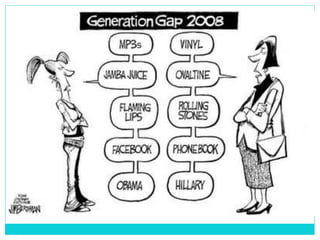
Different Generations 
Gender 
Ethnicity 
Disability and Special Needs
AGE 
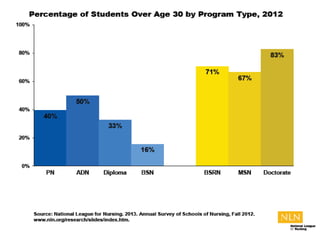
According to the National League 
for Nursing (NLN) in 2012, only 
16% of baccalaureate nursing 
students were over the age of 
30.
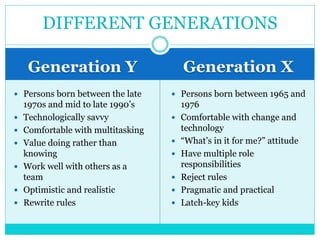
DIFFERENT GENERATIONS 
Generation Y Generation X 
 Persons born between the late 
1970s and mid to late 1990’s 
 Technologically savvy 
 Comfortable with multitasking 
 Value doing rather than 
knowing 
 Work well with others as a 
team 
 Optimistic and realistic 
 Rewrite rules 
 Persons born between 1965 and 
1976 
 Comfortable with change and 
technology 
 “What’s in it for me?” attitude 
 Have multiple role 
responsibilities 
 Reject rules 
 Pragmatic and practical 
 Latch-key kids
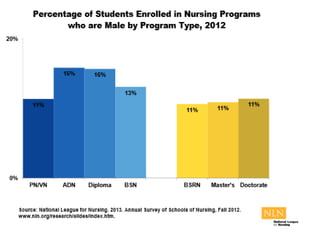
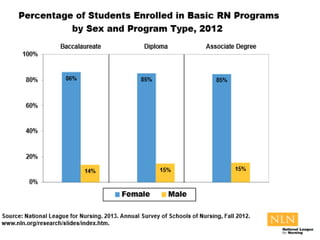
GENDER 
According to the National League 
for Nursing (NLN), only 13-14% 
of baccalaureate nursing 
students were males in 2012.
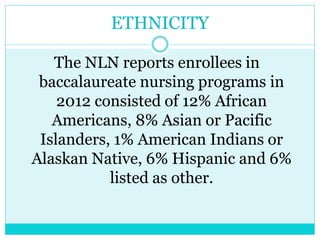
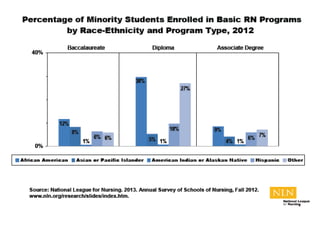
ETHNICITY 
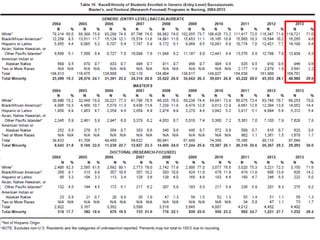
The NLN reports enrollees in 
baccalaureate nursing programs in 
2012 consisted of 12% African 
Americans, 8% Asian or Pacific 
Islanders, 1% American Indians or 
Alaskan Native, 6% Hispanic and 6% 
listed as other.
DISABILITIES & SPECIAL NEEDS 
 Learning Disability 
Physical Disability 
Substance Abuse 
Mental Health Problems
LEARNING DISABILITY 
Generally defined as neurological disorders of the 
brain that affects the way a person learns or 
processes oral or written language and/or 
mathematical concepts and reasoning (Frank, 2012). 
 Dyslexia 
 Attention Deficit Disorders 
 Memory Deficits 
 Difficulty with Reading and Writing
PHYSICAL DISABILITY 
Generally defined as a motor (walking, lifting, standing and 
maintaining stamina) or sensory (hearing, speech, vision 
or respiration) impairments (National Organization of 
Nursing with Disabilities, 2006). 
 Impaired Vision 
 Hearing Loss 
 Speech Impairment 
 Spinal Cord Injury 
 Back Condition 
 Arthritis 
 Hemiplegic 
 Asthma
According to the National 
Organization of Nurses with Disabilities (2006), 
“While the number of nursing students and nurses 
with disabilities is unknown, based on national 
prevalence estimates defining disability according 
to functional limitations (e.g., limitations in 
functional activities including hearing, seeing, 
walking, speaking, lifting and carrying, and 
climbing stairs) 33 million (16%) Americans, aged 
15 and above, experience one or more limitation in 
physical function”.
SUBSTANCE ABUSE 
The 4th edition of the Diagnostic and Statistical Manual of Mental 
Disorders (DSM-IV) definition is as follows: 
 A. A maladaptive pattern of substance use leading to clinically 
significant impairment or distress, as manifested by one (or more) 
of the following, occurring within a 12-month period: 
 Recurrent substance use resulting in a failure to fulfill major role obligations at 
work, school, or home (e.g., repeated absences or poor work performance related 
to substance use; substance-related absences, suspensions or expulsions from 
school; neglect of children or household) 
 Recurrent substance use in situations in which it is physically hazardous (e.g., 
driving an automobile or operating a machine when impaired by substance use) 
 Recurrent substance-related legal problems (e.g., arrests for substance-related 
disorderly conduct 
 Continued substance use despite having persistent or recurrent social or 
interpersonal problems caused or exacerbated by the effects of the substance 
(e.g., arguments with spouse about consequences of intoxication, physical fights) 
 B. The symptoms have never met the criteria for Substance 
Dependence for this class of substance.
According to the American Association of Colleges of 
Nursing (2014), “Substance abuse and its sequelae, 
addictive illness, can lead to serious physical, 
psychological, and social problems ranging from loss 
of employment to death. High school and college 
students are in the segment of the population most 
at risk: of the 13.9 million illicit drug users in the 
United States, the highest rate of use is for those 
between the ages of 16-20, the same age group that 
includes the highest rate of heavy drinkers”
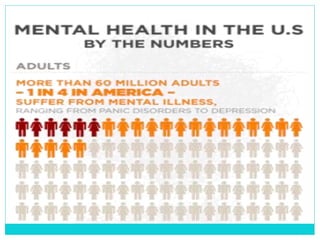
MENTAL HEALTH ISSUES 
Depression 
 Anxiety 
 Bipolar 
 Schizophrenia 
 Addiction 
 Eating Disorder 
Obsessive Compulsive Disorder
LEARNING THEORIES 
“A learning theory is defined as a 
coherent framework of integrated 
constructs and principles that describe, 
explain or predict how people learn” 
(Keating, 2015, p. 65).
LEARNING THEORIES 
Used alone or in combinations 
Used by educators to facilitate the best 
educational outcomes 
Typically emphasizes the learner and 
not the teacher
LEARING THEORIES 
 Behavioral Learning Theory 
 Social Cognitive Theory/Social Learning 
Theory 
 Cognitive Learning Theory 
 Constructivist Learning Theory 
 Adult Learning Theory 
 Humanistic Learning Theory
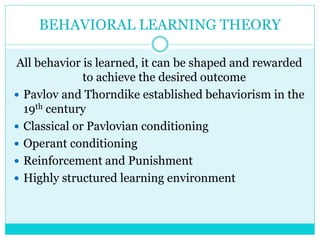
BEHAVIORAL LEARNING THEORY 
All behavior is learned, it can be shaped and rewarded 
to achieve the desired outcome 
 Pavlov and Thorndike established behaviorism in the 
19th century 
 Classical or Pavlovian conditioning 
 Operant conditioning 
 Reinforcement and Punishment 
 Highly structured learning environment
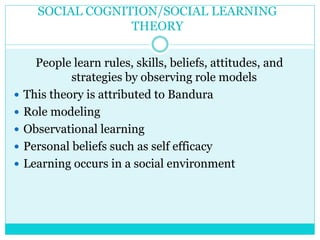
SOCIAL COGNITION/SOCIAL LEARNING 
THEORY 
People learn rules, skills, beliefs, attitudes, and 
strategies by observing role models 
 This theory is attributed to Bandura 
 Role modeling 
 Observational learning 
 Personal beliefs such as self efficacy 
 Learning occurs in a social environment
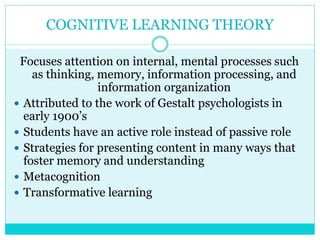
COGNITIVE LEARNING THEORY 
Focuses attention on internal, mental processes such 
as thinking, memory, information processing, and 
information organization 
 Attributed to the work of Gestalt psychologists in 
early 1900’s 
 Students have an active role instead of passive role 
 Strategies for presenting content in many ways that 
foster memory and understanding 
 Metacognition 
 Transformative learning
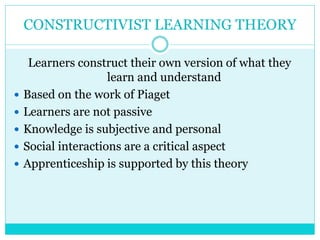
CONSTRUCTIVIST LEARNING THEORY 
Learners construct their own version of what they 
learn and understand 
 Based on the work of Piaget 
 Learners are not passive 
 Knowledge is subjective and personal 
 Social interactions are a critical aspect 
 Apprenticeship is supported by this theory
ADULT LEARNING THEORY 
Adult learners bring vast knowledge and experiences 
with a focus on real-world, relevant, practical issues 
 Adults learn differently than children 
 Problem centered and not content centered 
 Faculty and learners work together 
 Self directed 
 Flexibility to focus on self goals
HUMANISTIC LEARNING THEORY 
Focuses on the development of the individual, with 
self-actualization as the highest attainable level 
 Based on Maslow’s work 
 Carl Rogers contributed to the theory too 
 Emphasizes personal freedom, choice, self-determination 
and self-actualization 
 Goals are to facilitate the learner’s positive attitude, 
self-esteem, responsibility and enthusiasm
“In the real world of complex clinical 
sites and busy classrooms, educators 
draw from a variety of learning theories 
for the teaching strategies that are 
appropriate for a particular course, 
learner and content” (Keating, 2015, p. 
65).
REFERENCES 
American Association of Colleges of Nursing (2013). Race/ethnicity of students enrolled in generic 
baccalaureate, master’s, and doctoral programs in nursing, 2004-2013. Retrieved from: 
www.aacn.nche.educ/research-data/EthnicityTbl.pdf 
Billings, D. M. & Halstead, J. A. (2012). Teaching in nursing: A guide for faculty (4th ed.). St. 
Louis, MO: Elsevier. 
Frank, B. (2012). Teaching students with disabilities. In Billings, D. M. & Halstead, J. A. (Ed.). 
Teaching in nursing: A guide for faculty (55-75). St. Louis, MO: Elsevier. 
Keating, S. B. (2014). Curriculum development and evaluation in nursing (3rd ed.). New York, NY: 
Springer. 
Medicine Net (2014). Definition of substance abuse. Retrieved from: 
www.medicinenet.com/script/main/art.asp?articlekey=24405 
National League for Nursing (2013). Annual survey of schools of nursing, fall 2012. Retrieved 
from: www.nln.org/research/slides/index.htm 
National Organization of Nurses with Disabilities (2006). NOND internet resource clearinghouse: 
Regional demonstration project. Retrieved from: 
www.nond.org/resources/CCT_Final_Report.pdf 
Saylor, C. (2014). Learning theories applied to curriculum development. In Keating, S. B. (Ed.). 
Curriculum development and evaluation in nursing (63-83). New York, NY: Springer.

Nurs 710 student characterstics and learning theories

  • 1.
    STUDENT CHARACTERISTICS ANDLEARNING THEORIES B Y MI CHE L L E F L O R E S , C ON N I E HE C KMA N , N O AH S A R R , A N D E I L E EN SMI TH
  • 2.
    PROFILE OF CONTEMPORARYNURSING STUDENTS According to Billings and Halstead (2012), “The profile of nursing students in the new millennium is markedly different from that of the past” (p. 15).
  • 3.
    STUDENT CHARACTERISTICS Age Different Generations Gender Ethnicity Disability and Special Needs
  • 4.
    AGE According tothe National League for Nursing (NLN) in 2012, only 16% of baccalaureate nursing students were over the age of 30.
  • 6.
    DIFFERENT GENERATIONS GenerationY Generation X  Persons born between the late 1970s and mid to late 1990’s  Technologically savvy  Comfortable with multitasking  Value doing rather than knowing  Work well with others as a team  Optimistic and realistic  Rewrite rules  Persons born between 1965 and 1976  Comfortable with change and technology  “What’s in it for me?” attitude  Have multiple role responsibilities  Reject rules  Pragmatic and practical  Latch-key kids
  • 8.
    GENDER According tothe National League for Nursing (NLN), only 13-14% of baccalaureate nursing students were males in 2012.
  • 11.
    ETHNICITY The NLNreports enrollees in baccalaureate nursing programs in 2012 consisted of 12% African Americans, 8% Asian or Pacific Islanders, 1% American Indians or Alaskan Native, 6% Hispanic and 6% listed as other.
  • 14.
    DISABILITIES & SPECIALNEEDS  Learning Disability Physical Disability Substance Abuse Mental Health Problems
  • 15.
    LEARNING DISABILITY Generallydefined as neurological disorders of the brain that affects the way a person learns or processes oral or written language and/or mathematical concepts and reasoning (Frank, 2012).  Dyslexia  Attention Deficit Disorders  Memory Deficits  Difficulty with Reading and Writing
  • 16.
    PHYSICAL DISABILITY Generallydefined as a motor (walking, lifting, standing and maintaining stamina) or sensory (hearing, speech, vision or respiration) impairments (National Organization of Nursing with Disabilities, 2006).  Impaired Vision  Hearing Loss  Speech Impairment  Spinal Cord Injury  Back Condition  Arthritis  Hemiplegic  Asthma
  • 17.
    According to theNational Organization of Nurses with Disabilities (2006), “While the number of nursing students and nurses with disabilities is unknown, based on national prevalence estimates defining disability according to functional limitations (e.g., limitations in functional activities including hearing, seeing, walking, speaking, lifting and carrying, and climbing stairs) 33 million (16%) Americans, aged 15 and above, experience one or more limitation in physical function”.
  • 18.
    SUBSTANCE ABUSE The4th edition of the Diagnostic and Statistical Manual of Mental Disorders (DSM-IV) definition is as follows:  A. A maladaptive pattern of substance use leading to clinically significant impairment or distress, as manifested by one (or more) of the following, occurring within a 12-month period:  Recurrent substance use resulting in a failure to fulfill major role obligations at work, school, or home (e.g., repeated absences or poor work performance related to substance use; substance-related absences, suspensions or expulsions from school; neglect of children or household)  Recurrent substance use in situations in which it is physically hazardous (e.g., driving an automobile or operating a machine when impaired by substance use)  Recurrent substance-related legal problems (e.g., arrests for substance-related disorderly conduct  Continued substance use despite having persistent or recurrent social or interpersonal problems caused or exacerbated by the effects of the substance (e.g., arguments with spouse about consequences of intoxication, physical fights)  B. The symptoms have never met the criteria for Substance Dependence for this class of substance.
  • 19.
    According to theAmerican Association of Colleges of Nursing (2014), “Substance abuse and its sequelae, addictive illness, can lead to serious physical, psychological, and social problems ranging from loss of employment to death. High school and college students are in the segment of the population most at risk: of the 13.9 million illicit drug users in the United States, the highest rate of use is for those between the ages of 16-20, the same age group that includes the highest rate of heavy drinkers”
  • 20.
    MENTAL HEALTH ISSUES Depression  Anxiety  Bipolar  Schizophrenia  Addiction  Eating Disorder Obsessive Compulsive Disorder
  • 22.
    LEARNING THEORIES “Alearning theory is defined as a coherent framework of integrated constructs and principles that describe, explain or predict how people learn” (Keating, 2015, p. 65).
  • 23.
    LEARNING THEORIES Usedalone or in combinations Used by educators to facilitate the best educational outcomes Typically emphasizes the learner and not the teacher
  • 24.
    LEARING THEORIES Behavioral Learning Theory  Social Cognitive Theory/Social Learning Theory  Cognitive Learning Theory  Constructivist Learning Theory  Adult Learning Theory  Humanistic Learning Theory
  • 25.
    BEHAVIORAL LEARNING THEORY All behavior is learned, it can be shaped and rewarded to achieve the desired outcome  Pavlov and Thorndike established behaviorism in the 19th century  Classical or Pavlovian conditioning  Operant conditioning  Reinforcement and Punishment  Highly structured learning environment
  • 26.
    SOCIAL COGNITION/SOCIAL LEARNING THEORY People learn rules, skills, beliefs, attitudes, and strategies by observing role models  This theory is attributed to Bandura  Role modeling  Observational learning  Personal beliefs such as self efficacy  Learning occurs in a social environment
  • 27.
    COGNITIVE LEARNING THEORY Focuses attention on internal, mental processes such as thinking, memory, information processing, and information organization  Attributed to the work of Gestalt psychologists in early 1900’s  Students have an active role instead of passive role  Strategies for presenting content in many ways that foster memory and understanding  Metacognition  Transformative learning
  • 28.
    CONSTRUCTIVIST LEARNING THEORY Learners construct their own version of what they learn and understand  Based on the work of Piaget  Learners are not passive  Knowledge is subjective and personal  Social interactions are a critical aspect  Apprenticeship is supported by this theory
  • 29.
    ADULT LEARNING THEORY Adult learners bring vast knowledge and experiences with a focus on real-world, relevant, practical issues  Adults learn differently than children  Problem centered and not content centered  Faculty and learners work together  Self directed  Flexibility to focus on self goals
  • 30.
    HUMANISTIC LEARNING THEORY Focuses on the development of the individual, with self-actualization as the highest attainable level  Based on Maslow’s work  Carl Rogers contributed to the theory too  Emphasizes personal freedom, choice, self-determination and self-actualization  Goals are to facilitate the learner’s positive attitude, self-esteem, responsibility and enthusiasm
  • 31.
    “In the realworld of complex clinical sites and busy classrooms, educators draw from a variety of learning theories for the teaching strategies that are appropriate for a particular course, learner and content” (Keating, 2015, p. 65).
  • 32.
    REFERENCES American Associationof Colleges of Nursing (2013). Race/ethnicity of students enrolled in generic baccalaureate, master’s, and doctoral programs in nursing, 2004-2013. Retrieved from: www.aacn.nche.educ/research-data/EthnicityTbl.pdf Billings, D. M. & Halstead, J. A. (2012). Teaching in nursing: A guide for faculty (4th ed.). St. Louis, MO: Elsevier. Frank, B. (2012). Teaching students with disabilities. In Billings, D. M. & Halstead, J. A. (Ed.). Teaching in nursing: A guide for faculty (55-75). St. Louis, MO: Elsevier. Keating, S. B. (2014). Curriculum development and evaluation in nursing (3rd ed.). New York, NY: Springer. Medicine Net (2014). Definition of substance abuse. Retrieved from: www.medicinenet.com/script/main/art.asp?articlekey=24405 National League for Nursing (2013). Annual survey of schools of nursing, fall 2012. Retrieved from: www.nln.org/research/slides/index.htm National Organization of Nurses with Disabilities (2006). NOND internet resource clearinghouse: Regional demonstration project. Retrieved from: www.nond.org/resources/CCT_Final_Report.pdf Saylor, C. (2014). Learning theories applied to curriculum development. In Keating, S. B. (Ed.). Curriculum development and evaluation in nursing (63-83). New York, NY: Springer.