Connecting
        Kids with
   Nature
Today’s


                    A Policy
                     Action Plan
Connecting Today’s Kids with Nature
                                A Policy Action Plan
                                        May 2008

             Written by Heather White, Esq., Director of Education Advocacy

              © 2008 by the National Wildlife Federation. All rights reserved.

                                    Larry J. Schweiger
                           President and Chief Executive Officer
                                National Wildlife Federation

                                Acknowledgments
     We especially thank Kevin Coyle, Eliza Russell, Allen Cooper, Patrick Fitzgearld,
        Julie Gustafson and Bethe Almeras for their many valuable contributions.

 Special thanks to Richard Louv, author of Last Child in the Woods, and the founder of the
Children and Nature Network (www.cnnaturenet.org), an excellent resource for research and
strategies on connecting children to nature, and the more than 200 organizations involved in
the “No Child Left Inside ” coalition, www.nclicoalition.org, that have been advocating for
                           ™


     federal funding for environmental education and promoting environmental literacy.

               Cover and back cover images by NWF/Charlie Archambault.

                   Graphic design by Sarah Ornstein, DesignS By Sarah
                                designsbysarah@cox.net

                         NATIONAL WILDLIFE FEDERATION
                             11100 Wildlife Center Drive
                                 Reston, VA 20190
                                   703-438-6000
                                   www.nwf.org
Message from the President
                                                                                                                                                  i
                                       Looking out of my home-office window, I can see down a long forested valley
                                       across North Park to a far-away place appropriately called “wildwood” where nine
                                       decades ago, Rachel Carson and her mother Maria roamed the Pine Creek
                                       bottoms, explored rock outcrops and woodlands, listened to birds, and discovered
                                       spring wildflowers and insects. Those hours in the fields of western Pennsylvania
                                       profoundly influenced one of the 20th century’s greatest women by fostering a rich
                                       sense of wonder and profound love of nature.

                                       Perhaps reflecting on her wildwood walks with her mother, Rachel wrote later in
                                       life, “If a child is to keep alive his inborn sense of wonder he needs the
                                       companionship of at least one adult who can share it, rediscovering with him the
                                       joy, excitement and mystery of the world we live in.”
©Schweiger


         NWF President & CEO
         Larry Schweiger holding his Rachel would be deeply saddened by what has happened to the traditional
         grandson, Thadeus.
                                     connection between Americans and the outdoors, something that is markedly
                     different from anything in our past. The evidence is everywhere. The average child today spends
                     more than six hours a day watching TV, playing video games, or operating a computer. Meanwhile,
                     the amount of time U.S. children now spend outdoors has declined by 50% in the past 20 years.

                     An important connection between being outdoors and caring for nature is being broken, and it
                     greatly concerns me. Children who fish, camp and spend time in the wild before age 11 are much
                     more likely to grow up to be environmentally committed as adults, according to Cornell University
                     researchers. It was for me.

                     As a child, I spent many hours outdoors with my father, who was a dog trainer and hunter. He died
                     more than 30 years ago, yet when I go to the woods and smell a familiar plant or hear a distant crow
                     on a crisp fall day, my memories of being with Dad come flooding back in rich detail, as if it were
                     yesterday. In those moments I can hear his voice clearly and I can see his ruddy face in the golden
                     light of an early morning sun. I cherish those memories.

                     Although many environmental advocates speak of
                     early experiences in nature that formed their
                     connection, people of all professions often talk fondly
                     of childhood experiences outdoors. Most adult
                     Americans had a childhood where they could “go
                     outside and play,” four little words rarely heard today.

                     What will become of wild places if children know little
                     of the mystery, the grace, the interconnectedness of all
                     living things? How will we address global warming
                     and other environmental threats if we do not engage
                     and prepare the next generation for these monumental
                                                                                                                            ©NWF/Charlie Archambault.


                     challenges? We only save what we love and we only
                     love what we know.

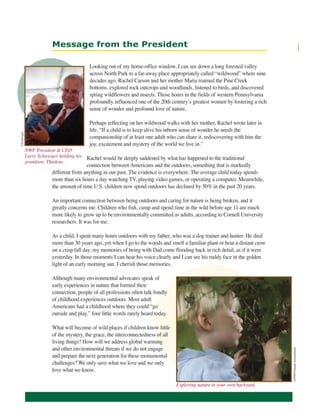
                                                                                Exploring nature in your own backyard.
As one of the largest conservation organizations in the
    country, National Wildlife Federation (NWF) is committed to
i
    helping children “rediscover the joy, the excitement, and the
    mystery” of our world.

    With over 70 years of experience inspiring and fostering a
    connection with nature and wildlife, NWF continues to lead
    the way. Our award-winning Ranger Rick™ magazine has
    sparked curiosity about nature and wildlife in generations of


                                                                                                                  ©Schweiger
    children. Every month it delivers engaging stories, wildlife   NWF has more than 70 years of experience
    images, and ideas for fun outdoor activities. In response to   inspiring and fostering a connection between
                                                                   children and nature.
    increasing demand for age appropriate magazines about
    animals for younger children, NWF also offers Your Big Backyard™ for families with children 3-8
    years old and Wild Animal Baby™ for families with children 12 months to 3 years old.

    With tens of thousands of Certified Wildlife Habitats and Schoolyard Habitats , our wildlife
                                                         ™                           ®


    gardening programs help individuals and families attract birds, butterflies and other local wildlife to
    backyards across the country. A more recent addition to the suite of fun family outdoor activities is
    NWF’s Great American Backyard Campout™, which is connecting families, neighborhoods and
    entire communities through camping, by sharing campfire stories and eating s’mores.

    To encourage parents and caregivers to make time for children to “go outside and play,” NWF
    launched Green Hour, www.nwf.org/kidsoutside, a source of information and inspiration to create
    daily free time outside for children.

    NWF and our partners are also working to engage policymakers on the local, state, and national
    level by:

    • Advocating for increased funding and opportunities for environmental education, a proven
      strategy to enhance a child’s connection to the outdoors, improve academic performance, and
      heighten interest in science and math;
    • Calling upon our public health agencies to promote and educate parents on the importance of
      outdoor play for our children’s well-being; and
    • Increasing opportunities for outdoor recreation by promoting better community design for kid-
      friendly natural play areas and green spaces for children to grow and to connect.

    We can’t do this alone. With your help, we can make sure America’s children carry with them a
    strong connection to nature. These are the memories they will carry with them fondly for a lifetime.
    You may even discover that you helped the next Rachel Carson find her wildwood.


    Larry Schweiger,
    President & CEO of the National Wildlife Federation
ii


           Today’s Reality


                                                                                                                                                      ©ShutterStock
                                                                A Parent’s Perspective
                                                                As I walked through the hallway of my daughter’s elementary school, memories
                                                                of my own school days came flooding back. For years, my day began by securing
                                                                books to my bike rack and riding through the neighborhood to school which was
                                                                only a few blocks away. It is only now that I understand how deep an impact my
                                                                time riding bikes, playing in the woods, and exploring the neighborhood stream
                                                                had on my development as a person.

                                                                As I learn more about the health benefits associated with spending unstructured
      Exploring nature can provide key bonding                  time in the outdoors, I am even more convinced of the importance of adding time
      chances for parent and child. Jaime                       outdoors—a Green Hour®—to our family routine.
      Berman Matyas with her two daughters.

                                                                                                        Outdoor physical activity is good for our lungs,
                                                                                                        growing bones and our hearts – in a multitude
                                                                                                        of ways. For me, playing outside opened my
                                                                                                        heart up to a love of nature, a sense of
                                                                                                        stewardship and responsibility for other living
                                                                                                        creatures. I came to understand the
                                                                                                        interconnectedness of the natural world in a
                                                                                                        very personal way.

                                                                                                        As a parent, it is now my responsibility to
                                                                                                        foster this sense of wonder and stewardship in
                                                                                                        my children. Providing them experiences in the
                                                                                                        outdoors is an important way to pass along
                                                                                                        these values. And I believe that doing so with
                                                                                                        friends and other families is a great way to
                                                                                                        have fun and create meaningful relationships.
©Matyas


          Ins p i r i n g A m e r ic a n s to pro te ct w i l d l i f e f o r o ur children’s future.
C o n n e c t i n g To d a y ’s K i d s w i t h N a t u r e


                     Like most parents, I feel forever challenged by time.
                     Ensuring teeth get brushed twice a day, three meals
iv
                     are eaten and homework completed is a daily
                     challenge. Yet as I think about my commitment as a
                     parent to raising healthy children with self-
                     confidence and strong values, I believe there is
                     much more to being a good parent than managing
                     these daily routines. Over the past few years I’ve
                     made a concerted effort to integrate outdoor
                     activities as part of our family’s daily regimen. Now,
                     our favorite setting for relaxed family time is
                     outdoors, not in front of a television. Whether it’s a
                     Saturday morning hike, planting our garden, or lying
                     in the backyard playing the cloud game, the
                     outdoors has provided an ideal setting for my family
                     to tune out other influences and connect with each
                     other and our environment. There’s always


                                                                                                                                                ©Matyas
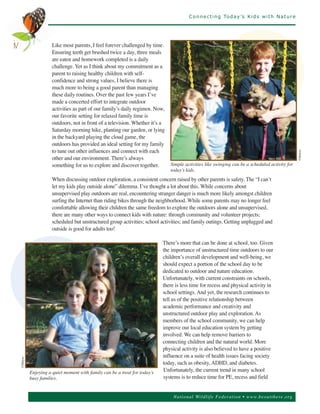
                     something for us to explore and discover together.       Simple activities like swinging can be a scheduled activity for
                                                                              today’s kids.
                     When discussing outdoor exploration, a consistent concern raised by other parents is safety. The “I can’t
                     let my kids play outside alone” dilemma. I’ve thought a lot about this. While concerns about
                     unsupervised play outdoors are real, encountering stranger danger is much more likely amongst children
                     surfing the Internet than riding bikes through the neighborhood. While some parents may no longer feel
                     comfortable allowing their children the same freedom to explore the outdoors alone and unsupervised,
                     there are many other ways to connect kids with nature: through community and volunteer projects;
                     scheduled but unstructured group activities; school activities; and family outings. Getting unplugged and
                     outside is good for adults too!

                                                                           There’s more that can be done at school, too. Given
                                                                           the importance of unstructured time outdoors to our
                                                                           children’s overall development and well-being, we
                                                                           should expect a portion of the school day to be
                                                                           dedicated to outdoor and nature education.
                                                                           Unfortunately, with current constraints on schools,
                                                                           there is less time for recess and physical activity in
                                                                           school settings. And yet, the research continues to
                                                                           tell us of the positive relationship between
                                                                           academic performance and creativity and
                                                                           unstructured outdoor play and exploration. As
                                                                           members of the school community, we can help
                                                                           improve our local education system by getting
                                                                           involved. We can help remove barriers to
                                                                           connecting children and the natural world. More
                                                                           physical activity is also believed to have a positive
                                                                           influence on a suite of health issues facing society
                                                                           today, such as obesity, ADHD, and diabetes.
©Matyas


          Enjoying a quiet moment with family can be a treat for today’s   Unfortunately, the current trend in many school
          busy families.                                                   systems is to reduce time for PE, recess and field


                                                                                Nationa l Wild life Fed er a tion • www.be outthere.o rg
A Policy Action Plan


           trips. As parents, we have the
           power to make a positive
                                                                                                                                                    v
           difference in our children’s
           education. We can get involved at
           a local level by volunteering to
           help create a schoolyard habitat,
           hosting outdoor school events, or
           speaking out for the importance of
           funding hands-on environmental
           education. We can also make a
           meaningful difference at the state
           and national levels by advocating
           for improvements to current
           education policy and funding to
           support more time outdoors and
           more environmental education.
           Both will better prepare our


                                                                                                                                              ©Matyas
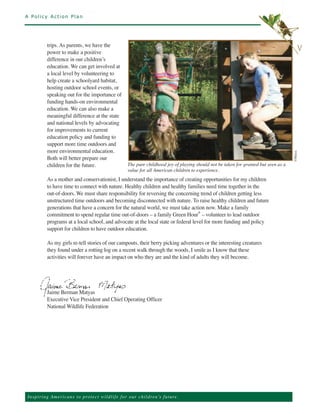
           children for the future.                         The pure childhood joy of playing should not be taken for granted but seen as a
                                                            value for all American children to experience.
           As a mother and conservationist, I understand the importance of creating opportunities for my children
           to have time to connect with nature. Healthy children and healthy families need time together in the
           out-of-doors. We must share responsibility for reversing the concerning trend of children getting less
           unstructured time outdoors and becoming disconnected with nature. To raise healthy children and future
           generations that have a concern for the natural world, we must take action now. Make a family
           commitment to spend regular time out-of-doors – a family Green Hour® – volunteer to lead outdoor
           programs at a local school, and advocate at the local state or federal level for more funding and policy
           support for children to have outdoor education.

           As my girls re-tell stories of our campouts, their berry picking adventures or the interesting creatures
           they found under a rotting log on a recent walk through the woods, I smile as I know that these
           activities will forever have an impact on who they are and the kind of adults they will become.


           Jaime Berman Matyas
           Executive Vice President and Chief Operating Officer
           National Wildlife Federation


Ins p i r i n g A m e r ic a n s to pro te ct w i l d l i f e f o r o ur children’s future.
Connecting Today’s Kids with Nature
                                                                  A Policy Action Plan


                            Table of Contents

                            Message from the President ..........................................................................................i

                            Today’s Reality ..............................................................................................................iii

                            Summary ........................................................................................................................1


                            Understanding Our Children’s Nature Deficit ..........................................................7

                                           Nature Deficit Defined

                                           Why We Keep Our Kids Indoors

                                           What is at Stake?

                            Solutions to Reverse Nature Deficit and Connect Our Children to Nature ........15

                                           Connect Kids to Nature through Environmental Education

                                           Promote Outdoor Play through our Public Health Systems

                                           Increase Opportunities for Outdoor Play through Better Design and Access

                                           Encourage Parents to Build in Time for Outdoor Play through a National

                                           Media and Educational Campaign

                            What You Can Do ........................................................................................................20

                                           Take Action in Your Community

                                           Take Action in Your State

                                           Take Action at the National Level

                            Endnotes ........................................................................................................................25
©NWF/Charlie Archambault.
1


  Summary


                                                                                                                                 ©NWF/Charlie Archambault.
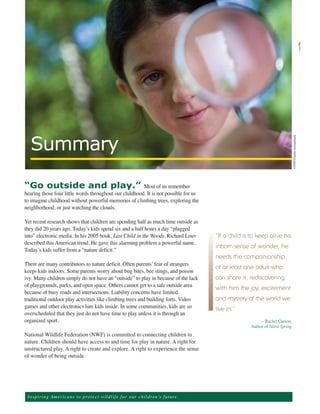
“Go outside and play.”                                  Most of us remember
hearing those four little words throughout our childhood. It is not possible for us
to imagine childhood without powerful memories of climbing trees, exploring the
neighborhood, or just watching the clouds.

Yet recent research shows that children are spending half as much time outside as
they did 20 years ago. Today’s kids spend six and a half hours a day “plugged
into” electronic media. In his 2005 book, Last Child in the Woods, Richard Louv
described this American trend. He gave this alarming problem a powerful name.
                                                                                               “If a child is to keep alive his

Today’s kids suffer from a “nature deficit.”
                                                                                               inborn sense of wonder, he

There are many contributors to nature deficit. Often parents’ fear of strangers
                                                                                               needs the companionship

keeps kids indoors. Some parents worry about bug bites, bee stings, and poison
                                                                                               of at least one adult who
ivy. Many children simply do not have an “outside” to play in because of the lack
of playgrounds, parks, and open space. Others cannot get to a safe outside area
                                                                                               can share it, rediscovering

because of busy roads and intersections. Liability concerns have limited
                                                                                               with him the joy, excitement
traditional outdoor play activities like climbing trees and building forts. Video
games and other electronics lure kids inside. In some communities, kids are so
                                                                                               and mystery of the world we

overscheduled that they just do not have time to play unless it is through an
                                                                                               live in.”
organized sport.                                                                                                 —Rachel Carson,
                                                                                                             Author of Silent Spring
National Wildlife Federation (NWF) is committed to connecting children to
nature. Children should have access to and time for play in nature. A right for
unstructured play. A right to create and explore. A right to experience the sense
of wonder of being outside.


 Ins p i r i n g A m e r ic a n s to pro te ct w i l d l i f e f o r o ur children’s future.
C o n n e c t i n g To d a y ’s K i d s w i t h N a t u r e


2


                                                                                                                                                        ©ShutterStock
    Youth spend an average of six hours daily connected to electronic devices.

    What is at                                    Research has linked childhood obesity                     even reduces the severity of
    Stake?                                        to a lack of play time outdoors.                          symptoms of Attention Deficit/
    The Health of Our Children                    Although physical activity through                        Hyperactivity Disorder (ADHD),
    Nature deficit has had profound               organized sports can help address                         which affects millions of American
    impacts on our children’s mental and          childhood obesity, the medical                            children.
    physical health. Over the past 20             community recognizes that
    years, time spent playing outdoors has        unstructured free time outdoors has                       The Economy
    been cut in half, but the childhood           unique health benefits to children.                       The economic impacts of nature
    obesity rate has more than doubled            Children who play outside are more                        deficit are significant. The costs of the
    and the adolescent obesity rate has           active and more physically fit than                       childhood obesity epidemic to our
    tripled. Doctors warn that, for the first     those who don’t. Time in nature                           public health systems could reach
    time in American history, life                improves a chld’s academic                                $100 billion annually. Hunting and
    expectancy may actually decrease              performance, concentration, balance,                      fishing licenses sales have stagnated,
    because of the health impacts of the          coordination, and self-esteem. Recent                     resulting in severe cuts to state
    current childhood obesity epidemic.           studies indicate that playing outside                     resource agencies’ budgets. A decline
                                                                                                            in outdoor retail sales, a $730 billion a
                                                                                                            year industry sector, may soon follow.

                                                                                                            The Future of American
     Know the       FACTS
                                                                                                            Conservation
                                                                                                            From the redwood forests to the Gulf
     Research Shows:

                                                                                                            Stream waters, exploring the diverse
     E nv i ro n m en ta l E d u c at i on :
     n Good for overall student                   n Standardized test
       performance                                  performance improves
                                                                                                            landscapes of America has shaped
     n Great at motivating students               n Supports and improves other                             who we are as Americans. Children
     n Critical thinking skills                        science learning                                     who spend time in nature are more
       consistently improve                               n Supports language-arts                          likely to have pro-environmental
     n Math skills consistently                        development                                          attitudes as adults. Time spent in
       improve                                                     n Under-resourced                        nature with an adult important to the
     n Life science skills                                         students show                            child often shapes a child’s long-term
       consistently                                                 increased improvement
                                                                                                            environmental ethic. If this nature
                                                                                                            deficit continues unabated, we may
       improve                                                       over peers

                                                                                                            face a dearth of environmental
                                                                    Sources: (Bartosh 2004);
                                                                    (Athman & Monroe 2004).
                                                   ©ShutterStock


                                                                                    Nationa l Wild life Feder ation • www.be outthere.o rg
A Policy Action Plan


leaders, professionals, and advocates                  education can connect children to the          educate parents that down time
as we try to conquer future                            natural world. In addition to providing        outside can result in healthier, happier
                                                                                                                                                                  3
environmental challenges such as                       this important connection, there are           kids. We will ask healthcare
global warming. We may also lose a                     many academic benefits to                      professionals to also consider
unique aspect of our national culture                  environmental education, including             recommending outdoor play for
and identity.                                          higher test scores in math, reading,           overstressed kids and for children
                                                       and language arts. Studies show that           diagnosed with ADHD.
                                                       integrated environmental education
                                                       programs also increase children’s              Increase Opportunities for
   ”We talk a lot about our

                                                       critical thinking skills, self-                Outdoor Recreation through
   children’s future, but not

                                                       confidence, and academic motivation.           Better Design and Access
                                                       Environmental education can also               The use of natural landscapes in
   that much about children.

                                                       serve as an educational equalizer              playground design leads to more active
   It’s time for big conservation

                                                       across race, ethnicity, and                    and more creative play. In many
                                                       socioeconomic levels.                          communities, children do not have
   organizations to actively

                                                                                                      access to safe outdoor play areas.
   engage children and work

                                                       Promote Outdoor Play                           Connecting city parks through
                                                       through our Public Health
   to protect them, to
                                                                                                      greenways and other green spaces can
                                                       Systems                                        provide natural areas for children to
   energize them, and to

                                                       NWF will encourage federal and state           play and increase wildlife habitat.
   cultivate their creativity in
                                                       public health leaders to educate               NWF will target cities in our nation’s
                                                       parents and caregivers about the               migratory bird flyways to establish
   protecting our world.”
                            —Richard Louv,
            Author of Last Child in the Woods
                                                       importance of play in tackling                 these green links that also serve as
                                                       childhood obesity and improving                wildlife corridors. By working with
                                                       children’s mental health. The medical          designers, city planners, and local
Solutions to                                           community recognizes that outdoor              elected officials, NWF will work to
Reversing                                              play time is critical to children’s            increase wildlife habitat and ensure
Nature Deficit                                         physical, mental, emotional, and               that children have access to green, kid-
and Connecting                                         social well-being. Well-child visits           friendly areas in their communities for
Children to                                            reflect an important opportunity to            unstructured play outside.
Nature
Reversing nature deficit and
connecting children to nature will take
concerted policy action on the local,
state, and federal levels. Since its
inception in 1936, National Wildlife
Federation (NWF) has worked to
develop public policies that protect the
environment and increase outdoor
recreation opportunities for children.
As part of our campaign to connect
children to nature, we will:

Connect Kids to Nature
                                                                                                                                            ©NWF/Charlie Archambault.


through Environmental
Education
NWF will advocate for better funding
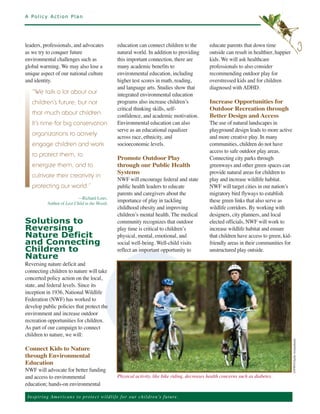
and access to environmental                            Physical activity, like bike riding, decreases health concerns such as diabetes.
education; hands-on environmental

 Ins p i r i n g A m e r ic a n s to pro te ct w i l d l i f e f o r o ur children’s future.
C o n n e c t i n g To d a y ’s K i d s w i t h N a t u r e


        Encourage Parents to
      Build in Regular Time for
4
    Outdoor Play through
    GreenHour®, a National
    Educational Campaign
    Parents and policymakers can make a
    difference to get children to
    experience all the benefits of free time
    in nature. NWF’s national media and
    educational campaign, GreenHour®,
    helps parents with simple suggestions


                                                                                                                                         ©NWF/Charlie Archambault.
    on how to play outside. To give
    parents and caregivers the
    information, tools, and inspiration to
    get their kids outside, NWF has
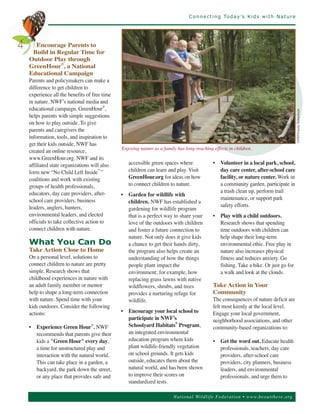
                                               Enjoying nature as a family has long-reaching effects in children.
    created an online resource,
    www.GreenHour.org. NWF and its
    affiliated state organizations will also      accessible green spaces where               • Volunteer in a local park, school,
    form new “No Child Left Inside™”              children can learn and play. Visit            day care center, after-school care
    coalitions and work with existing             GreenHour.org for ideas on how                facility, or nature center. Work in
    groups of health professionals,               to connect children to nature.                a community garden, participate in
    educators, day care providers, after-                                                       a trash clean up, perform trail
                                               • Garden for wildlife with
    school care providers, business                                                             maintenance, or support park
                                                 children. NWF has established a
    leaders, anglers, hunters,                                                                  safety efforts.
                                                 gardening for wildlife program
    environmental leaders, and elected           that is a perfect way to share your          • Play with a child outdoors.
    officials to take collective action to       love of the outdoors with children             Research shows that spending
    connect children with nature.                and foster a future connection to              time outdoors with children can
                                                 nature. Not only does it give kids             help shape their long-term
    What You Can Do                              a chance to get their hands dirty,             environmental ethic. Free play in
    Take Action Close to Home                    the program also helps create an               nature also increases physical
    On a personal level, solutions to            understanding of how the things                fitness and reduces anxiety. Go
    connect children to nature are pretty        people plant impact the                        fishing. Take a hike. Or just go for
    simple. Research shows that                  environment; for example, how                  a walk and look at the clouds.
    childhood experiences in nature with         replacing grass lawns with native
    an adult family member or mentor             wildflowers, shrubs, and trees               Take Action in Your
    help to shape a long-term connection         provides a nurturing refuge for              Community
    with nature. Spend time with your            wildlife.                                    The consequences of nature deficit are
    kids outdoors. Consider the following                                                     felt most keenly at the local level.
    actions:                                   • Encourage your local school to               Engage your local government,
                                                 participate in NWF’s                         neighborhood associations, and other
    • Experience Green Hour . NWF                Schoolyard Habitats Program,                 community-based organizations to:
                                                                        ®
                                ®


      recommends that parents give their         an integrated environmental
      kids a "Green Hour" every day,             education program where kids                 • Get the word out. Educate health
      a time for unstructured play and           plant wildlife-friendly vegetation             professionals, teachers, day care
      interaction with the natural world.        on school grounds. It gets kids                providers, after-school care
      This can take place in a garden, a         outside, educates them about the               providers, city planners, business
      backyard, the park down the street,        natural world, and has been shown              leaders, and environmental
      or any place that provides safe and        to improve their scores on                     professionals, and urge them to
                                                 standardized tests.

                                                                         Nationa l Wild life Fed er a tion • www.be outthere.o rg
A Policy Action Plan


    incorporate nature deficit solutions                   opportunities for field trips to local               • Require public health and
    into their everyday practices.                         nature centers, supply tools for an                    social service agencies to             5
                                                           after-school facility garden project,                  educate parents about the benefits
• Work with local planning
                                                           or give materials for a community-                     of outdoor play to children’s health
  commissions and homeowners’
                                                           based environmental education                          to fight obesity and make kids’
  associations to create zoning
                                                           program.                                               lives better.
  policies and incentives to
  encourage more kid-friendly green                                                                             • Encourage day care and
  spaces for creative play and                         Take Action in Your State                                  pre-kindergarten certification
  designate special areas where                        State governments are responsible for                      programs to include education on
  children can participate in                          the majority of public policies that can                   the benefits of time outside for
  traditional outdoor activities such                  make our children’s lives healthy,                         children.
  as climbing trees and fort-building,                 happy, and more active. State
                                                                                                                • Provide more funding for
  which have been limited because                      governments should consider
                                                                                                                  existing state programs that
  of liability concerns.                               integrated policy reforms that include
                                                                                                                  promote recess, access to parks,
                                                       connecting children to nature
• Support opportunities and                                                                                       camp experiences, and other ways
                                                       throughout the state health, social
  funding for local environmental                                                                                 to get kids outdoors.
                                                       service, natural resources, and
  education, including asking local
                                                       education systems. There are a number                    • Declare a Children’s Outdoor
  school board members to provide
                                                       of meaningful actions your governor                        Bill of Rights to ensure children
  information on current
                                                       and state legislature should take:                         have the right to experience all the
  environmental education efforts,
                                                                                                                  benefits of unstructured free time
  plans to update programs, and                        • Host a “No Child Left Inside™”                           in nature.
  ways to increase funding for                           forum to discuss ways to connect
  programs that help teachers link                       children to nature with health care
  students to the outdoors.                              professionals, business leaders,
• Team up with local law                                 nonprofit organizations, educators,
  enforcement to ensure that parents                     after-school providers, urban
  are adequately informed about the                      planners, hunters and anglers,
                                                                                                                 Know the           FACTS
  safety of public parks and play                        conservation groups, and state and
                                                         local officials to create access to
                                                                                                                 Summer Vacation:
  areas and to increase opportunities
  for kids to play safely outside.                       safe outdoor play areas and
                                                                                                                         A Ne w E x p e ri en c e

                                                         educate parents on the benefits of
                                                                                                                           fo r a n In d oo r
• Create a local “No Child Left                          unstructured free play.
                                                                                                                              G e n er at i on
  Inside™” Day or participate in
  other community awareness                            • Institute mandatory state
                                                                                                                                Research shows

                                                         standards for minimum exercise
                                                                                                                             that school children
  events, such as NWF’s Great
                                                         in school that focus on outdoor
                                                                                                                          are actually gaining
  American Backyard Campout ,
                               ™
                                                                                                                      weight during summer
  NWF’s Wildlife Watch Day,                              activities for children.
                                                                                                ©ShutterStock


                                                                                                                   vacation now. Communities
  National Get Outdoors Day, and                       • Pass state environmental
                                                                                                                should respond by:
  International Migratory Bird Day .                     education legislation to promote
                                  ®
                                                                                                                 n Connecting kids to water

• Reach out to after-school                              place-based and outdoor
                                                                                                                   safety classes and increase

                                                         environmental education and
                                                                                                                   opportunities for swim
  programs to see how you can help                                                                                 lessons.
  them create opportunities for more                     increase funding for updating
                                                         environmental education
                                                                                                                 n Sponsoring more day camps
  free play time outside for kids.                                                                                 at local parks.
  Research shows that the vast                           programs.
                                                                                                                 n Working with local libraries to
  majority of children are enrolled in                                                                             encourage kids to read about
  some kind of after-school                                                                                        the outdoors, then go outside.
  program. Provide incentives and                                                                               Source: (Von Hippel 2007).


 Ins p i r i n g A m e r ic a n s to pro te ct w i l d l i f e f o r o ur children’s future.
C o n n e c t i n g To d a y ’s K i d s w i t h N a t u r e


    Take Action at the
    National Level
6
    The federal government has an
    important role in creating
    opportunities for children to play
    outdoors. Several federal policy
    actions can make a difference in
    connecting children with nature, and
    your federal officials should work to:

    • Pass proposed federal


                                                                                                                                                           ©NWF/Charlie Archambault.
      legislation, such as the “No
      Child Left Inside™” amendment
      to the “No Child Left Behind” Act,
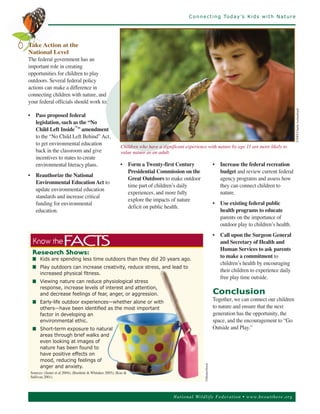
      to get environmental education                             Children who have a significant experience with nature by age 11 are more likely to
      back in the classroom and give                             value nature as an adult.
      incentives to states to create
      environmental literacy plans.                             • Form a Twenty-first Century                           • Increase the federal recreation
                                                                  Presidential Commission on the                          budget and review current federal
    • Reauthorize the National
                                                                  Great Outdoors to make outdoor                          agency programs and assess how
      Environmental Education Act to
                                                                  time part of children’s daily                           they can connect children to
      update environmental education
                                                                  experiences, and more fully                             nature.
      standards and increase critical
                                                                  explore the impacts of nature
      funding for environmental                                                                                         • Use existing federal public
                                                                  deficit on public health.
      education.                                                                                                          health programs to educate
                                                                                                                          parents on the importance of
                                                                                                                          outdoor play to children’s health.
                                                                                                                        • Call upon the Surgeon General
                          FACTS                                                                                           and Secretary of Health and
                                                                                                                          Human Services to ask parents
      Know the
                                                                                                                          to make a commitment to
      Research Shows:
                                                                                                                          children’s health by encouraging
      n Kids are spending less time outdoors than they did 20 years ago.

                                                                                                                          their children to experience daily
      n Play outdoors can increase creativity, reduce stress, and lead to

                                                                                                                          free play time outside.
        increased physical fitness.
      n Viewing nature can reduce physiological stress

                                                                                                                        Conclusion
        response, increase levels of interest and attention,
        and decrease feelings of fear, anger, or aggression.
                                                                                                                        Together, we can connect our children
                                                                                                                        to nature and ensure that the next
      n Early-life outdoor experiences—whether alone or with
        others—have been identified as the most important
        factor in developing an                                                                                         generation has the opportunity, the
        environmental ethic.                                                                                            space, and the encouragement to “Go
      n Short-term exposure to natural                                                                                  Outside and Play.”
        areas through brief walks and
        even looking at images of
        nature has been found to
        have positive effects on
        mood, reducing feelings of
        anger and anxiety.
                                                                                                        ©ShutterStock


     Sources: (Juster et al 2004); (Burdette & Whitaker 2005); (Kuo &
     Sullivan 2001).


                                                                                           Nationa l Wild life Fed er a tion • www.be outthere.o rg
7


     Understanding
     our Children’s
     Nature Deficit


                                                                                                                                         ©Shutterstock.
                                                      Nature Deficit Defined
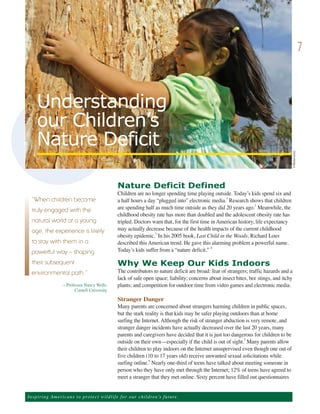
                                                      Children are no longer spending time playing outside. Today’s kids spend six and
                                                      a half hours a day “plugged into” electronic media.1 Research shows that children
                                                      are spending half as much time outside as they did 20 years ago.2 Meanwhile, the
  “When children become

                                                      childhood obesity rate has more than doubled and the adolescent obesity rate has
  truly engaged with the
                                                      tripled. Doctors warn that, for the first time in American history, life expectancy
                                                      may actually decrease because of the health impacts of the current childhood
  natural world at a young

                                                      obesity epidemic.3 In his 2005 book, Last Child in the Woods, Richard Louv
  age, the experience is likely
                                                      described this American trend. He gave this alarming problem a powerful name.
                                                      Today’s kids suffer from a “nature deficit.” 4
  to stay with them in a
  powerful way – shaping
                                                      Why We Keep Our Kids Indoors
                                                      The contributors to nature deficit are broad: fear of strangers; traffic hazards and a
  their subsequent

                                                      lack of safe open space; liability; concerns about insect bites, bee stings, and itchy
  environmental path.”
                    —Professor Nancy Wells,           plants; and competition for outdoor time from video games and electronic media.
                         Cornell University
                                                      Stranger Danger
                                                      Many parents are concerned about strangers harming children in public spaces,
                                                      but the stark reality is that kids may be safer playing outdoors than at home
                                                      surfing the Internet. Although the risk of stranger abduction is very remote, and
                                                      stranger danger incidents have actually decreased over the last 20 years, many
                                                      parents and caregivers have decided that it is just too dangerous for children to be
                                                      outside on their own—especially if the child is out of sight. Many parents allow
                                                                                                                    5


                                                      their children to play indoors on the Internet unsupervised even though one out of
                                                      five children (10 to 17 years old) receive unwanted sexual solicitations while
                                                      surfing online. Nearly one-third of teens have talked about meeting someone in
                                                                      6


                                                      person who they have only met through the Internet; 12% of teens have agreed to
                                                      meet a stranger that they met online. Sixty percent have filled out questionnaires


Ins p i r i n g A m e r ic a n s to pro te ct w i l d l i f e f o r o ur children’s future.
C o n n e c t i n g To d a y ’s K i d s w i t h N a t u r e


           and given their personal
       information, such as address,
8
     telephone number, and school name.
     Children who use the Internet are also
     more likely to be exposed to
     inappropriately sexual or violent
     content. “Nine out of 10 children
     between eight and 15 have viewed
     inappropriate content on the Internet,
     often unintentionally while doing
     homework or filesharing with friends.” 7

     Traffic & Lack of
     Open Space
     Children have fewer outdoor places to
     play in general, and in existing green
     areas, few kids can bike or walk to
     their play areas without facing


                                                                                                                                                            ©ShutterStock
     dangerous traffic hazards. Safe, natural
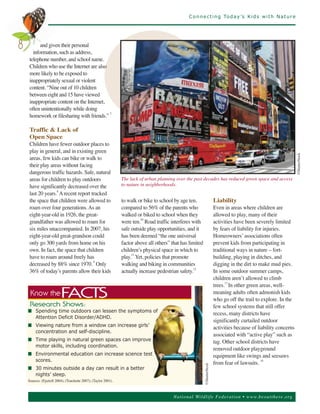
     areas for children to play outdoors                         The lack of urban planning over the past decades has reduced green space and access
     have significantly decreased over the                       to nature in neighborhoods.
     last 20 years.8 A recent report tracked
     the space that children were allowed to                     to walk or bike to school by age ten,                 Liability
     roam over four generations. As an                           compared to 56% of the parents who                    Even in areas where children are
     eight-year-old in 1926, the great-                          walked or biked to school when they                   allowed to play, many of their
     grandfather was allowed to roam for                         were ten.10 Road traffic interferes with              activities have been severely limited
     six miles unaccompanied. In 2007, his                       safe outside play opportunities, and it               by fears of liability for injuries.
     eight-year-old great-grandson could                         has been deemed “the one universal                    Homeowners’ associations often
     only go 300 yards from home on his                          factor above all others” that has limited             prevent kids from participating in
     own. In fact, the space that children                       children’s physical space in which to                 traditional ways in nature – fort-
     have to roam around freely has                              play.11 Yet, policies that promote                    building, playing in ditches, and
     decreased by 88% since 1970. 9 Only                         walking and biking in communities                     digging in the dirt to make mud pies.
     36% of today’s parents allow their kids                     actually increase pedestrian safety.12                In some outdoor summer camps,
                                                                                                                       children aren’t allowed to climb
                                                                                                                       trees.13 In other green areas, well-
                                                                                                                       meaning adults often admonish kids
                                                                                                                       who go off the trail to explore. In the
     Know the             FACTS
                                                                                                                       few school systems that still offer
                                                                                                                       recess, many districts have
     R es e ar c h S ho ws :
    n Spending time outdoors can lessen the symptoms of
                                                                                                                       significantly curtailed outdoor
      Attention Deficit Disorder/ADHD.
    n Viewing nature from a window can increase girls’                                                                 activities because of liability concerns
                                                                                                                       associated with “active play” such as
      concentration and self-discipline.
    n Time playing in natural green spaces can improve                                                                 tag. Other school districts have
                                                                                                                       removed outdoor playground
      motor skills, including coordination.
    n Environmental education can increase science test                                                                equipment like swings and seesaws
      scores.
                                                                                                                       from fear of lawsuits. 14
    n 30 minutes outside a day can result in a better
                                                                                                       ©ShutterStock


      nights’ sleep.
    Sources: (Fjortoft 2004); (Touchette 2007); (Taylor 2001).


                                                                                           Nationa l Wild life Fed er a tion • www.be outthere.o rg
A Policy Action Plan


                                                             For example, pre-schoolers who
                                                             watch violent television tend to be
                                                                                                           “I like to play indoors better
                                                                                                                                                      9
                                                             more antisocial and aggressive during
                                                                                                           ‘cause that’s where all the
                                                             school years.20                               electric outlets are.”

                                                             Bugs, Bites, Stings,
                                                                                                                    – A Fourth Grader in San Diego.

                                                             and Itchy Plants                           can excel at academics, athletics or
                                                             Many parents are concerned about           specialties.” The media, the
                                                                                                                     26


                                                             bugs, bee stings, poison ivy, and other    marketing of children’s toys and so-
                                                             hazards.21 These concerns are very         called educational products, and the
                                                             manageable. Long sleeved shirts and        increasingly rigorous college
                                                             insect repellent can protect from bugs     admission process contribute to this
                                                             and mosquito-borne illnesses. Poison       hyper-parenting phenomenon.27 As a
                                                             oak and poison sumac are readily           result, today’s children are feeling
                                                             recognizable, and the right clothing       more stress, more anxiety, and more
                                                             can help limit exposure to these itchy     pressure to be perfect. From piano
                                                             plants.                                    lessons to soccer practice, many of
                                                                                                        today’s kids shuttle back and forth
                                                             The Overscheduled Child                    from activity to activity and have very
                                             ©ShutterStock


                                                             The good news is that today’s              few chances for outdoor play.
Children’s time outside has decreased                        generation of parents is often more
by 50% over the last 20 years.
                                                             focused and more family-oriented           What is at Stake?
                                                             than that of the baby boomer               The Health of Our
Video Games and                                              generation.22 These parents are making     Children
Electronic Media                                             conscious decisions to spend more          Children are not spending time
As kids spend more time “plugged in”                         time with their family. The bad news       outdoors, which results in severe
to electronic media, outdoor time has                        is that in the quest to be perfect         impacts on their mental and physical
decreased by 50% and childhood                               parents, today’s parents may be            health. The medical community has
obesity has skyrocketed. According to                        unaware of the importance of play.         declared that “play (or some available
the Kaiser Family Foundation, today’s                                                                   free time in the case of older children
children spend an average of six and a                       Many children’s lives are way over-        and adolescents) is essential to the
half hours a day using media –                               scheduled, and, like adults, they are      cognitive, physical, social, and
including TV, computers, DVD                                 involved in too many activities.23 The     emotional well-being of children and
players, and mp3 players. Over a                             medical community observed in a            youth.”28 Because of the important
seven-day week, kids log in around 44                        2007 study that kids are often “being      health benefits of play, the American
hours of media use – close to a full-                        raised in an increasingly hurried and      Academy of Pediatrics has
time job worth of input. Eight- to 10-                       pressured style that may limit the         recommended that children spend 60
                          15


year-olds watch an average of more                           protective benefits they would gain        minutes each day in unstructured play
than four hours of TV a day. The                             from child-driven play.” The               time.29 The CDC recommends that
                             16                                                         24


University of Michigan has found a                           American Academy of Pediatrics             children and adolescents participate in
50% decrease in outdoor time over the                        warns that overscheduling of children      at least 60 minutes of moderate
last 20 years. The more television a                         is becoming the “culture and even          intensity physical activity most days
              17


child watches, the less time the child                       expectation of parents.” Dr. Alvin         of the week.30
                                                                                       25


spends outside playing. Research                             Rosenfeld has termed this cultural
                         18


shows that playing video games and                           phenomenon “hyper-parenting,”              Yet, for many American children, the
watching TV has negative impacts on                          which “compels parents to become           experience of playing outdoors is at
physical health, and violent media                           relentlessly self-sacrificing, enrolling   risk of going extinct.31 Today’s kids
content negatively impacts children.                         children in activities so early so they    spend six and a half hours a day
                                      19


Ins p i r i n g A m e r ic a n s to pro te ct w i l d l i f e f o r o ur children’s future.
C o n n e c t i n g To d a y ’s K i d s w i t h N a t u r e


           “plugged in” to some form of                      outdoors does not emphasize winning
       electronic media, and children have                   or losing.36 Some doctors also fear
10
     decreased their time outdoors by 50%                    that families experience additional
     since 1981.32 Children ages three to 12                 stress levels when their ultra-
     spend one percent of their time                         competitive children’s sports
     outdoors, but they spend 27 percent of                  schedules require travel to away
     their time just watching TV.33                          games.37 Furthermore, doctors warn
     Incredibly, children are now actually                   that parents should not simply rely on
     gaining weight over summer break, a                     organized sports to ensure kids get
     time most often associated with                         enough physical activity. Instead, the
     outdoor activities like swimming,                       medical community urges parents to
     hiking, and simply playing outside.34                   exercise with their children in the
     This lack of unstructured free time                     outdoors to promote an active, healthy
     outdoors has serious consequences for                   lifestyle.38
     children’s health.
                                                             The Physical Health
     Outdoor Play is Different                               Impacts: Outdoor
     than Participating in                                   “Play” Instead of
     Organized Sports                                        Exercise


                                                                                                                                                    ©ShutterStock
     Although participation in organized                     Given the positive associations
     sports is beneficial to children for a                  connected to outdoor play and
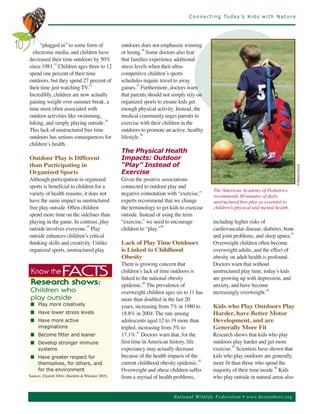
                                                                                                          The American Academy of Pediatrics
     variety of health reasons, it does not                  negative connotation with “exercise,”        recommends 60 minutes of daily
     have the same impact as unstructured                    experts recommend that we change             unstructured free play as essential to
     free play outside. Often children                       the terminology to get kids to exercise      children’s physical and mental health.
     spend more time on the sidelines than                   outside. Instead of using the term
     playing in the game. In contrast, play                  “exercise,” we need to encourage             including higher risks of
     outside involves everyone.35 Play                       children to “play.”39                        cardiovascular disease, diabetes, bone
     outside enhances children’s critical                                                                 and joint problems, and sleep apnea.
                                                                                                                                               43


     thinking skills and creativity. Unlike                  Lack of Play Time Outdoors                   Overweight children often become
     organized sports, unstructured play                     is Linked to Childhood                       overweight adults, and the effect of
                                                             Obesity                                      obesity on adult health is profound.
                                                             There is growing concern that                Doctors warn that without
                                                             children’s lack of time outdoors is          unstructured play time, today’s kids
                                                             linked to the national obesity               are growing up with depression, and
      Know the            FACTS
                                                             epidemic. The prevalence of                  anxiety, and have become
      Research shows:                                                    40


                                                             overweight children ages six to 11 has       increasingly overweight.44
                                                             more than doubled in the last 20
      C h ild r en wh o

                                                             years, increasing from 7% in 1980 to         Kids who Play Outdoors Play
      p la y o ut s id e
      n Play more creatively
      n Have lower stress levels                             18.8% in 2004. The rate among                Harder, have Better Motor
      n Have more active                                     adolescents aged 12 to 19 more than          Development, and are
        imaginations                                         tripled, increasing from 5% to               Generally More Fit
                                                             17.1%. Doctors warn that, for the            Research shows that kids who play
                                                                      41
      n Become fitter and leaner
      n Develop stronger immune                              first time in American history, life         outdoors play harder and get more
        systems                                              expectancy may actually decrease             exercise.45 Scientists have shown that
      n Have greater respect for                             because of the health impacts of the         kids who play outdoors are generally
                                                             current childhood obesity epidemic.          more fit than those who spend the
                                                                                                  42
        themselves, for others, and
        for the environment                                  Overweight and obese children suffer         majority of their time inside.46 Kids
     Sources: (Fjortoft 2004); (Burdette & Whitaker 2005).   from a myriad of health problems,            who play outside in natural areas also


                                                                                     Nationa l Wild life Fed er a tion • www.be outthere.o rg
A Policy Action Plan


showed a statistically significant
improvement in motor fitness with
                                                                                                                                                   11
better coordination, balance, and
agility.47 The “richness and novelty” of
being outdoors also stimulates brain
development.48

Outdoor Play May Help Kids
Get Better Sleep
The National Institutes of Health
recommends 30 minutes outside daily
for better sleep, and studies indicate
that children’s play outside can
improve sleep.49 Half of all


                                                                                                                                         ©Shutterstock.
adolescents get less than seven hours
of sleep on weeknights.50 Insufficient
sleep during childhood can cause                       The Mental Health                           Lessens the Symptoms
permanent changes in a child’s brain                   Impacts: More Time                          of ADHD
structure, and some scientists believe                 Outside, Less Anxiety                       Over two million children in the U.S.
that “many of the hallmark                                                                         have been diagnosed with Attention
characteristics of being a tweener and                 While today’s children are exposed to       Deficit/Hyperactivity Disorder
a teen – moodiness, depression, and                    more images of nature through the           (ADHD). Children with ADHD are
even binge eating – are actually                       Internet and television than previous       restless, have trouble paying attention,
symptoms of chronic sleep                              generations, they are missing out on        listening, following directions, and
deprivation.”51 For toddlers especially,               the benefits of a direct experience with    focusing on tasks.58 Research has shown
a lack of sleep can have serious                       nature.54 Time spent in nature has an       that spending time outdoors reduces the
consequences. Research has shown                       intense psychological effect on             severity of symptoms of children with
that less than 10 hours a night of sleep               children. “The non-human                    ADHD.59 The greener a child’s play
for toddlers “is associated with                       environment, far from being of little or    area, the less severe the ADHD
externalizing problems such as                         no account to human personality             symptoms. Even indoor settings with
Hyperactivity-impulsivity (HI) and                     development, constitutes one of the         windows may be more supportive for
lower cognitive performance on                         most basically important ingredients of     ADHD kids than indoor settings
neurodevelopment tests.”52 Obesity                     human psychological existence.”55           without windows.60 Researchers have
has been linked to sleep disorders in                  Exposure to nature has many short-          also found that even short walks in
children, and exercise has been shown                  term benefits on children’s                 green settings such as urban parks
to dramatically reduce sleep problems                  psychological and physical well-being.      increases concentration in sufferers of
in affected children. In one recent                    Being in nature engages all five senses     ADHD and lessens other ADHD related
study, for example, half of the                        and therefore affects childhood             symptoms.61
participating children who engaged in                  maturation very strongly. Nature is
                                                                                  56


daily outdoor play for 40 minutes                      also continuously dynamic and               Promotes Self-Confidence
found that their snoring went away in                  unstable, which heightens awareness         and Improves Concentration
three months.                                          while observing wildlife and                Children who spend time playing
               53


                                                       experiencing the outdoors. Research         outside are more likely to take risks,
                                                       shows that “direct, ongoing experience      seek out adventure, develop self-
                                                       of nature in relatively familiar settings   confidence and respect the value of
                                                       remains a vital source for children’s       nature.62 Outdoor recreation
                                                       physical, emotional, and intellectual       experiences like camping can improve
                                                       development.”                               children’s self-esteem.63 Green spaces
                                                                       57


 Ins p i r i n g A m e r ic a n s to pro te ct w i l d l i f e f o r o ur children’s future.
C o n n e c t i n g To d a y ’s K i d s w i t h N a t u r e


           outside the home – including                    stress. In a 2003 survey, 73% of
                                                                 67


       views of nature from windows – can                  children said that participating in
                                                                                                             "When one tugs at a single
12
     increase concentration, inhibition of                 outdoor activities allows them to
                                                                                                             thing in nature, he finds it

     initial impulses, and self-discipline.64              connect with themselves. 83% of
                                                           children said that getting into a natural
                                                                                                             attached to the rest of the

     Stimulates Creativity and                             setting allows them to escape the
                                                                                                             world."

     Problem-Solving Skills                                pressures of everyday life.68 Just                                   —John Muir, Naturalist

     Unstructured play outdoors also                       viewing nature reduces physiological
     promotes creativity and problem-                      stress response, increases levels of          developing. Health effects include
     solving skills, because all play                      interest and attention, and decreases         asthma, allergy attacks, headaches,
     requires “solving some form of social                 feelings of fear and anger or                 and even cancer.
                                                                                                                          72


     problem, such as deciding what to                     aggression.69
     play, who can play, when to start,                                                                  Costs to Outdoor Recreation
     when to stop, and the rules of                        The Economy                                   Industry from Reduced Visits
     engagement.”65                                        Public Health Costs Due to                    to Parks, Declining Interest
                                                           Obesity and Indoor Air                        in Hunting and Fishing, and
                                                           Pollution                                     Fewer Excursions in the
                                                           Given the connection between nature           Outdoors
                                                           deficit and childhood obesity, the            The active outdoor recreation
                                                           economic toll on our public health            economy contributes $730 billion
                                                           system is significant. According to the       annually to the U.S. economy.
                                                           National Academy of Sciences,                 Outdoor recreation supports six and a
                                                           national healthcare costs for obese           half million jobs in the U.S., and
                                                           and overweight adults alone range             generates $88 billion in annual state
                                                           from $98 billion to $129 billion              and national tax revenue, and $289
                                                           annually. “Obesity-associated annual          billion annually in retail sales and
                                                           hospital costs for children and youth         services in the country.73 A continued
                                                           more than tripled over two decades,           nature deficit could substantially
                                                           rising from $35 million in 1979-1981          impact this profitable sector of the
                                                           to $127 million in 1997-1999.”70              U.S. economy.
                                           ©ShutterStock


                                                           The economic toll associated with             In 2006, 87 million Americans spent
                                                           children’s exposure to indoor air             approximately $120 billion enjoying
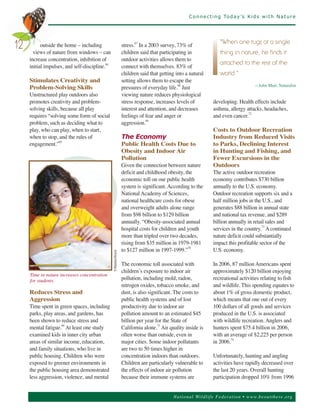
     Time in nature increases concentration
     for students.                                         pollution, including mold, radon,             recreational activities relating to fish
                                                           nitrogen oxides, tobacco smoke, and           and wildlife. This spending equates to
     Reduces Stress and                                    dust, is also significant. The costs to       about 1% of gross domestic product,
     Aggression                                            public health systems and of lost             which means that one out of every
     Time spent in green spaces, including                 productivity due to indoor air                100 dollars of all goods and services
     parks, play areas, and gardens, has                   pollution amount to an estimated $45          produced in the U.S. is associated
     been shown to reduce stress and                       billion per year for the State of             with wildlife recreation. Anglers and
     mental fatigue. At least one study                    California alone. Air quality inside is       hunters spent $75.4 billion in 2006,
                     66                                                      71


     examined kids in inner city urban                     often worse than outside, even in             with an average of $2,225 per person
     areas of similar income, education,                   major cities. Some indoor pollutants          in 2006.74
     and family situations, who live in                    are two to 50 times higher in
     public housing. Children who were                     concentration indoors than outdoors.          Unfortunately, hunting and angling
     exposed to greener environments in                    Children are particularly vulnerable to       activities have rapidly decreased over
     the public housing area demonstrated                  the effects of indoor air pollution           the last 20 years. Overall hunting
     less aggression, violence, and mental                 because their immune systems are              participation dropped 10% from 1996


                                                                                     Nationa l Wild life Fed er a tion • www.be outthere.o rg
A Policy Action Plan


                                                      businesses are at risk for revenue          Instilling a Long-Term
                                                      losses, too. In 2004, recreation            Environmental Ethic in
    “Environmental Education
                                                                   77                                                                                              13
                                                      workers held about 310,000 jobs.            Our Youth
    can help a struggling student

                                                      According to the Bureau of Labor            Direct childhood experience in
                                                      Statistics, about 35% of year-round         nature before age 11 promotes a
    become a competent

                                                      recreation workers are employed by          long-term connection to nature.81
    student, and a competent

                                                      local governments, mostly in park and       Studies of British environmental
                                                      recreation departments.78 A continued       educators; a comparison of
    student grow into a star.”
                               Kevin Coyle,
            NWF Vice President for Education          nature deficit would result in even         interviews with American and
                                                      more local recreation budget cutbacks,      Norwegian environmental activists;
to 2006. This trend could hurt the                    thereby perpetuating nature deficit by      and comprehensive analysis of El
economy if it continues since hunters                 reducing the already limited number         Salvadoran environmental
spent nearly $23 billion on trips,                    of local green areas for children to        professionals demonstrate that
equipment, licenses, and other items                  experience.                                 childhood contact with nature is
to support their hunting activities in                                                            essential to shaping a lasting
2006. Likewise, the number of anglers                 Loss of Potential                           environmental ethic and an interest
is decreasing. From 1996 to 2006, the                 Conservation Savings                        in environmental professions.82
number of anglers 16 years old and                    According to calculations by the            Organizations like the Scouts,
above decreased 15%. Fishing in the                   National Environmental Education            environmental education programs,
Great Lakes dropped 30% in the same                   Foundation, improved environmental          and Outward Bound-type programs
time period. In Alaska, one of the                    knowledge could result in $76 billion       during the teen years also serve as
most popular states for hunting and                   in savings to the national economy          formative experiences in creating a
fishing, recreational fishing decreased               from energy conservation and                sustained ethic of environmental
by 26% and recreational hunting                       environmentally friendly behaviors.         stewardship.83
decreased by 24%. Nationally, fishing                 Without effective environmental
related spending decreased by 16% in                  education for tomorrow’s leaders, and       The connections between childhood
the last 10 years. One positive trend is              without children who want to connect        nature experiences and adult
that wildlife watching has increased                  to the natural world, however, the          environmental attitude are not
13%. Wildlife-watching Americans                      nation could lose out on this               unique to environmental
spent $45 billion in 2003 on their                    considerable annual savings.79              professionals.84 A recent study
activities.75                                                                                     investigated the impacts of
                                                      The Future of American
In addition to dwindling sales of                     Conservation
hunting and fishing goods and                         Exploring the Great
services, state hunting and fishing                   Outdoors is a Special
license sales have plummeted. Many                    American Cultural Value
states rely on millions of dollars from               In a recent national survey, 92% of
license fees to protect threatened                    Americans responded that they “love
animal populations and control other                  to be outdoors,” and 91% believed that
menacing populations like deer. If the                today’s children are not spending
sales continue to decline, state                      enough time outside. Exploring the
                                                                            80


resource agencies will be hit hard and                outdoors is part of the American
                                                                                                                                            ©NWF/Charlie Archambault.


may be unable to keep up many                         experience. From the redwood forests
important conservation activities.                    to the Gulf Stream waters, Americans
                                    76


                                                      connect to the diverse landscapes of
Visits to our national parks have                     our country. If we lose this nature-child
decreased 25% over the last 15 years,                 connection, we will lose a special part     Teaching basic critical thinking skills
                                                                                                  through nature studies is a key
and park associated recreation                        of our national culture and identity.       component for professional success.


 Ins p i r i n g A m e r ic a n s to pro te ct w i l d l i f e f o r o ur children’s future.
C o n n e c t i n g To d a y ’s K i d s w i t h N a t u r e


           childhood nature experiences in
       interviews with over 2,000 non-
14
     environmentalists in the 112 most
     urban areas of the US. The survey
     asked how often participants had
     childhood contact with nature,
     participated in environmental
     education, nature experiences with
     other people, and associated these
     factors with environmental attitudes
     and behavior. This study concluded
     that the most important factor of
     long-term environmental attitudes
     was “many hours spent outdoors in


                                                                                                                                            ©NWF/Charlie Archambault.
     natural habitats during childhood or
     adolescence—alone or with
     others.”85
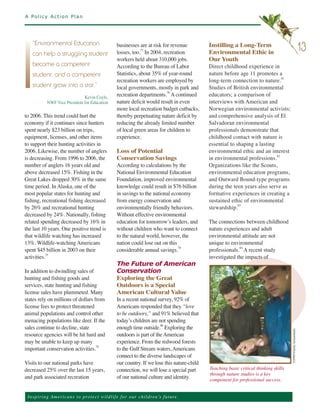
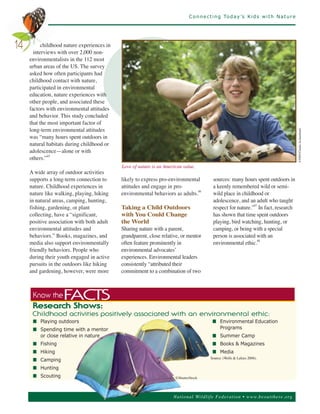
                                                 Love of nature is an American value.
     A wide array of outdoor activities
     supports a long-term connection to         likely to express pro-environmental             sources: many hours spent outdoors in
     nature. Childhood experiences in           attitudes and engage in pro-                    a keenly remembered wild or semi-
     nature like walking, playing, hiking       environmental behaviors as adults.86            wild place in childhood or
     in natural areas, camping, hunting,                                                        adolescence, and an adult who taught
     fishing, gardening, or plant               Taking a Child Outdoors                         respect for nature.”87 In fact, research
     collecting, have a “significant,           with You Could Change                           has shown that time spent outdoors
     positive association with both adult       the World                                       playing, bird watching, hunting, or
     environmental attitudes and                Sharing nature with a parent,                   camping, or being with a special
     behaviors.” Books, magazines, and          grandparent, close relative, or mentor          person is associated with an
     media also support environmentally         often feature prominently in                    environmental ethic.88
     friendly behaviors. People who             environmental advocates’
     during their youth engaged in active       experiences. Environmental leaders
     pursuits in the outdoors like hiking       consistently “attributed their
     and gardening, however, were more          commitment to a combination of two


      Know the      FACTS
      Research Shows:
      C hi l d ho o d ac ti v i t i e s p o s i t i v e l y a s so c i at e d w i th an e n v i r o nm e nt a l et hi c :
      n Playing outdoors                                                                        n Environmental Education
      n Spending time with a mentor                                                               Programs
        or close relative in nature                                                             n Summer Camp
      n Fishing                                                                                 n Books & Magazines
      n Hiking                                                                                  n Media
                                                                                              Source: (Wells & Lekies 2006).
      n Camping
      n Hunting
      n Scouting                                                           ©ShutterStock


                                                                          Nationa l Wild life Fed er a tion • www.be outthere.o rg
Solutions to
                                                                                                                                                             15


  Reverse Nature
  Deficit and
  Connect Our
  Children to Nature


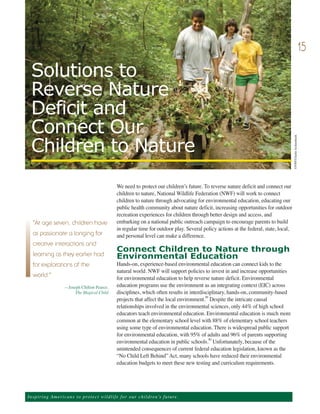
                                                                                                                                         ©NWF/Charlie Archambault.
                                                     We need to protect our children’s future. To reverse nature deficit and connect our
                                                     children to nature, National Wildlife Federation (NWF) will work to connect
                                                     children to nature through advocating for environmental education, educating our
                                                     public health community about nature deficit, increasing opportunities for outdoor
                                                     recreation experiences for children through better design and access, and
                                                     embarking on a national public outreach campaign to encourage parents to build
                                                     in regular time for outdoor play. Several policy actions at the federal, state, local,
   "At age seven, children have
   as passionate a longing for                       and personal level can make a difference.

                                                     Connect Children to Nature through
   creative interactions and

                                                     Environmental Education
                                                     Hands-on, experience-based environmental education can connect kids to the
   learning as they earlier had

                                                     natural world. NWF will support policies to invest in and increase opportunities
   for explorations of the

                                                     for environmental education to help reverse nature deficit. Environmental
                                                     education programs use the environment as an integrating context (EIC) across
   world."
                      —Joseph Chilton Pearce,
                           The Magical Child         disciplines, which often results in interdisciplinary, hands-on, community-based
                                                     projects that affect the local environment. Despite the intricate causal
                                                                                                 89


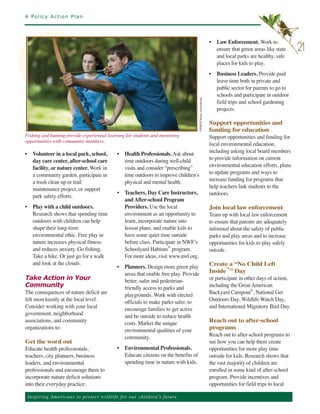
                                                     relationships involved in the environmental sciences, only 44% of high school
                                                     educators teach environmental education. Environmental education is much more
                                                     common at the elementary school level with 88% of elementary school teachers
                                                     using some type of environmental education. There is widespread public support
                                                     for environmental education, with 95% of adults and 96% of parents supporting
                                                     environmental education in public schools. Unfortunately, because of the
                                                                                                    90


                                                     unintended consequences of current federal education legislation, known as the
                                                     “No Child Left Behind” Act, many schools have reduced their environmental
                                                     education budgets to meet these new testing and curriculum requirements.


Ins p i r i n g A m e r ic a n s to pro te ct w i l d l i f e f o r o ur children’s future.
C o n n e c t i n g To d a y ’s K i d s w i t h N a t u r e


        There are four major types of         programs like Outward Bound or the                  In addition to connecting kids to
       outdoor education programs that        National Outdoor Leaderships                        nature, integrating environmental
16
     serve to connect children to nature:     Schools have become “meaningful                     education into school programs has
                                              lifetime experiences” and often                     proven academic benefits:
     (1) investigational approaches;          promote environmental stewardship.
                                              Place-based education connects the                  Sparks Interest in Science
     (2) outdoor learning;
                                              school to its immediate environment.                and Math as Future Career
     (3) place-based learning; and            Community service approaches                        Pathways
                                              advance responsible environmental                   According to the National
     (4) community service.
                                              behaviors and give children an                      Environmental Education and
     Traditional environmental problem-       opportunity to support local green                  Foundation, 80% of all students
     solving in a community or                spaces. Furthermore, experts note that              decide to opt out of science and math
     “investigational approaches” have        if environmental education is done                  careers before entering high school.
     shown to increase test scores on         right it can be worth up to $75 billion             Environmental education is a
     environmental knowledge, reading,        a year in measurable environmental                  “heuristic tool for making science
     and writing skills. Outdoor learning     benefits.91                                         more relevant and appealing,” and


     Know the       FACTS
     Research Shows:
     T he Be ne f it s o f E n v ir o nm e nt a l E d uc a t io n
     n Kids in environmental education classes have                       • Controlling for GPA, gender, and ethnicity, EIC
       higher scores on standard measures of academic                       programs significantly raised scores on three
       achievement (reading, writing, math, science,                        key tests: achievement, motivation, and
       social studies).                                                     critical thinking.
     n In schools that compared the Environment as an               n Increased critical thinking skills are attributed to
       Integrated Context for learning (EIC) to                       environmental themes, open-ended research
       traditional programs, 36 of 39 measures showed                 projects, student voice, and empowerment.
       higher performance by EIC students. There were               n Motivation improvements attributed to learning
       fewer behavior problems and more engagement                    experiences tailored to students’ interests/
       and enthusiasm for learning.                                   strengths, and applied to real-life
     n Environmental education programs have resulted                 issues/problems.
       in higher test scores across the board.                      n Schools with enviornmental education programs
     n Some specific case studies:                                    showed higher test scores on standardized tests
          • In a third grade class in Milwaukee, all the              in math, reading, writing, and listening. The
            students in the environmental elementary                  pattern of enviornmental education school
            school passed the state reading                           students’ higher scores persisted for five years of
            comprehension test, as opposed to only 25%                data investigated.
            of the Milwaukee public schools system-wide.            n Outdoor education programs in California showed
          • At an elementary school in Asheville, NC with             that science scores on post-test were higher for
            an environmental focus, fourth grade students             groups in outdoor education. Teachers reported
            achieved a 31% point increase in math                     improved self-esteem, conflict resolution, and
            achievement in one year.                                  relationship with peers, problem-solving,
                                                                      motivation to learn, and behavior in class.
          • Scores on college admission ACT test were              Sources: (Lieberman & Hoody 1998); (SEER 2000); (NEEF, 2000); (Coyle 2005);
            higher from the School of Environmental                (Bartosh 2004); (Athman & Monroe 2004); (American Institutes of Research 2005).
            Studies in Apple Valley, MN than their peers
            in schools at the district, state, and national
            levels.


                                                                        Nationa l Wild life Fed er a tion • www.be outthere.o rg
A Policy Action Plan


                                                       overall GPA improvements and                            critical thinking skills in
                                                       increased attendance and motivation.95                  environmental education programs
   ”Play is the only way the
                                                                                                                                                          17
                                                       Another study showed EIC students                       and traditional classes. The
   highest intelligence of

                                                       had better attendance rates 77% of the                  environmental education classes
                                                       time and fewer discipline problems.96                   significantly raised students’ scores on
   humankind can unfold.”
                       Joseph Chilton Pearce,
                  Author of The Magical Child                                                                  two nationally recognized critical
                                                       Closes the Gap in                                       thinking skills tests. Teachers
“provides an appealing entry point for                 Underserved Communities                                 concluded that students’ critical
students thinking about future                         and Serves as an Educational                            thinking skills improved because the
careers.”92 In one study, educators                    Equalizer                                               environmental programs involved
observed thousands of students in                      A 2004 study evaluated a place-based                    interdisciplinary problem-solving
environmental education programs                       environmental education project in an                   approaches, empowered students by
and found that test scores improved                    under-resourced, predominantly                          allowing them to choose their
across the board. Science was the only                 African-American Louisiana school                       projects, and allowed students to
subject where 100% of the students’                    district. The performance gap between                   connect their projects to their
scores improved.93                                     the district’s performance and the state                communities.99
                                                       average on state educational tests
Improved Math Scores                                   improved across all subject areas.97                    Higher Standardized Test
In a Houston schools study, fourth                     The National Environmental                              Scores in Reading, Math,
grade students who participated in                     Education Foundation found that                         Science, and Social Studies
NWF’s Schoolyard Habitats® Program                     “environment-based education                            Numerous studies, including an
increased math scores significantly                    appears to be a kind of educational                     evaluation of student performance in
more than peers with a traditional                     equalizer, improving reading, science                   40 schools in 12 states implementing
curriculum. Overall, minority children                 achievement, and critical thinking                      environment as an integrating context
showed more improvement.94                             across ethnic and racial groups and                     (EIC), show that students in EIC
                                                       across socioeconomic levels.”98                         programs have higher scores in
Increases Academic                                                                                             reading, writing, math, science, and
Motivation and Attendance                              Improves Critical                                       social studies.100
A Washington state study concluded                     Thinking Skills
that students enrolled in                              A recent study examined over 400                        Increases Self-Esteem and
environmental education programs                       high school students in eleven Florida                  Science Scores
                     showed better                     high schools and contrasted students’                   In California, a comparison of at-risk
                                                                                                               sixth-grade students showed that
                                                                                                               students in hands-on environmental
                                                                                                               education significantly raised their
                                                                                                               science scores by 27%, and they
                                                                                                               showed better self-esteem, motivation,
                                                                                                               and behavior.101

                                                                                                               Promote Outdoor Play
                                                                                                               through our Public
                                                                                                               Health Systems
                                                                                                               NWF will encourage public heath
                                                                                                               leaders to educate parents and
                                                                                                               caregivers about the importance of play
                                                                                                               in tackling childhood obesity and
                                                                                               ©ShutterStock


                                                                                                               improving children’s mental health. The
Parent and child playtime in the natural world strengthen bonds.                                               medical community recognizes that


 Ins p i r i n g A m e r ic a n s to pro te ct w i l d l i f e f o r o ur children’s future.
C o n n e c t i n g To d a y ’s K i d s w i t h N a t u r e


          outdoor play time is critical to        green areas in their design. Natural           • Avenues to experience weather
18      children’s physical, mental,              play areas result in more active play.
                                                                                         107       and changing seasons, like mobiles
     emotional, and social well being. The        Natural areas can also increase a                stirred by the breeze, soft wind
     American Academy of Pediatrics               child’s interest in the environment.108          chimes, or covered porches
     recommends that pediatricians promote        Research shows that green                      • Insect and butterfly gardens
     free play as “a healthy, essential part of   landscaping in playgrounds makes
     childhood,” and discourage parents from      kids’ play more creative and more              • Natural places to sit in, under, lean
     overuse of passive entertainment like        physical.109 Better community design             against, climb and provide shelter
     TV and videogames.102 Routine well-          that connects green spaces with                  and shade
     child visits provide an important            walking paths and hiking trails can            • Different levels and nooks and
     opportunity to educate parents that play     promote a more active lifestyle for              crannies, where kids can sit, read,
     time outside can help their kids be          families and help to combat obesity.             and talk
     healthier and happier. NWF will urge         The medical community also
     healthcare professionals to consider         recommends that physicians and                 • Rubber walkways, ramps, and low
     recommending outdoor play for over-          health care professionals work to                hills instead of stairs to promote
     stressed kids and as a way to augment        support active lifestyles by promoting           exploration of gravity
     strategies to help children diagnosed        “safe recreational facilities, including
     with ADHD.103 Public health programs         parks, playgrounds, bicycle paths,             NWF will also focus on developing
     like the Children’s Health Insurance         sidewalks, and crosswalks.”110                 green spaces in cities in the nation’s
     Program (CHIP) and the Women, Infant,                                                       migratory bird flyways to create
     and Children nutrition program (WIC)         Experts recommend using natural                habitats and access for wildlife, and in
     can provide critical information to          vegetation as “both the play setting           return, access for children to observe
     parents on the importance of playing         and the materials” in natural play             nature firsthand. Since urbanization
     outside.104 NWF will also reach out to       areas. According to designer Randy             often fragments habitats, green link
     the Surgeon General and Secretary of         White and professor Debra Rivkin,              projects can work to connect
     Health and Human Services to seek            kid-friendly, green playgrounds might          habitats.112 Urban green spaces “play a
     support for combating nature deficit and     include :111                                   crucial role in maintaining water
     to urge parents to make a commitment                                                        quality, loafing grounds, feeding
     to get their children outside for            • Indigenous vegetation, including             grounds, perch sites, ambient
     unstructured play time.                        trees that change colors, waving             temperature, buffer strips, and other
                                                    long grasses, and high vines that            important factors that contribute to the
     Increase Opportunities                         attract birds and butterflies                overall health of an ecosystem.”113
     for Outdoor Recreation                                                                      NWF will continue to support our
                                                  • Sand and water play areas
     Through Better Design
     and Access
     By working with designers, city
     planners, and local elected zoning
     commissions and officials, NWF will
     work to ensure that children have
     accessible kid-friendly green spaces
     for unstructured free play. In many
     communities, children do not have
     access to safe outdoor play areas.
                                       105


     Where there are playgrounds, many
     are barren, concrete slabs that
                                                                                                                                             ©NWF/Charlie Archambault.


     resemble parking lots. Given the
                            106


     many health benefits of play in natural
     areas, playgrounds should incorporate
                                                  Test scores increase when students have regular outdoor learning experiences.


                                                                            Nationa l Wild life Fed er a tion • www.be outthere.o rg
A Policy Action Plan


Wildlife Habitat® program and
Schoolyard Wildlife Habitats©
                                                                                                                                                       19
programs to enable communities to
form green links in their
neighborhoods.

Connecting nature through greenways
and green links can not only improve
wildlife habitat, but also provide many
quality of life benefits to citizens. In
Portland, Oregon, for example, the
140-mile green “loop” around the city


                                                                                                                                            ©ShutterStock
connects hiking trails, parks, and bike
paths.114 NWF will also research                       All-season play and exploration provide new opportunities for learning.
incentives and innovative policies to
promote urban green spaces and share                   The vast majority of Americans               will also target influential community
creative approaches with local                         receive their environmental                  leaders, who are often trendsetters and
planning officials. In Davis,                          information through traditional media        opinion leaders, to seek their support
California, for example, a city                        like television and newspapers.
                                                                                        116
                                                                                                    to educate parents about nature deficit
ordinance requires that new                            According to a recent national survey,       and potential solutions.
development link to the city’s                         91% of Americans believe that
greenway.115 A better built-                           children need to spend more time             NWF and its affiliated state
environment and better access to                       outside.117 Now we need to urge              organizations will form new “No
green spaces will help connect our                     parents to create time for outdoor play      Child Left Inside™” coalitions, and
children to nature.                                    for their children. NWF will use our         work with existing groups of health
                                                       existing publications, including             professionals, educators, day care
Encourage Parents to                                   Ranger Rick® magazine, to encourage          providers, business leaders, anglers,
Build in Regular Time                                  parents to build regular time for            hunters, environmental leaders, and
for Outdoor Play                                       outdoor play into their children’s           elected officials to take collective
through Green Hour®, a                                 lives. NWF will also reach out to the        policy actions to connect children to
National Educational                                   advertising and business communities         nature.
Campaign                                               in our efforts to get kids outside. We
Parents and policymakers can make a
difference to get children to
experience all the benefits of free time                                  FACTS
in nature. NWF’s national educational
                                                       Know the
campaign aims to reduce and address
                                                       Research Shows:
barriers preventing children from                                                                                                ©ShutterStock

experiencing the outdoors. Our goal is
                                                       S u g ge s te d O ut do o r A c t iv i ti es

to reach two million parents (10
                                                       f o r Pa re n ts an d K id s
                                                        n Nature Journaling
million children) encouraging them to                   n Bird Watching                            n Puddle Jumping
build regular outdoor time into their                   n Building a Fort                          n Wildflower Identification
children’s lives. NWF's Green Hour ,
                                      ®
                                                        n Taking a Tree Walk                       n Walking
an online resource for parents,
features ideas for unstructured play
                                                        n Using a Field Guide                      n Gardening

and interaction with the natural world.
                                                        n Looking at Clouds                        n Skipping Rocks
                                                        n Shape Searches                           n Climbing Trees
                                                                                                  Source: www.greenhour.org
                                                        n Bug Collecting


 Ins p i r i n g A m e r ic a n s to pro te ct w i l d l i f e f o r o ur children’s future.
What You Can Do
20


                                                                                                                             ©Shutterstock.
                                         Several policy actions at the local, state, and level can make a difference in
                                         connecting children to nature.

                                         Take Action Close to Home
                                         Experience Green Hour®
                                         Documented benefits of spending time outdoors motivated NWF to create a
                                         family-friendly website to encourage families to spend 60 minutes of time outside
                                         each day. You do not have to know a lot about the natural environment to enjoy
     "Nature has been for me, as

                                         time outdoors with your children. Take a field guide with you and learn together.
     long as I remember, a
                                         Or just simply take a walk to your local park. Spend some time together in your
                                         garden. Look for birds. Watch the clouds. For ideas on how to spend time
     source of solace, inspiration,

                                         outdoors, visit www.nwf.org/kidsoutside.
     adventure, and delight; a


                                         Garden for wildlife with a child
     home, a teacher, a

                                         NWF’s gardening for wildlife suite of programs encourages homeowners,
     companion."
                   — Lorraine Anderson   business-owners and community members to create wildlife friendly landscapes
                                Author   that are accessible for all to enjoy. Nurturing an appreciate for plants and wildlife
                                         at a young age is a key component for fostering a child’s future connection to
                                         nature. For more information, visit www.nwf.org/gardenforwildlife/.

                                         Encourage your local school
                                         Encourage your local school to participate in NWF’s Schoolyard Habitats©
                                         Program, an integrated environmental education program where community
                                         members, children, teachers and administrators work to create outdoor learning
                                         centers and labs. Both through the creation and utilization of these teaching
                                         spaces, children learn about the natural world, and can improve their scores on
                                         standardized tests.


                                                                    Nation al Wild life Federa ton • www.b eoutthere.org
A Policy Action Plan


                                                                                                                           • Law Enforcement. Work to
                                                                                                                             ensure that green areas like state      21
                                                                                                                             and local parks are healthy, safe
                                                                                                                             places for kids to play.
                                                                                                                           • Business Leaders. Provide paid
                                                                                                                             leave time both in private and
                                                                                                                             public sector for parents to go to
                                                                                                                             schools and participate in outdoor
                                                                                                                             field trips and school gardening
                                                                                                                             projects.


                                                                                               ©NWF/Charlie Archambault.
                                                                                                                           Support opportunities and
                                                                                                                           funding for education
Fishing and hunting provide experiential learning for students and mentoring                                               Support opportunities and funding for
opportunities with community members.
                                                                                                                           local environmental education,
• Volunteer in a local park, school,                   • Health Professionals. Ask about                                   including asking local board members
  day care center, after-school care                     time outdoors during well-child                                   to provide information on current
  facility, or nature center. Work in                    visits and consider “prescribing”                                 environmental education efforts, plans
  a community garden, participate in                     time outdoors to improve children’s                               to update programs and ways to
  a trash clean up or trail                              physical and mental health.                                       increase funding for programs that
  maintenance project, or support                                                                                          help teachers link students to the
                                                       • Teachers, Day Care Instructors,                                   outdoors.
  park safety efforts.
                                                         and After-school Program
• Play with a child outdoors.                            Providers. Use the local                                          Join local law enforcement
  Research shows that spending time                      environment as an opportunity to                                  Team up with local law enforcement
  outdoors with children can help                        learn, incorporate nature into                                    to ensure that parents are adequately
  shape their long-term                                  lesson plans, and enable kids to                                  informed about the safety of public
  environmental ethic. Free play in                      have some quiet time outside                                      parks and play areas and to increase
  nature increases physical fitness                      before class. Participate in NWF’s                                opportunities for kids to play safely
  and reduces anxiety. Go fishing.                       Schoolyard Habitats® program.                                     outside.
  Take a hike. Or just go for a walk                     For more ideas, visit www.nwf.org.
  and look at the clouds.
                                                       • Planners. Design more green play                                  Create a “No Child Left
                                                         areas that enable free play. Provide                              Inside™” Day
Take Action in Your                                      better, safer and pedestrian-                                     or participate in other days of action,
Community                                                friendly access to parks and                                      including the Great American
The consequences of nature deficit are                   playgrounds. Work with elected                                    Backyard Campout®, National Get
felt most keenly at the local level.                     officials to make parks safer, to                                 Outdoors Day, Wildlife Watch Day,
Consider working with your local                         encourage families to get active                                  and International Migratory Bird Day.
government, neighborhood                                 and be outside to reduce health
associations, and community                              costs. Market the unique                                          Reach out to after-school
organizations to:                                        environmental qualities of your                                   programs
                                                         community.                                                        Reach out to after-school programs to
Get the word out                                                                                                           see how you can help them create
Educate health professionals,                          • Environmental Professionals.                                      opportunities for more play time
teachers, city planners, business                        Educate citizens on the benefits of                               outside for kids. Research shows that
leaders, and environmental                               spending time in nature with kids.                                the vast majority of children are
professionals and encourage them to                                                                                        enrolled in some kind of after-school
incorporate nature deficit solutions                                                                                       program. Provide incentives and
into their everyday practice.                                                                                              opportunities for field trips to local

 Ins p i r i n g A m e r ic a n s to pro te ct w i l d l i f e f o r o ur children’s future.
C o n n e c t i n g To d a y ’s K i d s w i t h N a t u r e


         nature centers, supply tools for an
       after-school garden, or give
22
     materials for a community-based
     environmental education program.

     Enroll in the NWF’s
     Schoolyard Habitats®
     Program
     NWF has worked with schools to
     plant wildlife-friendly vegetation on
     school grounds. This tried and true
     program works and has been found to


                                                                                                                                          ©Dynamic Graphics
     increase participating students’ math
     scores and educate them about the
     environment.
                                               A family GreenHour® can instill a love for nature.

     Create zoning policies and                Take Action                                    Maryland’s Chesapeake Bay
     incentives                                in Your State                                  Watershed Education &
     Work with local planning                  State governments are responsible for          Training Program
     commissions and homeowners’               the majority of public policies that can       Maryland’s Chesapeake Bay
     associations to create zoning policies    make children’s lives healthier, happy,        Watershed Education & Training
     and incentives to encourage more kid-     and more active. State governments             Program strives to ensure that all
     friendly green spaces for creative play   should consider integrated policy              children within the Chesapeake Bay
     and designate special areas where         reforms that include connecting                watershed have a meaningful bay
     children can participate in traditional   children to nature throughout the state        experience before they graduate from
     outdoor activities, like climbing trees   health, natural resources, and                 high school.119 In conjunction with the
     and fort-building that have been          education systems. Some state reform           Chesapeake Bay program, the National
     limited because of liability concerns.    policies worth investigating include:          Oceanic & Atmospheric Association’s
     Consider the following actions:                                                          Bay and Watershed Education &
                                               Connecticut’s No Child Left                    Training (B-WET) Program supports
     • Advocate for better playground          Inside™ Parks Program                          environmental stewardship and
       design that incorporates natural         The State of Connecticut created a            provides hands-on watershed
       landscapes.                             “No Child Left Inside™” program,               experiences and uses the environment
                                               which includes a multi-week                    as an integrating context. Two Pacific
     • Support walkways and bike trails
                                               scavenger and adventure hunt in the            programs have also been created,
       into neighborhoods, unlinked to
                                               “Great Parks Pursuit Day” to                   including Monterey Bay in 2003 and
       roads, for recreating and
                                               encourage families to experience the           the Hawaiian Islands in 2004.120
       commuting by families.
                                               state park system. This comprehensive
     • Push for investments in public          program provides park passes for               California’s Children’s
       transportation infrastructure so        foster families, supports an urban             Outdoor Bill of Rights
       natural areas are easier to access.     fishing program, promotes water                On July 6, 2007, the State of
                                               safety classes for children to learn           California issued a proclamation
     • Promote a “walking school bus,”
                                               how to swim, and connects the                  recognizing the “Children’s Outdoor
       where parents take turns walking
                                               outdoors to the state library system by        Bill of Rights.” Drafted by the
       a group of kids to school in your
                                               offering a summer environmental                California Roundtable on Recreation,
       community to help kids walk to
                                               reading program and special park               Parks, and Tourism, the Children’s
       school safely, but also enjoy some
                                               passes that are only available at the          Outdoor Bill of Rights states that by
       time outside and get some
                                               libraries.                                     the age of 14, every child in California
       exercise.
                                                         118


                                                                         Nationa l Wild life Fed er a tion • www.be outthere.o rg
A Policy Action Plan


has the right to experience the                                           Pennsylvania Environmental
following activities:                                                     Education Grants Program
                                                                                                                                                                        23
                                                                          The Department of Environmental
• Discover California’s past                                              Protection set aside 5% of the
                                                                          pollution fines and penalties collected
• Splash in the water
                                                                          annually for a grants program that
• Play in a safe place                                                    funds environmental education
                                                                          projects across the state.123
• Camp under the stars
• Explore nature                                                          Governors and state legislatures can
                                                                          make a difference in connecting
• Play on a team
                                                                          children to nature and should take
• Follow a trail                                                          action to:


                                                                                                                                                             ©ShutterStock
• Catch a fish
                                                                          • Host a “No Child Left Inside™”
• Celebrate their heritage                                                  Forum, to discuss ways to connect       Share your love of the outdoors with a
                                                                            children to nature with health care     child.
Washington State No Child                                                   professionals, business leaders,
Left Inside™ Grant Program                                                  nonprofit organizations, educators,     • Pass state environmental
In January 2008, Washington State                                           after-school providers, urban             education legislation to promote
announced a No Child Left Inside™                                           planners, hunters and anglers,            place-based and outdoor
grant program administered by the                                           conservation groups, and local            environmental education and
Washington State Parks and                                                  officials to work together to create      increase funding for updating
Recreation Commission. The program                                          access to safe outdoor play areas         environmental education
has $1.5 million available to                                               and educate parents on the benefits       programs. Try to connect every
Washington state outdoor education                                          of unstructured free play.                school with a natural place.
and recreation youth programs to                                                                                      Consider incorporating
                                                                          • Declare a Children’s Outdoor              environmental education into
connect children to nature.122
                                                                            Bill of Rights to ensure that             teacher education and
                                                                            children have the right to                accreditation programs.
                                                                            experience all the benefits of
                                                                            unstructured free time in nature.       • Require public health and social
                                                                                                                      service agencies to educate
                                                                          • Institute mandatory state                 parents on the benefits of
                                                                            standards for minimum exercise            outdoor play on children’s
                                                                            in school that focus on outdoor           health to fight obesity and to
                                                                            activities for children. As a result      make kids’ lives better. Public
                                                                            of the No Child Left Behind               health agencies should work to
                                                                            legislation, many states have cut         redefine exercise to take away its
                                                                            physical education programs,              stigma and call it “play,” and work
                                                                            outdoor field trips, and                  with health professionals to
                                                                            environmental education. Exercise         advance time in nature as a
                                                                            programs in school that                   potential avenue to lessen the
                                                                            incorporate the outdoors would            symptoms of ADHD, fatigue, and
                                                                            provide substantial benefits to the       childhood depression.
                                              ©NWF/Charlie Archambault.


                                                                            health of our children.


Environmental education increases
interest in science and math.

 Ins p i r i n g A m e r ic a n s to pro te ct w i l d l i f e f o r o ur children’s future.
C o n n e c t i n g To d a y ’s K i d s w i t h N a t u r e


                                                                                                • Increase the federal recreation
        Take Action at the                      engage children in environmental
                                                                                                  budget, and conduct a review of
                                                stewardship projects and
24     National Level
                                                                                                  federal agency resource budgets
     The federal government has an              environmental education.
                                                                                                  and assess how they can connect
                                                                         127


     important role in creating
                                                                                                  children to nature.
     opportunities for children to play         Federal policies can make a difference
     outdoors. Some existing federal            in connecting children to nature, and           • Use existing federal public
     programs worth investigating include:      your federal officials should work to:            health programs to educate
                                                                                                  parents on the importance of
     U.S. Forest Service “More                  • Pass proposed federal                           outdoor play to children’s health.
     Kids in the Woods” Program                   legislation, such as the “No Child              The Children’s Health Insurance
     In 2007, this federal program awarded        Left Inside™” amendment to the                  Program (CHIP), the Women,
     $1.5 million with cost share partners        “No Child Left Behind” Act to get               Infants, and Children (WIC)
     for local projects that connect children     environmental education back in                 nutrition program, and Medicaid
     to national forest lands.124                 the classroom and give incentives               reflect unique avenues to
                                                  to states to create environmental               encourage parents to support
     U.S. Bureau of Land                          literacy plans.                                 outdoor play.
     Management’s (BLM)
                                                • Reauthorize the National                      • Call upon the Surgeon General
     “Take it Outside” Program
                                                  Environmental Education Act to                  and Secretary of Health and
     This program expands many existing
                                                  update environmental education                  Human Services to ask parents
     initiatives that connect children to the
                                                  standards and increase critical                 to make a commitment to their
     258 million acres of BLM-managed
                                                  funding for environmental                       children’s health by encouraging
     public lands. The agency partners with
                                                  education.                                      their children to experience daily
     schools, youth organizations like the
                                                • Form a Twenty-first Century                     unstructured free play outside.
     Girl Scouts, and provides a website
     for families on recreational                 Presidential Commission on the
     opportunities on BLM lands.125               Great Outdoors to make outdoor                Conclusion
                                                  time part of children’s daily                 Together, we can connect our children
     U.S. Fish & Wildlife Service                 experience, and more fully explore            to nature and ensure that the next
     “Children and Nature”                        the impacts of nature deficit on              generation has the opportunity, the
     Initiative                                   public health.                                space, and the encouragement to “Go
     This new initiative aims to connect                                                        Outside and Play.”
     children with nature, and to encourage
     families to visit national wildlife
     refuges to experience nature
     firsthand.
               126


     National Park Service’s
     Youth Programs
     The National Park Service has several
     educational programs to engage
     children who visit national parks,
     including the Jr. Ranger Program. The
     Park Service also has partnerships
     with groups such as the Student
                                                                                                                                            ©NWF/Charlie Archambault.


     Conservation Association, the Youth
     Conservation Corps, and Job Corps,
     and private youth organizations like
     the Girl Scouts and Boy Scouts to          Outdoor play results in healthier kids.


                                                                           Nationa l Wild life Fed er a tion • www.be outthere.o rg
ENDNOTES                                                                                Cowan, Alison Leigh (2007). “School Recess Gets Gentler and
                                                                                     14

                                                                                     Adults are Dismayed,” altparentingsolutions.com,
                                                                                     http://groups.google.com.sg/group/alt.parenting.solutions/browse_t
                                                                                                                                                           25
1
  Rideout, Victoria et al. (2005). Generation M: Media in the Lives                  hread/thread/b0d00fe0c9545d81(accessed Mar. 3, 2008); Lahoud,
of 8-18 Year-Olds. The Henry J. Kaiser Family Foundation.                            Susan (2006). “Tagged Out,” The Sun Chronicle, Oct.17, 2006,
http://www.kff.org/entmedia/up...f-8-18-Year-olds-Report.pdf                         http://www.thesunchronicle.com/articles/2006/10/18/features/featur
(accessed Oct. 22, 2007).                                                            e37.txt (accessed Mar. 7, 2008); USA Today Editorial (2006). “Our
  Juster, F. Thomas et al. (2004). “Changing Times of American                       View on Children’s Welfare: All Work and No Play… Makes Kids
                                                                                     Fat and Passive”, (Nov. 28, 2006),
2

Youth: 1981-2003,” Institute for Social Research, University of
Michigan. Child Development Supplement,                                              http://blogs.usatoday.com/oped/2006/11/ post_67.html (accessed
http://www.umich.edu/news/Releases/                                                  Mar. 7, 2008).
2004/Nov04/teen_time_report.pdf (accessed Oct. 27, 2007).                               (Rideout et al. 2005).
                                                                                     15


3 NIH News. (2005). “Obesity Threatens to Shorten U.S. Life Span,                       Ibid.
                                                                                     16


New Analysis Suggests,” (Mar. 17, 2005), available at                                17
                                                                                        (Juster et al. 2004)
http://www.nih.gov/news/pr/mar2005/nia-16.htm (accessed o Mar.                       18
                                                                                        Burdette, Hillary L & Whitaker, Robert C. (2005). “Resurrecting
8, 2008); Olshansky, S. J. et al. (20005). "A Potential Decline in                   Free Play in Young Children: Looking Beyond Fitness and Fatness
Life Expectancy in the United States in the 21st Century," New                       to Attention, Affiliation, and Affect,” Arch Pediatr Adolesc Med
England Journal of Medicine. 32: 1138-1145,                                          159: 46-50, http://archpedi.ama-
http://content.nejm.org (accessed Mar. 8, 2008).                                     assn.org/cgi/content/abstract/159/1/46 (accessed Nov. 10, 2007).
  Louv, Richard (2005). Last Child in the Woods: Saving Our                             Browne, KD & Hamiltion-Giachritsis, CE (2005). “The Influence
4                                                                                    19

Children from Nature-Deficit Disorder. Algonquin Books of Chapel                     of Violent Media on Children and Adolescents: A Public Health
Hill.                                                                                Approach,” The Lancet, 365: 702-10.
  U.S. Department of Justice. Finkelhor, David, et al. (2002).                          Christakis, Dimitri A. & Zimmerman, Frederick. (2007). “Violent
5                                                                                    20

Nonfamily Abducted Children: National Estimates and                                  Television Viewing During Preschool is Associated with Antisocial
Characteristics, National Incidence Studies of Missing, Abducted,                    Behavior During School Age,” Pediatrics, 120: 993-99.
Runaway, and Throwaway Children, Bulletin,                                              (Louv 2005).
http://www.ncjrs.gov/html/ojjdp/nismart/04/ (accessed Nov. 5,
                                                                                     21


2007); Williamson, L.J. (2007). “Let Kids Outdoors: Crime is                            DeMarco, Laura. (2004). “Generation X Parents Outshine Baby
                                                                                     22


Down, but Parents Shelter Children as if there is a Predator on                      Boomers: Group Called Slackers Embraces Family,” The Plain
Every Corner,” Los Angeles Times, (Mar. 29, 2007),                                   Dealer (Sept. 7, 2004).
http://www.latimes.com/news/opinion/la-oe-williamson29mar29,0,                          Bronson, Po. (2007). “Snooze or Lose,” New York Magazine,
                                                                                     23

803913.story (accessed Mar. 9, 2008).                                                http://nymag.com/news/features/38951/ (accessed Nov. 21, 2007);
6
  U.S. Dept. of Justice. (2001). Highlights of the Youth Internet                    Elkins, David (2003). “The Overbooked Child,” Psychology Today
Safety Survey, http://www.ncjrs.gov/pdffiles1/ojjdp/fs200104.pdf                     (Jan/Feb 2003).
(accessed Mar. 9, 2008).                                                                Ginsberg, D. (2007). “The Importance of Play in Promoting
                                                                                     24

7
  WiredSafety.Org. (1998). Overview of Online Survey,                                Healthy Child Development and Maintaining Strong Parent-Child
http://www.wiredsafety.org/askparry/special_reports/spr1/qa33.html                   Bonds,” Clinical Report, American Academy of Pediatrics,
(accessed Mar. 9, 2007); Polly Klass Foundation (2005). “Results                     http://www.aap.org/pressroom/playFINAL.pdf (accessed Nov. 1,
of Internet Survey: One Third of Teens Have Talked with Strangers                    2007).
Online About Meeting in Person; Nearly One in Eight Have                                Ibid.
                                                                                     25

Learned that Adults Online Were Pretending to be Younger,”                           26
                                                                                        Rosensfeld, Alvin & Wise, Nicole. (2005). The Over-Scheduled
http://www.pollyklaas.org/media/new-survey-data-reveals-                             Child: Avoiding the Hyper-Parenting Trap. St. Martin’s Press.
risks.html (accessed Nov. 15, 2007); Enough is Enough (2005).                           (Ginsberg 2007).
“Making the Internet Safer for Children and Families,” Internet
                                                                                     27


Statistics Fact Sheet,                                                                  Ibid.
                                                                                     28


http://www.enough.org/inside.php?tag=statistics (accessed Nov. 14,                      Ibid.
                                                                                     29

2007).                                                                               30
                                                                                        Centers for Disease Control. (2007). Fact Sheet, “Prevalence of
8
  Moore, Robin C. (1989). “Playgrounds at the Crossroads: Policy                     Overweight Among Adolescents and Children 2003-2004, Obesity
and Action Research Needed to Ensure a Viable Future for Public                      Still a Problem,”
Playgrounds in the United States,” published in Altman, I. & Zube                    http://www.cdc.gov/nchs/pressroom/06facts/obesity03_04.htm
E., Public Places and Spaces. Human behavior and the                                 (accessed Nov. 4, 2007).
environment, Vol. 10. New York: Plenum,                                              31
                                                                                        Kellert, Stephen R. (2004). Building for Life: Designing and
http://www.naturalearning.org/aboutus/countersedentary.htm                           Understanding the Human-Nature Connection. Island Press.
(accessed Nov. 20, 2007).                                                            32
                                                                                        (Juster et al. 2004).
  (Louv 2005).                                                                          Hofferth, S. and J. Sandberg. (2001). “Changes in American
9
                                                                                     33

   Ibid.                                                                             Children’s Time, 1981-1997.” In Hofferth, S.L. and T.J. Owens,
10

11
   Ibid.                                                                             eds. Children at the Millennium: Where Have We Come From,
12
   Jacobsen PL. (2003). “Safety in numbers: more walkers and                         Where Are We Going? Oxford, England: Elsevier Science.
bicyclists, safer walking and bicycling. Injury Prevention 9: 205-                      Von Hippel et al. (2007). “The Effect of School on Overweight in
                                                                                     34

209, http://injuryprevention.bmj.com/cgi/content/abstract/9/3/205                    Childhood: Gain in Body Mass Index During the School Year and
(accessed Nov. 20, 2007).                                                            During Summer Vacation,” American Journal of Public Health, 97:
13
   (Louv 2005).                                                                      606-702.
                                                                                        McCafferty, Dennis. (2007). “Mother Nature: Raising Healthier
                                                                                     35

                                                                                     Kids, Getting your Kids Back in Touch with the Great Outdoors can
                                                                                     Improve their Health and Well-being. USA Weekend Magazine,
                                                                                     (Nov. 18, 2007),
                                                                                     www.usaweekend.com/07_issues/071118/071118healthy-kids-
                                                                                     report.html (visited Nov. 22, 2007).


    Ins p i r i n g A m e r ic a n s to pro te ct w i l d l i f e f o r o ur children’s future.
C o n n e c t i n g To d a y ’s K i d s w i t h N a t u r e


        Council on Sports Medicine and Fitness and Council on School           Marsh, P. (1999). Does camping enhance self-esteem? Camping
     36                                                                     63


26   Health (2006). “Active Healthy Living: Prevention of Childhood         Magazine, 72(6), 36-40.
     Obesity Through Increased Physical Activity,” Pediatrics 117;          64
                                                                               (Taylor et al. 2001).
     1834-1842, www.pediatrics.org/cgi/content/full/117/5/1834                 (Burdette & Whitaker 2005).
     (accessed Nov. 18, 2007).
                                                                            65


                                                                               (Taylor et al. 2001).
        (Rosenfeld & Wise 2000).
                                                                            66
     37

                                                                               Kuo, F.E. and Sullivan, WC. (2001a). “Environment and Crime in
        (Council on Sports Medicine 2007).
                                                                            67

                                                                            the Inner City: Does Vegetation Reduce Crime?” Environment and
     38


        (Burdette & Whitaker 2005).                                         Behavior 33: 343-367; Kuo, F. & Sullivan, WC (2001b).
     39


        Luepker, RV. (1999). “How Physically Active are American            “Aggression and Violence in the Inner City: Effects of Environment
     40

     Children and What Can We Do about it?” International Journal of        via Mental Fatigue,” Environment and Behavior 33: 543-571.
     Obesity 23(2): S12-17; Sturm, R. (2005). “Childhood Obesity:           68
                                                                               Harris Interactive. (2003). Outdoor Industry Association Outreach
     What Can We Learn from Existing Data on Societal Trends, Part 1.       Study. Outdoor Industry Association.
     Preventing Chronic Disease [serial online] 2(1): 1-9,                     (Burdette & Whitaker 2005).
     http://www.cdc.gov/pcd/issues/2005/jan/04_0038.htm; Henig,
                                                                            69


     Robin Marantz. (2008). “Taking Play Seriously,” The New York              National Academy of Sciences. (2004). Preventing Childhood
                                                                            70


     Times, (Feb. 17, 2008).                                                Obesity: Health in the Balance,
                                                                            http://books.nap.edu/openbook.php?record_id=11015&page=125
        (CDC 2006).                                                         (accessed Nov. 12, 2007).
     41


        Olshansky, S. J. et al. (2005). A Potential Decline in Life            California Air Resources Board, News Release, “Air Board
     42

     Expectancy in the United States in the 21st Century. New England
                                                                            71

                                                                            Forwards Indoor Air Pollution Report to Legislature,”
     Journal of Medicine. 352: 1138-45,: http://content.nejm.org            http://www.arb.ca.gov/newsrel/nr031705.htm (visited Nov. 21,
     (accessed Mar. 7, 2008).                                               2007).
        Ogden CL, et al. (2006). “Prevalence of Overweight and Obesity         Ibid.
     43

     in the United States, 1994-2004. “ JAMA 295: 1549-1555.
                                                                            72


                                                                               Outdoor Industry Association (2006). The Active Outdoor
        (Ginsberg 2007).
                                                                            73

                                                                            Recreation Economy: A $730 billion annual contribution to the U.S.
     44


        (Burdette & Whitaker 2005).                                         Economy,
     45


        Fjortoft, I. (2004). “Landscape and Playscape: the Effects of       http://www.imba.com/resources/science/outdoor_industry_recreatio
     46

     Natural Environments on Children’s Play and Motor Development,”        n.pdf (accessed Oct. 15, 2007).
     Children, Youth and Environments 14(2): 21-44,                         74
                                                                               U.S. Fish & Wildlife Service. (2007). 2006 National Survey of
     http://www.colorado.edu/journals/cye/14_2/article2.pdf (accessed       Fishing, Hunting, and Wildlife-Associated Recreation: National
     Oct. 20, 2007).                                                        Overview (May 2007).
        Ibid.                                                                  Ibid.
     47                                                                     75

        Rivkin, Mary S. (2000). “Outdoor Experiences for Young                 Greenwell, Megan. (2007). “Clinics Pursue Elusive Quarry: New
     48                                                                     76

     Children.” ERIC clearinghouse on Rural Education and Small             Hunters,” The Washington Post (Nov. 12, 2007),
     Schools, http://www.eric.ed.gov (accessed on Nov. 17, 2007).           http://www.washingtonpost.com/wp-
        (NIH 2007).                                                         dyn/content/article/2007/11/11/ AR2007111101591_pf.html
     49

     50
        (Bronson 2007).                                                     (accessed Nov. 12, 2007).
        Ibid.                                                                  Pergams, O. R. W. and P. A. Zaradic. (2006). “Is Love of Nature
     51                                                                     77


        Touchette, E. et al. (2007). “Associations between Sleep Duration   in the US becoming Love of Electronic Media? 16-year downtrend
                                                                            in national park visits explained by watching movies, playing video
     52

     Patterns and Behavioral/Cognitive Functioning at School Entry,
     Sleep, 30: 1213-19,                                                    games, internet use, and oil prices,” Journal of Environmental
     http://www.websciences.org/cftemplate/NAPS/archives/                   Management 80: 387-393,
     indiv.cfm?ID=20067387 (visited Nov. 12, 2007).                         http://www.videophilia.org/uploads/JEM.pdf (accessed Mar. 9,
                                                                            2008); Biello, David. (2008). “Are We Afraid of the Outdoors?”
        Davis, Catherine, M.D. (2006). “Exercise Reduces Children’s         Scientific American News, (Feb. 5, 2008),
     53

     Sleep Problems,” Obesity (Nov. 2006),                                  http://www.cnaturenet.org/ news/detail_print644/ (accessed Feb. 19,
     http://vid_health.healthology.com/sleep-disorders/sleep-disorders-     2008).
     childhood/article3999.htm (visited Mar. 3, 2008).
                                                                               U.S. Bureau of Labor Statistics. (2006). Occupational Outlook
                                                                            78

        Kahn, P.H. & S.R. Kellert, eds. (2002). Children and Nature:        Handbook, 2006-07 Edition,
     54

     Psychological, Sociocultural and Evolutionary Investigations.          http://www.bls.gov/oco/prin/osco058.htm (accessed Nov. 19, 2007).
     Cambridge, MA: MIT Press; Kaplan, R. & S. Kaplan. (1989). The
     Experience of Nature: a Psychological Perspective. Cambridge:             Coyle, Kevin. (2005). “Environmental Literacy in America:
                                                                            79


     Cambridge University Press.                                            What Ten Years of NEEF/Roper Research and Related Studies
                                                                            Say about Environmental Literacy in the U.S.,” National
        (Kahn & Kellert 2002).                                              Environmental Education & Training Foundation,
     55


        Chawla, Louise. (1999). “Life Paths into Effective Environmental    www.neefusa.org/pdf/ELR2005.pdf (accessed on Nov. 2, 2007).
     56

     Action.” The Journal of Environmental Education 31(1): 15-26.          80
                                                                               EcoAmerica and SRI Consulting. (2006). The American
        (Kellert 2003).                                                     Environmental Values Survey: American Views on the Environment
     57

     58
        (Louv 2005).                                                        in the Era of Polarization and Conflicting Priorities,
        Kuo, F.E. & A. Faber Taylor (2004). “A Potential Natural            http://www.brainerd.org/downloads/ecoAmerica%20AEVS%20Su
                                                                            mmary.pdf (accessed Nov. 18, 2007).
     59

     Treatment for Attention-Deficit/Hyperactivity Disorder: Evidence
     from a National Study,” American Journal of Public Health 94 (9):         Wells, N.M. and Lekies, K.S. (2006). “Nature and the Life
                                                                            81


     1580-1586.                                                             Course: Pathways from childhood nature experiences to adult
        Taylor, Andrea et al. (2001). “Coping with ADD: The Surprising      environmentalism,” Children, Youth, and Environment, 16 (1), 1-24,
                                                                            http://www.colorado.edu/journals/cye/16_1/16_1_01_NatureAndLif
     60

     Connection to Green Play Settings,” Environment and Behavior,
     33: 54-77.                                                             eCourse.pdf (accessed Mar. 9, 2007).
        (Kuo & Taylor 2004).                                                   (Wells & Lekies 2006).
                                                                            82
     61


        United Kingdom Sustainable Development Commission (2007).              (Kellert 2004).
                                                                            83
     62

     Every Child’s Future Matters. http://www.sd-commission.org.uk/            (Wells & Lekies 2006).
                                                                            84


     publications/downloads/ECFM_report.pdf (accessed Nov. 1, 2007).        85
                                                                               Ibid.


                                                                                Nation al Wild life Federa ton • www.b eoutthere.org
A Policy Action Plan


    Ibid.                                                                              Snyder Sachs, Jessica (2002). “Seeking Safe Passage: Scientists
86                                                                                 112

87
    (Chalwa 1999).                                                                 are increasingly discovering the benefits of protecting corridors that
    (Wells & Lekies 2006.)                                                         connect isolated wildlife habitats,” National Wildlife Magazine, Vol     27
                                                                                   40 , No. 4 (Jun/July 2002),
88


    Duffin, M., Powers, A., Tremblay, G., & PEER Associates.                       http://www.nwf.org/nationalwildlife/article.cfm?issueId=43&article
89

(2004). Place-based Education Evaluation Collaborative: Report on                  Id=499 (accessed Nov. 14, 2007).
cross-program research and other program evaluation activities,
2003-2004,                                                                             Schaefer, Valentin. (2003). Green Links and Urban Biodiversity –
                                                                                   113


http://www.peecworks.org/PEEC/PEEC_Reports/S0019440A                               an Experiment in Connectivity. Institute of Urban Ecology, Douglas
(accessed Mar. 3, 2008).                                                           College,
                                                                                   http://www.psat.wa.gov/Publications/03_proceedings/PAPERS/OR
    (Coyle 2005).                                                                  AL/2c_schae.pdf (accessed Nov. 19, 2007).
90


    Ibid.                                                                              (Louv 2005).
91
                                                                                   114

    Ibid. Elder, J. (2003). A Field Guide to Environmental Literacy:                   Ibid.
92
                                                                                   115

Making Strategic Investments in Environmental Education.
Environmental Education Coalition.                                                     (Coyle 2005).
                                                                                   116


    Lieberman, G. & Hoody, L. (2002). Closing the Achievement                          (EcoAmerica 2006).
                                                                                   117
93

Gap: Using the Environment as an Integrating Context for                               Connecticut Department of Environmental Protection (2007).
                                                                                   118


Learning—2nd Edition. San Diego, CA.                                               “No Child Left Inside™,” http://www.nochildleftinside.org/
94
    Danforth, P. (2005). An evaluation of National Wildlife                        (accessed Oct. 15, 2007).
Federation’s Schoolyard Habitat Program in the Houston                                 Chesapeake Bay Program. (2000). “Meaningful Bay
                                                                                   119


Independent School District. Unpublished Master’s Thesis, Texas                    Experience,” available at http://www.chesapeakebay.net/pubs/doc-
State University, San Marcos, TX.                                                  c2k_meaningful_bay_experience.pdf (accessed Nov. 21, 2007).
95
    Bartosh, O. (2004). “Environmental Education: Improving                        120 The National Oceanic and Atmospheric Administration
Student Achievement.” Unpublished master's thesis, The Evergreen                   (NOAA) Chesapeake Bay Office, Bay Watershed Education and
State College, Olympia, Washington,                                                Training Program site,
http://www.peecworks.org/PEEC/PEEC_Research/0032637E-                              http://chesapeakebay.noaa.gov/formaleducation.aspx (accessed Nov.
007EA7AB.5/EEReportCard%202004.pdf (accessed Nov. 14,                              21, 2007).
2007).                                                                                 California Roundtable on Recreation, Parks and Tourism (2007).
                                                                                   121

96
    State Education and Environment Roundtable (SEER). (2000).                     “Children’s Outdoor Bill of Rights,”
California Student Assessment Project: The Effects of Environment-                 http://www.calroundtable.org/cobor.htm (accessed Oct. 23, 2007).
based Education on Student Achievement,                                                Washington State Parks. (2008). “No Child Left Inside Grant
                                                                                   122

http://www.seer.org/pages/csap.pdf (accessed Nov. 9, 2007).                        Program,” http://parks.wa.gov/NoChildLeftInside/ (accessed Mar.
97
    Emekauwa, E. (2004). They Remember What They Touch: The                        8, 2008).
Impact of Place-based Learning in East Feliciana parish. Rural                         Pennsylvania Department of Environment (2008).
                                                                                   123

School and Community Trust,                                                        “Pennsylvania’s Environmental Education Grants Program,”
http://www.peecworks.org/PEEC/PEEC_Research/S0009D4FB                              http://www.depweb.state.pa.us/enved/cwp/view.asp?a=3&q=47348
(accessed Nov. 16, 2005).                                                          3 (accessed Mar. 9, 2008)
    (Coyle 2005).                                                                      U.S. Forest Service. (2008). “Kids in the Woods,”
98                                                                                 124

99
   Athman, J. & Monroe, M. (2004). “The Effects of Environment-                    http://www.fs.fed.us/recreation/programs/woods/index.shtml
based Education on Students’ Achievement Motivation,” Journal of                   (accessed Mar. 31, 2008).
Interpretation Research, 9(1): 9-25.; Ernst, Julie Athman &                            U.S. Bureau of Land Management (2007). “BLM Launches New
                                                                                   125

Monroe, Martha. (2004). The effect of environment-based education                  Initiative to Connect Children and Families to the Outside,”
on student’ critical thinking skills and disposition toward critical               http://www.blm.gov/ak/st/en/info/newsroom/2007/05/5-22-
thinking. Environmental Education Research, 10(4): 507-522.                        07_take_it_outside_initiative.html (accessed Mar. 31, 2008).
     Lieberman, G. and Hoody, L. (1998). Closing the Achievement                   126 U.S. Fish & Wildlife Service (2008). “Let’s Go Outside:
100

Gap. San Diego, CA: State Education and Environment                                Helping Children and Families Connect to Nature,”
Roundtable. (www.seer.org),                                                        http://www.fws.gov/children/ (accessed Mar. 31, 2008).
     American Institutes of Research. (2005). Effects of Outdoor                       National Park Service. (2008). “Youth Programs,”
101                                                                                127

Education Programs for Children in California. Sacramento, http://                 http://www.nps.gov/gettinginvolved/youthprograms/index.htm
www.sierraclub.org/insidetheoutdoors/downloads/outdoorschool_fi                    (accessed Mar. 31, 2008).
nalreport.pdf (accessed Oct. 25, 2007).
     (Ginsberg 2007).
102


     (Kuo & Taylor 2001).
103


     (Burdette & Walker 2005).
104


     (Moore 1989).
105


    White, Randy. (2004). Young Children’s Relationship with
106

Nature: Its importance to Children’s Development and the Earth’s
Future. Kansas City, MO, & Doha, Qatar: White Hutchinson
Leisure & Learning Group,
http://www.whitehutchinson.com/children/articles/childrennature
(accessed Nov. 19, 2007).
     (Fjortoft 2004).
107


     (White 2004).
108


     (Moore 1989); (Fjortoft 2004).
109


     (Council on Sports Medicine 2006).
110


     (White 2004); (Rivkin 2000).
111


 Ins p i r i n g A m e r ic a n s to pro te ct w i l d l i f e f o r o ur children’s future.
NATIONAL WILDLIFE
FEDERATION
11100 Wildlife Center Drive
Reston, VA 20190

www.nwf.org

Kids outdoor education

  • 1.
    Connecting Kids with Nature Today’s A Policy Action Plan
  • 2.
    Connecting Today’s Kidswith Nature A Policy Action Plan May 2008 Written by Heather White, Esq., Director of Education Advocacy © 2008 by the National Wildlife Federation. All rights reserved. Larry J. Schweiger President and Chief Executive Officer National Wildlife Federation Acknowledgments We especially thank Kevin Coyle, Eliza Russell, Allen Cooper, Patrick Fitzgearld, Julie Gustafson and Bethe Almeras for their many valuable contributions. Special thanks to Richard Louv, author of Last Child in the Woods, and the founder of the Children and Nature Network (www.cnnaturenet.org), an excellent resource for research and strategies on connecting children to nature, and the more than 200 organizations involved in the “No Child Left Inside ” coalition, www.nclicoalition.org, that have been advocating for ™ federal funding for environmental education and promoting environmental literacy. Cover and back cover images by NWF/Charlie Archambault. Graphic design by Sarah Ornstein, DesignS By Sarah designsbysarah@cox.net NATIONAL WILDLIFE FEDERATION 11100 Wildlife Center Drive Reston, VA 20190 703-438-6000 www.nwf.org
  • 3.
    Message from thePresident i Looking out of my home-office window, I can see down a long forested valley across North Park to a far-away place appropriately called “wildwood” where nine decades ago, Rachel Carson and her mother Maria roamed the Pine Creek bottoms, explored rock outcrops and woodlands, listened to birds, and discovered spring wildflowers and insects. Those hours in the fields of western Pennsylvania profoundly influenced one of the 20th century’s greatest women by fostering a rich sense of wonder and profound love of nature. Perhaps reflecting on her wildwood walks with her mother, Rachel wrote later in life, “If a child is to keep alive his inborn sense of wonder he needs the companionship of at least one adult who can share it, rediscovering with him the joy, excitement and mystery of the world we live in.” ©Schweiger NWF President & CEO Larry Schweiger holding his Rachel would be deeply saddened by what has happened to the traditional grandson, Thadeus. connection between Americans and the outdoors, something that is markedly different from anything in our past. The evidence is everywhere. The average child today spends more than six hours a day watching TV, playing video games, or operating a computer. Meanwhile, the amount of time U.S. children now spend outdoors has declined by 50% in the past 20 years. An important connection between being outdoors and caring for nature is being broken, and it greatly concerns me. Children who fish, camp and spend time in the wild before age 11 are much more likely to grow up to be environmentally committed as adults, according to Cornell University researchers. It was for me. As a child, I spent many hours outdoors with my father, who was a dog trainer and hunter. He died more than 30 years ago, yet when I go to the woods and smell a familiar plant or hear a distant crow on a crisp fall day, my memories of being with Dad come flooding back in rich detail, as if it were yesterday. In those moments I can hear his voice clearly and I can see his ruddy face in the golden light of an early morning sun. I cherish those memories. Although many environmental advocates speak of early experiences in nature that formed their connection, people of all professions often talk fondly of childhood experiences outdoors. Most adult Americans had a childhood where they could “go outside and play,” four little words rarely heard today. What will become of wild places if children know little of the mystery, the grace, the interconnectedness of all living things? How will we address global warming and other environmental threats if we do not engage and prepare the next generation for these monumental ©NWF/Charlie Archambault. challenges? We only save what we love and we only love what we know. Exploring nature in your own backyard.
  • 4.
    As one ofthe largest conservation organizations in the country, National Wildlife Federation (NWF) is committed to i helping children “rediscover the joy, the excitement, and the mystery” of our world. With over 70 years of experience inspiring and fostering a connection with nature and wildlife, NWF continues to lead the way. Our award-winning Ranger Rick™ magazine has sparked curiosity about nature and wildlife in generations of ©Schweiger children. Every month it delivers engaging stories, wildlife NWF has more than 70 years of experience images, and ideas for fun outdoor activities. In response to inspiring and fostering a connection between children and nature. increasing demand for age appropriate magazines about animals for younger children, NWF also offers Your Big Backyard™ for families with children 3-8 years old and Wild Animal Baby™ for families with children 12 months to 3 years old. With tens of thousands of Certified Wildlife Habitats and Schoolyard Habitats , our wildlife ™ ® gardening programs help individuals and families attract birds, butterflies and other local wildlife to backyards across the country. A more recent addition to the suite of fun family outdoor activities is NWF’s Great American Backyard Campout™, which is connecting families, neighborhoods and entire communities through camping, by sharing campfire stories and eating s’mores. To encourage parents and caregivers to make time for children to “go outside and play,” NWF launched Green Hour, www.nwf.org/kidsoutside, a source of information and inspiration to create daily free time outside for children. NWF and our partners are also working to engage policymakers on the local, state, and national level by: • Advocating for increased funding and opportunities for environmental education, a proven strategy to enhance a child’s connection to the outdoors, improve academic performance, and heighten interest in science and math; • Calling upon our public health agencies to promote and educate parents on the importance of outdoor play for our children’s well-being; and • Increasing opportunities for outdoor recreation by promoting better community design for kid- friendly natural play areas and green spaces for children to grow and to connect. We can’t do this alone. With your help, we can make sure America’s children carry with them a strong connection to nature. These are the memories they will carry with them fondly for a lifetime. You may even discover that you helped the next Rachel Carson find her wildwood. Larry Schweiger, President & CEO of the National Wildlife Federation
  • 5.
    ii Today’s Reality ©ShutterStock A Parent’s Perspective As I walked through the hallway of my daughter’s elementary school, memories of my own school days came flooding back. For years, my day began by securing books to my bike rack and riding through the neighborhood to school which was only a few blocks away. It is only now that I understand how deep an impact my time riding bikes, playing in the woods, and exploring the neighborhood stream had on my development as a person. As I learn more about the health benefits associated with spending unstructured Exploring nature can provide key bonding time in the outdoors, I am even more convinced of the importance of adding time chances for parent and child. Jaime outdoors—a Green Hour®—to our family routine. Berman Matyas with her two daughters. Outdoor physical activity is good for our lungs, growing bones and our hearts – in a multitude of ways. For me, playing outside opened my heart up to a love of nature, a sense of stewardship and responsibility for other living creatures. I came to understand the interconnectedness of the natural world in a very personal way. As a parent, it is now my responsibility to foster this sense of wonder and stewardship in my children. Providing them experiences in the outdoors is an important way to pass along these values. And I believe that doing so with friends and other families is a great way to have fun and create meaningful relationships. ©Matyas Ins p i r i n g A m e r ic a n s to pro te ct w i l d l i f e f o r o ur children’s future.
  • 6.
    C o nn e c t i n g To d a y ’s K i d s w i t h N a t u r e Like most parents, I feel forever challenged by time. Ensuring teeth get brushed twice a day, three meals iv are eaten and homework completed is a daily challenge. Yet as I think about my commitment as a parent to raising healthy children with self- confidence and strong values, I believe there is much more to being a good parent than managing these daily routines. Over the past few years I’ve made a concerted effort to integrate outdoor activities as part of our family’s daily regimen. Now, our favorite setting for relaxed family time is outdoors, not in front of a television. Whether it’s a Saturday morning hike, planting our garden, or lying in the backyard playing the cloud game, the outdoors has provided an ideal setting for my family to tune out other influences and connect with each other and our environment. There’s always ©Matyas something for us to explore and discover together. Simple activities like swinging can be a scheduled activity for today’s kids. When discussing outdoor exploration, a consistent concern raised by other parents is safety. The “I can’t let my kids play outside alone” dilemma. I’ve thought a lot about this. While concerns about unsupervised play outdoors are real, encountering stranger danger is much more likely amongst children surfing the Internet than riding bikes through the neighborhood. While some parents may no longer feel comfortable allowing their children the same freedom to explore the outdoors alone and unsupervised, there are many other ways to connect kids with nature: through community and volunteer projects; scheduled but unstructured group activities; school activities; and family outings. Getting unplugged and outside is good for adults too! There’s more that can be done at school, too. Given the importance of unstructured time outdoors to our children’s overall development and well-being, we should expect a portion of the school day to be dedicated to outdoor and nature education. Unfortunately, with current constraints on schools, there is less time for recess and physical activity in school settings. And yet, the research continues to tell us of the positive relationship between academic performance and creativity and unstructured outdoor play and exploration. As members of the school community, we can help improve our local education system by getting involved. We can help remove barriers to connecting children and the natural world. More physical activity is also believed to have a positive influence on a suite of health issues facing society today, such as obesity, ADHD, and diabetes. ©Matyas Enjoying a quiet moment with family can be a treat for today’s Unfortunately, the current trend in many school busy families. systems is to reduce time for PE, recess and field Nationa l Wild life Fed er a tion • www.be outthere.o rg
  • 7.
    A Policy ActionPlan trips. As parents, we have the power to make a positive v difference in our children’s education. We can get involved at a local level by volunteering to help create a schoolyard habitat, hosting outdoor school events, or speaking out for the importance of funding hands-on environmental education. We can also make a meaningful difference at the state and national levels by advocating for improvements to current education policy and funding to support more time outdoors and more environmental education. Both will better prepare our ©Matyas children for the future. The pure childhood joy of playing should not be taken for granted but seen as a value for all American children to experience. As a mother and conservationist, I understand the importance of creating opportunities for my children to have time to connect with nature. Healthy children and healthy families need time together in the out-of-doors. We must share responsibility for reversing the concerning trend of children getting less unstructured time outdoors and becoming disconnected with nature. To raise healthy children and future generations that have a concern for the natural world, we must take action now. Make a family commitment to spend regular time out-of-doors – a family Green Hour® – volunteer to lead outdoor programs at a local school, and advocate at the local state or federal level for more funding and policy support for children to have outdoor education. As my girls re-tell stories of our campouts, their berry picking adventures or the interesting creatures they found under a rotting log on a recent walk through the woods, I smile as I know that these activities will forever have an impact on who they are and the kind of adults they will become. Jaime Berman Matyas Executive Vice President and Chief Operating Officer National Wildlife Federation Ins p i r i n g A m e r ic a n s to pro te ct w i l d l i f e f o r o ur children’s future.
  • 8.
    Connecting Today’s Kidswith Nature A Policy Action Plan Table of Contents Message from the President ..........................................................................................i Today’s Reality ..............................................................................................................iii Summary ........................................................................................................................1 Understanding Our Children’s Nature Deficit ..........................................................7 Nature Deficit Defined Why We Keep Our Kids Indoors What is at Stake? Solutions to Reverse Nature Deficit and Connect Our Children to Nature ........15 Connect Kids to Nature through Environmental Education Promote Outdoor Play through our Public Health Systems Increase Opportunities for Outdoor Play through Better Design and Access Encourage Parents to Build in Time for Outdoor Play through a National Media and Educational Campaign What You Can Do ........................................................................................................20 Take Action in Your Community Take Action in Your State Take Action at the National Level Endnotes ........................................................................................................................25 ©NWF/Charlie Archambault.
  • 9.
    1 Summary ©NWF/Charlie Archambault. “Go outside and play.” Most of us remember hearing those four little words throughout our childhood. It is not possible for us to imagine childhood without powerful memories of climbing trees, exploring the neighborhood, or just watching the clouds. Yet recent research shows that children are spending half as much time outside as they did 20 years ago. Today’s kids spend six and a half hours a day “plugged into” electronic media. In his 2005 book, Last Child in the Woods, Richard Louv described this American trend. He gave this alarming problem a powerful name. “If a child is to keep alive his Today’s kids suffer from a “nature deficit.” inborn sense of wonder, he There are many contributors to nature deficit. Often parents’ fear of strangers needs the companionship keeps kids indoors. Some parents worry about bug bites, bee stings, and poison of at least one adult who ivy. Many children simply do not have an “outside” to play in because of the lack of playgrounds, parks, and open space. Others cannot get to a safe outside area can share it, rediscovering because of busy roads and intersections. Liability concerns have limited with him the joy, excitement traditional outdoor play activities like climbing trees and building forts. Video games and other electronics lure kids inside. In some communities, kids are so and mystery of the world we overscheduled that they just do not have time to play unless it is through an live in.” organized sport. —Rachel Carson, Author of Silent Spring National Wildlife Federation (NWF) is committed to connecting children to nature. Children should have access to and time for play in nature. A right for unstructured play. A right to create and explore. A right to experience the sense of wonder of being outside. Ins p i r i n g A m e r ic a n s to pro te ct w i l d l i f e f o r o ur children’s future.
  • 10.
    C o nn e c t i n g To d a y ’s K i d s w i t h N a t u r e 2 ©ShutterStock Youth spend an average of six hours daily connected to electronic devices. What is at Research has linked childhood obesity even reduces the severity of Stake? to a lack of play time outdoors. symptoms of Attention Deficit/ The Health of Our Children Although physical activity through Hyperactivity Disorder (ADHD), Nature deficit has had profound organized sports can help address which affects millions of American impacts on our children’s mental and childhood obesity, the medical children. physical health. Over the past 20 community recognizes that years, time spent playing outdoors has unstructured free time outdoors has The Economy been cut in half, but the childhood unique health benefits to children. The economic impacts of nature obesity rate has more than doubled Children who play outside are more deficit are significant. The costs of the and the adolescent obesity rate has active and more physically fit than childhood obesity epidemic to our tripled. Doctors warn that, for the first those who don’t. Time in nature public health systems could reach time in American history, life improves a chld’s academic $100 billion annually. Hunting and expectancy may actually decrease performance, concentration, balance, fishing licenses sales have stagnated, because of the health impacts of the coordination, and self-esteem. Recent resulting in severe cuts to state current childhood obesity epidemic. studies indicate that playing outside resource agencies’ budgets. A decline in outdoor retail sales, a $730 billion a year industry sector, may soon follow. The Future of American Know the FACTS Conservation From the redwood forests to the Gulf Research Shows: Stream waters, exploring the diverse E nv i ro n m en ta l E d u c at i on : n Good for overall student n Standardized test performance performance improves landscapes of America has shaped n Great at motivating students n Supports and improves other who we are as Americans. Children n Critical thinking skills science learning who spend time in nature are more consistently improve n Supports language-arts likely to have pro-environmental n Math skills consistently development attitudes as adults. Time spent in improve n Under-resourced nature with an adult important to the n Life science skills students show child often shapes a child’s long-term consistently increased improvement environmental ethic. If this nature deficit continues unabated, we may improve over peers face a dearth of environmental Sources: (Bartosh 2004); (Athman & Monroe 2004). ©ShutterStock Nationa l Wild life Feder ation • www.be outthere.o rg
  • 11.
    A Policy ActionPlan leaders, professionals, and advocates education can connect children to the educate parents that down time as we try to conquer future natural world. In addition to providing outside can result in healthier, happier 3 environmental challenges such as this important connection, there are kids. We will ask healthcare global warming. We may also lose a many academic benefits to professionals to also consider unique aspect of our national culture environmental education, including recommending outdoor play for and identity. higher test scores in math, reading, overstressed kids and for children and language arts. Studies show that diagnosed with ADHD. integrated environmental education programs also increase children’s Increase Opportunities for ”We talk a lot about our critical thinking skills, self- Outdoor Recreation through children’s future, but not confidence, and academic motivation. Better Design and Access Environmental education can also The use of natural landscapes in that much about children. serve as an educational equalizer playground design leads to more active It’s time for big conservation across race, ethnicity, and and more creative play. In many socioeconomic levels. communities, children do not have organizations to actively access to safe outdoor play areas. engage children and work Promote Outdoor Play Connecting city parks through through our Public Health to protect them, to greenways and other green spaces can Systems provide natural areas for children to energize them, and to NWF will encourage federal and state play and increase wildlife habitat. cultivate their creativity in public health leaders to educate NWF will target cities in our nation’s parents and caregivers about the migratory bird flyways to establish protecting our world.” —Richard Louv, Author of Last Child in the Woods importance of play in tackling these green links that also serve as childhood obesity and improving wildlife corridors. By working with children’s mental health. The medical designers, city planners, and local Solutions to community recognizes that outdoor elected officials, NWF will work to Reversing play time is critical to children’s increase wildlife habitat and ensure Nature Deficit physical, mental, emotional, and that children have access to green, kid- and Connecting social well-being. Well-child visits friendly areas in their communities for Children to reflect an important opportunity to unstructured play outside. Nature Reversing nature deficit and connecting children to nature will take concerted policy action on the local, state, and federal levels. Since its inception in 1936, National Wildlife Federation (NWF) has worked to develop public policies that protect the environment and increase outdoor recreation opportunities for children. As part of our campaign to connect children to nature, we will: Connect Kids to Nature ©NWF/Charlie Archambault. through Environmental Education NWF will advocate for better funding and access to environmental Physical activity, like bike riding, decreases health concerns such as diabetes. education; hands-on environmental Ins p i r i n g A m e r ic a n s to pro te ct w i l d l i f e f o r o ur children’s future.
  • 12.
    C o nn e c t i n g To d a y ’s K i d s w i t h N a t u r e Encourage Parents to Build in Regular Time for 4 Outdoor Play through GreenHour®, a National Educational Campaign Parents and policymakers can make a difference to get children to experience all the benefits of free time in nature. NWF’s national media and educational campaign, GreenHour®, helps parents with simple suggestions ©NWF/Charlie Archambault. on how to play outside. To give parents and caregivers the information, tools, and inspiration to get their kids outside, NWF has Enjoying nature as a family has long-reaching effects in children. created an online resource, www.GreenHour.org. NWF and its affiliated state organizations will also accessible green spaces where • Volunteer in a local park, school, form new “No Child Left Inside™” children can learn and play. Visit day care center, after-school care coalitions and work with existing GreenHour.org for ideas on how facility, or nature center. Work in groups of health professionals, to connect children to nature. a community garden, participate in educators, day care providers, after- a trash clean up, perform trail • Garden for wildlife with school care providers, business maintenance, or support park children. NWF has established a leaders, anglers, hunters, safety efforts. gardening for wildlife program environmental leaders, and elected that is a perfect way to share your • Play with a child outdoors. officials to take collective action to love of the outdoors with children Research shows that spending connect children with nature. and foster a future connection to time outdoors with children can nature. Not only does it give kids help shape their long-term What You Can Do a chance to get their hands dirty, environmental ethic. Free play in Take Action Close to Home the program also helps create an nature also increases physical On a personal level, solutions to understanding of how the things fitness and reduces anxiety. Go connect children to nature are pretty people plant impact the fishing. Take a hike. Or just go for simple. Research shows that environment; for example, how a walk and look at the clouds. childhood experiences in nature with replacing grass lawns with native an adult family member or mentor wildflowers, shrubs, and trees Take Action in Your help to shape a long-term connection provides a nurturing refuge for Community with nature. Spend time with your wildlife. The consequences of nature deficit are kids outdoors. Consider the following felt most keenly at the local level. actions: • Encourage your local school to Engage your local government, participate in NWF’s neighborhood associations, and other • Experience Green Hour . NWF Schoolyard Habitats Program, community-based organizations to: ® ® recommends that parents give their an integrated environmental kids a "Green Hour" every day, education program where kids • Get the word out. Educate health a time for unstructured play and plant wildlife-friendly vegetation professionals, teachers, day care interaction with the natural world. on school grounds. It gets kids providers, after-school care This can take place in a garden, a outside, educates them about the providers, city planners, business backyard, the park down the street, natural world, and has been shown leaders, and environmental or any place that provides safe and to improve their scores on professionals, and urge them to standardized tests. Nationa l Wild life Fed er a tion • www.be outthere.o rg
  • 13.
    A Policy ActionPlan incorporate nature deficit solutions opportunities for field trips to local • Require public health and into their everyday practices. nature centers, supply tools for an social service agencies to 5 after-school facility garden project, educate parents about the benefits • Work with local planning or give materials for a community- of outdoor play to children’s health commissions and homeowners’ based environmental education to fight obesity and make kids’ associations to create zoning program. lives better. policies and incentives to encourage more kid-friendly green • Encourage day care and spaces for creative play and Take Action in Your State pre-kindergarten certification designate special areas where State governments are responsible for programs to include education on children can participate in the majority of public policies that can the benefits of time outside for traditional outdoor activities such make our children’s lives healthy, children. as climbing trees and fort-building, happy, and more active. State • Provide more funding for which have been limited because governments should consider existing state programs that of liability concerns. integrated policy reforms that include promote recess, access to parks, connecting children to nature • Support opportunities and camp experiences, and other ways throughout the state health, social funding for local environmental to get kids outdoors. service, natural resources, and education, including asking local education systems. There are a number • Declare a Children’s Outdoor school board members to provide of meaningful actions your governor Bill of Rights to ensure children information on current and state legislature should take: have the right to experience all the environmental education efforts, benefits of unstructured free time plans to update programs, and • Host a “No Child Left Inside™” in nature. ways to increase funding for forum to discuss ways to connect programs that help teachers link children to nature with health care students to the outdoors. professionals, business leaders, • Team up with local law nonprofit organizations, educators, enforcement to ensure that parents after-school providers, urban are adequately informed about the planners, hunters and anglers, Know the FACTS safety of public parks and play conservation groups, and state and local officials to create access to Summer Vacation: areas and to increase opportunities for kids to play safely outside. safe outdoor play areas and A Ne w E x p e ri en c e educate parents on the benefits of fo r a n In d oo r • Create a local “No Child Left unstructured free play. G e n er at i on Inside™” Day or participate in other community awareness • Institute mandatory state Research shows standards for minimum exercise that school children events, such as NWF’s Great in school that focus on outdoor are actually gaining American Backyard Campout , ™ weight during summer NWF’s Wildlife Watch Day, activities for children. ©ShutterStock vacation now. Communities National Get Outdoors Day, and • Pass state environmental should respond by: International Migratory Bird Day . education legislation to promote ® n Connecting kids to water • Reach out to after-school place-based and outdoor safety classes and increase environmental education and opportunities for swim programs to see how you can help lessons. them create opportunities for more increase funding for updating environmental education n Sponsoring more day camps free play time outside for kids. at local parks. Research shows that the vast programs. n Working with local libraries to majority of children are enrolled in encourage kids to read about some kind of after-school the outdoors, then go outside. program. Provide incentives and Source: (Von Hippel 2007). Ins p i r i n g A m e r ic a n s to pro te ct w i l d l i f e f o r o ur children’s future.
  • 14.
    C o nn e c t i n g To d a y ’s K i d s w i t h N a t u r e Take Action at the National Level 6 The federal government has an important role in creating opportunities for children to play outdoors. Several federal policy actions can make a difference in connecting children with nature, and your federal officials should work to: • Pass proposed federal ©NWF/Charlie Archambault. legislation, such as the “No Child Left Inside™” amendment to the “No Child Left Behind” Act, to get environmental education Children who have a significant experience with nature by age 11 are more likely to back in the classroom and give value nature as an adult. incentives to states to create environmental literacy plans. • Form a Twenty-first Century • Increase the federal recreation Presidential Commission on the budget and review current federal • Reauthorize the National Great Outdoors to make outdoor agency programs and assess how Environmental Education Act to time part of children’s daily they can connect children to update environmental education experiences, and more fully nature. standards and increase critical explore the impacts of nature funding for environmental • Use existing federal public deficit on public health. education. health programs to educate parents on the importance of outdoor play to children’s health. • Call upon the Surgeon General FACTS and Secretary of Health and Human Services to ask parents Know the to make a commitment to Research Shows: children’s health by encouraging n Kids are spending less time outdoors than they did 20 years ago. their children to experience daily n Play outdoors can increase creativity, reduce stress, and lead to free play time outside. increased physical fitness. n Viewing nature can reduce physiological stress Conclusion response, increase levels of interest and attention, and decrease feelings of fear, anger, or aggression. Together, we can connect our children to nature and ensure that the next n Early-life outdoor experiences—whether alone or with others—have been identified as the most important factor in developing an generation has the opportunity, the environmental ethic. space, and the encouragement to “Go n Short-term exposure to natural Outside and Play.” areas through brief walks and even looking at images of nature has been found to have positive effects on mood, reducing feelings of anger and anxiety. ©ShutterStock Sources: (Juster et al 2004); (Burdette & Whitaker 2005); (Kuo & Sullivan 2001). Nationa l Wild life Fed er a tion • www.be outthere.o rg
  • 15.
    7 Understanding our Children’s Nature Deficit ©Shutterstock. Nature Deficit Defined Children are no longer spending time playing outside. Today’s kids spend six and a half hours a day “plugged into” electronic media.1 Research shows that children are spending half as much time outside as they did 20 years ago.2 Meanwhile, the “When children become childhood obesity rate has more than doubled and the adolescent obesity rate has truly engaged with the tripled. Doctors warn that, for the first time in American history, life expectancy may actually decrease because of the health impacts of the current childhood natural world at a young obesity epidemic.3 In his 2005 book, Last Child in the Woods, Richard Louv age, the experience is likely described this American trend. He gave this alarming problem a powerful name. Today’s kids suffer from a “nature deficit.” 4 to stay with them in a powerful way – shaping Why We Keep Our Kids Indoors The contributors to nature deficit are broad: fear of strangers; traffic hazards and a their subsequent lack of safe open space; liability; concerns about insect bites, bee stings, and itchy environmental path.” —Professor Nancy Wells, plants; and competition for outdoor time from video games and electronic media. Cornell University Stranger Danger Many parents are concerned about strangers harming children in public spaces, but the stark reality is that kids may be safer playing outdoors than at home surfing the Internet. Although the risk of stranger abduction is very remote, and stranger danger incidents have actually decreased over the last 20 years, many parents and caregivers have decided that it is just too dangerous for children to be outside on their own—especially if the child is out of sight. Many parents allow 5 their children to play indoors on the Internet unsupervised even though one out of five children (10 to 17 years old) receive unwanted sexual solicitations while surfing online. Nearly one-third of teens have talked about meeting someone in 6 person who they have only met through the Internet; 12% of teens have agreed to meet a stranger that they met online. Sixty percent have filled out questionnaires Ins p i r i n g A m e r ic a n s to pro te ct w i l d l i f e f o r o ur children’s future.
  • 16.
    C o nn e c t i n g To d a y ’s K i d s w i t h N a t u r e and given their personal information, such as address, 8 telephone number, and school name. Children who use the Internet are also more likely to be exposed to inappropriately sexual or violent content. “Nine out of 10 children between eight and 15 have viewed inappropriate content on the Internet, often unintentionally while doing homework or filesharing with friends.” 7 Traffic & Lack of Open Space Children have fewer outdoor places to play in general, and in existing green areas, few kids can bike or walk to their play areas without facing ©ShutterStock dangerous traffic hazards. Safe, natural areas for children to play outdoors The lack of urban planning over the past decades has reduced green space and access have significantly decreased over the to nature in neighborhoods. last 20 years.8 A recent report tracked the space that children were allowed to to walk or bike to school by age ten, Liability roam over four generations. As an compared to 56% of the parents who Even in areas where children are eight-year-old in 1926, the great- walked or biked to school when they allowed to play, many of their grandfather was allowed to roam for were ten.10 Road traffic interferes with activities have been severely limited six miles unaccompanied. In 2007, his safe outside play opportunities, and it by fears of liability for injuries. eight-year-old great-grandson could has been deemed “the one universal Homeowners’ associations often only go 300 yards from home on his factor above all others” that has limited prevent kids from participating in own. In fact, the space that children children’s physical space in which to traditional ways in nature – fort- have to roam around freely has play.11 Yet, policies that promote building, playing in ditches, and decreased by 88% since 1970. 9 Only walking and biking in communities digging in the dirt to make mud pies. 36% of today’s parents allow their kids actually increase pedestrian safety.12 In some outdoor summer camps, children aren’t allowed to climb trees.13 In other green areas, well- meaning adults often admonish kids who go off the trail to explore. In the Know the FACTS few school systems that still offer recess, many districts have R es e ar c h S ho ws : n Spending time outdoors can lessen the symptoms of significantly curtailed outdoor Attention Deficit Disorder/ADHD. n Viewing nature from a window can increase girls’ activities because of liability concerns associated with “active play” such as concentration and self-discipline. n Time playing in natural green spaces can improve tag. Other school districts have removed outdoor playground motor skills, including coordination. n Environmental education can increase science test equipment like swings and seesaws scores. from fear of lawsuits. 14 n 30 minutes outside a day can result in a better ©ShutterStock nights’ sleep. Sources: (Fjortoft 2004); (Touchette 2007); (Taylor 2001). Nationa l Wild life Fed er a tion • www.be outthere.o rg
  • 17.
    A Policy ActionPlan For example, pre-schoolers who watch violent television tend to be “I like to play indoors better 9 more antisocial and aggressive during ‘cause that’s where all the school years.20 electric outlets are.” Bugs, Bites, Stings, – A Fourth Grader in San Diego. and Itchy Plants can excel at academics, athletics or Many parents are concerned about specialties.” The media, the 26 bugs, bee stings, poison ivy, and other marketing of children’s toys and so- hazards.21 These concerns are very called educational products, and the manageable. Long sleeved shirts and increasingly rigorous college insect repellent can protect from bugs admission process contribute to this and mosquito-borne illnesses. Poison hyper-parenting phenomenon.27 As a oak and poison sumac are readily result, today’s children are feeling recognizable, and the right clothing more stress, more anxiety, and more can help limit exposure to these itchy pressure to be perfect. From piano plants. lessons to soccer practice, many of today’s kids shuttle back and forth The Overscheduled Child from activity to activity and have very ©ShutterStock The good news is that today’s few chances for outdoor play. Children’s time outside has decreased generation of parents is often more by 50% over the last 20 years. focused and more family-oriented What is at Stake? than that of the baby boomer The Health of Our Video Games and generation.22 These parents are making Children Electronic Media conscious decisions to spend more Children are not spending time As kids spend more time “plugged in” time with their family. The bad news outdoors, which results in severe to electronic media, outdoor time has is that in the quest to be perfect impacts on their mental and physical decreased by 50% and childhood parents, today’s parents may be health. The medical community has obesity has skyrocketed. According to unaware of the importance of play. declared that “play (or some available the Kaiser Family Foundation, today’s free time in the case of older children children spend an average of six and a Many children’s lives are way over- and adolescents) is essential to the half hours a day using media – scheduled, and, like adults, they are cognitive, physical, social, and including TV, computers, DVD involved in too many activities.23 The emotional well-being of children and players, and mp3 players. Over a medical community observed in a youth.”28 Because of the important seven-day week, kids log in around 44 2007 study that kids are often “being health benefits of play, the American hours of media use – close to a full- raised in an increasingly hurried and Academy of Pediatrics has time job worth of input. Eight- to 10- pressured style that may limit the recommended that children spend 60 15 year-olds watch an average of more protective benefits they would gain minutes each day in unstructured play than four hours of TV a day. The from child-driven play.” The time.29 The CDC recommends that 16 24 University of Michigan has found a American Academy of Pediatrics children and adolescents participate in 50% decrease in outdoor time over the warns that overscheduling of children at least 60 minutes of moderate last 20 years. The more television a is becoming the “culture and even intensity physical activity most days 17 child watches, the less time the child expectation of parents.” Dr. Alvin of the week.30 25 spends outside playing. Research Rosenfeld has termed this cultural 18 shows that playing video games and phenomenon “hyper-parenting,” Yet, for many American children, the watching TV has negative impacts on which “compels parents to become experience of playing outdoors is at physical health, and violent media relentlessly self-sacrificing, enrolling risk of going extinct.31 Today’s kids content negatively impacts children. children in activities so early so they spend six and a half hours a day 19 Ins p i r i n g A m e r ic a n s to pro te ct w i l d l i f e f o r o ur children’s future.
  • 18.
    C o nn e c t i n g To d a y ’s K i d s w i t h N a t u r e “plugged in” to some form of outdoors does not emphasize winning electronic media, and children have or losing.36 Some doctors also fear 10 decreased their time outdoors by 50% that families experience additional since 1981.32 Children ages three to 12 stress levels when their ultra- spend one percent of their time competitive children’s sports outdoors, but they spend 27 percent of schedules require travel to away their time just watching TV.33 games.37 Furthermore, doctors warn Incredibly, children are now actually that parents should not simply rely on gaining weight over summer break, a organized sports to ensure kids get time most often associated with enough physical activity. Instead, the outdoor activities like swimming, medical community urges parents to hiking, and simply playing outside.34 exercise with their children in the This lack of unstructured free time outdoors to promote an active, healthy outdoors has serious consequences for lifestyle.38 children’s health. The Physical Health Outdoor Play is Different Impacts: Outdoor than Participating in “Play” Instead of Organized Sports Exercise ©ShutterStock Although participation in organized Given the positive associations sports is beneficial to children for a connected to outdoor play and The American Academy of Pediatrics variety of health reasons, it does not negative connotation with “exercise,” recommends 60 minutes of daily have the same impact as unstructured experts recommend that we change unstructured free play as essential to free play outside. Often children the terminology to get kids to exercise children’s physical and mental health. spend more time on the sidelines than outside. Instead of using the term playing in the game. In contrast, play “exercise,” we need to encourage including higher risks of outside involves everyone.35 Play children to “play.”39 cardiovascular disease, diabetes, bone outside enhances children’s critical and joint problems, and sleep apnea. 43 thinking skills and creativity. Unlike Lack of Play Time Outdoors Overweight children often become organized sports, unstructured play is Linked to Childhood overweight adults, and the effect of Obesity obesity on adult health is profound. There is growing concern that Doctors warn that without children’s lack of time outdoors is unstructured play time, today’s kids linked to the national obesity are growing up with depression, and Know the FACTS epidemic. The prevalence of anxiety, and have become Research shows: 40 overweight children ages six to 11 has increasingly overweight.44 more than doubled in the last 20 C h ild r en wh o years, increasing from 7% in 1980 to Kids who Play Outdoors Play p la y o ut s id e n Play more creatively n Have lower stress levels 18.8% in 2004. The rate among Harder, have Better Motor n Have more active adolescents aged 12 to 19 more than Development, and are imaginations tripled, increasing from 5% to Generally More Fit 17.1%. Doctors warn that, for the Research shows that kids who play 41 n Become fitter and leaner n Develop stronger immune first time in American history, life outdoors play harder and get more systems expectancy may actually decrease exercise.45 Scientists have shown that n Have greater respect for because of the health impacts of the kids who play outdoors are generally current childhood obesity epidemic. more fit than those who spend the 42 themselves, for others, and for the environment Overweight and obese children suffer majority of their time inside.46 Kids Sources: (Fjortoft 2004); (Burdette & Whitaker 2005). from a myriad of health problems, who play outside in natural areas also Nationa l Wild life Fed er a tion • www.be outthere.o rg
  • 19.
    A Policy ActionPlan showed a statistically significant improvement in motor fitness with 11 better coordination, balance, and agility.47 The “richness and novelty” of being outdoors also stimulates brain development.48 Outdoor Play May Help Kids Get Better Sleep The National Institutes of Health recommends 30 minutes outside daily for better sleep, and studies indicate that children’s play outside can improve sleep.49 Half of all ©Shutterstock. adolescents get less than seven hours of sleep on weeknights.50 Insufficient sleep during childhood can cause The Mental Health Lessens the Symptoms permanent changes in a child’s brain Impacts: More Time of ADHD structure, and some scientists believe Outside, Less Anxiety Over two million children in the U.S. that “many of the hallmark have been diagnosed with Attention characteristics of being a tweener and While today’s children are exposed to Deficit/Hyperactivity Disorder a teen – moodiness, depression, and more images of nature through the (ADHD). Children with ADHD are even binge eating – are actually Internet and television than previous restless, have trouble paying attention, symptoms of chronic sleep generations, they are missing out on listening, following directions, and deprivation.”51 For toddlers especially, the benefits of a direct experience with focusing on tasks.58 Research has shown a lack of sleep can have serious nature.54 Time spent in nature has an that spending time outdoors reduces the consequences. Research has shown intense psychological effect on severity of symptoms of children with that less than 10 hours a night of sleep children. “The non-human ADHD.59 The greener a child’s play for toddlers “is associated with environment, far from being of little or area, the less severe the ADHD externalizing problems such as no account to human personality symptoms. Even indoor settings with Hyperactivity-impulsivity (HI) and development, constitutes one of the windows may be more supportive for lower cognitive performance on most basically important ingredients of ADHD kids than indoor settings neurodevelopment tests.”52 Obesity human psychological existence.”55 without windows.60 Researchers have has been linked to sleep disorders in Exposure to nature has many short- also found that even short walks in children, and exercise has been shown term benefits on children’s green settings such as urban parks to dramatically reduce sleep problems psychological and physical well-being. increases concentration in sufferers of in affected children. In one recent Being in nature engages all five senses ADHD and lessens other ADHD related study, for example, half of the and therefore affects childhood symptoms.61 participating children who engaged in maturation very strongly. Nature is 56 daily outdoor play for 40 minutes also continuously dynamic and Promotes Self-Confidence found that their snoring went away in unstable, which heightens awareness and Improves Concentration three months. while observing wildlife and Children who spend time playing 53 experiencing the outdoors. Research outside are more likely to take risks, shows that “direct, ongoing experience seek out adventure, develop self- of nature in relatively familiar settings confidence and respect the value of remains a vital source for children’s nature.62 Outdoor recreation physical, emotional, and intellectual experiences like camping can improve development.” children’s self-esteem.63 Green spaces 57 Ins p i r i n g A m e r ic a n s to pro te ct w i l d l i f e f o r o ur children’s future.
  • 20.
    C o nn e c t i n g To d a y ’s K i d s w i t h N a t u r e outside the home – including stress. In a 2003 survey, 73% of 67 views of nature from windows – can children said that participating in "When one tugs at a single 12 increase concentration, inhibition of outdoor activities allows them to thing in nature, he finds it initial impulses, and self-discipline.64 connect with themselves. 83% of children said that getting into a natural attached to the rest of the Stimulates Creativity and setting allows them to escape the world." Problem-Solving Skills pressures of everyday life.68 Just —John Muir, Naturalist Unstructured play outdoors also viewing nature reduces physiological promotes creativity and problem- stress response, increases levels of developing. Health effects include solving skills, because all play interest and attention, and decreases asthma, allergy attacks, headaches, requires “solving some form of social feelings of fear and anger or and even cancer. 72 problem, such as deciding what to aggression.69 play, who can play, when to start, Costs to Outdoor Recreation when to stop, and the rules of The Economy Industry from Reduced Visits engagement.”65 Public Health Costs Due to to Parks, Declining Interest Obesity and Indoor Air in Hunting and Fishing, and Pollution Fewer Excursions in the Given the connection between nature Outdoors deficit and childhood obesity, the The active outdoor recreation economic toll on our public health economy contributes $730 billion system is significant. According to the annually to the U.S. economy. National Academy of Sciences, Outdoor recreation supports six and a national healthcare costs for obese half million jobs in the U.S., and and overweight adults alone range generates $88 billion in annual state from $98 billion to $129 billion and national tax revenue, and $289 annually. “Obesity-associated annual billion annually in retail sales and hospital costs for children and youth services in the country.73 A continued more than tripled over two decades, nature deficit could substantially rising from $35 million in 1979-1981 impact this profitable sector of the to $127 million in 1997-1999.”70 U.S. economy. ©ShutterStock The economic toll associated with In 2006, 87 million Americans spent children’s exposure to indoor air approximately $120 billion enjoying Time in nature increases concentration for students. pollution, including mold, radon, recreational activities relating to fish nitrogen oxides, tobacco smoke, and and wildlife. This spending equates to Reduces Stress and dust, is also significant. The costs to about 1% of gross domestic product, Aggression public health systems and of lost which means that one out of every Time spent in green spaces, including productivity due to indoor air 100 dollars of all goods and services parks, play areas, and gardens, has pollution amount to an estimated $45 produced in the U.S. is associated been shown to reduce stress and billion per year for the State of with wildlife recreation. Anglers and mental fatigue. At least one study California alone. Air quality inside is hunters spent $75.4 billion in 2006, 66 71 examined kids in inner city urban often worse than outside, even in with an average of $2,225 per person areas of similar income, education, major cities. Some indoor pollutants in 2006.74 and family situations, who live in are two to 50 times higher in public housing. Children who were concentration indoors than outdoors. Unfortunately, hunting and angling exposed to greener environments in Children are particularly vulnerable to activities have rapidly decreased over the public housing area demonstrated the effects of indoor air pollution the last 20 years. Overall hunting less aggression, violence, and mental because their immune systems are participation dropped 10% from 1996 Nationa l Wild life Fed er a tion • www.be outthere.o rg
  • 21.
    A Policy ActionPlan businesses are at risk for revenue Instilling a Long-Term losses, too. In 2004, recreation Environmental Ethic in “Environmental Education 77 13 workers held about 310,000 jobs. Our Youth can help a struggling student According to the Bureau of Labor Direct childhood experience in Statistics, about 35% of year-round nature before age 11 promotes a become a competent recreation workers are employed by long-term connection to nature.81 student, and a competent local governments, mostly in park and Studies of British environmental recreation departments.78 A continued educators; a comparison of student grow into a star.” Kevin Coyle, NWF Vice President for Education nature deficit would result in even interviews with American and more local recreation budget cutbacks, Norwegian environmental activists; to 2006. This trend could hurt the thereby perpetuating nature deficit by and comprehensive analysis of El economy if it continues since hunters reducing the already limited number Salvadoran environmental spent nearly $23 billion on trips, of local green areas for children to professionals demonstrate that equipment, licenses, and other items experience. childhood contact with nature is to support their hunting activities in essential to shaping a lasting 2006. Likewise, the number of anglers Loss of Potential environmental ethic and an interest is decreasing. From 1996 to 2006, the Conservation Savings in environmental professions.82 number of anglers 16 years old and According to calculations by the Organizations like the Scouts, above decreased 15%. Fishing in the National Environmental Education environmental education programs, Great Lakes dropped 30% in the same Foundation, improved environmental and Outward Bound-type programs time period. In Alaska, one of the knowledge could result in $76 billion during the teen years also serve as most popular states for hunting and in savings to the national economy formative experiences in creating a fishing, recreational fishing decreased from energy conservation and sustained ethic of environmental by 26% and recreational hunting environmentally friendly behaviors. stewardship.83 decreased by 24%. Nationally, fishing Without effective environmental related spending decreased by 16% in education for tomorrow’s leaders, and The connections between childhood the last 10 years. One positive trend is without children who want to connect nature experiences and adult that wildlife watching has increased to the natural world, however, the environmental attitude are not 13%. Wildlife-watching Americans nation could lose out on this unique to environmental spent $45 billion in 2003 on their considerable annual savings.79 professionals.84 A recent study activities.75 investigated the impacts of The Future of American In addition to dwindling sales of Conservation hunting and fishing goods and Exploring the Great services, state hunting and fishing Outdoors is a Special license sales have plummeted. Many American Cultural Value states rely on millions of dollars from In a recent national survey, 92% of license fees to protect threatened Americans responded that they “love animal populations and control other to be outdoors,” and 91% believed that menacing populations like deer. If the today’s children are not spending sales continue to decline, state enough time outside. Exploring the 80 resource agencies will be hit hard and outdoors is part of the American ©NWF/Charlie Archambault. may be unable to keep up many experience. From the redwood forests important conservation activities. to the Gulf Stream waters, Americans 76 connect to the diverse landscapes of Visits to our national parks have our country. If we lose this nature-child decreased 25% over the last 15 years, connection, we will lose a special part Teaching basic critical thinking skills through nature studies is a key and park associated recreation of our national culture and identity. component for professional success. Ins p i r i n g A m e r ic a n s to pro te ct w i l d l i f e f o r o ur children’s future.
  • 22.
    C o nn e c t i n g To d a y ’s K i d s w i t h N a t u r e childhood nature experiences in interviews with over 2,000 non- 14 environmentalists in the 112 most urban areas of the US. The survey asked how often participants had childhood contact with nature, participated in environmental education, nature experiences with other people, and associated these factors with environmental attitudes and behavior. This study concluded that the most important factor of long-term environmental attitudes was “many hours spent outdoors in ©NWF/Charlie Archambault. natural habitats during childhood or adolescence—alone or with others.”85 Love of nature is an American value. A wide array of outdoor activities supports a long-term connection to likely to express pro-environmental sources: many hours spent outdoors in nature. Childhood experiences in attitudes and engage in pro- a keenly remembered wild or semi- nature like walking, playing, hiking environmental behaviors as adults.86 wild place in childhood or in natural areas, camping, hunting, adolescence, and an adult who taught fishing, gardening, or plant Taking a Child Outdoors respect for nature.”87 In fact, research collecting, have a “significant, with You Could Change has shown that time spent outdoors positive association with both adult the World playing, bird watching, hunting, or environmental attitudes and Sharing nature with a parent, camping, or being with a special behaviors.” Books, magazines, and grandparent, close relative, or mentor person is associated with an media also support environmentally often feature prominently in environmental ethic.88 friendly behaviors. People who environmental advocates’ during their youth engaged in active experiences. Environmental leaders pursuits in the outdoors like hiking consistently “attributed their and gardening, however, were more commitment to a combination of two Know the FACTS Research Shows: C hi l d ho o d ac ti v i t i e s p o s i t i v e l y a s so c i at e d w i th an e n v i r o nm e nt a l et hi c : n Playing outdoors n Environmental Education n Spending time with a mentor Programs or close relative in nature n Summer Camp n Fishing n Books & Magazines n Hiking n Media Source: (Wells & Lekies 2006). n Camping n Hunting n Scouting ©ShutterStock Nationa l Wild life Fed er a tion • www.be outthere.o rg
  • 23.
    Solutions to 15 Reverse Nature Deficit and Connect Our Children to Nature ©NWF/Charlie Archambault. We need to protect our children’s future. To reverse nature deficit and connect our children to nature, National Wildlife Federation (NWF) will work to connect children to nature through advocating for environmental education, educating our public health community about nature deficit, increasing opportunities for outdoor recreation experiences for children through better design and access, and embarking on a national public outreach campaign to encourage parents to build in regular time for outdoor play. Several policy actions at the federal, state, local, "At age seven, children have as passionate a longing for and personal level can make a difference. Connect Children to Nature through creative interactions and Environmental Education Hands-on, experience-based environmental education can connect kids to the learning as they earlier had natural world. NWF will support policies to invest in and increase opportunities for explorations of the for environmental education to help reverse nature deficit. Environmental education programs use the environment as an integrating context (EIC) across world." —Joseph Chilton Pearce, The Magical Child disciplines, which often results in interdisciplinary, hands-on, community-based projects that affect the local environment. Despite the intricate causal 89 relationships involved in the environmental sciences, only 44% of high school educators teach environmental education. Environmental education is much more common at the elementary school level with 88% of elementary school teachers using some type of environmental education. There is widespread public support for environmental education, with 95% of adults and 96% of parents supporting environmental education in public schools. Unfortunately, because of the 90 unintended consequences of current federal education legislation, known as the “No Child Left Behind” Act, many schools have reduced their environmental education budgets to meet these new testing and curriculum requirements. Ins p i r i n g A m e r ic a n s to pro te ct w i l d l i f e f o r o ur children’s future.
  • 24.
    C o nn e c t i n g To d a y ’s K i d s w i t h N a t u r e There are four major types of programs like Outward Bound or the In addition to connecting kids to outdoor education programs that National Outdoor Leaderships nature, integrating environmental 16 serve to connect children to nature: Schools have become “meaningful education into school programs has lifetime experiences” and often proven academic benefits: (1) investigational approaches; promote environmental stewardship. Place-based education connects the Sparks Interest in Science (2) outdoor learning; school to its immediate environment. and Math as Future Career (3) place-based learning; and Community service approaches Pathways advance responsible environmental According to the National (4) community service. behaviors and give children an Environmental Education and Traditional environmental problem- opportunity to support local green Foundation, 80% of all students solving in a community or spaces. Furthermore, experts note that decide to opt out of science and math “investigational approaches” have if environmental education is done careers before entering high school. shown to increase test scores on right it can be worth up to $75 billion Environmental education is a environmental knowledge, reading, a year in measurable environmental “heuristic tool for making science and writing skills. Outdoor learning benefits.91 more relevant and appealing,” and Know the FACTS Research Shows: T he Be ne f it s o f E n v ir o nm e nt a l E d uc a t io n n Kids in environmental education classes have • Controlling for GPA, gender, and ethnicity, EIC higher scores on standard measures of academic programs significantly raised scores on three achievement (reading, writing, math, science, key tests: achievement, motivation, and social studies). critical thinking. n In schools that compared the Environment as an n Increased critical thinking skills are attributed to Integrated Context for learning (EIC) to environmental themes, open-ended research traditional programs, 36 of 39 measures showed projects, student voice, and empowerment. higher performance by EIC students. There were n Motivation improvements attributed to learning fewer behavior problems and more engagement experiences tailored to students’ interests/ and enthusiasm for learning. strengths, and applied to real-life n Environmental education programs have resulted issues/problems. in higher test scores across the board. n Schools with enviornmental education programs n Some specific case studies: showed higher test scores on standardized tests • In a third grade class in Milwaukee, all the in math, reading, writing, and listening. The students in the environmental elementary pattern of enviornmental education school school passed the state reading students’ higher scores persisted for five years of comprehension test, as opposed to only 25% data investigated. of the Milwaukee public schools system-wide. n Outdoor education programs in California showed • At an elementary school in Asheville, NC with that science scores on post-test were higher for an environmental focus, fourth grade students groups in outdoor education. Teachers reported achieved a 31% point increase in math improved self-esteem, conflict resolution, and achievement in one year. relationship with peers, problem-solving, motivation to learn, and behavior in class. • Scores on college admission ACT test were Sources: (Lieberman & Hoody 1998); (SEER 2000); (NEEF, 2000); (Coyle 2005); higher from the School of Environmental (Bartosh 2004); (Athman & Monroe 2004); (American Institutes of Research 2005). Studies in Apple Valley, MN than their peers in schools at the district, state, and national levels. Nationa l Wild life Fed er a tion • www.be outthere.o rg
  • 25.
    A Policy ActionPlan overall GPA improvements and critical thinking skills in increased attendance and motivation.95 environmental education programs ”Play is the only way the 17 Another study showed EIC students and traditional classes. The highest intelligence of had better attendance rates 77% of the environmental education classes time and fewer discipline problems.96 significantly raised students’ scores on humankind can unfold.” Joseph Chilton Pearce, Author of The Magical Child two nationally recognized critical Closes the Gap in thinking skills tests. Teachers “provides an appealing entry point for Underserved Communities concluded that students’ critical students thinking about future and Serves as an Educational thinking skills improved because the careers.”92 In one study, educators Equalizer environmental programs involved observed thousands of students in A 2004 study evaluated a place-based interdisciplinary problem-solving environmental education programs environmental education project in an approaches, empowered students by and found that test scores improved under-resourced, predominantly allowing them to choose their across the board. Science was the only African-American Louisiana school projects, and allowed students to subject where 100% of the students’ district. The performance gap between connect their projects to their scores improved.93 the district’s performance and the state communities.99 average on state educational tests Improved Math Scores improved across all subject areas.97 Higher Standardized Test In a Houston schools study, fourth The National Environmental Scores in Reading, Math, grade students who participated in Education Foundation found that Science, and Social Studies NWF’s Schoolyard Habitats® Program “environment-based education Numerous studies, including an increased math scores significantly appears to be a kind of educational evaluation of student performance in more than peers with a traditional equalizer, improving reading, science 40 schools in 12 states implementing curriculum. Overall, minority children achievement, and critical thinking environment as an integrating context showed more improvement.94 across ethnic and racial groups and (EIC), show that students in EIC across socioeconomic levels.”98 programs have higher scores in Increases Academic reading, writing, math, science, and Motivation and Attendance Improves Critical social studies.100 A Washington state study concluded Thinking Skills that students enrolled in A recent study examined over 400 Increases Self-Esteem and environmental education programs high school students in eleven Florida Science Scores showed better high schools and contrasted students’ In California, a comparison of at-risk sixth-grade students showed that students in hands-on environmental education significantly raised their science scores by 27%, and they showed better self-esteem, motivation, and behavior.101 Promote Outdoor Play through our Public Health Systems NWF will encourage public heath leaders to educate parents and caregivers about the importance of play in tackling childhood obesity and ©ShutterStock improving children’s mental health. The Parent and child playtime in the natural world strengthen bonds. medical community recognizes that Ins p i r i n g A m e r ic a n s to pro te ct w i l d l i f e f o r o ur children’s future.
  • 26.
    C o nn e c t i n g To d a y ’s K i d s w i t h N a t u r e outdoor play time is critical to green areas in their design. Natural • Avenues to experience weather 18 children’s physical, mental, play areas result in more active play. 107 and changing seasons, like mobiles emotional, and social well being. The Natural areas can also increase a stirred by the breeze, soft wind American Academy of Pediatrics child’s interest in the environment.108 chimes, or covered porches recommends that pediatricians promote Research shows that green • Insect and butterfly gardens free play as “a healthy, essential part of landscaping in playgrounds makes childhood,” and discourage parents from kids’ play more creative and more • Natural places to sit in, under, lean overuse of passive entertainment like physical.109 Better community design against, climb and provide shelter TV and videogames.102 Routine well- that connects green spaces with and shade child visits provide an important walking paths and hiking trails can • Different levels and nooks and opportunity to educate parents that play promote a more active lifestyle for crannies, where kids can sit, read, time outside can help their kids be families and help to combat obesity. and talk healthier and happier. NWF will urge The medical community also healthcare professionals to consider recommends that physicians and • Rubber walkways, ramps, and low recommending outdoor play for over- health care professionals work to hills instead of stairs to promote stressed kids and as a way to augment support active lifestyles by promoting exploration of gravity strategies to help children diagnosed “safe recreational facilities, including with ADHD.103 Public health programs parks, playgrounds, bicycle paths, NWF will also focus on developing like the Children’s Health Insurance sidewalks, and crosswalks.”110 green spaces in cities in the nation’s Program (CHIP) and the Women, Infant, migratory bird flyways to create and Children nutrition program (WIC) Experts recommend using natural habitats and access for wildlife, and in can provide critical information to vegetation as “both the play setting return, access for children to observe parents on the importance of playing and the materials” in natural play nature firsthand. Since urbanization outside.104 NWF will also reach out to areas. According to designer Randy often fragments habitats, green link the Surgeon General and Secretary of White and professor Debra Rivkin, projects can work to connect Health and Human Services to seek kid-friendly, green playgrounds might habitats.112 Urban green spaces “play a support for combating nature deficit and include :111 crucial role in maintaining water to urge parents to make a commitment quality, loafing grounds, feeding to get their children outside for • Indigenous vegetation, including grounds, perch sites, ambient unstructured play time. trees that change colors, waving temperature, buffer strips, and other long grasses, and high vines that important factors that contribute to the Increase Opportunities attract birds and butterflies overall health of an ecosystem.”113 for Outdoor Recreation NWF will continue to support our • Sand and water play areas Through Better Design and Access By working with designers, city planners, and local elected zoning commissions and officials, NWF will work to ensure that children have accessible kid-friendly green spaces for unstructured free play. In many communities, children do not have access to safe outdoor play areas. 105 Where there are playgrounds, many are barren, concrete slabs that ©NWF/Charlie Archambault. resemble parking lots. Given the 106 many health benefits of play in natural areas, playgrounds should incorporate Test scores increase when students have regular outdoor learning experiences. Nationa l Wild life Fed er a tion • www.be outthere.o rg
  • 27.
    A Policy ActionPlan Wildlife Habitat® program and Schoolyard Wildlife Habitats© 19 programs to enable communities to form green links in their neighborhoods. Connecting nature through greenways and green links can not only improve wildlife habitat, but also provide many quality of life benefits to citizens. In Portland, Oregon, for example, the 140-mile green “loop” around the city ©ShutterStock connects hiking trails, parks, and bike paths.114 NWF will also research All-season play and exploration provide new opportunities for learning. incentives and innovative policies to promote urban green spaces and share The vast majority of Americans will also target influential community creative approaches with local receive their environmental leaders, who are often trendsetters and planning officials. In Davis, information through traditional media opinion leaders, to seek their support California, for example, a city like television and newspapers. 116 to educate parents about nature deficit ordinance requires that new According to a recent national survey, and potential solutions. development link to the city’s 91% of Americans believe that greenway.115 A better built- children need to spend more time NWF and its affiliated state environment and better access to outside.117 Now we need to urge organizations will form new “No green spaces will help connect our parents to create time for outdoor play Child Left Inside™” coalitions, and children to nature. for their children. NWF will use our work with existing groups of health existing publications, including professionals, educators, day care Encourage Parents to Ranger Rick® magazine, to encourage providers, business leaders, anglers, Build in Regular Time parents to build regular time for hunters, environmental leaders, and for Outdoor Play outdoor play into their children’s elected officials to take collective through Green Hour®, a lives. NWF will also reach out to the policy actions to connect children to National Educational advertising and business communities nature. Campaign in our efforts to get kids outside. We Parents and policymakers can make a difference to get children to experience all the benefits of free time FACTS in nature. NWF’s national educational Know the campaign aims to reduce and address Research Shows: barriers preventing children from ©ShutterStock experiencing the outdoors. Our goal is S u g ge s te d O ut do o r A c t iv i ti es to reach two million parents (10 f o r Pa re n ts an d K id s n Nature Journaling million children) encouraging them to n Bird Watching n Puddle Jumping build regular outdoor time into their n Building a Fort n Wildflower Identification children’s lives. NWF's Green Hour , ® n Taking a Tree Walk n Walking an online resource for parents, features ideas for unstructured play n Using a Field Guide n Gardening and interaction with the natural world. n Looking at Clouds n Skipping Rocks n Shape Searches n Climbing Trees Source: www.greenhour.org n Bug Collecting Ins p i r i n g A m e r ic a n s to pro te ct w i l d l i f e f o r o ur children’s future.
  • 28.
    What You CanDo 20 ©Shutterstock. Several policy actions at the local, state, and level can make a difference in connecting children to nature. Take Action Close to Home Experience Green Hour® Documented benefits of spending time outdoors motivated NWF to create a family-friendly website to encourage families to spend 60 minutes of time outside each day. You do not have to know a lot about the natural environment to enjoy "Nature has been for me, as time outdoors with your children. Take a field guide with you and learn together. long as I remember, a Or just simply take a walk to your local park. Spend some time together in your garden. Look for birds. Watch the clouds. For ideas on how to spend time source of solace, inspiration, outdoors, visit www.nwf.org/kidsoutside. adventure, and delight; a Garden for wildlife with a child home, a teacher, a NWF’s gardening for wildlife suite of programs encourages homeowners, companion." — Lorraine Anderson business-owners and community members to create wildlife friendly landscapes Author that are accessible for all to enjoy. Nurturing an appreciate for plants and wildlife at a young age is a key component for fostering a child’s future connection to nature. For more information, visit www.nwf.org/gardenforwildlife/. Encourage your local school Encourage your local school to participate in NWF’s Schoolyard Habitats© Program, an integrated environmental education program where community members, children, teachers and administrators work to create outdoor learning centers and labs. Both through the creation and utilization of these teaching spaces, children learn about the natural world, and can improve their scores on standardized tests. Nation al Wild life Federa ton • www.b eoutthere.org
  • 29.
    A Policy ActionPlan • Law Enforcement. Work to ensure that green areas like state 21 and local parks are healthy, safe places for kids to play. • Business Leaders. Provide paid leave time both in private and public sector for parents to go to schools and participate in outdoor field trips and school gardening projects. ©NWF/Charlie Archambault. Support opportunities and funding for education Fishing and hunting provide experiential learning for students and mentoring Support opportunities and funding for opportunities with community members. local environmental education, • Volunteer in a local park, school, • Health Professionals. Ask about including asking local board members day care center, after-school care time outdoors during well-child to provide information on current facility, or nature center. Work in visits and consider “prescribing” environmental education efforts, plans a community garden, participate in time outdoors to improve children’s to update programs and ways to a trash clean up or trail physical and mental health. increase funding for programs that maintenance project, or support help teachers link students to the • Teachers, Day Care Instructors, outdoors. park safety efforts. and After-school Program • Play with a child outdoors. Providers. Use the local Join local law enforcement Research shows that spending time environment as an opportunity to Team up with local law enforcement outdoors with children can help learn, incorporate nature into to ensure that parents are adequately shape their long-term lesson plans, and enable kids to informed about the safety of public environmental ethic. Free play in have some quiet time outside parks and play areas and to increase nature increases physical fitness before class. Participate in NWF’s opportunities for kids to play safely and reduces anxiety. Go fishing. Schoolyard Habitats® program. outside. Take a hike. Or just go for a walk For more ideas, visit www.nwf.org. and look at the clouds. • Planners. Design more green play Create a “No Child Left areas that enable free play. Provide Inside™” Day Take Action in Your better, safer and pedestrian- or participate in other days of action, Community friendly access to parks and including the Great American The consequences of nature deficit are playgrounds. Work with elected Backyard Campout®, National Get felt most keenly at the local level. officials to make parks safer, to Outdoors Day, Wildlife Watch Day, Consider working with your local encourage families to get active and International Migratory Bird Day. government, neighborhood and be outside to reduce health associations, and community costs. Market the unique Reach out to after-school organizations to: environmental qualities of your programs community. Reach out to after-school programs to Get the word out see how you can help them create Educate health professionals, • Environmental Professionals. opportunities for more play time teachers, city planners, business Educate citizens on the benefits of outside for kids. Research shows that leaders, and environmental spending time in nature with kids. the vast majority of children are professionals and encourage them to enrolled in some kind of after-school incorporate nature deficit solutions program. Provide incentives and into their everyday practice. opportunities for field trips to local Ins p i r i n g A m e r ic a n s to pro te ct w i l d l i f e f o r o ur children’s future.
  • 30.
    C o nn e c t i n g To d a y ’s K i d s w i t h N a t u r e nature centers, supply tools for an after-school garden, or give 22 materials for a community-based environmental education program. Enroll in the NWF’s Schoolyard Habitats® Program NWF has worked with schools to plant wildlife-friendly vegetation on school grounds. This tried and true program works and has been found to ©Dynamic Graphics increase participating students’ math scores and educate them about the environment. A family GreenHour® can instill a love for nature. Create zoning policies and Take Action Maryland’s Chesapeake Bay incentives in Your State Watershed Education & Work with local planning State governments are responsible for Training Program commissions and homeowners’ the majority of public policies that can Maryland’s Chesapeake Bay associations to create zoning policies make children’s lives healthier, happy, Watershed Education & Training and incentives to encourage more kid- and more active. State governments Program strives to ensure that all friendly green spaces for creative play should consider integrated policy children within the Chesapeake Bay and designate special areas where reforms that include connecting watershed have a meaningful bay children can participate in traditional children to nature throughout the state experience before they graduate from outdoor activities, like climbing trees health, natural resources, and high school.119 In conjunction with the and fort-building that have been education systems. Some state reform Chesapeake Bay program, the National limited because of liability concerns. policies worth investigating include: Oceanic & Atmospheric Association’s Consider the following actions: Bay and Watershed Education & Connecticut’s No Child Left Training (B-WET) Program supports • Advocate for better playground Inside™ Parks Program environmental stewardship and design that incorporates natural The State of Connecticut created a provides hands-on watershed landscapes. “No Child Left Inside™” program, experiences and uses the environment which includes a multi-week as an integrating context. Two Pacific • Support walkways and bike trails scavenger and adventure hunt in the programs have also been created, into neighborhoods, unlinked to “Great Parks Pursuit Day” to including Monterey Bay in 2003 and roads, for recreating and encourage families to experience the the Hawaiian Islands in 2004.120 commuting by families. state park system. This comprehensive • Push for investments in public program provides park passes for California’s Children’s transportation infrastructure so foster families, supports an urban Outdoor Bill of Rights natural areas are easier to access. fishing program, promotes water On July 6, 2007, the State of safety classes for children to learn California issued a proclamation • Promote a “walking school bus,” how to swim, and connects the recognizing the “Children’s Outdoor where parents take turns walking outdoors to the state library system by Bill of Rights.” Drafted by the a group of kids to school in your offering a summer environmental California Roundtable on Recreation, community to help kids walk to reading program and special park Parks, and Tourism, the Children’s school safely, but also enjoy some passes that are only available at the Outdoor Bill of Rights states that by time outside and get some libraries. the age of 14, every child in California exercise. 118 Nationa l Wild life Fed er a tion • www.be outthere.o rg
  • 31.
    A Policy ActionPlan has the right to experience the Pennsylvania Environmental following activities: Education Grants Program 23 The Department of Environmental • Discover California’s past Protection set aside 5% of the pollution fines and penalties collected • Splash in the water annually for a grants program that • Play in a safe place funds environmental education projects across the state.123 • Camp under the stars • Explore nature Governors and state legislatures can make a difference in connecting • Play on a team children to nature and should take • Follow a trail action to: ©ShutterStock • Catch a fish • Host a “No Child Left Inside™” • Celebrate their heritage Forum, to discuss ways to connect Share your love of the outdoors with a children to nature with health care child. Washington State No Child professionals, business leaders, Left Inside™ Grant Program nonprofit organizations, educators, • Pass state environmental In January 2008, Washington State after-school providers, urban education legislation to promote announced a No Child Left Inside™ planners, hunters and anglers, place-based and outdoor grant program administered by the conservation groups, and local environmental education and Washington State Parks and officials to work together to create increase funding for updating Recreation Commission. The program access to safe outdoor play areas environmental education has $1.5 million available to and educate parents on the benefits programs. Try to connect every Washington state outdoor education of unstructured free play. school with a natural place. and recreation youth programs to Consider incorporating • Declare a Children’s Outdoor environmental education into connect children to nature.122 Bill of Rights to ensure that teacher education and children have the right to accreditation programs. experience all the benefits of unstructured free time in nature. • Require public health and social service agencies to educate • Institute mandatory state parents on the benefits of standards for minimum exercise outdoor play on children’s in school that focus on outdoor health to fight obesity and to activities for children. As a result make kids’ lives better. Public of the No Child Left Behind health agencies should work to legislation, many states have cut redefine exercise to take away its physical education programs, stigma and call it “play,” and work outdoor field trips, and with health professionals to environmental education. Exercise advance time in nature as a programs in school that potential avenue to lessen the incorporate the outdoors would symptoms of ADHD, fatigue, and provide substantial benefits to the childhood depression. ©NWF/Charlie Archambault. health of our children. Environmental education increases interest in science and math. Ins p i r i n g A m e r ic a n s to pro te ct w i l d l i f e f o r o ur children’s future.
  • 32.
    C o nn e c t i n g To d a y ’s K i d s w i t h N a t u r e • Increase the federal recreation Take Action at the engage children in environmental budget, and conduct a review of stewardship projects and 24 National Level federal agency resource budgets The federal government has an environmental education. and assess how they can connect 127 important role in creating children to nature. opportunities for children to play Federal policies can make a difference outdoors. Some existing federal in connecting children to nature, and • Use existing federal public programs worth investigating include: your federal officials should work to: health programs to educate parents on the importance of U.S. Forest Service “More • Pass proposed federal outdoor play to children’s health. Kids in the Woods” Program legislation, such as the “No Child The Children’s Health Insurance In 2007, this federal program awarded Left Inside™” amendment to the Program (CHIP), the Women, $1.5 million with cost share partners “No Child Left Behind” Act to get Infants, and Children (WIC) for local projects that connect children environmental education back in nutrition program, and Medicaid to national forest lands.124 the classroom and give incentives reflect unique avenues to to states to create environmental encourage parents to support U.S. Bureau of Land literacy plans. outdoor play. Management’s (BLM) • Reauthorize the National • Call upon the Surgeon General “Take it Outside” Program Environmental Education Act to and Secretary of Health and This program expands many existing update environmental education Human Services to ask parents initiatives that connect children to the standards and increase critical to make a commitment to their 258 million acres of BLM-managed funding for environmental children’s health by encouraging public lands. The agency partners with education. their children to experience daily schools, youth organizations like the • Form a Twenty-first Century unstructured free play outside. Girl Scouts, and provides a website for families on recreational Presidential Commission on the opportunities on BLM lands.125 Great Outdoors to make outdoor Conclusion time part of children’s daily Together, we can connect our children U.S. Fish & Wildlife Service experience, and more fully explore to nature and ensure that the next “Children and Nature” the impacts of nature deficit on generation has the opportunity, the Initiative public health. space, and the encouragement to “Go This new initiative aims to connect Outside and Play.” children with nature, and to encourage families to visit national wildlife refuges to experience nature firsthand. 126 National Park Service’s Youth Programs The National Park Service has several educational programs to engage children who visit national parks, including the Jr. Ranger Program. The Park Service also has partnerships with groups such as the Student ©NWF/Charlie Archambault. Conservation Association, the Youth Conservation Corps, and Job Corps, and private youth organizations like the Girl Scouts and Boy Scouts to Outdoor play results in healthier kids. Nationa l Wild life Fed er a tion • www.be outthere.o rg
  • 33.
    ENDNOTES Cowan, Alison Leigh (2007). “School Recess Gets Gentler and 14 Adults are Dismayed,” altparentingsolutions.com, http://groups.google.com.sg/group/alt.parenting.solutions/browse_t 25 1 Rideout, Victoria et al. (2005). Generation M: Media in the Lives hread/thread/b0d00fe0c9545d81(accessed Mar. 3, 2008); Lahoud, of 8-18 Year-Olds. The Henry J. Kaiser Family Foundation. Susan (2006). “Tagged Out,” The Sun Chronicle, Oct.17, 2006, http://www.kff.org/entmedia/up...f-8-18-Year-olds-Report.pdf http://www.thesunchronicle.com/articles/2006/10/18/features/featur (accessed Oct. 22, 2007). e37.txt (accessed Mar. 7, 2008); USA Today Editorial (2006). “Our Juster, F. Thomas et al. (2004). “Changing Times of American View on Children’s Welfare: All Work and No Play… Makes Kids Fat and Passive”, (Nov. 28, 2006), 2 Youth: 1981-2003,” Institute for Social Research, University of Michigan. Child Development Supplement, http://blogs.usatoday.com/oped/2006/11/ post_67.html (accessed http://www.umich.edu/news/Releases/ Mar. 7, 2008). 2004/Nov04/teen_time_report.pdf (accessed Oct. 27, 2007). (Rideout et al. 2005). 15 3 NIH News. (2005). “Obesity Threatens to Shorten U.S. Life Span, Ibid. 16 New Analysis Suggests,” (Mar. 17, 2005), available at 17 (Juster et al. 2004) http://www.nih.gov/news/pr/mar2005/nia-16.htm (accessed o Mar. 18 Burdette, Hillary L & Whitaker, Robert C. (2005). “Resurrecting 8, 2008); Olshansky, S. J. et al. (20005). "A Potential Decline in Free Play in Young Children: Looking Beyond Fitness and Fatness Life Expectancy in the United States in the 21st Century," New to Attention, Affiliation, and Affect,” Arch Pediatr Adolesc Med England Journal of Medicine. 32: 1138-1145, 159: 46-50, http://archpedi.ama- http://content.nejm.org (accessed Mar. 8, 2008). assn.org/cgi/content/abstract/159/1/46 (accessed Nov. 10, 2007). Louv, Richard (2005). Last Child in the Woods: Saving Our Browne, KD & Hamiltion-Giachritsis, CE (2005). “The Influence 4 19 Children from Nature-Deficit Disorder. Algonquin Books of Chapel of Violent Media on Children and Adolescents: A Public Health Hill. Approach,” The Lancet, 365: 702-10. U.S. Department of Justice. Finkelhor, David, et al. (2002). Christakis, Dimitri A. & Zimmerman, Frederick. (2007). “Violent 5 20 Nonfamily Abducted Children: National Estimates and Television Viewing During Preschool is Associated with Antisocial Characteristics, National Incidence Studies of Missing, Abducted, Behavior During School Age,” Pediatrics, 120: 993-99. Runaway, and Throwaway Children, Bulletin, (Louv 2005). http://www.ncjrs.gov/html/ojjdp/nismart/04/ (accessed Nov. 5, 21 2007); Williamson, L.J. (2007). “Let Kids Outdoors: Crime is DeMarco, Laura. (2004). “Generation X Parents Outshine Baby 22 Down, but Parents Shelter Children as if there is a Predator on Boomers: Group Called Slackers Embraces Family,” The Plain Every Corner,” Los Angeles Times, (Mar. 29, 2007), Dealer (Sept. 7, 2004). http://www.latimes.com/news/opinion/la-oe-williamson29mar29,0, Bronson, Po. (2007). “Snooze or Lose,” New York Magazine, 23 803913.story (accessed Mar. 9, 2008). http://nymag.com/news/features/38951/ (accessed Nov. 21, 2007); 6 U.S. Dept. of Justice. (2001). Highlights of the Youth Internet Elkins, David (2003). “The Overbooked Child,” Psychology Today Safety Survey, http://www.ncjrs.gov/pdffiles1/ojjdp/fs200104.pdf (Jan/Feb 2003). (accessed Mar. 9, 2008). Ginsberg, D. (2007). “The Importance of Play in Promoting 24 7 WiredSafety.Org. (1998). Overview of Online Survey, Healthy Child Development and Maintaining Strong Parent-Child http://www.wiredsafety.org/askparry/special_reports/spr1/qa33.html Bonds,” Clinical Report, American Academy of Pediatrics, (accessed Mar. 9, 2007); Polly Klass Foundation (2005). “Results http://www.aap.org/pressroom/playFINAL.pdf (accessed Nov. 1, of Internet Survey: One Third of Teens Have Talked with Strangers 2007). Online About Meeting in Person; Nearly One in Eight Have Ibid. 25 Learned that Adults Online Were Pretending to be Younger,” 26 Rosensfeld, Alvin & Wise, Nicole. (2005). The Over-Scheduled http://www.pollyklaas.org/media/new-survey-data-reveals- Child: Avoiding the Hyper-Parenting Trap. St. Martin’s Press. risks.html (accessed Nov. 15, 2007); Enough is Enough (2005). (Ginsberg 2007). “Making the Internet Safer for Children and Families,” Internet 27 Statistics Fact Sheet, Ibid. 28 http://www.enough.org/inside.php?tag=statistics (accessed Nov. 14, Ibid. 29 2007). 30 Centers for Disease Control. (2007). Fact Sheet, “Prevalence of 8 Moore, Robin C. (1989). “Playgrounds at the Crossroads: Policy Overweight Among Adolescents and Children 2003-2004, Obesity and Action Research Needed to Ensure a Viable Future for Public Still a Problem,” Playgrounds in the United States,” published in Altman, I. & Zube http://www.cdc.gov/nchs/pressroom/06facts/obesity03_04.htm E., Public Places and Spaces. Human behavior and the (accessed Nov. 4, 2007). environment, Vol. 10. New York: Plenum, 31 Kellert, Stephen R. (2004). Building for Life: Designing and http://www.naturalearning.org/aboutus/countersedentary.htm Understanding the Human-Nature Connection. Island Press. (accessed Nov. 20, 2007). 32 (Juster et al. 2004). (Louv 2005). Hofferth, S. and J. Sandberg. (2001). “Changes in American 9 33 Ibid. Children’s Time, 1981-1997.” In Hofferth, S.L. and T.J. Owens, 10 11 Ibid. eds. Children at the Millennium: Where Have We Come From, 12 Jacobsen PL. (2003). “Safety in numbers: more walkers and Where Are We Going? Oxford, England: Elsevier Science. bicyclists, safer walking and bicycling. Injury Prevention 9: 205- Von Hippel et al. (2007). “The Effect of School on Overweight in 34 209, http://injuryprevention.bmj.com/cgi/content/abstract/9/3/205 Childhood: Gain in Body Mass Index During the School Year and (accessed Nov. 20, 2007). During Summer Vacation,” American Journal of Public Health, 97: 13 (Louv 2005). 606-702. McCafferty, Dennis. (2007). “Mother Nature: Raising Healthier 35 Kids, Getting your Kids Back in Touch with the Great Outdoors can Improve their Health and Well-being. USA Weekend Magazine, (Nov. 18, 2007), www.usaweekend.com/07_issues/071118/071118healthy-kids- report.html (visited Nov. 22, 2007). Ins p i r i n g A m e r ic a n s to pro te ct w i l d l i f e f o r o ur children’s future.
  • 34.
    C o nn e c t i n g To d a y ’s K i d s w i t h N a t u r e Council on Sports Medicine and Fitness and Council on School Marsh, P. (1999). Does camping enhance self-esteem? Camping 36 63 26 Health (2006). “Active Healthy Living: Prevention of Childhood Magazine, 72(6), 36-40. Obesity Through Increased Physical Activity,” Pediatrics 117; 64 (Taylor et al. 2001). 1834-1842, www.pediatrics.org/cgi/content/full/117/5/1834 (Burdette & Whitaker 2005). (accessed Nov. 18, 2007). 65 (Taylor et al. 2001). (Rosenfeld & Wise 2000). 66 37 Kuo, F.E. and Sullivan, WC. (2001a). “Environment and Crime in (Council on Sports Medicine 2007). 67 the Inner City: Does Vegetation Reduce Crime?” Environment and 38 (Burdette & Whitaker 2005). Behavior 33: 343-367; Kuo, F. & Sullivan, WC (2001b). 39 Luepker, RV. (1999). “How Physically Active are American “Aggression and Violence in the Inner City: Effects of Environment 40 Children and What Can We Do about it?” International Journal of via Mental Fatigue,” Environment and Behavior 33: 543-571. Obesity 23(2): S12-17; Sturm, R. (2005). “Childhood Obesity: 68 Harris Interactive. (2003). Outdoor Industry Association Outreach What Can We Learn from Existing Data on Societal Trends, Part 1. Study. Outdoor Industry Association. Preventing Chronic Disease [serial online] 2(1): 1-9, (Burdette & Whitaker 2005). http://www.cdc.gov/pcd/issues/2005/jan/04_0038.htm; Henig, 69 Robin Marantz. (2008). “Taking Play Seriously,” The New York National Academy of Sciences. (2004). Preventing Childhood 70 Times, (Feb. 17, 2008). Obesity: Health in the Balance, http://books.nap.edu/openbook.php?record_id=11015&page=125 (CDC 2006). (accessed Nov. 12, 2007). 41 Olshansky, S. J. et al. (2005). A Potential Decline in Life California Air Resources Board, News Release, “Air Board 42 Expectancy in the United States in the 21st Century. New England 71 Forwards Indoor Air Pollution Report to Legislature,” Journal of Medicine. 352: 1138-45,: http://content.nejm.org http://www.arb.ca.gov/newsrel/nr031705.htm (visited Nov. 21, (accessed Mar. 7, 2008). 2007). Ogden CL, et al. (2006). “Prevalence of Overweight and Obesity Ibid. 43 in the United States, 1994-2004. “ JAMA 295: 1549-1555. 72 Outdoor Industry Association (2006). The Active Outdoor (Ginsberg 2007). 73 Recreation Economy: A $730 billion annual contribution to the U.S. 44 (Burdette & Whitaker 2005). Economy, 45 Fjortoft, I. (2004). “Landscape and Playscape: the Effects of http://www.imba.com/resources/science/outdoor_industry_recreatio 46 Natural Environments on Children’s Play and Motor Development,” n.pdf (accessed Oct. 15, 2007). Children, Youth and Environments 14(2): 21-44, 74 U.S. Fish & Wildlife Service. (2007). 2006 National Survey of http://www.colorado.edu/journals/cye/14_2/article2.pdf (accessed Fishing, Hunting, and Wildlife-Associated Recreation: National Oct. 20, 2007). Overview (May 2007). Ibid. Ibid. 47 75 Rivkin, Mary S. (2000). “Outdoor Experiences for Young Greenwell, Megan. (2007). “Clinics Pursue Elusive Quarry: New 48 76 Children.” ERIC clearinghouse on Rural Education and Small Hunters,” The Washington Post (Nov. 12, 2007), Schools, http://www.eric.ed.gov (accessed on Nov. 17, 2007). http://www.washingtonpost.com/wp- (NIH 2007). dyn/content/article/2007/11/11/ AR2007111101591_pf.html 49 50 (Bronson 2007). (accessed Nov. 12, 2007). Ibid. Pergams, O. R. W. and P. A. Zaradic. (2006). “Is Love of Nature 51 77 Touchette, E. et al. (2007). “Associations between Sleep Duration in the US becoming Love of Electronic Media? 16-year downtrend in national park visits explained by watching movies, playing video 52 Patterns and Behavioral/Cognitive Functioning at School Entry, Sleep, 30: 1213-19, games, internet use, and oil prices,” Journal of Environmental http://www.websciences.org/cftemplate/NAPS/archives/ Management 80: 387-393, indiv.cfm?ID=20067387 (visited Nov. 12, 2007). http://www.videophilia.org/uploads/JEM.pdf (accessed Mar. 9, 2008); Biello, David. (2008). “Are We Afraid of the Outdoors?” Davis, Catherine, M.D. (2006). “Exercise Reduces Children’s Scientific American News, (Feb. 5, 2008), 53 Sleep Problems,” Obesity (Nov. 2006), http://www.cnaturenet.org/ news/detail_print644/ (accessed Feb. 19, http://vid_health.healthology.com/sleep-disorders/sleep-disorders- 2008). childhood/article3999.htm (visited Mar. 3, 2008). U.S. Bureau of Labor Statistics. (2006). Occupational Outlook 78 Kahn, P.H. & S.R. Kellert, eds. (2002). Children and Nature: Handbook, 2006-07 Edition, 54 Psychological, Sociocultural and Evolutionary Investigations. http://www.bls.gov/oco/prin/osco058.htm (accessed Nov. 19, 2007). Cambridge, MA: MIT Press; Kaplan, R. & S. Kaplan. (1989). The Experience of Nature: a Psychological Perspective. Cambridge: Coyle, Kevin. (2005). “Environmental Literacy in America: 79 Cambridge University Press. What Ten Years of NEEF/Roper Research and Related Studies Say about Environmental Literacy in the U.S.,” National (Kahn & Kellert 2002). Environmental Education & Training Foundation, 55 Chawla, Louise. (1999). “Life Paths into Effective Environmental www.neefusa.org/pdf/ELR2005.pdf (accessed on Nov. 2, 2007). 56 Action.” The Journal of Environmental Education 31(1): 15-26. 80 EcoAmerica and SRI Consulting. (2006). The American (Kellert 2003). Environmental Values Survey: American Views on the Environment 57 58 (Louv 2005). in the Era of Polarization and Conflicting Priorities, Kuo, F.E. & A. Faber Taylor (2004). “A Potential Natural http://www.brainerd.org/downloads/ecoAmerica%20AEVS%20Su mmary.pdf (accessed Nov. 18, 2007). 59 Treatment for Attention-Deficit/Hyperactivity Disorder: Evidence from a National Study,” American Journal of Public Health 94 (9): Wells, N.M. and Lekies, K.S. (2006). “Nature and the Life 81 1580-1586. Course: Pathways from childhood nature experiences to adult Taylor, Andrea et al. (2001). “Coping with ADD: The Surprising environmentalism,” Children, Youth, and Environment, 16 (1), 1-24, http://www.colorado.edu/journals/cye/16_1/16_1_01_NatureAndLif 60 Connection to Green Play Settings,” Environment and Behavior, 33: 54-77. eCourse.pdf (accessed Mar. 9, 2007). (Kuo & Taylor 2004). (Wells & Lekies 2006). 82 61 United Kingdom Sustainable Development Commission (2007). (Kellert 2004). 83 62 Every Child’s Future Matters. http://www.sd-commission.org.uk/ (Wells & Lekies 2006). 84 publications/downloads/ECFM_report.pdf (accessed Nov. 1, 2007). 85 Ibid. Nation al Wild life Federa ton • www.b eoutthere.org
  • 35.
    A Policy ActionPlan Ibid. Snyder Sachs, Jessica (2002). “Seeking Safe Passage: Scientists 86 112 87 (Chalwa 1999). are increasingly discovering the benefits of protecting corridors that (Wells & Lekies 2006.) connect isolated wildlife habitats,” National Wildlife Magazine, Vol 27 40 , No. 4 (Jun/July 2002), 88 Duffin, M., Powers, A., Tremblay, G., & PEER Associates. http://www.nwf.org/nationalwildlife/article.cfm?issueId=43&article 89 (2004). Place-based Education Evaluation Collaborative: Report on Id=499 (accessed Nov. 14, 2007). cross-program research and other program evaluation activities, 2003-2004, Schaefer, Valentin. (2003). Green Links and Urban Biodiversity – 113 http://www.peecworks.org/PEEC/PEEC_Reports/S0019440A an Experiment in Connectivity. Institute of Urban Ecology, Douglas (accessed Mar. 3, 2008). College, http://www.psat.wa.gov/Publications/03_proceedings/PAPERS/OR (Coyle 2005). AL/2c_schae.pdf (accessed Nov. 19, 2007). 90 Ibid. (Louv 2005). 91 114 Ibid. Elder, J. (2003). A Field Guide to Environmental Literacy: Ibid. 92 115 Making Strategic Investments in Environmental Education. Environmental Education Coalition. (Coyle 2005). 116 Lieberman, G. & Hoody, L. (2002). Closing the Achievement (EcoAmerica 2006). 117 93 Gap: Using the Environment as an Integrating Context for Connecticut Department of Environmental Protection (2007). 118 Learning—2nd Edition. San Diego, CA. “No Child Left Inside™,” http://www.nochildleftinside.org/ 94 Danforth, P. (2005). An evaluation of National Wildlife (accessed Oct. 15, 2007). Federation’s Schoolyard Habitat Program in the Houston Chesapeake Bay Program. (2000). “Meaningful Bay 119 Independent School District. Unpublished Master’s Thesis, Texas Experience,” available at http://www.chesapeakebay.net/pubs/doc- State University, San Marcos, TX. c2k_meaningful_bay_experience.pdf (accessed Nov. 21, 2007). 95 Bartosh, O. (2004). “Environmental Education: Improving 120 The National Oceanic and Atmospheric Administration Student Achievement.” Unpublished master's thesis, The Evergreen (NOAA) Chesapeake Bay Office, Bay Watershed Education and State College, Olympia, Washington, Training Program site, http://www.peecworks.org/PEEC/PEEC_Research/0032637E- http://chesapeakebay.noaa.gov/formaleducation.aspx (accessed Nov. 007EA7AB.5/EEReportCard%202004.pdf (accessed Nov. 14, 21, 2007). 2007). California Roundtable on Recreation, Parks and Tourism (2007). 121 96 State Education and Environment Roundtable (SEER). (2000). “Children’s Outdoor Bill of Rights,” California Student Assessment Project: The Effects of Environment- http://www.calroundtable.org/cobor.htm (accessed Oct. 23, 2007). based Education on Student Achievement, Washington State Parks. (2008). “No Child Left Inside Grant 122 http://www.seer.org/pages/csap.pdf (accessed Nov. 9, 2007). Program,” http://parks.wa.gov/NoChildLeftInside/ (accessed Mar. 97 Emekauwa, E. (2004). They Remember What They Touch: The 8, 2008). Impact of Place-based Learning in East Feliciana parish. Rural Pennsylvania Department of Environment (2008). 123 School and Community Trust, “Pennsylvania’s Environmental Education Grants Program,” http://www.peecworks.org/PEEC/PEEC_Research/S0009D4FB http://www.depweb.state.pa.us/enved/cwp/view.asp?a=3&q=47348 (accessed Nov. 16, 2005). 3 (accessed Mar. 9, 2008) (Coyle 2005). U.S. Forest Service. (2008). “Kids in the Woods,” 98 124 99 Athman, J. & Monroe, M. (2004). “The Effects of Environment- http://www.fs.fed.us/recreation/programs/woods/index.shtml based Education on Students’ Achievement Motivation,” Journal of (accessed Mar. 31, 2008). Interpretation Research, 9(1): 9-25.; Ernst, Julie Athman & U.S. Bureau of Land Management (2007). “BLM Launches New 125 Monroe, Martha. (2004). The effect of environment-based education Initiative to Connect Children and Families to the Outside,” on student’ critical thinking skills and disposition toward critical http://www.blm.gov/ak/st/en/info/newsroom/2007/05/5-22- thinking. Environmental Education Research, 10(4): 507-522. 07_take_it_outside_initiative.html (accessed Mar. 31, 2008). Lieberman, G. and Hoody, L. (1998). Closing the Achievement 126 U.S. Fish & Wildlife Service (2008). “Let’s Go Outside: 100 Gap. San Diego, CA: State Education and Environment Helping Children and Families Connect to Nature,” Roundtable. (www.seer.org), http://www.fws.gov/children/ (accessed Mar. 31, 2008). American Institutes of Research. (2005). Effects of Outdoor National Park Service. (2008). “Youth Programs,” 101 127 Education Programs for Children in California. Sacramento, http:// http://www.nps.gov/gettinginvolved/youthprograms/index.htm www.sierraclub.org/insidetheoutdoors/downloads/outdoorschool_fi (accessed Mar. 31, 2008). nalreport.pdf (accessed Oct. 25, 2007). (Ginsberg 2007). 102 (Kuo & Taylor 2001). 103 (Burdette & Walker 2005). 104 (Moore 1989). 105 White, Randy. (2004). Young Children’s Relationship with 106 Nature: Its importance to Children’s Development and the Earth’s Future. Kansas City, MO, & Doha, Qatar: White Hutchinson Leisure & Learning Group, http://www.whitehutchinson.com/children/articles/childrennature (accessed Nov. 19, 2007). (Fjortoft 2004). 107 (White 2004). 108 (Moore 1989); (Fjortoft 2004). 109 (Council on Sports Medicine 2006). 110 (White 2004); (Rivkin 2000). 111 Ins p i r i n g A m e r ic a n s to pro te ct w i l d l i f e f o r o ur children’s future.
  • 36.
    NATIONAL WILDLIFE FEDERATION 11100 WildlifeCenter Drive Reston, VA 20190 www.nwf.org