Cold Machine Perfusion versus Static Cold Storage for SCD, ECD and DCD KidneysSession 6: Devices for Kidney Flushing, Transport and PreservationWilliam Irish, PhDCTI Clinical Trial and Consulting ServicesSeptember 9, 2011
DisclosureConsultant:	Y’s Therapeutics
OutlineDelayed graft functionIncidence and clinical impactRisk factors – role of ischemia time Kidney preservationPreservation solutionsStorage modalities – cold storage vs. machine perfusionOutcomesCost-effectivenessSources of variabilityUnanswered questions/unresolved issuesApproaching resolution
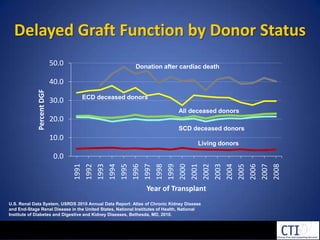
Delayed Graft Function by Donor Status Donation after cardiac deathECD deceased donorsAll deceased donorsSCD deceased donorsLiving donorsU.S. Renal Data System, USRDS 2010 Annual Data Report: Atlas of Chronic Kidney Disease and End-Stage Renal Disease in the United States, National Institutes of Health, National Institute of Diabetes and Digestive and Kidney Diseases, Bethesda, MD, 2010.
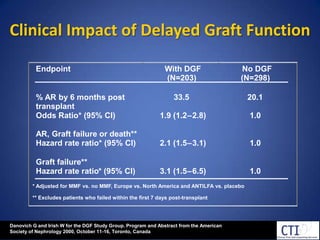
EndpointWith DGFNo DGF(N=203)(N=298)% AR by 6 months post-33.520.1transplantOdds Ratio* (95% CI) 1.9 (1.2 – 2.8)1.0AR, Graft failure or death**Hazard rate ratio* (95% CI)2.1 (1.5 – 3.1)1.0Graft failure**Hazard rate ratio* (95% CI)3.1 (1.5 – 6.5)1.0* Adjusted for MMF vs. no MMF, Europe vs. North America and ANTILFA vs. placebo ** Excludes patients who failed within the first 7 days post-transplantClinical Impact of Delayed Graft FunctionDanovich G and Irish W for the DGF Study Group. Program and Abstract from the American Society of Nephrology 2000, October 11-16, Toronto, Canada
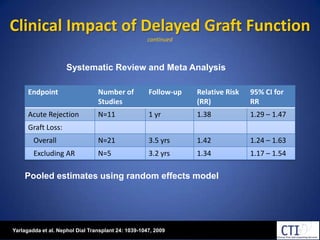
Clinical Impact of Delayed Graft Function continuedSystematic Review and Meta AnalysisPooled estimates using random effects modelYarlagadda et al. Nephol Dial Transplant 24: 1039-1047, 2009
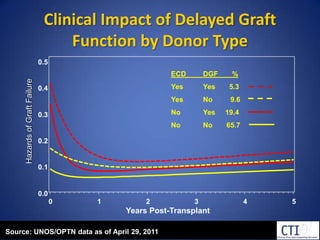
Clinical Impact of Delayed Graft Function by Donor Type0.5ECD 	DGF       %Yes	Yes       5.3Yes	No         9.6No	Yes     19.4No	No       65.70.40.3Hazards of Graft Failure0.20.10.0012345Years Post-TransplantSource: UNOS/OPTN data as of April 29, 2011
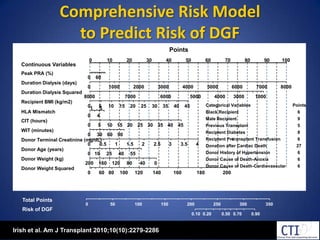
  0 10 20 30 40 50 60 70 80 90100Continuous VariablesPeak PRA (%)060Duration Dialysis (days)010002000300040005000600070008000Duration Dialysis Squared8000700060005000400030001000Recipient BMI (kg/m2)05101520253035404515HLA Mismatch04CIT (hours)051015202530354045WIT (minutes)0306090Donor Terminal Creatinine (mg/dL)00.511.522.533.54Donor Age (years)010254055Donor Weight (kg)20016012080400Donor Weight Squared06080100120140Comprehensive Risk Model to Predict Risk of DGFPointsPointsCategorical Variables6Black Recipient9Male Recipient5Previous Transplant8Recipient Diabetes6Recipient Pre-transplant Transfusion27Donation after Cardiac Death6Donor History of Hypertension6Donor Cause of Death-Anoxia6Donor Cause of Death-Cardiovascular160180200Total Points  0 50100150200250300350Risk of DGF0.100.200.500.700.90Irish et al. Am J Transplant 2010;10(10):2279-2286
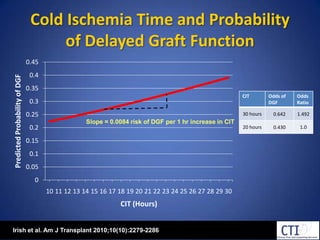
Cold Ischemia Time and Probabilityof Delayed Graft FunctionSlope = 0.0084 risk of DGF per 1 hr increase in CITIrish et al. Am J Transplant 2010;10(10):2279-2286
Potential Role of Warm Ischemia Timeas a Risk Factor for DGFWarm ischemic time associated with DCD transplants*Time from circulatory arrest until start of cold perfusion and grouped by 10 minute intervals with <10 minutes as reference# Adjusted for donor - and recipient characteristics and type of preservation method (machine perfusion versus static cold storage)Jochmans  et al. Ann Surg 2010; 252:756-764
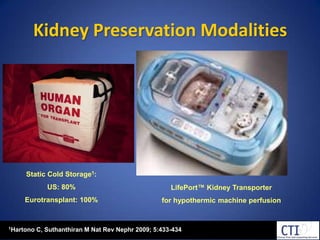
Kidney Preservation ModalitiesStatic Cold Storage1:US: 80%Eurotransplant: 100%LifePort™ Kidney Transporterfor hypothermic machine perfusion1Hartono C, Suthanthiran M Nat Rev Nephr 2009; 5:433-434
Static Cold Storage
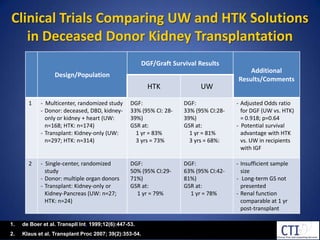
Clinical Trials Comparing UW and HTK Solutionsin Deceased Donor Kidney Transplantationde Boer et al. Transpll Int. 1999;12(6):447-53.Klaus et al. Transplant Proc 2007; 39(2):353-54.
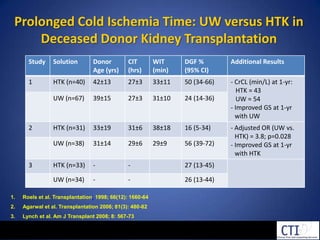
Prolonged Cold Ischemia Time: UW versus HTK in Deceased Donor Kidney TransplantationRoels et al. Transplantation. 1998; 66(12): 1660-64Agarwal et al. Transplantation 2006; 81(3): 480-82Lynch et al. Am J Transplant 2008; 8: 567-73
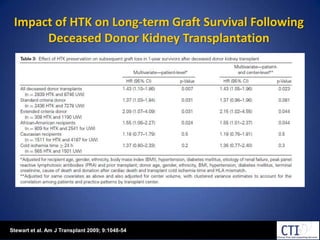
Impact of HTK on Long-term Graft Survival Following Deceased Donor Kidney TransplantationStewart et al. Am J Transplant 2009; 9:1048-54
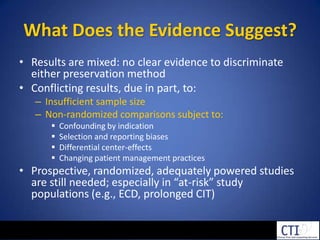
What Does the Evidence Suggest?Results are mixed: no clear evidence to discriminate either preservation method Conflicting results, due in part, to:Insufficient sample sizeNon-randomized comparisons subject to:Confounding by indicationSelection and reporting biasesDifferential center-effectsChanging patient management practicesProspective, randomized, adequately powered studies are still needed; especially in “at-risk” study populations (e.g., ECD, prolonged CIT)
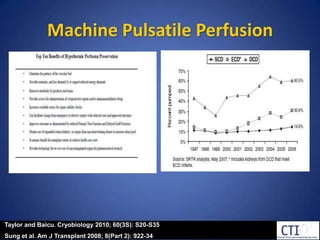
Machine Pulsatile Perfusion Taylor and Baicu. Cryobiology 2010; 60(3S): S20-S35Sung et al. Am J Transplant 2008; 8(Part 2): 922-34
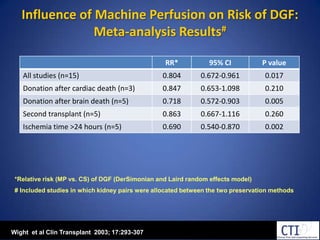
Influence of Machine Perfusion on Risk of DGF: Meta-analysis Results#*Relative risk (MP vs. CS) of DGF (DerSimonian and Laird random effects model)# Included studies in which kidney pairs were allocated between the two preservation methodsWight  et al Clin Transplant  2003; 17:293-307
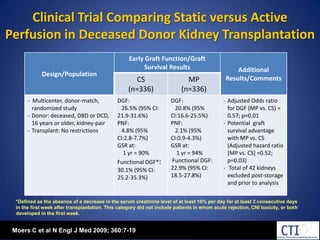
Clinical Trial Comparing Static versus Active Perfusion in Deceased Donor Kidney Transplantation*Defined as the absence of a decrease in the serum creatinine level of at least 10% per day for at least 3 consecutive daysin the first week after transplantation. This category did not include patients in whom acute rejection, CNI toxicity, or bothdeveloped in the first week.Moers C et al N Engl J Med 2009; 360:7-19
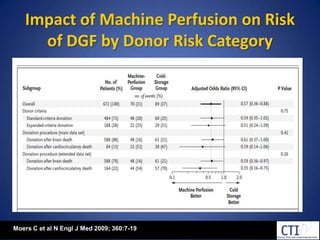
Impact of Machine Perfusion on Risk of DGF by Donor Risk CategoryMoers C et al N Engl J Med 2009; 360:7-19
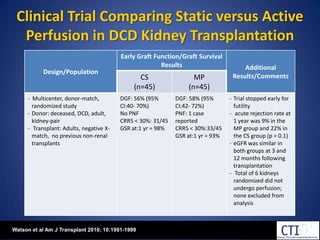
Clinical Trial Comparing Static versus Active Perfusion in DCD Kidney TransplantationWatson et al Am J Transplant 2010; 10:1991-1999
Unanswered Questions
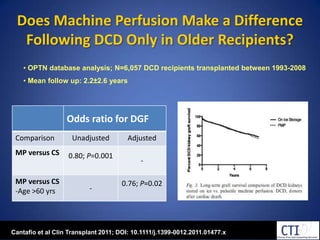
Does Machine Perfusion Make a Difference Following DCD Only in Older Recipients? OPTN database analysis; N=6,057 DCD recipients transplanted between 1993-2008
 Mean follow up: 2.2±2.6 yearsCantafio et al Clin Transplant 2011; DOI: 10.1111/j.1399-0012.2011.01477.x
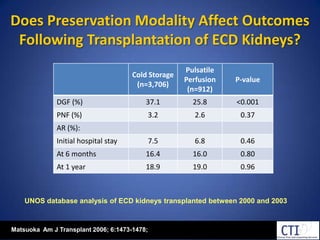
Does Preservation Modality Affect Outcomes Following Transplantation of ECD Kidneys?UNOS database analysis of ECD kidneys transplanted between 2000 and 2003Matsuoka  Am J Transplant 2006; 6:1473-1478;
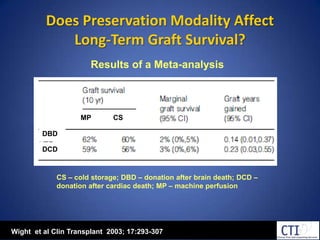
Does Preservation Modality AffectLong-Term Graft Survival?Results of a Meta-analysis         MP           CSDBDDCDCS – cold storage; DBD – donation after brain death; DCD – donation after cardiac death; MP – machine perfusion Wight  et al Clin Transplant  2003; 17:293-307
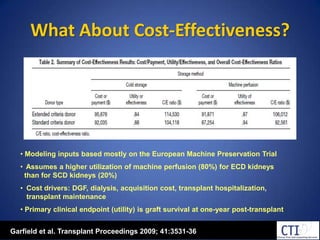
What About Cost-Effectiveness? Modeling inputs based mostly on the European Machine Preservation Trial
 Assumes a higher utilization of machine perfusion (80%) for ECD kidneys  than for SCD kidneys (20%)
Cost drivers: DGF, dialysis, acquisition cost, transplant hospitalization, transplant maintenance

Fda Iri Dgf Workshop 09 Sep2011 W Irish

  • 1.
    Cold Machine Perfusionversus Static Cold Storage for SCD, ECD and DCD KidneysSession 6: Devices for Kidney Flushing, Transport and PreservationWilliam Irish, PhDCTI Clinical Trial and Consulting ServicesSeptember 9, 2011
  • 2.
  • 3.
    OutlineDelayed graft functionIncidenceand clinical impactRisk factors – role of ischemia time Kidney preservationPreservation solutionsStorage modalities – cold storage vs. machine perfusionOutcomesCost-effectivenessSources of variabilityUnanswered questions/unresolved issuesApproaching resolution
  • 4.
    Delayed Graft Functionby Donor Status Donation after cardiac deathECD deceased donorsAll deceased donorsSCD deceased donorsLiving donorsU.S. Renal Data System, USRDS 2010 Annual Data Report: Atlas of Chronic Kidney Disease and End-Stage Renal Disease in the United States, National Institutes of Health, National Institute of Diabetes and Digestive and Kidney Diseases, Bethesda, MD, 2010.
  • 5.
    EndpointWith DGFNo DGF(N=203)(N=298)%AR by 6 months post-33.520.1transplantOdds Ratio* (95% CI) 1.9 (1.2 – 2.8)1.0AR, Graft failure or death**Hazard rate ratio* (95% CI)2.1 (1.5 – 3.1)1.0Graft failure**Hazard rate ratio* (95% CI)3.1 (1.5 – 6.5)1.0* Adjusted for MMF vs. no MMF, Europe vs. North America and ANTILFA vs. placebo ** Excludes patients who failed within the first 7 days post-transplantClinical Impact of Delayed Graft FunctionDanovich G and Irish W for the DGF Study Group. Program and Abstract from the American Society of Nephrology 2000, October 11-16, Toronto, Canada
  • 6.
    Clinical Impact ofDelayed Graft Function continuedSystematic Review and Meta AnalysisPooled estimates using random effects modelYarlagadda et al. Nephol Dial Transplant 24: 1039-1047, 2009
  • 7.
    Clinical Impact ofDelayed Graft Function by Donor Type0.5ECD DGF %Yes Yes 5.3Yes No 9.6No Yes 19.4No No 65.70.40.3Hazards of Graft Failure0.20.10.0012345Years Post-TransplantSource: UNOS/OPTN data as of April 29, 2011
  • 8.
    010 20 30 40 50 60 70 80 90100Continuous VariablesPeak PRA (%)060Duration Dialysis (days)010002000300040005000600070008000Duration Dialysis Squared8000700060005000400030001000Recipient BMI (kg/m2)05101520253035404515HLA Mismatch04CIT (hours)051015202530354045WIT (minutes)0306090Donor Terminal Creatinine (mg/dL)00.511.522.533.54Donor Age (years)010254055Donor Weight (kg)20016012080400Donor Weight Squared06080100120140Comprehensive Risk Model to Predict Risk of DGFPointsPointsCategorical Variables6Black Recipient9Male Recipient5Previous Transplant8Recipient Diabetes6Recipient Pre-transplant Transfusion27Donation after Cardiac Death6Donor History of Hypertension6Donor Cause of Death-Anoxia6Donor Cause of Death-Cardiovascular160180200Total Points 0 50100150200250300350Risk of DGF0.100.200.500.700.90Irish et al. Am J Transplant 2010;10(10):2279-2286
  • 9.
    Cold Ischemia Timeand Probabilityof Delayed Graft FunctionSlope = 0.0084 risk of DGF per 1 hr increase in CITIrish et al. Am J Transplant 2010;10(10):2279-2286
  • 10.
    Potential Role ofWarm Ischemia Timeas a Risk Factor for DGFWarm ischemic time associated with DCD transplants*Time from circulatory arrest until start of cold perfusion and grouped by 10 minute intervals with <10 minutes as reference# Adjusted for donor - and recipient characteristics and type of preservation method (machine perfusion versus static cold storage)Jochmans et al. Ann Surg 2010; 252:756-764
  • 11.
    Kidney Preservation ModalitiesStaticCold Storage1:US: 80%Eurotransplant: 100%LifePort™ Kidney Transporterfor hypothermic machine perfusion1Hartono C, Suthanthiran M Nat Rev Nephr 2009; 5:433-434
  • 12.
  • 13.
    Clinical Trials ComparingUW and HTK Solutionsin Deceased Donor Kidney Transplantationde Boer et al. Transpll Int. 1999;12(6):447-53.Klaus et al. Transplant Proc 2007; 39(2):353-54.
  • 14.
    Prolonged Cold IschemiaTime: UW versus HTK in Deceased Donor Kidney TransplantationRoels et al. Transplantation. 1998; 66(12): 1660-64Agarwal et al. Transplantation 2006; 81(3): 480-82Lynch et al. Am J Transplant 2008; 8: 567-73
  • 15.
    Impact of HTKon Long-term Graft Survival Following Deceased Donor Kidney TransplantationStewart et al. Am J Transplant 2009; 9:1048-54
  • 16.
    What Does theEvidence Suggest?Results are mixed: no clear evidence to discriminate either preservation method Conflicting results, due in part, to:Insufficient sample sizeNon-randomized comparisons subject to:Confounding by indicationSelection and reporting biasesDifferential center-effectsChanging patient management practicesProspective, randomized, adequately powered studies are still needed; especially in “at-risk” study populations (e.g., ECD, prolonged CIT)
  • 17.
    Machine Pulsatile PerfusionTaylor and Baicu. Cryobiology 2010; 60(3S): S20-S35Sung et al. Am J Transplant 2008; 8(Part 2): 922-34
  • 18.
    Influence of MachinePerfusion on Risk of DGF: Meta-analysis Results#*Relative risk (MP vs. CS) of DGF (DerSimonian and Laird random effects model)# Included studies in which kidney pairs were allocated between the two preservation methodsWight et al Clin Transplant 2003; 17:293-307
  • 19.
    Clinical Trial ComparingStatic versus Active Perfusion in Deceased Donor Kidney Transplantation*Defined as the absence of a decrease in the serum creatinine level of at least 10% per day for at least 3 consecutive daysin the first week after transplantation. This category did not include patients in whom acute rejection, CNI toxicity, or bothdeveloped in the first week.Moers C et al N Engl J Med 2009; 360:7-19
  • 20.
    Impact of MachinePerfusion on Risk of DGF by Donor Risk CategoryMoers C et al N Engl J Med 2009; 360:7-19
  • 21.
    Clinical Trial ComparingStatic versus Active Perfusion in DCD Kidney TransplantationWatson et al Am J Transplant 2010; 10:1991-1999
  • 22.
  • 23.
    Does Machine PerfusionMake a Difference Following DCD Only in Older Recipients? OPTN database analysis; N=6,057 DCD recipients transplanted between 1993-2008
  • 24.
    Mean followup: 2.2±2.6 yearsCantafio et al Clin Transplant 2011; DOI: 10.1111/j.1399-0012.2011.01477.x
  • 25.
    Does Preservation ModalityAffect Outcomes Following Transplantation of ECD Kidneys?UNOS database analysis of ECD kidneys transplanted between 2000 and 2003Matsuoka Am J Transplant 2006; 6:1473-1478;
  • 26.
    Does Preservation ModalityAffectLong-Term Graft Survival?Results of a Meta-analysis MP CSDBDDCDCS – cold storage; DBD – donation after brain death; DCD – donation after cardiac death; MP – machine perfusion Wight et al Clin Transplant 2003; 17:293-307
  • 27.
    What About Cost-Effectiveness?Modeling inputs based mostly on the European Machine Preservation Trial
  • 28.
    Assumes ahigher utilization of machine perfusion (80%) for ECD kidneys than for SCD kidneys (20%)
  • 29.
    Cost drivers: DGF,dialysis, acquisition cost, transplant hospitalization, transplant maintenance