1107
mpspg.com/
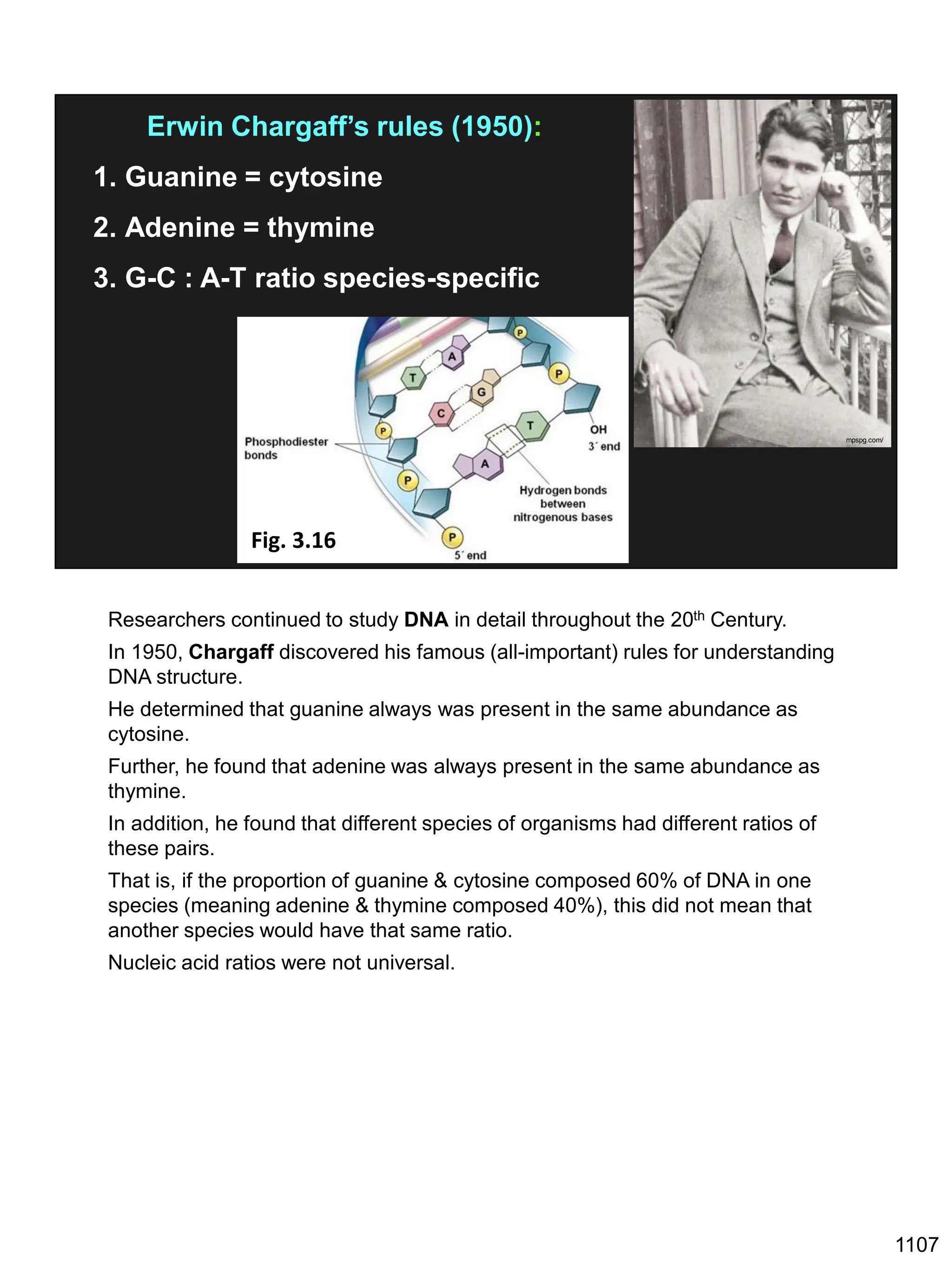
Erwin Chargaff’s rules (1950):
1. Guanine = cytosine
2. Adenine = thymine
3. G-C : A-T ratio species-specific
Fig. 3.16
Researchers continued to study DNA in detail throughout the 20th Century.
In 1950, Chargaff discovered his famous (all-important) rules for understanding
DNA structure.
He determined that guanine always was present in the same abundance as
cytosine.
Further, he found that adenine was always present in the same abundance as
thymine.
In addition, he found that different species of organisms had different ratios of
these pairs.
That is, if the proportion of guanine & cytosine composed 60% of DNA in one
species (meaning adenine & thymine composed 40%), this did not mean that
another species would have that same ratio.
Nucleic acid ratios were not universal.
1108
http://2.bp.blogspot.com
askabiologist.asu.edu
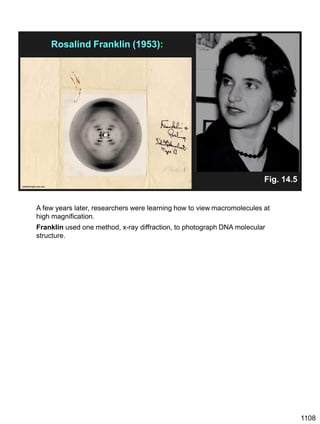
Rosalind Franklin (1953):
Fig. 14.5
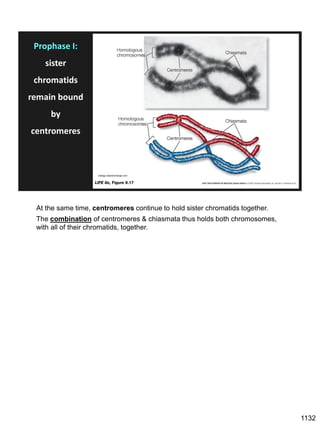
A few years later, researchers were learning how to view macromolecules at
high magnification.
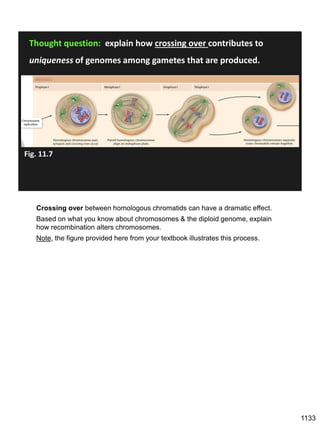
Franklin used one method, x-ray diffraction, to photograph DNA molecular
structure.
1109
James Watson
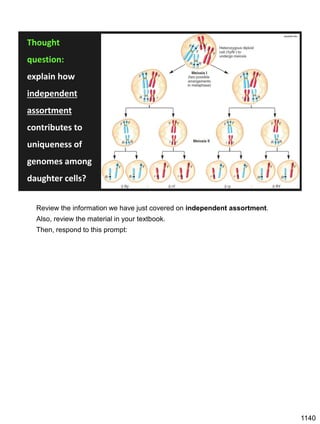
& Francis Crick
(1953):
Fig.
14.6
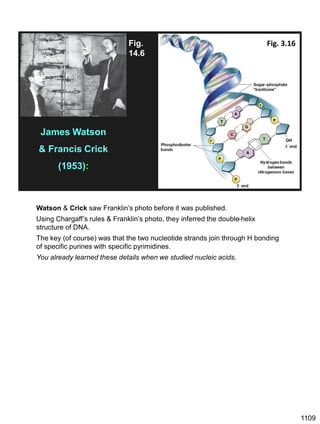
Fig. 3.16
Watson & Crick saw Franklin’s photo before it was published.
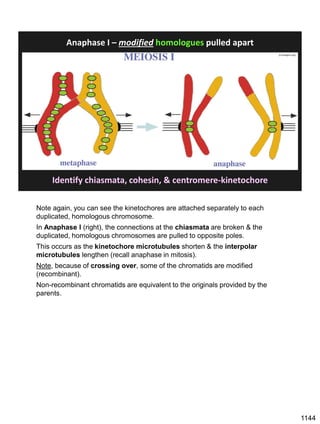
Using Chargaff’s rules & Franklin’s photo, they inferred the double-helix
structure of DNA.
The key (of course) was that the two nucleotide strands join through H bonding
of specific purines with specific pyrimidines.
You already learned these details when we studied nucleic acids.
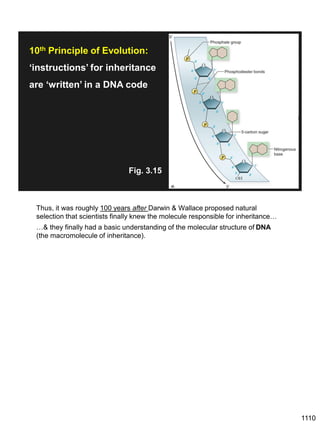
10th Principle of Evolution:
‘instructions’ for inheritance
are ‘written’ in a DNA code
Fig. 3.15
Thus, it was roughly 100 years after Darwin & Wallace proposed natural
selection that scientists finally knew the molecule responsible for inheritance…
…& they finally had a basic understanding of the molecular structure of DNA
(the macromolecule of inheritance).
1110
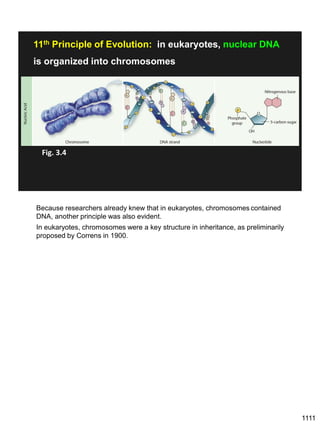
11th Principle of Evolution: in eukaryotes, nuclear DNA
is organized into chromosomes
Fig. 3.4
Because researchers already knew that in eukaryotes, chromosomes contained
DNA, another principle was also evident.
In eukaryotes, chromosomes were a key structure in inheritance, as preliminarily
proposed by Correns in 1900.
1111
1112
Thought question:
Why didn’t Darwin
or Wallace
propose these
additional
principles?
www.ashbe.org
To reflect one more time on the process of science, consider why neither Darwin
nor Wallace were able to propose these 10th & 11th principles when they
proposed natural selection?
1113
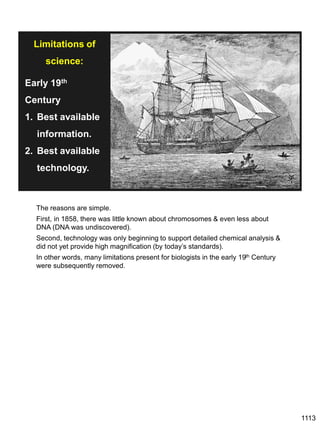
Early 19th
Century
1. Best available
information.
2. Best available
technology.
Wikipedia
medium.com
Limitations of
science:
The reasons are simple.
First, in 1858, there was little known about chromosomes & even less about
DNA (DNA was undiscovered).
Second, technology was only beginning to support detailed chemical analysis &
did not yet provide high magnification (by today’s standards).
In other words, many limitations present for biologists in the early 19th Century
were subsequently removed.
1114
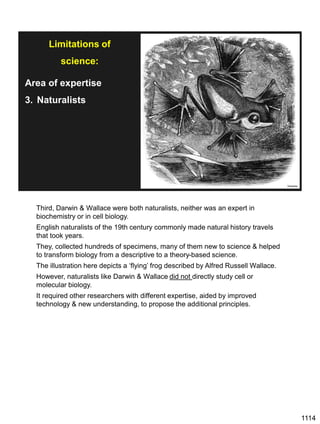
Area of expertise
3. Naturalists
Wikipedia
medium.com
Limitations of
science:
Third, Darwin & Wallace were both naturalists, neither was an expert in
biochemistry or in cell biology.
English naturalists of the 19th century commonly made natural history travels
that took years.
They, collected hundreds of specimens, many of them new to science & helped
to transform biology from a descriptive to a theory-based science.
The illustration here depicts a ‘flying’ frog described by Alfred Russell Wallace.
However, naturalists like Darwin & Wallace did not directly study cell or
molecular biology.
It required other researchers with different expertise, aided by improved
technology & new understanding, to propose the additional principles.
1115
www.goodreads.com
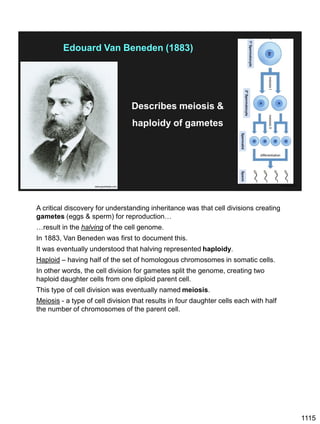
Edouard Van Beneden (1883)
alchetron.com
Describes meiosis &
haploidy of gametes
A critical discovery for understanding inheritance was that cell divisions creating
gametes (eggs & sperm) for reproduction…
…result in the halving of the cell genome.
In 1883, Van Beneden was first to document this.
It was eventually understood that halving represented haploidy.
Haploid – having half of the set of homologous chromosomes in somatic cells.
In other words, the cell division for gametes split the genome, creating two
haploid daughter cells from one diploid parent cell.
This type of cell division was eventually named meiosis.
Meiosis - a type of cell division that results in four daughter cells each with half
the number of chromosomes of the parent cell.
1116
www.scielo.br/
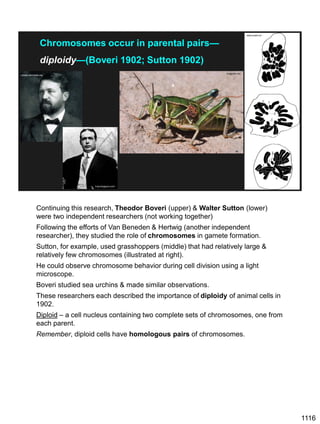
Chromosomes occur in parental pairs—
diploidy—(Boveri 1902; Sutton 1902)
bugguide.net/
4.bp.blogspot.com/
upload.wikimedia.org
Continuing this research, Theodor Boveri (upper) & Walter Sutton (lower)
were two independent researchers (not working together)
Following the efforts of Van Beneden & Hertwig (another independent
researcher), they studied the role of chromosomes in gamete formation.
Sutton, for example, used grasshoppers (middle) that had relatively large &
relatively few chromosomes (illustrated at right).
He could observe chromosome behavior during cell division using a light
microscope.
Boveri studied sea urchins & made similar observations.
These researchers each described the importance of diploidy of animal cells in
1902.
Diploid – a cell nucleus containing two complete sets of chromosomes, one from
each parent.
Remember, diploid cells have homologous pairs of chromosomes.
1117
http://images.slideplayer.com/
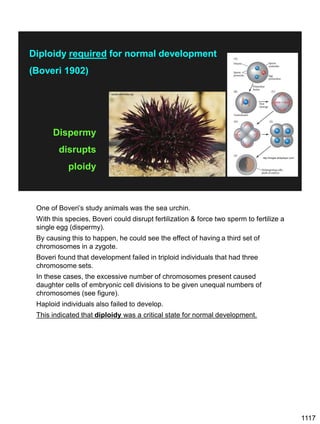
Diploidy required for normal development
(Boveri 1902)
upload.wikimedia.org/
Dispermy
disrupts
ploidy
One of Boveri’s study animals was the sea urchin.
With this species, Boveri could disrupt fertilization & force two sperm to fertilize a
single egg (dispermy).
By causing this to happen, he could see the effect of having a third set of
chromosomes in a zygote.
Boveri found that development failed in triploid individuals that had three
chromosome sets.
In these cases, the excessive number of chromosomes present caused
daughter cells of embryonic cell divisions to be given unequal numbers of
chromosomes (see figure).
Haploid individuals also failed to develop.
This indicated that diploidy was a critical state for normal development.
1118
www.thoughtco.com
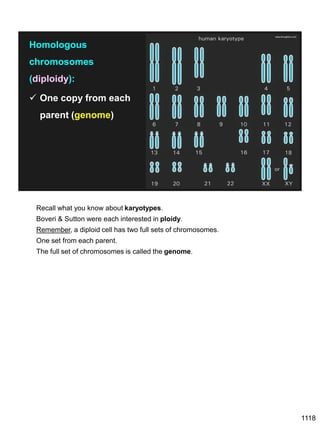
Homologous
chromosomes
(diploidy):
✓ One copy from each
parent (genome)
Recall what you know about karyotypes.
Boveri & Sutton were each interested in ploidy.
Remember, a diploid cell has two full sets of chromosomes.
One set from each parent.
The full set of chromosomes is called the genome.
www.issfguidebooks.org
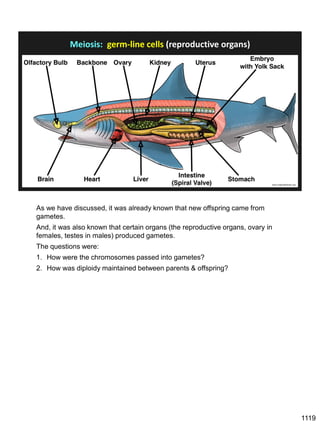
Meiosis: germ-line cells (reproductive organs)
As we have discussed, it was already known that new offspring came from
gametes.
And, it was also known that certain organs (the reproductive organs, ovary in
females, testes in males) produced gametes.
The questions were:
1. How were the chromosomes passed into gametes?
2. How was diploidy maintained between parents & offspring?
1119
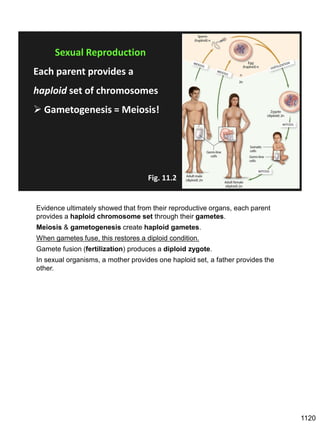
Sexual Reproduction
Each parent provides a
haploid set of chromosomes
➢ Gametogenesis = Meiosis!
Fig. 11.2
Evidence ultimately showed that from their reproductive organs, each parent
provides a haploid chromosome set through their gametes.
Meiosis & gametogenesis create haploid gametes.
When gametes fuse, this restores a diploid condition.
Gamete fusion (fertilization) produces a diploid zygote.
In sexual organisms, a mother provides one haploid set, a father provides the
other.
1120
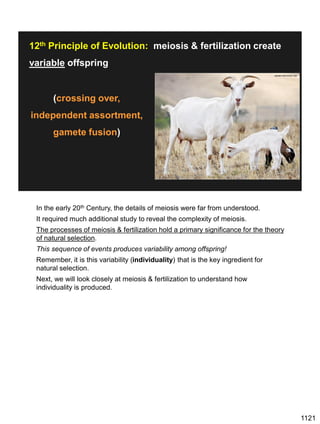
12th Principle of Evolution: meiosis & fertilization create
variable offspring
upload.wikimedia.org/
(crossing over,
independent assortment,
gamete fusion)
In the early 20th Century, the details of meiosis were far from understood.
It required much additional study to reveal the complexity of meiosis.
The processes of meiosis & fertilization hold a primary significance for the theory
of natural selection.
This sequence of events produces variability among offspring!
Remember, it is this variability (individuality) that is the key ingredient for
natural selection.
Next, we will look closely at meiosis & fertilization to understand how
individuality is produced.
1121
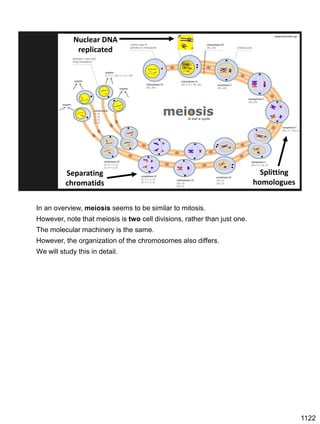
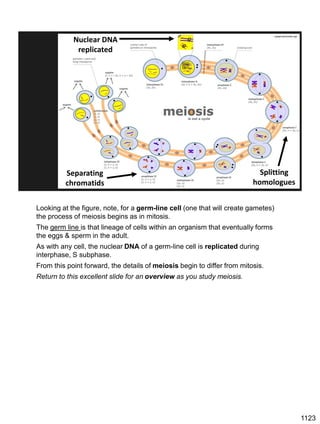
Nuclear DNA
replicated
upload.wikimedia.org/
Splitting
homologues
Separating
chromatids
In an overview, meiosis seems to be similar to mitosis.
However, note that meiosis is two cell divisions, rather than just one.
The molecular machinery is the same.
However, the organization of the chromosomes also differs.
We will study this in detail.
1122
Nuclear DNA
replicated
upload.wikimedia.org/
Splitting
homologues
Separating
chromatids
Looking at the figure, note, for a germ-line cell (one that will create gametes)
the process of meiosis begins as in mitosis.
The germ line is that lineage of cells within an organism that eventually forms
the eggs & sperm in the adult.
As with any cell, the nuclear DNA of a germ-line cell is replicated during
interphase, S subphase.
From this point forward, the details of meiosis begin to differ from mitosis.
Return to this excellent slide for an overview as you study meiosis.
1123
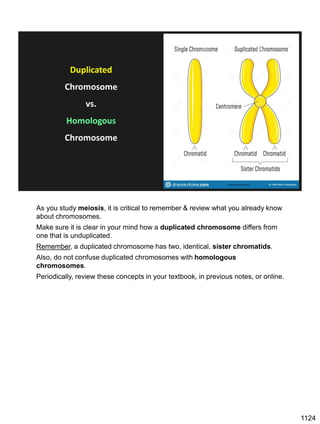
Duplicated
Chromosome
vs.
Homologous
Chromosome
www.dreamstime.com
As you study meiosis, it is critical to remember & review what you already know
about chromosomes.
Make sure it is clear in your mind how a duplicated chromosome differs from
one that is unduplicated.
Remember, a duplicated chromosome has two, identical, sister chromatids.
Also, do not confuse duplicated chromosomes with homologous
chromosomes.
Periodically, review these concepts in your textbook, in previous notes, or online.
1124
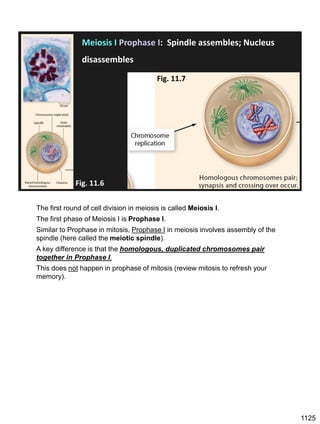
Meiosis I Prophase I: Spindle assembles; Nucleus
disassembles
Fig. 11.6
Fig. 11.7
The first round of cell division in meiosis is called Meiosis I.
The first phase of Meiosis I is Prophase I.
Similar to Prophase in mitosis, Prophase I in meiosis involves assembly of the
spindle (here called the meiotic spindle).
A key difference is that the homologous, duplicated chromosomes pair
together in Prophase I.
This does not happen in prophase of mitosis (review mitosis to refresh your
memory).
1125
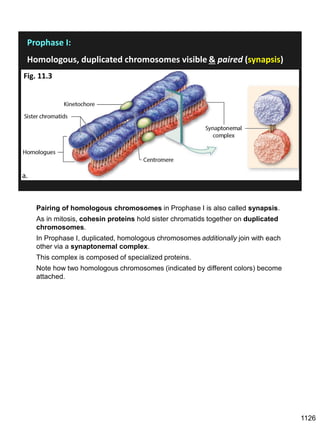
Prophase I:
Homologous, duplicated chromosomes visible & paired (synapsis)
Fig. 11.3
Pairing of homologous chromosomes in Prophase I is also called synapsis.
As in mitosis, cohesin proteins hold sister chromatids together on duplicated
chromosomes.
In Prophase I, duplicated, homologous chromosomes additionally join with each
other via a synaptonemal complex.
This complex is composed of specialized proteins.
Note how two homologous chromosomes (indicated by different colors) become
attached.
1126
Prophase I:
Recombination: homologous chromatids (non-sister chromatids)
exchange DNA segments
Page 221
During Prophase I, homologous chromosomes can swap segments!
This is called recombination because it mixes the DNA of one haploid set with
that of the other.
In other words, DNA of different parents, which is normally kept separate,
becomes mixed.
[this refers to the parents of the individual whose cells are in meiosis]
Note, in your textbook (as in this figure), homologous chromosomes descending
from different parents are color coded.
One parent is shown as red, the other as blue.
1127
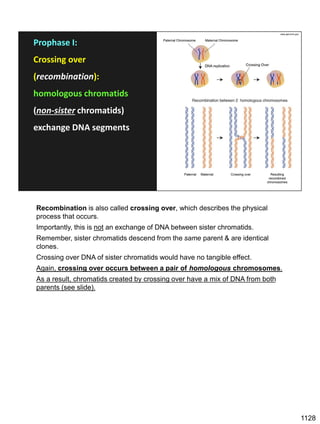
Prophase I:
Crossing over
(recombination):
homologous chromatids
(non-sister chromatids)
exchange DNA segments
www.genome.gov
Recombination is also called crossing over, which describes the physical
process that occurs.
Importantly, this is not an exchange of DNA between sister chromatids.
Remember, sister chromatids descend from the same parent & are identical
clones.
Crossing over DNA of sister chromatids would have no tangible effect.
Again, crossing over occurs between a pair of homologous chromosomes.
As a result, chromatids created by crossing over have a mix of DNA from both
parents (see slide).
1128
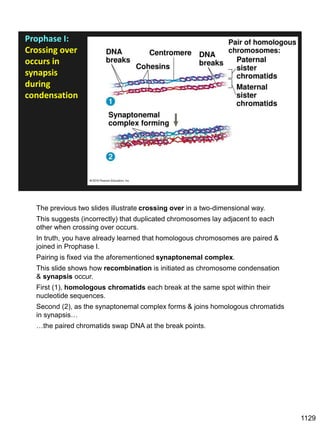
Prophase I:
Crossing over
occurs in
synapsis
during
condensation
The previous two slides illustrate crossing over in a two-dimensional way.
This suggests (incorrectly) that duplicated chromosomes lay adjacent to each
other when crossing over occurs.
In truth, you have already learned that homologous chromosomes are paired &
joined in Prophase I.
Pairing is fixed via the aforementioned synaptonemal complex.
This slide shows how recombination is initiated as chromosome condensation
& synapsis occur.
First (1), homologous chromatids each break at the same spot within their
nucleotide sequences.
Second (2), as the synaptonemal complex forms & joins homologous chromatids
in synapsis…
…the paired chromatids swap DNA at the break points.
1129
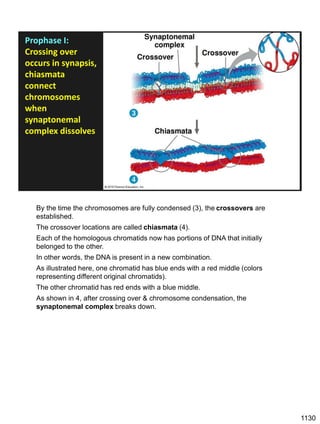
Prophase I:
Crossing over
occurs in synapsis,
chiasmata
connect
chromosomes
when
synaptonemal
complex dissolves
By the time the chromosomes are fully condensed (3), the crossovers are
established.
The crossover locations are called chiasmata (4).
Each of the homologous chromatids now has portions of DNA that initially
belonged to the other.
In other words, the DNA is present in a new combination.
As illustrated here, one chromatid has blue ends with a red middle (colors
representing different original chromatids).
The other chromatid has red ends with a blue middle.
As shown in 4, after crossing over & chromosome condensation, the
synaptonemal complex breaks down.
1130
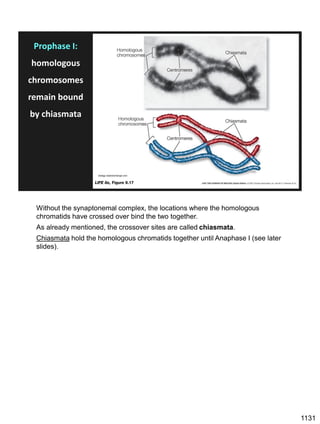
Prophase I:
homologous
chromosomes
remain bound
by chiasmata
biology.stackexchange.com
Without the synaptonemal complex, the locations where the homologous
chromatids have crossed over bind the two together.
As already mentioned, the crossover sites are called chiasmata.
Chiasmata hold the homologous chromatids together until Anaphase I (see later
slides).
1131
Prophase I:
sister
chromatids
remain bound
by
centromeres
biology.stackexchange.com
At the same time, centromeres continue to hold sister chromatids together.
The combination of centromeres & chiasmata thus holds both chromosomes,
with all of their chromatids, together.
1132
Thought question: explain how crossing over contributes to
uniqueness of genomes among gametes that are produced.
Fig. 11.7
Crossing over between homologous chromatids can have a dramatic effect.
Based on what you know about chromosomes & the diploid genome, explain
how recombination alters chromosomes.
Note, the figure provided here from your textbook illustrates this process.
1133
evolution.gs.washington.edu
Crossing over:
creates
recombinant
chromatids
Sister chromatids
may differ!
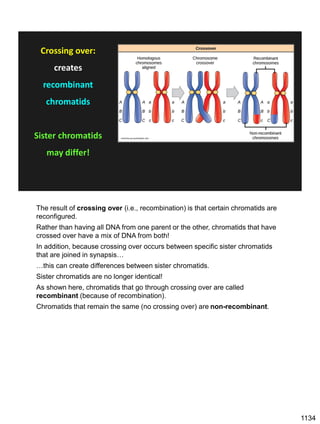
The result of crossing over (i.e., recombination) is that certain chromatids are
reconfigured.
Rather than having all DNA from one parent or the other, chromatids that have
crossed over have a mix of DNA from both!
In addition, because crossing over occurs between specific sister chromatids
that are joined in synapsis…
…this can create differences between sister chromatids.
Sister chromatids are no longer identical!
As shown here, chromatids that go through crossing over are called
recombinant (because of recombination).
Chromatids that remain the same (no crossing over) are non-recombinant.
1134
www.scienceabc.com
Crossing over:
creates ‘new’
chromosomes!
Sister chromatids
may differ!
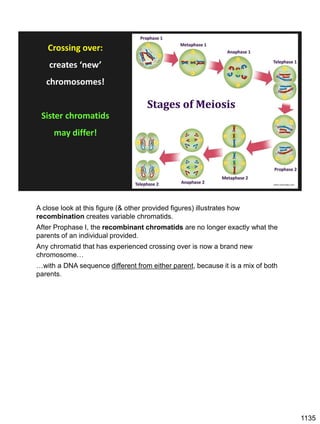
A close look at this figure (& other provided figures) illustrates how
recombination creates variable chromatids.
After Prophase I, the recombinant chromatids are no longer exactly what the
parents of an individual provided.
Any chromatid that has experienced crossing over is now a brand new
chromosome…
…with a DNA sequence different from either parent, because it is a mix of both
parents.
1135
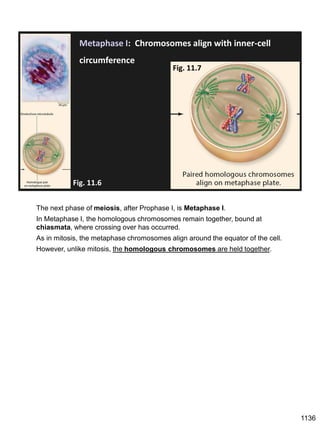
Metaphase I: Chromosomes align with inner-cell
circumference
Fig. 11.7
Fig. 11.6
The next phase of meiosis, after Prophase I, is Metaphase I.
In Metaphase I, the homologous chromosomes remain together, bound at
chiasmata, where crossing over has occurred.
As in mitosis, the metaphase chromosomes align around the equator of the cell.
However, unlike mitosis, the homologous chromosomes are held together.
1136
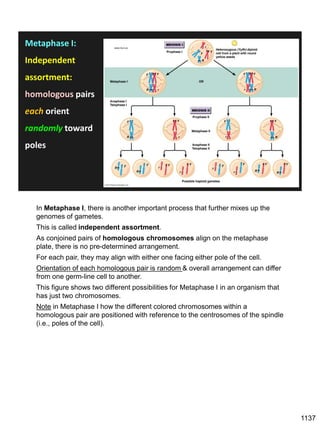
Metaphase I:
Independent
assortment:
homologous pairs
each orient
randomly toward
poles
www.mun.ca
In Metaphase I, there is another important process that further mixes up the
genomes of gametes.
This is called independent assortment.
As conjoined pairs of homologous chromosomes align on the metaphase
plate, there is no pre-determined arrangement.
For each pair, they may align with either one facing either pole of the cell.
Orientation of each homologous pair is random & overall arrangement can differ
from one germ-line cell to another.
This figure shows two different possibilities for Metaphase I in an organism that
has just two chromosomes.
Note in Metaphase I how the different colored chromosomes within a
homologous pair are positioned with reference to the centrosomes of the spindle
(i.e., poles of the cell).
1137
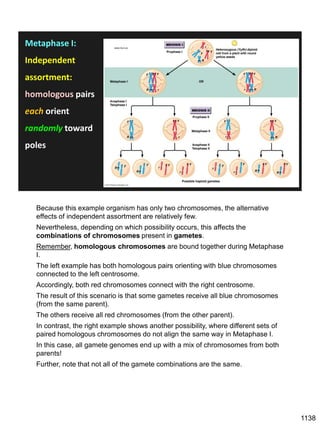
Metaphase I:
Independent
assortment:
homologous pairs
each orient
randomly toward
poles
www.mun.ca
Because this example organism has only two chromosomes, the alternative
effects of independent assortment are relatively few.
Nevertheless, depending on which possibility occurs, this affects the
combinations of chromosomes present in gametes.
Remember, homologous chromosomes are bound together during Metaphase
I.
The left example has both homologous pairs orienting with blue chromosomes
connected to the left centrosome.
Accordingly, both red chromosomes connect with the right centrosome.
The result of this scenario is that some gametes receive all blue chromosomes
(from the same parent).
The others receive all red chromosomes (from the other parent).
In contrast, the right example shows another possibility, where different sets of
paired homologous chromosomes do not align the same way in Metaphase I.
In this case, all gamete genomes end up with a mix of chromosomes from both
parents!
Further, note that not all of the gamete combinations are the same.
1138
www.dlt.ncssm.edu/
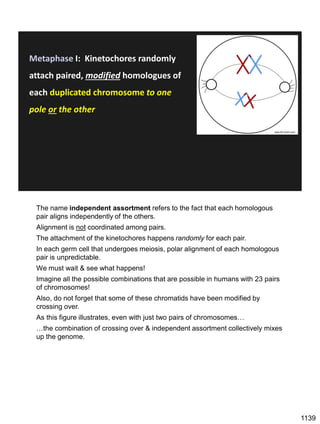
Metaphase I: Kinetochores randomly
attach paired, modified homologues of
each duplicated chromosome to one
pole or the other
The name independent assortment refers to the fact that each homologous
pair aligns independently of the others.
Alignment is not coordinated among pairs.
The attachment of the kinetochores happens randomly for each pair.
In each germ cell that undergoes meiosis, polar alignment of each homologous
pair is unpredictable.
We must wait & see what happens!
Imagine all the possible combinations that are possible in humans with 23 pairs
of chromosomes!
Also, do not forget that some of these chromatids have been modified by
crossing over.
As this figure illustrates, even with just two pairs of chromosomes…
…the combination of crossing over & independent assortment collectively mixes
up the genome.
1139
doctorlib.info
Thought
question:
explain how
independent
assortment
contributes to
uniqueness of
genomes among
daughter cells?
Review the information we have just covered on independent assortment.
Also, review the material in your textbook.
Then, respond to this prompt:
1140
1141
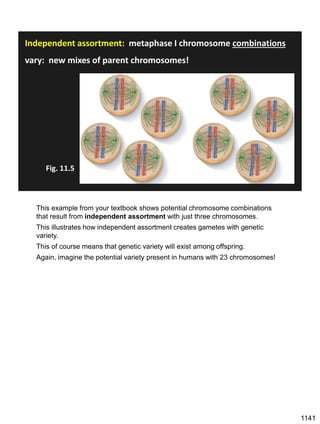
Independent assortment: metaphase I chromosome combinations
vary: new mixes of parent chromosomes!
Fig. 11.5
This example from your textbook shows potential chromosome combinations
that result from independent assortment with just three chromosomes.
This illustrates how independent assortment creates gametes with genetic
variety.
This of course means that genetic variety will exist among offspring.
Again, imagine the potential variety present in humans with 23 chromosomes!
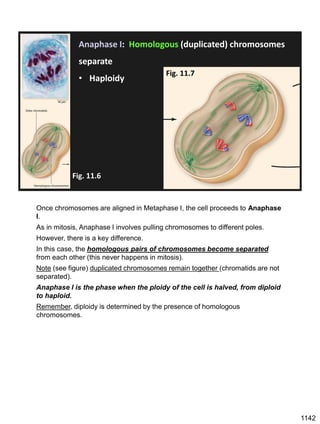
Anaphase I: Homologous (duplicated) chromosomes
separate
• Haploidy
Fig. 11.6
Fig. 11.7
Once chromosomes are aligned in Metaphase I, the cell proceeds to Anaphase
I.
As in mitosis, Anaphase I involves pulling chromosomes to different poles.
However, there is a key difference.
In this case, the homologous pairs of chromosomes become separated
from each other (this never happens in mitosis).
Note (see figure) duplicated chromosomes remain together (chromatids are not
separated).
Anaphase I is the phase when the ploidy of the cell is halved, from diploid
to haploid.
Remember, diploidy is determined by the presence of homologous
chromosomes.
1142
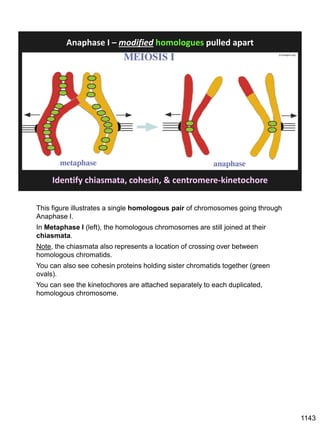
Anaphase I – modified homologues pulled apart
jcs.biologists.org/
Identify chiasmata, cohesin, & centromere-kinetochore
This figure illustrates a single homologous pair of chromosomes going through
Anaphase I.
In Metaphase I (left), the homologous chromosomes are still joined at their
chiasmata.
Note, the chiasmata also represents a location of crossing over between
homologous chromatids.
You can also see cohesin proteins holding sister chromatids together (green
ovals).
You can see the kinetochores are attached separately to each duplicated,
homologous chromosome.
1143
Anaphase I – modified homologues pulled apart
jcs.biologists.org/
Identify chiasmata, cohesin, & centromere-kinetochore
Note again, you can see the kinetochores are attached separately to each
duplicated, homologous chromosome.
In Anaphase I (right), the connections at the chiasmata are broken & the
duplicated, homologous chromosomes are pulled to opposite poles.
This occurs as the kinetochore microtubules shorten & the interpolar
microtubules lengthen (recall anaphase in mitosis).
Note, because of crossing over, some of the chromatids are modified
(recombinant).
Non-recombinant chromatids are equivalent to the originals provided by the
parents.
1144
Telophase I: Nuclear envelope reforms; cytokinesis
Fig. 11.6
Fig. 11.7
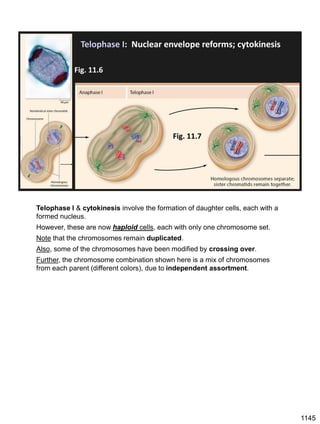
Telophase I & cytokinesis involve the formation of daughter cells, each with a
formed nucleus.
However, these are now haploid cells, each with only one chromosome set.
Note that the chromosomes remain duplicated.
Also, some of the chromosomes have been modified by crossing over.
Further, the chromosome combination shown here is a mix of chromosomes
from each parent (different colors), due to independent assortment.
1145
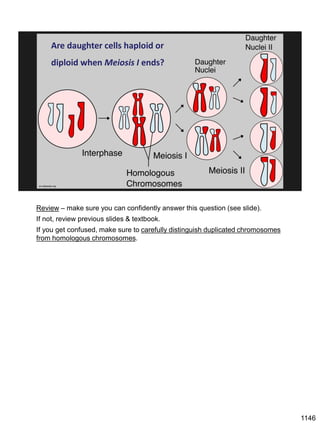
Are daughter cells haploid or
diploid when Meiosis I ends?
en.wikipedia.org
Review – make sure you can confidently answer this question (see slide).
If not, review previous slides & textbook.
If you get confused, make sure to carefully distinguish duplicated chromosomes
from homologous chromosomes.
1146
Haploid vs. diploid:
• homologous chromosomes
• not duplicated
chromosomes
Quizlet.com
Meiosis I:
reduction division
(ploidy reduced)
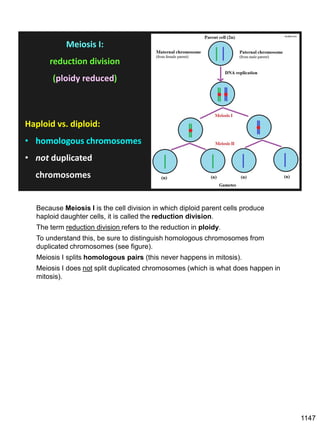
Because Meiosis I is the cell division in which diploid parent cells produce
haploid daughter cells, it is called the reduction division.
The term reduction division refers to the reduction in ploidy.
To understand this, be sure to distinguish homologous chromosomes from
duplicated chromosomes (see figure).
Meiosis I splits homologous pairs (this never happens in mitosis).
Meiosis I does not split duplicated chromosomes (which is what does happen in
mitosis).
1147
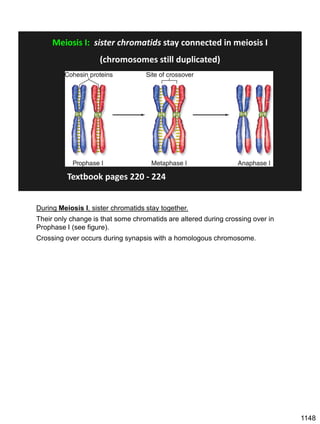
Meiosis I: sister chromatids stay connected in meiosis I
(chromosomes still duplicated)
Textbook pages 220 - 224
During Meiosis I, sister chromatids stay together.
Their only change is that some chromatids are altered during crossing over in
Prophase I (see figure).
Crossing over occurs during synapsis with a homologous chromosome.
1148
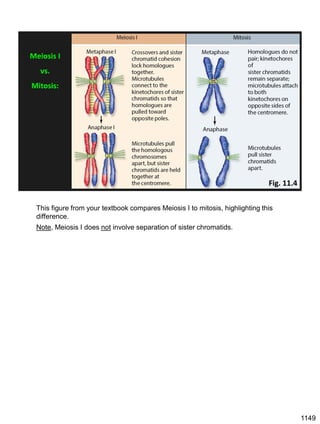
Meiosis I
vs.
Mitosis:
Fig. 11.4
This figure from your textbook compares Meiosis I to mitosis, highlighting this
difference.
Note, Meiosis I does not involve separation of sister chromatids.
1149
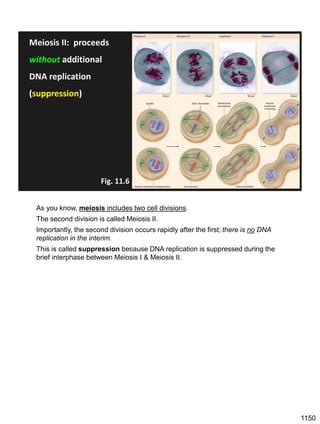
Meiosis II: proceeds
without additional
DNA replication
(suppression)
Fig. 11.6
As you know, meiosis includes two cell divisions.
The second division is called Meiosis II.
Importantly, the second division occurs rapidly after the first; there is no DNA
replication in the interim.
This is called suppression because DNA replication is suppressed during the
brief interphase between Meiosis I & Meiosis II.
1150
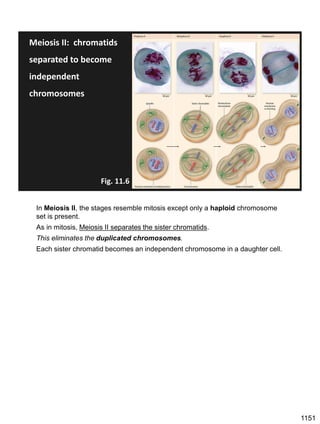
Meiosis II: chromatids
separated to become
independent
chromosomes
Fig. 11.6
In Meiosis II, the stages resemble mitosis except only a haploid chromosome
set is present.
As in mitosis, Meiosis II separates the sister chromatids.
This eliminates the duplicated chromosomes.
Each sister chromatid becomes an independent chromosome in a daughter cell.
1151
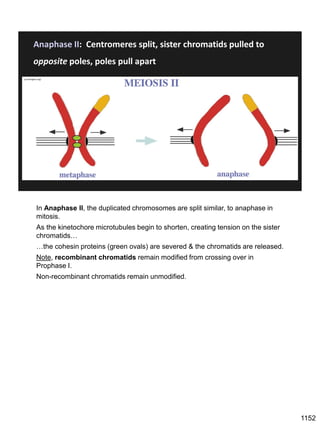
Anaphase II: Centromeres split, sister chromatids pulled to
opposite poles, poles pull apart
jcs.biologists.org/
In Anaphase II, the duplicated chromosomes are split similar, to anaphase in
mitosis.
As the kinetochore microtubules begin to shorten, creating tension on the sister
chromatids…
…the cohesin proteins (green ovals) are severed & the chromatids are released.
Note, recombinant chromatids remain modified from crossing over in
Prophase I.
Non-recombinant chromatids remain unmodified.
1152
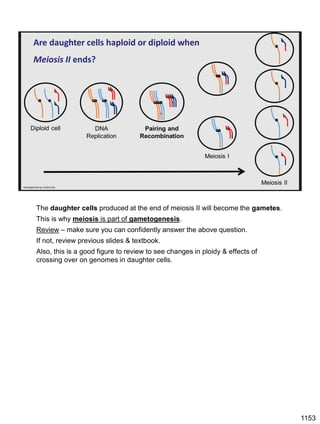
Are daughter cells haploid or diploid when
Meiosis II ends?
smburgess.faculty.ucdavis.edu
The daughter cells produced at the end of meiosis II will become the gametes.
This is why meiosis is part of gametogenesis.
Review – make sure you can confidently answer the above question.
If not, review previous slides & textbook.
Also, this is a good figure to review to see changes in ploidy & effects of
crossing over on genomes in daughter cells.
1153
End
Workshop 22
1154

Workshop22_Principles_Fall2023_Notes (1).pdf

  • 1.
    1107 mpspg.com/ Erwin Chargaff’s rules(1950): 1. Guanine = cytosine 2. Adenine = thymine 3. G-C : A-T ratio species-specific Fig. 3.16 Researchers continued to study DNA in detail throughout the 20th Century. In 1950, Chargaff discovered his famous (all-important) rules for understanding DNA structure. He determined that guanine always was present in the same abundance as cytosine. Further, he found that adenine was always present in the same abundance as thymine. In addition, he found that different species of organisms had different ratios of these pairs. That is, if the proportion of guanine & cytosine composed 60% of DNA in one species (meaning adenine & thymine composed 40%), this did not mean that another species would have that same ratio. Nucleic acid ratios were not universal.
  • 2.
    1108 http://2.bp.blogspot.com askabiologist.asu.edu Rosalind Franklin (1953): Fig.14.5 A few years later, researchers were learning how to view macromolecules at high magnification. Franklin used one method, x-ray diffraction, to photograph DNA molecular structure.
  • 3.
    1109 James Watson & FrancisCrick (1953): Fig. 14.6 Fig. 3.16 Watson & Crick saw Franklin’s photo before it was published. Using Chargaff’s rules & Franklin’s photo, they inferred the double-helix structure of DNA. The key (of course) was that the two nucleotide strands join through H bonding of specific purines with specific pyrimidines. You already learned these details when we studied nucleic acids.
  • 4.
    10th Principle ofEvolution: ‘instructions’ for inheritance are ‘written’ in a DNA code Fig. 3.15 Thus, it was roughly 100 years after Darwin & Wallace proposed natural selection that scientists finally knew the molecule responsible for inheritance… …& they finally had a basic understanding of the molecular structure of DNA (the macromolecule of inheritance). 1110
  • 5.
    11th Principle ofEvolution: in eukaryotes, nuclear DNA is organized into chromosomes Fig. 3.4 Because researchers already knew that in eukaryotes, chromosomes contained DNA, another principle was also evident. In eukaryotes, chromosomes were a key structure in inheritance, as preliminarily proposed by Correns in 1900. 1111
  • 6.
    1112 Thought question: Why didn’tDarwin or Wallace propose these additional principles? www.ashbe.org To reflect one more time on the process of science, consider why neither Darwin nor Wallace were able to propose these 10th & 11th principles when they proposed natural selection?
  • 7.
    1113 Early 19th Century 1. Bestavailable information. 2. Best available technology. Wikipedia medium.com Limitations of science: The reasons are simple. First, in 1858, there was little known about chromosomes & even less about DNA (DNA was undiscovered). Second, technology was only beginning to support detailed chemical analysis & did not yet provide high magnification (by today’s standards). In other words, many limitations present for biologists in the early 19th Century were subsequently removed.
  • 8.
    1114 Area of expertise 3.Naturalists Wikipedia medium.com Limitations of science: Third, Darwin & Wallace were both naturalists, neither was an expert in biochemistry or in cell biology. English naturalists of the 19th century commonly made natural history travels that took years. They, collected hundreds of specimens, many of them new to science & helped to transform biology from a descriptive to a theory-based science. The illustration here depicts a ‘flying’ frog described by Alfred Russell Wallace. However, naturalists like Darwin & Wallace did not directly study cell or molecular biology. It required other researchers with different expertise, aided by improved technology & new understanding, to propose the additional principles.
  • 9.
    1115 www.goodreads.com Edouard Van Beneden(1883) alchetron.com Describes meiosis & haploidy of gametes A critical discovery for understanding inheritance was that cell divisions creating gametes (eggs & sperm) for reproduction… …result in the halving of the cell genome. In 1883, Van Beneden was first to document this. It was eventually understood that halving represented haploidy. Haploid – having half of the set of homologous chromosomes in somatic cells. In other words, the cell division for gametes split the genome, creating two haploid daughter cells from one diploid parent cell. This type of cell division was eventually named meiosis. Meiosis - a type of cell division that results in four daughter cells each with half the number of chromosomes of the parent cell.
  • 10.
    1116 www.scielo.br/ Chromosomes occur inparental pairs— diploidy—(Boveri 1902; Sutton 1902) bugguide.net/ 4.bp.blogspot.com/ upload.wikimedia.org Continuing this research, Theodor Boveri (upper) & Walter Sutton (lower) were two independent researchers (not working together) Following the efforts of Van Beneden & Hertwig (another independent researcher), they studied the role of chromosomes in gamete formation. Sutton, for example, used grasshoppers (middle) that had relatively large & relatively few chromosomes (illustrated at right). He could observe chromosome behavior during cell division using a light microscope. Boveri studied sea urchins & made similar observations. These researchers each described the importance of diploidy of animal cells in 1902. Diploid – a cell nucleus containing two complete sets of chromosomes, one from each parent. Remember, diploid cells have homologous pairs of chromosomes.
  • 11.
    1117 http://images.slideplayer.com/ Diploidy required fornormal development (Boveri 1902) upload.wikimedia.org/ Dispermy disrupts ploidy One of Boveri’s study animals was the sea urchin. With this species, Boveri could disrupt fertilization & force two sperm to fertilize a single egg (dispermy). By causing this to happen, he could see the effect of having a third set of chromosomes in a zygote. Boveri found that development failed in triploid individuals that had three chromosome sets. In these cases, the excessive number of chromosomes present caused daughter cells of embryonic cell divisions to be given unequal numbers of chromosomes (see figure). Haploid individuals also failed to develop. This indicated that diploidy was a critical state for normal development.
  • 12.
    1118 www.thoughtco.com Homologous chromosomes (diploidy): ✓ One copyfrom each parent (genome) Recall what you know about karyotypes. Boveri & Sutton were each interested in ploidy. Remember, a diploid cell has two full sets of chromosomes. One set from each parent. The full set of chromosomes is called the genome.
  • 13.
    www.issfguidebooks.org Meiosis: germ-line cells(reproductive organs) As we have discussed, it was already known that new offspring came from gametes. And, it was also known that certain organs (the reproductive organs, ovary in females, testes in males) produced gametes. The questions were: 1. How were the chromosomes passed into gametes? 2. How was diploidy maintained between parents & offspring? 1119
  • 14.
    Sexual Reproduction Each parentprovides a haploid set of chromosomes ➢ Gametogenesis = Meiosis! Fig. 11.2 Evidence ultimately showed that from their reproductive organs, each parent provides a haploid chromosome set through their gametes. Meiosis & gametogenesis create haploid gametes. When gametes fuse, this restores a diploid condition. Gamete fusion (fertilization) produces a diploid zygote. In sexual organisms, a mother provides one haploid set, a father provides the other. 1120
  • 15.
    12th Principle ofEvolution: meiosis & fertilization create variable offspring upload.wikimedia.org/ (crossing over, independent assortment, gamete fusion) In the early 20th Century, the details of meiosis were far from understood. It required much additional study to reveal the complexity of meiosis. The processes of meiosis & fertilization hold a primary significance for the theory of natural selection. This sequence of events produces variability among offspring! Remember, it is this variability (individuality) that is the key ingredient for natural selection. Next, we will look closely at meiosis & fertilization to understand how individuality is produced. 1121
  • 16.
    Nuclear DNA replicated upload.wikimedia.org/ Splitting homologues Separating chromatids In anoverview, meiosis seems to be similar to mitosis. However, note that meiosis is two cell divisions, rather than just one. The molecular machinery is the same. However, the organization of the chromosomes also differs. We will study this in detail. 1122
  • 17.
    Nuclear DNA replicated upload.wikimedia.org/ Splitting homologues Separating chromatids Looking atthe figure, note, for a germ-line cell (one that will create gametes) the process of meiosis begins as in mitosis. The germ line is that lineage of cells within an organism that eventually forms the eggs & sperm in the adult. As with any cell, the nuclear DNA of a germ-line cell is replicated during interphase, S subphase. From this point forward, the details of meiosis begin to differ from mitosis. Return to this excellent slide for an overview as you study meiosis. 1123
  • 18.
    Duplicated Chromosome vs. Homologous Chromosome www.dreamstime.com As you studymeiosis, it is critical to remember & review what you already know about chromosomes. Make sure it is clear in your mind how a duplicated chromosome differs from one that is unduplicated. Remember, a duplicated chromosome has two, identical, sister chromatids. Also, do not confuse duplicated chromosomes with homologous chromosomes. Periodically, review these concepts in your textbook, in previous notes, or online. 1124
  • 19.
    Meiosis I ProphaseI: Spindle assembles; Nucleus disassembles Fig. 11.6 Fig. 11.7 The first round of cell division in meiosis is called Meiosis I. The first phase of Meiosis I is Prophase I. Similar to Prophase in mitosis, Prophase I in meiosis involves assembly of the spindle (here called the meiotic spindle). A key difference is that the homologous, duplicated chromosomes pair together in Prophase I. This does not happen in prophase of mitosis (review mitosis to refresh your memory). 1125
  • 20.
    Prophase I: Homologous, duplicatedchromosomes visible & paired (synapsis) Fig. 11.3 Pairing of homologous chromosomes in Prophase I is also called synapsis. As in mitosis, cohesin proteins hold sister chromatids together on duplicated chromosomes. In Prophase I, duplicated, homologous chromosomes additionally join with each other via a synaptonemal complex. This complex is composed of specialized proteins. Note how two homologous chromosomes (indicated by different colors) become attached. 1126
  • 21.
    Prophase I: Recombination: homologouschromatids (non-sister chromatids) exchange DNA segments Page 221 During Prophase I, homologous chromosomes can swap segments! This is called recombination because it mixes the DNA of one haploid set with that of the other. In other words, DNA of different parents, which is normally kept separate, becomes mixed. [this refers to the parents of the individual whose cells are in meiosis] Note, in your textbook (as in this figure), homologous chromosomes descending from different parents are color coded. One parent is shown as red, the other as blue. 1127
  • 22.
    Prophase I: Crossing over (recombination): homologouschromatids (non-sister chromatids) exchange DNA segments www.genome.gov Recombination is also called crossing over, which describes the physical process that occurs. Importantly, this is not an exchange of DNA between sister chromatids. Remember, sister chromatids descend from the same parent & are identical clones. Crossing over DNA of sister chromatids would have no tangible effect. Again, crossing over occurs between a pair of homologous chromosomes. As a result, chromatids created by crossing over have a mix of DNA from both parents (see slide). 1128
  • 23.
    Prophase I: Crossing over occursin synapsis during condensation The previous two slides illustrate crossing over in a two-dimensional way. This suggests (incorrectly) that duplicated chromosomes lay adjacent to each other when crossing over occurs. In truth, you have already learned that homologous chromosomes are paired & joined in Prophase I. Pairing is fixed via the aforementioned synaptonemal complex. This slide shows how recombination is initiated as chromosome condensation & synapsis occur. First (1), homologous chromatids each break at the same spot within their nucleotide sequences. Second (2), as the synaptonemal complex forms & joins homologous chromatids in synapsis… …the paired chromatids swap DNA at the break points. 1129
  • 24.
    Prophase I: Crossing over occursin synapsis, chiasmata connect chromosomes when synaptonemal complex dissolves By the time the chromosomes are fully condensed (3), the crossovers are established. The crossover locations are called chiasmata (4). Each of the homologous chromatids now has portions of DNA that initially belonged to the other. In other words, the DNA is present in a new combination. As illustrated here, one chromatid has blue ends with a red middle (colors representing different original chromatids). The other chromatid has red ends with a blue middle. As shown in 4, after crossing over & chromosome condensation, the synaptonemal complex breaks down. 1130
  • 25.
    Prophase I: homologous chromosomes remain bound bychiasmata biology.stackexchange.com Without the synaptonemal complex, the locations where the homologous chromatids have crossed over bind the two together. As already mentioned, the crossover sites are called chiasmata. Chiasmata hold the homologous chromatids together until Anaphase I (see later slides). 1131
  • 26.
    Prophase I: sister chromatids remain bound by centromeres biology.stackexchange.com Atthe same time, centromeres continue to hold sister chromatids together. The combination of centromeres & chiasmata thus holds both chromosomes, with all of their chromatids, together. 1132
  • 27.
    Thought question: explainhow crossing over contributes to uniqueness of genomes among gametes that are produced. Fig. 11.7 Crossing over between homologous chromatids can have a dramatic effect. Based on what you know about chromosomes & the diploid genome, explain how recombination alters chromosomes. Note, the figure provided here from your textbook illustrates this process. 1133
  • 28.
    evolution.gs.washington.edu Crossing over: creates recombinant chromatids Sister chromatids maydiffer! The result of crossing over (i.e., recombination) is that certain chromatids are reconfigured. Rather than having all DNA from one parent or the other, chromatids that have crossed over have a mix of DNA from both! In addition, because crossing over occurs between specific sister chromatids that are joined in synapsis… …this can create differences between sister chromatids. Sister chromatids are no longer identical! As shown here, chromatids that go through crossing over are called recombinant (because of recombination). Chromatids that remain the same (no crossing over) are non-recombinant. 1134
  • 29.
    www.scienceabc.com Crossing over: creates ‘new’ chromosomes! Sisterchromatids may differ! A close look at this figure (& other provided figures) illustrates how recombination creates variable chromatids. After Prophase I, the recombinant chromatids are no longer exactly what the parents of an individual provided. Any chromatid that has experienced crossing over is now a brand new chromosome… …with a DNA sequence different from either parent, because it is a mix of both parents. 1135
  • 30.
    Metaphase I: Chromosomesalign with inner-cell circumference Fig. 11.7 Fig. 11.6 The next phase of meiosis, after Prophase I, is Metaphase I. In Metaphase I, the homologous chromosomes remain together, bound at chiasmata, where crossing over has occurred. As in mitosis, the metaphase chromosomes align around the equator of the cell. However, unlike mitosis, the homologous chromosomes are held together. 1136
  • 31.
    Metaphase I: Independent assortment: homologous pairs eachorient randomly toward poles www.mun.ca In Metaphase I, there is another important process that further mixes up the genomes of gametes. This is called independent assortment. As conjoined pairs of homologous chromosomes align on the metaphase plate, there is no pre-determined arrangement. For each pair, they may align with either one facing either pole of the cell. Orientation of each homologous pair is random & overall arrangement can differ from one germ-line cell to another. This figure shows two different possibilities for Metaphase I in an organism that has just two chromosomes. Note in Metaphase I how the different colored chromosomes within a homologous pair are positioned with reference to the centrosomes of the spindle (i.e., poles of the cell). 1137
  • 32.
    Metaphase I: Independent assortment: homologous pairs eachorient randomly toward poles www.mun.ca Because this example organism has only two chromosomes, the alternative effects of independent assortment are relatively few. Nevertheless, depending on which possibility occurs, this affects the combinations of chromosomes present in gametes. Remember, homologous chromosomes are bound together during Metaphase I. The left example has both homologous pairs orienting with blue chromosomes connected to the left centrosome. Accordingly, both red chromosomes connect with the right centrosome. The result of this scenario is that some gametes receive all blue chromosomes (from the same parent). The others receive all red chromosomes (from the other parent). In contrast, the right example shows another possibility, where different sets of paired homologous chromosomes do not align the same way in Metaphase I. In this case, all gamete genomes end up with a mix of chromosomes from both parents! Further, note that not all of the gamete combinations are the same. 1138
  • 33.
    www.dlt.ncssm.edu/ Metaphase I: Kinetochoresrandomly attach paired, modified homologues of each duplicated chromosome to one pole or the other The name independent assortment refers to the fact that each homologous pair aligns independently of the others. Alignment is not coordinated among pairs. The attachment of the kinetochores happens randomly for each pair. In each germ cell that undergoes meiosis, polar alignment of each homologous pair is unpredictable. We must wait & see what happens! Imagine all the possible combinations that are possible in humans with 23 pairs of chromosomes! Also, do not forget that some of these chromatids have been modified by crossing over. As this figure illustrates, even with just two pairs of chromosomes… …the combination of crossing over & independent assortment collectively mixes up the genome. 1139
  • 34.
    doctorlib.info Thought question: explain how independent assortment contributes to uniquenessof genomes among daughter cells? Review the information we have just covered on independent assortment. Also, review the material in your textbook. Then, respond to this prompt: 1140
  • 35.
    1141 Independent assortment: metaphaseI chromosome combinations vary: new mixes of parent chromosomes! Fig. 11.5 This example from your textbook shows potential chromosome combinations that result from independent assortment with just three chromosomes. This illustrates how independent assortment creates gametes with genetic variety. This of course means that genetic variety will exist among offspring. Again, imagine the potential variety present in humans with 23 chromosomes!
  • 36.
    Anaphase I: Homologous(duplicated) chromosomes separate • Haploidy Fig. 11.6 Fig. 11.7 Once chromosomes are aligned in Metaphase I, the cell proceeds to Anaphase I. As in mitosis, Anaphase I involves pulling chromosomes to different poles. However, there is a key difference. In this case, the homologous pairs of chromosomes become separated from each other (this never happens in mitosis). Note (see figure) duplicated chromosomes remain together (chromatids are not separated). Anaphase I is the phase when the ploidy of the cell is halved, from diploid to haploid. Remember, diploidy is determined by the presence of homologous chromosomes. 1142
  • 37.
    Anaphase I –modified homologues pulled apart jcs.biologists.org/ Identify chiasmata, cohesin, & centromere-kinetochore This figure illustrates a single homologous pair of chromosomes going through Anaphase I. In Metaphase I (left), the homologous chromosomes are still joined at their chiasmata. Note, the chiasmata also represents a location of crossing over between homologous chromatids. You can also see cohesin proteins holding sister chromatids together (green ovals). You can see the kinetochores are attached separately to each duplicated, homologous chromosome. 1143
  • 38.
    Anaphase I –modified homologues pulled apart jcs.biologists.org/ Identify chiasmata, cohesin, & centromere-kinetochore Note again, you can see the kinetochores are attached separately to each duplicated, homologous chromosome. In Anaphase I (right), the connections at the chiasmata are broken & the duplicated, homologous chromosomes are pulled to opposite poles. This occurs as the kinetochore microtubules shorten & the interpolar microtubules lengthen (recall anaphase in mitosis). Note, because of crossing over, some of the chromatids are modified (recombinant). Non-recombinant chromatids are equivalent to the originals provided by the parents. 1144
  • 39.
    Telophase I: Nuclearenvelope reforms; cytokinesis Fig. 11.6 Fig. 11.7 Telophase I & cytokinesis involve the formation of daughter cells, each with a formed nucleus. However, these are now haploid cells, each with only one chromosome set. Note that the chromosomes remain duplicated. Also, some of the chromosomes have been modified by crossing over. Further, the chromosome combination shown here is a mix of chromosomes from each parent (different colors), due to independent assortment. 1145
  • 40.
    Are daughter cellshaploid or diploid when Meiosis I ends? en.wikipedia.org Review – make sure you can confidently answer this question (see slide). If not, review previous slides & textbook. If you get confused, make sure to carefully distinguish duplicated chromosomes from homologous chromosomes. 1146
  • 41.
    Haploid vs. diploid: •homologous chromosomes • not duplicated chromosomes Quizlet.com Meiosis I: reduction division (ploidy reduced) Because Meiosis I is the cell division in which diploid parent cells produce haploid daughter cells, it is called the reduction division. The term reduction division refers to the reduction in ploidy. To understand this, be sure to distinguish homologous chromosomes from duplicated chromosomes (see figure). Meiosis I splits homologous pairs (this never happens in mitosis). Meiosis I does not split duplicated chromosomes (which is what does happen in mitosis). 1147
  • 42.
    Meiosis I: sisterchromatids stay connected in meiosis I (chromosomes still duplicated) Textbook pages 220 - 224 During Meiosis I, sister chromatids stay together. Their only change is that some chromatids are altered during crossing over in Prophase I (see figure). Crossing over occurs during synapsis with a homologous chromosome. 1148
  • 43.
    Meiosis I vs. Mitosis: Fig. 11.4 Thisfigure from your textbook compares Meiosis I to mitosis, highlighting this difference. Note, Meiosis I does not involve separation of sister chromatids. 1149
  • 44.
    Meiosis II: proceeds withoutadditional DNA replication (suppression) Fig. 11.6 As you know, meiosis includes two cell divisions. The second division is called Meiosis II. Importantly, the second division occurs rapidly after the first; there is no DNA replication in the interim. This is called suppression because DNA replication is suppressed during the brief interphase between Meiosis I & Meiosis II. 1150
  • 45.
    Meiosis II: chromatids separatedto become independent chromosomes Fig. 11.6 In Meiosis II, the stages resemble mitosis except only a haploid chromosome set is present. As in mitosis, Meiosis II separates the sister chromatids. This eliminates the duplicated chromosomes. Each sister chromatid becomes an independent chromosome in a daughter cell. 1151
  • 46.
    Anaphase II: Centromeressplit, sister chromatids pulled to opposite poles, poles pull apart jcs.biologists.org/ In Anaphase II, the duplicated chromosomes are split similar, to anaphase in mitosis. As the kinetochore microtubules begin to shorten, creating tension on the sister chromatids… …the cohesin proteins (green ovals) are severed & the chromatids are released. Note, recombinant chromatids remain modified from crossing over in Prophase I. Non-recombinant chromatids remain unmodified. 1152
  • 47.
    Are daughter cellshaploid or diploid when Meiosis II ends? smburgess.faculty.ucdavis.edu The daughter cells produced at the end of meiosis II will become the gametes. This is why meiosis is part of gametogenesis. Review – make sure you can confidently answer the above question. If not, review previous slides & textbook. Also, this is a good figure to review to see changes in ploidy & effects of crossing over on genomes in daughter cells. 1153
  • 48.