Presented by
Dr. Ankita Pathak
Five Key Trends from SHRM’s
AND
CONTENTS
 Global Interdependence
 New Ways Of Working: Virtual Teams
 Managing Talent Across Borders
 Balancing Cultural Differences
 Corporate Social Responsibility
 Concept Of Culture
 Diversity Management
 Strategies For Managing Diversified Workforce
 Cross-Border Merger & Acquisitions
 Motives for Cross-Mergers & Acquisitions
 Strategies For Mergers & Acquisitions
 Role of HRM in cross-border M & A
GLOBAL INTERDEPENDENCE
EXPECTED CHANGES
 Multinational companies may counter global risks by
becoming too diversified to fail.
 If one market or line of business is negatively affected, it
can be offset by other parts of the business.
 Businesses will continue to seek new opportunities in
emerging economies.
 Labor migration between countries and from rural to
urban areas within countries will increase
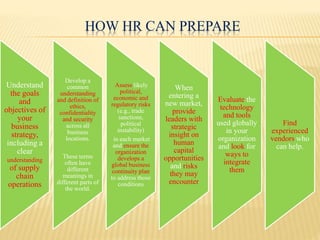
HOW HR CAN PREPARE
Understand
the goals
and
objectives of
your
business
strategy,
including a
clear
understanding
of supply
chain
operations
Develop a
common
understanding
and definition of
ethics,
confidentiality
and security
across all
business
locations.
These terms
often have
different
meanings in
different parts of
the world.
Assess likely
political,
economic and
regulatory risks
(e.g., trade
sanctions,
political
instability)
in each market
and ensure the
organization
develops a
global business
continuity plan
to address those
conditions
When
entering a
new market,
provide
leaders with
strategic
insight on
human
capital
opportunities
and risks
they may
encounter
Evaluate the
technology
and tools
used globally
in your
organization
and look for
ways to
integrate
them
Find
experienced
vendors who
can help.
NEW WAYS OF WORKING: VIRTUAL TEAMS
EXPECTED CHANGES
 More work will get done in multicultural, virtual teams.
 A 2010 survey of randomly selected employees at multinational
corporations found that 64 percent were involved in a virtual work team,
and this group reported that on average 52 percent of team members
were based outside the company’s home country. Companies will
increasingly use remote and temporary workers based in multiple
countries or regions.
 As the workforce becomes more global, the profile of the average global
worker will continue to change. Tomorrow’s U.S. workforce is likely to
be older, more gender and ethnically diverse, and more interconnected
through technology. In other parts of the world, such as emerging
markets, the workforce will be much younger
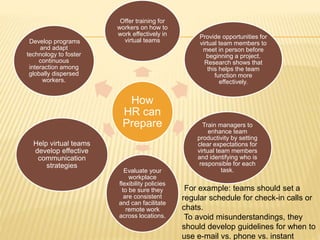
How
HR can
Prepare
Offer training for
workers on how to
work effectively in
virtual teams
Provide opportunities for
virtual team members to
meet in person before
beginning a project.
Research shows that
this helps the team
function more
effectively.
Train managers to
enhance team
productivity by setting
clear expectations for
virtual team members
and identifying who is
responsible for each
task.Evaluate your
workplace
flexibility policies
to be sure they
are consistent
and can facilitate
remote work
across locations.
Help virtual teams
develop effective
communication
strategies
Develop programs
and adapt
technology to foster
continuous
interaction among
globally dispersed
workers.
For example: teams should set a
regular schedule for check-in calls or
chats.
To avoid misunderstandings, they
should develop guidelines for when to
use e-mail vs. phone vs. instant
MANAGING TALENT ACROSS BORDERS
EXPECTED CHANGES
 In sectors where demand for skilled workers exceeds the labor supply,
companies will increasingly look outside their borders for new talent, creating
incentives for cross border migration, as well as increased use of temporary and
remote workers.
 Emerging economies will continue to evolve and move from unskilled to skilled
labor.
For example, wages in China’s manufacturing sector have risen by 71 percent since
2008.3 China and other developing countries will continue to move into high-
value-added, high-technology manufacturing. Companies will relocate low-cost
manufacturing to other countries.
 Cities will continue to evolve as centers of population. In the space of just 10
years, from 2000-2010, the percentage of Chinese population living in cities
increased from one-third to one-half.
 The number of university-educated workers in the developing world (e.g., East
Asia, Latin America and North Africa) is increasing significantly.
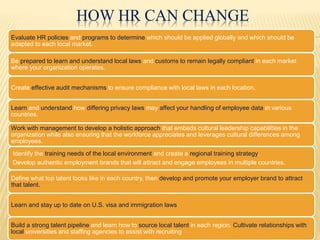
HOW HR CAN CHANGE
Evaluate HR policies and programs to determine which should be applied globally and which should be
adapted to each local market.
Be prepared to learn and understand local laws and customs to remain legally compliant in each market
where your organization operates.
Create effective audit mechanisms to ensure compliance with local laws in each location.
Learn and understand how differing privacy laws may affect your handling of employee data in various
countries.
Work with management to develop a holistic approach that embeds cultural leadership capabilities in the
organization while also ensuring that the workforce appreciates and leverages cultural differences among
employees.
Identify the training needs of the local environment and create a regional training strategy.
Develop authentic employment brands that will attract and engage employees in multiple countries.
Define what top talent looks like in each country, then develop and promote your employer brand to attract
that talent.
Learn and stay up to date on U.S. visa and immigration laws
Build a strong talent pipeline and learn how to source local talent in each region. Cultivate relationships with
local universities and staffing agencies to assist with recruiting
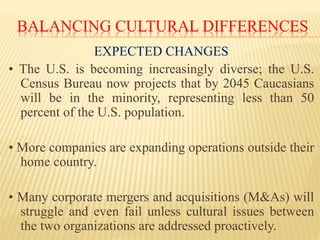
BALANCING CULTURAL DIFFERENCES
EXPECTED CHANGES
• The U.S. is becoming increasingly diverse; the U.S.
Census Bureau now projects that by 2045 Caucasians
will be in the minority, representing less than 50
percent of the U.S. population.
• More companies are expanding operations outside their
home country.
• Many corporate mergers and acquisitions (M&As) will
struggle and even fail unless cultural issues between
the two organizations are addressed proactively.
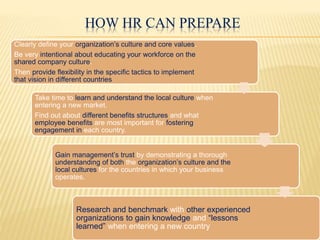
HOW HR CAN PREPARE
Clearly define your organization’s culture and core values.
Be very intentional about educating your workforce on the
shared company culture.
Then provide flexibility in the specific tactics to implement
that vision in different countries
Take time to learn and understand the local culture when
entering a new market.
Find out about different benefits structures and what
employee benefits are most important for fostering
engagement in each country.
Gain management’s trust by demonstrating a thorough
understanding of both the organization’s culture and the
local cultures for the countries in which your business
operates.
Research and benchmark with other experienced
organizations to gain knowledge and “lessons
learned” when entering a new country
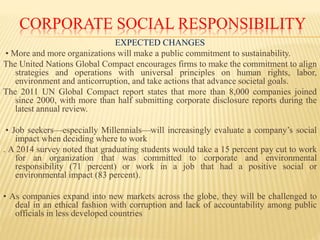
CORPORATE SOCIAL RESPONSIBILITY
EXPECTED CHANGES
• More and more organizations will make a public commitment to sustainability.
The United Nations Global Compact encourages firms to make the commitment to align
strategies and operations with universal principles on human rights, labor,
environment and anticorruption, and take actions that advance societal goals.
The 2011 UN Global Compact report states that more than 8,000 companies joined
since 2000, with more than half submitting corporate disclosure reports during the
latest annual review.
• Job seekers—especially Millennials—will increasingly evaluate a company’s social
impact when deciding where to work
. A 2014 survey noted that graduating students would take a 15 percent pay cut to work
for an organization that was committed to corporate and environmental
responsibility (71 percent) or work in a job that had a positive social or
environmental impact (83 percent).
• As companies expand into new markets across the globe, they will be challenged to
deal in an ethical fashion with corruption and lack of accountability among public
officials in less developed countries
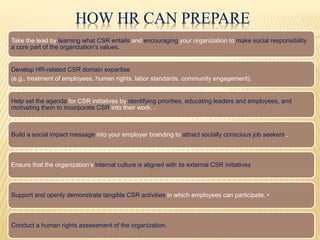
HOW HR CAN PREPARE
Take the lead by learning what CSR entails and encouraging your organization to make social responsibility
a core part of the organization’s values.
Develop HR-related CSR domain expertise
(e.g., treatment of employees, human rights, labor standards, community engagement).
Help set the agenda for CSR initiatives by identifying priorities, educating leaders and employees, and
motivating them to incorporate CSR into their work. .
Build a social impact message into your employer branding to attract socially conscious job seekers..
Ensure that the organization’s internal culture is aligned with its external CSR initiatives
Support and openly demonstrate tangible CSR activities in which employees can participate. •
Conduct a human rights assessment of the organization.
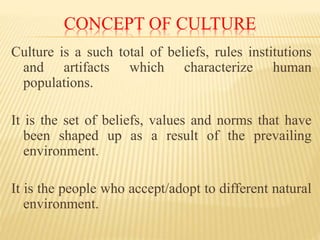
CONCEPT OF CULTURE
Culture is a such total of beliefs, rules institutions
and artifacts which characterize human
populations.
It is the set of beliefs, values and norms that have
been shaped up as a result of the prevailing
environment.
It is the people who accept/adopt to different natural
environment.
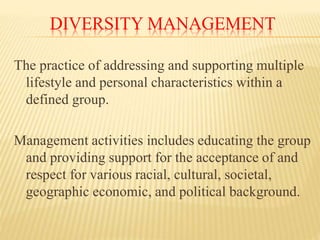
DIVERSITY MANAGEMENT
The practice of addressing and supporting multiple
lifestyle and personal characteristics within a
defined group.
Management activities includes educating the group
and providing support for the acceptance of and
respect for various racial, cultural, societal,
geographic economic, and political background.
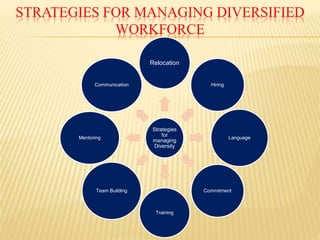
STRATEGIES FOR MANAGING DIVERSIFIED
WORKFORCE
Strategies
for
managing
Diversity
Relocation
Hiring
Language
Commitment
Training
Team Building
Mentoring
Communication
CROSS-BORDER MERGER & ACQUISITIONS
The tradition subject of Merger & Acquisition has
been expanded to include takeover and related
issues of corporate restructuring, corporate
control, and changes in the ownership structure of
firm
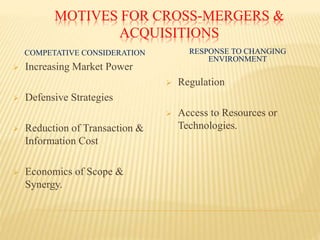
MOTIVES FOR CROSS-MERGERS &
ACQUISITIONS
COMPETATIVE CONSIDERATION RESPONSE TO CHANGING
ENVIRONMENT
 Increasing Market Power
 Defensive Strategies
 Reduction of Transaction &
Information Cost
 Economics of Scope &
Synergy.
 Regulation
 Access to Resources or
Technologies.
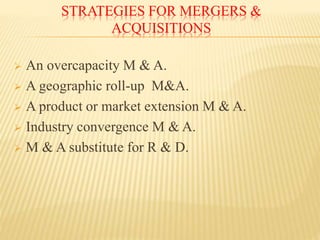
STRATEGIES FOR MERGERS &
ACQUISITIONS
 An overcapacity M & A.
 A geographic roll-up M&A.
 A product or market extension M & A.
 Industry convergence M & A.
 M & A substitute for R & D.
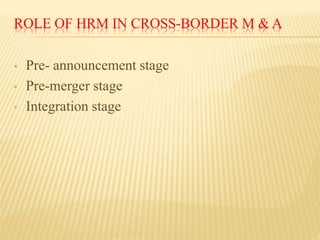
ROLE OF HRM IN CROSS-BORDER M & A
• Pre- announcement stage
• Pre-merger stage
• Integration stage
Key trends in shrm

Key trends in shrm

  • 1.
    Presented by Dr. AnkitaPathak Five Key Trends from SHRM’s AND
  • 2.
    CONTENTS  Global Interdependence New Ways Of Working: Virtual Teams  Managing Talent Across Borders  Balancing Cultural Differences  Corporate Social Responsibility  Concept Of Culture  Diversity Management  Strategies For Managing Diversified Workforce  Cross-Border Merger & Acquisitions  Motives for Cross-Mergers & Acquisitions  Strategies For Mergers & Acquisitions  Role of HRM in cross-border M & A
  • 3.
    GLOBAL INTERDEPENDENCE EXPECTED CHANGES Multinational companies may counter global risks by becoming too diversified to fail.  If one market or line of business is negatively affected, it can be offset by other parts of the business.  Businesses will continue to seek new opportunities in emerging economies.  Labor migration between countries and from rural to urban areas within countries will increase
  • 4.
    HOW HR CANPREPARE Understand the goals and objectives of your business strategy, including a clear understanding of supply chain operations Develop a common understanding and definition of ethics, confidentiality and security across all business locations. These terms often have different meanings in different parts of the world. Assess likely political, economic and regulatory risks (e.g., trade sanctions, political instability) in each market and ensure the organization develops a global business continuity plan to address those conditions When entering a new market, provide leaders with strategic insight on human capital opportunities and risks they may encounter Evaluate the technology and tools used globally in your organization and look for ways to integrate them Find experienced vendors who can help.
  • 5.
    NEW WAYS OFWORKING: VIRTUAL TEAMS EXPECTED CHANGES  More work will get done in multicultural, virtual teams.  A 2010 survey of randomly selected employees at multinational corporations found that 64 percent were involved in a virtual work team, and this group reported that on average 52 percent of team members were based outside the company’s home country. Companies will increasingly use remote and temporary workers based in multiple countries or regions.  As the workforce becomes more global, the profile of the average global worker will continue to change. Tomorrow’s U.S. workforce is likely to be older, more gender and ethnically diverse, and more interconnected through technology. In other parts of the world, such as emerging markets, the workforce will be much younger
  • 6.
    How HR can Prepare Offer trainingfor workers on how to work effectively in virtual teams Provide opportunities for virtual team members to meet in person before beginning a project. Research shows that this helps the team function more effectively. Train managers to enhance team productivity by setting clear expectations for virtual team members and identifying who is responsible for each task.Evaluate your workplace flexibility policies to be sure they are consistent and can facilitate remote work across locations. Help virtual teams develop effective communication strategies Develop programs and adapt technology to foster continuous interaction among globally dispersed workers. For example: teams should set a regular schedule for check-in calls or chats. To avoid misunderstandings, they should develop guidelines for when to use e-mail vs. phone vs. instant
  • 7.
    MANAGING TALENT ACROSSBORDERS EXPECTED CHANGES  In sectors where demand for skilled workers exceeds the labor supply, companies will increasingly look outside their borders for new talent, creating incentives for cross border migration, as well as increased use of temporary and remote workers.  Emerging economies will continue to evolve and move from unskilled to skilled labor. For example, wages in China’s manufacturing sector have risen by 71 percent since 2008.3 China and other developing countries will continue to move into high- value-added, high-technology manufacturing. Companies will relocate low-cost manufacturing to other countries.  Cities will continue to evolve as centers of population. In the space of just 10 years, from 2000-2010, the percentage of Chinese population living in cities increased from one-third to one-half.  The number of university-educated workers in the developing world (e.g., East Asia, Latin America and North Africa) is increasing significantly.
  • 8.
    HOW HR CANCHANGE Evaluate HR policies and programs to determine which should be applied globally and which should be adapted to each local market. Be prepared to learn and understand local laws and customs to remain legally compliant in each market where your organization operates. Create effective audit mechanisms to ensure compliance with local laws in each location. Learn and understand how differing privacy laws may affect your handling of employee data in various countries. Work with management to develop a holistic approach that embeds cultural leadership capabilities in the organization while also ensuring that the workforce appreciates and leverages cultural differences among employees. Identify the training needs of the local environment and create a regional training strategy. Develop authentic employment brands that will attract and engage employees in multiple countries. Define what top talent looks like in each country, then develop and promote your employer brand to attract that talent. Learn and stay up to date on U.S. visa and immigration laws Build a strong talent pipeline and learn how to source local talent in each region. Cultivate relationships with local universities and staffing agencies to assist with recruiting
  • 9.
    BALANCING CULTURAL DIFFERENCES EXPECTEDCHANGES • The U.S. is becoming increasingly diverse; the U.S. Census Bureau now projects that by 2045 Caucasians will be in the minority, representing less than 50 percent of the U.S. population. • More companies are expanding operations outside their home country. • Many corporate mergers and acquisitions (M&As) will struggle and even fail unless cultural issues between the two organizations are addressed proactively.
  • 10.
    HOW HR CANPREPARE Clearly define your organization’s culture and core values. Be very intentional about educating your workforce on the shared company culture. Then provide flexibility in the specific tactics to implement that vision in different countries Take time to learn and understand the local culture when entering a new market. Find out about different benefits structures and what employee benefits are most important for fostering engagement in each country. Gain management’s trust by demonstrating a thorough understanding of both the organization’s culture and the local cultures for the countries in which your business operates. Research and benchmark with other experienced organizations to gain knowledge and “lessons learned” when entering a new country
  • 11.
    CORPORATE SOCIAL RESPONSIBILITY EXPECTEDCHANGES • More and more organizations will make a public commitment to sustainability. The United Nations Global Compact encourages firms to make the commitment to align strategies and operations with universal principles on human rights, labor, environment and anticorruption, and take actions that advance societal goals. The 2011 UN Global Compact report states that more than 8,000 companies joined since 2000, with more than half submitting corporate disclosure reports during the latest annual review. • Job seekers—especially Millennials—will increasingly evaluate a company’s social impact when deciding where to work . A 2014 survey noted that graduating students would take a 15 percent pay cut to work for an organization that was committed to corporate and environmental responsibility (71 percent) or work in a job that had a positive social or environmental impact (83 percent). • As companies expand into new markets across the globe, they will be challenged to deal in an ethical fashion with corruption and lack of accountability among public officials in less developed countries
  • 12.
    HOW HR CANPREPARE Take the lead by learning what CSR entails and encouraging your organization to make social responsibility a core part of the organization’s values. Develop HR-related CSR domain expertise (e.g., treatment of employees, human rights, labor standards, community engagement). Help set the agenda for CSR initiatives by identifying priorities, educating leaders and employees, and motivating them to incorporate CSR into their work. . Build a social impact message into your employer branding to attract socially conscious job seekers.. Ensure that the organization’s internal culture is aligned with its external CSR initiatives Support and openly demonstrate tangible CSR activities in which employees can participate. • Conduct a human rights assessment of the organization.
  • 14.
    CONCEPT OF CULTURE Cultureis a such total of beliefs, rules institutions and artifacts which characterize human populations. It is the set of beliefs, values and norms that have been shaped up as a result of the prevailing environment. It is the people who accept/adopt to different natural environment.
  • 15.
    DIVERSITY MANAGEMENT The practiceof addressing and supporting multiple lifestyle and personal characteristics within a defined group. Management activities includes educating the group and providing support for the acceptance of and respect for various racial, cultural, societal, geographic economic, and political background.
  • 16.
    STRATEGIES FOR MANAGINGDIVERSIFIED WORKFORCE Strategies for managing Diversity Relocation Hiring Language Commitment Training Team Building Mentoring Communication
  • 17.
    CROSS-BORDER MERGER &ACQUISITIONS The tradition subject of Merger & Acquisition has been expanded to include takeover and related issues of corporate restructuring, corporate control, and changes in the ownership structure of firm
  • 18.
    MOTIVES FOR CROSS-MERGERS& ACQUISITIONS COMPETATIVE CONSIDERATION RESPONSE TO CHANGING ENVIRONMENT  Increasing Market Power  Defensive Strategies  Reduction of Transaction & Information Cost  Economics of Scope & Synergy.  Regulation  Access to Resources or Technologies.
  • 19.
    STRATEGIES FOR MERGERS& ACQUISITIONS  An overcapacity M & A.  A geographic roll-up M&A.  A product or market extension M & A.  Industry convergence M & A.  M & A substitute for R & D.
  • 20.
    ROLE OF HRMIN CROSS-BORDER M & A • Pre- announcement stage • Pre-merger stage • Integration stage