
www.istructuring.com
Key Factors in Structuring Cross-Border
Corporate Acquisitions
A review of 2014 and a foretaste of 2015
Roy Saunders, IFS Consultants
December 10 12:00 – 12:45 GMT
The dramatic changes in 2014
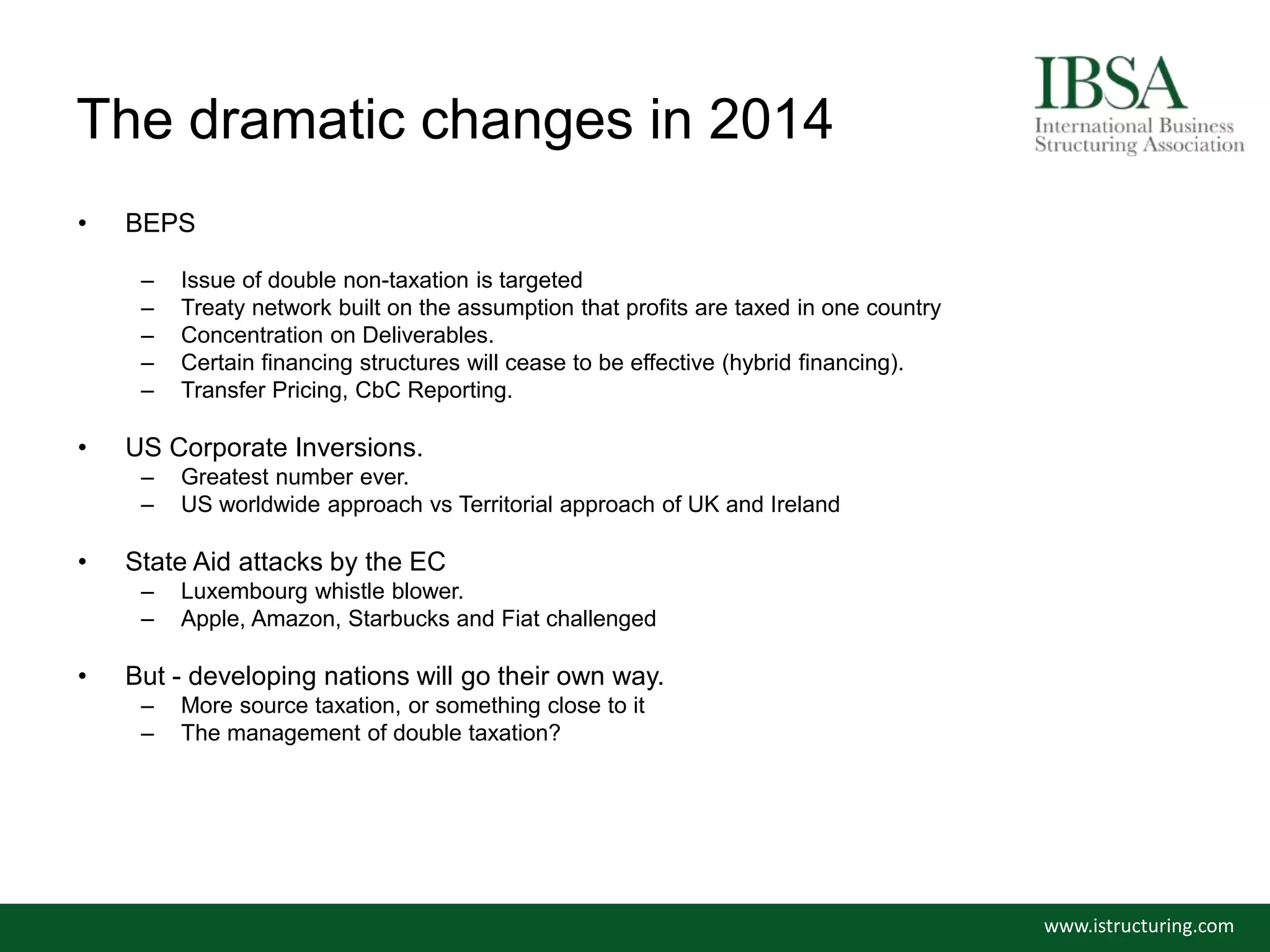
• BEPS
– Issue of double non-taxation is targeted
– Treaty network built on the assumption that profits are taxed in one country
– Concentration on Deliverables.
– Certain financing structures will cease to be effective (hybrid financing).
– Transfer Pricing, CbC Reporting.
• US Corporate Inversions.
– Greatest number ever.
– US worldwide approach vs Territorial approach of UK and Ireland
• State Aid attacks by the EC
– Luxembourg whistle blower.
– Apple, Amazon, Starbucks and Fiat challenged
• But - developing nations will go their own way.
– More source taxation, or something close to it
– The management of double taxation?
www.istructuring.com
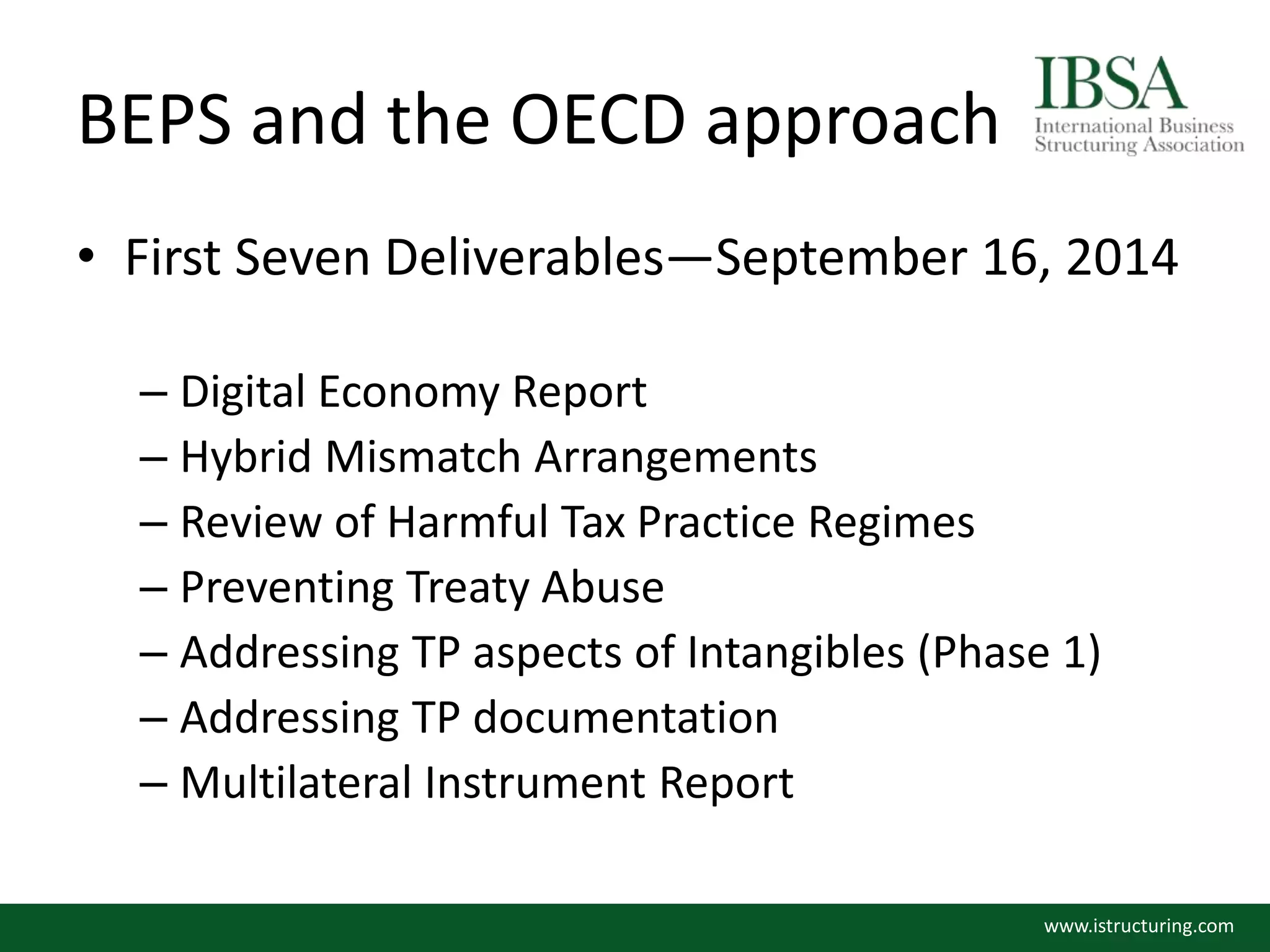
BEPS and the OECD approach
• First Seven Deliverables—September 16, 2014
– Digital Economy Report
– Hybrid Mismatch Arrangements
– Review of Harmful Tax Practice Regimes
– Preventing Treaty Abuse
– Addressing TP aspects of Intangibles (Phase 1)
– Addressing TP documentation
– Multilateral Instrument Report
www.istructuring.com
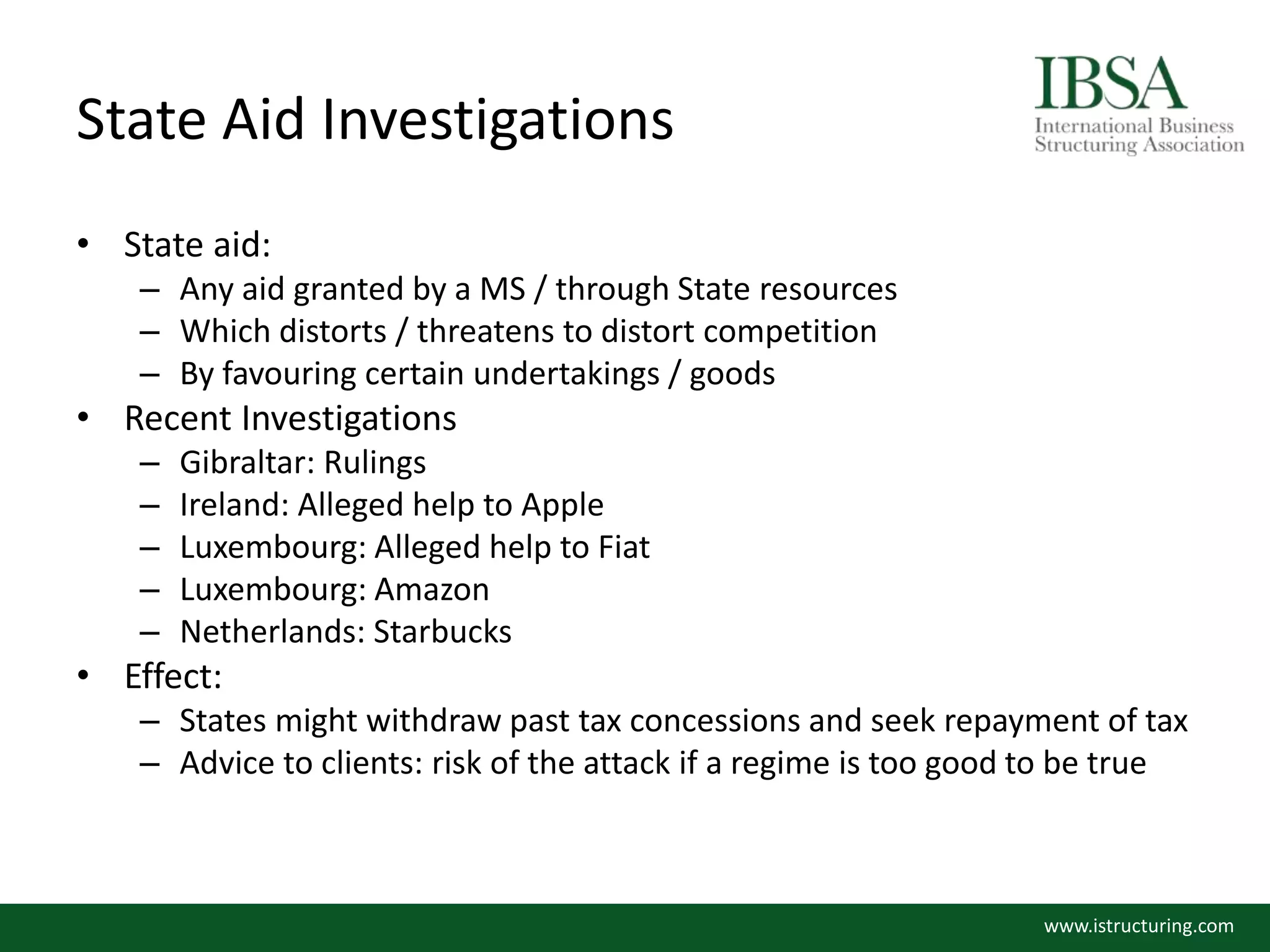
State Aid Investigations
• State aid:
– Any aid granted by a MS / through State resources
– Which distorts / threatens to distort competition
– By favouring certain undertakings / goods
• Recent Investigations
– Gibraltar: Rulings
– Ireland: Alleged help to Apple
– Luxembourg: Alleged help to Fiat
– Luxembourg: Amazon
– Netherlands: Starbucks
• Effect:
– States might withdraw past tax concessions and seek repayment of tax
– Advice to clients: risk of the attack if a regime is too good to be true
www.istructuring.com
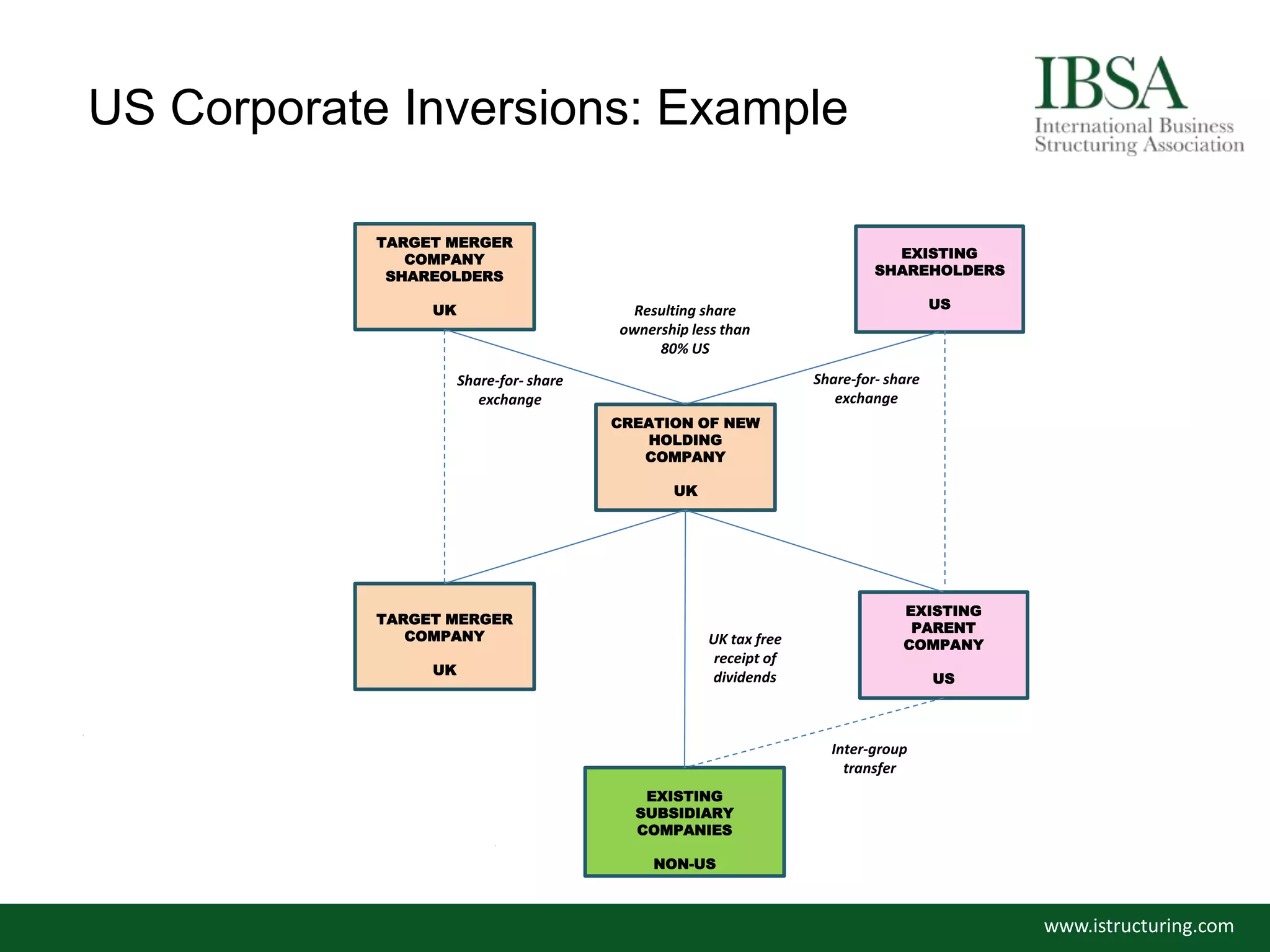
TARGET MERGER
COMPANY
SHAREOLDERS
UK
TARGET MERGER
COMPANY
UK
EXISTING
PARENT
COMPANY
US
EXISTING
SUBSIDIARY
COMPANIES
NON-US
Inter-group
transfer
Share-for- share
exchange
EXISTING
SHAREHOLDERS
US
CREATION OF NEW
HOLDING
COMPANY
UK
Share-for- share
exchange
Resulting share
ownership less than
80% US
UK tax free
receipt of
dividends
US Corporate Inversions: Example
www.istructuring.com
Inversions: key tax issues
• Low corporate tax rate
• Accessing a territorial/exemption system
• Withholding on dividends
• Treaty network/EU Directives
• IP patent box
• Managing tax residence
• Stamp duty/SDRT
• Impact of recent proposals to change US tax law
www.istructuring.com
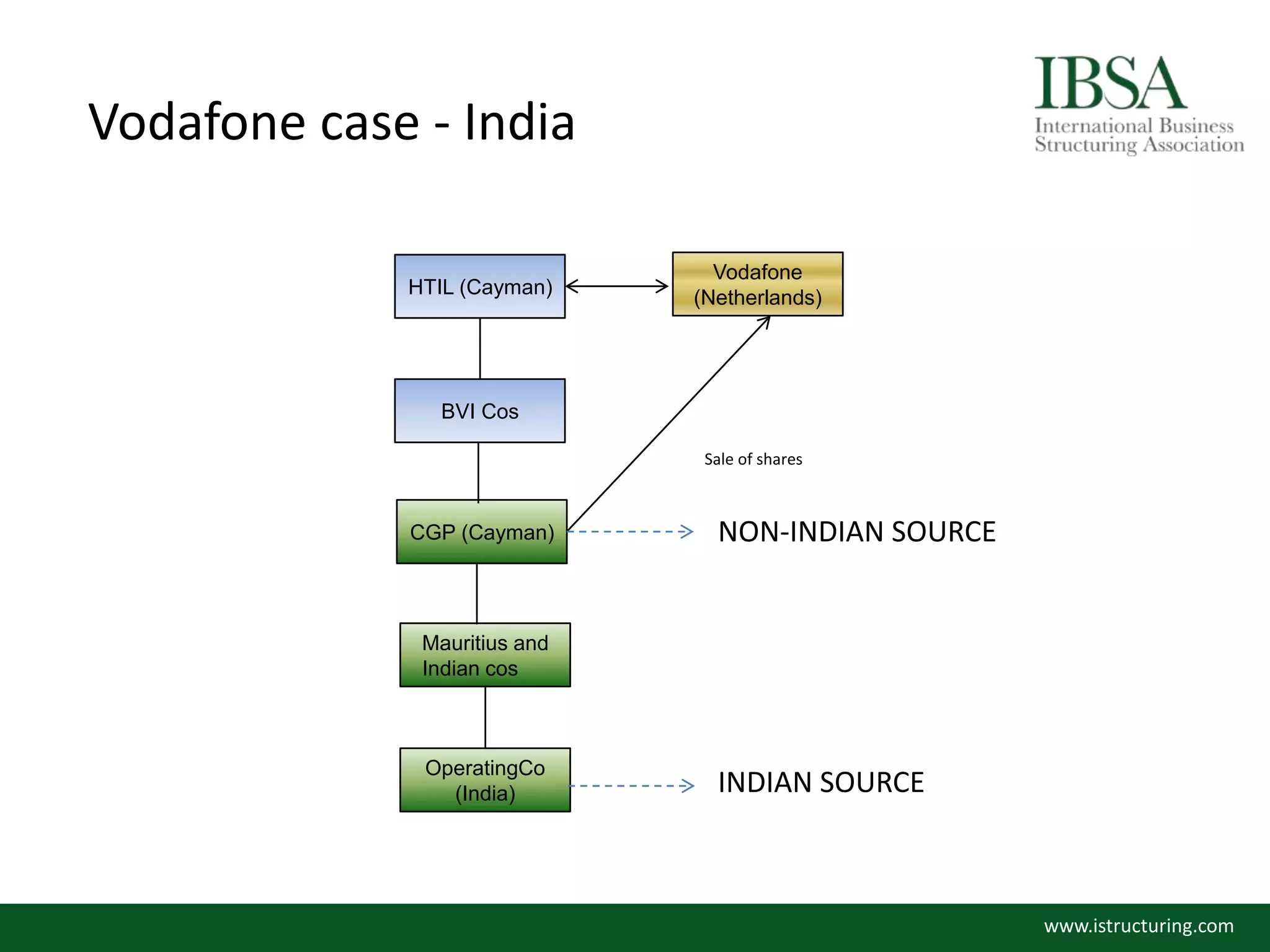
Vodafone case - India
HTIL (Cayman)
Vodafone
(Netherlands)
BVI Cos
CGP (Cayman)
Mauritius and
Indian cos
OperatingCo
(India)
Sale of shares
NON-INDIAN SOURCE
INDIAN SOURCE
www.istructuring.com
Issues in Developing Countries
• Ensure tax indemnities exist and that any capital gains tax risk
is clearly for the vendor
• Arrange escrow accounts wherever possible
• Utilise bilateral investment agreements as well as double tax
treaties by investing from entities in relevant jurisdictions
• Treaty shopping may be challenged so ensure entities chosen
have relevant substance
www.istructuring.com
The impact of reform in 2015 and beyond
• BEPS
– Substance will be king.
– Multilateral Instrument to implement BEPS
– Treaty access denial
– TP Manuals to reflect location of profits, sales, employees and assets
• US Tax Reform.
– Eventually fewer incentives, balanced by lower rates.
• The shape of the future
– Less opportunities for structuring, but competition between countries remains.
– Fewer very low tax structures, but generally lower tax rates?
• Automatic Exchange of Information (AEOI)
– Common Reporting Standard
www.istructuring.com
Reputation
• The reputational risk is far greater than tax savings
through aggressive structuring
• Coordinated internal procedures need to be adopted
when questions are asked in place that have been
tested
• There needs to be a global response to local issues
• It takes 20 years to build a reputation and 5 minutes
to lose it
www.istructuring.com
Avoiding falling into Treaty Shopping
problems
• Title of Double Tax Treaties
– for the avoidance of double taxation
– and the prevention of fiscal evasion
• Limitation on benefits provisions (second line of defence)
www.istructuring.com
Beneficial Ownership and Substance
• Case law does not give conclusive definition
– Indofoods v JP Morgan, Prévost Car, MIL Investments,
Velcro Canada Inc:
• Possession
• Use
• Risk
• Control
• Conduit companies must have proper degree of SUBSTANCE
www.istructuring.com
Ensuring corporate management and control
is where you want it
• Article 4 OECD MTC — “place of effective management” (POEM)
• National treatment — the incorporation theory
– The UK, the US, Ireland, Switzerland, the Netherlands
– Mobile POEM
• National treatment — the real seat theory (siège social, siège réel)
– France, Germany, Luxembourg
– Change of POEM leads to dissolution of the company
www.istructuring.com
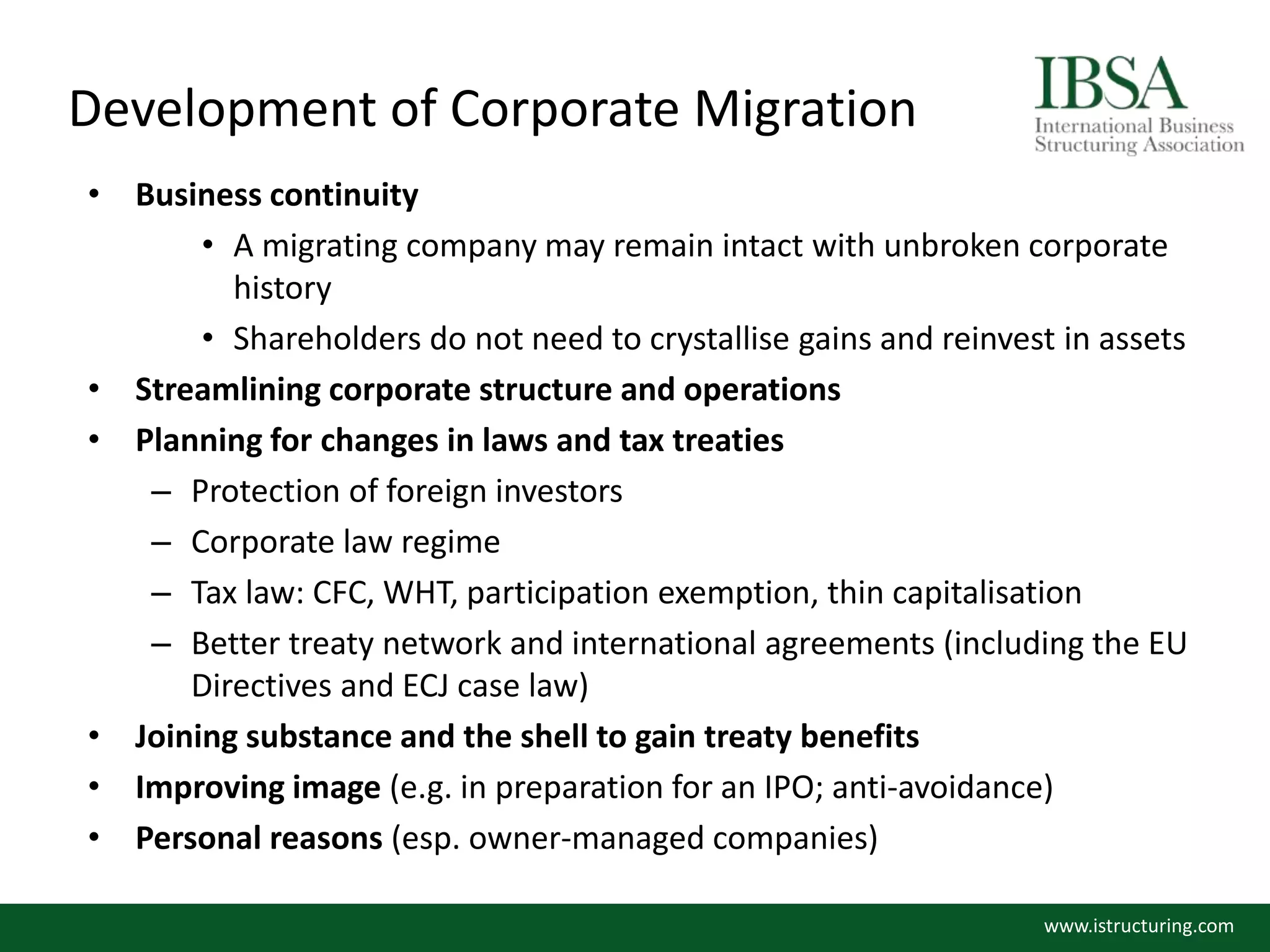
Development of Corporate Migration
• Business continuity
• A migrating company may remain intact with unbroken corporate
history
• Shareholders do not need to crystallise gains and reinvest in assets
• Streamlining corporate structure and operations
• Planning for changes in laws and tax treaties
– Protection of foreign investors
– Corporate law regime
– Tax law: CFC, WHT, participation exemption, thin capitalisation
– Better treaty network and international agreements (including the EU
Directives and ECJ case law)
• Joining substance and the shell to gain treaty benefits
• Improving image (e.g. in preparation for an IPO; anti-avoidance)
• Personal reasons (esp. owner-managed companies)
www.istructuring.com
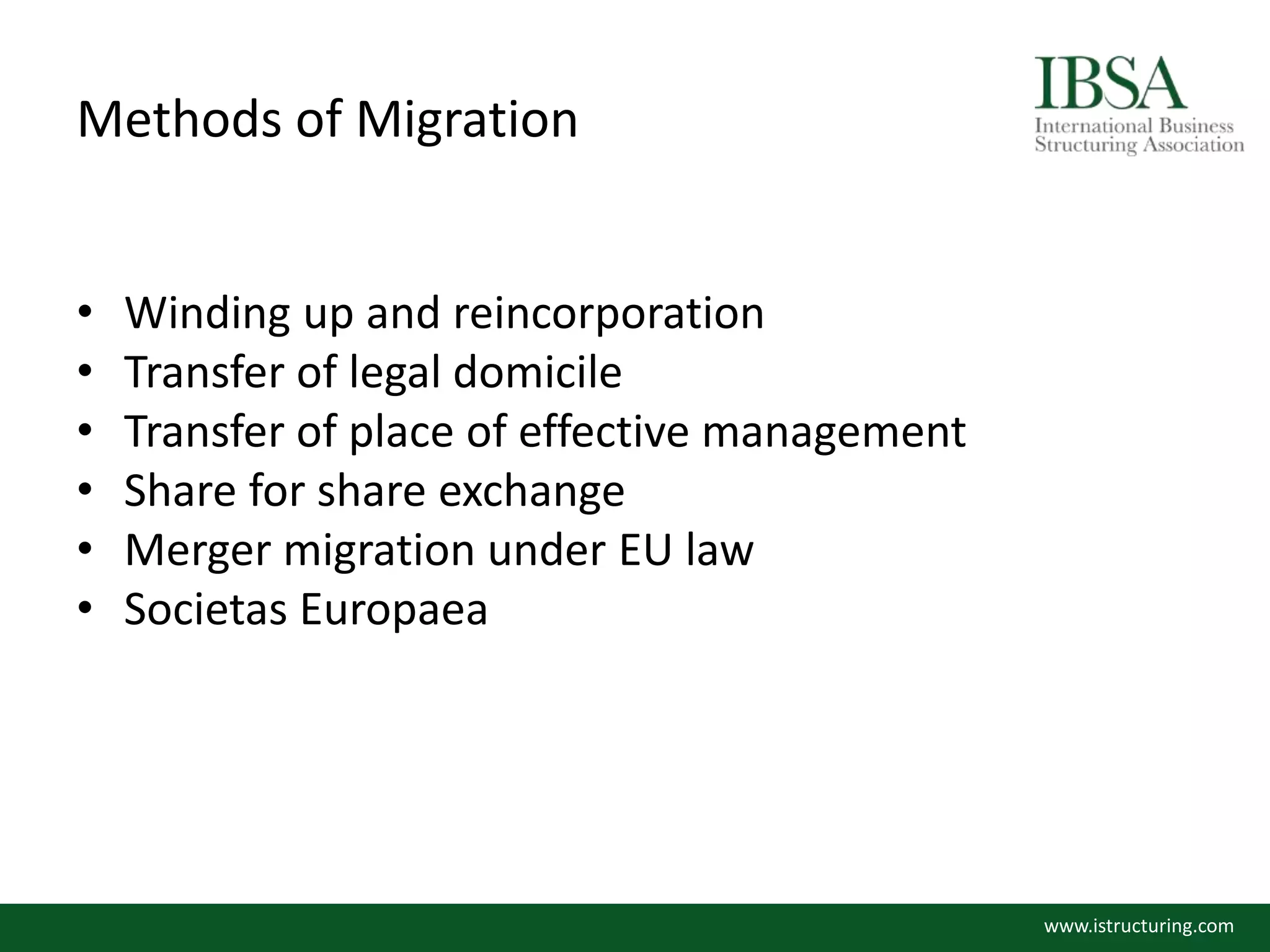
Methods of Migration
• Winding up and reincorporation
• Transfer of legal domicile
• Transfer of place of effective management
• Share for share exchange
• Merger migration under EU law
• Societas Europaea
www.istructuring.com
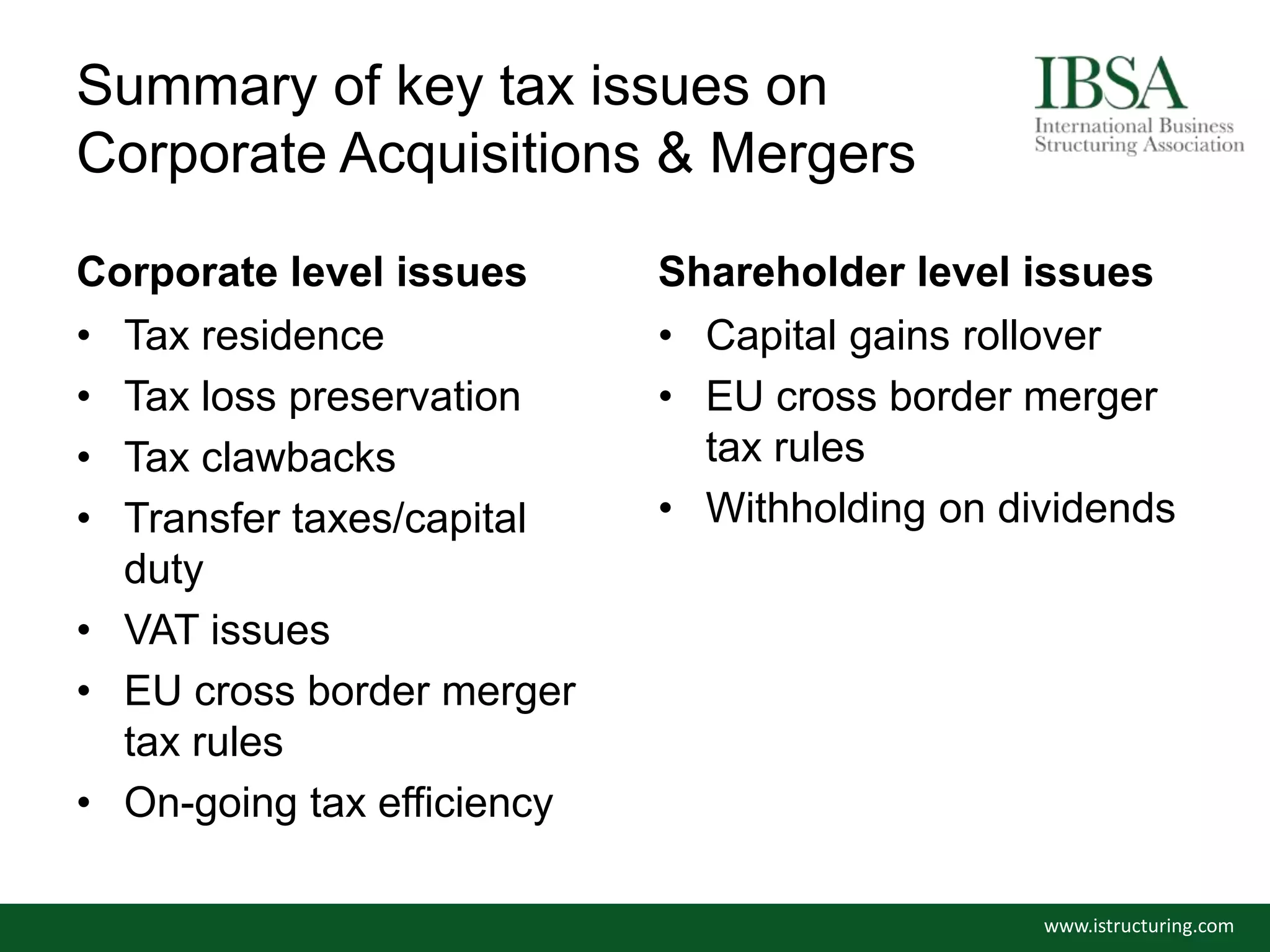
Summary of key tax issues on
Corporate Acquisitions & Mergers
Corporate level issues
• Tax residence
• Tax loss preservation
• Tax clawbacks
• Transfer taxes/capital
duty
• VAT issues
• EU cross border merger
tax rules
• On-going tax efficiency
Shareholder level issues
• Capital gains rollover
• EU cross border merger
tax rules
• Withholding on dividends
www.istructuring.com
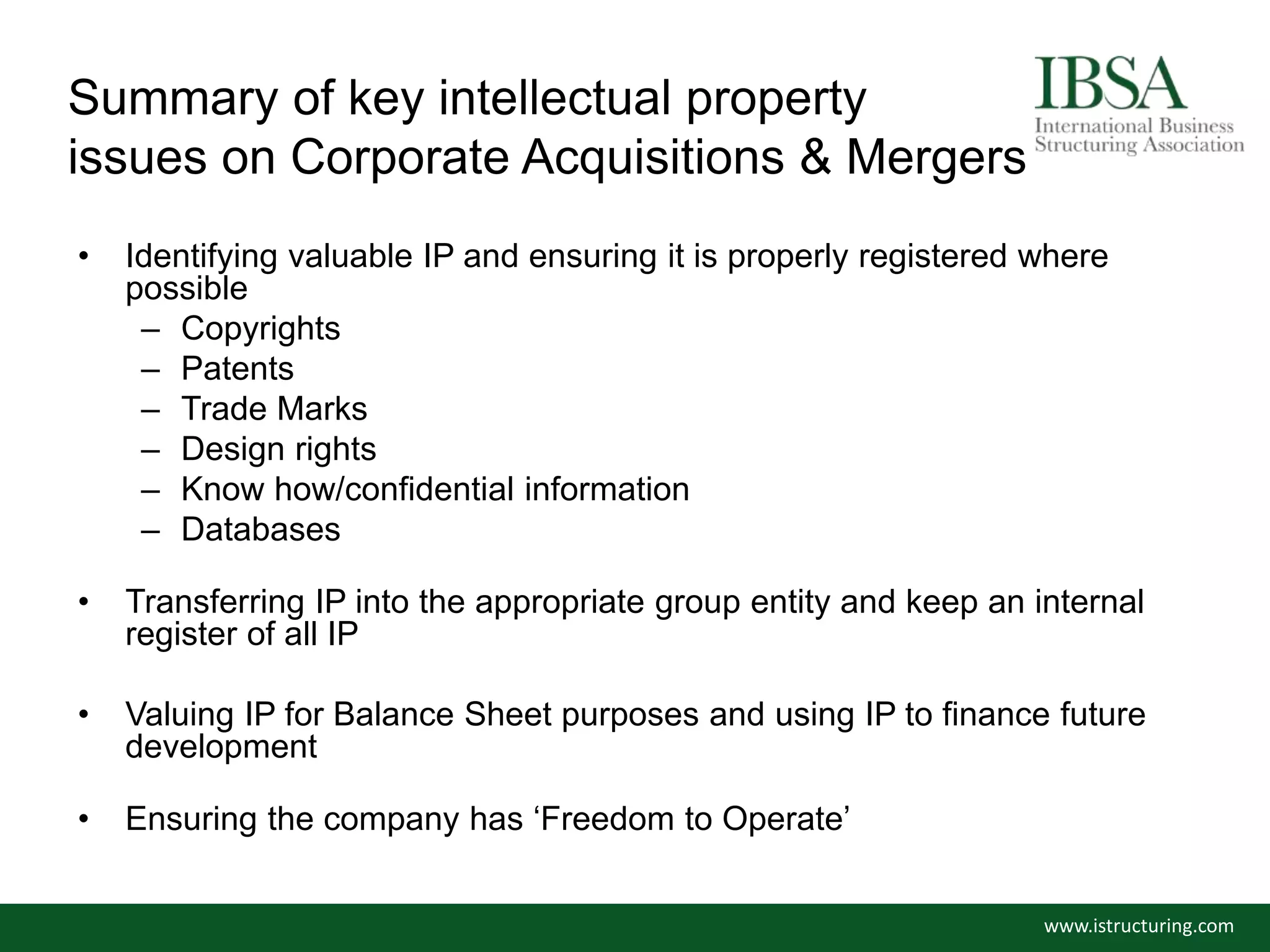
Summary of key intellectual property
issues on Corporate Acquisitions & Mergers
• Identifying valuable IP and ensuring it is properly registered where
possible
– Copyrights
– Patents
– Trade Marks
– Design rights
– Know how/confidential information
– Databases
• Transferring IP into the appropriate group entity and keep an internal
register of all IP
• Valuing IP for Balance Sheet purposes and using IP to finance future
development
• Ensuring the company has ‘Freedom to Operate’
www.istructuring.com
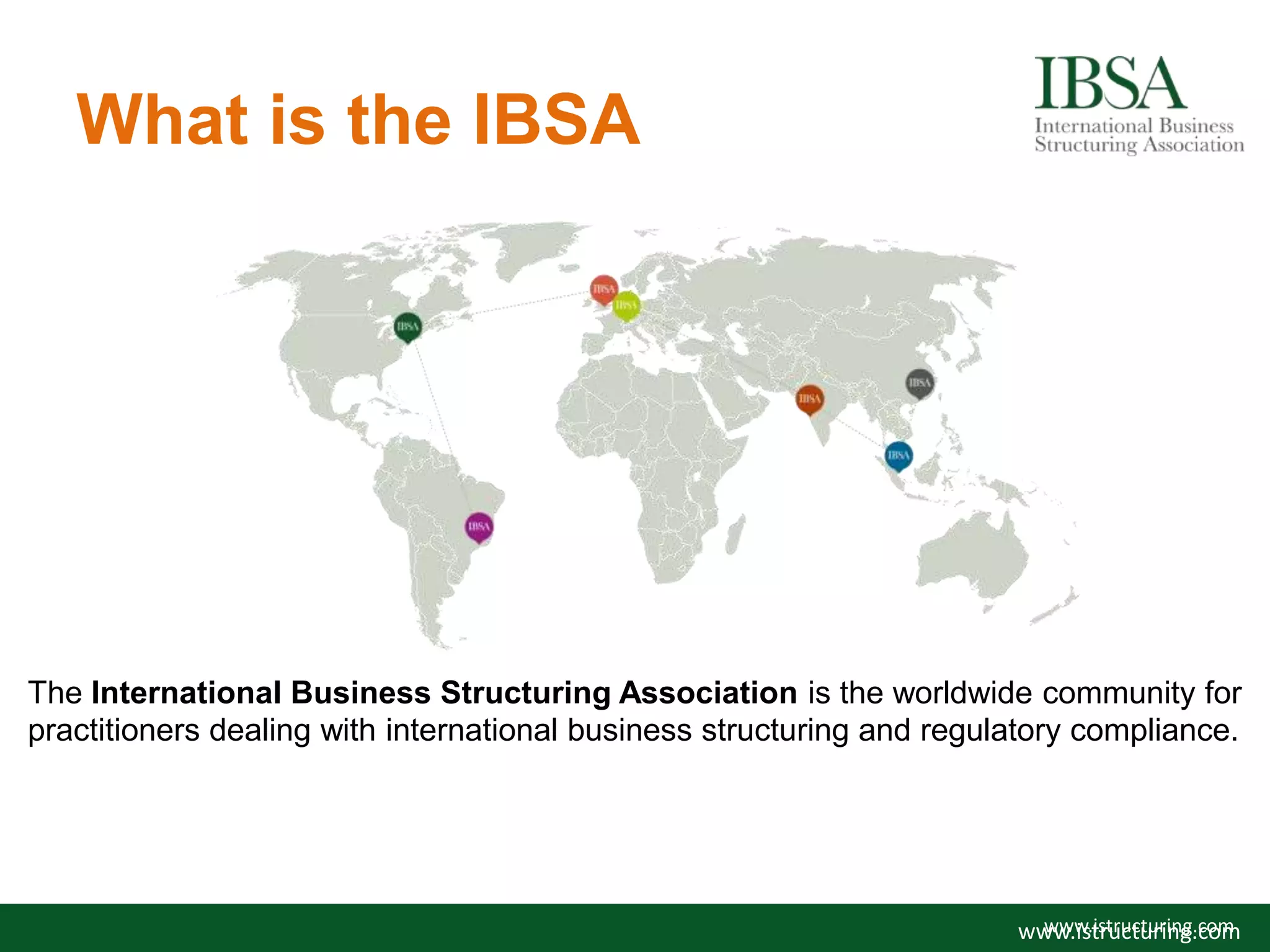
What is the IBSA
The International Business Structuring Association is the worldwide community for
practitioners dealing with international business structuring and regulatory compliance.
www.istructuring.comwww.istructuring.com
Vision of the IBSA
• Create a multi-disciplinary multi-jurisdictional association
of best practice professional advisers
• Promote transparency and integrity
• Develop greater knowledge and international contacts
• Enhance profile of younger advisers
• Reach out to the entrepreneurial community
www.istructuring.com
Principles of the IBSA
• Commerciality
• Substance
• Transparency
• Integrity
• Knowledge
• Imagination
• Anticipation
www.istructuring.comwww.istructuring.com
Discussion Groups
• Transparency of International Business Structures –
issues relating to the OECD BEPS initiative
• Intellectual Property as a Value Proposition
• International Business Structures and Fiduciary
Relationships
• Corporate Finance: Public vs Private Equity
www.istructuring.com
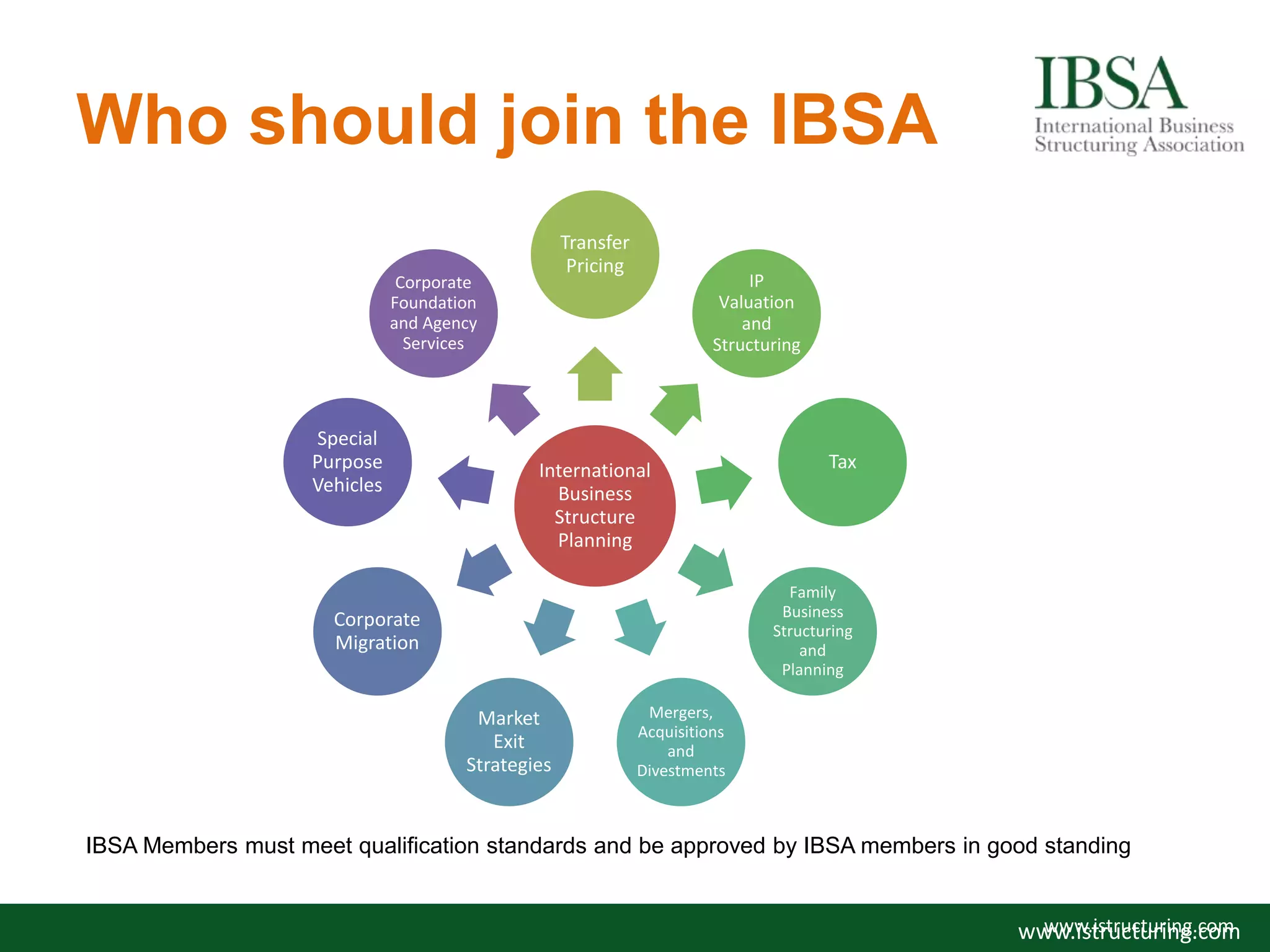
Who should join the IBSA
IBSA Members must meet qualification standards and be approved by IBSA members in good standing
International
Business
Structure
Planning
Transfer
Pricing
IP
Valuation
and
Structuring
Tax
Family
Business
Structuring
and
Planning
Mergers,
Acquisitions
and
Divestments
Market
Exit
Strategies
Corporate
Migration
Special
Purpose
Vehicles
Corporate
Foundation
and Agency
Services
www.istructuring.comwww.istructuring.com
To join the IBSA or find out more:
www.istructuring.com

Key Factors in Structuring Cross Border Corporate Acquisitions

  • 1.
    www.istructuring.com Key Factors inStructuring Cross-Border Corporate Acquisitions A review of 2014 and a foretaste of 2015 Roy Saunders, IFS Consultants December 10 12:00 – 12:45 GMT
  • 2.
    The dramatic changesin 2014 • BEPS – Issue of double non-taxation is targeted – Treaty network built on the assumption that profits are taxed in one country – Concentration on Deliverables. – Certain financing structures will cease to be effective (hybrid financing). – Transfer Pricing, CbC Reporting. • US Corporate Inversions. – Greatest number ever. – US worldwide approach vs Territorial approach of UK and Ireland • State Aid attacks by the EC – Luxembourg whistle blower. – Apple, Amazon, Starbucks and Fiat challenged • But - developing nations will go their own way. – More source taxation, or something close to it – The management of double taxation? www.istructuring.com
  • 3.
    BEPS and theOECD approach • First Seven Deliverables—September 16, 2014 – Digital Economy Report – Hybrid Mismatch Arrangements – Review of Harmful Tax Practice Regimes – Preventing Treaty Abuse – Addressing TP aspects of Intangibles (Phase 1) – Addressing TP documentation – Multilateral Instrument Report www.istructuring.com
  • 4.
    State Aid Investigations •State aid: – Any aid granted by a MS / through State resources – Which distorts / threatens to distort competition – By favouring certain undertakings / goods • Recent Investigations – Gibraltar: Rulings – Ireland: Alleged help to Apple – Luxembourg: Alleged help to Fiat – Luxembourg: Amazon – Netherlands: Starbucks • Effect: – States might withdraw past tax concessions and seek repayment of tax – Advice to clients: risk of the attack if a regime is too good to be true www.istructuring.com
  • 5.
    TARGET MERGER COMPANY SHAREOLDERS UK TARGET MERGER COMPANY UK EXISTING PARENT COMPANY US EXISTING SUBSIDIARY COMPANIES NON-US Inter-group transfer Share-for-share exchange EXISTING SHAREHOLDERS US CREATION OF NEW HOLDING COMPANY UK Share-for- share exchange Resulting share ownership less than 80% US UK tax free receipt of dividends US Corporate Inversions: Example www.istructuring.com
  • 6.
    Inversions: key taxissues • Low corporate tax rate • Accessing a territorial/exemption system • Withholding on dividends • Treaty network/EU Directives • IP patent box • Managing tax residence • Stamp duty/SDRT • Impact of recent proposals to change US tax law www.istructuring.com
  • 7.
    Vodafone case -India HTIL (Cayman) Vodafone (Netherlands) BVI Cos CGP (Cayman) Mauritius and Indian cos OperatingCo (India) Sale of shares NON-INDIAN SOURCE INDIAN SOURCE www.istructuring.com
  • 8.
    Issues in DevelopingCountries • Ensure tax indemnities exist and that any capital gains tax risk is clearly for the vendor • Arrange escrow accounts wherever possible • Utilise bilateral investment agreements as well as double tax treaties by investing from entities in relevant jurisdictions • Treaty shopping may be challenged so ensure entities chosen have relevant substance www.istructuring.com
  • 9.
    The impact ofreform in 2015 and beyond • BEPS – Substance will be king. – Multilateral Instrument to implement BEPS – Treaty access denial – TP Manuals to reflect location of profits, sales, employees and assets • US Tax Reform. – Eventually fewer incentives, balanced by lower rates. • The shape of the future – Less opportunities for structuring, but competition between countries remains. – Fewer very low tax structures, but generally lower tax rates? • Automatic Exchange of Information (AEOI) – Common Reporting Standard www.istructuring.com
  • 10.
    Reputation • The reputationalrisk is far greater than tax savings through aggressive structuring • Coordinated internal procedures need to be adopted when questions are asked in place that have been tested • There needs to be a global response to local issues • It takes 20 years to build a reputation and 5 minutes to lose it www.istructuring.com
  • 11.
    Avoiding falling intoTreaty Shopping problems • Title of Double Tax Treaties – for the avoidance of double taxation – and the prevention of fiscal evasion • Limitation on benefits provisions (second line of defence) www.istructuring.com
  • 12.
    Beneficial Ownership andSubstance • Case law does not give conclusive definition – Indofoods v JP Morgan, Prévost Car, MIL Investments, Velcro Canada Inc: • Possession • Use • Risk • Control • Conduit companies must have proper degree of SUBSTANCE www.istructuring.com
  • 13.
    Ensuring corporate managementand control is where you want it • Article 4 OECD MTC — “place of effective management” (POEM) • National treatment — the incorporation theory – The UK, the US, Ireland, Switzerland, the Netherlands – Mobile POEM • National treatment — the real seat theory (siège social, siège réel) – France, Germany, Luxembourg – Change of POEM leads to dissolution of the company www.istructuring.com
  • 14.
    Development of CorporateMigration • Business continuity • A migrating company may remain intact with unbroken corporate history • Shareholders do not need to crystallise gains and reinvest in assets • Streamlining corporate structure and operations • Planning for changes in laws and tax treaties – Protection of foreign investors – Corporate law regime – Tax law: CFC, WHT, participation exemption, thin capitalisation – Better treaty network and international agreements (including the EU Directives and ECJ case law) • Joining substance and the shell to gain treaty benefits • Improving image (e.g. in preparation for an IPO; anti-avoidance) • Personal reasons (esp. owner-managed companies) www.istructuring.com
  • 15.
    Methods of Migration •Winding up and reincorporation • Transfer of legal domicile • Transfer of place of effective management • Share for share exchange • Merger migration under EU law • Societas Europaea www.istructuring.com
  • 16.
    Summary of keytax issues on Corporate Acquisitions & Mergers Corporate level issues • Tax residence • Tax loss preservation • Tax clawbacks • Transfer taxes/capital duty • VAT issues • EU cross border merger tax rules • On-going tax efficiency Shareholder level issues • Capital gains rollover • EU cross border merger tax rules • Withholding on dividends www.istructuring.com
  • 17.
    Summary of keyintellectual property issues on Corporate Acquisitions & Mergers • Identifying valuable IP and ensuring it is properly registered where possible – Copyrights – Patents – Trade Marks – Design rights – Know how/confidential information – Databases • Transferring IP into the appropriate group entity and keep an internal register of all IP • Valuing IP for Balance Sheet purposes and using IP to finance future development • Ensuring the company has ‘Freedom to Operate’ www.istructuring.com
  • 18.
    What is theIBSA The International Business Structuring Association is the worldwide community for practitioners dealing with international business structuring and regulatory compliance. www.istructuring.comwww.istructuring.com
  • 19.
    Vision of theIBSA • Create a multi-disciplinary multi-jurisdictional association of best practice professional advisers • Promote transparency and integrity • Develop greater knowledge and international contacts • Enhance profile of younger advisers • Reach out to the entrepreneurial community www.istructuring.com
  • 20.
    Principles of theIBSA • Commerciality • Substance • Transparency • Integrity • Knowledge • Imagination • Anticipation www.istructuring.comwww.istructuring.com
  • 21.
    Discussion Groups • Transparencyof International Business Structures – issues relating to the OECD BEPS initiative • Intellectual Property as a Value Proposition • International Business Structures and Fiduciary Relationships • Corporate Finance: Public vs Private Equity www.istructuring.com
  • 22.
    Who should jointhe IBSA IBSA Members must meet qualification standards and be approved by IBSA members in good standing International Business Structure Planning Transfer Pricing IP Valuation and Structuring Tax Family Business Structuring and Planning Mergers, Acquisitions and Divestments Market Exit Strategies Corporate Migration Special Purpose Vehicles Corporate Foundation and Agency Services www.istructuring.comwww.istructuring.com
  • 23.
    To join theIBSA or find out more: www.istructuring.com www.istructuring.com

Editor's Notes

  • #3 IBSA will offer members ways to promote their business refer clients to each other and build their own trusted networks through the activitys covered by this mission statement
  • #10 IBSA will offer members ways to promote their business refer clients to each other and build their own trusted networks through the activitys covered by this mission statement
  • #18 IBSA will offer members ways to promote their business refer clients to each other and build their own trusted networks through the activitys covered by this mission statement
  • #19 IBSA will offer members ways to promote their business refer clients to each other and build their own trusted networks through the activitys covered by this mission statement
  • #20 IBSA will offer members ways to promote their business refer clients to each other and build their own trusted networks through the activitys covered by this mission statement
  • #21 IBSA will offer members ways to promote their business refer clients to each other and build their own trusted networks through the activitys covered by this mission statement
  • #22 IBSA will offer members ways to promote their business refer clients to each other and build their own trusted networks through the activitys covered by this mission statement
  • #23 IBSA will offer members ways to promote their business refer clients to each other and build their own trusted networks through the activitys covered by this mission statement