







Understanding

Tanning

A
publicatio
n of
Lesson 1

Understanding

Tanning

A
publicatio
n of
INTRO
In this lesson you will learn:
INTRO
In this lesson you will learn:
•The origins of spray tanning
INTRO
In this lesson you will learn:
•The origins of spray tanning
•The benefits of a spray tan
INTRO
In this lesson you will learn:
•The origins of spray tanning
•The benefits of a spray tan
•How does a spray tan work?
The Origins of
spray tanning
The Origins of
spray tanning
In the past, a tan was considered to be a
symbol of poverty. A tanned skin was a badge
of the working classes, the unavoidable result
of performing manual, outdoor labour in all
weathers.
The Origins of
spray tanning
In the past, a tan was considered to be a
symbol of poverty. A tanned skin was a badge
of the working classes, the unavoidable result
of performing manual, outdoor labour in all
weathers.
The rich, on the other hand, covered up with
long sleeves, hats and parasols and did
everything possible to protect themselves from
the sun’s rays.
The 1920s heralded a huge change in
perception. 
The 1920s heralded a huge change in
perception. 
Celebrity fashion icon, Coco Chanel, caught a
tan whilst holidaying on her yacht in the French
Riviera; suddenly everyone wanted to follow
suit and the craze for tanning began.
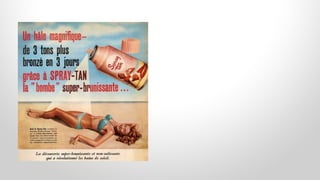
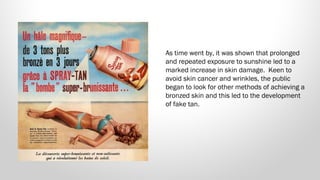
As time went by, it was shown that prolonged
and repeated exposure to sunshine led to a
marked increase in skin damage.  Keen to
avoid skin cancer and wrinkles, the public
began to look for other methods of achieving a
bronzed skin and this led to the development
of fake tan.
As time went by, it was shown that prolonged
and repeated exposure to sunshine led to a
marked increase in skin damage.  Keen to
avoid skin cancer and wrinkles, the public
began to look for other methods of achieving a
bronzed skin and this led to the development
of fake tan.
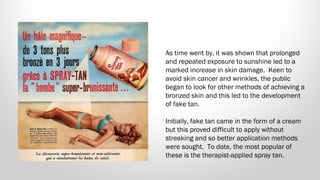
Initially, fake tan came in the form of a cream
but this proved difficult to apply without
streaking and so better application methods
were sought.  To date, the most popular of
these is the therapist-applied spray tan.
The Benefits
of spray
tanning
The Benefits
of spray
tanning
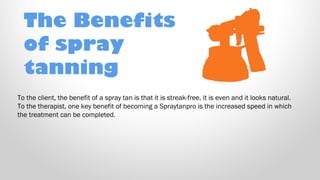
To the client, the benefit of a spray tan is that it is streak-free, it is even and it looks natural.
To the therapist, one key benefit of becoming a Spraytanpro is the increased speed in which
the treatment can be completed. 
The Benefits
of spray
tanning
To the client, the benefit of a spray tan is that it is streak-free, it is even and it looks natural.
To the therapist, one key benefit of becoming a Spraytanpro is the increased speed in which
the treatment can be completed. 
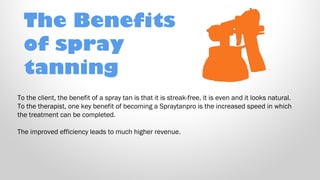
The improved efficiency leads to much higher revenue.
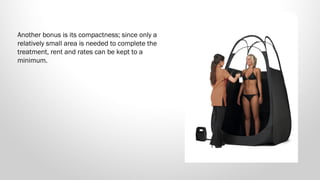
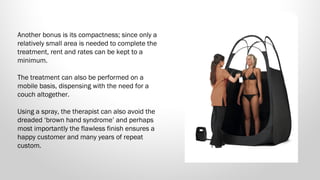
Another bonus is its compactness; since only a
relatively small area is needed to complete the
treatment, rent and rates can be kept to a
minimum. 
Another bonus is its compactness; since only a
relatively small area is needed to complete the
treatment, rent and rates can be kept to a
minimum. 
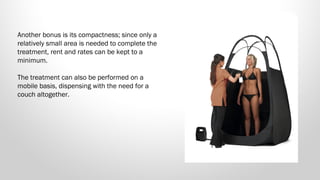
The treatment can also be performed on a
mobile basis, dispensing with the need for a
couch altogether.
Another bonus is its compactness; since only a
relatively small area is needed to complete the
treatment, rent and rates can be kept to a
minimum. 
The treatment can also be performed on a
mobile basis, dispensing with the need for a
couch altogether.
Using a spray, the therapist can also avoid the
dreaded ‘brown hand syndrome’ and perhaps
most importantly the flawless finish ensures a
happy customer and many years of repeat
custom.
How does fake
tan work?
How does fake
tan work?

Dihydroxyacetone
(DHA)
How does fake
tan work?

Dihydroxyacetone
(DHA)

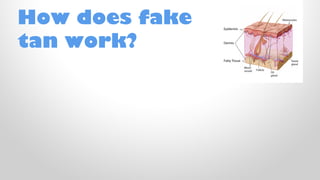
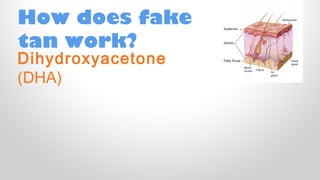
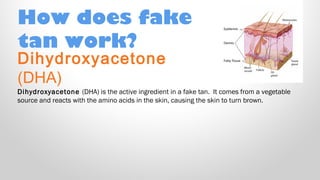
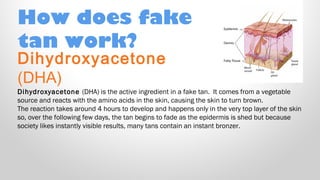
Dihydroxyacetone (DHA) is the active ingredient in a fake tan.  It comes from a vegetable
source and reacts with the amino acids in the skin, causing the skin to turn brown.
How does fake
tan work?

Dihydroxyacetone
(DHA)

Dihydroxyacetone (DHA) is the active ingredient in a fake tan.  It comes from a vegetable
source and reacts with the amino acids in the skin, causing the skin to turn brown.
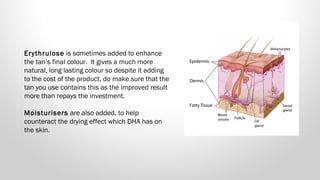
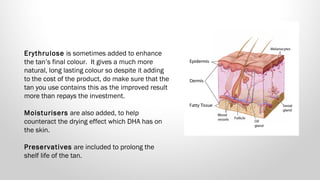
The reaction takes around 4 hours to develop and happens only in the very top layer of the skin
so, over the following few days, the tan begins to fade as the epidermis is shed but because
society likes instantly visible results, many tans contain an instant bronzer.
How does fake
tan work?

Dihydroxyacetone
(DHA)

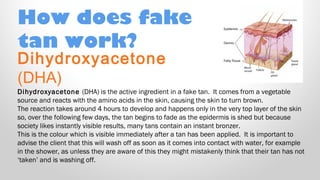
Dihydroxyacetone (DHA) is the active ingredient in a fake tan.  It comes from a vegetable
source and reacts with the amino acids in the skin, causing the skin to turn brown.
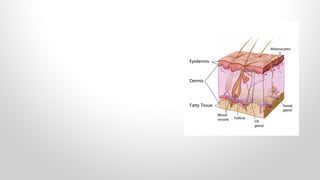
The reaction takes around 4 hours to develop and happens only in the very top layer of the skin
so, over the following few days, the tan begins to fade as the epidermis is shed but because
society likes instantly visible results, many tans contain an instant bronzer.
This is the colour which is visible immediately after a tan has been applied.  It is important to
advise the client that this will wash off as soon as it comes into contact with water, for example
in the shower, as unless they are aware of this they might mistakenly think that their tan has not
‘taken’ and is washing off.
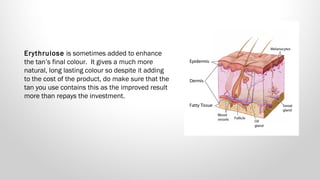
Erythrulose is sometimes added to enhance
the tan’s final colour.  It gives a much more
natural, long lasting colour so despite it adding
to the cost of the product, do make sure that the
tan you use contains this as the improved result
more than repays the investment.
Erythrulose is sometimes added to enhance
the tan’s final colour.  It gives a much more
natural, long lasting colour so despite it adding
to the cost of the product, do make sure that the
tan you use contains this as the improved result
more than repays the investment.
Moisturisers are also added, to help
counteract the drying effect which DHA has on
the skin.
Erythrulose is sometimes added to enhance
the tan’s final colour.  It gives a much more
natural, long lasting colour so despite it adding
to the cost of the product, do make sure that the
tan you use contains this as the improved result
more than repays the investment.
Moisturisers are also added, to help
counteract the drying effect which DHA has on
the skin.
Preservatives are included to prolong the
shelf life of the tan.
… AND
YOU’RE
DONE...
… AND
YOU’RE
DONE...

....Now
you can
move on
to your
next
lesson!
So you want to become a spray tan
technician, and you want it to drive more
business …?
.
So you want to become a spray tan
technician, and you want it to drive more
business …?
can help with that.

Lesson 4 - Spray Tanning - Understanding Tanning

  • 1.
  • 2.
  • 3.
    INTRO In this lessonyou will learn:
  • 4.
    INTRO In this lessonyou will learn: •The origins of spray tanning
  • 5.
    INTRO In this lessonyou will learn: •The origins of spray tanning •The benefits of a spray tan
  • 6.
    INTRO In this lessonyou will learn: •The origins of spray tanning •The benefits of a spray tan •How does a spray tan work?
  • 7.
  • 8.
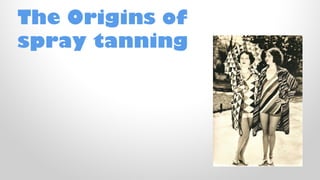
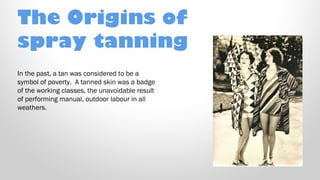
    The Origins of spraytanning In the past, a tan was considered to be a symbol of poverty. A tanned skin was a badge of the working classes, the unavoidable result of performing manual, outdoor labour in all weathers.
  • 9.
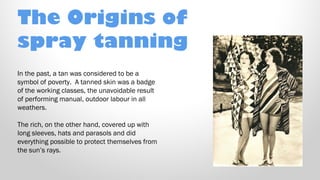
    The Origins of spraytanning In the past, a tan was considered to be a symbol of poverty. A tanned skin was a badge of the working classes, the unavoidable result of performing manual, outdoor labour in all weathers. The rich, on the other hand, covered up with long sleeves, hats and parasols and did everything possible to protect themselves from the sun’s rays.
  • 11.
    The 1920s heraldeda huge change in perception. 
  • 12.
    The 1920s heraldeda huge change in perception.  Celebrity fashion icon, Coco Chanel, caught a tan whilst holidaying on her yacht in the French Riviera; suddenly everyone wanted to follow suit and the craze for tanning began.
  • 14.
    As time wentby, it was shown that prolonged and repeated exposure to sunshine led to a marked increase in skin damage.  Keen to avoid skin cancer and wrinkles, the public began to look for other methods of achieving a bronzed skin and this led to the development of fake tan.
  • 15.
    As time wentby, it was shown that prolonged and repeated exposure to sunshine led to a marked increase in skin damage.  Keen to avoid skin cancer and wrinkles, the public began to look for other methods of achieving a bronzed skin and this led to the development of fake tan. Initially, fake tan came in the form of a cream but this proved difficult to apply without streaking and so better application methods were sought.  To date, the most popular of these is the therapist-applied spray tan.
  • 16.
  • 17.
    The Benefits of spray tanning Tothe client, the benefit of a spray tan is that it is streak-free, it is even and it looks natural. To the therapist, one key benefit of becoming a Spraytanpro is the increased speed in which the treatment can be completed. 
  • 18.
    The Benefits of spray tanning Tothe client, the benefit of a spray tan is that it is streak-free, it is even and it looks natural. To the therapist, one key benefit of becoming a Spraytanpro is the increased speed in which the treatment can be completed.  The improved efficiency leads to much higher revenue.
  • 20.
    Another bonus isits compactness; since only a relatively small area is needed to complete the treatment, rent and rates can be kept to a minimum. 
  • 21.
    Another bonus isits compactness; since only a relatively small area is needed to complete the treatment, rent and rates can be kept to a minimum.  The treatment can also be performed on a mobile basis, dispensing with the need for a couch altogether.
  • 22.
    Another bonus isits compactness; since only a relatively small area is needed to complete the treatment, rent and rates can be kept to a minimum.  The treatment can also be performed on a mobile basis, dispensing with the need for a couch altogether. Using a spray, the therapist can also avoid the dreaded ‘brown hand syndrome’ and perhaps most importantly the flawless finish ensures a happy customer and many years of repeat custom.
  • 23.
  • 24.
    How does fake tanwork? Dihydroxyacetone (DHA)
  • 25.
    How does fake tanwork? Dihydroxyacetone (DHA) Dihydroxyacetone (DHA) is the active ingredient in a fake tan.  It comes from a vegetable source and reacts with the amino acids in the skin, causing the skin to turn brown.
  • 26.
    How does fake tanwork? Dihydroxyacetone (DHA) Dihydroxyacetone (DHA) is the active ingredient in a fake tan.  It comes from a vegetable source and reacts with the amino acids in the skin, causing the skin to turn brown. The reaction takes around 4 hours to develop and happens only in the very top layer of the skin so, over the following few days, the tan begins to fade as the epidermis is shed but because society likes instantly visible results, many tans contain an instant bronzer.
  • 27.
    How does fake tanwork? Dihydroxyacetone (DHA) Dihydroxyacetone (DHA) is the active ingredient in a fake tan.  It comes from a vegetable source and reacts with the amino acids in the skin, causing the skin to turn brown. The reaction takes around 4 hours to develop and happens only in the very top layer of the skin so, over the following few days, the tan begins to fade as the epidermis is shed but because society likes instantly visible results, many tans contain an instant bronzer. This is the colour which is visible immediately after a tan has been applied.  It is important to advise the client that this will wash off as soon as it comes into contact with water, for example in the shower, as unless they are aware of this they might mistakenly think that their tan has not ‘taken’ and is washing off.
  • 29.
    Erythrulose is sometimesadded to enhance the tan’s final colour.  It gives a much more natural, long lasting colour so despite it adding to the cost of the product, do make sure that the tan you use contains this as the improved result more than repays the investment.
  • 30.
    Erythrulose is sometimesadded to enhance the tan’s final colour.  It gives a much more natural, long lasting colour so despite it adding to the cost of the product, do make sure that the tan you use contains this as the improved result more than repays the investment. Moisturisers are also added, to help counteract the drying effect which DHA has on the skin.
  • 31.
    Erythrulose is sometimesadded to enhance the tan’s final colour.  It gives a much more natural, long lasting colour so despite it adding to the cost of the product, do make sure that the tan you use contains this as the improved result more than repays the investment. Moisturisers are also added, to help counteract the drying effect which DHA has on the skin. Preservatives are included to prolong the shelf life of the tan.
  • 33.
  • 34.
  • 35.
    So you wantto become a spray tan technician, and you want it to drive more business …? .
  • 36.
    So you wantto become a spray tan technician, and you want it to drive more business …? can help with that.