
STRENGTHENING EXTENSION &
ADVISORYSERVICE DELIVERY TOWARDS
MEETING THE CHALLENGES OF THE 21ST
             CENTURY

The Critical Factors – The Kenya Experience
                        BY MARY KAMAU
                 DIRECTOR, EXTENSION & TRAINING
                    MINISTRY OF AGRICULTURE
                             KENYA
 DURING THE GLOBAL FORUM FOR RURAL ADVISORY SERVICES (GFRAS) 3RD
    ANNUAL CONFERENCE, MANILA PHILIPPINES 25 SEPTEMBER 2012


                                                                   1
Agricultural Extension in Kenya
• Kenya’s agriculture is dominated by small
  scale farmers (75% of the total production).
• There are wide variations among the small
  farmers in management practices and
  husbandry skills
• Therefore, provision of high quality extension
  services is very critical for improvement of
  smallholder productivity, farm incomes and
  hence poverty reduction benefits
                                                   2
National Agricultural Sector
   Extension Policy (NASEP)
• Developed by Key sector Ministries with the
  objective of making extension service
  delivery more effective and efficient.
• Has strong focus on promotion of pluralistic
  and demand driven extension service.
• Addresses funding modalities and
  regulation of extension services

                                             3
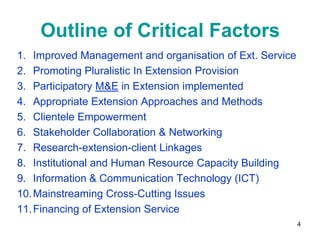
Outline of Critical Factors
1. Improved Management and organisation of Ext. Service
2. Promoting Pluralistic In Extension Provision
3. Participatory M&E in Extension implemented
4. Appropriate Extension Approaches and Methods
5. Clientele Empowerment
6. Stakeholder Collaboration & Networking
7. Research-extension-client Linkages
8. Institutional and Human Resource Capacity Building
9. Information & Communication Technology (ICT)
10. Mainstreaming Cross-Cutting Issues
11. Financing of Extension Service
                                                          4
1. Improve Management and Organisation of
            Extension Service:

• Embrace pluralism in extension services delivery
• Promote decentralization of decision making processes
• Establish an independent regulatory system
• Establish of participatory M&E and impact assessment;
• Invest in capacity building (for private and public
  extension providers, extension clientele, etc.);
• Strengthen inter-sectoral planning (to improve extension
  facilitating factors.


                                                          5
2. Promote Pluralism in Extension Provision

• Develop guidelines, code of ethics and standards for
  extension providers.
• Establish regulatory body for registration and
  accreditation of extension providers and practitioners.
• Strengthen public-private partnerships
• Build capacity of private sector to operate
• Empower community organizations
• Institutional linkage to providers of facilitating factors

                                                               6
3. Implement Participatory M&E in Extension

i.   Service Charters for Extension Service Providers
ii. Use a dynamic, Participatory M&E Framework
iii. Undertake TNA and train stakeholders on PM&E


                                                        7
4. Use Appropriate Extension Approaches and
                  Methods

• Promote market and value addition orientation in
  production
• Demand driven and beneficiary led approach
• Use of group approaches
• Have clear accountability mechanisms;
• Recognise socio-economic and cultural characteristics
  of the clients
• Mainstream cross-cutting issues
• Promote enterprise diversification
                                                          8
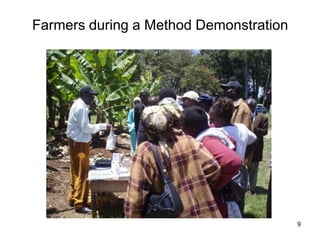
Farmers during a Method Demonstration


                                        9
5. Empower Clientele

• Develop community information system networks.
• Promote good governance in clientele groups and
  cooperatives.
• Build the capacity for community groups on e.g. resource
  mobilisation and access
• Harmonise clientele empowerment approaches
• Link clients with service providers
• Link clients with the markets
• Empower community groups on technology development
  and entrepreneurship business skills.
                                                        10
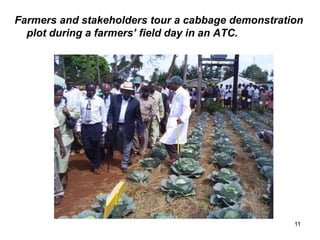
Farmers and stakeholders tour a cabbage demonstration
  plot during a farmers’ field day in an ATC.


                                                   11
6. Stakeholder Collaboration & Networking

• Should provide for integrated approach to problem
  solving
• Increase efficiency in utilization of resources
• Minimize duplication of efforts
• Allow for exchange of ideas/updating of
  technologies
• Take into account institutional comparative
  advantages
• Strife for benefits to all stakeholders
  (win-win situation).

                                                      12
7. Research-Extension-Client Linkages

• Facilitate strengthening of research-extension-client
  linkages and feedback mechanism.
• Sector ministries and research bodies to design a
  workable mechanism for strengthening research-
  extension-client linkage and feedback.
• Institutionalise research setting priorities
• Formulate sustainable funding mechanisms for
  technology development, dissemination and Clientele
  access.

                                                          13
8. Institutional and Human Resource Capacity
                     Building
• Extension personnel are well trained and motivated.
• In-service staff training on e.g. farming as a business;
  value addition; emerging technological developments.
• Gender balance in service and mainstreaming in
  training.
• Ensure rationalization of staff recruitment and
  deployment
• Public training institutions should respond to the wider
  sectoral and stakeholder requirements

                                                             14
9. Information & Communication Technology
                   (ICT)

• Investment in human skills and operational
  infrastructure (for personnel and clientele capacity
  building in ICT).
• Establish an integrated and dynamic database for
  the sector.
• Operate ICT-based rural information centres.


                                                         15
10. Mainstreaming Cross-Cutting Issues

• Mainstream HIV/AID
• Capacity building of CBOs on governance
• Communities basic rights and obligation
• Resource use conflict management
• Management and conservation of natural resources
  and environment
• Gender friendly extension approaches
• Vulnerable groups such as the disabled and
  resource-poor farmers
                                                     16
11. Financing of Extension Service

• Commercialisation of extension services
• Privatization of services where private sector
  business can thrive
• Ensure adequate funding mechanism of extension
  services.
• Facilitate a stakeholder-driven Trust Fund for
  extension service
• Institutional arrangements for cost sharing and
  graduating to full cost recovery.

                                                    17
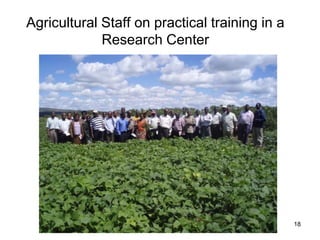
Agricultural Staff on practical training in a
             Research Center


                                                18
END

THANK YOU


            19

Kenya - Extension Policy Development

  • 1.
    STRENGTHENING EXTENSION & ADVISORYSERVICEDELIVERY TOWARDS MEETING THE CHALLENGES OF THE 21ST CENTURY The Critical Factors – The Kenya Experience BY MARY KAMAU DIRECTOR, EXTENSION & TRAINING MINISTRY OF AGRICULTURE KENYA DURING THE GLOBAL FORUM FOR RURAL ADVISORY SERVICES (GFRAS) 3RD ANNUAL CONFERENCE, MANILA PHILIPPINES 25 SEPTEMBER 2012 1
  • 2.
    Agricultural Extension inKenya • Kenya’s agriculture is dominated by small scale farmers (75% of the total production). • There are wide variations among the small farmers in management practices and husbandry skills • Therefore, provision of high quality extension services is very critical for improvement of smallholder productivity, farm incomes and hence poverty reduction benefits 2
  • 3.
    National Agricultural Sector Extension Policy (NASEP) • Developed by Key sector Ministries with the objective of making extension service delivery more effective and efficient. • Has strong focus on promotion of pluralistic and demand driven extension service. • Addresses funding modalities and regulation of extension services 3
  • 4.
    Outline of CriticalFactors 1. Improved Management and organisation of Ext. Service 2. Promoting Pluralistic In Extension Provision 3. Participatory M&E in Extension implemented 4. Appropriate Extension Approaches and Methods 5. Clientele Empowerment 6. Stakeholder Collaboration & Networking 7. Research-extension-client Linkages 8. Institutional and Human Resource Capacity Building 9. Information & Communication Technology (ICT) 10. Mainstreaming Cross-Cutting Issues 11. Financing of Extension Service 4
  • 5.
    1. Improve Managementand Organisation of Extension Service: • Embrace pluralism in extension services delivery • Promote decentralization of decision making processes • Establish an independent regulatory system • Establish of participatory M&E and impact assessment; • Invest in capacity building (for private and public extension providers, extension clientele, etc.); • Strengthen inter-sectoral planning (to improve extension facilitating factors. 5
  • 6.
    2. Promote Pluralismin Extension Provision • Develop guidelines, code of ethics and standards for extension providers. • Establish regulatory body for registration and accreditation of extension providers and practitioners. • Strengthen public-private partnerships • Build capacity of private sector to operate • Empower community organizations • Institutional linkage to providers of facilitating factors 6
  • 7.
    3. Implement ParticipatoryM&E in Extension i. Service Charters for Extension Service Providers ii. Use a dynamic, Participatory M&E Framework iii. Undertake TNA and train stakeholders on PM&E 7
  • 8.
    4. Use AppropriateExtension Approaches and Methods • Promote market and value addition orientation in production • Demand driven and beneficiary led approach • Use of group approaches • Have clear accountability mechanisms; • Recognise socio-economic and cultural characteristics of the clients • Mainstream cross-cutting issues • Promote enterprise diversification 8
  • 9.
    Farmers during aMethod Demonstration 9
  • 10.
    5. Empower Clientele •Develop community information system networks. • Promote good governance in clientele groups and cooperatives. • Build the capacity for community groups on e.g. resource mobilisation and access • Harmonise clientele empowerment approaches • Link clients with service providers • Link clients with the markets • Empower community groups on technology development and entrepreneurship business skills. 10
  • 11.
    Farmers and stakeholderstour a cabbage demonstration plot during a farmers’ field day in an ATC. 11
  • 12.
    6. Stakeholder Collaboration& Networking • Should provide for integrated approach to problem solving • Increase efficiency in utilization of resources • Minimize duplication of efforts • Allow for exchange of ideas/updating of technologies • Take into account institutional comparative advantages • Strife for benefits to all stakeholders (win-win situation). 12
  • 13.
    7. Research-Extension-Client Linkages •Facilitate strengthening of research-extension-client linkages and feedback mechanism. • Sector ministries and research bodies to design a workable mechanism for strengthening research- extension-client linkage and feedback. • Institutionalise research setting priorities • Formulate sustainable funding mechanisms for technology development, dissemination and Clientele access. 13
  • 14.
    8. Institutional andHuman Resource Capacity Building • Extension personnel are well trained and motivated. • In-service staff training on e.g. farming as a business; value addition; emerging technological developments. • Gender balance in service and mainstreaming in training. • Ensure rationalization of staff recruitment and deployment • Public training institutions should respond to the wider sectoral and stakeholder requirements 14
  • 15.
    9. Information &Communication Technology (ICT) • Investment in human skills and operational infrastructure (for personnel and clientele capacity building in ICT). • Establish an integrated and dynamic database for the sector. • Operate ICT-based rural information centres. 15
  • 16.
    10. Mainstreaming Cross-CuttingIssues • Mainstream HIV/AID • Capacity building of CBOs on governance • Communities basic rights and obligation • Resource use conflict management • Management and conservation of natural resources and environment • Gender friendly extension approaches • Vulnerable groups such as the disabled and resource-poor farmers 16
  • 17.
    11. Financing ofExtension Service • Commercialisation of extension services • Privatization of services where private sector business can thrive • Ensure adequate funding mechanism of extension services. • Facilitate a stakeholder-driven Trust Fund for extension service • Institutional arrangements for cost sharing and graduating to full cost recovery. 17
  • 18.
    Agricultural Staff onpractical training in a Research Center 18
  • 19.