










Keeping Your Content Searchable in Google’s World
          Bob Burch, Digital Media Supervisor
          bburch@martinoflynn.com

          9.28.2011
Today’s Agenda

• What is Search Engine Marketing?
• Understanding The SEO Process
   - Finding the Right Keywords
   - Building a Search Engine-Friendly Website
   - Website/Content Optimization
   - Acquiring Relevant Inbound Links
   - Leveraging Social Media
   - Analyzing Performance
• Key Takeaways for PR Professionals
• Resources


                                                 2
What is Search Engine Marketing (SEM)?


                                         3
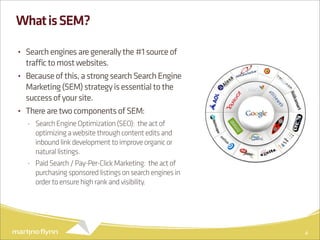
What is SEM?

•   Search engines are generally the #1 source of
    traffic to most websites.
•   Because of this, a strong search Search Engine
    Marketing (SEM) strategy is essential to the
    success of your site.
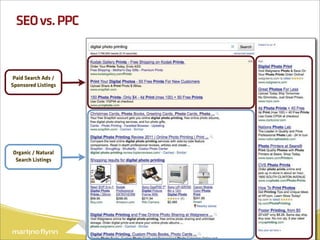
•   There are two components of SEM:
    - Search Engine Optimization (SEO): the act of
      optimizing a website through content edits and
      inbound link development to improve organic or
      natural listings.
    - Paid Search / Pay-Per-Click Marketing: the act of
      purchasing sponsored listings on search engines in
      order to ensure high rank and visibility.


                                                           4
SEO vs. PPC


 Paid Search Ads /
Sponsored Listings


Organic / Natural
 Search Listings


                     5
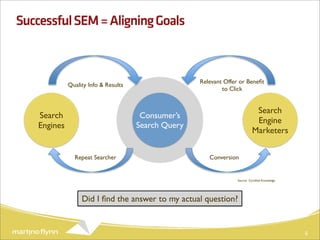
Successful SEM = Aligning Goals


                                                      Relevant Offer or Benefit
              Quality Info & Results
                                                              to Click


                                                                              Search
    Search                              Consumer’s
                                                                              Engine
    Engines                            Search Query
                                                                             Marketers


                Repeat Searcher                          Conversion


                                                                    Source: Certified Knowledge


                   Did I find the answer to my actual question?


                                                                                                 6
Principles of Search Engine Optimization

• Architecture and design:
   - Give search engine spiders easy, user-friendly
     access to content through the site and page
     architecture.
• Quality content:
   - Keyword-focused: use words and phrases
     commonly searched by your target audience.
   - Leads to link popularity: increase the number of
     objective, third-party, quality sites linking to your
     content.


                                                             7
SEO Strategies Must Continually Evolve

• The search engines (specifically Google) made many changes to their
  algorithms over the past year.
• What’s changed?
   - Search Engine Results Pages (SERPs) were given a face-lift
   - Personalized search
   - Greater emphasis on site usability
   - Greater emphasis on quality, not quantity, of inbound links
   - Greater emphasis on social media


                                                                        8
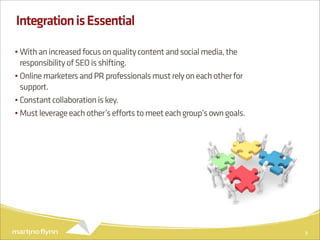
Integration is Essential

• With an increased focus on quality content and social media, the
  responsibility of SEO is shifting.
• Online marketers and PR professionals must rely on each other for
  support.
• Constant collaboration is key.
• Must leverage each other’s efforts to meet each group’s own goals.


                                                                       9
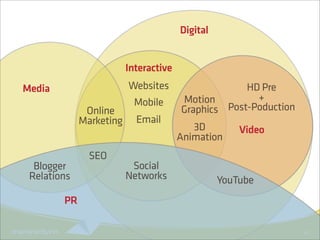
Digital


                         Interactive
Media                    Websites                   HD Pre
                           Mobile      Motion         +
              Online                   Graphics Post-Poduction
             Marketing     Email
                                          3D         Video
                                       Animation
               SEO
  Blogger                 Social
 Relations               Networks                YouTube
        PR

                                                                 10
Understanding the SEO Process:
Step 1: Finding the Right Keywords


                                     11
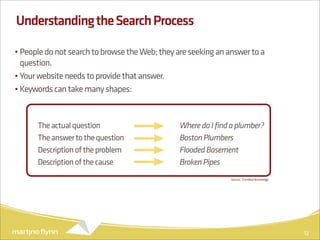
Understanding the Search Process

• People do not search to browse the Web; they are seeking an answer to a
  question.
• Your website needs to provide that answer.
• Keywords can take many shapes:


      The actual question                       Where do I find a plumber?
      The answer to the question                Boston Plumbers
      Description of the problem                Flooded Basement
      Description of the cause                  Broken Pipes
                                                               Source: Certified Knowledge


                                                                                            12
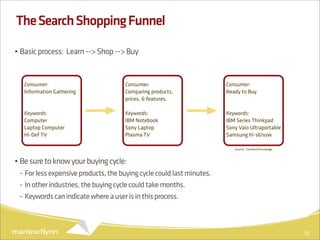
The Search Shopping Funnel

• Basic process: Learn --> Shop --> Buy


   Consumer:                         Consumer:                         Consumer:
   Information Gathering             Comparing products,               Ready to Buy
                                     prices, & features.

   Keywords:                         Keywords:                         Keywords:
   Computer                          IBM Notebook                      IBM Series Thinkpad
   Laptop Computer                   Sony Laptop                       Sony Vaio Ultraportable
   Hi-Def TV                         Plasma TV                         Samsung hl-s61ssw

                                                                          Source: Certified Knowledge


• Be sure to know your buying cycle:
 - For less expensive products, the buying cycle could last minutes.
 - In other industries, the buying cycle could take months.
 - Keywords can indicate where a user is in this process.


                                                                                                       13
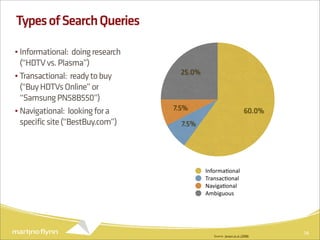
Types of Search Queries

• Informational: doing research
  (“HDTV vs. Plasma”)
                                    25.0%
• Transactional: ready to buy
  (“Buy HDTVs Online” or
  “Samsung PN58B550”)
• Navigational: looking for a     7.5%                                60.0%
  specific site (“BestBuy.com”)     7.5%


                                            Informa(onal
                                            Transac(onal
                                            Naviga(onal
                                            Ambiguous


                                               Source: Jansen et al. (2008)
                                                                              14
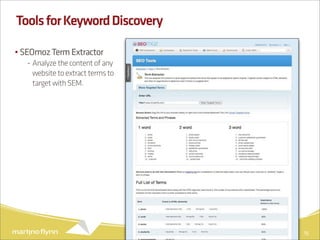
Tools for Keyword Discovery

• SEOmoz Term Extractor
   - Analyze the content of any
     website to extract terms to
     target with SEM.


                                   15
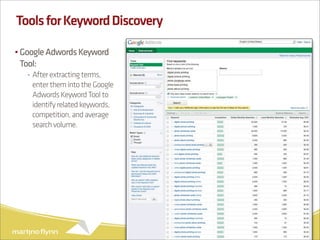
Tools for Keyword Discovery

• Google Adwords Keyword
  Tool:
   - After extracting terms,
     enter them into the Google
     Adwords Keyword Tool to
     identify related keywords,
     competition, and average
     search volume.


                                  16
Tools for Keyword Discovery

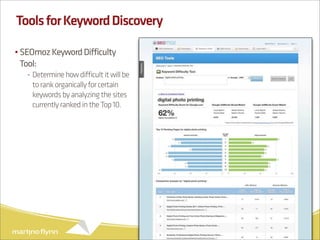
• SEOmoz Keyword Difficulty
  Tool:
   - Determine how difficult it will be
     to rank organically for certain
     keywords by analyzing the sites
     currently ranked in the Top 10.


                                          17
Which Keywords are the Right Keywords?

• Varies from business to business due to a number of factors:
   - Tactic (PPC vs. SEO)
   - Budget
   - Conversion rates
   - Goals
• The key is to find the right combination of keywords that will help you
  reach your goals.
   - Test
   - Optimize


                                                                            18
Understanding the SEO Process:
Step 2: Building a Search Engine-Friendly Website


                                                    19
User-Friendly = Search-Friendly

• Search engines are focused on offering up the most relevant results for
  their users, not just the sites that optimize the best.
• By focusing on the user, you’re making sure that your site is optimized
  against future changes to the search engine algorithms.
• More importantly, user-friendly = repeat visitors, repeat customers, and
  high ROI (return on investment).


                                                                             20
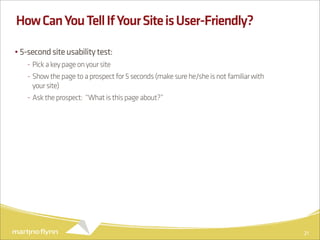
How Can You Tell If Your Site is User-Friendly?

• 5-second site usability test:
   - Pick a key page on your site
   - Show the page to a prospect for 5 seconds (make sure he/she is not familiar with
     your site)
   - Ask the prospect: “What is this page about?”


                                                                                        21
What Was This Page About?


                            23
What About This Page?


                        25
What About This Page?


                        27
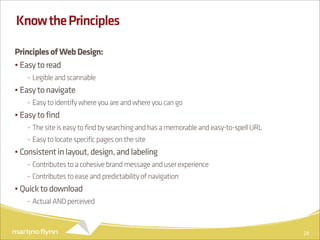
Know the Principles

Principles of Web Design:
• Easy to read
   - Legible and scannable
• Easy to navigate
   - Easy to identify where you are and where you can go
• Easy to find
   - The site is easy to find by searching and has a memorable and easy-to-spell URL
   - Easy to locate specific pages on the site
• Consistent in layout, design, and labeling
   - Contributes to a cohesive brand message and user experience
   - Contributes to ease and predictability of navigation
• Quick to download
   - Actual AND perceived


                                                                                       28
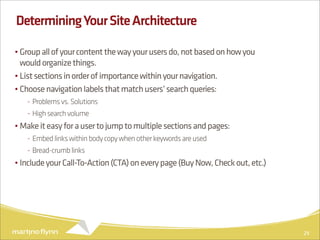
Determining Your Site Architecture

• Group all of your content the way your users do, not based on how you
  would organize things.
• List sections in order of importance within your navigation.
• Choose navigation labels that match users’ search queries:
   - Problems vs. Solutions
   - High search volume
• Make it easy for a user to jump to multiple sections and pages:
   - Embed links within body copy when other keywords are used
   - Bread-crumb links
• Include your Call-To-Action (CTA) on every page (Buy Now, Check out, etc.)


                                                                               29
Understanding the SEO Process:
Step 3: Website / Content Optimization


                                         30
On-Page Optimization Tactics

• Each page should have an individual theme, with relevant phrases used
  in key locations:
   - URL
   - Page Title
   - Headline (H1 & H2)
   - Body Copy


• Other items to consider:
   - Meta-descriptions: short description of the page, only visible on Search Engine
     Results Pages (SERPs)
   - Alt-tags: 1-2 word description of any images to help them rank well in Google
     Image Search


                                                                                       31
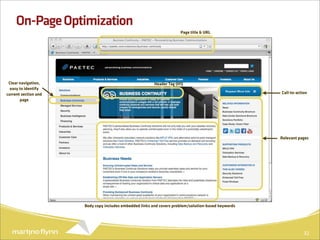
On-Page Optimization
                                                                      Page title & URL


 Clear navigation,                                       Header Tag (H1)
  easy to identify
current section and                                                                                  Call-to-action
       page


                                                                                                     Relevant pages


                      Body copy includes embedded links and covers problem/solution-based keywords


                                                                                                                 32
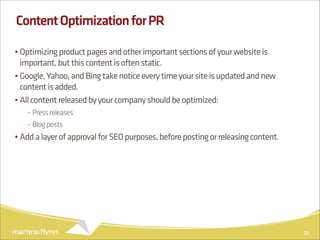
Content Optimization for PR

• Optimizing product pages and other important sections of your website is
  important, but this content is often static.
• Google, Yahoo, and Bing take notice every time your site is updated and new
  content is added.
• All content released by your company should be optimized:
   - Press releases
   - Blog posts
• Add a layer of approval for SEO purposes, before posting or releasing content.


                                                                                   33
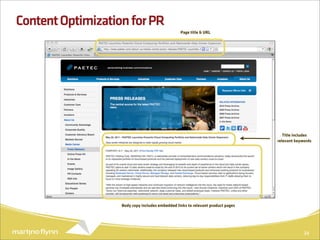
Content Optimization for PR
                                                 Page title & URL


                                                                                    Title includes
                                                                                 relevant keywords


                   Body copy includes embedded links to relevant product pages


                                                                                              34
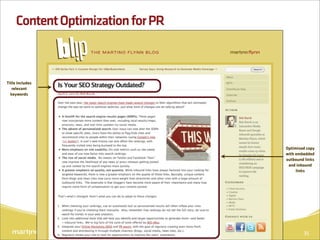
Content Optimization for PR


Title includes
   relevant
  keywords


                                   Optimized copy
                                   with embedded
                                   outbound links
                                    and inbound
                                        links


                                           35
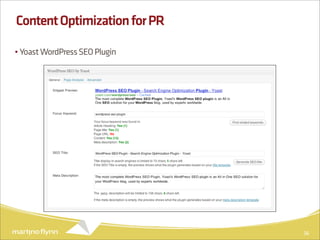
Content Optimization for PR

• Yoast WordPress SEO Plugin


                               36
Remember...

• Whether you’re writing an article/blog post or optimizing a website, always
  put the user first.
• Add a layer of approval for SEO purposes, before posting or releasing
  content.
• Site optimization is important, but the quantity and quality of sites linking
  are often what determine which sites rank well.


                                                                                  37
Understanding the SEO Process:
Step 4: Acquiring Relevant Inbound Links


                                           38
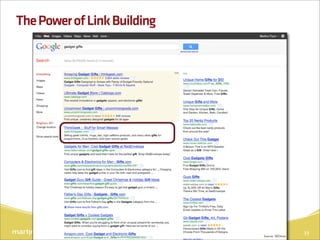
The Power of Link Building


                             Source: SEOmoz
                                              39
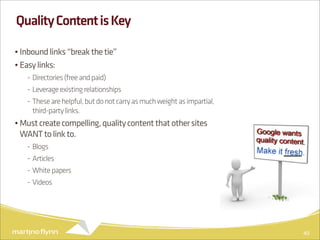
Quality Content is Key

• Inbound links “break the tie”
• Easy links:
   - Directories (free and paid)
   - Leverage existing relationships
   - These are helpful, but do not carry as much weight as impartial,
     third-party links.
• Must create compelling, quality content that other sites
  WANT to link to.
   - Blogs
   - Articles
   - White papers
   - Videos


                                                                        40
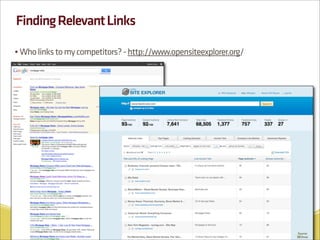
Finding Relevant Links

• Who links to my competitors? - http://www.opensiteexplorer.org/


                                                                         41
                                                                     Source:
                                                                    SEOmoz
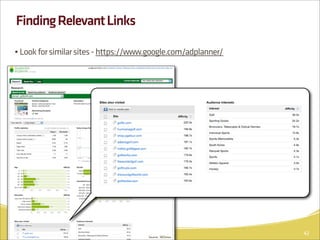
Finding Relevant Links

• Look for similar sites - https://www.google.com/adplanner/


                                                               42
                                      Source: SEOmoz
Finding Relevant Links

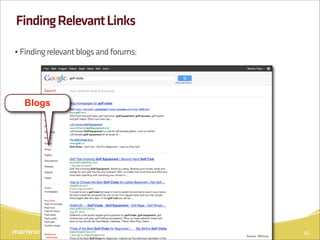
• Finding relevant blogs and forums:


  Blogs


                                       Source: SEOmoz
                                                        43
Finding Relevant Links

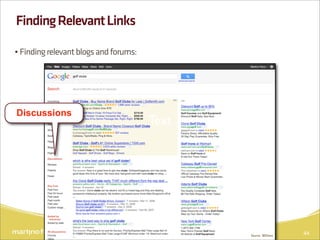
• Finding relevant blogs and forums:


Discussions
                                       Text


                                              Source: SEOmoz   44
Link Outreach

• Once you have a list of link targets, the next step is to reach out to those
  targets.
• Determine if any existing content would be relevant to the site owner or
  create new content.
• Reach out to the site’s administrator / blogger:
   - Guest blogger / ghostwriting opportunities
   - Sponsorship opportunities
   - Reciprocal links (only if it makes sense for your company)
• Don’t forget to ASK for the link.


                                                                                 45
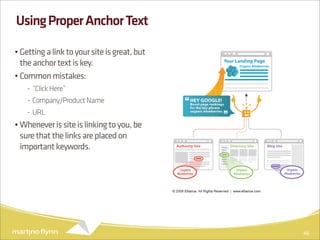
Using Proper Anchor Text

• Getting a link to your site is great, but
  the anchor text is key.
• Common mistakes:
    - “Click Here”
    - Company/Product Name
    - URL
• Whenever is site is linking to you, be
  sure that the links are placed on
  important keywords.


                                              46
Understanding the SEO Process:
Step 5: Leveraging Social Media


                                  47
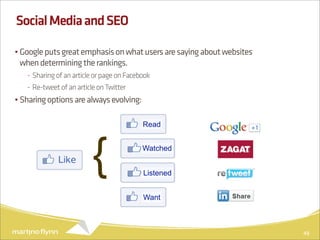
Social Media and SEO

• Google puts great emphasis on what users are saying about websites
  when determining the rankings.
   - Sharing of an article or page on Facebook
   - Re-tweet of an article on Twitter
• Sharing options are always evolving:

                                           Read


                          {                Watched


                                           Listened


                                           Want


                                                                       48
Where Do PR Professionals Fit In?

• Keep doing what you’re already doing:
   - Frequent posts, relevant content
   - Acquire fans, followers, etc.
   - Monitor discussions
   - Respond to comments
   - Participate in forums
• All of this helps, but keep SEO top of
  mind:
   - Post relevant links when responding to
     comments (other products, FAQs, customer
     service, etc.)
   - Include relevant keywords, whenever
     possible


                                                49
Understanding the SEO Process:
Step 6: Analyzing Performance


                                 50
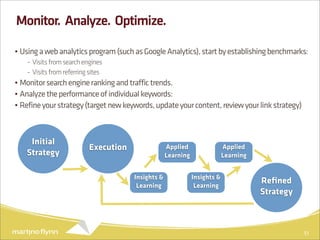
Monitor. Analyze. Optimize.

• Using a web analytics program (such as Google Analytics), start by establishing benchmarks:
    - Visits from search engines
    - Visits from referring sites
• Monitor search engine ranking and traffic trends.
• Analyze the performance of individual keywords:
• Refine your strategy (target new keywords, update your content, review your link strategy)


    Initial
                           Execution                Applied                 Applied
   Strategy                                         Learning                Learning


                                       Insights &              Insights &
                                        Learning                Learning
                                                                                       Refined
                                                                                       Strategy


                                                                                                  51
Key Takeaways

• Digital, Media, and PR must be integrated.
• Make sure that any content released by your company is optimized, but
  always put the user first.
• Always ask for a link (with the proper anchor text, of course).
• Use SEO as an opportunity to grow individually and as a company:
   - Make yourself more valuable to a company
   - Push for additional services (blogger relations, social media monitoring, etc.)
• Adopt an iterative mindset, test and refine.
• Stay informed:
   - SEO is constantly evolving
   - What works today, may be irrelevant tomorrow
   - Follow blogs, attend conferences, etc.


                                                                                       52
Relevant Resources

• Great blogs and resources:
   - SEO Moz: http://www.seomoz.org/blog
   - iMedia Connection: http://www.imediaconnection.com/
   - Search Engine Land: http://searchengineland.com/
   - Search Engine Watch: http://searchenginewatch.com/
   - Internet Marketing Glossary: http://www.laredogroup.com/free-
     tools-resources/index.asp
• Conferences to consider:
   - Search Engine Strategies (SES)
   - Search Marketing Expo (SMX)


                                                                     53
Questions?


             54
To learn more about Martino Flynn, visit us at martinoflynn.com, read our blog,
 join us on Facebook, follow us on Twitter, or tune in to our YouTube channel.


                  Presentation will be posted to our blog this week.
     Any further questions, feel free to contact me at bburch@martinoflynn.com

                                                                                  55

Keeping Content Searchable In Google's World

  • 1.
    Keeping Your ContentSearchable in Google’s World Bob Burch, Digital Media Supervisor bburch@martinoflynn.com 9.28.2011
  • 2.
    Today’s Agenda • Whatis Search Engine Marketing? • Understanding The SEO Process - Finding the Right Keywords - Building a Search Engine-Friendly Website - Website/Content Optimization - Acquiring Relevant Inbound Links - Leveraging Social Media - Analyzing Performance • Key Takeaways for PR Professionals • Resources 2
  • 3.
    What is SearchEngine Marketing (SEM)? 3
  • 4.
    What is SEM? • Search engines are generally the #1 source of traffic to most websites. • Because of this, a strong search Search Engine Marketing (SEM) strategy is essential to the success of your site. • There are two components of SEM: - Search Engine Optimization (SEO): the act of optimizing a website through content edits and inbound link development to improve organic or natural listings. - Paid Search / Pay-Per-Click Marketing: the act of purchasing sponsored listings on search engines in order to ensure high rank and visibility. 4
  • 5.
    SEO vs. PPC Paid Search Ads / Sponsored Listings Organic / Natural Search Listings 5
  • 6.
    Successful SEM =Aligning Goals Relevant Offer or Benefit Quality Info & Results to Click Search Search Consumer’s Engine Engines Search Query Marketers Repeat Searcher Conversion Source: Certified Knowledge Did I find the answer to my actual question? 6
  • 7.
    Principles of SearchEngine Optimization • Architecture and design: - Give search engine spiders easy, user-friendly access to content through the site and page architecture. • Quality content: - Keyword-focused: use words and phrases commonly searched by your target audience. - Leads to link popularity: increase the number of objective, third-party, quality sites linking to your content. 7
  • 8.
    SEO Strategies MustContinually Evolve • The search engines (specifically Google) made many changes to their algorithms over the past year. • What’s changed? - Search Engine Results Pages (SERPs) were given a face-lift - Personalized search - Greater emphasis on site usability - Greater emphasis on quality, not quantity, of inbound links - Greater emphasis on social media 8
  • 9.
    Integration is Essential •With an increased focus on quality content and social media, the responsibility of SEO is shifting. • Online marketers and PR professionals must rely on each other for support. • Constant collaboration is key. • Must leverage each other’s efforts to meet each group’s own goals. 9
  • 10.
    Digital Interactive Media Websites HD Pre Mobile Motion + Online Graphics Post-Poduction Marketing Email 3D Video Animation SEO Blogger Social Relations Networks YouTube PR 10
  • 11.
    Understanding the SEOProcess: Step 1: Finding the Right Keywords 11
  • 12.
    Understanding the SearchProcess • People do not search to browse the Web; they are seeking an answer to a question. • Your website needs to provide that answer. • Keywords can take many shapes: The actual question Where do I find a plumber? The answer to the question Boston Plumbers Description of the problem Flooded Basement Description of the cause Broken Pipes Source: Certified Knowledge 12
  • 13.
    The Search ShoppingFunnel • Basic process: Learn --> Shop --> Buy Consumer: Consumer: Consumer: Information Gathering Comparing products, Ready to Buy prices, & features. Keywords: Keywords: Keywords: Computer IBM Notebook IBM Series Thinkpad Laptop Computer Sony Laptop Sony Vaio Ultraportable Hi-Def TV Plasma TV Samsung hl-s61ssw Source: Certified Knowledge • Be sure to know your buying cycle: - For less expensive products, the buying cycle could last minutes. - In other industries, the buying cycle could take months. - Keywords can indicate where a user is in this process. 13
  • 14.
    Types of SearchQueries • Informational: doing research (“HDTV vs. Plasma”) 25.0% • Transactional: ready to buy (“Buy HDTVs Online” or “Samsung PN58B550”) • Navigational: looking for a 7.5% 60.0% specific site (“BestBuy.com”) 7.5% Informa(onal Transac(onal Naviga(onal Ambiguous Source: Jansen et al. (2008) 14
  • 15.
    Tools for KeywordDiscovery • SEOmoz Term Extractor - Analyze the content of any website to extract terms to target with SEM. 15
  • 16.
    Tools for KeywordDiscovery • Google Adwords Keyword Tool: - After extracting terms, enter them into the Google Adwords Keyword Tool to identify related keywords, competition, and average search volume. 16
  • 17.
    Tools for KeywordDiscovery • SEOmoz Keyword Difficulty Tool: - Determine how difficult it will be to rank organically for certain keywords by analyzing the sites currently ranked in the Top 10. 17
  • 18.
    Which Keywords arethe Right Keywords? • Varies from business to business due to a number of factors: - Tactic (PPC vs. SEO) - Budget - Conversion rates - Goals • The key is to find the right combination of keywords that will help you reach your goals. - Test - Optimize 18
  • 19.
    Understanding the SEOProcess: Step 2: Building a Search Engine-Friendly Website 19
  • 20.
    User-Friendly = Search-Friendly •Search engines are focused on offering up the most relevant results for their users, not just the sites that optimize the best. • By focusing on the user, you’re making sure that your site is optimized against future changes to the search engine algorithms. • More importantly, user-friendly = repeat visitors, repeat customers, and high ROI (return on investment). 20
  • 21.
    How Can YouTell If Your Site is User-Friendly? • 5-second site usability test: - Pick a key page on your site - Show the page to a prospect for 5 seconds (make sure he/she is not familiar with your site) - Ask the prospect: “What is this page about?” 21
  • 23.
    What Was ThisPage About? 23
  • 25.
  • 27.
  • 28.
    Know the Principles Principlesof Web Design: • Easy to read - Legible and scannable • Easy to navigate - Easy to identify where you are and where you can go • Easy to find - The site is easy to find by searching and has a memorable and easy-to-spell URL - Easy to locate specific pages on the site • Consistent in layout, design, and labeling - Contributes to a cohesive brand message and user experience - Contributes to ease and predictability of navigation • Quick to download - Actual AND perceived 28
  • 29.
    Determining Your SiteArchitecture • Group all of your content the way your users do, not based on how you would organize things. • List sections in order of importance within your navigation. • Choose navigation labels that match users’ search queries: - Problems vs. Solutions - High search volume • Make it easy for a user to jump to multiple sections and pages: - Embed links within body copy when other keywords are used - Bread-crumb links • Include your Call-To-Action (CTA) on every page (Buy Now, Check out, etc.) 29
  • 30.
    Understanding the SEOProcess: Step 3: Website / Content Optimization 30
  • 31.
    On-Page Optimization Tactics •Each page should have an individual theme, with relevant phrases used in key locations: - URL - Page Title - Headline (H1 & H2) - Body Copy • Other items to consider: - Meta-descriptions: short description of the page, only visible on Search Engine Results Pages (SERPs) - Alt-tags: 1-2 word description of any images to help them rank well in Google Image Search 31
  • 32.
    On-Page Optimization Page title & URL Clear navigation, Header Tag (H1) easy to identify current section and Call-to-action page Relevant pages Body copy includes embedded links and covers problem/solution-based keywords 32
  • 33.
    Content Optimization forPR • Optimizing product pages and other important sections of your website is important, but this content is often static. • Google, Yahoo, and Bing take notice every time your site is updated and new content is added. • All content released by your company should be optimized: - Press releases - Blog posts • Add a layer of approval for SEO purposes, before posting or releasing content. 33
  • 34.
    Content Optimization forPR Page title & URL Title includes relevant keywords Body copy includes embedded links to relevant product pages 34
  • 35.
    Content Optimization forPR Title includes relevant keywords Optimized copy with embedded outbound links and inbound links 35
  • 36.
    Content Optimization forPR • Yoast WordPress SEO Plugin 36
  • 37.
    Remember... • Whether you’rewriting an article/blog post or optimizing a website, always put the user first. • Add a layer of approval for SEO purposes, before posting or releasing content. • Site optimization is important, but the quantity and quality of sites linking are often what determine which sites rank well. 37
  • 38.
    Understanding the SEOProcess: Step 4: Acquiring Relevant Inbound Links 38
  • 39.
    The Power ofLink Building Source: SEOmoz 39
  • 40.
    Quality Content isKey • Inbound links “break the tie” • Easy links: - Directories (free and paid) - Leverage existing relationships - These are helpful, but do not carry as much weight as impartial, third-party links. • Must create compelling, quality content that other sites WANT to link to. - Blogs - Articles - White papers - Videos 40
  • 41.
    Finding Relevant Links •Who links to my competitors? - http://www.opensiteexplorer.org/ 41 Source: SEOmoz
  • 42.
    Finding Relevant Links •Look for similar sites - https://www.google.com/adplanner/ 42 Source: SEOmoz
  • 43.
    Finding Relevant Links •Finding relevant blogs and forums: Blogs Source: SEOmoz 43
  • 44.
    Finding Relevant Links •Finding relevant blogs and forums: Discussions Text Source: SEOmoz 44
  • 45.
    Link Outreach • Onceyou have a list of link targets, the next step is to reach out to those targets. • Determine if any existing content would be relevant to the site owner or create new content. • Reach out to the site’s administrator / blogger: - Guest blogger / ghostwriting opportunities - Sponsorship opportunities - Reciprocal links (only if it makes sense for your company) • Don’t forget to ASK for the link. 45
  • 46.
    Using Proper AnchorText • Getting a link to your site is great, but the anchor text is key. • Common mistakes: - “Click Here” - Company/Product Name - URL • Whenever is site is linking to you, be sure that the links are placed on important keywords. 46
  • 47.
    Understanding the SEOProcess: Step 5: Leveraging Social Media 47
  • 48.
    Social Media andSEO • Google puts great emphasis on what users are saying about websites when determining the rankings. - Sharing of an article or page on Facebook - Re-tweet of an article on Twitter • Sharing options are always evolving: Read { Watched Listened Want 48
  • 49.
    Where Do PRProfessionals Fit In? • Keep doing what you’re already doing: - Frequent posts, relevant content - Acquire fans, followers, etc. - Monitor discussions - Respond to comments - Participate in forums • All of this helps, but keep SEO top of mind: - Post relevant links when responding to comments (other products, FAQs, customer service, etc.) - Include relevant keywords, whenever possible 49
  • 50.
    Understanding the SEOProcess: Step 6: Analyzing Performance 50
  • 51.
    Monitor. Analyze. Optimize. •Using a web analytics program (such as Google Analytics), start by establishing benchmarks: - Visits from search engines - Visits from referring sites • Monitor search engine ranking and traffic trends. • Analyze the performance of individual keywords: • Refine your strategy (target new keywords, update your content, review your link strategy) Initial Execution Applied Applied Strategy Learning Learning Insights & Insights & Learning Learning Refined Strategy 51
  • 52.
    Key Takeaways • Digital,Media, and PR must be integrated. • Make sure that any content released by your company is optimized, but always put the user first. • Always ask for a link (with the proper anchor text, of course). • Use SEO as an opportunity to grow individually and as a company: - Make yourself more valuable to a company - Push for additional services (blogger relations, social media monitoring, etc.) • Adopt an iterative mindset, test and refine. • Stay informed: - SEO is constantly evolving - What works today, may be irrelevant tomorrow - Follow blogs, attend conferences, etc. 52
  • 53.
    Relevant Resources • Greatblogs and resources: - SEO Moz: http://www.seomoz.org/blog - iMedia Connection: http://www.imediaconnection.com/ - Search Engine Land: http://searchengineland.com/ - Search Engine Watch: http://searchenginewatch.com/ - Internet Marketing Glossary: http://www.laredogroup.com/free- tools-resources/index.asp • Conferences to consider: - Search Engine Strategies (SES) - Search Marketing Expo (SMX) 53
  • 54.
  • 55.
    To learn moreabout Martino Flynn, visit us at martinoflynn.com, read our blog, join us on Facebook, follow us on Twitter, or tune in to our YouTube channel. Presentation will be posted to our blog this week. Any further questions, feel free to contact me at bburch@martinoflynn.com 55