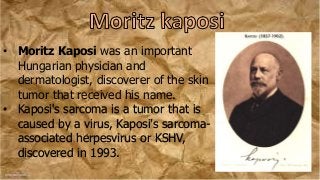
• Moritz Kaposi was an important
Hungarian physician and
dermatologist, discoverer of the skin
tumor that received his name.
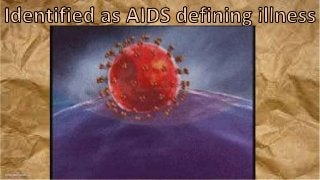
• Kaposi's sarcoma is a tumor that is
caused by a virus, Kaposi's sarcoma-
associated herpesvirus or KSHV,
discovered in 1993.
 Identified as incurable condition;
• The disease leads to death,
and it does so within a short
period of two to three
years...
• The disease must, from our
present experience, be
considered from the onset
not only as incurable but also
as deadly.“
• This occurs more often in men than in women.
• HIV-1 associated kaposi sarcoma has high
occurance in homosexual men.
• Most cultures of these tumors yeild cells with
properties of hyperplastic endothelial cells.
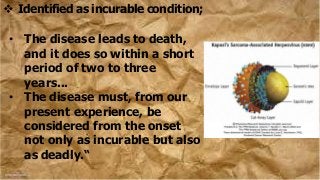
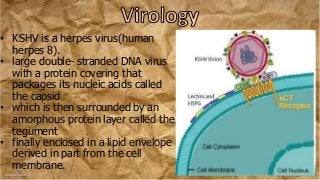
• KSHV is a herpes virus(human
herpes 8).
• large double- stranded DNA virus
with a protein covering that
packages its nucleic acids called
the capsid
• which is then surrounded by an
amorphous protein layer called the
tegument
• finally enclosed in a lipid envelope
derived in part from the cell
membrane.
• KSHV appears to be shed in saliva independent of subjects
immune status
• Viral DNA is detected in breast milk samples in African
patients.
• HSHV 8 infects dividing B cells CD45+phase
• Sexaully transmitted among men who have sex with men.
Who have higher prevalence ( 30- 60%)
• Infections are common in Africa (>50%) with infections
acquired early in life by nonsexual routes, through contact
with oral secretions
• Kaposi's tumors are divided into 3 groups;
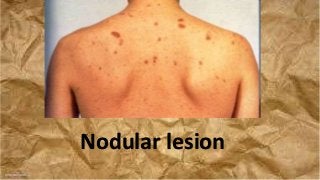
• Nodular lesions(varying size and thickness,purple and
has brown or yellow pigment around them).
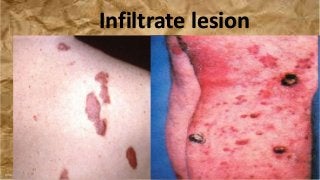
• Infiltrating lesions(quite large,may be raised,grown
downward beneath the skin).
• Lymphatic lesions.
Nodular lesion
Infiltrate lesion
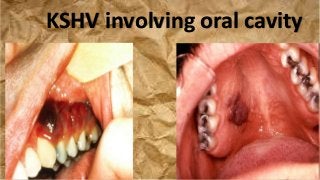
KSHV involving oral cavity
 The most common type of Kaposi sarcoma (KS) in the United
States is epidemic or AIDS-related KS.
 This type of KS develops in people who are infected with HIV, the
virus that causes AIDS.
 A person infected with HIV (that is, who is HIV- positive) does
not necessarily have AIDS.
 The virus can be present in the body for a long time, typically
many years, before causing major illness.
 The disease known as AIDS begins when the virus has seriously
damaged the immune system,
 Classic Kaposi sarcoma (KS) occurs in elderly people of
Mediterranean, Eastern European, and Middle Eastern
heritage.
 Classic KS is more common in men than in women.
 Patients typically have one or more lesions on the legs, ankles,
or the soles of the feet.
 In comparison with other types of KS, the lesions in this type
do not grow as quickly, and new lesions do not develop as
often.
 Endemic Kaposi sarcoma (KS) occurs in people living in
Equatorial Africa and is sometimes called African KS.
 KS herpes virus infection is much more common in Africa than
in other parts of the world, increasing the chance of KS
developing.
 When Kaposi sarcoma (KS) develops in people whose immune
systems have been suppressed after an organ transplant it is
called iatrogenic, or transplant-associated, KS.
 Most transplant patients take drugs to keep the immune system
from rejecting (attacking and killing) the new organ.
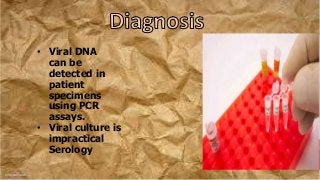
• Viral DNA
can be
detected in
patient
specimens
using PCR
assays.

• Viral culture is
impractical
Serology
• It is not curable but can be treated
for years.
• People with few local lesions can be
treated with local measures such as
cyrosurgery.
• Weak evidence suggest that
antiretroviral therapy in combination
with chemotherapy
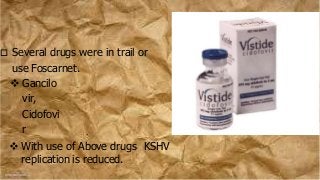
 Several drugs were in trail or
use Foscarnet.
 Gancilo
vir,
Cidofovi
r
 With use of Above drugs KSHV
replication is reduced.
Kaposi sarcoma
Kaposi sarcoma

Kaposi sarcoma

  • 2.
    • Moritz Kaposiwas an important Hungarian physician and dermatologist, discoverer of the skin tumor that received his name. • Kaposi's sarcoma is a tumor that is caused by a virus, Kaposi's sarcoma- associated herpesvirus or KSHV, discovered in 1993.
  • 3.
     Identified asincurable condition; • The disease leads to death, and it does so within a short period of two to three years... • The disease must, from our present experience, be considered from the onset not only as incurable but also as deadly.“
  • 4.
    • This occursmore often in men than in women. • HIV-1 associated kaposi sarcoma has high occurance in homosexual men. • Most cultures of these tumors yeild cells with properties of hyperplastic endothelial cells.
  • 6.
    • KSHV isa herpes virus(human herpes 8). • large double- stranded DNA virus with a protein covering that packages its nucleic acids called the capsid • which is then surrounded by an amorphous protein layer called the tegument • finally enclosed in a lipid envelope derived in part from the cell membrane.
  • 7.
    • KSHV appearsto be shed in saliva independent of subjects immune status • Viral DNA is detected in breast milk samples in African patients. • HSHV 8 infects dividing B cells CD45+phase • Sexaully transmitted among men who have sex with men. Who have higher prevalence ( 30- 60%) • Infections are common in Africa (>50%) with infections acquired early in life by nonsexual routes, through contact with oral secretions
  • 8.
    • Kaposi's tumorsare divided into 3 groups; • Nodular lesions(varying size and thickness,purple and has brown or yellow pigment around them). • Infiltrating lesions(quite large,may be raised,grown downward beneath the skin). • Lymphatic lesions.
  • 9.
  • 10.
  • 11.
  • 12.
     The mostcommon type of Kaposi sarcoma (KS) in the United States is epidemic or AIDS-related KS.  This type of KS develops in people who are infected with HIV, the virus that causes AIDS.  A person infected with HIV (that is, who is HIV- positive) does not necessarily have AIDS.  The virus can be present in the body for a long time, typically many years, before causing major illness.  The disease known as AIDS begins when the virus has seriously damaged the immune system,
  • 13.
     Classic Kaposisarcoma (KS) occurs in elderly people of Mediterranean, Eastern European, and Middle Eastern heritage.  Classic KS is more common in men than in women.  Patients typically have one or more lesions on the legs, ankles, or the soles of the feet.  In comparison with other types of KS, the lesions in this type do not grow as quickly, and new lesions do not develop as often.
  • 14.
     Endemic Kaposisarcoma (KS) occurs in people living in Equatorial Africa and is sometimes called African KS.  KS herpes virus infection is much more common in Africa than in other parts of the world, increasing the chance of KS developing.
  • 15.
     When Kaposisarcoma (KS) develops in people whose immune systems have been suppressed after an organ transplant it is called iatrogenic, or transplant-associated, KS.  Most transplant patients take drugs to keep the immune system from rejecting (attacking and killing) the new organ.
  • 16.
    • Viral DNA canbe detected in patient specimens using PCR assays. • Viral culture is impractical Serology
  • 17.
    • It isnot curable but can be treated for years. • People with few local lesions can be treated with local measures such as cyrosurgery. • Weak evidence suggest that antiretroviral therapy in combination with chemotherapy
  • 19.
     Several drugswere in trail or use Foscarnet.  Gancilo vir, Cidofovi r  With use of Above drugs KSHV replication is reduced.