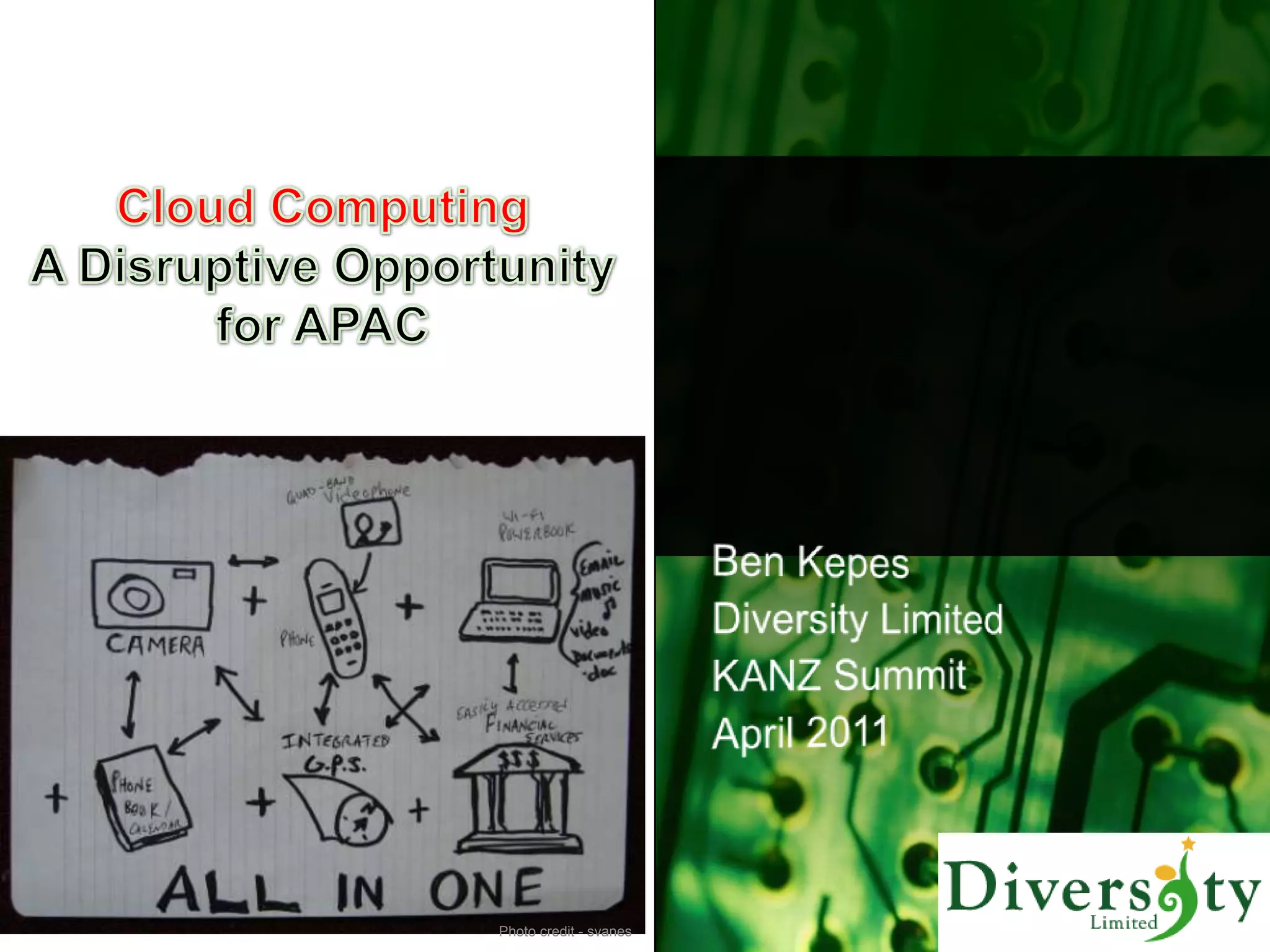
Cloud ComputingA Disruptive Opportunity for APACBen KepesDiversity Limited KANZ SummitApril 2011Photo credit - svanes
AgendaWho am I?Understanding Cloud ComputingSaaSPaaSIaaSImpactsChallenges
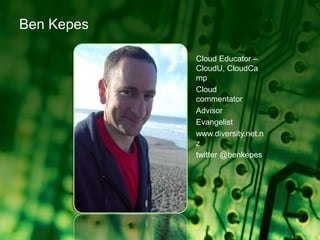
Ben KepesCloud Educator – CloudU, CloudCampCloud commentatorAdvisorEvangelistwww.diversity.net.nztwitter @benkepes
So What is Cloud Computing?“Cloud computing is a model for enabling convenient, on-demand network access to a shared pool of configurable computing resources (e.g., networks, servers, storage, applications, and services) that can be rapidly provisioned and released with minimal management effort or service provider interaction.”Nist definition [http://csrc.nist.gov/groups/SNS/cloud-computing/cloud-def-v15.doc
So What is Cloud Computing?OSSM – Dave NielsenOn-DemandSelf-serviceScalableMeasured
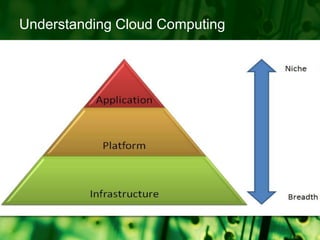
Understanding Cloud Computing
Understanding Cloud ComputingScalabilityInstantaneousnessPay according to useFocus on core businessReliable/Stable/Ease of use
“ …everyone on the planet deserves to have their own virtual data center in the cloud ”- Lew Tucker, CTO of SUN cloud group
“ …we are able to reduce our IT operational costs by roughly 30% of what we’re spending now ”- Ingo Elfering, Vice President of Information Technology Strategy, GlaxoSmithKline
“ The deployment time is really what impressed us, it's just shy of instantaneous ”- Dave Powers Associate Information Consultant, Eli Lilly
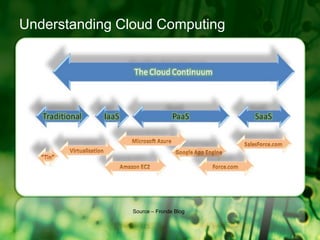
Understanding Cloud ComputingSource – Fronde Blog
Understanding SaaSModern version of application service providers (ASPs) but,Custom created for web based deliverySingle instance, multi-tenant architectureProvider patch and upgrade managementMay include application programming interfaces (APIs)Generally subscription basis – per seat, user, instance
Understanding PaaSServices to develop, test, deploy, hostWeb based user interfaceMulti-tenant architectureIntegration with web services and databasesSupport for development team collaborationUtility-grade instrumentation
Understanding IaaSResources delivered as a service Dynamic scaling of infrastructureVariable cost serviceMultiple tenants on the same infrastructure resourcesEnterprise grade infrastructure
Case Study – eq.org.nzLeveraged OpenSource crisis relief app Ushahidi Google People FinderCloud mapping and geo-locationUtilized SMS, email, web formsTwo hours to execution – auto scale and integrationVolunteers nationally and globallyBetter, faster, more complete than official channels
How will the cloud affect the organisation?IT governance implicationsSecurity needsService level agreements (SLAs)Migration strategiesIn-house integrationRegulatory impactsIT Role impacts
“Services designed to scale to tens or hundreds or millions of users will dramatically change the nature and cost of solutions deliverable to enterprise..”- Bill GatesMicrosoft Internal memo
“I believe, over time, more and more software will be delivered as a service. I totally believe that... We have to be good at this, or we have a problem”- Larry Ellison CEO Oracle
Impacts on APACPotential for companies here to play on global stageConnectivity/Latency an issueDemocratization of marketsLocalization/Regionalization opportunities
Challenges?Regulation – privacy, jurisdictionInternational bandwidthAccess and retention of smart technologistsVelocity of changeLocal infrastructure

Kanz visual bee

  • 1.
    Cloud ComputingA DisruptiveOpportunity for APACBen KepesDiversity Limited KANZ SummitApril 2011Photo credit - svanes
  • 2.
    AgendaWho am I?UnderstandingCloud ComputingSaaSPaaSIaaSImpactsChallenges
  • 3.
    Ben KepesCloud Educator– CloudU, CloudCampCloud commentatorAdvisorEvangelistwww.diversity.net.nztwitter @benkepes
  • 4.
    So What isCloud Computing?“Cloud computing is a model for enabling convenient, on-demand network access to a shared pool of configurable computing resources (e.g., networks, servers, storage, applications, and services) that can be rapidly provisioned and released with minimal management effort or service provider interaction.”Nist definition [http://csrc.nist.gov/groups/SNS/cloud-computing/cloud-def-v15.doc
  • 5.
    So What isCloud Computing?OSSM – Dave NielsenOn-DemandSelf-serviceScalableMeasured
  • 6.
  • 7.
    Understanding Cloud ComputingScalabilityInstantaneousnessPayaccording to useFocus on core businessReliable/Stable/Ease of use
  • 8.
    “ …everyone onthe planet deserves to have their own virtual data center in the cloud ”- Lew Tucker, CTO of SUN cloud group
  • 9.
    “ …we areable to reduce our IT operational costs by roughly 30% of what we’re spending now ”- Ingo Elfering, Vice President of Information Technology Strategy, GlaxoSmithKline
  • 10.
    “ The deploymenttime is really what impressed us, it's just shy of instantaneous ”- Dave Powers Associate Information Consultant, Eli Lilly
  • 11.
  • 12.
    Understanding SaaSModern versionof application service providers (ASPs) but,Custom created for web based deliverySingle instance, multi-tenant architectureProvider patch and upgrade managementMay include application programming interfaces (APIs)Generally subscription basis – per seat, user, instance
  • 13.
    Understanding PaaSServices todevelop, test, deploy, hostWeb based user interfaceMulti-tenant architectureIntegration with web services and databasesSupport for development team collaborationUtility-grade instrumentation
  • 14.
    Understanding IaaSResources deliveredas a service Dynamic scaling of infrastructureVariable cost serviceMultiple tenants on the same infrastructure resourcesEnterprise grade infrastructure
  • 15.
    Case Study –eq.org.nzLeveraged OpenSource crisis relief app Ushahidi Google People FinderCloud mapping and geo-locationUtilized SMS, email, web formsTwo hours to execution – auto scale and integrationVolunteers nationally and globallyBetter, faster, more complete than official channels
  • 16.
    How will thecloud affect the organisation?IT governance implicationsSecurity needsService level agreements (SLAs)Migration strategiesIn-house integrationRegulatory impactsIT Role impacts
  • 17.
    “Services designed toscale to tens or hundreds or millions of users will dramatically change the nature and cost of solutions deliverable to enterprise..”- Bill GatesMicrosoft Internal memo
  • 18.
    “I believe, overtime, more and more software will be delivered as a service. I totally believe that... We have to be good at this, or we have a problem”- Larry Ellison CEO Oracle
  • 19.
    Impacts on APACPotentialfor companies here to play on global stageConnectivity/Latency an issueDemocratization of marketsLocalization/Regionalization opportunities
  • 20.
    Challenges?Regulation – privacy,jurisdictionInternational bandwidthAccess and retention of smart technologistsVelocity of changeLocal infrastructure

Editor's Notes

  • #3 Agenda for today
  • #5 A very quick introduction to what cloud computing actually is…
  • #6 A very quick introduction to what cloud computing actually is…
  • #7 Salesforce.com is held up as the classic example of SaaS – sign up and you have a full featured CRM available to you immediately. Configuration and customisation can all be done via your web browser. “Great – it fits in the SaaS box” you say…but not quite…Force.com is the platform under-pinning Salesforce.com – and on Force.com you can build any type of application you like – CRM related or not. Often implementers will customise salesforce using the force.com platform thereby creating, in effect a hybrid SaaS/PaaS offeringGoogle AppEngine and Windows Azure are essentially straight PaaS solutions – take your application component and deploy into the platform. Azure pushes into the IaaS aspects of cloud computing – for example, by offering relatively low level SQL Server features in a way not dissimilar to what you essentially get when starting an “off the shelf” Windows SQL Server AMI on Amazon EC2.Amazon EC2 is predominantly IaaS; and apart from some specific limitations, mainly around networking, is not too dissimilar from that of mass-market virtualisation providers or what large enterprise IT teams offer their internal customers in “private clouds”.
  • #8 Some common themes of cloud computing
  • #11 With AWS a new server can be up and running in three minutes (it used to take Eli Lilly seven and a half weeks to deploy a server internally) and a 64-node Linux cluster can be online in five minutes (compared with three months internally).
  • #12 Salesforce.com is held up as the classic example of SaaS – sign up and you have a full featured CRM available to you immediately. Configuration and customisation can all be done via your web browser. “Great – it fits in the SaaS box” you say…but not quite…Force.com is the platform under-pinning Salesforce.com – and on Force.com you can build any type of application you like – CRM related or not. Often implementers will customise salesforce using the force.com platform thereby creating, in effect a hybrid SaaS/PaaS offeringGoogle AppEngine and Windows Azure are essentially straight PaaS solutions – take your application component and deploy into the platform. Azure pushes into the IaaS aspects of cloud computing – for example, by offering relatively low level SQL Server features in a way not dissimilar to what you essentially get when starting an “off the shelf” Windows SQL Server AMI on Amazon EC2.Amazon EC2 is predominantly IaaS; and apart from some specific limitations, mainly around networking, is not too dissimilar from that of mass-market virtualisation providers or what large enterprise IT teams offer their internal customers in “private clouds”.
  • #13 network-based access to, and management of, commercially available softwareactivities managed from central locations rather than at each customer's site, enabling customers to access applications remotely via the Webapplication delivery typically closer to a one-to-many model (single instance, multi-tenant architecture) than to a one-to-one model, including architecture, pricing, partnering, and management characteristicscentralized feature updating, which obviates the need for end-users to download patches and upgrades.frequent integration into a larger network of communicating software - either as part of a mashup or as a plugin to a platform as a service. (Service oriented architecture is naturally more complex than traditional models of software deployment.)Providers of SaaS generally price applications on a per-user basis, sometimes with a relatively small minimum number of users and often with additional fees for extra bandwidth and storage. SaaS revenue streams to the vendor are therefore lower initially than traditional software license fees, but are also recurring, and therefore viewed as more predictable, much like maintenance fees for licensed software.
  • #14 develop, test, deploy, host and maintain applicationssource code control, version control, dynamic (interactive) multiple user testing, roll out and roll back with the ability to audit and track who made what changes when to accomplish what purposeWeb based user interface creation toolsWYSIWYG etc etcMulti-tenant architectureIntegration with web services and databasesSupport for SOAP and REST interfaces allow PaaS offerings to create compositions of multiple Web services, sometimes called "Mashups".Support for development team collaborationThe ability to form and share code with ad-hoc or pre-defined or distributed teams greatly enhances the productivity of PaaS offerings. Schedules, objectives, teams, action items, owners of different areas of responsibilities, roles (designers, developers, tester, QC) can be defined, updated and tracked based on access rights.Utility-grade instrumentation
  • #15 Resources delivered as a service including servers, network equipment, memory, CPU, disk space, data center facilities,Dynamic scaling of infrastructure which scales up and down based on application resource needs AMAZON 50k per dayVariable cost service using fixed prices per resource componentMultiple tenants typically coexist on the same infrastructure resourcesEnterprise grade infrastructure allows mid-size companies to benefit from the aggregate compute resource pools
  • #17 Need to assess how change will effect existing IT assetsAssess data security needs and ensure external SaaS provider can meet organisation’s requirementsGiven that SaaS has traditionally been seen as a SME delivery methodology – SaaS providers may not have service level agreements already in place – need to ensure SLAs are in place, guarantees are sufficient to meet organisational needs and mitigation provisions are sufficient to cope with a “worst case” situationEnsure prospective SaaS provider has data-migration functionalities in the event that later migration from the SaaS product is required. Ensure access to raw data and contractual agreed access to organisational dataObvious need to ensure that SaaS product will integrate with other organisationally used applicationsIn these post enron days and with sarbanes-oxley requirements SAS70 (Statement on auditing standards #70) is a major issue. Need to ensure SaaS provider can provide a SAS70 report and that it meets organisational requirements in terms of privacy and data securityIT departments embracing an open outsourcing or SaaS perspective need to see themselves not as IT gatekeepers but internal consultants offering advice, deployment services and mission critical IT functionality. It moves IT from a technology-centric approach to a service-centric one where it can add value to the organisation within which it operates
  • #20 No huge capital investment required so less risky financiallyMinimises time to value period – 30 day free trial shows quick benefitsEncourages consistent utilisation and therefore reduces roll out headachesSaaS reduces IT depts requirements to spend time sysadmining – therefore can do higher value strategic IT stuff