Unlocking the Cloud:An
Introduction to Cloud
Computing
Explore the fundamental concepts of cloud computing, its
transformative impact on businesses and individuals, and how it's
shaping the future of technology.
2.
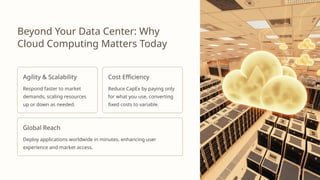
Beyond Your DataCenter: Why
Cloud Computing Matters Today
Agility & Scalability
Respond faster to market
demands, scaling resources
up or down as needed.
Cost Efficiency
Reduce CapEx by paying only
for what you use, converting
fixed costs to variable.
Global Reach
Deploy applications worldwide in minutes, enhancing user
experience and market access.
3.
The Cloud's DNA:Defining Core Concepts and Key
Characteristics
On-Demand Self-Service
Provision computing
resources without human
interaction.
Broad Network Access
Available over the network via
standard mechanisms.
Resource Pooling
Multi-tenant model with
shared physical resources.
Measured Service
Resource usage is monitored,
controlled, and reported.
Rapid Elasticity
Capabilities can be rapidly and
elastically provisioned.
4.
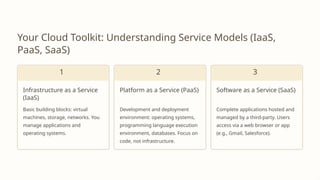
Your Cloud Toolkit:Understanding Service Models (IaaS,
PaaS, SaaS)
1
Infrastructure as a Service
(IaaS)
Basic building blocks: virtual
machines, storage, networks. You
manage applications and
operating systems.
2
Platform as a Service (PaaS)
Development and deployment
environment: operating systems,
programming language execution
environment, databases. Focus on
code, not infrastructure.
3
Software as a Service (SaaS)
Complete applications hosted and
managed by a third-party. Users
access via a web browser or app
(e.g., Gmail, Salesforce).
5.
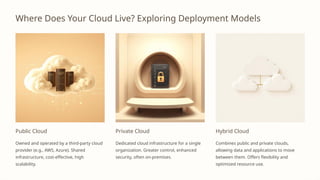
Where Does YourCloud Live? Exploring Deployment Models
Public Cloud
Owned and operated by a third-party cloud
provider (e.g., AWS, Azure). Shared
infrastructure, cost-effective, high
scalability.
Private Cloud
Dedicated cloud infrastructure for a single
organization. Greater control, enhanced
security, often on-premises.
Hybrid Cloud
Combines public and private clouds,
allowing data and applications to move
between them. Offers flexibility and
optimized resource use.
6.
Navigating the Skies:Benefits, Challenges, and Security
Insights
Key Benefits
• Cost Savings
• Enhanced Collaboration
• Disaster Recovery
Potential Challenges
• Vendor Lock-in
• Complex Migrations
• Internet Dependency
Security Insights
• Shared Responsibility Model
• Data Encryption
• Compliance & Governance
7.
Your Cloud JourneyBegins:
Key Takeaways & Next Steps
1
Cloud computing offers transformative agility, cost savings,
and global reach.
2
Understanding IaaS, PaaS, SaaS, and deployment models is
crucial for strategic adoption.
3
Prioritize security, plan for potential challenges, and embrace
the shared responsibility model.